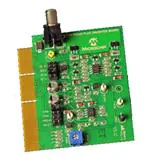
Utility-band BPSK 6.0 kbps PLM PICtail™ Plus Daughter
Board Information Sheet
The Utility-band BPSK 6.0 kbps PLM PICtail Plus Daughter Board provides a low-cost method for
the development and testing of utility applications implementing a Powerline Communication Softmodem (PLM), which is driven by a dsPIC33F Digital Signal Controller (DSC). The daughter board
operates at a utility-band carrier frequency of 72 kHz.
Any dsPIC33F device with at least 2 Kbytes RAM, 16 Kbytes of Flash memory, four Output Compare channels, one DMA channel, and one 12-bit ADC input (at least 500 ksps), can be used with
this daughter board. Please refer to the user’s guide for more details regarding the resource
requirements.
The evaluation kit includes a pair of daughter boards and two High Voltage (HV) AC power line
adapter cables. Two Explorer 16 Development Boards (purchased separately - PN: DM240001)
are required to evaluate the daughter boards. In addition, two 9V power supplies (AC002014) are
also required. A Microchip programming/debugging tool, such as MPLAB® ICD 3 or REAL ICE™
is required for programming or debugging the firmware on the dsPIC33F device.
Installing MPLAB® IDE and C Compilers
Americas
Asia/Pacific
Atlanta - 678-957-9614
Boston - 774-760-0087
Chicago - 630-285-0071
Cleveland - 216-447-0464
Dallas - 972-818-7423
Detroit - 248-538-2250
Indianapolis - 317-773-8323
Los Angeles - 949-462-9523
Phoenix - 480-792-7200
Santa Clara - 408-961-6444
Toronto - 905-673-0699
Australia - Sydney - 61-2-9868-6733
China - Beijing - 86-10-8528-2100
China - Chengdu - 86-28-8665-5511
China - Chongqing - 86-23-8980-9588
China - Hong Kong SAR - 852-2401-1200
China - Nanjing- 86-25-8473-2460
China - Qingdao - 86-532-8502-7355
China - Shanghai - 86-21-5407-5533
China - Shenyang - 86-24-2334-2829
China - Shenzhen - 86-755-8203-2660
China - Wuhan - 86-27-5980-5300
China - Xiamen - 86-592-2388138
China - Xian - 86-29-8833-7252
China - Zhuhai - 86-756-3210040
India - Bangalore - 91-80-3090-4444
India - New Delhi - 91-11-4160-8631
India - Pune - 91-20-2566-1512
Japan - Yokohama - 81-45-471-6166
Korea - Daegu - 82-53-744-4301
Korea - Seoul - 82-2-554-7200
Malaysia - Kuala Lumpur - 60-3-6201-9857
Malaysia - Penang - 60-4-227-8870
Philippines - Manila - 63-2-634-9065
Singapore - 65-6334-8870
Taiwan - Hsin Chu - 886-3-6578-300
Taiwan - Kaohsiung - 886-7-213-7830
Taiwan - Taipei - 886-2-2500-6610
Thailand - Bangkok - 66-2-694-1351
Europe
Austria - Wels - 43-7242-2244-39
Denmark - Copenhagen - 45-4450-2828
France - Paris - 33-1-69-53-63-20
Germany - Munich - 49-89-627-144-0
Italy - Milan - 39-0331-742611
Netherlands - Drunen - 31-416-690399
Spain - Madrid - 34-91-708-08-90
UK - Wokingham - 44-118-921-5869
05/02/11
Microchip Technology Inc. • 2355 West Chandler Blvd. • Chandler, AZ 85224-6199
www.microchip.com
The Microchip name and logo, the Microchip logo, and MPLAB are registered trademarks of Microchip Technology
Incorporated in the U.S.A. and other countries. All other trademarks mentioned herein are property of their respective
companies. © 2011, Microchip Technology Incorporated, Printed in the U.S.A. All Rights Reserved. 05/11
DS51982A
*DS51982A*
The MPLAB Integrated Development Environment (IDE) should be installed prior to using a daughter board for application development. While MPLAB provides the assembler tools for development, demonstration applications are written in the C language and require a C compiler to be
installed. Microchip’s MPLAB C compiler seamlessly integrates into MPLAB IDE. Both the MPLAB
IDE and MPLAB C compiler are available for download at www.microchip.com/MPLAB and
www.microchip.com/compilers, respectively.
Microchip Demo Applications and More Information
For free demo source code and more information, please visit the related web page at www.microchip.com/powerline. From the landing page, select Utility-band BPSK 6.0 kbps PLM PICtail Plus
Daughter Board. In the download section, select a demonstration application (such as the PingPong demonstration) to download an archive file that contains the related demonstration source
code files. Refer to the user’s guide in the download section for additional information.
Running the Demo Applications
After downloading the Ping-Pong demonstration application code and installing the development
tools, use the following procedure to run the demonstration:
1. Insert a dsPIC33FJ256GP710A PIM into the first Explorer 16 Development Board.
2. Plug a daughter board into the PICtail Plus expansion slot on the Explorer 16 Development
Board and connect the RCA jack of the HV adapter cable (provided in the kit) to the daughter
board.
3. Plug the AC end of the HV adapter cable into a 110V/220V power outlet.
4. Connect a Microchip programming/debugging tool to the Explorer 16 Development Board and
power up the Explorer 16 Development Board from the 9V power supply.
5. In MPLAB IDE, double-click pingpong.mcp to load the Ping-Pong demonstration project.
6. Choose your programming tool by selecting Programmer > Select Programmer, and then
choosing the tool to program the dsPIC33F device.
7. Build the project by selecting Project > Build All.
8. Download your code into the dsPIC33F device by selecting Programmer > Program.
9. Repeat steps 1 through 8 for the second daughter board.
10. The demonstration code previously downloaded pings frames of data back and forth between
the two evaluation kits. Initiate the demonstration by pressing the S5 button on either of the
Explorer 16 Development Boards. The transmit frame count (TX) and the receive frame count
(RX) displayed on the Explorer 16 Development Board LCD screen should increment for both
of the daughter boards.
�
很抱歉,暂时无法提供与“AC164145”相匹配的价格&库存,您可以联系我们找货
免费人工找货