Features
• High-performance, Low-power AVR® 8-bit Microcontroller
• Advanced RISC Architecture
•
•
•
•
•
•
– 130 Powerful Instructions – Most Single Clock Cycle Execution
– 32 x 8 General Purpose Working Registers
– Fully Static Operation
– Up to 16 MIPS Throughput at 16 MHz
– On-chip 2-cycle Multiplier
Nonvolatile Program and Data Memories
– 8K Bytes of In-System Self-Programmable Flash
Endurance: 10,000 Write/Erase Cycles
– Optional Boot Code Section with Independent Lock Bits
In-System Programming by On-chip Boot Program
True Read-While-Write Operation
– 512 Bytes EEPROM
Endurance: 100,000 Write/Erase Cycles
– 512 Bytes Internal SRAM
– Programming Lock for Software Security
Peripheral Features
– Two 8-bit Timer/Counters with Separate Prescalers and Compare Modes
– One 16-bit Timer/Counter with Separate Prescaler, Compare Mode, and Capture
Mode
– Real Time Counter with Separate Oscillator
– Four PWM Channels
– 8-channel, 10-bit ADC
8 Single-ended Channels
7 Differential Channels for TQFP Package Only
2 Differential Channels with Programmable Gain at 1x, 10x, or 200x for TQFP
Package Only
– Byte-oriented Two-wire Serial Interface
– Programmable Serial USART
– Master/Slave SPI Serial Interface
– Programmable Watchdog Timer with Separate On-chip Oscillator
– On-chip Analog Comparator
Special Microcontroller Features
– Power-on Reset and Programmable Brown-out Detection
– Internal Calibrated RC Oscillator
– External and Internal Interrupt Sources
– Six Sleep Modes: Idle, ADC Noise Reduction, Power-save, Power-down, Standby
and Extended Standby
I/O and Packages
– 32 Programmable I/O Lines
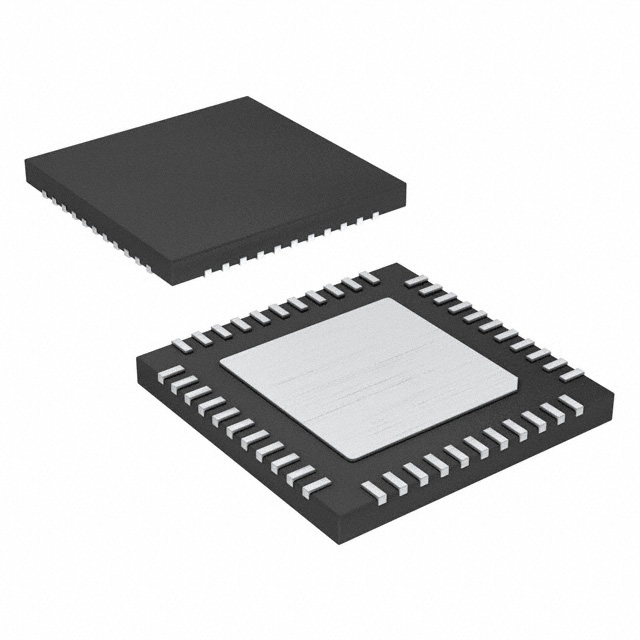
– 40-pin PDIP, 44-lead TQFP, 44-lead PLCC, and 44-pad QFN/MLF
Operating Voltages
– 2.7 - 5.5V for ATmega8535L
– 4.5 - 5.5V for ATmega8535
Speed Grades
– 0 - 8 MHz for ATmega8535L
– 0 - 16 MHz for ATmega8535
8-bit
Microcontroller
with 8K Bytes
In-System
Programmable
Flash
ATmega8535
ATmega8535L
2502K–AVR–10/06
�Pin Configurations
Figure 1. Pinout ATmega8535
(XCK/T0) PB0
(T1) PB1
(INT2/AIN0) PB2
(OC0/AIN1) PB3
(SS) PB4
(MOSI) PB5
(MISO) PB6
(SCK) PB7
RESET
VCC
GND
XTAL2
XTAL1
(RXD) PD0
(TXD) PD1
(INT0) PD2
(INT1) PD3
(OC1B) PD4
(OC1A) PD5
(ICP1) PD6
PA0 (ADC0)
PA1 (ADC1)
PA2 (ADC2)
PA3 (ADC3)
PA4 (ADC4)
PA5 (ADC5)
PA6 (ADC6)
PA7 (ADC7)
AREF
GND
AVCC
PC7 (TOSC2)
PC6 (TOSC1)
PC5
PC4
PC3
PC2
PC1 (SDA)
PC0 (SCL)
PD7 (OC2)
PA4 (ADC4)
PA5 (ADC5)
PA6 (ADC6)
PA7 (ADC7)
AREF
GND
AVCC
PC7 (TOSC2)
PC6 (TOSC1)
PC5
PC4
(MOSI) PB5
(MISO) PB6
(SCK) PB7
RESET
VCC
GND
XTAL2
XTAL1
(RXD) PD0
(TXD) PD1
(INT0) PD2
6
5
4
3
2
1
44
43
42
41
40
33
32
31
30
29
28
27
26
25
24
23
1
2
3
4
5
6
7
8
9
10
11
7
8
9
10
11
12
13
14
15
16
17
39
38
37
36
35
34
33
32
31
30
29
PA4 (ADC4)
PA5 (ADC5)
PA6 (ADC6)
PA7 (ADC7)
AREF
GND
AVCC
PC7 (TOSC2)
PC6 (TOSC1)
PC5
PC4
PD3
PD4
PD5
PD6
PD7
VCC
GND
(SCL) PC0
(SDA) PC1
PC2
PC3
(INT1)
(OC1B)
(OC1A)
(ICP1)
(OC2)
(INT1)
(OC1B)
(OC1A)
(ICP1)
(OC2)
PD3
PD4
PD5
PD6
PD7
VCC
GND
(SCL) PC0
(SDA) PC1
PC2
PC3
12
13
14
15
16
17
18
19
20
21
22
(MOSI) PB5
(MISO) PB6
(SCK) PB7
RESET
VCC
GND
XTAL2
XTAL1
(RXD) PD0
(TXD) PD1
(INT0) PD2
18
19
20
21
22
23
24
25
26
27
28
44
43
42
41
40
39
38
37
36
35
34
PB4 (SS)
PB3 (AIN1/OC0)
PB2 (AIN0/INT2)
PB1 (T1)
PB0 (XCK/T0)
GND
VCC
PA0 (ADC0)
PA1 (ADC1)
PA2 (ADC2)
PA3 (ADC3)
PB4 (SS)
PB3 (AIN1/OC0)
PB2 (AIN0/INT2)
PB1 (T1)
PB0 (XCK/T0)
GND
VCC
PA0 (ADC0)
PA1 (ADC1)
PA2 (ADC2)
PA3 (ADC3)
PLCC
NOTE: MLF Bottom pad should be soldered to ground.
Disclaimer
2
Typical values contained in this data sheet are based on simulations and characterization of other AVR microcontrollers manufactured on the same process technology. Min
and Max values will be available after the device is characterized.
ATmega8535(L)
2502K–AVR–10/06
�ATmega8535(L)
Overview
The ATmega8535 is a low-power CMOS 8-bit microcontroller based on the AVR
enhanced RISC architecture. By executing instructions in a single clock cycle, the
ATmega8535 achieves throughputs approaching 1 MIPS per MHz allowing the system
designer to optimize power consumption versus processing speed.
Block Diagram
Figure 2. Block Diagram
PA0 - PA7
PC0 - PC7
PORTA DRIVERS/BUFFERS
PORTC DRIVERS/BUFFERS
PORTA DIGITAL INTERFACE
PORTC DIGITAL INTERFACE
VCC
GND
AVCC
ADC
INTERFACE
MUX &
ADC
TWI
AREF
PROGRAM
COUNTER
STACK
POINTER
PROGRAM
FLASH
SRAM
TIMERS/
COUNTERS
OSCILLATOR
INTERNAL
OSCILLATOR
XTAL1
INSTRUCTION
REGISTER
GENERAL
PURPOSE
REGISTERS
WATCHDOG
TIMER
OSCILLATOR
XTAL2
X
INSTRUCTION
DECODER
Y
MCU CTRL.
& TIMING
RESET
Z
CONTROL
LINES
ALU
INTERRUPT
UNIT
AVR CPU
STATUS
REGISTER
EEPROM
PROGRAMMING
LOGIC
SPI
USART
+
-
INTERNAL
CALIBRATED
OSCILLATOR
COMP.
INTERFACE
PORTB DIGITAL INTERFACE
PORTD DIGITAL INTERFACE
PORTB DRIVERS/BUFFERS
PORTD DRIVERS/BUFFERS
PB0 - PB7
PD0 - PD7
3
2502K–AVR–10/06
�The AVR core combines a rich instruction set with 32 general purpose working registers.
All 32 registers are directly connected to the Arithmetic Logic Unit (ALU), allowing two
independent registers to be accessed in one single instruction executed in one clock
cycle. The resulting architecture is more code efficient while achieving throughputs up to
ten times faster than conventional CISC microcontrollers.
The ATmega8535 provides the following features: 8K bytes of In-System Programmable
Flash with Read-While-Write capabilities, 512 bytes EEPROM, 512 bytes SRAM, 32
general purpose I/O lines, 32 general purpose working registers, three flexible
Timer/Counters with compare modes, internal and external interrupts, a serial programmable USART, a byte oriented Two-wire Serial Interface, an 8-channel, 10-bit ADC with
optional differential input stage with programmable gain in TQFP package, a programmable Watchdog Timer with Internal Oscillator, an SPI serial port, and six software
selectable power saving modes. The Idle mode stops the CPU while allowing the
SRAM, Timer/Counters, SPI port, and interrupt system to continue functioning. The
Power-down mode saves the register contents but freezes the Oscillator, disabling all
other chip functions until the next interrupt or Hardware Reset. In Power-save mode, the
asynchronous timer continues to run, allowing the user to maintain a timer base while
the rest of the device is sleeping. The ADC Noise Reduction mode stops the CPU and
all I/O modules except asynchronous timer and ADC, to minimize switching noise during
ADC conversions. In Standby mode, the crystal/resonator Oscillator is running while the
rest of the device is sleeping. This allows very fast start-up combined with low-power
consumption. In Extended Standby mode, both the main Oscillator and the asynchronous timer continue to run.
The device is manufactured using Atmel’s high density nonvolatile memory technology.
The On-chip ISP Flash allows the program memory to be reprogrammed In-System
through an SPI serial interface, by a conventional nonvolatile memory programmer, or
by an On-chip Boot program running on the AVR core. The boot program can use any
interface to download the application program in the Application Flash memory. Software in the Boot Flash section will continue to run while the Application Flash section is
updated, providing true Read-While-Write operation. By combining an 8-bit RISC CPU
with In-System Self-Programmable Flash on a monolithic chip, the Atmel ATmega8535
is a powerful microcontroller that provides a highly flexible and cost effective solution to
many embedded control applications.
The ATmega8535 AVR is supported with a full suite of program and system development tools including: C compilers, macro assemblers, program debugger/simulators, InCircuit Emulators, and evaluation kits.
AT90S8535 Compatibility The ATmega8535 provides all the features of the AT90S8535. In addition, several new
features are added. The ATmega8535 is backward compatible with AT90S8535 in most
cases. However, some incompatibilities between the two microcontrollers exist. To
solve this problem, an AT90S8535 compatibility mode can be selected by programming
the S8535C fuse. ATmega8535 is pin compatible with AT90S8535, and can replace the
AT90S8535 on current Printed Circuit Boards. However, the location of fuse bits and the
electrical characteristics differs between the two devices.
AT90S8535 Compatibility
Mode
4
Programming the S8535C fuse will change the following functionality:
•
The timed sequence for changing the Watchdog Time-out period is disabled. See
“Timed Sequences for Changing the Configuration of the Watchdog Timer” on page
45 for details.
•
The double buffering of the USART Receive Register is disabled. See “AVR USART
vs. AVR UART – Compatibility” on page 146 for details.
ATmega8535(L)
2502K–AVR–10/06
�ATmega8535(L)
Pin Descriptions
VCC
Digital supply voltage.
GND
Ground.
Port A (PA7..PA0)
Port A serves as the analog inputs to the A/D Converter.
Port A also serves as an 8-bit bi-directional I/O port, if the A/D Converter is not used.
Port pins can provide internal pull-up resistors (selected for each bit). The Port A output
buffers have symmetrical drive characteristics with both high sink and source capability.
When pins PA0 to PA7 are used as inputs and are externally pulled low, they will source
current if the internal pull-up resistors are activated. The Port A pins are tri-stated when
a reset condition becomes active, even if the clock is not running.
Port B (PB7..PB0)
Port B is an 8-bit bi-directional I/O port with internal pull-up resistors (selected for each
bit). The Port B output buffers have symmetrical drive characteristics with both high sink
and source capability. As inputs, Port B pins that are externally pulled low will source
current if the pull-up resistors are activated. The Port B pins are tri-stated when a reset
condition becomes active, even if the clock is not running.
Port B also serves the functions of various special features of the ATmega8535 as listed
on page 60.
Port C (PC7..PC0)
Port C is an 8-bit bi-directional I/O port with internal pull-up resistors (selected for each
bit). The Port C output buffers have symmetrical drive characteristics with both high sink
and source capability. As inputs, Port C pins that are externally pulled low will source
current if the pull-up resistors are activated. The Port C pins are tri-stated when a reset
condition becomes active, even if the clock is not running.
Port D (PD7..PD0)
Port D is an 8-bit bi-directional I/O port with internal pull-up resistors (selected for each
bit). The Port D output buffers have symmetrical drive characteristics with both high sink
and source capability. As inputs, Port D pins that are externally pulled low will source
current if the pull-up resistors are activated. The Port D pins are tri-stated when a reset
condition becomes active, even if the clock is not running.
Port D also serves the functions of various special features of the ATmega8535 as listed
on page 64.
RESET
Reset input. A low level on this pin for longer than the minimum pulse length will generate a reset, even if the clock is not running. The minimum pulse length is given in Table
15 on page 37. Shorter pulses are not guaranteed to generate a reset.
XTAL1
Input to the inverting Oscillator amplifier and input to the internal clock operating circuit.
XTAL2
Output from the inverting Oscillator amplifier.
AVCC
AVCC is the supply voltage pin for Port A and the A/D Converter. It should be externally
connected to VCC, even if the ADC is not used. If the ADC is used, it should be connected to VCC through a low-pass filter.
AREF
AREF is the analog reference pin for the A/D Converter.
5
2502K–AVR–10/06
�Resources
6
A comprehensive set of development tools, application notes and datasheets are available for download on http://www.atmel.com/avr.
ATmega8535(L)
2502K–AVR–10/06
�ATmega8535(L)
About Code
Examples
This documentation contains simple code examples that briefly show how to use various
parts of the device. These code examples assume that the part specific header file is
included before compilation. Be aware that not all C compiler vendors include bit definitions in the header files and interrupt handling in C is compiler dependent. Please
confirm with the C Compiler documentation for more details.
7
2502K–AVR–10/06
�AVR CPU Core
Introduction
This section discusses the AVR core architecture in general. The main function of the
CPU core is to ensure correct program execution. The CPU must therefore be able to
access memories, perform calculations, control peripherals, and handle interrupts.
Architectural Overview
Figure 3. Block Diagram of the AVR MCU Architecture
8-bit Data Bus
Flash
Program
Memory
Program
Counter
Status
and Control
32 x 8
General
Purpose
Registrers
Control Lines
Direct Addressing
Instruction
Decoder
Indirect Addressing
Instruction
Register
Interrupt
Unit
SPI
Unit
Watchdog
Timer
ALU
Analog
Comparator
I/O Module1
Data
SRAM
I/O Module 2
I/O Module n
EEPROM
I/O Lines
In order to maximize performance and parallelism, the AVR uses a Harvard architecture
– with separate memories and buses for program and data. Instructions in the program
memory are executed with a single level pipelining. While one instruction is being executed, the next instruction is pre-fetched from the program memory. This concept
enables instructions to be executed in every clock cycle. The program memory is InSystem Re-Programmable Flash memory.
The fast-access Register File contains 32 x 8-bit general purpose working registers with
a single clock cycle access time. This allows single-cycle Arithmetic Logic Unit (ALU)
operation. In a typical ALU operation, two operands are output from the Register File,
the operation is executed, and the result is stored back in the Register File – in one
clock cycle.
8
ATmega8535(L)
2502K–AVR–10/06
�ATmega8535(L)
Six of the 32 registers can be used as three 16-bit indirect address register pointers for
Data Space addressing – enabling efficient address calculations. One of the these
address pointers can also be used as an address pointer for look up tables in Flash program memory. These added function registers are the 16-bit X-, Y-, and Z-registers,
described later in this section.
The ALU supports arithmetic and logic operations between registers or between a constant and a register. Single register operations can also be executed in the ALU. After
an arithmetic operation, the Status Register is updated to reflect information about the
result of the operation.
Program flow is provided by conditional and unconditional jump and call instructions,
able to directly address the whole address space. Most AVR instructions have a single
16-bit word format. Every program memory address contains a 16- or 32-bit instruction.
Program Flash memory space is divided in two sections, the Boot Program section and
the Application Program section. Both sections have dedicated Lock bits for write and
read/write protection. The SPM instruction that writes into the Application Flash memory
section must reside in the Boot Program section.
During interrupts and subroutine calls, the return address Program Counter (PC) is
stored on the Stack. The Stack is effectively allocated in the general data SRAM, and
consequently the Stack size is only limited by the total SRAM size and the usage of the
SRAM. All user programs must initialize the SP in the reset routine (before subroutines
or interrupts are executed). The Stack Pointer SP is read/write accessible in the I/O
space. The data SRAM can easily be accessed through the five different addressing
modes supported in the AVR architecture.
The memory spaces in the AVR architecture are all linear and regular memory maps.
A flexible interrupt module has its control registers in the I/O space with an additional
Global Interrupt Enable bit in the Status Register. All interrupts have a separate Interrupt
Vector in the Interrupt Vector table. The interrupts have priority in accordance with their
Interrupt Vector position. The lower the Interrupt Vector address, the higher the priority.
The I/O memory space contains 64 addresses for CPU peripheral functions as Control
Registers, SPI, and other I/O functions. The I/O Memory can be accessed directly, or as
the Data Space locations following those of the Register File, 0x20 - 0x5F.
ALU – Arithmetic Logic
Unit
The high-performance AVR ALU operates in direct connection with all the 32 general
purpose working registers. Within a single clock cycle, arithmetic operations between
general purpose registers or between a register and an immediate are executed. The
ALU operations are divided into three main categories – arithmetic, logical, and bit-functions. Some implementations of the architecture also provide a powerful multiplier
supporting both signed/unsigned multiplication and fractional format. See the “Instruction Set” section for a detailed description.
9
2502K–AVR–10/06
�Status Register
The Status Register contains information about the result of the most recently executed
arithmetic instruction. This information can be used for altering program flow in order to
perform conditional operations. Note that the Status Register is updated after all ALU
operations, as specified in the Instruction Set Reference. This will, in many cases,
remove the need for using the dedicated compare instructions, resulting in faster and
more compact code.
The Status Register is not automatically stored when entering an interrupt routine and
restored when returning from an interrupt. This must be handled by software.
The AVR Status Register – SREG – is defined as:
Bit
7
6
5
4
3
2
1
0
I
T
H
S
V
N
Z
C
Read/Write
R/W
R/W
R/W
R/W
R/W
R/W
R/W
R/W
Initial Value
0
0
0
0
0
0
0
0
SREG
• Bit 7 – I: Global Interrupt Enable
The Global Interrupt Enable bit must be set for the interrupts to be enabled. The individual interrupt enable control is then performed in separate control registers. If the Global
Interrupt Enable Register is cleared, none of the interrupts are enabled independent of
the individual interrupt enable settings. The I-bit is cleared by hardware after an interrupt
has occurred, and is set by the RETI instruction to enable subsequent interrupts. The Ibit can also be set and cleared by the application with the SEI and CLI instructions, as
described in the instruction set reference.
• Bit 6 – T: Bit Copy Storage
The Bit Copy instructions BLD (Bit LoaD) and BST (Bit STore) use the T-bit as source or
destination for the operated bit. A bit from a register in the Register file can be copied
into T by the BST instruction, and a bit in T can be copied into a bit in a register in the
Register File by the BLD instruction.
• Bit 5 – H: Half Carry Flag
The Half Carry Flag H indicates a Half Carry in some arithmetic operations. Half carry is
useful in BCD arithmetic. See the “Instruction Set Description” for detailed information.
• Bit 4 – S: Sign Bit, S = N
⊕V
The S-bit is always an exclusive or between the Negative Flag N and the Two’s Complement Overflow Flag V. See the “Instruction Set Description” for detailed information.
• Bit 3 – V: Two’s Complement Overflow Flag
The Two’s Complement Overflow Flag V supports two’s complement arithmetics. See
the “Instruction Set Description” for detailed information.
• Bit 2 – N: Negative Flag
The Negative Flag N indicates a negative result in an arithmetic or logic operation. See
the “Instruction Set Description” for detailed information.
• Bit 1 – Z: Zero Flag
The Zero Flag Z indicates a zero result in an arithmetic or logic operation. See the
“Instruction Set Description” for detailed information.
• Bit 0 – C: Carry Flag
The Carry Flag C indicates a carry in an arithmetic or logic operation. See the “Instruction Set Description” for detailed information.
10
ATmega8535(L)
2502K–AVR–10/06
�ATmega8535(L)
General Purpose
Register File
The Register File is optimized for the AVR Enhanced RISC instruction set. In order to
achieve the required performance and flexibility, the following input/output schemes are
supported by the Register File:
•
One 8-bit output operand and one 8-bit result input
•
Two 8-bit output operands and one 8-bit result input
•
Two 8-bit output operands and one 16-bit result input
•
One 16-bit output operand and one 16-bit result input
Figure 4 shows the structure of the 32 general purpose working registers in the CPU.
Figure 4. AVR CPU General Purpose Working Registers
7
0
Addr.
R0
0x00
R1
0x01
R2
0x02
…
R13
0x0D
General
R14
0x0E
Purpose
R15
0x0F
Working
R16
0x10
Registers
R17
0x11
…
R26
0x1A
X-register Low Byte
R27
0x1B
X-register High Byte
R28
0x1C
Y-register Low Byte
R29
0x1D
Y-register High Byte
R30
0x1E
Z-register Low Byte
R31
0x1F
Z-register High Byte
Most of the instructions operating on the Register File have direct access to all registers,
and most of them are single cycle instructions.
As shown in Figure 4, each register is also assigned a data memory address, mapping
them directly into the first 32 locations of the user Data Space. Although not being physically implemented as SRAM locations, this memory organization provides great
flexibility in access of the registers, as the X-, Y-, and Z-pointer Registers can be set to
index any register in the file.
11
2502K–AVR–10/06
�The X-register, Y-register, and
Z-register
The registers R26..R31 have some added functions to their general purpose usage.
These registers are 16-bit address pointers for indirect addressing of the Data Space.
The three indirect address registers X, Y, and Z are defined as described in Figure 5.
Figure 5. The X-, Y-, and Z-registers
15
X-register
XH
XL
7
0
0
R27 (0x1B)
15
Y-register
R26 (0x1A)
YH
YL
7
0
15
ZH
7
0
0
7
0
R29 (0x1D)
Z-register
0
7
R28 (0x1C)
ZL
7
0
0
R31 (0x1F)
R30 (0x1E)
In the different addressing modes, these address registers have functions as fixed displacement, automatic increment, and automatic decrement (see the instruction set
reference for details).
Stack Pointer
The Stack is mainly used for storing temporary data, for storing local variables and for
storing return addresses after interrupts and subroutine calls. The Stack Pointer Register always points to the top of the Stack. Note that the Stack is implemented as growing
from higher memory locations to lower memory locations. This implies that a Stack
PUSH command decreases the Stack Pointer.
The Stack Pointer points to the data SRAM Stack area where the Subroutine and Interrupt Stacks are located. This Stack space in the data SRAM must be defined by the
program before any subroutine calls are executed or interrupts are enabled. The Stack
Pointer must be set to point above 0x60. The Stack Pointer is decremented by one
when data is pushed onto the Stack with the PUSH instruction, and it is decremented by
two when the return address is pushed onto the Stack with subroutine call or interrupt.
The Stack Pointer is incremented by one when data is popped from the Stack with the
POP instruction, and it is incremented by two when data is popped from the Stack with
return from subroutine RET or return from interrupt RETI.
The AVR Stack Pointer is implemented as two 8-bit registers in the I/O space. The number of bits actually used is implementation dependent. Note that the data space in some
implementations of the AVR architecture is so small that only SPL is needed. In this
case, the SPH Register will not be present.
Bit
Read/Write
Initial Value
12
15
14
13
12
11
10
9
8
-
-
-
-
-
-
SP9
SP8
SPH
SP7
SP6
SP5
SP4
SP3
SP2
SP1
SP0
SPL
7
6
5
4
3
2
1
0
R/W
R/W
R/W
R/W
R/W
R/W
R/W
R/W
R/W
R/W
R/W
R/W
R/W
R/W
R/W
R/W
0
0
0
0
0
0
0
0
0
0
0
0
0
0
0
0
ATmega8535(L)
2502K–AVR–10/06
�ATmega8535(L)
Instruction Execution
Timing
This section describes the general access timing concepts for instruction execution. The
AVR CPU is driven by the CPU clock clkCPU, directly generated from the selected clock
source for the chip. No internal clock division is used.
Figure 6 shows the parallel instruction fetches and instruction executions enabled by the
Harvard architecture and the fast-access Register File concept. This is the basic pipelining concept to obtain up to 1 MIPS per MHz with the corresponding unique results for
functions per cost, functions per clocks, and functions per power-unit.
Figure 6. The Parallel Instruction Fetches and Instruction Executions
T1
T2
T3
T4
clkCPU
1st Instruction Fetch
1st Instruction Execute
2nd Instruction Fetch
2nd Instruction Execute
3rd Instruction Fetch
3rd Instruction Execute
4th Instruction Fetch
Figure 7 shows the internal timing concept for the Register file. In a single clock cycle an
ALU operation using two register operands is executed, and the result is stored back to
the destination register.
Figure 7. Single Cycle ALU Operation
T1
T2
T3
T4
clkCPU
Total Execution Time
Register Operands Fetch
ALU Operation Execute
Result Write Back
Reset and Interrupt
Handling
The AVR provides several different interrupt sources. These interrupts and the separate
Reset Vector each have a separate Program Vector in the program memory space. All
interrupts are assigned individual enable bits which must be written logic one together
with the Global Interrupt Enable bit in the Status Register in order to enable the interrupt.
Depending on the Program Counter value, interrupts may be automatically disabled
when Boot Lock bits BLB02 or BLB12 are programmed. This feature improves software
security. See the section “Memory Programming” on page 237 for details.
The lowest addresses in the program memory space are, by default, defined as the
Reset and Interrupt Vectors. The complete list of vectors is shown in “Interrupts” on
page 46. The list also determines the priority levels of the different interrupts. The lower
the address, the higher the priority level is. RESET has the highest priority, and next is
INT0 – the External Interrupt Request 0. The Interrupt Vectors can be moved to the start
of the Boot Flash section by setting the IVSEL bit in the General Interrupt Control Register (GICR). Refer to “Interrupts” on page 46 for more information. The Reset Vector can
13
2502K–AVR–10/06
�also be moved to the start of the Boot Flash section by programming the BOOTRST
Fuse, see “Boot Loader Support – Read-While-Write Self-Programming” on page 224.
When an interrupt occurs, the Global Interrupt Enable I-bit is cleared and all interrupts
are disabled. The user software can write logic one to the I-bit to enable nested interrupts. All enabled interrupts can then interrupt the current interrupt routine. The I-bit is
automatically set when a Return from Interrupt instruction – RETI – is executed.
There are basically two types of interrupts. The first type is triggered by an event that
sets the interrupt flag. For these interrupts, the Program Counter is vectored to the
actual Interrupt Vector in order to execute the interrupt handling routine, and hardware
clears the corresponding interrupt flag. Interrupt flags can also be cleared by writing a
logic one to the flag bit position(s) to be cleared. If an interrupt condition occurs while the
corresponding interrupt enable bit is cleared, the interrupt flag will be set and remembered until the interrupt is enabled, or the flag is cleared by software. Similarly, if one or
more interrupt conditions occur while the Global Interrupt Enable bit is cleared, the corresponding interrupt flag(s) will be set and remembered until the Global Interrupt Enable
bit is set, and will then be executed by order of priority.
The second type of interrupts will trigger as long as the interrupt condition is present.
These interrupts do not necessarily have interrupt flags. If the interrupt condition disappears before the interrupt is enabled, the interrupt will not be triggered.
When the AVR exits from an interrupt, it will always return to the main program and execute one more instruction before any pending interrupt is served.
Note that the Status Register is not automatically stored when entering an interrupt routine, nor restored when returning from an interrupt routine. This must be handled by
software.
When using the CLI instruction to disable interrupts, the interrupts will be immediately
disabled. No interrupt will be executed after the CLI instruction, even if it occurs simultaneously with the CLI instruction. The following example shows how this can be used to
avoid interrupts during the timed EEPROM write sequence.
Assembly Code Example
in
r16, SREG
cli
; store SREG value
; disable interrupts during timed sequence
sbi EECR, EEMWE ; start EEPROM write
sbi EECR, EEWE
out SREG, r16
; restore SREG value (I-bit)
C Code Example
char cSREG;
cSREG = SREG; /* store SREG value */
/* disable interrupts during timed sequence */
_CLI();
EECR |= (1