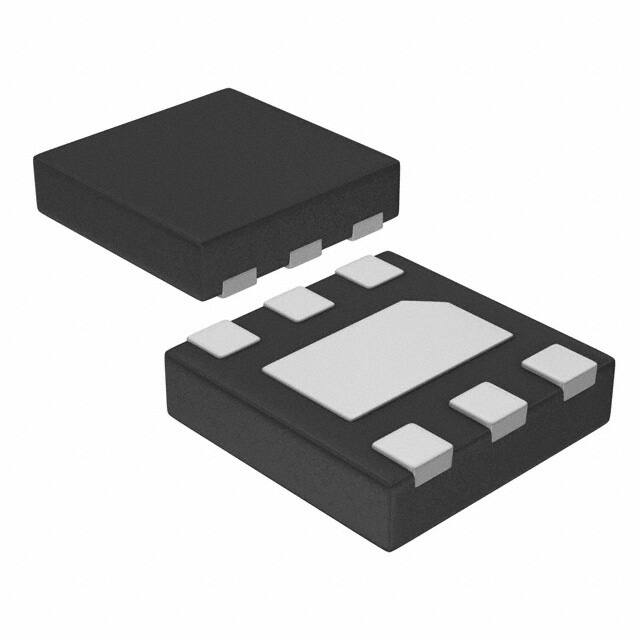
LX7186A
1.4MHz, 1A Synchronous
Buck Converter
Features
Description
The LX7186A is 1.4MHz fixed frequency, currentmode, synchronous PWM buck (step-down) DC-DC
converter, capable of driving a 1A load with high
efficiency, excellent line and load regulation. The
device integrates synchronous P-channel and Nchannel power MOSFET switches with low onresistance. They accept an input voltage range from
2.5V to 5.5V and will enter 100% duty cycle at
dropout making them ideal for powering portable
equipment that runs from a single Li-ion battery.
A standard series of inductors are available from
several different manufacturers optimized for use
with the LX7186A. This feature greatly simplifies the
design of switch-mode power supplies.
The converter includes standard safety features
such as over-current, short-circuit and thermal
shutdown protection. This device is available in
both TSOT-5L and UDFN 2x2 6L packages.
VIN
1 (6)
Input Supply Range: 2.5V to 5.5V
Output Adjustable from 0.6V to VIN – 0.5V
100% Duty Cycle in Dropout
Integrated NMOS & PMOS Switches
Current Mode Control
1A Maximum Output Current
Fixed 1.4MHz Frequency
High Efficiency: Up To 96%
Built-in Soft-start
Built-in UV & OT Protection
Built-in Short Circuit Protection
RoHS Compliant & Halogen Free
TSOT-5L or UDFN 2x2 6L Packages
Applications
Datacom
Portable Devices
Smart Phone
SW
VIN
5 (2) L
CIN
4.7µF
VOUT
2.2µH
R1
COUT
22µF
LX7186A
ON
4 (3)
OFF
3 (4)
FB
EN
R2
GND
TSOT-5L (UDFN 2x2 6L)
2 (1, 5)
Figure 1 · Typical Application of LX7186A
October 2013 Rev. 1.5
www.microsemi.com
© 2013 Microsemi Corporation
1
�1.4MHz 1A Synchronous Buck Converter
Pin Configuration and Pinout
1
2
EN
3
6
1
SW
GND
86A
GND
5
186A
YWWA
VIN
2
SW
4
3
FB
FB
VIN
5
GND
4
EN
YWWA = bottom mark
Figure 2 · Pinout TSOT-5 Top View
Figure 3 · Pinout UDFN 2x2 6L Top View
Marking: Front Mark 86A
Marking: Line1 186A
Bottom Mark YWWA
Line2 YWWA
Year/Work Week/Lot Code
Year/Work Week/Lot Code
Ordering Information
Ambient
Temperature
Type
Package
Part Number
Packaging Type
LX7186AISG
Bulk / Tube
LX7186AISG-TR
Tape and Reel
LX7186AILU
Bulk / Tube
LX7186AILU-TR
Tape and Reel
TSOT-5L
RoHS Compliant,
Pb-free
-40°C to 85°C
UDFN 2x2 6L
Pin Description
Pin Number
Pin Designator
Description
TSOT-5L UDFN 2x2 6L
2
1
6
VIN
Supply Input Pin. A 4.7µF ceramic capacitor should be connected
between the VIN pin and GND pin to bypass the supply.
2
1, 5
GND
Ground Pin.
3
4
EN
Enable Input. Setting this pin above 1.5V enables the IC. Setting this pin
below 0.4V shuts down the IC. When the IC is in shutdown mode, all
functions are disabled to decrease the supply current below 1µA.
4
3
FB
Feedback Pin. This pin is connected to an external resistor divider to
program the system output voltage.
5
2
SW
Power Switch Output Pin. Inductor connection to drain of the internal
PFET and NFET switches.
�Block Diagram
Block Diagram
VIN
1 (6)
GND
VIN
2 (1, 5)
1 (6)
3 (4)
EN
VOLTAGE
REFERENCE
OSCILLATOR
CURRENT
SENSE
FB
0.6V
4 (3)
ERROR
AMPLIFIER
PWM
COMPARATOR
MAX
CURRENT LIMIT
VOCP
DRIVER
5 (2)
0.4V
SW
LOGIC
CLK
SHORT
CIRCUIT
PROTECTION
REVERSE
COMPARATOR
2 (1, 5)
GND
TSOT-5L (UDFN 2x2 6L)
Figure 4 · Simplified Block Diagram of LX7186A
3
�1.4MHz 1A Synchronous Buck Converter
Absolute Maximum Ratings
Min
Max
Units
VIN to GND
-0.3
6
V
EN, FB to GND
-0.3
VIN + 0.3
V
SW to GND
-0.3
VIN + 0.3
V
150
°C
Parameter
Junction Temperature
Storage Temperature
-65
Peak Package Solder Reflow Temperature (40s, reflow)
Lead Soldering Temperature (10 seconds)
150
°C
260 (+0,-5)
°C
260
°C
Note: Performance is not necessarily guaranteed over this entire range. These are maximum stress ratings only.
Exceeding these ratings, even momentarily, can cause immediate damage, or negatively impact long-term
operating reliability
Operating Ratings
Min
Max
Units
2.5
5.5
V
VOUT
0.6
VIN – 0.5
V
Ambient Temperature
-40
85
°C
0
1
A
VIN
Output Current
Thermal Properties
Package
Thermal Resistance
Typ
Units
TSOT-5
θJA
160
°C/W
UDFN 2x2 6L
θJA
86
°C/W
Note: The JA number assumes no forced airflow. Junction Temperature is calculated using TJ = TA + (PD x JA). In
particular, θJA is a function of the PCB construction. The stated number above is for a four-layer board in
accordance with JESD-51 (JEDEC).
Electrical Characteristics
Note: Unless otherwise specified, the following specifications apply at VIN = VEN = 3.3V. -40°C < TA < 85°C.
Symbol
Parameter
Test Condition
Min
Typ
Max
Units
Operating Current
IQ
Quiescent Current
VFB = 0.65V
62
100
µA
ISHDN
Shutdown Supply Current
VEN = GND
0.1
1
µA
VUVLO
Under Voltage Lockout
VIN rising
VHYS
UVLO Hysteresis
VIN UVLO
4
2.3
V
200
mV
�Electrical Characteristics
Symbol
Parameter
Test Condition
Min
Typ
Max
0.588
0.6
Units
FEEDBACK VOLTAGE
VREF
Feedback Voltage
IFB
FB Pin Input Bias Current
∆VOUT
Output Voltage Accuracy
VFB = VIN
0.612
V
-100
100
nA
-2
2
%
OUTPUT
RDSON_P
PMOS Switch RDSON
ISW = 200mA
0.28
Ω
RDSON_N
NMOS Switch RDSON
ISW = -200mA
0.25
Ω
ILEAK
NMOS Switch Leakage
Current
VIN = 3.3V, VSW = 3.3V
0.1
µA
ILIM
Switch Current Limit
VFB = 0.55V
2.0
A
TOTSD
Thermal Shutdown
160
°C
THYS
Thermal Shutdown
Hysteresis
20
°C
1.5
OSCILLATOR
fOSC
Oscillator Frequency
DMAX
Maximum Duty Cycle
VFB = 0V
1.12
DMIN
Minimum Duty Cycle
VFB = 0.65V
1.40
1.68
100
MHz
%
0
%
SOFT START
TSS
Soft Start Time
1
ms
EN INPUT
VEN_H
VEN_L
EN Pin Threshold
1.5
V
0.4
V
5
�1.4MHz 1A Synchronous Buck Converter
Typical Performance Curves --
(Efficiency in PSM)
100%
95%
Efficiency
90%
85%
80%
75%
VOUT = 1V
VOUT = 1.2V
VOUT = 1.8V
VOUT = 3V
VOUT = 3.3V
70%
65%
1
10
100
1000
Output Current (mA)
Figure 5 · Efficiency vs. Output Current with 5V Input UDFN Package
100%
Efficiency
90%
80%
VOUT = 1V
VOUT = 1.2V
VOUT = 1.8V
VOUT = 3V
70%
1
10
100
Output Current (mA)
Figure 6 · Output Voltage vs. Output Current with 3.3V Input UDFN Package
6
1000
�Typical Performance Curves -- (VIN = 3.3V, VOUT = 2.5V)
Typical Performance Curves --
(VIN = 3.3V, VOUT = 2.5V)
100
92
IOUT= 1.0A
84
76
2.51
Output Voltage (V)
Efficiency (%)
IOUT= 0.5A
68
2.50
2.49
2.48
2.47
2
3
4
5
6
0
200
Input Voltage (V)
0.61
1.6
Frequency (MHz)
Feedback Voltage (V)
1.7
0.60
0.59
0.58
0.57
40
800
1000
Figure 8 · Output Voltage vs. Output Current
0.62
0
600
Output Current (mA)
Figure 7 · Efficiency vs. Input Voltage
-40
400
80
120
Temperature (°C)
1.5
1.4
1.3
1.2
-40
0
40
80
120
Temperature (°C)
Figure 9 · Feedback Voltage vs. Temperature
Figure 10 · Frequency vs. Temperature
OC Current Limit (A)
2.2
2.0
1.8
1.6
1.4
1.2
-40
0
40
80
120
Temperature (°C)
Figure 11 · OCP Current Limit vs. Temperature
7
�1.4MHz 1A Synchronous Buck Converter
Theory of Operation / Application Information
Basic Operation
The LX7186A is a synchronous step-down converter operating with a typically 1.4MHz fixed
frequency pulse width modulation (PWM) at moderate to heavy load currents and in power-saving
mode (PSM) when operating at light load currents. It is capable of delivering a 1A output current over
a wide input voltage range from 2.5 to 5.5V.
At the beginning of each cycle initiated by the clock signal (from the internal oscillator), the P-channel
MOSFET switch is turned on, and the inductor current ramps up until the comparator trips and the
control logic turns off the switch. The current limit comparator also turns off the switch in case the
current limit of the P-channel MOSFET is exceeded. Then the N-channel synchronous switch is
turned on and the inductor current ramps down. The next cycle is initiated by the clock signal again,
turning off the N-channel synchronous switch and turning on the P-channel switch (See Figure 4).
Two operational modes are available: PSM and PWM. The internal synchronous rectifier with low
RDSON dramatically reduces conduction loss at PWM mode. No external Schottky diode is required in
practical application. The LX7186A enters PSM at extremely light load condition. The equivalent
switching frequency is reduced to increase the efficiency in PSM.
As the input supply voltage decreases to a value approaching the output voltage, the duty cycle
increases to the maximum. Further reduction of the supply voltage forces the P-channel main switch
to remain on for more than one cycle until it reaches 100% duty cycle. The output voltage will then be
determined by the input voltage minus the voltage drop across the P-channel MOSFET and the
inductor. This is particularly useful in battery powered applications to achieve longest operation time
by taking full advantage of the whole battery voltage range.
Typical Application
A general LX7186A application circuit is shown in Figure 12. External component selection is driven
by the load requirement, and begins with the selection of the inductor L. Once L is chosen, CIN and
COUT can be selected.
VIN
L 2.2µH
1 (6)
LX7186A
CIN
4.7µF
SW
VIN
3 (4)
EN
R1
FB
4 (3)
GND
2 (1, 5)
SOT23-5L (UDFN 2x2 6L)
Figure 12 · Typical Application
8
VOUT
5 (2)
R2
COUT
22µF
�Theory of Operation / Application Information
Component Selection
Inductor Selection
Although the inductor does not influence the operating frequency, the inductor value has a direct
effect on ripple current. The inductor ripple current ∆IL decreases with higher inductance and
increases with higher VIN or VOUT.
Accepting larger values of ∆IL allows the use of low inductances, but results in higher output voltage
ripple, greater core losses, and lower output current capability. A typical ∆IL value is 20% to 40% of
output current.
Another important parameter for the inductor is the current rating. Exceeding an inductor's maximum
current rating may cause the inductor to saturate and overheat. Once the inductor value has been
selected, the peak inductor current can be calculated as the following:
It should be ensured that the current rating of the selected inductor is 1.5 times of the IPEAK.
Input Capacitor Selection
Because the buck converter has a pulsating input current, a low ESR input capacitor is required. This
results in the best input voltage filtering and minimizing the interference with other circuits caused by
high input voltage spikes. Also the input capacitor must be sufficiently large to stabilize the input
voltage during heavy load transients. Ceramic capacitors show a good performance because of the
low ESR value, and they are less sensitive to voltage transients and spikes. Place the input capacitor
as close as possible to the input pin of the device for best performance. The typical value is about
4.7µF. The X5R or X7R ceramic capacitors have the best temperature and voltage characteristics,
which is good for the input capacitor.
Output Capacitor Selection
The output capacitor is the most critical component of a switching regulator, it is used for output
filtering and keeping the loop stable. The selection of COUT is driven by the required ESR to minimize
voltage ripple and load step transients. Typically, once the ESR requirement is satisfied, the
capacitance is adequate for filtering. The output ripple (∆VOUT) is determined by:
The output ripple is highest at maximum input voltage since ∆IL increases with input voltage.
Once the ESR requirements for COUT have been met, the RMS current rating generally far exceeds
the IRIPPLE (P-P) requirement, except for an all ceramic solution. In most applications, a 22µF ceramic
capacitor is usually enough for these conditions.
At light load currents, the device operates in PSM mode, and the output voltage ripple is independent
of the output capacitor value. The output voltage ripple is set by the internal comparator thresholds.
The typical output voltage ripple is 1% of the output voltage VOUT.
9
�1.4MHz 1A Synchronous Buck Converter
Feedback Divider Resistors
The LX7186A develops a 0.6V reference voltage between the feedback pin, FB, and the signal
ground as shown in Figure 13. The output voltage is set by a resistive divider according to the
following formula:
Keeping the current small (