MIC27600
36V, 7A Hyper Speed Control™
Synchronous DC-DC Buck Regulator
SuperSwitcher II™
General Description
Features
The Micrel MIC27600 is a constant-frequency, synchronous
buck regulator featuring a unique digitally-modified adaptive
on-time control architecture. The MIC27600 operates over an
input supply range of 4.5V to 36V and provides a regulated
output of up to 7A of output current. The output voltage is
adjustable down to 0.8V with a guaranteed accuracy of ±1%,
and the device operates at a switching frequency of 300kHz.
•
Micrel’s Hyper Speed Control™ architecture allows for ultrafast transient response while reducing the output capacitance
and also makes (High VIN)/(Low VOUT) operation possible.
This digitally modified adaptive tON ripple control architecture
combines the advantages of fixed-frequency operation and
fast transient response in a single device.
The MIC27600 offers a full suite of protection features to
ensure protection of the IC during fault conditions. These
include undervoltage lockout to ensure proper operation
under power-sag conditions, internal soft-start to reduce
inrush current, foldback current limit, “hiccup” mode shortcircuit protection and thermal shutdown.
All support documentation can be found on Micrel’s web
site at: www.micrel.com.
•
•
•
•
•
•
•
•
•
•
•
•
•
Hyper Speed Control™ architecture enables
- High Delta V operation (VIN = 36V and VOUT = 0.8V)
- Small output capacitance
4.5V to 36V voltage input
Adjustable output from 0.8V to 5.5V (VHSD ≤ 28V)
Adjustable output from 0.8V to 3.6V (VHSD ≤ 36V)
±1% FB accuracy
Any Capacitor™ Stable - Zero-ESR to high-ESR
7A output current capability, up to 95% efficiency
300kHz switching frequency
Internal compensation, 6ms Internal soft-start
Foldback current-limit and “hiccup” mode short-circuit
protection
Thermal shutdown
Supports safe startup into a pre-biased load
–40°C to +125°C junction temperature range
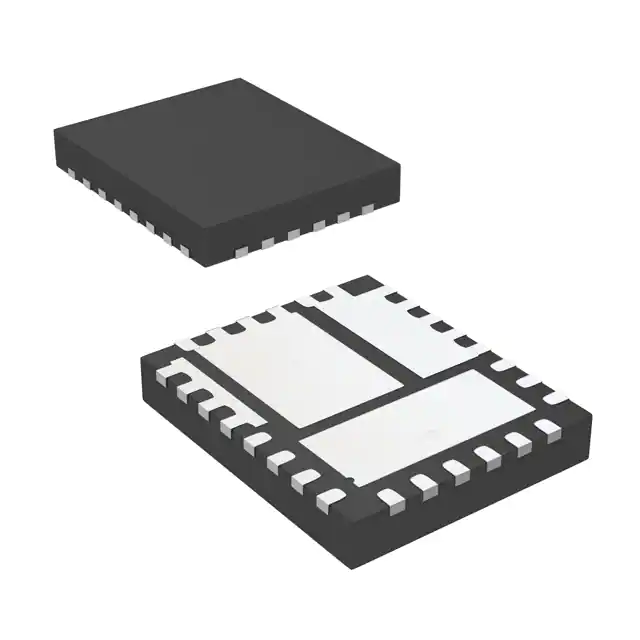
28-pin 5mm × 6mm MLF® package
Applications
• Distributed power systems
• Communications/networking infrastructure
• Set-top box, gateways and routers
• Printers, scanners, graphic cards and video cards
___________________________________________________________________________________________________________
Typical Application
Efficiency (VIN = 28V)
vs. Output Current
95
5.0V
3.3V
2.5V
EFFICIENCY (%)
90
85
1.8V
1.5V
1.2V
1.0V
0.9V
0.8V
80
75
70
65
60
0
1
2
3
4
5
6
7
8
9
OUTPUT CURRENT (A)
Hyper Speed Control, SuperSwitcher II and Any Capacitor are trademarks of Micrel, Inc.
MLF and MicroLeadFrame are registered trademarks of Amkor Technology, Inc.
Micrel Inc. • 2180 Fortune Drive • San Jose, CA 95131 • USA • tel +1 (408) 944-0800 • fax + 1 (408) 474-1000 • http://www.micrel.com
July 2011
M9999-070811
�Micrel, Inc.
MIC27600
Ordering Information
Part Number
Voltage
Switching Frequency
Junction Temperature Range
Package
Lead Finish
MIC27600YJL
Adjustable
300kHz
−40°C to +125°C
28-pin 5mm × 6mm MLF®
Pb-Free
Pin Configuration
28-Pin 5mm × 6mm MLF® (YJL)
Pin Description
Pin
Number
Pin Name
13, 14, 15,
16, 17, 18,
19
PVIN
24
EN
Enable (Input): A logic level control of the output. The EN pin is CMOS-compatible. Logic high or
floating = enable, logic low = shutdown. In the off state, the VDD supply current of the device is
reduced (typically 0.7mA). Do not pull the EN pin above the VDD supply.
25
FB
Feedback (Input): Input to the transconductance amplifier of the control loop. The FB pin is regulated
to 0.8V. A resistor divider connecting the feedback to the output is used to adjust the desired output
voltage.
26
SGND
Signal ground. SGND must be connected directly to the ground planes. Do not route the SGND pin to
the PGND Pad on the top layer, see PCB layout guidelines for details.
27
2, 5, 6, 7,
8, 21
22
July 2011
VDD
PGND
CS
Pin Function
High-Side N-internal MOSFET Drain Connection (Input): The PVIN operating voltage range is from
4.5V to 36V. Input capacitors between the PVIN pins and the power ground (PGND) are required and
keep the connection short.
VDD Bias (Input): Power to the internal reference and control sections of the MIC27600. The VDD
operating voltage range is from 4.5V to 5.5V. A 2.2µF ceramic capacitor from the VDD pin to the
PGND pin must be placed next to the IC. VDD must be powered up at the same time or after VIN to
make the soft-start function correctly.
Power Ground. PGND is the ground path for the MIC27600 buck converter power stage. The PGND
pin connects to the sources of low-side N-Channel internal MOSFETs, the negative terminals of input
capacitors, and the negative terminals of output capacitors. The loop for the power ground should be
as small as possible and separate from the signal ground (SGND) loop.
Current Sense (Input): High current output driver return. The CS pin connects directly to the switch
node. Due to the high-speed switching on this pin, the CS pin should be routed away from sensitive
nodes. CS pin also senses the current by monitoring the voltage across the low-side internal
MOSFET during OFF-time.
2
M9999-070811
�Micrel, Inc.
MIC27600
Pin Description (Continued)
Pin
Number
Pin Name
20
BST
Boost (Output): Bootstrapped voltage to the high-side N-channel internal MOSFET driver. A Schottky
diode is connected between the VDD pin and the BST pin. A boost capacitor of 0.1μF is connected
between the BST pin and the SW pin.
4, 9, 10,
11, 12
SW
Switch Node (Output): Internal connection for the high-side MOSFET source and low-side MOSFET
drain.
23
VIN
Power Supply Voltage (Input): Requires bypass capacitor to SGND.
1, 3, 28
NC
No Connect.
July 2011
Pin Function
3
M9999-070811
�Micrel, Inc.
MIC27600
Absolute Maximum Ratings(1, 2)
Operating Ratings(3)
PVIN to PGND................................................ −0.3V to +38V
VIN to PGND ....................................................−0.3V to PVIN
VDD to PGND ................................................... −0.3V to +6V
VSW, VCS to PGND .............................. −0.3V to (PVIN +0.3V)
VBST to VSW ........................................................ −0.3V to 6V
VBST to PGND .................................................. −0.3V to 44V
VEN to PGND ...................................... −0.3V to (VDD + 0.3V)
VFB to PGND....................................... −0.3V to (VDD + 0.3V)
PGND to SGND ........................................... −0.3V to +0.3V
Junction Temperature .............................................. +150°C
Storage Temperature (TS).........................−65°C to +150°C
Lead Temperature (soldering, 10sec)........................ 260°C
Supply Voltage (PVIN, VIN)................................. 4.5V to 36V
Bias Voltage (VDD)............................................ 4.5V to 5.5V
Enable Input (VEN) ................................................. 0V to VDD
Junction Temperature (TJ) ........................ −40°C to +125°C
Maximum Power Dissipation......................................Note 4
Package Thermal Resistance(4)
5mm x 6mm MLF® (θJA) ....................................36°C/W
Electrical Characteristics(5)
PVIN = VIN = 12V, VDD = 5V; VBST – VSW = 5V; TA = 25°C, unless noted. Bold values indicate −40°C ≤ TJ ≤ +125°C.
Parameter
Condition
Min.
Typ.
Max.
Units
36
V
Power Supply Input
Input Voltage Range (VIN, PVIN)
4.5
VDD Bias Voltage
Operating Bias Voltage (VDD)
Under-Voltage Lockout Trip Level
VDD Rising
4.5
5
5.5
V
2.4
2.7
3.2
V
UVLO Hysteresis
Quiescent Supply Current
Shutdown Supply Current
50
mV
VFB = 1.5V
1.4
3
mA
VDD = VBST = 5.5V, VIN = 36V
0.7
2
mA
SW = unconnected, VEN = 0V
Reference
Feedback Reference Voltage
0°C ≤ TJ ≤ 85°C (±1.0%)
0.792
0.8
0.808
−40°C ≤ TJ ≤ 125°C (±1.5%)
0.788
0.8
0.812
V
Load Regulation
IOUT = 0A to 7A
0.2
%
Line Regulation
VIN = (VOUT + 3.0V) to 36V
0.1
%
FB Bias Current
VFB = 0.8V
5
nA
DC-DC Converter
Output Voltage Range
3.0V ≤ VHSD ≤ 28V
0.8
5.5
3.0V ≤ VHSD ≤ 36V
0.8
3.6
4.5V < VDD < 5.5V
1.2
V
Enable Control
EN Logic Level High
EN Logic Level Low
4.5V < VDD < 5.5V
EN Bias Current
VEN = 0V
0.85
0.78
50
V
0.4
V
µA
Notes:
1. Exceeding the absolute maximum rating may damage the device.
2. Devices are ESD sensitive. Handling precautions recommended. Human body model, 1.5kΩ in series with 100pF.
3. The device is not guaranteed to function outside operating range.
4. PD(MAX) = (TJ(MAX) – TA)/ θJA, where θJA depends upon the printed circuit layout. See “Applications Information.”
5. Specification for packaged product only.
July 2011
4
M9999-070811
�Micrel, Inc.
MIC27600
Electrical Characteristics(5) (Continued)
PVIN = VIN = 12V, VDD = 5V; VBST – VSW = 5V; TA = 25°C, unless noted. Bold values indicate −40°C ≤ TJ ≤ +125°C.
Parameter
Condition
Min.
Typ.
Max.
Units
225
300
375
kHz
Oscillator
Switching Frequency (6)
Maximum Duty Cycle
(7)
Minimum Duty Cycle
VFB = 0V
87
%
VFB > 0.8V
0
%
360
ns
6
ms
15
A
Minimum Off-time
Soft-Start
Soft-Start time
Short Circuit Protection
Current-Limit Threshold
VFB = 0.8V
Short-Circuit Current
VFB = 0V
6
A
Top-MOSFET RDS (ON)
ISW = 1A
25
mΩ
Bottom-MOSFET RDS (ON)
ISW = 1A
10
mΩ
SW Leakage Current
VIN = 36V, VSW = 36V, VEN = 0V, VBST = 41V
60
µA
VIN Leakage Current
VIN = 36V, VSW = 0V, VEN = 0V, VBST = 41V
25
µA
7.7
Internal FETs
Thermal Protection
Over-Temperature Shutdown
TJ Rising
Over-Temperature Shutdown
Hysteresis
155
°C
10
°C
Notes:
6. Measured in test mode.
7. The maximum duty-cycle is limited by the fixed mandatory off-time tOFF of typically 360ns.
July 2011
5
M9999-070811
�Micrel, Inc.
MIC27600
Typical Characteristics
12
VOUT = 3.3V
IOUT = 0A
VDD = 5V
SWITCHING
4
10
16
12
8
VDD = 5V
4
5
10
15
20
25
30
35
10
15
25
30
35
0.800
VOUT = 3.3V
VDD = 5V
IOUT = 0A
15
20
25
30
35
40
INPUT VOLTAGE (V)
Current Limit
vs. Input Voltage
20
VOUT = 3.3V
VDD = 5V
0.8%
IOUT = 0A to 7A
0.6%
0.4%
0.2%
15
10
5
VOUT = 3.3V
0
0.0%
20
25
30
35
40
5
10
20
25
30
35
SUPPLY CURRENT (mA)
VOUT = 3.3V
VDD = 5V
IOUT = 0A
300
250
200
20
25
30
15
8
6
VIN = 28V
4
VOUT = 3.3V
VDD = 5V
2
35
40
20
25
30
35
40
100
130
VDD Shutdown Current
vs. Temperature
1
IOUT = 0A
SWITCHING
0.8
0.6
0.4
VIN = 28V
0.2
VDD = 5V
IOUT = 0A
VEN = 0V
0
INPUT VOLTAGE (V)
10
INPUT VOLTAGE (V)
VDD Operating Supply Current
vs. Temperature
10
400
15
5
40
INPUT VOLTAGE (V)
Switching Frequency
vs. Input Voltage
350
15
SUPPLY CURRENT (mA)
15
INPUT VOLTAGE (V)
July 2011
10
VDD = 5V
0.792
10
VDD= 5V
SWITCHING
5
40
CURRENT LIMIT (A)
TOTAL REGULATION (%)
FEEDBACK VOLTAGE (V)
20
1.0%
0.804
5
VOUT = 3.3V
2
Total Regulation
vs. Input Voltage
0.808
10
4
INPUT VOLTAGE (V)
Feedback Voltage
vs. Input Voltage
5
6
0
5
40
INPUT VOLTAGE (V)
0.796
8
VEN = 0V
0
0
SWITCHING FREQUENCY (kHz)
SUPPLY CURRENT (mA)
16
8
VDD Operating Supply Current
vs. Input Voltage
20
SHUTDOWN CURRENT (µA)
20
SUPPLY CURRENT (mA)
VIN Shutdown Current
vs. Input Voltage
VIN Operating Supply Current
vs. Input Voltage
0
-50
-20
10
40
70
TEMPERATURE (°C)
6
100
130
-50
-20
10
40
70
TEMPERATURE (°C)
M9999-070811
�Micrel, Inc.
MIC27600
Typical Characteristics (Continued)
20
Rising
2.7
2.6
Falling
2.5
2.4
2.3
20
16
12
VIN = 28V
8
VOUT = 3.3V
VDD = 5V
4
IOUT = 0A
SWITCHING
10
40
70
100
130
-50
-20
10
TEMPERATURE (°C)
70
100
12
8
VIN = 28V
VDD = 5V
4
0
130
-50
-20
TEMPERATURE (°C)
Current Limit
vs. Temperature
FEEBACK VOLTAGE (V)
20
15
10
VIN = 28V
VOUT = 3.3V
10
40
70
100
130
TEMPERATURE (°C)
Load Regulation
vs. Temperature
Feedback Voltage
vs. Temperature
0.808
25
5
40
1.0%
VIN = 28V
VIN = 28V
LOAD REGULATION (%)
-20
16
IOUT = 0A
0
-50
CURRENT LIMIT (A)
SUPPLY CURRENT (µA)
SUPPLY CURRENT (mA)
VDD THRESHOLD (V)
2.8
VIN Shutdown Current
vs. Temperature
VIN Operating Supply Current
vs. Temperature
VDD UVLO Threshold
vs. Temperature
VOUT = 3.3V
0.804
VDD = 5V
IOUT = 0A
0.800
0.796
VOUT = 3.3V
0.8%
VDD = 5V
IOUT = 0A to 7A
0.6%
0.4%
0.2%
VDD = 5V
0
0.792
-50
-20
10
40
70
100
-50
130
-20
40
70
100
0.0%
130
-50
Line Regulation
vs. Temperature
0.3%
0.2%
0.1%
0.0%
-50
-20
10
40
70
TEMPERATURE (°C)
July 2011
100
130
70
100
130
100
VIN = 28V
EN BIAS CURRENT (µA)
SWITCHING FREQUENCY (kHz)
VOUT = 3.3V
VDD = 5V
40
EN Bias Current
vs. Temperature
400
VIN = 5.5V to 36V
10
TEMPERATURE (°C)
Switching Frequency
vs. Temperature
0.5%
0.4%
-20
TEMPERATURE (°C)
TEMPERATURE (°C)
LINE REGULATION (%)
10
VOUT = 3.3V
350
VDD = 5V
IOUT = 0A
300
250
80
60
40
VIN = 28V
VOUT = 3.3V
20
VDD = 5V
VEN = 0V
200
0
-50
-20
10
40
70
TEMPERATURE (°C)
7
100
130
-50
-20
10
40
70
100
130
TEMPERATURE (°C)
M9999-070811
�Micrel, Inc.
MIC27600
Typical Characteristics (Continued)
Feedback Voltage
vs. Output Current
Efficiency
vs. Output Current
28VIN
85
80
VOUT = 3.3V
36VIN
75
VDD = 5V
70
65
60
VIN = 6V to 36V
0.804
0.800
VIN = 28V
0.796
VOUT = 3.3V
0.792
50
0
1
2
3
4
5
6
VOUT = 3.3V
VDD = 5V
0.3%
0.2%
0.1%
0.0%
0
7
1
2
OUTPUT CURRENT (A)
3
4
5
6
7
0
40
VIN = 12V
VOUT = 3.3V
DIE TEMPERATURE (°C)
DIE TEMPERATURE (°C)
60
60
40
VIN = 28V
20
VOUT = 3.3V
VDD= 5V
3
4
5
6
7
1
2
OUTPUT CURRENT (A)
Efficiency (VIN = 12V)
vs. Output Current
3
4
5
6
85
80
75
60
4
5
6
7
OUTPUT CURRENT (A)
8
9
4
5
6
90
7
3.3V
2.5V
1.8V
1.5V
1.2V
1.0V
0.9V
0.8V
85
70
70
3
Efficiency (VIN = 36V)
vs. Output Current
1.8V
1.5V
1.2V
1.0V
0.9V
0.8V
80
65
2
95
85
75
3
1
OUTPUT CURRENT (A)
EFFICIENCY (%)
1.8V
1.5V
1.2V
1.0V
0.9V
0.8V
2
VOUT = 3.3V
0
5.0V
3.3V
2.5V
90
EFFICIENCY (%)
90
1
VIN = 36V
20
7
95
0
40
Efficiency (VIN = 28V)
vs. Output Current
5.0V
3.3V
2.5V
7
60
OUTPUT CURRENT (A)
95
6
0
0
100
5
VDD = 5V
0
2
4
VDD= 5V
0
1
3
Die Temperature* (VIN = 36V)
vs. Output Current
80
80
0
2
OUTPUT CURRENT (A)
Die Temperature* (VIN = 28V)
vs. Output Current
80
20
1
OUTPUT CURRENT (A)
Die Temperature* (VIN = 12V)
vs. Output Current
DIE TEMPERATURE (°C)
0.4%
VDD = 5V
55
EFFICIENCY (%)
LINE REGULATION (%)
90
FEEDBACK VOLTAGE (V)
12VIN
95
EFFICIENCY (%)
0.5%
0.808
100
Line Regulation
vs. Output Current
80
75
70
65
60
55
50
0
1
2
3
4
5
6
7
OUTPUT CURRENT (A)
8
9
0
1
2
3
4
5
6
7
8
9
OUTPUT CURRENT (A)
Die Temperature* : The temperature measurement was taken at the hottest point on the MIC27600 case mounted on a 5 square inch PCB, see
Thermal Measurement section. Actual results will depend upon the size of the PCB, ambient temperature and proximity to other heat emitting
components.
July 2011
8
M9999-070811
�Micrel, Inc.
MIC27600
Typical Characteristics (Continued)
Thermal Derating*
vs. Ambient Temperature
Thermal Derating*
vs. Ambient Temperature
8
8
0.8V
6
2.5V
5
3.3V
4
5V
3
2
VIN = 12V
1
0.8V
7
1.2V
OUTPUT CURRENT (A)
OUTPUT CURRENT (A)
7
1.2V
6
2.5V
5
3.3V
4
5V
3
2
VIN = 24V
1
VOUT = 0.8, 1.2, 2.5, 3.3, 5V
0
VOUT = 0.8, 1.2, 2.5, 3.3, 5V
0
85
95
105
115
AMBIENT TEMPERATURE (°C)
125
75
85
95
105
115
125
AMBIENT TEMPERATURE (°C)
Die Temperature* : The temperature measurement was taken at the hottest point on the MIC27600 case mounted on a 5 square inch PCB, see
Thermal Measurement section. Actual results will depend upon the size of the PCB, ambient temperature and proximity to other heat emitting
components.
July 2011
9
M9999-070811
�Micrel, Inc.
MIC27600
Functional Characteristics
July 2011
10
M9999-070811
�Micrel, Inc.
MIC27600
Functional Characteristics (Continued)
July 2011
11
M9999-070811
�Micrel, Inc.
MIC27600
Functional Characteristics (Continued)
July 2011
12
M9999-070811
�Micrel, Inc.
MIC27600
Functional Diagram
Figure 1. MIC27600 Block Diagram
July 2011
13
M9999-070811
�Micrel, Inc.
MIC27600
where tS = 1/300kHz = 3.33μs. It is not recommended to
use MIC27600 with a OFF-time close to tOFF(min) during
steady-state operation. Also, as VOUT increases, the
internal ripple injection will increase and reduce the line
regulation performance. Therefore, the maximum output
voltage of the MIC27600 should be limited to 5.5V.
Please refer to “Setting Output Voltage” subsection in
Application Information for more details.
The actual ON-time and resulting switching frequency
will vary with the part-to-part variation in the rise and fall
times of the internal MOSFETs, the output load current,
and variations in the VDD voltage. Also, the minimum tON
results in a lower switching frequency in high VIN to VOUT
applications, such as 26V to 1.0V. The minimum tON
measured on the MIC27600 evaluation board is about
184ns. During load transients, the switching frequency is
changed due to the varying OFF-time.
To illustrate, the control loop operation will be analyzed
in both steady-state and load transient scenarios. For
easy analysis, the gain of the gm amplifier is assumed to
be 1. With this assumption, the inverting input of the
error comparator is the same as the feedback voltage.
Figure 2 shows the MIC27600 control loop timing during
steady-state operation. During steady-state, the gm
amplifier senses the feedback voltage ripple, which is
proportional to the output voltage ripple and the inductor
current ripple, to trigger the ON-time period. The ONtime is predetermined by the tON estimator. The
termination of the OFF-time is controlled by the feedback
voltage. At the valley of the feedback voltage ripple,
which occurs when VFB falls below VREF, the OFF period
ends and the next ON-time period is triggered through
the control logic circuitry.
Functional Description
The MIC27600 is an adaptive ON-time synchronous
step-down DC-DC regulator. It is designed to operate
over a wide input voltage range from, 4.5V to 36V, and
provides a regulated output voltage at up to 7A of output
current. A digitally modified adaptive ON-time control
scheme is employed in to obtain a constant switching
frequency and to simplify the control compensation.
Over-current protection is implemented without the use
of an external sense resistor. The device includes an
internal soft-start function which reduces the power
supply input surge current at start-up by controlling the
output voltage rise time.
Theory of Operation
Figure 1 illustrates the block diagram for the control loop
of the MIC27600. The output voltage is sensed by the
MIC27600 feedback pin FB via the voltage divider R1
and R2, and compared to a 0.8V reference voltage VREF
at the error comparator through a low gain
transconductance (gm) amplifier. If the feedback voltage
decreases and the output of the gm amplifier is below
0.8V, then the error comparator will trigger the control
logic and generate an ON-time period. The ON-time
period length is predetermined by the “FIXED tON
ESTIMATION” circuitry:
t ON(estimated) =
VOUT
VIN × 300kHz
Eq. 1
where VOUT is the output voltage and VIN is the power
stage input voltage.
At the end of the ON-time period, the internal high-side
driver turns off the high-side MOSFET and the low-side
driver turns on the low-side MOSFET. The OFF-time
period length depends upon the feedback voltage in
most cases. When the feedback voltage decreases and
the output of the gm amplifier is below 0.8V, the ON-time
period is triggered and the OFF-time period ends. If the
OFF-time period determined by the feedback voltage is
less than the minimum OFF-time tOFF(min), which is about
360ns, then the MIC27600 control logic will apply the
tOFF(min) instead. tOFF(min) is required to maintain enough
energy in the boost capacitor (CBST) to drive the highside MOSFET. The maximum duty cycle is obtained
from the 360ns tOFF(min):
D max =
July 2011
t S − t OFF(min)
tS
= 1−
360ns
tS
Eq. 2
Figure 2. MIC27600 Control Loop Timing
14
M9999-070811
�Micrel, Inc.
MIC27600
Figure 3 shows the operation of the MIC27600 during a
load transient. The output voltage drops due to the
sudden load increase, which causes the VFB to be less
than VREF. This will cause the error comparator to trigger
an ON-time period. At the end of the ON-time period, a
minimum OFF-time tOFF(min) is generated to charge CBST
since the feedback voltage is still below VREF. Then, the
next ON-time period is triggered due to the low feedback
voltage. Therefore, the switching frequency changes
during the load transient, but returns to the nominal fixed
frequency once the output has stabilized at the new load
current level. With the varying duty cycle and switching
frequency, the output recovery time is fast and the
output voltage deviation is small in MIC27600 converter.
Soft-Start
Soft-start reduces the power supply input surge current
at startup by controlling the output voltage rise time. The
input surge appears while the output capacitor is
charged up. A slower output rise time will draw a lower
input surge current.
The MIC27600 implements an internal digital soft-start
by making the 0.8V reference voltage VREF ramp from 0
to 100% in about 6ms with 9.7mV steps. Therefore, the
output voltage is controlled to increase slowly by a staircase VFB ramp. Once the soft-start cycle ends, the
related circuitry is disabled to reduce current
consumption. VDD must be powered up at the same time
or after VIN to make the soft-start function correctly.
Current Limit
The MIC27600 uses the RDS(ON) of the internal low-side
power MOSFET to sense over-current conditions. This
method will avoid adding cost, board space and power
losses taken by a discrete current sense resistor. The
low-side MOSFET is used because it displays much
lower parasitic oscillations during switching than the
high-side MOSFET.
In each switching cycle of the MIC27600 converter, the
inductor current is sensed by monitoring the low-side
MOSFET in the OFF period. If the peak inductor current
is greater than 15A, then the MIC27600 turns off the
high-side MOSFET and a soft-start sequence is
triggered. This mode of operation is called “hiccup
mode” and its purpose is to protect the downstream load
in case of a hard short. The current-limit threshold has a
foldback characteristic related to the feedback voltage,
as shown in Figure 4.
Figure 3. MIC27600 Load Transient Response
Unlike true current-mode control, the MIC27600 uses the
output voltage ripple to trigger an ON-time period. The
output voltage ripple is proportional to the inductor
current ripple if the ESR of the output capacitor is large
enough. The MIC27600 control loop has the advantage
of eliminating the need for slope compensation.
In order to meet the stability requirements, the
MIC27600 feedback voltage ripple should be in phase
with the inductor current ripple and large enough to be
sensed by the gm amplifier and the error comparator.
The recommended feedback voltage ripple is
20mV~100mV. If a low-ESR output capacitor is selected,
then the feedback voltage ripple may be too small to be
sensed by the gm amplifier and the error comparator.
Also, the output voltage ripple and the feedback voltage
ripple are not necessarily in phase with the inductor
current ripple if the ESR of the output capacitor is very
low. In these cases, ripple injection is required to ensure
proper operation. Please refer to “Ripple Injection”
subsection in Application Information for more details
about the ripple injection technique.
July 2011
Peak Inductor Current
vs. Feedback Voltage
PEAK INDUCTOR CURENT (A)
20.0
16.0
12.0
8.0
VIN = 12V
VOUT = 0V
4.0
0.0
0.0
0.2
0.4
0.6
0.8
1.0
FEEDBACK VOLTAGE (V)
Figure 4. MIC27600 Current Limit Foldback Characteristic
15
M9999-070811
�Micrel, Inc.
MIC27600
the power stroke (high-side switching) cycle, i.e. ΔBST =
10mA x 3.33μs/0.1μF = 333mV. When the low-side
MOSFET is turned back on, CBST is recharged through
D1. A small resistor RG, which is in series with CBST, can
be used to slow down the turn-on time of the high-side
N-channel MOSFET.
The drive voltage is derived from the VDD supply voltage.
The nominal low-side gate drive voltage is VDD and the
nominal high-side gate drive voltage is approximately
VDD – VDIODE, where VDIODE is the voltage drop across
D1. An approximate 30ns delay between the high-side
and low-side driver transitions is used to prevent current
from simultaneously flowing unimpeded through both
MOSFETs.
Internal MOSFET Gate Drive
Figure 1 (Block Diagram) shows a bootstrap circuit,
consisting of D1 (a Schottky diode is recommended) and
CBST. This circuit supplies energy to the high-side drive
circuit. Capacitor CBST is charged, while the low-side
MOSFET is on, and the voltage on the SW pin is
approximately 0V. When the high-side MOSFET driver is
turned on, energy from CBST is used to turn the MOSFET
on. As the high-side MOSFET turns on, the voltage on
the SW pin increases to approximately VIN. Diode D1 is
reverse biased and CBST floats high while continuing to
keep the high-side MOSFET on. The bias current of the
high-side driver is less than 10mA so a 0.1μF to 1μF is
sufficient to hold the gate voltage with minimal droop for
July 2011
16
M9999-070811
�Micrel, Inc.
MIC27600
but the increase in core loss will reduce the efficiency of
the power supply. This is especially noticeable at low
output power. The winding resistance decreases
efficiency at the higher output current levels. The
winding resistance must be minimized although this
usually comes at the expense of a larger inductor. The
power dissipated in the inductor is equal to the sum of
the core and copper losses. At higher output loads, the
core losses are usually insignificant and can be ignored.
At lower output currents, the core losses can be a
significant contributor. Core loss information is usually
available from the magnetics vendor. Copper loss in the
inductor is calculated by Equation 7:
Application Information
Inductor Selection
Values for inductance, peak, and RMS currents are
required to select the output inductor. The input and
output voltages and the inductance value determine the
peak-to-peak inductor ripple current. Generally, higher
inductance values are used with higher input voltages.
Larger peak-to-peak ripple currents will increase the
power dissipation in the inductor and MOSFETs. Larger
output ripple currents will also require more output
capacitance to smooth out the larger ripple current.
Smaller peak-to-peak ripple currents require a larger
inductance value and therefore a larger and more
expensive inductor. A good compromise between size,
loss and cost is to set the inductor ripple current to be
equal to 20% of the maximum output current. The
inductance value is calculated by Equation 3:
L=
VOUT × (VIN(max) − VOUT )
VIN(max) × fsw × 20% × IOUT(max)
2
PINDUCTOR(Cu) = IL(RMS) × RWINDING
The resistance of the copper wire, RWINDING, increases
with the temperature. The value of the winding
resistance used should be at the operating temperature:
Eq. 3
PWINDING(Ht) = RWINDING(20°C) × (1 + 0.0042 × (TH – T20°C))
Eq. 8
where:
fSW = switching frequency, 300kHz
20% = ratio of AC ripple current to DC output current
VIN(max) = maximum power stage input voltage
The peak-to-peak inductor current ripple is:
ΔIL(pp) =
VOUT × (VIN(max) − VOUT )
VIN(max) × fsw × L
where:
TH = temperature of wire under full load
T20°C = ambient temperature
RWINDING(20°C) = room temperature winding resistance
(usually specified by the manufacturer)
Output Capacitor Selection
The type of the output capacitor is usually determined by
its equivalent series resistance (ESR). Voltage and RMS
current capability are two other important factors for
selecting the output capacitor. Recommended capacitor
types are ceramic, low-ESR aluminum electrolytic, OSCON and POSCAP. The output capacitor’s ESR is
usually the main cause of the output ripple. The output
capacitor ESR also affects the control loop from a
stability point of view. The maximum value of ESR is
calculated:
Eq. 4
The peak inductor current is equal to the average output
current plus one half of the peak-to-peak inductor current
ripple.
IL(pk) =IOUT(max) + 0.5 × ΔIL(pp)
Eq. 5
The RMS inductor current is used to calculate the I2R
losses in the inductor.
ESR COUT ≤
2
IL(RMS) = IOUT(max) +
ΔIL(PP)
12
2
ΔVOUT(pp)
Eq. 9
ΔIL(PP)
Eq. 6
where:
ΔVOUT(pp) = peak-to-peak output voltage ripple
ΔIL(PP) = peak-to-peak inductor current ripple
Maximizing efficiency requires the proper selection of
core material and minimizing the winding resistance. The
high frequency operation of the MIC27600 requires the
use of ferrite materials for all but the most cost sensitive
applications. Lower cost iron powder cores may be used
July 2011
Eq. 7
17
M9999-070811
�Micrel, Inc.
MIC27600
peak inductor current, so:
The total output ripple is a combination of the ESR and
output capacitance. The total ripple is calculated in
Equation 10:
2
ΔVOUT(pp)
ΔVIN = IL(pk) × CESR
The input capacitor must be rated for the input current
ripple. The RMS value of input capacitor current is
determined at the maximum output current. Assuming
the peak-to-peak inductor current ripple is low:
ΔIL(PP)
⎞
⎛
2
⎟ + ΔIL(PP) × ESR C
= ⎜⎜
OUT
⎟
C
f
8
×
×
⎠
⎝ OUT SW
Eq. 10
(
)
where:
D = duty cycle
COUT = output capacitance value
fSW = switching frequency
ICIN(RMS) ≈ IOUT(max) × D × (1 − D)
ΔIL(PP)
PDISS(CIN) = ICIN(RMS)2 × CESR
The power dissipated in the output capacitor is:
2
PDISS(COUT ) = ICOUT (RMS) × ESR COUT
ΔVFB(pp) =
Eq. 12
Input Capacitor Selection
The input capacitor for the power stage input VIN should
be selected for ripple current rating and voltage rating.
Tantalum input capacitors may fail when subjected to
high inrush currents, caused by turning the input supply
on. A tantalum input capacitor’s voltage rating should be
at least two times the maximum input voltage to
maximize reliability. Aluminum electrolytic, OS-CON, and
multilayer polymer film capacitors can handle the higher
inrush currents without voltage de-rating. The input
voltage ripple will primarily depend on the input
capacitor’s ESR. The peak input current is equal to the
July 2011
Eq. 15
Ripple Injection
The VFB ripple required for proper operation of the
MIC27600 gm amplifier and error comparator is 20mV to
100mV. However, the output voltage ripple is generally
designed as 1% to 2% of the output voltage. For a low
output voltage, such as a 1V, the output voltage ripple is
only 10mV to 20mV, and the feedback voltage ripple is
less than 20mV. If the feedback voltage ripple is so small
that the gm amplifier and error comparator can’t sense it,
then the MIC27600 will lose control and the output
voltage is not regulated. In order to have some amount
of VFB ripple, a ripple injection method is applied for low
output voltage ripple applications.
The applications are divided into three situations
according to the amount of the feedback voltage ripple:
1) Enough ripple at the feedback voltage due to the large
ESR of the output capacitors.
As shown in Figure 5a, the converter is stable without
any ripple injection. The feedback voltage ripple is:
Eq. 11
12
Eq. 14
The power dissipated in the input capacitor is:
As described in the “Theory of Operation” subsection in
Functional Description, the MIC27600 requires at least
20mV peak-to-peak ripple at the FB pin to make the gm
amplifier and the error comparator behave properly. Also,
the output voltage ripple should be in phase with the
inductor current. Therefore, the output voltage ripple
caused by the output capacitors value should be much
smaller than the ripple caused by the output capacitor
ESR. If low-ESR capacitors, such as ceramic capacitors,
are selected as the output capacitors, a ripple injection
method should be applied to provide the enough
feedback voltage ripple. Please refer to the “Ripple
Injection” subsection for more details.
The voltage rating of the capacitor should be 20%
greater for aluminum electrolytic or OS-CON. The output
capacitor RMS current is calculated in Equation 11:
ICOUT (RMS) =
Eq. 13
R2
× ESR COUT × ΔIL (pp)
R1 + R2
Eq. 16
where ΔIL(pp) is the peak-to-peak value of the inductor
current ripple.
2) Inadequate ripple at the feedback voltage due to the
small ESR of the output capacitors.
The output voltage ripple is fed into the FB pin through a
feedforward capacitor Cff in this situation, as shown in
Figure 5b. The typical Cff value is between 1nF and
100nF.
18
M9999-070811
�Micrel, Inc.
MIC27600
The injected ripple is:
With the feedforward capacitor, the feedback voltage
ripple is very close to the output voltage ripple:
ΔVFB(pp) ≈ ESR × ΔIL (pp)
ΔVFB(pp) = VIN × K div × D × (1 - D) ×
Eq. 17
3) Virtually no ripple at the FB pin voltage due to the very
low ESR of the output capacitors.
K div =
R1//R2
R inj + R1//R2
1
fSW × τ
Eq. 18
Eq. 19
where
VIN = Power stage input voltage
D = duty cycle
fSW = switching frequency
τ = (R1//R2//Rinj) × Cff
In Equations 18 and 19, it is assumed that the time
constant associated with Cff must be much greater than
the switching period:
Figure 5a. Enough Ripple at FB
1
T
=