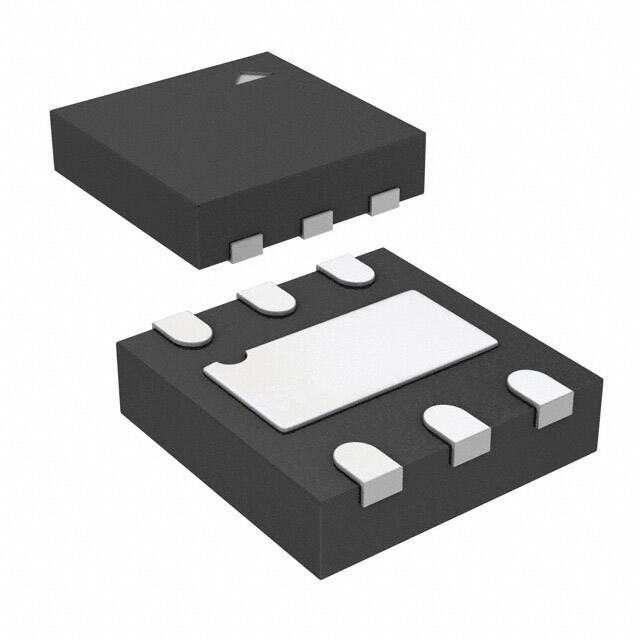
MIC5528
High Performance 500 mA LDO
in Thin and Extra Thin DFN Packages
Features
General Description
• Input Voltage Range: 2.5V to 5.5V
• Output Voltage Range: 1.0V to 5.0V
• Fixed Output Voltages: 1.1V, 1.2V, 1.8V, 2.8V,
3.0V, 3.3V
• ±2% Room Temperature Accuracy
• Low Quiescent Current 38 µA
• Stable with 2.2 µF Ceramic Output Capacitors
• Low Dropout Voltage 260 mV @ 500 mA
• Auto-Discharge and Internal Enable Pull-Down
• Thermal Shutdown and Current-Limit Protection
• 6-Pin 1.2 mm × 1.2 mm Extra Thin DFN Package
• 6-Pin 1.2 mm × 1.2 mm Thin DFN Package
The MIC5528 is a low-power, µCap, low dropout
regulator designed for optimal performance in a very
small footprint. It is capable of sourcing up to 500 mA
of output current while only drawing 38 µA of operating
current. This high performance LDO is a µCap design
in a thermally enhanced 1.2 mm × 1.2 mm extra thin
(0.4 mm height) DFN package. It operates with small
ceramic output capacitor for stability, thereby reducing
required board space.
Applications
•
•
•
•
Portable Communication Equipment
DSC, GPS, PMP, and PDAs
Portable Medical Devices
5V POL Applications
Ideal for battery-operated applications, the MIC5528
offers ±2% accuracy, extremely low dropout voltage
(260 mV @ 500 mA), and can regulate output voltages
down to 1.0V. Equipped with a TTL logic-compatible
enable pin, the MIC5528 can be put into a
zero-off-mode current state, drawing no current when
disabled.
The MIC5528 is a µCap design, operating with very
small ceramic output capacitors for stability, reducing
required board space and component cost for
space-critical applications. The MIC5528 has an
operating junction temperature range of –40°C to
125°C.
Package Types
MIC5528
6-Lead Thin DFN (MT)
(Top View)
MIC5528
6-Lead Extra Thin DFN (MX)
(Top View)
VOUT 1
6 VIN
VOUT 1
6 VIN
VOUT 2
5 NC
VOUT 2
5 NC
4 EN
GND 3
GND 3
EP
2018 Microchip Technology Inc.
EP
4 EN
DS20005982B-page 1
�MIC5528
Typical Application Circuit
VIN
VOUT
MIC5528
EN
PORTABLE
COMMUNICATION
EQUIPMENT
VBAT
GND
Functional Block Diagram
VIN
EN
ENABLE
UVLO
VOUT
BIAS
TSD
LDO
GND
DS20005982B-page 2
2018 Microchip Technology Inc.
�MIC5528
1.0
ELECTRICAL CHARACTERISTICS
Absolute Maximum Ratings †
Supply Voltage (VIN) .................................................................................................................................... –0.3V to +6V
Enable Voltage (VEN) .....................................................................................................................................–0.3V to VIN
Power Dissipation (PD) ............................................................................................................. Internally Limited, Note 1
ESD Rating (Note 2) .................................................................................................................................................. 3 kV
Operating Ratings ‡
Supply Voltage (VIN) ................................................................................................................................. +2.5V to +5.5V
Enable Voltage (VEN) ..........................................................................................................................................0V to VIN
† Notice: Stresses above those listed under “Absolute Maximum Ratings” may cause permanent damage to the device.
This is a stress rating only and functional operation of the device at those or any other conditions above those indicated
in the operational sections of this specification is not intended. Exposure to maximum rating conditions for extended
periods may affect device reliability.
‡ Notice: The device is not guaranteed to function outside its operating ratings.
Note 1: The maximum allowable power dissipation of any TA (ambient temperature) is PD(max) = (TJ(max) – TA)/θJA.
Exceeding the maximum allowable power dissipation will result in excessive die temperature, and the regulator will go into thermal shutdown.
2: Devices are ESD sensitive. Handling precautions are recommended. Human body model, 1.5 kΩ in series
with 100 pF.
TABLE 1-1:
ELECTRICAL CHARACTERISTICS
Electrical Characteristics: VIN = VEN = VOUT + 1V; CIN = COUT = 2.2 µF; IOUT = 100 µA; TJ = +25°C, bold values
indicate –40°C to +85°C, unless noted. Note 1
Parameter
Symbol
Output Voltage Accuracy
—
Line Regulation
—
Load Regulation (Note 2)
—
Dropout Voltage (Note 3)
VDO
Ground Pin Current (Note 4)
IGND
Ground Pin Current in
Shutdown
ISHDN
Ripple Rejection
PSRR
Current Limit
Min.
Typ.
Max.
–2.0
±1
+2.0
Units
Conditions
Variation from nominal VOUT
%
Variation from nominal VOUT;
–40°C to +85°C
–3.0
—
+3.0
—
0.02
0.3
%/V
VIN = VOUT + 1V to 5.5V; IOUT =
100 µA
mV
IOUT = 100 µA to 500 mA
—
14
65
—
80
180
—
260
500
—
38
55
—
42
65
—
0.05
1
—
70
—
—
60
—
mV
µA
µA
dB
ILIM
525
800
—
mA
Output Voltage Noise
—
—
175
—
µVRMS
Auto-Discharge NFET
Resistance
—
—
25
—
Ω
—
—
4
—
MΩ
—
—
0.2
1.2
—
—
IOUT = 150 mA
IOUT = 500 mA
IOUT = 0 mA
IOUT = 500 mA
VEN = 0V
f = 100 Hz, IOUT = 100 mA
f = 1 kHz, IOUT = 100 mA
VOUT = 0V
f =10 Hz to 100 kHz
VEN = 0V; VIN = 3.6V; IOUT = –3 mA
Enable Input
Enable Pull-Down Resistor
Enable Input Voltage
2018 Microchip Technology Inc.
VEN
V
—
Logic low
Logic high
DS20005982B-page 3
�MIC5528
TABLE 1-1:
ELECTRICAL CHARACTERISTICS (CONTINUED)
Electrical Characteristics: VIN = VEN = VOUT + 1V; CIN = COUT = 2.2 µF; IOUT = 100 µA; TJ = +25°C, bold values
indicate –40°C to +85°C, unless noted. Note 1
Parameter
Symbol
Enable Input Current
IEN
Turn-On Time
tON
Note 1:
2:
3:
4:
Min.
Typ.
Max.
—
0.01
1
—
1.4
2
—
50
125
Units
µA
µs
Conditions
VEN = 0V
VEN = 5.5V
IOUT = 150 mA
Specification for packaged product only.
Regulation is measured at constant junction temperature using low duty cycle pulse testing. Changes in
output voltage due to heating effects are covered by the thermal regulation specification.
Dropout voltage is defined as the input-to-output differential at which the output voltage drops 2% below its
nominal value measured at 1V differential. For outputs below 2.5V, dropout voltage is the input-to-output
differential with the minimum input voltage 2.5V.
Ground pin current is the regulator quiescent current. The total current drawn from the supply is the sum of
the load current plus the ground pin current.
DS20005982B-page 4
2018 Microchip Technology Inc.
�MIC5528
TEMPERATURE SPECIFICATIONS (Note 1)
Parameters
Sym.
Min.
Typ.
Max.
Units
Conditions
TS
–65
—
+150
°C
—
Maximum Junction Temperature Range
TJ
–40
—
+150
°C
—
Junction Operating Temperature Range
TJ
–40
—
+125
°C
—
Lead Temperature
—
—
—
+260
°C
Soldering, 10s
JA
—
173
—
°C/W
Temperature Ranges
Storage Temperature Range
Package Thermal Resistances
Thermal Resistance 6-Lead Extra Thin DFN
Note 1:
—
The maximum allowable power dissipation is a function of ambient temperature, the maximum allowable
junction temperature and the thermal resistance from junction to air (i.e., TA, TJ, JA). Exceeding the
maximum allowable power dissipation will cause the device operating junction temperature to exceed the
maximum +125°C rating. Sustained junction temperatures above +125°C can impact the device reliability.
2018 Microchip Technology Inc.
DS20005982B-page 5
�MIC5528
2.0
Note:
TYPICAL PERFORMANCE CURVES
The graphs and tables provided following this note are a statistical summary based on a limited number of
samples and are provided for informational purposes only. The performance characteristics listed herein
are not tested or guaranteed. In some graphs or tables, the data presented may be outside the specified
operating range (e.g., outside specified power supply range) and therefore outside the warranted range.
FIGURE 2-1:
Ratio.
Power Supply Rejection
FIGURE 2-4:
Voltage.
Ground Current vs. Supply
FIGURE 2-2:
Current.
Dropout Voltage vs. Output
FIGURE 2-5:
Current.
Ground Current vs. Load
FIGURE 2-3:
Temperature.
Dropout Voltage vs.
FIGURE 2-6:
Temperature.
Ground Current vs.
DS20005982B-page 6
2018 Microchip Technology Inc.
�MIC5528
FIGURE 2-7:
Current.
Output Voltage vs. Output
FIGURE 2-10:
Voltage.
Current Limit vs. Supply
FIGURE 2-8:
Voltage.
Output Voltage vs. Supply
FIGURE 2-11:
Output Noise Spectral
Density (MIC5528-3.3YMT).
VEN
(1V/div)
VOUT
(2V/div)
VIN = 4.3V
VOUT = 3.3V
CIN = COUT = 2.2μF
Time (40μs/div)
FIGURE 2-9:
Temperature.
Output Voltage vs.
2018 Microchip Technology Inc.
FIGURE 2-12:
Enable Turn-On.
DS20005982B-page 7
�MIC5528
PSRR (dB)
VIN = 4.3V
VOUT = 3.3V
CIN = COUT = 2.2μF
VEN
(1V/div)
VOUT
(2V/div)
Time (100μs/div)
FIGURE 2-13:
Auto-Discharge (No Load).
0
VOUT = 1.1V
VIN = 2.7V
-10 V
IN_AC = 400 mVp-p
-20 CIN = 0 μF
-30 COUT = 2.2 μF
-40
IOUT = 500 mA
-50 IOUT = 300 mA
-60
-70
IOUT = 100 μA
-80
IOUT = 150 mA
-90
-100
0.01
0.1
1
10
100
1000 10000
FREQUENCY (kHz)
FIGURE 2-16:
Ratio.
Power Supply Rejection
VOUT
(AC-COUPLED)
(100mV/div)
VIN
(1V/div)
VOUT = 3.3V
CIN = COUT = 2.2μF
IOUT = 500mA
GROUND CURRENT (μA)
70
VOUT = 1.1V
60
IOUT = 500 mA
50
40
IOUT = 100 μA
30
20
10
0
2.0
2.5
Time (20μs/div)
IOUT
(200mA/div)
VOUT
(AC-COUPLED)
(100mV/div)
Line Transient.
VIN = 4.3V
VOUT = 3.3V
CIN = COUT = 2.2μF
FIGURE 2-17:
Voltage.
GROUND CURRENT (μA)
FIGURE 2-14:
50
45
40
35
30
25
20
15
10
5
0
FIGURE 2-15:
DS20005982B-page 8
Load Transient.
5.0
5.5
Ground Current vs. Input
VOUT = 1.1V
VIN = 2.5V
0
Time (20μs/div)
3.0
3.5
4.0
4.5
INPUT VOLTAGE (V)
100
200
300
400
OUTPUT CURRENT (mA)
FIGURE 2-18:
Current.
500
Ground Current vs. Output
2018 Microchip Technology Inc.
�MIC5528
10
1.1
NOISE (μV/Hz)
OUTPUT VOLTAGE (V)
1.12
1.08
1.06
1.04
1.02
VOUT = 1.1V
VIN = 2.5V
1
0
100
200
300
400
OUTPUT CURRENT (mA)
FIGURE 2-19:
Current.
1
0.1
0.01
0.001
500
VOUT = 1.1V
VIN = 2.5V
CIN = COUT = 2.2 μF
IOUT = 100 μA
Output Noise (10 Hz - 10 MHz) = 154 μVrms
10
100
1K
10K
100K
1M
10M
FREQUENCY (Hz)
Output Voltage vs. Output
FIGURE 2-22:
Density.
Output Noise Spectral
OUTPUT VOLTAGE (V)
1.40
VIN (DC Coupled, 2V/Div)
1.20
0.80
VIN
0.60
0.40
0.20
VOUT
0.0 0.5 1.0 1.5 2.0 2.5 3.0 3.5 4.0 4.5 5.0 5.5
INPUT VOLTAGE (V)
FIGURE 2-20:
Voltage.
Output Voltage vs. Input
1000
900
800
700
600
500
400
300
200
100
0
0.0V
1.1V
VOUT = 1.1V
VOUT = 1.1V
VIN = VEN
IOUT = 0
0.00
CURRENT LIMIT (mA)
5.0V
1.00
VIN = 0V to 5.0V
0.0V
IOUT = 100 µA
VOUT (DC Coupled, 500 mV/Div)
Time = 10 µs/Div
FIGURE 2-23:
Start-Up from VIN.
VEN (DC Coupled, 1V/Div)
2.5V
VEN
3.0
FIGURE 2-21:
Voltage.
3.5
4.0
4.5
INPUT VOLTAGE (V)
5.0
Current Limit vs. Input
2018 Microchip Technology Inc.
1.1V
VOUT = 1.1V
VOUT = 1.1V
CIN = COUT = 2.2 μF
2.5
0.0V
VOUT
5.5
VIN = 2.5V
0.0V
VOUT (DC Coupled, 500 mV/Div)
IOUT = 100 µA
Time = 10 µs/Div
FIGURE 2-24:
Start-Up from ENABLE.
DS20005982B-page 9
�MIC5528
VOUT = 1.1V
2.5V
VOUT = 1.1V
500 mA
VIN = 2.5V
IOUT = 0
0.0V
VEN
VEN (DC Coupled, 1V/Div)
1.1V
IOUT
100 µA
IOUT (DC Coupled, 200 mA/Div)
VOUT
VOUT
VOUT (DC Coupled, 500 mV/Div)
Time = 40 µs/Div
FIGURE 2-25:
Auto-Discharge (No Load).
VOUT (AC Coupled, 100 mV/Div)
FIGURE 2-28:
VOUT = 1.1V
3.5V
Time = 40 µs/Div
Load Transient.
VOUT = 1.1V
500 mA
2.5V
VIN (DC Coupled, 1V/Div)
IOUT
1 mA
IOUT (DC Coupled, 200 mA/Div)
VIN
VOUT
VOUT
VOUT (AC Coupled, 10 mV/Div)
FIGURE 2-26:
Time = 40 µs/Div
Line Transient.
VOUT (AC Coupled, 100 mV/Div)
FIGURE 2-29:
Time = 40 µs/Div
Load Transient.
VOUT = 1.1V
VOUT = 1.1V
5.5V
150 mA
2.5V
VIN
IOUT
VIN (DC Coupled, 2V/Div)
100 µA
IOUT (DC Coupled, 200 mA/Div)
VOUT
VOUT
VOUT (AC Coupled, 50 mV/Div)
VOUT (AC Coupled, 100 mV/Div)
Time = 40 µs/Div
Time = 40 µs/Div
FIGURE 2-27:
DS20005982B-page 10
Line Transient.
FIGURE 2-30:
Load Transient.
2018 Microchip Technology Inc.
�MIC5528
VOUT = 1.1V
150 mA
IOUT 1 mA
IOUT (DC Coupled, 200 mA/Div)
VOUT
VOUT (AC Coupled, 100 mV/Div)
Time = 40 µs/Div
FIGURE 2-31:
Load Transient.
2018 Microchip Technology Inc.
DS20005982B-page 11
�MIC5528
3.0
PIN DESCRIPTIONS
The descriptions of the pins are listed in Table 3-1.
TABLE 3-1:
PIN FUNCTION TABLE
Pin Number
Pin Name
1, 2
VOUT
Output Voltage. When disabled, the MIC5528 switches in an internal 25Ω load to
discharge the external capacitors.
3
GND
Ground.
4
EN
Enable Input: Active-High. High = ON; Low = OFF. The MIC5528 has an internal
pull-down and this pin can be left floating.
5
NC
No Connection.
6
VIN
Supply input.
EP
ePad
DS20005982B-page 12
Description
Exposed Heatsink Pad. Connect to GND for best thermal performance.
2018 Microchip Technology Inc.
�MIC5528
4.0
APPLICATION INFORMATION
The MIC5528 is a high performance, low power
500 mA
LDO. The
MIC5528
includes
an
auto-discharge circuit that is switched on when the
regulator is disabled through the enable pin. The
MIC5528 also offers an internal pull-down resistor on
the enable pin to ensure the output is disabled if the
control signal is tri-stated. The MIC5528 regulator is
fully protected from damage due to fault conditions,
offering linear current-limiting and thermal shutdown.
4.1
Input Capacitor
The MIC5528 is a high performance, high bandwidth
device. An input capacitor of 2.2 µF is required from the
input to ground to provide stability. Low-ESR ceramic
capacitors provide optimal performance at a minimum
of space. Additional high frequency capacitors, such as
small-valued NPO dielectric-type capacitors, help filter
out high frequency noise and are good practice in any
RF-based circuit. X5R or X7R dielectrics are
recommended for the input capacitor. Y5V dielectrics
lose most of their capacitance over temperature and
are therefore, not recommended.
4.2
Output Capacitor
The MIC5528 requires an output capacitor of 2.2 µF or
greater to maintain stability. The design is optimized for
use with low-ESR ceramic chip capacitors. High-ESR
capacitors are not recommended because they may
cause high frequency oscillation. The output capacitor
can be increased, but performance has been optimized
for a 2.2 µF ceramic output capacitor and does not
improve significantly with larger capacitance.
X7R/X5R dielectric-type ceramic capacitors are
recommended because of their temperature
performance. X7R-type capacitors change capacitance
by 15% over their operating temperature range and are
the most stable type of ceramic capacitors. Z5U and
Y5V dielectric capacitors change value by as much as
50% and 60%, respectively, over their operating
temperature ranges. To use a ceramic chip capacitor
with Y5V dielectric, the value must be much higher than
an X7R ceramic capacitor to ensure the same
minimum capacitance over the equivalent operating
temperature range.
4.3
No-Load Stability
4.4
Enable/Shutdown
The MIC5528 comes with an active-high enable pin
that allows the regulator to be disabled. Forcing the
enable pin low disables the regulator and sends it into
an off mode current state drawing virtually zero current.
When disabled the MIC5528 switches an internal 25Ω
load on the regulator output to discharge the external
capacitor.
Forcing the enable pin high enables the output voltage.
The MIC5528 has an internal pull-down resistor on the
enable pin to disable the output when the enable pin is
floating.
4.5
Thermal Considerations
The MIC5528 is designed to provide 500 mA of
continuous current in a very small package. Maximum
ambient operating temperature can be calculated
based on the output current and the voltage drop
across the part. For example, if the input voltage is
3.6V, the output voltage is 3.3V, and the output current
is 500 mA. The actual power dissipation of the
regulator circuit can be determined using Equation 4-1:
EQUATION 4-1:
P D = V IN – V OUT I OUT + V IN I GND
Because this device is CMOS and the ground current
is typically