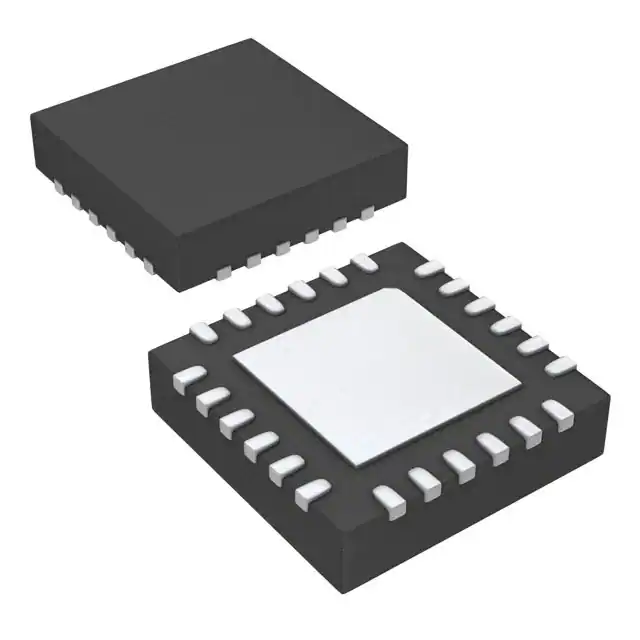
MRF39RA
Low-Power, Integrated UHF Receiver
MRF39RA RECEIVER:
LOW-POWER INTEGRATED
UHF RECEIVER
VR_DIG
Mixers
Single to
Differential
RFIN
2015 Microchip Technology Inc.
RSSI
AFC
Division by
2, 4 or 6
Tank
Inductor
Frac-N PLL
Synthesizer
Loop
Filter
NC
RESET
SPI
GND
DIO0
DIO1
DIO2
DIO3
DIO4
NC
DIO5
XO
32 MHz
NC
XTAL
GND
Typical Applications
•
•
•
•
•
•
Automated Meter Reading
Wireless Sensor Networks
Home and Building Automation
Wireless Alarm and Security Systems
Industrial Monitoring and Control
Wireless M-Bus
Pin Diagram
VR_ANA
NC
NC
24
VBAT1 1
23 22
NC
24-PIN QFN
RFIN
FIGURE 2:
General Description
21 20 19
18 NSS
2
17 MOSI
VR_DIG 3
16 MISO
XTA
4
15 SCK
XTB 5
14 GND
13 VBAT2
8
9
10
11 12
DIO3
DIO4
DIO5
7
DIO1
6
DIO2
RESET
DIO0
The MRF39RA device is a highly integrated RF
receiver capable of operation over a wide frequency
range, including the 433, 868 and 915 MHz
license-free Industry Scientific and Medical (ISM)
frequency bands. Its highly integrated architecture
enables for a minimum of external components while
maintaining maximum design flexibility. All major RF
communication parameters are programmable and
most of these can be dynamically set. The MRF39RA
offers the unique advantage of programmable
narrow-band and wide-band communication modes
without the need of modifying external components.
The MRF39RA is optimized for low-power
consumption while offering high sensitivity and
channelized operation. TrueRF™ technology enables
a low-cost external component count (elimination of the
SAW filter) while still satisfying the European
RC
Oscillator
Modulators
Packet Engine & 66 Bytes FIFO
LNA
Control Registers - Shift Registers - SPI Interface
VR_ANA
Power Distribution System
Demodulator &
Bit Synchronizer
VBAT1&2
Decimation and
& Filtering
FIGURE 1:
GND
• High Sensitivity:
- down to -120 dBm at 1.2 kbps
• High Selectivity:
- 16-Tap FIR channel filter
• Bullet-Proof Front End:
- IIP3 = -18 dBm, IIP2 = +35 dBm, 80 dB
blocking immunity, no image frequency
response
• Low Current:
- Rx = 16 mA, 100 nA register retention
• Constant RF Performance over Voltage Range of
Chip
• FSK Bit Rates up to 300 kbps
• Fully Integrated Synthesizer with a Resolution of
61 Hz
• FSK, GFSK, MSK, GMSK
and
OOK
Demodulation
• Built-in Bit Synchronizer Performing Clock
Recovery
• Incoming Sync Word Recognition
• 115 dB+ Dynamic Range Received Signal
Strength Indicator (RSSI)
• Automatic RF Sense with Ultra-Fast Automatic
Frequency Control (AFC)
• Packet Engine with CRC, AES-128 Encryption
and 66-Byte First In First Out (FIFO)
• Built-in Temperature Sensor and Low-Battery
Indicator
Telecommunications Standards Institute (ETSI) and
Federal
Communications
Commission
(FCC)
regulations.
GND
Features
Markets
• Europe: EN 300-220-1
• North America: FCC Part 15.247, 15.249, 15.231
• Narrow Korean and Japanese Bands
DS40001778B-page 1
�MRF39RA
Table of Contents
1.0
Overview .................................................................................................................................................................................... 3
2.0
Device Description ..................................................................................................................................................................... 5
3.0
Operating Modes ..................................................................................................................................................................... 20
4.0
Data Processing....................................................................................................................................................................... 26
5.0
Configuration and Status Registers ......................................................................................................................................... 41
6.0
Application Information ............................................................................................................................................................ 56
7.0
Electrical Specifications ........................................................................................................................................................... 59
8.0
Packaging Information ............................................................................................................................................................. 63
The Microchip Web Site ....................................................................................................................................................................... 69
Customer Change Notification Service ................................................................................................................................................ 69
Customer Support ................................................................................................................................................................................ 69
Product Identification System .............................................................................................................................................................. 70
TO OUR VALUED CUSTOMERS
It is our intention to provide our valued customers with the best documentation possible to ensure successful use of your Microchip
products. To this end, we will continue to improve our publications to better suit your needs. Our publications will be refined and
enhanced as new volumes and updates are introduced.
If you have any questions or comments regarding this publication, please contact the Marketing Communications Department via
E-mail at docerrors@microchip.com. We welcome your feedback.
Most Current Data Sheet
To obtain the most up-to-date version of this data sheet, please register at our Worldwide Web site at:
http://www.microchip.com
You can determine the version of a data sheet by examining its literature number found on the bottom outside corner of any page.
The last character of the literature number is the version number, (e.g., DS30000000A is version A of document DS30000000).
Errata
An errata sheet, describing minor operational differences from the data sheet and recommended workarounds, may exist for current
devices. As device/documentation issues become known to us, we will publish an errata sheet. The errata will specify the revision
of silicon and revision of document to which it applies.
To determine if an errata sheet exists for a particular device, please check with one of the following:
• Microchip’s Worldwide Web site; http://www.microchip.com
• Your local Microchip sales office (see last page)
When contacting a sales office, please specify which device, revision of silicon and data sheet (include literature number) you are
using.
Customer Notification System
Register on our web site at www.microchip.com to receive the most current information on all of our products.
DS40001778B-page 2
2015 Microchip Technology Inc.
�MRF39RA
OVERVIEW
The MRF39RA is intended for applications over a wide
frequency range, including the 433 MHz and 868 MHz
European and 902-928 MHz North American ISM
bands. Coupled with a very aggressive sensitivity, the
advanced system features of the MRF39RA include a
66-byte RX FIFO, configurable automatic packet
handler, Listen mode, temperature sensor and
configurable DIOs, which greatly enhance system
flexibility
while
significantly
reducing
MCU
requirements at the same time.
The MRF39RA complies with both ETSI and FCC
regulatory requirements and is available in a 5 x 5 mm
24-lead QFN package.
The MRF39RA is a single-chip integrated circuit
ideally suited for today’s high-performance ISM band
RF applications. The MRF39RA’s advanced features
set, including state-of-the-art packet engine, greatly
simplifies system design while the high level of
integration reduces the external bill of materials (BOM)
to a handful of passive decoupling and matching
components. It is intended for use as a
high-performance, low-cost FSK and OOK RF receiver
for robust frequency agile RF links, and where stable
and constant RF performance is required over the full
operating range of the device down to 1.8V.
SIMPLIFIED BLOCK DIAGRAM
VR_DIG
RC
Oscillator
Power Distribution System
LNA
Single to
Differential
Mixers
Modulators
RFIN
RSSI
AFC
Division by
2, 4 or 6
Tank
Inductor
NC
Loop
Filter
Frac-N PLL
Synthesizer
RESET
SPI
GND
DIO0
DIO1
DIO2
DIO3
DIO4
NC
DIO5
XO
32 MHz
NC
XTAL
Frequency Synthesis
Receiver Blocks
2015 Microchip Technology Inc.
Control Registers - Shift Registers - SPI Interface
VR_ANA
Packet Engine & 66 Bytes FIFO
VBAT1&2
Demodulator &
Bit Synchronizer
FIGURE 1-1:
Decimation and
& Filtering
1.0
GND
Control Blocks
Primarily Analog
Primarily Digital
DS40001778B-page 3
�MRF39RA
Table 1-1 lists the MRF39RA pinouts.
TABLE 1-1:
MRF39RA PINOUTS
Number
Name
Type
Description
0
GROUND
—
Exposed Ground Pad
1
VBAT1
—
Supply Voltage
2
VR_ANA
—
Regulated Supply Voltage for Analogue Circuitry
3
VR_DIG
—
Regulated Supply Voltage for Digital Blocks
4
XTA
I/O
XTAL Connection
5
XTB
I/O
XTAL Connection
6
RESET
I/O
Reset Trigger Input
7
DIO0
I/O
Digital I/O; Software Configured
8
DIO1/DCLK
O
Digital Output; Software Configured
9
DIO2/DATA
O
Digital Output; Software Configured
10
DIO3
I/O
Digital I/O; Software Configured
11
DIO4
I/O
Digital I/O; Software Configured
12
DIO5
I/O
Digital I/O; Software Configured
13
VBAT2
—
Supply Voltage
14
GND
—
Ground
15
SCK
I
SPI Clock Input
16
MISO
O
SPI Data Output
17
MOSI
I
SPI Data Input
18
NSS
I
SPI Chip Select Input
19
NC
—
Do not connect
20
GND
—
Ground
21
RFIN
I
RF Input
22
GND
—
Ground
23
NC
—
Do not connect
24
NC
—
Do not connect
DS40001778B-page 4
2015 Microchip Technology Inc.
�MRF39RA
2.0
DEVICE DESCRIPTION
FIGURE 2-1:
TCXO CONNECTION
This section describes in detail the architecture of the
MRF39RA low-power, highly integrated receiver.
2.1
MRF39RA
Power Supply Strategy
The MRF39RA employs an advanced power supply
scheme,
which
provides
stable
operating
characteristics over the full temperature and voltage
range of operation.
The MRF39RA can be powered from any low-noise
voltage source via pins VBAT1 and VBAT2. As
suggested in the reference design, decoupling
capacitors must be connected on VR_DIG and
VR_ANA pins to ensure a correct operation of the
built-in voltage regulators.
2.2
Frequency Synthesis
The LO generation on the MRF39RA is based on a
state-of-the-art fractional-N PLL. The PLL is fully
integrated with automatic calibration.
2.3.1
TCXO
32 MHZ
XTB
NC
OP
VCC
GND
VCC
CD
Low Battery Detector
A low battery detector is also included enabling the
generation of an interrupt signal in response to passing
a programmable threshold adjustable through the
RegLowBat register. The interrupt signal can be
mapped to any of the DIO pins through the
programming of RegDioMapping.
2.3
XTA
REFERENCE OSCILLATOR
The crystal oscillator is the main timing reference of the
MRF39RA. It is used as a reference for the frequency
synthesizer and as a clock for the digital processing.
The XO start-up time, TS_OSC, depends on the actual
XTAL being connected on pins XTA and XTB. When
using the built-in sequencer, the MRF39RA optimizes
the start-up time and automatically triggers the PLL
when the XO signal is stable. To manually control the
start-up time, the user must either wait for TS_OSC
max, or monitor the signal CLKOUT, which is only
made available on the output buffer when a stable XO
oscillation is achieved.
2.3.2
CLKOUT OUTPUT
The reference frequency, or a fraction of it, can be
provided on DIO5 (pin 12) by modifying bits ClkOut in
RegDioMapping2. Two typical applications of the
CLKOUT output include:
• Providing a clock output for a companion
processor, thus saving the cost of an additional
oscillator; CLKOUT can be made available in any
operation mode except Sleep mode and is
automatically enabled at Power-on Reset
• Providing an oscillator reference output;
measurement of the CLKOUT signal enables
simple software trimming of the initial crystal
tolerance.
Note:
To minimize the current consumption of
the MRF39RA, ensure that the CLKOUT
signal is disabled when not required.
An external clock can be used to replace the crystal
oscillator, for instance a tight tolerance TCXO. To do
this, bit 4 at address 0x59 must be set to ‘1’, and the
external clock has to be provided on XTA (pin 4). XTB
(pin 5) must be left open. The peak-peak amplitude of
the input signal must never exceed 1.8V. Consult the
TCXO supplier for an appropriate value of decoupling
capacitor, CD. Figure 2-1 shows the TCXO connection.
2015 Microchip Technology Inc.
DS40001778B-page 5
�MRF39RA
2.3.3
PLL ARCHITECTURE
The frequency synthesizer generating the LO
frequency for the receiver is a fractional-N sigma-delta
PLL. The PLL incorporates a third-order loop capable
of fast auto-calibration, and it has a fast switching
time. The VCO and the loop filter are both fully
integrated, removing the need for an external
tight-tolerance, high-Q inductor in the VCO tank circuit.
2.3.3.1
VCO
The VCO runs at two, four or six times the RF
frequency (respectively in the 915, 434 and 315 MHz
bands) to reduce any LO leakage in Receiver mode, to
improve the quadrature precision of the receiver.
The VCO calibration is fully automated. A coarse
adjustment is carried out at Power-on Reset, and a
fine tuning is performed each time the MRF39RA PLL
is activated. Automatic calibration times are fully
transparent to the end user as their processing time is
included in the TS_RE specifications.
2.3.3.2
PLL Bandwidth
The bandwidth of the MRF39RA Fractional-N PLL is
wide enough to enable for very fast PLL lock times,
enabling both short start-up and fast hop times
required for frequency-agile applications.
2.3.3.3
Carrier Frequency and Resolution
The MRF39RA PLL embeds a 19-bit sigma-delta
modulator and its frequency resolution, constant over
the whole frequency range, see Equation 2-1.
EQUATION 2-1:
2.3.4
LOCK TIME
PLL lock time TS_FS is a function of a number of
technical factors, such as synthesized frequency,
frequency step, and so on. When using the built-in
sequencer, the MRF39RA optimizes the start-up time
and automatically starts the receiver when the PLL is
locked. To manually control the start-up time, the user
must either wait for TS_FS max as given in the
specification, or monitor the signal PLL lock detect
indicator, which is set when the PLL is within its
locking range.
When performing an AFC, which usually corrects very
small frequency errors, the PLL response time is
shown in Equation 2-3.
EQUATION 2-3:
PLL RESPONSE TIME
5
T PLLAFC = -------------------PLLBW
In a frequency hopping scheme, the TS_HOP timings
in Table 7-4 give an order of magnitude for the
expected lock times.
2.3.5
LOCK DETECT INDICATOR
A lock indication signal can be made available on
some of the DIO pins, which is toggled high when the
PLL reaches its locking range. Refer to Table 4-2 and
Table 4-3 to map this interrupt to the desired pins.
CARRIER FREQUENCY
STEP
F XOSC
F STEP = --------------19
2
The carrier frequency is programmed through RegFrf,
split across addresses 0x07 to 0x09:
EQUATION 2-2:
CARRIER FREQUENCY
F RF = F STEP Frf (23,0)
Note:
The Frf setting is split across three bytes.
A change in the center frequency is only
taken into account when the Least
Significant Byte FrfLsb in RegFrfLsb is
written.
DS40001778B-page 6
2015 Microchip Technology Inc.
�MRF39RA
2.4
Receiver Description
The MRF39RA features a digital receiver with the
Analog-to-Digital conversion process being performed
directly following the LNA-mixers block. The zero-IF
receiver is able to handle (G)FSK and (G)MSK
modulation. ASK and OOK modulation is, however,
demodulated by a low-IF architecture. All the filtering,
demodulation, gain control, synchronization and
packet handling is performed digitally, which enables a
very wide range of bit rates and frequency deviations
to be selected. The receiver is also capable of
automatic gain calibration to improve precision on
RSSI measurements.
RECEIVER BLOCK DIAGRAM
Rx Calibration
Reference
LNA
Single to
Differential
Modulators
Channel
Filter
DC
Cancellation
CORDIC
Complex
Filter
Decimator
RFIN
Mixers
Local
Oscillator
FSK
Demodulator
Phase
Output
Module
Output
RSSI
Processing
FIGURE 2-2:
OOK
Demodulator
Bypassed
in FSK
AFC
AGC
Figure 2-2 shows the receiver block diagram, and the
following sections provides a brief description of each
of the receiver blocks.
2.4.1
LNA – SINGLE-TO-DIFFERENTIAL
BUFFER
The LNA uses a common-gate topology, which enables
for a flat characteristic over the whole frequency range.
It is designed to have an input impedance of 50 Ohms
or 200 Ohms (as selected with bit LnaZin in RegLna),
and the parasitic capacitance at the LNA input port is
canceled with the external RF choke. A
single-to-differential buffer is implemented to improve
the second order linearity of the receiver.
The LNA gain, including the single-to-differential buffer,
is programmable over a 48 dB dynamic range, and
control is either manual or automatic with the
embedded AGC function.
Note:
Table 2-1 shows the LNA Gain settings.
TABLE 2-1:
LnaGainSelect
LNA GAIN SETTINGS
LNA Gain
Gain
Setting
000
Any of the below, set
by the AGC loop
001
Max gain
G1
010
Max gain – 6 dB
G2
011
Max gain – 12 dB
G3
100
Max gain – 24 dB
G4
101
Max gain – 36 dB
G5
110
Max gain – 48 dB
G6
111
Reserved
—
—
In the specific case where the LNA gain is
manually set by the user, the receiver is
unable to properly handle FSK signals
with a modulation index smaller than 2 at
an input power greater than the 1 dB
compression
point,
tabulated
in
Section 2.4.2
“Automatic
Gain
Control”.
2015 Microchip Technology Inc.
DS40001778B-page 7
�MRF39RA
2.4.2
AUTOMATIC GAIN CONTROL
By default (LnaGainSelect = 000) the LNA gain is
controlled by a digital AGC loop to obtain the optimal
sensitivity/linearity trade-off.
Note 1: The AGC procedure must be performed
while receiving preamble in FSK mode.
2: In OOK mode, the AGC gives better
results if performed while receiving a
constant ‘1’ sequence.
Regardless of the Data Transfer mode (Packet or
Continuous), the following series of events takes place
when the receiver is enabled:
• The receiver stays in Wait mode, until RssiValue
exceeds RssiThreshold for two consecutive
samples. Its power consumption is the receiver
power consumption.
• When this condition is satisfied, the receiver
automatically selects the most suitable LNA gain,
optimizing the sensitivity/linearity trade-off.
• The programmed LNA gain, read-accessible with
LnaCurrentGain in RegLna, is carried on for the
whole duration of the packet, until one of the
following conditions is fulfilled:
• Packet mode: if AutoRxRestartOn = 0, the LNA
gain remains the same for the reception of the
following packet. If AutoRxRestartOn = 1, after
the controller has emptied the FIFO the receiver
re-enters the Wait mode, after a delay of
InterPacketRxDelay, enabling for the distant
transmitter to ramp down, hence avoiding a false
RSSI detection. In both cases (AutoRxRestartOn
= 0 or AutoRxRestartOn = 1), the receiver can
also re-enter the Wait mode by setting RestartRx
bit to ‘1’. The user can decide to do this to
manually launch a new AGC procedure.
• Continuous mode: upon reception of valid data,
the user can decide to either leave the receiver
enabled with the same LNA gain, or to restart the
procedure, by setting RestartRx bit to ‘1’,
resuming the Wait mode of the receiver,
described above.
Figure 2-3 illustrates the AGC behavior.
16 dB
G1
Higher Sensitivity
Lower Linearity
Lower Noise Figure
DS40001778B-page 8
7 dB
11 dB
9 dB
11 dB
G2
G3
G4
G5
Ag
cT
hr
es
h5
Ag
cT
hr
es
h4
Ag
cT
hr
es
h3
Ag
cT
hr
es
h2
AG
C
Towards
-125 dBm
Ag
cT
hr
es
h1
AGC THRESHOLDS SETTINGS
R
ef
er
en
ce
FIGURE 2-3:
Pin (dBm)
G6
Lower Sensitivity
Higher Linearity
Higher Noise Figure
2015 Microchip Technology Inc.
�MRF39RA
Table 2-2 summarizes the performance
figures) of the complete receiver.
TABLE 2-2:
(typical
RECEIVER PERFORMANCE SUMMARY
Gain
Setting
Input Power Pin
Receiver Performance (typ.)
P-1dB
[dBm]
NF
[dB]
IIP3
[dBm]
IIP2
[dBm]
Pin < AgcThresh1
G1
-37
7
-18
+35
AgcThresh1 < Pin < AgcThresh2
G2
-31
13
-15
+40
AgcThresh2 < Pin < AgcThresh3
G3
-26
18
-8
+48
AgcThresh3 < Pin < AgcThresh4
G4
-14
27
-1
+62
AgcThresh4 < Pin < AgcThresh5
G5
>-6
36
+13
+68
AgcThresh5 < Pin
G6
>0
44
+20
+75
2.4.2.1
RssiThreshold Setting
For correct operation of the AGC, set the
RssiThreshold in RegRssiThresh to the sensitivity of
the receiver. The receiver remains in Wait mode until
RssiThreshold is exceeded.
Note:
2.4.2.2
AGC Reference
The AGC reference level is automatically computed in
the MRF39RA, according to the formula in Equation 2-4.
When AFC is enabled and automatically
performed at the receiver start-up, the
channel filter used by the receiver during
the AFC and AGC is RxBwAfc instead of
the standard RxBw setting. This may
impact the sensitivity of the receiver and
the setting of RssiThreshold accordingly.
EQUATION 2-4:
AGC REFERENCE LEVEL
AGC Reference [dBm] = – 174 + NF + DemoSnr + 10. log 2 RxBw + FadingMargin dBm
Where:
NF = 7 dB
: LNA’s Noise Figure at maximum gain
DemodSnr = 8 dB
: SNR needed by the demodulator
RxBw
: Single sideband channel filter bandwidth
FadingMargin = 5 dB
: Fading margin
2015 Microchip Technology Inc.
DS40001778B-page 9
�MRF39RA
2.4.3
CONTINUOUS-TIME DAGC
In addition to the automatic gain control described in
Section 2.4.2 “Automatic Gain Control”, the
MRF39RA is capable of continuously adjusting its gain
in the digital domain, after the Analog-to-Digital
conversion has occurred. This feature, named DAGC,
is fully transparent to the end user. The digital gain
adjustment is repeated every two bits and has the
following benefits:
• Fully transparent to the end user
• Improves the fading margin of the receiver during
the reception of a packet, even if the gain of the
LNA is frozen
• Improves the receiver robustness in fast fading
signal conditions by quickly adjusting the receiver
gain (every two bits)
• Works in Continuous, Packet and Unlimited
Length Packet modes.
The DAGC is enabled by setting RegTestDagc to 0x20
for low modulation index systems (i.e., when
AfcLowBetaOn = ‘1’) and 0x30 for other systems. See
Section 2.4.17 “Optimized Setup for Low
Modulation Index Systems”. It is recommended to
always enable the DAGC.
2.4.4
QUADRATURE MIXER – ADCs –
DECIMATORS
The mixer is inserted between the output of the RF
buffer stage and the input of the Analog-to-Digital
Converter (ADC) of the receiver section. This block is
designed to translate the spectrum of the input RF
signal to base-band, and offer both high IIP2 and IIP3
responses.
In the lower bands of operation (290 to 510 MHz), the
multi-phase mixing architecture with weighted phases
improves the rejection of the LO harmonics in
Receiver mode, hence increasing the receiver
immunity to out-of-band interferers.
The I and Q digitalization is made by two 5th order
continuous-time
sigma-delta
Analog-to-Digital
Converters (ADC). Gain is not constant over
temperature, but the whole receiver is calibrated
before reception that this inaccuracy has no impact on
the RSSI precision. The ADC output is one bit per
channel. It needs to be decimated and filtered
afterwards. This ADC can also be used for
temperature measurement. For more details, refer to
Section 2.4.18 “Temperature Sensor”.
The decimators decrease the sample rate of the
incoming signal to optimize the area and power
consumption of the following receiver blocks.
DS40001778B-page 10
2.4.5
CHANNEL FILTER
The role of the channel filter is to filter out the noise and
interferers outside of the channel. Channel filtering on
the MRF39RA is implemented with a 16-tap finite
impulse response (FIR) filter, providing an outstanding
adjacent channel rejection performance, even for
narrow-band applications.
Note:
To respect oversampling rules in the
decimation chain of the receiver, the bit
rate cannot be set at a higher value than
two times the single-side receiver
bandwidth (BitRate < 2 x RxBw)
The single-side channel filter bandwidth RxBw is
controlled by the RxBwMant and RxBwExp parameters
in RegRxBw, as shown in Equation 2-5.
EQUATION 2-5:
RXBW
When FSK modulation is enabled:
FXOSC
RxBw = -----------------------------------------------------------------RxBwExp + 2
RxBwMant 2
When OOK modulation is enabled:
FXOSC
RxBw = -----------------------------------------------------------------RxBwExp + 3
RxBwMant 2
2015 Microchip Technology Inc.
�MRF39RA
Table 2-3 lists the accessible channel filter bandwidths (oscillator is mandated at 32 MHz).
TABLE 2-3:
AVAILABLE RxBw SETTINGS
RxBwMant
(binary/value)
RxBwExp
(decimal)
10b/24
01b/20
RxBw (kHz)
FSK
ModulationType = 00
OOK
ModulationType = 01
7
2.6
1.3
7
3.1
1.6
00b/16
7
3.9
2.0
10b/24
6
5.2
2.6
01b/20
6
6.3
3.1
00b/16
6
7.8
3.9
10b/24
5
10.4
5.2
01b/20
5
12.5
6.3
00b/16
5
15.6
7.8
10b/24
4
20.8
10.4
01b/20
4
25.0
12.5
00b/16
4
31.3
15.6
10b/24
3
41.7
20.8
01b/20
3
50.0
25.0
00b/16
3
62.5
31.3
10b/24
2
83.3
41.7
01b/20
2
100.0
50.0
00b/16
2
125.0
62.5
10b/24
1
166.7
83.3
01b/20
1
200.0
100.0
00b/16
1
250.0
125.0
10b/24
0
333.3
166.7
01b/20
0
400.0
200.0
00b/16
0
500.0
250.0
2015 Microchip Technology Inc.
DS40001778B-page 11
�MRF39RA
2.4.6
DC CANCELLATION
DC cancellation is required in zero-IF architecture
transceivers to remove any DC offset generated
through self-reception. It is built in the MRF39RA and
its adjustable cutoff frequency (fc) is controlled in
RegRxBw. Table 2-4 shows the available DCC cutoff
frequencies.
TABLE 2-4:
AVAILABLE DCC CUTOFF
FREQUENCIES
DccFreq in RegRxBw
fc in % of RxBw
000
16
001
8
010 (default)
4
011
2
100
1
101
0.5
110
0.25
111
0.125
The default value of DccFreq cutoff frequency is
typically 4% of the RxBw (channel filter BW). The
cutoff frequency of the DCC can however be
increased to slightly improve the sensitivity, under
wider modulation conditions. It is advised to adjust the
DCC setting while monitoring the receiver sensitivity.
2.4.7
COMPLEX FILTER – OOK
In OOK mode the MRF39RA is modified to a low-IF
architecture. The IF frequency is automatically set to
half the single-side bandwidth of the channel filter
(FIF = 0.5 x RxBw).
The
Local
Oscillator
is
automatically offset by the IF in the OOK receiver. A
complex filter is implemented on the chip to attenuate
the resulting image frequency by typically 30 dB.
Note:
This filter is automatically bypassed when
receiving FSK signals (ModulationType = 00
in RegDataModul).
DS40001778B-page 12
2015 Microchip Technology Inc.
�MRF39RA
2.4.8
RSSI
The RSSI block evaluates the amount of energy
available within the receiver channel bandwidth. Its
resolution is 0.5 dB, and it has a wide dynamic range to
accommodate both small and large signal levels that
may be present. Its acquisition time is very short, only
taking 2-bit periods. The RSSI sampling must occur
during the reception of preamble in FSK and constant
‘1’ reception in OOK. Figure 2-4 shows the RSSI
dynamic curve.
Note 1: RssiValue can only be read when it
exceeds RssiThreshold.
2: RssiStart command and RssiDone flags
are not usable when DAGC is turned on.
See Section 2.4.3 “Continuous-Time
DAGC”.
3: The receiver is capable of automatic gain
calibration to improve the precision of its
RSSI measurements. This function
injects a known RF signal at the LNA
input and calibrates the receiver gain
accordingly.
This
calibration
is
automatically performed during the PLL
start-up, making it a transparent process
to the end user.
4: RSSI accuracy depends on all
components located between the
antenna port and pin RFIO and is
therefore limited to a few decibels.
Board-level calibration is advised to
further improve accuracy.
FIGURE 2-4:
RSSI DYNAMIC CURVE
RSSI Chart �Zith AGC�
0.0
RssiValue �dBm�
-20.0
-40.0
-60.0
-80.0
-100.0
-120.0
-120
-110
-100
-90
-80
-70
-60
-50
-40
-30
-20
-10
0
Pin �dBm�
2015 Microchip Technology Inc.
DS40001778B-page 13
�MRF39RA
2.4.9
CORDIC
2.4.10
BIT RATE SETTING
The Cordic task is to extract the phase and the
amplitude of the modulation vector (I + j.Q). The
following information is used, still in the digital domain:
The bit rate (BR) is controlled by the BitRate bits in
RegBitrate, as shown in Equation 2-6 below.
• Phase output: used by the FSK demodulator and
the AFC blocks
• Amplitude output: used by the RSSI block for
FSK demodulation, AGC and automatic gain
calibration purposes.
EQUATION 2-6:
Figure 2-5 shows the cordic extraction.
Table 2-5 lists some of the accessible bit rates.
FIGURE 2-5:
BIT RATE
F XOSC
BR = -------------------BitRate
CORDIC EXTRACTION
Q(t)
Real-Time
Magnitude
Real-Time Phase
I(t)
TABLE 2-5:
BIT RATE EXAMPLES
Type
Classical Modem Baud Rates
(multiples of 1.2 kbps)
BitRate
BitRate
(G)FSK
(G)MSK
0x68
0x2B
1.2 kbps
1.2 kbps
1200.015
0x34
0x15
2.4 kbps
2.4 kbps
2400.060
0x1A
0x0B
4.8 kbps
4.8 kbps
4799.760
0x0D
0x05
9.6 kbps
9.6 kbps
9600.960
OOK
Actual BR (b/s)
0x06
0x83
19.2 kbps
19.2 kbps
19196.16
0x03
0x41
38.4 kbps
—
38415.36
0x01
0xA1
76.8 kbps
—
76738.60
0x00
0xD0
153.6 kbps
—
153846.1
Classical Modem Baud Rates
(multiples of 0.9 kbps)
0x02
0x2C
57.6 kbps
—
57553.95
0x01
0x16
115.2 kbps
—
115107.9
Round Bit Rates
(multiples of 12.5, 25 and 50 kbps)
0x0A
0x00
12.5 kbps
12.5 kbps
12500.00
0x05
0x00
25 kbps
25 kbps
25000.00
0x02
0x80
50 kbps
—
50000.00
0x01
0x40
100 kbps
—
100000.0
0x00
0xD5
150 kbps
—
150234.7
0x00
0xA0
200 kbps
—
200000.0
0x00
0x80
250 kbps
—
250000.0
0x00
0x6B
300 kbps
—
299065.4
0x03
0xD1
32.768 kbps
32.768 kbps
32753.32
Watch Xtal Frequency
DS40001778B-page 14
2015 Microchip Technology Inc.
�MRF39RA
2.4.11
FSK DEMODULATOR
2.4.12
The FSK demodulator of the MRF39RA is designed to
demodulate FSK, GFSK, MSK and GMSK modulated
signals. It is most efficient when the modulation index
of the signal is greater than 0.5 and below 10, see
Equation 2-7.
EQUATION 2-7:
MODULATION INDEX
OOK DEMODULATOR
The OOK demodulator performs a comparison of the
RSSI output and a threshold value. Three different
threshold modes are available, configured through bits
OokThreshType in RegOokPeak.
The recommended mode of operation is the Peak
Threshold mode as illustrated in Figure 2-6.
2 F DEV
0.5 = ---------------------- 10
BR
The output of the FSK demodulator can be fed to the
bit synchronizer as described in Section 2.4.14 “Bit
Synchronizer” to provide the companion processor
with a synchronous data stream in Continuous mode.
FIGURE 2-6:
OOK PEAK DEMODULATOR DESCRIPTION
RSSI
(dBm)
‘’Peak -6 dB’’ Threshold
‘’Floor’’ threshold defined by
OokFixedThresh
Noise floor of
receiver
Time
Zoom
Zoom
Decay in dB as defined in
OokPeakThreshStep
Fixed 6 dB difference
Period as defined in
OokPeakThreshDec
In Peak Threshold mode the comparison threshold level
is the peak value of the RSSI, reduced by 6 dB. In the
absence of an input signal or during the reception of a
logical ‘0’, the acquired peak value is decremented by
one OokPeakThreshStep every OokPeakThreshDec
period.
When the RSSI output is null for a long time (for
instance after a long string of ‘0’ received, or if no
transmitter is present), the peak threshold level
continues to fall until it reaches the Floor Threshold,
programmed in OokFixedThresh.
The default settings of the OOK demodulator lead to
the performance stated in the electrical specification.
However, in applications in which sudden signal drops
are awaited during a reception, the three parameters
must be optimized accordingly.
2015 Microchip Technology Inc.
DS40001778B-page 15
�MRF39RA
2.4.13
OPTIMIZING THE FLOOR
THRESHOLD
OokFixedThresh determines the sensitivity of the OOK
receiver as it sets the comparison threshold for weak
input signals (i.e., those close to the noise floor).
Significant sensitivity improvements can be generated
if configured correctly.
Note that the noise floor of the receiver at the
demodulator input depends on:
• The noise figure of the receiver
• The gain of the receive chain from antenna to
base band
• The matching, including SAW filter (if any)
• The bandwidth of the channel filters.
It is important to note that OokFixedThresh setting is
application-dependent. The following procedure as
illustrated in Figure 2-7 is recommended to optimize
OokFixedThresh.
FIGURE 2-7:
FLOOR THRESHOLD
OPTIMIZATION
2.4.13.2
Alternative OOK Demodulator
Threshold Modes
In addition to the Peak OOK Threshold mode, the user
can alternatively select two other types of threshold
detectors:
• Fixed Threshold: the value is selected through
OokFixedThresh
• Average Threshold: data supplied by the RSSI
block is averaged and this operation mode must
be used only with DC-free encoded data.
2.4.14
BIT SYNCHRONIZER
The bit synchronizer is a block that provides a clean
and synchronized digital output, free of glitches. Its
output is made available on pin DIO1/DCLK in
Continuous mode and can be disabled through register
settings. However, for optimum receiver performance it
is used when running Continuous mode is strongly
advised.
The bit synchronizer is automatically activated in
Packet mode. Its bit rate is controlled by BitRateMsb
and BitRateLsb in RegBitrate.
Set MRF39RA in OOK Rx mode;
Adjust bit rate, channel filter BW
Default OokFixedThresh setting
No input signal
Continuous mode
Monitor DIO2/DATA pin
Increment
OokFixedThresh
Glitch activity
on DATA?
Optimization complete
The new floor threshold value found during this test
must be used for OOK reception with those receiver
settings.
2.4.13.1
Optimizing OOK Demodulator for
Fast Fading Signals
A sudden drop in signal strength can cause the bit error
rate to increase. For applications where the expected
signal drop can be estimated, the OokPeakThreshStep
and OokPeakThreshDec parameters can be optimized
for a given number of threshold decrements per bit.
Refer to RegOokPeak to access those settings.
DS40001778B-page 16
2015 Microchip Technology Inc.
�MRF39RA
FIGURE 2-8:
BIT SYNCHRONIZER DESCRIPTION
Raw demodulator
output
(FSK or OOK)
DATA
BitSync Output
To pin DATA and
DCLK in Continuous
mode
DCLK
To ensure correct operation of the bit synchronizer, the
following conditions must be satisfied:
• A preamble (0x55 or 0xAA) of at least 12 bits is
required for synchronization; the longer the
synchronization, the better the packet success
rate
• The subsequent payload bit stream must have at
least one transition from ‘0’ to ‘1’ or ‘1’ to ‘0’ every
16 bits during data transmission
• The bit rate matching between the transmitter and
the receiver must be better than 6.5%.
2.4.15
FREQUENCY ERROR INDICATOR
(FEI)
This function provides information about the frequency
error of the local oscillator (LO) compared with the
carrier frequency of a modulated signal at the input of
the receiver. When the FEI block is launched, the
frequency error is measured and the signed result is
loaded in FeiValue in RegFei, in two’s complement
format. The time required for an FEI evaluation is four
times the bit period.
The frequency error, in Hz, can be calculated with the
formula in Equation 2-9.
EQUATION 2-9:
FREQUENCY ERROR-HZ
FEI = F STEP FeiValue
FIGURE 2-9:
FEI PROCESS
MRF39RA in Rx mode
Preamble-modulated input signal
Signal level > Sensitivity
Set FeiStart = 1
To ensure a proper behavior of the FEI:
• The operation must be done during the reception
of preamble
• The sum of the frequency offset and the 20 dB
signal bandwidth must be lower than the base
band filter bandwidth.
FeiDone = 1
No
Yes
The 20 dB bandwidth of the signal (double-side
bandwidth) can be evaluated as shown in Equation 2-8.
EQUATION 2-8:
20 DB BANDWIDTH
Read FeiValue
BR
BW 20dB = 2 F DEV + -------
2
2015 Microchip Technology Inc.
DS40001778B-page 17
�MRF39RA
2.4.16
AUTOMATIC FREQUENCY
CORRECTION
The AFC is based on the FEI block and, therefore, the
same input signal and receiver setting conditions apply.
When the AFC procedure is done, AfcValue is directly
subtracted to the register that defines the frequency of
operation of the chip, FRF. The AFC can be launched
in the following cases:
• Each time the receiver is enabled, if
AfcAutoOn = 1
• Upon user request, by setting bit AfcStart in
RegAfcFei, if AfcAutoOn = 0
When
the AFC
is automatically
triggered
(AfcAutoOn = 1), the user has the option to:
• Clear the former AFC correction value, if
AfcAutoClearOn = 1
• Start the AFC evaluation from the previously
corrected frequency. This may be useful in
systems in which the LO keeps on drifting in the
same direction. Aging compensation is a good
example.
The MRF39RA offers an alternate receiver bandwidth
setting during the AFC phase to accommodate large
LO drifts. If the user considers that the received signal
may be out of the receiver bandwidth, a higher channel
filter bandwidth can be programmed in RegAfcBw, at
the expense of the receiver noise floor, which produces
impact upon sensitivity.
2.4.17
OPTIMIZED SETUP FOR LOW
MODULATION INDEX SYSTEMS
For wide band systems, where AFC is usually not
required (XTAL inaccuracies do not typically impact the
sensitivity), it is recommended to offset the LO
frequency of the receiver to avoid desensitization. This
can be simply done by modifying Frf in RegFrfLsb. A
good rule of thumb is to offset the receiver’s LO by 10%
of the expected transmitter frequency deviation.
For narrow band systems, it is recommended to
perform AFC. The MRF39RA has a dedicated AFC,
enabled when AfcLowBetaOn in RegAfcCtrl is set to
‘1’. A frequency offset, programmable through
LowBetaAfcOffset in RegTestAfc, is added and is
calculated as shown in Equation 2-10.
EQUATION 2-10:
FREQUENCY OFFSET
Offset = LowBetaAFCOffset 488 Hz
The user must ensure that the programmed offset
exceeds the DC canceler’s cutoff frequency, set
through DccFreqAfc in RegAfcBw.
FIGURE 2-10:
RX
OPTIMIZED AFC (Afc
LowBetaOn = 1)
TX
RX & TX
FeiValue
Standard AFC
AfcLowBetaOn = 0
AfcValue
f
RX
f
TX RX
TX
FeiValue
Optimized AFC
AfcLowBetaOn = 1
AfcValue
f
Before AFC
LowBetaAfcOffset
f
After AFC
As shown in Figure 2-10, a standard AFC sequence
uses the result of the FEI to correct the LO frequency
and align both local oscillators. When the optimized
AFC is enabled (AfcLowBetaOn = 1), the receiver’s LO
is corrected by FeiValue + LowBetaAfcOffset.
When the optimized AFC routine is enabled, the
receiver start-up time can be computed as shown in
Equation 2-11, see Section 3.2.1 “Receiver Start-up
Time”.
EQUATION 2-11:
RECEIVER START-UP
TIME
TS_RE_AGC&AFC optimized AFC =
= T AN A + 4.T CF + 4.T DC C + 3.T RSSI + 2.T AFC + 2.T PLLAFC
DS40001778B-page 18
2015 Microchip Technology Inc.
�MRF39RA
2.4.18
TEMPERATURE SENSOR
When temperature is measured, the receiver ADC is
used to digitize the sensor response. Most receiver
blocks are disabled, and temperature measurement
can only be triggered in Standby or Frequency
Synthesizer modes.
As shown in Figure 2-11, the response of the
temperature sensor is -1°C/Lsb. A CMOS temperature
sensor is not accurate by nature; therefore, it must be
calibrated at ambient temperature for precise
temperature readings.
FIGURE 2-11:
TEMPERATURE SENSOR RESPONSE
TempValue
-1°C/Lsb
TempValue(t)
TempValue(t)-1
Returns 150d (typ.)
Needs calibration
-40°C
t t+1
Ambient
+85°C
It takes less than 100 microseconds for the MRF39RA
to
evaluate
the
temperature
from
setting
TempMeasStart to ‘1’ to TempMeasRunning Reset.
2.4.19
TIME-OUT FUNCTION
The MRF39RA includes a time-out function, which
enables it to automatically shut down the receiver after
a receive sequence and, therefore, save energy.
• Time-out interrupt is generated,
TimeoutRxStart x 16 x Tbit, after switching to RX
mode if RssiThreshold flag does not raise within
this time frame.
• Time-out interrupt is generated,
TimeoutRssiThresh x 16 x Tbit, after
RssiThreshold flag is raised.
Use Time-out interrupt to warn the companion
processor to shut down the receiver and return to a
lower power mode.
2015 Microchip Technology Inc.
DS40001778B-page 19
�MRF39RA
3.0
OPERATING MODES
3.1
Basic Modes
The circuit is set in four different basic modes as
described in Table 3-1.
TABLE 3-1:
By default when switching from one mode to another,
the sub-blocks wakes up according to a pre-defined
and optimized sequence. Alternatively, these operating
modes can be selected directly by disabling the
automatic sequencer (SequencerOff in RegOpMode =
1).
BASIC RECEIVER MODES
ListenOn
in RegOpMode
Mode in
RegOpMode
0
0 0 0
Sleep mode
0
0 0 1
Stand-by mode
Top regulator and crystal oscillator
0
0 1 0
FS mode
Frequency synthesizer
0
1 0 0
Receive mode
Frequency synthesizer and receiver
1
x
Listen mode
See Section 3.3 “Listen Mode”
3.2
Selected mode
Enabled blocks
None
Automatic Sequencer and
Wake-up Times
By default when switching from one operating mode to
another, the circuit takes care of the sequence of
events in a manner that the transition timing is
optimized. For example, when switching from Sleep
mode to Receive mode, the MRF39RA first goes to
Standby mode (XO started), then to Frequency
Synthesizer mode, and finally, when the PLL has
locked, to Receive mode.
The crystal oscillator wake-up time, TS_OSC, is
directly related to the time for the crystal oscillator to
reach its steady state. This depends notably on the
crystal characteristics.
The frequency synthesizer wake-up time, TS_FS, is
directly related to the time needed by the PLL to reach
its steady state. The PLL_LOCK signal, provided on an
external pin, gives an indication of the lock status. It
goes high when the PLL reaches its locking range.
Three specific cases can be highlighted:
• Receiver wake-up time from Sleep mode =
TS_OSC + TS_FS + TS_RE
• Receiver wake-up time from Sleep mode,
AGC enabled = TS_OSC + TS_FS + TS_RE_AGC
• Receiver wake-up time from Sleep mode,
AGC and AFC enabled = TS_OSC + TS_FS +
TS_RE_AGC&AFC.
These timings are detailed in Section 3.2.1 “Receiver
Start-up Time”.
In applications where the target average power
consumption, or the target start-up time do not require
setting the MRF39RA in the lowest power modes
(Sleep or Standby), the respective TS_OSC and
TS_FS timings in the equations above can be omitted.
DS40001778B-page 20
2015 Microchip Technology Inc.
�MRF39RA
3.2.1
RECEIVER START-UP TIME
It is highly recommended to use the built-in sequencer
of the MRF39RA to optimize the delays when setting
the chip in Receive mode. It ensures the shortest startup times, hence the lowest possible energy usage for
battery-operated systems.
The start-up times of the receiver can be calculated as
shown in Figure 3-1 through Figure 3-3.
FIGURE 3-1:
Rx START-UP – NO AGC, NO AFC
Rx startup request
(sequencer or user)
XO Started and PLL is locked
TS_RE
Analog FE’s
group delay
Channel Filter’s
group delay
DC Cutoff’s
group delay
RSSI
sampling
RSSI
sampling
Tana
Tcf
Tdcc
Trssi
Trssi
Reception of Packet
ModeReady
RxReady
Received Packet Preamble may start
FIGURE 3-2:
Rx START-UP – AGC, NO AFC
Rx startup request
(sequencer or user)
XO Started and PLL is locked
The LNA gain is adjusted by
the AGC, according to the
RSSI result
TS_RE_AGC
Analog FE’s
group delay
Channel Filter’s
group delay
DC Cutoff’s
group delay
RSSI
sampling
RSSI
sampling
Channel Filter’s
group delay
DC Cutoff’s
group delay
RSSI
sampling
Tana
Tcf
Tdcc
Trssi
Trssi
Tcf
Tdcc
Trssi
Reception of Packet
ModeReady
RxReady
Received Packet Preamble may start
FIGURE 3-3:
Rx START-UP – AGC AND AFC
Rx startup request
(sequencer or user)
XO Started and
PLL is locked
The LNA gain is adjusted by
the AGC, according to the
RSSI result
TS_RE_AGC&AFC
Carrier Frequency is adjusted
by the AFC
Analog FE’s
group delay
Channel Filter’s
group delay
DC Cutoff’s
group delay
RSSI
sampling
RSSI
sampling
Channel Filter’s
group delay
DC Cutoff’s
group delay
RSSI
sampling
AFC
PLL
lock
Channel Filter’s
group delay
DC Cutoff’s
group delay
Tana
Tcf
Tdcc
Trssi
Trssi
Tcf
Tdcc
Trssi
Tafc
Tpllafc
Tcf
Tdcc
Reception of Packet
ModeReady
RxReady
Received Packet Preamble may start
The different timings shown above are as follows:
• Group delay of the analog front end: Tana = 20 µs
• Channel filter’s group delay in FSK mode:
Tcf = 21/(4.RxBw)
• Channel filter’s group delay in OOK mode:
Tcf = 34/(4.RxBw)
• DC Cutoff’s group delay: Tdcc = max(8,
2^(round(log2(8.RxBw.Tbit)+1))/(4.RxBw)
• PLL lock time after AFC adjustment: Tpllafc = 5/
PLLBW (PLLBW = 300 kHz)
2015 Microchip Technology Inc.
• AFC sample time: Tafc = 4 x Tbit (also denoted
TS_AFC in the general specification)
• RSSI sample time: Trssi = 2 x int(4.RxBw.Tbit)/
(4.RxBw) (also known as TS_RSSI).
Note:
The timings represent maximum settling
times. Shorter settling times may be
observed in real cases.
DS40001778B-page 21
�MRF39RA
3.2.2
Rx Start Procedure
3.3
As described in the previous sections, the RxReady
interrupt warns the uC that the receiver is ready.
• In Continuous mode with bit synchronizer, the
receiver starts locking its bit synchronizer on a
minimum or 12 bits of received preamble before
the reception of correct data or sync word (if
enabled) can occur. See Section 2.4.14 “Bit
Synchronizer” for details.
• In Continuous mode without bit synchronizer,
valid data is available on DIO2/DATA right after
the RxReady interrupt.
• In Packet mode, the receiver starts locking its bit
synchronizer on a minimum or 12 bits of received
preamble before the reception of correct data or
sync word (if enabled) can occur. See
Section 2.4.14 “Bit Synchronizer” for details.
Listen Mode
To set the circuit to Listen mode, ListenOn in
RegOpMode must be set to ‘1’ while in Standby mode.
In this mode, MRF39RA spends most of the time in
Idle mode, during which only the RC oscillator runs.
Periodically the receiver wakes up and listens for an
RF signal. If a wanted signal is detected, the receiver
is kept on and the data is demodulated.
Otherwise, if a wanted signal is not detected after a
predefined period of time, the receiver is disabled until
the next time period.
This periodical Rx wake-up requirement is very
common in low-power applications. On MRF39RA, it is
locally handled by the Listen mode block without using
uC resources or energy.
The simplified timing diagram of this procedure is
illustrated in Figure 3-4.
3.2.3
Optimized Frequency Hopping
Sequences
In a frequency hopping-like application, it is required to
turn off the receiver when hopping from one channel to
another, to optimize the hopping sequence:
Receiver hop from Ch A to Ch B:
1.
2.
3.
4.
5.
MRF39RA is in Rx mode in Ch A
Change the carrier frequency in the RegFrf
registers
Program the MRF39RA in FS mode
Turn the receiver back to Rx mode
Respect the Rx start procedure, described in
Section 3.2.2 “Rx Start Procedure”.
Note:
The sequence assumes that
sequencer
is
turned
(SequencerOff = 0 in RegOpMode).
FIGURE 3-4:
the
on
LISTEN MODE SEQUENCE (NO WANTED SIGNAL IS RECEIVED)
tListenIdle
Rx
tListenRx
DS40001778B-page 22
Idle
Rx
time
tListenRx
2015 Microchip Technology Inc.
�MRF39RA
3.3.1
Timings
The duration of the idle phase is given by tListenIdle. The
time during which the receiver is on and is waiting for a
signal is given by tListenRx. The tListenRx includes the
wake-up time of the receiver as described in
Section 3.2.1 “Receiver Start-up Time”. This
duration is programmed in the Configuration registers
via the serial interface.
Both time periods tListenRx and tListenIdle (denoted
tListenX in the text below) are fixed by two parameters
from the Configuration register and are calculated as
follows:
EQUATION 3-1:
TIME PERIODS
t ListenX = ListenCoefX ListenResolX
Where:
ListenResolX is the Rx or idle resolution and is
independently programmable on three values (64 µs,
4.1 ms or 262 ms), whereas ListenCoefX is an
integer between 1 and 255. All parameters are
located in RegListen registers.
The timing ranges are tabulated in Table 3-2.
TABLE 3-2:
RANGE OF DURATIONS IN
LISTEN MODE
ListenResolX
Min duration
(ListenCoef = 1)
Max duration
(ListenCoef = 255)
01
64 µs
16 ms
10
4.1 ms
1.04s
11
0.26s
67s
Note 1: The accuracy of the typical timings given
in Table 3-2 depends on the RC oscillator
calibration.
2: RC oscillator calibration is required and
must be performed at power-up. See
Section 3.3.5 “RC Timer Accuracy” for
details.
2015 Microchip Technology Inc.
DS40001778B-page 23
�MRF39RA
3.3.2
Criteria
The criteria taken for detecting a wanted signal and
hence deciding to maintain the receiver on is defined
by ListenCriteria in RegListen1.
TABLE 3-3:
SIGNAL ACCEPTANCE
CRITERIA IN LISTEN MODE
ListenCriteria Input Signal Power SyncAddressMatch
RssiThreshold
0
Required
Not Required
1
Required
Required
3.3.3
End of Cycle Actions
The action taken after detection of a packet is defined
by ListenEnd in RegListen3 as described in Table 3-4.
TABLE 3-4:
END OF LISTEN CYCLE ACTION
ListenEnd
Description
00
Chip stays in Rx mode. Listen mode stops and must be disabled.
01
Chip stays in Rx mode until PayloadReady or Time-out interrupt occurs. It then goes to the
mode defined by Mode. Listen mode stops and must be disabled.
10
Chip stays in Rx mode until PayloadReady or Time-out interrupt occurs. Listen mode then
resumes in Idle state. FIFO content is lost at next Rx wake-up.
Upon detection of a valid packet, the sequencing is
altered as shown in Figure 3-5.
FIGURE 3-5:
LISTEN MODE SEQUENCE (WANTED SIGNAL IS RECEIVED)
PayloadReady
ListenCriteria
passed
Idle
Rx
Idle
Rx
Idle
Rx
ListenEnd = 00
Listen Mode
Mode
ListenEnd = 01
Listen Mode
Idle
Rx
ListenEnd = 10
Listen Mode
Listen mode can be disabled by writing ListenOn to ‘0’.
DS40001778B-page 24
2015 Microchip Technology Inc.
�MRF39RA
3.3.4
Stopping Listen Mode
3.4
Auto Modes
To abort Listen mode operation, observe the following
procedure:
Automatic modes of packet handler can be enabled by
configuring the related parameters in RegAutoModes.
• Program RegOpMode with ListenOn = 0,
ListenAbort = 1 and the desired setting for the
Mode bits (Sleep, Stdby, FS, Rx or Tx mode) in a
single SPI access
• Program RegOpMode with ListenOn = 0,
ListenAbort = 0 and the desired setting for the
Mode bits (Sleep, Stdby, FS, Rx or Tx mode) in a
second SPI access.
The Intermediate mode of the chip is called
IntermediateMode and the Enter and Exit conditions to
and from this Intermediate mode can be configured
through the parameters EnterCondition and
ExitCondition.
3.3.5
The initial and the final state is the one configured in the
mode in RegOpMode. The initial and final states can be
different by configuring the Modes register while the
chip is in Intermediate mode. The pictorial description
of the AutoModes is shown in Figure 3-6.
RC Timer Accuracy
All timings of the Listen mode rely on the accuracy of
the internal low-power RC oscillator. This oscillator is
automatically calibrated at the device power-up. This is
a user-transparent process.
For applications enduring large temperature variations
and for which the power supply is never removed, RC
calibration can be performed on user request.
RcCalStart in RegOsc1 is used to trigger this
calibration and the flag RcCalDone automatically sets
when the calibration is over.
The Enter and Exit conditions cannot be used
independently of each other (i.e., both must be enabled
at the same time).
FIGURE 3-6:
AUTO MODES OF
PACKET HANDLER
Intermediate State
defined by IntermediateMode
EnterCondition
Initial state defined
By Mode in RegOpMode
ExitCondition
Final state defined
By Mode in RegOpMode
Some typical examples of AutoModes usage are
described below:
• Automatic reception (AutoRx):
- Mode = Rx
- IntermediateMode = Sleep
- EnterCondition = CrcOk
- ExitCondition = falling edge of FifoNotEmpty
2015 Microchip Technology Inc.
DS40001778B-page 25
�MRF39RA
4.0
DATA PROCESSING
4.1.2
4.1
Overview
The MRF39RA has two different data operation modes
that the user can select:
4.1.1
BLOCK DIAGRAM
Figure 4-1 illustrates the MRF39RA data processing
circuit. Its role is to interface the data from the
demodulator and the uC access points (SPI and DIO
pins). It also controls all the Configuration registers.
The circuit contains several control blocks that are
described in the following paragraphs.
The MRF39RA implements several data operation
modes, each with their own data path through the data
processing section. Depending on the data operation
mode selected, some control blocks are active while
others remain disabled.
DATA OPERATION MODES
• Continuous mode: each received bit is accessed
in real time at the DIO2/DATA pin. This mode may
be used if adequate external signal processing is
available.
• Packet mode (recommended): user only
retrieves payload bytes from the FIFO. The
packet engine automatically removes the
preamble, checks the sync word, performs AES
decryption, checks the CRC and decodes DC-free
schemes, if enabled. The uC processing
overhead is significantly reduced compared to
Continuous mode. Depending on the optional
features activated (CRC, AES, etc) the maximum
payload length is limited to FIFO size, 255 bytes
or unlimited.
Each of these data operation modes is fully described
in the following sections.
FIGURE 4-1:
MRF39RA DATA PROCESSING CONCEPTUAL VIEW
DIO0
DIO1
DIO2
DIO3
DIO4
DIO5
Rx
CONTROL
Data
Rx
SYNC
RECOG.
PACKET
HANDLER
FIFO
(+SR)
SPI
NSS
SCK
MOSI
MISO
Potential datapa ths (data operation mode dependant)
DS40001778B-page 26
2015 Microchip Technology Inc.
�MRF39RA
4.2
4.2.1
Control Block Description
SPI INTERFACE
The SPI interface gives access to the Configuration
register via a synchronous full-duplex protocol
corresponding to CPOL = 0 and CPHA = 0 in Motorola/
Freescale nomenclature. Only the slave side is
implemented.
Three access modes to the registers are provided:
• Single Access: an address byte followed by a
data byte is sent for a write access, whereas an
address byte is sent and a read byte is received
for the read access. The NSS pin goes low at the
beginning of the frame and goes high after the
data byte.
• Burst Access: the address byte is followed by
several data bytes. The address is automatically
incremented internally between each data byte.
This mode is available for both read and write
accesses. The NSS pin goes low at the beginning
of the frame and stays low between each byte. It
goes high only after the last byte transfer.
• FIFO access: if the address byte corresponds to
the address of the FIFO, then succeeding data
byte contains the address of the FIFO. The
address is not automatically incremented, but it is
memorized and does not need to be sent between
each data byte. The NSS pin goes low at the
beginning of the frame and stays low between
each byte. It goes high only after the last byte
transfer.
FIGURE 4-2:
Figure 4-2 shows a typical SPI single access to a
register.
MOSI is generated by the master on the falling edge of
SCK and is sampled by the slave (i.e., this SPI
interface) on the rising edge of SCK. MISO is
generated by the slave on the falling edge of SCK.
A transfer always starts by the NSS pin going low.
MISO is high-impedance when NSS is high.
The first byte is the address byte. It is made of:
• wnr bit, which is ‘1’ for write access and ‘0’ for
read access
• 7 bits of address, MSB first
The second byte is a data byte, either sent on MOSI by
the master in case of a write access, or received by the
master on MISO in case of a read access. The data
byte is transmitted MSB first.
Proceeding bytes may be sent on MOSI (for write
access) or received on MISO (for read access) without
rising NSS and re-sending the address. In FIFO mode,
if the address was the FIFO address, then the bytes will
is read at the FIFO address. In Burst mode, if the
address was not the FIFO address, then it is
automatically incremented at each new byte received.
The frame ends when NSS goes high. The next frame
must start with an address byte. The Single Access
mode is actually a special case of FIFO/Burst mode
with only one data byte transferred.
During the write access, the byte transferred from the
slave to the master on the MISO line is the value of the
written register before the write operation.
SPI TIMING DIAGRAM (SINGLE ACCESS)
2015 Microchip Technology Inc.
DS40001778B-page 27
�MRF39RA
4.2.2
4.2.2.2
FIFO
4.2.2.1
The FIFO size is fixed to 66 bytes.
Overview and Shift Register (SR)
4.2.2.3
In Packet mode of operation, received data is stored in
a configurable FIFO (First In First Out) device. It is
accessed via the SPI interface and provides several
interrupts for transfer management.
FIFO AND SHIFT
REGISTER (SR)
FIFO
byte1
byte0
8
Rx Data
SR (8bits)
1
MSB
Note:
Interrupt Sources and Flags
• FifoNotEmpty: FifoNotEmpty interrupt source is
low when byte 0 (i.e., whole FIFO, is empty).
Otherwise it is high. Note that when retrieving
data from the FIFO, FifoNotEmpty is updated on
NSS falling edge (i.e., when FifoNotEmpty is
updated to low state, the currently started read
operation must be completed). In other words,
FifoNotEmpty state must be checked after each
read operation for a decision on the next one
(FifoNotEmpty = 1: more bytes to read;
FifoNotEmpty = 0: no more bytes to read).
• FifoFull: Fifofull interrupt source is high when the
last FIFO byte (i.e., the whole FIFO, is full).
Otherwise, it is low.
• FifoOverrunFlag: FifoOverrunFlag is set when a
new byte is written by the SR while the FIFO is
already full. Data is lost and the flag must be
cleared by writing a ‘1’, note that the FIFO is also
be cleared.
• FifoLevel: Threshold is programmed by
FifoThreshold in RegFifoThresh. Its behavior is
illustrated in Figure 4-4.
The FIFO is 1-byte wide, hence it only performs byte
(parallel) operations, whereas the demodulator
functions serially. A Shift register is therefore employed
to interface the two devices. In Rx the Shift register gets
bit by bit data from the demodulator and writes these
byte by byte to the FIFO as illustrated in Figure 4-3.
FIGURE 4-3:
Size
LSB
When switching to Sleep mode, only use
the FIFO once the ModeReady flag is set
(quasi immediate from all modes).
FIGURE 4-4:
FIFOLEVEL IRQ SOURCE BEHAVIOR
FifoLevel
1
0
DS40001778B-page 28
B
B+1
# of bytes in FIFO
2015 Microchip Technology Inc.
�MRF39RA
4.2.2.4
FIFO Clearing
Table 4-1 summarizes the status of the FIFO when
switching between different modes.
TABLE 4-1:
STATUS OF FIFO WHEN SWITCHING BETWEEN DIFFERENT MODES
From
To
FIFO status
Stdby
Sleep
Not cleared
Sleep
Stdby
Not cleared
Stdby/Sleep
Rx
Cleared
Rx
Stdby/Sleep
Not cleared
4.2.3
4.2.3.1
Comments
To enable the user to read FIFO in Stdby/Sleep mode after Rx
SYNC WORD RECOGNITION
Overview
Sync word recognition, also called pattern recognition,
is activated by setting SyncOn in RegSyncConfig. The
bit synchronizer must also be activated in Continuous
mode (automatically done in Packet mode).
The block behaves like a Shift register; it continuously
compares the incoming data with its internally
programmed sync word and sets SyncAddressMatch
when a match is detected as illustrated in Figure 4-5.
FIGURE 4-5:
SYNC WORD RECOGNITION
Rx DATA
Bit N-x =
(NRZ)
Sync_value[x]
Bit N-1 =
Bit N =
Sync_value[1] Sync_value[0]
DCLK
SyncAddressMatch
During the comparison of the demodulated data, the
first bit received is compared with bit 7 (MSB) of
RegSyncValue1 and the last bit received is compared
with bit 0 (LSB) of the last byte whose address is
determined by the length of the sync word.
4.2.4
When the programmed sync word is detected, the user
can assume that this incoming packet is for the node
and can be processed accordingly.
4.2.5
SyncAddressMatch is cleared when leaving Rx or FIFO
is emptied.
4.2.3.2
PACKET HANDLER
The packet handler is the block used in Packet mode.
Its functionality is fully described in Section 4.5
“Packet Mode”.
CONTROL
The control block configures and controls the full chip
behavior according to the settings programmed in the
Configuration registers.
Configuration
• Size: sync word size is set from 1 to 8 bytes (i.e.,
8 to 64 bits) via SyncSize in RegSyncConfig
• Error tolerance: the number of errors tolerated in
the sync word recognition is set from 0 to 7 bits
via SyncTol
• Value: the sync word value is configured in
SyncValue(63:0)
Note:
SyncValue choices containing 0x00 bytes
are not allowed.
2015 Microchip Technology Inc.
DS40001778B-page 29
�MRF39RA
4.3
Digital I/O Pins Mapping
Six general purpose I/O pins are available on the
MRF39RA. Their configuration in Continuous or Packet
mode is controlled through RegDioMapping1 and
RegDioMapping2.
4.3.1
DIO PINS MAPPING IN
CONTINUOUS MODE
TABLE 4-2:
Mode
Sleep
Stdby
FS
Rx
DIO MAPPING, CONTINUOUS MODE
Diox
Mapping
DIO5
DIO4
DIO3
DIO2
DIO1
DIO0
00
—
—
—
—
—
—
01
—
—
—
—
—
—
10
LowBat
LowBat
AutoMode
—
LowBat
LowBat
11
ModeReady
—
—
—
—
ModeReady
00
ClkOut
—
—
—
—
—
01
—
—
—
—
—
—
10
LowBat
LowBat
AutoMode
—
LowBat
LowBat
11
ModeReady
—
—
—
—
ModeReady
00
ClkOut
—
—
—
—
PllLock
01
—
—
—
—
—
—
10
LowBat
LowBat
AutoMode
—
LowBat
LowBat
ModeReady
11
ModeReady
PllLock
—
—
PllLock
00
ClkOut
Timeout
Rssi
Data
Dclk
SyncAddress
01
Rssi
RxReady
RxReady
Data
RxReady
Timeout
10
LowBat
SyncAddress AutoMode
Data
LowBat
Rssi
11
ModeReady
PllLock
Data
SyncAddress ModeReady
DS40001778B-page 30
Timeout
2015 Microchip Technology Inc.
�MRF39RA
4.3.2
DIO PINS MAPPING IN PACKET
MODE
TABLE 4-3:
Mode
Sleep
Stdby
FS
DIO MAPPING, PACKET MODE
Diox
Mapping
DIO5
DIO4
DIO3
DIO2
DIO1
00
—
—
FifoFull
FifoNotEmpty FifoLevel
—
01
—
—
—
—
FifoFull
—
10
LowBat
LowBat
LowBat
LowBat
FifoNotEmpty LowBat
11
ModeReady
—
—
AutoMode
—
00
ClkOut
—
FifoFull
FifoNotEmpty FifoLevel
—
01
—
—
—
—
FifoFull
—
10
LowBat
LowBat
LowBat
LowBat
FifoNotEmpty LowBat
11
ModeReady
—
—
AutoMode
—
00
ClkOut
—
FifoFull
FifoNotEmpty FifoLevel
—
01
—
—
—
—
FifoFull
—
10
LowBat
LowBat
LowBat
LowBat
FifoNotEmpty LowBat
PllLock
—
—
11
ModeReady
PllLock
PllLock
AutoMode
00
ClkOut
Timeout
FifoFull
FifoNotEmpty FifoLevel
CrcOk
01
Data
Rssi
Rssi
Data
PayloadReady
10
LowBat
RxReady
SyncAddress LowBat
FifoNotEmpty SyncAddress
11
ModeReady
PllLock
PllLock
Timeout
FifoFull
Rx
Note:
DIO0
AutoMode
PllLock
Rssi
Received data is only shown on the data
signal
between
RxReady
and
PayloadReady’s rising edges.
2015 Microchip Technology Inc.
DS40001778B-page 31
�MRF39RA
4.4
Continuous Mode
4.4.1
GENERAL DESCRIPTION
As illustrated in Figure 4-6, in Continuous mode, the
NRZ data from the demodulator is directly accessed by
the uC on the DIO2/DATA pin. The FIFO and packet
handler are inactive.
FIGURE 4-6:
CONTINUOUS MODE CONCEPTUAL VIEW
DIO0
DIO1/DCLK
DIO2/DATA
DIO3
DIO4
DIO5
Rx
CONTROL
Data
Rx
SYNC
RECOG.
SPI
NSS
SCK
MOSI
MISO
4.4.2
RX PROCESSING
If the bit synchronizer is disabled, the raw demodulator
output is made directly available on DATA pin and no
DCLK signal is provided.
FIGURE 4-7:
Conversely, if the bit synchronizer is enabled,
synchronous cleaned data and clock are made
available on DIO2/DATA and DIO1/DCLK pins,
respectively. DATA is sampled on the rising edge of
DCLK and updated on the falling edge as illustrated in
Figure 4-7.
RX PROCESSING IN CONTINUOUS MODE
DATA (NRZ)
DCLK
Note:
In Continuous mode it is always
recommended to enable the bit
synchronizer to clean the DATA signal
even if the DCLK signal is not used by the
uC (bit synchronizer is automatically
enabled in Packet mode).
DS40001778B-page 32
2015 Microchip Technology Inc.
�MRF39RA
4.5
Packet Mode
4.5.1
GENERAL DESCRIPTION
In Packet mode the NRZ data from the demodulator is
not directly accessed by the uC, but stored in the FIFO
and accessed via the SPI interface.
In addition, the MRF39RA packet handler performs
several packet-oriented tasks such as preamble and
sync word check, CRC check, de-whitening of data,
Manchester decoding, address filtering, AES
decryption, etc. This simplifies software and reduces
uC overhead by performing these repetitive tasks
within the RF chip itself.
Another important feature is ability to empty the FIFO in
Sleep/Standby mode, ensuring optimum power
consumption and adding more flexibility for the
software.
FIGURE 4-8:
PACKET MODE CONCEPTUAL VIEW
DIO0
DIO1
DIO2
DIO3
DIO4
DIO5
CONTROL
Data
Note:
Rx
SYNC
RECOG.
PACKET
HANDLER
FIFO
(+SR)
SPI
NSS
SCK
MOSI
MISO
The bit synchronizer is automatically
enabled in Packet mode.
2015 Microchip Technology Inc.
DS40001778B-page 33
�MRF39RA
4.5.2
4.5.2.1
PACKET FORMAT
Fixed Length Packet Format
Fixed length packet format is selected when bit
PacketFormat is set to ‘0’ and PayloadLength is set to
any value greater than ‘0’.
In applications where the packet length is fixed in
advance, this mode of operation may be of interest to
minimize RF overhead (no length byte field is required).
All nodes must be programmed with the same packet
length value.
The length of the payload is limited to 255 bytes if AES
is not enabled; otherwise, the message is limited to 64
bytes (i.e., maximum 65 bytes payload if Address byte
is enabled).
The length programmed in PayloadLength relates only
to the payload, which includes the message and the
optional address byte. In this mode, the payload must
contain at least one byte (i.e., address or message
byte).
An illustration of a fixed length packet is shown in
Figure 4-9, which contains the following fields:
•
•
•
•
•
Preamble (1010...)
Sync Word (Network ID)
Optional Address Byte (Node ID)
Message Data
Optional 2-Byte CRC Checksum
FIGURE 4-9:
FIXED LENGTH PACKET FORMAT
DC fr ee Data decoding
CRC checksum calculation
AES Decryption
Preamble
0 to 65535
bytes
Sync Word
0 to 8 bytes
Address
byte
Message
Up to 255 bytes
CRC
2-bytes
Payload
(min 1 Byte)
Fields processed and removed in Rx
Optional User provided fields which are part of the payload
Message part of the payload
DS40001778B-page 34
2015 Microchip Technology Inc.
�MRF39RA
4.5.2.2
Variable Length Packet Format
Variable length packet format is selected when bit
PacketFormat is set to ’1’.
This mode is useful in applications where the length of
the packet is not known in advance and can vary over
time. It is necessary for the transmitter to send the
length information together with each packet to enable
the receiver to operate properly.
In this mode, the length of the payload indicated by the
length byte is given by the first byte of the FIFO and is
limited to 255 bytes if AES is not enabled; otherwise,
the message is limited to 64 bytes (i.e., max 66 bytes
payload, if address byte is enabled). Note that the
length byte itself is not included in its calculation. In this
mode, the payload must contain at least two bytes (i.e.,
length + address or message byte).
An illustration of a variable length packet is shown in
Figure 4-10, which contains the following fields:
•
•
•
•
•
•
Preamble (1010...)
Sync Word (Network ID)
Length Byte
Optional Address Byte (Node ID)
Message Data
Optional 2-Byte CRC Checksum
FIGURE 4-10:
VARIABLE LENGTH PACKET FORMAT
DC free Data decoding
CRC checksum calculation
AES Decryption
Preamble
0 to 65535
bytes
Sync Word
0 to 8 bytes
Length
byte
Address
byte
Message
Up to 255 bytes
CRC
2-bytes
Payload
(min 2 bytes)
Fields processed and removed in Rx
Optional User provided fields which are part of the payload
Message part of the payload
2015 Microchip Technology Inc.
DS40001778B-page 35
�MRF39RA
4.5.2.3
Unlimited Length Packet Format
Unlimited length packet format is selected when bit
PacketFormat is set to ‘0’ and PayloadLength is set to
‘0’.
The user can receive packets of arbitrary length and
PayloadLength register is not used in Rx modes for
counting the length of the bytes received.
The data processing features such as address filtering,
Manchester decoding and data de-whitening are
unavailable if the sync pattern length is set to zero
(SyncOn = ‘0’). The CRC detection is also not
supported in this mode of the packet handler. Interrupts
such as CrcOk and PayloadReady are unavailable
either.
An unlimited length packet shown in Figure 4-11
contains the following fields:
•
•
•
•
Preamble (1010...).
Sync Word (Network ID).
Optional Address Byte (Node ID).
Message Data
FIGURE 4-11:
UNLIMITED LENGTH PACKET FORMAT
DC free Data decoding
Preamble
0 to 65535
bytes
Sync Word
0 to 8 bytes
Address
byte
Message
unlimited length
Payload
Fields processed and removed in Rx
Message part of the payload
Optional User provided fields which are part of the payload
DS40001778B-page 36
2015 Microchip Technology Inc.
�MRF39RA
4.5.3
PROCESSING (WITHOUT AES)
In Rx mode the packet handler extracts the user
payload to the FIFO by performing the following
operations:
•
•
•
•
•
Receiving the preamble and stripping it off
Detecting the sync word and stripping it off
Optional DC-free decoding of data
Optionally checking the address byte
Optionally checking CRC and reflecting the result
on CrcOk.
Only the payload (including optional address and
length fields) is made available in the FIFO.
When the Rx mode is enabled the demodulator
receives the preamble followed by the detection of sync
word. If fixed length packet format is enabled, then the
number of bytes received as the payload is given by the
PayloadLength parameter.
In Variable Length mode, the first byte received after
the sync word is interpreted as the length of the
received packet. The internal length counter is
initialized to this received length. The PayloadLength
register is set to a value which is greater than the
maximum expected length of the received packet. If the
received length is greater than the maximum length
stored in PayloadLength register, the packet is
discarded; otherwise, the complete packet is received.
If the address check is enabled, then the second byte
received in case of variable length and first byte in case
of fixed length is the address byte. If the address
matches the one in the NodeAddress field, reception of
the data continues; otherwise, it is stopped. The CRC
check is performed if CrcOn = 1 and the result is
available in CrcOk, indicating that the CRC was
successful. An interrupt (PayloadReady) is also
generated on DIO0 as soon as the payload is available
in the FIFO. The payload available in the FIFO can also
be read in Sleep/Standby mode.
If the CRC fails, the PayloadReady interrupt is not
generated and the FIFO is cleared. This function is
overridden by setting CrcAutoClearOff = 1, thus forcing
the availability of the PayloadReady interrupt and the
payload in the FIFO, even if the CRC fails.
4.5.4
AES
AES is the symmetric-key block cipher that provides
the cryptographic capabilities to the receiver. The
system proposed can work with 128-bit long fixed keys.
The fixed key is stored in a 16-byte write-only user
Configuration register, which retains its value in Sleep
mode.
As shown in Figure 4-9 and Figure 4-10, the message
part of the packet can be decrypted with the 128-cipher
key stored in the Configuration registers.
4.5.4.1
Processing
The data received is stored in the FIFO. The address,
CRC interrupts are generated as usual because these
parameters were not encrypted.
As soon as the complete packet is received, the data is
read from the FIFO, decrypted, and written back to
FIFO. The PayloadReady interrupt is issued once the
decrypted data is ready for reading in the FIFO via the
SPI interface.
The AES decryption cannot be used on the fly (i.e.,
while receiving data). Thus, when AES decryption is
enabled, the FIFO acts as a simple buffer. The
decryption is only initiated when the complete packet is
received in the buffer.
The decryption process takes approximately 7.0 µs per
16-byte block. For a maximum of four blocks (i.e., 64
bytes) it can take up to 28 µs for completing the
cryptographic operations.
The receiver sees the AES decryption time as a
sequential delay before the PayloadReady interrupt is
available.
In Fixed Length mode, the message part of the payload
that can be decrypted is 64-byte long. If the address
filtering is enabled, the length of the payload must be at
maximum 65 bytes in this case.
In Variable Length mode the maximum message size
that can be decrypted is also 64 bytes whether address
comparison is enabled or not. Thus, including length
byte, the length of the payload is either 65 or 66 bytes
maximum (the latter, when address comparison is
enabled).
Crc check being performed on encrypted data, CrcOk
interrupt
occurs
“decryption
time”
before
PayloadReady interrupt.
2015 Microchip Technology Inc.
DS40001778B-page 37
�MRF39RA
4.5.5
HANDLING LARGE PACKETS
When Payload length exceeds FIFO size (66 bytes)
whether in fixed, variable or unlimited length packet
format, in addition to PayloadReady or CrcOk in Rx, the
FIFO interrupts/flags can be used as follows:
4.5.6.2
Address-Based
FIFO must be unfilled on the fly during Rx to prevent
FIFO overrun.
Address filtering can be enabled via the
AddressFiltering bits. It adds another level of filtering
above sync word (i.e., sync must match first), typically
useful in a multi-node networks where a network ID is
shared between all nodes (sync word) and each node
has its own ID (address).
1.
Two address-based filtering options are available:
2.
3.
4.
Start reading bytes from the FIFO when
FifoNotEmpty or FifoThreshold becomes set.
Suspend reading from the FIFO if FifoNotEmpty
clears before all bytes of the message have
been read
Continue to step 1 until PayloadReady
Read all remaining bytes from the FIFO either in
Rx or Sleep/Standby mode.
Note:
4.5.6
AES decryption is not feasible on large
packets, since all Payload bytes need to
be in the FIFO at the same time to perform
decryption.
PACKET FILTERING
MRF39RA’s packet handler offers several mechanisms
for packet filtering, ensuring that only useful packets
are made available to the uC, reducing significantly
system power consumption and software complexity.
4.5.6.1
Sync Word-Based
Sync word filtering/recognition is used for identifying
the start of the payload and also for network
identification. As previously described, the sync word
recognition block is configured (size, error tolerance,
value) in RegSyncValue registers. This information is
used to filter packets in Rx.
Every received packet which does not start with this
locally configured sync word is automatically discarded
and no interrupt is generated.
1.
2.
AddressFiltering = 01: Received address field is
compared with internal register NodeAddress. If
they match, then the packet is accepted and
processed, otherwise it is discarded.
AddressFiltering = 10: Received address field is
compared with internal registers NodeAddress
and BroadcastAddress. If either is a match, the
received packet is accepted and processed, otherwise it is discarded. This additional check with
a constant is useful for implementing broadcast
in a multi-node networks.
As address filtering requires a sync word match, both
features
share
the
same
interrupt
flag
SyncAddressMatch.
Note that the received address byte, as part of the
payload, is not stripped off the packet and is made
available in the FIFO.
4.5.6.3
Length-Based
In variable length Packet mode, PayloadLength must
be programmed with the maximum payload length
permitted. If received length byte is smaller than this
maximum, then the packet is accepted and processed,
otherwise it is discarded.
Note that the received length byte, as part of the
payload, is not stripped off the packet and is made
available in the FIFO.
To disable this function, the user must set the value of
the PayloadLength to 255.
When the sync word is detected, payload reception
automatically starts and SyncAddressMatch is
asserted.
Note:
Sync word values containing 0x00 byte(s)
are forbidden.
DS40001778B-page 38
2015 Microchip Technology Inc.
�MRF39RA
4.5.6.4
CRC-Based
The CRC check is enabled by setting bit CrcOn in
RegPacketConfig1. It is used for checking the integrity
of the message. The checksum is calculated on the
received payload and compared with the two
checksum bytes received. The result of the comparison
is stored in bit CrcOk.
By default if the CRC check fails then the FIFO is
automatically cleared and no interrupt is generated.
This filtering function can be disabled via
CrcAutoClearOff bit and in this case, even if CRC fails,
the FIFO is not cleared and only PayloadReady
interrupt goes high. Note that in both cases, the two
CRC checksum bytes are stripped off by the packet
handler and only the payload is made available in the
FIFO.
The CRC is based on the CCITT polynomial, see
Figure 4-12. This implementation also detects errors
due to leading and trailing zeros.
FIGURE 4-12:
CRC IMPLEMENTATION
data in pu t
X1 5
CRC Po lyn om ial = X 16 + X 12 + X 5 + 1
X 14
2015 Microchip Technology Inc.
X 13
X 12
X1 1
** *
X5
X4
* **
X0
DS40001778B-page 39
�MRF39RA
4.5.7
DC-FREE DATA MECHANISMS
The received payload can be de-whitened or
automatically Manchester-decoded in the MRF39RA
packet handler.
Note:
4.5.7.1
Only one of the two methods must be
enabled at a time.
Manchester Decoding
Manchester decoding is enabled if DcFree = 01 and it
can only be used in Packet mode.
The Manchester data is decoded to NRZ code by
decoding ‘10' as '1' and ‘01‘ as '0'.
In this case, the maximum chip rate is the maximum bit
rate given in the specifications section, and the actual
bit rate is half the chip rate.
Manchester decoding is only applied to the payload
and CRC checksum while preamble and sync word are
kept NRZ. However, the chip rate from preamble to
CRC is the same and defined by BitRate in RegBitRate
(Chip Rate = Bit Rate NRZ = 2 x Bit Rate Manchester).
Manchester decoding is thus made transparent for the
user, who still retrieves NRZ data from the FIFO.
FIGURE 4-13:
MANCHESTER DECODING
1/BR ...Sync
RF chips @ BR
User/NRZ bits
Manchester OFF
User/NRZ bits
Manchester ON
4.5.7.2
1/BR
...
1
1
1
0
1
0
0
1
0
0
1
Payload...
0
1
1
0
1
0
...
...
1
1
1
0
1
0
0
1
0
0
1
0
0
1
0
...
...
1
1
1
0
1
0
0
Data De-Whitening
Another technique called whitening or scrambling is
widely used for randomizing the user data before radio
transmission. The data is whitened using a random
sequence on the Tx side and de-whitened on the Rx
side using the same sequence. Compared to the
Manchester technique it has the advantage of keeping
the NRZ data rate (i.e., the actual bit rate is not halved).
FIGURE 4-14:
DS40001778B-page 40
1
0
1
0
1
1
1
t
...
The de-whitening process is enabled if DcFree = 10.
The data, including payload and 2-byte CRC
checksum, is de-whitened by XORing it with a random
sequence generated in a 9-bit LFSR as shown in
Figure 4-14.
Payload de-whitening is thus made transparent for the
user, who still retrieves NRZ data from the FIFO.
DATA DE-WHITENING
2015 Microchip Technology Inc.
�MRF39RA
5.0
CONFIGURATION AND
STATUS REGISTERS
5.1
General Description
TABLE 5-1:
Address
0x00
REGISTERS SUMMARY
Register Name
Reset
(Built-in)
Default
(Recommended)
Description
RegFifo
0x00
FIFO read/write access
0x01
RegOpMode
0x04
Operating modes of the receiver
0x02
RegDataModul
0x00
Data Operation mode and modulation settings
0x03
RegBitrateMsb
0x1A
Bit rate setting; Most Significant bits
0x04
RegBitrateLsb
0x0B
Bit rate setting; Least Significant bits
0x05
Reserved05
0x00
—
0x06
Reserved06
0x52
—
0x07
RegFrfMsb
0xE4
RF carrier frequency; Most Significant bits
0x08
RegFrfMid
0xC0
RF carrier frequency; Intermediate bits
0x09
RegFrfLsb
0x00
RF carrier frequency; Least Significant bits
0x0A
RegOsc1
0x41
RC oscillators settings
0x0B
RegAfcCtrl
0x00
AFC control in low modulation index situations
0x0C
RegLowBat
0x02
Low battery indicator settings
0x0D
RegListen1
0x92
Listen mode settings
0x0E
RegListen2
0xF5
Listen mode Idle duration
0x0F
RegListen3
0x20
Listen mode Rx duration
0x10
RegVersion
0x23
Microchip ID relating the silicon revision
0x11
Reserved11
0x9F
—
0x12
Reserved12
0x09
—
0x13
Reserved13
0x1A
—
0x14
Reserved14
0x40
—
0x15
Reserved15
0xB0
—
0x16
Reserved16
0x7B
—
0x17
Reserved17
0x18
RegLna
0x19
RegRxBw
0x1A
RegAfcBw
0x1B
RegOokPeak
0x40
OOK demodulator selection and control in Peak
mode
0x1C
RegOokAvg
0x80
Average threshold control of the OOK demodulator
0x1D
RegOokFix
0x06
Fixed threshold control of the OOK demodulator
0x1E
RegAfcFei
0x10
AFC and FEI control and status
0x1F
RegAfcMsb
0x00
MSB of the frequency correction of the AFC
0x20
RegAfcLsb
0x00
LSB of the frequency correction of the AFC
0x9B
0x08
—
0x88
LNA settings
0x86
0x55
Channel filter BW control
0x8A
0x8B
Channel filter BW control during the AFC routine
0x21
RegFeiMsb
0x00
MSB of the calculated frequency error
0x22
RegFeiLsb
0x00
LSB of the calculated frequency error
0x23
RegRssiConfig
0x02
RSSI-related settings
0x24
RegRssiValue
0xFF
RSSI value in dBm
0x25
RegDioMapping1
0x00
Mapping of pins DIO0 to DIO3
0x26
RegDioMapping2
2015 Microchip Technology Inc.
0x05
0x07
Mapping of pins DIO4 and DIO5; ClkOut frequency
DS40001778B-page 41
�MRF39RA
TABLE 5-1:
Address
REGISTERS SUMMARY (CONTINUED)
Register Name
Reset
(Built-in)
Default
(Recommended)
Description
0x27
RegIrqFlags1
0x80
Status register: PLL lock state, time out,
RSSI > Threshold
0x28
RegIrqFlags2
0x00
Status register: FIFO handling flags, low battery
detection
0x29
RegRssiThresh
0x2A
RegRxTimeout1
0x00
Time-out duration between Rx request and RSSI
detection
0x2B
RegRxTimeout2
0x00
Time-out duration between RSSI detection and
PayloadReady
0x2C
Reserved2C
0x00
—
0x2D
Reserved2D
0x03
—
0x2E
RegSyncConfig
0x98
Sync word recognition control
0x2F
0x36
RegSyncValue1-8
0x37
RegPacketConfig1
0xFF
0xE4
0x00
0x01
0x10
RSSI threshold control
Sync word bytes, 1 through 8
Packet mode settings
0x38
RegPayloadLength
0x40
Payload length setting
0x39
RegNodeAdrs
0x00
Node address
0x3A
RegBroadcastAdrs
0x00
Broadcast address
0x3B
RegAutoModes
0x3C
RegFifoThresh
0x3D
RegPacketConfig2
0x02
Packet mode settings
0x3E
0x4D
RegAesKey1-16
0x00
16 bytes of the cypher key
0x00
0x0F
Auto modes settings
0x8F
FIFO threshold
0x4E
RegTemp1
0x01
Temperature Sensor control
0x4F
RegTemp2
0x00
Temperature readout
0x58
RegTestLna
0x1B
Sensitivity boost
0x59
RegTestTcxo
0x09
XTAL or TCXO input selection
0x5F
RegTestllBw
0x08
PLL bandwidth setting
0x6F
RegTestDagc
0x71
RegTestAfc
0x50 +
RegTest
0x00
0x30
0x00
—
Fading margin Improvement
AFC offset for low modulation index AFC
Internal test registers
Note 1: Reset values are automatically refreshed
in the chip at Power-on Reset.
2: Default values are the Microchip
recommended register values, optimizing
the device operation.
3: Registers for which the default value
differs from the Reset value are denoted
by an * in the tables of Section 5.0
“Configuration and Status Registers”.
DS40001778B-page 42
2015 Microchip Technology Inc.
�MRF39RA
5.2
Common Configuration Registers
TABLE 5-2:
Name
(Address)
RegFifo
(0x00)
COMMON CONFIGURATION REGISTERS
Bits
7-0
Variable Name
Fifo
Mode
Default
Value
rw
0x00
RegOpMode
(0x01)
7
6
5
RegDataModule
(0x02)
ListenOn
ListenAbort
FIFO data output
0
Controls the automatic sequencer, see Section 3.2
“Automatic Sequencer and Wake-up Times”:
0 Operating mode as selected with Mode bits in
RegOpMode is automatically reached with the
Sequencer
1 Mode is forced by the user
0
Enables Listen mode; it must be enabled while in
Standby mode:
0 OFF (see Section 3.3 “Listen Mode”)
1 ON
0
Aborts Listen mode when set together with
ListenOn = 0 (see Section 3.3.4 “Stopping Listen
Mode”)
Always reads ‘0’
rw
001
Receiver’s operating modes:
000
Sleep mode (SLEEP)
001
Standby mode (STDBY)
010
Frequency Synthesizer mode (FS)
100
Receiver mode (RX)
Others Reserved
Reads the value corresponding to the current chip
mode
rw
rw
w
4-2
Mode
1-0
—
r
00
Unused
7
—
r
0
Unused
00
Data Processing mode:
00 Packet mode
01 Reserved
10 Continuous mode with bit synchronizer
11 Continuous mode without bit synchronizer
rw
00
Modulation scheme:
00
FSK
01
OOK
10 - 11 Reserved
r
000
Unused
rw
0X1A
6-5
RegBitrateMsb
(0x03)
SequencerOff
Description
DataMode
4-3
ModulationType
2-0
—
7-0
BitRate(15:8)
rw
RegBitrateLsb
(0x04)
MSB of bit rate (chip rate when Manchester encoding
is enabled)
LSB of bit rate (chip rate if Manchester encoding is
enabled)
7-0
BitRate(7:0)
rw
FXOSC
BitRate = ----------------------------------BitRate (15,0)
0X0B
Default value: 4.8 kbps
Reserved05
(0x05)
7-0
—
r
0X00
Unused
Reserved06
(0x06)
7-0
—
r
0X52
Unused
2015 Microchip Technology Inc.
DS40001778B-page 43
�MRF39RA
TABLE 5-2:
Name
(Address)
COMMON CONFIGURATION REGISTERS (CONTINUED)
Bits
Variable Name
Mode
Default
Value
Description
RegFrfMsb
(0x07)
7-0
Frf(23:16)
rw
0XE4
MSB of the RF local oscillator
RegFrfMid
(0x08)
7-0
Frf(15:8)
rw
0XC0
Middle byte of the RF local oscillator
RegFrfLsb
(0x09)
LSB of the RF local oscillator
7-0
Frf(7:0)
rw
Frf = Fstep Frf 23 ;0
0x00
Default value: Frf = 915 MHz (32 MHz XO)
RegOsc1
(0x0A)
RegAfcCtrl
(0x0B)
7
RcCalStart
w
0
Triggers the calibration of the RC oscillator when set.
Always reads ‘0’. RC calibration must be triggered in
Standby mode.
6
RcCalDone
r
1
0 RC calibration in progress
1 RC calibration is over
5-0
—
r
7-6
—
r
5
RegLowBat
(0x0C)
AfcLowBetaOn
000001 Unused
00
Unused
rw
0
Improved AFC routine for signals with modulation
index lower than 2, see Section 2.4.17 “Optimized
Setup for Low Modulation Index Systems”.
0 Standard AFC routine
1 Improved AFC routine
4-0
—
r
00000
Unused
7-5
—
r
000
Unused
4
LowBatMonitor
rw
—
Real-time (not latched) output of the low battery
detector, when enabled.
3
LowBatOn
rw
0
Low Battery detector enable signal
0 LowBat OFF
1 LowBat ON
010
Trimming of the LowBat threshold:
000 1.695V
010 1.835V
100 1.976V
110 2.116V
001 1.764V
011 1.905V
101 2.045V
111 2.185V
2-0
DS40001778B-page 44
LowBatTrim
rw
2015 Microchip Technology Inc.
�MRF39RA
TABLE 5-2:
Name
(Address)
RegListen1
(0x0D)
COMMON CONFIGURATION REGISTERS (CONTINUED)
Bits
Variable Name
Mode
Default
Value
Description
7-6
ListenResolIdle
rw
10
Resolution of Listen modes timings (calibrated RC
osc):
0101 64 µs
1010 4.1 ms
1111 262 ms
Others Reserved
5-4
ListenResolRx
rw
01
Resolution of Listen mode Rx time (calibrated RC
osc):
00 Reserved
01 64 µs
10 4.1 ms
11 262 ms
3
ListenCriteria
rw
0
Criteria for packet acceptance in Listen mode:
0 Signal strength is above RssiThreshold
1 Signal strength is above RssiThreshold and
SyncAddress matched
ListenEnd
rw
01
Action taken after acceptance of a packet in Listen
mode:
00 Chip stays in Rx mode. Listen mode stops
and must be disabled, see Section 3.3 “Listen Mode”.
01 Chip stays in Rx mode until PayloadReady or
Time-out interrupt occurs. It then goes to the
mode defined by Mode. Listen mode stops
and must be disabled, see Section 3.3 “Listen Mode”.
10 Chip stays in Rx mode until PayloadReady or
Time-out interrupt occurs. Listen mode then
resumes in idle state. FIFO content is lost at
next Rx wake-up.
11 Reserved
r
0
Unused
rw
0xf5
2-1
0
RegListen2
(0x0E)
7-0
RegListen3
(0x0F)
7-0
—
ListenCoefIdle
Duration of the Idle phase in Listen mode.
t ListenIdle = ListenCoefIdle ListenResolIdle
ListenCoefRx
rw
0x20
Duration of the Rx phase in Listen mode; start-up time
included, see Section 3.2.1 “Receiver Start-up
Time”.
t ListenRx = ListenCoefRx ListenResolRx
RegVersion
(0x10)
7-0
Version
2015 Microchip Technology Inc.
r
0x23
Version code of the chip. Bits 7-4 give the full revision
number. Bits 3-0 give the metal mask revision number.
DS40001778B-page 45
�MRF39RA
5.3
Receiver Registers
TABLE 5-3:
RECEIVER REGISTERS
Name
(Address)
Bits
Variable Name
Mode
Default
Value
Description
Reserved14
(0x14)
7-0
—
r
0x40
Unused
Reserved15
(0x15)
7-0
—
r
0xB0
Unused
Reserved16
(0x16)
7-0
—
r
0x7B
Unused
Reserved17
(0x17)
7-0
—
r
0x9B
Unused
rw
1*
LNA’s input impedance
0 50 Ohms
1 200 Ohms
Unused
RegLna
(0x18)
7
6
RegRxBw
(0x19)
LnaZin
—
r
0
5-3
LnaCurrentGain
r
001
Current LNA gain set either manually or
by the AGC
2-0
LnaGainSelect
rw
000
LNA gain setting:
000 Gain set by the internal AGC
loop
001 G1 = Highest gain
010 G2 = Highest gain – 6 dB
011 G3 = Highest gain – 12 dB
100 G4 = Highest gain – 24 dB
101 G5 = Highest gain – 36 dB
110 G6 = Highest gain – 48 dB
111 Reserved
7-5
DccFreq
rw
010*
Cut-off frequency of the DC offset
canceler (DCC):
4 RxBw fc = ----------------------------------------DccFreq + 2
2 2
~4% of the RxBw by default
4-3
RxBwMant
rw
10
*
Channel filter bandwidth control:
00 RxBwMant = 16
10 RxBwMant = 24
01 RxBwMant = 20
11 Reserved
2-0
RxBwExp
rw
101
*
Channel filter bandwidth control:
FSK mode:
FXOSC
RxBw = ----------------------------------------------------------------RxBwExp + 2
RxBwMant 2
OOK mode:
FXOSC
RxBw = ----------------------------------------------------------------RxBwExp + 3
RxBwMant 2
See Table 2-3 for tabulated values.
DS40001778B-page 46
2015 Microchip Technology Inc.
�MRF39RA
TABLE 5-3:
Name
(Address)
RegAfcBw
(0x1A)
RegOokPeak
(0x1B)
RegOokAvg
(0x1C)
RegOokFix
(0x1D)
RECEIVER REGISTERS (CONTINUED)
Bits
Variable Name
Mode
Default
Value
Description
7-5
DccFreqAfc
rw
100
DccFreq parameter used during the AFC
4-3
RxBwMantAfc
rw
01
RxBwMant parameter used during the
AFC
2-0
RxBwExpAfc
rw
011*
RxBwExp parameter used during the
AFC
7-6
OokThreshType
rw
01
Selects type of threshold in the OOK
data slicer:
00 Fixed
10 Average
01 Peak
11 Reserved
5-3
OokPeakTheshStep
rw
000
Size of each decrement of the RSSI
threshold in the OOK demodulator:
000 0.5 dB
010 1.5 dB
100 3.0 dB
110 5.0 dB
001 1.0 dB
011 2.0 dB
101 4.0 dB
111 6.0 dB
2-0
OokPeakThreshDec
rw
000
Period of decrement of the RSSI
threshold in the OOK demodulator:
000 Once per chip
001 Once every two chips
010 Once every four chips
011 Once every eight chips
100 Twice in each chip
101 Four times in each chip
110 Eight times in each chip
111 16 times in each chip
7-6
OokAverageThreshFilt
rw
10
5-0
—
7-0
OokFixedThresh
2015 Microchip Technology Inc.
r
rw
Filter coefficients in Average mode of the
OOK demodulator:
00 fC ≈ chip rate / 32.π
01 fC ≈ chip rate / 8.π
10 fC ≈ chip rate / 4.π
11 fC ≈ chip rate / 2.π
000000 Unused
0110
(6dB)
Fixed threshold value (in dB) in the OOK
demodulator.
Used when OokThresType = 00
DS40001778B-page 47
�MRF39RA
TABLE 5-3:
RECEIVER REGISTERS (CONTINUED)
Name
(Address)
RegAfcFei
(0x1E)
Bits
Variable Name
Mode
Default
Value
Description
7
—
r
0
Unused
6
FeiDone
r
0
0 FEI is on-going
1 FEI finished
5
FeiStart
w
0
Triggers a FEI measurement when set.
Always reads ‘0’.
4
AfcDone
r
1
0 AFC is on-going
1 AFC has finished
3
AfcAutoclearOn
rw
0
Only valid if AfcAutoOn is set
0 AFC register is not cleared before a
new AFC phase
1 AFC register is cleared before a
new AFC phase
2
AfcAutoOn
rw
0
0 AFC is performed each time
AfcStart is set
1 AFC is performed each time Rx
mode is entered
1
AfcClear
w
0
Clears the AfcValue if set in Rx mode.
Always reads ‘0’.
0
AfcStart
w
0
Triggers an AFC when set. Always reads
‘0’.
RegAfcMsb
(0x1F)
7-0
AfcValue(15:8)
r
0x00
MSB of the AfcValue, two’s complement
format
RegAfcLsb
(0x20)
7-0
AfcValue(7:0)
r
0x00
LSB of the AfcValue, two’s complement
format
Frequency correction = AfcValue x Fstep
RegFeiMsb
(0x21)
7-0
FeiValue(15:8)
r
—
MSB of the measured frequency offset,
two’s complement
RegFeiLsb
(0x22)
7-0
FeiValue(7:0)
r
—
LSB of the measured frequency offset,
two’s complement
Frequency error = FeiValue x Fstep
RegRssiConfig
(0x23)
7-2
—
r
1
RssiDone
r
1
0
1
0
RssiStart
w
0
Trigger a RSSI measurement when set.
Always reads ‘0’.
7-0
RssiValue
r
0xFF
RegRssiValue
(0x24)
DS40001778B-page 48
000000 Unused
RSSI is on-going
RSSI sampling is finished, result
available
Absolute value of the RSSI in dBm,
0.5 dB steps.
RSSI = -RssiValue/2 [dBm]
2015 Microchip Technology Inc.
�MRF39RA
5.4
IRQ and Pin Mapping Registers
TABLE 5-4:
IRQ AND PIN MAPPING REGISTERS
Name
(Address)
RegDioMapping1
(0x25)
RegDioMapping2
(0x26)
Bits
Mode
Default
Value
Description
7-6
Dio0Mapping
rw
00
5-4
Dio1Mapping
rw
00
Mapping of pins DIO0 to DIO5
3-2
Dio2Mapping
rw
00
1-0
Dio3Mapping
rw
00
See Table 4-2 for mapping in Continuous mode
See Table 4-3 for mapping in Packet mode
7-6
Dio4Mapping
rw
00
5-4
Dio5Mapping
rw
00
3
2-0
RegIrqFlags1
(0x27)
Variable Name
—
ClkOut
r
0
rw
111*
Unused
Selects CLKOUT frequency:
000 FXOSC
001 FXOSC/2
010 FXOSC/4
011 FXOSC/8
100 FXOSC/16
101 FXOSC/32
110 RC (automatically enabled)
111 OFF
7
ModeReady
r
1
Set when the operation mode requested in
Mode, is ready
- Sleep: Entering Sleep mode
- Standby: XO is running
- FS: PLL is locked
- Rx: RSSI sampling starts
Cleared when changing operating mode.
6
RxReady
r
0
Set in Rx mode, after RSSI, AGC and AFC.
Cleared when leaving Rx.
5
—
r
0
Unused
4
PllLock
r
0
Set (in FS and Rx) when the PLL is locked.
Cleared when it is not.
3
Rssi
rwc
0
Set in Rx when the RssiValue exceeds
RssiThreshold.
Cleared when leaving Rx.
2
Timeout
r
0
Set when a time-out occurs (see TimeoutRxStart
and TimeoutRssiThresh)
Cleared when leaving Rx or FIFO is emptied.
1
AutoMode
r
0
Set when entering Intermediate mode.
Cleared when exiting Intermediate mode.
Note that in Sleep mode a small delay can be
observed between AutoMode interrupt and the
corresponding Enter/Exit condition.
0
SyncAddressMatch
r/rwc
0
Set when sync and address (if enabled) are
detected.
Cleared when leaving Rx or FIFO is emptied.
This bit is read-only in Packet mode, rwc in
Continuous mode.
2015 Microchip Technology Inc.
DS40001778B-page 49
�MRF39RA
TABLE 5-4:
IRQ AND PIN MAPPING REGISTERS (CONTINUED)
Name
(Address)
RegIrqFlags2
(0x28)
Bits
Variable Name
Mode
Default
Value
Description
7
FifoFull
r
0
Set when FIFO is full (i.e., contains 66 bytes),
else cleared.
6
FifoNotEmpty
r
0
Set when FIFO contains at least one byte, else
cleared
5
FifoLevel
r
0
Set when the number of bytes in the FIFO
strictly exceeds FifoThreshold, else cleared.
4
FifoOverrun
rwc
0
Set when FIFO overrun occurs. (except in Sleep
mode)
Flag(s) and FIFO are cleared when this bit is
set. The FIFO then becomes immediately
available for the next reception.
3
—
r
0
Unused
2
PayloadReady
r
0
Set in Rx when the payload is ready (i.e., last
byte received and CRC is OK if enabled and
CrcAutoClearOff is cleared). Cleared when
FIFO is empty.
1
CrcOk
r
0
Set in Rx when the CRC of the payload is OK.
Cleared when FIFO is empty.
0
LowBat
rwc
—
Set when the battery voltage drops below the
low battery threshold. Only cleared when set by
the user.
RegRssiThresh
(0x29)
7-0
RssiThreshold
rw
0xE4*
RSSI trigger level for Rssi interrupt:
- RssiThreshold / 2 [dBm]
RegRxTimeout1
(0x2A)
7-0
TimeoutRxStart
rw
0x00
Time-out interrupt is generated
TimeoutRxStart*16*Tbit after switching to Rx
mode if Rssi interrupt does not occur (i.e.,
RssiValue > RssiThreshold)
0x00: TimeoutRxStart is disabled
RegRxTimeout2
(0x2B)
7-0
TimeoutRssiThresh
rw
0x00
Time-out interrupt is generated
TimeoutRssiThresh*16*Tbit after Rssi interrupt if
PayloadReady interrupt does not occur.
0x00: TimeoutRssiThresh is disabled
DS40001778B-page 50
2015 Microchip Technology Inc.
�MRF39RA
5.5
Packet Engine Registers
TABLE 5-5:
Name
(Address)
PACKET ENGINE REGISTERS
Bits
Variable Name
Mode
Default
Value
Description
Reserved2C
(0x2c)
7-0
—
rw
0x00
Unused
Reserved2D
(0x2d)
7-0
—
rw
0x03
Unused
7
SyncOn
rw
1
Enables the sync word detection:
0 OFF
1 ON
6
FifoFillCondition
rw
0
FIFO filling condition:
0 If SyncAddress interrupt occurs
1 As long as FifoFillCondition is set
5-3
SyncSize
rw
011
Size of the sync word:
(SyncSize + 1) bytes
2-0
SyncTol
rw
000
Number of tolerated bit errors in sync word
RegSyncValue1
(0x2f)
7-0
SyncValue(63:56)
rw
0x01*
First byte of sync word (MSB byte)
Used if SyncOn is set.
RegSyncValue2
(0x30)
7-0
SyncValue(55:48)
rw
0x01*
Second byte of sync word
Used if SyncOn is set and (SyncSize +1) >= 2.
RegSyncValue3
(0x31)
7-0
SyncValue(47:40)
rw
0x01*
Third byte of sync word.
Used if SyncOn is set and (SyncSize +1) >= 3.
RegSyncValue4
(0x32)
7-0
SyncValue(39:32)
rw
0x01*
Forth byte of sync word.
Used if SyncOn is set and (SyncSize +1) >= 4.
RegSyncValue5
(0x33)
7-0
SyncValue(31:24)
rw
0x01*
Fifth byte of sync word.
Used if SyncOn is set and (SyncSize +1) >= 5.
RegSyncValue6
(0x34)
7-0
SyncValue(23:16)
rw
0x01*
Sixth byte of sync word.
Used if SyncOn is set and (SyncSize +1) >= 6.
RegSyncValue7
(0x35)
7-0
SyncValue(15:8)
rw
0x01*
Seventh byte of sync word.
Used if SyncOn is set and (SyncSize +1) >= 7.
RegSyncValue8
(0x36)
7-0
SyncValue(7:0)
rw
0x01*
Eighth byte of sync word.
Used if SyncOn is set and (SyncSize +1) = 8.
RegSyncConfig
(0x2e)
2015 Microchip Technology Inc.
DS40001778B-page 51
�MRF39RA
TABLE 5-5:
PACKET ENGINE REGISTERS (CONTINUED)
Name
(Address)
RegPacketConfig1
(0x37)
Mode
Default
Value
PacketFormat
rw
0
6-5
DcFree
rw
00
4
CrcOn
rw
1
Enables CRC check:
0 OFF
1 ON
3
CrcAutoClearOff
rw
0
Defines the behavior of the packet handler when
CRC check fails:
0 Clear FIFO and restart new packet
reception. No PayloadReady interrupt
issued.
1 Do not clear FIFO. PayloadReady interrupt
issued.
2-1
AddressFiltering
rw
00
Defines address based filtering in Rx:
00 None (OFF)
01 Address field must match NodeAddress
10 Must match NodeAddress or
BroadcastAddress
11 Reserved
—
rw
0
Bits
7
0
Variable Name
Description
Defines the packet format used:
0 Fixed length
1 Variable length
Defines DC-free decoding performed:
00 None (OFF)
01 Manchester
10 Whitening
11 Reserved
Unused
RegPayloadLength
(0x38)
7-0
PayloadLength
rw
0x40
If PacketFormat = 0 (fixed), payload length
If PacketFormat = 1 (variable), max length in Rx
RegNodeAdrs
(0x39)
7-0
NodeAddress
rw
0x00
Node address used in address filtering.
RegBroadcastAdrs
(0x3A)
7-0
BroadcastAddress
rw
0x00
Broadcast address used in address filtering.
DS40001778B-page 52
2015 Microchip Technology Inc.
�MRF39RA
TABLE 5-5:
PACKET ENGINE REGISTERS (CONTINUED)
Name
(Address)
RegAutoModes
(0x3B)
RegFifoThresh
(0x3C)
RegPacketConfig2
(0x3D)
Bits
Variable Name
Mode
Default
Value
Description
7-5
EnterCondition
rw
000
Interrupt condition for entering the Intermediate
mode:
000 None (AutoModes OFF)
001 Rising edge of FifoNotEmpty
010 Rising edge of FifoLevel
011 Rising edge of CrcOk
100 Rising edge of PayloadReady
101 Rising edge of SyncAddress
110 Reserved
111 Falling edge of FifoNotEmpty (i.e., FIFO
empty)
4-2
ExitCondition
rw
000
Interrupt condition for exiting the Intermediate
mode:
000 None (AutoModes OFF)
001 Falling edge of FifoNotEmpty (i.e., FIFO
empty)
010 Rising edge of FifoLevel or Timeout
011 Rising edge of CrcOk or Timeout
100 Rising edge of PayloadReady or Timeout
101 Rising edge of SyncAddress or Timeout
110 Reserved
111 Rising edge of Timeout
1-0
IntermediateMode
rw
00
Intermediate mode:
00 Sleep mode (SLEEP)
01 Standby mode (STDBY)
10 Receiver mode (RX)
11 Reserved
1*
Unused
—
rw
6-0
7
FifoThreshold
rw
7-4
InterPacketRxDelay
rw
0000
3
—
rw
0
Unused
2
RestartRx
w
0
Forces the receiver in Wait mode, in Continuous
Rx mode.
Always reads ‘0’.
1
AutoRxRestartOn
rw
1
Enables automatic Rx restart (RSSI phase) after
PayloadReady occurred and packet is completely
read from FIFO:
0 OFF. RestartRx can be used.
1 ON. Rx auto. restart after
InterPacketRxDelay.
0
AesOn
rw
0
Enable the AES decryption:
0 OFF
1 ON (payload limited to 66 bytes maximum)
0001111 Used to trigger FifoLevel interrupt.
After PayloadReady occurred, defines the delay
between FIFO empty and the start of a new RSSI
phase for next packet. Must match the
transmitter’s PA ramp-down time.
- Tdelay = 0 if InterpacketRxDelay >= 12
- Tdelay = (2InterpacketRxDelay)/BitRate otherwise
RegAesKey1
(0x3E)
7-0
AesKey(127:120)
w
0x00
First byte of cipher key (MSB byte)
RegAesKey2
(0x3F)
7-0
AesKey(119:112)
w
0x00
Second byte of cipher key
RegAesKey3
(0x40)
7-0
AesKey(111:104)
w
0x00
Third byte of cipher key
2015 Microchip Technology Inc.
DS40001778B-page 53
�MRF39RA
TABLE 5-5:
PACKET ENGINE REGISTERS (CONTINUED)
Name
(Address)
Bits
Variable Name
Mode
Default
Value
Description
RegAesKey4
(0x41)
7-0
AesKey(103:96)
w
0x00
Forth byte of cipher key
RegAesKey5
(0x42)
7-0
AesKey(95:88)
w
0x00
Fifth byte of cipher key
RegAesKey6
(0x43)
7-0
AesKey(87:80)
w
0x00
Sixth byte of cipher key
RegAesKey7
(0x44)
7-0
AesKey(79:72)
w
0x00
Seventh byte of cipher key
RegAesKey8
(0x45)
7-0
AesKey(71:64)
w
0x00
Eighth byte of cipher key
RegAesKey9
(0x46)
7-0
AesKey(63:56)
w
0x00
Ninth byte of cipher key
RegAesKey10
(0x47)
7-0
AesKey(55:48)
w
0x00
Tenth byte of cipher key
RegAesKey11
(0x48)
7-0
AesKey(47:40)
w
0x00
Eleventh byte of cipher key
RegAesKey12
(0x49)
7-0
AesKey(39:32)
w
0x00
Twelfth byte of cipher key
RegAesKey13
(0x4A)
7-0
AesKey(31:24)
w
0x00
Thirteenth byte of cipher key
RegAesKey14
(0x4B)
7-0
AesKey(23:16)
w
0x00
Fourteenth byte of cipher key
RegAesKey15
(0x4C)
7-0
AesKey(15:8)
w
0x00
Fifteenth byte of cipher key
RegAesKey16
(0x4D)
7-0
AesKey(7:0)
w
0x00
Sixteenth byte of cipher key (LSB byte)
DS40001778B-page 54
2015 Microchip Technology Inc.
�MRF39RA
5.6
Temperature Sensor Registers
TABLE 5-6:
Name
(Address)
RegTemp1
(0x4E)
RegTemp2
(0x4F)
5.7
TEMPERATURE SENSOR REGISTERS
Bits
7-4
Variable Name
Mode
Default
Value
Description
—
r
0000
3
TempMeasStart
w
0
Unused
Triggers the temperature measurement
when set. Always reads ‘0’.
2
TempMeasRunning
r
0
Set to ‘1’ while the temperature measurement is running. Toggles back to ‘0’ when
the measurement is completed. The
receiver cannot be used while measuring
temperature
1-0
—
r
01
Unused
7-0
TempValue
r
—
Measured temperature
-1°C per Lsb
Needs calibration for accuracy
Mode
Default
Value
Test Registers
TABLE 5-7:
Name
(Address)
TEST REGISTERS
Bits
Variable Name
Description
RegTestLna
(0x58)
7-0
SensitivityBoost
rw
0x1B
High Sensitivity or Normal Sensitivity mode:
0x1B Normal mode
0x2D High Sensitivity mode
RegTestTcxo
(0x59)
7-5
Reserved
rw
0x00
Reserved
TcxoInputOn
rw
0x00
Controls the crystal oscillator
0 Crystal oscillator with external crystal
1 External clipped sine TCXO ac
coupled to XTA pin
4
3-0
Reserved
rw
0x09
Reserved
RegTestPIIBW
(0x5F)
3-2
PIIBW
rw
0x02
PLL 3 dB BW setting
0x00 75 kHz
0x01 150 kHz
0x10 300 kHz
0x11 600 kHz
RegTestDagc
(0x6F)
7-0
ContinuousDagc
rw
0x30
*
Fading Margin Improvement (see
Section 2.4.3 “Continuous-Time DAGC”).
0x00 Normal mode
0x20 Improved margin, use if
AfcLowBetaOn=1
0x30 Improved margin, use if
AfcLowBetaOn=0
RegTestAfc
(0x71)
7-0
LowBetaAfcOffset
rw
0x00
AFC offset set for low modulation index
systems, used if AfcLowBetaOn = 1.
Offset = LowBetaAfcOffset x 488 Hz
2015 Microchip Technology Inc.
DS40001778B-page 55
�MRF39RA
6.0
APPLICATION INFORMATION
6.1
Crystal Resonator Specification
Table 6-1 shows the crystal resonator specification for
the crystal reference oscillator circuit of the MRF39RA.
This specification covers the full range of operation of
the MRF39RA and is employed in the reference
design.
TABLE 6-1:
CRYSTAL SPECIFICATION
Symbol
Description
Conditions
Min.
Typ.
Max.
FXOSC
XTAL Frequency
RS
C0
CLOAD
Unit
—
26
—
32
XTAL Serial Resistance
—
—
30
140
XTAL Shunt Capacitance
—
—
2.8
7
pF
External Foot Capacitance
On each pin XTA and XTB
8
16
22
pF
MHz
Ohms
Note 1: The
initial
frequency
tolerance,
temperature
stability
and
aging
performance must be chosen in
accordance with the target operating
temperature range and the receiver
bandwidth selected.
2: The loading capacitance must be applied
externally and adapted to the actual
CLOAD specification of the XTAL.
3: A minimum XTAL frequency of 28 MHz is
required to cover the 863-870 MHz band,
29 MHz for the 902-928 MHz band.
6.2
Reset of the Chip
A Power-on Reset of the MRF39RA is triggered at
power-up. Additionally, a manual Reset can be issued
by controlling pin 6.
6.2.1
POR
If the application requires the disconnection of VDD
from the MRF39RA, despite the extremely low Sleep
mode current, the user must wait for 10 ms from the
end of the POR cycle before commencing
communications over the SPI bus. Pin 6 (RESET) must
be left floating during the POR sequence.
FIGURE 6-1:
POR TIMING DIAGRAM
VDD
Pin 6
(output)
Und efine d
Wait for
10 ms
Chip is ready from
this point on
Note that any CLKOUT activity is also used to detect
that the chip is ready.
DS40001778B-page 56
2015 Microchip Technology Inc.
�MRF39RA
6.2.2
MANUAL RESET
A manual Reset of the MRF39RA is possible even for
applications in which VDD cannot be physically
disconnected. Pin 6 must be pulled high for 100 µs and
then released. The user must wait for 5 ms before
using the chip.
FIGURE 6-2:
MANUAL RESET TIMING DIAGRAM
VDD
Wait for
5 ms
> 100 us
Pin 6
(Input)
Note:
6.3
High-Z
’1’
Chip is ready from
this point on
High-Z
While pin 6 is driven high, an overcurrent
consumption of up to 10 mA can be seen
on VDD.
Reference Design
Contact the Microchip representative for evaluation
tools, reference designs and design assistance. Note
that all schematics shown in this section are full
schematics, listing all required components, including
decoupling capacitors.
FIGURE 6-3:
APPLICATION SCHEMATIC
VCC VCC
J1
RF_IN
C3
C8
0.1uF
0.1uF
C2
GND
GND
GND
21
RFIN
VBAT1
GND
VBAT2
13
GND
L1
1
C1
Q1
3
4
5
1
C6
C7
XTA
XTB
RESET
U1
MRF39RA
GND
C4
0.1uF
GND
2015 Microchip Technology Inc.
C5
0.1uF
GND
VR_ANA
VR_DIG
14
GND
20
GND
22
GND
2
3
SCK
MISO
MOSI
CS
DIO0
DIO1
DIO2
DIO3
DIO4
DIO5
NC
NC
NC
15
16
17
18
SCK
MISO
MOSI
CS
6
7
8
9
10
11
12
SPI
RESET
DIO0
DIO1
DIO2
DIO3
DIO4
DIO5
DIO
19
23
24
GND
DS40001778B-page 57
�MRF39RA
TABLE 6-2:
Designator
REFERENCE BILL OF MATERIALS
315 MHz
433 MHz
868 MHz
915 MHz
Type
C3, C4, C5, C8
100 nF
X7R
C6, C7
15 pF
COG
L1
39 nH
33 nH
120 nH
120 nH
C1
—
—
5.6 pF
5.6 pF
C2
12 pF
12 pF
6.8 nH (2)
5.6 nH (2)
Wirewound air core or multilayer (1)
COG
See above (L or C)
Note 1: Inductor values may change when using multilayer type components.
2: An additional DC-cut capacitor (typ. 47 pF) may be required with this matching topology and DC grounded
antennas.
DS40001778B-page 58
2015 Microchip Technology Inc.
�MRF39RA
7.0
ELECTRICAL SPECIFICATIONS
7.1
Absolute Maximum Ratings(†)
Stresses above the values listed below may cause
permanent device failure. Exposure to absolute
maximum ratings for extended periods may affect
device reliability.
TABLE 7-1:
ABSOLUTE MAXIMUM RATINGS
Symbol
Description
Min.
Max.
Unit
VDDmr
Supply Voltage
-0.5
3.9
V
Tmr
Temperature
-55
+115
°C
Tj
Junction temperature
—
+125
Pmr
RF Input Level
—
+6
7.2
°C
dBm
Operating Range
Table 7-2 shows the operating range.
TABLE 7-2:
OPERATING RANGE
Symbol
Min.
Max.
Supply voltage
1.8
3.6
Top
Operational temperature range
-40
+85
°C
Clop
Load capacitance on digital ports
—
25
pF
ML
RF Input Level
—
0
dBm
VDDop
7.3
Description
Unit
V
ESD Notice
MRF39RA is a high-performance radio frequency
device:
• Class 2 of the JEDEC® standard JESD22-A114-B
(Human Body Model) on all pins
• Class B of the JEDEC standard JESD22-A115-A
(Machine Model) on all pins
• Class IV of the JEDEC standard JESD22-C101C
(Charged Device Model) on pins 2, 3, 21, 23, 24,
Class III on all other pins.
It must be handled with all the necessary ESD
precautions to avoid any permanent damage.
2015 Microchip Technology Inc.
DS40001778B-page 59
�MRF39RA
7.4
Device Specification
The tables below give the electrical specifications of
the receiver under the following conditions:
• Supply voltage VBAT1 = VBAT2 = VDD = 3.3V
• Temperature = 25°C
• FXOSC = 32 MHz
• FRF = 915 MHz
• 2-level FSK modulation without pre-filtering
• Bit Rate = 4.8 kbps and terminated in a matched
50-Ohm impedance, unless otherwise specified.
Note:
7.4.1
Unless
otherwise
specified,
the
performance in the other frequency bands
is similar or better.
POWER CONSUMPTION
Table 7-3 shows the power consumption specification.
TABLE 7-3:
POWER CONSUMPTION SPECIFICATION
Symbol
Description
Conditions
Min.
Typ.
Max.
Unit
IDDSL
Supply current in Sleep mode
—
—
0.1
1
uA
IDDIDLE
Supply current in Idle mode
RC oscillator enabled
—
1.2
—
uA
IDDST
Supply current in Standby mode
Crystal oscillator enabled
—
1.25
1.5
mA
IDDFS
Supply current in Synthesizer mode
—
—
9
—
mA
IDDR
Supply current in Receive mode
—
—
16
—
mA
7.4.2
FREQUENCY SYNTHESIS
Table 7-4 shows the frequency synthesizer specification.
TABLE 7-4:
FREQUENCY SYNTHESIZER SPECIFICATION
Symbol
Description
Conditions
Min.
Typ.
Max.
Unit
290
424
862
—
—
—
340
510
1020
MHz
MHz
MHz
—
32
—
MHz
—
250
500
µs
—
80
150
µs
FR
Synthesizer frequency range
Programmable
FXOSC
Crystal oscillator frequency
See Section 6.1 “Crystal Resonator Specification”
TS_OSC
Crystal oscillator wake-up time
TS_FS
Frequency synthesizer
wake-up time to PllLock signal
TS_HOP
Frequency synthesizer hop
200 kHz step
time at most 10 kHz away from 1 MHz step
the target
5 MHz step
7 MHz step
12 MHz step
20 MHz step
25 MHz step
—
—
—
—
—
—
—
20
20
50
50
80
80
80
—
—
—
—
—
—
—
µs
µs
µs
µs
µs
µs
µs
FSTEP
Frequency synthesizer step
FSTEP = FXOSC/219
—
61.0
—
Hz
FRC
RC Oscillator frequency
After calibration
—
62.5
—
kHz
From Standby mode
BRF
Bit rate, FSK
Programmable
1.2
—
300
kbps
BRO
Bit rate, OOK
Programmable
1.2
—
32.768
kbps
DS40001778B-page 60
2015 Microchip Technology Inc.
�MRF39RA
7.4.3
RECEIVER
All receiver tests are performed with RxBw = 10 kHz
(Single Side Bandwidth) as programmed in RegRxBw,
receiving a PN15 sequence with a BER of 0.1% (bit
synchronizer is enabled), unless otherwise specified.
The LNA impedance is set to 200 Ohms, by setting bit
LnaZin in RegLna to ‘1’. Blocking tests are performed
with an unmodulated interferer. The wanted signal
power for the blocking immunity, ACR, IIP2, IIP3 and
AMR tests is set 3 dB above the nominal sensitivity
level. Table 7-5 shows the receiver specification.
TABLE 7-5:
RECEIVER SPECIFICATION
Symbol
RFS_F
Description
FSK sensitivity, highest LNA
gain
Conditions
Min.
Typ.
Max.
Unit
FDA = 5 kHz, BR = 1.2 kbps
FDA = 5 kHz, BR = 4.8 kbps
FDA = 40 kHz, BR = 38.4 kbps
—
—
—
-118
-114
-105
—
—
—
dBm
dBm
dBm
FDA = 5 kHz, BR = 1.2 kbps(1)
—
-120
—
dBm
RFS_O
OOK sensitivity, highest LNA BR = 4.8 kbps
gain
—
-112
-109
dBm
CCR
Co-channel rejection
—
-13
-10
—
dB
ACR
Adjacent channel rejection
Offset = +/- 25 kHz
Offset = +/- 50 kHz
—
37
42
42
—
—
dB
dB
BI
Blocking immunity
Offset = +/- 1 MHz
Offset = +/- 2 MHz
Offset = +/- 10 MHz
—
—
—
66
71
79
—
—
—
dB
dB
dB
Blocking immunity
Wanted signal at sensitivity
+16 dB
Offset = +/- 1 MHz
Offset = +/- 2 MHz
Offset = +/- 10 MHz
—
—
—
62
65
73
—
—
—
dB
dB
dB
AMR
AM Rejection, AM modulated Offset = +/- 1 MHz
interferer with 100%
Offset = +/- 2 MHz
modulation depth,
Offset = +/- 10 MHz
fm = 1 kHz, square
—
—
—
66
71
79
—
—
—
dB
dB
dB
IIP2
Second order input intercept Lowest LNA gain
point
Highest LNA gain
Unwanted tones are 20 MHz
above the LO
—
—
+75
+35
—
—
dBm
dBm
IIP3
Third order input intercept
point
Unwanted tones are 1 MHz
and 1.995 MHz above the
LO
—
-23
+20
-18
—
—
dBm
dBm
BW_SSB
Single side channel filter BW Programmable
2.6
—
500
kHz
IMR_OOK
Image rejection in OOK
mode
27
30
—
dB
TS_RE
—
Receiver wake-up time, from RxBw = 10 kHz, BR = 4.8 kbps
PLL locked state to RxReady RxBw = 200 kHz, BR = 100 kbps —
1.7
96
—
—
ms
µs
TS_RE_AGC
Receiver wake-up time, from RxBw= 10 kHz, BR = 4.8 kbps
—
PLL locked state, AGC
RxBw = 200 kHz, BR = 100 kbps
enabled
3.0
163
—
ms
µs
TS_RE_AGC&AFC
Receiver wake-up time, from RxBw= 10 kHz, BR = 4.8 kbs
PLL lock state, AGC and
RxBw = 200 kHz, BR = 100 kbs
AFC enabled
Note 1:
Lowest LNA gain
Highest LNA gain
Wanted signal level = -106 dBm
—
4.8
265
—
ms
µs
Set SensitivityBoost in RegTestLna to 0x2D to reduce the noise floor in the receiver.
2015 Microchip Technology Inc.
DS40001778B-page 61
�MRF39RA
TABLE 7-5:
RECEIVER SPECIFICATION (CONTINUED)
Symbol
Description
Conditions
Min.
Typ.
Max.
Unit
TS_FEI
FEI sampling time
Receiver is ready
—
4.Tbit
—
—
TS_AFC
AFC response time
Receiver is ready
—
4.Tbit
—
—
TS_RSSI
RSSI response time
Receiver is ready
—
2.Tbit
—
—
DR_RSSI
RSSI dynamic range
AGC enabled
Min.
Max.
—
—
-115
0
—
—
dBm
dBm
Note 1:
7.4.4
Set SensitivityBoost in RegTestLna to 0x2D to reduce the noise floor in the receiver.
DIGITAL SPECIFICATION
Table 7-6 shows the digital specification.
TABLE 7-6:
DIGITAL SPECIFICATION
Operating Conditions (unless otherwise specified)
Temperature: 25°C, VDD = 3.3V, FXOSC = 32 MHz
Symbol
Description
Conditions
Min.
Typ.
Max.
Units
VIH
Digital input level high
—
0.8
—
—
VDD
VIL
Digital input level low
—
—
—
0.2
VDD
VOH
Digital output level high
IMAX = 1 mA
0.9
—
—
VDD
VOL
Digital output level low
IMAX = -1 mA
—
—
0.1
VDD
FSCK
SCK frequency
—
—
—
10
MHz
tch
SCK high time
—
50
—
—
ns
tcl
SCK low time
—
50
—
—
ns
trise
SCK rise time
—
—
5
—
ns
tfall
SCK fall time
—
—
5
—
ns
tsetup
MOSI setup time
From MOSI change to SCK rising edge
30
—
—
ns
thold
MOSI hold time
From SCK rising edge to MOSI change
60
—
—
ns
tnsetup
NSS setup time
From NSS falling edge to SCK rising
edge
30
—
—
ns
tnhold
NSS hold time
From SCK falling edge to NSS rising
edge, Normal mode
100
—
—
ns
tnhigh
NSS high time between SPI —
accesses
20
—
—
ns
T_DATA
DATA hold and setup time
250
—
—
ns
DS40001778B-page 62
—
2015 Microchip Technology Inc.
�MRF39RA
8.0
PACKAGING INFORMATION
8.1
Package Marking Information
24-Lead QFN (5x5x0.9 mm)
PIN 1
XXXXXXX
YYWW
NNNNNNN
Legend: XX...X
Y
YY
WW
NNN
e3
*
Note:
Example
PIN 1
MRF39RA
1444
E901010
Customer-specific information
Year code (last digit of calendar year)
Year code (last 2 digits of calendar year)
Week code (week of January 1 is week ‘01’)
Alphanumeric traceability code
Pb-free JEDEC® designator for Matte Tin (Sn)
This package is Pb-free. The Pb-free JEDEC designator ( e3 )
can be found on the outer packaging for this package.
In the event the full Microchip part number cannot be marked on one line, it will
be carried over to the next line, thus limiting the number of available
characters for customer-specific information.
2015 Microchip Technology Inc.
DS40001778B-page 63
�MRF39RA
8.2
Package Details
The following sections give the technical details of the packages.
24-Lead Plastic Quad Flat, No Lead Package (LY) – 5x5x1.0 mm Body [QFN or VQFN]
Note:
For the most current package drawings, please see the Microchip Packaging Specification located at
http://www.microchip.com/packaging
D
A
B
N
NOTE 1
1
2
E
(DATUM B)
(DATUM A)
2X
0.10 C
2X
TOP VIEW
0.10 C
0.10 C
C
SEATING
PLANE
A1
A
24X
(A3)
SIDE VIEW
0.08 C
0.10
C A B
D2
0.10
C A B
E2
24X K
2
1
NOTE 1
N
24X L
e
BOTTOM VIEW
24X b
0.10
0.05
C A B
C
Microchip Technology Drawing C04-364A Sheet 1 of 2
DS40001778B-page 64
2015 Microchip Technology Inc.
�MRF39RA
24-Lead Plastic Quad Flat, No Lead Package (LY) – 5x5x1.0 mm Body [QFN or VQFN]
Note:
For the most current package drawings, please see the Microchip Packaging Specification located at
http://www.microchip.com/packaging
Units
Dimension Limits
Number of Terminals
N
e
Pitch
Overall Height
A
Standoff
A1
(A3)
Terminal Thickness
Overall Width
E
Exposed Pad Width
E2
Overall Length
D
Exposed Pad Length
D2
b
Terminal Width
Terminal Length
L
Terminal-to-Exposed Pad
K
MIN
0.80
0.00
3.20
3.20
0.25
0.35
0.20
MILLIMETERS
NOM
24
0.65 BSC
0.90
0.02
0.20 REF
5.00 BSC
3.25
5.00 BSC
3.25
0.30
0.40
-
MAX
1.00
0.05
3.30
3.30
0.35
0.45
-
Notes:
1. Pin 1 visual index feature may vary, but must be located within the hatched area.
2. Package is saw singulated.
3. Dimensioning and tolerancing per ASME Y14.5M.
BSC: Basic Dimension. Theoretically exact value shown without tolerances.
REF: Reference Dimension, usually without tolerance, for information purposes only.
Microchip Technology Drawing C04-364A Sheet 2 of 2
2015 Microchip Technology Inc.
DS40001778B-page 65
�MRF39RA
24-Lead Plastic Quad Flat, No Lead Package (LY) – 5x5x1.0 mm Body [QFN or VQFN]
Note:
For the most current package drawings, please see the Microchip Packaging Specification located at
http://www.microchip.com/packaging
C1
X2
EV
24
1
2
ØV
C2 Y2
EV
G1
Y1
X1
E
SILK SCREEN
RECOMMENDED LAND PATTERN
Units
Dimension Limits
E
Contact Pitch
Center Pad Width
X2
Center Pad Length
Y2
Contact Pad Spacing
C1
Contact Pad Spacing
C2
Contact Pad Width (X24)
X1
Contact Pad Length (X24)
Y1
Contact Pad to Center Pad (X24)
G1
Thermal Via Diameter
V
Thermal Via Pitch
EV
MIN
MILLIMETERS
NOM
0.65 BSC
MAX
3.30
3.30
4.90
4.90
0.35
0.80
0.20
0.30
1.00
Notes:
1. Dimensioning and tolerancing per ASME Y14.5M
BSC: Basic Dimension. Theoretically exact value shown without tolerances.
Microchip Technology Drawing C04-2364A
DS40001778B-page 66
2015 Microchip Technology Inc.
�MRF39RA
8.3
Thermal Impedance
The thermal impedance of this package is:
Theta ja = 23.8°C/W typ., calculated from a package in
still air, on a 4-layer FR4 PCB as per the JEDEC®
standard.
2015 Microchip Technology Inc.
DS40001778B-page 67
�MRF39RA
APPENDIX A:
DOCUMENT
REVISION HISTORY
Revision A (December 2014)
Initial release of this document.
Revision B (June 2015)
• Updated Figure 4-14 and renamed title from Data
Whitening to "Data De-Whitening"
• Updated Figure 6-3 Application Schematic
• Corrected Product Identification System table to
update the example part number from
MRF39RA-I/LY to “MRF39RAT-I/LY”
• Removed Section 8.4 “Ordering Information”.
DS40001778B-page 68
2015 Microchip Technology Inc.
�MRF39RA
THE MICROCHIP WEB SITE
CUSTOMER SUPPORT
Microchip provides online support via our WWW site at
www.microchip.com. This web site is used as a means
to make files and information easily available to
customers. Accessible by using your favorite Internet
browser, the web site contains the following
information:
Users of Microchip products can receive assistance
through several channels:
• Product Support – Data sheets and errata,
application notes and sample programs, design
resources, user’s guides and hardware support
documents, latest software releases and archived
software
• General Technical Support – Frequently Asked
Questions (FAQ), technical support requests,
online discussion groups, Microchip consultant
program member listing
• Business of Microchip – Product selector and
ordering guides, latest Microchip press releases,
listing of seminars and events, listings of
Microchip sales offices, distributors and factory
representatives
•
•
•
•
Distributor or Representative
Local Sales Office
Field Application Engineer (FAE)
Technical Support
Customers
should
contact
their
distributor,
representative or Field Application Engineer (FAE) for
support. Local sales offices are also available to help
customers. A listing of sales offices and locations is
included in the back of this document.
Technical support is available through the web site
at: http://microchip.com/support.
CUSTOMER CHANGE NOTIFICATION
SERVICE
Microchip’s customer notification service helps keep
customers current on Microchip products. Subscribers
will receive e-mail notification whenever there are
changes, updates, revisions or errata related to a
specified product family or development tool of interest.
To register, access the Microchip web site at
www.microchip.com. Under “Support”, click on
“Customer Change Notification” and follow the
registration instructions.
2015 Microchip Technology Inc.
DS40001778B-page 69
�MRF39RA
PRODUCT IDENTIFICATION SYSTEM
To order or obtain information, e.g., on pricing or delivery, refer to the factory or the listed sales office.
[X](1)
PART NO.
Device
-
X
Tape and Reel Temperature
Option
Range
/XX
XXX
Package
Pattern
Device:
MRF39RA
Tape and Reel
Option:
Blank
T
= Standard packaging (tube or tray)
= Tape and Reel(1)
Temperature
Range:
I
= -40C to
Package:(2)
LY
Pattern:
QTP, SQTP, Code or Special Requirements
(blank otherwise)
=
+85C
Examples:
a)
MRF39RAT - I/LY
Industrial temperature,
QFN package
(Industrial)
QFN
Note 1:
2:
DS40001778B-page 70
Tape and Reel identifier only appears in the
catalog part number description. This
identifier is used for ordering purposes and is
not printed on the device package. Check
with your Microchip Sales Office for package
availability with the Tape and Reel option.
For other small form-factor package
availability and marking information, visit
www.microchip.com/packaging or contact
your local sales office.
2015 Microchip Technology Inc.
�Note the following details of the code protection feature on Microchip devices:
•
Microchip products meet the specification contained in their particular Microchip Data Sheet.
•
Microchip believes that its family of products is one of the most secure families of its kind on the market today, when used in the
intended manner and under normal conditions.
•
There are dishonest and possibly illegal methods used to breach the code protection feature. All of these methods, to our
knowledge, require using the Microchip products in a manner outside the operating specifications contained in Microchip’s Data
Sheets. Most likely, the person doing so is engaged in theft of intellectual property.
•
Microchip is willing to work with the customer who is concerned about the integrity of their code.
•
Neither Microchip nor any other semiconductor manufacturer can guarantee the security of their code. Code protection does not
mean that we are guaranteeing the product as “unbreakable.”
Code protection is constantly evolving. We at Microchip are committed to continuously improving the code protection features of our
products. Attempts to break Microchip’s code protection feature may be a violation of the Digital Millennium Copyright Act. If such acts
allow unauthorized access to your software or other copyrighted work, you may have a right to sue for relief under that Act.
Information contained in this publication regarding device
applications and the like is provided only for your convenience
and may be superseded by updates. It is your responsibility to
ensure that your application meets with your specifications.
MICROCHIP MAKES NO REPRESENTATIONS OR
WARRANTIES OF ANY KIND WHETHER EXPRESS OR
IMPLIED, WRITTEN OR ORAL, STATUTORY OR
OTHERWISE, RELATED TO THE INFORMATION,
INCLUDING BUT NOT LIMITED TO ITS CONDITION,
QUALITY, PERFORMANCE, MERCHANTABILITY OR
FITNESS FOR PURPOSE. Microchip disclaims all liability
arising from this information and its use. Use of Microchip
devices in life support and/or safety applications is entirely at
the buyer’s risk, and the buyer agrees to defend, indemnify and
hold harmless Microchip from any and all damages, claims,
suits, or expenses resulting from such use. No licenses are
conveyed, implicitly or otherwise, under any Microchip
intellectual property rights unless otherwise stated.
Trademarks
The Microchip name and logo, the Microchip logo, dsPIC,
FlashFlex, flexPWR, JukeBlox, KEELOQ, KEELOQ logo, Kleer,
LANCheck, MediaLB, MOST, MOST logo, MPLAB,
OptoLyzer, PIC, PICSTART, PIC32 logo, RightTouch, SpyNIC,
SST, SST Logo, SuperFlash and UNI/O are registered
trademarks of Microchip Technology Incorporated in the
U.S.A. and other countries.
The Embedded Control Solutions Company and mTouch are
registered trademarks of Microchip Technology Incorporated
in the U.S.A.
Analog-for-the-Digital Age, BodyCom, chipKIT, chipKIT logo,
CodeGuard, dsPICDEM, dsPICDEM.net, ECAN, In-Circuit
Serial Programming, ICSP, Inter-Chip Connectivity, KleerNet,
KleerNet logo, MiWi, MPASM, MPF, MPLAB Certified logo,
MPLIB, MPLINK, MultiTRAK, NetDetach, Omniscient Code
Generation, PICDEM, PICDEM.net, PICkit, PICtail,
RightTouch logo, REAL ICE, SQI, Serial Quad I/O, Total
Endurance, TSHARC, USBCheck, VariSense, ViewSpan,
WiperLock, Wireless DNA, and ZENA are trademarks of
Microchip Technology Incorporated in the U.S.A. and other
countries.
SQTP is a service mark of Microchip Technology Incorporated
in the U.S.A.
Silicon Storage Technology is a registered trademark of
Microchip Technology Inc. in other countries.
GestIC is a registered trademark of Microchip Technology
Germany II GmbH & Co. KG, a subsidiary of Microchip
Technology Inc., in other countries.
All other trademarks mentioned herein are property of their
respective companies.
© 2015, Microchip Technology Incorporated, Printed in the
U.S.A., All Rights Reserved.
ISBN: 978-1-63277-509-2
QUALITY MANAGEMENT SYSTEM
CERTIFIED BY DNV
== ISO/TS 16949 ==
2015 Microchip Technology Inc.
Microchip received ISO/TS-16949:2009 certification for its worldwide
headquarters, design and wafer fabrication facilities in Chandler and
Tempe, Arizona; Gresham, Oregon and design centers in California
and India. The Company’s quality system processes and procedures
are for its PIC® MCUs and dsPIC® DSCs, KEELOQ® code hopping
devices, Serial EEPROMs, microperipherals, nonvolatile memory and
analog products. In addition, Microchip’s quality system for the design
and manufacture of development systems is ISO 9001:2000 certified.
DS40001778B-page 71
�Worldwide Sales and Service
AMERICAS
ASIA/PACIFIC
ASIA/PACIFIC
EUROPE
Corporate Office
2355 West Chandler Blvd.
Chandler, AZ 85224-6199
Tel: 480-792-7200
Fax: 480-792-7277
Technical Support:
http://www.microchip.com/
support
Web Address:
www.microchip.com
Asia Pacific Office
Suites 3707-14, 37th Floor
Tower 6, The Gateway
Harbour City, Kowloon
Hong Kong
Tel: 852-2943-5100
Fax: 852-2401-3431
China - Xiamen
Tel: 86-592-2388138
Fax: 86-592-2388130
China - Zhuhai
Tel: 86-756-3210040
Fax: 86-756-3210049
Austria - Wels
Tel: 43-7242-2244-39
Fax: 43-7242-2244-393
Denmark - Copenhagen
Tel: 45-4450-2828
Fax: 45-4485-2829
India - Bangalore
Tel: 91-80-3090-4444
Fax: 91-80-3090-4123
France - Paris
Tel: 33-1-69-53-63-20
Fax: 33-1-69-30-90-79
India - New Delhi
Tel: 91-11-4160-8631
Fax: 91-11-4160-8632
Germany - Dusseldorf
Tel: 49-2129-3766400
Atlanta
Duluth, GA
Tel: 678-957-9614
Fax: 678-957-1455
Austin, TX
Tel: 512-257-3370
Boston
Westborough, MA
Tel: 774-760-0087
Fax: 774-760-0088
Chicago
Itasca, IL
Tel: 630-285-0071
Fax: 630-285-0075
Cleveland
Independence, OH
Tel: 216-447-0464
Fax: 216-447-0643
Australia - Sydney
Tel: 61-2-9868-6733
Fax: 61-2-9868-6755
China - Beijing
Tel: 86-10-8569-7000
Fax: 86-10-8528-2104
China - Chengdu
Tel: 86-28-8665-5511
Fax: 86-28-8665-7889
China - Chongqing
Tel: 86-23-8980-9588
Fax: 86-23-8980-9500
China - Dongguan
Tel: 86-769-8702-9880
China - Hangzhou
Tel: 86-571-8792-8115
Fax: 86-571-8792-8116
India - Pune
Tel: 91-20-3019-1500
Japan - Osaka
Tel: 81-6-6152-7160
Fax: 81-6-6152-9310
Japan - Tokyo
Tel: 81-3-6880- 3770
Fax: 81-3-6880-3771
Korea - Daegu
Tel: 82-53-744-4301
Fax: 82-53-744-4302
China - Hong Kong SAR
Tel: 852-2943-5100
Fax: 852-2401-3431
Korea - Seoul
Tel: 82-2-554-7200
Fax: 82-2-558-5932 or
82-2-558-5934
China - Nanjing
Tel: 86-25-8473-2460
Fax: 86-25-8473-2470
Malaysia - Kuala Lumpur
Tel: 60-3-6201-9857
Fax: 60-3-6201-9859
Detroit
Novi, MI
Tel: 248-848-4000
China - Qingdao
Tel: 86-532-8502-7355
Fax: 86-532-8502-7205
Malaysia - Penang
Tel: 60-4-227-8870
Fax: 60-4-227-4068
Houston, TX
Tel: 281-894-5983
China - Shanghai
Tel: 86-21-5407-5533
Fax: 86-21-5407-5066
Philippines - Manila
Tel: 63-2-634-9065
Fax: 63-2-634-9069
China - Shenyang
Tel: 86-24-2334-2829
Fax: 86-24-2334-2393
Singapore
Tel: 65-6334-8870
Fax: 65-6334-8850
China - Shenzhen
Tel: 86-755-8864-2200
Fax: 86-755-8203-1760
Taiwan - Hsin Chu
Tel: 886-3-5778-366
Fax: 886-3-5770-955
China - Wuhan
Tel: 86-27-5980-5300
Fax: 86-27-5980-5118
Taiwan - Kaohsiung
Tel: 886-7-213-7828
Dallas
Addison, TX
Tel: 972-818-7423
Fax: 972-818-2924
Indianapolis
Noblesville, IN
Tel: 317-773-8323
Fax: 317-773-5453
Los Angeles
Mission Viejo, CA
Tel: 949-462-9523
Fax: 949-462-9608
New York, NY
Tel: 631-435-6000
San Jose, CA
Tel: 408-735-9110
Canada - Toronto
Tel: 905-673-0699
Fax: 905-673-6509
China - Xian
Tel: 86-29-8833-7252
Fax: 86-29-8833-7256
Germany - Munich
Tel: 49-89-627-144-0
Fax: 49-89-627-144-44
Germany - Pforzheim
Tel: 49-7231-424750
Italy - Milan
Tel: 39-0331-742611
Fax: 39-0331-466781
Italy - Venice
Tel: 39-049-7625286
Netherlands - Drunen
Tel: 31-416-690399
Fax: 31-416-690340
Poland - Warsaw
Tel: 48-22-3325737
Spain - Madrid
Tel: 34-91-708-08-90
Fax: 34-91-708-08-91
Sweden - Stockholm
Tel: 46-8-5090-4654
UK - Wokingham
Tel: 44-118-921-5800
Fax: 44-118-921-5820
Taiwan - Taipei
Tel: 886-2-2508-8600
Fax: 886-2-2508-0102
Thailand - Bangkok
Tel: 66-2-694-1351
Fax: 66-2-694-1350
01/27/15
DS40001778B-page 72
2015 Microchip Technology Inc.
�