r.ANALOG
WDEVICES
Rugged, Military Temperature Range,
10 kHz Bandwidth Isolation Amplifier
AD203SN I
FEATURES
C
Rugged Design:
Environmental Test Methods
1004 (Moisture Resistance)
1010 Condition B (Temperature Cycling,
-55°C to +125°C)
2002 Condition B (Mechanical Shock@ 1,500 g
for 0.5 ms)
2004 (Lead Integrity)
2007 Condition A (Variable Frequency Vibration
@20g)
2015 (Resistance to Solvents)
Reliable Design: Conforms to Stringent Quality and
Reliability Standards
Characterized to the Full Military Temperature Range
-55°C to +125°C Rated Performance
10 kHz Full Power Bandwidth
Low Nonlinearity: ±0.025% max
Wide Output Range: ±10 V min (Into a 2.5 k!l Load)
High CMV Isolation: 1500 V RMS Continuous
Isolated Power: ±15 V DC@ ±5 mA
Small Size: 2.23"x0.83"x0.65"
56.6 mmx21.1 mmx16.5 mm
Uncommitted Input Amplifier
Two-Port Isolation Through Transformer Coupling
ISOLATION AMPLIFIERS
Provide Galvanic Isolation Between the Input and
Output Stages
Eliminate Ground Loops
Reject High Common Mode Voltages and Noise
Protect Sensitive Electronic Signal Processing Systems
from Transient and/or Fault Voltages
APPLICATIONS INCLUDE
Engine Monitoring and Control
Mobile Multichannel Data Acquisition Systems
Instrumentation and/or Control Signal Isolation
Current Shunt Measurements
High Voltage Instrumentation Amplifier
GENERAL DESCRIPTION
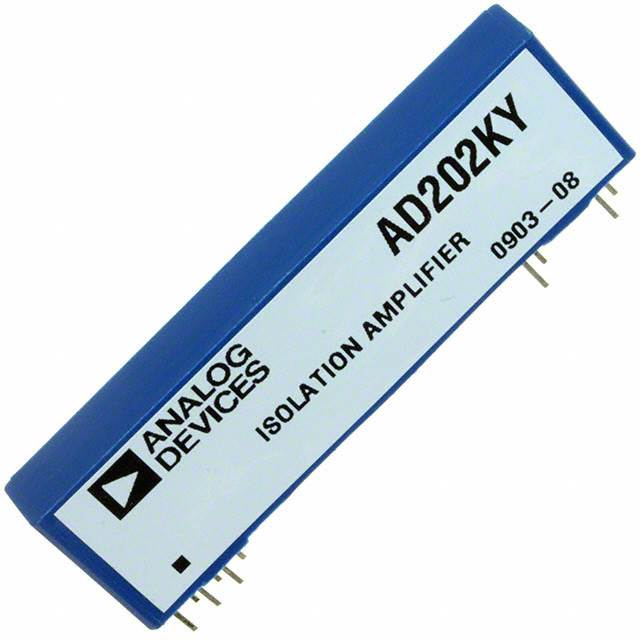
The AD203SN is designed and built expressly for use in hostile
operating environments. The AD203SN is also an integral member of Analog Devices' AD200 Series of low cost, high performance, transformer coupled isolation amplifiers. Technological
innovations in circuit design, transformer construction, surface
mount components and assembly automation have resulted in a
rugged, economical, military temperature range isolator that
either retains or improves upon the key performance specifications of the AD202/AD204 line.
FUNCTIONAL BLOCK DIAGRAM
MODULATOR
DEMODULATOR
'I
INPUT
PORT~ ~OUTPUT PORT
The AD203SN provides total galvanic isolation between the input and output stages of the isolation amplifier, including the
power supplies, through the use of internal transformer coupling. The functionally complete design of the AD203SN, powered by a single + 15 V de supply, eliminates the need for an
external de/de converter. This permits the designer to minimize
the necessary circuit overhead and consequently reduce the overall design and component costs. Furthermore, the power consumption, nonlinearity and drift characteristics of transformer
coupled devices are vastly superior to those achievable with
other isolation technologies, without sacrificing bandwidth or
noise performance. Finally, the AD203SN will maintain its high
operating performance even under sustained common mode
stress.
The design of the AD203SN emphasizes maximum flexibility
and ease of use in a broad range of applications where signals
must be measured or transmitted under high CMV conditions.
The AD203SN has a ± 10 V output range, an uncommitted input amplifier, an output buffer, a 10 kHz full power bandwidth
and a front-end isolated power supply of ± 15 V de (CT; ± 5 mA.
�\
-
AD203SN-SPECIFICAJIQNS (typical@ +25°C, Vs= +15 Vde ~\iless otherwise noted)
GAIN
Range
Error
vs. Temperature 1
-55°C to + 125°C
-55°C to +25°C
-40°C to + 25°C
- 25°C to + 25°C
+ 25°C to + 125°C
vs. Time
vs. Supply Voltage
Nonlinearity 2, G= 1 VN, ±10 V Output Swing
,!
I
1 VN-100 VN
±1% typ (±4% max)
50 ppm/°C
100 ppm/°C
80 ppm/°C
60 ppm/°C
5 ppm/°C
± 50 ppm/1000 hours
±0.005%N
±0.012% (±0.025% max)
INPUT VOLTAGE RATINGS
Linear Differential Range
Max CMV Input to Output
AC, 60 Hz, Continuous
Continuous (ac and de)
Common Mode Rejection (CMR) @ 60 Hz
Rs '.'S 100 !1 (HI & LO Inputs), G = 1 VN
G = 100 VN
Rs '.'S 1 k!1 (Input, HI, LO or Both), G = 1-100 VN
Leakage Current, Input to Output@ 240 V rms, 60 Hz
106dB
120dB
96dB (min)
4.0µA rms (max)
INPUT IMPEDANCE
Differential (G = 1 VN)
Common Mode
1012 n
2 G!1ll4.5 pF
INPUT BIAS CURRENT
Initial @ + 25°C
Current @ + 125°C
30 pA
30 nA
INPUT DIFFERENCE CURRENT
Initial @ + 25°C
Current @ + 125°C
±5 pA
±5 nA
INPUT NOISE
Voltage, 0.1 Hz to 100 Hz
Voltage, Frequency> 200 Hz
4 µV p-p
50 nV/VHz
FREQUENCY RESPONSE
Bandwidth (VoUT '.'S 20 V p--p, G = 1-100 VN)
Slew Rate
Settling Time to ±0.10%
10 kHz
0.5 V/µs
160 µs
OFFSET VOLTAGE, REFERRED TO INPUT (RTI)
Initial @ + 25°C (Adjustable to Zero)
vs. Temperature (-55°C to + 125°C)
± (5 + 25/G) mV (max)
± (6 + 100/G) µVl°C
RATED OUTPUT3
Voltage (Out HI to Out LO) @ RL = 5.0 k!1
Current
Maximum Capacitive Load4
Output Resistance
Output Ripple, 100 kHz Bandwidth
5 kHz Bandwidth
±10 V (min)
±4mA
270 pF
0.2 n
15 mV p-p
0.7 mV rms
ISOLATED POWER OUTPUT5
Voltage, No Load
Accuracy
Current (Either Output)
Re~ulation, No Load to Full Load
Ripple, 100 kHz Bandwidth, Full Load
±15 v
±5%
5mA
5%
llO mV p--p
POWER SUPPLY
Voltage, Rated Performance
Voltage, Operating Performance6
Current, No Load (Vs= +15 V de)
+ 15 V de (±5%)
+ 12 V de to + 16 V de
20mA
±lOV
1500 V rms
±2000 V peak
.
-2Rev. B
�AD203SN
TEMPERATURE RANGE
Rated Performance
Storage
-55°C to + 125°C
- 55°C to + 125°C
PACKAGE DIMENSIONS
Inches
Millimeters
2.23 x 0.83 x 0.65
56.6·X 21.l X 16 5
NOTES
'Refer to Figure 1 for a plot of gain versus temperature.
2
For gains greater than 50 VN, a 100 pF capacitor from the feedback terminal of the input op amp (Pin 38) to the input common terminal (Pin 2) is
recommended in order to minimize the gain nonlinearity. Refer to Figure 17 for a circuit schematic.
3
For additional information on the Rated Output parameters, refer to Figure 9 for a plot of the Output Voltage Swing vs. Power Supply Voltage, and
Figure 10 for the Output Current vs. Temperature and Power Supply Voltage relationship.
•For larger capacitive loads, it is recommended that a 4. 7 fl resistor be placed in series with the load in order to suppress possible output oscillations.
' LO µF (min) decoupling is required .
6 Refer to Figure 9 for a plot of output voltage swing versus supply voltage.
Specifications subject to change without notice.
AC1062 MATING SOCKET
AD203SN PIN DESIGNATIONS
·1 l~~
I' ,...____ ::: ::·::____I
PIN
1
2
~+--'-olo=--=--=----=--'--olo-o:- T~1
- 0 - -- -
----
+
-
I
I
0.100 (2.5) DIA. C/S TO
0.180 (4.6) DIA. TYP
2 PLACES
0.825
20
21
J(21.0)
22
36
37
38
0.600
-!-0-0- - - - -- - ----- 0-!-J:_
3
18
19
I
DESIGNATION
IN+
INCOM
INOUT RTN
OUTHI
PWRIN
NONE
PWRCOM
V;so+
VISOFB
PORT
FUNCTION
INPUT OP AMP: NONINVERTING INPUT INPUT
INPUT
INPUT COMMON
INPUT
INPUT OP AMP: INVERTING INPUT
OUTPUT
OUTPUT RETURN
OUTPUT
OUTPUT SIGNAL
OUTPUT
DC POWER SUPPLY INPUT
NONE
DC POWER SUPPLY COMMON
OUTPUT
INPUT
ISOLATED POWER: + DC
INPUT
ISOLATED POWER: - DC
INPUT
INPUT OP AMP: OUTPUT/FEEDBACK
-
0.125 TYP--11-32
l · l
CONTROLLING DIMENSIONS ARE IN INCHES, MILLIMETER DIMENSIONS
ARE CONVERTED EQUIVALENTS AND SHOULD NOT BE USED FOR DESIGN.
CAUTION~~~~~~~~~~~~~~~~~~~~~~~~~~~~~~~~~~~~
ESD (electrostatic discharge) sens1uve device. Permanent damage may occur on unconnected
devices subject to high energy electrostatic fields. Unused devices must be discharged to the
destination socket before devices are removed.
Note: Per MIL-STD-883C, Method 3015, this device have been classified as a Category 2 ESD
sensitive device.
Rev. B
-3-
WARNING!
0
~~ENSl llVl
UtV ICl
�AD203SN
PRODUCT HIGHLIGHTS
Rugged Design. The AD203SN is specifically designed for
applications where ruggedness and high performance are the key
requirements. The ruggedness of the AD203SN design meets
MIL-STD-883C Methods 1004 (Moisture Resistance), 1010
Condition B (Temperature Cycling, -SS°C to + 125°C), 2002
Condition B (Mechanical Shock @ 1,500 g for 0.5 ms), 2004
(Lead Integrity), 2007 Condition A (Variable Frequency Vibration @ 20 g) and 2015 (Resistance to Solvents).
Engine and vehicular monitor/control systems as well as mobile
instrumentation and control systems are some examples of applications for which the AD203SN is well suited.
Military Temperature Range Rating. With its performance
rated over the -SS°C to + 125°C MIL specification temperature
range, the AD203SN is an excellent choice in applications where
severe environmental conditions may be encountered. Examples
include engine monitoring/control systems and remote power
line monitoring.
10 kHz Bandwidth. With a full power bandwidth of 10 kHz,
the AD203SN is effective in control loop applications where a
smaller bandwidth could induce control system instabilities.
Excellent Common Mode Performance. The AD203SN provides a 1.5 kV rms continuous common mode isolation. A low
common mode input capacitance of 4.5 pF, inclusive of power
isolation, results in a minimum 96 dB of CMR as well as a very
low leakage current of 4.0 µA rms (max @ 240 V rms, 60 Hz).
High Accuracy. Exhibiting a maximum nonlinearity of
±0.025% and a low gain temperature coefficient, averaging
SO ppm/°C over the full temperature range, the AD203SN provides high isolation without loss of signal integrity and quality.
Isolated Power. An isolated power supply capable of delivering ± 15 V de @ ± 5 mA is available at the input port of the
isolator. This permits the AD203SN to power up floating signal
conditioners, front-end amplifiers or remote transducers at the
input.
Flexible Input Stage. An uncommitted op amp is provided on
the input stage. This amplifier provides input buffering and gain
as needed. It also facilitates a host of alternative input functions
including filtering, summing, high voltage ranges and current
(transimpedance) inputs.
DESCRIPTION OF KEY SPECIFICATIONS
Gain Nonlinearity. Nonlinearity is defined as the peak deviation of the output voltage from the best straight line and is expressed as a percent of peak-to-peak output voltage span. The
nonlinearity of the model AD203SN, which operates at a 20 V
p-p output span, is ±0.025% or ±5 mV. Good nonlinearity is
critical for retaining signal fidelity.
Max CMV, Input to Output. Maximum common mode voltage (CMV) describes the amount of voltage that may be applied
across both input terminals with respect to the output terminals
without degrading the integrity of the isolation barrier. High
input-to-output CMV capability is necessary in applications
where high CMV inputs exist or high voltage transients may
occur at the input.
Common Mode Rejection (CMR). CMR describes the isolator's ability to reject common mode voltages that may exist between the inputs and the outputs. High CMR is required when
it is necessary to process small signals riding on high common
mode voltages.
Leakage Current. This is the current that flows from the input common across the isolation barrier to the output common
when the power-line voltage (either 115 V or 240 V rms, 60 Hz)
is impressed on the inputs. Leakage current is dependent on the
magnitude of the coupling capacitance between the input and
the output ports. Line frequency leakage current levels are unaffected by the power ON or OFF condition of the AD203SN.
Common Mode Input Impedance. This is defined to be the
impedance seen across either input terminal (i.e., +IN or - IN)
and the input common.
Input Noise. This specification characterizes the voltage noise
levels that are generated internally by the isolation amplifier. In
order to facilitate a comparison between the "isolator background noise" levels and the expected input signal levels the
input noise parameter is referred to the input.
Input noise is a function of the noise bandwidth, i.e., the frequency range over which the noise characteristics are measured.
Offset Voltage, Referred to Input (RTI). The offset voltage
describes the isolation amplifier's total de offset voltage with the
inputs grounded. The offset voltage is referred to the input in
order to allow for a comparison of the de offset voltages with the
expected input signal levels. The total offset comes from two
sources, namely from the input and output stages, and is gain
dependent. To compute the offset voltage, RTI, the isolator is
modelled as two cascaded amplifier stages. The input stage has a
variable gain G while the output isolation stage has a fixed gain
of 1. RTI offset is then given by:
E 05 (RT!) = E 051 + E 05iG
where:
E 081 = Total input stage offset voltage
E0 s2 = Output stage offset voltage
G
=
Input stage gain.
Offset voltage drift, RTI, is calculated in an identical manner.
Isolated Power Output. Dual supply voltages, completely
isolated from the input power supply terminals, provide the
capability to excite floating input signal conditioners as well as
remote transducers.
-4-
Rev. B
�AD203SN
PERFORMANCE CHARACTERISTICS
This section details the key specifications of the AD203SN that
exhibit a functional dependence on such variables as frequency,
power supply load, output voltage swing, bypass capacitance
and temperature. Table I summarizes the performance characteristics that will be discussed in this section. For the sake of
completeness, a typical dynamic output response of the
AD203SN is included.
Gain Nonlinearity. The maximum nonlinearity error of the
AD203SN, at a gain of 1 VIV, is specified as ±0.025% or
± 5 mV. The nonlinearity performance of the AD203SN is dependent on the output voltage swing and this dependency is illustrated in Figure 2. The horizontal axis represents the gain
error, expressed either in percent of peak-to-peak output span
(i.e., % of 20 V) on the left axis or in mV on the right axis. The
vertical axis indicates the magnitude of the output voltage
swing.
Gain Temperature Coefficient. Figure 1 presents the
AD203SN's gain temperature coefficient over the entire -55°C
to + 125°C temperature range.
0.5k
-1k
II"
-2k
I
E -3k
c.
c.
I -4k
I
2
.........
~ -4
:>
0
-6
Isolated Power. The load characteristics of the AD203SN's isolated power supplies (i.e., + 15 V de and -15 V de) are plotted
in Figure 11.
' '\
The isolated power supply exhibits some ripple which varies as
a function of the load current. Figure 12 demonstrates this
relationship. The AD203SN has internal bypass capacitors that
optimize the tradeoff between output ripple and power supply
performance, even under full load. If a specific application
requires more bypassing on the isolated power supplies, external
capacitors may be added. Figure 13 plots the isolated power
supply ripple as a function of external bypass capacitance under
full load conditions (i.e., 5 mA).
\
-8
-55 -40 -25
+25
TEMPERATURE - °C
+85
+125
Figure 8. Output Offset Voltage rmV) vs. Temperature r°C)
with G=1 VN
13
..,,,..,
12
>ti
~=+10V
(!)
z
"'
10
w
~
0
,_>
v
9
8
/
~/
:>
0.
50
t.>
~ ±15~------=F"""'-..~--+-----~
I
/
I 11
ii:
~v
7
v
w
/
.....
~
.J'......-
0
> ±14 1--------+-----~------t
'.'.;
0.
0.
:>
"'a:w
V 0 =-10V
~
±13
1---------+-----+--·-----t
0.
,_fil
:50
/
'!?
10
11
12
13
14
15
16
SUPPLY VOLTAGE - V DC
±1
±15
±10
±5
LOAD - mA
Figure 9. Output Voltage Swing r±V) vs. Power Supply
Input Voltage (V DC), with a 2.5 kn Load
Figure 11. Isolated Power Supply Voltage (V DC) vs. Load
rmA)
V0 =+10 V
~
-55°C TO +125°C
>
740~-+--+-----+---+-~~-~
~
0.
0.
ii:
~
2 1--------+-----+----------j
,_
1
~ 30~-+-~-i""'-~"--t----t----~
0.
0.
:>
1--------+-----+----------j
"'a:
i'E
~ 201£---+--+----+---+----~
a:
a:
:>
~
t.>
5
e:
i5
-1 1 - - - - - - - - + - - - - - + - - - - - - - - - - j
V 0 =-10 V
-2 ~-----+------+----------j
0
w
:;;:
5
101----+---+-----+---+----+---I
'!?
10
-5L.__ _ _----1._ _ _ ___L_ __:::::,,,,,_,
14.25
14.5
14.75
15.00
SUPPLY VOLTAGE-V DC
Figure 12. Isolated Power Supply Ripple rmv p-p) vs.
Load rmA)
Figure 10. Output Current rmA) vs. Supply Voltage (V DC)
and Temperature r°C), with V150 Loaded at 5 mA
Rev. B
11
LOAD- mA
-7-
�AD203SN
1000
INSIDE THE AD203SN
The functional block diagram of the AD203SN is shown in Figure 14. The AD203SN employs amplitude modulation techniques to implement transformer coupling of signals down to de.
~
>
E
I 200
w
~
0.
~...._
9: 100
"''.'.;
"""
it
""'"'
20
~
10
~
c
The 35 kHz, 30 V p-p square wave carrier used by the
AD203SN is generated by an internal oscillator located in the
· output port of the isolator. This oscillator is powered by a
+ 15 V de supply.
'r--.r-.
"r--..._
~
A full wave modulator translates the input signal to the carrier
frequency which is then transmitted across transformer Tl. The
synchronous demodulator in the output port extracts the input
signal from the carrier. The 12 kHz two-pole filter is employed
to minimize output noise and ripple. Furthermore, the filter
serves as a low impedance output buffer.
~
1
0.1
10
BYPASS CAPACITANCE - µF
100
Figure 13. Isolated Power Supply Ripple (mV p-p} vs. Bypass Capacitance (µF), with a 5 mA Load on ± V150, and
Noise Bandwidth of 1 MHz.
The input port of the AD203SN contains an uncommitted input
op amp, a modulator and the power transformer T2. The primary of the power transformer is driven by the 35 kHz square
wave while the secondary, in conjunction with a rectifier network, supplies isolated power to the modulator, input op amp
and any external load. The uncommitted input amplifier can be
used to supply gain or to buffer the input signals.
The curves in Figures 12 and 13 were generated by measuring
the power supply ripple over a 1 MHz bandwidth.
CAUTION: The AD203SN does not provide for short circuit
protection of its isolated power supply. A current limiting resistor may be placed in series with the isolated power terminals
and the load in order to protect the supply against inadvertent
shorts.
AD203SN
12 kHz
DEMODULATOR
MODULATOR
APPLICABLE STANDARDS
The tests and methods employed in the design verification process are summarized in Table II. A copy of the AD203SN Quality & Reliability Summaries test report, which documents the
results of the tests listed in Table II, is available on request.
LP FILTER
& OUTPUT
BUFFER
T1
'.
'I
''
POWER
-.
OSCILLATOR
t-41-----i
Ill
35kHz
Test Method
Test Description
MIL-STD-883C, Method 1004
Moisture Resistance
MIL-STD-883C, Method 1010
Condition B
Temperature Cycling, - 55°C
to + 125°C
Figure 14. Functional Block Diagram
MIL-STD-883C, Method 2002,
Condition B
Mechanical Shock@ 1,500 g
for 0.5 ms
MIL-STD-883C, Method 2003
Solderability of Terminations
MIL-STD-883C, Method 2004
Integrity of Microelectronic
Device Leads
USING THE AD203SN
Powering the AD203SN. The AD203SN requires only a single
+ 15 V de power supply connected as shown in Figure 15. A
bypass capacitor is provided in the module.
'I
INPUT
PORT~ ~OUTPUT PORT
PWRIN
+12VDCTO
+16 V DC SUPPLY
MIL-STD-883C, Method 2007,
Condition A
Variable Frequency Vibration
@20 g
MIL-STD-883C, Method 2015
Resistance to Solvents
MIL-STD-883C, Method 3015.5
Electrostatic Discharge
Sensitivity Classification
Figure 15. Powering the AD203SN
Analog Devices Product
Reliability Program
MTBF Calculation (per
MIL-HDBK-217D)
and Verification
Unity Gain Input Configuration. The basic unity gain configuration for input signals of up to ± 10 V is shown in Figure 16.
PWRCOM
SUPPLY
COMMON
Table II. Tests Used to Verify the Ruggedness, Reliability
and Quality of the AD203SN Design
Vs1GNAL
Per 883C Method 3015.5, the AD203SN has been classified as a
Class 2 ESD (electrostatic discharge) sensitive device. As a Class
2 device, the AD203SN is insensitive to static discharge voltages
of less than 2000 V.
(±10V)
Figure 16. Basic Unity Gain Configuration
-8-
Rev. B
�AD203SN
Inverting, Summing or Current Input Configuration. Figure
19 shows how the AD203SN can accommodate current inputs or
sum currents or voltages.
Input Configuration for a Gain Greater Than I (G > 1). When
small input signal levels must be amplified and isolated, Figure
17 shows how to get a gain greater than 1 while continuing to
preserve a very high input impedance.
In this circuit, the gain equation may be written as:
where
V0
VsrG
RF
RG =
Output Voltage (V)
Input Signal Voltage (V)
Feedback Resistor Value (!1)
Gain Resistor Value (!1).
Note on the 100 pF Capacitor. Whenever a gain of 50 VIV or
greater is required, a 100 pF capacitor from the FB (input op
amp feedback) terminal to the IN COM (input common) terminal, as shown with the dotted lines in Figure 17, is highly recommended. The capacitor acts to filter out switching noise and
will minimize the isolator's nonlinearity parameter.
Figure 19. Input Configuration for Summing or Current
Input
In this circuit the output voltage equation can be written as:
Vo= -Rpx(Is+Vs1!Rs1+Vs2!Rs2+ ... )
where
V0
Vsi
Vsz
Is
RF
Output Voltage (V)
Voltage of Input Signal 1 (V)
Voltage of Input Signal 2 (V)
Input Current Source (A)
Feedback Resistor Value (!1)
Source Resistance Associated with Input
Rs 1
Signal 1 (!1)
Source Resistance Associated with Input
Signal 2 (!1).
Rs 2
The circuit of Figure 19 can also be used when the input signal
is larger than the ± 10 V input range of the isolator. For example, suppose that in Figure 19 only Vs 1, Rs 1 and RF are connected to the feedback, input and common terminals as shown
by the solid lines in Figure 19. Now, a Vs 1 with a ±100 V span
can be accommodated with Rp = 20 k!1 and a total
Rs 1 =200 k!1.
Figure 17. Input Configuration for a Gain Greater than 1
Compensating the Uncommitted Input Op Amp. The open
loop gain and phase versus frequency for the uncommitted input
op amp are given in Figure 18. These curves are to be used to
determine the appropriate values for the feedback resistor and
compensation capacitor in order to ensure frequency stability
when a gain greater than unity is required. The final values for
these components should also be chosen so as to satisfy the following constraints:
GAIN AND OFFSET ADJUSTMENTS
General Comments. When gain and offset adjustments are
required, the actual compensation circuit ultimately utilized will
depend on:
• The current drawn in the feedback resistor (Rp) is no greater
than 1 mA.
• The input configuration mode of the isolation amplifier
(i.e., noninverting or inverting).
• The feedback (Rp) and gain resistor (RG) result in the desired
amplifier gain.
+ 100
• The placement of the adjusting potentiometer (i.e., on the
isolator's input or output side).
+100°
As a general rule:
',
+80°
+80
\
\
+60° ~
I
2
\
;;
"
\
"
\
\
~ +40
g
~
+40° ~
\
~
• Offset adjustments are best accomplished on the isolator's input side, as it is much easier and more efficient to null the
offset ahead of any gain.
~
\
.,,"' +60
• Gain adjustments are mostly easily accomplished as part of
the gain-setting resistor network at the isolator's input side.
":;
0:
"
I
1 +200 ~
0 +20
• Input adjustments, of the offset and/or gain, are preferred
when the adjusting potentiometers are as near as possible to
the input end of the isolator (so as to minimize strays).
ii:
-20
• Output side adjustments may be necessary under the
conditions where adjusting potentiometers placed on the
input side would present a hazard to the user due to the
presence of high common mode voltages during the adjustment procedure.
~-~-~-~-~--~-~
10
100
lk
10k
100k
1M
-20°
lOM
FREQUENCY - Hz
Figure 18. Open Loop Gain and Phase vs. Frequency for
the Uncommitted Input Op Amp
Rev. B
-9-
�AD203SN
• It is recommended that the offset adjustment precedes the
gain adjustment.
Adjustments for the Noninverting Mode of Operation
Offset Adjustment. Figure 20 shows the suggested input adjustment connections when the isolator's input amplifier is configured for the noninverting mode of operation. The offset adjustment circuit injects a small voltage in series with the low side of
the signal source. The adjustment potentiometer Pl modulates
the injection voltage and is therefore responsible for nulling out
the offset voltage.
Note: • To minimize CMR degradation it is recommended that
the resistor in series with the input LO (i.e., Re) be
below a few hundred ohms.
• The offset adjustment circuit of Figure 20 will not
work if the signal source has another current path to
input common, or if current flows in the signal source
LO lead. If this is the case, use the output adjustment
procedure.
ured for the inverting mode of operation. Here the offset adjustment potentiometer Pl nulls the voltage at the summing node.
This method is preferred over current injection since it is less
affected by any subsequent gain adjustments.
Gain Adjustment. Figure 21 also shows the suggested gain
adjustment circuit. In this circuit, the gain adjustment is made
in the feedback loop using potentiometer P2. The adjustments
will be effective for all gains in the 1 to 100 VN range.
Output Adjustments
Offset Adjustment. Figure 22 shows the recommended technique for offset adjustment at the output. In this circuit, the
± 15 V de voltage is supplied by an independent source. With
reference to the output circuitry shown in Figure 22, the maximum offset adjustment range is given by:
RDxVs
EoFFSET = RD+ Ro
where, Vs is the power supply voltage. A 20 kf! potentiometer
(P0 ) should work well in this adjustment circuit.
Gain Adjustment. Figure 20 also shows the suggested gain
adjustment circuit. Note that the gain adjustment potentiometer
P2 is incorporated into the gain-setting resistor network at the
isolator's input.
t
+15V
ZERO
ADJUST
OUTHI
Po
Ro
GAIN ADJUST
-15V
OUT ATN
PWRIN
(+12V TO +16V DC)
PWRCOM
Figure 22. Output Side Offset Adjustment Circuit
Gain Adjustment. Since the AD203SN's output amplifier is
fixed at unity, any desired output gain adjustments can only be
made in a subsequent stage.
Figure 20. Input Adjustments for the Noninverting Mode
of Operation
An RGA of 47.5 kf! and a 5 kf! potentiometer, resulting in a
median RF value of 50 kf! (i.e., RGA + P2/2), will work nicely
for gains of 10 VN or greater. The gain adjustment becomes
less effective at lower gains, in fact it is halved at G=2 VN, so
that potentiometer P2 will have to be a larger fraction of the
total Rp. At a gain of 1 VN attempting to adjust the gain downwards will compromise the isolator's input impedance. In this
case it would be better to adjust the gain at the signal source or
after the output.
Input Adjustments for the Inverting Mode of Operation
Offset Adjustment. Figure 21 shows the suggested input adjustment connections when the isolator's input amplifier is configGAIN ADJUST
Figure 21. Input Adjustments for the Inverting Mode of
Operation
USING ISOLATED POWER
The AD203SN provides ± 15 V de power outputs referred to
the input common. These may be used to power various accessory circuits which must operate at the input common mode
level. The input offset adjustment circuits of the previous section are examples of this need.
The isolated power supply output has a current capacity of
5 mA which should be sufficient to operate adjustment circuits,
references, op amps, signal conditioners and remote transducers.
CAUTION: The AD203SN does not provide for short circuit
protection of its isolated power supply. A current limiting resistor may be placed in series with the isolated power terminals
and the load in order to protect the supply against inadvertent
shorts.
APPLICATIONS EXAMPLES
Isolated Process Current to Voltage Converter
Figure 23 shows how the AD203SN can be utilized as an isolated receiver that translates a 4-20 mA process current signal
input into a 0 to + 10 V output. The 25 n shunt resistor converts the 4-20 mA current into a + 100 to +500 mV signal. The
signal is then offset by - 100 mV via the use of P0 to produce a
0 to +400 mV input. The signal is then amplified by a gain of
25 resulting in the desired 0 to + 10 V output. With an open
circuit on the input side, the AD203SN will have - 2.5 V on the
output, corresponding to the -100 mV offset voltage multiplied
by a gain of 25 VN.
-10-
Rev. B
�AD203SN
Low Level Inputs
In applications where low level signals need to be isolated (thermocouples are one such application), a low drift input amplifier
can be used with the AD203SN. Figure 25 illustrates this implementation of the AD203SN. The circuit design also includes a
three-pole active filter which provides for enhanced common
mode rejection at 60 Hz and normal mode rejection of frequencies above a few Hz. If any offset adjustments are desired, they
are best done at the trim pins of the low drift input amplifier.
Gain adjustments can be done at the feedback resistor.
Figure 23. Using the AD203SN as an Isolated Process
Current to Voltage Converter
For the circuit of Figure 23, the input to output transfer function can be expressed as:
Vour = 625 xJJN-2.5 V
where
Output Voltage (V)
Input Current in milliamps (mA). This current is
limited to the 4 to 20 mA range.
VouT
IrN
Figure 25. Using the AD203SN with Low Level Inputs
Current Shunt Measurements
In addition to isolating and converting process current signals
into voltage signals, the AD203SN can be used to indicate the
value of any loop current in general. Figure 24 illustrates a typical current shunt measurement application of the AD203SN. A
small sensing resistor RsHUND placed in series with the current
·1oop, develops a small differential voltage that may be further
scaled to provide an isolator output voltage that is directly pro. portional to the current. The voltage developed across the shunt
can potentially be several hundred to a thousand volts above
ground. In this circuit, the AD203SN provides the necessary
scaling of the shunt signal while providing high common-mode
voltage isolation and high common mode rejection of de and
60 Hz components.
The input-output relationship for the circuit shown in Figure 25
can be written as:
Vour = VINx (1 +SO kWRG)
where
VouT
VrN
RG
Output Voltage (V)
Low Level Input Voltage (V)
Isolation Amplifier Gain Resistance (D).
Noise Reduction in Data Acquisition Systems
The AD203SN uses amplitude modulation techniques with a
35 kHz carrier to pass both ac and de signals across the isolation
barrier. Some of the carrier's harmonics are unavoidably passed
through to the isolator output in the form of ripple. In most
cases, this noise source is insignificant when compared to the
measured signal. However, in some applications, particularly
when a fast AID converter is used following the isolator, it may
be desirable to add filtering at the isolator's output in order to
reduce the carrier ripple. Figure 26 shows a circuit that will
reduce the carrier ripple through the use of a two-pole output
filter.
t
VouT {±10V)
PWRIN
Figure 24. Using the AD203SN for Current Shunt
Measurements
The transfer function for the circuit of Figure 24 can be written
as:
VouT
=
RsHuNrx(I+Rp/RG)xlwoP
where
VouT
Rs HUNT
RF
RG
I LOOP
Rev. B
Output Voltage (V)
Sense or Current Shunt Resistance (D)
Feedback Resistance (D)
Gain Resistance (D)
Loop Current (A).
Figure 26. Noise Reduction in Data Acquisition Systems
Using the AD203SN
-11-
�SELECTION GUIDE FOR ANALOG DEVICES' FAMILY OF ISOLATION AMPLIFIERS
.....I
~
~
AD202J
AD202K
AD203SN
AD204J
AD204K
AD210AN
AD210BN
AD210JN
284J
Low Nonlinearity (""±0.01?%)
Low Gain Temp. Co. (""25 ppm/QC)
±0.05%
45 ppm/QC
±0.025%
45 ppm/QC
±0.025%
60 ppm/QC
±0.05%
45 ppm/QC
±0.025%
45 ppm/QC
±0.025%
25 ppm/QC
±0.012%
25 ppm/QC
±0.025%
25 ppm/QC
±0.05%
75 ppm/QC
Isolation
High CMV Rating (2:2.5 kV rms, Continuous)
High CMR (2:104 dB, All Conditions)
Low Leakage Current (""2 µArms, 240 V rms, 60 Hz)
750 V rms
100 dB
2 µArms
1.5 kV rms
100 dB
2 µArms
1.5 kV rms
96 dB
4 µArms
750 V rms
104 dB
2 µArms
1.5 kV rms
104 dB
2 µArms
2.5 kV rms
120 dB
2 µArms
2.5 kV rms
120 dB
2 µArms
1.5 kV rms
120 dB
2 µArms
3.5 kV rms
78 dB
2 µA rms 1
Speed
20 kHz Full Signal Bandwidth
10 kHz Full Signal Bandwidth
5 kHz Full Signal Bandwidth
Fast Settling Time (""150 µs)
Fast Slew Rate (2:1V/ µs)
2 kHz
lms
2kHz
lms
150 µs
0.5 V/ µs
lms
lms
150 µs
1 VI µs
150 µs
1 V/ µs
150 µs
1 V/ µs
25 mV/ µs
Offset
Low Offset Drift Temp. Co. (""20 µV/QC)
20 µV/QC
20 µVl°C
55 µVl°C
20 µVl°C
20 µVl°C
40 µV/QC
40 µV/QC
40 µV/QC
170 µV/QC
Rated Output
± 10 V Differential Output
Low Output Impedance (""l !1)
±5 v
7 k.!1
±5 v
7 k.!1
±10 v
0.2 !1
±5 v
3 k !1
±5 v
3 k !1
±10
1 !1
Isolated Power
Supply
Isolated Front End Power (2:75 mW)
6mW
6mW
150mW
37.5 mW
37.5 mW
150mW
150mW
150mW
85mW
Input Power Supply
Isolator Powered by a de Supply
+15 V de
+15 V de
+ 15 V de
15 v p-p
@25 kHz
+15 V de
+ 15 V de
+ 15 V de
+15 V de
@ 25 kHz
SIP Pkg.
SIP Pkg.
0.735 in 3
0.735 in 3
0.735 in3
1.395 in 3
If You Need:
General
Isolator for Multichannel Applications
Lowest Cost Isolator
3-Port Isolation
Rugged, Military Temperature Range Isolator
Medical Isolator
Gain
Rated Performance
Temperature
-55QC to + 125QC, Rated Range
-40QC to +85QC, Rated Range
-25QC to +85QC, Rated Range
0 to + 70QC, Rated Range2
Packaging
Small Size (0.325 in 3 typ)
SIP Package
DIP Package
SIP Pkg.
SIP Pkg.
700 Hz
1.021 in 3
15
v p-p
v
±10
1 !1
v
NOTES
All performance specification numbers apply for G=l VN and 0 to +7D°C.
Quotations for nonlinearity, gain temperature coefficient, CMV rating and leakage current are max numbers; CMR and offset temperature coefficient are min, all other are
typical.
Isolated front end power specifications are for both the + and - terminals.
I
The 284J leakage applies for 115 V rms.
2 The AD202, AD204 and AD210 series will operate in the -40QC to+85QC temperature range.
PRINTED IN U.S.A.
C1301-10-5/89
±10
1 !1
v
±5
v
1 k.!1
�Data Sheet
AD203SN
OUTLINE DIMENSIONS
2.23 (56.60) MAX
0.65 (16.50)
MAX
SIDE VIEW
0.15 (3.81)
MIN
0.10 (2.50)
TYP
0.018 (0.45)
SQ
1 2 3
0.83 (21.10)
MAX
18 19
0.60 (15.20)
BOTTOM VIEW
38 37 36
22 21 20
CONTROLLING DIMENSIONS ARE IN INCHES; MILLIMETER DIMENSIONS
(IN PARENTHESES) ARE ROUNDED-OFF INCH EQUIVALENTS FOR
REFERENCE ONLY AND ARE NOT APPROPRIATE FOR USE IN DESIGN.
072508-A
1.60 (40.60)
0.215
(5.50)
Figure 27. AD203 SIP Package
(N-11)
11-Lead Count with 38-Lead Spacing
Dimensions shown in inches and (millimeters)
ORDERING GUIDE
Model
AD203SN
Temperature Range
−55°C to +125°C
Package Description
11-Lead SIP Package
Package Option
N-11
�Data Sheet
REVISION HISTORY
8/2016—Rev. A to Rev. B
Changes to Features Section ............................................................ 1
Deleted Prices .................................................................................... 3
©2002–2016 Analog Devices, Inc. All rights reserved. Trademarks and
registered trademarks are the property of their respective owners.
D02988-0-8/16(B)
AD203SN
�