a
32-Channel, 14-Bit DAC with Precision
Infinite Sample-and-Hold Mode
AD5532B*
GENERAL DESCRIPTION
FEATURES
High Integration:
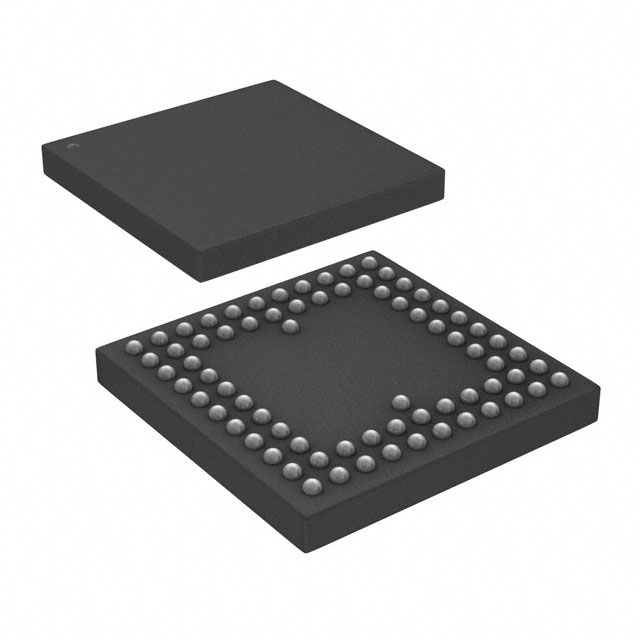
32-Channel DAC in 12 mm � 12 mm CSPBGA
Guaranteed Monotonic to 14 Bits
Infinite Sample-and-Hold Capability to �0.018% Accuracy
Infinite Sample-and-Hold Total Unadjusted Error �2.5 mV
Adjustable Voltage Output Range
Readback Capability
DSP/Microcontroller Compatible Serial Interface
Output Impedance 0.5 �
Output Voltage Span 10 V
Temperature Range –40�C to +85�C
The AD5532B is a 32-channel, voltage output, 14-bit DAC with
an additional precision infinite sample-and-hold mode. The
selected DAC register is written to via the 3-wire serial interface and VOUT for this DAC is then updated to reflect the new
contents of the DAC register. DAC selection is accomplished via
address bits A0–A4. The output voltage range is determined by
the offset voltage at the OFFS_IN pin and the gain of the
output amplifier. It is restricted to a range from VSS + 2 V to
VDD – 2 V because of the headroom of the output amplifier.
The device is operated with AVCC = +5 V ± 5%, DVCC = +2.7 V
to +5.25 V, VSS = –4.75 V to –16.5 V, and VDD = +8 V to +16.5 V
and requires a stable 3 V reference on REF_IN as well as an
offset voltage on OFFS_IN.
APPLICATIONS
Automatic Test Equipment
Optical Networks
Level Setting
Instrumentation
Industrial Control Systems
Data Acquisition
Low Cost I/O
PRODUCT HIGHLIGHTS
1. 32-channel, 14-bit DAC in one package, guaranteed
monotonic.
2. The AD5532B is available in a 74-lead CSPBGA with a body
size of 12 mm � 12 mm.
3. In infinite sample-and-hold mode, a total unadjusted error of
± 2.5 mV is achieved by laser-trimming on-chip resistors.
FUNCTIONAL BLOCK DIAGRAM
DVCC AVCC
REF IN REF OUT
OFFS IN
VDD
VSS
AD5532B
VOUT 0
VIN
ADC
DAC
TRACK / RESET
14-BIT
BUS
BUSY
DAC GND
MUX
VOUT 31
DAC
AGND
OFFS OUT
DAC
DGND
SER /PAR
MODE
INTERFACE
CONTROL
LOGIC
SCLK DIN DOUT
ADDRESS INPUT REGISTER
SYNC / CS
A4–A0
CAL
WR
OFFSET_SEL
*Protected by U.S. Patent No. 5,969,657.
REV. A
Information furnished by Analog Devices is believed to be accurate and
reliable. However, no responsibility is assumed by Analog Devices for its
use, nor for any infringements of patents or other rights of third parties that
may result from its use. No license is granted by implication or otherwise
under any patent or patent rights of Analog Devices.
One Technology Way, P.O. Box 9106, Norwood, MA 02062-9106, U.S.A.
Tel: 781/329-4700
www.analog.com
Fax: 781/326-8703
© Analog Devices, Inc., 2002
�(VDD = +8 V to +16.5 V, VSS = –4.75 V to –16.5 V; AVCC = +4.75 V to +5.25 V;
AD5532B–SPECIFICATIONS DV = +2.7 V to +5.25 V; AGND = DGND = DAC_GND = 0 V; REF_IN = 3 V;
OFFS_IN = OV; Output Range from V + 2 V to V – 2 V. All outputs unloaded. All specifications T to T , unless otherwise noted.)
CC
SS
DD
MIN
MAX
AD5532B-1
Parameter1
B Version2
Unit
DAC DC PERFORMANCE
Resolution
Integral Nonlinearity (INL)
Differential Nonlinearity (DNL)
Offset
Gain
Full-Scale Error
14
± 0.39
±1
90/170/250
3.52
–1/+0.5
Bits
% of FSR max
LSB max
mV min/typ/max
typ
% of FSR max
± 0.006
± 0.018
± 2.5
± 12
±1
± 10
3.51/3.52/3.53
% typ
% max
mV typ
mV max
mV typ
mV max
min/typ/max
After Offset and Gain Adjustment
0 to 3
70
V
mV max
Input Upper Dead Band
40
mV max
Input Current
1
µA max
Nominal Input Range
50 mV typ. Referred to VIN.
See Figure 7.
12 mV typ. Referred to VIN.
See Figure 7.
100 nA typ. VIN acquired
on one channel.
Input Capacitance4
20
pF typ
1
0/4
µA max
V min/max
3.0
2.85/3.15
1
V typ
V min/max
µA max
3
280
60
V typ
kΩ typ
ppm/°C typ
10
0.5
VSS + 2/VDD – 2
5
100
7
–70
–70
250
ppm/°C typ
Ω typ
V min/max
kΩ min
pF max
mA typ
dB
dB
µV max
10
1.3
50 to REF_IN – 12
10
100
ppm/°C typ
kΩ typ
mV typ
µA max
pF max
ISHA DC PERFORMANCE
VIN to VOUT Nonlinearity3
Total Unadjusted Error (TUE)
Offset Error
Gain
ISHA ANALOG INPUT (VIN)
Input Voltage Range
Input Lower Dead Band
ANALOG INPUT (OFFS_IN)
Input Current
Input Voltage Range
VOLTAGE REFERENCE
REF_IN
Nominal Input Voltage
Input Voltage Range4
Input Current
REF_OUT
Output Voltage
Output Impedance4
Reference Temperature Coefficient4
ANALOG OUTPUTS (VOUT 0–31)
Output Temperature Coefficient4, 5
DC Output Impedance4
Output Range
Resistive Load4, 6
Capacitive Load4, 6
Short-Circuit Current4
DC Power-Supply Rejection Ratio4
DC Crosstalk4
ANALOG OUTPUT (OFFS_OUT)
Output Temperature Coefficient4, 5
DC Output Impedance4
Output Range
Output Current
Capacitive Load
–2–
Conditions/ Comments
± 0.15% typ
± 0.5 LSB typ Monotonic
See Figure 6.
See TPC 6.
100 nA typ
Output Range Restricted from
VSS + 2 V to VDD – 2 V
VOUT = (Gain × VDAC) – (Gain –1) ×
VOFFS_IN = 50 mV.
Analog Input (ISHA Mode)
Output Buffer Stage—Gain and Offset
The function of the output buffer stage is to translate the 50 mV–3 V
typical output of the DAC to a wider range. This is done by
gaining up the DAC output by 3.52 and offsetting the voltage
by the voltage on OFFS_IN pin.
VOUT = 3.52 × VDAC – 2.52 × VOFFS _ IN
VDAC is the output of the DAC.
VOFFS_IN is the voltage at the OFFS_IN pin.
The equivalent analog input circuit is shown in Figure 8. The
capacitor C1 is typically 20 pF and can be attributed to pin
capacitance and 32 off-channels. When a channel is selected, an
extra 7.5 pF (typ) is switched in. This capacitor C2 is charged
to the previously acquired voltage on that particular channel
so it must charge/discharge to the new level. It is essential that the
external source can charge/discharge this additional capacitance
within 1 µs to 2 µs of channel selection so that VIN can be
acquired accurately. For this reason a low impedance source
is recommended.
Table I shows how the output range on VOUT relates to the offset
voltage supplied by the user:
ADDRESSED
CHANNEL
VIN
Table I. Sample Output Voltage Ranges
VOFFS_IN
(V)
VDAC (Typ)
(V)
VOUT (Typ)
(V)
0
1
2.130
0.05 to 3
0.05 to 3
0.05 to 3
0.176 to 10.56
–2.34 to +8.04
–5.192 to +5.192
C1
20pF
C2
7.5pF
Figure 8. Analog Input Circuit
VOUT is limited only by the headroom of the output amplifiers.
VOUT must be within maximum ratings.
Large source impedances will significantly affect the performance
of the ADC. This may necessitate the use of an input buffer
amplifier.
Offset Voltage Channel
TRACK Function (ISHA Mode)
The offset voltage can be externally supplied by the user at
OFFS_IN or it can be supplied by an additional offset voltage
channel on the device itself. The offset can be set up in two ways.
In ISHA mode the required offset voltage is set up on VIN
and acquired by the offset channel. In DAC mode, the code
corresponding to the offset value is loaded directly into the
offset DAC. This offset channel’s DAC output is directly
connected to the OFFS_OUT pin. By connecting OFFS_OUT to
OFFS_IN this offset voltage can be used as the offset voltage
for the 32 output amplifiers. The offset must be chosen so
that VOUT is within maximum ratings.
Reset Function
The reset function on the AD5532B can be used to reset all nodes
on this device to their power-on-reset condition. This is implemented by applying a low going pulse of between 90 ns and 200 ns
to the TRACK/RESET pin on the device. If the applied pulse is
less than 90 ns, it is assumed to be a glitch and no operation
takes place. If the applied pulse is wider than 200 ns, this pin
adopts its track function on the selected channel, VIN is switched
to the output buffer, and an acquisition on the channel will not
occur until a rising edge of TRACK.
REV. A
Normally in ISHA mode of operation, TRACK is held high and
the channel begins to acquire when it is addressed. However, if
TRACK is low when the channel is addressed, VIN is switched to
the output buffer and an acquisition on the channel will not
occur until a rising edge of TRACK. At this stage the BUSY pin
will go low until the acquisition is complete, at which point the
DAC assumes control of the voltage to the output buffer and
VIN is free to change again without affecting this output value.
This is useful in an application where the user wants to ramp up
VIN until VOUT reaches a particular level (Figure 9). VIN does
not need to be acquired continuously while it is ramping up.
TRACK can be kept low and only when VOUT has reached its
desired voltage is TRACK brought high. At this stage, the
acquisition of VIN begins.
In the example shown, a desired voltage is required on the output
of the pin driver. This voltage is represented by one input to a
comparator. The microcontroller/microprocessor ramps up the
input voltage on VIN through a DAC. TRACK is kept low
while the voltage on VIN ramps up so that VIN is not continually acquired. When the desired voltage is reached on the output
–11–
�AD5532B
PIN
DRIVER
VIN
DAC
CONTROLLER
VOUT1
OUTPUT
STAGE
ACQUISITION
CIRCUIT
DEVICE
UNDER
TEST
BUSY
AD5532B
TRACK
THRESHOLD
VOLTAGE
ONLY ONE CHANNEL SHOWN FOR SIMPLICITY
Figure 9. Typical ATE Circuit Using TRACK Input
of the pin driver, the comparator output switches. The µC/µP
then knows what code is required to be input in order to obtain
the desired voltage at the DUT. The TRACK input is now
brought high and the part begins to acquire VIN. At this stage,
BUSY goes low until VIN has been acquired. The output buffer
is then switched from VIN to the output of the DAC.
MODES OF OPERATION
The AD5532B can be used in four different modes of operation. These modes are set by two mode bits, the first two bits in
the serial word.
Table II. Modes of Operation
Mode Bit 1
Mode Bit 2
Operating Mode
0
0
1
1
0
1
0
1
ISHA Mode
DAC Mode
Acquire and Readback
Readback
1. ISHA Mode
In this mode, a channel is addressed and that channel
acquires the voltage on VIN. This mode requires a 10-bit
write (see Figure 3) to address the relevant channel (VOUT0–
VOUT31, offset channel or all channels). MSB is written first.
MSB
LSB
0
0
CAL
OFFSET SEL
A4 –A0
0
MODE BIT 1 MODE BIT 2
TEST BIT
MODE BITS
a. 10-Bit Input Serial Write Word (ISHA Mode)
MSB
LSB
0
1
CAL
OFFSET SEL
0
A4 –A0
DB13–DB0
TEST BIT
MODE BITS
b. 24-Bit Input Serial Write Word (DAC Mode)
LSB
MSB
1
0
CAL
OFFSET SEL
0
MSB
A4 –A0
LSB
DB1 3 –DB0
TEST BIT
MODE BITS
14-BIT DATA
READ FROM PART AFTER
NEXT FALLING EDGE OF SYNC
(DB13 = MSB OF DAC WORD)
10-BIT
SERIAL WORD
WRITTEN TO PART
c. Input Serial Interface (Acquire and Readback Mode)
LSB
MSB
1
1
CAL
0
OFFSET SEL
MSB
A4 –A0
LSB
DB1 3 –DB0
TEST BIT
MODE BITS
14-BIT DATA
READ FROM PART AFTER
NEXT FALLING EDGE OF SYNC
(DB13 = MSB OF DAC WORD)
10-BIT
SERIAL WORD
WRITTEN TO PART
d. Input Serial Interface (Readback Mode)
Figure 10. Serial Interface Formats
–12–
REV. A
�AD5532B
2. DAC Mode
In this standard mode, a selected DAC register is loaded serially.
This requires a 24-bit write (10 bits to address the relevant
DAC plus an extra 14 bits of DAC data). (See Figure 4.) MSB
is written first. The user must allow 400 ns (min) between
successive writes in DAC mode.
3. Acquire and Readback Mode
This mode allows the user to acquire VIN and read back the
data in a particular DAC register. The relevant channel is
addressed (10-bit write, MSB first) and VIN is acquired in
16 µs (max). Following the acquisition, after the next falling
edge of SYNC, the data in the relevant DAC register is
clocked out onto the DOUT line in a 14-bit serial format.
(See Figure 5.) The full acquisition time must elapse before
the DAC register data can be clocked out.
4. Readback Mode
Again, this is a readback mode but no acquisition is performed.
The relevant channel is addressed (10-bit write, MSB first)
and on the next falling edge of SYNC, the data in the relevant
DAC register is clocked out onto the DOUT line in a 14-bit
serial format. (See Figure 5.) The user must allow 400 ns (min)
between the last SCLK falling edge in the 10-bit write and
the falling edge of SYNC in the 14-bit readback. The serial
write and read words can be seen in Figure 10.
This feature allows the user to read back the DAC register
code of any of the channels. In DAC mode, this is useful in
verification of write cycles. In ISHA mode, readback is useful
if the system has been calibrated and the user wants to know
what code in the DAC corresponds to a desired voltage on
VOUT. If the user requires this voltage again, the user can input
the code directly to the DAC register without going through
the acquisition sequence.
INTERFACES
SERIAL INTERFACE
The SER/PAR pin is tied high to enable the serial interface and
to disable the parallel interface. The serial interface is controlled
by four pins as follows:
SYNC, DIN, SCLK
Test Bit
This must be set low for correct operation of the part.
A4–A0 Bits
Used to address any one of the 32 channels (A4 = MSB of
address, A0 = LSB).
DB13–DB0 Bits
These are used to write a 14-bit word into the addressed DAC
register. Clearly, this is only valid when in DAC mode.
The serial interface is designed to allow easy interfacing to most
microcontrollers and DSPs, e.g., PIC16C, PIC17C, QSPI™, SPI™,
DSP56000, TMS320, and ADSP-21xx, without the need for any
glue logic. When interfacing to the 8051, the SCLK must be inverted.
The Microprocessor/Microcontroller Interface section explains
how to interface to some popular DSPs and microcontrollers.
Figures 3, 4, and 5 show the timing diagram for a serial read and
write to the AD5532B. The serial interface works with both a continuous and a noncontinuous serial clock. The first falling edge of
SYNC resets a counter that counts the number of serial clocks
to ensure the correct number of bits are shifted in and out of the
serial shift registers. Any further edges on SYNC are ignored until
the correct number of bits are shifted in or out. Once the correct
number of bits for the selected mode have been shifted in or out,
the SCLK is ignored. In order for another serial transfer to take
place, the counter must be reset by the falling edge of SYNC.
In readback, the first rising SCLK edge after the falling edge of
SYNC causes DOUT to leave its high impedance state and data
is clocked out onto the DOUT line and also on subsequent SCLK
rising edges. The DOUT pin goes back into a high impedance
state on the falling edge of the fourteenth SCLK. Data on the
DIN line is latched in on the first SCLK falling edge after the
falling edge of the SYNC signal and on subsequent SCLK falling
edges. During readback DIN is ignored. The serial interface will
not shift data in or out until it receives the falling edge of the
SYNC signal.
PARALLEL INTERFACE (ISHA Mode Only)
The SER/PAR bit must be tied low to enable the parallel interface
and disable the serial interface. The parallel interface is controlled
by nine pins.
Standard 3-wire interface pins. The SYNC pin is shared
with the CS function of the parallel interface.
CS
Active low package select pin. This pin is shared with the
SYNC function for the serial interface.
DOUT
WR
Data out pin for reading back the contents of the DAC
registers. The data is clocked out on the rising edge of SCLK
and is valid on the falling edge of SCLK.
Active low write pin. The values on the address pins are
latched on a rising edge of WR.
Mode Bits
A4–A0
There are four different modes of operation as described above.
Five address pins (A4 = MSB of address, A0 = LSB). These
are used to address the relevant channel (out of a possible 32).
Cal Bit
In DAC mode, this is a test bit. When it is high it is used to load
all zeros or all ones to the 32 DACs simultaneously. In ISHA mode,
all 32 channels acquire VIN simultaneously when this bit is high.
In ISHA mode, the acquisition time is then 45 µs (typ) and
accuracy may be reduced. This bit is set low for normal operation.
Offset_Sel
Offset_Sel Bit
When this pin is high, all 32 channels acquire VIN simultaneously. The acquisition time is then 45 µs (typ) and accuracy
may be reduced.
Offset select pin. This has the same function as the Offset_Sel
bit in the serial interface. When it is high, the offset channel
is addressed. The address on A4–A0 is ignored in this case.
Cal
If this is set high, the offset channel is selected and Bits A4–A0
are ignored.
*SPI and QSPI are trademarks of Motorola, Inc.
REV. A
–13–
�AD5532B
MICROPROCESSOR INTERFACING
AD5532B to ADSP-21xx Interface
The ADSP-21xx family of DSPs is easily interfaced to the
AD5532B without the need for extra logic.
A data transfer is initiated by writing a word to the TX register
after the SPORT has been enabled. In a write sequence, data is
clocked out on each rising edge of the DSP’s serial clock and
clocked into the AD5532B on the falling edge of its SCLK.
In readback, 16 bits of data are clocked out of the AD5532B on
each rising edge of SCLK and clocked into the DSP on the
rising edge of SCLK. DIN is ignored. The valid 14 bits of data
will be centered in the 16-bit RX register when using this configuration. The SPORT control register should be set up as follows:
TFSW
INVRFS
DTYPE
ISCLK
TFSR
IRFS
ITFS
SLEN
SLEN
SLEN
=
=
=
=
=
=
=
=
=
=
RFSW = 1, Alternate Framing
INVTFS = 1, Active Low Frame Signal
00, Right Justify Data
1, Internal Serial Clock
RFSR = 1, Frame Every Word
0, External Framing Signal
1, Internal Framing Signal
1001, 10-Bit Data-Words (ISHA Mode Write)
0111, 3 8-Bit Data-Words (DAC Mode Write)
1111, 16-Bit Data-Words (Readback Mode)
When data is being transmitted to the AD5532B, the SYNC line
is taken low (PC7). Data appearing on the MOSI output is valid
on the falling edge of SCK. Serial data from the 68HC11 is
transmitted in 8-bit bytes with only eight falling clock edges
occurring in the transmit cycle. Data is transmitted MSB first. In
order to transmit 10 data bits in ISHA mode, it is important to
left-justify the data in the SPDR register. PC7 must be pulled
low to start a transfer. It is taken high and pulled low again before
any further read/write cycles can take place.
AD5532B to PIC16C6x/7x
The PIC16C6x/7x synchronous serial port (SSP) is configured as
an SPI master with the clock polarity bit = 0. This is done by
writing to the synchronous serial port control register (SSPCON).
See PIC16/17 Microcontroller User Manual. In this example,
I/O port RA1 is being used to pulse SYNC and enable the serial
port of the AD5532B. This microcontroller transfers only eight
bits of data during each serial transfer operation; therefore, two or
three consecutive read/write operations are needed depending
on the mode. Figure 13 shows the connection diagram.
PIC16C6x/7x*
AD5532B*
SCLK
SCK/RC3
DOUT
SDO/RC5
Figure 11 shows the connection diagram.
DIN
SYNC
ADSP-2101/
AD5532B*
DOUT
DR ADSP-2103*
SYNC
TFS
DIN
SCLK
SDI/RC4
RA1
*ADDITIONAL PINS OMITTED FOR CLARITY
Figure 13. AD5532B to PIC16C6x/7x Interface
RFS
AD5532B to 8051
DT
The AD5532B requires a clock synchronized to the serial data. The
8051 serial interface must therefore be operated in Mode 0. In this
mode, serial data enters and exits through RxD and a shift clock
is output on TxD. Figure 14 shows how the 8051 is connected
to the AD5532B. Because the AD5532B shifts data out on the
rising edge of the shift clock and latches data in on the falling
edge, the shift clock must be inverted. The AD5532B requires its
data with the MSB first. Since the 8051 outputs the LSB first,
the transmit routine must take this into account.
SCLK
*ADDITIONAL PINS OMITTED FOR CLARITY
Figure 11. AD5532B to ADSP-2101/ADSP-2103 Interface
AD5532B to MC68HC11
The serial peripheral interface (SPI) on the MC68HC11 is configured for master mode (MSTR = 1), clock polarity bit (CPOL) = 0,
and the clock phase bit (CPHA) = 1. The SPI is configured by
writing to the SPI control register (SPCR)—see 68HC11 User
Manual. SCK of the 68HC11 drives the SCLK of the AD5532B, the
MOSI output drives the serial data line (DIN) of the AD5532B,
and the MISO input is driven from DOUT. The SYNC signal is
derived from a port line (PC7). A connection diagram is shown
in Figure 12.
8051*
AD5532B*
SCLK
TxD
DOUT
RxD
DIN
SYNC
P1.1
*ADDITIONAL PINS OMITTED FOR CLARITY
MC68HC11*
AD5532B*
DOUT
SYNC
PC7
SCLK
SCK
DIN
Figure 14. AD5532B to 8051 Interface
MISO
MOSI
*ADDITIONAL PINS OMITTED FOR CLARITY
Figure 12. AD5532B to MC68HC11 Interface
–14–
REV. A
�AD5532B
APPLICATION CIRCUITS
AD5532B in a Typical ATE System
Typical Application Circuit (ISHA Mode)
The AD5532B is ideally suited for use in automatic test
equipment. Several DACs are required to control pin drivers,
comparators, active loads, and signal timing. Traditionally,
sample-and-hold devices were used in these applications.
The AD5532B has several advantages: no refreshing is required,
there is no droop, pedestal error is eliminated, and there is no
need for extra filtering to remove glitches. Overall a higher level
of integration is achieved in a smaller area (see Figure 15).
The AD5532B can be used to set up voltage levels on 32 channels
as shown in the circuit below. An AD780 provides the 3 V reference for the AD5532B, and for the AD5541 16-bit DAC. A simple
3-wire serial interface is used to write to the AD5541. Because
the AD5541 has an output resistance of 6.25 kW (typ), the time
taken to charge/discharge the capacitance at the VIN pin is significant. Thus an AD820 is used to buffer the DAC output. Note
that it is important to minimize noise on VIN and REFIN when
laying out this circuit.
AVCC DVCC
AVCC
PARAMETRIC
MEASUREMENT SYSTEM BUS
UNIT
DAC
DAC
VDD
ACTIVE
LOAD
DAC
STORED
DATA
AND INHIBIT
PATTERN
VSS
CS
DIN
SCLK
AD5541*
AD820
VIN
AD5532B*
VOUT 0–31
OFFS_IN
REF
OFFS_OUT
DRIVER
DAC
REFIN
FORMATTER
DUT
DAC
PERIOD
GENERATION
AND
DELAY
TIMING
AD780*
VOUT
DAC
COMPARE
REGISTER
SCLK DIN
SYNC
*ADDITIONAL PINS OMITTED FOR CLARITY
DAC
Figure 17. Typical Application Circuit (ISHA Mode)
COMPARATOR
SYSTEM BUS
DACs
POWER SUPPLY DECOUPLING
Figure 15. AD5532B in an ATE System
Typical Application Circuit (DAC Mode)
The AD5532B can be used in many optical networking applications
that require a large number of DACs to perform control and
measurement functions. In the example shown in Figure 16, the
outputs of the AD5532B are amplified and used to control actuators
that determine the position of MEMS mirrors in an optical switch.
The exact position of each mirror is measured using sensors. The
sensor readings are muxed using four dual 4-channel matrix switches
(ADG739) and fed back to an 8-channel 14-bit ADC (AD7856).
The control loop is driven by an ADSP-2191M, a 16-bit fixedpoint DSP with three SPORT interfaces and two SPI ports. The
DSP uses some of these serial ports to write data to the DAC,
control the multiplexer, and read back data from the ADC.
1
AD5532B
32
MEMS
MIRROR
ARRAY
1
32
S
E
N
S
O
R
In any circuit where accuracy is important, careful consideration
of the power supply and ground return layout helps to ensure the
rated performance. The printed circuit board on which the
AD5532B is mounted should be designed so that the analog and
digital sections are separated, and confined to certain areas of the
board. If the AD5532B is in a system where multiple devices require
an AGND-to-DGND connection, the connection should be made
at one point only. The star ground point should be established
as close as possible to the device. For supplies with multiple pins
(VSS, VDD, AVCC), it is recommended to tie those pins together.
The AD5532B should have ample supply bypassing of 10 µF in
parallel with 0.1 µF on each supply located as close to the package
as possible, ideally right up against the device. The 10 µF capacitors
are the tantalum bead type. The 0.1 µF capacitor should have
low effective series resistance (ESR) and effective series inductance (ESI), like the common ceramic types that provide a low
impedance path to ground at high frequencies, to handle transient
currents due to internal logic switching.
1
ADG739
AD7856
�4
8
AD8544
�2
ADSP-2191M
Figure 16. Typical Optical Control and
Measurement Application Circuit
REV. A
–15–
�09/19/02 2:30 PM_GS
AD5532B
Note that it is essential to minimize noise on VIN and REFIN
lines. Particularly for optimum ISHA performance, the VIN line
must be kept noise-free. Depending on the noise performance of
the board, a noise filtering capacitor may be required on the VIN
line. If this capacitor is necessary, then for optimum throughput
it may be necessary to buffer the source that is driving VIN.
Avoid crossover of digital and analog signals. Traces on opposite
sides of the board should run at right angles to each other. This
reduces the effects of feedthrough through the board. A microstrip
technique is by far the best, but not always possible with a doublesided board. In this technique, the component side of the board
is dedicated to ground plane while signal traces are placed on the
solder side.
As is the case for all thin packages, care must be taken to avoid
flexing the package and to avoid a point load on the surface of
the package during the assembly process.
C02709–0–9/02(A)
The power supply lines of the AD5532B should use as large a trace
as possible to provide low impedance paths and reduce the effects of
glitches on the power supply line. Fast switching signals such as
clocks should be shielded with digital ground to avoid radiating
noise to other parts of the board, and should never be run near
the reference inputs. A ground line routed between the DIN and
SCLK lines will help reduce crosstalk between them (not required
on a multilayer board as there will be a separate ground plane,
but separating the lines will help).
OUTLINE DIMENSIONS
74-Lead Chip Scale Ball Grid Array [CSPBGA]
(BC-74)
Dimensions shown in millimeters
A1 CORNER
INDEX AREA
12.00 BSC
SQ
11 10 9 8 7 6 5 4 3 2 1
A1
TOP VIEW
1.00
BSC
BOT TOM
VIEW
A
B
C
D
E
F 10.00 BSC
SQ
G
H
J
K
L
1.00 BSC
1.70
MAX
DETAIL A
DETAIL A
0.30 MIN
0.20 MAX
COPLANARITY
0.70
SEATING
0.60
PLANE
0.50
BALL DIAMETER
Revision History
Location
Page
9/02—Data Sheet changed from REV. 0 to REV. A.
Term LFBGA updated to CSPBGA . . . . . . . . . . . . . . . . . . . . . . . . . . . . . . . . . . . . . . . . . . . . . . . . . . . . . . . . . . . . . . . . . . . . Global
Changes to SERIAL INTERFACE table . . . . . . . . . . . . . . . . . . . . . . . . . . . . . . . . . . . . . . . . . . . . . . . . . . . . . . . . . . . . . . . . . . . . . .4
Replaced Figure 5 . . . . . . . . . . . . . . . . . . . . . . . . . . . . . . . . . . . . . . . . . . . . . . . . . . . . . . . . . . . . . . . . . . . . . . . . . . . . . . . . . . . . . . .5
Changes to ABSOLUTE MAXIMUM RATINGS . . . . . . . . . . . . . . . . . . . . . . . . . . . . . . . . . . . . . . . . . . . . . . . . . . . . . . . . . . . . . . 6
Changes to Figure 8 . . . . . . . . . . . . . . . . . . . . . . . . . . . . . . . . . . . . . . . . . . . . . . . . . . . . . . . . . . . . . . . . . . . . . . . . . . . . . . . . . . . . . 11
Updated BC-74 package drawing . . . . . . . . . . . . . . . . . . . . . . . . . . . . . . . . . . . . . . . . . . . . . . . . . . . . . . . . . . . . . . . . . . . . . . . . . . 16
–16–
REV. A
PRINTED IN U.S.A.
COMPLIANT TO JEDEC STANDARDS MO-192ABD-1
�