a
FEATURES
User Programmed Gains of 1 to 10,000
Low Gain Error: 0.02% Max
Low Gain TC: 5 ppm/�C Max
Low Nonlinearity: 0.001% Max
Low Offset Voltage: 25 �V
Low Noise 4 nV/√Hz (at 1 kHz) RTI
Gain Bandwidth Product: 25 MHz
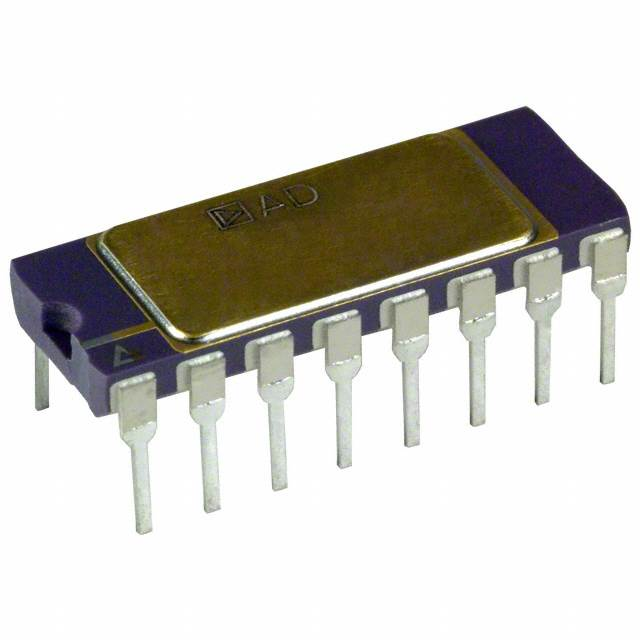
16-Lead Ceramic or Plastic DIP Package,
20-Terminal LCC Package
Standard Military Drawing Available
MlL-Standard Parts Available
Low Cost
Programmable Gain
Instrumentation Amplifier
AD625
FUNCTIONAL BLOCK DIAGRAM
50�
–INPUT
–
+
–
AD625
+
–GAIN
SENSE
10k�
SENSE
–GAIN
DRIVE
10k�
VB
+GAIN
DRIVE
–
OUTPUT
+
10k�
REFERENCE
+GAIN
SENSE
50�
+INPUT
10k�
–
+
–
+
PRODUCT DESCRIPTION
PRODUCT HIGHLIGHTS
The AD625 is a precision instrumentation amplifier specifically
designed to fulfill two major areas of application: 1) Circuits requiring nonstandard gains (i.e., gains not easily achievable with
devices such as the AD524 and AD624). 2) Circuits requiring a
low cost, precision software programmable gain amplifier.
1. The AD625 affords up to 16-bit precision for user selected
fixed gains from 1 to 10,000. Any gain in this range can be
programmed by 3 external resistors.
For low noise, high CMRR, and low drift the AD625JN is the
most cost effective instrumentation amplifier solution available.
An additional three resistors allow the user to set any gain from
1 to 10,000. The error contribution of the AD625JN is less than
0.05% gain error and under 5 ppm/°C gain TC; performance
limitations are primarily determined by the external resistors.
Common-mode rejection is independent of the feedback resistor
matching.
A software programmable gain amplifier (SPGA) can be configured with the addition of a CMOS multiplexer (or other switch
network), and a suitable resistor network. Because the ON
resistance of the switches is removed from the signal path, an
AD625 based SPGA will deliver 12-bit precision, and can be
programmed for any set of gains between 1 and 10,000, with
completely user selected gain steps.
2. A 12-bit software programmable gain amplifier can be configured using the AD625, a CMOS multiplexer and a resistor
network. Unlike previous instrumentation amplifier designs,
the ON resistance of a CMOS switch does not affect the gain
accuracy.
3. The gain accuracy and gain temperature coefficient of the
amplifier circuit are primarily dependent on the user selected
external resistors.
4. The AD625 provides totally independent input and output
offset nulling terminals for high precision applications. This
minimizes the effects of offset voltage in gain-ranging
applications.
5. The proprietary design of the AD625 provides input voltage
noise of 4 nV/√Hz at 1 kHz.
6. External resistor matching is not required to maintain high
common-mode rejection.
For the highest precision the AD625C offers an input offset
voltage drift of less than 0.25 µV/°C, output offset drift below
15 µV/°C, and a maximum nonlinearity of 0.001% at G = 1. All
grades exhibit excellent ac performance; a 25 MHz gain bandwidth product, 5 V/µs slew rate and 15 µs settling time.
The AD625 is available in three accuracy grades (A, B, C) for
industrial (–40°C to +85°C) temperature range, two grades (J,
K) for commercial (0°C to +70°C) temperature range, and one
(S) grade rated over the extended (–55°C to +125°C) temperature range.
REV. D
Information furnished by Analog Devices is believed to be accurate and
reliable. However, no responsibility is assumed by Analog Devices for its
use, nor for any infringements of patents or other rights of third parties
which may result from its use. No license is granted by implication or
otherwise under any patent or patent rights of Analog Devices.
One Technology Way, P.O. Box 9106, Norwood, MA 02062-9106, U.S.A.
Tel: 781/329-4700
World Wide Web Site: http://www.analog.com
Fax: 781/326-8703
© Analog Devices, Inc., 2000
�AD625–SPECIFICATIONS
Model
GAIN
Gain Equation
Gain Range
Gain Error1
Nonlinearity, Gain = 1-256
Gain>256
Gain vs. Temp. Gain 5
+
VB
–
50�A
50�A
+VS
FD333
A1
A2
C3
10k�
C4
FD333
SENSE
+IN
2k�
10k�
GAIN
DRIVE
50�
Q1, Q3
–IN
50�A
GAIN
DRIVE
RF
RF
RG
GAIN
SENSE
10k�
50�
Q2, Q4
GAIN
SENSE
10k�
RF
2N5952
VO
RG
REF
AD625
VOUT
RF
+IN
–IN
2k�
FD333
2N5952
50�A
FD333
–VS
–VS
Figure 26c. Input Protection Circuit
Figure 25. Simplified Circuit of the AD625
–8–
REV. D
�AD625
Any resistors in series with the inputs of the AD625 will degrade
the noise performance. For this reason the circuit in Figure 26b
should be used if the gains are all greater than 5. For gains less
than 5, either the circuit in Figure 26a or in Figure 26c can be
used. The two 1.4 kΩ resistors in Figure 26a will degrade the
noise performance to:
4 kTRext +(4 nV/ Hz )2 = 7.9 nV / Hz
300
200
100
10k 20k 30k 40k 50k 60k
FEEDBACK RESISTANCE – �
RESISTOR PROGRAMMABLE GAIN AMPLIFIER
In the resistor-programmed mode (Figure 27), only three external resistors are needed to select any gain from 1 to 10,000.
Depending on the application, discrete components or a
pretrimmed network can be used. The gain accuracy and gain
TC are primarily determined by the external resistors since the
AD625C contributes less than 0.02% to gain error and under
5 ppm/°C gain TC. The gain sense current is insensitive to
common-mode voltage, making the CMRR of the resistor programmed AD625 independent of the match of the two feedback
resistors, RF.
RTO OFFSET VOLTAGE DRIFT
RG
+GAIN
SENSE
RTI NULL
1
16
2
15
3
RTO
14 NULL
4
13
+VS
RTI NULL
+GAIN DRIVE
A1
5
A2
NC 6
REF
–VS 8
10k�
AD625
A3
10k�
RTO
NULL
–GAIN DRIVE
VOUT
10
9 +VS
Figure 27. AD625 in Fixed Gain Configuration
A list of standard resistors which can be used to set some common gains is shown in Table I.
20k�
50k�
10k
1
10
100
1k
FEEDBACK RESISTANCE – �
RF
RG
20 kΩ
19.6 kΩ
20 kΩ
20 kΩ
20 kΩ
19.6 kΩ
20 kΩ
20.5 kΩ
19.6 kΩ
19.6 kΩ
20 kΩ
19.6 kΩ
20 kΩ
19.6 kΩ
20 kΩ
20 kΩ
19.6 kΩ
19.6 kΩ
19.6 kΩ
∞
39.2 kΩ
10 kΩ
4.42 kΩ
2.1 kΩ
806 Ω
402 Ω
205 Ω
78.7 Ω
39.2 Ω
13.3 kΩ
5.62 kΩ
2.67 kΩ
1.27 kΩ
634 Ω
316 Ω
154 Ω
76.8 Ω
38.3 Ω
SENSE TERMINAL
The sense terminal is the feedback point for the AD625 output
amplifier. Normally it is connected directly to the output. If
heavy load currents are to be drawn through long leads, voltage
drops through lead resistance can cause errors. In these instances the sense terminal can be wired to the load thus putting
For single gain applications, only one offset null adjust is necessary; in these cases the RTI null should be used.
REV. D
FREQUENCY – Hz
MULTIPLYING FACTOR
1
2
5
10
20
50
100
200
500
1000
4
8
16
32
64
128
256
512
1024
–GAIN
SENSE
10k�
2
GAIN
11
10k�
7
12
3
10k�
Table I. Common Gains Nominally Within �0.5% Error
Using Standard 1% Resistors
RF
–INPUT
100k
4
BANDWIDTH
Figure 28. RTO Noise, Offset, Drift and Bandwidth vs.
Feedback Resistance Normalized to 20 kΩ
2RF
+1
RG
+INPUT
2
1M
1
10k 20k 30k 40k 50k 60k
FEEDBACK RESISTANCE – �
As previously stated each RF provides feedback to the input
stage and sets the unity gain transconductance. These feedback
resistors are provided by the user. The AD625 is tested and
specified with a value of 20 kΩ for RF. Since the magnitude of
RTO errors increases with increasing feedback resistance, values
much above 20 kΩ are not recommended (values below 10 kΩ
for RF may lead to instability). Refer to the graph of RTO noise,
offset, drift, and bandwidth (Figure 28) when selecting the
feedback resistors. The gain resistor (RG) is determined by the
formula RG = 2 RF/(G – l).
RF
5
3
10k 20k 30k 40k 50k 60k
FEEDBACK RESISTANCE – �
6
Selecting Resistor Values
G=
RTO OFFSET VOLTAGE
MULTIPLYING FACTOR
VOLTAGE NOISE – nV Hz
RTO NOISE
–9–
�AD625
the I × R drops “inside the loop” and virtually eliminating this
error source.
GND VDD VSS
Typically, IC instrumentation amplifiers are rated for a full ± 10
volt output swing into 2 kΩ. In some applications, however, the
need exists to drive more current into heavier loads. Figure 29
shows how a high-current booster may be connected “inside the
loop” of an instrumentation amplifier. By using an external
power boosting circuit, the power dissipated by the AD625 will
remain low, thereby, minimizing the errors induced by selfheating. The effects of nonlinearities, offset and gain inaccuracies of the buffer are reduced by the loop gain of the AD625’s
output amplifier.
+VS
A1
EN
SENSE
AD7502
VS 39k�
SENSE
AD589
VOUT
–VS
REFERENCE
VREF
+VS
1.2V
RF
RG
AD625
–IN
+VS
VIN+
+IN
A0
0.01�F
R3
20k�
RFB
AD625
X1
RF
DATA
INPUTS
RI
VIN–
MSB
LSB
OUT 1
OUT 2
AD7524
8-BIT DAC
CS
REFERENCE
+VS
C1
1/2
AD712
R4
10k�
1/2
AD712
WR
–VS
R5
2k�
5k�
–VS
Figure 29. AD625 /Instrumentation Amplifier with Output
Current Booster
Figure 30. Software Controllable Offset
REFERENCE TERMINAL
An instrumentation amplifier can be turned into a voltage-tocurrent converter by taking advantage of the sense and reference
terminals as shown in Figure 31.
The reference terminal may be used to offset the output by up
to ± 10 V. This is useful when the load is “floating” or does not
share a ground with the rest of the system. It also provides a
direct means of injecting a precise offset. However, it must be
remembered that the total output swing is ± 10 volts, from
ground, to be shared between signal and reference offset.
VIN+
SENSE
RF
The AD625 reference terminal must be presented with nearly
zero impedance. Any significant resistance, including those
caused by PC layouts or other connection techniques, will increase the gain of the noninverting signal path, thereby, upsetting the common-mode rejection of the in-amp. Inadvertent
thermocouple connections created in the sense and reference
lines should also be avoided as they will directly affect the output offset voltage and output offset voltage drift.
RG
AD625
+VX–
R1
RF
VIN–
IL
AD711
LOAD
Figure 31. Voltage-to-Current Converter
In the AD625 a reference source resistance will unbalance the
CMR trim by the ratio of 10 kΩ/RREF. For example, if the reference source impedance is 1 Ω, CMR will be reduced to 80 dB
(10 kΩ/1 Ω = 80 dB). An operational amplifier may be used to
provide the low impedance reference point as shown in Figure
30. The input offset voltage characteristics of that amplifier will
add directly to the output offset voltage performance of the
instrumentation amplifier.
By establishing a reference at the “low” side of a current setting
resistor, an output current may be defined as a function of input
voltage, gain and the value of that resistor. Since only a small
current is demanded at the input of the buffer amplifier A1, the
forced current IL will largely flow through the load. Offset and
drift specifications of A2 must be added to the output offset and
drift specifications of the In-Amp.
The circuit of Figure 30 also shows a CMOS DAC operating in
the bipolar mode and connected to the reference terminal to
provide software controllable offset adjustments. The total offset
range is equal to ± (VREF/2 × R5/R4), however, to be symmetrical about 0 V R3 = 2 × R4.
The offset per bit is equal to the total offset range divided by 2N,
where N = number of bits of the DAC. The range of offset for
Figure 30 is ± 120 mV, and the offset is incremented in steps of
0.9375 mV/LSB.
INPUT AND OUTPUT OFFSET VOLTAGE
Offset voltage specifications are often considered a figure of
merit for instrumentation amplifiers. While initial offset may be
adjusted to zero, shifts in offset voltage due to temperature
variations will cause errors. Intelligent systems can often correct
for this factor with an autozero cycle, but this requires extra
circuitry.
–10–
REV. D
�AD625
Offset voltage and offset voltage drift each have two components: input and output. Input offset is that component of offset
that is generated at the input stage. Measured at the output it is
directly proportional to gain, i.e., input offset as measured at the
output at G = 100 is 100 times greater than that measured at
G = 1. Output offset is generated at the output and is constant
for all gains.
in distributed stray capacitances. In many applications shielded
cables are used to minimize noise. This technique can create
+VS
+INPUT
SENSE
RF
100�
AD711
The input offset and drift are multiplied by the gain, while the
output terms are independent of gain, therefore, input errors
dominate at high gains and output errors dominate at low gains.
The output offset voltage (and drift) is normally specified at
G = 1 (where input effects are insignificant), while input offset
(and drift) is given at a high gain (where output effects are negligible). All input-related parameters are specified referred to the
input (RTI) which is to say that the effect on the output is “G”
times larger. Offset voltage vs. power supply is also specified as
an RTI error.
RF
–INPUT
REFERENCE
–VS
Figure 32. Common-Mode Shield Driver
common-mode rejection errors unless the shield is properly
driven. Figures 32 and 33 show active data guards which are
configured to improve ac common-mode rejection by “bootstrapping” the capacitances of the input cabling, thus minimizing differential phase shift.
By separating these errors, one can evaluate the total error independent of the gain. For a given gain, both errors can be combined to give a total error referred to the input (RTI) or output
(RTO) by the following formula:
+INPUT
+VS
AD712
100�
SENSE
RF
Total Error RTI = input error + (output error/gain)
AD625
RG
Total Error RTO = (Gain × input error) + output error
100�
The AD625 provides for both input and output offset voltage
adjustment. This simplifies nulling in very high precision applications and minimizes offset voltage effects in switched gain
applications. In such applications the input offset is adjusted
first at the highest programmed gain, then the output offset is
adjusted at G = 1. If only a single null is desired, the input offset
null should be used. The most additional drift when using only
the input offset null is 0.9 µV/°C, RTO.
COMMON-MODE REJECTION
Common-mode rejection is a measure of the change in output
voltage when both inputs are changed by equal amounts. These
specifications are usually given for a full-range input voltage
change and a specified source imbalance.
In an instrumentation amplifier, degradation of common-mode
rejection is caused by a differential phase shift due to differences
RF
–VS
–VS
Figure 33. Differential Shield Driver
GROUNDING
In order to isolate low level analog signals from a noisy digital
environment, many data-acquisition components have two or
more ground pins. These grounds must eventually be tied together at one point. It would be convenient to use a single
ground line, however, current through ground wires and pc runs
of the circuit card can cause hundreds of millivolts of error.
Therefore, separate ground returns should be provided to minimize the current flow from the sensitive points to the system
ground (see Figure 34). Since the AD625 output voltage is
developed with respect to the potential on the reference terminal, it can solve many grounding problems.
STATUS
AD583
SAMPLE
AND
HOLD
AD625
–VS
–VS
+VS
ANALOG
OUT
AD574A
+VS
HOLD
CAP
A/D
CONVERTER
VLOGIC
+VS
–VS
+VS –VS
DIGITAL
COMMON
ANALOG POWER
GROUND
Figure 34. Basic Grounding Practice for a Data Acquisition System
REV. D
VOUT
REFERENCE
–INPUT
AD7502
INPUT
SIGNAL
VOUT
AD625
RG
–11–
�AD625
GROUND RETURNS FOR BIAS CURRENTS
Input bias currents are those currents necessary to bias the input
transistors of a dc amplifier. There must be a direct return path
for these currents, otherwise they will charge external capacitances, causing the output to drift uncontrollably or saturate.
Therefore, when amplifying “floating” input sources such as
transformers, or ac-coupled sources, there must be a dc path
from each input to ground as shown in Figure 35.
high thermoelectric potential (about 35 µV°C). This means that
care must be taken to insure that all connections (especially
those in the input circuit of the AD625) remain isothermal. This
includes the input leads (1, 16) and the gain sense lines (2, 15).
These pins were chosen for symmetry, helping to desensitize the
input circuit to thermal gradients. In addition, the user should
also avoid air currents over the circuitry since slowly fluctuating
GND VDD VSS
+VS
SENSE
RF
RG
AD625
+VS
VOUT
15
RF
16
LOAD
AD7502
REFERENCE
TO POWER
SUPPLY
GROUND
–VS
Figure 35a. Ground Returns for Bias Currents with
Transformer Coupled Inputs
10 VOUT
AD625
9
14
+
VIN
–
0.1�F LOW
LEAKAGE
13
1k�
–VS
11
12
AD711
+VS
SENSE
RF
RG
AD625
VDD
VOUT
VSS
RF
LOAD
AD7510DIKD
GND
REFERENCE
200�s
TO POWER
SUPPLY
GROUND
–VS
ZERO PULSE
A1
A2
A3
A4
Figure 36. Auto-Zero Circuit
Figure 35b. Ground Returns for Bias Currents with
Thermocouple Input
+VS
SENSE
RF
RG
AD625
VOUT
RF
LOAD
REFERENCE
100k�
100k�
–VS
TO POWER
SUPPLY
GROUND
Figure 35c. Ground Returns for Bias Currents with AC
Coupled Inputs
thermocouple voltages will appear as “flicker” noise. In SPGA
applications relay contacts and CMOS mux leads are both
potential sources of additional thermocouple errors.
The base emitter junction of an input transistor can rectify out
of band signals (i.e., RF interference). When amplifying small
signals, these rectified voltages act as small dc offset errors. The
AD625 allows direct access to the input transistors’ bases and
emitters enabling the user to apply some first order filtering to
these unwanted signals. In Figure 37, the RC time constant
should be chosen for desired attenuation of the interfering signals.
In the case of a resistive transducer, the capacitance alone working against the internal resistance of the transducer may suffice.
RG
RF
R
FILTER
CAP
AUTOZERO CIRCUITS
In many applications it is necessary to maintain high accuracy.
At room temperature, offset effects can be nulled by the use of
offset trimpots. Over the operating temperature range, however,
offset nulling becomes a problem. For these applications the
autozero circuit of Figure 36 provides a hardware solution.
C
+IN
+GAIN SENSE
RTI NULL
RF
R
+IN
OTHER CONSIDERATIONS
+GAIN DRIVE
One of the more overlooked problems in designing ultralowdrift dc amplifiers is thermocouple induced offset. In a circuit
comprised of two dissimilar conductors (i.e., copper, kovar), a
current flows when the two junctions are at different temperatures. When this circuit is broken, a voltage known as the
“Seebeck” or thermocouple emf can be measured. Standard IC
lead material (kovar) and copper form a thermocouple with a
16
2
15
3
RTO
14 NULL
4
13
A1
5
A2
NC 6
REF
C
–IN
–GAIN SENSE
1
+V
RTI NULL
FILTER
CAP
–IN
11
10k�
7
–VS 8
12
10k�
AD625
RTO
NULL
–GAIN DRIVE
SENSE
10k�
A3
10k�
VOUT
10
VOUT
9 +VS
Figure 37. Circuit to Attenuate RF Interference
–12–
REV. D
�AD625
These capacitances may also be incorporated as part of the
external input protection circuit (see section on Input Protection). As a general practice every effort should be made to
match the extraneous capacitance at Pins 15 and 2, and Pins 1
and 16, to preserve high ac CMR.
–GAIN
SENSE
20k�
CS-OUT
COUT
An SPGA provides the ability to externally program precision
gains from digital inputs. Historically, the problem in systems
requiring electronic switching of gains has been the ON resistance (RON) of the multiplexer, which appears in series with the
gain setting resistor RG. This can result in substantial gain errors
and gain drifts. The AD625 eliminates this problem by making
the gain drive and gain sense pins available (Pins 2, 15, 5, 12;
see Figure 39). Consequently the multiplexer’s ON resistance is
removed from the signal current path. This transforms the ON
resistance error into a small nullable offset error. To clarify this
point, an error budget analysis has been performed in Table II
based on the SPGA configuration shown in Figure 39.
AD7502
TTL/DTL TO CMOS LEVEL TRANSLATOR
A0
DECODER/DRIVER
VDD
A1
GND
IOUT
–
VIN
+
3.9k�
975k�
12-BIT
DAS
VS
650k�
975k�
RON
IOUT
10k�
10k�
IS
CS
CS-OUT
COUT
–GAIN
DRIVE
15.6k�
RON
SOFTWARE PROGRAMMABLE GAIN AMPLIFIER
VSS
AD625
–INPUT
10k�
IS
CS
3.9k�
15.6k�
+GAIN
DRIVE
10k�
20k� +GAIN
SENSE
+INPUT
Figure 39. SPGA with Multiplexer Error Sources
Figure 39 shows a complete SPGA feeding a 12-bit DAS with a
0 V–10 V input range. This configuration was used in the error
budget analysis shown in Table II. The gain used for the RTI
calculations is set at 16. As the gain is changed, the ON resistance of the multiplexer and the feedback resistance will change,
which will slightly alter the values in the table.
EN
Table II. Errors Induced by Multiplexer to an SPGA
3.9k� 975�
20k�
650�
975� 3.9k�
15.6k�
15.6k�
+INPUT
+GAIN
SENSE
RTI NULL
20k�
–INPUT
1
16
2
15
3
14
4
13
–GAIN
SENSE
RTO NULL
Specifications
AD625C
AD7520KN Calculation
RTI Offset
Voltage
Gain Sense Switch
Offset
Resistance
Current
170 Ω
40 nA
40 nA × 170 Ω =
6.8 µV
6.8 µV
RTI Offset
Voltage
Gain Sense Differential
Current
Switch
60 nA
Resistance
6.8 Ω
60 nA × 6.8 Ω =
0.41 µV
0.41 µV
–VS
+VS
RTI NULL
+GAIN DRIVE
A1
5
A2
NC 6
REF
12
RTO NULL
–GAIN DRIVE
11
10k�
7
–VS 8
10k�
AD625
10k�
10k�
VOUT
A3
9
RG
+1=
Differential 2 (0.2 nA × 20 kΩ)
Leakage
= 8 µV/16
Current (IS)2
+0.2 nA
–0.2 nA
RTO Offset Feedback
Voltage
Resistance
20 kΩ1
Differential
Leakage
Current
(IOUT)2
+1 nA
–1 nA
+VS
Figure 38 shows an AD625 based SPGA with possible gains of
1, 4, 16, 64. RG equals the resistance between the gain sense
lines (Pins 2 and 15) of the AD625. In Figure 38, RG equals
the sum of the two 975 Ω resistors and the 650 Ω resistor, or
2600 Ω. RF equals the resistance between the gain sense and the
gain drive pins (Pins 12 and 15, or Pins 2 and 5), that is RF
equals the 15.6 kΩ resistor plus the 3.9 kΩ resistor, or 19.5 kΩ.
The gain, therefore equals:
2RF
RTO Offset Feedback
Voltage
Resistance
20 kΩ1
10
Figure 38. SPGA in a Gain of 16
2(19.5 kΩ)
+1=16
(2.6 kΩ)
As the switches of the differential multiplexer proceed synchronously, RG and RF change, resulting in the various programmed
gain settings.
REV. D
Induced
Error
2 (1 nA × 20 kΩ)
= 40 µV/16
Total error induced by a typical CMOS multiplexer
to an SPGA at +25°C
Voltage Offset
Induced RTI
0.5 µV
2.5 µV
10.21 �A
NOTES
1
The resistor for this calculation is the user-provided feedback resistance (R F).
20 kΩ is recommended value (see Resistor Programmable Gain Amplifier section).
2
The leakage currents (I S and IOUT ) will induce an offset voltage, however, the offset
will be determined by the difference between the leakages of each “half’’ of the
differential multiplexer. The differential leakage current is multiplied by the
feedback resistance (see Note 1), to determine offset voltage. Because differential
leakage current is not a parameter specified on multiplexer data sheets, the most
extreme difference (one most positive and one most negative) was used for the
calculations in Table II. Typical performance will be much better.
**The frequency response and settling will be affected by the ON resistance and
internal capacitance of the multiplexer. Figure 40 shows the settling time vs.
ON resistance at different gain settings for an AD625 based SPGA.
**Switch resistance and leakage current errors can be reduced by using relays.
–13–
�AD625
3) Begin all calculations with G0 = 1 and RF0 = 0.
1000
800
RF1 = (20 kΩ – RF0) (1–1/4): RF0 = 0 ∴ RF1 = 15 kΩ
400
RON = 1k�
RF2 = [20 kΩ – (RF0 + RF1)] (1–4/16):
SETTLING TIME – �s
200
RF0 + RF1 = 15 kΩ ∴ RF2 = 3.75 kΩ
100
80
RF3 = [20 kΩ – (RF0 + RF1 + RF2)] (1–16/64):
RON = 500�
40
RF0 + RF1 + RF2 = 18.75 kΩ ∴ RF3 = 937.5 Ω
RON = 200�
20
10
8
4) The center resistor (RG of the highest gain setting), is determined last. Its value is the remaining resistance of the 40 kΩ
string, and can be calculated with the equation:
RON = 0�
4
2
1
M
1
4
16
64
GAIN
256
1024
RG = (40 kΩ – 2 ∑ RF j )
j =0
4096
RG = 40 kΩ – 2 (RF0 + RF1 + RF2 + RF3 )
40 kΩ – 39.375 kΩ = 625 Ω
Figure 40. Time to 0.01% of a 20 V Step Input for
SPGA with AD625
DETERMINING SPGA RESISTOR NETWORK VALUES
The individual resistors in the gain network can be calculated
sequentially using the formula given below. The equation determines the resistors as labeled in Figure 41. The feedback resistors and the gain setting resistors are interactive, therefore; the
formula must be a series where the present term is dependent on
the preceding term(s). The formula
RFi + 1 = (20 kΩ –
1
Gi
j =0
Gi = 1
∑ RF j ) (1 –
)
G0 = 1
RF0 = 0
can be used to calculate the necessary feedback resistors for any
set of gains. This formula yields a network with a total resistance
of 40 kΩ. A dummy variable (j) serves as a counter to keep a
running total of the preceding feedback resistors. To illustrate
how the formula can be applied, an example similar to the
calculation used for the resistor network in Figure 38 is examined below.
5) If different resistor values are desired, all the resistors in the
network can be scaled by some convenient factor. However,
raising the impedance will increase the RTO errors, lowering
the total network resistance below 20 kΩ can result in amplifier instability. More information on this phenomenon is
given in the RPGA section of the data sheet. The scale factor
will not affect the unity gain feedback resistors. The resistor
network in Figure 38 has a scaling factor of 650/625 = 1.04,
if this factor is used on RF1, RF2, RF3, and RG, then the resistor values will match exactly.
6) Round off errors can be cumulative, therefore, it is advised to
carry as many significant digits as possible until all the values
have been calculated.
AD75xx
TO GAIN SENSE
(PIN 2)
1) Unity gain is treated as a separate case. It is implemented
with separate 20 kΩ feedback resistors as shown in Figure 41.
It is then ignored in further calculations.
2) Before making any calculations it is advised to draw a resistor
network similar to the network in Figure 41. The network
will have (2 × M) + 1 resistors, where M = number of gains.
For Figure 38 M = 3 (4, 16, 64), therefore, the resistor string
will have seven resistors (plus the two 20 kΩ “side” resistors
for unity gain).
–14–
RF2
20k�
RFN
RFG
RFN
TO GAIN SENSE
(PIN 15)
RF2
20k�
RF1
CONNECT IF UNITY
GAIN IS DESIRED
TO GAIN DRIVE
(PIN 5)
CONNECT IF UNITY
GAIN IS DESIRED
TO GAIN DRIVE
(PIN 12)
Figure 41. Resistors for a Gain Setting Network
REV. D
�AD625
OUTLINE DIMENSIONS
Dimensions shown in inches and (mm).
0.430
(10.922)
0.755 (19.18)
0.745 (18.93)
16
9
1
8
0.040R 16
0.310 �0.01
7.874 �0.254)
0.26 (6.61)
0.24 (6.1)
PIN 1
0.17 (4.32)
MAX
0.175 (4.45)
SEATING
PLANE
0.12 (3.05)
0.02 (0.508) 0.015 (2.67) 0.065 (1.66)
0.015 (0.381) 0.095 (2.42) 0.045 (1.15)
9
0.265 0.290 �0.010
(6.73) (7.37 �0.254)
1
0.306 (7.78)
0.294 (7.47)
8
PIN 1
0.800 �0.010
20.32 �0.254
0.14 (3.56)
0.12 (3.05)
0.095 (2.41)
0.012 (0.305)
0.008 (0.203)
0.125 (3.175)
MIN
0.047 �0.007
(1.19 �0.18)
0.035 �0.01
(0.889 �0.254)
0.300
(7.62)
REF
0.085 (2.159)
C00780c–0–6/00 (rev. D)
16-Lead Ceramic DIP (D-16)
16-Lead Plastic DIP (N-16)
0.180 �0.03
(4.57 �0.762)
+0.003
–0.002
+0.076
0.43
–0.05
0.017
0.700 (17.78) BSC
SEATING
PLANE
0.010 �0.002
(0.254 �0.05)
0.100 (254)
BSC
20-Terminal Leadless Chip Carrier (E-20A)
0.082 �0.018
(2.085 �0.455)
0.350 �0.008
(8.89 �0.20) SQ
3
4
19
18 20
1
0.050
(1.27)
BOTTOM
VIEW
14
13
0.20 � 45°
(0.51 � 45°)
REF
0.025 �0.003
(0.635 �0.075)
8
9
PRINTED IN U.S.A.
0.040 � 45°
(1.02 � 45°)
REF 3 PLCS
REV. D
–15–
�