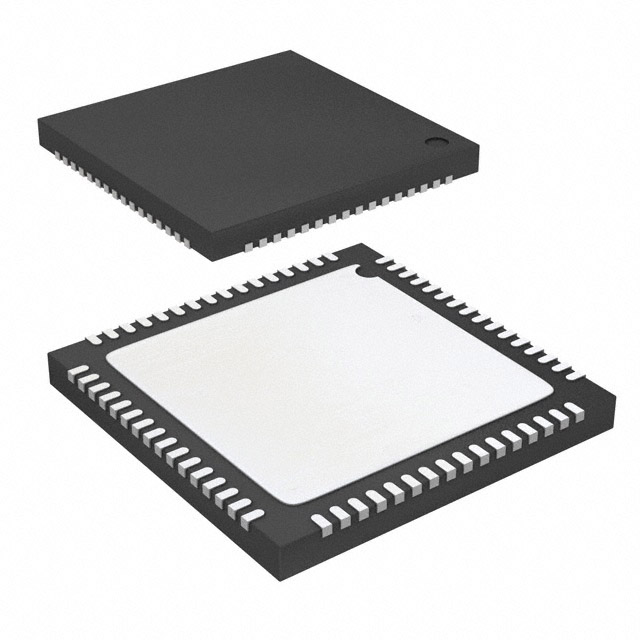
8-Channel, 24-Bit,
Simultaneous Sampling ADC
AD7779
Data Sheet
FEATURES
8-channel, 24-bit simultaneous sampling analog-to-digital
converter (ADC)
Single-ended or true differential inputs
Programmable gain amplifier (PGA) per channel (gains of
1, 2, 4, and 8)
Low dc input current
±1.5 nA (differential)
±4 nA (single-ended)
Up to 16 kSPS output data rate (ODR) per channel
Programmable ODRs and bandwidth
Sample rate converter (SRC) for coherent sampling
Sampling rate resolution up to 15.2 µSPS
Low latency sinc3 filter path
Adjustable phase synchronization
Internal 2.5 V reference
Two power modes optimizing power dissipation and
performance: high resolution mode and low power mode
Low resolution successive approximation (SAR) ADC for
system and chip diagnostics
Power supply
Bipolar (±1.65 V) or unipolar (3.3 V) supplies
Digital input/output (I/O) supply: 1.8 V to 3.6 V
Performance temperature range: –40°C to +105°C
Functional temperature range: –40°C to +125°C
Performance
Combined ac and dc performance
108 dB signal-to-noise ratio (SNR)/dynamic range at 16 kSPS
in high resolution mode
−109 dB total harmonic distortion (THD)
±7 ppm integral nonlinearity (INL)
±40 µV offset error
±0.1% gain error
±10 ppm/°C typical temperature coefficient
APPLICATIONS
Circuit breakers
General-purpose data acquisition
Electroencephalography (EEG)
Industrial process control
Each channel contains an ADC modulator and a sinc3, low
latency digital filter. An SRC is provided to allow fine resolution
control over the AD7779 ODR. This control can be used in
applications where the ODR resolution is required to maintain
coherency with 0.01 Hz changes in the line frequency. The SRC
is programmable through the serial port interface (SPI). The
AD7779 implements two different interfaces: a data output
interface and SPI control interface. The ADC data output
interface is dedicated to transmitting the ADC conversion
results from the AD7779 to the processor. The SPI interface
is used to write to and read from the AD7779 configuration
registers and for the control and reading of data from the SAR
ADC. The SPI interface can also be configured to output the
Σ-Δ conversion data.
The AD7779 includes a 12-bit SAR ADC. This ADC can be used
for AD7779 diagnostics without having to decommission one of
the Σ-Δ ADC channels dedicated to system measurement functions. With the use of an external multiplexer, which can be
controlled through the three general-purpose inputs/outputs pins
(GPIOs), and signal conditioning, the SAR ADC can be used to
validate the Σ-Δ ADC measurements in applications where
functional safety is required. In addition, the AD7779 SAR ADC
includes an internal multiplexer to sense internal nodes.
The AD7779 contains a 2.5 V reference and reference buffer.
The reference has a typical temperature coefficient of 10 ppm/°C.
The AD7779 offers two modes of operation: high resolution
mode and low power mode. High resolution mode provides a
higher dynamic range while consuming 10.75 mW per channel;
low power mode consumes just 3.37 mW per channel at a
reduced dynamic range specification.
The specified operating temperature range is −40°C to +105°C,
although the device is operational up to +125°C.
GENERAL DESCRIPTION
The AD7779 is an 8-channel, simultaneous sampling ADC.
There are eight full Σ-Δ ADCs on chip. The AD7779 provides
an ultralow input current to allow direct sensor connection. Each
input channel has a programmable gain stage allowing gains of
1, 2, 4, and 8 to map lower amplitude sensor outputs into the
full-scale ADC input range, maximizing the dynamic range of
Rev. C
the signal chain. The AD7779 accepts VREF from 1 V up to 3.6 V.
The analog inputs accept unipolar (0 V to VREF/GAIN) or true
bipolar (±VREF/GAIN/2 V) analog input signals with 3.3 V or
±1.65 V analog supply voltages. The analog inputs can be
configured to accept true differential, pseudo differential, or singleended signals to match different sensor output configurations.
Note that throughout this data sheet, certain terms are used to
refer to either the multifunction pins or a range of pins. The
multifunction pins, such as DCLK0/SDO, are referred to either
by the entire pin name or by a single function of the pin, for
example, DCLK0, when only that function is relevant. In the
case of ranges of pins, AVSSx refers to the following pins:
AVSS1A, AVSS1B, AVSS2A, AVSS2B, AVSS3, and AVSS4.
Document Feedback
Information furnished by Analog Devices is believed to be accurate and reliable. However, no
responsibility is assumed by Analog Devices for its use, nor for any infringements of patents or other
rights of third parties that may result from its use. Specifications subject to change without notice. No
license is granted by implication or otherwise under any patent or patent rights of Analog Devices.
Trademarks and registered trademarks are the property of their respective owners.
One Technology Way, P.O. Box 9106, Norwood, MA 02062-9106, U.S.A.
Tel: 781.329.4700 ©2016–2018 Analog Devices, Inc. All rights reserved.
Technical Support
www.analog.com
�AD7779
Data Sheet
TABLE OF CONTENTS
Features .............................................................................................. 1
Σ-∆ Output Data ............................................................................. 51
Applications ....................................................................................... 1
ADC Conversion Output—Header and Data ........................ 51
General Description ......................................................................... 1
Sample Rate Converter (SRC) (SPI COntrol MOde) ............ 52
Revision History ............................................................................... 4
Data Output Interface ................................................................ 54
Functional Block Diagram .............................................................. 5
Calculating the CRC Checksum .............................................. 58
Specifications..................................................................................... 6
Register Summary .......................................................................... 60
DOUTx Timing Characterististics ........................................... 10
Register Details ............................................................................... 64
SPI Timing Characterististics ................................................... 11
Channel 0 Configuration Register ........................................... 64
Synchronization Pins and Reset Timing Characteristics ...... 12
Channel 1 Configuration Register ........................................... 64
SAR ADC Timing Characterististics ....................................... 13
Channel 2 Configuration Register ........................................... 65
GPIO SRC Update Timing Characterististics......................... 13
Channel 3 Configuration Register ........................................... 65
Absolute Maximum Ratings .......................................................... 14
Channel 4 Configuration Register ........................................... 66
Thermal Resistance .................................................................... 14
Channel 5 Configuration Register ........................................... 66
ESD Caution ................................................................................ 14
Channel 6 Configuration Register ........................................... 67
Pin Configuration and Function Descriptions ........................... 15
Channel 7 Configuration Register ........................................... 67
Typical Performance Characteristics ........................................... 18
Disable Clocks to ADC Channel Register .............................. 68
Terminology .................................................................................... 31
Channel 0 Sync Offset Register ................................................ 68
RMS Noise and Resolution............................................................ 33
Channel 1 Sync Offset Register ................................................ 68
High Resolution Mode............................................................... 33
Channel 2 Sync Offset Register ................................................ 69
Low Power Mode ........................................................................ 33
Channel 3 Sync Offset Register ................................................ 69
Theory of Operation ...................................................................... 34
Channel 4 Sync Offset Register ................................................ 69
Analog Inputs .............................................................................. 34
Channel 5 Sync Offset Register ................................................ 69
Transfer Function ....................................................................... 35
Channel 6 Sync Offset Register ................................................ 70
Core Signal Chain....................................................................... 36
Channel 7 Sync Offset Register ................................................ 70
Capacitive PGA ........................................................................... 36
General User Configuration 1 Register ................................... 70
Internal Reference and Reference Buffers ............................... 36
General User Configuration 2 Register ................................... 71
Integrated LDOs ......................................................................... 37
General User Configuration 3 Register ................................... 72
Clocking and Sampling .............................................................. 37
Data Output Format Register ................................................... 72
Digital Reset and Synchronization Pins .................................. 37
Main ADC Meter and Reference Mux Control Register ...... 73
Digital Filtering ........................................................................... 38
Global Diagnostics Mux Register ............................................. 74
Shutdown Mode.......................................................................... 38
GPIO Configuration Register ................................................... 75
Controlling the AD7779 ............................................................ 39
GPIO Data Register.................................................................... 75
Pin Control Mode....................................................................... 39
Buffer Configuration 1 Register ............................................... 75
SPI Control .................................................................................. 41
Buffer Configuration 2 Register ............................................... 76
Digital SPI Interface ................................................................... 44
Channel 0 Offset Upper Byte Register..................................... 76
Diagnostics and Monitoring ......................................................... 47
Channel 0 Offset Middle Byte Register ................................... 76
Self Diagnostics Error ................................................................ 47
Channel 0 Offset Lower Byte Register..................................... 77
Monitoring Using the AD7779 SAR ADC (SPI Control
Mode) ........................................................................................... 48
Channel 0 Gain Upper Byte Register....................................... 77
Σ-Δ ADC Diagnostics (SPI Control Mode) ............................ 50
Channel 0 Gain Lower Byte Register ....................................... 77
Channel 0 Gain Middle Byte Register ..................................... 77
Rev. C | Page 2 of 100
�Data Sheet
AD7779
Channel 1 Offset Upper Byte Register .....................................78
Channel 6 Gain Lower Byte Register ....................................... 86
Channel 1 Offset Middle Byte Register ....................................78
Channel 7 Offset Upper Byte Register ..................................... 87
Channel 1 Offset Lower Byte Register .....................................78
Channel 7 Offset Middle Byte Register.................................... 87
Channel 1 Gain Upper Byte Register........................................78
Channel 7 Offset Lower Byte Register ..................................... 87
Channel 1 Gain Middle Byte Register ......................................79
Channel 7 Gain Upper Byte Register ....................................... 87
Channel 1 Gain Lower Byte Register........................................79
Channel 7 Gain Middle Byte Register ...................................... 88
Channel 2 Offset Upper Byte Register .....................................79
Channel 7 Gain Lower Byte Register ....................................... 88
Channel 2 Offset Middle Byte Register ....................................79
Channel 0 Status Register .......................................................... 88
Channel 2 Offset Lower Byte Register .....................................80
Channel 1 Status Register .......................................................... 89
Channel 2 Gain Upper Byte Register........................................80
Channel 2 Status Register .......................................................... 89
Channel 2 Gain Middle Byte Register ......................................80
Channel 3 Status Register .......................................................... 90
Channel 2 Gain Lower Byte Register........................................80
Channel 4 Status Register .......................................................... 90
Channel 3 Offset Upper Byte Register .....................................81
Channel 5 Status Register .......................................................... 91
Channel 3 Offset Middle Byte Register ....................................81
Channel 6 Status Register .......................................................... 91
Channel 3 Offset Lower Byte Register .....................................81
Channel 7 Status Register .......................................................... 92
Channel 3 Gain Upper Byte Register........................................81
Channel 0/Channel 1 DSP Errors Register.............................. 92
Channel 3 Gain Middle Byte Register ......................................82
Channel 2/Channel 3 DSP Errors Register.............................. 93
Channel 3 Gain Lower Byte Register........................................82
Channel 4/Channel 5 DSP Errors Register.............................. 93
Channel 4 Offset Upper Byte Register .....................................82
Channel 6/Channel 7 DSP Errors Register.............................. 94
Channel 4 Offset Middle Byte Register ....................................82
Channel 0 to Channel 7 Error Register Enable Register ....... 94
Channel 4 Offset Lower Byte Register .....................................83
General Errors Register 1 ........................................................... 95
Channel 4 Gain Upper Byte Register........................................83
General Errors Register 1 Enable .............................................. 95
Channel 4 Gain Middle Byte Register ......................................83
General Errors Register 2 ........................................................... 96
Channel 4 Gain Lower Byte Register........................................83
General Errors Register 2 Enable .............................................. 96
Channel 5 Offset Upper Byte Register .....................................84
Error Status Register 1 ................................................................ 97
Channel 5 Offset Middle Byte Register ....................................84
Error Status Register 2 ................................................................ 97
Channel 5 Offset Lower Byte Register .....................................84
Error Status Register 3 ................................................................ 98
Channel 5 Gain Upper Byte Register........................................84
Decimation Rate (N) MSB Register ......................................... 98
Channel 5 Gain Middle Byte Register ......................................85
Decimation Rate (N) LSB Register ........................................... 98
Channel 5 Gain Lower Byte Register........................................85
Decimation Rate (IF) MSB Register ......................................... 99
Channel 6 Offset Upper Byte Register .....................................85
Decimation Rate (IF) LSB Register .......................................... 99
Channel 6 Offset Middle Byte Register ....................................85
SRC Load Source and Load Update Register .......................... 99
Channel 6 Offset Lower Byte Register .....................................86
Outline Dimensions ......................................................................100
Channel 6 Gain Upper Byte Register........................................86
Ordering Guide .........................................................................100
Channel 6 Gain Middle Byte Register ......................................86
Rev. C | Page 3 of 100
�AD7779
Data Sheet
REVISION HISTORY
6/2018—Rev. B to Rev. C
Change to t22B Parameter, Table 3 ................................................. 11
Changes to AUXAIN± Parameter, Table 7.................................. 14
Changes to Table 17 ........................................................................ 39
Added Figure 104; Renumbered Sequentially ............................ 46
Changes to Figure 115 Caption and Figure 116 Caption .......... 54
Updated Outline Dimensions ..................................................... 100
Changes to Ordering Guide ........................................................ 100
8/2017—Rev. A to Rev. B
Changes to Features Section............................................................ 1
Change to START Pin Description, Table 9 ................................ 15
Changes to Figure 48 ...................................................................... 24
Changes to Digital Reset and Synchronization Pins Section .... 37
Changes to Figure 94 ...................................................................... 38
Changes to Phase Adjustment Section and Table 20 ................. 42
Added Table 21; Renumbered Sequentially ................................ 42
Changes to Digital SPI Interface Section ..................................... 44
9/2016—Rev. 0 to Rev. A
Changes to General Description Section ...................................... 1
Changes to Table 1 ............................................................................ 6
Changes to Table 2 .......................................................................... 10
Changes to Table 4 .......................................................................... 12
Changes to Figure 8 Caption through Figure 13 Caption ......... 18
Changes to Figure 14 Caption and Figure 17 Caption .............. 19
Changes to Figure 22 ...................................................................... 20
Changes to Figure 26 Caption, Figure 27 Caption, Figure 29
Caption, and Figure 30 Caption ................................................... 21
Changes to Figure 35 Caption ...................................................... 22
Changes to Figure 38 through Figure 43 ..................................... 23
Changes to Figure 44, Figure 45 Caption, and Figure 47 .......... 24
Changes to Figure 51 Caption, Figure 52 Caption, and
Figure 55 Caption ........................................................................... 25
Changes to Figure 56, Figure 58, Figure 59, and Figure 61....... 26
Changes to Figure 63 Caption, Figure 64 Caption, Figure 66
Caption, and Figure 67 Caption ................................................... 27
Changes to Figure 76 and Figure 79 ............................................ 29
Changes to Figure 80 and Figure 81 ............................................ 30
Changes to Figure 100 ................................................................... 44
Changes to SPI SAR Diagnostic Mode (SPI Control Mode)
Section .............................................................................................. 46
Changes to SPI Transmission Errors (SPI Control Mode) ....... 48
Changes to CRC Header Section, Figure 107, and Table 33 to
Table 35 ............................................................................................ 51
Changes to SRC Bandwidth Section ............................................ 52
Changes to Figure 109, Figure 110, SRC Group Delay and
Latency Section, and Setting Time Section ................................. 53
Added Figure 111 and Figure 112; Renumbered Sequentially .....53
Changes to Table 40 ..............................................................................57
Changes to Calculating the CRC Checksum Section and
Table 42 ............................................................................................ 58
Changes to SPI Control Mode Checksum Section .................... 59
Changes to Table 66 ....................................................................... 74
2/2016—Revision 0: Initial Version
Rev. C | Page 4 of 100
�Data Sheet
AD7779
FUNCTIONAL BLOCK DIAGRAM
AVDD1x
REFx+ REFx–
AVDD2
COMMONMODE
VOLTAGE
AREGxCAP
ANALOG
LDO
IOVDD
DREGCAP
DIGITAL
LDO
2.5V REF
AIN0+
AIN0–
280mV p-p
EXT_REF
Σ-Δ ADC
PGA
SINC3/
SRC
FILTER
XTAL1
CLOCK
MANAGER
AIN2+
AIN2–
AIN3+
AIN3–
AIN4+
AIN4–
AIN5+
AIN5–
AIN6+
AIN6–
AIN7+
AIN7–
SYNC_IN
SYNC_OUT
START
GAIN
OFFSET
DCLK
DRDY
INT_REF
AIN1+
AIN1–
XTAL2/MCLK
DATA OUTPUT
INTERFACE
DOUT3
Σ-Δ ADC
SINC3/
SRC
FILTER
GAIN
OFFSET
PGA
Σ-Δ ADC
SINC3/
SRC
FILTER
GAIN
OFFSET
PGA
Σ-Δ ADC
SINC3/
SRC
FILTER
GAIN
OFFSET
PGA
Σ-Δ ADC
SINC3/
SRC
FILTER
GAIN
OFFSET
MODE0/GPIO0
PGA
Σ-Δ ADC
SINC3/
SRC
FILTER
GAIN
OFFSET
ALERT/CS
PGA
REFERENCES
REFERENCES
REFERENCES
REFERENCES
REFERENCES
Σ-Δ ADC
SINC3/
SRC
FILTER
GAIN
OFFSET
PGA
Σ-Δ ADC
SINC3/
SRC
FILTER
GAIN
OFFSET
REFERENCES
REFERENCES
DOUT1
DOUT0
REGISTER MAP
AND
LOGIC CONTROL
RESET
FORMAT1
FORMAT0
HARDWARE
MODE
CONFIGURATION
SPI INTERFACE
PGA
AUXAIN+
AUXAIN–
DOUT2
MODE3/ALERT
MODE2/GPIO2
MODE1/GPIO1
DCLK2/SCLK
DCLK1/SDI
DCLK0/SDO
AD7779
SAR ADC
DIAGNOSTIC
INPUTS
AVSSx
AVDD4
CONVST_SAR
Figure 1.
Rev. C | Page 5 of 100
13295-001
VCM
REF_OUT
�AD7779
Data Sheet
SPECIFICATIONS
AVDD1x = +1.65 V, AVSSx 1 = −1.65 V (dual supply operation), AVDD1x = 3.3 V, AVSSx = AGND (single-supply operation), AVDD2x −
AVSSx = 2.2 V to 3.6 V; IOVDD = 1.8 V to 3.6 V; DGND = 0 V, REFx+/REFx− = 2.5 V AVSSx (internal/external), master clock (MCLK) =
8192 kHz for high resolution mode and 4096 kHz for low power mode, ODR = 16 kSPS for high resolution mode and 4 kSPS for low power
mode; all specifications at TMIN to TMAX, unless otherwise noted.
Table 1.
Parameter
ANALOG INPUTS
Differential Input Voltage
Range
Single-Ended Input Voltage
Range
AINx± Common-Mode Input
Range
Absolute AINx± Voltage
Limits
DC Input Current
Differential
Single-Ended
Input Current Drift
AC Input Capacitance
PGA
Gain Settings
Bandwidth
REFERENCE
Internal
Initial Accuracy
Temperature Coefficient
Reference Load Current, IL
DC Power Supply Rejection
Load Regulation, ∆VOUT/∆IL
Voltage Noise
Voltage Noise Density
Turn On Settling Time
External
Input Voltage
Buffer Headroom
REFx− Input Voltage
Average REFx± Input
Current
Test Conditions/Comments
Min
Typ
VREF = (REFx+ − REFx−)
AVSSx + 0.10
(AVDD1x + AVSSx)/2
AVSSx + 0.10
HR, MCLK = 8192 kHz
Low power mode, MCLK = 4096 kHz
HR, MCLK = 8192 kHz
Low power mode, MCLK = 4096 kHz
Max
Unit
±VREF/PGAGAIN
V
0 to VREF/PGAGAIN
V
AVDD1x − 0.10
V
AVDD1x − 0.10
±1.5
±0.6
±4
±1.5
50
8
nA
nA
nA
nA
pA/°C
pF
1, 2, 4, or 8
Small signal, high resolution mode
Small signal, low power mode
Large signal, high resolution mode
Large signal, low power mode
REF_OUT, TA = 25°C
2.5 − 0.2%
2.5
±10
−10
Line regulation
2
512
5
1.5
MHz
kHz
kHz
kHz
2.5 + 0.2%
±38
+10
V
ppm/°C
mA
dB
µV/mA
µV rms
nV/√Hz
ms
AVDD1x
AVDD1x − 0.1
AVDD1x – REFx+
V
95
100
6.8
273.5
1.5
eN p-p, 0.1 Hz to 10 Hz
eN, 1 kHz, 2.5 V reference
100 nF
VREF = (REFx+ − REFx−)
1
AVSSx + 0.1
2.5
AVSSx
V
Current per channel
Reference buffer disabled,
high resolution mode
Reference buffer precharge mode
(pre-Q), high resolution mode
Reference buffer disabled,
low power mode
Reference buffer pre-Q,
low power mode
Rev. C | Page 6 of 100
18
µA/V
600
nA/V
4.5
µA/V
100
nA/V
�Data Sheet
Parameter
TEMPERATURE RANGE
Specified Performance
Functional 2
TEMPERATURE SENSOR
Accuracy
DIGITAL FILTER RESPONSE
(SINC3)
Group Delay
AD7779
Test Conditions/Comments
Reference buffer enabled,
high resolution mode
Reference buffer enabled,
low power mode
Min
TMIN to TMAX
TMIN to TMAX
−40
−40
CLOCK SOURCE
Frequency
Duty Cycle
Σ-Δ ADC
Speed and Performance
Resolution
ODR
No Missing Codes
AC Accuracy
Dynamic Range
16 kSPS
4 kSPS
1 kSPS
THD
SINAD
SFDR
Intermodulation Distortion
(IMD)
DC Power Supply Rejection
DC Common-Mode
Rejection Ratio
Crosstalk
Unit
nA/V
nA/V
+105
+125
±2
°C
°C
°C
See the SRC Group
Delay section
See the Settling
Time section
See the SRC
Bandwidth section
See the SRC
Bandwidth section
−0.1 dB
−3 dB
Decimation Rate
Max
5
Settling Time
Pass Band
Typ
10
High resolution mode
Low power mode
128
64
4095.99
4095.99
High resolution mode
Low power mode
0.655
1.3
45:55
8.192
4.096
55:45
MHz
MHz
%
16
8
Bits
kSPS
kSPS
Bits
50:50
24
High resolution mode
Low power mode
24
Shorted inputs, PGAGAIN = 1
High resolution mode
High resolution mode
Low power mode
Low power mode
−0.5 dBFS, high resolution mode
−0.5 dBFS, low power mode
fIN = 60 Hz
High resolution mode, 16 kSPS,
PGAGAIN = 1
fA = 50 Hz, fB = 51 Hz, high
resolution mode
fA = 50 Hz, fB = 51 Hz, low power
mode
AVDD1x = 3.3 V
108
116
106
116
−109
−105
106
132
dB
dB
dB
dB
dB
dB
dB
dB
−125
dB
−105
dB
−90
dB
dB
−120
dB
80
Rev. C | Page 7 of 100
�AD7779
Parameter
DC ACCURACY
INL
Data Sheet
Test Conditions/Comments
Min
Endpoint method, PGAGAIN = 1
Other PGA gains
Offset Error
Offset Error Drift
Offset Error Drift vs. Time
Offset Matching
Gain Error
Gain Drift vs. Temperature
Gain Matching
SAR ADC
Speed and Performance
Resolution
Analog Input Range
Analog Input CommonMode Range
Analog Input Dynamic
Current
Throughput
DC Accuracy
INL
DNL
Offset
Gain
AC Performance
SNR
THD
VCM PIN
Output
Load Current, IL
Load Regulation, ∆VOUT/∆IL
Short-Circuit Current
LOGIC INPUTS
Input High Voltage, VIH
Input Low Voltage, VIL
Hysteresis
Input Currents
LOGIC OUTPUTS 3
Output High Voltage, VOH
Output Low Voltage, VOL
Leakage Current
Output Capacitance
Σ-Δ ADC Data Output Coding
SAR ADC Data Output Coding
Typ
Max
Unit
±7
±3
±40
±0.5
−2
±15
±15
±125
ppm of FSR
ppm of FSR
µV
µV/°C
µV/
1000 hrs
µV
% FS
ppm/°C
%
25
±0.1
±0.75
±0.1
PGAGAIN = 1
12
AVSS4 + 0.1
AVSS4 + 0.1
256 kSPS, 0 dBFS
(AVDD4 + AVSS4)/2
AVDD4 − 0.1
AVDD4 − 0.1
±100
Bits
V
V
nA
256
kSPS
Differential mode
1.5
No missing codes (12-bit)
1
12
LSB
LSB
LSB
LSB
66
−81
dB
dB
(AVDD1x + AVSSx)/2
1
12
5
V
mA
mV/mA
mA
−0.99
1 kHz
1 kHz
+1
0.7 × IOVDD
0.4
0.1
−10
IOVDD ≥ 3 V, ISOURCE = 1 mA
2.3 ≤ IOVDD < 3 V, ISOURCE = 500 µA
IOVDD < 2.3 V, ISOURCE = 200 µA
IOVDD ≥ 3 V, ISINK = 2 mA
2.3 ≤ IOVDD < 3 V, ISINK = 1 mA
IOVDD < 2.3 V, ISINK = 100 µA
Floating state
Floating state
+10
0.8 × IOVDD
0.8 × IOVDD
0.8 × IOVDD
0.4
0.4
0.4
+10
−10
Rev. C | Page 8 of 100
10
Twos complement
Binary
V
V
V
µA
V
V
V
V
V
V
µA
pF
�Data Sheet
Parameter
POWER SUPPLIES
AVDD1x – AVSSx
IAVDD1x 4, 5
AVDD2x – AVSSx
IAVDD2x
AVDD4 – AVSSx
IAVDD4
AVSSx − DGND
IOVDD − DGND
IIOVDD
Power Dissipation 6
High Resolution Mode
Low Power Mode
Power-Down
AD7779
Test Conditions/Comments
All Σ-Δ channels enabled
Min
Typ
Max
Unit
3.6
V
17
4.5
22.7
6.1
mA
mA
19
5
25.5
6.8
mA
mA
13
3.5
17.8
4.8
3.6
9.45
3.7
AVDD1x
2
10
0
3.6
10.7
4.4
mA
mA
V
mA
mA
V
mA
µA
V
V
mA
mA
133
44
mW
mW
µW
3.0
Reference buffer pre-Q, VCM
enabled, internal reference enabled
High resolution mode
Low power mode
Reference buffer enabled, VCM
enabled, internal reference enabled
High resolution mode
Low power mode
Reference buffer disabled, VCM
disabled, internal reference disabled
High resolution mode
Low power mode
2.2
High resolution mode
Low power mode
9
3.5
AVDD1x – 0.3
SAR enabled
SAR disabled
1.7
1
−1.8
1.8
High resolution mode
Low power mode
Internal buffers bypassed, internal
reference disabled, internal
oscillator disabled, SAR disabled
16 kSPS
4 kSPS
All ADCs disabled
8
3
86
27
530
AVSSx is used to refer to the following pins: AVSS1A, AVSS1B, AVSS2B, and AVSS2A. This term is used throughout the data sheet.
At temperatures higher than 105°C, the device can be operated normally, though slight degradation on the maximum/minimum specifications is expected because
these specifications are only guaranteed up to 105°C. See the Typical Performance Characteristics section for plots showing the typical performance of the device at
high temperatures.
3
The SDO pin and the DOUTx pin are configured in the default mode of strength.
4
AVDD1x = 3.3 V, AVSSx = GND = ground, IOVDD = 1.8 V, CMOS clock.
5
Disabling either the VCM pin or the internal reference results in a 40 µA typical current consumption reduction.
6
Power dissipation is calculated using the maximum supply voltage, 3.6 V.
1
2
Rev. C | Page 9 of 100
�AD7779
Data Sheet
DOUTx TIMING CHARACTERISTISTICS
AVDD1x/AVSSx = ±1.65 V, 3.3 V/AGND, AVDD2 − AVSSx = 2.2 V to 3.6 V; IOVDD = 1.8 V to 3.6 V; DGND = 0 V, REFx+/REFx− =
2.5 V (internal/external), MCLK = 8192 kHz; all specifications at TMIN to TMAX, unless otherwise noted.
Table 2.
Parameter
t1
t2
t3
t4
t5
t6
t7
t8
t9
t10
t11
Test Conditions/Comments
50:50
MCLK/2
MCLK/2
Min
0.655
60
60
121
121
Typ
2
1
20
20
All input signals are specified with tR = tF = 1 ns/V (10% to 90% of IOVDD) and timed from a voltage level of (VIL + VIH)/2.
t1
t2
t3
MCLK
DCLK
t4
t6
t5
t8
t7
t9
DRDY
DOUTx
LSB
MSB
Max
8.192
45
45
MSB – 1
t10
t11
Figure 2. Data Interface Timing Diagram
Rev. C | Page 10 of 100
LSB + 1
LSB
13295-002
1
Description 1
MCLK frequency
MCLK low time
MCLK high time
DCLKx high time
DCLKx low time
MCLK falling edge to DCLK rising edge
MCLK falling edge to DCLK falling edge
DCLKx rising edge to DRDY rising edge
DCLKx rising edge to DRDY falling edge
DOUTx setup time
DOUTx hold time
Unit
MHz
ns
ns
ns
ns
ns
ns
ns
ns
ns
ns
�Data Sheet
AD7779
SPI TIMING CHARACTERISTISTICS
AVDD1x/AVSSx = ±1.65 V, 3.3 V/AGND, AVDD2 − AVSSx = 2.2 V to 3.6 V; IOVDD = 1.8 V to 3.6 V; DGND = 0 V, REFx+/REFx− =
2.5 V (internal/external), MCLK = 8192 kHz; all specifications at TMIN to TMAX, unless otherwise noted.
Table 3.
Parameter
t12
t13
t14
t15
t16
t17
t18
t19
t20
t21
t22A
t22B
t23
t24
t25
Test Conditions/Comments
50:50
Min
7
7
10
10
10
10
10
5
5
30
49
10
10
30
All input signals are specified with tR = tF = 1 ns/V (10% to 90% of IOVDD) and timed from a voltage level of (VIL + VIH)/2.
t19
CS
t15
t16
t17
t13
t14
t18
SCLK
t20
SDI
MSB
t22A
SDO
MSB – 1
t12
LSB + 1
LSB
t21
MSB
t22B
MSB – 1
LSB + 1
t24
t23
Figure 3. SPI Control Interface Timing Diagram
Rev. C | Page 11 of 100
LSB
t25
13295-003
1
Description 1
SCLK period
SCLK low time
SCLK high time
SCLK rising edge to CS falling edge
CS falling edge to SCLK rising edge
SCLK rising edge to CS rising edge
CS rising edge to SCLK rising edge
Minimum CS high time
SDI setup time
SDI hold time
CS falling edge to SDO enable (SPI = Mode 0)
SCLK falling edge to SDO enable (SPI = Mode 3)
SDO setup time
SDO hold time
CS rising edge to SDO disable
Typ
Max
30
Unit
MHz
ns
ns
ns
ns
ns
ns
ns
ns
ns
ns
ns
ns
ns
ns
�AD7779
Data Sheet
SYNCHRONIZATION PINS AND RESET TIMING CHARACTERISTICS
AVDD1x/AVSSx = ±1.65 V, 3.3 V/AGND, AVDD2 − AVSSx = 2.2 V to 3.6 V; IOVDD = 1.8 V to 3.6 V; DGND = 0 V, REFx+/REFx− =
2.5 V (internal/external), MCLK = 8192 kHz; all specifications at TMIN to TMAX, unless otherwise noted.
Table 4.
Parameter
t26
t27
t28
t29
t30
tINIT_
tINIT_
t31
tPOWER_UP
SYNC_IN
RESET
Test Conditions/Comments
16 kSPS, HR mode
16 kSPS, HR mode
Min
10
MCLK
MCLK
10
MCLK
145
225
2 × MCLK
tPOWER_UP is not shown in Figure 4
All input signals are specified with tR = tF = 1 ns/V (10% to 90% of IOVDD) and timed from a voltage level of (VIL + VIH)/2.
MCLK
START
t26
t27
SYNC_OUT
t28
SYNC_IN
t29
t30
DRDY
tINIT_SYNC_IN
RESET
t31
tINIT_RESET
Figure 4. Synchronization Pins and Reset Control Interface Timing Diagram
Rev. C | Page 12 of 100
Typ
2
13295-004
1
Description 1
START setup time
START hold time
MCLK falling edge to SYNC_OUT falling edge
SYNC_IN setup time
SYNC_IN hold time
SYNC_IN rising edge to first DRDY
RESET rising edge to first DRDY
RESET hold time
Start time
Max
Unit
ns
ns
ns
ns
ns
µs
µs
ns
ms
�Data Sheet
AD7779
SAR ADC TIMING CHARACTERISTISTICS
AVDD1x/AVSSx = ±1.65 V, 3.3 V/AGND, AVDD2 − AVSSx = 2.2 V to 3.6 V; IOVDD = 1.8 V to 3.6 V; DGND = 0 V, REFx+/REFx− =
2.5 V (internal/external), MCLK = 8192 kHz; all specifications at TMIN to TMAX, unless otherwise noted.
Table 5.
Parameter
t32
t33
t34
t35
1
2
Description 1
Conversion time
Acquisition time 2
Delay time
Throughput data
Min
1
500
50
Typ
Max
3.4
Unit
µs
ns
ns
kSPS
256
All input signals are specified with tR = tF = 1 ns/V (10% to 90% of IOVDD) and timed from a voltage level of (VIL + VIH)/2.
Direct mode enabled. If deglitch mode is enabled, add 1.5/MCLK.
CS
t33
t32
t34
13295-005
CONVST_SAR
t35
Figure 5. SAR ADC Timing Diagram
GPIO SRC UPDATE TIMING CHARACTERISTISTICS
AVDD1x/AVSSx = ±1.65 V, 3.3 V/AGND, AVDD2 − AVSSx = 2.2 V to 3.6 V; IOVDD = 1.8 V to 3.6 V; DGND = 0 V, REFx+/REFx− =
2.5 V (internal/external), MCLK = 8192 kHz; all specifications TMIN to TMAX, unless otherwise noted.
Table 6.
Parameter
t36
t37
t37
t38
t39
t40
Min
10
MCLK
2 × MCLK
20
5
MCLK
All input signals are specified with tR = tF = 1 ns/V (10% to 90% of IOVDD) and timed from a voltage level of (VIL + VIH)/2.
MCLK
GPIO2
t36
t37
GPIO1
t38
GPIO0
t39
t40
Figure 6. GPIOs for SRC Update Timing Diagram
Rev. C | Page 13 of 100
13295-006
1
Description 1
GPIO2 setup time
GPIO2 hold time—high resolution mode
GPIO2 hold time—low power mode
MCLK rising edge to GPIO1 rising edge time
GPIO0 setup time
GPIO0 hold time
Typ
Max
Unit
ns
ns
ns
ns
ns
�AD7779
Data Sheet
ABSOLUTE MAXIMUM RATINGS
Table 7.
Parameter
Any Supply Pin to AVSSx
AVSSx to DGND
AREGxCAP to AVSSx
DREGCAP to DGND
IOVDD to DGND
IOVDD to AVSSx
AVDD4 to AVSSx
Analog Input Voltage
REFx± Input Voltage
AUXAIN±
Digital Input Voltage to
DGND
Digital Output Voltage to
DGND
XTAL1 to DGND
AINx±, AUXAIN±, and
Digital Input Current
Operating Temperature
Range
Junction Temperature,
TJ Maximum
Storage Temperature Range
Reflow Soldering
ESD
Field Induced Charged
Device Model (FICDM)
Rating
−0.3 V to +3.96 V
−1.98 V to +0.3 V
−0.3 V to +1.98 V
−0.3 V to +1.98 V
−0.3 V to +3.96 V
−0.3 V to +5.94 V
AVDD1x − 0.3 V to 3.96 V
AVSSx − 0.3 V to AVDD1x + 0.3 V or
3.96 V (whichever is less)
AVSSx − 0.3 V to AVDD1x + 0.3 V or
3.96 V (whichever is less)
AVSSx − 0.3 V to AVDD4 + 0.3 V or
3.96 V (whichever is less)
DGND − 0.3 V to IOVDD + 0.3 V or
3.96 V (whichever is less)
DGND − 0.3 V to IOVDD + 0.3 V or
3.96 V (whichever is less)
DGND − 0.3 V to DREGCAP + 0.3 V
or 1.98 V (whichever is less)
±10 mA
Stresses at or above those listed under Absolute Maximum
Ratings may cause permanent damage to the product. This is a
stress rating only; functional operation of the product at these
or any other conditions above those indicated in the operational
section of this specification is not implied. Operation beyond
the maximum operating conditions for extended periods may
affect product reliability.
THERMAL RESISTANCE
Thermal performance is directly linked to printed circuit board
(PCB) design and operating environment. Close attention to PCB
thermal design is required.
Table 8. Thermal Resistance
Package Type1
64-Lead LFCSP
No Thermal Vias1
49 Thermal Vias1
θJA
θJB
ΨJT
ΨJB
Unit
30.43
22.62
N/A2
3.17
0.13
0.09
6.59
3.19
°C/W
°C/W
Thermal impedance simulated values are based on a JEDEC 2S2P thermal
test board. See JEDEC JESD51.
2
N/A means not applicable.
1
ESD CAUTION
−40°C to +125°C
150°C
−65°C to +150°C
260°C
2 kV
500 V
Rev. C | Page 14 of 100
�Data Sheet
AD7779
64
63
62
61
60
59
58
57
56
55
54
53
52
51
50
49
AUXAIN–
AUXAIN+
AVDD4
AVSS4
AVSS2A
AREG1CAP
AVDD2A
VCM
CLK_SEL
FORMAT0
FORMAT1
AVSS3
AVDD2B
AREG2CAP
AVSS2B
REF_OUT
PIN CONFIGURATION AND FUNCTION DESCRIPTIONS
1
2
3
4
5
6
7
8
9
10
11
12
13
14
15
16
AD7779
TOP VIEW
(Not to Scale)
48
47
46
45
44
43
42
41
40
39
38
37
36
35
34
33
AIN4–
AIN4+
AIN5–
AIN5+
AVSS1B
AVDD1B
REF2–
REF2+
AIN6–
AIN6+
AIN7–
AIN7+
RESET
SYNC_IN
SYNC_OUT
START
NOTES
1. EXPOSED PAD. CONNECT THE EXPOSED PAD TO AVSSx.
13295-007
CONVST_SAR
ALERT/CS
DCLK2/SCLK
DCLK1/SDI
DCLK0/SDO
DGND
DREGCAP
IOVDD
DOUT3
DOUT2
DOUT1
DOUT0
DCLK
DRDY
XTAL1
XTAL2/MCLK
17
18
19
20
21
22
23
24
25
26
27
28
29
30
31
32
AIN0–
AIN0+
AIN1–
AIN1+
AVSS1A
AVDD1A
REF1–
REF1+
AIN2–
AIN2+
AIN3–
AIN3+
MODE0/GPIO0
MODE1/GPIO1
MODE2/GPIO2
MODE3/ALERT
Figure 7. Pin Configuration
Table 9. Pin Function Descriptions
Pin No.
1
2
3
4
5
Mnemonic
AIN0−
AIN0+
AIN1−
AIN1+
AVSS1A
Type
Analog input
Analog input
Analog input
Analog input
Supply
Direction
Input
Input
Input
Input
Supply
6
AVDD1A
Supply
Supply
7
REF1−
Reference
Input
8
9
10
11
12
13
REF1+
AIN2−
AIN2+
AIN3−
AIN3+
MODE0/GPIO0
Reference
Analog input
Analog input
Analog input
Analog input
Digital I/O
Input
Input
Input
Input
Input
I/O
14
MODE1/GPIO1
Digital I/O
I/O
15
MODE2/GPIO2
Digital I/O
I/O
16
MODE3/ALERT
Digital I/O
I/O
Description
Analog Input Channel 0, Negative.
Analog Input Channel 0, Positive.
Analog Input Channel 1, Negative.
Analog Input Channel 1, Positive.
Negative Front-End Analog Supply for Channel 0 to Channel 3, Typical at −1.65 V
(Dual Supply) and AGND (Single Supply). Connect all the AVSSx pins to the
same potential.
Positive Front-End Analog Supply for Channel 0 to Channel 3, Typical at
AVSSx + 3.3 V. Connect this pin to AVDD1B.
Negative Reference Input 1 for Channel 0 to Channel 3, Typical at AVSSx.
Connect all the REFx− pins to the same potential.
Positive Reference Input 1 for Channel 0 to Channel 3, Typical at REF1− + 2.5 V.
Analog Input Channel 2, Negative.
Analog Input Channel 2, Positive.
Analog Input Channel 3, Negative.
Analog Input Channel 3, Positive.
Mode 0 Input Pin in Pin Control Mode (MODE0). See Table 18 for more details.
Configurable General-Purpose Input/Output 0 in SPI Control Mode (GPIO0).
If not in use, connect this pin to DGND or IOVDD.
Mode 1 Input Pin in Pin Control Mode (MODE1). See Table 18 for more details.
Configurable General-Purpose Input/Output 1 in SPI Control Mode (GPIO1).
If not in use, connect this pin to DGND or IOVDD.
Mode 2 Input Pin in Pin Control Mode (MODE2). See Table 18 for more details.
Configurable General-Purpose Input/Output 2 in SPI Control Mode (GPIO2).
If not in use, connect this pin to DGND or IOVDD.
Mode 3 Input Pin in Pin Control Mode (MODE3). See Table 18 for more details.
Alert Output Pin in SPI Control Mode (ALERT).
Rev. C | Page 15 of 100
�AD7779
Data Sheet
Pin No.
17
Mnemonic
CONVST_SAR
Type
Digital input
Direction
Input
18
ALERT/CS
Digital input
Input
19
DCLK2/SCLK
Digital input
Input
20
DCLK1/SDI
Digital input
Input
21
DCLK0/SDO
Digital output
Output
22
23
24
DGND
DREGCAP
IOVDD
Supply
Supply
Supply
Supply
Output
Supply
25
DOUT3
Digital output
I/O
26
DOUT2
Digital output
I/O
27
28
29
30
31
DOUT1
DOUT0
DCLK
DRDY
XTAL1
Digital output
Digital output
Digital output
Digital output
Clock
Output
Output
Output
Output
Input
32
XTAL2/MCLK
Clock
Input
33
START
Digital input
Input
34
SYNC_OUT
Digital output
Input
35
SYNC_IN
Digital input
Input
36
RESET
Digital input
Input
37
38
39
40
41
42
AIN7+
AIN7−
AIN6+
AIN6−
REF2+
REF2−
Analog input
Analog input
Analog input
Analog input
Reference
Reference
Input
Input
Input
Input
Input
Input
43
AVDD1B
Supply
Supply
44
AVSS1B
Supply
Supply
Description
Σ-Δ Output Interface Selection Pin in Pin Control Mode. See Table 17 for more
details. This pin also functions as the start for the SAR conversion in SPI control
mode.
Alert Output Pin in Pin Control Mode (ALERT).
Chip Select Pin in SPI Control Mode (CS).
DCLK Frequency Selection Pin 2 in Pin Control Mode (DCLK2). See Table 19 for
more details.
SPI Clock in SPI Control Mode (SCLK).
DCLK Frequency Selection Pin 1 in Pin Control Mode (DCLK1). See Table 19 for
more details.
SPI Data Input in SPI Control Mode (SDI). Connect this pin to DGND if the
device is configured in pin control mode with the SPI as the data output interface.
DCLK Frequency Selection Pin 0 in Pin Control Mode (DCLK0). See Table 19 for
more details.
SPI Data Output in SPI Control Mode (SDO).
Digital Ground.
Digital LDO Output. Decouple this pin to DGND with a 1 µF capacitor.
Digital Levels Input/Output and Digital LDO (DLDO) Supply from 1.8 V to 3.6 V.
IOVDD must not be lower than DREGCAP.
Data Output Pin 3. If the device is configured in daisy-chain mode, this pin
acts as an input pin. See the Daisy-Chain Mode section for more details.
Data Output Pin 2. If the device is configured in daisy-chain mode, this pin
acts as an input pin. See the Daisy-Chain Mode section for more details.
Data Output Pin 1.
Data Output Pin 0.
Data Output Clock.
Data Output Ready Pin.
Crystal 1 Input Connection. If CMOS is used as a clock source, tie this pin to
DGND. See Table 16 for more details.
Crystal 2 Input Connection (XTAL2). See Table 16 for more details.
CMOS Clock (MCLK). See Table 16 for more details.
Synchronization Pulse. This pin is used to synchronize internally an external
START asynchronous pulse with MCLK. The synchronize signal is shift out by
the SYNC_OUT pin. If not in use, tie this pin to IOVDD. See the Phase Adjustment
section and the Digital Reset and Synchronization Pins section for more details.
Synchronization Signal. This pin generates a synchronous pulse generated
and driven by hardware (via the START pin) or by software (GENERAL_USER_
CONFIG_2, Bit 0). If this pin is in use, it must be wired to the SYNC_IN pin. See
the Phase Adjustment and the Digital Reset and Synchronization Pins section
for more details.
Reset for the Internal Digital Block and Synchronize for Multiple Devices. See
the Digital Reset and Synchronization Pins section for more details.
Asynchronous Reset Pin. This pin resets all registers to their default value. It is
recommended to generate a pulse on this pin after the device is powered up
because a slow slew rate in the supplies may generate an incorrect initialization
in the digital block.
Analog Input Channel 7, Positive.
Analog Input Channel 7, Negative.
Analog Input Channel 6, Positive.
Analog Input Channel 6, Negative.
Positive Reference Input 2 for Channel 4 to Channel 7, Typical at REF2− + 2.5 V.
Negative Reference Input 2 for Channel 4 to Channel 7, Typical at AVSSx.
Connect all the REFx− pins to the same potential.
Positive Front-End Analog Supply for Channel 4 to Channel 7. Connect this pin
to AVDD1A.
Negative Front-End Analog Supply for Channel 4 to Channel 7, Typical at −1.65 V
(Dual Supply) or AGND (Single Supply). Connect all the AVSSx pins together.
Rev. C | Page 16 of 100
�Data Sheet
AD7779
Pin No.
45
46
47
48
49
Mnemonic
AIN5+
AIN5−
AIN4+
AIN4−
REF_OUT
Type
Analog input
Analog input
Analog input
Analog input
Reference
Direction
Input
Input
Input
Input
Output
50
51
52
53
54
55
56
57
58
AVSS2B
AREG2CAP
AVDD2B
AVSS3
FORMAT1
FORMAT0
CLK_SEL
VCM
AVDD2A
Supply
Supply
Supply
Supply
Digital input
Digital input
Digital input
Analog output
Supply
Supply
Output
Supply
Supply
Input
Input
Input
Output
Input
59
60
61
62
63
64
AREG1CAP
AVSS2A
AVSS4
AVDD4
AUXAIN+
AUXAIN−
EPAD
Supply
Supply
Supply
Supply
Analog input
Analog input
Supply
Output
Input
Supply
Supply
Input
Input
Input
Description
Analog Input Channel 5, Positive.
Analog Input Channel 5, Negative.
Analog Input Channel 4, Positive.
Analog Input Channel 4, Negative.
2.5 V Reference Output. Connect a 100 nF capacitor on this pin if using the
internal reference.
Negative Analog Supply. Connect all the AVSSx pins together.
Analog LDO Output 2. Decouple this pin to AVSS2B with a 1 µF capacitor.
Positive Analog Supply. Connect this pin to AVDD2A.
Negative Analog Ground. Connect all the AVSSx pins together.
Output Data Frame 1. See Table 17 for more details.
Output Data Frame 0. See Table 17 for more details.
Select Clock Source. See Table 16 for more details.
Common-Mode Voltage Output, Typical at (AVDD1 + AVSSx)/2.
Analog Supply from 2.2 V to 3.6 V. AVSS2x must not be lower than AREGxCAP.
Connect this pin to AVDD2B.
Analog LDO Output 1. Decouple this pin to AVSS with a 1 µF capacitor.
Negative Analog supply. Connect all the AVSSx pins together.
Negative SAR Analog Supply and Reference. Connect all AVSSx pins together.
Positive SAR Analog Supply and Reference Source.
Positive SAR Analog Input Channel.
Negative SAR Analog Input Channel.
Exposed Pad. Connect the exposed pad to AVSSx.
Rev. C | Page 17 of 100
�AD7779
Data Sheet
TYPICAL PERFORMANCE CHARACTERISTICS
8
8
4
8
TEMPERATURE = 25°C
VREF = 2.5V
DIFFERENTIAL VIN × GAIN
VCM = (AVDD1x + AVSSx) ÷ 2
4
INL (ppm)
0
GAIN = 1
GAIN = 2
GAIN = 4
GAIN = 8
2.48
13295-019
1.77
2.12
1.41
0.70
0
GAIN = 1
GAIN = 2
GAIN = 4
GAIN = 8
–2
–4
–6
2.48
INPUT VOLTAGE (V)
Figure 9. INL vs. Input Voltage and PGA Gain at 8 kSPS, High Resolution Mode
13295-012
2.12
1.77
1.41
1.06
0.70
0.35
0
–0.35
–0.70
–1.06
–1.41
–1.77
–2.48
2.48
INPUT VOLTAGE (V)
–8
13295-009
2.12
1.77
1.41
1.06
0.70
0.35
0
–0.35
–0.70
–1.06
–1.41
–1.77
–2.12
–6
–2.48
0.35
0
Figure 12. INL vs. Input Voltage and PGA Gain at 2 kSPS, Low Power Mode
6
10
GAIN = 1
DIFFERENTIAL INPUT SIGNAL
VREF = 2.5V
VCM = (AVDD1x + AVSSx) ÷ 2
GAIN = 1
DIFFERENTIAL INPUT SIGNAL
VREF = 2.5V
VCM = (AVDD1x + AVSSx) ÷ 2
8
6
4
2
TA = –40°C
TA = +25°C
TA = +105°C
TA = +125°C
–2
2
INL (ppm)
0
0
TA = –40°C
TA = +25°C
TA = +105°C
TA = +125°C
–2
–4
–6
–4
–8
2.48
INPUT VOLTAGE (V)
Figure 10. INL vs. Input Voltage and Temperature at 8 kSPS,
High Resolution Mode
Figure 13. INL vs. Input Voltage and Temperature at 2 kSPS,
Low Power Mode
Rev. C | Page 18 of 100
13295-013
1.77
2.12
1.41
1.06
0.70
0.35
0
–0.35
–0.70
–1.06
–1.41
–1.77
–2.48
2.48
INPUT VOLTAGE (V)
–10
13295-010
2.12
1.77
1.41
1.06
0.70
0.35
0
–0.35
–0.70
–1.06
–1.41
–1.77
–2.48
–2.12
–6
–2.12
INL (ppm)
2
–4
INL (ppm)
TEMPERATURE = 25°C
DIFFERENTIAL VIN × GAIN
VREF = 2.5V
VCM = (AVDD1x + AVSSx) ÷ 2
6
2
4
–0.35
Figure 11. INL vs. Input Voltage and Channel at 2 kSPS, Low Power Mode
6
–2
–0.70
INPUT VOLTAGE (V)
Figure 8. INL vs. Input Voltage and Channel at 8 kSPS, High Resolution Mode
4
–1.41
–2.48
2.48
INPUT VOLTAGE (V)
13295-016
1.77
2.12
1.41
0.70
0
0.35
–0.35
–0.70
–1.41
–1.06
–8
–1.77
–8
–2.48
–6
–2.12
–6
–1.06
–4
–1.77
–4
–2
–2.12
–2
CH 0
CH 1
CH 2
CH 3
CH 4
CH 5
CH 6
CH 7
0
1.06
CH 0
CH 1
CH 2
CH 3
CH 4
CH 5
CH 6
CH 7
0
2
INL (ppm)
2
1.06
INL (ppm)
4
TEMPERATURE = 25°C
GAIN = 1
DIFFERENTIAL INPUT SIGNAL
VREF = 2.5V
VCM = (AVDD1x + AVSSx) ÷ 2
6
–2.12
6
TEMPERATURE = 25°C
GAIN = 1
DIFFERENTIAL INPUT SIGNAL
VREF = 2.5V
VCM = (AVDD1x + AVSSx) ÷ 2
�Data Sheet
15
AD7779
15
TEMPERATURE = 25°C
GAIN = 1
DIFFERENTIAL INPUT SIGNAL
VCM = (AVDD1x + AVSSx) ÷ 2
10
10
5
INL (ppm)
–10
–15
–3.6
–2.6
–1.6
= 3.3V
= 3.0V
= 2.5V
= 2.0V
= 1.5V
= 1.0V
–0.6
0.4
1.4
INPUT VOLTAGE (V)
–10
2.4
3.4
–15
–3.6
Figure 14. INL vs. Input Voltage and Reference Voltage (VREF)
at 8 kSPS, High Resolution Mode
10
10
6
4
4
2
2
0
VCM = 1.35V
VCM = 1.65V
VCM = 1.95V
–2
–4
–1.6
–0.6
0.4
1.4
INPUT VOLTAGE (V)
2.4
3.4
TEMPERATURE = 25°C
GAIN = 1
DIFFERENTIAL INPUT SIGNAL
VREF = 2.5V
8
INL (ppm)
0
VCM = 1.35V
VCM = 1.65V
VCM = 1.95V
–2
–4
2.48
13295-018
1.77
2.12
1.41
1.06
0.70
1200
1000
ADC CODE
Figure 16. Noise Histogram at 8 kSPS, High Resolution Mode
Figure 19. Noise Histogram at 2 kSPS, Low Power Mode
Rev. C | Page 19 of 100
13295-225
8388772
8388688
8388730
8388646
8388604
8388520
8388562
13295-022
8388436
0
8388478
0
8388394
200
8388352
400
200
8388310
400
8388100
600
8388268
800
600
8388226
800
0.35
0
1400
1000
8388300
8388314
8388328
8388342
8388356
8388370
8388384
8388398
8388412
8388426
8388440
8388454
8388468
8388482
8388496
8388510
8388524
8388538
8388552
8388566
8388580
8388594
–0.35
1600
1200
ADC CODE
VREF = 2.5V
VCM = (AVDD1x + AVSSx) ÷ 2
TEMPERATURE = 25°C
GAIN = 1
GAIN = 2
GAIN = 4
GAIN = 8
1800
GAIN = 1
GAIN = 2
GAIN = 4
GAIN = 8
1400
–0.70
2000
VREF = 2.5V
VCM = (AVDD1x + AVSSx) ÷ 2
TEMPERATURE = 25°C
8388142
1600
Figure 18. INL vs. Input Voltage and VCM at 2 kSPS, Low Power Mode
SAMPLE CODE
1800
–1.06
INPUT VOLTAGE (V)
Figure 15. INL vs. Input Voltage and VCM at 8 kSPS, High Resolution Mode
2000
–1.41
–2.48
2.48
INPUT VOLTAGE (V)
13295-015
2.12
1.77
1.41
1.06
0.35
0.70
0
–0.35
–0.70
–1.41
–1.06
–1.77
–2.48
–8
–10
–2.12
–8
–10
–1.77
–6
–6
8388184
INL (ppm)
6
–2.6
= 3.3V
= 3.0V
= 2.5V
= 2.0V
= 1.5V
= 1.0V
Figure 17. INL vs. Input Voltage and Reference Voltage (VREF)
at 2 kSPS, Low Power Mode
TEMPERATURE = 25°C
GAIN = 1
DIFFERENTIAL INPUT SIGNAL
VREF = 2.5V
8
VREF
VREF
VREF
VREF
VREF
VREF
–5
13295-014
VREF
VREF
VREF
VREF
VREF
VREF
–5
0
13295-017
0
–2.12
INL (ppm)
5
SAMPLE COUNT
TEMPERATURE = 25°C
GAIN = 1
DIFFERENTIAL INPUT SIGNAL
VCM = (AVDD1x + AVSSx) ÷ 2
�AD7779
Data Sheet
5.0
10
4.5
9
NOISE (µV rms)
7
3.0
2.5
2.0
1.5
6
5
4
3
GAIN = 1
GAIN = 2
GAIN = 4
GAIN = 8
1.0
0.5
0
–40
1
105
25
GAIN = 1
GAIN = 2
GAIN = 4
GAIN = 8
2
0
–40
13295-026
NOISE (µV rms)
3.5
VREF = 2.5V
VCM = (AVDD1x + AVSSx) ÷ 2
8
VREF = 2.5V
VCM = (AVDD1x + AVSSx) ÷ 2
125
TEMPERATURE (°C)
105
25
13295-029
4.0
125
TEMPERATURE (°C)
Figure 20. Noise vs. Temperature at 8 kSPS, High Resolution Mode
Figure 23. Noise vs. Temperature at 2 kSPS, Low Power Mode
5.0
6
4.5
5
2.5
2.0
2
3980920
13295-035
3750760
3520600
3290440
3060280
2830120
2599960
2369800
2139640
CLOCK FREQUENCY (Hz)
Figure 21. Noise vs. Clock Frequency, High Resolution Mode, Decimation = 256
Figure 24. Noise vs. Clock Frequency at 2 kSPS, Low Power Mode,
Decimation = 256
120
400
350
100
GAIN = 1
GAIN = 2
GAIN = 4
GAIN = 8
300
NOISE (nV/√Hz)
80
60
40
250
200
150
100
20
0
ODR (Hz)
0
500
1000
2000
4000
ODR (Hz)
Figure 22. Noise vs. ODR, High Resolution Mode
Figure 25. Noise vs. ODR, Low Power Mode
Rev. C | Page 20 of 100
8000
13295-098
50
13295-097
NOISE (nV/√Hz)
1909480
1679320
1449160
988840
0
298360
7961840
VREF = 2.5V
VCM = (AVDD1x + AVSSx) ÷ 2
TEMPERATURE = 25°C
DECIMATION = 256
GAIN = 1
GAIN = 2
GAIN = 4
GAIN = 8
1
13295-032
CLOCK FREQUENCY (Hz)
7501520
6580880
7041200
6120560
5660240
5199920
4739600
3358640
2898320
2438000
1977680
1517360
596720
0
1057040
0.5
4279280
VREF = 2.5V
VCM = (AVDD1x + AVSSx) ÷ 2
TEMPERATURE = 25°C
DECIMATION = 256
1.0
3
1219000
1.5
4
758680
3.0
3818960
NOISE (µV rms)
3.5
NOISE (µV rms)
GAIN = 1
GAIN = 2
GAIN = 4
GAIN = 8
528520
4.0
�AD7779
GAIN = 1
GAIN = 2
GAIN = 4
GAIN = 8
FREQUENCY (Hz)
Figure 27. FFT Plot, High Resolution Mode, Input Frequency (fIN) = 1 kHz
FREQUENCY (Hz)
–100
–110
–115
–115
THD (dB)
–110
–120
GAIN = 1
GAIN = 2
GAIN = 4
GAIN = 8
–120
–125
–135
Figure 28. THD vs. Input Frequency at 8 kSPS, High Resolution Mode
GAIN = 1
GAIN = 2
GAIN = 4
GAIN = 8
10
70
130
190
250
310
370
460
530
590
650
710
770
840
900
960
1066
1198
1352
1484
1616
1748
1880
2012
–135
13295-033
–130
10
90
170
250
330
410
490
570
650
730
810
890
970
1355
1923
2491
3059
3627
4266
4905
5544
6112
6751
7390
7958
–130
INPUT FREQUENCY (Hz)
VIN = –0.5dBFS
VREF = 2.5V
TEMPERATURE = 25°C
–105
INPUT FREQUENCY (Hz)
Figure 31. THD vs. Input Frequency at 2 kSPS, Low Power Mode
Rev. C | Page 21 of 100
13295-036
VIN = –0.5dBFS
VREF = 2.5V
TEMPERATURE = 25°C
–105
–125
VREF = 2.5V
TEMPERATURE = 25°C
DIFFERENTIAL INPUT =
–0.5dBFS
VCM = (AVDD1x + AVSSx) ÷ 2
INPUT FREQUENCY = 1kHz
8192 SAMPLES
4kSPS
GAIN = 1
GAIN = 2
GAIN = 4
GAIN = 8
Figure 30. FFT Plot, Low Power Mode, Input Frequency (fIN) = 1 kHz
–100
THD (dB)
10
0
–10
–20
–30
–40
–50
–60
–70
–80
–90
–100
–110
–120
–130
–140
–150
–160
–170
–180
13295-024
AMPLITUDE (dB)
VREF = 2.5V
TEMPERATURE = 25°C
DIFFERENTIAL INPUT = –0.5dBFS
VCM = (AVDD1x + AVSSx) ÷ 2
INPUT FREQUENCY = 1kHz
16384 SAMPLES
16kSPS
Figure 29. FFT Plot at 4kSPS, Low Power Mode, Input Frequency (fIN) =
50 Hz, (This Plot is a Close Up Perspective of the Original Data)
13295-021
10
0
–10
–20
–30
–40
–50
–60
–70
–80
–90
–100
–110
–120
–130
–140
–150
–160
–170
–180
0
277.343750
554.687500
832.031250
1109.37500
1386.71875
1664.06250
1941.40625
2218.75000
2496.09375
2773.43750
3050.78125
3328.12500
3605.46875
3882.81250
4160.15625
4437.50000
4714.84375
4992.10875
5269.53125
5546.87500
5824.21875
6101.56250
6378.90625
6656.25000
6933.59375
7210.93750
7488.28125
7765.62500
AMPLITUDE (dB)
Figure 26. FFT Plot at 16 kSPS, High Resolution Mode, Input Frequency (fIN) =
50 Hz (This Plot is a Close Up Perspective of the Original Data)
13295-023
0
31.25
62.50
93.75
125.00
156.25
187.50
218.75
250.00
281.25
312.50
343.75
375.00
406.25
437.50
468.75
500.00
531.25
562.50
593.75
625.00
656.25
687.5
718.75
750.00
781.25
812.50
843.75
875.00
906.25
937.50
968.75
AMPLITUDE (dB)
996.093750
FREQUENCY (Hz)
VREF = 2.5V
TEMPERATURE = 25°C
DIFFERENTIAL INPUT = –0.5dBFS
VCM = (AVDD1x + AVSSx) ÷ 2
INPUT FREQUENCY = 50Hz
8192 SAMPLES
4kSPS
GAIN = 1
GAIN = 2
GAIN = 4
GAIN = 8
FREQUENCY (Hz)
13295-020
937.500000
878.906250
820.312500
761.718750
703.125000
644.531250
585.937500
527.343750
468.750000
410.156250
351.562500
292.968750
234.375000
175.781250
117.187500
0
VREF = 2.5V
TEMPERATURE = 25°C
DIFFERENTIAL INPUT = –0.5dBFS
VCM = (AVDD1x + AVSSx) ÷ 2
INPUT FREQUENCY = 50Hz
16384 SAMPLES
16kSPS
GAIN = 1
GAIN = 2
GAIN = 4
GAIN = 8
10
0
–10
–20
–30
–40
–50
–60
–70
–80
–90
–100
–110
–120
–130
–140
–150
–160
–170
–180
0
66.40625
132.81250
199.21875
265.62500
332.03125
398.43750
464.84375
531.25000
597.65625
664.06250
730.46875
796.87500
863.28125
929.68750
996.09375
1062.50000
1128.90625
1195.31250
1261.71875
1328.12500
1394.53125
1460.93750
1527.34375
1593.75000
1660.15625
1726.56250
1792.96875
1859.37500
1925.78125
1992.18750
10
0
–10
–20
–30
–40
–50
–60
–70
–80
–90
–100
–110
–120
–130
–140
–150
–160
–170
–180
58.593750
AMPLITUDE (dB)
Data Sheet
�AD7779
Data Sheet
–100
–100
INPUT FREQUENCY = 50Hz
VREF = 2.5V
TEMPERATURE = 25°C
–105
–110
–120
–120
–125
–125
–130
–130
–135
–135
0.172
0.344
0.516
0.688
0.860
1.032
1.204
1.376
1.548
1.720
1.892
2.064
2.236
2.408
2.580
2.752
2.924
3.096
3.268
3.440
3.612
3.784
3.956
4.128
4.300
4.472
4.644
13295-034
0.172
0.344
0.516
0.688
0.860
1.032
1.204
1.376
1.548
1.720
1.892
2.064
2.236
2.408
2.580
2.752
2.924
3.096
3.268
3.440
3.612
3.784
3.956
4.128
4.300
4.472
4.644
INPUT VOLTAGE (V)
INPUT VOLTAGE (V)
Figure 32. THD vs. Input Voltage at 2 kSPS, High Resolution Mode
(Input Frequency = 50 Hz)
Figure 35. THD vs. Input Voltage at 500 SPS, Low Power Mode
(Input Frequency = 50 Hz)
–90
–90
–100
THD (dB)
–105
–110
–105
–110
–120
–120
–125
–125
REFERENCE VOLTAGE (V)
1.0
1.1
1.2
1.3
1.4
1.5
1.6
1.7
1.8
1.9
2.0
2.1
2.2
2.3
2.4
2.5
2.6
2.7
2.8
2.9
3.0
3.1
3.2
3.3
13295-038
–115
1.0
1.1
1.2
1.3
1.4
1.5
1.6
1.7
1.8
1.9
2.0
2.1
2.2
2.3
2.4
2.5
2.6
2.7
2.8
2.9
3.0
3.1
3.2
3.3
–115
REFERENCE VOLTAGE (V)
Figure 33. THD vs. Reference Voltage at 8 kSPS, High Resolution Mode
(Input Frequency = 50 Hz)
–100
–100
INPUT FREQUENCY = 50Hz
VREF = 2.5V
INPUT VOLTAGE = –0.5dBFS
TEMPERATURE = 25°C
DECIMATION = 256
–102
–104
–106
Figure 36. THD vs. Reference Voltage at 2 kSPS, Low Power Mode
(Input Frequency = 50 Hz)
GAIN = 1
GAIN = 2
GAIN = 4
GAIN = 8
–102
–104
–106
THD (dB)
–108
–110
–112
–110
–112
235840
665920
1096000
1216000
1336000
1456000
1576000
1696000
1816000
1936000
2056000
2176000
2296000
2416000
2536000
2656000
2776000
2896000
3016000
3136000
3256000
3376000
3496000
3616000
3736000
3856000
3976000
4096000
13295-039
7823010
7301490
6779970
5736930
6258450
5215410
4693890
4172370
3129330
–120
3650850
–118
2607810
-118
–120
2086290
–116
1564770
–114
1043250
–114
MCLK FREQUENCY (Hz)
GAIN = 1
GAIN = 2
GAIN = 4
GAIN = 8
–108
–116
655000
INPUT FREQUENCY = 50Hz
VREF = 2.5V
INPUT VOLTAGE = 5V p-p
TEMPERATURE = 25°C
DECIMATION = 256
FREQUENCY (Hz)
Figure 34. THD vs. MCLK Frequency, High Resolution Mode,
Input Frequency (fIN) = 50 Hz, Decimation = 256
Figure 37. THD vs. MCLK Frequency, Low Power Mode,
Input Frequency (fIN) = 50 Hz, Decimation = 256
Rev. C | Page 22 of 100
13295-042
–100
INPUT FREQUENCY = 50Hz
INPUT VOLTAGE = 5V p-p
TEMPERATURE = 25°C
GAIN = 1
GAIN = 2
GAIN = 4
GAIN = 8
–95
13295-041
INPUT FREQUENCY = 50Hz
INPUT VOLTAGE = ±VREF
TEMPERATURE = 25°C
GAIN = 1
GAIN = 2
GAIN = 4
GAIN = 8
–95
THD (dB)
13295-037
–140
–140
THD (dB)
GAIN = 1
GAIN = 2
GAIN = 4
GAIN = 8
–115
THD (dB)
THD (dB)
–110
GAIN = 1
GAIN = 2
GAIN = 4
GAIN = 8
–115
INPUT FREQUENCY = 50Hz
VREF = 2.5V
TEMPERATURE = 25°C
–105
�Data Sheet
AD7779
VIN = 0dBFS
VREF = 2.5V
TEMPERATURE = 25°C
SNR (dB)
VIN = 0dBFS
VREF = 2.5V
TEMPERATURE = 25°C
2
4
8
16
ODR (kHz)
13295-040
1
GAIN = 1
GAIN = 2
GAIN = 4
GAIN = 8
0.5
2
4
8
ODR (kHz)
4
PGA GAIN
8
1
Figure 39. Dynamic Range vs. PGA Gain, High Resolution Mode, ODR = 8 kSPS
0
TEMPERATURE = 25°C
VIN = 0V
VREF = 2.5V
AVDD1x = 3.3V
OFFSET ERROR (µV)
CH 0
CH 1
CH 2
CH 3
CH 4
CH 5
CH 6
CH 7
–30
–40
–50
–20
–30
–40
CH 0
CH 1
CH 2
CH 3
CH 4
CH 5
CH 6
CH 7
–50
–60
1
4
2
PGA GAIN
8
–70
13295-044
–60
TEMPERATURE = 25°C
VIN = 0V
VREF = 2.5V
AVDD1x = 3.3V
–10
–20
8
Figure 42. Dynamic Range vs. PGA Gain, Low Power Mode, ODR = 2 kSPS
0
–10
2
4
PGA GAIN
13295-090
2
1
2
4
PGA GAIN
Figure 40. Offset Error vs. PGA Gain, High Resolution Mode
Figure 43. Offset Error vs. PGA Gain, Low Power Mode
Rev. C | Page 23 of 100
8
13295-047
1
13295-089
DYNAMIC RANGE (dB)
Figure 41. SNR vs. ODR at 2 kSPS, Low Power Mode
DYNAMIC RANGE (dB)
Figure 38. SNR vs. ODR at 8 kSPS, High Resolution Mode
OFFSET ERROR (µV)
1
13295-043
SNR (dB)
GAIN = 1
GAIN = 2
GAIN = 4
GAIN = 8
�AD7779
Data Sheet
0
–5
OFFSET ERROR (µV)
–10
TEMPERATURE = 25°C
VIN = 0V
VREF = 2.5V
–15
–20
GAIN = 1
GAIN = 2
GAIN = 4
GAIN = 8
GAIN = 1
GAIN = 2
GAIN = 4
GAIN = 8
TEMPERATURE = 25°C
VIN = 0V
VREF = 2.5V
–25
–30
13295-051
–40
AVDD1x SUPPLY (V)
AVDD1x SUPPLY (V)
Figure 44. Offset Error vs. Supply Setting, High Resolution Mode
Figure 47. Offset Error vs. Supply Setting, Low Power Mode
45
30
40
AVDD1x = 3.3V
20
GAIN ERROR DRIFT (ppm)
35
10
0
CH 0
CH 1
CH 2
CH 3
CH 4
CH 5
CH 6
CH 7
–10
–20
–30
30
25
20
15
10
5
0
–5
–10
115.991
124.589
95.349
105.439
87.104
78.593
70.920
62.669
54.035
45.142
35.461
26.714
9.272
18.298
0.073
–13.506
–22.232
–30.430
–37.624
–40
–20
0
168
500
1000
TIME (Hours)
13295-058
–15
13295-045
OFFSET DRIFT (µV)
13295-054
–35
TEMPERATURE (°C)
Figure 48. Gain Error Drift vs. Time
Figure 45. Offset Drift vs. Temperature
0.008
TEMPERATURE = 25°C
GAIN = 1
0.008
0
–0.008
–0.017
–0.026
–0.035
TEMPERATURE = 25°C
GAIN = 1
–0.008
–0.017
–0.035
3.0
3.3
3.6
AVDD1x SUPPLY (V)
Figure 46. Gain Error vs. AVDD1x Supply, High Resolution Mode
–0.043
3.0
3.3
AVDD1x SUPPLY (V)
Figure 49. Gain Error vs. AVDD1x Supply, Low Power Mode
Rev. C | Page 24 of 100
3.6
13295-059
–0.043
CH 0
CH 1
CH 2
CH 3
CH 4
CH 5
CH 6
CH 7
–0.026
13295-056
GAIN ERROR (%)
0
0.017
CH 0
CH 1
CH 2
CH 3
CH 4
CH 5
CH 6
CH 7
GAIN ERROR (%)
0.017
�Data Sheet
0.011
0.005
0
0.005
–0.005
–0.011
–0.017
–0.011
–0.017
–0.023
–0.029
–0.029
–0.035
–0.035
125
105
25
TEMPERATURE (°C)
Figure 50. Gain Error vs. Temperature, High Resolution Mode, AVDD1x = 3.3 V
0.09
–0.400
–40
125
105
25
TEMPERATURE (°C)
Figure 53. Gain Error vs. Temperature, Low Power Mode, AVDD1x = 3.3 V
REFERENCE VOLTAGE DRIFT (mV)
TEMPERATURE = 25°C
AVDD1x = 3.3V
0.08
0.07
GAIN ERROR (%)
0
–0.005
–0.023
–0.400
–40
CH 0
CH 1
CH 2
CH 3
CH 4
CH 5
CH 6
CH 7
AVDD1x = 3.3V
0.011
13295-057
GAIN ERROR (%)
0.017
CH 0
CH 1
CH 2
CH 3
CH 4
CH 5
CH 6
CH 7
13295-060
AVDD1x = 3.3V
GAIN ERROR (%)
0.017
AD7779
0.06
HIGH RESOLUTION
LOW POWER
0.05
0.04
0.03
0.02
8
PGA GAIN
25
125
Figure 54. Internal Reference Voltage Drift
0.008
0.010
0.006
0.008
TUE (% OF INPUT)
0.004
0.002
VREF = 2.5V
VIN = –0.5dBFS
GAIN = 1
AVDD1x = 3.3V
VREF = 2.5V
VIN = –0.5dBFS
GAIN = 1
AVDD1x = 3.3V
0.006
0.004
0.002
0
–0.002
–0.002
110
125
100
80
90
70
50
60
30
40
20
0
10
–10
–30
–40
TEMPERATURE (°C)
Figure 55. TUE (as % of Input) vs. Temperature, Low Power Mode
Rev. C | Page 25 of 100
13295-085
TEMPERATURE (°C)
Figure 52. Total Unadjusted Error (TUE) (as % of Input) vs. Temperature,
High Resolution Mode
–0.004
13295-082
110
125
100
80
90
70
50
60
30
40
20
0
10
–10
–30
–20
–0.004
–40
TUE (% OF INPUT)
Figure 51. Channel Gain Mismatch, High Resolution Mode
0
105
TEMPERATURE (°C)
13295-099
4
2
1
–20
0
13295-052
0.01
�AD7779
Data Sheet
AINx+, VCM
AINx–, V CM
AINx+, VCM
AINx–, V CM
=
=
=
=
1.95V
1.95V
1.35V
1.35V
INPUT CURRENT (nA)
INPUT CURRFENT (nA)
AINx+, VCM = 1.95V
AINx–, VCM = 1.95V
AINx+, VCM = 1.35V
AINx–, VCM = 1.35V
VREF = 2.5V
AVDD1 = 3.3V
– 2.5 –2.0
4
–2
TEMPERATURE (°C)
Figure 57. Absolute Input Current vs. Temperature, High Resolution Mode
Figure 60. Absolute Input Current vs. Temperature, Low Power Mode
DIFFERENTIAL INPUT CURRENT (nA)
AINx+ – AINx–; VCM = 1.95V
AINx+ – AINx–; VCM = 1.35V
VREF = 2.5V
AVDD1x = 3.3V
13295-083
115.991
124.589
95.349
105.439
78.593
87.104
62.669
70.920
54.035
45.142
35.461
–40.000
13295-080
115.991
124.589
95.349
105.439
87.104
78.593
70.920
62.669
54.035
45.142
35.461
26.714
9.272
18.298
–0.073
–8.000
–6
–16.000
–6
–24.000
2.5
–4
–5
–32.000
2
AIN0+
AIN0–
AIN2+
AIN2–
–3
–5
DIFFERENTIAL INPUT CURRENT (nA)
1.5
–1
26.714
–4
TEMPERATURE (°C)
1
0
9.272
–3
0.5
1
–24.000
AIN0+
AIN0–
AIN2+
AIN2–
2
–32.000
ABSOLUTE INPUT CURRENT (nA)
0
–40.000
AINx+ – AINx–; VCM = 1.95V
AINx+ – AINx–; VCM = 1.35V
VREF = 2.5V
AVDD1x = 3.3V
–0.1
–0.2
–0.3
–2.5
1.0
1.5
2.0
–2.0 –1.5 –1.0 –0.5
0
0.5
DIFFERENTIAL INPUT VOLTAGE ((AINx+) – (AINx–))
2.5
13295-091
–0.4
–0.5
–2.5
Figure 58. Differential Input Current vs. Differential Input Voltage,
High Resolution Mode
–2.0
–1.5
–1.0
–0.5
0
0.5
1.0
1.5
2.0
2.5
DIFFERENTIAL INPUT VOLTAGE ((AINx+) – (AINx–))
Figure 61. Differential Input Current vs. Differential Input Voltage,
Low Power Mode
Rev. C | Page 26 of 100
13295-093
ABSOLUTE INPUT CURRENT (nA)
1
–2
0
VREF = 2.5V
VIN = 2.5V
AVDD1x = 3.3V
3
2
–1
–0.5
18.298
VREF = 2.5V
VIN = 2.5V
AVDD1x = 3.3V
–0.073
5
3
–1.0
Figure 59. Input Current vs. Differential Input Voltage, Low Power Mode
–8.000
Figure 56. Input Current vs. Differential Input Voltage, High Resolution Mode
4
–1.5
DIFFERENTIAL INPUT VOLTAGE ((AINx+) – (AINx–))
–16.000
DIFFERENTIAL INPUT VOLTAGE ((AINx+) – (AINx–))
13295-079
13295-076
VREF = 2.5V
AVDD1x = 3.3V
�–40
GAIN 1
GAIN 2
GAIN 4
GAIN 8
INPUT FREQUENCY (Hz)
INPUT FREQUENCY (Hz)
Figure 62. Differential Input Current vs. Temperature, High Resolution Mode
AVDD1x = 3.3V
VCM = 1.65V + 100mV p-p
Figure 63. CMRR vs. Input Frequency at 8 kSPS, High Resolution Mode
–100
–80
–120
–140
–160
–180
Figure 64. AC PSRR vs. Input Frequency at 8 kSPS, High Resolution Mode
Rev. C | Page 27 of 100
0
–10
–20
–30
–40
–50
–60
–70
–80
–90
–100
–110
–120
–130
–140
–150
–160
–170
TEMPERATURE = 25°C
AVDD1x = 3.3V + 100mV p-p
–60
GAIN 1
GAIN 2
GAIN 4
GAIN 8
0
–20
GAIN 1
GAIN 2
GAIN 4
GAIN 8
INPUT FREQUENCY (Hz)
TEMPERATURE (°C)
13295-094
124.589
115.991
105.439
95.349
87.104
78.593
70.920
62.669
CH 7
CH 6
CH 5
CH 4
CH 3
CH 2
CH 1
CH 0
54.035
45.142
35.461
4
26.714
5
18.298
6
9.272
–0.073
0
–8.000
1
–16.000
2
–24.000
3
–32.000
–40.000
4
13.000
8250.088
16487.177
24724.265
32961.353
41198.442
49435.530
57672.618
65909.707
74146.795
82383.883
90620.971
98858.060
107095.148
115332.236
123569.325
131806.413
140043.501
148280.590
156517.678
164754.766
172991.855
181228.943
189466.031
197782.322
VREF = 2.5V
VIN = 2.5V
AVDD1x = 3.3V
DIFFERENTIAL INPUT CURRENT (nA)
9
INPUT FREQUENCY (Hz)
13295-065
CMRR (dB)
TEMPERATURE (°C)
13295-092
124.589
115.991
105.439
95.349
87.104
78.593
70.920
62.669
54.035
45.142
35.461
5
26.714
18.298
9.272
–0.073
–8.000
–16.000
–24.000
10
13295-066
–20
–32.000
–40.000
6
–180
10
380962
761914
1142866
1523818
1904770
2285722
2666674
3047626
3428578
3809530
4190482
4571434
4952386
5333338
5714290
6095242
6476194
6857146
7238098
7619050
8000002
8390478
8790477
9190477
9590477
9990476
0
GAIN 1
GAIN 2
GAIN 4
GAIN 8
AC PSRR (dB)
0
–10
–20
–30
–40
–50
–60
–70
–80
–90
–100
–110
–120
–130
–140
–150
–160
–170
13.000
6903.641
13794.282
20684.924
27575.565
34466.206
41356.847
48247.488
55138.130
62028.771
68919.412
75810.053
82700.694
89591.335
96481.977
103372.618
110263.259
117153.900
124044.541
130935.183
137825.824
144756.066
151646.708
158576.950
165507.193
172437.435
179367.678
186297.920
193228.163
DIFFERENTIAL INPUT CURRENT (nA)
7
CH 7
CH 6
CH 5
CH 4
CH 3
CH 2
CH 1
CH 0
13295-062
CMRR (dB)
8
13295-063
10
380962
761914
1142866
1523818
1904770
2285722
2666674
3047626
3428578
3809530
4190482
4571434
4952386
5333338
5714290
6095242
6476194
6857146
7238098
7619050
8000002
8390478
8790477
9190477
9590477
9990476
AC PSRR (dB)
Data Sheet
AD7779
8
7
VREF = 2.5V
VIN = 2.5V
AVDD1x = 3.3V
3
2
1
0
Figure 65. Differential Input Current vs. Temperature, Low Power Mode
AVDD1x = 3.3V
VCM = 1.65V + 100mV p-p
Figure 66. CMRR vs. Input Frequency at 2 kSPS, Low Power Mode
TEMPERATURE = 25°C
AVDD1x = 3.3V + 100mV p-p
–40
–60
–80
–100
–120
–140
–160
Figure 67. AC PSRR vs. Input Frequency at 2 kSPS, Low Power Mode
�AD7779
Data Sheet
0
0
–10
–40
GAIN = 1
GAIN = 2
GAIN = 4
GAIN = 8
–60
–80
–30
–40
–50
–60
–70
–80
–100
–90
FREQUENCY (Hz)
Figure 71. Filter Profiles at 2 kSPS, Low Power Mode
Figure 68. Filter Profiles at 8 kSPS, High Resolution Mode
18
16
14
6
AVDD1
AVDD2
AVDD4
IOVDD
AVDD1
AVDD2
AVDD4
IOVDD
5
ALL CHANNELS ENABLED
SUPPLY CURRENT (mA)
20
13295-087
13295-086
25
664
1303
1942
2581
3220
3859
4498
5137
5776
6415
7054
7693
8332
8971
9610
10249
10888
11527
12166
12805
13444
14083
14722
15361
FREQUENCY (Hz)
25
344
663
982
1301
1620
1939
2258
2577
2896
3215
3534
3853
4172
4491
4810
5129
5448
5767
6086
6405
6724
7043
7362
7681
–100
–120
SUPPLY CURRENT (mA)
GAIN = 1
GAIN = 2
GAIN = 4
GAIN = 8
–20
ATTENUATION (dB)
ATTENUATION (dB)
–20
12
10
8
6
4
ALL CHANNELS ENABLED
4
3
2
1
2.2
2.4
2.6
2.8
3.2
3.0
3.4
3.6
SUPPLY VOLTAGE (V)
0
2.0
13295-064
0
2.0
2.6
2.8
3.0
3.2
3.4
3.6
Figure 72. Supply Current vs. Supply Voltage at 2 kSPS, Low Power Mode
7
ALL CHANNELS ENABLED
6
SUPPLY CURRENT (mA)
SUPPLY CURRENT (mA)
20
AVDD1
AVDD2
AVDD4
IOVDD
2.4
SUPPLY VOLTAGE (V)
Figure 69. Supply Current vs. Supply Voltage at 8 kSPS, High Resolution Mode
25
2.2
15
10
13295-067
2
AVDD1
AVDD2
AVDD4
IOVDD
ALL CHANNELS ENABLED
5
4
3
2
5
–20
0
20
40
60
TEMPERATURE (°C)
80
100
120
0
–40
13295-069
0
–40
–20
0
20
40
60
TEMPERATURE (°C)
Figure 70. Supply Current vs. Temperature at 8 kSPS, High Resolution Mode
80
100
120
13295-072
1
Figure 73. Supply Current vs. Temperature at 2 kSPS, Low Power Mode
Rev. C | Page 28 of 100
�AD7779
800
300
600
200
REFERENCE INPUT CURRENT (nA)
400
200
REF1–
REF1+
REF2–
REF2+
0
–200
–400
–600
100
0
REF1–
REF1+
REF2–
REF2+
–100
–200
–300
–400
–500
–800
SHUTDOWN SUPPLY CURRENT (µA)
SHUTDOWN SUPPLY CURRENT (µA)
600
AVDD1
AVDD2
AVDD4
IOVDD
500
400
300
200
100
0
20
AVDD1
AVDD2
AVDD4
IOVDD
18
50
40
30
20
10
20
0
40
60
80
100
120
140
16
3.6
AVDD1
AVDD2
AVDD4
IOVDD
14
12
10
8
6
4
2
2.0
2.2
2.4
2.6
2.8
3.0
SUPPLY VOLTAGE (V)
3.2
3.4
3.6
0
1.8
13295-068
0
1.8
–20
Figure 78. Shutdown Supply Current vs. Temperature
POWER CONSUMPTION (mW)
POWER CONSUMPTION (mW)
60
–40
TEMPERATURE (°C)
Figure 75. Shutdown Supply Current vs. Supply Voltage
70
AVDD1
AVDD2
AVDD4
IOVDD
–100
–60
13295-074
SUPPLY VOLTAGE (V)
13295-095
TEMPERATURE (°C)
Figure 77. Reference Input Current vs. Temperature, Low Power Mode
13295-078
Figure 74. Reference Input Current vs. Temperature, High Resolution Mode
13295-071
TEMPERATURE (°C)
13295-096
–35.263
–29.594
–22.185
–15.223
–7.366
–0.405
7.006
14.429
22.067
29.170
36.646
44.122
52.009
58.557
66.064
74.427
81.446
89.252
96.238
105.348
112.092
119.542
123.075
–600
–35.263
–29.594
–22.185
–15.223
–7.366
–0.405
7.006
14.429
22.067
29.170
36.646
44.122
52.009
58.557
66.064
74.427
81.446
89.252
96.238
105.348
112.092
119.542
123.075
REFERENCE INPUT CURRENT (nA)
Data Sheet
2.0
2.2
2.4
2.6
2.8
3.0
SUPPLY VOLTAGE (V)
Figure 76. Power Consumption per Channel vs. Supply Voltage at 8 kSPS,
High Resolution Mode
3.2
3.4
Figure 79. Power Consumption per Channel vs. Supply Voltage at 2 kSPS,
Low Power Mode
Rev. C | Page 29 of 100
�AD7779
90
25
AVDD1
AVDD2
AVDD4
IOVDD
70
POWER DISSIPATION (mW)
POWER DISSIPATION (mW)
80
Data Sheet
60
50
40
30
20
20
AVDD1
AVDD2
AVDD4
IOVDD
15
10
5
–20
0
20
40
60
TEMPERATURE (°C)
80
100
120
0
–40
13295-070
0
–40
–20
0
20
40
60
TEMPERATURE (°C)
Figure 80. Power Dissipation vs. Temperature at 8 kSPS, High Resolution Mode
80
100
120
13295-073
10
Figure 81. Power Dissipation vs. Temperature at 2 kSPS, Low Power Mode
Rev. C | Page 30 of 100
�Data Sheet
AD7779
TERMINOLOGY
Common-Mode Rejection Ratio (CMRR)
CMRR is the ratio of the power in the ADC output at full-scale
frequency, f, to the power of a 100 mV p-p sine wave applied to
the common-mode voltage of VIN+ and VIN− at frequency, fS.
CMRR (dB) = 10 log(Pf/PfS)
where:
Pf is the power at frequency, f, in the ADC output.
PfS is the power at frequency, fS, in the ADC output.
Differential Nonlinearity (DNL) Error
In an ideal ADC, code transitions are 1 LSB apart. Differential
nonlinearity is the maximum deviation from this ideal value.
DNL error is often specified in terms of resolution for which no
missing codes are guaranteed.
Integral Nonlinearity (INL) Error
Integral noninearity error refers to the deviation of each individual
code from a line drawn from negative full scale through positive
full scale. The point used as negative full scale occurs ½ LSB before
the first code transition. Positive full scale is a level 1½ LSB beyond
the last code transition. The deviation is measured from the middle
of each code to the true straight line.
Dynamic Range
Dynamic range is the ratio of the rms value of the full-scale
input signal to the rms noise measured for an input. The value
for dynamic range is expressed in decibels.
Channel to Channel Isolation
Channel to channel isolation is a measure of the level of
crosstalk between channels. It is measured by applying a full-scale
frequency sweep sine wave signal to all seven nonselected input
channels and determining how much that signal is attenuated in
the selected channel. The figure is given for worst case scenarios
across all eight channels of the AD7779.
Intermodulation Distortion
With inputs consisting of sine waves at two frequencies, fa and fb,
any active device with nonlinearities creates distortion products
at sum and difference frequencies of mfa and nfb, where m, n = 0,
1, 2, 3, and so on. Intermodulation distortion terms are those for
which neither m nor n are equal to 0. For example, the secondorder terms include (fa + fb) and (fa − fb), and the third-order
terms include (2fa + fb), (2fa − fb), (fa + 2fb), and (fa − 2fb).
The AD7779 is tested using the CCIF standard, where two input
frequencies near the top end of the input bandwidth are used.
In this case, the second-order terms are usually distanced in
frequency from the original sine waves, and the third-order
terms are usually at a frequency close to the input frequencies.
As a result, the second- and third-order terms are specified
separately. The calculation of the intermodulation distortion is
per the THD specification, where it is the ratio of the rms sum
of the individual distortion products to the rms amplitude of
the sum of the fundamentals, expressed in decibels.
Gain Error
The first transition (from 100 … 000 to 100 … 001) occurs at a
level ½ LSB above nominal negative full scale (−2.49999 V for the
±2.5 V range). The last transition (from 011 … 110 to 011 …
111) occurs for an analog voltage 1½ LSB below the nominal
full scale (2.49999 V for the ±2.5V range). The gain error is the
deviation of the difference between the actual level of the last
transition and the actual level of the first transition from the
difference between the ideal levels.
Gain Error Drift
Gain error drift is the ratio of the gain error change due to a
temperature change of 1°C and the full-scale range (2N). It is
expressed in parts per million.
Least Significant Bit (LSB)
The least significant bit, or LSB, is the smallest increment that
can be represented by a converter. For a fully differential input
ADC with N bits of resolution, the LSB expressed in volts is
LSB (V) =
2× VREF
2N
The LSB referred to the input is
2× VREF
PGAGAIN
LSB (VIN) =
2N
Power Supply Rejection Ratio (PSRR)
Variations in power supply affect the full-scale transition but not
the linearity of the converter. PSRR is the maximum change in the
full-scale transition point due to a change in the power supply
voltage from the nominal value.
Signal-to-Noise Ratio (SNR)
SNR is the ratio of the rms value of the actual input signal to the
rms sum of all other spectral components below the Nyquist
frequency, excluding harmonics and dc. The value for SNR is
expressed in decibels.
Signal-to-(Noise + Distortion) Ratio (SINAD)
SINAD is the ratio of the rms value of the actual input signal to
the rms sum of all other spectral components below the Nyquist
frequency, including harmonics but excluding dc. The value for
SINAD is expressed in decibels.
Spurious-Free Dynamic Range (SFDR)
SFDR is the difference, in decibels, between the rms amplitude
of the input signal and the peak spurious signal (including
harmonics).
Total Harmonic Distortion (THD)
THD is the ratio of the rms sum of the first five harmonic
components to the rms value of a full-scale input signal and
is expressed in decibels.
Rev. C | Page 31 of 100
�AD7779
Data Sheet
Offset Error
Offset error is the difference between the ideal midscale input
voltage (0 V) and the actual voltage producing the midscale
output code.
Offset Error Drift
Offset error drift is the ratio of the offset error change due to a
temperature change of 1°C and the full-scale code range (2N). It
is expressed in µV/°C.
Rev. C | Page 32 of 100
�Data Sheet
AD7779
RMS NOISE AND RESOLUTION
It is important to note that the effective resolution is calculated
using the rms noise; 16,384 consecutives samples were used to
calculate the rms noise.
Table 10 through Table 12 show the dynamic range (DR), rms
noise (RTI), effective number of bits (ENOB), and effective
resolution (ER) of the AD7779 for various output data rates and
gain settings. The numbers given are for the bipolar input range
with an external 2.5 V reference. These numbers are typical and
are generated with a differential input voltage of 0 V when the
ADC is continuously converting on a single channel.
Effective Resolution = log2(Input Range/RMS Noise)
ENOB = (DR − 1.78)/6
HIGH RESOLUTION MODE
Table 10. DR (dB) and RTI (µVRMS) for High Resolution Mode
Gain
Decimation
Rate
128
256
512
1024
2048
Output Data Rate (SPS)
16000
8000
4000
2000
1000
f−3dB
(Hz)
5029.99
2521.99
1267.99
640.99
327.49
1
DR
108.28
112.5
116.12
119.5
122.37
2
RTI
6.80
4.12
2.70
1.87
1.33
DR
105.13
110.21
114.7
118.3
121.55
4
RTI
4.80
2.63
1.59
1.07
0.74
8
DR
101
106.8
111.6765
115.82
119
RTI
3.95
2.01
1.11
0.70
0.49
DR
95.86
102
107.61
112
115.5
RTI
3.46
1.72
0.93
0.57
0.38
Table 11. ENOB and ER for High Resolution Mode
Gain
Decimation
Rate
128
256
512
1024
2048
Output Data Rate (SPS)
16000
8000
4000
2000
1000
f−3dB
(Hz)
5029.99
2521.99
1267.99
640.99
327.49
1
ENOB
17.75
18.46
19.06
19.62
20.1
2
ER
19.49
20.21
20.82
21.35
21.84
ENOB
17.23
18.08
18.82
19.42
19.97
4
ER
18.99
19.86
20.58
21.16
21.69
ENOB
16.54
17.51
18.32
19.01
19.54
8
ER
18.27
19.25
20.10
20.76
21.28
ENOB
15.68
16.71
17.64
18.37
18.96
ER
17.46
18.47
19.36
20.08
20.66
LOW POWER MODE
Table 12. DR and RTI (µVRMS) for Low Power Mode
Gain
Decimation
Rate
64
128
256
512
Output Data Rate (SPS)
8000
4000
2000
1000
f−3dB
(Hz)
2521.99
1267.99
640.99
327.49
1
RTI
19.1
8.82
4.53
2.89
DR
100
106
112
116
2
DR
96
103
108.5
114
4
RTI
13.4
6.18
3.03
1.77
DR
92
98.5
106
111
8
RTI
11.2
5.2
2.32
1.24
DR
87
94
100.5
107
RTI
10.3
4.65
2.05
1.04
Table 13. ENOB and ER for Low Power Mode
Gain
Decimation
Rate
64
128
256
512
Output Data Rate (SPS)
8000
4000
2000
1000
f−3dB
(Hz)
2521.99
1267.99
640.99
327.49
1
ENOB
16.37
17.37
18.37
19.04
2
ER
18.00
19.11
20.07
20.72
ENOB
15.71
16.87
17.79
18.71
Rev. C | Page 33 of 100
4
ER
17.51
18.63
19.65
20.43
ENOB
15.04
16.12
17.37
18.21
8
ER
16.77
17.87
19.04
19.94
ENOB
14.21
15.37
16.46
17.54
ER
15.89
17.04
18.22
19.20
�AD7779
Data Sheet
THEORY OF OPERATION
The AD7779 is an 8-channel, simultaneously sampling, low
noise, 24-bit Σ-∆ ADC with integrated digital filtering per
channel and SRC.
Due to the high oversampling rate, this technique spreads the
quantization noise from 0 to fCLKIN/2 (in the case of the AD7779,
fCLKIN relates to the external clock); therefore, the noise energy
contained in the band of interest is reduced (see Figure 82). To
further reduce the quantization noise, a high order modulator is
employed to shape the noise spectrum so that most of the noise
energy is shifted out of the band of interest (see Figure 83). The
digital filter that follows the modulator removes the large out of
band quantization noise (see Figure 84).
For more information on basic and advanced concepts of Σ-∆
ADCs, see the MT-022 and MT-023.
Digital filtering has certain advantages over analog filtering.
Because digital filtering occurs after the analog-to-digital
conversion process, it can remove noise injected during the
conversion. Analog filtering cannot remove noise injected
during conversion.
fICLK\2
Figure 82. Σ-∆ ADC Operation, Reduction of Noise Energy Contained in the
Band of Interest (Linear Scale X-Axis)
NOISE SHAPING
BAND OF INTEREST
fICLK\2
Figure 83. Σ-∆ ADC Operation, Majority of Noise Energy Shifted Out of the
Band of Interest (Linear Scale X-Axis)
DIGITAL FILTER CUTOFF FREQUENCY
BAND OF INTEREST
fICLK\2
Figure 84. Σ-∆ ADC Operation, Removal of Noise Energy from the Band of
Interest (Linear Scale X-Axis)
The Σ-∆ ADC starts the conversions of the input signal after the
supplies generated by the internal LDOs become stable. An
external signal is not required to generate the conversions.
ANALOG INPUTS
The AD7779 can be operated in bipolar or unipolar modes and
accepts true differential, pseudo differential, and single-ended
input signals, as shown in Figure 85 through Figure 88.
Table 14 summarizes the maximum differential input signal and
dynamic range for the different input modes.
Table 14. Input Signal Modes
Input Signal Mode
True differential
Pseudo differential
Single-ended
PGA Gain
All gains
All gains
All gains
13295-101
The AD7779 employs a Σ-∆ conversion technique to convert
the analog input signal into an equivalent digital word. The
overview of the Σ-∆ technique is that the modulator samples
the input waveform and outputs an equivalent digital word at
the input clock frequency, fCLKIN.
BAND OF INTEREST
13295-102
The AD7779 offers two operation modes: high resolution mode,
which offers up to 16 kSPS, and low power mode, which offers
up to 8 kSPS. In low power mode, the specifications are guaranteed
up to 4 kSPS, with performance degradation expected at ODRs
higher than 4 kSPS.
13295-100
QUANTIZATION NOISE
Maximum Differential Signal
±(VREF/PGAGAIN)
±(VREF/PGAGAIN)
VREF/PGAGAIN
Rev. C | Page 34 of 100
Maximum Peak-to-Peak Signal
2 × VREF/PGAGAIN
2 × VREF/PGAGAIN
VREF/PGAGAIN
�Data Sheet
AD7779
BIPOLAR OR UNIPOLAR
Figure 89 shows the maximum and minimum voltage commonmode range at different PGA gains for a maximum differential
input voltage.
13295-103
AINx+
VCM
AINx+
VREF /PGAGAIN
AVSSx + 0.1V
Figure 85. Σ-∆ ADC Input Signal Configuration, True Differential
0.8250
0.4125
(AVDD1x + AVSSx)/2
–0.4125
–0.8250
VREF = 2.5V
AVDD1x = 1.65V
AVSSx = –1.65V
–1.6500
1
4
2
PGA GAIN
–1.2375
BIPOLAR OR UNIPOLAR
VREF /PGAGAIN
The AD7779 provides a common-mode voltage pin (AVDD1x +
AVSSx)/2), VCM, for the single-supply, pseudo differential, or true
differential input configurations.
AINx+
AINx+
TRANSFER FUNCTION
Figure 86. Σ-∆ ADC Input Signal Configuration, Pseudo Differential
BIPOLAR
VREF /PGAGAIN
AINx+
AINx+
Table 15. Output Codes and Ideal Input Voltages for PGA = 1×
13295-105
AVSSx + 0.1V
Figure 87. Σ-∆ ADC Input Signal Configuration, Single-Ended Bipolar
UNIPOLAR
VREF /PGAGAIN
13295-106
AINx+
AINx+
+ 0.1V
The AD7779 can operate with up to a 3.6 V reference, typical at
2.5 V, and converts the differential voltage between the analog
inputs (AINx+ and AINx−) into a digital output. The ADC
converts the voltage difference between the analog input pins
(AINx+ − AINx−) into a digital code on the output. The 24-bit
conversion result is in MSB first, twos complement format, as
shown in Table 15 and Figure 90.
Figure 88. Σ-∆ ADC Input Signal Configuration, Single-Ended Unipolar
The input signal common mode is not limited, but keep the
absolute input signal voltage on any AINx± pin between AVSSx +
100 mV and AVDD1x – 100 mV; otherwise, the input signal
linearity degrades and, if the signal voltage exceeds the absolute
maximum signal rating, damages the device.
Condition
FS − 1 LSB
Midscale + 1 LSB
Midscale
Midscale − 1 LSB
−FS + 1 LSB
−FS
ADC CODE (TWOS COMPLEMENT)
VCM
AVSSx + 0.1V
SINGLE-ENDED
8
Figure 89. Maximum Common-Mode Voltage Range for a Maximum
Differential Input Signal
13295-104
PSEUDO DIFFERENTIAL
AVDD1x – 0.1V
SINGLE-ENDED
TRUE DIFFERENTIAL
PSEUDO DIFFERENTIAL
13295-107
COMMON-MODE VOLTAGE (V)
1.6500
1.2375
Analog Input
(AINx+ − AINx−),
VREF = 2.5 V
+2.499999702 V
+298 nV
0V
−298 nV
−2.499999702 V
−2.5 V
Digital Output Code,
Twos Complement
(Hex)
0x7FFFFF
0x000001
0x000000
0xFFFFFF
0x800001
0x800000
011 ... 111
011 ... 110
011 ... 101
100 ... 010
100 ... 001
100 ... 000
–FSR
–FSR + 1LSB
–FSR + 0.5LSB
+FSR – 1LSB
+FSR – 1.5LSB
ANALOG INPUT
Figure 90. Transfer Function
Rev. C | Page 35 of 100
13295-108
TRUE DIFFERENTIAL
AVDD1x – 0.1V
�AD7779
Data Sheet
MCLK
START
SYNC_OUT
PGA
GAIN 1, 2, 4, 8
AINx+
DIGITAL
FILTER
SINC3
SRC
Σ-Δ
MODULATOR
AINx–
ESD
PROTECTION
SYNC_IN
RESET
GAIN
SCALING
AND
OFFSET
CORRECTION
CONVERSION
DATA INTERFACE
DRDY
DOUTx
SCLK
SIGNAL CHAIN FOR CHANNEL x
CONTROL BLOCK
FORMAT0
AND
FORMAT1
CONTROL
OPTION
PIN OR SPI
MODE0 TO MODE3
SPI CONTROL
13295-109
PIN CONTROL
CS SCLK SDO SDI
Figure 91. Top Level Core Signal Chain
CORE SIGNAL CHAIN
Each Σ-∆ ADC channel on the AD7779 has an identical signal
path from the analog input pins to the digital output pins.
Figure 91 shows a top level implementation of this signal chain.
Prior to each Σ-∆ ADC, a PGA maps sensor outputs into the
ADC inputs, providing low input current in dc (±4 nA, input
current, and ±1.5 nA differential input current), an 8 pF input
capacitance in ac, and configurable gains of 1, 2, 4, and 8. See
the AN-1392 for more information. Each ADC channel has its
own Σ-∆ modulator, which oversamples the analog input and
passes the digital representation to the digital filter block. The
data is filtered, scaled for gain and offset, and is then output on
the data interface.
To minimize power consumption, the channels can be
individually disabled.
for the maximum common-mode voltage at maximum
differential input signals.
INTERNAL REFERENCE AND REFERENCE BUFFERS
The AD7779 integrates a 2.5 V, 10 ppm/°C typical, voltage
reference that is disabled at power-up. The buffered reference is
available at Pin 49 and offers up to 10 mA of continuous current.
A 100 nF capacitor is required if the reference is enabled.
In applications where a low noise reference is required, it is
recommended to add a low-pass filter (LPF) with a cutoff
frequency (fCUTOFF) below 10 Hz to the REF_OUT pin. Connect
the output of this filter to REFx+, and connect AVSSx to REFx−.
In this scenario, config-ure the Σ-∆ reference as external. An
example of performance with and without the output filter is
shown in Figure 92.
115
CAPACITIVE PGA
The AD7779 uses chopping of the PGA to minimize offset and
offset drift in the input amplifier, reducing the 1/f noise as well.
For the AD7779, the chopping frequency is set to 64 kHz for
high resolution mode, and 16 kHz for low power mode (see the
AN-1311 for more information). The chopping tone is rejected
by the SINC filter.
To minimize intermodulation effects that may cause image in
the band of interest, it is recommended to limit the input signal
bandwidth to 2/3 of the chop frequency.
The capacitive PGA common-mode voltage does not depend on
the gain, and can be any value as long as the input signal voltage
is within AVSSx + 100 mV to AVDD1x – 100 mV. See Figure 89
95
85
75
0.05
0.50
1.00
2.00
DIFFERENTIAL INPUT VOLTAGE (V)
2.50
13295-110
The PGA maximize the signal chain dynamic range for small
sensor output signals.
105
SNR (dB)
Each Σ-∆ ADC has a dedicated PGA, offering gain ranges of 1,
2, 4, and 8. This PGA reduces the need for an external input buffer
and allows the user to amplify small sensor signals to use the
full dynamic range of the AD7779.
VREF = INTERNAL REFERENCE
fCUTOFF = 10Hz
Figure 92. SNR Adding External LPF with VREF = Internal Reference and
fCUTOFF = 10 Hz
The AD7779 can be used with an external reference connected
between the REFx+ and REFx− pins. Recommended reference
voltage sources for the AD7779 include the ADR441 and ADR4525
family of low noise, high accuracy voltage references.
Rev. C | Page 36 of 100
�Data Sheet
AD7779
DCLK DIVIDER
1, 2, 4, 8, 16, 32, 64, 128
MCLK DIVIDER
HIGH RESOLUTION MODE: MCLK/4
LOW POWER MODE: MCLK/8
MOD_MCLK
AINx+
PGA
AINx–
ADC
MODULATOR
SINC
FILTER
DATA
INTERFACE
CONTROL
DEC RATES = ×128, ×256, ×512, ×1024, ×2048, ×4095.99
DCLKx
DRDY
DOUT3
TO
DOUT0
13295-111
MCLK
Figure 93. Clock Generation on the AD7779
The reference buffers can be operated in three different modes:
buffer enabled mode, buffer bypassed mode, and buffer
precharged mode.
In buffer enabled mode, the buffer is fully enabled, minimizing
the current requirements from the external references. Note
that the buffer output voltage headroom is ±100 mV from the
rails.
In buffer bypassed mode, the external reference is directly
connected to the ADC reference capacitors; the reference must
provide enough current to correctly charge the internal ADC
reference capacitors. In this mode of operation, a degradation in
crosstalk is expected because the ADC channels are not isolated
from each other.
Buffer precharged (pre-Q) mode is the default operation mode.
It is a hybrid mode where the internal reference buffers are
connected during the initial acquisition time to precharge the
internal ADC reference capacitors. During the final phase of the
acquisition, the reference is connected directly to the ADC
capacitors. This mode has some benefits compared to the buffer
enabled and buffer bypassed modes. In buffer precharged
mode, the reference current requirements are minimized
compared to buffer bypassed mode the noise contribution from
the internal reference buffers is removed (compared to buffer
enabled mode).
In buffer precharged mode, the headroom/footroom of the
buffer reference is not applicable because the reference sets the
final voltage in the ADC reference capacitors.
INTEGRATED LDOs
The AD7779 has three internal LDOs to regulate the internal
supplies: two LDOs for the analog block and one LDO for the
digital core. The internal LDOs requires an external 1 µF
decoupling capacitor on the DREGCAP, AREG1CAP, and
the AREG2CAP pins. The LDO slew rate may be low because
it depends on the main supply slew rate; therefore, a hardware
reset generated by pulsing the RESET pin at power-up is required
to guarantee that the digital block initializes correctly.
CLOCKING AND SAMPLING
The AD7779 includes eight Σ-∆ ADC cores. Each ADC receives
the same master clock signal. The AD7779 requires a maximum
external MCLK frequency of 8192 kHz for high resolution mode
and 4096 kHz for low power mode. The MCLK is internally
divided by 4 in high resolution mode and by 8 in low power
mode to produce the modulator MCLK (MOD_MCLK) signal
used as the modulator sampling clock for the ADCs. The MCLK
can be decreased to accommodate lower ODRs if the minimum
ODR selected by the SINC filter is not low enough. If the external
clock is lower than 250 kHz, set the CLK_QUAL_DIS bit (in
SPI control mode only).
The AD7779 integrates an internal oscillator clock that initializes
the internal registers at power-up. The CLK_SEL pin defines the
external clock used after initialization (see Table 16).
Table 16. Clock Sources
CLK_SEL State
0
Clock Source
CMOS
1
Crystal
Connection
Input to XTAL2/MCLK, IOVDD
logic level. XTAL1 must be
tied to DGND.
Connected between XTAL1
and XTAL2/MCLK.
The MCLK signal generates the DCLK output signal, which in
turn clocks the Σ-∆ conversion data from the AD7779, as
shown in Figure 93.
DIGITAL RESET AND SYNCHRONIZATION PINS
An external pulse in the SYNC_IN pin generates the internal
reset of the digital block; this pulse does not affect the data
programmed in the internal registers. A pulse in this pin is
required in two cases as follows:
•
•
Rev. C | Page 37 of 100
After updating one or more registers directly related to the
sinc3 filter. These are power mode, offset, gain, and phase
compensation.
To synchronize multiple devices, the pulse in the SYNC_IN
pin must be synchronous with MCLK.
�AD7779
Data Sheet
There are two different ways to achieve a synchronous pulse if
the controller/processor cannot generate it, as follows:
The SYNC_IN and SYNC_OUT pins must be externally
connected if internal synchronization is used.
If multiple AD7779 devices must be synchronized, the
SYNC_OUT pin of one device can be connected to multiple
devices. This synchronization method requires the use of a
common MCLK signal for all the AD7779 devices connected,
as shown in Figure 94.
The AD7779 offers a low latency sinc3 filter. Most precision
Σ-∆ ADCs use sinc3 filters because the sinc3 filter offers a low
latency path for applications requiring low bandwidth signals,
for example, in control loops or where application specific
postprocessing is required. The digital filter adds notches at
multiples of the sampling frequency.
The digital filter implements three main notches, one at the
maximum ODR (16 kHz or 8 kHz, depending on the power
mode) and another two at the ODR frequency selected to stop
noise aliasing into the pass band.
Figure 95 shows the typical filter transfer function for the high
resolution and low power modes using a decimation rate of
256 samples.
0
–20
–30
GAIN (dB)
If the START pin is not used, tie it to IOVDD.
ASYNCHRONOUS
PULSE
AD7779
MCLK
LOW POWER MODE DECIMATION = 256
HIGH RESOLUTION MODE DECIMATION = 256
–10
–40
–50
–60
–70
START
SYNCHRONIZATION SYNC_OUT
LOGIC
–80
–90
DIGITAL FILTER
–100
SYNC_IN
0
16
8
24
32
FREQUENCY (kHz)
13295-113
•
Applying an asynchronous pulse on the START pin, which
is then internally synchronized with the external MCLK
clock, and the resulting synchronous signal is output on
the SYNC_OUT pin.
Triggering the SYNC_OUT internally. When the AD7779
is configured in SPI control mode, toggling Bit 0 in the
GEN_USER_CONFIG_2 register generates a synchronous
pulse that is output on the SYNC_OUT pin.
Figure 95. Sinc3 Frequency Response
IOVDD
The sample rate converter featured allows fine tuning of the
decimation rate, even for noninteger multiples of the decimation
rate. See the Sample Rate Converter (SRC) section for more
information on filter profiles for noninteger decimation rates.
AD7779
START
SYNCHRONIZATION SYNC_OUT
LOGIC
NC
SHUTDOWN MODE
DIGITAL FILTER
The AD7779 can be placed in shutdown mode by pulling
AVDD2 to ground and connecting 1 MΩ resistance, pulled low,
to XTAL2. In this mode, the average current consumption is
reduced to 1 mA, as shown in Figure 96.
SYNC_IN
IOVDD
AD7779
MCLK
START
SYNCHRONIZATION SYNC_OUT
LOGIC
1.0
IAVDD1x
IAVDD2x
IAVDD4x
IIOVDD
NC
DIGITAL FILTER
SYNC_IN
Figure 94. Multiple AD7779 Synchronization
SUPPLY CURRENT (mA)
MCLK
13295-112
MCLK
AVDDx = 3.3V
IOVDD = 3.3V
0.5
0
–0.5
–40
10
60
TEMPERATURE (°C)
Figure 96. Shutdown Current
Rev. C | Page 38 of 100
125
13295-114
•
DIGITAL FILTERING
�Data Sheet
AD7779
CONTROLLING THE AD7779
of 4, and the ODR is selected for the maximum value defined by
the decimation rate; ODR (kSPS) = 2048/decimation for high
resolution mode, and ODR (kSPS) = 512/decimation for low
power mode.
The AD7779 can be controlled using either pin control mode or
SPI control mode.
Pin control mode allows the AD7779 to be hardwired to predefined
settings that offer a subset of the overall functionality of the
AD7779. In this mode, the SRC and diagnostic features or
extended errors source are not available.
Depending on the mode selected, the device is configured to
use an external or an internal reference.
The conversion data can be read back using the SPI interface or
the data output interface, as shown in Table 17. If the data output
interface is used to read back the data from the conversions, the
number of DOUTx lines enabled and the number of clocks
required for the Σ-∆ data transfer are determined by the logic level
of the CONV_SAR, FORMAT0, and FORMAT1 pins. In this case,
the DCLK2, DCLK1, and DCLK0 pins select the Σ-∆ output
interface and control the DCLKx divide function, which is a
submultiple of MCLK, as shown in Table 19. The DCLKx divide
function sets the frequency of the data output interface DCLKx
signal. The DCLK minimum frequency depends on the decimation rate and operation mode. See the Data Output Interface
section for more details about the minimum DCLKx frequency.
Controlling the AD7779 over the SPI interface allows the user
access to the full monitoring, diagnostic, and Σ-∆ control
functionality. SPI control offers additional functionality such
as offset, gain, and phase correction per channel, in addition to
access to the flexible SRC to achieve a coherent sampling.
See Table 17 for more details about these different configurations.
PIN CONTROL MODE
In pin control mode, the AD7779 is configured at power-up
based on the level of the mode pins, MODE 0, MODE1, MODE2,
and MODE3. These four pins set the following functions on the
AD7779: the mode of operation, the decimation rate/ODR, the
PGA gain, and the reference source, as shown in Table 18.
All the pins that define the AD7779 configuration mode are
reevaluated each time the SYNC_IN pin is pulsed. The typical
connection diagram for pin control mode is shown in Figure 97.
Due to the limited number of mode pins and the number of
options available, the PGA gain control is grouped into blocks
Table 17. Format of the Data Interface
CONV_SAR State
1
0
FORMAT1
0
0
1
1
0
FORMAT0
0
1
0
1
0
Control Mode
Pin
Pin
Pin
SPI
Pin
0
1
Pin
1
1
0
1
Pin
SPI
Data Output Mode
SPI output
SPI output
SPI output
Defined in Register 0x013 and/or Register 0x014
DOUT0, Channel 0 to Channel 1
DOUT1, Channel 2 to Channel 3
DOUT2, Channel 4 to Channel 5
DOUT3, Channel 5 to Channel 7
DOUT0, Channel 0 to Channel 3
DOUT1, Channel 4 to Channel 7
DOUT0, Channel 0 to Channel 7
Defined in Register 0x013 and/or Register 0x014
Table 18. Pin Mode Options
Pin State
MODE3
0
0
0
0
0
0
0
0
MODE2
0
0
0
0
1
1
1
1
MODE1
0
0
1
1
0
0
1
1
MODE0
0
1
0
1
0
1
0
1
Decimation
Rate
1024
512
256
128
256
512
256
128
Power Mode
High resolution
High resolution
High resolution
High resolution
High resolution
High resolution
High resolution
High resolution
Rev. C | Page 39 of 100
PGA Gain Channel
Channel 0 to
Channel 4 to
Channel 3
Channel 7
1
1
1
1
1
1
1
1
1
2
1
4
1
4
1
4
Reference
Type
External
External
External
External
External
External
External
External
�AD7779
Data Sheet
Pin State
MODE3
1
1
1
1
1
1
1
1
MODE2
0
0
0
0
1
1
1
1
MODE1
0
0
1
1
0
0
1
1
Decimation
Rate
512
256
128
512
256
128
128
256
MODE0
0
1
0
1
0
1
0
1
Power Mode
High resolution
High resolution
High resolution
Low power
Low power
Low power
Low power
Low power
PGA Gain Channel
Channel 0 to
Channel 4 to
Channel 3
Channel 7
1
1
1
1
1
1
1
1
1
1
1
1
1
1
1
1
Reference
Type
Internal
Internal
Internal
External
External
External
Internal
Internal
Table 19. DCLKx Selection for Pin Control Mode
DCLK2/SCLK
0
0
0
0
1
1
1
1
State
DCLK0/SDO
0
1
0
1
0
1
0
1
DCLK1/SDI
0
0
1
1
0
0
1
1
MCLK Divider
1
2
4
8
16
32
64
128
EXTERNAL
REFERENCE
AVDD 3.3V
AVDD3.3V
AVSSx
AVDD1x
VCM
REFx+
VCM
AVSSx
AVSSx
AVSSx
REFx–
AVDD4
REF_OUT AVDD2x AREGxCAP
BUFFER
AVSSx
IOVDD 2V TO 3.6V
AVSSx
IOVDD
AD7779
BUFFER
AIN0+
AVDD3.3V
DRDY
PGA
24-BIT
Σ-Δ
ADC
PGA
SINC3/SRC
CS
SCLK
SDO
SPI
CONTROL
INTERFACE
SDI
SPI/SPORT
SLAVE
INTERFACE
FPGA
OR
DSP
SPI
MASTER
INTERFACE
CLK_SEL
AVSSx
XTAL1
XTAL2
MODE3
TO
MODE0
CONVST_SAR
DCLK2
TO
DCLK0
FORMAT1
AND
FORMAT0
13295-115
AIN7–
DCLK
DOUT0
DOUT1
DOUT2
DOUT3
ADC
DATA
SERIAL
INTERFACE
AIN0–
AIN7+
DREGCAP SYNC_IN
SYNC_OUT
START
RESET
CLOCK
SOURCE
Figure 97. Pin Mode Connection Diagram with External Reference
Rev. C | Page 40 of 100
�Data Sheet
AD7779
AVDD 3.3V
AVDD3.3V
AVSSx
AVSSx
REFx+
AVDD1x
VCM
VCM
BUFFER
BUFFER
AIN0+
AVDD4
AVSSx
AVSSx
AVSSx
REF_OUT
REFx–
IOVDD 2V TO 3.6V
AVDD2x AREGxCAP
IOVDD
AD7779
DRDY
PGA
ADC
DATA
SERIAL
INTERFACE
AIN0–
AIN7+
AIN7–
DREGCAP SYNC_IN
SYNC_OUT
START
RESET
24-BIT
Σ-Δ
ADC
PGA
SINC3/SRC
SPI
CONTROL
INTERFACE
DIAGNOSTIC
INPUTS
DCLK
DOUT0
DOUT1
DOUT2
DOUT3
CS
SCLK
SDO
SDI
FULL BUFFER
12-BIT
SAR ADC
MUX
AUXAIN–
AVSSx
GPIO2
TO
GPIO0
CONVST_SAR
XTAL1
FPGA
OR
DSP
SPI
MASTER
INTERFACE
CLK_SEL
XTAL2
FORMAT1
IOVDD
FORMAT0
IOVDD
13295-116
AUXAIN+
SPI/SPORT
SLAVE
INTERFACE
CLOCK
SOURCE
Figure 98. SPI Control Mode Connection Diagram with Internal Reference
SPI CONTROL
The second option for control and monitoring the AD7779 is via
the SPI interface. This option allows access to the full functionality
on the AD7779, including access to the SAR converter, phase
synchronization, offset and gain adjustment, diagnostics and
the SRC. To use the SPI control, set the FORMAT0 and
FORMAT1 pins to logic high.
In this mode, the SPI interface can also be used to read the Σ-∆
conversation data by setting the SPI_SLAVEMODE_EN bit.
The typical connection diagram for SPI control mode is shown
in Figure 98.
Functionality Available in SPI Mode
SPI control of the AD7779 offers the super set of the functions
and diagnostics. The SPI Control Functionality section describes
the functionality and diagnostics offered when in SPI control
mode.
Offset and Gain Correction
Offset and gain registers are available for system calibration.
The gain register is preprogrammed during final production for
a PGA gain of 1, but can be overwritten with a new value if
required.
The gain register is 24 bits long and is split across three registers,
CHx_GAIN_UPPER_BYTE, CHx_GAIN_MID_BYTE, and
CHx_GAIN_LOWER_BYTE, which set the gain on a per
channel basis.
The gain value is relative to 0x555555, which represents a gain of 1.
The offset register is 24 bits long and is spread across three byte
registers, CHx_OFFSET_UPPER_BYTE, CHx_OFFSET_MID_
BYTE, and CHx_OFFSET_LOWER_BYTE. The default value is
0x000000 at power-up. Program the offset as a twos complement,
signed 24-bit number. If the channel gain is set to its nominal
value of 0x555555, an LSB of offset register adjustment changes
the digital output by −4/3 LSBs.
As an example of calibration, the offset measured is −200 LSB
(with both AINx± pins connected to the same potential).
An offset adjustment of −150 changes the digital output by
−150 × (−4/3) = 200 LSBs (gain value = 0x555555), representing
this number as two complement, 0xFFFFFF – 0x96 + 1 =
0xFFFF70.
•
•
•
CHx_OFFSET_UPPER_BYTE = 0xFF
CHx_OFFSET_MID_BYTE = 0xFF
CHx_OFFSET_LOWER_BYTE = 0x70
Note that the offset compensation is performed before the gain
compensation. The gain is programmed during final testing for
PGAGAIN = 1. The gain register values can be overwritten; however,
after a reset or power cycle, the gain register values revert to the
hard coded programmed factory setting.
If the gain required is 0.75 of the nominal value (0x555555), the
value that must be programmed is
0x555555 × 0.75 = 0x400000
Then, an LSB of the offset register adjustment changes the
digital output by −4/3 × 0.75 = 1 LSB.
•
•
•
Rev. C | Page 41 of 100
CHx_GAIN_UPPER_BYTE = 0x40
CHx_GAIN_MID_BYTE = 0x00
CHx_GAIN_LOWER_BYTE = 0x00
�AD7779
Data Sheet
SPI Control Functionality
Global Control Functions
Table 20. Phase Adjustment vs. Decimation Rate
The following list details the global control functions of the
AD7779:
•
•
•
•
•
•
•
•
•
•
•
•
•
•
•
•
High resolution and low power modes of operation
Output data rate: sample rate converter (SRC)
VCM buffer power-down
Internal/external reference selection
Enable, precharged, or bypassed reference buffer modes
Internal reference power-down
SAR diagnostic mux
SAR power-down
GPIO write/read
SPI SAR conversion readback
SPI slave mode—read Σ-∆ results
SDO and DOUT drive strength
DOUT mode
DCLK division
Internal LDO bypassed
CRC protection: enabled or disabled
Per Channel Functions
The following list details the per channel functions of the
AD7779:
•
•
•
•
•
•
•
•
Phase Adjustment Compensation (n)
×1
×2
×4
×8
×16
Decimation Rate
≤255
≤511
≤1023
≤2047
≤4095
The maximum phase delay cannot be equal to or greater than
the decimation rate. If this is the case, the value changes
internally to the decimation rate value minus 1.
When the CHx_SYNC_OFFSET register is written it automatically
overwrites itself multiplied by the corresponding factor (n), as
defined in Table 20. As CHx_SYNC_OFFSET is only 8 bits
long, the resulting value will be scaled down to fit 8 bits. In
order to know whether the phase adjustment has clipped or not,
see Table 21.
Table 21.
CHx_SYNC_OFFSET × n
≤255
≤511
≤1023
≤2047
≤4095
CHx_SYNC_OFFSET Overwrite
CHx_SYNC_OFFSET × n
CHx_SYNC_OFFSET × n/2
CHx_SYNC_OFFSET × n/4
CHx_SYNC_OFFSET × n/8
CHx_SYNC_OFFSET × n/16
As an example, the phase mismatch between Channel 0 and
Channel 1 is 5°, and the ODR is 5 kSPS in high resolution mode. In
this case, the decimation rate is 2048 kHz/5 kHz = 409.6, which
means that the offset register value is multiplied internally by 2.
PGA gain.
Σ-∆ channel power-down.
Phase delay: synchronization phase offset per channel.
Calibration of offset.
Calibration of gain.
Σ-∆ input signal mux.
Channel error register.
PGA gain.
Assuming an input signal of 50 Hz, the number of MOD_
MCLK pulses required to sample a full period is 2048 kHz/
50 Hz = 40960 > 360°/40960 = 0.00878°.
Phase Adjustment
The AD7779 phase delay can be adjusted to compensate for phase
mismatches between channels due to sensors or signal channel
phase errors connected to the AD7779. Achieve phase adjustment
by programming the CHx_SYNC_OFFSET register. This
programming delays the synchronization signal by a certain
number of modulator clocks, MOD_CLKs, to individually initiate
the digital filter for each Σ-∆ ADC.
The phase adjustment register is read during the pulse; consequently, any further changes on the register have no effect unless a
pulse is generated (see the Digital Reset and Synchronization
Pins section for more information on how to generate a pulse in
the pin).
The phase offset register is multiplied internally by a factor (n),
that depends on the decimation rate, as shown in Table 20.
If a 5° delay is required, the number of MOD_MCLK delays
must be 569 (5°/0.00878°) because the offset register is multiplied
by 2; the final offset register value is 409.6/2 − 569/2, which
gives a negative value. In this case, if the offset value programmed
to the register is higher than 204 (for example, 210 × 2 = 420),
the value is internally changed to 408, resulting in a phase
compensation of 408 × 0.00878° = 3.58°.
PGA Gain
The PGA gain can be selected individually by appropriately
selecting Bits[7:6] in the CHx_CONFIG register, as shown in
Table 22.
Table 22. PGA Gain Settings via CHx_CONFIG
CHx_CONFIG, Bits[7:6] Setting
00
01
10
11
Rev. C | Page 42 of 100
PGA Gain Setting
×1
×2
×4
×8
�Data Sheet
AD7779
If the Σ-∆ reference is updated, it is recommended to apply a
pulse on the SYNC_IN pin to remove invalid samples during
the transition of the reference
Decimation
The decimation defines the sampling frequency as follows:
•
•
In high resolution mode, the sampling frequency = MCLK/
(4 × decimation)
In low power mode, the sampling frequency = MCLK/
(8 × decimation)
Refer to the Sample Rate Converter (SRC) section for more
information.
Configuration control and readback of the GPIO pins are dealt
with by Bits[2:0] in the GPIO_CONFIG register (0 = input, 1 =
output) and the GPIO_DATA register. Among other uses, the
GPIOs can control an external mux connected to the auxiliary
inputs of the SAR ADC. Use this mux to verify the results on
the Σ-∆ ADCs.
In addition, the GPIO pins can be used to externally trigger a
new decimation rate. Refer to the Sample Rate Converter (SRC)
section for more information about this functionality.
Σ-∆ Reference Configuration
The AD7779 can operate with internal or external references. In
addition, for diagnostic purposes, the analog supply can be used
as a reference, as shown in Table 23.
Table 23. Σ-∆ References
GPIO Pins
If the AD7779 operates in SPI control mode, the mode pins
operate as GPIO pins, as shown in Figure 99. The GPIO pins
can be configured as inputs or outputs in any order.
GPIO0
GPIO1
Setting for
ADC_MUX_CONFIG,
Bits[7:6]
00
01
10
11
Channel 0 to
Channel 3
REF1+/REF1−
Internal reference
AVDD1A/AVSS1A
REF1−/REF1+
Channel 4 to
Channel 7
REF2+/REF2−
Internal reference
AVDD1B/AVSS1B
REF2−/REF2+
Reference buffer operation is described in Table 24. The selected
reference and buffer operation mode affect all channels.
REGISTER
MAP
13295-117
GPIO2
If the Σ-∆ reference is updated, it is recommended to apply a
pulse on the SYNC_IN pin to remove invalid samples during
the transition of the reference.
Figure 99. GPIO Pin Functionality
Table 24. Reference Buffer Operation Modes
Reference Buffer
Operation Mode
Enabled
Precharged
Disabled
REFx+
BUFFER_CONFIG_1, Bit 4 = 1; BUFFER_CONFIG_2, Bit 7 = 0
BUFFER_CONFIG_1, Bit 4 = 1; BUFFER_CONFIG_2, Bit 7 = 1
BUFFER_CONFIG_1, Bit 4 = 0
REFx−
BUFFER_CONFIG_1, Bit 3 = 1; BUFFER_CONFIG_2, Bit 6 = 0
BUFFER_CONFIG_1, Bit 3 = 1; BUFFER_CONFIG_2, Bit 6 = 1
BUFFER_CONFIG_1, Bit 3 = 0
Table 25. Additional Disable Power-Down Blocks
Block
VCM
Reference Buffer
Internal Reference Buffer
Σ-∆ Channel
SAR
Internal Oscillator
Register
GENERAL_USER_CONFIG_1, Bit 5
BUFFER_CONFIG_1, Bits[4:3]
GENERAL_USER_CONFIG_1, Bit 4
CH_DISABLE, Bits[7:0]
GENERAL_USER_CONFIG_1, Bit 3
GENERAL_USER_CONFIG_1, Bit 2
Rev. C | Page 43 of 100
Notes
Enable by default
Precharge mode by default
Disable by default
All channels enable
Disable by default
Enable by default
�AD7779
Data Sheet
Power Modes
The AD7779 offers different power modes to improve the
power efficiency, high resolution and low power mode, which
can be controlled via GENERAL_USER_CONFIG_1, Bit 6. To
further reduce the power, additional blocks can be disabled
independently, as described in Table 25.
If the power mode changes, a pulse on the SYNC_IN pin is
required.
LDO Bypassing
The internal LDOs can be individually bypassed and an external
supply can be applied directly to AREG1CAP, AREG2CAP, or
DREGCAP pins. Table 26 shows the absolute minimum and
maximum supplies for these pins, as well as the associated
register used to bypass the regulator.
Table 26. LDO Bypassing
LDO
AREG1CAP
AREG2CAP
DREGCAP
1
BUFFER_CONFIG_2,
Bits[2:0]1
1XX
X1X
XX1
Supply
Max (V)
Min (V)
1.9
1.85
1.9
1.85
1.98
1.65
X means don’t care.
DIGITAL SPI INTERFACE
The SPI serial interface on the AD7779 consists of four signals:
CS, SDI, SCLK, and SDO. A typical connection diagram of the
SPI interface is shown in Figure 100.
AD7779
DSP/FPGA
The SPI interfaces operates in Mode 0 and Mode 3, CPOL = 0,
CPHA = 0 (Mode 0) or CPOL = 1, CPHA = 1 (Mode 3).
In pin control mode, the SDO can be used to read back the Σ-∆
results, depending on the level of the CONV_SAR pin, as
described in Table 17.
In SPI control mode, the SPI interface transfers data into the
on-chip registers while the SDO pin reads back data from the
on-chip registers or reads the SAR or the Σ-∆ conversions
results, depending on the selected operation mode.
The SDO data source in SPI control mode is defined by the
GENERAL_USER_CONFIG_2 and GENERAL_USER_
CONFIG_3 registers, as described in Table 27.
Table 27. SPI Operation Mode in SPI Control Mode
GENERAL_USER_
CONFIG_2, Bit 5
Setting
0
0
1
GENERAL_USER_
CONFIG_3, Bit 4
Setting
0
1
X
Mode
Internal register
Σ-∆ data conversion
SAR conversion
In SPI control mode, there are four different levels of I/O strength
on the SDO pin, which can be selected in GENERAL_USER_
CONFIG_2, Bits[4:3], as described in Table 28.
Table 28. SDO Strength
GENERAL_USER_CONFIG_2, Bits[4:3] Setting
0
0
0
1
1
0
1
1
Mode
Nominal
Strong
Weak
Extra strong
CS
SCLK is the serial clock input for the device. All data transfers
(on either SDO or SDI) occur with respect to this SCLK signal.
SCLK
SDI
13295-118
SDO
Figure 100. SPI Control Interface—AD7779 is the SPI Slave, Digital Signal
Processor (DSP)/Field Programmable Gate Array (FPGA) is the Master
Rev. C | Page 44 of 100
�Data Sheet
AD7779
To ensure that the register write is successful, it is recommended to
read back the register and verify the checksum.
The SPI interface can operate in multiples of eight bits. For
example, in SPI control mode, if the SDO pin is used to read
back the data from the internal register or the SAR ADC, the data
frame is 16 bits wide (CRC disabled), as shown in Figure 101, or
24 bits wide (CRC enabled), as shown in Figure 102. In this case,
the controller can generate one frame of 16 bits/24 bits (with
and without the CRC enabled), or 2/3 frames of 8 bits (with and
without the CRC enabled). When the SDO pin is used to read
back the data from the Σ-∆ channels, 64 bits must be read back
from the controller (in this case, the controller can generate a
frame of 64 bits: either 2 × 32 bits, 4 × 16 bits, or 8 × 8 bits).
For CRC checksum calculations, the following polynomial is
always used: x8 + x2 + x + 1. See the SPI Control Mode
Checksum section for more information.
SPI Read/Write Register Mode (SPI Control Mode)
The AD7779 has on-board registers to configure and control
the device.
The registers have 7-bit addresses—the 7-bit register address on
the SDI line selects the register for the read/write function. The
7-bit register address follows the R/W bit in the SDI data. The
8 bits on the SDI line following the 7-bit register address are the
data to be written to the selected register if the SPI is a write
transfer. Data on the SDI line is clocked into the AD7779 on
the rising edge of SCLK, as shown in Figure 3.
SPI CRC—Checksum Protection (SPI Control Mode)
The AD7779 has a checksum mode that improves SPI interface
robustness in SPI control mode. Using the checksum ensures
that only valid data is written to a register and allows data read
from the device to be validated. The SPI CRC can be enabled by
setting the SPI_CRC_TEST_EN bit. If an error occurs during a
register write, the SPI_CRC_ERR is set in the error register.
The data on the SDO line during the SPI transfer contains the
8-bit 0010 0000 header: 8 bits of register data in the case of a read
(R) operation, or 8 zeros in the case of a write (W) operation.
Enabling the SPI_CRC_TEST_EN bit results in a CRC checksum
being performed on all the R/W operations. When SPI_
CRC_TEST_EN is enabled, an 8-bit CRC word is appended
to every SPI transaction for SAR and register map operations.
For more information on Σ-∆ readback operations, see the
CRC Header section.
With the CRC disabled, the basic data frame on the SDI line
during the transfer is 16 bits long, as shown in Figure 101.
When the CRC is enabled, a minimum frame length of 24 SCLKs is
required on SPI transfers. The 24 bits of data on the SDO line
consist of an 8-bit header (0010 0000), 8 bits of data, and an 8-bit
CRC (see Figure 102).
CS
SDI
R/W
A6
A5
A4
A3
A2
A1
A0
D7
D6
D5
D4
D3
D2
D1
D0
SDO
0
0
1
0
0
0
0
0
R7
R6
R5
R4
R3
R2
R1
R0
13295-119
SCLK
Figure 101. 16-Bit SPI Transfer—CRC Disabled
CS
SDI
R/W
A6
A5
A4
A3
A2
A1
A0
D7
D6
D5
D4
D3
D2
D1
D0
ICRC7 ICRC6 ICRC5 ICRC4 ICRC3 ICRC2 ICRC1 ICRC0
SDO
0
0
1
0
0
0
0
0
R7
R6
R5
R4
R3
R2
R1
R0
ICRC7 ICRC6 ICRC5 ICRC4 ICRC3 ICRC2 ICRC1 ICRC0
Figure 102. 24-Bit SPI Transfer—CRC Enabled
Rev. C | Page 45 of 100
13295-120
SCLK
�AD7779
Data Sheet
SPI SAR Diagnostic Mode (SPI Control Mode)
to the device, which is ignored because the SDO pin is used to
shift out the content of the SAR ADC.
Setting Bit 5 in the GENERAL_USER_CONFIG_2 register
configures the SDO line to shift out data from the SAR ADC
conversions, as described in Table 27. The SAR ADC is disabled
at power-up. To enable this ADC, set the PDB_SAR bit.
If consecutives conversion are performed in the SAR ADC, read
back the result from the previous conversion before a new
conversion is generated. Otherwise, the results are corrupted.
In SAR mode, the AD7779 internal registers can be written to,
but any readback command is ignored because the SDO data
frame is dedicated to shift out the conversion results from the
SAR ADC.
Σ-∆ Data, ADC Mode
In pin control mode, the SPI interface can be used to read back
the Σ-∆ conversions as described in Table 17. In SPI control
mode, the SPI interface reads back the Σ-∆ conversions by setting
GENERAL_USER_CONFIG_3, Bit 4, as described in Table 27; in
this mode, the AD7779 internal register can be written to, but any
readback command is ignored because the SDO data frame is
dedicated to shifting out the conversion results from the Σ-∆
ADCs. To avoid unwanted writes to the internal register, it is
recommended to send a readback command, for example, 0x8000,
to the device, which is ignored because the SDO pin is used to
shift out the content of the Σ-∆ ADC.
To exit this mode of operation, reset Bit 5 in the GENERAL_
USER_CONFIG_2 register.
The data on the SDO line during the SPI transfer contains a
4-bit 0010 header and 12 bits of the SAR conversion result if the
CRC is disabled.
When the CRC is enabled, a minimum frame length of 24 SCLKs
is required on SPI transfers. The 24 bits of data on the SDO line
consist of a 4-bit header (0010), 12 bits of data, and an 8-bit
CRC, as shown in Figure 103.
The SDO pin data can be read back in any multiple of 8 bits, for
example, as 64 bits, 2 × 32 bits, 4 × 16 bits, or 8 × 8 bits.
Per the SPI read/write register mode (see the SPI Read/Write
Register Mode section), the SDI line contains the R/W bit, a 7-bit
register address, 8 bits of data, and an 8-bit CRC (if enabled). To
avoid unwanted writes to the internal register while the SAR
conversions are read back through the SDO line, it is recommended to send a readback command, for example, 0x8000,
SPI Software Reset
Keeping the SDI pin high during 64 consecutives clocks
generates a software reset.
CS
SCLK
R/W
A6
A5
A4
SDO
0
0
1
0
A3
A2
A1
A0
D7
D6
D5
D4
D3
D2
D1
D0
ICRC7 ICRC6 ICRC5 ICRC4 ICRC3 ICRC2 ICRC1 ICRC0
SAR SAR SAR SAR SAR SAR SAR SAR SAR SAR SAR SAR I
CRC7 ICRC6 ICRC5 ICRC4 ICRC3 ICRC2 ICRC1 ICRC0
11
10
9
8
7
6
5
4
3
2
1
0
13295-121
SDI
Figure 103. SAR ADC/Diagnostic Mode—CRC Enabled
DRDY
CS
SCLK
SDO
0x800000
HEADER CH0
0x800000
D23CH0 TO D8CH0
D7CH0 TO D0CH0
HEADER CH1
Figure 104. SPI Used to Read Back the Σ-Δ ADC Data, in 24-Bit Frames
Rev. C | Page 46 of 100
D23CH1 TO D16CH1
13295-201
SDI
�Data Sheet
AD7779
DIAGNOSTICS AND MONITORING
SELF DIAGNOSTICS ERROR
The AD7779 includes self diagnostic features to guarantee the
correct operation. If an error is detected, the ALERT pin is
pulled high to generate an external interruption to the controller.
In addition, the header of the Σ-∆ output data contains a bit
used to inform the controller of a chip error (see the ADC
Conversion Output—Header and Data section).
Both the ALERT pin and the bit (status header) are automatically
cleared if the error is no longer present. The errors related to the
SPI interface do not recover automatically; read back the appropriate register to clear the error, resetting both the ALERT pin
and the bit.
If an error detector is manually disabled, it does not generate an
internal error and, consequently, the register map or the
ALERT pin and bit are not triggered.
There are different sources of errors, as described in Table 29. In
pin control mode, it is not possible to check the error source,
and some sources of error are not enabled. In SPI control mode,
check the source of an error by reading the appropriate register bit.
The STATUS_REG_x register bits identify the register that
generates an error, as summarized in Table 29.
Table 29. Register Error Source
Bit Name
ERR_LOC_GEN2
ERR_LOC_GEN1
ERR_LOC_CH7
ERR_LOC_CH6
ERR_LOC_CH5
ERR_LOC_CH4
ERR_LOC_CH3
ERR_LOC_CH2
ERR_LOC_CH1
ERR_LOC_CH0
ERR_LOC_SAT_CH6_7
ERR_LOC_SAT_CH4_5
ERR_LOC_SAT_CH2_3
ERR_LOC_SAT_CH0_1
the EXT_MCLK_SWITCH_ERR bit is set in the general error
register, GEN_ERR_REG_2.
If EXT_MCLK_SWITCH_ERR is set, this means that the device
is operating off the internal oscillator.
To use a slow external clock (