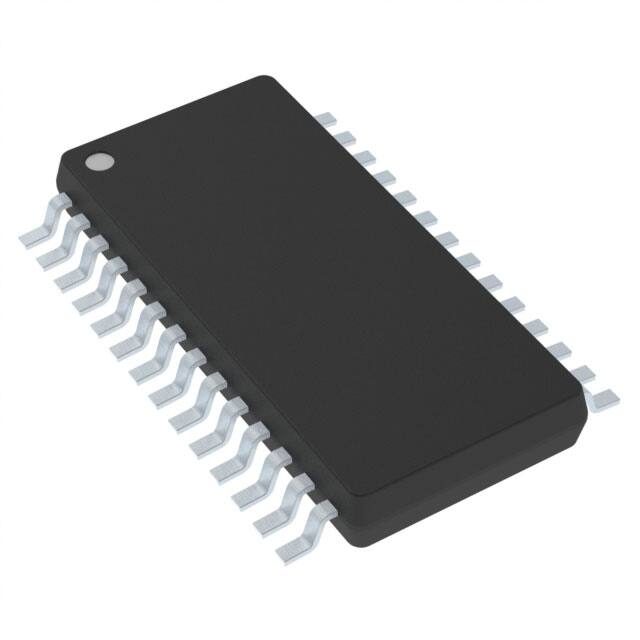
xDSL line driver that features full ADSL central office (CO)
Performance on ±12 V supplies
Low power operation
±5 V to ±12 V voltage supply
12.5 mA/amp (typical) total supply current
Power reduced keep alive current of 4.5 mA/amp
High output voltage and current drive
IOUT = 600 mA
40 V p-p differential output voltage RL = 50 Ω, VS = ±12 V
Low single-tone distortion
–75 dBc @ 1 MHz SFDR, RL = 100 Ω, VOUT = 2 V p-p
MTPR = –75 dBc, 26 kHz to 1.1 MHz, ZLINE = 100 Ω,
PLINE = 20.4 dBm
High Speed
78 MHz bandwidth (–3 dB), G = +5
40 MHz gain flatness
1000 V/μs slew rate
PIN CONFIGURATIONS
+V1 1
24
VOUT1 2
23
VOUT2
VINN1 3
22
VINN2
VINP1 4
21
VINP2
AGND 5
20
AGND
– +
+ –
AD8016
AGND 6
+V2
AGND
TOP VIEW
(Not to Scale) 18 AGND
17 AGND
AGND 7
AGND 8
19
PWDN0 9
16
PWDN1
DGND 10
15
BIAS
–V1 11
14
–V2
NC 12
13
NC
NC = NO CONNECT
01019-002
FEATURES
Figure 1. 24-Lead SOIC_W_BAT (RB-24)
NC 1
28 NC
NC 2
27 NC
NC 3
26 NC
+VIN2 4
25 NC
–VIN2 5
24 PWDN1
VOUT2 6
23 BIAS
+V2 7
AD8016ARE
22 –V2
+V1 8
TOP VIEW
(Not to Scale)
21 –V1
VOUT1 9
20 DGND
–VIN1 10
19 NC
+VIN1 11
18
PWDN0
NC 12
17 NC
NC 13
16
NC
NC 14
15
NC
NOTES
1. THE EXPOSED PADDLE IS FLOATING,
NOT ELECTRICALLY CONNECTED
INTERNALLY.
2. NC = NO CONNECT.
01019-003
Data Sheet
Low Power, High Output
Current xDSL Line Driver
AD8016
Figure 2. 28-Lead TSSOP_EP (RE-28-1)
GENERAL DESCRIPTION
The AD8016 high output current dual amplifier is designed for
the line drive interface in Digital Subscriber Line systems such
as ADSL, HDSL2, and proprietary xDSL systems. The drivers
are capable, in full-bias operation, of providing 24.4 dBm
output power into low resistance loads, enough to power a
20.4 dBm line, including hybrid insertion loss.
the xDSL hybrid in Figure 35 and Figure 36. Two digital bits
(PWDN0, PWDN1) allow the driver to be capable of full
performance, an output keep-alive state, or two intermediate
bias states. The keep-alive state biases the output transistors
enough to provide a low impedance at the amplifier outputs
for back termination.
The AD8016 is available in a low cost 24-lead SOIC_W_BAT
and a 28-lead TSSOP_EP with an exposed lead frame (ePAD).
Operating from ±12 V supplies, the AD8016 requires only 1.5 W
of total power dissipation (refer to the Power Dissipation section
for details) while driving 20.4 dBm of power downstream using
The low power dissipation, high output current, high output
voltage swing, flexible power-down, and robust thermal
packaging enable the AD8016 to be used as the central office
(CO) terminal driver in ADSL, HDSL2, VDSL, and proprietary
xDSL systems.
Rev. C
Information furnished by Analog Devices is believed to be accurate and reliable. However, no
responsibility is assumed by Analog Devices for its use, nor for any infringements of patents or other
rights of third parties that may result from its use. Specifications subject to change without notice. No
license is granted by implication or otherwise under any patent or patent rights of Analog Devices.
Trademarks and registered trademarks are the property of their respective owners.
One Technology Way, P.O. Box 9106, Norwood, MA 02062-9106, U.S.A.
Tel: 781.329.4700
www.analog.com
Fax: 781.461.3113
©2012 Analog Devices, Inc. All rights reserved.
�AD8016
Data Sheet
TABLE OF CONTENTS
Features .............................................................................................. 1
Feedback Resistor Selection ...................................................... 14
Pin Configurations ........................................................................... 1
Bias Pin and PWDN Features ................................................... 14
General Description ......................................................................... 1
Thermal Shutdown .................................................................... 15
Revision History ............................................................................... 2
Applications Information .............................................................. 16
Specifications..................................................................................... 3
Multitone Power Ratio (MTPR) ............................................... 16
Logic Inputs (CMOS Compatible Logic) .................................. 4
Generating DMT ........................................................................ 17
Absolute Maximum Ratings ............................................................ 5
Power Dissipation....................................................................... 17
Maximum Power Dissipation ..................................................... 5
Thermal Enhancements and PCB Layout ............................... 18
ESD Caution .................................................................................. 5
Thermal Testing.......................................................................... 18
Pin Configurations and Function Descriptions ........................... 6
Air Flow Test Conditions .......................................................... 18
Typical Performance Characteristics ............................................. 7
Experimental Results ................................................................. 19
Test Circuts ...................................................................................... 13
Outline Dimensions ....................................................................... 20
Theory of Operation ...................................................................... 14
Ordering Guide .......................................................................... 20
Power Supply and Decoupling .................................................. 14
REVISION HISTORY
3/12—Rev. B to Rev. C
Updated Format .................................................................. Universal
Deleted PSOP Package and Evaluation Boards (Throughout) ... 1
Added Pin Configurations and Function Descriptions Sections .. 7
Updated Outline Dimensions ....................................................... 21
Changes to Ordering Guide .......................................................... 19
11/03—Rev. A to Rev. B
Changes to Ordering Guide ............................................................ 4
Changes to TPC 21 ........................................................................... 8
Updated Outline Dimensions ..................................................19-20
Rev. C | Page 2 of 20
�Data Sheet
AD8016
SPECIFICATIONS
@ 25°C, VS = ±12 V, RL = 100 Ω, PWDN0, PWDN1 = (1, 1), TMIN = −40°C, TMAX = +85°C, unless otherwise noted.
Table 1.
Parameter
DYNAMIC PERFORMANCE
−3 dB Bandwidth
Bandwidth for 0.1 dB Flatness
Large Signal Bandwidth
Peaking
Slew Rate
Rise and Fall Time
Settling Time
Input Overdrive Recovery Time
NOISE/DISTORTION PERFORMANCE
Distortion, Single-Ended
Second Harmonic
Third Harmonic
Multitone Power Ratio 1
IMD
IP3
Voltage Noise (RTI)
Input Current Noise
INPUT CHARACTERISTICS
RTI Offset Voltage
+Input Bias Current
–Input Bias Current
Input Resistance
Input Capacitance
Input Common-Mode Voltage Range
Common-Mode Rejection Ratio
OUTPUT CHARACTERISTICS
Output Voltage Swing
Linear Output Current
Short-Circuit Current
Capacitive Load Drive
POWER SUPPLY
Operating Range
Quiescent Current
Recovery Time
Shutdown Current
Power Supply Rejection Ratio
OPERATING TEMPERATURE RANGE
1
Test Conditions/Comments
G = +1, RF = 1.5 kΩ, VOUT = 0.2 V p-p
G = +5, RF = 499 Ω, VOUT < 0.5 V p-p
G = +5, RF = 499 Ω, VOUT = 0.2 V p-p
VOUT = 4 V p-p
VOUT = 0.2 V p-p < 50 MHz
VOUT = 4 V p-p, G = +2
VOUT = 2 V p-p
0.1%, VOUT = 2 V p-p
VOUT = 12.5 V p-p
VOUT = 2 V p-p, G = +5, RF = 499 Ω
fC = 1 MHz, RL = 100 Ω/25 Ω
fC = 1 MHz, RL = 100 Ω/25 Ω
26 kHz to 1.1 MHz, ZLINE = 100 Ω, PLINE = 20.4 dBm
500 kHz, Δf = 10 kHz, RL = 100 Ω/25 Ω
500 kHz, RL = 100 Ω/25 Ω
f = 10 kHz
f = 10 kHz
Min
69
16
−75/−62
−88/−74
−84/−80
42/40
−3.0
−45
−75
−10
58
Single-ended, RL = 100 Ω
G = 5, RL = 10 Ω, f1 = 100 kHz, −60 dBc SFDR
−11
400
Typ
See Figure 48, R20, R21 = 0 Ω, R1 = open.
Rev. C | Page 3 of 20
63
−40
Unit
380
78
38
90
0.1
1000
2
23
350
MHz
MHz
MHz
MHz
dB
V/μs
ns
ns
ns
−77/−64
−93/−76
–75
−88/−85
43/41
2.6
18
dBc
dBc
dBc
dBc
dBm
nV/√Hz
pA√Hz
1.0
4
400
2
4.5
21
+3.0
+45
+75
+10
64
12.5
8
5
4
25
1.5
75
mV
μA
μA
kΩ
pF
V
dB
+11
V
mA
mA
pF
±13
13.2
10
8
6
V
mA/Amp
mA/Amp
mA/Amp
mA/Amp
μs
mA/Amp
dB
°C
600
2000
80
±3
PWDN1, PWDN0 = (1, 1)
PWDN1, PWDN0 = (1, 0)
PWDN1, PWDN0 = (0, 1)
PWDN1, PWDN0 = (0, 0)
To 95% of IQ
250 μA out of bias pin
ΔVS = ±1 V
Max
4.0
+85
�AD8016
Data Sheet
@ 25°C, VS = ±6 V, RL = 100 Ω, PWDN0, PWDN1 = (1, 1), TMIN = –40°C, TMAX = +85°C, unless otherwise noted.
Table 2.
Parameter
DYNAMIC PERFORMANCE
–3 dB Bandwidth
Test Conditions/Comments
Bandwidth for 0.1 dB Flatness
Large Signal Bandwidth
Peaking
Slew Rate
Rise and Fall Time
Settling Time
Input Overdrive Recovery Time
NOISE/DISTORTION PERFORMANCE
Distortion, Single-Ended
Second Harmonic
Third Harmonic
Multitone Power Ratio 1
IMD
IP3
Voltage Noise (RTI)
Input Current Noise
INPUT CHARACTERISTICS
RTI Offset Voltage
+Input Bias Current
−Input Bias Current
Input Resistance
Input Capacitance
Input Common-Mode Voltage Range
Common-Mode Rejection Ratio
OUTPUT CHARACTERISTICS
Output Voltage Swing
Linear Output Current
Short-Circuit Current
Capacitive Load Drive
POWER SUPPLY
Quiescent Current
Recovery Time
Shutdown Current
Power Supply Rejection Ratio
OPERATING TEMPERATURE RANGE
Min
G = +1, RF = 1.5 kΩ, VOUT = 0.2 V p-p
G = +5, RF = 499 Ω, VOUT < 0.5 V p-p
G = +5, RF = 499 Ω, VOUT = 0.2 V p-p
VOUT = 1 V rms
VOUT = 0.2 V p-p < 50 MHz
VOUT = 4 V p-p, G = +2
VOUT = 2 V p-p
0.1%, VOUT = 2 V p-p
VOUT = 6.5 V p-p
70
10
G = +5, VOUT = 2 V p-p, RF = 499 Ω
fC = 1 MHz, RL = 100 Ω/25 Ω
fC = 1 MHz, RL = 100 Ω/25 Ω
26 kHz to 138 kHz, ZLINE = 100 Ω, PLINE = 13 dBm
500 kHz, Δf = 110 kHz, RL = 100 Ω/25 Ω
500 kHz
f = 10 kHz
f = 10 kHz
−73/61
−80/−68
−87/−82
42/39
−3.0
−25
−30
−4
60
Single-Ended, RL = 100 Ω
G = +5, RL = 5 Ω, f = 100 kHz, −60 dBc SFDR
−5
300
Typ
320
71
15
80
0.7
300
2
39
350
−75/−63
−82/−70
−68
−88/−83
42/39
4
17
+4
66
RS = 10 Ω
PWDN1, PWDN0 = (1, 1)
PWDN1, PWDN0 = (1, 0)
PWDN1, PWDN0 = (0, 1)
PWDN1, PWDN0 = (0, 0)
To 95% of IQ
250 μA out of bias pin
ΔVS = ±1 V
8
6
4
3
23
1.0
80
PWDN0, PWDN1, VCC = ±12 V or ±6 V; full temperature range.
Table 3.
Typ
Max
VCC
0.8
Rev. C | Page 4 of 20
Unit
V
V
mV
μA
μA
kΩ
pF
V
dB
V
mA
mA
pF
9.7
6.9
5.0
4.1
mA/Amp
mA/Amp
mA/Amp
mA/Amp
μs
mA/Amp
dB
°C
+85
LOGIC INPUTS (CMOS COMPATIBLE LOGIC)
dBc
dBc
dBc
dBc
dBm
nV/√Hz
pA√Hz
+5
2.0
See Figure 48, R20, R21 = 0 Ω, R1 = open.
Min
2.2
0
1.0
MHz
MHz
MHz
MHz
dB
V/μs
ns
ns
ns
+3.0
+25
+30
1
Parameter
Logic 1 Voltage
Logic 0 Voltage
Unit
5
20
0.2
10
10
400
2
420
830
50
63
−40
Max
�Data Sheet
AD8016
ABSOLUTE MAXIMUM RATINGS
Storage Temperature Range
Operating Temperature Range
Lead Temperature Range (Soldering 10 sec)
Rating
26.4 V
1.4 W
1.4 W
±VS
±VS
Observe power derating
curves
−65°C to +125°C
−40°C to +85°C
300°C
1
Specification is for device on a 4-layer board with 10 inches2 of 1 oz copper
at 85°C 24-lead SOIC_W_BAT package: θJA = 28°C/W.
2 Specification is for device on a 4-layer board with 9 inches2 of 1 oz copper at
85°C 28-lead (TSSOP_EP) package: θJA = 29°C/W.
Stresses above those listed under Absolute Maximum Ratings
may cause permanent damage to the device. This is a stress
rating only; functional operation of the device at these or any
other conditions above those indicated in the operational
section of this specification is not implied. Exposure to absolute
maximum rating conditions for extended periods may affect
device reliability.
8
7
6
5
4
SOIC_W_BAT
3
TSSOP-EP
2
1
0
0
10
20
30
40
50
60
AMBIENT TEMPERATURE (°C)
70
80
90
01019-005
Parameter
Supply Voltage
Internal Power Dissipation
SOIC_W_BAT Package1
TSSOP_EP Package2
Input Voltage (Common-Mode)
Differential Input Voltage
Output Short-Circuit Duration
The output stage of the AD8016 is designed for maximum load
current capability. As a result, shorting the output to common
can cause the AD8016 to source or sink 2000 mA. To ensure
proper operation, it is necessary to observe the maximum
power derating curves. Direct connection of the output to
either power supply rail can destroy the device.
MAXIMUM POWER DISSIPATION (W)
Table 4.
Figure 3. Maximum Power Dissipation vs. Temperature for AD8016 for
TJ = 125 °C
ESD CAUTION
MAXIMUM POWER DISSIPATION
The maximum power that can be safely dissipated by the
AD8016 is limited by the associated rise in junction temperature. The maximum safe junction temperature for a plastic
encapsulated device is determined by the glass transition
temperature of the plastic, approximately 150°C. Temporarily
exceeding this limit may cause a shift in parametric performance due to a change in the stresses exerted on the die by
the package.
Rev. C | Page 5 of 20
�AD8016
Data Sheet
PIN CONFIGURATIONS AND FUNCTION DESCRIPTIONS
NC 1
24
+V2
VOUT1 2
23
VOUT2
VINN1 3
– +
+ –
VINP1 4
21
AGND 5
AGND 7
AGND 8
AD8016
VINN2
VINP2
25 NC
–VIN2 5
24 PWDN1
23 BIAS
+V2 7
AD8016ARE
22 –V2
+V1 8
TOP VIEW
(Not to Scale)
21 –V1
20
AGND
19
AGND
–VIN1 10
19 NC
+VIN1 11
18
16
PWDN1
DGND 10
15
BIAS
–V1 11
14
–V2
NC 12
13
NC
NC = NO CONNECT
+VIN2 4
VOUT1 9
TOP VIEW
(Not to Scale) 18 AGND
17 AGND
PWDN0 9
26 NC
VOUT2 6
20 DGND
PWDN0
NC 12
17 NC
NC 13
16
NC
NC 14
15
NC
NOTES
1. THE EXPOSED PADDLE IS FLOATING,
NOT ELECTRICALLY CONNECTED
INTERNALLY.
2. NC = NO CONNECT.
01019-002
AGND 6
22
27 NC
NC 3
Figure 4. 24-Lead SOIC_W_BAT (RB-24)
01019-003
+V1 1
28 NC
NC 2
Figure 5. 28-Lead TSSOP_EP (RE-28-1)
Table 5. Pin Function Descriptions
SOIC_W_BAT
1
2
3
4
5 to 8, 17 to 20
9
10
11
12, 13
14
15
16
21
22
23
24
Pin No.
TSSOP_EP
8
9
18
20
21
1 to 3, 12 to 17, 19,
25 to 28
22
23
24
6
7
4
5
10
11
EP
Mnemonic
+V1
VOUT1
VINN1
VINP1
AGND
PWDN0
DGND
−V1
NC
Description
Positive Power Supply, Amp 1.
Output Signal, Amp 1.
Negative Input Signal, Amp 1.
Positive Input Signal, Amp1.
Analog Ground.
Power-Down Input 0.
Digital Ground.
Negative Power Supply, Amp1.
This pin is not connected internally (see Figure 4 and Figure 5).
−V2
BIAS
PWDN1
VINP2
VINN2
VOUT2
+V2
+VIN2
−VIN2
−VIN1
+VIN1
EPAD
−V Power Supply, Amp 2.
Quiescent Current Adjust.
Power-Down Input 1.
Positive Input Signal, Amp 2.
Negative Input Signal, Amp 2.
Output Signal, Amp 2.
Positive Power Supply, Amp 2.
Positive Input Signal, Amp 2.
Negative Input Signal, Amp 2.
Negative Input Signal, Amp 1.
Positive Input Signal, Amp 1.
Exposed Pad. The exposed paddle is floating, not electrically connected internally.
Rev. C | Page 6 of 20
�Data Sheet
AD8016
TYPICAL PERFORMANCE CHARACTERISTICS
549.3 550.3 551.3 552.3 553.3 554.3 555.3 556.3 557.3 558.3 559.3
FREQUENCY (kHz)
TIME (100ns/DIV)
Figure 6. Multitone Power Ratio; VS = ±12 V, 20.4 dBm Output Power into
100 Ω, Downstream
Figure 9. 100 mV Step Response; G = +5, VS = ±12 V, RL = 25 Ω, Single-Ended
VOLTS
VOUT = 4V
VIN = 20mV
01019-011
VIN = 800mV
01019-008
VOLTS
VOUT = 100mV
TIME (100ns/DIV)
VIN = 20mV
01019-010
VOLTS
–75dBc
01019-004
10dB/DIV
VOUT = 100mV
TIME (100ns/DIV)
Figure 7. 100 mV Step Response; G = +5, VS = ±6 V, RL = 25 Ω, Single-Ended
Figure 10. 4 V Step Response; G = +5, VS = ±12 V, RL = 25 Ω, Single-Ended
–30
RF = 499Ω
G = +10
–40 VOUT = 4V p-p
VOUT = 5V
(0,0)
VOLTS
DISTORTION (dBc)
–50
VIN = 800mV
(0,1)
(1,0)
–60
–70
–80
PWDN1, PWDN0 = (1,1)
–90
–110
0.01
Figure 8. 4 V Step Response; G = +5, VS = ±6 V, RL = 25 Ω, Single-Ended
0.1
1
FREQUENCY (MHz)
10
20
01019-012
01019-009
TIME (100ns/DIV)
–100
Figure 11. Distortion vs. Frequency; Second Harmonic, VS = ±12 V, RL = 50 Ω,
Differential
Rev. C | Page 7 of 20
�AD8016
Data Sheet
–30
(0,0)
RF = 499Ω
G = +10
V
–40 OUT = 4V p-p
(0,1)
–50
DISTORTION (dBc)
(1,0)
–60
–70
–80
PWDN1, PWDN0 = (1,1)
–100
10
20
Figure 12. Distortion vs. Frequency; Second Harmonic, VS = ±6 V, RL = 50 Ω
–30
–110
0.01
–30
10
20
RF = 499Ω
G = +5
(1,0)
(0,0)
–45
DISTORTION (dBc)
–50
–55
(0,0)
(0,1)
(1,0)
–60
–65
–70
–50
(0,1)
–60
–70
–80
0
100
300
400
500
600
200
PEAK OUTPUT CURRENT (mA)
700
800
01019-014
PWDN1, PWDN0 = (1,1)
–75
Figure 13. Distortion vs. Peak Output Current; Second Harmonic, VS = ±12 V,
RL = 10 Ω, f = 100 kHz, Single-Ended
–30
–90
0
100
300
400
500
200
PEAK OUTPUT CURRENT (mA)
600
700
Figure 16. Distortion vs. Peak Output Current, Third Harmonic; VS = ±12 V,
RL = 10 Ω, G = +5, f = 100 kHz, Single-Ended
–30
(0,0)
RF = 499Ω
G = +10
–40 VOUT = 4V p-p
PWDN1,
PWDN0 = (1,1)
01019-017
DISTORTION (dBc)
1
FREQUENCY (MHz)
–40
–40
–80
0.1
Figure 15. Distortion vs. Frequency; Third Harmonic, VS = ±6 V, RL = 50 Ω,
Differential
RF = 499Ω
G = +5
–35
PWDN1, PWDN0 = (1,1)
–80
–100
1
FREQUENCY (MHz)
(1,0)
–70
–90
0.1
(0,1)
–60
–90
–110
0.01
(0,0)
–50
01019-013
DISTORTION (dBc)
RF = 499Ω
G = +10
–40 VOUT = 4V p-p
01019-016
–30
RF = 499Ω
G = +5
–35
(0,1)
–40
–60
DISTORTION (dBc)
DISTORTION (dBc)
–50
(1,0)
–70
PWDN1, PWDN0 = (1,1)
–80
–45
(0,0)
–50
(0,1)
–55
(1,0)
–60
–65
–90
–70
0.1
1
FREQUENCY (MHz)
10
20
–80
01019-015
–110
0.01
–75
Figure 14. Distortion vs. Frequency; Third Harmonic, VS = ±12 V, RL = 50 Ω,
Differential
PWDN1, PWDN0 = (1,1)
0
100
200
300
400
PEAK OUTPUT CURRENT (mA)
500
600
01019-018
–100
Figure 17. Distortion vs. Peak Output Current; Second Harmonic, VS = ±6 V,
RL = 5 Ω, f = 100 kHz, Single-Ended
Rev. C | Page 8 of 20
�AD8016
–30
–30
–40
–40
–50
–50
DISTORTION (dBc)
(0,0)
–60
(0,1)
–70
(1,0)
(0,0)
(0,1)
–60
(1,0)
–70
–80
–80
PWDN1, PWDN0 = (1,1)
0
5
15
20
25
30
10
DIFFERENTIAL OUTPUT (V p-p)
35
–100
01019-020
–100
PWDN1, PWDN0 = (1,1)
–90
–90
40
0
5
10
15
20
25
30
DIFFERENTIAL OUTPUT (V p-p)
35
01019-023
DISTORTION (dBc)
Data Sheet
40
Figure 21. Distortion vs. Output Voltage; Third Harmonic, VS = ±12 V,
G = +10, f = 1 MHz, RL = 50 Ω, Differential
Figure 18. Distortion vs. Output Voltage; Second Harmonic, VS = ±12 V,
G = +10, f = 1 MHz, RL = 50 Ω, Differential
–30
–30
–40
–40
DISTORTION (dBc)
DISTORTION (dBc)
(0,0)
–50
–60
(0,0)
(0,1)
–70
–50
(0,1)
–60
(1,0)
–70
(1,0)
10
15
5
DIFFERENTIAL OUTPUT (V p-p)
0
20
–90
Figure 19. Distortion vs. Output Voltage; Second Harmonic, VS = ±6 V,
G = +10, f = 1 MHz, RL = 50 Ω, Differential
20
3
–40
–45
–50
(0,0)
–55
(0,1)
–60
(1,0)
–65
–70
–75
0
100
300
400
200
PEAK OUTPUT CURRENT (mA)
500
600
Figure 20. Distortion vs. Peak Output Current; Third Harmonic, VS = ±6 V,
G = +5, RL = 5 Ω, f = 100 kHz, Single-Ended
–3
(1,1)
–6
(1,0)
–9
–12
(0,1)
–15
–18
(0,0)
–21
VIN = 40mV p-p
G = +5
RL = 100Ω
–24
–27
01019-022
PWDN1, PWDN0 = (1,1)
0
1
10
FREQUENCY (MHz)
100
500
01019-025
NORMALIZED FREQUENCY RESPONSE (dB)
–35
DISTORTION (dBc)
5
10
15
DIFFERENTIAL OUTPUT (V p-p)
Figure 22. Distortion vs. Output Voltage, Third Harmonic, VS = ±6 V, G = +10,
f = 1 MHz, RL = 50 Ω, Differential
–30
–80
0
01019-024
PWDN1, PWDN0 = (1,1)
01019-021
–90
PWDN1, PWDN0 = (1,1)
–80
–80
Figure 23. Frequency Response; VS = ±12 V, @ PWDN1, PWDN0 Codes
Rev. C | Page 9 of 20
�AD8016
11
Data Sheet
11
G = +5
RL = 100Ω
RF = 499Ω
8
–1
–4
–7
–10
2
–1
–4
–7
–10
–13
–13
–16
–16
1
10
FREQUENCY (MHz)
100
500
–19
10
FREQUENCY (MHz)
1
Figure 24. Output Voltage vs. Frequency; VS = ±12 V
20
10
500
Figure 27. Output Voltage vs. Frequency; VS = ±6 V
–10
VIN = 2V rms
RF = 602Ω
RF = 499Ω
–20
(1,1)
0
100
01019-029
OUTPUT VOLTAGE (dBV)
5
2
01019-026
OUTPUT VOLTAGE (dBV)
5
–19
G = +5
RL = 100Ω
RF = 499Ω
8
(1,0)
–30
+PSRR
–20
–30
PSRR (dB)
CMRR (dB)
–10
(0,1)
–40
–40
–50
–PSRR
–60
(0,0)
–50
–70
–60
100
500
–90
0.01
10
1
FREQUENCY (MHz)
100
500
Figure 28. PSRR vs. Frequency; VS = ±12 V
Figure 25. CMRR vs. Frequency; VS = ±12 V @ PWDN1, PWDN0 Codes
180
90
3
160
80
140
70
120
60
100
50
80
40
+ INPUT CURRENT NOISE (pA/ Hz)
6
0
(1,1)
–3
–6
(1,0)
–9
–12
(0,1)
–15
–18
–21 VIN = 40mV p-p
G = +5
RL = 100Ω
–24
1
(0,0)
60
30
+INOISE
40
20
VIN NOISE
10
20
10
FREQUENCY (MHz)
100
500
01019-028
NORMALIZED FREQUENCY RESPONSE (dB)
0.1
Figure 26. Frequency Response; VS = ±6 V, @ PWDN1, PWDN0 Codes
Rev. C | Page 10 of 20
0
10
INPUT VOLTAGE NOISE (nV/ Hz)
10
1
FREQUENCY (MHz)
100
100k
1k
10k
FREQUENCY (MHz)
Figure 29. Noise vs. Frequency
1M
0
10M
01019-031
0.1
01019-027
–80
0.03
01019-030
–80
–70
�G = +2
RF = 1kΩ
VOUT = 2VSTEP
RL = 100Ω
+2mV
(–0.1%)
0
–2mV
(–0.1%)
VOUT
VIN
–5
0
5
10
VOUT – VIN
15
20
25
30
35
40
G = +2
RF = 1kΩ
VOUT = 2VSTEP
RL = 100Ω
+2mV
(–0.1%)
0
–2mV
(–0.1%)
45
TIME (ns)
VIN
VOUT
–5
0
10
5
15
20
25
30
35
40
45
TIME (ns)
Figure 30. Settling Time 0.1%; VS = ±12 V
Figure 33. Settling Time 0.1%; VS = ±6 V
1000
–20
VOUT = 2V p-p
RF = 499Ω
G = +5
–30 R = 100Ω
L
OUTPUT IMPEDANCE (Ω)
100
–40
CROSSTALK (dB)
VOUT – VIN
01019-035
OUTPUT VOLTAGE ERROR (2mV/DIV (0.1%/DIV))
AD8016
01019-032
OUTPUT VOLTAGE ERROR (2mV/DIV (0.1%/DIV))
Data Sheet
–50
–60
–70
(0,0)
(0,1)
10
(1,0)
1
(1,1)
0.1
0.1
1
10
FREQUENCY (MHz)
100
500
0.01
0.03
01019-033
–90
0.03
Figure 31. Output Crosstalk vs. Frequency
0.1
1
10
FREQUENCY (MHz)
100
01019-036
–80
500
Figure 34. Output Impedance vs. Frequency @ PWDN1, PWDN0 Codes
1M
360
100k
320
10k
280
VIN = 2V/DIV
VOUT = 5V/DIV
240
100
200
TRANSIMPEDANCE
10
160
120
1
0.1
80
0.01
40
PHASE (Degrees)
PHASE
1k
0V
VIN
0.001
0.0001
0.001
0.01
0.1
1
10
FREQUENCY (MHz)
100
1k
0
10k
Figure 32. Open-Loop Transimpedance and Phase vs. Frequency
–100
0
100
200
300 400 500
TIME (ns)
600
700
800
900
01019-037
0V
01019-034
TRANSIMPEDANCE (k Ω)
VOUT
Figure 35. Positive Overdrive Recovery; VS = ±12 V, G = +5, RL = 100 Ω
Rev. C | Page 11 of 20
�AD8016
Data Sheet
18
VIN = 2V/DIV
VOUT = 5V/DIV
16
PWDN1, PWDN0 = (1,1)
14
0V
VOUT
12
IQ (mA)
(1,0)
0V
10
(0,1)
8
(0,0)
VIN
6
4
100
200
300 400 500
TIME (ns)
600
700
800
900
0
0
50
100
IBIAS (µA)
150
200
01019-040
0
01019-038
2
–100
Figure 38. IQ vs. IBIAS Current; VS = ±6 V
Figure 36. Negative Overdrive Recovery; VS = ±12 V, G = +5, RL = 100 Ω
12
25
+VOUT, VS = ±12V
PWDN1, PWDN0 = (1,1)
8
20
OUTPUT SWING (V)
+VOUT, VS = ±6V
(1,0)
IQ (mA)
15
(0,1)
10
4
0
–4
(0,0)
–VOUT, VS = ±6V
5
–8
50
100
IBIAS (µA)
150
200
Figure 37. IQ vs. IBIAS Current; VS = ±12 V
–12
10
100
1k
RLOAD (Ω)
Figure 39. Output Voltage vs. RLOAD
Rev. C | Page 12 of 20
10k
01019-041
0
01019-039
–VOUT, VS = ±12V
0
�Data Sheet
AD8016
TEST CIRCUTS
10µF
+VS
124Ω
499Ω
+
0.1µF
+VIN
VOUT
+VO
49.9Ω
RL
499Ω
111Ω
VIN
49.9Ω
499Ω
RL
+VS
0.1µF
+
10µF
0.1µF
+
10µF
0.1µF
–VIN
–VO
–VS
Figure 40. Single-Ended Test Circuit; G = +5
10µF
+
Figure 41. Differential Test Circuit; G = +10
Rev. C | Page 13 of 20
01019-007
–VS
01019-006
49.9Ω
�AD8016
Data Sheet
THEORY OF OPERATION
The AD8016 is a current feedback amplifier with high
(500 mA) output current capability. With a current feedback
amplifier, the current into the inverting input is the feedback
signal and the open-loop behavior is that of a transimpedance,
dVOUT/dIIN or TZ. The open-loop transimpedance is analogous
to the open-loop voltage gain of a voltage feedback amplifier.
Figure 42 shows a simplified model of a current feedback amplifier. Because RIN is proportional to 1/gm, the equivalent voltage
gain is just TZ × gm, where gm is the transconductance of the
input stage. Basic analysis of the follower with gain circuit yields
TZ (S)
VOUT
=G×
TZ (S) + G × RIN + RF
VIN
RIN =
RF
RG
1
≈ 25 Ω
gm
Recognizing that G × RIN