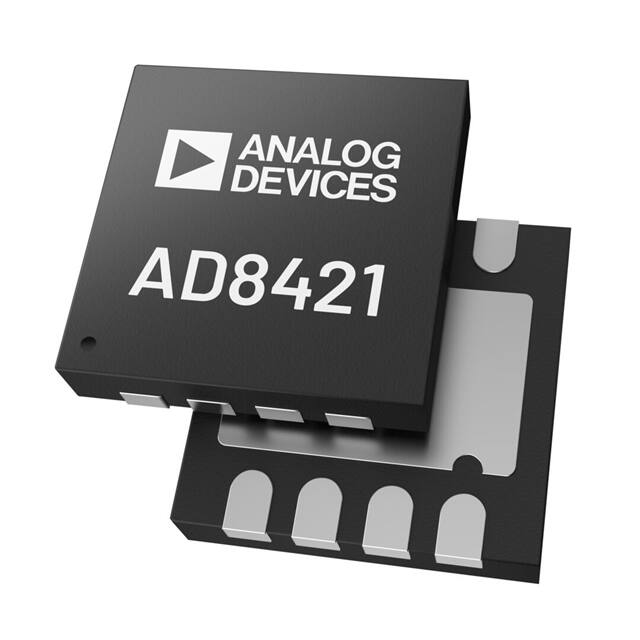
3 nV/√Hz, Low Power
Instrumentation Amplifier
AD8421
Data Sheet
FEATURES
Medical instrumentation
Precision data acquisition
Microphone preamplification
Vibration analysis
Multiplexed input applications
ADC driver
GENERAL DESCRIPTION
The AD8421 is a low cost, low power, extremely low noise,
ultralow bias current, high speed instrumentation amplifier that
is ideally suited for a broad spectrum of signal conditioning and
data acquisition applications. This product features extremely
high CMRR, allowing it to extract low level signals in the presence
of high frequency common-mode noise over a wide
temperature range.
The 10 MHz bandwidth, 35 V/µs slew rate, and 0.6 µs settling
time to 0.001% (G = 10) allow the AD8421 to amplify high speed
signals and excel in applications that require high channel count,
multiplexed systems. Even at higher gains, the current feedback
architecture maintains high performance; for example, at G = 100,
the bandwidth is 2 MHz and the settling time is 0.8 µs. The
AD8421 has excellent distortion performance, making it suitable
for use in demanding applications such as vibration analysis.
ADR435
0.1µF
+12V
+IN
10Ω
+5V
10kΩ
2.5V
10kΩ
1µF
G = 10
1.1kΩ
REF
100Ω
AD8421
VDD VIO
IN+
SPI
INTERFACE
SDI
REF 3nF
AD7685
–IN
SCK
SDO
–12V
IN–
CNV
GND
+
2.5V
OP1177
10µF
10123-101
–
5kΩ
Figure 1. AD8421 Driving 16-Bit AD7685
10µ
G = 100
BEST AVAILABLE
7mA LOW NOISE IN-AMP
1µ
100n
BEST AVAILABLE
1mA LOW POWER IN-AMP
10n
AD8421
RS NOISE ONLY
1n
100
1k
10k
100k
SOURCE RESISTANCE, RS (Ω)
1M
10123-078
APPLICATIONS
TYPICAL APPLICATION DIAGRAM
+12V
TOTAL NOISE DENSITY AT 1kHz (V/√Hz)
Low power
2.3 mA maximum supply current
Low noise
3.2 nV/√Hz maximum input voltage noise at 1 kHz
200 fA/√Hz current noise at 1 kHz
Excellent ac specifications
10 MHz bandwidth (G = 1)
2 MHz bandwidth (G = 100)
0.6 µs settling time to 0.001% (G = 10)
80 dB CMRR at 20 kHz (G = 1)
35 V/µs slew rate
High precision dc performance (AD8421BRZ)
94 dB CMRR minimum (G = 1)
0.2 µV/°C maximum input offset voltage drift
1 ppm/°C maximum gain drift (G = 1)
500 pA maximum input bias current
Inputs protected to 40 V from opposite supply
±2.5 V to ±18 V dual supply (5 V to 36 V single supply)
Gain set with a single resistor (G = 1 to 10,000)
Available in 8-lead LFCSP, 8-lead MSOP, and 8-lead SOIC
Figure 2. Noise Density vs. Source Resistance
The AD8421 delivers 3 nV/√Hz input voltage noise and
200 fA/√Hz current noise with only 2 mA quiescent current,
making it an ideal choice for measuring low level signals. For
applications with high source impedance, the AD8421 employs
innovative process technology and design techniques to provide
noise performance that is limited only by the sensor.
The AD8421 uses unique protection methods to ensure robust
inputs while still maintaining very low noise. This protection
allows input voltages up to 40 V from the opposite supply rail
without damage to the part.
A single resistor sets the gain from 1 to 10,000. The reference
pin can be used to apply a precise offset to the output voltage.
The AD8421 is specified from −40°C to +85°C for the 8-lead
MSOP and SOIC packages, and from −40°C to +125°C for the
8-lead LFCSP package.
Rev. A
Information furnished by Analog Devices is believed to be accurate and reliable. However, no
responsibility is assumed by Analog Devices for its use, nor for any infringements of patents or other
rights of third parties that may result from its use. Specifications subject to change without notice.
No license is granted by implication or otherwise under any patent or patent rights of Analog
Devices. Trademarks and registered trademarks are the property of their respective owners.
One Technology Way, P.O. Box 9106, Norwood, MA 02062-9106, U.S.A.
Tel: 781.329.4700
www.analog.com
Fax: 781.461.3113 ©2012–2020 Analog Devices, Inc. All rights reserved.
�AD8421
Data Sheet
TABLE OF CONTENTS
Features .............................................................................................. 1
Architecture ................................................................................ 22
Applications ...................................................................................... 1
Gain Selection ............................................................................. 22
Typical Application Diagram ......................................................... 1
Reference Terminal .................................................................... 23
General Description ......................................................................... 1
Input Voltage Range .................................................................. 23
Revision History ............................................................................... 2
Layout .......................................................................................... 23
Specifications .................................................................................... 3
Input Bias Current Return Path ............................................... 24
AR and BR Grades ....................................................................... 3
Input Voltages Beyond the Supply Rails ................................. 24
ARM and BRM Grades................................................................ 5
Radio Frequency Interference (RFI) ....................................... 25
ACP Grade .................................................................................... 7
Calculating the Noise of the Input Stage ................................ 25
Absolute Maximum Ratings ......................................................... 10
Applications Information ............................................................. 27
Thermal Resistance .................................................................... 10
Differential Output Configuration .......................................... 27
ESD Caution................................................................................ 10
Driving an ADC ......................................................................... 28
Pin Configurations and Function Descriptions ......................... 11
Outline Dimensions ....................................................................... 29
Typical Performance Characteristics ........................................... 12
Ordering Guide .......................................................................... 30
Theory of Operation ...................................................................... 22
REVISION HISTORY
10/2020—Rev. 0 to Rev. A
Added 8-Lead LFCSP .................................................... Throughout
Changed Pin Connection Diagram Section to Typical
Application Diagram Section ......................................................... 1
Changes to Features Section, Figure 1, and General
Description Section .......................................................................... 1
Added ACP Grade Section and Table 3; Renumbered
Sequentially ....................................................................................... 7
Changes to Table 5 ......................................................................... 10
Changes to Figure 44 ..................................................................... 18
Changes to Figure 72 ..................................................................... 28
Added Figure 76; Renumbered Sequentially .............................. 29
Changes to Ordering Guide .......................................................... 30
5/2012—Revision 0: Initial Version
Rev. A | Page 2 of 31
�Data Sheet
AD8421
SPECIFICATIONS
VS = ±15 V, VREF = 0 V, TA = 25°C, G = 1, RL = 2 kΩ, unless otherwise noted.
AR AND BR GRADES
Table 1.
Parameter
COMMON-MODE REJECTION
RATIO (CMRR)
CMRR DC to 60 Hz with 1 kΩ
Source Imbalance
G=1
G = 10
G = 100
G = 1000
Over Temperature, G = 1
CMRR at 20 kHz
G=1
G = 10
G = 100
G = 1000
NOISE
Voltage Noise, 1 kHz 1
Input Voltage Noise, eni
Output Voltage Noise, eno
Peak to Peak, RTI
G=1
G = 10
G = 100 to 1000
Current Noise
Spectral Density
Peak to Peak, RTI
VOLTAGE OFFSET 2
Input Offset Voltage, VOSI
Over Temperature
Average TC
Output Offset Voltage, VOSO
Over Temperature
Average TC
Offset RTI vs. Supply (PSR)
G=1
G = 10
G = 100
G = 1000
INPUT CURRENT
Input Bias Current
Over Temperature
Average TC
Input Offset Current
Over Temperature
Average TC
Test Conditions/
Comments
Min
AR Grade
Typ
Max
Min
BR Grade
Typ
Max
Unit
VCM = −10 V to +10 V
T = −40°C to +85°C
VCM = −10 V to +10 V
86
106
126
136
80
94
114
134
140
93
dB
dB
dB
dB
dB
80
90
100
110
80
100
110
120
dB
dB
dB
dB
VIN+, VIN− = 0 V
3
3.2
60
3
3.2
60
nV/√Hz
nV/√Hz
2
0.5
0.07
2
0.5
0.07
2.2
µV p-p
µV p-p
µV p-p
200
18
200
18
f = 0.1 Hz to 10 Hz
f = 1 kHz
f = 0.1 Hz to 10 Hz
VS = ±5 V to ±15 V
TA = −40°C to +85°C
60
86
0.4
350
0.66
6
TA = −40°C to +85°C
0.09
fA/√Hz
pA p-p
25
45
0.2
250
0.45
5
µV
µV
µV/°C
µV
mV
µV/°C
VS = ±2.5 V to ±18 V
90
110
124
130
120
120
130
140
1
TA = −40°C to +85°C
50
0.5
TA = −40°C to +85°C
1
Rev. A | Page 3 of 31
100
120
140
140
2
8
2
2.2
120
140
150
150
0.1
50
0.1
1
dB
dB
dB
dB
0.5
6
0.5
0.8
nA
nA
pA/°C
nA
nA
pA/°C
�AD8421
Parameter
DYNAMIC RESPONSE
Small Signal Bandwidth
G=1
G = 10
G = 100
G = 1000
Settling Time to 0.01%
G=1
G = 10
G = 100
G = 1000
Settling Time to 0.001%
G=1
G = 10
G = 100
G = 1000
Slew Rate
G = 1 to 100
GAIN 3
Gain Range
Gain Error
G=1
G = 10 to 1000
Gain Nonlinearity
G=1
G = 10 to 1000
Gain vs. Temperature3
G=1
G>1
INPUT
Input Impedance
Differential
Common Mode
Input Operating Voltage Range 4
Over Temperature
OUTPUT
Output Swing
Over Temperature
Short-Circuit Current
REFERENCE INPUT
RIN
IIN
Voltage Range
Reference Gain to Output
Data Sheet
Test Conditions/
Comments
Min
AR Grade
Typ
Max
Min
BR Grade
Typ
Max
Unit
−3 dB
10
10
2
0.2
10
10
2
0.2
MHz
MHz
MHz
MHz
0.7
0.4
0.6
5
0.7
0.4
0.6
5
µs
µs
µs
µs
1
0.6
0.8
6
1
0.6
0.8
6
µs
µs
µs
µs
35
35
V/µs
10 V step
10 V step
G = 1 + (9.9 kΩ/RG)
1
10,000
1
10,000
V/V
0.01
0.1
%
%
1
3
50
10
ppm
ppm
ppm
ppm
1
−50
ppm/°C
ppm/°C
GΩ||pF
GΩ||pF
V
V
V
VOUT = ±10 V
0.02
0.2
VOUT = −10 V to +10 V
RL ≥ 2 kΩ
RL = 600 Ω
RL ≥ 600 Ω
VOUT = −5 V to +5 V
1
30
5
1
3
50
10
1
30
5
5
−50
0.1
30||3
30||3
VS = ±2.5 V to ±18 V
TA = −40°C
TA = +85°C
RL = 2 kΩ
VS = ±2.5 V to ±18 V
TA = −40°C to +85°C
30||3
30||3
−VS + 2.3
−VS + 2.5
−VS + 2.1
+VS − 1.8
+VS − 2.0
+VS − 1.8
−VS + 2.3
−VS + 2.5
−VS + 2.1
+VS − 1.8
+VS − 2.0
+VS − 1.8
−VS + 1.2
−VS + 1.2
+Vs − 1.6
+Vs − 1.6
−VS + 1.2
−VS + 1.2
+VS − 1.6
+VS − 1.6
65
20
20
VIN+, VIN− = 0 V
−VS
1±
0.0001
Rev. A | Page 4 of 31
65
24
+VS
20
20
−VS
1±
0.0001
24
+VS
V
V
mA
kΩ
µA
V
V/V
�Data Sheet
Parameter
POWER SUPPLY
Operating Range
Quiescent Current
Over Temperature
TEMPERATURE RANGE
For Specified Performance
Operational 5
AD8421
Test Conditions/
Comments
Min
Dual supply
Single supply
±2.5
5
AR Grade
Typ
Max
2
TA = −40°C to +85°C
−40
−40
Min
±18
36
2.3
2.6
±2.5
5
+85
+125
−40
−40
BR Grade
Typ
2
Max
Unit
±18
36
2.3
2.6
V
V
mA
mA
+85
+125
°C
°C
Total voltage noise = √(eni2 + (eno/G)2 + eRG2). See the Theory of Operation section for more information.
Total RTI VOS = (VOSI) + (VOSO/G).
3
These specifications do not include the tolerance of the external gain setting resistor, RG. For G > 1, add RG errors to the specifications given in this table.
4
Input voltage range of the AD8421 input stage only. The input range can depend on the common-mode voltage, differential voltage, gain, and reference voltage.
See the Input Voltage Range section for more details.
5
See the Typical Performance Characteristics section for expected operation between 85°C and 125°C.
1
2
ARM AND BRM GRADES
Table 2.
Parameter
COMMON-MODE REJECTION
RATIO (CMRR)
CMRR DC to 60 Hz with 1 kΩ
Source Imbalance
G=1
G = 10
G = 100
G = 1000
Over Temperature, G = 1
CMRR at 20 kHz
G=1
G = 10
G = 100
G = 1000
NOISE
Voltage Noise, 1 kHz 1
Input Voltage Noise, eni
Output Voltage Noise, eno
Peak to Peak, RTI
G=1
G = 10
G = 100 to 1000
Current Noise
Spectral Density
Peak to Peak, RTI
VOLTAGE OFFSET 2
Input Offset Voltage, VOSI
Over Temperature
Average TC
Output Offset Voltage, VOSO
Over Temperature
Average TC
Test Conditions/
Comments
Min
ARM Grade
Typ
Max
Min
BRM Grade
Typ
Max
Unit
VCM = −10 V to +10 V
TA = −40°C to +85°C
VCM = −10 V to +10 V
84
104
124
134
80
92
112
132
140
90
dB
dB
dB
dB
dB
80
90
100
100
80
90
100
100
dB
dB
dB
dB
VIN+, VIN− = 0 V
3
3.2
60
3
3.2
60
nV/√Hz
nV/√Hz
2
0.5
0.07
2
0.5
0.07
2.2
µV p-p
µV p-p
µV p-p
200
18
200
18
f = 0.1 Hz to 10 Hz
f = 1 kHz
f = 0.1 Hz to 10 Hz
VS = ±5 V to ±15 V
TA = −40°C to +85°C
70
135
0.9
600
1
9
TA = −40°C to +85°C
Rev. A | Page 5 of 31
0.09
fA/√Hz
pA p-p
50
135
0.9
400
1
9
µV
µV
µV/°C
µV
mV
µV/°C
�AD8421
Parameter
Offset RTI vs. Supply (PSR)
G=1
G = 10
G = 100
G = 1000
INPUT CURRENT
Input Bias Current
Over Temperature
Average TC
Input Offset Current
Over Temperature
Average TC
DYNAMIC RESPONSE
Small Signal Bandwidth
G=1
G = 10
G = 100
G = 1000
Settling Time 0.01%
G=1
G = 10
G = 100
G = 1000
Settling Time 0.001%
G=1
G = 10
G = 100
G = 1000
Slew Rate
G = 1 to 100
GAIN 3
Gain Range
Gain Error
G=1
G = 10 to 1000
Gain Nonlinearity
G=1
G = 10 to 1000
Gain vs. Temperature3
G=1
G>1
INPUT
Input Impedance
Differential
Common Mode
Input Operating Voltage
Range4
Over Temperature
Data Sheet
Test Conditions/
Comments
VS = ±2.5 V to ±18 V
Min
90
110
124
130
ARM Grade
Typ
Max
120
120
130
140
1
Min
100
120
140
140
120
140
150
150
dB
dB
dB
dB
1
1
10
10
2
0.2
10
10
2
0.2
MHz
MHz
MHz
MHz
0.7
0.4
0.6
5
0.7
0.4
0.6
5
µs
µs
µs
µs
1
0.6
0.8
6
1
0.6
0.8
6
µs
µs
µs
µs
35
35
V/µs
50
0.5
TA = −40°C to +85°C
0.1
Unit
nA
nA
pA/°C
nA
nA
pA/°C
TA = −40°C to +85°C
2
8
BRM Grade
Typ
Max
50
0.1
2
3
1
6
1
1.5
−3 dB
10 V step
10 V step
G = 1 + (9.9 kΩ/RG)
1
10,000
1
10,000
V/V
0.02
0.2
%
%
1
3
50
10
ppm
ppm
ppm
ppm
1
−50
ppm/°C
ppm/°C
VOUT = ±10 V
0.05
0.3
VOUT = −10 V to +10 V
RL ≥ 2 kΩ
RL = 600 Ω
RL ≥ 600 Ω
VOUT = −5 V to +5 V
1
30
5
1
3
50
10
1
30
5
5
−50
0.1
30||3
30||3
VS = ±2.5 V to ±18 V
−VS + 2.3
+VS − 1.8
−VS + 2.3
+VS − 1.8
GΩ||pF
GΩ||pF
V
TA = −40°C
TA = +85°C
−VS + 2.5
−VS + 2.1
+VS − 2.0
+VS − 1.8
−VS + 2.5
−VS + 2.1
+VS − 2.0
+VS − 1.8
V
V
Rev. A | Page 6 of 31
30||3
30||3
�Data Sheet
Parameter
OUTPUT
Output Swing
Over Temperature
Short-Circuit Current
REFERENCE INPUT
RIN
IIN
Voltage Range
Reference Gain to Output
POWER SUPPLY
Operating Range
Quiescent Current
Over Temperature
TEMPERATURE RANGE
For Specified Performance
Operational 5
AD8421
Test Conditions/
Comments
RL = 2 kΩ
VS = ±2.5 V to ±18 V
TA = −40°C to +85°C
Min
ARM Grade
Typ
Max
−VS + 1.2
−VS + 1.2
+VS − 1.6
+VS − 1.6
Min
−VS + 1.2
−VS + 1.2
65
20
20
VIN+, VIN− = 0 V
−VS
±2.5
5
2
TA = −40°C to +85°C
−40
−40
+Vs − 1.6
+Vs − 1.6
65
24
+VS
20
20
−VS
±18
36
2.3
2.6
±2.5
5
+85
+125
−40
−40
2
Unit
V
V
mA
24
+VS
kΩ
µA
V
V/V
±18
36
2.3
2.6
V
V
mA
mA
+85
+125
°C
°C
1±
0.0001
1±
0.0001
Dual supply
Single supply
BRM Grade
Typ
Max
Total voltage noise = √(eni2 + (eno/G)2 + eRG2). See the Theory of Operation section for more information.
Total RTI VOS = (VOSI) + (VOSO/G).
3
These specifications do not include the tolerance of the external gain setting resistor, RG. For G > 1, add RG errors to the specifications given in this table.
4
Input voltage range of the AD8421 input stage only. The input range can depend on the common-mode voltage, differential voltage, gain, and reference voltage.
See the Input Voltage Range section for more information.
5
See the Typical Performance Characteristics section for expected operation between 85°C and 125°C.
1
2
ACP GRADE
Table 3.
Parameter
COMMON-MODE REJECTION RATIO (CMRR)
CMRR DC to 60 Hz with 1 kΩ Source
Imbalance
G=1
G = 10
G = 100
G = 1000
Over Temperature, G = 1
CMRR at 20 kHz
G=1
G = 10
G = 100
G = 1000
NOISE
Voltage Noise, 1 kHz 1
Input Voltage Noise, eni
Output Voltage Noise, eno
Peak to Peak, RTI
G=1
G = 10
G = 100 to 1000
Current Noise
Spectral Density
Peak to Peak, RTI
Test Conditions/Comments
Min
ACP Grade
Typ
Max
Unit
VCM = −10 V to +10 V
TA = −40°C to +125°C
VCM = −10 V to +10 V
84
104
124
134
80
dB
dB
dB
dB
dB
80
90
100
100
dB
dB
dB
dB
VIN+, VIN− = 0 V
3
3.2
60
nV/√Hz
nV/√Hz
f = 0.1 Hz to 10 Hz
f = 1 kHz
f = 0.1 Hz to 10 Hz
Rev. A | Page 7 of 31
2
0.5
0.07
µV p-p
µV p-p
µV p-p
200
18
fA/√Hz
pA p-p
�AD8421
Parameter
VOLTAGE OFFSET 2
Input Offset Voltage, VOSI
Over Temperature
Average TC
Output Offset Voltage, VOSO
Over Temperature
Average TC
Offset RTI vs. Supply (PSR)
G=1
G = 10
G = 100
G = 1000
INPUT CURRENT
Input Bias Current
Over Temperature
Average TC
Input Offset Current
Over Temperature
Average TC
DYNAMIC RESPONSE
Small Signal Bandwidth
G=1
G = 10
G = 100
G = 1000
Settling Time 0.01%
G=1
G = 10
G = 100
G = 1000
Settling Time 0.001%
G=1
G = 10
G = 100
G = 1000
Slew Rate
G = 1 to 100
GAIN 3
Gain Range
Gain Error
G=1
G = 10 to 1000
Gain Nonlinearity
G=1
G = 10 to 1000
Gain vs. Temperature3
G=1
G>1
Data Sheet
Test Conditions/Comments
Min
ACP Grade
Typ
VS = ±5 V to ±15 V
TA = −40°C to +125°C
TA = −40°C to +125°C
Max
Unit
70
135
0.9
600
1
9
µV
µV
µV/°C
µV
mV
µV/°C
VS = ±2.5 V to ±18 V
90
110
124
130
120
120
130
140
1
dB
dB
dB
dB
1
nA
nA
pA/°C
nA
nA
pA/°C
10
10
2
0.2
MHz
MHz
MHz
MHz
0.7
0.4
0.6
5
µs
µs
µs
µs
1
0.6
0.8
6
µs
µs
µs
µs
35
V/µs
TA = −40°C to +125°C
50
0.5
TA = −40°C to +125°C
2
8
2
3
−3 dB
10 V step
10 V step
G = 1 + (9.9 kΩ/RG)
1
10,000
V/V
0.03
0.3
%
%
1
3
50
10
ppm
ppm
ppm
ppm
1
−50
ppm/°C
ppm/°C
VOUT = ±10 V
VOUT = −10 V to +10 V
RL ≥ 2 kΩ
RL = 600 Ω
RL ≥ 600 Ω
VOUT = −5 V to +5 V
TA = −40°C to +125°C
Rev. A | Page 8 of 31
1
30
5
�Data Sheet
Parameter
INPUT
Input Impedance
Differential
Common Mode
Input Operating Voltage Range 4
Over Temperature
OUTPUT
Output Swing
Over Temperature
Short-Circuit Current
REFERENCE INPUT
RIN
IIN
Voltage Range
Reference Gain to Output
POWER SUPPLY
Operating Range
Quiescent Current
Over Temperature
TEMPERATURE RANGE
For Specified Performance
Operational
AD8421
Test Conditions/Comments
Min
ACP Grade
Typ
Max
Unit
−VS + 2.3
−VS + 2.5
−VS + 2.4
+VS − 1.8
+VS – 2.0
+VS – 2.1
GΩ||pF
GΩ||pF
V
V
V
−VS + 1.2
−VS + 1.2
+VS − 1.7
+VS − 1.9
30||3
30||3
VS = ±2.5 V to ±18 V
TA = −40°C
TA = +125°C
RL = 2 kΩ
VS = ±2.5 V to ±18 V
TA = −40°C to +125°C
65
20
20
VIN+, VIN− = 0 V
−VS
24
+VS
kΩ
µA
V
V/V
±18
36
2.3
2.6
V
V
mA
mA
+125
+125
°C
°C
1 ± 0.0001
Dual supply
Single supply
±2.5
5
2
TA = −40°C to +125°C
−40
−40
V
V
mA
Total voltage noise = √(eni2 + (eno/G)2 + eRG2). See the Theory of Operation section for more information.
Total RTI VOS = (VOSI) + (VOSO/G).
3
These specifications do not include the tolerance of the external gain setting resistor, RG. For G > 1, add RG errors to the specifications given in this table.
4
Input voltage range of the AD8421 input stage only. The input range can depend on the common-mode voltage, differential voltage, gain, and reference voltage.
See the Input Voltage Range section for more information.
1
2
Rev. A | Page 9 of 31
�AD8421
Data Sheet
ABSOLUTE MAXIMUM RATINGS
THERMAL RESISTANCE
Table 4.
Parameter
Supply Voltage
Output Short-Circuit Current Duration
Maximum Voltage at −IN or +IN1
Minimum Voltage at −IN or +IN
Maximum Voltage at REF2
Minimum Voltage at REF
Storage Temperature Range
Operating Temperature Range
Maximum Junction Temperature
ESD
Human Body Model
Charged Device Model
Machine Model
θJA is specified for a device in free air using a 4-layer JEDEC
printed circuit board (PCB).
Rating
±18 V
Indefinite
−VS + 40 V
+VS − 40 V
+VS + 0.3 V
−VS − 0.3 V
−65°C to +150°C
−40°C to +125°C
150°C
Table 5.
Package
8-Lead SOIC
8-Lead MSOP
8-Lead LFCSP
ESD CAUTION
2 kV
1.25 kV
0.2 kV
For voltages beyond these limits, use input protection resistors. See the
Theory of Operation section for more information.
2
There are ESD protection diodes from the reference input to each supply, so
REF cannot be driven beyond the supplies in the same way that +IN and −IN
can. See the Reference Terminal section for more information.
1
Stresses at or above those listed under Absolute Maximum Ratings
may cause permanent damage to the product. This is a stress
rating only; functional operation of the product at these or any
other conditions above those indicated in the operational section of
this specification is not implied. Operation beyond the maximum
operating conditions for extended periods may affect product
reliability.
Rev. A | Page 10 of 31
θJA
107.8
138.6
53.65
Unit
°C/W
°C/W
°C/W
�Data Sheet
AD8421
PIN CONFIGURATIONS AND FUNCTION DESCRIPTIONS
AD8421
–IN 1
8
+VS
RG
2
RG
3
6
REF
+IN
4
5
–VS
7
TOP VIEW
(Not to Scale)
VOUT
8 +VS
RG 2
AD8421
7 VOUT
RG 3
TOP VIEW
(Not to Scale)
6 REF
+IN 4
5 –VS
NOTES
1. CONNECT THE EXPOSED PAD TO
–VS OR LEAVE IT UNCONNECTED.
Figure 3. 8-Lead SOIC and 8-Lead MSOP Pin Configuration
10123-104
1
10123-002
–IN
Figure 4. 8-Lead LFCSP Pin Configuration
Table 6. Pin Function Descriptions
Pin No.
1
2, 3
4
5
6
7
8
Mnemonic
−IN
RG
+IN
−VS
REF
VOUT
+VS
Description
Negative Input Terminal.
Gain Setting Terminals. Place resistor across the RG pins to set the gain. G = 1 + (9.9 kΩ/RG).
Positive Input Terminal.
Negative Power Supply Terminal.
Reference Voltage Terminal. Drive this terminal with a low impedance voltage source to level shift the output.
Output Terminal.
Positive Power Supply Terminal.
Rev. A | Page 11 of 31
�AD8421
Data Sheet
TYPICAL PERFORMANCE CHARACTERISTICS
TA = 25°C, VS = ±15 V, VREF = 0 V, RL = 2 kΩ, unless otherwise noted.
600
600
500
500
300
300
200
200
100
100
0
–60
–40
–20
0
20
40
60
INPUT OFFSET VOLTAGE (µV)
0
–400
–200
–100
0
100
200
300
400
OUTPUT OFFSET VOLTAGE (µV)
Figure 8. Typical Distribution of Output Offset Voltage
Figure 5. Typical Distribution of Input Offset Voltage
1800
1200
1500
1000
1200
800
UNITS
900
600
600
400
300
0
–2.0
–1.5
–1.0
–0.5
0
0.5
1.0
1.5
2.0
INPUT BIAS CURRENT (nA)
10123-004
200
0
–2.0
–1.5
–1.0
–0.5
0
0.5
1.0
1.5
2.0
INPUT OFFSET CURRENT (nA)
10123-007
UNITS
–300
10123-006
UNITS
400
10123-003
UNITS
400
Figure 9. Typical Distribution of Input Offset Current
Figure 6. Typical Distribution of Input Bias Current
1600
1400
1400
1200
1200
1000
UNITS
800
600
600
400
400
200
–15
–10
–5
0
5
10
PSRR (µV/V)
15
20
0
–120
–90
–60
–30
0
30
60
90
CMRR (µV/V)
Figure 10. Typical Distribution of CMRR (G = 1)
Figure 7. Typical Distribution of PSRR (G = 1)
Rev. A | Page 12 of 31
120
10123-008
0
–20
200
10123-005
UNITS
1000
800
�Data Sheet
AD8421
4
15
G=1
G = 100
VS = ±15V
3
COMMON-MODE VOLTAGE (V)
VS = ±12V
5
0
–5
–10
1
VS = ±2.5V
0
–1
10
15
–3
–4
–3
–2
–1
1
0
3
2
4
OUTPUT VOLTAGE (V)
Figure 11. Input Common-Mode Voltage vs. Output Voltage;
VS = ±12 V and ±15 V (G = 1)
10123-012
5
0
10123-009
–5
–10
OUTPUT VOLTAGE (V)
Figure 14. Input Common-Mode Voltage vs. Output Voltage;
VS = ±2.5 V and ±5 V (G = 100)
4
40
G=1
VS = ±5V
30
3
VS = 5V
G=1
20
2
INPUT CURRENT (mA)
VS = ±2.5V
1
0
–1
10
0
–10
–20
–2
–30
–3
–2
–1
0
1
2
3
4
OUTPUT VOLTAGE (V)
–40
–35 –30 –25 –20 –15 –10 –5
10123-010
–3
–4
Figure 12. Input Common-Mode Voltage vs. Output Voltage;
VS = ±2.5 V and ±5 V (G = 1)
0
5
10 15 20 25 30 35 40
INPUT VOLTAGE (V)
10123-013
COMMON-MODE VOLTAGE (V)
2
–2
–15
–15
Figure 15. Input Overvoltage Performance; G = 1, +VS = 5 V, −VS = 0 V
15
30
VS = ±15V
G = 100
VS = ±15V
G=1
10
20
INPUT CURRENT (mA)
VS = ±12V
5
0
–5
–15
–15
10
0
–10
–20
–10
–10
–5
0
5
10
15
OUTPUT VOLTAGE (V)
10123-011
COMMON-MODE VOLTAGE (V)
VS = ±5V
–30
–25
–20
–15
–10
–5
0
5
10
15
20
25
INPUT VOLTAGE (V)
Figure 16. Input Overvoltage Performance; G = 1, VS = ±15 V
Figure 13. Input Common-Mode Voltage vs. Output Voltage;
VS = ±12 V and ±15 V (G = 100)
Rev. A | Page 13 of 31
10123-014
COMMON-MODE VOLTAGE (V)
10
�AD8421
Data Sheet
160
40
30
VS = 5V
G = 100
GAIN = 1000
140
GAIN = 100
0
–10
100 GAIN = 1
80
60
–20
40
–30
20
–40
–35 –30 –25 –20 –15 –10 –5
0
5
10 15 20 25 30 35 40
INPUT VOLTAGE (V)
0
0.1
1
Figure 17. Input Overvoltage Performance; +VS = 5 V, −VS = 0 V, G = 100
1k
100
FREQUENCY (Hz)
10k
100k
1M
100k
1M
Figure 20. Positive PSRR vs. Frequency
160
30
GAIN = 1000
VS = ±15V
G = 100
140 GAIN = 100
20
GAIN = 10
NEGATIVE PSRR (dB)
120
INPUT CURRENT (mA)
10
10123-018
10
10123-019
POSITIVE PSRR (dB)
120 GAIN = 10
10123-015
INPUT CURRENT (mA)
20
10
0
–10
GAIN = 1
100
80
60
40
–20
20
–15
–10
–5
0
5
10
15
20
25
INPUT VOLTAGE (V)
0
0.1
1
70
60
1.5
50
1.0
40
0.5
30
GAIN (dB)
2.5
2.0
0
–0.5
20
0
–1.5
–10
–2.0
–20
–6
–4
–2
0
2
4
6
8
10
12
COMMON-MODE VOLTAGE (V)
14
10k
Figure 19. Input Bias Current vs. Common-Mode Voltage
GAIN = 1000
GAIN = 100
GAIN = 10
10
–1.0
–2.5
–12 –10 –8
100
1k
FREQUENCY (Hz)
Figure 21. Negative PSRR vs. Frequency
10123-017
BIAS CURRENT (nA)
Figure 18. Input Overvoltage Performance; VS = ±15 V, G = 100
10
GAIN = 1
–30
100
1k
10k
100k
FREQUENCY (Hz)
Figure 22. Gain vs. Frequency
Rev. A | Page 14 of 31
1M
10M
10123-020
–20
10123-016
–30
–25
�Data Sheet
160
6
GAIN = 1000
REPRESENTATIVE SAMPLES
GAIN = 100
140
4
BIAS CURRENT (nA)
GAIN = 10
120
GAIN = 1
100
80
60
2
0
–2
–4
–6
1
10
100
1k
10k
100k
FREQUENCY (Hz)
–8
–40
10123-021
40
0.1
–25
–10
5
20
35
50
65
80
95
110
125
110
125
110
125
TEMPERATURE (°C)
10123-024
CMRR (dB)
AD8421
Figure 26. Input Bias Current vs. Temperature
Figure 23. CMRR vs. Frequency
100
160
GAIN = 1000
80
REPRESENTATIVE SAMPLES
GAIN = 1
140
60
CMRR (dB)
120
GAIN ERROR (µV/V)
GAIN = 100
GAIN = 10
100
GAIN = 1
80
40
20
0
–20
–40
60
1
10
100
1k
10k
100k
FREQUENCY (Hz)
–80
–40
10123-022
40
0.1
–25
5
20
35
50
65
80
95
TEMPERATURE (°C)
Figure 24. CMRR vs. Frequency, 1 kΩ Source Imbalance
Figure 27. Gain vs. Temperature (G = 1)
2.0
15
REPRESENTATIVE SAMPLES
GAIN = 1
10
1.5
CMRR (µV/V)
5
1.0
0.5
0
–5
0
–0.5
0
5
10
15
20
25
30
35
40
45
50
WARM-UP TIME (Seconds)
–15
–40
–25
–10
5
20
35
50
65
80
95
TEMPERATURE (°C)
Figure 28. CMRR vs. Temperature (G = 1)
Figure 25. Change in Input Offset Voltage (VOSI) vs. Warm-Up Time
Rev. A | Page 15 of 31
10123-074
–10
10123-023
CHANGE IN INPUT OFFSET VOLTAGE (µV)
–10
10123-025
–60
�AD8421
Data Sheet
40
3.0
–SR
35
2.5
30
SLEW RATE (V/µs)
SUPPLY CURRENT (mA)
VS = ±15V
2.0
VS = ±5V
1.5
1.0
+SR
25
20
15
10
0.5
–25
–10
5
20
35
50
65
80
95
110
125
TEMPERATURE (°C)
0
–40
10123-026
0
–40
–10
5
20
35
50
65
80
95
110
125
TEMPERATURE (°C)
Figure 29. Supply Current vs. Temperature (G = 1)
Figure 32. Slew Rate vs. Temperature, VS = ±5 V (G = 1)
+VS
80
–0.5
ISHORT+
40
20
0
–20
–40
–60
–80
ISHORT–
–100
–1.0
–1.5
–2.0
–2.5
+2.5
+2.0
+1.5
–40°C
+25°C
+85°C
+105°C
+125°C
+1.0
+0.5
–25
–10
5
20
35
50
65
80
95
110
125
TEMPERATURE (°C)
–VS
10123-027
–120
–40
2
4
6
8
10
12
14
16
18
SUPPLY VOLTAGE (±VS)
10123-030
INPUT VOLTAGE (V)
REFERRED TO SUPPLY VOLTAGES
60
SHORT-CIRCUIT CURRENT (mA)
–25
10123-029
5
Figure 33. Input Voltage Limit vs. Supply Voltage
Figure 30. Short-Circuit Current vs. Temperature (G = 1)
+VS
40
–0.5
OUTPUT VOLTAGE (V)
REFERRED TO SUPPLY VOLTAGES
35
–SR
+SR
25
20
15
10
–1.0
–1.5
–2.0
–40°C
+25°C
+85°C
+105°C
+125°C
–2.5
+2.5
+2.0
+1.5
+1.0
5
–10
5
20
35
50
65
80
95
110
TEMPERATURE (°C)
125
–VS
0
2
4
6
8
10
12
14
16
18
20
SUPPLY VOLTAGE (±VS)
Figure 34. Output Voltage Swing vs. Supply Voltage, RL = 10 kΩ
Figure 31. Slew Rate vs. Temperature, VS = ±15 V (G = 1)
Rev. A | Page 16 of 31
10123-031
+0.5
0
–40 –25
10123-028
SLEW RATE (V/µs)
30
�AD8421
+VS
5
–0.5
4
GAIN = 1
–1.0
3
–1.5
NONLINEARITY (ppm)
–2.0
–40°C
+25°C
+85°C
+105°C
+125°C
–2.5
+2.5
+2.0
2
1
0
–1
–2
+1.5
–3
+1.0
0
2
4
6
8
10
12
14
16
18
20
SUPPLY VOLTAGE (±VS)
–5
–10
10123-032
–VS
RL = 2kΩ
RL = 10kΩ
–4
+0.5
–8
–6
–4
–2
0
2
4
6
8
10
OUTPUT VOLTAGE (V)
Figure 35. Output Voltage Swing vs. Supply Voltage, RL = 600 Ω
10123-035
OUTPUT VOLTAGE (V)
REFERRED TO SUPPLY VOLTAGES
Data Sheet
Figure 38. Gain Nonlinearity (G = 1), RL = 10 kΩ, 2 kΩ
5
15
GAIN = 1
4
3
NONLINEARITY (ppm)
OUTPUT VOLTAGE SWING (V)
10
5
–40°C
+25°C
+85°C
+105°C
+125°C
0
–5
2
1
RL = 600Ω
0
–1
–2
–3
–10
1k
10k
100k
LOAD (Ω)
–5
–10
10123-033
–15
100
–8
–6
–4
–2
0
2
4
6
8
10
OUTPUT VOLTAGE (V)
Figure 36. Output Voltage Swing vs. Load Resistance
10123-036
–4
Figure 39. Gain Nonlinearity (G = 1), RL = 600 Ω
+VS
100
–2
80
–4
60
NONLINEARITY (ppm)
–6
–40°C
+25°C
+85°C
+105°C
+125°C
–8
+8
+6
+4
+2
20
RL = 600Ω
0
–20
–40
–80
0
0.01
0.02
0.03
0.04
0.05
0.06
0.07
0.08
0.09
OUTPUT CURRENT (A)
0.10
Figure 37. Output Voltage Swing vs. Output Current
–100
–10
–8
–6
–4
–2
0
2
4
6
8
10
OUTPUT VOLTAGE (V)
Figure 40. Gain Nonlinearity (G = 1000), RL = 600 Ω, VOUT = ±10 V
Rev. A | Page 17 of 31
10123-072
–VS
40
–60
10123-034
OUTPUT VOLTAGE SWING (V)
REFERRED TO SUPPLY VOLTAGES
GAIN = 1000
�AD8421
Data Sheet
100
GAIN = 1000
80
NONLINEARITY (ppm)
60
40
20
RL = 600Ω
0
–20
–40
–60
–4
–3
–2
–1
0
1
2
3
4
5
OUTPUT VOLTAGE (V)
10123-073
–80
–100
–5
Figure 41. Gain Nonlinearity (G = 1000), RL = 600 Ω, VOUT = ±5 V
Figure 44. Current Noise Spectral Density vs. Frequency
100
GAIN = 1
GAIN = 10
10
GAIN = 100
1
10
100
1k
10k
100k
FREQUENCY (Hz)
5pA/DIV
1s/DIV
10123-040
1
10123-037
GAIN = 1000
Figure 42. RTI Voltage Noise Spectral Density vs. Frequency
Figure 45. 0.1 Hz to 10 Hz Current Noise
G = 1000, 40nV/DIV
30
OUTPUT VOLTAGE (V p-p)
25
G = 1, 1µV/DIV
20
15
10
5
0
10
Figure 43. 0.1 Hz to 10 Hz RTI Voltage Noise (G = 1, G = 1000)
100
1k
10k
100k
1M
FREQUENCY (Hz)
Figure 46. Large Signal Frequency Response
Rev. A | Page 18 of 31
10M
10123-045
1s/DIV
10123-038
VOLTAGE NOISE SPECTRAL DENSITY (nV/√Hz)
1k
�Data Sheet
AD8421
5V/DIV
5V/DIV
720ns TO 0.01%
1.12µs TO 0.001%
3.8µs TO 0.01%
5.76µs TO 0.001%
0.002%/DIV
Figure 47. Large Signal Pulse Response and Settling Time (G = 1),
10 V Step, VS = ±15 V, RL = 2 kΩ, CL = 100 pF
4µs/DIV
10123-044
1µs/DIV
10123-041
0.002%/DIV
Figure 50. Large Signal Pulse Response and Settling Time (G = 1000),
10 V Step, VS = ±15 V, RL = 2 kΩ, CL = 100 pF
2500
SETTLING TIME (ns)
2000
5V/DIV
420ns TO 0.01%
604ns TO 0.001%
0.002%/DIV
1500
SETTLED TO 0.001%
1000
SETTLED TO 0.01%
GAIN = 1
0
2
4
6
8
10
12
14
16
18
20
STEP SIZE (V)
10123-054
1µs/DIV
10123-042
500
Figure 51. Settling Time vs. Step Size (G = 1), RL = 2 kΩ, CL = 100 pF
Figure 48. Large Signal Pulse Response and Settling Time (G = 10),
10 V Step, VS = ±15 V, RL = 2 kΩ, CL = 100 pF
GAIN = 1
5V/DIV
704ns TO 0.01%
764ns TO 0.001%
Figure 49. Large Signal Pulse Response and Settling Time (G = 100),
10 V Step, VS = ±15 V, RL = 2 kΩ, CL = 100 pF
50mV/DIV
1µs/DIV
10123-046
1µs/DIV
10123-043
0.002%/DIV
Figure 52. Small Signal Pulse Response (G = 1), RL = 600 Ω, CL = 100 pF
Rev. A | Page 19 of 31
�AD8421
Data Sheet
1µs/DIV
10123-047
50mV/DIV
20pF 50pF
NO LOAD
100pF
G=1
50mV/DIV
Figure 53. Small Signal Pulse Response (G = 10), RL = 600 Ω, CL = 100 pF
1µs/DIV
10123-053
GAIN = 10
Figure 56. Small Signal Response with Various Capacitive Loads (G = 1),
RL = Infinity
–40
GAIN = 100
–50
RL ≥ 600Ω
VOUT = 10V p-p
–60
AMPLITUDE (dBc)
–70
–80
–90
–100
–110
–120
1µs/DIV
–140
–150
10
100
1k
10k
FREQUENCY (Hz)
10123-055
20mV/DIV
10123-048
–130
Figure 57. Second Harmonic Distortion vs. Frequency (G = 1)
Figure 54. Small Signal Pulse Response (G = 100), RL = 600 Ω, CL = 100 pF
–40
GAIN = 1000
–50
–60
NO LOAD
RL = 2kΩ
RL = 600Ω
VOUT = 10V p-p
AMPLITUDE (dBc)
–70
–80
–90
–100
–110
–120
2µs/DIV
–140
–150
10
100
1k
10k
FREQUENCY (Hz)
Figure 55. Small Signal Pulse Response (G = 1000), RL = 600 Ω, CL = 100 pF
Rev. A | Page 20 of 31
Figure 58. Third Harmonic Distortion vs. Frequency (G = 1)
10123-056
20mV/DIV
10123-049
–130
�Data Sheet
–40
–50
AD8421
–20
NO LOAD
RL = 2kΩ
RL = 600Ω
VOUT = 10V p-p
–30
–40
VOUT = 10V p-p
RL = 2kΩ
=1
= 10
= 100
= 1000
–50
AMPLITUDE (dBc)
AMPLITUDE (dBc)
–60
G
G
G
G
–70
–80
–90
–60
–70
–80
–90
–100
–110
–100
–120
–110
1k
10k
FREQUENCY (Hz)
Figure 59. Second Harmonic Distortion vs. Frequency (G = 1000)
–40
RL ≥ 600Ω
VOUT = 10V p-p
–70
–80
–90
–100
–110
1k
10k
FREQUENCY (Hz)
10123-076
AMPLITUDE (dBc)
–60
100
100
1k
FREQUENCY (Hz)
Figure 61. THD vs. Frequency
–50
–120
10
–140
10
Figure 60. Third Harmonic Distortion vs. Frequency (G = 1000)
Rev. A | Page 21 of 31
10k
10123-077
100
10123-075
–130
–120
10
�AD8421
Data Sheet
THEORY OF OPERATION
+VS
I
VB
I
IB
COMPENSATION
A1
IB
COMPENSATION
A2
C1
10kΩ
+VS
C2
10kΩ
NODE 1
NODE 3
+VS
+VS
RG
10kΩ
R2
4.95kΩ Q2
superβ
ESD AND
OVERVOLTAGE
PROTECTION
+VS
REF
+IN
NODE 4
I
–VS
10kΩ
–VS
I
–VS
10123-057
–IN
R1
Q1 4.95kΩ
superβ
ESD AND
OVERVOLTAGE
PROTECTION
OUTPUT
A3
NODE 2
DIFFERENCE
AMPLIFIER STAGE
GAIN STAGE
Figure 62. Simplified Schematic
ARCHITECTURE
The AD8421 is based on the classic 3-op-amp topology. This
topology has two stages: a preamplifier to provide differential
amplification, followed by a difference amplifier that removes the
common-mode voltage. Figure 62 shows a simplified schematic
of the AD8421.
Topologically, Q1, A1, R1 and Q2, A2, R2 can be viewed as
precision current feedback amplifiers. Input Transistors Q1 and
Q2 are biased at a fixed current so that any input signal forces
the output voltages of A1 and A2 to change accordingly. The
differential signal applied to the inputs is replicated across the
RG pins. Any current through RG also flows through R1 and R2,
creating a gained differential voltage between Node 1 and Node 2.
The amplified differential and common-mode signals are applied
to a difference amplifier that rejects the common-mode voltage
but preserves the amplified differential voltage. The difference
amplifier employs innovations that result in very low output errors
such as offset voltage and drift, distortion at various loads, as well
as output noise. Laser-trimmed resistors allow for a highly accurate
in-amp with gain error less than 0.01% and CMRR that exceeds
94 dB (G = 1). The high performance pinout and special attention
given to design and layout allow for high CMRR performance
across a wide frequency and temperature range.
Using superbeta input transistors and bias current compensation,
the AD8421 offers extremely high input impedance, low bias current, low offset current, low current noise, and extremely low
voltage noise of 3 nV/√Hz. The current-limiting and
overvoltage protection scheme allow the input to go 40 V from
the opposite rail at all gains without compromising the noise
performance.
The transfer function of the AD8421 is
VOUT = G × (V+IN − V−IN) + VREF
Users can easily and accurately set the gain using a single
standard resistor.
GAIN SELECTION
Placing a resistor across the RG terminals sets the gain of the
AD8421. The gain can be calculated by referring to Error!
Reference source not found. or by using the following gain
equation:
RG = 9.9 kΩ
G −1
The AD8421 defaults to G = 1 when no gain resistor is used. To
determine the total gain accuracy of the system, add the tolerance
and gain drift of the RG resistor to the specifications of the AD8421.
When the gain resistor is not used, gain error and gain drift are
minimal.
Table 7. Gains Achieved Using 1% Resistors
1% Standard Table Value of RG
10 kΩ
2.49 kΩ
1.1 kΩ
523 Ω
200 Ω
100 Ω
49.9 Ω
20 Ω
10 Ω
4.99 Ω
Calculated Gain
1.99
4.98
10.00
19.93
50.50
100.0
199.4
496.0
991.0
1985
RG Power Dissipation
The AD8421 duplicates the differential voltage across its inputs
onto the RG resistor. Choose an RG resistor size that is sufficient
to handle the expected power dissipation at ambient
temperature.
where G = 1 + 9.9 kΩ
RG
Rev. A | Page 22 of 31
�Data Sheet
AD8421
REFERENCE TERMINAL
Common-Mode Rejection Ratio over Frequency
The output voltage of the AD8421 is developed with respect to
the potential on the reference terminal. This can be used to sense
the ground at the load, thereby taking advantage of the CMRR to
reject ground noise or to introduce a precise offset to the signal
at the output. For example, a voltage source can be tied to the REF
pin to level shift the output, allowing the AD8421 to drive a singlesupply ADC. The REF pin is protected with ESD diodes and
should not exceed either +VS or −VS by more than 0.3 V.
Poor layout can cause some of the common-mode signals to
be converted to differential signals before reaching the in-amp.
Such conversions occur when one input path has a frequency
response that is different from the other. To maintain high
CMRR over frequency, closely match the input source
impedance and capacitance of each path. Place additional
source resistance in the input path (for example, input
protection resistors) close to the in-amp inputs, to minimize
the interaction of the resistance with parasitic capacitance from
the PCB traces.
For best performance, maintain a source impedance to the
REF terminal that is below 1 Ω. As shown in Figure 62, the
reference terminal, REF, is at one end of a 10 kΩ resistor.
Additional impedance at the REF terminal adds to this 10 kΩ
resistor and results in amplification of the signal connected to
the positive input. The amplification from the additional RREF
can be calculated as follows:
Power Supplies and Grounding
2(10 kΩ + RREF)/(20 kΩ + RREF)
Only the positive signal path is amplified; the negative path is
unaffected. This uneven amplification degrades CMRR.
AD8421
REF
REF
V
V
+
10123-058
OP1177
–
Figure 63. Driving the Reference Pin
+VS
INPUT VOLTAGE RANGE
0.1µF
The 3-op-amp architecture of the AD8421 applies gain in the
first stage before removing the common-mode voltage in the
difference amplifier stage. Internal nodes between the first and
second stages (Node 1 and Node 2 in Figure 62) experience
a combination of a gained signal, a common-mode signal, and
a diode drop. The voltage supplies can limit the combined signal,
even when the individual input and output signals are not limited.
Figure 11 through Figure 14 show this limitation in detail.
+IN
RG
–IN 1
8
+VS
RG 2
7
VOUT
RG 3
6
REF
+IN 4
5
–VS
AD8421
TOP VIEW
(Not to Scale)
10123-059
To ensure optimum performance of the AD8421 at the PCB
level, care must be taken in the design of the board layout. The
pins of the AD8421 are arranged in a logical manner to aid in
this task.
Figure 64. Pin Configuration Diagram
VOUT
AD8421
LOAD
REF
–IN
0.1µF
–VS
LAYOUT
10µF
10µF
10123-060
AD8421
Use a stable dc voltage to power the instrumentation amplifier.
Noise on the supply pins can adversely affect performance.
Place a 0.1 µF capacitor as close as possible to each supply pin.
Because the length of the bypass capacitor leads is critical at
high frequency, surface-mount capacitors are recommended.
Any parasitic inductance in the bypass ground trace works against
the low impedance that is created by the bypass capacitor. As
shown in Figure 65, a 10 µF capacitor can be used farther away
from the device. For these larger value capacitors, which are
intended to be effective at lower frequencies, the current return
path distance is less critical. In most cases, the 10 µF capacitor
can be shared by other local precision integrated circuits.
CORRECT
INCORRECT
Parasitic capacitance at the gain setting pins (RG) can also affect
CMRR over frequency. If the board design has a component at
the gain setting pins (for example, a switch or jumper), choose
a component such that the parasitic capacitance is as small as
possible.
Figure 65. Supply Decoupling, REF, and Output Referred to Local Ground
A ground plane layer helps to reduce parasitic inductances, which
minimizes voltage drops with changes in current. The area of
the current path is directly proportional to the magnitude of
parasitic inductances and, therefore, the impedance of the path
at high frequency. Large changes in currents in an inductive
decoupling path or ground return create unwanted effects due
to the coupling of such changes into the amplifier inputs.
Because load currents flow from the supplies, the load should be
connected at the same physical location as the bypass capacitor
grounds.
Rev. A | Page 23 of 31
�AD8421
Data Sheet
Reference Pin
The output voltage of the AD8421 is developed with respect to
the potential on the reference terminal. Ensure that REF is tied
to the appropriate local ground.
INPUT BIAS CURRENT RETURN PATH
The input bias current of the AD8421 must have a return path
to ground. When using a floating source without a current return
path (such as a thermocouple), create a current return path as
shown in Figure 66.
CORRECT
+VS
+VS
Input Voltages Beyond the Maximum Ratings
For applications where the AD8421 encounters voltages beyond
the limits in the Absolute Maximum Ratings table, external
protection is required. This external protection depends on the
duration of the overvoltage event and the noise performance that
is required.
For short-lived events, transient protectors (such as metal oxide
varistors (MOVs)), may be all that is required.
AD8421
AD8421
The remaining AD8421 terminals should be kept within the
supplies. All terminals of the AD8421 are protected against
ESD.
+VS
REF
REF
+
VIN+
–
–VS
–VS
I
AD8421
RPROTECT
+
VIN+
–
TRANSFORMER
TRANSFORMER
I
AD8421
RPROTECT
+
VIN–
–
+VS
+VS
–VS
TRANSIENT PROTECTION
+
VIN–
–
–VS
SIMPLE CONTINUOUS PROTECTION
AD8421
AD8421
RPROTECT
REF
REF
+
VIN+
–
10MΩ
AD8421
+
VIN–
–
+VS
+VS
+VS
RPROTECT
+
VIN+
–
+VS
I
–VS
+VS
AD8421
RPROTECT
RPROTECT
THERMOCOUPLE
THERMOCOUPLE
+VS
I
–VS
–VS
+VS
–VS
+
VIN–
–
–VS
–VS
C
C
LOW NOISE CONTINUOUS
OPTION 1
AD8421
C
R
1
fHIGH-PASS = 2πRC
Figure 68. Input Protection Options for Input Voltages Beyond Absolute
Maximum Ratings
AD8421
C
REF
REF
10123-061
R
–VS
–VS
CAPACITIVELY COUPLED
CAPACITIVELY COUPLED
Figure 66. Creating an Input Bias Current Return Path
INPUT VOLTAGES BEYOND THE SUPPLY RAILS
The AD8421 has very robust inputs. It typically does not need
additional input protection, as shown in Figure 67.
+
VIN+
–
I
AD8421
–VS
MOST APPLICATIONS
10123-062
VIN+
–
For longer events, use resistors in series with the inputs, combined
with diodes. To avoid degrading bias current performance, low
leakage diodes such as the BAV199 or FJH1100 are recommended.
The diodes prevent the voltage at the input of the amplifier from
exceeding the maximum ratings, and the resistors limit the current
into the diodes. Because most external diodes can easily handle
100 mA or more, resistor values do not need to be large and,
therefore, have a minimal impact on noise performance.
At the expense of some noise performance, another solution is
to use series resistors. In the case of overvoltage, current into
the AD8421 inputs is internally limited. Although the AD8421
inputs must be kept within the limits defined in the Absolute
Maximum Ratings section, the I × R drop across the protection
resistor increases the maximum voltage that the system can
withstand, as follows:
+VS
+
LOW NOISE CONTINUOUS
OPTION 2
10123-063
INCORRECT
protection required at all gains. For example, if +VS = +5 V and
−VS = −8 V, the part can safely withstand voltages from −35 V to
+32 V.
For positive input signals
Figure 67. Typical Application; No Input Protection Required
The AD8421 inputs are current limited; therefore, input voltages
can be up to 40 V from the opposite supply rail, with no input
Rev. A | Page 24 of 31
VMAX_NEW = (40 V + Negative Supply) + IIN × RPROTECT
�Data Sheet
AD8421
For negative input signals
VMIN_NEW = (Positive Supply − 40 V) − IOUT × RPROTECT
Overvoltage performance is shown in Figure 15, Figure 16,
Figure 17, and Figure 18. The AD8421 inputs can withstand
a current of 40 mA at room temperature for at least a day. This
time is cumulative over the life of the device. If long periods of
overvoltage are expected, the use of an external protection method
is recommended. Under extreme input conditions, the output
of the amplifier may invert.
RADIO FREQUENCY INTERFERENCE (RFI)
RF rectification is often a problem when amplifiers are used in
applications that have strong RF signals. The problem is intensified
if long leads or PCB traces are required to connect the amplifier
to the signal source. The disturbance can appear as a dc offset
voltage or a train of pulses.
High frequency signals can be filtered with a low-pass filter
network at the input of the instrumentation amplifier, as shown
in Figure 69.
+VS
0.1µF
10µF
+IN
33Ω
CD
10nF
L*
VOUT
AD8421
R
REF
33Ω
–IN
–VS
*CHIP FERRITE BEAD.
10123-067
10µF
0.1µF
Figure 69. RFI Suppression
The choice of resistor and capacitor values depends on the
desired trade-off between noise, input impedance at high
frequencies, CMRR, signal bandwidth, and RFI immunity. An
RC network limits both the differential and common-mode
bandwidth, as shown in the following equations:
FilterFrequency CM =
CALCULATING THE NOISE OF THE INPUT STAGE
The total noise of the amplifier front end depends on much more
than the 3.2 nV/√Hz specification of this data sheet. The three
main contributors to noise are: the source resistance, the
voltage noise of the instrumentation amplifier, and the current
noise of the instrumentation amplifier.
Source Resistance Noise
CC
1nF
FilterFrequency DIFF =
The resistors used for the RFI filter can be the same as those used
for input protection.
Any sensor connected to the AD8421 has some output resistance.
There may also be resistance placed in series with inputs for protection from either overvoltage or radio frequency interference.
This combined resistance is labeled R1 and R2 in Figure 70. Any
resistor, no matter how well made, has an intrinsic level of noise.
This noise is proportional to the square root of the resistor value.
At room temperature, the value is approximately equal to
4 nV/√Hz × √(resistor value in kΩ).
SENSOR
1
2πR(2C D + C C )
R1
1
2πRC C
R2
RG
AD8421
10123-065
R
For best results, place the RFI filter network as close as possible
to the amplifier. Layout is critical to ensure that RF signals are
not picked up on the traces after the filter. If RF interference is
too strong to be filtered sufficiently, shielding is recommended.
In the following calculations, noise is referred to the input (RTI).
In other words, all sources of noise are calculated as if the source
appeared at the amplifier input. To calculate the noise referred
to the amplifier output (RTO), multiply the RTI noise by the
gain of the instru-mentation amplifier.
CC
1nF
L*
To achieve low noise and sufficient RFI filtering, the use of chip
ferrite beads is recommended. Ferrite beads increase their impedance with frequency, thus leaving the signal of interest unaffected
while preventing RF interference to reach the amplifier. They also
help to eliminate the need for large resistor values in the filter,
thus minimizing the system’s input-referred noise. The
selection of the appropriate ferrite bead and capacitor values is
a function of the interference frequency, input lead length, and
RF power.
Figure 70. Source Resistance from Sensor and Protection Resistors
where CD ≥ 10 CC.
CD affects the differential signal, and CC affects the commonmode signal. A mismatch between R × CC at the positive input
and R × CC at the negative input degrades the CMRR of the
AD8421. By using a value of CD that is one order of magnitude
larger than CC, the effect of the mismatch is reduced and
CMRR performance is improved near the cutoff frequencies.
For example, assume that the combined sensor and protection
resistance is 4 kΩ on the positive input and 1 kΩ on the negative
input. Then the total noise from the input resistance is
Rev. A | Page 25 of 31
(4 × 4 ) + (4 × 1 )
2
2
= 64 + 16 = 8.9 nV/√Hz
�AD8421
Data Sheet
Voltage Noise of the Instrumentation Amplifier
The voltage noise of the instrumentation amplifier is calculated
using three parameters: the device output noise, the input
noise, and the RG resistor noise. It is calculated as follows:
Total Voltage Noise =
(Output Noise / G ) + (Input Noise ) + (Noise of R
2
2
G
Resistor )2
For example, for a gain of 100, the gain resistor is 100 Ω. Therefore,
the voltage noise of the in-amp is
(60 / 100 )
2
+ 3.2
2
+
(4 ×
)
2
0.1
For example, if the R1 source resistance in Figure 70 is 4 kΩ,
and the R2 source resistance is 1 kΩ, the total effect from the
current noise is calculated as follows:
(4 × 0.2 )2 + (1 × 0.2 )2
= 0.8 nV/√Hz
Total Noise Density Calculation
To determine the total noise of the in-amp, referred to input,
combine the source resistance noise, voltage noise, and current
noise contribution by the sum of squares method.
For example, if the R1 source resistance in Figure 70 is 4 kΩ,
the R2 source resistance is 1 kΩ, and the gain of the in-amp is
100, the total noise, referred to input, is
= 3.5 nV/√Hz
Current Noise of the Instrumentation Amplifier
Current noise is converted to a voltage by the source resistance.
The effect of current noise can be calculated by multiplying the
specified current noise of the in-amp by the value of the source
resistance.
Rev. A | Page 26 of 31
8.9
2
+ 3.5 2 + 0.8 2
= 9.6 nV/√Hz
�Data Sheet
AD8421
APPLICATIONS INFORMATION
DIFFERENTIAL OUTPUT CONFIGURATION
Figure 71 shows an example of how to configure the AD8421
for differential output.
Because this circuit is susceptible to instability, a capacitor is
included to limit the effective op amp bandwidth. This capacitor
can be omitted if the amplifier pairing is stable.
+IN
AD8421
+OUT
10kΩ
REF
12pF
10kΩ
VBIAS
The open-loop gain and phase of any amplifier may vary with
process variation and temperature. Additional phase lag can be
introduced by resistive or capacitive loading. To guarantee
stability, the value of the capacitor in Figure 71 should be
determined with a sample of circuits by evaluating the small
signal pulse response of the circuit with load at the extremes of
the output dynamic range.
+
–
OP AMP
–OUT
10123-066
–IN
Although the dc performance and resistor matching of the op amp
affect the dc common-mode output accuracy, such errors are
likely to be rejected by the next device in the signal chain and,
therefore, typically have little effect on overall system accuracy.
Figure 71. Differential Output Configuration with Op Amp
The differential output voltage is set by the following equation:
VDIFF_OUT = V+OUT − V−OUT = Gain × (V+IN − V−IN)
The common-mode output is set by the following equation:
VCM_OUT = (V+OUT + V−OUT)/2 = VBIAS
The advantage of this circuit is that the dc differential accuracy
depends on the AD8421, not on the op amp or the resistors. In
addition, this circuit takes advantage of the precise control that the
AD8421 has of its output voltage relative to the reference voltage.
The ambient temperature should also be varied over the expected
range to evaluate its effect on stability. The voltage at +OUT may
still have some overshoot after the circuit is tuned because the
AD8421 output amplifier responds faster than the op amp. A 12 pF
capacitor is a good starting point.
For best large signal ac performance, use an op amp with a high
slew rate to match the AD8421 performance of 35 V/µs. High
bandwidth is not essential because the system bandwidth is
limited by the RC feedback. Some good choices for op amps are
the AD8610, ADA4627-1, AD8510, and the ADA4898-1.
Rev. A | Page 27 of 31
�AD8421
Data Sheet
frequency, and set the filter cutoff to settle to ½ LSB in one
sampling period for a full-scale step. For additional considerations,
refer to the data sheet of the ADC in use.
DRIVING AN ADC
The Class AB output stage, low noise and distortion, and high
bandwidth and slew rate make the AD8421 a good choice for
driving an ADC in a data acquisition system that requires
front-end gain, high CMRR, and dc precision. Figure 72 shows
the AD8421, in a gain-of-10 configuration, driving the AD7685,
a 16-bit, 250 kSPS pseudodifferential SAR ADC. The RC low-pass
filter that is shown between the AD8421 and the AD7685 has
several purposes. It isolates the amplifier output from excessive
loading from the dynamic ADC inputs, reduces the noise
bandwidth of the amplifier, and provides overload protection for
the AD7685 analog inputs. The filter cutoff can be determined
empirically. To achieve the best ac performance, keep the impedance magnitude greater than 1 kΩ at the maximum input signal
In a gain-of-10 configuration, the AD8421 has approximately
8 nV/√Hz voltage noise RTI (See the Calculating the Noise of
the Input Stage section.) The front-end gain makes the system
ten times more sensitive to input signals, with only a 7.5 dB
reduction of SNR. The high current output and load regulation
of the ADR435 allow the AD7685 to be powered directly from the
reference without the need to provide another analog supply rail.
The reference pin buffer may be any low power, unity-gain
stable, dc precision op amp with less than approximately 25
nV/√Hz of wideband noise, such as the OP1177. Not all proper
decoupling is shown in Figure 72. Take care to follow
decoupling guidelines for both amplifiers and the ADR435.
Figure 72. AD8421 Driving 16-Bit AD7685
0
SNR 81.12dB
THD –100.91dB
SFDR 90.71dB
AMPLITUDE (dB OF FULL SCALE)
–20
–40
–60
–80
–100
–120
–160
0
25
50
75
FREQUENCY (kHz)
100
125
10123-071
–140
Figure 73. Typical Spectrum of the AD8421 (G = 10) Driving the AD7685
Rev. A | Page 28 of 31
�Data Sheet
AD8421
OUTLINE DIMENSIONS
5.00 (0.1968)
4.80 (0.1890)
8
4.00 (0.1574)
3.80 (0.1497)
5
1
4
1.27 (0.0500)
BSC
0.25 (0.0098)
0.10 (0.0040)
6.20 (0.2441)
5.80 (0.2284)
0.50 (0.0196)
0.25 (0.0099)
1.75 (0.0688)
1.35 (0.0532)
8°
0°
0.51 (0.0201)
0.31 (0.0122)
COPLANARITY
0.10
SEATING
PLANE
45°
0.25 (0.0098)
0.17 (0.0067)
1.27 (0.0500)
0.40 (0.0157)
012407-A
COMPLIANT TO JEDEC STANDARDS MS-012-AA
CONTROLLING DIMENSIONS ARE IN MILLIMETERS; INCH DIMENSIONS
(IN PARENTHESES) ARE ROUNDED-OFF MILLIMETER EQUIVALENTS FOR
REFERENCE ONLY AND ARE NOT APPROPRIATE FOR USE IN DESIGN.
Figure 74. 8-Lead Standard Small Outline Package [SOIC_N]
Narrow Body
(R-8)
Dimensions shown in millimeters and (inches)
3.20
3.00
2.80
8
3.20
3.00
2.80
1
5.15
4.90
4.65
5
4
PIN 1
IDENTIFIER
0.65 BSC
0.95
0.85
0.75
15° MAX
1.10 MAX
0.80
0.55
0.40
0.23
0.09
6°
0°
0.40
0.25
10-07-2009-B
0.15
0.05
COPLANARITY
0.10
COMPLIANT TO JEDEC STANDARDS MO-187-AA
Figure 75. 8-Lead Mini Small Outline Package [MSOP]
(RM-8)
Dimensions shown in millimeters
2.54
2.44
2.34
3.10
3.00 SQ
2.90
DETAIL A
(JEDEC 95)
0.65 BSC
8
PIN 1 INDEX
AREA
1.70
1.60
1.50
EXPOSED
PAD
0.45
0.40
0.35
4
PKG-004263
0.80
0.75
0.70
SEATING
PLANE
SIDE VIEW
0.35
0.30
0.20
1
BOTTOM VIEW
TOP VIEW
0.05 MAX
0.02 NOM
0.203 REF
0.20 MIN
P IN 1
IN D IC ATO R AR E A OP T IO N S
(SEE DETAIL A)
FOR PROPER CONNECTION OF
THE EXPOSED PAD, REFER TO
THE PIN CONFIGURATION AND
FUNCTION DESCRIPTIONS
SECTION OF THIS DATA SHEET
Figure 76. 8-Lead Lead Frame Chip Scale Package [LFCSP]
3 mm × 3 mm Body and 0.75 mm Package Height
(CP-8-19)
Dimensions shown in millimeters
Rev. A | Page 29 of 31
08-17-2018-A
5
�AD8421
Data Sheet
ORDERING GUIDE
Model 1
AD8421ARZ
AD8421ARZ-R7
AD8421ARZ-RL
AD8421BRZ
AD8421BRZ-R7
AD8421BRZ-RL
AD8421ARMZ
AD8421ARMZ-R7
AD8421ARMZ-RL
AD8421BRMZ
AD8421BRMZ-R7
AD8421BRMZ-RL
AD8421ACPZ-RL
Temperature Range
−40°C to +85°C
−40°C to +85°C
−40°C to +85°C
−40°C to +85°C
−40°C to +85°C
−40°C to +85°C
−40°C to +85°C
−40°C to +85°C
−40°C to +85°C
−40°C to +85°C
−40°C to +85°C
−40°C to +85°C
−40°C to +125°C
AD8421ACPZ-R7
−40°C to +125°C
1
Package Description
8-Lead SOIC_N, standard grade
8-Lead SOIC_N, standard grade, 7” Tape and Reel,
8-Lead SOIC_N, standard grade, 13” Tape and Reel
8-Lead SOIC_N, high performance grade
8-Lead SOIC_N, high performance grade, 7” Tape and Reel
8-Lead SOIC_N, high performance grade, 13” Tape and Reel
8-Lead MSOP, standard grade
8-Lead MSOP, standard grade, 7” Tape and Reel
8-Lead MSOP, standard grade, 13” Tape and Reel
8-Lead MSOP, high performance grade
8-Lead MSOP, high performance grade, 7” Tape and Reel
8-Lead MSOP, high performance grade, 13” Tape and Reel
8-Lead Lead Frame Chip Scale Package [LFCSP], Standard
Grade, 13” Tape and Reel
8-Lead Lead Frame Chip Scale Package [LFCSP], Standard
Grade, 7” Tape and Reel
Z = RoHS Compliant Part.
Rev. A | Page 30 of 31
Package Option
R-8
R-8
R-8
R-8
R-8
R-8
RM-8
RM-8
RM-8
RM-8
RM-8
RM-8
CP-8-19
Branding
Y49
Y49
Y49
Y4A
Y4A
Y4A
A4H
CP-8-19
A4H
�Data Sheet
AD8421
NOTES
©2012–2020 Analog Devices, Inc. All rights reserved. Trademarks and
registered trademarks are the property of their respective owners.
D10123-10/20(A)
Rev. A | Page 31 of 31
�