PIN CONFIGURATIONS
Very low voltage noise: 2.8 nV/√Hz
Rail-to-rail output swing
Low input bias current: 2 nA maximum
Very low offset voltage: 75 µV maximum
Low input offset drift: 0.6 µV/°C maximum
Very high gain: 120 dB
Wide bandwidth: 10 MHz typical
±5 V to ±18 V operation
NULL 1
–IN 2
+IN 3
V– 4
AD8675
8
NULL
7
V+
6 OUT
TOP VIEW
(Not to Scale)
5 NC
05564-001
FEATURES
NC = NO CONNECT
Figure 1. 8-Lead SOIC_N (R-8)
NULL 1
APPLICATIONS
Precision instrumentation
PLL filters
Laser diode control loops
Strain gage amplifiers
Medical instrumentation
Thermocouple amplifiers
8
NULL
–IN 2
AD8675
7
V+
+IN 3
TOP VIEW
(Not to Scale)
6
OUT
5
NC
V– 4
NC = NO CONNECT
05564-002
Data Sheet
36 V Precision, 2.8 nV/√Hz
Rail-to-Rail Output Op Amp
AD8675
Figure 2. 8-Lead MSOP (RM-8)
GENERAL DESCRIPTION
The AD8675 precision operational amplifier has ultralow offset,
drift, and voltage noise combined with very low input bias currents
over the full operating temperature range. The AD8675 is a
precision, wide bandwidth op amp featuring rail-to-rail output
swings and very low noise. Operation is fully specified from
±5 V to ±15 V.
take advantage of the low noise, dc precision, and rail-to-rail
output swing provided by the AD8675 to maximize SNR and
dynamic range.
The AD8675 features a rail-to-rail output like that of the OP184,
but with wide bandwidth and even lower voltage noise, combined
with the precision and low power consumption like that of the
industry-standard OP07 amplifier. Unlike other low noise, railto-rail op amps, the AD8675 has very low input bias current
and low input current noise.
The AD8675 is specified for the extended industrial temperature
range (−40°C to +125°C). The AD8675 amplifier is available in
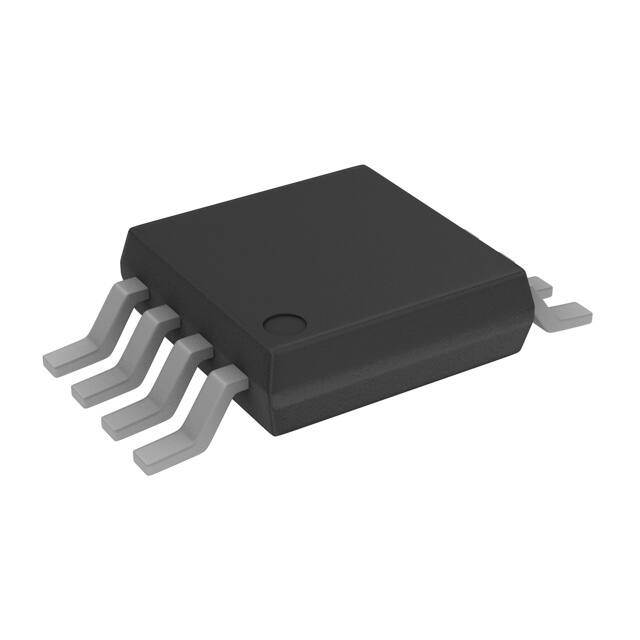
the tiny 8-lead MSOP, and the popular 8-lead, narrow SOIC,
RoHS compliant packages. MSOP packaged devices are only
available in tape and reel format.
With typical offset voltage of only 10 µV, offset drift of 0.2 µV/°C,
and noise of only 0.10 μV p-p (0.1 Hz to 10 Hz), the AD8675 is
perfectly suited for applications where large error sources cannot
be tolerated. For applications with even lower offset tolerances,
the proprietary nulling capability allows a combination of both
device and system offset errors up to 3.5 mV (referred to the
input) to be compensated externally. Unlike previous circuits,
the AD8675 accommodates this adjustment without adversely
affecting the offset drift, CMRR, and PSRR of the amplifier.
Precision instrumentation, PLL, and other precision filter circuits,
position and pressure sensors, medical instrumentation, and
strain gage amplifiers benefit greatly from the very low noise,
low input bias current, and wide bandwidth. Many systems can
The smaller packages and low power consumption afforded by
the AD8675 allow maximum channel density or minimum
board size for space-critical equipment.
For the dual version of this ultraprecision, rail-to-rail op amp,
see the AD8676 data sheet.
The AD8675 and AD8676 are members of a growing series of
low noise op amps offered by Analog Devices, Inc.
Table 1. Voltage Noise
Package
Single
Dual
Quad
0.9 nV
AD797
1.1 nV
AD8597
AD8599
1.8 nV
ADA4004-1
ADA4004-2
ADA4004-4
2.8 nV
AD8675
AD8676
3.8 nV
AD8671
AD8672
AD8674
Rev. E
Information furnished by Analog Devices is believed to be accurate and reliable. However, no
responsibility is assumed by Analog Devices for its use, nor for any infringements of patents or other
rights of third parties that may result from its use. Specifications subject to change without notice. No
license is granted by implication or otherwise under any patent or patent rights of Analog Devices.
Trademarks and registered trademarks are the property of their respective owners.
One Technology Way, P.O. Box 9106, Norwood, MA 02062-9106, U.S.A.
Tel: 781.329.4700
www.analog.com
Fax: 781.461.3113 ©2005–2012 Analog Devices, Inc. All rights reserved.
�AD8675
Data Sheet
TABLE OF CONTENTS
Features .............................................................................................. 1
Thermal Resistance .......................................................................5
Applications ....................................................................................... 1
Power Sequencing .........................................................................5
Pin Configurations ........................................................................... 1
ESD Caution...................................................................................5
General Description ......................................................................... 1
Typical Performance Characteristics ..............................................6
Revision History ............................................................................... 2
Test Circuit ...................................................................................... 11
Specifications..................................................................................... 3
Outline Dimensions ....................................................................... 12
Electrical Specifications ............................................................... 3
Ordering Guide .......................................................................... 12
Absolute Maximum Ratings ............................................................ 5
REVISION HISTORY
7/12—Rev. D to Rev. E
Added Power Sequencing Section .................................................. 5
Added Figure 28 and Figure 29; Renumbered Sequentially ..... 10
8/11—Rev. C to Rev. D
Added Input Capacitance, Common Mode Parameter and Input
Capacitance, Differential Mode Parameter, Table 3..................... 4
6/10—Rev. B to Rev. C
Changes to Figure 10 ........................................................................ 7
5/10—Rev. A to Rev. B
Changes to General Description Section ...................................... 1
Added Table 1; Renumbered Sequentially .................................... 1
Changes to Table 2 ............................................................................ 3
Changes to Table 3 ............................................................................ 4
Changes to Table 4 and Table 5 ....................................................... 5
Changes to Figure 4 and Figure 6 to Figure 8 ............................... 6
Changes to Figure 15 ........................................................................ 8
Changes to Figure 21 and Figure 24............................................... 9
Added Figure 27; Renumbered Sequentially .............................. 10
Updated Outline Dimensions ....................................................... 12
Changes to Ordering Guide .......................................................... 12
4/07—Rev. 0 to Rev. A
Added Figure 7 and Figure 8; Renumbered Sequentially ........... 6
10/05—Revision 0: Initial Version
Rev. E | Page 2 of 12
�Data Sheet
AD8675
SPECIFICATIONS
ELECTRICAL SPECIFICATIONS
VS = ±5.0 V, VCM = 0 V, VO = 0 V, TA = +25°C, unless otherwise specified.
Table 2.
Parameter
INPUT CHARACTERISTICS
Offset Voltage
Offset Voltage Drift
Input Bias Current
Symbol
Test Conditions/Comments
VOS
ΔVOS/ΔT
IB
−40°C ≤ TA ≤ +125°C
−40°C ≤ TA ≤ +125°C
−40°C ≤ TA ≤ +125°C
Input Offset Current
IOS
Input Voltage Range
Common-Mode Rejection Ratio
IVR
CMRR
Open-Loop Gain
AVO
−40°C ≤ TA ≤ +125°C
OUTPUT CHARACTERISTICS
Output Voltage High
Output Voltage Low
Short-Circuit Limit
POWER SUPPLY
Power Supply Rejection Ratio
Supply Current/Amplifier
DYNAMIC PERFORMANCE
Slew Rate
Gain Bandwidth Product
NOISE PERFORMANCE
Voltage Noise
Voltage Noise Density
Current Noise Density
Min
VOH
VOL
VCM = −3.0 V to +3.0 V
−40°C ≤ TA ≤ +125°C
RL = 2 kΩ to ground,
VO = −3.5 V to +3.5 V
−40°C ≤ TA ≤ +125°C
RL = 10 kΩ to ground
−40°C ≤ TA ≤ +125°C
RL = 2 kΩ to ground
−40°C ≤ TA ≤ +125°C
RL = 10 kΩ to ground
−40°C ≤ TA ≤ +125°C
RL = 2 kΩ to ground
−40°C ≤ TA ≤ +125°C
−2
−5.5
−1
−2.8
−3.0
105
105
120
ISY
Max
Unit
10
12
0.2
+0.5
−2
+0.1
+0.1
75
240
0.6
+2
+5.5
+1
+2.8
+3.0
µV
µV
µV/°C
nA
nA
nA
nA
V
dB
dB
dB
130
126
117
4.90
4.85
4.80
4.75
dB
4.95
4.90
−4.98
−4.91
ISC
PSRR
Typ
−4.90
−4.85
−4.86
−4.82
±35
VS = ±5.0 V to ±15.0 V
−40°C ≤ TA ≤ +125°C
VO = 0 V
−40°C ≤ TA ≤ +125°C
120
120
140
2.3
2.7
3.4
V
V
V
V
V
V
V
V
mA
dB
dB
mA
mA
SR
GBP
RL = 2 kΩ
2.5
10
V/µs
MHz
en p-p
en
in
0.1 Hz to 10 Hz
f = 1 kHz
f = 10 Hz
0.1
2.8
0.3
µV p-p
nV/√Hz
pA/√Hz
Rev. E | Page 3 of 12
�AD8675
Data Sheet
VS = ±15 V, VCM = 0 V, VO = 0 V, TA = +25°C, unless otherwise specified.
Table 3.
Parameter
INPUT CHARACTERISTICS
Offset Voltage
Offset Voltage Drift
Input Bias Current
Symbol
Test Conditions/Comments
VOS
ΔVOS/ΔT
IB
−40°C ≤ TA ≤ +125°C
−40°C ≤ TA ≤ +125°C
−40°C ≤ TA ≤ +125°C
Input Offset Current
IOS
Input Voltage Range
Common-Mode Rejection Ratio
IVR
CMRR
Open-Loop Gain
AVO
−40°C ≤ TA ≤ +125°C
Input Capacitance, Common Mode
Input Capacitance, Differential Mode
OUTPUT CHARACTERISTICS
Output Voltage High
Output Voltage Low
Short-Circuit Limit
POWER SUPPLY
Power Supply Rejection Ratio
Supply Current/Amplifier
DYNAMIC PERFORMANCE
Slew Rate
Gain Bandwidth Product
NOISE PERFORMANCE
Voltage Noise
Voltage Noise Density
Current Noise Density
Min
VCM = −12.5 V to +12.5 V
−40°C ≤ TA ≤ +125°C
RL = 2 kΩ to ground,
VO = −13.5 V to +13.5 V
−40°C ≤ TA ≤ +125°C
−2
−4.5
−1
−2.8
−12.5
114
114
123
VOL
RL = 10 kΩ to ground
−40°C ≤ TA ≤ +125°C
RL = 2 kΩ to ground
−40°C ≤ TA ≤ +125°C
RL = 10 kΩ to ground
−40°C ≤ TA ≤ +125°C
RL = 2 kΩ to ground
−40°C ≤ TA ≤ +125°C
14.85
14.80
14.60
14.40
ISY
Unit
10
12
0.2
+0.5
+1
+0.1
+0.1
75
240
0.6
+2
+4.5
+1
+2.8
+12.5
132
µV
µV
µV/°C
nA
nA
nA
nA
V
dB
dB
dB
3.8
9.6
dB
pF
pF
130
14.92
14.80
−14.96
−14.85
ISC
PSRR
Max
117
CINCM
CINDM
VOH
Typ
−14.94
−14.90
−14.75
−14.69
±35
VS = ±5.0 V to ±15.0 V
−40°C ≤ TA ≤ +125°C
VO = 0 V
−40°C ≤ TA ≤ +125°C
120
120
140
2.5
2.9
3.8
V
V
V
V
V
V
V
V
mA
dB
dB
mA
mA
SR
GBP
RL = 10 kΩ
2.5
10
V/µs
MHz
en p-p
en
in
0.1 Hz to 10 Hz
f = 1 kHz
f = 10 Hz
0.1
2.8
0.3
µV p-p
nV/√Hz
pA/√Hz
Rev. E | Page 4 of 12
�Data Sheet
AD8675
ABSOLUTE MAXIMUM RATINGS
THERMAL RESISTANCE
Table 4.
Parameter
Supply Voltage
Input Voltage
Input Current
Differential Input Voltage
Output Short-Circuit Duration to GND
Storage Temperature Range
RM-8, R-8 Packages
Operating Temperature Range
Junction Temperature Range
RM-8, R-8 Packages
Lead Temperature Range (Soldering, 10 sec)
NULL Pins (Pin 1, Pin 8), Input Current Maximum
θJA is specified for the worst-case conditions, that is, a device
soldered in a circuit board for surface-mount packages and
measured using a standard 4-layer board, unless otherwise
specified.
Rating
±18 V
±V supply
±5 mA
±0.7 V
Indefinite
Table 5. Thermal Resistance
−65°C to +150°C
−40°C to +125°C
−65°C to +150°C
300°C










 工商网监
湘ICP备2023018690号
工商网监
湘ICP备2023018690号