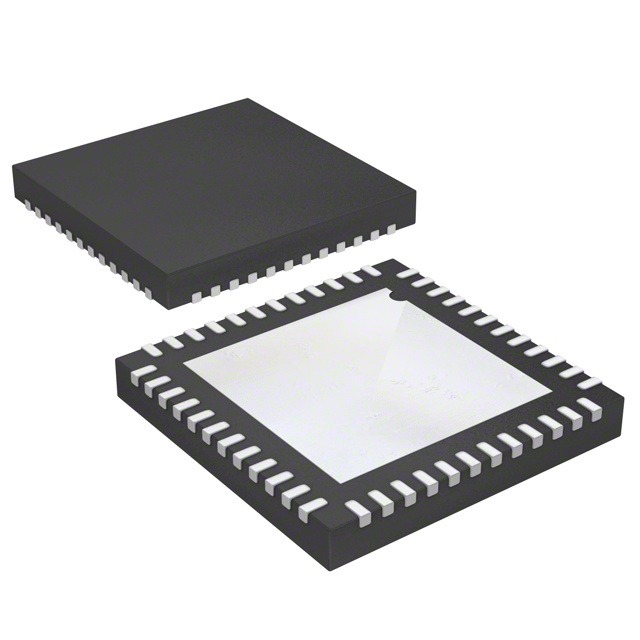
655 MHz Low Jitter Clock Generator
AD9540
Data Sheet
FEATURES
APPLICATIONS
Excellent intrinsic jitter performance
200 MHz phase frequency detector inputs
655 MHz programmable input dividers for the phase
frequency detector (÷M, ÷N) {M, N = 1 to 16} (bypassable)
Programmable RF divider (÷R) {R = 1, 2, 4, 8} (bypassable)
8 programmable phase/frequency profiles
400 MSPS internal DDS clock speed
48-bit frequency tuning word resolution
14-bit programmable phase offset
1.8 V supply for device operation
3.3 V supply for I/O, CML driver, and charge pump output
Software controlled power-down
48-lead LFCSP package
Programmable charge pump current (up to 4 mA)
Dual-mode PLL lock detect
655 MHz CML-mode PECL-compliant output driver
Clocking high performance data converters
Base station clocking applications
Network (SONET/SDH) clocking
Gigabit Ethernet (GbE) clocking
Instrumentation clocking circuits
Agile LO frequency synthesis
Automotive radar
FM chirp source for radar and scanning systems
Test and measurement equipment
Acousto-optic device drivers
FUNCTIONAL BLOCK DIAGRAM
AVDD AGND DVDD DGND CP_VDD
CP_RSET
CP
REF, AMP
REFIN
M DIVIDER
PHASE
FREQUENCY
DETECTOR
REFIN
N DIVIDER
SYNC_IN/STATUS
CHARGE
PUMP
CP_OUT
CLK2
SYNC, PLL
LOCK
CLK2
CLK1
CML
CLK1
DIVIDER
1, 2, 4, 8
DRV_RSET
OUT0
OUT0
SCLK
SDO
SERIAL
CONTROL
PORT
AD9540
CS
CLK
TIMING AND
CONTROL LOGIC
S2
S1
S0
PHASE/
FREQUENCY
PROFILES
DIVCLK
48
14
DDS
10
DAC
DAC_RSET
IOUT
IOUT
04947-001
SDI/O
Figure 1.
Rev. D
Document Feedback
Information furnished by Analog Devices is believed to be accurate and reliable. However, no
responsibility is assumed by Analog Devices for its use, nor for any infringements of patents or other
rights of third parties that may result from its use. Specifications subject to change without notice.
No license is granted by implication or otherwise under any patent or patent rights of Analog
Devices. Trademarks and registered trademarks are the property of their respective owners.
One Technology Way, P.O. Box 9106, Norwood, MA 02062-9106, U.S.A.
Tel: 781.329.4700 ©2004–2020 Analog Devices, Inc. All rights reserved.
Technical Support
www.analog.com
�AD9540
Data Sheet
TABLE OF CONTENTS
Features .............................................................................................. 1
PLL Circuitry .............................................................................. 19
Applications ...................................................................................... 1
CML Driver ................................................................................. 19
Functional Block Diagram .............................................................. 1
DDS and DAC ............................................................................ 20
Revision History ............................................................................... 2
Modes of Operation ....................................................................... 21
Product Overview ............................................................................. 3
Selectable Clock Frequencies and Selectable Edge Delay ..... 21
Specifications .................................................................................... 4
Synchronization Modes for Multiple Devices ............................. 21
Loop Measurement Conditions ................................................. 8
Serial Port Operation ..................................................................... 22
Absolute Maximum Ratings ........................................................... 9
Instruction Byte .......................................................................... 23
ESD Caution.................................................................................. 9
Serial Interface Port Pin Description ...................................... 23
Pin Configuration and Function Descriptions .......................... 10
MSB/LSB Transfers .................................................................... 23
Typical Performance Characteristics ........................................... 12
Register Map and Description ...................................................... 24
Typical Application Circuits ......................................................... 17
Control Register Bit Descriptions ............................................ 27
Application Circuit Descriptions ............................................. 18
Outline Dimensions ....................................................................... 32
Theory of Operation ...................................................................... 19
Ordering Guide .......................................................................... 32
REVISION HISTORY
9/2020—Rev. C to Rev. D
Changed CP-48-1 to CP-48-4 ...................................... Throughout
Changes to Figure 3........................................................................ 10
Updated Outline Dimensions ....................................................... 33
Changes to Ordering Guide .......................................................... 33
4/2018—Rev. B to Rev. C
Changes to Figure 3........................................................................ 10
Updated Outline Dimensions ....................................................... 32
Changes to Ordering Guide .......................................................... 32
9/2016—Rev. A to Rev. B
Change to Features ............................................................................1
Updated Outline Dimensions ...................................................... 32
Changes to Ordering Guide .......................................................... 32
2/2006—Rev. 0 to Rev. A
Changes to Features Section ............................................................1
Changes to Applications Section ....................................................1
Changes to Functional Block Diagram ..........................................1
Changes to Table 1 ............................................................................4
Changes to Typical Application Circuits Section ...................... 17
Updates to Ordering Guide .......................................................... 32
7/2004—Revision 0: Initial Version
Rev. D | Page 2 of 32
�Data Sheet
AD9540
PRODUCT OVERVIEW
The AD9540 is Analog Devices’ first dedicated clocking
product specifically designed to support the extremely stringent
clocking requirements of the highest performance data
converters. The device features high performance PLL (phaselocked loop) circuitry, including a flexible 200 MHz phase
frequency detector and a digitally controlled charge pump
current. The device also provides a low jitter, 655 MHz CMLmode, PECL-compliant output driver with programmable slew
rates. External VCO rates up to 2.7 GHz are supported.
Extremely fine tuning resolution (steps less than 2.33 μHz) is
another feature supported by this device. Information is loaded
into the AD9540 via a serial I/O port that has a device write
speed of 25 Mbps. The AD9540 frequency divider block can
also be programmed to support a spread spectrum mode of
operation.
The AD9540 is specified to operate over the extended
automotive range of −40°C to +85°C.
Rev. D | Page 3 of 32
�AD9540
Data Sheet
SPECIFICATIONS
AVDD = DVDD = 1.8 V ± 5%; DVDD_I/O = CP_VDD = 3.3 V ± 5% (@ TA = 25°C), DAC_RSET = 3.92 kΩ, CP_RSET = 3.09 kΩ,
DRV_RSET = 4.02 kΩ, unless otherwise noted.
Table 1.
Parameter
TOTAL SYSTEM JITTER AND PHASE NOISE FOR
105 MHz ADC CLOCK GENERATION CIRCUIT
Converter Limiting Jitter1
Resultant Signal-to-Noise Ratio (SNR)
Phase Noise of Fundamental
@ 10 Hz Offset
@ 100 Hz Offset
@ 1 kHz Offset
@ 10 kHz Offset
@ 100 kHz Offset
≥1 MHz Offset
TOTAL SYSTEM PHASE NOISE FOR 210 MHz
ADC CLOCK GENERATION CIRCUIT
Phase Noise of Fundamental
@ 10 Hz Offset
@ 100 Hz Offset
@ 1 kHz Offset
@ 10 kHz Offset
@ 100 kHz Offset
@ 1 MHz Offset
TOTAL SYSTEM TIME JITTER FOR CLOCKS
155.52 MHz Clock
622.08 MHz Clock
RF DIVIDER/CML DRIVER EQUIVALENT
INTRINSIC TIME JITTER
FIN = 414.72 MHz, FOUT = 51.84 MHz
FIN = 1244.16 MHz, FOUT = 155.52 MHz
FIN = 2488.32 MHz, FOUT = 622.08 MHz
RF DIVIDER/CML DRIVER RESIDUAL PHASE NOISE
FIN = 81.92 MHz, FOUT = 10.24 MHz
@ 10 Hz
@ 100 Hz
@ 1 kHz
@ 10 kHz
@ 100 kHz
≥1 MHz
FIN = 983.04 MHz, FOUT = 122.88 MHz
@ 10 Hz
@ 100 Hz
@ 1 KHz
@ 10 kHz
@ 100 kHz
@ 1 MHz
>3 MHz
Min
Typ
Max
Unit
Test Conditions/Comments
720
59.07
fS rms
dB
80
92
101
110
147
153
dBc/Hz
dBc/Hz
dBc/Hz
dBc/Hz
dBc/Hz
dBc/Hz
79.2
86
95
105
144
151
dBc/Hz
dBc/Hz
dBc/Hz
dBc/Hz
dBc/Hz
dBc/Hz
581
188
fS rms
fS rms
12 kHz to 1.3 MHz bandwidth
12 kHz to 5 MHz bandwidth
136
101
108
fS rms
fS rms
fS rms
R = 8, BW = 12 kHz to 400 kHz
R = 8, BW = 12 kHz to 1.3 MHz
R = 4, BW = 12 kHz to 5 MHz
120
128
137
145
150
153
dBc/Hz
dBc/Hz
dBc/Hz
dBc/Hz
dBc/Hz
dBc/Hz
115
125
132
142
146
151
153
dBc/Hz
dBc/Hz
dBc/Hz
dBc/Hz
dBc/Hz
dBc/Hz
dBc/Hz
RF Divider R = 8
RF Divider R = 8
Rev. D | Page 4 of 32
�Data Sheet
Parameter
FIN = 1966.08 MHz, FOUT = 491.52 MHz
@ 10 Hz
@ 100 Hz
@ 1 kHz
@ 10 kHz
@ 100 kHz
@ 1 MHz
>3 MHz
FIN = 2488 MHz, FOUT = 622 MHz
@ 10 Hz
@ 100 Hz
@ 1 kHz
@ 10 kHz
@ 100 kHz
@ 1 MHz
≥3 MHz
PHASE FREQUENCY DETECTOR/CHARGE PUMP
REFIN Input
Input Frequency2
÷M Set to Divide by at Least 4
÷M Bypassed
Input Voltage Levels
Input Capacitance
Input Resistance
CLK2 Input
Input Frequency
÷N Set to Divide by at Least 4
÷N Bypassed
Input Voltage Levels
Input Capacitance
Input Resistance
Charge Pump Source/Sink Maximum Current
Charge Pump Source/Sink Accuracy
Charge Pump Source/Sink Matching
Charge Pump Output Compliance Range3
STATUS Drive Strength
PHASE FREQUENCY DETECTOR NOISE FLOOR
@ 50 kHz PFD Frequency
@ 2 MHz PFD Frequency
@ 100 MHz PFD Frequency
@ 200 MHz PFD Frequency
RF DIVIDER (CLK1 ) INPUT SECTION (÷R)
RF Divider Input Range
Input Capacitance (DC)
Input Impedance (DC)
Input Duty Cycle
Input Power/Sensitivity
Input Voltage Level
AD9540
Min
Typ
Max
Unit
105
112
122
130
141
144
146
dBc/Hz
dBc/Hz
dBc/Hz
dBc/Hz
dBc/Hz
dBc/Hz
dBc/Hz
100
108
115
125
135
140
142
dBc/Hz
dBc/Hz
dBc/Hz
dBc/Hz
dBc/Hz
dBc/Hz
dBc/Hz
Test Conditions/Comments
RF Divider R = 4
RF Divider R = 4
200
655
200
600
10
MHz
MHz
mV p-p
pF
Ω
655
200
600
10
2
MHz
MHz
mV p-p
pF
Ω
mA
%
%
V
mA
148
133
116
113
dBc/Hz
dBc/Hz
dBc/Hz
dBc/Hz
450
1500
200
450
1500
4
5
2
CP_VDD − 0.5
0.5
1
42
−10
200
3
1500
50
2700
MHz
58
+4
1000
pF
Ω
%
dBm
mV p-p
Rev. D | Page 5 of 32
DDS SYSCLK not to
exceed 400 MSPS
Single-ended, into a 50 Ω load4
�AD9540
Parameter
CML OUTPUT DRIVER (OUT0)
Differential Output Voltage Swing5
Maximum Toggle Rate
Common-Mode Output Voltage
Output Duty Cycle
Output Current
Continuous6
Rising Edge Surge
Falling Edge Surge
Output Rise Time
Output Fall Time
LOGIC INPUTS (SDI/O, I/O_RESET, RESET,
I/O_UPDATE, S0, S1, S2, SYNC_IN)
VIH, Input High Voltage
VIL, Input Low Voltage
IINH, IINL, Input Current
CIN, Maximum Input Capacitance
LOGIC OUTPUTS (SDO, SYNC_OUT, STATUS)7
VOH, Output High Voltage
VOH, Output Low Voltage
IOH
IOL
POWER CONSUMPTION
Total Power Consumed, All Functions On
I(AVDD)
I(DVDD)
I(DVDD_I/O)
I(CP_VDD)
Power-Down Mode
WAKE-UP TIME (FROM POWER-DOWN MODE)
Digital Power-Down
DAC Power-Down
RF Divider Power-Down
Clock Driver Power-Down
Charge Pump Full Power-Down
Charge Pump Quick Power-Down
CRYSTAL OSCILLATOR (ON REFIN INPUT)
Operating Range
Residual Phase Noise (@ 25 MHz)
@ 10 Hz Offset
@ 100 Hz Offset
@ 1 kHz Offset
@ 10 kHz Offset
@ 100 kHz Offset
>1 MHz Offset
DIGITAL TIMING SPECIFICATIONS
CS to SCLK Setup Time, TPRE
Period of SCLK (Write), TSCLKW
Period of SCLK (Read), TSCLKR
Serial Data Setup Time, TDSU
Serial Data Hold Time, TDHD
Data Valid Time, TDV
Data Sheet
Min
Typ
Max
720
Unit
Test Conditions/Comments
mV
50 Ω load to supply, both lines
655
1.75
42
58
7.2
20.9
13.5
250
250
mA
mA
mA
ps
ps
2.0
±1
3
0.8
±5
2.7
0.4
100
100
400
85
45
20
15
20
V
%
V
V
μA
pF
V
V
μA
μA
80
mW
mA
mA
mA
mA
mW
12
7
400
6
10
150
ns
μs
ns
μs
μs
ns
25
30
95
120
140
157
164
168
6
40
400
6.5
0
40
MHz
dBc/Hz
dBc/Hz
dBc/Hz
dBc/Hz
dBc/Hz
dBc/Hz
ns
ns
ns
ns
ns
ns
Rev. D | Page 6 of 32
100 Ω terminated, 5 pF load
100 Ω terminated, 5 pF load
Control Function Register 1[7]
Control Function Register 3[39]
Control Function Register 2[23]
Control Function Register 2[20]
Control Function Register 2[4]
Control Function Register 2[3]
�Data Sheet
Parameter
I/O_Update to SYNC_OUT Setup Time
PS[2:0> to SYNC_OUT Setup Time
Latencies/Pipeline Delays
I/O_Update to DAC Frequency Change
I/O_Update to DAC Phase Change
PS[2:0] to DAC Frequency Change
PS[2:0] to DAC Phase Change
I/O_Update to CP_OUT Scaler Change
I/O_Update to Frequency Accumulator
Step Size Change
DAC OUTPUT CHARACTERISTICS
Resolution
Full-Scale Output Current
Gain Error
Output Offset
Output Capacitance
Voltage Compliance Range
Wideband SFDR (DC to Nyquist)
10 MHz Analog Out
40 MHz Analog Out
80 MHz Analog Out
120 MHz Analog Out
160 MHz Analog Out
Narrow-Band SFDR
10 MHz Analog Out (±1 MHz)
10 MHz Analog Out (±250 kHz)
10 MHz Analog Out (±50 kHz)
40 MHz Analog Out (±1 MHz)
40 MHz Analog Out (±250 kHz)
40 MHz Analog Out (±50 kHz)
80 MHz Analog Out (±1 MHz)
80 MHz Analog Out (±250 kHz)
80 MHz Analog Out (±50 kHz)
120 MHz Analog Out (±1 MHz)
120 MHz Analog Out (±250 kHz)
120 MHz Analog Out (±50 kHz)
160 MHz Analog Out (±1 MHz)
160 MHz Analog Out (±250 kHz)
160 MHz Analog Out (±50 kHz)
DAC RESIDUAL PHASE NOISE
19.7 MHz FOUT
@ 10 Hz Offset
@ 100 Hz Offset
@ 1 kHz Offset
@ 10 kHz Offset
@ 100 kHz Offset
>1 MHz Offset
AD9540
Min
7
7
Typ
Max
33
33
29
29
4
4
Unit
ns
ns
SYSCLK cycles
SYSCLK cycles
SYSCLK cycles
SYSCLK cycles
SYSCLK cycles
SYSCLK cycles
10
10
−10
15
+10
0.6
5
AVDD − 0.50
Bits
mA
% fS
μA
pF
AVDD + 0.50
65
62
57
56
54
dBc
dBc
dBc
dBc
dBc
83
85
86
82
84
87
80
82
86
80
82
84
80
82
84
dBc
dBc
dBc
dBc
dBc
dBc
dBc
dBc
dBc
dBc
dBc
dBc
dBc
dBc
dBc
122
134
143
150
158
160
dBc/Hz
dBc/Hz
dBc/Hz
dBc/Hz
dBc/Hz
dBc/Hz
Rev. D | Page 7 of 32
Test Conditions/Comments
�AD9540
Parameter
51.84 MHz FOUT
@ 10 Hz Offset
@ 100 Hz Offset
@ 1 kHz Offset
@ 10 kHz Offset
@ 100 kHz Offset
> 1 MHz Offset
105 MHz Analog Out
@ 10 Hz Offset
@ 100 Hz Offset
@ 1 kHz Offset
@ 10 kHz Offset
@ 100 kHz Offset
>1 MHz Offset
155.52 MHz Analog Out
@ 10 Hz Offset
@ 100 Hz Offset
@ 1 kHz Offset
@ 10 kHz Offset
@ 100 kHz Offset
>1 MHz Offset
Data Sheet
Min
Typ
Max
Unit
Test Conditions/Comments
110
121
135
142
148
153
dBc/Hz
dBc/Hz
dBc/Hz
dBc/Hz
dBc/Hz
dBc/Hz
105
115
126
132
140
145
dBc/Hz
dBc/Hz
dBc/Hz
dBc/Hz
dBc/Hz
dBc/Hz
100
112
123
131
138
144
dBc/Hz
dBc/Hz
dBc/Hz
dBc/Hz
dBc/Hz
dBc/Hz
1
The SNR of a 14-bit ADC was measured with an ENCODE rate of 105 MSPS and an AIN of 170 MHz. The resultant SNR was known to be limited by the jitter of the clock,
not by the noise on the AIN signal. From this SNR value, the jitter affecting the measurement can be back calculated.
2
Driving the REFIN input buffer. The crystal oscillator section of this input stage performs up to only 30 MHz.
3
The charge pump output compliance range is functionally 0.2 V to (CP_VDD − 0.2 V). The value listed here is the compliance range for 5% matching.
4
The input impedance of the CLK1 input is 1500 Ω. However, to provide matching on the clock line, an external 50 Ω load is used.
5
Measured as peak-to-peak between DAC outputs.
6
For a 4.02 kΩ resistor from DRV_RSET to GND.
7
Assumes a 1 mA load.
LOOP MEASUREMENT CONDITIONS
622 MHz OC-12 Clock
105 MHz Converter Clock
VCO = Sirenza 190-640T
VCO = Sirenza 190-845T
Reference = Wenzel 500-10116 (30.3 MHz)
Reference = Wenzel 500-10116 (30.3 MHz)
Loop Filter = 10 kHz BW, 60° Phase Margin
Loop Filter = 10 kHz BW, 45° Phase Margin
C1 = 170 nF, R1 = 14.4 Ω, C2 = 5.11 μF, R2 = 89.3 Ω,
C3 Omitted
C1 = 117 nF, R1 = 28 Ω, C2 = 1.6 μF, R2 = 57.1 Ω, C3 = 53.4 nF
÷R = 8, ÷M = 1, ÷N = 1
÷R = 2, ÷M = 1, ÷N = 1
R2
INPUT
OUTPUT
R1
C1
C3
C2
Figure 2. Generic Loop Filter
Rev. D | Page 8 of 32
04947-041
CP_OUT = 4 mA (Scaler = ×8)
CP_OUT = 4 mA (Scaler = ×8)
�Data Sheet
AD9540
ABSOLUTE MAXIMUM RATINGS
Stresses at or above those listed under Absolute Maximum
Ratings may cause permanent damage to the product. This is a
stress rating only; functional operation of the product at these
or any other conditions above those indicated in the
operational section of this specification is not implied.
Operation beyond the maximum operating conditions for
extended periods may affect product reliability.
Table 2.
Parameter
Analog Supply Voltage (AVDD)
Digital Supply Voltage (DVDD)
Digital I/O Supply Voltage
(DVDD_I/O)
Charge Pump Supply Voltage
(CP_VDD)
Maximum Digital Input Voltage
Storage Temperature Range
Operating Temperature Range
Lead Temperature
(Soldering 10 sec)
Junction Temperature
Thermal Resistance (θJA)
Rating
2V
2V
3.6 V
3.6 V
−0.5 V to DVDD_I/O + 0.5 V
−65°C to +150°C
−40°C to +125°C
300°C
ESD CAUTION
150°C
26°C/W
Rev. D | Page 9 of 32
�AD9540
Data Sheet
48 AVDD
47 DAC_RSET
46 DRV_RSET
45 CP_RSET
44 AVDD
43 AGND
42 CLK2
41 CLK2
40 REFIN
39 REFIN
38 AVDD
37 AGND
PIN CONFIGURATION AND FUNCTION DESCRIPTIONS
AGND 1
AVDD 2
AGND 3
AVDD 4
IOUT 5
IOUT 6
AVDD 7
AGND 8
I/O_RESET 9
RESET 10
DVDD 11
DGND 12
AD9540
15
16
17
18
19
20
21
22
23
24
NOTES
1. THE EXPOSED PADDLE ON THIS PACKAGE IS AN ELECTRICAL
CONNECTION AS WELL AS A THERMAL ENHANCEMENT.
IN ORDER FOR THE DEVICE TO FUNCTION PROPERLY,
THE PADDLE MUST BE ATTACHED TO ANALOG GROUND.
04947-047
SDO
SDI/O
SCLK
CS
DVDD_I/O
SYNC_OUT
SYNC_IN/STATUS
I/O_UPDATE
S0
S1
S2
DGND
13
14
TOP VIEW
(Not to Scale)
36 CP_OUT
35 CP_VDD
34 AGND
33 OUT0
32 OUT0
31 CP_VDD
30 AGND
29 CLK1
28 CLK1
27 AVDD
26 AGND
25 DVDD
Figure 3. 48-Lead LFCSP Pin Configuration
Table 3. Pin Function Descriptions
Pin No.
1, 3, 8, 26, 30,
34, 37, 43,
2, 4, 7, 27, 38,
44, 48
5
6
9
Mnemonic
AGND
Description
Analog Ground.
AVDD
Analog Core Supply (1.8 V).
IOUT
IOUT
I/O_RESET
10
11, 25
12, 24
13
14
RESET
DVDD
DGND
SDO
SDI/O
15
16
SCLK
CS
17
18
19
DVDD_I/O
SYNC_OUT
SYNC_IN/STATUS
20
I/O_UPDATE
DAC Analog Output.
DAC Analog Complementary Output.
Resets the serial port when synchronization is lost in communications but does not reset the
device itself (active high). When not being used, this pin should be forced low, because it floats to
the threshold value.
Master Reset. Clears all accumulators and returns all registers to their default values (active high).
Digital Core Supply (1.8 V).
Digital Ground.
Serial Data Output. Used only when the device is programmed for 3-wire serial data mode.
Serial Data Input/Output. When the part is programmed for 3-wire serial data mode, this is input
only; in 2-wire mode, it serves as both the input and output.
Serial Data Clock. Provides the clock signal for the serial data port.
Active Low Signal That Enables Shared Serial Buses. When brought high, the serial port ignores the
serial data clocks.
Digital Interface Supply (3.3 V).
Synchronization Clock Output.
Bidirectional Dual Function Pin. Depending on device programming, this pin is either the direct
digital synthesizer’s (DDS) synchronization input (allows alignment of multiple subclocks), or the PLL
lock detect output signal.
This input pin, when set high, transfers the data from the I/O buffers to the internal registers on the
rising edge of the internal SYNC_CLK, which can be observed on SYNC_OUT.
Rev. D | Page 10 of 32
�Data Sheet
AD9540
Pin No.
21, 22, 23
Mnemonic
S0, S1, S2
28
29
31, 35
32
33
36
39
40
41
42
45
46
47
Paddle
CLK1
CLK1
CP_VDD
OUT0
OUT0
CP_OUT
REFIN
REFIN
CLK2
CLK2
CP_RSET
DRV_RSET
DAC_RSET
Exposed Paddle
Description
Clock Frequency and Delay Select Pins. These pins specify one of eight clock frequency/delay
profiles.
RF Divider and Internal Clock Complementary Input.
RF Divider and Internal Clock Input.
Charge Pump and CML Driver Supply Pin. 3.3 V analog (clean) supply.
CML Driver Complementary Output.
CML Driver Output.
Charge Pump Output.
Phase Frequency Detector Reference Input.
Phase Frequency Detector Reference Complementary Input.
Phase Frequency Detector Oscillator (Feedback) Complementary Input.
Phase Frequency Detector Oscillator (Feedback) Input.
Charge Pump Current Set. Program charge pump current with a resistor to AGND.
CML Driver Output Current Set. Program CML output current with a resistor to AGND.
DAC Output Current Set. Program DAC output current with a resistor to AGND.
The exposed paddle on this package is an electrical connection as well as a thermal enhancement.
In order for the device to function properly, the paddle must be attached to analog ground.
Rev. D | Page 11 of 32
�AD9540
Data Sheet
TYPICAL PERFORMANCE CHARACTERISTICS
RBW 100Hz
VBW 100Hz
25s
SWT
DELTA 1 [T1]
–85.94dB
–2.10420842kHz
RF ATT 20dB
UNIT
dB
1
0
–10
–20
–20
–30
1 AP
–40
–50
–50
–60
–60
–70
–70
A
1 AP
CENTER 10.1MHz
5kHz/
–100
SPAN 50kHz
CENTER 40.1MHz
Figure 4. DAC Performance: 400 MSPS Clock,
10 MHz FOUT, 50 kHz Span
REF LVL
0dBm
RBW 500Hz
VBW 500Hz
20s
SWT
DELTA 1 [T1]
–86.03dB
–368.73747495kHz
dB
1
0
REF LVL
0dBm
–10
–20
–20
–30
1 AP
–40
–50
–50
–60
–60
–70
–70
04947-004
–100
100kHz/
DELTA 1 [T1]
–64.54dB
100.20040080MHz
RBW 10kHz
VBW 10kHz
5s
SWT
1
–100
SPAN 1MHz
CENTER 40.1MHz
100kHz/
SPAN 1MHz
Figure 8. DAC Performance: 400 MSPS Clock,
40 MHz FOUT, 1 MHz Span
RF ATT 20dB
UNIT
A
–90
Figure 5. DAC Performance: 400 MSPS Clock,
10 MHz FOUT, 1 MHz Span
REF LVL
0dBm
dB
1 AP
–80
1
UNIT
1
04947-007
–80
RF ATT 20dB
–30
–40
CENTER 10.1MHz
SPAN 50kHz
RBW 500Hz
VBW 500Hz
20s
SWT
DELTA 1 [T1]
–80.17dB
–200.40080160kHz
A
–10
–90
5kHz/
Figure 7. DAC Performance: 400 MSPS Clock,
40 MHz FOUT, 50 kHz Span
RF ATT 20dB
UNIT
1
–90
04947-006
04947-003
–100
0
dB
–80
1
–90
0
UNIT
–30
–40
–80
RF ATT 20dB
1
A
–10
RBW 100Hz
VBW 100Hz
25s
SWT
DELTA 1 [T1]
–84.94dB
2.10420842kHz
REF LVL
0dBm
dB
0
1
A
–10
–20
REF LVL
0dBm
DELTA 1 [T1]
–61.61dB
100.20040080MHz
RBW 10kHz
VBW 10kHz
5s
SWT
RF ATT 20dB
UNIT
dB
1
A
–10
–20
–30
1 AP
–30
–40
–40
–50
–50
–60
1 AP
–60
1
1
–70
–70
–80
04947-005
–80
–90
–100
START 0Hz
20MHz/
STOP 200MHz
04947-008
0
REF LVL
0dBm
–90
–100
START 0Hz
Figure 6. DAC Performance: 400 MSPS Clock,
10 MHz FOUT, 200 MHz Span
20MHz/
STOP 200MHz
Figure 9. DAC Performance: 400 MSPS Clock,
40 MHz FOUT, 200 MHz Span (Nyquist)
Rev. D | Page 12 of 32
�Data Sheet
RBW 100Hz
VBW 100Hz
25s
SWT
DELTA 1 [T1]
–83.72dB
–2.70541082kHz
RF ATT 20dB
UNIT
dB
1
0
–10
–20
–20
–30
1 AP
–40
–50
–50
–60
–60
–70
–70
dB
A
1 AP
CENTER 100.1MHz
5kHz/
–90
RBW 500Hz
VBW 500Hz
20s
SWT
DELTA 1 [T1]
–56.47dB
–400.80160321kHz
SPAN 50kHz
CENTER 159.5MHz
dB
1
0
REF LVL
0dBm
SPAN 50kHz
–20
–20
1 AP
RF ATT 20dB
UNIT
dB
A
1
–10
–30
RBW 500Hz
VBW 500Hz
20s
SWT
DELTA 1 [T1]
–82.83dB
262.52505010kHz
A
–10
–30
–40
–40
–50
–50
1 AP
–60
–70
–80
–80
04947-010
–70
–90
–100
CENTER 100.1MHz
100kHz/
–100
SPAN 1kHz
CENTER 159.5MHz
Figure 11. DAC Performance: 400 MSPS Clock,
100 MHz FOUT, 1 MHz Span
RBW 10kHz
VBW 10kHz
5s
SWT
DELTA 1 [T1]
–48.71dB
–400.80160321kHz
100kHz/
SPAN 1MHz
Figure 14. DAC Performance: 400 MSPS Clock,
160 MHz FOUT, 1 MHz Span
RF ATT 20dB
UNIT
1
–90
04947-013
1
REF LVL
0dBm
5kHz/
Figure 13. DAC Performance: 400 MSPS Clock,
160 MHz FOUT, 50 kHz Span
RF ATT 20dB
UNIT
1
–100
Figure 10. DAC Performance: 400 MSPS Clock,
100 MHz FOUT, 50 kHz Span
REF LVL
0dBm
04947-012
04947-009
–100
0
UNIT
1
–80
1
–90
–60
RF ATT 20dB
–30
–40
–80
RBW 100Hz
VBW 100Hz
25s
SWT
DELTA 1 [T1]
–85.98dB
–2.90581162kHz
A
–10
0
REF LVL
0dBm
dB
1
0
REF LVL
0dBm
DELTA 1 [T1]
–54.90dB
–78.55711423MHz
RBW 10kHz
VBW 10kHz
5s
SWT
–10
–20
–20
1 AP
–40
UNIT
dB
1
A
–10
–30
RF ATT 20dB
–30
A
1 AP
–40
–50
–50
1
–60
–70
–70
–80
–80
04947-011
–60
–90
–100
START 0Hz
20MHz/
STOP 200MHz
1
04947-014
0
REF LVL
0dBm
AD9540
–90
–100
START 0Hz
Figure 12. DAC Performance: 400 MSPS Clock,
100 MHz FOUT, 200 MHz Span
20MHz/
STOP 200MHz
Figure 15. DAC Performance: 400 MSPS Clock,
160 MHz FOUT, 200 MHz Span
Rev. D | Page 13 of 32
�100k
1M
L(f) (dBc/Hz)
0
–10
–20
–30
–40
–50
–60
–70
–80
–90
–100
–110
–120
–130
–140
–150
–160
–170
10
100
1k
10k
100k
FREQUENCY (Hz)
1M
10M
0
–10
–20
–30
–40
–50
–60
–70
–80
–90
–100
–110
–120
–130
–140
–150
–160
–170
10
L(f) (dBc/Hz)
100
1k
10k
100k
FREQUENCY (Hz)
1M
10k
100k
FREQUENCY (Hz)
1M
10M
100
1k
10k
FREQUENCY (Hz)
100k
1M 2M
Figure 20. RF Divider and CML Driver Residual
Phase Noise (81.92 MHz In, 10.24 MHz Out)
04947-025
L(f) (dBc/Hz)
Figure 17. DDS/DAC Residual Phase Noise
400 MHz Clock, 51.84 MHz Output
0
–10
–20
–30
–40
–50
–60
–70
–80
–90
–100
–110
–120
–130
–140
–150
–160
–170
10
1k
Figure 19. DDS/DAC Residual Phase Noise
400 MHz Clock, 155.52 MHz Output
04947-024
L(f) (dBc/Hz)
Figure 16. DDS/DAC Residual Phase Noise
400 MHz Clock, 19.7 MHz Output
100
04947-0-027
1k
10k
FREQUENCY (Hz)
10M
Figure 18. DDS/DAC Residual Phase Noise
400 MHz Clock, 105.3 MHz Output
0
–10
–20
–30
–40
–50
–60
–70
–80
–90
–100
–110
–120
–130
–140
–150
–160
–170
10
04947-0-028
100
0
–10
–20
–30
–40
–50
–60
–70
–80
–90
–100
–110
–120
–130
–140
–150
–160
–170
10
04947-026
L(f) (dBc/Hz)
0
–10
–20
–30
–40
–50
–60
–70
–80
–90
–100
–110
–120
–130
–140
–150
–160
–170
10
Data Sheet
04947-023
L(f) (dBc/Hz)
AD9540
100
1k
10k
FREQUENCY (Hz)
100k
Figure 21. RF Divider and CML Driver Residual
Phase Noise (157.6 MHz In, 19.7 MHz Out)
Rev. D | Page 14 of 32
1M 2M
�10k
100k
FREQUENCY (Hz)
1M
10M
L(f) (dBc/Hz)
0
–10
–20
–30
–40
–50
–60
–70
–80
–90
–100
–110
–120
–130
–140
–150
–160
–170
10
100
1k
10k
100k
FREQUENCY (Hz)
1M
10M
0
–10
–20
–30
–40
–50
–60
–70
–80
–90
–100
–110
–120
–130
–140
–150
–160
–170
10
L(f) (dBc/Hz)
100
1k
10k
100k
FREQUENCY (Hz)
1M
10k
100k
FREQUENCY (Hz)
1M
10M
100
1k
10k
100k
FREQUENCY (Hz)
1M
10M
Figure 26. RF Divider and CML Driver Residual
Phase Noise (1680 MHz In, 210 MHz Out)
04947-031
L(f) (dBc/Hz)
Figure 23. RF Divider and CML Driver Residual
Phase Noise (842.4 MHz In, 105.3 MHz Out)
0
–10
–20
–30
–40
–50
–60
–70
–80
–90
–100
–110
–120
–130
–140
–150
–160
–170
10
1k
Figure 25. RF Divider and CML Driver Residual
Phase Noise (1240 MHz In, 155 MHz Out)
04947-030
L(f) (dBc/Hz)
Figure 22. RF Divider and CML Driver Residual
Phase Noise (410.4 MHz In, 51.3 MHz Out)
100
04947-033
1k
10M
Figure 24. RF Divider and CML Driver Residual
Phase Noise (983.04 MHz In, 122.88 MHz Out)
0
–10
–20
–30
–40
–50
–60
–70
–80
–90
–100
–110
–120
–130
–140
–150
–160
–170
10
04947-034
100
0
–10
–20
–30
–40
–50
–60
–70
–80
–90
–100
–110
–120
–130
–140
–150
–160
–170
10
04947-032
L(f) (dBc/Hz)
0
–10
–20
–30
–40
–50
–60
–70
–80
–90
–100
–110
–120
–130
–140
–150
–160
–170
10
AD9540
04947-029
L(f) (dBc/Hz)
Data Sheet
100
1k
10k
100k
FREQUENCY (Hz)
1M
Figure 27. RF Divider and CML Driver Residual
Phase Noise (1966.08 MHz In, 491.52 MHz Out)
Rev. D | Page 15 of 32
10M
�1k
10k
100k
FREQUENCY (Hz)
1M
10M
L(f) (dBc/Hz)
0
–10
–20
–30
–40
–50
–60
–70
–80
–90
–100
–110
–120
–130
–140
–150
–160
–170
–180
10
100
1k
10k
100k
FREQUENCY (Hz)
1M
1k
10k
100k
FREQUENCY (Hz)
1M
20M
Figure 30. Total System Phase Noise for 210 MHz Converter Clock
04947-0-036
L(f) (dBc/Hz)
Figure 28. RF Divider and CML Driver Residual
Phase Noise (2488 MHz In, 622 MHz Out)
100
20M
Figure 29. Total System Phase Noise for 105 MHz Converter Clock
Rev. D | Page 16 of 32
0
–10
–20
–30
–40
–50
–60
–70
–80
–90
–100
–110
–120
–130
–140
–150
–160
–170
–180
10
04947-0-038
100
0
–10
–20
–30
–40
–50
–60
–70
–80
–90
–100
–110
–120
–130
–140
–150
–160
–170
–180
10
04947-0-037
L(f) (dBc/Hz)
0
–10
–20
–30
–40
–50
–60
–70
–80
–90
–100
–110
–120
–130
–140
–150
–160
–170
10
Data Sheet
04947-035
L(f) (dBc/Hz)
AD9540
100
1k
10k
100k
FREQUENCY (Hz)
1M
20M
Figure 31. Total System Phase Noise for 622 MHz OC-12 Clock
�Data Sheet
AD9540
TYPICAL APPLICATION CIRCUITS
25MHz
CRYSTAL
PHASE FREQUENCY
DETECTOR/CHARGE PUMP
M
REFIN
400MHz
CP_OUT
N
VCO
LPF
CLK2
CML
DRIVER
R
DAC
DDS
CLOCK1
LPF
ADCMP563
Figure 32. Dual Clock Configuration
PHASE FREQUENCY
DETECTOR
622MHz
CHARGE
PUMP
CLK2
VCO
LPF
CML
DRIVER
R
CLOCK1
AD9540
DAC
DDS
CLOCK2
ADCMP563
Figure 33. Optical Networking Clock
REFIN
CP_OUT
VCO
LPF
CLK2
DAC
DDS
LPF
R
AD9540
Figure 34. Fractional-Divider Loop
DAC
DDS
PHASE
FREQUENCY
DETECTOR
LPF
REFIN
CLK2
CHARGE
PUMP
VCO
LPF
N
AD9540
Figure 35. Direct Upconversion of DDS Output Spectrum
Rev. D | Page 17 of 32
04947-043
N
REFIN
04947-045
M
04947-044
EXTERNAL
REFERENCE
04947-042
AD9540
CLOCK1
�AD9540
Data Sheet
DDS
CML
DRIVER
8-LEVEL FSK
(FC = 100MHz)
DAC
BPF
R
AD9540
BPF
REFIN
25MHz
CRYSTAL
CP_OUT
CLK2
2.5GHz
TONE
LPF
04947-046
N
VCO
Figure 36. ISM Band Modulator (LO & Baseband Generation)
APPLICATION CIRCUIT DESCRIPTIONS
Dual Clock Configuration
In this loop, M = 1, N = 16, and R = 4. The DDS (direct digital
synthesizer) tuning word is also equal to ¼, so that the
frequency of CLOCK1’ equals the frequency of CLOCK 1.
Phase adjustments in the DDS provide 14-bit programmable
rising edge delay capability of CLOCK1’ with respect to
CLOCK1 (see Figure 32).
Optical Networking Clock
This is the AD9540 configured as an optical networking clock.
The loop can be used to generate a 622 MHz clock for OC12.
The DDS can be programmed to output 8 kHz to serve as a base
reference for other circuits in the subsystem (see Figure 33).
Direct Upconversion
The AD9540 is configured to use the DDS as a precision
reference to the PLL. Since the VCO is 400 MHz, the RF divider must be engaged. The RF
divider can be programmed to take values of 1, 2, 4, or 8. The
ratio for the divider is programmed in the control register. The
output of the divider can be routed to the input of the on-chip
CML driver. For lower frequency input signals, it is possible to
use the divider to divide the input signal to the CML driver and
to use the undivided input of the divider as the SYSCLK input
to the DDS, or vice versa. In all cases, the SYSCLK to the DDS
should not exceed 400 MSPS.
�AD9540
Data Sheet
DDS AND DAC
The precision frequency division within the device is
accomplished using DDS technology. The DDS can control the
digital phase relationships by clocking a 48-bit accumulator.
The incremental value loaded into the accumulator, known as
the frequency tuning word, controls the overflow rate of the
accumulator. Similar to a sine wave completing a 2π radian
revolution, the overflow of the accumulator is cyclical in nature
and generates a fundamental frequency according to
fo
FTW ( f s )
2 48
{0 FTW 2 47 }
The instantaneous phase of the sine wave is therefore the
output of the phase accumulator block. This signal can be
phase-offset by programming an additive digital phase that is
added to each phase sample coming out of the accumulator.
Finally, the amplitude words are piped to a 10-bit DAC. Because
the DAC is a sampled data system, the output is a reconstructed
sine wave that needs to be filtered to take high frequency images
out of the spectrum. The DAC is a current steering DAC that is
AVDD referenced. To get a measurable voltage output, the DAC
outputs must be terminated through a load resistor to AVDD,
typically 50 Ω. At positive full scale, IOUT sinks no current and
the voltage drop across the load resistor is 0. However, the IOUT
output sinks the programmed full-scale output current of the
DAC, causing the maximum output voltage drop across the load
resistor. At negative full-scale, the situation is reversed and IOUT
sinks the full-scale current (and generates the maximum drop
across the load resistor), while IOUT sinks no current (and
generates no voltage drop). At midscale, the outputs sink equal
amounts of current, generating equal voltage drops.
These instantaneous phase values are then piped through a
phase-to-amplitude conversion (sometimes called an angle-toamplitude conversion or AAC) block. This algorithm follows a
COS(x) relationship, where x is the phase coming out of the
phase offset block, normalized to 2π.
Rev. D | Page 20 of 32
�Data Sheet
AD9540
MODES OF OPERATION
Automatic Synchronization
SELECTABLE CLOCK FREQUENCIES AND
SELECTABLE EDGE DELAY
Because the precision driver is implemented using a DDS, it
is possible to store multiple clock frequency words to enable
externally switchable clock frequencies. The phase accumulator
runs at a fixed frequency, according to the active profile clock
frequency word. Likewise, any delay applied to the rising and
falling edges is a static value that comes from the delay shift
word of the active profile. The device has eight different
phase/frequency profiles, each with its own 48-bit clock
frequency word and 14-bit delay shift word. Profiles are
selected by applying their digital values on the clock select pins
(Pin S0, Pin S1, and Pin S2). It is not possible to use the phase
offset of one profile and the frequency tuning word of another.
SYNCHRONIZATION MODES FOR MULTIPLE DEVICES
In a DDS system, the SYNC_CLK is derived internally from the
master system clock, SYSCLK, with a ÷4 divider. Because the
divider does not power up to a known state, multiple devices in a
system might have staggered clock phase relationships, because
each device can potentially generate the SYNC_CLK rising edge
from any one of four rising edges of SYSCLK. This ambiguity can
be resolved by employing digital synchronization logic to control
the phase relationships of the derived clocks among different
devices in the system. Note that the synchronization functions
included on the AD9540 control only the timing relationships
among different digital clocks. They do not compensate for the
analog timing delay on the system clock due to mismatched phase
relationships on the input clock, CLK1 (see Figure 38).
SYNCHRONIZATION FUNCTIONS CAN ALIGN
DIGITAL CLOCK RELATIONSHIPS, THEY
CANNOT DESKEW THE EDGES OF CLOCKS
SYSCLK DUT1
0
2
1
3
0
SYNC_CLK
DUT1
SYSCLK DUT2
3
0
1
2
In automatic synchronization mode, the device is placed in slave
mode and automatically aligns the internal SYNC_CLK to a
master SYNC_CLK signal, supplied on the SYNC_IN input. When
this bit is enabled, the STATUS is not available as an output;
however, an out-of-lock condition can be detected by reading
Control Function Register 1 and checking the status of the
STATUS_Error bit. The automatic synchronization function is
enabled by setting the Control Function Register 1, Automatic
Synchronization Bit CFR1[3]. To employ this function at higher
clock rates (SYNC_CLK > 62.5 MHz, SYSCLK > 250 MHz), the
high speed sync enable bit (CFR1[0]) should be set as well.
Manual Synchronization, Hardware Controlled
In this mode, the user controls the timing relationship of the
SYNC_CLK with respect to SYSCLK. When hardware manual
synchronization is enabled, the SYNC_IN/STATUS pin
becomes a digital input. For each rising edge detected on the
SYNC_IN input, the device advances the SYNC_IN rising edge
by one SYSCLK period. When this bit is enabled, the STATUS
is not available as an output; however, an out-of-lock condition
can be detected by reading Control Function Register 1 and
checking the status of the STATUS_Error bit. This synchronization function is enabled by setting the Hardware Manual
Synchronization Enable Bit CFR1[1].
Manual Synchronization, Software Controlled
In this mode, the user controls the timing relationship between
SYNC_CLK and SYSCLK through software programming.
When the software manual synchronization bit (CFR1[2]) is set
high, the SYNC_CLK is advanced by one SYSCLK cycle. Once
this operation is complete, the bit is cleared. The user can set
this bit repeatedly to advance the SYNC_CLK rising edge
multiple times. Because the operation does not use the
SYNC_IN/STATUS pin as a SYNC_IN input, the STATUS
signal can be monitored on the STATUS pin during this
operation.
3
SYNC_CLK DUT2 w/
SYNC_CLK ALIGNED
04947-018
SYNC_CLK DUT2 w/o
SYNC_CLK ALIGNED
Figure 38. Synchronization Functions: Capabilities and Limitations
Rev. D | Page 21 of 32
�AD9540
Data Sheet
SERIAL PORT OPERATION
An AD9540 serial data port communication cycle has two
phases. Phase 1 is the instruction cycle, writing an instruction
byte to the AD9540, coincident with the first eight SCLK rising
edges. The instruction byte provides the AD9540 serial port
controller with information regarding the data transfer cycle,
which is Phase 2 of the communication cycle. The Phase 1
instruction byte defines the serial address of the register being
accessed and whether the upcoming data transfer is read or
write.
The number of bytes transferred during Phase 2 of the communication cycle is a function of the register being accessed. For
example, when accessing Control Function Register 2, which is
four bytes wide, Phase 2 requires that four bytes be transferred. If
accessing a frequency tuning word, which is six bytes wide,
Phase 2 requires that six bytes be transferred. After transferring
all data bytes per the instruction, the communication cycle is
completed.
At the completion of any communication cycle, the AD9540
serial port controller expects the next eight rising SCLK edges
to be the instruction byte of the next communication cycle. All
data input to the AD9540 is registered on the rising edge of
SCLK. All data is driven out of the AD9540 on the falling edge
of SCLK. Figure 39 through Figure 42 are useful in understanding the general operation of the AD9540 serial port.
The first eight SCLK rising edges of each communication cycle
are used to write the instruction byte into the AD9540. The
remaining SCLK edges are for Phase 2 of the communication
cycle. Phase 2 is the actual data transfer between the AD9540
and the system controller.
.
INSTRUCTION CYCLE
DATA TRANSFER CYCLE
CS
I7
SDI/O
I6
I5
I4
I3
I2
I1
I0
D7
D6
D5
D4
D3
D2
D1
04947-019
SCLK
D0
Figure 39. Serial Port Write Timing—Clock Stall Low
INSTRUCTION CYCLE
DATA TRANSFER CYCLE
CS
SCLK
I7
I6
I5
I4
I3
I2
I1
I0
DON'T CARE
D7
SDO
D6
D5
D4
D3
D2
D1
D0
04947-020
SDI/O
Figure 40. 3-Wire Serial Port Read Timing—Clock Stall Low
INSTRUCTION CYCLE
DATA TRANSFER CYCLE
CS
I7
SDI/O
I6
I5
I4
I3
I2
I1
I0
D7
D6
D5
D4
D3
D2
D1
D0
04947-021
SCLK
Figure 41. Serial Port Write Timing—Clock Stall High
INSTRUCTION CYCLE
DATA TRANSFER CYCLE
CS
SDI/O
I7
I6
I5
I4
I3
I2
I1
I0
D7
D6
D5
D4
Figure 42. 2-Wire Serial Port Read Timing—Clock Stall High
Rev. D | Page 22 of 32
D3
D2
D1
D0
04947-022
SCLK
�Data Sheet
AD9540
INSTRUCTION BYTE
MSB/LSB TRANSFERS
The instruction byte contains the following information.
The AD9540 serial port can support both most significant bit
(MSB) first or least significant bit (LSB) first data formats. This
functionality is controlled by the LSB first bit in Control
Register 1 (CFR1[15]). The default value of this bit is low (MSB
first). When CFR1[15] is set high, the AD9540 serial port is in
LSB first format. The instruction byte must be written in the
format indicated by CFR1[15]. If the AD9540 is in LSB first
mode, the instruction byte must be written from LSB to MSB.
However, the instruction byte phase of the communication
cycle still precedes the data transfer cycle.
D5
X
D4
A4
D3
A3
D2
A2
D1
A1
LSB
D0
A0
R/Wb—Bit 7 of the instruction byte determines whether a read
or write data transfer occurs after the instruction byte write.
Logic 1 indicates a read operation. Logic 0 indicates a write
operation.
X, X—Bit 6 and Bit 5 of the instruction byte are don’t care.
A4, A3, A2, A1, and A0—Bit 4, Bit 3, Bit 2, Bit 1, and Bit 0 of
the instruction byte determine which register is accessed during
the data transfer portion of the communications cycle.
For MSB first operation, all data written to (or read from) the
AD9540 are in MSB first order. If the LSB mode is active, all
data written to (or read from) the AD9540 are in LSB first
order.
SERIAL INTERFACE PORT PIN DESCRIPTION
TPRE
SCLK—Serial Clock. The serial clock pin is used to synchronize
data to and from the AD9540 and to run the internal state
machines. The SCLK maximum frequency is 25 MHz.
CS—Chip Select Bar. CS is the active low input that allows
more than one device on the same serial communications line.
The SDO pin and SDI/O pin go to a high impedance state when
this input is high. If driven high during any communications
cycle, that cycle is suspended until CS is reactivated low. Chip
select can be tied low in systems that maintain control of SCLK.
SDI/O—Serial Data Input/Output. Data is always written to the
AD9540 on this pin. However, this pin can be used as a
bidirectional data line. CFR1[7] controls the configuration of
this pin. The default value (0) configures the SDI/O pin as
bidirectional.
SDO—Serial Data Output. Data is read from this pin for
protocols that use separate lines for transmitting and receiving
data. When the AD9540 operates in a single bidirectional I/O
mode, this pin does not output data and is set to a high
impedance state.
TSCLKW
CS
TDSU
SCLK
TDHLD
SDI/O
FIRST BIT
SYMBOL
TPRE
TSCLKW
TDSU
TDHLD
MIN
6ns
40ns
6.5ns
0ns
SECOND BIT
DEFINITION
CS SETUP TIME
PERIOD OF SERIAL DATA CLOCK (WRITE)
SERIAL DATA SETUP TIME
SERIAL DATA HOLD TIME
04947-039
D6
X
Figure 43. Timing Diagram for Data Write to AD9540
TSCLKR
CS
SCLK
SDI/O
SDO
I/O_RESET—A high signal on this pin resets the I/O port state
machines without affecting the addressable registers’ contents.
An active high input on the I/O_RESET pin causes the current
communication cycle to abort. After I/O_RESET returns low
(0), another communication cycle can begin, starting with the
instruction byte write. Note that when not in use, this pin
should be forced low, because it floats to the threshold value.
Rev. D | Page 23 of 32
FIRST BIT
SECOND BIT
TDV
SYMBOL
MAX
DEFINITION
TDV
TSCLKR
40ns
DATA VALID TIME
400ns PERIOD OF SERIAL DATA CLOCK (READ)
Figure 44. Timing Diagram for Data Read from AD9540
04947-040
MSB
D7
R/Wb
�AD9540
Data Sheet
REGISTER MAP AND DESCRIPTION
Table 4. Register Map
Register
Name
(Serial
Address)
Control
Function
Register 1
(CFR1)
(0x00)
Control
Function
Register 2
(CFR2)
(0x01)
Bit
Range
[31:24]
[23:16]
Bit 6
Open1
AutoClear
Freq.
Accum.
SDI/O
Input
Only
PFD
Input
PowerDown
Open1
Bit 5
Open1
AutoClear
Phase
Accum.
Open1
Bit 4
Open1
Enable
Sine
Output
Bit 3
Open1
Clear
Freq.
Accum.
Bit 2
Open1
Clear
Phase
Accum.
Bit 1
Open1
Open1
Bit 0 (LSB)
STATUS_Error
Open1
Open1
Open1
Open1
Open1
Open1
0x00
REFIN
Cyrstal
Enable
SYNC_CLK
Out
Disable
Software
Manual
Sync
Hardware
Manual
Sync
High Speed
Sync Enable
0x00
Open1
Open1
Auto
Sync
Multiple
AD9540s
Open1
Open1
Internal
Band Gap
PowerDown
PLL Lock
Detect
Enable
Slew Rate
Control
Internal CML
Driver
DRV_RSET
0x00
PLL Lock
Detect Mode
0x00
RF Div CLK1
Mux Bit
0x78
[15:8]
LSB First
[7:0]
Digital
PowerDown
[39:32]
DAC PowerDown
[31:24]
Clock Driver Rising Edge [31:29]
[23:16]
RF Divider
PowerDown
[15:8]
[7:0]
Rising Delta
Frequency
Tuning
Word
(RDFTW)
(0x02)
Falling
Delta
Frequency
Tuning
Word
(FDFTW)
(0x03)
Rising
Sweep
Ramp Rate
(RSRR)
(0x04)
Falling
Sweep
Ramp Rate
(FSRR)
(0x05)
Bit 7 (MSB)
Open1
Load SRR @
I/O_UPDATE
Default
Value/
Profile
0x00
0x00
[23:16]
[15:8]
[7:0]
Open1
RF Divider
Ratio[22:21]
Clock Driver Falling Edge Control
[28:26]
Clock
Driver
PowerDown
Clock Driver Input
Select [19:18]
Divider N Control[15:12]
Divider M Control[11:8]
CP
CP Quick
Open1
CP Full PD
CP Current Scale[2:0]
Polarity
PD
Rising Delta Frequency Tuning Word [23:16]
Rising Delta Frequency Tuning Word [15:8]
Rising Delta Frequency Tuning Word [7:0]
0x00
0x07
0x00
0x00
0x00
[23:16]
[15:8]
[7:0]
Falling Delta Frequency Tuning Word [23:16]
Falling Delta Frequency Tuning Word [15:8]
Falling Delta Frequency Tuning Word [7:0]
0x00
0x00
0x00
[15:8]
[7:0]
Rising Sweep Ramp Rate [15:8]
Rising Sweep Ramp Rate [7:0]
0x00
0x00
[15:8]
[7:0]
Falling Sweep Ramp Rate [15:8]
Falling Sweep Ramp Rate [7:0]
0x00
0x00
Rev. D | Page 24 of 32
�Data Sheet
Register
Name
(Serial
Address)
Profile
Control
Register 0
(PCR0)
(0x06)
Profile
Control
Register 1
(PCR1)
(0x07)
Profile
Control
Register 2
(PCR2)
(0x08)
Profile
Control
Register 3
(PCR3)
(0x09)
Profile
Control
Register 4
(PCR4)
(0x0A)
Profile
Control
Register 5
(PCR5)
(0x0B)
Bit
Range
[63:56]
[55:48]
[47:40]
[39:32]
[31:24]
[23:16]
[15:8]
[7:0]
[63:56]
[55:48]
[47:40]
[39:32]
[31:24]
[23:16]
[15:8]
[7:0]
[63:56]
[55:48]
[47:40]
[39:32]
[31:24]
[23:16]
[15:8]
[7:0]
[63:56]
[55:48]
[47:40]
[39:32]
[31:24]
[23:16]
[15:8]
[7:0]
[63:56]
[55:48]
[47:40]
[39:32]
[31:24]
[23:16]
[15:8]
[7:0]
[63:56]
[55:48]
[47:40]
[39:32]
[31:24]
[23:16]
[15:8]
[7:0]
AD9540
Bit 7 (MSB)
Bit 6
1
Open
Open1
Open1
Open1
Open1
Open1
Bit 5
Bit 4
Bit 3
Bit 2
Bit 1
Phase Offset Word 0 (POW0) [13:8]
Phase Offset Word 0 (POW0) [7:0]
Frequency Tuning Word 0 (FTW0) [47:40]
Frequency Tuning Word 0 (FTW0) [39:32]
Frequency Tuning Word 0 (FTW0) [31:24]
Frequency Tuning Word 0 (FTW0) [23:16]
Frequency Tuning Word. 0 (FTW0) [15:8]
Frequency Tuning Word 0 (FTW0) [7:0]
Phase Offset Word 1 (POW1) [13:8]
Phase Offset Word 1 (POW1) [7:0]
Frequency Tuning Word 1 (FTW1) [47:40]
Frequency Tuning Word 1 (FTW1) [39:32]
Frequency Tuning Word 1 (FTW1) [31:24]
Frequency Tuning Word 1 (FTW1) [23:16]
Frequency Tuning Word 1 (FTW1) [15:8]
Frequency Tuning Word 1 (FTW1) [7:0]
Phase Offset Word 2 (POW2) [13:8]
Phase Offset Word 2 (POW2) [7:0]
Frequency Tuning Word 2 (FTW1) [47:40]
Frequency Tuning Word 2 (FTW2) [39:32]
Frequency Tuning Word 2 (FTW2) [31:24]
Frequency Tuning Word 2 (FTW2) [23:16]
Frequency Tuning Word 2 (FTW2) [15:8]
Frequency Tuning Word 2 (FTW2) [7:0]
Phase Offset Word 3 (POW3) [13:8]
Phase Offset Word 3 (POW3) [7:0]
Frequency Tuning Word 3 (FTW3) [47:40]
Frequency Tuning Word 3 (FTW3) [39:32]
Frequency Tuning Word 3 (FTW3) [31:24]
Frequency Tuning Word 3 (FTW3) [23:16]
Frequency Tuning Word 3 (FTW3) [15:8]
Frequency Tuning Word 3 (FTW3) [7:0]
Phase Offset Word 4 (POW4) [13:8]
Phase Offset Word 4 (POW4) [7:0]
Frequency Tuning Word. 4 (FTW4) [47:40]
Frequency Tuning Word 4 (FTW4) [39:32]
Frequency Tuning Word 4 (FTW4) [31:24]
Frequency Tuning Word 4 (FTW4) [23:16]
Frequency Tuning Word 4 (FTW4) [15:8]
Frequency Tuning Word 4 (FTW4) [7:0]
Phase Offset Word 5 (POW5) [13:8]
Phase Offset Word 5 (POW5) [7:0]
Frequency Tuning Word 5 (FTW5) [47:40]
Frequency Tuning Word 5 (FTW5) [39:32]
Frequency Tuning Word 5 (FTW5) [31:24]
Frequency Tuning Word 5 (FTW5) [23:16]
Frequency Tuning Word 5 (FTW5) [15:8]
Frequency Tuning Word 5 (FTW5) [7:0]
Rev. D | Page 25 of 32
Bit 0 (LSB)
Default
Value/
Profile
0x00
0x00
0x00
0x00
0x00
0x00
0x00
0x00
0x00
0x00
0x00
0x00
0x00
0x00
0x00
0x00
0x00
0x00
0x00
0x00
0x00
0x00
0x00
0x00
0x00
0x00
0x00
0x00
0x00
0x00
0x00
0x00
0x00
0x00
0x00
0x00
0x00
0x00
0x00
0x00
0x00
0x00
0x00
0x00
0x00
0x00
0x00
0x00
�AD9540
Register
Name
(Serial
Address)
Profile
Control
Register 6
(PCR6)
(0x0C)
Profile
Control
Register 7
(PCR7)
(0x0D)
1
Data Sheet
Bit
Range
[63:56]
[55:48]
[47:40]
[39:32]
[31:24]
[23:16]
[15:8]
[7:0]
[63:56]
[55:48]
[47:40]
[39:32]
[31:24]
[23:16]
[15:8]
[7:0]
Bit 7 (MSB)
Bit 6
1
Open
Open1
Bit 5
Bit 4
Bit 3
Bit 2
Bit 1
Phase Offset Word 6 (POW6) [13:8]
Phase Offset Word 6 (POW6) [7:0]
Frequency Tuning Word 6 (FTW6) [47:40]
Frequency Tuning Word 6 (FTW6) [39:32]
Frequency Tuning Word 6 (FTW6) [31:24]
Frequency Tuning Word 6 (FTW6) [23:16]
Frequency Tuning Word 6 (FTW6) [15:8]
Frequency Tuning Word 6 (FTW6) [7:0]
Phase Offset Word 7 (POW7) [13:8]
Phase Offset Word 7 (POW7) [7:0]
Frequency Tuning Word 7 (FTW7) [47:40]
Frequency Tuning Word 7 (FTW7) [39:32]
Frequency Tuning Word 7 (FTW7) [31:24]
Frequency Tuning Word 7 (FTW7) [23:16]
Frequency Tuning Word 7 (FTW7) [15:8]
Frequency Tuning Word 7 (FTW7) [7:0]
In all cases, Open bits must be written to 0.
Rev. D | Page 26 of 32
Bit 0 (LSB)
Default
Value/
Profile
0x00
0x00
0x00
0x00
0x00
0x00
0x00
0x00
0x00
0x00
0x00
0x00
0x00
0x00
0x00
0x00
�Data Sheet
AD9540
sweep operation that then begins sweeping from a known value of
FTW0.
CONTROL REGISTER BIT DESCRIPTIONS
Control Function Register 1 (CFR1)
This control register is comprised of four bytes that must be
written during a write operation involving CFR1. CFR1 is used
to control various functions, features, and operating modes of
the AD9540. The functionality of each bit is described below. In
general, the bit is named for the function it serves when the bit
is set.
CFR1[22] = 0 (default). Issuing an I/O_UPDATE has no effect
on the current state of the frequency accumulator.
CFR1[31:25] Open
CFR1[21] Auto Clear Phase Accumulator
Unused locations. Write a Logic 0.
This bit enables the auto clear function for the phase
accumulator. The auto clear function serves as a reset function
for the phase accumulator, which then begins accumulating from
a known phase value of 0.
CFR1[24] STATUS_Error (Read Only)
When the device is operating in automatic synchronization
mode or hardware manual synchronization mode the
SYNC_IN/STATUS pin behaves as the SYNC_IN. To
determine whether or not the PLL has become unlocked while
in
synchronization mode, this bit serves as a flag to indicate that
an unlocked condition has occurred within the phase frequency
detector. Once set, the flag stays high until it is cleared by a
readback of the value even though the loop might have
relocked. Readback of the CFR1 register clears this bit.
CFR1[24] = 0 indicates that the loop has maintained lock since
the last readback.
CFR1[24] = 1 indicates that the loop became unlocked at some
point since the last readback of this bit.
CFR1[23] Load Sweep Ramp Rate at I/O_UPDATE, also
known as Load SRR @ I/O_UPDATE
CFR1[22] = 1. Issuing an I/O_UPDATE signal to the part clears
the current contents of the frequency accumulator for one
sync-clock period.
CFR1[21] = 0 (default). Issuing an I/O_UPDATE has no effect
on the current state of the phase accumulator.
CFR1[21] = 1. Issuing an I/O_UPDATE clears the current
contents of the phase accumulator for one SYNC_CLK period.
CFR1[20] Enable Sine Output
Two different trigonometric functions can be used to convert
the phase angle to an amplitude value, cosine, or sine. This bit
selects the function used.
CFR1[20] = 0 (default). The phase-to-amplitude conversion
block uses a cosine function.
CFR1[20] = 1. The phase-to-amplitude conversion block uses a
sine function.
CFR1[19] Clear Frequency Accumulator
The sweep ramp rate is set by entering a value to a downcounter that is clocked by the SYNC_CLK. Each time a new
step is taken in the linear sweep algorithm, the ramp rate value
is passed from the linear sweep ramp rate register to this downcounter. When set, CFR1[23] enables the user to force the part
to restart the countdown sequence for the current linear sweep
step by toggling the I/O_UPDATE pin.
CFR1[23] = 0 (default). The linear sweep ramp rate countdown
value is loaded only upon completion of a countdown
sequence.
CFR1[23] = 1. The linear sweep ramp rate countdown value is
reloaded, if an I/O_UPDATE signal is sent to the part during a
sweep.
This bit serves as a static clear, or a clear-and-hold bit for the
frequency accumulator. It prevents the frequency accumulator
from incrementing the value as long as it is set.
CFR1[19] = 0 (default). The frequency accumulator operates
normally.
CFR1[19] = 1. The frequency accumulator is cleared and held at 0.
CFR1[18] Clear Phase Accumulator
This bit serves as a static clear, or a clear-and-hold bit for the
phase accumulator. It prevents the phase accumulator from
incrementing the value as long as it is set.
CFR1[18] = 0 (default). The phase accumulator operates normally.
CFR1[22] Auto-Clear Frequency Accumulator
CFR1[18] = 1. The phase accumulator is cleared and held at 0.
This bit enables the auto clear function for the frequency
accumulator. The auto clear function serves as a clear and release
function for the frequency accumulator. This performs the linear
CFR1[17:16] Open
Unused locations. Write a Logic 0.
CFR1[15] LSB First Serial Data Mode
Rev. D | Page 27 of 32
�AD9540
Data Sheet
The serial data transfer to the device can be either MSB first or
LSB first. This bit controls that operation.
CFR1[15] = 0 (default). Serial data transfer to the device is in
MSB first mode.
CFR1[15] = 1. Serial data transfer to the device is in LSB first mode.
CFR1[14] SDI/O Input Only (3-Wire Serial Data Mode)
The serial port on the AD9540 can act in 2-wire mode (SCLK
and SDI/O) or 3-wire mode (SCLK, SDI/O, and SDO). This bit
toggles the serial port between these two modes.
CFR1[14] = 0 (default). Serial data transfer to the device is in
2-wire mode. The SDI/O pin is bidirectional.
CFR1[4] SYNC_CLK Disable
If synchronization of multiple devices is not required, the
spectral energy resulting from this signal can be reduced by
gating the output buffer off. This function gates the internal
clock reference SYNC_CLK (SYSCLK ÷ 4) off of the
SYNC_OUT pin.
CFR1[4] = 0 (default). The SYNC_CLK signal is present on the
SYNC_OUT pin and is ready to be ported to other devices.
CFR1[4] = 1. The SYNC_CLK signal is gated off, putting the
SYNC_OUT pin into a high impedance state.
CFR1[3] Automatic Synchronization
One of the synchronization modes of the AD9540 forces the
DDS core to derive the internal reference from an external
reference supplied on the SYNC_IN pin. For details on
synchronization modes for the DDS core, see the
Synchronization Modes for Multiple Devices section.
CFR1[14] = 1. Serial data transfer to the device is in 3-wire
mode. The SDI/O pin is input only.
CFR1[13:8] Open
Unused locations. Write a Logic 0.
CFR1[3] = 0 (default). The automatic synchronization function
of the DDS core is disabled.
CFR1[7] Digital Power-Down
This bit powers down the digital circuitry not directly related
to the I/O port. The I/O port functionality is not suspended,
regardless of the state of this bit.
CFR1[7] = 0 (default). Digital logic operating as normal.
CFR1[7] = 1. All digital logic not directly related to the I/O port
is powered down. Internal digital clocks are suspended.
CFR1[6] Phase Frequency Detector Input Power-Down
This bit controls the input buffers on the phase frequency
detector. It provides a way to gate external signals from the
phase frequency detector.
CFR1[3] = 1. The automatic synchronization function is on.
The device is slaved to an external reference and adjusts the
internal SYNC_CLK to match the external reference that is
supplied on the SYNC_IN input.
CFR1[2] Software Manual Synchronization
Rather than relying on the part to automatically synchronize
the internal clocks, the user can program the part to advance
the internal SYNC_CLK one system clock cycle. This bit is self
clearing and can be set multiple times.
CFR1[2] = 0 (default). The SYNC_CLK stays in the current
timing relationship to SYSCLK.
CFR1[6] = 0 (default). Phase frequency detector input buffers
are functioning normally.
CFR1[2] = 1. The SYNC_CLK advances the rising and falling
edges by one SYSCLK cycle. This bit is then self-cleared.
CFR1[6] = 1. Phase frequency detector input buffers are
powered down, isolating the phase frequency detector from the
outside world.
CFR1[1] Hardware Manual Synchronization
CFR1[5] REFIN Crystal Enable
The AD9540 phase frequency detector has an on-chip oscillator
circuit. When enabled, the reference input to the phase frequency detector (REFIN/REFIN) can be driven by a crystal.
CFR1[5] = 0 (default). The phase frequency detector reference
input operates as a standard analog input.
Similar to the software manual synchronization (CFR1[2]), this
function enables the user to advance the SYNC_CLK rising edge
by one system clock period. This bit enables the
SYNC_IN/STATUS pin as a digital input. Once enabled, every
rising edge on the SYNC_IN input advances the SYNC_CLK by
one SYSCLK period. While enabled, the STATUS signal is not
available on an external pin. However, loop out-of-lock events
trigger a flag in the Control Register CFR1[24].
CFR1[5] = 1. The reference input oscillator circuit is enabled,
allowing the use of a crystal for the reference of the phase
frequency detector.
Rev. D | Page 28 of 32
�Data Sheet
AD9540
CFR1[1] = 0 (default). The hardware manual synchronization
function is disabled. Either the part is outputting the STATUS
(CFR1[3] = 0) or it is using the SYNC_IN to slave the
SYNC_CLK signal to an external reference provided on
SYNC_IN (CFR1[3] = 1).
CFR2[32] = 0 (default). The DRV_RSET pin is enabled, and an
external resistor must be attached to the CP_RSET pin to
program the output current.
CFR2[32] = 1. The CML current is programmed by the internal
resistor and ignores the resistor on the DRV_RSET pin.
CFR1[1] = 1. The SYNC_IN/STATUS pin is set as a digital
input. Each subsequent rising edge on this pin advances the
SYNC_CLK rising edge by one SYSCLK period.
CFR2[31:29] Clock Driver Rising Edge
CFR1[0] High Speed Synchronization Enable Bit
This bit enables extra functionality in the autosynchronization
algorithm, which enables the device to synchronize high speed
clocks (SYNC_CLK > 62.5 MHz).
CFR1[0] = 0 (default). High speed synchronization is disabled.
CFR1[0] = 1. High speed synchronization is enabled.
Control Function Register 2 (CFR2)
The Control Register 2 is comprised of five bytes, that must be
written during a write operation involving CFR2. With some
minor exceptions, the CFR2 primarily controls analog and
timing functions on the AD9540.
These bits control the slew rate of the rising edge of the CML
clock driver output. When these bits are on, additional current
is sent to the output driver to increase the rising edge slew rate
capability. Table 5 describes how the bits increase the current.
The additional current is on only during the rising edge of the
waveform for approximately 250 ps, not during the entire
transition.
Table 5. CML Clock Driver Rising Edge Slew Rate Control
Bits and Associated Surge Current
CFR2[31] = 1
CFR2[30] = 1
CFR2[29] = 1
7.6 mA
3.8 mA
1.9 mA
CFR2[28:26] Clock Driver Falling Edge Control
CFR2[39] DAC Power-Down Bit
This bit powers down the DAC portion of the AD9540 and puts
it into the lowest power dissipation state.
CFR2[39] = 0 (default). DAC is powered on and operating.
CFR2[39] = 1. DAC is powered down and the output is in a
high impedance state.
CFR2[38:34] Open
These bits control the slew rate of the falling edge of the CML
clock driver output. When these bits are on, additional current
is sent to the output driver to increase the rising edge slew rate
capability. Table 6 describes how the bits increase the current.
The additional current is on only during the rising edge of the
waveform, for approximately 250 ps, not during the entire
transition.
Table 6. CML Clock Drive Falling Edge Slew Rate Control
Bits and Associated Surge Current
Unused locations. Write a Logic 0.
CFR2[33] Internal Band Gap Power-Down
To shut off all internal quiescent current, the band gap needs to
be powered down. This is normally not done because it takes a
long time (~10 ms) for the band gap to power up and settle to
its final value.
CFR2[33] = 0. Even when all other sections are powered down,
the band gap is powered up and is providing a regulated
voltage.
CFR2[28] = 1
CFR2[30] = 1
CFR2[29] = 1
5.4 mA
2.7 mA
1.35 mA
CFR2[25] PLL Lock Detect Enable
This bit enables the SYNC_IN/STATUS pin as a lock detect
output for the PLL.
CFR2[25] = 0 (default).The STATUS_DETECT signal is
disabled.
CFR2[33] = 1. The band gap is powered down.
CFR2[25] = 1. The STATUS_DETECT signal is enabled.
CFR2[32] Internal CML Driver DRV_RSET
CFR2[24] PLL Lock Detect Mode
To program the CML driver output current, a resistor must
be placed between the DRV_RSET pin and ground. This bit
enables an internal resistor to program the output current
of the driver.
This bit toggles the modes of the PLL lock detect function. The
lock detect can either be a status indicator (locked or unlocked)
or it can indicate a lead-lag relationship between the two phase
frequency detector inputs.
Rev. D | Page 29 of 32
�AD9540
Data Sheet
CFR2[24] = 0 (default). The lock detect acts as a status
indicator (PLL is locked 0 or unlocked 1).
control bits, the device applies a default 7.6 mA surge current to
the rising edge and a 4.05 mA surge current to the falling edge.
CFR2[24] = 1. The lock detect acts as a lead-lag indicator. A 1
on the STATUS pin means that the CLK2 pin lags the
reference. A 0 means that the CLK2 pin leads the reference.
This bit disables all slew rate enhancement surge current,
including the default values.
CFR2[23] RF Divider Power-Down
CFR2[17] = 0 (default). The CML driver applies default surge
current to rising and falling edges.
This bit powers down the RF divider to save power when
not in use.
CFR2[17] = 1. Driver applies no surge current during
transitions. The only current is the continuous current.
CFR2[23] = 0 (default). The RF divider is on.
CFR2[16] RF Divider CLK1 Mux
CFR2[23] = 1. The RF divider is powered down and an
alternate path between the CLK1 inputs and SYSCLK is
enabled.
This bit toggles the mux to control whether the RF divider
output or input is supplying SYSCLK to the device.
CFR2[16] = 0 (default). The RF divider output supplies the
DDS SYSCLK.
CFR2[22:21] RF Divider Ratio
These two bits control the RF divider ratio (÷R).
CFR2[22:21] = 10. RF Divider R = 4.
CFR2[16] = 1. The RF divider input supplies the DDS SYSCLK
(bypass the divider). Note that regardless of the condition of
the configuration of the clock input, the DDS SYSCLK must
not exceed the maximum rated clock speed.
CFR2[22:21] = 01. RF Divider R = 2.
CFR2[15:12] CLK2 Divider (÷N) Control Bits
CFR2[22:21] = 00. RF Divider R = 1. Note that this is not the
same as bypassing the RF divider.
CFR2[20] Clock Driver Power-Down
These four bits set the CLK2 divider (÷N) ratio where N is a
value = 1 to 16, and CFR2[15:12] = 0000 means that N = 1 and
CFR2[15:12] = 1111 means that N = 16 or simply, N =
CFR2[15:12] + 1.
This bit powers down the CML clock driver circuit.
Table 7. CLK2 Divider Values (÷N)
CFR2[22:21] = 11 (default). RF Divider R = 8.
CFR2[15:12]
0000
0001
0010
0011
0100
0101
0110
0111
CFR2[20] =1 (default). The CML clock driver circuit is
powered down.
CFR2[20] = 0. The CML clock driver is powered up.
CFR2[19:18] Clock Driver Input Select
These bits control the mux on the input for the CML clock
driver.
CFR2[19:18] = 00. The CML clock driver is disconnected from
all inputs (and does not toggle).
CFR2[19:18] = 01. The CML clock driver is driven by the CLK2
input pin.
CFR2[19:18] = 10 (default). The CML clock driver is driven by
the output of the RF divider.
CFR2[19:18] = 11. The CML clock driver is driven by the input
of the RF divider
CFR2[17] Slew Rate Control Bit
Even without the additional surge current supplied by the
rising edge slew rate control bits and the falling edge slew rate
N
1
2
3
4
5
6
7
8
CFR2[15:12]
1000
1001
1010
1011
1100
1101
1110
1111
N
9
10
11
12
13
14
15
16
CFR2[11:8] REFIN Divider (÷M) Control Bits
These 4 bits set the REFIN divider (÷M) ratio where the M = 1
to 16 and CFR2[11:8] = 0000 means that M = 1, and
CFR2[11:8] = 1111 means that M = 16 or M = CFR2[11:8] + 1.
Table 8. REFIN Input Divider Values (÷M)
CFR2[15:12]
0000
0001
0010
0011
0100
0101
0110
0111
Rev. D | Page 30 of 32
M
1
2
3
4
5
6
7
8
CFR2[11:8]
1000
1001
1010
1011
1100
1101
1110
1111
M
9
10
11
12
13
14
15
16
�Data Sheet
AD9540
CFR2[7:6] Open
CFR2[3] Charge Pump Quick Power-Down
Unused locations. Write a Logic 0.
Rather than power down the charge pump, which have a long
recovery time, a quick power-down mode that powers down
only the charge pump output buffer is included. Though this
does not reduce the power consumption significantly, it does
shut off the output to the charge pump and allows it to come
back on rapidly.
CFR2[5] CP Polarity
This bit sets the polarity of the charge pump in response to a
ground referenced or a supply referenced VCO.
CFR2[5] = 0 (default). The charge pump is configured to
operate with a supply referenced VCO. If CLK2 lags REFIN, the
charge pump attempts to drive the VCO control node voltage
higher. If CLK2 leads REFIN, the charge pump attempts to
drive the VCO control node voltage lower.
CFR2[5] = 1. The charge pump is configured to operate with a
ground referenced VCO. If CLK2 lags REFIN, the charge pump
attempts to drive the VCO control node voltage lower. If CLK2
leads REFIN, the charge pump attempts to drive the VCO
control node voltage higher.
CFR2[4] Charge Pump Full Power-Down
This bit, when set, puts the charge pump into a full powerdown mode.
CFR2[3] = 0 (default). The charge pump is powered on and
operating normally.
CFR2[3] = 1. The charge pump is on and running, but the
output buffer is powered down.
CFR2[2:0] Charge Pump Current Scale
A base output current from the charge pump is determined by
a resistor connected from the CP_RSET pin to ground (see the
PLL Circuitry section). However, it is possible to multiply the
charge pump output current by a value from 1:8 by programming these bits. The charge pump output current is scaled by
CFR2[2:0] +1.
CFR2[2:0] = 000 (default)
CFR2[4] = 0 (default). The charge pump is powered on and
operating normally.
Scale factor = 1 to CFR2[2:0] = 111 (8).
CFR2[4] = 1. The charge pump is powered down completely.
Rev. D | Page 31 of 32
�AD9540
Data Sheet
OUTLINE DIMENSIONS
PIN 1
INDICATOR
AREA
7.10
7.00 SQ
6.90
DETAIL A
(JEDEC 95)
0.30
0.23
0.18
37
36
48
1
0.50
BSC
P IN 1
IN D IC ATO R AR E A OP T IO N S
(SEE DETAIL A)
5.20
5.10 SQ
5.00
EXPOSED
PAD
12
0.80
0.75
0.70
END VIEW
PKG-004509
SEATING
PLANE
0.45
0.40
0.35
24
13
BOTTOM VIEW
0.05 MAX
0.02 NOM
COPLANARITY
0.08
0.203 REF
0.20 MIN
5.50 REF
FOR PROPER CONNECTION OF
THE EXPOSED PAD, REFER TO
THE PIN CONFIGURATION AND
FUNCTION DESCRIPTIONS
SECTION OF THIS DATA SHEET.
COMPLIANT TO JEDEC STANDARDS MO-220-WKKD-4
10-10-2018-C
TOP VIEW
Figure 45. 48-Lead Lead Frame Chip Scale Package [LFCSP]
7 mm × 7 mm Body and 0.75 mm Package Height
(CP-48-4)
Dimensions shown in millimeters
ORDERING GUIDE
Model1
AD9540BCPZ
AD9540BCPZ-REEL7
1
Temperature Range
−40°C to +85°C
−40°C to +85°C
Package Description
48-Lead Lead Frame Chip Scale Package [LFCSP]
48-Lead Lead Frame Chip Scale Package [LFCSP] Tape and Reel
Z = RoHS Compliant Part.
©2004–2020 Analog Devices, Inc. All rights reserved. Trademarks and
registered trademarks are the property of their respective owners.
D04947-9/20(D)
Rev. D | Page 32 of 32
Package Option
CP-48-4
CP-48-4
�