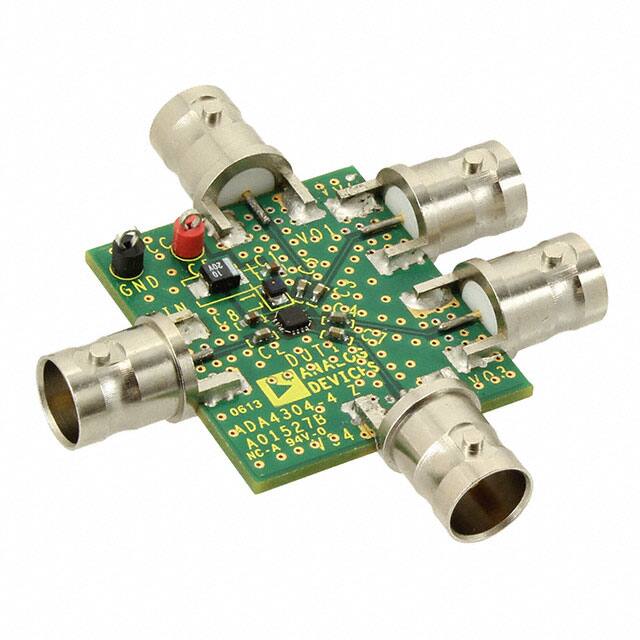
1:3 and 1:4 Single-Ended, Low Cost,
Active RF Splitters
ADA4304-3/ADA4304-4
Data Sheet
FEATURES
FUNCTIONAL BLOCK DIAGRAMS
Ideal for CATV and terrestrial applications
2.4 GHz, −3 dB bandwidth
1 dB flatness: 54 MHz to 865 MHz
Low noise figure: 4.6 dB
Low distortion
Composite second-order (CSO): −62 dBc
Composite triple beat (CTB): −72 dBc
Nominal 3 dB gain per output channel
25 dB output-to-output isolation, 50 MHz to 1000 MHz
75 Ω input and outputs
Small package size: 16-lead, 3 mm × 3 mm LFCSP
5V
5V
0.1µF
0.1µF
1µH
VCC
IL
VOUT1
0.01µF
VIN
VOUT2
ADA4304-3
0.01µF
0.01µF
VOUT3
0.01µF
GND
07082-001
APPLICATIONS
Set-top boxes
Residential gateways
CATV distribution systems
Splitter modules
Digital cable ready (DCR) TVs
Figure 1.
5V
5V
0.1µF
0.1µF
1µH
VCC
IL
VOUT1
VOUT2
VIN
ADA4304-4
0.01µF
VOUT3
VOUT4
0.01µF
0.01µF
0.01µF
0.01µF
07082-002
GND
Figure 2.
GENERAL DESCRIPTION
The ADA4304-3/ADA4304-4 are 75 Ω active splitters for use in
applications where a lossless signal split is required. Typical
applications include multituner digital set-top boxes, cable
splitter modules, multituners/digital cable ready (DCR)
televisions, and home gateways where traditional solutions
require discrete passive splitter modules with separate fixed
gain amplifiers.
Rev. A
The ADA4304-3/ADA4304-4 are fabricated using the
Analog Devices, Inc., proprietary silicon germanium (SiGe),
complementary bipolar process, enabling them to achieve very
low levels of distortion with a noise figure of 4.6 dB. The parts
provide low cost alternatives that simplify designs and improve
system performance by integrating a signal splitter element and
a gain block into a single IC. The ADA4304-3/ADA4304-4 are
available in a 16-lead LFCSP and operate in the extended
industrial temperature range of −40°C to +85°C.
Document Feedback
Information furnished by Analog Devices is believed to be accurate and reliable. However, no
responsibility is assumed by Analog Devices for its use, nor for any infringements of patents or other
rights of third parties that may result from its use. Specifications subject to change without notice. No
license is granted by implication or otherwise under any patent or patent rights of Analog Devices.
Trademarks and registered trademarks are the property of their respective owners.
One Technology Way, P.O. Box 9106, Norwood, MA 02062-9106, U.S.A.
Tel: 781.329.4700 ©2007–2016 Analog Devices, Inc. All rights reserved.
Technical Support
www.analog.com
�ADA4304-3/ADA4304-4
Data Sheet
TABLE OF CONTENTS
Features .............................................................................................. 1
Pin Configurations and Function Descriptions ............................5
Applications ....................................................................................... 1
Typical Performance Characteristics ..............................................6
Functional Block Diagrams ............................................................. 1
Test Circuits ........................................................................................9
General Description ......................................................................... 1
Applications..................................................................................... 10
Revision History ............................................................................... 2
Circuit Description .................................................................... 10
Specifications..................................................................................... 3
Outline Dimensions ....................................................................... 11
Absolute Maximum Ratings............................................................ 4
Ordering Guide .......................................................................... 11
Thermal Resistance ...................................................................... 4
ESD Caution .................................................................................. 4
REVISION HISTORY
7/2016—Rev. 0 to Rev. A
Changes to Figure 4, Figure 5, Table 4, and Table 5 ..................... 5
Deleted Evaluation Boards Section, RF Layout Considerations
Section, Power Supply Section, and Figure 21; Renumbered
Sequentially ..................................................................................... 10
Deleted Figure 22 and Figure 23 ................................................... 11
Updated Outline Dimensions ....................................................... 12
Changes to Ordering Guide .......................................................... 12
11/2007—Revision 0: Initial Version
Rev. A | Page 2 of 11
�Data Sheet
ADA4304-3/ADA4304-4
SPECIFICATIONS
VCC = 5 V, 75 Ω system, TA = 25°C, unless otherwise noted.
Table 1.
Parameter
DYNAMIC PERFORMANCE
Bandwidth (−3 dB)
Frequency Range
Gain
Gain Flatness
NOISE/DISTORTION PERFORMANCE
Noise Figure1
Output IP3
Output IP2
Composite Triple Beat (CTB)
Composite Second Order (CSO)
Cross Modulation (CXM)
INPUT CHARACTERISTICS
Input Return Loss
Output-to-Input Isolation
OUTPUT CHARACTERISTICS
Output Return Loss
Output-to-Output Isolation
1 dB Compression (P1dB)
POWER SUPPLY
Nominal Supply Voltage
Quiescent Supply Current
1
Conditions
See Figure 19 for test circuit
ADA4304-3
Min Typ
Max
ADA4304-4
Min Typ
Max
2400
f = 100 MHz
54 MHz to 865 MHz
3.3
1.0
2.9
1.0
MHz
MHz
dB
dB
@ 54 MHz
@ 550 MHz
@ 865 MHz
f1 = 97.25 MHz, f2 = 103.25 MHz
f1 = 97.25 MHz, f2 = 103.25 MHz
135 channels, 15 dBmV/channel, f = 865 MHz
135 channels, 15 dBmV/channel, f = 865 MHz
135 channels, 15 dBmV/channel,
100% modulation @ 15.75 kHz, f = 865 MHz
See Figure 19 for test circuit
@ 54 MHz
@ 550 MHz
@ 865 MHz
Any output, 54 MHz to 865 MHz
@ 54 MHz
@ 550 MHz
@ 865 MHz
See Figure 19 and Figure 20 for test circuits
Any output, 54 MHz to 865 MHz
@ 54 MHz
@ 550 MHz
@ 865 MHz
Any output, 54 MHz to 865 MHz
@ 54 MHz
@ 550 MHz
@ 865 MHz
Output referred, f = 100 MHz
4.0
4.6
4.8
26
43
−72
−62
−68
4.0
4.6
4.8
26
43
−72
−62
−68
dB
dB
dB
dBm
dBm
dBc
dBc
dBc
54
Rev. A | Page 3 of 11
865
54
865
−17
−22
−12
−13
−16
−8
−18
−21
−12
−14
−15
−8
dB
dB
dB
−33
−33
−34
−30
−30
−31
−33
−33
−35
−31
−31
−32
dB
dB
dB
−21
−16
−14
−17
−11
−9
−21
−17
−14
−17
−12
−9
dB
dB
dB
dB
dB
dB
dB
dBm
5.25
105
V
mA
−26
−25
−25
9.0
4.75
Characterized with 50 Ω noise figure analyzer.
2400
Unit
5.0
92
−26
−25
−25
8.7
5.25
105
4.75
5.0
92
�ADA4304-3/ADA4304-4
Data Sheet
ABSOLUTE MAXIMUM RATINGS
Parameter
Supply Voltage
Power Dissipation
Storage Temperature Range
Operating Temperature Range
Lead Temperature (Soldering, 10 sec)
Junction Temperature
Rating
5.5 V
See Figure 3
−65°C to +125°C
−40°C to +85°C
300°C
150°C
Stresses at or above those listed under Absolute Maximum
Ratings may cause permanent damage to the product. This
is a stress rating only; functional operation of the product
at these or any other conditions above those indicated in
the operational section of this specification is not implied.
Operation beyond the maximum operating conditions for
extended periods may affect product reliability.
THERMAL RESISTANCE
θJA is specified for the device (including exposed pad)
soldered to a high thermal conductivity 4-layer (2s2p)
circuit board, as described in EIA/JESD 51-7.
Table 3. Thermal Resistance
Package Type
16-Lead LFCSP (Exposed Pad)
θJA
98
Unit
°C/W
The power dissipated in the package (PD) is essentially equal to
the quiescent power dissipation, that is, the supply voltage (VS)
times the quiescent current (IS). In Table 1, the maximum
power dissipation of the ADA4304-3/ADA4304-4 can be
calculated as
PD (MAX) = 5.25 V × 105 mA = 551 mW
Airflow increases heat dissipation, effectively reducing θJA.
In addition, more metal directly in contact with the package
leads/exposed pad from metal traces, through-holes, ground,
and power planes reduces the θJA.
Figure 3 shows the maximum safe power dissipation in the
package vs. the ambient temperature for the 16-lead LFCSP
(98°C/W) on a JEDEC standard 4-layer board.
2.0
1.8
MAXIMUM POWER DISSIPATION (W)
Table 2.
1.6
1.4
1.2
1.0
0.8
0.6
0.4
The maximum safe power dissipation in the ADA4304-3/
ADA4304-4 package is limited by the associated rise in
junction temperature (TJ) on the die. At approximately
150°C, which is the glass transition temperature, the plastic
changes its properties. Even temporarily exceeding this
temperature limit can change the stresses that the package
exerts on the die, permanently shifting the parametric
performance. Exceeding a junction temperature of 150°C
for an extended period can result in changes in the silicon
devices, potentially causing failure.
0
0
10
20
30
40
50
60
70
AMBIENT TEMPERATURE (°C)
80
90
100
07082-003
0.2
Maximum Power Dissipation
Figure 3. Maximum Power Dissipation vs. Temperature for a 4-Layer Board
ESD CAUTION
Rev. A | Page 4 of 11
�Data Sheet
ADA4304-3/ADA4304-4
10 VOUT3
GND 3
GND
NOTES
1. NIC = NO INTERNAL CONNECTION.
2. EPAD SHOULD BE CONNECTED TO GND.
13 VOUT1
TOP VIEW
(Not to Scale)
11 GND
10 VOUT3
9
GND 7
VIN 4
NIC 8
GND 7
GND 6
GND 5
9
12 VOUT2
ADA4304-4
GND
NOTES
1. EPAD SHOULD BE CONNECTED TO GND.
Figure 4. ADA4304-3Pin Configuration
07082-005
VCC 2
14 IL
16 VCC
VCC 1
VOUT4 8
TOP VIEW
(Not to Scale)
VIN 4
12 VOUT2
11 GND
GND 5
GND 3
ADA4304-3
07082-004
VCC 2
GND 6
VCC 1
15 VCC
13 VOUT1
14 IL
16 VCC
15 VCC
PIN CONFIGURATIONS AND FUNCTION DESCRIPTIONS
Figure 5. ADA4304-4 Pin Configuration
Table 4. ADA4304-3 Pin Function Descriptions
Table 5. ADA4304-4 Pin Function Descriptions
Pin No.
1, 2, 15,
16
3, 5 to 7,
9, 11
4
8
10
12
13
14
Pin No.
1, 2, 15, 16
3, 5 to 7,
9, 11
4
8
10
12
13
14
Mnemonic
VCC
Description
Supply Pin.
GND
Ground.
VIN
NIC
VOUT3
VOUT2
VOUT1
IL
EPAD
Input.
No Internal Connection.
Output 3.
Output 2.
Output 1.
Bias Pin.
Exposed Pad. Exposed pad should be
connected to GND.
Rev. A | Page 5 of 11
Mnemonic
VCC
GND
Description
Supply Pin.
Ground.
VIN
VOUT4
VOUT3
VOUT2
VOUT1
IL
EPAD
Input.
Output 4.
Output 3.
Output 2.
Output 1.
Bias Pin.
Exposed Pad. Exposed pad should be
connected to GND.
�ADA4304-3/ADA4304-4
Data Sheet
TYPICAL PERFORMANCE CHARACTERISTICS
VCC = 5 V, 75 Ω system, TA = 25°C, unless otherwise noted.
10
–54
50Ω SYSTEM
–56
8
CSO (dBc)
–60
TA = +85°C
TA = +25°C
–62
NOISE FIGURE (dB)
–58
–64
–66
TA = –40°C
–68
6
TA = +85°C
TA = +25°C
4
TA = –40°C
2
–70
100
1000
FREQUENCY (MHz)
0
50
07082-020
–74
50
100
1000
FREQUENCY (MHz)
Figure 6. Composite Second Order (CSO) vs. Frequency
07082-023
–72
Figure 9. Noise Figure vs. Frequency
60
–60
–63
55
–66
50
TA = +85°C
OUTPUT IP2 (dBm)
CTB (dBc)
–69
–72
–75
TA = +25°C
–78
TA = –40°C
–81
ADA4304-3
45
40
ADA4304-4
35
30
–84
1000
FREQUENCY (MHz)
20
50
100
1000
07082-010
100
07082-021
–90
50
1000
07082-011
25
–87
FREQUENCY (MHz)
Figure 7. Composite Triple Beat (CTB) vs. Frequency
Figure 10. Output IP2 vs. Frequency
–60
40
–63
35
–66
OUTPUT IP3 (dBm)
TA = +25°C
–75
–78
TA = –40°C
–81
20
ADA4304-4
15
5
–87
–90
50
ADA4304-3
25
10
–84
100
1000
FREQUENCY (MHz)
07082-022
CXM (dBc)
–72
30
TA = +85°C
–69
Figure 8. Cross Modulation (CXM) vs. Frequency
0
50
100
FREQUENCY (MHz)
Figure 11. Output IP3 vs. Frequency
Rev. A | Page 6 of 11
�Data Sheet
ADA4304-3/ADA4304-4
0
4
OUTPUT-TO-OUTPUT ISOLATION (dB)
TA = +25°C
TA = –40°C
3
2
GAIN (dB)
1
TA = +85°C
0
–1
–2
–3
–4
–5
100
1000
FREQUENCY (MHz)
–10
–15
–20
–30
ADA4304-3
–35
–40
100
1000
FREQUENCY (MHz)
Figure 12. ADA4304-3 Gain vs. Frequency
Figure 15. Output-to-Output Isolation vs. Frequency
5
0
TA = +25°C
4
3
–5
INPUT RETURN LOSS (dB)
TA = –40°C
2
1
GAIN (dB)
ADA4304-4
–25
–45
50
07082-024
–6
40
–5
07082-014
5
TA = +85°C
0
–1
–2
–3
–4
–10
–15
ADA4304-3
–20
–25
ADA4304-4
1000
FREQUENCY (MHz)
–30
50
100
1000
07082-015
100
07082-025
–6
40
1000
07082-016
–5
FREQUENCY (MHz)
Figure 13. ADA4304-4 Gain vs. Frequency
Figure 16. Input Return Loss vs. Frequency
–25
0
–5
–31
OUTPUT RETURN LOSS (dB)
–29
ADA4304-3
–33
ADA4304-4
–35
–37
–39
–41
–10
ADA4304-3
–15
–20
ADA4304-4
–25
–43
–45
50
100
1000
FREQUENCY (MHz)
07082-013
OUTPUT-TO-INPUT ISOLATION (dB)
–27
Figure 14. Output-to-Input Isolation vs. Frequency
–30
50
100
FREQUENCY (MHz)
Figure 17. Output Return Loss vs. Frequency
Rev. A | Page 7 of 11
�ADA4304-3/ADA4304-4
Data Sheet
95
90
85
80
75
–60
–50
–40
–30
–20
0
20
40
60
80
100
–10
10
30
50
70
90
TEMPERATURE (°C)
07082-026
QUIESCENT SUPPLY CURRENT (mA)
100
Figure 18. Quiescent Supply Current vs. Temperature
Rev. A | Page 8 of 11
�Data Sheet
ADA4304-3/ADA4304-4
TEST CIRCUITS
RF NETWORK ANALYZER
RF NETWORK ANALYZER
75Ω S-PARAMETER
TEST SET
75Ω S-PARAMETER
TEST SET
VOUTm
VOUTm
VIN
DUT
4
VIN
DUT
75Ω
NOTES
1. TESTED FOR ALL COMBINATIONS OF
VOUTm AND VOUTn.
VOUTn
NOTES
1. TESTED FOR ALL COMBINATIONS OF
VOUTm AND VOUTn.
75Ω
07082-018
VOUTn
Figure 19. Test Circuit for Transmission, Isolation, and
Reflection Measurements
07082-019
4
Figure 20. Test Circuit for Output-to-Output Isolation Measurements
Rev. A | Page 9 of 11
�ADA4304-3/ADA4304-4
Data Sheet
APPLICATIONS
The ADA4304-3/ADA4304-4 active splitters are primarily
intended for use in the downstream path of television set-top
boxes (STBs) that contain multiple tuners. They are typically
located directly after the diplexer in a bidirectional CATV
customer premise unit. The ADA4304-3/ADA4304-4 provide a
single-ended input and three or four single-ended outputs that
allow the delivery of the RF signal to multiple signal paths. These
paths can include, but are not limited to, a main picture tuner,
the picture-in-picture (PIP) tuner, an out-of-band (OOB) tuner,
a digital video recorder (DVR), and a cable modem (CM).
The ADA4304-3/ADA4304-4 exhibit composite second-order
(CSO) and composite triple beat (CTB) products that are −62 dBc
and −72 dBc, respectively. The use of the SiGe bipolar process
also allows the ADA4304-3/ADA4304-4 to achieve a noise figure
(NF) of 4.6 dB at 550 MHz.
CIRCUIT DESCRIPTION
The ADA4304-3/ADA4304-4 consist of a low noise buffer
amplifier followed by a resistive power divider. This arrangement
provides 3.3 dB (ADA4304-3) or 2.9 dB (ADA4304-4) of gain
relative to the RF signal present at the input of the device. The
input and each output must be properly matched to a 75 Ω
environment for distortion and noise performance to match
the data sheet specifications. AC coupling capacitors of 0.01 μF
are recommended for the input and outputs.
A 1 μH RF choke (Coilcraft chip inductor 0805LS-102X) is
required to correctly bias the internal nodes of the ADA4304-3/
ADA4304-4. It should be connected between the 5 V supply and
the IL pin (Pin 14). The choke should be placed as close as possible
to the ADA4304-3/ADA4304-4 to minimize parasitic capacitance
on the IL pin, which is critical for achieving the specified
bandwidth and flatness.
Rev. A | Page 10 of 11
�Data Sheet
ADA4304-3/ADA4304-4
OUTLINE DIMENSIONS
PIN 1
INDICATOR
0.30
0.23
0.18
0.50
BSC
PIN 1
INDICATOR
16
13
1
12
EXPOSED
PAD
1.45
1.30 SQ
1.15
4
9
TOP VIEW
0.80
0.75
0.70
0.50
0.40
0.30
5
8
0.05 MAX
0.02 NOM
COPLANARITY
0.08
0.20 REF
SEATING
PLANE
0.25 MIN
BOTTOM VIEW
FOR PROPER CONNECTION OF
THE EXPOSED PAD, REFER TO
THE PIN CONFIGURATION AND
FUNCTION DESCRIPTIONS
SECTION OF THIS DATA SHEET.
COMPLIANT TO JEDEC STANDARDS MO-220-WEED.
111808-A
3.10
3.00 SQ
2.90
Figure 21. 16-Lead Lead Frame Chip Scale Package [LFCSP]
3 mm × 3 mm Body and 0.75 mm Package Height
(CP-16-21)
Dimensions shown in millimeters
ORDERING GUIDE
Model1
ADA4304-3ACPZ-RL
ADA4304-3ACPZ-R7
ADA4304-3ACPZ-R2
ADA4304-4ACPZ-RL
ADA4304-4ACPZ-R7
ADA4304-4ACPZ-R2
1
Temperature Range
−40°C to +85°C
−40°C to +85°C
−40°C to +85°C
−40°C to +85°C
−40°C to +85°C
−40°C to +85°C
Package Description
16-Lead LFCSP
16-Lead LFCSP
16-Lead LFCSP
16-Lead LFCSP
16-Lead LFCSP
16-Lead LFCSP
Z=RoHS Compliant Part
©2007–2016 Analog Devices, Inc. All rights reserved. Trademarks and
registered trademarks are the property of their respective owners.
D07082-0-7/16(A)
Rev. A | Page 11 of 11
Package Option
CP-16-21
CP-16-21
CP-16-21
CP-16-21
CP-16-21
CP-16-21
Ordering Quantity
5,000
1,500
250
5,000
1,500
250
Branding
H16
H16
H16
H10
H10
H10
�