Vol 54, No 3—July 2020
Characterizing the PSRR of
Data Acquisition μModule
Devices with Internal
Bypass Capacitors
Naveed Naeem�, Product Test Development Engineer
and Samantha Fontaine�, Product Engineer
Abstract
When optimizing data acquisition (DAQ) systems, designers must carefully
consider the effects of power supplies on high precision performance. Often,
the power supply circuitry includes a combination of low dropout linear
regulators and dc-to-dc switch-mode converters. One drawback of switchmode converters is that they produce an output ripple. While the ripple
magnitudes are relatively low, they can couple into key components in the
analog signal path that could corrupt measurements and compromise
performance. Power components must typically be low noise with adequate
supply decoupling at multiple locations on the PCB to prevent performance
degradation of the signal chain.
Power supply rejection ratio (PSRR) is a metric that quantifies a system’s
ability to reject supply noise and perturbations. As DAQ solutions evolve to be
more complete signal chain solutions via system-in-package (SiP) technology,
the supply decoupling can be co-packaged with the precision signal chain to
improve the overall system PSRR.
PSRR Definition
Power supply rejection ratio, also referred to as power supply ripple rejection, is
essentially the ratio of change in supply voltage to the output voltage expressed
in dB.
The following equation defines how to calculate PSRR (A2V is the voltage gain).
PSRR (dB) = 10log10
2
∆VSUPPLY
AV2
2
∆VOUT
(1)
PSRR is a key parameter that quantifies a circuit’s sensitivity to supply noise and
perturbations and how it affects the circuit’s output. It’s typically measured over
a wide frequency range from dc up to several MHz, with PSRR tending to degrade
at higher frequencies.
VISIT ANALOG.COM
System designers often add decoupling capacitors to the power supply nodes of
their circuit to reduce noise and glitches that could couple into sensitive components. For amplifiers, 0.1 µF ceramic capacitors are placed as close to the power
supply pins as possible to reduce high frequency coupling. In addition, to provide
low frequency decoupling, large 10 μF tantalum capacitors are connected in
parallel, and typically placed closer to the supply source.
PSRR Motivation
The desire for power efficiency is one reason why some system designers can’t
tolerate high power, low noise power conversion components. Battery-powered
DAQ systems are an example of an application that requires high performance
at low power—a significant motivator for designing DAQs with less sensitivity to
power supply noise.
Modern devices often include several systems powered from the same battery.
If the current consumption for one system or device increases under certain
conditions, the battery voltage, and therefore any supply voltage to other devices
powered from said battery, can vary. For these reasons, dc PSRR is important
when designing the battery management circuitry of a system. Depending on
how sensitive the system is, a designer can use LDO regulators to help combat
voltage drops. AC PSRR is also an important specification in battery-powered
systems if a ripple-inducing buck, boost, or inverting regulator is required.
For industrial applications, system noise is a key specification. For example,
electromagnetic interference (EMI) from nearby sources can couple to the supplies, causing noise spurs and other errors. To help minimize these noise spurs,
it is important to use decoupling capacitors and proper PCB design techniques
such as grounding, shielding, and proper component placement.
�Power Management
Reference
Buffer
Reference
Drive
JFET/
In-Amp
Sensor
ADC Driver
Digital Host
(FPGA/DSP)
ADC
RC Filter
Digital
Isolator
Signal
Conditioning
Figure 1. Typical precision data acquisition signal chain.
Analog Devices signal chain µModule® data acquisition solutions help solve some
of the power design pain points, such as optimized layout of traces, the addition
of decoupling capacitors, and in some cases, power management components
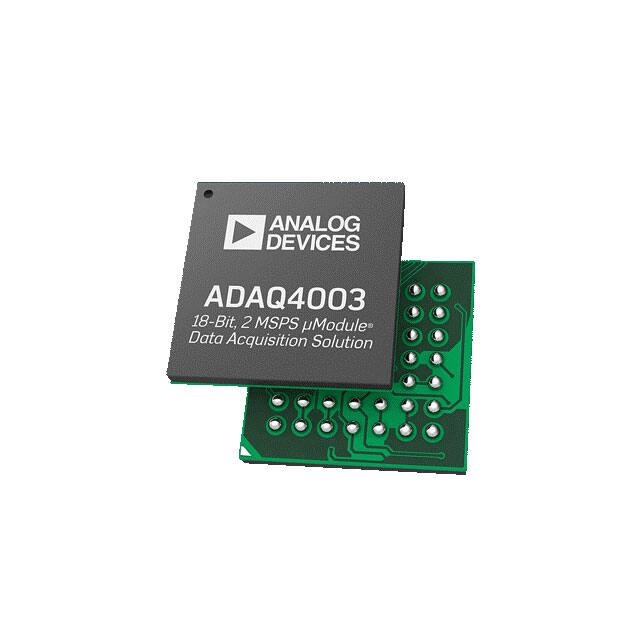
such as LDO regulators. The ADAQ4003 is a µModule data acquisition solution
that includes decoupling capacitors on all supplies to reduce their sensitivity
to perturbations. The ADAQ7980/ADAQ7988 µModule data acquisition systems
include decoupling capacitors and an LDO regulator. The integrated LDO regulator
further simplifies design—system designers only need to provide one clean supply to power the µModule device and they are free to bypass the LDO regulator
if required.
130
120
110
100
90
80
70
60
–PSRR
+PSRR
50
Current Method for Testing PSRR
on Discrete Components
40
0.1
PSRR testing of discrete components is a common feature in a characterization
plan, as it utilizes a methodology of well-established standards and methods.
The PSRR test of a discrete component is usually performed without any external
supply decoupling capacitance, intentionally revealing the direct impact on
performance of substantial noise on the power supply rails.
Usually, a function generator and scope, or network analyzer, can be used to
characterize the PSRR of an amplifier by injecting various frequency tones into the
dc supply voltage and measuring the amount of perturbation at the DUT’s output.
+VS
AC
Performing an ac PSRR test on a discrete part requires injecting the ac signal into
the dc supply voltage and measuring the output disturbance relative to stimulus on
the supply. For example, the ADA4945 has a PSRR of 115 dB at a frequency 100 kHz.
This means that a 1 VPEAK, 100 kHz ac disturbance on the supply manifests as an
approximately 1.79 µVPEAK signal at the output of the device.
PSRR (dB)
Figure 1 shows a typical precision data acquisition system signal chain. Each
component is affected by power supply noise to a different degree. Adding
proper decoupling capacitance improves PSRR performance at higher frequencies
for each of the components in the signal chain shown in Figure 1.
1
10
100
Frequency (MHz)
Figure 3. PSRR vs. frequency for the ADA4945 fully differential ADC driver.
Testing PSRR performance of an ADC is similar to testing an amplifier, but instead
of voltage out, it codes out. For ac PSRR, the PSRR of an ADC is the ratio of the
power in the ADC output at the frequency to the power of a 200 mV p-p sine wave
applied to the ADC VDD supply of frequency. Figure 4 and Figure 5 show the test
configuration and resulting typical response for a SAR ADC, respectively.
PSRR (dB) = 10log
PVDD_IN
PVADC_OUT
(2)
For dc PSRR testing, the error is the maximum change in the full-scale transition
point due to a change in power supply voltage from the nominal value.
49.9 Ω
DC
Reference
VOUT
RL
10 µF
0.1 µF
VCM
AC
IN+ REF VDD
ADC
IN-
–VS
Figure 2. Example of a discrete PSRR test circuit.
2
Figure 4. Single-ended ADC ac PSRR test circuit.
CHARACTERIZING THE PSRR OF DATA ACQUISITION μMODULE DEVICES WITH INTERNAL BYPASS CAPACITORS
Digital Output
�Signal chain µModule solutions can be applied in a wide variety of applications,
so the PSRR of the SiPs must be tested similarly to a discrete part in the final
application. Although there are multiple discrete components, it can be difficult
to predict how the full system will respond to the ac supply stimuli.
80
PSRR (dB)
75
From a characterization perspective, internal bypass capacitance and proper
evaluation board design are the most important things to consider for properly
testing PSRR (the evaluation board design is described further in this article
in the “Design Considerations for Evaluation Board Development” section). Any
internal bypass capacitors improve the ac PSRR of the signal chain µModule
solution, but this capacitance affects how the test should be performed.
70
65
60
55
1
10
100
As previously noted, signal generators do not have the capability to drive larger
capacitive loads. For example, consider a signal chain µModule solution with
a total 3 µF internal bypass capacitance on its main supply, and a PSRR test
calling for a maximum frequency of 10 MHz and an amplitude of 50 mV p-p.
Based on these conditions, a signal generator producing a sine wave would need
to be able to drive approximately 4.71 A of current and have enough bandwidth
to handle a 10 MHz signal. This is based on the impedance of the decoupling
capacitor at 10 MHz.
V
25 mV
IC = PEAK ≥
≥ 4.7124 A
(3)
1
1
2πfC
2π × 10 MHz × 3 μF
1000
Frequency (kHz)
Figure 5. ADC ac PSRR response.
The challenge with testing SiPs for PSRR is that they contain multiple internal
bypass capacitors up to 30 µF, and most signal generators and network analyzers struggle to drive such large capacitive loads at higher frequencies.
How to Characterize the PSRR of a Signal Chain
µModule Solution
To supply enough current, a high power amplifier such as the ADA4870 can be
used to provide additional current sourcing capability. This setup assumes that
the function generator being used can provide the necessary dc voltage to bias
your DUT. If that’s not the case, a bias tee can be used to isolate the dc and ac
signal paths, or you can gain up the available dc bias from a given signal generator that otherwise meets the other necessary output requirements.
When characterizing the PSRR of a signal chain µModule solution, the test
methodology is essentially the same as testing an amplifier. An ac signal is
superimposed on the dc supply voltage and the relationship between the stimulus
on the supply and µModule output is measured. However, due to the internal supply
decoupling capacitors, as the input frequencies into the supply increase, so
does the need for increased current drive capability from the signal source. The
internal capacitance does provide increased immunity to ac PSRR, but the test
is intended to account for a worst-case scenario.
Using the ADA4870 evaluation board provides a relatively easy way to interface with
an evaluation board and a signal generator since it has SMA inputs and SMA outputs.
1 kΩ
1 kΩ
–
ADA4870
*Supply with Cap Load
+
AC
3 µF*
49.9 Ω
SIP
DUT
Output
DC
SIP DUT Board
FFT
Figure 6. Block diagram of a PSRR setup with ADA4870.
VISIT ANALOG.COM
3
�Design Considerations for Evaluation Board
Development
X
Designing an evaluation board that can also be used for ac PSRR testing is not
grounds for drastically changing the design. Some key points to keep in mind are:
X
For each supply that is going to be tested for PSRR, provide an option to drive
it via an SMA to maintain signal integrity from the signal source.
X
Pay careful attention to reduce any parasitic inductances and capacitances
in the path from the SMA input to the associated power plane on the DUT. Any
parasitic capacitances or inductances can cause unwanted resonances over
the frequencies of interest.
Connector
For each supply, make sure that its associated power plane is solid—that is,
not split into multiple sections through passive components and multiple
layers. For instance, a current sense resistor should not straddle two power
planes (as shown in Figure 7). Also, minimize the number of times the power
supply crosses layers to avoid parasitic inductances due to vias, as represented in the high frequency model shown in Figure 8. The resistors shown
in Figure 7 could be used for current sensing but, in this case, they are 0 Ω.
Figure 9 shows better PCB power plane routing, while Figure 10 shows the
high frequency equivalent model.
Power Plane on
Lower Layer (Layer 3)
Via
Signal
Resistor
Via
Via
Resistor
Via
Power Plane on
Lower Layer (Layer 4)
DUT
Top Layer of PCB
Figure 7. Poor power plane connection design example.
DUT on Layer 1
High Frequency Resistor Model
High Frequency Via Model
High Frequency Via Model
Trace Impedance
Power Plane
on Lower
Layer 3
AC
High Frequency Resistor Model
High Frequency Via Model
High Frequency Via Model
Power Plane
on Lower
Layer 4
Figure 8. High frequency schematic equivalent of Figure 7.
4
CHARACTERIZING THE PSRR OF DATA ACQUISITION μMODULE DEVICES WITH INTERNAL BYPASS CAPACITORS
�Connector
Via
Signal
Resistor
Resistor
Via
DUT
Power Plane on
Lower Layer
Top Layer of PCB
Connector
Via
Signal
Resistor
Via
Power Plane on
Lower Layer
DUT
Top Layer of PCB
Figure 9. Optimizing PCB power plane routing: best performance.
High Frequency Resistor Model
High Frequency Via Model
High Frequency Via Model
Trace Impedance
Power Plane
on Lower
Layer
DUT on Layer 1
AC
Figure 10. High frequency equivalent of Figure 9.
It’s important that the evaluation board be tested without a DUT to make sure
there aren’t any unwanted resonances in the frequency range of interest. If there
are any resonances, then it should be accounted for during data processing. For
each frequency, scope verify that the supply signal matches expectations—don’t
trust the dials on the signal generator.
Test Setup
As previously noted, the supply for the signal chain µModule solution under
test must be able to provide the nominal dc offset to power the DUT plus an ac
stimulus at sufficient current at the maximum input frequency. To accomplish
this in the test setup shown here, the ADA4870 evaluation board is used in a
noninverting gain of two in combination with an AD3256 function generator.
Figure 11 shows a customized ADA4870 power amplifier evaluation board and the
ADA4355 evaluation board.
Figure 11. ADA4355 evaluation board with ADA4870 for PSRR testing.
VISIT ANALOG.COM
5
�The data shown in Figure 12 was generated by capturing data at each input frequency and looking at the power of the FFT (dBFS) at each of those frequencies.
From there, the voltage level at that frequency was solved by using Equation 4:
VOUT_PSRR = 10
POUT_PSRR
20
(4)
× VFULLSCALE
Use the resulting VOUT_PSRR to calculate the PSRR:
PSRR(F) = 20 log10
VOUT_PSRR
VSUPPLY_AC
(5)
“Op Amp Power Supply Rejection Ratio (PSRR) and Supply Voltages.”
Analog Devices, Inc., 2009.
200k Gain
20k Gain
2k Gain
Reeder, Rob. “Designing Power Supplies for High Speed ADC.” Analog Devices, Inc.,
February 2012.
PSRR (dB)
–30
Morita, Glenn. “Understand Low Dropout (LDO) Regulator Concepts to Achieve
Optimal Designs.” Analog Dialogue, Vol. 48, No. 12, December 2014.
–40
–50
Walsh, Alan. “Powering a Precision SAR ADC Using a High Efficiency, Ultralow Power
Switcher in Power Sensitive Applications.” Analog Devices, Inc., March 2016.
–60
–70
103
Analog Devices signal chain µModule solutions integrate signal conditioning,
supply generation, and passive internal components. These all-in-one, system
in a package designs enable customers to quickly achieve desired, ready for
market performance in a very small PCB footprint. Although signal chain µModule
solutions are unmatched in ease of use, appropriate testing must be done. While
the standard practices of testing PSRR can be applied, additional current drive
capability is often necessary due to standard equipment limitations.
References
–10
–20
Conclusion
104
105
106
107
Frequency (Hz)
Figure 12. ADA4355 PSRR results.
About the Author
Naveed Naeem joined Analog Devices in 2016 as a product test development engineer. Prior to joining ADI, he worked as an electrical
engineer for an automotive sensors company for three years. His interests include sensor applications, analog-to-digital converters, audio applications, and software development. In 2013, he graduated with a bachelor’s degree in electrical and computer
engineering from Worcester Polytechnic Institute. He can be reached at naveed.naeem@analog.com.
About the Author
Samantha Fontaine is a product engineer in the Linear Products and Solutions (LPS) Group. She joined Analog Devices in June 2012
after finishing her B.S. in electrical and computer engineering from Worcester Polytechnic Institute (WPI). She is currently working
toward her M.S. in engineering management at Tufts University. She can be reached at samantha.fontaine@analog.com.
For regional headquarters, sales, and distributors or
to contact customer service and technical support,
visit analog.com/contact.
Ask our ADI technology experts tough questions, browse
FAQs, or join a conversation at the EngineerZone Online
Support Community. Visit ez.analog.com.
©2020 Analog Devices, Inc. All rights reserved.
Trademarks and registered trademarks are
the property of their respective owners.
VISIT ANALOG.COM
�