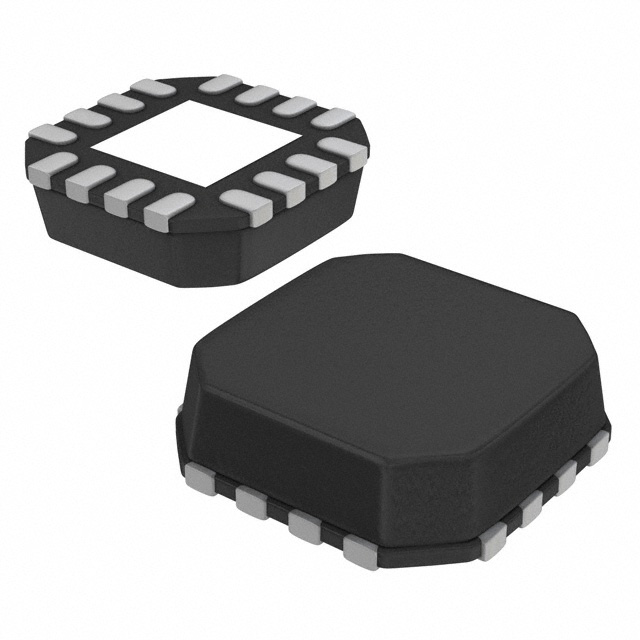
Ultrafast 3.3 V/5 V
Single-Supply SiGe Comparators
ADCMP572/ADCMP573
Data Sheet
FUNCTIONAL BLOCK DIAGRAM
3.3 V/5.2 V single-supply operation
150 ps propagation delay
15 ps overdrive and slew rate dispersion
8 GHz equivalent input rise time bandwidth
80 ps minimum pulse width
35 ps typical output rise/fall
10 ps deterministic jitter (DJ)
200 fs random jitter (RJ)
On-chip terminations at both input pins
Robust inputs with no output phase reversal
Resistor-programmable hysteresis
Differential latch control
Extended industrial −40°C to +125°C temperature range
VCCI
VCCO
VTP TERMINATION
VP NONINVERTING
INPUT
VN INVERTING
INPUT
Q OUTPUT
ADCMP572
ADCMP573
CML/
RSPECL
Q OUTPUT
VTN TERMINATION
LE INPUT
HYS
LE INPUT
04409-025
FEATURES
Figure 1.
APPLICATIONS
Clock and data signal restoration and level shifting
Automatic test equipment (ATE)
High speed instrumentation
Pulse spectroscopy
Medical imaging and diagnostics
High speed line receivers
Threshold detection
Peak and zero-crossing detectors
High speed trigger circuitry
GENERAL DESCRIPTION
The ADCMP572 and ADCMP573 are ultrafast comparators
fabricated on Analog Devices, Inc., proprietary XFCB3 Silicon
Germanium (SiGe) bipolar process. The ADCMP572 features
CML output drivers and latch inputs, and the ADCMP573
features reduced swing PECL (RSPECL) output drivers and
latch inputs.
Both devices offer 150 ps propagation delay and 80 ps
minimum pulse width for 10 Gbps operation with 200 fs rms
random jitter (RJ). Overdrive and slew rate dispersion are
typically less than 15 ps.
A flexible power supply scheme allows both devices to operate
with a single 3.3 V positive supply and a −0.2 V to +1.2 V input
signal range or with split input/output supplies to support a
wider −0.2 V to +3.2 V input signal range and an independent
range of output levels. 50 Ω on-chip termination resistors are
Rev. B
provided at both inputs with the optional capability to be left
open (on an individual pin basis) for applications requiring
high impedance inputs.
The CML output stage is designed to directly drive 400 mV into
50 Ω transmission lines terminated to between 3.3 V to 5.2 V.
The RSPECL output stage is designed to drive 400 mV into 50 Ω
terminated to VCCO − 2 V and is compatible with several commonly
used PECL logic families. The comparator input stage offers robust
protection against large input overdrive, and the outputs do not
phase reverse when the valid input signal range is exceeded.
High speed latch and programmable hysteresis features are also
provided.
The ADCMP572 and ADCMP573 are available in a 16-lead
LFCSP package and have been characterized over an extended
industrial temperature range of −40°C to +125°C.
Document Feedback
Information furnished by Analog Devices is believed to be accurate and reliable. However, no
responsibility is assumed by Analog Devices for its use, nor for any infringements of patents or other
rights of third parties that may result from its use. Specifications subject to change without notice. No
license is granted by implication or otherwise under any patent or patent rights of Analog Devices.
Trademarks and registered trademarks are the property of their respective owners.
One Technology Way, P.O. Box 9106, Norwood, MA 02062-9106, U.S.A.
Tel: 781.329.4700 ©2005–2015 Analog Devices, Inc. All rights reserved.
Technical Support
www.analog.com
�ADCMP572/ADCMP573
Data Sheet
TABLE OF CONTENTS
Features .............................................................................................. 1
Power/Ground Layout and Bypassing ........................................9
Applications ....................................................................................... 1
CML/RSPECL Output Stage ........................................................9
Functional Block Diagram .............................................................. 1
Using/Disabling the Latch Feature..............................................9
General Description ......................................................................... 1
Optimizing High Speed Performance ..................................... 10
Revision History ............................................................................... 2
Comparator Propagation Delay Dispersion ........................... 10
Electrical Characteristics ................................................................. 3
Comparator Hysteresis .............................................................. 11
Absolute Maximum Ratings............................................................ 5
Minimum Input Slew Rate Requirements .............................. 11
Thermal Considerations .............................................................. 5
Typical Application Circuits ......................................................... 12
ESD Caution .................................................................................. 5
Timing Information ....................................................................... 13
Pin Configuration and Function Descriptions ............................. 6
Outline Dimensions ....................................................................... 14
Typical Performance Characteristics ............................................. 7
Ordering Guide .......................................................................... 14
Applications Information ................................................................ 9
REVISION HISTORY
3/15—Rev. A to Rev. B
Changes to Figure 2 and Table 3 ..................................................... 6
Changes to Figure 23 ...................................................................... 12
Updated Outline Dimensions ....................................................... 14
Changes to Ordering Guide .......................................................... 14
4/09—Rev. 0 to Rev. A
Changes to Figure 26 ...................................................................... 12
Updated Outline Dimensions ....................................................... 14
Changes to Ordering Guide .......................................................... 14
4/05—Revision 0: Initial Version
Rev. B | Page 2 of 14
�Data Sheet
ADCMP572/ADCMP573
ELECTRICAL CHARACTERISTICS
VCCI = VCCO = 3.3 V, TA = −40°C to +125°C, typical at TA = +25°C, unless otherwise noted.
Table 1.
Parameter
DC INPUT CHARACTERISTICS
Input Voltage Range
Input Differential Voltage
Input Offset Voltage
Offset Voltage Tempco
Input Bias Current
Input Bias Current Tempco
Input Offset Current
Input Impedance
Input Resistance, Differential
Input Resistance, Common-Mode
Active Gain
Common-Mode Rejection
Power Supply Rejection—VCCI
Hysteresis
LATCH ENABLE CHARACTERISTICS
ADCMP572
Latch Enable Input Range
Latch Enable Input Differential
Latch Setup Time
Latch Hold Time
ADCMP573
Latch Enable Input Range
Latch Enable Input Differential
Latch Setup Time
Latch Hold Time
Latch Enable Input Impedance
Latch to Output Delay
Latch Minimum Pulse Width
DC OUTPUT CHARACTERISTICS
ADCMP572 (CML)
Output Impedance
Output Voltage High Level
Output Voltage Low Level
Output Voltage Differential
ADCMP573 (RSPECL)
Output Voltage High −40°C
Output Voltage High +25°C
Output Voltage High +125°C
Output Voltage Low −40°C
Output Voltage Low +25°C
Output Voltage Low +125°C
Output Voltage Differential
Symbol
Conditions
Min
VP, VN
VCCI = 3.3 V, VCCO = 3.3 V
VCCI = 5.2 V, VCCO = 3.3 V
−0.2
−0.2
−1.2
−5.0
VOS
∆VOS/dT
IP, IN
Open termination
−50.0
Open termination
Open termination
AV
CMRR
PSRVCCI
VCCI = 3.3 V, VCCO = 3.3 V,
VCM = 0.0 V to 1.0 V
VCCI = 5.2 V, VCCO = 3.3 V,
VCM = 0.0 V to 3.0 V
VCCI = 3.3 V ± 5%, VCCO = 3.3 V
RHYS = ∞
2.8
0.2
tS
tH
VOD = 100 mV
VOD = 100 mV
1.8
0.2
Typ
±2.0
10.0
−25.0
50.0
±2.0
50
50
500
54
65
Max
Unit
+1.2
+3.1
+1.2
+5.0
V
V
V
mV
μV/°C
μA
nA/°C
μA
Ω
kΩ
kΩ
dB
dB
0.0
65
dB
74
±1
dB
mV
0.4
15
5
0.4
90
100
50.0
150
100
VCCO + 0.2
0.5
V
V
ps
ps
VCCO − 0.6
0.5
V
V
ps
ps
Ω
ps
ps
tS
tH
VOD = 100 mV
VOD = 100 mV
tPLOH, tPLOL
tPL
VOD = 100 mV
VOD = 100 mV
ZOUT
VOH
VOL
−8 mA < IOUT < 8 mA
50 Ω terminate to VCCO
50 Ω terminate to VCCO
50 Ω terminate to VCCO
VCCO − 0.10
VCCO − 0.60
300
50.0
VCCO − 0.05
VCCO − 0.45
375
VCCO
VCCO − 0.30
450
Ω
V
V
mV
VOH
VOH
VOH
VOL
VOL
VOL
50 Ω terminate to VCCO − 2.0
50 Ω terminate to VCCO − 2.0
50 Ω terminate to VCCO − 2.0
50 Ω terminate to VCCO − 2.0
50 Ω terminate to VCCO − 2.0
50 Ω terminate to VCCO − 2.0
50 Ω terminate to VCCO − 2.0
VCCO − 1.14
VCCO − 1.10
VCCO − 1.04
VCCO − 1.54
VCCO − 1.50
VCCO − 1.44
300
VCCO − 1.02
VCCO − 0.98
VCCO − 0.92
VCCO − 1.39
VCCO − 1.35
VCCO − 1.29
375
VCCO − 0.90
VCCO − 0.86
VCCO − 0.80
VCCO − 1.24
VCCO − 1.20
VCCO − 1.14
450
V
V
V
V
V
V
mV
Rev. B | Page 3 of 14
�ADCMP572/ADCMP573
Parameter
AC PERFORMANCE
Propagation Delay
Propagation Delay Tempco
Prop Delay Skew—Rising Transition
to Falling Transition
Overdrive Dispersion
Data Sheet
Symbol
Conditions
tPD
VCCI = 3.3 V, VOD = 200 mV
VCCI = 3.3 V, VOD = 20 mV
VCCI = 5.2 V, VOD = 200 mV
∆tPD/dT
VOD = 200 mV, 5 V/ns
Slew Rate Dispersion
Pulse Width Dispersion
10% – 90% Duty Cycle Dispersion
Common-Mode Dispersion
Equivalent Input Bandwidth1
Toggle Rate
Deterministic Jitter
RMS Random Jitter
Minimum Pulse Width
Rise Time
Fall Time
POWER SUPPLY
Input Supply Voltage Range
Output Supply Voltage Range
Positive Supply Differential
ADCMP572 (CML)
Positive Supply Current
Device Power Dissipation
ADCMP573 (RSPECL)
Positive Supply Current
Device Power Dissipation
1
Min
BWEQ
DJ
RJ
PWMIN
PWMIN
tR
tF
50 mV < VOD < 0.2 V, 5 V/ns
10 mV < VOD < 0.2 V, 5 V/ns
2 V/ns to 10 V/ns, 250 mV OD
100 ps to 5 ns, 250 mV OD
VCCI = 3.3 V, 1 V/ns, 250 mV OD
VCCI = 5.2 V, 1 V/ns, 250 mV OD
VOD = 0.2 V, 0.0 V < VCM < 2.9 V
0.0 V to 250 mV input
tR = tF = 17 ps, 20/80
>50% Output Swing
VOD = 200 mV, 5 V/ns,
PRBS31 − 1 NRZ, 4 Gbps
VOD = 200 mV, 5 V/ns,
PRBS31 − 1 NRZ, 10 Gbps
VOD = 200 mV, 5 V/ns, 1.25 GHz
∆tPD/∆PW < 5 ps, 200 mV OD
∆tPD/∆PW < 10 ps, 200 mV OD
20/80
20/80
VCCI
VCCO
VCCI − VCCO
IVCCI + IVCCO
PD
IVCCI + IVCCO
PD
Typ
Max
Unit
150
165
145
0.5
10
Ps
Ps
Ps
ps/°C
Ps
15
15
15
5
5
10
5
8.0
Ps
Ps
Ps
Ps
Ps
ps/V
GHz
12.5
10
Gbps
Ps
20
Ps
0.2
100
80
35
35
Ps
Ps
Ps
Ps
Ps
3.1
3.1
−0.2
5.4
5.4
+2.3
V
V
V
mA
VCCI = 3.3 V, VCCO = 3.3 V,
terminate 50 Ω to VCCO
VCCI = 5.2 V, VCCO = 5.2 V,
terminate 50 Ω to VCCO
VCCI = 3.3 V, VCCO = 3.3 V,
terminate 50 Ω to VCCO
VCCI = 5.2 V, VCCO = 5.2 V,
terminate 50 Ω to VCCO
44
52
44
52
140
165
230
265
VCCI = 3.3 V, VCCO = 3.3 V,
50 Ω to VCCO − 2 V
VCCI = 5.2 V, VCCO = 5.2 V,
50 Ω to VCCO – 2 V
VCCI = 3.3 V, VCCO = 3.3 V,
50 Ω to VCCO − 2 V
VCCI = 5.2 V, VCCO = 5.2 V,
50 Ω to VCCO − 2 V
62
80
64
80
110
160
146
230
mW
mA
mW
Equivalent input bandwidth assumes a simple first-order response and is calculated with the following formula: BWEQ = 0.22/√(trCOMP2−trIN2), where trIN is the 20/80
transition time of a quasi-Gaussian signal applied to the comparator input, and trCOMP is the effective transition time digitized by the comparator.
Rev. B | Page 4 of 14
�Data Sheet
ADCMP572/ADCMP573
ABSOLUTE MAXIMUM RATINGS
THERMAL CONSIDERATIONS
Table 2.
Parameter
SUPPLY VOLTAGE
Input Supply Voltage
(VCCI to GND)
Output Supply Voltage
(VCCO to GND)
Positive Supply Differential
(VCCI − VCCO)
INPUT VOLTAGE
Input Voltage
Differential Input Voltage
Input Voltage, Latch Enable
HYSTERESIS CONTROL PIN
Applied Voltage (HYS to GND)
Maximum Input/Output Current
OUTPUT CURRENT
ADCMP572 (CML)
ADCMP573 (RSPECL)
TEMPERATURE
Operating Temperature, Ambient
Operating Temperature, Junction
Storage Temperature Range
The ADCMP572/ADCMP573 LFCSP 16-lead package has a θJA
(junction-to-ambient thermal resistance) of 70°C/W in still air.
Rating
−0.5 V to +6.0 V
ESD CAUTION
−0.5 V to +6.0 V
−0.5 V to +3.5 V
−0.5 V to VCCI + 0.5 V
±(VCCI + 0.5 V)
−0.5 V to VCCO + 0.5 V
−0.5 V to +1.5 V
±1 mA
±20 mA
−35 mA
−40°C to +125°C
+150°C
−65°C to +150°C
Stresses at or above those listed under Absolute Maximum
Ratings may cause permanent damage to the product. This is a
stress rating only; functional operation of the product at these
or any other conditions above those indicated in the operational
section of this specification is not implied. Operation beyond
the maximum operating conditions for extended periods may
affect product reliability.
Rev. B | Page 5 of 14
�ADCMP572/ADCMP573
Data Sheet
13 GND
14 HYS
16 VCCI
15 GND
PIN CONFIGURATION AND FUNCTION DESCRIPTIONS
VTP 1
VN 3
12 VCCO
ADCMP572
ADCMP573
TOP VIEW
11 Q
10 Q
9
LE 7
VCCO
VCCO /VTT 8
LE 6
VCCI 5
VTN 4
NOTES
1. LEAVE EPAD FLOATING UNLESS IMPROVED THERMAL OR MECHANICAL
STABILITY IS DESIRED, IN WHICH CASE SOLDER IT TO THE APPLICATION BOARD.
04409-026
VP 2
Figure 2. ADCMP572/ADCMP573 Pin Configuration
Table 3. Pin Function Descriptions
Pin
No.
1
2
3
4
5, 16
6
Mnemonic
VTP
VP
VN
VTN
VCCI
LE
7
LE
8
VCCO/VTT
9, 12
13, 15
10
VCCO
GND
Q
11
Q
14
HYS
Isolated
Heat Sink
EPAD
Description
Termination Resistor Return Pin for VP Input.
Noninverting Analog Input.
Inverting Analog Input.
Termination Resistor Return Pin for VN Input.
Positive Supply Voltage for Input Stage.
Latch Enable Input Pin, Inverting Side.
In compare mode (LE = low), the output tracks changes at the input of the comparator.
In latch mode (LE = high), the output reflects the input state just prior to the comparator’s being placed into latch
mode. LE must be driven in complement with LE.
Latch Enable Input Pin, Noninverting Side.
In compare mode (LE = high), the output tracks changes at the input of the comparator.
In latch mode (LE = low), the output reflects the input state just prior to the comparator’s being placed into latch
mode. LE must be driven in complement with LE.
Termination Return Pin for the LE/LE Input Pins.
For the ADCMP572 (CML output stage), this pin is internally connected to and also should be externally connected
to the positive VCCO supply.
For the ADCMP573 (RSPECL output stage), this pin should normally be connected to the VCCO – 2 V termination
potential.
Positive Supply Voltage for the CML/RSPECL Output Stage.
Ground.
Inverting Output. Q is at logic low if the analog voltage at the noninverting input, VP, is greater than the analog
voltage at the inverting input, VN, provided the comparator is in compare mode. See the LE/LE descriptions (Pins 6
and 7) for more information.
Noninverting Output. Q is at logic high if the analog voltage at the noninverting input VP is greater than the analog
voltage at the inverting input, VN, provided the comparator is in compare mode.
See the LE/LE descriptions (Pins 6 and 7) for more information.
Hysteresis Control Pin. Leave this pin disconnected for zero hysteresis. Connect to GND with a suitably sized
resistor to add the desired amount of hysteresis. Refer to Figure 7 for proper sizing of RHYS hysteresis control
resistor.
The metallic back surface of the package is not electrically connected to any part of the circuit, and it can be left
floating for best electrical isolation between the package handle and the substrate of the die. However, it can be
soldered to the application board if improved thermal and/or mechanical stability is desired. Exposed metal at
package corners is connected to the heat sink paddle.
Exposed Pad. Leave EPAD floating unless improved thermal or mechanical stability is desired, in which case solder
it to the application board.
Rev. B | Page 6 of 14
�Data Sheet
ADCMP572/ADCMP573
TYPICAL PERFORMANCE CHARACTERISTICS
VCCI = VCCO = 3.3 V, TA = 25°C, unless otherwise noted.
39.0
38.5
RISE/FALL TIME (ps)
15
10
38.0
37.5
37.0
5
0
50
100
150
200
250
INPUT OVERDRIVE VOLTAGE (mV)
36.0
–60
158.5
60
158.0
50
157.5
40
HYSTERESIS (mV)
20
40
60
80
100
157.0
156.5
30
20
10
0.2
0.4
0.6
0.8
1.0
1.2
INPUT COMMON-MODE VOLTAGE (V)
0
04409-040
0
0
1
2
3
4
5
6
RHYS (k)
Figure 4. Propagation Delay vs. Input Common-Mode
Figure 7. Hysteresis vs. RHYS Control Resistor
160
80
158
70
60
HYSTERESIS (mV)
156
154
152
50
40
30
150
20
148
–40
–20
0
20
40
60
80
TEMPERATURE (°C)
100
04409-041
146
–60
10
Figure 5. Propagation Delay vs. Temperature
0
–600
04409-047
PROPAGATION DELAY (ps)
0
Figure 6. Rise/Fall Time vs. Temperature
156.0
PROPAGATION DELAY (ps)
–20
TEMPERATURE (°C)
Figure 3. Propagation Delay vs. Input Overdrive
155.5
–40
04409-043
0
04409-042
36.5
04409-039
PROPAGATION DELAY ERROR (ps)
20
–500
–400
–300
–200
RHYS SINK CURRENT (A)
Figure 8. Hysteresis vs. RHYS Sink Current
Rev. B | Page 7 of 14
–100
0
�Data Sheet
–15.0
380
–15.5
379
–16.0
378
OUTPUT LEVELS (mV)
–16.5
–17.0
–17.5
377
376
375
374
–18.5
–0.5
–0.3
–0.1
0.1
0.3
0.5
0.7
0.9
1.1
1.3
04409-044
–18.0
1.5
VP INPUT VOLTAGE (VN = –0.2V)
373
–60
–40
–20
0
20
40
60
80
100
TEMPERATURE (°C)
Figure 12. Output Levels vs. Temperature
Figure 9. Input Bias Current vs. Input Differential
–16.2
496.0mV
–16.4
–16.5
–16.6
–16.7
–16.8
–20
0
20
40
60
80
100
04409-045
–40
TEMPERATURE (°C)
504.0mV
60.00ps/DIV
04409-049
M1
–16.9
–60
Figure 13. ADCMP572 Eye Diagram at 2.5 Gbps
Figure 10. Input Bias Current vs. Temperature
0.5
500.0mV
0.4
0.3
0.2
0.1
0
–0.1
–0.2
–0.4
–0.5
–50
–25
0
25
50
TEMPERATURE (C)
75
100
500.0mV
125
25.00ps/DIV
Figure 14. ADCMP572 Eye Diagram at 6.5 Gbps
Figure 11. Input Offset Voltage vs. Temperature
Rev. B | Page 8 of 14
04409-050
–0.3
04409-024
OFFSET (mV)
INPUT BIAS CURRENT (A)
–16.3
04409-046
INPUT BIAS CURRENT (A)
ADCMP572/ADCMP573
�Data Sheet
ADCMP572/ADCMP573
APPLICATIONS INFORMATION
VCCO
50
Q
It is important to adequately bypass the input and output supplies.
A 1 μF electrolytic bypass capacitor should be placed within
several inches of each power supply pin to ground. In addition,
multiple high quality 0.01 μF bypass capacitors should be placed
as close as possible to each of the VCCI and VCCO supply pins and
should be connected to the GND plane with redundant vias. High
frequency bypass capacitors should be carefully selected for
minimum inductance and ESR. Parasitic layout inductance should
be avoided to maximize the effectiveness of the bypass at high
frequencies.
If the input and output supplies are connected separately such
that VCCI ≠ VCCO, care should be taken to bypass each of these
supplies separately to the GND plane. A bypass capacitor should
not be connected between them. It is recommended that the
GND plane separate the VCCI and VCCO planes when the circuit
board layout is designed to minimize coupling between the two
supplies and to take advantage of the additional bypass capacitance from each respective supply to the ground plane. This
enhances the performance when split input/output supplies are
used. If the input and output supplies are connected together for
single-supply operation such that VCCI = VCCO, coupling between
the two supplies is unavoidable; however, every effort should be
made to keep the supply plane adjacent to the GND plane to
maximize the additional bypass capacitance this arrangement
provides.
CML/RSPECL OUTPUT STAGE
Specified propagation delay dispersion performance can be
achieved only by using proper transmission line terminations.
The outputs of the ADCMP572 are designed to directly drive
400 mV into 50 Ω cable, microstrip, or strip line transmission
lines properly terminated to the VCCO supply plane. The CML
output stage is shown in the simplified schematic diagram of
Figure 15. The outputs are each back terminated with 50 Ω for
best transmission line matching. The RSPECL outputs of the
ADCMP573 are illustrated in Figure 16 and should be terminated
to VCCO − 2 V. As an alternative, Thevenin equivalent termination
networks can be used in either case if the direct termination
voltage is not readily available. If high speed output signals must
be routed more than a centimeter, microstrip or strip line
techniques are essential to ensure proper transition times and to
Q
16mA
GND
Figure 15. Simplified Schematic Diagram of
the ADCMP572 CML Output Stage
VCCO
Q
Q
GND
04409-038
The ADCMP572/ADCMP573 comparators are very high speed
SiGe devices. Consequently, it is essential to use proper high speed
design techniques to achieve the specified performance. Of critical
importance is the use of low impedance supply planes, particularly
the output supply plane (VCCO) and the ground plane (GND).
Individual supply planes are recommended as part of a multilayer
board. Providing the lowest inductance return path for switching
currents ensures the best possible performance in the target
application.
prevent output ringing and pulse width dependent propagation
delay dispersion. For the most timing critical applications where
transmission line reflections pose the greatest risk to performance,
the ADCMP572 provides the best match to 50 Ω output
transmission paths.
04409-037
POWER/GROUND LAYOUT AND BYPASSING
Figure 16. Simplified Schematic Diagram of
the ADCMP573 RSPECL Output Stage
USING/DISABLING THE LATCH FEATURE
The latch inputs (LE/LE) are active low for latch mode and are
internally terminated with 50 Ω resistors to Pin 8. This pin
corresponds to and is internally connected to the VCCO supply
for the CML-compatible ADCMP572. With the aid of these
resistors, the ADCMP572 latch function can be disabled by
connecting the LE pin to GND with an external pull-down
resistor and leaving the LE pin unconnected. To avoid excessive
power dissipation, the resistor should be 750 Ω when VCCO =
3.3 V, and 1.2 kΩ when VCCO = 5.2 V. In the PECL-compatible
ADCMP573, the VTT pin should be connected externally to the
PECL termination supply at VCCO – 2 V. The latch can then be
disabled by connecting the LE pin to VCCO with an external
500 Ω resistor and leaving the LE pin disconnected. In this case,
the resistor value does not depend on the VCCO supply voltage.
Rev. B | Page 9 of 14
�ADCMP572/ADCMP573
Data Sheet
As with any high speed comparator, proper design and layout
techniques are essential to obtaining the specified performance.
Stray capacitance, inductance, inductive power and ground
impedances, or other layout issues can severely limit performance
and often cause oscillation. Discontinuities along input and
output transmission lines can severely limit the specified pulse
width dispersion performance.
For applications working in a 50 Ω environment, input and
output matching has a significant impact on data dependent (or
deterministic) jitter (DJ) and on pulse width dispersion
performance. The ADCMP572/ADCMP573 comparators
provide internal 50 Ω termination resistors for both the VP and
VN inputs, and the ADCMP572 provides 50 Ω back terminated
outputs. The return side for each input termination is pinned
out separately with the VTP and VTN pins, respectively. If a 50 Ω
termination is desired at one or both of the VP/VN inputs, then
the VTP and VTN pins can be connected (or disconnected) to
(from) the desired termination potential as required. The
termination potential should be carefully bypassed using high
quality bypass capacitors as discussed earlier to prevent undesired
aberrations on the input signal due to parasitic inductance in
the circuit board layout. If a 50 Ω input termination is not
desired, either one or both of the VTP/VTN termination pins can
be left disconnected. In this case, the pins should be left floating
with no external pull-downs or bypassing capacitors.
The ADCMP572/ADCMP573 comparators are designed to
reduce propagation delay dispersion over a wide input overdrive
range of 5 mV to 500 mV. Propagation delay dispersion is variation
in the propagation delay that results from a change in the degree of
overdrive or slew rate (how far or how fast the input signal
exceeds the switching threshold).
Propagation delay dispersion is a specification that becomes
important in high speed, time-critical applications such as data
communication, automatic test and measurement, instrumentation, and event driven applications such as pulse spectroscopy,
nuclear instrumentation, and medical imaging. Dispersion is
defined as the variation in propagation delay as the input overdrive conditions vary (Figure 17 and Figure 18). For the
ADCMP572/ADCMP573, dispersion is typically