Data Sheet
High Performance, Low Power, ISM Band
FSK/GFSK/MSK/GMSK Transceiver IC
ADF7023-J
FEATURES
Ultralow power, high performance transceiver
Frequency bands: 902 MHz to 958 MHz
Data rates supported: 1 kbps to 300 kbps
2.2 V to 3.6 V power supply
Single-ended and differential power amplifiers (PAs)
Low IF receiver with programmable IF bandwidths
100 kHz, 150 kHz, 200 kHz, 300 kHz
Receiver sensitivity (BER)
−116 dBm at 1.0 kbps, 2FSK, GFSK
−107.5 dBm at 38.4 kbps, 2FSK, GFSK
−106.5 dBm at 50 kbps, 2FSK, GFSK
−105 dBm at 100 kbps, 2FSK, GFSK
−104 dBm at 150 kbps, GFSK, GMSK
−103 dBm at 200 kbps, GFSK, GMSK
−100.5 dBm at 300 kbps, GFSK, GMSK
Very low power consumption
12.8 mA in PHY_RX mode (maximum front-end gain)
11.9 mA in PHY_RX mode (AGC off, ADC off)
24.1 mA in PHY_TX mode (10 dBm output, single-ended PA)
0.75 µA in PHY_SLEEP mode (32 kHz RC oscillator active)
1.28 µA in PHY_SLEEP mode (32 kHz XTAL oscillator active)
0.33 µA in PHY_SLEEP mode (Deep Sleep Mode 1)
RF output power of −20 dBm to +13.5 dBm (single-ended PA)
RF output power of −20 dBm to +10 dBm (differential PA)
Patented fast settling automatic frequency control (AFC)
Digital received signal strength indication (RSSI)
Integrated PLL loop filter and Tx/Rx switch
Fast automatic voltage controlled oscillator (VCO) calibration
Automatic synthesizer bandwidth optimization
On-chip, low power, custom 8-bit processor
Radio control
Packet management
Smart wake mode
Rev. D
SPORT mode support
High speed synchronous serial interface to Tx and Rx Data
for direct interfacing to processors and DSPs
Packet management support
Highly flexible for a wide range of packet formats
Insertion/detection of preamble/sync word/CRC/address
Manchester and 8b/10b data encoding and decoding
Data whitening
Smart wake mode
Current saving low power mode with autonomous receiver
wake up, carrier sense, and packet reception
Downloadable firmware modules
Image rejection calibration, fully automated (patent
pending)
128-bit AES encryption/decryption with hardware
acceleration and key sizes of 128 bits, 192 bits, and
256 bits
Reed-Solomon error correction with hardware acceleration
240-byte packet buffer for Tx/Rx data
Efficient SPI control interface with block read/write access
Integrated battery alarm and temperature sensor
Integrated RC and 32.768 kHz crystal oscillator
On-chip, 8-bit ADC
5 mm × 5 mm, 32-lead, LFCSP package
APPLICATIONS
Smart metering
IEEE 802.15.4g
Home automation
Process and building control
Wireless sensor networks (WSNs)
Wireless healthcare
Document Feedback
Information furnished by Analog Devices is believed to be accurate and reliable. However, no
responsibility is assumed by Analog Devices for its use, nor for any infringements of patents or other
rights of third parties that may result from its use. Specifications subject to change without notice. No
license is granted by implication or otherwise under any patent or patent rights of Analog Devices.
Trademarks and registered trademarks are the property of their respective owners.
One Technology Way, P.O. Box 9106, Norwood, MA 02062-9106, U.S.A.
Tel: 781.329.4700 ©2011–2014 Analog Devices, Inc. All rights reserved.
Technical Support
www.analog.com
�ADF7023-J
Data Sheet
TABLE OF CONTENTS
Features .............................................................................................. 1
Interrupts in Sport Mode .......................................................... 48
Applications ....................................................................................... 1
ADF7023-J Memory Map ............................................................. 49
Revision History ............................................................................... 3
BBRAM ........................................................................................ 49
Functional Block Diagram .............................................................. 4
Modem Configuration RAM (MCR) ...................................... 49
General Description ......................................................................... 4
Program ROM ............................................................................ 49
Specifications..................................................................................... 6
Program RAM ............................................................................ 49
RF and Synthesizer Specifications .............................................. 6
Packet RAM ................................................................................ 50
Transmitter Specifications ........................................................... 7
SPI Interface .................................................................................... 51
Receiver Specifications ................................................................ 9
General Characteristics ............................................................. 51
Timing and Digital Specifications ............................................ 12
Command Access ....................................................................... 51
Auxilary Block Specifications ................................................... 13
Status Word ................................................................................. 51
General Specifications ............................................................... 14
Command Queuing ................................................................... 52
Timing Specifications ................................................................ 15
Memory Access........................................................................... 53
Absolute Maximum Ratings.......................................................... 16
Low Power Modes .......................................................................... 56
ESD Caution ................................................................................ 16
Example Low Power Modes ...................................................... 59
Pin Configuration and Function Descriptions ........................... 17
Low Power Mode Timing Diagrams........................................ 61
Typical Performance Characteristics ........................................... 19
WUC Setup ................................................................................. 62
Terminology .................................................................................... 26
Firmware Timer Setup ............................................................... 63
Radio Control.................................................................................. 27
Calibrating the RC Oscillator ................................................... 63
Radio States ................................................................................. 27
Downloadable Firmware Modules ............................................... 65
Initialization ................................................................................ 29
Writing a Module to Program RAM........................................ 65
Commands .................................................................................. 30
Image Rejection Calibration Module ...................................... 65
Automatic State Transitions ...................................................... 32
AES Encryption and Decryption Module............................... 65
State Transition and Command Timing.................................. 33
Reed-Solomon Coding Module ............................................... 65
Sport Mode ...................................................................................... 37
Radio Blocks .................................................................................... 67
Packet Structure in Sport Mode ............................................... 37
Frequency Synthesizer ............................................................... 67
Sport Mode in Transmit ............................................................ 37
Crystal Oscillator........................................................................ 68
Sport Mode in Receive ............................................................... 37
Modulation .................................................................................. 68
Transmit Bit Latencies in Sport Mode ..................................... 37
RF Output Stage.......................................................................... 69
Packet Mode .................................................................................... 40
PA/LNA Interface ....................................................................... 69
Preamble ...................................................................................... 40
Receive Channel Filter ............................................................... 69
Sync Word ................................................................................... 41
Image Channel Rejection .......................................................... 69
Payload ......................................................................................... 42
Automatic Gain Control (AGC)............................................... 70
CRC .............................................................................................. 43
RSSI .............................................................................................. 70
Postamble..................................................................................... 44
2FSK/GFSK/MSK/GMSK Demodulation............................... 72
Transmit Packet Timing ............................................................ 44
Clock Recovery ........................................................................... 73
Data Whitening .......................................................................... 45
Manchester Encoding ................................................................ 45
Recommended Receiver Settings for
2FSK/GFSK/MSK/GMSK ......................................................... 73
8b/10b Encoding ........................................................................ 45
Peripheral Features ......................................................................... 76
Interrupt Generation ...................................................................... 46
Analog-to-Digital Converter .................................................... 76
Rev. D | Page 2 of 104
�Data Sheet
ADF7023-J
Temperature Sensor ....................................................................76
Command Reference ...................................................................... 80
Test DAC ......................................................................................76
Register Maps .................................................................................. 81
Transmit Test Modes ..................................................................76
BBRAM Register Description ................................................... 83
Silicon Revision Readback .........................................................76
MCR Register Description......................................................... 94
Applications Information ...............................................................77
Packet RAM Register Description ..........................................101
Application Circuit .....................................................................77
Outline Dimensions ......................................................................102
Host Processor Interface ............................................................77
Ordering Guide .........................................................................102
PA/LNA Matching ......................................................................78
REVISION HISTORY
3/14—Rev. C to Rev. D
Changes to Figure 54 ......................................................................42
Changes to Transmit Packet Timing Section and Figure 56 .....44
Changes to Figure 69 ......................................................................58
Changes to Figure 72 ......................................................................61
Change to Power Amplifier (PA) Section ....................................69
Changes to Table 88 and Table 89 .................................................91
Change to Table 94 ..........................................................................92
Change to Table 99 ..........................................................................94
Change to Table 107 ........................................................................95
Change to Table 114 ........................................................................98
5/13—Rev. B to Rev. C
Added t15 to Table 7 and Figure 3 ..................................................15
Changed Register 0x018 200 kbps Data Rate from 0x18 to
0x22; Table 31...................................................................................67
1/13—Rev. A to Rev. B
Change to Accuracy of Temperature Readback Parameter,
Table 5 ...............................................................................................13
Changes to Table 9 ..........................................................................17
Change to PHY_TX Section ..........................................................27
Changes to Table 12 ........................................................................36
Changes to Figure 56 ......................................................................44
Changes to Interrupts in Sport Mode Section .............................48
Changes to Table 26 ........................................................................52
Changes to Table 28 ........................................................................57
Changes to Table 29 ........................................................................62
Changes to Crystal Oscillator Section and Table 32 ...................73
Change to Power Amplifier (PA) Section ....................................74
Changes to Figure 84 ......................................................................77
Changes to Table 44 ........................................................................79
Changes to Table 95 ........................................................................93
Change to Table 99 ..........................................................................94
Change to Table 137 ..................................................................... 100
Updated Outline Dimensions ..................................................... 102
6/12—Rev. 0 to Rev. A
Changes to General Descriptions Section...................................... 4
Changes to Calibration Time and to ADC Parameter
in Table 5 ..........................................................................................13
Changes to Table 7 and to table summary statement and
changes to Figure 2 and Figure 3 .................................................. 15
Changes to Figure 5 and Figure 7 ................................................. 19
Changes to Figure 43 ...................................................................... 25
Changes to PHY_SLEEP Section .................................................. 27
Changes to State Transition and Command Timing Section
and changes to Table 11 .................................................................. 33
Changes to Table 12 ........................................................................ 34
Changes to Figure 49 and Figure 50 ............................................. 38
Changes to Figure 51 and Figure 52 ............................................. 39
Changes to Figure 53 ...................................................................... 41
Changes to Addressing Section ..................................................... 42
Changes to Table 20 and changes to CRC Section...................... 43
Changes to Figure 56 ...................................................................... 44
Changes to Command Access Section ......................................... 51
Changes to Table 28 ........................................................................ 57
Changes to Figure 69 ...................................................................... 58
Changes to Table 29 ........................................................................ 62
Added Calibrating the RC Oscillator Section ............................. 63
Added Figure 75; Renumbered Sequentially ............................... 64
Changes to Automatic PA Ramp Section and changes to Image
Channel Rejection Section ............................................................. 69
Changes to Temperature Sensor Section and changes to
Table 42 ............................................................................................. 76
Changes to Support for External PA and LNA Control Section
and changes to Table 44 .................................................................. 79
Changes to Table 47 ........................................................................ 81
Changes to Table 48 ........................................................................ 82
Changes to Table 69 ........................................................................ 86
Changes to Table 70 ........................................................................ 86
Changes to Table 76 ........................................................................ 88
Changes to Table 77 and to Table 78 ............................................ 89
Changes to Table 83 and to Table 85 ............................................ 91
Changes to Table 93 and added Table 94; Renumbered
Sequentially ...................................................................................... 92
Added Table 95 and Table 96 ........................................................ 93
Changes to Table 100 ...................................................................... 94
Changes to Table 110 ...................................................................... 96
Added Table 123 and Table 124..................................................... 98
Changes to Table 144 ....................................................................101
5/11—Revision 0: Initial Version
Rev. D | Page 3 of 104
�ADF7023-J
Data Sheet
FUNCTIONAL BLOCK DIAGRAM
ADCIN_ATB3
FSK
ASK
DEMOD
RFIO_1P
RSSI/
LOGAMP
RFIO_1N
MUX
LNA
8-BIT
ADC
4kB ROM
MAC
8-BIT RISC
PROCESSOR
IRQ
CTRL
CS
2kB RAM
CDR
AFC
AGC
256 BYTE
PACKET
RAM
PA
IRQ_GP3
SPI
MISO
SCLK
MOSI
64 BYTE
BBRAM
LOOP
FILTER
DIVIDER
PA
CHARGE
PUMP
26MHz OSC
PFD
256 BYTE
MCR RAM
TEST
DAC
DIVIDER
GPIO1
fDEV
PA RAMP
PROFILE
Σ-Δ
MODULATOR
LDO4
LDO3
LDO2
ADF7023-J
LDO1
GPIO
BIAS
WAKE-UP CONTROL
TIMER UNIT
GAUSSIAN
FILTER
ANALOG
TEST
CREGRFx CREGVCO CREGSYNTH CREGDIGx RBIAS
TEMP
SENSOR
BATTERY
MONITOR
XOSC32KN_ATB2
1GPIO REFERS TO PINS 17, 18, 19, 20, 25, AND 27.
32kHz
OSC
32kHz
RCOSC
CLOCK
DIVIDER
26MHz
OSC
XOSC32KP_GP5_ATB1 XOSC26N XOSC26P
09555-001
RFO2
Figure 1.
GENERAL DESCRIPTION
The ADF7023-J is a very low power, high performance, highly
integrated 2FSK/GFSK/MSK/GMSK transceiver designed for
operation in the 902 MHz to 958 MHz frequency band, which
covers the ARIB Standard T96 band at 950 MHz. Data rates
from 1 kbps to 300 kbps are supported.
The transmit RF synthesizer contains a VCO and a low noise
fractional-N phase locked loop (PLL) with an output channel
frequency resolution of 400 Hz. The VCO operates at twice the
fundamental frequency to reduce spurious emissions. The receive
and transmit synthesizer bandwidths are automatically, and
independently, configured to achieve optimum phase noise,
modulation quality, and settling time. The transmitter output
power is programmable from −20 dBm to +13.5 dBm, with
automatic PA ramping to meet transient spurious specifications.
The part possesses both single-ended and differential PAs, which
allow for Tx antenna diversity.
The receiver is exceptionally linear, achieving an IP3 specification
of −12.2 dBm and −11.5 dBm at maximum gain and minimum
gain, respectively, and an IP2 specification of 18.5 dBm and 27 dBm
at maximum gain and minimum gain, respectively. The receiver
achieves an interference blocking specification of 66 dB at a
±2 MHz offset and 74 dB at a ±10 MHz offset. Thus, the part
is extremely resilient to the presence of interferers in spectrally
noisy environments. The receiver features a novel, high speed,
AFC loop, allowing the PLL to find and correct any RF frequency
errors in the recovered packet. A patent pending image rejection
calibration scheme is available by downloading the image rejection
calibration firmware module to program RAM. The algorithm
does not require the use of an external RF source nor does it
require any user intervention once initiated. The results of the
calibration can be stored in nonvolatile memory for use on
subsequent power-ups of the transceiver.
The ADF7023-J operates with a power supply range of 2.2 V to
3.6 V and has very low power consumption in both Tx and Rx
modes, enabling long lifetimes in battery-operated systems while
maintaining excellent RF performance. The device can enter a
low power sleep mode in which the configuration settings are
retained in the battery backup random access memory (BBRAM).
The ADF7023-J features an ultralow power, on-chip,
communications processor. The communications processor,
which is an 8-bit RISC processor, performs the radio control,
packet management, and smart wake mode (SWM) functionality.
The communications processor eases the processing burden of
the companion processor by integrating the lower layers of a
typical communication protocol stack. The communications
processor also permits the download and execution of firmware
modules. Available modules include image rejection (IR)
calibration, advanced encryption standard (AES) encryption,
and Reed-Solomon coding. These firmware modules are available
online at ftp://ftp.analog.com/pub/RFL/FirmwareModules.
The communications processor provides a simple command-based
radio control interface for the host processor. A single-byte command
transitions the radio between states or performs a radio function.
The communications processor provides support for generic
packet formats. The packet format is highly flexible and fully
programmable, thereby ensuring its compatibility with proprietary
packet profiles. In transmit mode, the communications processor
can be configured to add preamble, sync word, and CRC to the
payload data stored in packet RAM. In receive mode, the
Rev. D | Page 4 of 104
�Data Sheet
ADF7023-J
communications processor can detect and interrupt the host
processor on reception of preamble, sync word, address, and CRC
and store the received payload to packet RAM. The ADF7023-J
uses an efficient interrupt system comprising MAC level interrupts
and PHY level interrupts that can be individually set. The payload
data plus the 16-bit CRC can be encoded/decoded using
Manchester or 8b/10b encoding. Alternatively, data whitening
and dewhitening can be applied.
The SWM allows the ADF7023-J to wake up autonomously from
sleep using the internal wake-up timer without intervention from
the host processor. After wake-up, the ADF7023-J is controlled
by the communications processor. This functionality allows
carrier sense, packet sniffing, and packet reception while the
host processor is in sleep, thereby reducing overall system current
consumption. The smart wake mode can wake the host processor
on an interrupt condition. These interrupt conditions can be
configured to include the reception of valid preamble, sync
word, CRC, or address match. Wake-up from sleep mode can
also be triggered by the host processor. For systems requiring
very accurate wake-up timing, a 32 kHz oscillator can be used
to drive the wake-up timer. Alternatively, the internal RC oscillator
can be used, which gives lower current consumption in sleep.
The ADF7023-J features an AES engine with hardware
acceleration that provides 128-bit block encryption and
decryption with key sizes of 128 bits, 192 bits, and 256 bits.
Both electronic code book (ECB) and Cipher Block Chaining
Mode 1 (CBC Mode 1) are supported. The AES engine can be
used to encrypt/decrypt packet data and can be used as a standalone engine for encryption/decryption by the host processor.
The AES engine is enabled on the ADF7023-J by downloading
the AES firmware module to program RAM.
An on-chip, 8-bit ADC provides readback of an external analog
input, the RSSI signal, or an integrated temperature sensor. An
integrated battery voltage monitor raises an interrupt flag to the
host processor whenever the battery voltage drops below a userdefined threshold.
Rev. D | Page 5 of 104
�ADF7023-J
Data Sheet
SPECIFICATIONS
VDD = VDDBAT1 = VDDBAT2 = 2.2 V to 3.6 V, GND = 0 V, TA = TMIN to TMAX, unless otherwise noted. Typical specifications are at
VDD = 3 V and TA = 25°C.
RF AND SYNTHESIZER SPECIFICATIONS
Table 1.
Parameter
RF CHARACTERISTICS
Frequency Range
PHASE-LOCKED LOOP
Channel Frequency Resolution
Phase Noise at Offset of
600 kHz
800 kHz
600 kHz
800 kHz
1 MHz
2 MHz
10 MHz
VCO Calibration Time
Synthesizer Settling Time
Min
Typ
902
Max
Unit
958
MHz
396.7
Hz
−116.3
−119.4
−113.8
−117.2
−126
−131
−142
142
56
dBc/Hz
dBc/Hz
dBc/Hz
dBc/Hz
dBc/Hz
dBc/Hz
dBc/Hz
µs
µs
Integer Boundary Spurious 3
(26 MHz × N) + 0.1 MHz
−39
dBc
(26 MHz × N) + 1.0 MHz
−79
dBc
CRYSTAL OSCILLATOR
Crystal Frequency
Recommended Load Capacitance
Maximum Crystal ESR
Pin Capacitance
Start-Up Time
26
7
18
1800
2.1
310
388
MHz
pF
Ω
pF
µs
µs
Test Conditions/Comments
PA output power = 10 dBm, RF frequency = 950 MHz
130 kHz closed-loop bandwidth 1
130 kHz closed-loop bandwidth
223 kHz closed-loop bandwidth 2
223 kHz closed-loop bandwidth
Frequency synthesizer settles to within ±5 ppm of the target
frequency within this time following the VCO calibration,
transmit, and receive, 2FSK/GFSK/MSK/GMSK
N = 35 or 36
Using 130 kHz synthesizer bandwidth, integer boundary spur at
910 MHz (26 MHz × 35), inside synthesizer loop bandwidth
Using 130 kHz synthesizer bandwidth, integer boundary spur at
910 MHz (26 MHz × 35), outside synthesizer loop bandwidth
Parallel load resonant crystal
26 MHz crystal with 18 pF load capacitance
Capacitance for XOSC26P and XOSC26N
26 MHz crystal with 7 pF load capacitance
26 MHz crystal with 18 pF load capacitance
130 kHz closed-loop bandwidth recommended for T96/15.4 g, 50 kbps and 100 kbps data rates (see Table 31).
223 kHz closed-loop bandwidth recommended for T96/15.4 g, 200 kbps data rate (see Table 31).
3
As the 26 MHz XTAL is fixed, integer boundary spurs occur at 910 MHz and 936 MHz (N = 35 and N = 36).
1
2
Rev. D | Page 6 of 104
�Data Sheet
ADF7023-J
TRANSMITTER SPECIFICATIONS
Table 2.
Parameter
DATA RATE
2FSK/GFSK/MSK/GMSK
Data Rate Resolution
MODULATION ERROR RATIO (MER) 1
10 kbps to 49.5 kbps
49.6 kbps to 129.5 kbps
129.6 kbps to 179.1 kbps
179.2 kbps to 239.9 kbps
240 kbps to 300 kbps
MODULATION ERROR RATIO 15.4 g DATA RATES
50 kbps
100 kbps
200 kbps
100 kbps
MODULATION
2FSK/GFSK/MSK/GMSK Frequency Deviation
Deviation Frequency Resolution
Gaussian Filter Bandwidth-Time (BT) Product
SINGLE-ENDED PA
Maximum Power 3
Min
Typ
1
Max
Unit
300
kbps
bps
100
25.4
25.3
23.9
23.3
23
dB
dB
dB
dB
dB
25.4
28.9
25.9
24.3
dB
dB
dB
dB
0.1
409.5
100
0.5
Test Conditions/Comments
RF frequency = 957.2 MHz, GFSK
Modulation index = 1
Modulation index = 1
Modulation index = 0.5
Modulation index = 0.5
Modulation index = 0.5
With T96 look-up table (LUT) 2
Modulation index = 1
Modulation index = 1
Modulation index = 1
Modulation index = 0.5
kHz
Hz
13.5
dBm
Minimum Power
Transmit Power Variation vs. Temperature
−20
±0.5
dBm
dB
Transmit Power Variation vs. VDD
Transmit Power Flatness
±1
±1
dB
dB
0.5
dB
Programmable in 63 steps
10
−20
±1
dBm
dBm
dB
Programmable
Transmit Power Variation vs. VDD
Transmit Power Flatness
±2
±1
dB
dB
Programmable Step Size
−20 dBm to +10 dBm
0.5
dB
Programmable Step Size
−20 dBm to +13.5 dBm
DIFFERENTIAL PA
Maximum Power3
Minimum Power
Transmit Power Variation vs. Temperature
Rev. D | Page 7 of 104
Programmable, separate PA and LNA
match 4
From −40°C to +85°C, RF frequency =
958.0 MHz
From 2.2 V to 3.6 V, RF frequency = 958.0 MHz
From 902 MHz to 928 MHz and 950 MHz to
958 MHz
From −40°C to +85°C, RF frequency =
958.0 MHz
From 2.2 V to 3.6 V, RF frequency = 958.0 MHz
From 902 MHz to 928 MHz and 950 MHz to
958 MHz
Programmable in 63 steps
�ADF7023-J
Parameter
SPURIOUS EMISSIONS
30 MHz to 710 MHz
710 MHz to 945 MHz
945 MHz to 950 MHz
958 MHz to 960 MHz
960 MHz to 1 GHz
1 GHz to 1.215 GHz
1.215 GHz to 1.8845 GHz
1.8845 GHz to 1.9196 GHz 5
1.9196 GHz to 3 GHz
3 GHz to 5 GHz
OPTIMUM PA LOAD IMPEDANCE
Single-Ended PA in Transmit Mode
fRF = 915 MHz
fRF = 954MHz
Single-Ended PA in Receive Mode
fRF = 915 MHz
fRF = 954 MHz
Differential PA in Transmit Mode
fRF = 915 MHz
fRF = 954 MHz
Data Sheet
Min
Typ
Max
Unit
−65
−63
−66
−60.7
−64
−72
−76
−69
−66
−69
dBm/100 kHz
dBm/1 MHz
dBm/100 kHz
dBm/100 kHz
dBm/100 kHz
dBm/1 MHz
dBm/1 MHz
dBm/1 MHz
dBm/1 MHz
dBm/1 MHz
50.8 + j10.2
38.5 + j5.9
Ω
Ω
9.4 − j124
8.8 − j118.5
Ω
Ω
Test Conditions/Comments
Measured as per TELEC T-245 for T96
compliance, 950 MHz to 958 MHz band,
single-ended PA with combined output. For
spurious emissions compliance in the
1.8845 GHz to 1.9196 GHz frequency band,
a seventh-order PA harmonic filter is used.
This has an insertion loss of up to 1.5 dB.
DR = 100 kbps, MI = 1, n = 2, fC = 957.3 MHz
PA Impedance in Rx mode
Load impedance between RFIO_1P and
RFIO_1N to ensure maximum output power
20.5 + j36.4
28.1 + j17.3
Ω
Ω
MER is a measure of signal to noise ratio at optimal eye sampling point.
Optimized PLL bandwidth settings vs. data rate defined in Table 31.
3
Measured as the maximum unmodulated power.
4
A combined single-ended PA and LNA match can reduce the maximum achievable output power by up to 1 dB.
5
This includes the second harmonic.
1
2
Rev. D | Page 8 of 104
�Data Sheet
ADF7023-J
RECEIVER SPECIFICATIONS
Table 3.
Parameter
2FSK/MSK INPUT SENSITIVITY, BIT ERROR RATE (BER)
Min
Typ
Max
Unit
1.0 kbps
−116
dBm
10 kbps
−111
dBm
38.4 kbps
−107.5
dBm
50 kbps
−106.5
dBm
100 kbps
−105
dBm
150 kbps
−104
dBm
200 kbps
−103
dBm
300 kbps
−100.5
dBm
50 kbps
−107.4
dBm
100 kbps
−105
dBm
100 kbps
−106
dBm
200 kbps
−102
dBm
200 kbps
−103.3
dBm
1.0 kbps
−115.5
dBm
9.6 kbps
−110.6
dBm
38.4 kbps
−106
dBm
50 kbps
−104.3
dBm
100 kbps
−102.6
dBm
150 kbps
−101
dBm
200 kbps
−99.1
dBm
300 kbps
−97.9
dBm
GFSK/GMSK INPUT SENSITIVITY, BER
2FSK/MSK INPUT SENSITIVITY, PACKET ERROR RATE (PER)
Rev. D | Page 9 of 104
Test Conditions/Comments
At BER = 1E − 3, RF frequency = 915 MHz,
LNA and PA matched separately 1
Frequency deviation = 4.8 kHz,
IF filter bandwidth = 100 kHz
Frequency deviation = 9.6 kHz,
IF filter bandwidth = 100 kHz
Frequency deviation = 20 kHz,
IF filter bandwidth = 100 kHz
Frequency deviation = 12.5 kHz,
IF filter bandwidth = 100 kHz
Frequency deviation = 25 kHz,
IF filter bandwidth = 100 kHz
Frequency deviation = 37.5 kHz,
IF filter bandwidth = 150 kHz
Frequency deviation = 50 kHz,
IF filter bandwidth = 200 kHz
Frequency deviation = 75 kHz,
IF filter bandwidth = 300 kHz
At BER = 1E − 3, RF frequency = 954 MHz,
LNA and PA matched separately1
Frequency deviation = 25 kHz,
IF filter bandwidth = 100 kHz
Frequency deviation = 50 kHz,
IF filter bandwidth = 100 kHz
Frequency deviation = 40 kHz,
IF filter bandwidth = 100 kHz
Frequency deviation = 100 kHz,
IF filter bandwidth = 200 kHz
Frequency deviation = 80 kHz,
IF filter bandwidth = 200 kHz
At PER = 1%, RF frequency = 915 MHz,
LNA and PA matched separately,1
packet length = 128 bits, packet mode
Frequency deviation = 4.8 kHz,
IF filter bandwidth = 100 kHz
Frequency deviation = 9.6 kHz,
IF filter bandwidth = 100 kHz
Frequency deviation = 20 kHz,
IF filter bandwidth = 100 kHz
Frequency deviation = 12.5 kHz,
IF filter bandwidth = 100 kHz
Frequency deviation = 25 kHz,
IF filter bandwidth = 100 kHz
Frequency deviation = 37.5 kHz,
IF filter bandwidth = 150 kHz
Frequency deviation = 50 kHz,
IF filter bandwidth = 200 kHz
Frequency deviation = 75 kHz,
IF filter bandwidth = 300 kHz
�ADF7023-J
Parameter
GFSK/GMSK INPUT SENSITIVITY, PER
Data Sheet
Min
Typ
Max
Unit
50 kbps
−104.1
dBm
100 kbps
−101.1
dBm
100 kbps
−102.2
dBm
200 kbps
−98.5
dBm
200 kbps
−99.5
dBm
Minimum LNA Gain
Maximum LNA Gain
LNA AND MIXER, INPUT IP2
−11.5
−12.2
dBm
dBm
Maximum LNA Gain, Maximum Mixer Gain
Minimum LNA Gain, Minimum Mixer Gain
LNA AND MIXER, 1 dB COMPRESSION POINT
Maximum LNA Gain, Maximum Mixer Gain
Minimum LNA Gain, Minimum Mixer Gain
ADJACENT CHANNEL REJECTION
CW Interferer
18.5
27
dBm
dBm
−21.9
−21
dBm
dBm
LNA AND MIXER, INPUT IP3
Receiver LO frequency (fLO) = 920.8 MHz,
fSOURCE1 = fLO + 1.1 MHz, fSOURCE2 = fLO + 1.3 MHz
RF frequency = 915 MHz
±200 kHz Offset
38
dB
+400 kHz Offset
−400 kHz Offset
51
33/39
dB
dB
−6
dB
CO-CHANNEL REJECTION
BLOCKING
RF Frequency = 954 MHz
±2 MHz
±10 MHz
±60 MHz
IMAGE CHANNEL ATTENUATION
954 MHz
Test Conditions/Comments
At PER = 1%, RF frequency = 954 MHz,
LNA and PA matched separately,
packet length = 20 octets, packet mode
Frequency deviation = 25 kHz,
IF filter bandwidth = 100 kHz
Frequency deviation = 50 kHz,
IF filter bandwidth = 100 kHz
Frequency deviation = 40 kHz,
IF filter bandwidth = 100 kHz
Frequency deviation = 100 kHz,
IF filter bandwidth = 200 kHz
Frequency deviation = 80 kHz,
IF filter bandwidth = 200 kHz
Receiver LO frequency (fLO) = 914.8 MHz,
fSOURCE1 = fLO + 0.4 MHz, fSOURCE2 = fLO + 0.7 MHz
Desired signal at −87 dBm, CW interferer
power level increased until BER = 62−6,
image calibrated
IF BW = 100 kHz, wanted signal:
fDEV = 25 kHz, DR = 50 kbps
Uncalibrated/internal calibration; using an
IF of 200 kHz, −400 kHz is the image frequency
Desired signal at −87 dBm,
data rate = 50 kbps,
frequency deviation = 25 kHz,
RF frequency = 954 MHz
Desired signal 3 dB above the input
sensitivity level, data rate = 50 kbps,
CW interferer power level increased until
BER = 10−3 (see the Typical Performance
Characteristics section for blocking at other
offsets and IF bandwidths), image calibrated
65
72
76
36/43.8
Rev. D | Page 10 of 104
dB
dB
dB
dB
Measured as image attenuation at the
IF filter output, carrier wave interferer at
400 kHz below the channel frequency,
100 kHz IF filter bandwidth
Uncalibrated/calibrated
�Data Sheet
Parameter
AFC
Accuracy
Maximum Pull-In Range
300 kHz IF Filter Bandwidth
200 kHz IF Filter Bandwidth
150 kHz IF Filter Bandwidth
100 kHz IF Filter Bandwidth
PREAMBLE LENGTH
AFC Off, AGC Lock on Sync Word Detection
38.4 kbps
300 kbps
AFC On, AFC and AGC Lock on Preamble Detection
9.6 kbps
38.4 kbps
50 kbps
100 kbps
150 kbps
200 kbps
300 kbps
AFC On, AFC and AGC Lock on Sync Word Detection
38.4 kbps
300 kbps
RSSI
Range at Input
Linearity
Absolute Accuracy
SATURATION (MAXIMUM INPUT LEVEL)
2FSK/GFSK/MSK/GMSK
LNA INPUT IMPEDANCE
Receive Mode
fRF = 915 MHz
fRF = 954 MHz
Transmit Mode
fRF = 915 MHz
fRF = 954 MHz
Rx SPURIOUS EMISSIONS 2
Maximum < 1 GHz
Maximum > 1 GHz
1
2
ADF7023-J
Min
Typ
Max
1
Unit
Test Conditions/Comments
kHz
Achievable pull-in range dependent on
discriminator bandwidth and modulation
±150
±100
±75
±50
kHz
kHz
kHz
kHz
8
24
Bits
Bits
46
44
50
52
54
58
64
Bits
Bits
Bits
Bits
Bits
Bits
Bits
14
32
Bits
Bits
−97 to −26
±2
±3
dBm
dB
dB
12
dBm
75.9 −
j32.3
74.6 −
j32.5
Ω
7.7 + j8.6
7.7 + j8.9
Ω
Ω
−66
−62
dBm
dBm
Sync word length 24 bits
Sync word tolerance = 0
Sync word tolerance = 1
Ω
Sensitivity for combined matching network case is typically 1 dB less than separate matching networks.
Follow the matching and layout guidelines to achieve the relevant ARIB-T96/TELEC T-245 specifications.
Rev. D | Page 11 of 104
Minimum number of preamble bits to
ensure the minimum PER across the full
input power range (see Table 41)
Sync word length 24 bits
Sync word tolerance = 0
Sync word tolerance = 1
At antenna input, unfiltered conductive
At antenna input, unfiltered conductive
�ADF7023-J
Data Sheet
TIMING AND DIGITAL SPECIFICATIONS
Table 4.
Parameter
Rx AND Tx TIMING PARAMETERS
Min
Typ
Max
Unit
PHY_ON to PHY_RX (on CMD_PHY_RX)
300
µs
PHY_ON to PHY_TX (on CMD_PHY_TX)
296
µs
LOGIC INPUTS
Input High Voltage, VINH
Input Low Voltage, VINL
Input Current, IINH/IINL
Input Capacitance, CIN
LOGIC OUTPUTS
Output High Voltage, VOH
Output Low Voltage, VOL
GPIO Rise/Fall
GPIO Load
Maximum Output Current
ATB OUTPUTS
ADCIN_ATB3 and ATB4
Output High Voltage, VOH
Output Low Voltage, VOL
Maximum Output Current
XOSC32KP_GP5_ATB1 and XOSC32KN_ATB2
Output High Voltage, VOH
Output Low Voltage, VOL
Maximum Output Current
0.7 × VDD
0.2 × V DD
±1
10
VDD − 0.4
0.4
5
10
5
Test Conditions/Comments
See the State Transition and Command
Timing section for more details
Includes VCO calibration and synthesizer
settling
Includes VCO calibration and synthesizer
settling, does not include PA ramp-up
V
V
µA
pF
V
V
ns
pF
mA
IOH = 500 µA
IOL = 500 µA
Used for external PA and LNA control
1.8
0.1
0.5
V
V
mA
VDD
0.1
5
V
V
mA
Rev. D | Page 12 of 104
�Data Sheet
ADF7023-J
AUXILARY BLOCK SPECIFICATIONS
Table 5.
Parameter
32 kHz RC OSCILLATOR
Frequency
Frequency Accuracy
Frequency Drift
Temperature Coefficient
Voltage Coefficient
Calibration Time
32 kHz XTAL OSCILLATOR
Frequency
Start-Up Time
WAKE UP CONTROLLER (WUC)
Hardware Timer
Wake-Up Period
Firmware Timer
Wake-Up Period
ADC
Resolution
DNL
INL
Conversion Time
Input Capacitance
BATTERY MONITOR
Absolute Accuracy
Alarm Voltage Setpoint
Alarm Voltage Step Size
Start-Up Time
Current Consumption
TEMPERATURE SENSOR
Range
Resolution
Accuracy of Temperature Readback
Min
Typ
Max
Unit
Test Conditions/Comments
32.768
1.5
kHz
%
After calibration
After calibration at 25°C
0.14
4
1.25
%/°C
%/V
ms
32.768
630
kHz
ms
61 × 10−6
1.31 × 10⁵
sec
1
216
Hardware
periods
8
±1
±1
1
12.4
Bits
LSB
LSB
32.768 kHz crystal with 7 pF load capacitance
Firmware counter counts of the number of
hardware wake-ups, resolution of 16 bits
Maximum input voltage at ADCIN_ATB3 is 1.8 V
VDD from 2.2 V to 3.6 V, TA = 25°C
VDD from 2.2 V to 3.6 V, TA = 25°C
µs
pF
±45
mV
V
mV
µs
µA
When enabled
0.3
°C
°C
With averaging
+7/−4
°C
±4
°C
±3
°C
1.7
2.7
62
100
30
−40
+85
Rev. D | Page 13 of 104
5-bit resolution
Overtemperature range −40°C to +85°C
(calibrated at +25°C)
Overtemperature range −36°C to +84°C
(calibrated at +25°C)
Overtemperature range −12°C to +79°C
(calibrated at +25°C)
�ADF7023-J
Data Sheet
GENERAL SPECIFICATIONS
Table 6.
Parameter
TEMPERATURE RANGE, TA
VOLTAGE SUPPLY
VDD
TRANSMIT CURRENT CONSUMPTION
Single-Ended PA, 915 MHz
−10 dBm
0 dBm
10 dBm
13.5 dBm
Differential PA, 915 MHz
−10 dBm
0 dBm
5 dBm
10 dBm
POWER MODES
PHY_SLEEP (Deep Sleep Mode 2)
Min
−40
Typ
2.2
Max
+85
Unit
°C
Test Conditions/Comments
3.6
V
Applied to VDDBAT1 and VDDBAT2
In the PHY_TX state, single-ended PA matched to 50 Ω,
differential PA matched to 100 Ω, separate single-ended PA
and LNA match, combined differential PA and LNA match
10.3
13.3
24.1
32.1
mA
mA
mA
mA
9.3
12
16.7
28
mA
mA
mA
mA
0.18
µA
PHY_SLEEP (Deep Sleep Mode 1)
0.33
µA
PHY_SLEEP (RCO Wake Mode)
0.75
µA
PHY_SLEEP (XTO Wake Mode)
1.28
µA
PHY_OFF
1
mA
PHY_ON
1
mA
11.9
12.8
mA
mA
21.78
µA
11.75
µA
PHY_RX (ADC, AGC Off )
PHY_RX (ADC, AGC On)
SMART WAKE MODE
Rev. D | Page 14 of 104
Sleep mode, wake-up configuration values (BBRAM) not
retained
Sleep mode, wake-up configuration values (BBRAM)
retained
WUC active, RC oscillator running, wake-up configuration
values retained (BBRAM)
WUC active, 32 kHz crystal running, wake-up configuration
values retained (BBRAM)
Device in PHY_OFF state, 26 MHz oscillator running, digital
and synthesizer regulators active, all register values retained
Device in PHY_ON state, 26 MHz oscillator running, digital,
synthesizer, VCO, and RF regulators active, baseband filter
calibration performed, all register values retained
Device in PHY_Rx state, ADC off, manual AGC gain
Device in PHY_RX state
Average current consumption
Autonomous reception every 1 sec, with receive dwell
time of 1.25 ms, using RC oscillator, data rate = 38.4 kbps
Autonomous reception every 1 sec, with receive dwell
time of 0.5 ms, using RC oscillator, data rate = 300 kbps
�Data Sheet
ADF7023-J
TIMING SPECIFICATIONS
VDD = VDDBAT1 = VDDBAT2 = 2.2 V to 3.6 V, VGND = GND = 0 V, TA = TMIN to TMAX, unless otherwise noted.
Table 7. SPI Interface Timing
Parameter
t2
t3
t4
t5
t6
t7
t8
t9
t11
t12
t13
t14
t15
Limit
85
85
85
170
10
5
5
85
270
310
20
20
25
Unit
ns min
ns min
ns min
ns min
ns max
ns min
ns min
ns min
ns min
µs typ
ns max
ns max
µs max
Test Conditions/Comments
CS low to SCLK setup time
SCLK high time
SCLK low time
SCLK period
SCLK falling edge to MISO delay
MOSI to SCLK rising edge setup time
MOSI to SCLK rising edge hold time
SCLK falling edge to CS hold time
CS high time
CS low to MISO high wake-up time, 26 MHz crystal with 7 pF load capacitance, TA = 25°C
SCLK rise time
SCLK fall time
Communications processor initialization time. Do not issue a command during this time.
Alternatively, poll status word and wait for the CMD_READY bit to go high.
Timing Diagrams
CS
t11
t2
t3
t4
t13
t5
t14
t9
SCLK
t6
BIT 7
BIT 5
BIT 4
BIT 3
BIT 2
BIT 1
BIT 0
BIT 7
2
1
0
7
BIT 0
X
BIT 7
t8
t7
MOSI
BIT 6
7
6
5
4
3
7
Figure 2. SPI Interface Timing
CS
t9
t15
7
SCLK
t12
6
5
4
3
2
1
0
t6
MISO
SLEEP
SPI READY
WAKE UP
Figure 3. PHY_SLEEP to SPI Ready State Timing (SPI Ready T12 After Falling Edge of CS)
Rev. D | Page 15 of 104
09555-003
X
SPI STATE
09555-002
MISO
�ADF7023-J
Data Sheet
ABSOLUTE MAXIMUM RATINGS
TA = 25°C, unless otherwise noted. Connect the exposed paddle
of the LFCSP package to ground.
Table 8.
Parameter
VDDBAT1, VDDBAT2 to GND
Operating Temperature Range
Industrial
Storage Temperature Range
Maximum Junction Temperature
LFCSP θJA Thermal Impedance
Reflow Soldering
Peak Temperature
Time at Peak Temperature
Rating
−0.3 V to +3.96 V
−40°C to +85°C
−65°C to +125°C
150°C
26°C/W
260°C
40 sec
Stresses above those listed under Absolute Maximum Ratings
may cause permanent damage to the device. This is a stress
rating only; functional operation of the device at these or any
other conditions above those indicated in the operational
section of this specification is not implied. Exposure to absolute
maximum rating conditions for extended periods may affect
device reliability.
This device is a high performance, RF integrated circuit with an
ESD rating of 16 BITS
LSB
SYNC_BYTE_0
SYNC_BYTE_1
SYNC_BYTE_2
APPEND UNUSED BITS
WITH PREAMBLE (0101..)
MSB
16 BITS ≥ SYNC_WORD_LENGTH > 8 BITS
LSB
SYNC_BYTE_1
SYNC_BYTE_2
APPEND UNUSED BITS
WITH PREAMBLE (0101..)
MSB
SYNC_BYTE_2
APPEND UNUSED BITS
WITH PREAMBLE (0101..)
Figure 53. Transmit Sync Word Configuration
Rev. D | Page 41 of 104
09555-068
SYNC_WORD_LENGTH ≤ 8 BITS
LSB
�ADF7023-J
Data Sheet
Table 18. Sync Word Programming Examples
Required Sync Word (Binary,
First Bit Being First in Time)
000100100011010001010110
111010011100101000100
0001001000110100
011100001110
00010010
011100
SYNC_
BYTE_0 1
0x12
0x5D
0xXX
0xXX
0xXX
0xXX
SYNC_
BYTE_11
0x34
0x39
0x12
0x57
0xXX
0xXX
SYNC_
BYTE_2
0x56
0x44
0x34
0x0E
0x12
0x5C
Transmitted Sync Word (Binary,
First Bit Being First in Time)
0001_0010_0011_0100_0101_0110
0101_1101_0011_1001_0100_0100
0001_0010_0011_0100
0101_0111_0000_1110
0001_0010
0101_1100
Receiver Sync
Word Match
Length (Bits)
24
21
16
12
8
6
X = don’t care.
Choice of Sync Word
The sync word should be chosen to have low correlation with the
preamble and have good autocorrelation properties. When the AFC
is set to lock on detection of sync word (AFC_LOCK_MODE = 3
and PREAMBLE_MATCH = 0), the sync word should be chosen
to be dc free, and it should have a run length limit not greater
than four bits.
PAYLOAD
The host processor writes the transmit data payload to the packet
RAM. The location of the transmit data in the packet RAM is
defined by the TX_BASE_ADR value register (Address 0x124).
The TX_BASE_ADR value is the location of the first byte of the
transmit payload data in the packet RAM. On reception of a
valid sync word, the communications processor automatically
loads the receive payload to the packet RAM. The RX_BASE_ADR
register value (Address 0x125) sets the location in the packet
RAM of the first byte of the received payload. For more details on
packet RAM memory, see the ADF7023-J Memory Map section.
The communications processor calculates the actual received
payload length as
RxPayload Length = Length + LENGTH_OFFSET − 4
where:
Length is the length field (the first byte in the received payload).
LENGTH_OFFSET is a programmable offset (set in the
PACKET_LENGTH_CONTROL register (Address 0x126).
The LENGTH_OFFSET value allows compatibility with
systems where the length field in the proprietary packet may
also include the length of the CRC and/or the sync word. The
ADF7023-J defines the payload length as the number of bytes
from the end of the sync word to the start of the CRC. In
variable packet length mode, the PACKET_LENGTH_MAX
value defines the maximum packet length that can be received,
as described in Figure 54.
TX PAYLOAD LENGTH = PACKET_LENGTH_MAX + LENGTH_OFFSET - 4
RX PAYLOAD LENGTH = PACKET_LENGTH_MAX + LENGTH_OFFSET - 4
FIXED PREAMBLE
Byte Orientation
The over-the-air arrangement of each transmitted packet RAM
byte can be set to MSB first or LSB first using the DATA_BYTE
setting in the PACKET_LENGTH_CONTROL register
(Address 0x126). The same orientation setting should be
used on the transmit and receive sides of the RF link.
Packet Length Modes
The ADF7023-J can be used in both fixed and variable length
packet systems. Fixed or variable length packet mode is set
using the PACKET_LEN variable setting in the PACKET_
LENGTH_CONTROL register (Address 0x126).
For a fixed packet length system, the length of the transmit and
received payload is set by the PACKET_LENGTH_MAX register
(Address 0x127). The payload length is defined as the number
of bytes from the end of the sync word to the start of the CRC.
In variable packet length mode, the communications processor
extracts the length field from the received payload data. In
transmit mode, the length field must be the first byte in the
transmit payload.
SYNC
WORD
PAYLOAD
CRC
TX PAYLOAD LENGTH = LENGTH + LENGTH_OFFSET - 4
RX PAYLOAD LENGTH = LENGTH + LENGTH_OFFSET - 4
VARIABLE PREAMBLE
SYNC LENGTH
WORD
PAYLOAD
CRC
09555-125
1
SYNC_WORD_
LENGTH Bits in
SYNC_CONTROL
Register (0x120)
24
21
16
12
8
6
Figure 54. Payload Length in Fixed and Variable Length Packet Modes
Addressing
The ADF7023-J provides a very flexible address-matching scheme,
allowing matching of a single address, multiple addresses, and
broadcast addresses. Addresses of up to 32 bits in length are
supported. The address information can be included at any
section of the transmit payload.
The location of the starting byte of the address data in the
received payload is set in the ADDRESS_MATCH_OFFSET
register (Address 0x129), as illustrated in Figure 55. The
number of bytes in the first address field is set in the
ADDRESS_LENGTH register (Address 0x12A). These settings
allow the communications processor to extract the address
information from the received packet.
Rev. D | Page 42 of 104
�Data Sheet
ADF7023-J
The address data is then compared against a list of known addresses
that are stored in BBRAM (Address 0x12B to Address 0x137).
Each stored address byte has an associated mask byte, thereby
allowing matching of partial sections of the address bytes,
which is useful for checking broadcast addresses or a family of
addresses that have a unique identifier in the address sequence.
The format and placement of the address information in the
payload data should match the address check settings at the
receiver to ensure exact address detection and qualification.
Table 19 shows the register locations in the BBRAM that are
used for setup of the address checking. When Register 0x12A
(number of bytes in the first address field) is set to 0x00,
address checking is disabled. Note that if static register fixes
are employed (see Table 90), then the space available for address
matching will be reduced.
PREAMBLE
ADDRESS
DATA
SYNC
WORD
PAYLOAD
CRC
09555-126
ADDRESS_MATCH_OFFSET
Figure 55. Address Match Offset
Table 19. Address Check Register Setup
Address (BBRAM)
0x129, ADDRESS_MATCH_
OFFSET
Description1
Position of first address byte in the
received packet (first byte after
sync word = 0)
Number of bytes in the first
address field (NADR_1)
Address 1 Match Byte 0
Address 1 Mask Byte 0
Address 1 Match Byte 1
Address 1 Mask Byte 1
…
Address 1 Match Byte NADR_1 − 1
Address 1 Mask Byte NADR_1 − 1
0x00 to end or NADR_2 for another
address check sequence
0x12A, ADDRESS_LENGTH
0x12B
0x12C
0x12D
0x12E
…
1
NADR_1 = the number of bytes in the first address field; NADR_2 = the number of
bytes in the second address field.
The host processor should set the INTERRUPT_ADDRESS_
MATCH bit in the INTERRUPT_SOURCE_0 register
(Address 0x336) if an interrupt is required on the IRQ_GP3
pin. Additional information on interrupts is contained in the
Interrupt Generation section.
Example Address Check
Consider a system with 16-bit address lengths, in which the first
byte is located in the 10th byte of the received payload data. The
system also uses broadcast addresses in which the first byte is
always 0xAA. To match the exact address, 0xABCD or any
broadcast address in the form 0xAAXX, the ADF7023-J must
be configured as shown in Table 20.
Table 20. Example Address Check Configuration
BBRAM
Address
0x129
0x12A
Value
0x09
0x02
0x12B
0x12C
0x12D
0x12E
0x12F
0xAB
0xFF
0xCD
0xFF
0x02
0x130
0x131
0x132
0x133
0x134
0x135
0x136
0x137
0xAA
0xFF
0x00
0x00
0x00
0xXX
0xXX
0xXX
Description
Location in payload of the first address byte
Number of bytes in the first address field,
NADR_1 = 2
Address 1 Match Byte 0
Address 1 Mask Byte 0
Address 1 Match Byte 1
Address 1 Mask Byte 1
Number of bytes in the second address
field, NADR_2 = 2
Address 2 Match Byte 0
Address 2 Mask Byte 0
Address 2 Match Byte 1
Address 2 Mask Byte 1
End of addresses (indicated by 0x00)
Don’t care
Don’t care
Don’t care
CRC
An optional CRC-16 can be appended to the packet by setting
CRC_EN =1 in the PACKET_LENGTH_CONTROL register
(Address 0x126). In receive mode, this bit enables CRC detection
on the received packet. A default polynomial is used if
PROG_CRC_EN = 0 in the SYMBOL_MODE register
(Address 0x11C). The default CRC polynomial is
g(x) = x16 + x12 + x5 + 1
Any other 16-bit polynomial can be used if PROG_CRC_EN =
1, and the polynomial is set in CRC_POLY_0 and CRC_POLY_1
(Address 0x11E and Address 0x11F, respectively). The setup of
the CRC is described in Table 21. The CRC is initialized with
0x0000.
Table 21.CRC Setup
CRC_EN Bit in
the PACKET_LENGTH
CONTROL Register
0
1
PROG_CRC_EN Bit in
the SYMBOL_MODE
Register
X1
0
1
1
1
Description
CRC is disabled in transmit, and CRC detection is disabled in receive.
CRC is enabled in transmit, and CRC detection is enabled in receive, with the
default CRC polynomial.
CRC is enabled in transmit, and CRC detection is enabled in receive, with the CRC
polynomial defined by CRC_POLY_0 and CRC_POLY_1.
X = don’t care.
Rev. D | Page 43 of 104
�ADF7023-J
Data Sheet
POSTAMBLE
To convert a user-defined polynomial to the 2-byte value, the
polynomial should be written in binary format. The x16 coefficient
is assumed equal to 1 and is, therefore, discarded. The remaining
16 bits then make up CRC_POLY_0 (most significant byte) and
CRC_POLY_1 (least significant byte). Two examples of setting
common 16-bit CRCs are shown in Table 22.
The communications processor automatically appends two
bytes of postamble to the end of the transmitted packet. Each
byte of the postamble is 0x55. The first byte is transmitted
immediately after the CRC. The PA ramp-down begins
immediately after the first postamble byte. The second byte
is transmitted while the PA is ramping down.
Table 22. Example Programming of CRC_POLY_0 and
CRC_POLY_1
Polynomial
x16 + x15 + x2 + 1
(CRC-16-IBM)
x16 + x13 + x12 +
x11 x10 + x8 +
x6 + x5 + x2 + 1
(CRC-16-DNP)
Binary Format
1_1000_0000_
0000_0101
1_0011_1101_
0110_0101
CRC_POLY_0
0x80
CRC_POLY_1
0x05
0x3D
0x65
On the receiver, if the received packet is valid, the RSSI is
automatically measured during the first postamble byte, and the
result is stored in the RSSI_READBACK register (Address 0x312).
The RSSI is measured by the communications processor 17 µs
after the last CRC bit.
TRANSMIT PACKET TIMING
The PA ramp timing in relation to the transmit packet data is
described in Figure 56. After the CMD_PHY_TX command is
issued, a VCO calibration is carried out, followed by a delay for
synthesizer settling. The PA ramp follows the synthesizer settling.
After the PA starts to ramp up at the programmed rate, there is
1-byte delay before the start of modulation (preamble). At the
beginning of the second byte of postamble, the PA ramps down. The
communications processor then transitions to the PHY_ON state
or the PHY_RX state (if the TX_TO_RX_AUTO_TURNAROUND
is enabled or the CMD_PHY_RX command is issued).
To enable CRC detection on the receiver, with the default CRC or
user-defined 16-bit CRC, CRC_EN in the PACKET_LENGTH_
CONTROL register (Address 0x126) should be set to 1. An
interrupt can be generated on reception of a CRC verified
packet (see the Interrupt Generation section).
STATE TRANSITION TIME TO
PHY_TX (See Table 12)
RAMP TIME
1 BYTE
RAMP TIME
CMD_PHY_TX
PA OUTPUT
COMMUNICATIONS
PROCESSOR
FW_STATE
PREAMBLE
142µs
55µs
VCO CAL
SYNTH
PA
RAMP
= 0x00 (BUSY)
SYNC
WORD
PAYLOAD
PHY_TX
= 0x14 (PHY_TX)
Figure 56. Transmit Packet Timing
Rev. D | Page 44 of 104
CRC POSTAMBLE
PA
RAMP
09555-227
TX DATA
�Data Sheet
ADF7023-J
DATA WHITENING
Data whitening can be employed to avoid long runs of 1s or
0s in the transmitted data stream. This ensures sufficient bit
transitions in the packet, which aids in receiver clock and data
recovery because the encoding breaks up long runs of 1s or 0s
in the transmit packet. The data, excluding the preamble and
sync word, is automatically whitened before transmission by
XOR’ing the data with an 8-bit pseudorandom sequence. At
the receiver, the data is XOR’ed with the same pseudorandom
sequence, thereby reversing the whitening. The linear feedback
shift register polynomial used is x7 + x1 + 1. Data whitening and
dewhitening are enabled by setting DATA_WHITENING = 1 in
the SYMBOL_MODE register (Address 0x11C).
MANCHESTER ENCODING
Manchester encoding can be used to ensure a dc-free (zero mean)
transmission. The encoded over-the-air bit rate (chip rate) is
double the rate set by the DATA_RATE variable (Address 0x10C
and Address 0x10D). A Binary 0 is mapped to 10, and a Binary 1 is
mapped to 01. Manchester encoding and decoding are applied
to the payload data and the CRC. Manchester encoding and
decoding are enabled by setting MANCHESTER_ENC = 1 in
the SYMBOL_MODE register (Address 0x11C).
8b/10b ENCODING
8b/10b encoding is a byte-orientated encoding scheme that
maps an 8-bit byte to a 10-bit data block. It ensures that the
maximum number of consecutive 1s or 0s (that is, run length)
in any 10-bit transmitted symbol is five. The advantage of this
encoding scheme is that dc balancing is employed without the
efficiency loss of Manchester encoding. The rate loss for 8b/10b
encoding is 0.8, whereas for Manchester encoding, it is 0.5.
Encoding and decoding are applied to the payload data and
the CRC. The 8b/10b encoding and decoding are enabled by
setting EIGHT_TEN_ENC =1 in the SYMBOL_MODE register
(Address 0x11C).
Rev. D | Page 45 of 104
�ADF7023-J
Data Sheet
INTERRUPT GENERATION
The ADF7023-J uses a highly flexible, powerful interrupt
system with support for MAC level interrupts and PHY level
interrupts. To enable an interrupt source, the corresponding
mask bit must be set. When an enabled interrupt occurs, the
IRQ_GP3 pin goes high, and the interrupt bit of the status word
is set to Logic 1. The host processor can use either the IRQ_GP3
pin or the status word to check for an interrupt. After an
interrupt is asserted, the ADF7023-J continues operations
unaffected, unless it is directed to do otherwise by the host
processor. An outline of the interrupt source and mask system
is shown in Table 23.
Following an interrupt condition, the host processor should
clear the relevant interrupt flag so that further interrupts assert
the IRQ_GP3 pin. This is performed by writing a Logic 1 to the
bit that is high in either the INTERRUPT_SOURCE_0 or the
INTERRUPT_SOURCE_1 register. If multiple bits in the interrupt
source registers are high, they can be cleared individually or
altogether by writing Logic 1 to them. The IRQ_GP3 pin goes
low when all the interrupt source bits are cleared.
As an example, take the case where a battery alarm (in the
INTERRUPT_SOURCE_1 register) interrupt occurs. The host
processor should do the following:
MAC interrupts can be enabled by writing a Logic 1 to the relevant
bits of the INTERRUPT_MASK_0 register (Address 0x100) and
PHY level interrupts by writing a Logic 1 to the relevant bits of
the INTERRUPT_MASK_1 register (Address 0x101). The
structure of these memory locations is described in Table 23.
1.
In the case of an interrupt condition, the interrupt source can
be determined by reading the INTERRUPT_SOURCE_0
register (Address 0x336) and the INTERRUPT_SOURCE_1
register (Address 0x337). The bit that corresponds to the
relevant interrupt condition is high. The structure of these
two registers is shown in Table 24.
3.
2.
Read the interrupt source registers. In this example, if none
of the interrupt flags in INTERRUPT_SOURCE_0 are
enabled, only INTERRUPT_SOURCE_1 must be read.
Clear the interrupt by writing 0x80 (or 0xFF) to
INTERRUPT_SOURCE_1.
Respond to the interrupt condition.
Table 23. Structure of the Interrupt Mask Registers
Register
INTERRUPT_MASK_0,
Address 0x100
Bit
7
Name
INTERRUPT_NUM_WAKEUPS
6
INTERRUPT_SWM_RSSI_DET
5
INTERRUPT_AES_DONE
4
INTERRUPT_TX_EOF
3
INTERRUPT_ADDRESS_MATCH
2
INTERRUPT_CRC_CORRECT
1
INTERRUPT_SYNC_DETECT
0
INTERRUPT_PREAMBLE_DETECT
Description
Interrupt when the number of WUC wake-ups
(NUMBER_OF_WAKEUPS[15:0]) has reached the threshold
(NUMBER_OF_WAKEUPS_IRQ_THRESHOLD[15:0])
1: interrupt enabled; 0: interrupt disabled
Interrupt when the measured RSSI during smart wake mode has
exceeded the RSSI threshold value (SWM_RSSI_THRESH,
Address 0x108)
1: interrupt enabled; 0: interrupt disabled
Interrupt when an AES encryption or decryption command is
complete; available only when the AES firmware module has been
loaded to the ADF7023-J program RAM
1: interrupt enabled; 0: interrupt disabled
Interrupt when a packet has finished transmitting
1: interrupt enabled; 0: interrupt disabled
Interrupt when a received packet has a valid address match
1: interrupt enabled; 0: interrupt disabled
Interrupt when a received packet has the correct CRC
1: interrupt enabled; 0: interrupt disabled
Interrupt when a qualified sync word has been detected in the
received packet
1: interrupt enabled; 0: interrupt disabled
Interrupt when a qualified preamble has been detected in the
received packet
1: interrupt enabled; 0: interrupt disabled
Rev. D | Page 46 of 104
�Data Sheet
Register
INTERRUPT_MASK_1,
Address 0x101
ADF7023-J
Bit
7
Name
BATTERY_ALARM
6
CMD_READY
5
4
Reserved
WUC_TIMEOUT
3
2
1
Reserved
Reserved
SPI_READY
0
CMD_FINISHED
Description
Interrupt when the battery voltage has dropped below the threshold
value (BATTERY_MONITOR_THRESHOLD_VOLTAGE, Address 0x32D)
1: interrupt enabled; 0: interrupt disabled
Interrupt when the communications processor is ready to load a new
command; mirrors the CMD_READY bit of the status word
1: interrupt enabled; 0: interrupt disabled
Interrupt when the WUC has timed out
1: interrupt enabled; 0: interrupt disabled
Interrupt when the SPI is ready for access
1: interrupt enabled; 0: interrupt disabled
Interrupt when the communications processor has finished
performing a command
1: interrupt enabled; 0: interrupt disabled
Table 24. Structure of the Interrupt Source Registers
Register
INTERRUPT_SOURCE_0,
Address: 0x336
INTERRUPT_SOURCE_1,
Address: 0x337
Bit
7
Name
INTERRUPT_NUM_WAKEUPS
6
INTERRUPT_SWM_RSSI_DET
5
INTERRUPT_AES_DONE
4
3
INTERRUPT_TX_EOF
INTERRUPT_ADDRESS_MATCH
2
1
INTERRUPT_CRC_CORRECT
INTERRUPT_SYNC_DETECT
0
INTERRUPT_PREAMBLE_DETECT
7
BATTERY_ALARM
6
CMD_READY
5
4
3
2
1
0
Reserved
WUC_TIMEOUT
Reserved
Reserved
SPI_READY
CMD_FINISHED
Interrupt Description
Asserted when the number of WUC wake-ups
(NUMBER_OF_WAKEUPS[15:0]) has reached the threshold
(NUMBER_OF_WAKEUPS_IRQ_THRESHOLD[15:0])
Asserted when the measured RSSI during smart wake mode has
exceeded the RSSI threshold value (SWM_RSSI_THRESH,
Address 0x108)
Asserted when an AES encryption or decryption command is
complete; available only when the AES firmware module has been
loaded to the ADF7023-J program RAM
Asserted when a packet has finished transmitting (packet mode only)
Asserted when a received packet has a valid address match (packet
mode only)
Asserted when a received packet has the correct CRC (packet mode only)
Asserted when a qualified sync word has been detected in the
received packet
Asserted when a qualified preamble has been detected in the
received packet
Asserted when the battery voltage has dropped below the threshold
value (BATTERY_MONITOR_THRESHOLD_VOLTAGE, Address 0x32D)
Asserted when the communications processor is ready to load a new
command; mirrors the CMD_READY bit of the status word
Asserted when the WUC has timed out
Asserted when the SPI is ready for access
Asserted when the communications processor has finished
performing a command
Rev. D | Page 47 of 104
�ADF7023-J
Data Sheet
INTERRUPTS IN SPORT MODE
In sport mode, the interrupts from INTERRUPT_SOURCE_1 are
all available. However, only INTERRUPT_NUM_WAKEUPS,
INTERRUPT_SWM_RSSI_DET, INTERRUPT_PREAMBLE_
DETECT and INTERRUPT_SYNC_DETECT are available from
INTERRUPT_SOURCE_0. A second interrupt pin is provided
on GP4, which gives a dedicated sport mode interrupt on either
preamble or sync word detection. For more details, see the
Sport Mode section.
Following receipt of the packet in SPORT mode, re-issue the
PHY_RX command to re-enable the interrupts for the next packet.
Rev. D | Page 48 of 104
�Data Sheet
ADF7023-J
ADF7023-J MEMORY MAP
11-BIT
ADDRESSES
0x3FF
ADDRESS
[12:0]
PROGRAM
RAM
2kB
MCR
256 BYTES
0x300
CS
NOT USED
MISO
PROGRAM
ROM
4kB
SPI
SCLK
COMMS
PROCESSOR
CLOCK
COMMS
PROCESSOR
8-BIT
RISC
ENGINE
BBRAM
64 BYTES
0x100
0x0FF
SPI/CP
MEMORY
ARBITRATION
INSTRUCTION/DATA
[7:0]
ADDRESS/
DATA
MUX
0x13F
PACKET
RAM
256 BYTES
ADDRESS[10:0]
0x010
0x00F
DATA[7:0]
RESERVED
0x000
09555-070
MOSI
Figure 57. ADF7023-J Memory Map
This section describes the various memory locations used by
the ADF7023-J. The radio control, packet management, and
smart wake mode capabilities of the part are realized using an
integrated RISC processor, which executes instructions stored
in the embedded program ROM. There is also a local RAM,
subdivided into three sections, that is used as a data packet
buffer, both for transmitted and received data (packet RAM),
and for storing the radio and packet management configuration
(BBRAM and MCR). The RAM addresses of these memory
banks are 11 bits long.
MODEM CONFIGURATION RAM (MCR)
The 256-byte modem configuration RAM (MCR) contains the
various registers used for direct control or observation of the
physical layer radio blocks of the ADF7023-J. The contents of
the MCR are not retained in the PHY_SLEEP state.
PROGRAM ROM
The program ROM consists of 4 kB of nonvolatile memory. It
contains the firmware code for radio control, packet management,
and smart wake mode.
BBRAM
PROGRAM RAM
The battery backup RAM contains the main radio and packet
management registers used to configure the radio. On application
of battery power to the ADF7023-J for the first time, the entire
BBRAM should be initialized by the host processor with the
appropriate settings. After the BBRAM is written to, the
CMD_CONFIG_DEV command should be issued to update the
radio and communications processor with the current BBRAM
settings. The CMD_CONFIG_DEV command can be issued in
the PHY_OFF state or the PHY_ON state only.
The program RAM consists of 2 kB of volatile memory. This
memory space is used for software modules, such as AES
encryption, IR calibration, and Reed-Solomon coding, which
are available from Analog Devices. The software modules are
downloaded to the program RAM memory space over the SPI
by the host processor. See the Downloadable Firmware Modules
section for details on loading a firmware module to program RAM.
The BBRAM is used to maintain settings needed at wake-up from
sleep mode by the wake-up controller. Upon wake-up from sleep,
in smart wake mode, the BBRAM contents are read by the on-chip
processor to recover the packet management and radio parameters.
Rev. D | Page 49 of 104
�ADF7023-J
Data Sheet
PACKET RAM
The packet RAM consists of 256 bytes of memory space. The
first 16 bytes of this memory space are allocated for use by the
on-chip processor. The remaining 240 bytes of this memory
space are allocated for storage of data from valid received packets
and packet data to be transmitted. The communications processor
stores received payload data at the memory location indicated
by the value of the RX_BASE_ADR register (Address 0x125),
the receive address pointer. The value of the TX_BASE_ADR
TRANSMIT
AND RECEIVE
PACKET
TX_BASE_ADR
0x010
TX_BASE_ADR
RX_BASE_ADR
register (Address 0x124), the transmit address pointer, determines
the start address of data to be transmitted by the communications
processor. This memory can be arbitrarily assigned to store
single or multiple transmit or receive packets, with and without
overlap. The RX_BASE_ADR value should be chosen to ensure
that there is enough allocated packet RAM space for the
maximum receiver payload length.
240 BYTE TRANSMIT
OR RECEIVE
PACKET
0x010
TX_BASE_ADR
(PACKET 1)
MULTIPLE TRANSMIT
AND RECEIVE
PACKETS
0x010
TRANSMIT
PAYLOAD
TRANSMIT
PAYLOAD
TX_BASE_ADR
(PACKET 2)
TRANSMIT
PAYLOAD 2
RX_BASE_ADR
(PACKET 1)
TRANSMIT OR
RECEIVE
PAYLOAD
RX_BASE_ADR
RECEIVE
PAYLOAD
RECEIVE
PAYLOAD
RX_BASE_ADR
(PACKET 2)
0x0FF
0x0FF
Figure 58. Example Packet RAM Configurations Using the Tx Packet and Rx Packet Address Pointers
Rev. D | Page 50 of 104
0x0FF
09555-071
RECEIVE
PAYLOAD 2
�Data Sheet
ADF7023-J
SPI INTERFACE
GENERAL CHARACTERISTICS
STATUS WORD
The ADF7023-J is equipped with a 4-wire SPI interface, using
the SCLK, MISO, MOSI, and CS pins. The ADF7023-J always
acts as a slave to the host processor. Figure 59 shows an example
connection diagram between the processor and the ADF7023-J.
The diagram also shows the direction of the signal flow for each
pin. The SPI interface is active, and the MISO outputs enabled,
only while the CS input is low. The interface uses a word length
of eight bits, which is compatible with the SPI hardware of most
processors. The data transfer through the SPI interface occurs
with the most significant bit first. The MOSI input is sampled at
the rising edge of SCLK. As commands or data are shifted in
from the MOSI input at the SCLK rising edge, the status word
or data is shifted out at the MISO pin synchronous with the
SCLK clock falling edge. If CS is brought low, the most significant
bit of the status word appears on the MISO output without the
need for a rising clock edge on the SCLK input.
The status word of the ADF7023-J is automatically returned
over the MISO each time a byte is transferred over the MOSI.
Shifting in double SPI_NOP commands (see Table 27) causes
the status word to be shifted out as shown in Figure 61. The
meaning of the various bit fields is illustrated in Table 25. The
FW_STATE variable can be used to read the current state of the
communications processor and is described in Table 26. If it is
busy performing an action or state transition, FW_STATE is
busy. The FW_STATE variable also indicates the current state of the
radio.
Figure 59. SPI Interface Connections
COMMAND ACCESS
The ADF7023-J is controlled through commands. Command
words are single octet instructions that control the state transitions
of the communications processor and access to the registers and
packet RAM. The complete list of valid commands is given in
the Command Reference section. Commands that have a CMD
prefix are handled by the communications processor. Memory
access commands have an SPI prefix and are handled by an
independent controller. Thus, SPI commands can be issued
independent of the state of the communications processor.
A command is initiated by bringing CS low and shifting in the
command word over the SPI, as shown in Figure 60. All commands
are executed on the last positive edge of the SCLK input. The CS
input must be brought high again after a command has been
shifted into the ADF7023-J to enable the recognition of successsive command words. This is because a single command can be
issued only during a CS low period (with the exception of a
double NOP command).
The ADF7023-J interrupt handler can also be configured
to generate an interrupt signal on IRQ_GP3 when the
communications processor is ready to accept a new command
(CMD_READY in the INTERRUPT_SOURCE_1 register
[Address 0x337]) or when it has finished processing a command
(CMD_FINISHED in the INTERRUPT_SOURCE_1 register
[Address 0x337]).
CS
MOSI
SPI_NOP
SPI_NOP
MISO
IGNORE
STATUS
Figure 61. Reading the Status Word Using a Double SPI_NOP Command
Table 25. Status Word
Bit
[7]
Name
SPI_READY
[6]
IRQ_STATUS
[5]
CMD_READY
[4:0]
FW_STATE
CS
MISO
CMD
IGNORE
09555-027
MOSI
09555-028
HOST
PROCESSOR
09555-026
ADF7023-J
GPIO
SCLK
MOSI
MISO
IRQ
CS
SCLK
MOSI
MISO
IRQ_GP3
The SPI_READY variable is used to indicate when the SPI is ready
for access. The CMD_READY variable is used to indicate when
the communications processor is ready to accept a new command.
The status word should be polled and the CMD_READY bit
examined before issuing a command to ensure that the
communications processor is ready to accept a new command.
It is not necessary to check the CMD_READY bit before issuing
a SPI memory access command. It is possible to queue one
command while the communications processor is busy. This
is discussed in the Command Queuing section.
Figure 60. Command Write (No Parameters)
Rev. D | Page 51 of 104
Description
0: SPI is not ready for access.
1: SPI is ready for access.
0: no pending interrupt condition.
1: pending interrupt condition (mirrors
the IRQ_GP3 pin).
0: the radio controller is not ready to
receive a radio controller command.
1: the radio controller is ready to receive a
radio controller command.
Indicates the ADF7023-J state (in Table 26).
�ADF7023-J
Data Sheet
Table 26. FW_STATE Description
COMMAND QUEUING
Value
0x0F
0x00
0x11
0x12
0x13
0x14
0x06
0x05
0x08
0x09
0x0A
The CMD_READY status bit is used to indicate that the command
queue used by the communications processor is empty. The queue
is one command deep. The FW_STATE bit is used to indicate
the state of the communications processor. The operation of the
status word and these bits is illustrated in Figure 62 when a
CMD_PHY_ON command is issued in the PHY_OFF state.
State
Initializing
Busy, performing a state transition
PHY_OFF
PHY_ON
PHY_RX
PHY_TX
PHY_SLEEP
Performing CMD_GET_RSSI
Performing CMD_AES_DECRYPT_INIT
Performing CMD_AES_DECRYPT
Performing CMD_AES_ENCRYPT
Operation of the status word when a command is being queued
is illustrated in Figure 63 when a CMD_PHY_ON command is
issued in the PHY_OFF state followed quickly by a CMD_PHY_
RX command. The CMD_PHY_RX command is issued while
FW_STATE is busy (that is, transitioning between the PHY_OFF
and PHY_ON states) but the CMD_READY bit is high, indicating
that the command queue is empty. After the CMD_PHY_RX
command is issued, the CMD_READY bit transitions to a logic
low, indicating that the command queue is full. After the PHY_OFF
to PHY_ON transition is finished, the PHY_RX command is
processed immediately by the communications processor, and
the CMD_READY bit goes high, indicating that the command
queue is empty and another command can be issued.
ISSUE
CMD_PHY_ON
CS
CMD_READY
STATUS WORD
COMMUNICATIONS
PROCESSOR ACTION
= 0x11 (PHY_OFF)
0xB1
= 0x00 (BUSY)
= 0x12 (PHY_ON)
0xA0
0x80
0xB2
TRANSITION RADIO FROM
PHY_OFF TO PHY_ON
WAITING FOR COMMAND
09555-138
FW_STATE
WAITING FOR COMMAND
Figure 62. Operation of the CMD_READY and FW_STATE Bits in Transitioning the ADF7023-J from the PHY_OFF State to the PHY_ON State
ISSUE
CMD_PHY_ON
ISSUE
CMD_PHY_RX
CS
CMD_READY
STATUS WORD
COMMUNICATIONS
PROCESSOR ACTION
= 0x11 (PHY_OFF)
0xB1
WAITING FOR COMMAND
= 0x00 (BUSY)
0x80
0xA0
0x12
0x80
= 0x00 (BUSY)
0xA0
0xB3
TRANSITION RADIO FROM
PHY_ON TO PHY_RX
WAITING FOR COMMAND
0xB2
TRANSITION RADIO FROM
PHY_OFF TO PHY_ON
= 0x13 (PHY_RX)
IN PHY_ON, READING
NEW COMMAND
Figure 63. Command Queuing and Operation of the CMD_READY and FW_STATE Bits in Transitioning the ADF7023-J
from the PHY_OFF State to the PHY_ON State and Then to the PHY_RX State
Rev. D | Page 52 of 104
09555-139
FW_STATE
�Data Sheet
ADF7023-J
MEMORY ACCESS
Block Write
Memory locations are accessed by invoking the relevant SPI
command. An 11-bit address is used to identify registers or
locations in the memory space. The most significant three bits
of the address are incorporated into the SPI command by
appending them as the LSBs of the command word. Figure 64
illustrates command, address, and data partitioning. The various
SPI memory access commands are different, depending on the
memory location being accessed (see Table 27).
MCR, BBRAM, and packet RAM memory locations can be
written to in block format using the SPI_MEM_WR command.
The SPI_MEM_WR command code is 00011xxxb, where xxxb
represent Bits[10:8] of the first 11-bit address. If more than one
data byte is written, the write address is automatically incremented
for every byte sent until CS is set high, which terminates the
memory access command (see Figure 65 for more details). The
maximum block write for the MCR, packet RAM, and BBRAM
memories is 256 bytes, 256 bytes, and 64 bytes, respectively.
These maximum block-write lengths should not be exceeded.
An SPI command should be issued only if the SPI_READY bit
in the INTERRUPT_SOURCE_1 register (Address 0x337) of
the status word bit is high. The ADF7023-J interrupt handler
can also be configured to generate an interrupt signal on
IRQ_GP3 when the SPI_READY bit is high.
An SPI command should not be issued while the communications
processor is initializing (FW_STATE = 0x0F). SPI commands
can be issued in any other communications processor state,
including the busy state (FW_STATE = 0x00). This allows the
ADF7023-J memory to be accessed while the radio is transitioning between states.
Example
Write 0x00 to the ADC_CONFIG_HIGH register
(Address 0x35A).
•
•
•
•
•
The first five bits of the SPI_MEM_WR command are 00011.
The 11-bit address of ADC_CONFIG_HIGH is
01101011010.
The first byte sent is 00011011 or 0x1B.
The second byte sent is 01011010 or 0x5A.
The third byte sent is 0x00.
Thus, 0x1B, 0x5A, 0x00 is written to the part.
CS
MEMORY ADDRESS
BITS[7:0]
SPI MEMORY ACCESS COMMAND
DATA BYTE
5 BITS
MEMORY ADDRESS
BITS[10:0]
DATA
n × 8 BITS
09555-029
MOSI
Figure 64. SPI Memory Access Command/Address Format
Table 27. Summary of SPI Memory Access Commands
SPI Command
SPI_MEM_WR
SPI_MEM_RD
SPI_MEMR_WR
SPI_MEMR_RD
SPI_NOP
Command Value
0x18 (packet RAM),
0x19 (BBRAM),
0x1B (MCR),
0x1E (program RAM)
0x38 (packet RAM),
0x39 (BBRAM),
0x3B (MCR)
0x08 (packet RAM),
0x09 (BBRAM),
0x0B (MCR)
0x28 (packet RAM),
0x29 (BBRAM),
0x2B (MCR)
0xFF
Description
Write data to BBRAM, MCR, or packet RAM sequentially. An 11-bit address is used to
identify memory locations. The most significant three bits of the address are
incorporated into the command (xxxb). This command is followed by the remaining
eight bits of the address.
Read data from BBRAM, MCR, or packet RAM sequentially. An 11-bit address is used to
identify memory locations. The most significant three bits of the address are
incorporated into the command (xxxb). This command is followed by the remaining
eight bits of the address, which is subsequently followed by the appropriate number
of SPI_NOP commands.
Write data to BBRAM, MCR, or packet RAM nonsequentially.
Read data from BBRAM, MCR, or packet RAM nonsequentially.
No operation. Use for dummy writes when polling the status word. Also used as
dummy data on the MOSI line when performing a memory read.
Rev. D | Page 53 of 104
�ADF7023-J
Data Sheet
Random Address Write
Random Address Read
MCR, BBRAM, and packet RAM memory locations can be
written to in a nonsequential manner using the SPI_MEMR_WR
command. The SPI_MEMR_WR command code is 00001xxxb,
where xxxb represent Bits[10:8] of the 11-bit address. The lower
eight bits of the address should follow this command and then
the data byte to be written to the address. The lower eight bits of
the next address are entered, followed by the data for that address
until all required addresses within that block are written, as
shown in Figure 66.
MCR, BBRAM, and packet RAM memory locations can be
read from memory in a nonsequential manner using the
SPI_MEMR_RD command. The SPI_MEMR_RD command
code is 00101xxxb, where xxxb represent Bits[10:8] of the 11-bit
address. This command is followed by the remaining eight bits
of the address to be written. Each subsequent address byte is
then written. The last address byte to be written should be
followed by two SPI_NOP commands, as shown in Figure 68.
The data bytes from memory, starting at the first address
location, are available after the second status byte.
Program RAM Write
The program RAM can be written to only by using the memory
block write, as illustrated in Figure 65. SPI_MEM_WR should
be set to 0x1E. See the Downloadable Firmware Modules section
for details on loading a firmware module to program RAM.
Block Read
Example
Read the value stored in the ADC_CONFIG_HIGH register.
•
•
MCR, BBRAM, and packet RAM memory locations can be read
from in block format using the SPI_MEM_RD command. The
SPI_MEM_RD command code is 00111xxxb, where xxxb represent
Bits[10:8] of the first 11-bit address. This command is followed
by the remaining eight bits of the address to be read and then
two SPI_NOP commands (dummy byte). The first byte available
after writing the address should be ignored, with the second
byte constituting valid data. If more than one data byte is to be
read, the write address is automatically incremented for subsequent
SPI_NOP commands sent. See Figure 67 for more details.
•
•
•
•
The first five bits of the SPI_MEM_RD command are
00111.
The 11-bit address of ADC_CONFIG_HIGH is
01101011010.
The first byte sent is 00111011 or 0x3B.
The second byte sent is 01011010 or 0x5A.
The third byte sent is 0xFF (SPI_NOP).
The fourth byte sent is 0xFF.
Thus, 0x3B5AFFFF is written to the part.
The value shifted out on the MISO line while the fourth byte is
sent is the value stored in the ADC_CONFIG_HIGH register.
MOSI
MISO
SPI_MEM_WR
IGNORE
ADDRESS
DATA FOR
[ADDRESS]
DATA FOR
[ADDRESS + 1]
DATA FOR
[ADDRESS + 2]
DATA FOR
[ADDRESS + N]
STATUS
STATUS
STATUS
STATUS
STATUS
09555-030
CS
Figure 65. Memory (MCR, BBRAM, or Packet RAM) Block Write
MOSI
MISO
SPI_MEMR_WR
IGNORE
ADDRESS 1
DATA FOR
[ADDRESS 1]
ADDRESS 2
DATA FOR
[ADDRESS 2]
DATA FOR
[ADDRESS N]
STATUS
STATUS
STATUS
STATUS
STATUS
Figure 66. Memory (MCR, BBRAM, or Packet RAM) Random Address Write
Rev. D | Page 54 of 104
09555-142
CS
�Data Sheet
ADF7023-J
MOSI
SPI_MEM_RD
ADDRESS
SPI_NOP
SPI_NOP
SPI_NOP
SPI_NOP
MISO
IGNORE
STATUS
STATUS
DATA FROM
ADDRESS
DATA FROM
ADDRESS + 1
DATA FROM
ADDRESS + N
09555-143
MAX N = (256-INITIAL ADDRESS)
CS
Figure 67. Memory (MCR, BBRAM, or Packet RAM) Block Read
MOSI
SPI_MEMR_RD
ADDRESS 1
MISO
IGNORE
STATUS
ADDRESS 2
STATUS
ADDRESS 3
ADDRESS 4
DATA FROM
ADDRESS 1
DATA FROM
ADDRESS 2
ADDRESS N
SPI_NOP
SPI_NOP
DATA FROM
ADDRESS N – 2
DATA FROM
ADDRESS N – 1
DATA FROM
ADDRESS N
Figure 68. Memory (MCR, BBRAM, or Packet RAM) Random Address Read
Rev. D | Page 55 of 104
09555-144
CS
�ADF7023-J
Data Sheet
LOW POWER MODES
The ADF7023-J can be configured to operate in a broad range
of energy sensitive applications where battery lifetime is critical.
This includes support for applications where the ADF7023-J is
required to operate in a fully autonomous mode or applications
where the host processor controls the transceiver during low power
mode operation. These low power modes are implemented using a
hardware wake-up controller (WUC), a firmware timer, and the
smart wake mode functionality of the on-chip communications
processor. The hardware WUC is a low power WUC that comprises
a 16-bit wake-up timer with a programmable prescaler. The
32.768 kHz RCOSC or XOSC provides the clock source for
the timer.
The firmware timer is a software timer residing on the ADF7023-J.
The firmware timer is used to count the number of WUC timeouts
and can be used to count the number of ADF7023-J wake-ups.
The WUC and the firmware timer, therefore, provide a real-time
clock capability.
Using the low power WUC and the firmware timer, the SWM
firmware allows the ADF7023-J to wake up autonomously from
sleep without intervention from the host processor. During this
wake-up period, the ADF7023-J is controlled by the communications processor. This functionality allows carrier sense, packet
sniffing, and packet reception while the host processor is in
sleep, thereby dramatically reducing overall system current
consumption. The smart wake mode can then wake the host
processor on an interrupt condition. An overview of the low
power mode configuration is shown in Figure 69, and the
register settings that are used for the various low power modes
are described in Table 28.
Rev. D | Page 56 of 104
�Data Sheet
ADF7023-J
Table 28. Settings for Low Power Modes
Low
Power
Mode
Deep
Sleep
Modes
Memory
Address Register
0x30D 1
WUC_CONFIG_LOW
Bit
3
Name
WUC_BBRAM_EN
WUC
0x30C1
WUC_CONFIG_HIGH
[2:0]
WUC_PRESCALER[2:0]
WUC
WUC
WUC
0x30D1
0x30D1
0x30D1
WUC_CONFIG_LOW
WUC_CONFIG_LOW
WUC_CONFIG_LOW
6
5
4
WUC_RCOSC_EN
WUC_XOSC32K_EN
WUC_CLKSEL
WUC
0x30D1
WUC_CONFIG_LOW
0
WUC_ARM
WUC
0x30E 2,
0x30F2
WUC_VALUE_HIGH
WUC_VALUE_LOW
[7:0]
[7:0]
WUC_TIMER_VALUE[15:8]
WUC_TIMER_VALUE[7:0]
WUC
0x101
INTERRUPT_MASK_1
4
WUC_TIMEOUT
Firmware
Timer
0x100
INTERRUPT_MASK_0
7
INTERRUPT_NUM_WAKEUPS
Firmware
Timer
0x102
0x103
0x104
[7:0]
[7:0]
[7:0]
7
5
NUMBER_OF_WAKEUPS[7:0]
NUMBER_OF_WAKEUPS[15:8]
NUMBER_OF_WAKEUPS_IRQ_
THRESHOLD[7:0]
NUMBER_OF_WAKEUPS_IRQ_
THRESHOLD[15:8]
SWM_EN
SWM_RSSI_QUAL
SWM
SWM
0x11A
0x11A
NUMBER_OF_WAKEUPS_0
NUMBER_OF_WAKEUPS_1
NUMBER_OF_WAKEUPS_IRQ_
THRESHOLD_0
NUMBER_OF_WAKEUPS_IRQ_
THRESHOLD_1
MODE_CONTROL
MODE_CONTROL
SWM
0x108
SWM_RSSI_THRESH
[7:0]
SWM_RSSI_THRESH[7:0]
SWM
SWM
0x107
0x106
PARMTIME_DIVIDER
RX_DWELL_TIME
[7:0]
[7:0]
PARMTIME_DIVIDER[7:0]
RX_DWELL_TIME[7:0]
Firmware
Timer
0x105
[7:0]
Description
0: BBRAM contents are not retained
during PHY_SLEEP.
1: BBRAM contents are retained during
PHY_SLEEP.
Sets the prescaler value of the WUC to
give the 32.768 kHz Divider value (see
Table 29).
Enables the 32.768 kHz RC OSC.
Enables the 32.768 kHz external OSC.
Sets the WUC clock source.
1: RC OSC selected.
2: XOSC selected.
Enable to ensure that the device wakes
from the PHY_SLEEP state on a WUC
timeout.
The WUC timer value.
WUC Interval(s) = WUC_TIMER_VALUE ×
32.768 kHz Divider
32 , 768
Enables the interrupt on a WUC
timeout.
Enabling this interrupt enables the
firmware timer. Interrupt is set when
the NUMBER_OF WAKEUPS count
exceeds the threshold.
Number of ADF7023-J wake-ups.
Threshold for the number of ADF7023-J
wake-ups. When exceeded, the
ADF7023-J exits low power mode.
Enables smart wake mode.
Enables RSSI prequalification in smart
wake mode.
RSSI threshold for RSSI prequalification.
RSSI threshold (dBm) =
SWM_RSSI_THRESH − 107.
Tick rate for the Rx dwell timer.
Time that the ADF7023-J remains
awake during SWM.
Receive Dwell Time = RX_DWELL_TIME ×
6.5 MHz
128 × PARMTIME_DIVIDER
SWM
0x100
INTERRUPT_MASK_0
6
0
1
3
INTERRUPT_SWM_RSSI_DET
INTERRUPT_PREAMBLE_DETECT
INTERRUPT_SYNC_DETECT
INTERRUPT_ADDRESS_MATCH
Various interrupts that can be used in
SWM.
It is necessary to write to the 0x30C and 0x30D registers in the following order: WUC_CONFIG_HIGH (Address 0x30C), directly followed by writing to WUC_CONFIG_LOW
(Address 0x30D).
2
It is necessary to write to the 0x30E and 0x30F registers in the following order: WUC_VALUE_HIGH (Address 0x30E), directly followed by writing to WUC_VALUE_LOW
(Address 0x30F).
1
Rev. D | Page 57 of 104
�ADF7023-J
Data Sheet
INTERRUPT
(IF ENABLED)
ADF7023-J
HOST
DEEP
SLEEP
MODE 2
PHY_SLEEP
BBRAM RETAINED?
NO
WAIT FOR HOST
COMMAND
NO
WAIT FOR HOST
COMMAND
DEEP
SLEEP
MODE 1
YES
WUC CONFIGURED?
WUC AND RTC MODES
YES
SET WUC_TIMEOUT
INTERRUPT
INCREMENT
NUMBER_OF_WAKEUPS
NUMBER_OF_WAKEUPS
> THRESHOLD?
YES
SET
INTERRUPT_NUM_
WAKEUPS
WAIT FOR HOST
COMMAND
SET INTERRUPT_
SWM_RSSI_DET
REMAIN IN PHY_RX
LOOKING FOR PREAMBLE,
AND WAIT FOR HOST
COMMAND
NO
NO
SWM ENABLED?
(SWM_EN = 1)
YES
RSSI QUAL ENABLED?
(SWM_RSSI_QUAL)
SMART WAKE MODE
(CARRIER SENSE ONLY)
YES
MEASURE RSSI
NO
NO
RSSI > THRESHOLD
(SWM_RSSI_THRESH)
YES
RSSI INT ENABLED?
(INTERRUPT_
SWM_RSSI_DET)
YES
NO
NO AND
RX_DWELL_TIME
EXCEEDED
NO
PREAMBLE
DETECTED?
YES
SET INTERRUPT_
PREAMBLE_DETECT
YES
SET INTERRUPT_
SYNC_DETECT
YES
SET INTERRUPT_
CRC_CORRECT
YES
SET INTERRUPT_
ADDRESS_MATCH
YES
SYNC WORD
DETECTED?
CRC
CORRECT?
YES
NO
ADDRESS
MATCH?
YES
ANY INTERRUPT
SET?
YES
WAIT FOR HOST
COMMAND
NO
NO
TIME IN RX >
RX_DWELL_TIME?
YES
Figure 69. Low Power Mode Operation
Rev. D | Page 58 of 104
09555-145
SMART WAKE MODE
YES
NO
�Data Sheet
ADF7023-J
EXAMPLE LOW POWER MODES
WUC Mode with Firmware Timer
Deep Sleep Mode 2
In this low power mode, the WUC is used to periodically wake
the ADF7023-J from the PHY_SLEEP state, and the firmware
timer is used to count the number of WUC timeouts. The
combination of the WUC and the firmware timer provides
a real-time clock (RTC) capability.
Deep Sleep Mode 2 is suitable for applications where the host
processor controls the low power mode timing and the lowest
possible ADF7023-J sleep current is required.
In this low power mode, the ADF7023-J is in the PHY_SLEEP
state. The BBRAM contents are not retained. This low power
mode is entered by issuing the CMD_HW_RESET command
from any radio state. To wake the part from the PHY_SLEEP
state, the CS pin should be set low. The initialization routine
after a CMD_HW_RESET command should be followed, as
detailed in the Radio Control section.
Deep Sleep Mode 1
Deep Sleep Mode 1 is suitable for applications where the host
processor controls the low power mode timing and the ADF7023-J
configuration is retained during the PHY_SLEEP state.
In this low power mode, the ADF7023-J is in the PHY_SLEEP
state with the BBRAM contents retained. Before entering the
PHY_SLEEP state, the WUC_BBRAM_EN bit (Address 0x30D)
should be set to 1 to ensure that the BBRAM is retained. This
low power mode is entered by issuing the CMD_PHY_SLEEP
command from either the PHY_OFF or PHY_ON state. To exit
the PHY_SLEEP state, the CS pin can be set low. The CS low
initialization routine should then be followed, as detailed in the
Radio Control section.
WUC Mode
In this low power mode, the hardware WUC is used to wake
the ADF7023-J from the PHY_SLEEP state after a user-defined
duration. At the end of this duration, the ADF7023-J can provide
an interrupt to the host processor. While the ADF7023-J is in the
PHY_SLEEP state, the host processor can optionally be in a
deep sleep state to save power.
Before issuing the CMD_PHY_SLEEP command, the host
processor should configure the WUC and set the firmware
timer threshold to zero (NUMBER_OF_WAKEUPS_IRQ_
THRESHOLD_x = 0, Address 0x104 and Address 0x105). The
WUC_BBRAM_EN bit (Address 0x30D) should be set to 1 to
ensure that the BBRAM is retained. On issuing the CMD_PHY_
SLEEP command, the device goes to sleep for a period until the
hardware timer times out. At this point, the device wakes up,
and, if the WUC_TIMEOUT bit (Address 0x101) or the
INTERRUPT_NUM_WAKEUPS bit (Address 0x100) interrupts
are enabled, the device asserts the IRQ_GP3 pin.
The operation of this low power mode is illustrated in Figure 70.
The host processor should set up the WUC and the firmware
timer before entering the PHY_SLEEP state. The WUC_
BBRAM_EN bit (Address 0x30D) should be set to 1 to ensure
that the BBRAM is retained. The WUC can be configured to
time out at some standard time interval (for example, 1 sec, 60 sec).
On issuing the CMD_PHY_SLEEP command, the device enters
the PHY_SLEEP state for a period until the hardware timer times
out. At this point, the device wakes up, increments the 16-bit
firmware timer (NUMBER_OF_WAKEUPS_x, Address 0x102 and
Address 0x103) and, if the WUC_TIMEOUT bit (Address 0x101)
is enabled, the device asserts the IRQ_GP3 pin. If the 16-bit
firmware count is less than or equal to the user set threshold
(NUMBER_OF_WAKEUPS_IRQ_THRESHOLD_x,
Address 0x104 and Address 0x105), the device returns to the
PHY_SLEEP state. With this method, the firmware count
(NUMBER_OF_WAKEUPS_x) equates to a real-time interval.
When the firmware count exceeds the user-set threshold
(NUMBER_OF_WAKEUPS_IRQ_THRESHOLD_x), the
ADF7023-J asserts the IRQ_GP3 pin, if the INTERRUPT_NUM_
WAKEUPS bit (Address 0x100) is set, and enters the PHY_OFF
state. The operation of this low power mode is illustrated in
Figure 71.
Smart Wake Mode (Carrier Sense Only)
In this low power mode, the WUC, firmware timer, and smart
wake mode are used to implement periodic RSSI measurements
on a particular channel (that is, carrier sense). To enable this
mode, the WUC and firmware timer should be configured before
entering the PHY_SLEEP state. The WUC_BBRAM_EN bit
(Address 0x30D) should be set to 1 to ensure that the BBRAM
is retained. The RSSI measurement is enabled by setting the
SWM_RSSI_QUAL bit = 1 and the SWM_EN bit = 1
(Address 0x11A). The INTERRUPT_SWM_RSSI_DET bit
(Address 0x100) should also be enabled. If the measured
RSSI value is below the user-defined threshold set in the
SWM_RSSI_THRESH register (Address 0x108), the device
returns to the PHY_SLEEP state. If the RSSI measurement is
greater than the SWM_RSSI_THRESH value, the device sets the
INTERRUPT_SWM_RSSI_DET interrupt to alert the host
processor and remains in the PHY_RX state looking for preamble,
or waiting for a host command. The operation of this low power
mode is illustrated in Figure 72.
Rev. D | Page 59 of 104
�ADF7023-J
Data Sheet
Smart Wake Mode
In this low power mode, the WUC, firmware timer, and smart
wake mode are employed to periodically listen for packets. To
enable this mode, the WUC and firmware timer should be
configured and smart wake mode (SWM) enabled (the SWM_EN
bit, Address 0x11A) before entering the PHY_SLEEP state. The
WUC_BBRAM_EN bit (Address 0x30D) should be set to 1 to
ensure that the BBRAM is retained. RSSI prequalification can
be optionally enabled (SWM_RSSI_QUAL = 1, Address 0x11A).
When RSSI prequalification is enabled, the ADF7023-J begins
searching for the preamble only if the RSSI measurement is
greater than the user-defined threshold.
The ADF7023-J is in the PHY_RX state for a duration determined by the RX_DWELL_TIME setting (Address 0x106).
If the ADF7023-J detects the preamble during the receive dwell
time, it searches for the sync word. If the sync word routine is
detected, the ADF7023-J loads the received data to packet RAM
and checks for a CRC and address match, if enabled. If any of
the receive packet interrupts has been set, the ADF7023-J
returns to the PHY_ON state and waits for a host command.
This low power mode terminates when a valid packet interrupt
is received. Alternatively, this low power mode can be terminated
via a firmware timer timeout. This can be useful if certain radio
tasks (for example, IR calibration) or processor tasks must be
run periodically while in the low power mode.
The operation of this low power mode is illustrated in Figure 73.
Exiting Low Power Mode
As described in Figure 69, the ADF7023-J waits for a host
command on any of the termination conditions of the low power
mode. It is also possible to perform an asynchronous exit from
low power mode using the following procedure:
1.
2.
Bring the CS pin of the SPI low and wait until the MISO
output goes high.
Issue a CMD_HW_RESET command.
The host processor should then follow the initialization
procedure after a CMD_HW_RESET command, as described in
the Initialization section.
If the ADF7023-J receives preamble detection during the receive
dwell time but the remainder of the received packet extends
beyond the dwell time, the ADF7023-J extends the dwell time
until all of the packet is received or the packet is recognized as
invalid (for example, there is an incorrect sync word).
Rev. D | Page 60 of 104
�Data Sheet
ADF7023-J
LOW POWER MODE TIMING DIAGRAMS
HOST: CMD_PHY_SLEEP
HOST: START WUC
ADF7023-J PHY_OFF OR PHY_ON
PHY_SLEEP
OPERATION
PHY_OFF
WUC TIMEOUT PERIOD
INTERRUPT
WUC_TIMEOUT
(IF ENABLED)
09555-146
INTERRUPT
INTERRUPT_NUM_WAKEUPS
(IF ENABLED AND
NUMBER_OF_WAKEUPS_IRQ_THRESHOLD = 0)
Figure 70. Low Power Mode Timing When Using the WUC
HOST: CMD_PHY_SLEEP
INCREMENT
FIRMWARE TIMER
HOST: START WUC
ADF7023-J
OPERATION
PHY_OFF OR
PHY_ON
PHY_SLEEP
INCREMENT
FIRMWARE TIMER
PHY_SLEEP
FIRMWARE TIMER
> THRESHOLD
PHY_SLEEP
PHY_OFF
WUC TIMEOUT PERIOD
09555-147
WUC TIMEOUT PERIOD × NUMBER_OF_WAKEUPS_IRQ_THRESHOLD
REAL TIME INTERNAL
INTERRUPT_
NUM_WAKEUPS
Figure 71. Low Power Mode Timing When Using the WUC and the Firmware Timer
HOST: CMD_PHY_SLEEP
HOST: START WUC
ADF7023-J
OPERATION
RSSI ≤ THRESHOLD
PHY_OFF OR
PHY_ON
PHY_SLEEP
RSSI
WUC TIMEOUT PERIOD
RSSI ≤ THRESHOLD
PHY_SLEEP
RSSI
RSSI > THRESHOLD
PHY_SLEEP
RSSI
PHY_RX
09555-148
WUC TIMEOUT PERIOD
INTERRUPT_
SWM_RSSI_DET
Figure 72. Low Power Mode Timing When Using the WUC, Firmware Timer, and SWM with Carrier Sense
t
ADF7023-J
OPERATION
INTERRUPT_
SWM_RSSI_DET
INTERRUPT_
PREAMBLE_DETECT
INTERRUPT_
SYNC_DETECT
INTERRUPT_
CRC_CORRECT
INTERRUPT_
ADDRESS_MATCH
PHY_OFF OR
PHY_ON
NO PACKET
DETECTED
PHY_SLEEP
WUC TIMEOUT PERIOD
RX
NO PACKET
DETECTED
PHY_SLEEP
RX
PACKET
DETECTED
PHY_SLEEP
PHY_ON
WUC TIMEOUT PERIOD
INIT
PHY_RX
RECEIVE DWELL TIME
(RX_DWELL_TIME)
Figure 73. Low Power Mode Timing When Using the WUC, Firmware Timer, and SWM
Rev. D | Page 61 of 104
09555-149
HOST: CMD_PHY_SLEEP
HOST: START WUC
�ADF7023-J
Data Sheet
WUC SETUP
The relevant fields of each register are detailed in Table 29. All
four of these registers are write only.
Circuit Description
The WUC should be configured as follows:
The ADF7023-J features a low power wake-up controller
comprising a 16-bit wake-up timer with a 3-bit programmable
prescaler, as illustrated in Figure 74. The prescaler clock source
can be configured to use either the 32.76 kHz internal RC oscillator
(RCOSC) or the 32.76 kHz external oscillator (XOSC). This
combination of programmable prescaler and 16-bit down counter
gives a total hardware timer range of 30.52 µs to 36.4 hours.
1.
2.
3.
Clear all interrupts.
Set required interrupts.
Write to WUC_CONFIG_HIGH and WUC_CONFIG_
LOW. Ensure that the WUC_ARM bit = 1. Ensure that the
WUC_BBRAM_EN bit = 1 (retain BBRAM during
PHY_SLEEP). It is necessary to write to both registers
together in the following order: WUC_CONFIG_HIGH
directly followed by writing to WUC_CONFIG_LOW.
Write to WUC_VALUE_HIGH and WUC_VALUE_LOW.
This configures the WUC_TIMER_VALUE[15:0] and,
thus, the WUC timeout period. The timer begins counting
from the configured value after these registers have been
written to. It is necessary to write to both registers together
in the following order: WUC_VALUE_HIGH directly
followed by writing to WUC_VALUE_LOW.
Configuration and Operation
The hardware WUC is configured via the following registers:
•
•
•
•
4.
WUC_CONFIG_HIGH (Address 0x30C)
WUC_CONFIG_LOW (Address 0x30D)
WUC_VALUE_HIGH (Address 0x30E)
WUC_VALUE_LOW (Address 0x30F)
WUC
WUC_VALUE_HIGH
WUC_VALUE_LOW
WUC_CONFIG_LOW[4]
RC OSCILLATOR
32kHz XTAL
1
32.768kHz
PRESCALER
TICK RATE
16-BIT
RELOAD VALUE
16-BIT DOWN
COUNTER
ADF7023-J
WAKE-UP CIRCUIT
0
WUC_TIMEOUT
INTERRUPT
09555-150
WUC_CONFIG_HIGH[2:0]
TO FIRMWARE TIMER
Figure 74. Hardware Wake-Up Controller (WUC)
Table 29. WUC Register Settings
WUC Setting
WUC_VALUE_HIGH [7:0]
Name
WUC_TIMER_VALUE[15:8]
Description
WUC timer value.
WUC Interval(s) = WUC_TIMER_VALUE × 32.768 kHz Divider
32 , 768
WUC_VALUE_LOW[7:0]
WUC_CONFIG_HIGH[7]
WUC_CONFIG_HIGH[6:3]
WUC_TIMER_VALUE[7:0]
Reserved
RCOSC_COARSE_CAL_VALUE
WUC timer value.
Set to 0.
RCOSC_COARSE_
CAL_VALUE
0000
0001
1000
1001
1100
1101
1110
1111
0110
0111
Rev. D | Page 62 of 104
Change in RC Oscillator
Frequency
+83%
+66%
+50%
+33%
+16%
0%
−16%
−33%
−50%
−66%
Coarse Tune
State
State 10
State 9
State 8
State 7
State 6
State 5
State 4
State 3
State 2
State 1
�Data Sheet
ADF7023-J
WUC Setting
WUC_CONFIG_HIGH[2:0]
Name
WUC_PRESCALER
Description
WUC_PRESCALER
000
001
010
011
100
101
110
111
Set to 0.
WUC_CONFIG_LOW[7]
Reserved
WUC_CONFIG_LOW[6]
WUC_RCOSC_EN
1: enable.
0: disable RCOSC32K.
WUC_CONFIG_LOW[5]
WUC_XOSC32K_EN
1: enable.
0: disable XOSC32K.
WUC_CONFIG_LOW[4]
WUC_CLKSEL
1: RC 32.768 kHz oscillator.
0: external crystal oscillator.
WUC_CONFIG_LOW [3]
WUC_BBRAM_EN
1: enable power to BBRAM during the PHY_SLEEP state.
0: disable power to BBRAM during the PHY_SLEEP state.
WUC_CONFIG_LOW[2:1]
Reserved
Set to 0.
WUC_CONFIG_LOW[0]
WUC_ARM
1: enable wake-up on WUC timeout event.
0: disable wake-up on WUC timeout event.
FIRMWARE TIMER SETUP
The ADF7023-J wakes up from the PHY_SLEEP state at the rate
set by the WUC. A firmware timer, implemented by the on-chip
processor, can be used to count the number of hardware wake-ups
and generate an interrupt to the host processor. Thus, the
ADF7023-J can be used to handle the wake-up timing of the
host processor, reducing overall system power consumption.
To set up the firmware timer, the host processor must set a value
in the NUMBER_OF_WAKEUPS_IRQ_THRESHOLD[15:0]
registers (Address 0x104 and Address 0x105). This 16-bit value
represents the number of times the device wakes up before it
interrupts the host processor. At each wake-up, the ADF7023-J
increments the NUMBER_OF_WAKEUPS[15:0] registers
(Address 0x102 and Address 103). If this value exceeds the value
set by the NUMBER_OF_WAKEUPS_IRQ_THRESHOLD[15:0]
registers, the NUMBER_OF_WAKEUPS[15:0] value is cleared
to 0. At this time, if the INTERRUPT_NUM_WAKEUPS bit in
the INTERRUPT_MASK_0 register (Address 0x100) is set, the
device asserts the IRQ_GP3 pin and enters the PHY_OFF state.
CALIBRATING THE RC OSCILLATOR
There are two types of RC oscillator calibration, namely fine
and coarse calibrations. A fine calibration of the RC oscillator is
automatically performed upon wake-up from PHY_SLEEP and
upon cold start. The user can also manually initiate a fine
calibration.
32.768 kHz Divider
1
4
8
16
128
1024
8192
65,536
Tick Period
30.52 µs
122.1 µs
244.1 µs
488.3 µs
3.91 ms
31.25 ms
250 ms
2000 ms
In order to meet the quoted RC oscillator frequency accuracy
given in the Specifications section, it is necessary to perform a
coarse calibration of the RC oscillator.
Performing a Fine Calibration of the RC Oscillator
This is performed as follows:
1.
2.
3.
Write to the WUC_CONFIG_HIGH and
WUC_CONFIG_LOW registers, setting the
WUC_RCOSC_EN bit high.
Write a 0 to WUC_RCOSC_CAL_EN in the
WUC_FLAG_RESET register.
Write a 1 to WUC_RCOSC_CAL_EN in the
WUC_FLAG_RESET register.
During calibration, the host microprocessor can write to
and read from memory locations and issue commands to the
ADF7023-J. The RC oscillator calibration status can be viewed
in the WUC_STATUS register (Location 0x311).
A fine calibration typically takes 1.5 ms. The result of a fine
calibration can be read back from the following two registers:
RCOSC_CAL_READBACK_HIGH (Location 0x34F) and
RCOSC_CAL_READBACK_LOW (Location 0x350).
Performing a Coarse Calibration of the RC Oscillator
This calibration involves performing fine calibrations of the RC
oscillator for different values of RCOSC_COARSE_CAL_VALUE
to determine the optimum value to be written to
WUC_CONFIG_HIGH (Location 0x30C[6:3]).
Rev. D | Page 63 of 104
�ADF7023-J
Data Sheet
Usually the optimum RCOSC_COARSE_CAL_VALUE is
determined at 25°C once, and the result stored in the host
microprocessor. This result can incorporated in the value
written to WUC_CONFIG_HIGH prior to fine calibrations
of the RC oscillator.
The coarse calibration procedure is outlined in Figure 75.
Typically, the optimum coarse tune state is State 5, so the
algorithm starts in this state to minimize the number of
iterations.
Set i = 5
Set Coarse Cal State = i
Initiate Fine Cal and
wait 1.25 ms
Readback Fine Cal result (i) and calculate
Fine_Cal_Code_Delta(i) = Fine_Cal_Code(i) - 300
Increment i
Set Coarse Cal state = i
NO Is Fine_Cal_Code_Delta(i) YES
positive?
Decrement i
Set Coarse Cal state = i
Initiate Fine Cal and
wait 1.25ms
Initiate Fine Cal and
wait 1.25ms
Readback Fine Cal result (i) and calculate
Fine_Cal_Code_Delta(i) = Fine_Cal_Code(i) - 300
Readback Fine Cal result (i) and calculate
Fine_Cal_Code_Delta(i) = Fine_Cal_Code(i) - 300
YES
Is ABS(Fine_Cal_Code_Delta(i))
< ABS(Fine_Cal_Code_Delta(i+1))?
YES
NO
NO
Is ABS(Fine_Cal_Code_Delta(i))
< ABS(Fine_Cal_Code_Delta(i-1))?
NO
Is i = 10?
Is i = 1?
Exit
Optimum Coarse Cal
State = i+1
Exit
Optimum Coarse Cal
State = i-1
Figure 75. RC Oscillator Coarse Calibration Algorithm
Rev. D | Page 64 of 104
Exit
Optimum Coarse Cal
State = 10
09555-400
YES
YES
Exit
Optimum Coarse Cal
State = 1
NO
�Data Sheet
ADF7023-J
DOWNLOADABLE FIRMWARE MODULES
The program RAM memory of the ADF7023-J can be used to
store firmware modules for the communications processor that
provide the ADF7023-J with extra functionality. The binary
code for these firmware modules and details on their functionality
are available from Analog Devices. These firmware modules are
available online at
ftp://ftp.analog.com/pub/RFL/FirmwareModules/ADF7023/.
Three modules are briefly described in this section: image
rejection calibration, AES encryption and decryption, and
Reed-Solomon coding.
WRITING A MODULE TO PROGRAM RAM
The sequence to write a firmware module to program RAM is
as follows:
4.
5.
Ensure that the ADF7023-J is in PHY_OFF.
Issue the CMD_RAM_LOAD_INIT command.
Write the module to program RAM using an SPI memory
block write (see the SPI Interface section).
Issue the CMD_RAM_LOAD_DONE command.
Issue the CMD_SYNC command.
The downloadable AES firmware module supports 128-bit block
encryption and decryption with key sizes of 128 bits, 192 bits,
and 256 bits. Two modes are supported: ECB mode and CBC
Mode 1. ECB mode simply encrypts/decrypts on a 128-bit block
by block with a single secret key as illustrated in Figure 77. CBC
Mode 1 encrypts after first adding (Modulo 2), a 128-bit usersupplied initialization vector. The resulting cipher text is then
used as the initialization vector for the next block and so forth,
as illustrated in Figure 78. Decryption provides the inverse
functionality. The firmware also takes advantage of an on-chip
hardware accelerator module to enhance throughput and minimize
the latency of the AES processing.
REED-SOLOMON CODING MODULE
This coding module uses Reed-Solomon block coding to detect
and correct errors in the received packet. A transmit message of
k bytes in length is appended with an error checking code (ECC) of
length n − k bytes to give a total message length of n bytes, as
shown in Figure 76.
n BYTES
The firmware module is now stored on program RAM.
IMAGE REJECTION CALIBRATION MODULE
PREAMBLE
The calibration system initially disables the ADF7023-J receiver,
and an internal RF source is applied to the RF input at the
image frequency. The algorithm then maximizes the receiver
image rejection performance by iteratively minimizing the
quadrature gain and phase errors in the polyphase filter.
The calibration algorithm takes its initial estimates for quadrature
phase correction (Address 0x118) and quadrature gain correction
(Address 0x119) from BBRAM. After calibration, new optimum
values of phase and gain are loaded back into these locations. These
calibration values are maintained in BBRAM during sleep mode
and are automatically reapplied from a wake-up event, which
keeps the number of calibrations required to a minimum.
Depending on the initial values of quadrature gain and phase
correction, the calibration algorithm can take approximately 20 ms
to find the optimum image rejection performance. However, the
calibration time can be significantly less than this when the seed
values used for gain and phase correction are close to optimum.
The image rejection performance is also dependent on temperature.
To maintain optimum image rejection performance, a calibration
should be activated whenever a temperature change of more than
10°C occurs. The ADF7023-J on-chip temperature sensor can
be used to determine when the temperature exceeds this limit.
To run the IR calibration, issue a CMD_IR_CAL (Register 0xBD).
In order for this to work successfully, ensure that the BB filter
calibration is enabled in the MODE_CONTROL register
(Address 0x11A).
SYNC
WORD
PAYLOAD
k BYTES
ECC
(n – k) BYTES
09555-151
1.
2.
3.
AES ENCRYPTION AND DECRYPTION MODULE
Figure 76. Packet Structure with Appended Reed-Solomon ECC
The receiver decodes the ECC to detect and correct up to t bytes
in error, where t = (n − k)/2. The firmware supports correction
of up to five bytes in the n byte field. To correct t bytes in error,
an ECC length of 2t bytes is required, and the byte errors can be
randomly distributed throughout the payload and ECC fields.
Reed-Solomon coding exhibits excellent burst error correction
capability and is commonly used to improve the robustness of a
radio link in the presence of transient interference or due to
rapid signal fading conditions that can corrupt sections of the
message payload.
Reed-Solomon coding is also capable of improving the receiver’s
sensitivity performance by several dB, where random errors
tend to dominate under low SNR conditions and the receiver’s
packet error rate performance is limited by thermal noise.
The number of consecutive bit errors that can be 100% corrected is
{(t − 1) × 8 + 1}. Longer, random bit-error patterns, up to t bytes,
can also be corrected if the error patterns start and end at byte
boundaries.
The firmware also takes advantage of an on-chip hardware
accelerator module to enhance throughput and minimize the
latency of the Reed-Solomon processing.
Rev. D | Page 65 of 104
�ADF7023-J
Data Sheet
ECB MODE
PLAIN TEXT
128 BITS
AES
ENCRYPT
AES
ENCRYPT
AES
ENCRYPT
128 BITS
128 BITS
128 BITS
CIPHER TEXT
09555-152
KEY
KEY
KEY
128 BITS
128 BITS
Figure 77. ECB Mode
CBC MODE 1
PLAIN TEXT
128 BITS
+
INITIAL VECTOR
KEY
128 BITS
+
+
KEY
128 BITS
KEY
+
KEY
AES
ENCRYPT
AES
ENCRYPT
AES
ENCRYPT
AES
ENCRYPT
128 BITS
128 BITS
128 BITS
128 BITS
CIPHER TEXT
Figure 78. CBC Mode 1
Rev. D | Page 66 of 104
09555-153
128 BITS
�Data Sheet
ADF7023-J
RADIO BLOCKS
FREQUENCY SYNTHESIZER
Synthesizer Bandwidth
A fully integrated RF frequency synthesizer is used to generate
both the transmit signal and the receiver’s local oscillator (LO)
signal. The architecture of the frequency synthesizer is shown in
Figure 79.
The synthesizer loop filter is fully integrated on chip and has a
programmable bandwidth. The communications processor
automatically sets the bandwidth of the synthesizer when the device
enters the PHY_TX or the PHY_RX state. Upon entering the
PHY_TX state, the communications processor chooses the bandwidth based on the programmed modulation scheme (2FSK or
GFSK) and the data rate. This ensures optimum modulation quality
for each data rate. Upon entering the PHY_RX state, the
communications processor sets a narrow bandwidth to ensure best
receiver rejection. In all, there are eight bandwidth configurations.
Each synthesizer bandwidth setting is described in Table 30.
The receiver uses a fractional-N frequency synthesizer to generate
the mixer’s LO for down conversion to the intermediate frequency
(IF) of 200 kHz or 300 kHz. In transmit mode, a high resolution
sigma-delta (Σ-Δ) modulator is used to generate the required
frequency deviations at the RF output when FSK data is transmitted. To reduce the occupied FSK bandwidth, the transmitted
bit stream can be filtered using a digital Gaussian filter, which is
enabled via the RADIO_CFG_9 register (Address 0x115). The
Gaussian filter uses a bandwidth time (BT) of 0.5.
The VCO and the PLL loop filter of the ADF7023-J are fully
integrated. To reduce the effect of pulling of the VCO by the
power-up of the PA and to minimize spurious emissions, the
VCO operates at twice the RF frequency. The VCO signal is
then divided by 2, giving the required frequency for the
transmitter and the required LO frequency for the receiver.
Description
Rx 2FSK/GFSK/MSK/GMSK
Tx 2FSK/GFSK/MSK/GMSK
Tx 2FSK/GFSK/MSK/GMSK
Tx 2FSK/GFSK/MSK/GMSK
Tx 2FSK/GFSK/MSK/GMSK
Tx 2FSK/GFSK/MSK/GMSK
Tx 2FSK/GFSK/MSK/GMSK
A high speed, fully automatic calibration scheme is used to
ensure that the frequency and amplitude characteristics of the
VCO are maintained over temperature, supply voltage, and
process variations.
As part of the initial BBRAM configuration, do the following:
•
•
÷2
VCO
LOOP
FILTER
N DIVIDER
FRAC-N
GAUSSIAN
FILTER
F_DEVIATION
These values are retained in memory while VDDBAT remains
valid, unless PHY_SLEEP is entered; in which case, the values
must be reprogrammed.
Table 31. T96 Custom Transmit Look-Up Table (LUT)
÷2
Σ-Δ DIVIDER
INTEGER-N
Figure 79. RF Frequency Synthesizer Architecture
09555-035
TX
DATA
Issue the SPI_MEM_WR command, writing 0x2 to Bits[5:4]
of Register 0x113 (RADIO_CFG_7).
Issue the CMD_CONFIG_DEV command.
The custom transmit LUT must be written to the 0x010 to 0x018
packet RAM locations. This is achieved using a SPI_MEM_WR
command and a block write as described in the Memory Access
section. The LUT values are described in Table 31.
RF
FREQ
CHARGE
PUMP
Closed-Loop
Synthesizer
Bandwidth (kHz)
92
130
174
174
226
305
382
The following procedure must be used to program the device
for optimized PLL bandwidth settings during transmit operation.
VCO
CALIBRATION
PFD
Data Rate
(kbps)
All
1 to 49.5
49.6 to 99.1
99.2 to 129.5
129.6 to 179.1
179.2 to 239.9
240 to 300
For performance margin to the T96 specification limits, the PLL
closed-loop bandwidth is optimized depending on the data rate.
The calibration is automatically performed when the
CMD_PHY_RX or the CMD_PHY_TX command is
issued. The calibration duration is 142 µs, and if required,
the CALIBRATION_STATUS register (Address 0x339) can be
polled to indicate the completion of the VCO self calibration.
After the VCO is calibrated, the frequency synthesizer settles
to within ±5 ppm of the target frequency in 56 µs.
26MHz
REF
Table 30. Automatic Synthesizer Bandwidth Selections
Register
0x010
0x011
0x012
0x013
0x014
0x015
0x016
0x017
0x018
Rev. D | Page 67 of 104
Data Rate = 50 kbps or
100 kbps (CLBW = 130 kHz)
0x10
0x10
0x0F
0x0F
0x1F
0x0F
0x1F
0x33
0x22
Data Rate = 200 kbps
(CLBW = 223 kHz)
0x20
0x20
0x0F
0x0F
0x1F
0x05
0x1F
0x33
0x22
�ADF7023-J
Data Sheet
Synthesizer Settling
After the VCO calibration, a 56 µs delay is allowed for synthesizer
settling. This delay is fixed at 56 µs by default and ensures that
the synthesizer has fully settled when using any of the default
synthesizer bandwidths.
However, in some cases, it may be necessary to use a custom
synthesizer settling delay. To use a custom delay, set the CUSTOM_
TRX_SYNTH_LOCK_TIME EN bit to 1 in the MODE_CONTROL
register (Address 0x11A). The synthesizer settling delays for the
PHY_RX and the PHY_TX state transitions can be set independently
in the RX_SYNTH_LOCK_TIME register (Address 0x13E) and
the TX_SYNTH_LOCK_TIME register (Address 0x13F). The
settling time can be set in the 2 µs to 512 µs range in steps of 2 µs.
Bypassing VCO Calibration
It is possible to bypass the VCO calibration for ultrafast frequency
hopping in transmit or receive. The calibration data for each RF
channel should be stored in the host processor memory. The
calibration data comprises two values: the VCO band select
value and the VCO amplitude level.
Read and Store Calibration Data
1.
2.
Go to the PHY_TX or the PHY_RX state without bypassing
the VCO calibration.
Read the following MCR registers and store the calibrated
data in memory on the host processor:
a. VCO_BAND_READBACK (Address 0x3DA)
b. VCO_AMPL_READBACK (Address 0x3DB)
Bypassing VCO Calibration on CMD_PHY_TX or
CMD_PHY_RX
1.
2.
3.
4.
5.
6.
7.
8.
Ensure that the BBRAM is configured.
Set VCO_OVRW_EN (Address 0x3CD) = 0x3.
Set VCO_CAL_CFG (Address 0x3D0) = 0x0F.
Set VCO_BAND_OVRW_VAL (Address 0x3CB) = stored
VCO_BAND_READBACK (Address 0x3DA) for that
channel.
Set VCO_AMPL_OVRW_VAL (Address 0x3CC) = stored
VCO_AMPL_READBACK (Address 0x3DB) for that
channel.
Set SYNTH_CAL_EN = 0 (in the CALIBRATION_
CONTROL register, Address 0x338).
Set SYNTH_CAL_EN = 1 (in the CALIBRATION_
CONTROL register, Address 0x338).
Issue CMD_PHY_TX or CMD_PHY_RX to go to the
PHY_TX or PHY_RX state without the VCO calibration.
CRYSTAL OSCILLATOR
A 26 MHz crystal oscillator operating in parallel mode must be
connected between the XOSC26P and XOSC26N pins. Two
parallel loading capacitors are required for oscillation at the
correct frequency. Their values are dependent upon the crystal
specification. They should be chosen to ensure that the shunt
value of capacitance added to the PCB track capacitance and the
input pin capacitance of the ADF7023-J equals the specified
load capacitance of the crystal, usually 10 pF to 20 pF. Track
capacitance values vary from 2 pF to 5 pF, depending on board
layout. The total load capacitance is described by
CLOAD =
C
1
+ PIN + C PCB
1
1
2
+
C1 C2
where:
CLOAD is the total load capacitance.
C1 and C2 are the external crystal load capacitors.
CPIN is the ADF7023-J input capacitance of the XOSC26P and
XOSC26N pins and is equal to 2.1 pF.
CPCB is the PCB track capacitance.
When possible, choose capacitors that have a very low
temperature coefficient to ensure stable frequency operation
over all conditions.
The crystal frequency error can be corrected by means of an
integrated digital tuning varactor. For a typical crystal load
capacitance of 10 pF, a tuning range of 0 to +15 ppm is available
via programming of a 3-bit DAC, according to Table 32. The 3-bit
value should be written to the XOSC_CAP_DAC bits in the
OSC_CONFIG register (Address 0x3D2).
Alternatively, any error in the RF frequency due to crystal error
can be adjusted for by offsetting the RF channel frequency using
the RF channel frequency setting in BBRAM memory.
Table 32. Crystal Frequency Pulling Programming
XOSC_CAP_DAC
000
001
010
011
100
Pulling (ppm)
+15
+11.25
+7.5
+3.75
0
MODULATION
The ADF7023-J supports binary frequency shift keying (2FSK),
minimum shift keying (MSK), binary level Gaussian filtered
2FSK (GFSK), and Gaussian filtered MSK (GMSK). The desired
transmit and receive modulation formats are set in the
RADIO_CFG_9 register (Address 0x115).
When using 2FSK/GFSK/MSK/GMSK modulation, the frequency
deviation can be set using the FREQ_DEVIATION[11:0] bits
in the RADIO_CFG_1 register (Address 0x10D) and the
RADIO_CFG_2 register (Address 0x10E). The data rate can be
set in the 1 kbps to 300 kbps range using the DATA_RATE[11:0]
parameter in the RADIO_CFG_0 register (Address 0x10C) and
RADIO_CFG_1 register (Address 0x10D). For GFSK/GMSK
modulation, the Gaussian filter uses a fixed BT of 0.5.
Rev. D | Page 68 of 104
�Data Sheet
ADF7023-J
RF OUTPUT STAGE
PA/LNA INTERFACE
Power Amplifier (PA)
The ADF7023-J supports both single-ended and differential PA
outputs. Only one PA can be active at a time. The differential
PA and LNA share the same pins, RFIO_1P and RFIO_1N,
which facilitate a simpler antenna interface. The single-ended
PA output is available on the RFO2 pin. A number of PA/LNA
antenna matching options are possible and are described in the
PA/LNA Matching section.
The ADF7023-J PA can be configured for single-ended or
differential output operation using the PA_SINGLE_DIFF_SEL
bit in the RADIO_CFG_8 register (Address 0x114). The PA level
is set by the PA_LEVEL bit in the RADIO_CFG_8 register and
has a range of 0 to 15. For finer control of the output power
level, the PA_LEVEL_MCR register (Address 0x307) can be
used. It offers more resolution with a setting range of 2 to 63.
The relationship between the PA_LEVEL and PA_LEVEL_MCR
settings is given by
PA_LEVEL_MCR = 4 × PA_LEVEL + 3
The single-ended configuration can deliver 13.5 dBm output
power. The differential PA can deliver 10 dBm output power
and allows a straightforward interface to dipole antennae. The
two PA configurations offer a Tx antenna diversity capability.
Note that the two PAs cannot be enabled at the same time.
Automatic PA Ramp
The ADF7023-J has built-in up and down PA ramping for both
single-ended and differential PAs. There are eight ramp rate
settings, with the ramp rate defined as a certain number of PA
power level settings per data bit period. The PA_RAMP
variable in the RADIO_CFG_8 register (Address 0x114)
sets this PA ramp rate, as illustrated in Figure 80.
1
2
3
4
...
8
...
16
The channel filter of the receiver is a fourth-order, active polyphase
Butterworth filter with programmable bandwidths of 100 kHz,
150 kHz, 200 kHz, and 300 kHz. The fourth-order filter gives very
good interference suppression of adjacent and neighboring channels
and also suppresses the image channel by approximately 36 dB at a
100 kHz IF bandwidth and an RF frequency of 915 MHz.
For channel bandwidths of 100 kHz to 200 kHz, an IF frequency
of 200 kHz is used, which results in an image frequency located
400 kHz below the wanted RF frequency. When the 300 kHz
bandwidth is selected, an IF frequency of 300 kHz is used, and
the image frequency is located at 600 kHz below the wanted
frequency.
The bandwidth and center frequency of the IF filter are calibrated
automatically after entering the PHY_ON state if the BB_CAL
bit is set in the MODE_CONTROL register (Address 0x11A).
The filter calibration time takes 100 µs.
The IF bandwidth is programmed by setting the IFBW field in
the RADIO_CFG_9 register (Address 0x115). The filter’s pass
band is centered at an IF frequency of 200 kHz when bandwidths
of 100 kHz to 200 kHz are used and centered at 300 kHz when
an IF bandwidth of 300 kHz is used.
DATA BITS
PA RAMP 1
(256 CODES PER BIT)
PA RAMP 2
(128 CODES PER BIT)
PA RAMP 3
(64 CODES PER BIT)
IMAGE CHANNEL REJECTION
PA RAMP 4
(32 CODES PER BIT)
PA RAMP 5
(16 CODES PER BIT)
09555-036
PA RAMP 6
(8 CODES PER BIT)
PA RAMP 7
(4 CODES PER BIT)
Figure 80. PA Ramp for Different PA_RAMP Settings
The PA ramps to the level set by the PA_LEVEL or PA_LEVEL_
MCR settings. Enabling the PA ramp reduces spectral splatter
and helps meet radio regulations, which limit PA transient
spurious emissions. To ensure optimum performance, an
adequately long PA ramp rate is required based on the data rate
and the PA output power setting. The PA_RAMP setting should,
therefore, be set such that
Ramp Rate (Codes/Bit) < 10000 ×
RECEIVE CHANNEL FILTER
PA_LEVEL_MCR[5 : 0]
DATA_RATE[11 : 0]
The ADF7023-J is capable of providing improved receiver image
rejection performance by the use of a fully integrated image
rejection calibration system under the control of the on-chip
communications processor. To operate the calibration system, a
firmware module is downloaded to the on-chip program RAM.
The firmware download is supplied by Analog Devices and
described in the Downloadable Firmware Modules section.
To achieve the typical uncalibrated image attenuation values
given in the Specifications section, it is required to use
recommended default values for
IMAGE_REJECT_CAL_PHASE (Address 0x118) and
IMAGE_REJECT_CAL_AMPLITUDE (Address 0x119).
These recommended defaults, at 915 MHz, are
IMAGE_REJECT_CAL_AMPLITUDE = 0x07 and
IMAGE_REJECT_CAL_PHASE = 0x16.
where PA_LEVEL_MCR is related to the PA_LEVEL setting by
PA_LEVEL_MCR = 4 × PA_LEVEL + 3.
Rev. D | Page 69 of 104
�ADF7023-J
Data Sheet
AUTOMATIC GAIN CONTROL (AGC)
RSSI Method 1
AGC is enabled by default and keeps the receiver gain at the
correct level by selecting the LNA, mixer, and filter gain settings
based on the measured RSSI level. The LNA has three gain levels,
the mixer has two gain levels, and the filter has three gain levels.
In all, there are six AGC stages, which are defined in Table 33.
Table 33. AGC Gain Modes
When a valid packet is received in packet mode, the RSSI level
during postamble is automatically loaded to the RSSI_READBACK
register (Address 0x312) by the communications processor. The
RSSI_READBACK register contains a twos complement value and
can be converted to input power in dBm using the following
formula:
Gain Mode
1
2
3
4
5
6
LNA Gain
High
High
Medium
Low
Low
Low
Mixer Gain
High
Low
Low
Low
Low
Low
Filter Gain
High
High
High
High
Medium
Low
The AGC remains at each gain stage for a time defined by the
AGC_CLK_DIVIDE register (Address 0x32F). The default
value of AGC_CLK_DIVIDE = 0x28 gives an AGC delay of
25 μs. When the RSSI is above AGC_HIGH_THRESHOLD
(Address 0x35F), the gain is reduced. When the RSSI is below
AGC_LOW_THRESHOLD (Address 0x35E), the gain is increased.
The AGC can be configured to remain active while in the PHY_RX
state or can be locked on preamble detection. The AGC can also
be set to manual mode, in which case, the host processor must
set the LNA, filter, and mixer gains by writing to the AGC_MODE
register (Address 0x35D). The AGC operation is set by the
AGC_LOCK_MODE setting in the RADIO_CFG_7 register
(Address 0x113) and is described in Table 34.
The LNA, filter, and mixer gains can be read back through the
AGC_GAIN_STATUS register (Address 0x360).
2
3
To extend the linear range of RSSI measurement down to an
input power of −110 dBm (see Figure 42), a cosine adjustment
can be applied using the following formula:
RSSI(dBm) =
8
COS
× RSSI_READBACK − 106
RSSI _ READBACK
where COS(X) is the cosine of angle X (radians).
RSSI Method 2
The CMD_GET_RSSI command can be used from the PHY_ON
state to read the RSSI. This RSSI measurement method uses
additional low-pass filtering, resulting in a more accurate RSSI
reading. The RSSI result is loaded to the RSSI_READBACK
register (Address 0x312) by the communications processor.
The RSSI_READBACK register contains a twos complement
value and can be converted to input power in dBm using the
following formula:
RSSI(dBm) = RSSI_READBACK – 107
The CMD_GET_RSSI execution time is specified in Table 11.
RSSI Method 3
Table 34. AGC Operation
AGC_LOCK_MODE Bits
in RADIO_CFG_7 Register
0
1
RSSI(dBm) = RSSI_READBACK − 107
Description
AGC is free running.
AGC is disabled. Gains must be set
manually.
AGC is held at the current gain level.
AGC is locked on preamble detection.
RSSI
The RSSI is based on a successive compression, log amplifier
architecture following the analog channel filter. The analog
RSSI level is digitized by an 8-bit SAR ADC for user readback
and for use by the digital AGC controller.
The ADF7023-J has three RSSI measurement functions that
support a wide range of applications. These functions can be
used to implement carrier sense (CS) or clear channel assessment
(CCA). In packet mode, the RSSI is automatically recorded in MCR
memory and is available for user readback after receipt of a packet.
This method supports the measurement of RSSI by the host
processor at any time while in the PHY_RX state. The receiver
input power can be calculated using the following procedure:
1.
2.
3.
4.
5.
Table 36 details the three RSSI measurement methods.
Set AGC to hold by setting the AGC_MODE register
(Address 0x35D) = 0x40 (only necessary if AGC has not
been locked on the preamble or sync word).
Read back the AGC gain settings (AGC_GAIN_STATUS
register, Address 0x360).
Read the ADC_READBACK[7:0] bit values (Address
0x327 and Address 0x328; see the Analog-to-Digital
Converter section).
Re-enable the AGC by setting the AGC_MODE register
(Address 0x35D) = 0x00 (only necessary if AGC has not
already been locked on the preamble or sync word).
Calculate the RSSI in dBm as follows:
RSSI(dBm) =
ADC_READBACK[7:0] × 1 + Gain_Correction − 109
7
where Gain_Correction is determined by the value of the
AGC_GAIN_STATUS register (Address 0x360) as shown
in Table 35.
Rev. D | Page 70 of 104
�Data Sheet
ADF7023-J
Table 35. Gain Mode Correction for 2FSK/GFSK/MSK/GMSK
RSSI
AGC_GAIN_STATUS
(Address 0x360)
0x00
0x01
0x02
0x0A
0x12
0x16
To simplify the RSSI calculation, the following approximation
can be used by the host processor:
1 ≈ 1
1 1
1 + +
7
8
8 64
GAIN_CORRECTION
44
35
26
17
10
0
Table 36. Summary of RSSI Measurement Methods
RSSI
Method
1
2
3
Available in
Packet Mode
Yes
Available in
Sport Mode
No
2FSK/GFSK/
MSK/GMSK
Yes
Yes
2FSK/GFSK/
MSK/GMSK
Yes
Yes
RSSI Type
Automatic end of
packet RSSI
Modulation
2FSK/GFSK/
MSK/GMSK
CMD_GET_RSSI
command from
PHY_ON
RSSI via ADC and
AGC readback, FSK
Description
Automatic RSSI measurement during reception of
the postamble in packet mode. The RSSI result is available
in the RSSI_READBACK register (Address 0x312).
Automatic RSSI measurement from PHY_ON using
CMD_GET_RSSI. The RSSI result is available in the
RSSI_READBACK register (Address 0x312).
RSSI measurement based on the ADC and AGC gain
read backs. The host processor calculates RSSI in dBm.
SPORT MODE
GPIOS
IF FILTER
MIXER
LIMITERS
FREQUENCY
CORRELATOR
I
LNA
RxDATA/
CLOCK AND
RxCLK
DATA
RECOVERY
RFIO_1P
RFIO_1N
COMMUNICATIONS PROCESSOR
POST-DEMOD
FILTER
Q
PREAMBLE
DETECT
IF
DISCRIM_PHASE[1:0]
IFBW[1:0]
(ADDRESS RADIO_CFG_9[7:6])
POST_DEMOD_BW[7:0]
DATA_RATE[11:0]
DISCRIM_BW[7:0]
SYNC WORD
DETECT
PREAMBLE_MATCH = 0
AFC SYSTEM
PI
CONTROL
RANGE
2T
AVERAGING
FILTER
AFC LOCK
MAX_AFC_RANGE[7:0]
AFC_LOCK_MODE[1:0]
AFC_KI[3:0] (ADDRESS RADIO_CFG_11[7:4])
AFC_KP[3:0]
Figure 81. 2FSK/GFSK/MSK/GMSK Demodulation and AFC Architecture
Rev. D | Page 71 of 104
09555-156
RF
SYNTHESIZER
(LO)
�ADF7023-J
Data Sheet
2FSK/GFSK/MSK/GMSK DEMODULATION
A correlator demodulator is used for 2FSK, GFSK, MSK, and GMSK
demodulation. The quadrature outputs of the IF filter are first
limited and then fed to a digital frequency correlator that performs
filtering and frequency discrimination of the 2FSK/GFSK/MSK/
GMSK spectrum. Data is recovered by comparing the output
levels from two correlators. The performance of this frequency
discriminator approximates that of a matched filter detector, which
is known to provide optimum detection in the presence of additive
white Gaussian noise (AWGN). This method of 2FSK/GFSK/MSK/
GMSK demodulation provides approximately 3 dB to 4 dB better
sensitivity than a linear frequency discriminator. The 2FSK/GFSK/
MSK/GMSK demodulator architecture is shown in Figure 81.
The ADF7023-J is configured for 2FSK/GFSK/MSK/GMSK
demodulation by setting DEMOD_SCHEME = 0 in the
RADIO_CFG_9 register (Address 0x115).
To optimize receiver sensitivity, the correlator bandwidth and
phase must be optimized for the specific deviation frequency,
data rate, and maximum expected frequency error between the
transmitter and receiver. The bandwidth and phase of the
discriminator must be set using the DISCRIM_BW bits in the
RADIO_CFG_3 register (Address 0x10F) and the DISCRIM_
PHASE[1:0] bits in the RADIO_CFG_6 register (Address 0x112).
The discriminator setup is performed in three steps.
Step 1: Calculate the Discriminator Bandwidth
Coefficient K
The Discriminator Bandwidth Coefficient K depends on the
modulation index (MI), which is determined by
MI =
K is the discriminator coefficient.
Floor[x] is a function to round down to the nearest integer.
IF_Freq is the IF frequency in hertz (200 kHz or 300 kHz).
FSK_Dev is the 2FSK/GFSK/MSK/GMSK frequency deviation
in hertz.
Freq_Error_Max is the maximum expected frequency error, in
hertz, between Tx and Rx.
Step 2: Calculate the DISCRIM_BW Setting
The bandwidth setting of the discriminator is calculated based
on the Discriminator Coefficient K and the IF frequency. The
bandwidth is set using the DISCRIM_BW[7:0] setting
(Address 0x10F), which is calculated according to
K × 3.25 MHz
DISCRIM_BW[7:0] = Round
IF _ Freq
Step 3: Calculate the DISCRIM_PHASE Setting
The phase setting of the discriminator is calculated based on the
Discriminator Coefficient K, as described in Table 37. The phase is
set using the DISCRIM_PHASE[1:0] value in the RADIO_CFG_6
register (Address 0x112).
Table 37. Setting the DISCRIM_PHASE[1:0] Values Based on K
K
Even
Odd
Even
Odd
K/2
Odd
(K + 1)/2
Even
Even
Odd
DISCRIM_PHASE[1:0]
0
1
2
3
AFC
2 × FSK _ Dev
Data Rate
where
FSK_Dev is the 2FSK/GFSK/MSK/GMSK frequency deviation
in hertz (Hz), measured from the carrier to the +1 symbol
frequency (positive frequency deviation) or to the −1 symbol
frequency (negative frequency deviation).
Data Rate is the data rate in bits per second (bps).
The ADF7023-J features an internal real-time automatic frequency
control loop. In receive mode, the control loop automatically
monitors the frequency error during the packet preamble
sequence and adjusts the receiver synthesizer local oscillator using
proportional integral (PI) control. The AFC frequency error
measurement bandwidth is targeted specifically at the packet
preamble sequence (dc free). AFC is supported during
2FSK/GFSK/MSK/GMSK demodulation.
IF _ Freq
MI ≥ 1, AFC on: K = Floor
FSK _ Dev + Freq _ Error _ Max
AFC can be configured to lock on detection of the qualified
preamble or on detection of the qualified sync word. To lock
AFC on detection of the qualified preamble, set AFC_LOCK_
MODE = 3 (Address 0x116) and ensure that preamble detection is
enabled in the PREAMBLE_MATCH register (Address 0x11B).
AFC lock is released if the sync word is not detected immediately
after the end of the preamble. In packet mode, if the qualified
preamble is followed by a qualified sync word, the AFC lock is
maintained for the duration of the packet. In sport mode, the
AFC lock is released on transitioning back to the PHY_ON state or
when a CMD_PHY_RX is issued while in the PHY_RX state.
IF _ Freq
MI < 1, AFC on: K = Floor
Data Rate
+ Freq _ Error _ Max
2
where:
MI is the modulation index.
To lock AFC on detection of the qualified sync word, set
AFC_LOCK_MODE = 3 and ensure that preamble detection is
disabled in the PREAMBLE_MATCH register (Address 0x11B). If
this mode is selected, consideration must be given to the selection of
the sync word. The sync word should be dc free and have short run
lengths yet low correlation with the preamble sequence. See the
The value of K is then determined by
IF _ Freq
MI ≥ 1, AFC off: K = Floor
FSK _ Dev
IF _ Freq
MI < 1, AFC off: K = Floor
Data Rate
2
Rev. D | Page 72 of 104
�Data Sheet
ADF7023-J
sync word description in the Packet Mode section for further
details. After lock on detection of the qualified sync word, the AFC
lock is maintained for the duration of the packet. In sport mode,
the AFC lock is released on transitioning back to the PHY_ON state
or when CMD_ PHY_RX is issued while in the PHY_RX state.
AFC is enabled by setting the AFC_LOCK_MODE bits in the
RADIO_CFG_10 register (Address 0x116), as described in Table 38.
Table 38. AFC Mode
AFC_LOCK_MODE [1:0]
0
1
2
3
Mode
Free running: AFC is free running.
Disabled: AFC is disabled.
Hold: AFC is paused.
Lock: AFC locks after the preamble
or sync word.
The bandwidth of the AFC loop can be controlled by the
AFC_KI and AFC_KP bits in the RADIO_CFG_11 register
(Address 0x117).
The maximum AFC pull-in range is automatically set based
on the programmed IF filter bandwidth (the IFBW bits in the
RADIO_CFG_9 register (Address 0x115).
Table 39. Maximum AFC Pull-In Range
IF Bandwidth (kHz)
100
150
200
300
Max AFC Pull-In Range (kHz)
±50
±75
±100
±150
AFC and Preamble Length
The AFC requires a certain number of the received preamble
bits to correct the frequency error between the transmitter and
the receiver. The number of preamble bits required depends on
the data rate and whether the AFC is locked on detection of the
qualified preamble or locked on detection of the qualified sync
word. This is discussed in more detail in the Recommended
Receiver Settings for 2FSK/GFSK/MSK/GMSK section.
AFC Readback
The frequency error between the received carrier and the receiver
local oscillator can be measured when AFC is enabled. The error
value can be read from the FREQUENCY_ERROR_READBACK
register (Address 0x372), where each LSB equates to 1 kHz. The
value is a twos complement number. The FREQUENCY_ERROR_
READBACK value is valid in the PHY_RX state after the AFC
has been locked. The value is retained in the FREQUENCY_
ERROR_READBACK register after recovering a packet and
transitioning back to the PHY_ON state.
Post-Demodulator Filter
A second-order, digital low-pass filter removes excess noise from
the demodulated bit stream at the output of the discriminator. The
bandwidth of this post-demodulator filter is programmable and
must be optimized for the user’s data rate and received modulation
type. If the bandwidth is set too narrow, performance degrades
due to inter-symbol interference (ISI). If the bandwidth is set
too wide, excess noise degrades the performance of the receiver.
For optimum performance, the post-demodulator filter bandwidth
should be set close to 0.75 times the data rate (when using
FSK/GFSK/MSK/GMSK modulation). The actual bandwidth of
the post-demodulator filter is given by
Post-Demodulator Filter Bandwidth (kHz) =
POST_DEMOD_BW × 2
where POST_DEMOD_BW is set in the RADIO_CFG_4
register (Address 0x110).
CLOCK RECOVERY
An oversampled digital clock and data recovery (CDR) PLL is
used to resynchronize the received bit stream to a local clock in
all modulation modes. The maximum symbol rate tolerance of
the CDR PLL is determined by the number of bit transitions in
the transmitted bit stream. For example, during reception of a
010101 preamble, the CDR achieves a maximum data rate
tolerance of ±3.0%. However, this tolerance is reduced during
recovery of the remainder of the packet where symbol transitions
may not be guaranteed to occur at regular intervals during the
payload data. To maximize data rate tolerance of the receiver’s
CDR, 8b/10b encoding or Manchester encoding should be
enabled, which guarantees a maximum number of contiguous
bits in the transmitted bit stream. Data whitening can also be
enabled on the ADF7023-J to break up long sequences of
contiguous data bit patterns.
Using 2FSK/GFSK/MSK/GMSK modulation, it is also possible
to tolerate uncoded payload data fields and payload data fields
with long run length coding constraints if the data rate tolerance
and packet length are both constrained. More details of CDR
operation using uncoded packet formats are discussed in the
AN-915 Application Note.
The CDR PLL of the ADF7023-J is optimized for fast acquisition
of the recovered symbols during preamble and typically
achieves bit synchronization within five symbol transitions of
preamble.
RECOMMENDED RECEIVER SETTINGS FOR
2FSK/GFSK/MSK/GMSK
To optimize the ADF7023-J receiver performance and to ensure
the lowest possible packet error rate, it is recommended to use
the following configurations:
•
•
•
•
Set the recommended AGC low and high thresholds and
the AGC clock divide.
Set the recommended AFC Ki and Kp parameters.
Use a preamble length ≥ the minimum recommended
preamble length.
When the AGC is configured to lock on the sync word at
data rates greater than 200 kbps, it is recommended to set
the sync word error tolerance to one bit.
The recommended settings for AGC, AFC, preamble length,
and sync word are summarized in Table 41.
Rev. D | Page 73 of 104
�ADF7023-J
Data Sheet
Recommended AGC Settings
Recommended AFC Settings
To optimize the receiver for robust packet error rate performance,
when using minimum preamble length over the full input power
range, it is recommended to overwrite the default AGC settings
in the MCR memory. The recommended settings are as follows:
The bandwidth of the AFC loop is controlled by the AFC_KI and
AFC_KP bits in the RADIO_CFG_11 register (Address 0x117).
To ensure optimum AFC accuracy while minimizing the AFC
settling time (and thus the required preamble length), the
AFC_KI and AFC_KP bits should be set as outlined in Table 41.
•
•
•
AGC_HIGH_THRESHOLD (Address 0x35F) = 0x78
AGC_LOW_THRESHOLD (Address 0x35E) = 0x46
AGC_CLK_DIVIDE (Address 0x32F) = 0x0F or 0x19
(depends on the data rate; see Table 41)
Recommended Preamble Length
Note that the accuracy of the RSSI readback is degraded with
these modified settings.
When AFC is locked on preamble detection, the minimum
preamble length is between 40 bits and 60 bits depending on
the data rate. When AFC is set to lock on sync word detection,
the minimum preamble length is between 14 bits and 32 bits,
depending on the data rate. When AFC and preamble detection
are disabled, the minimum preamble length is dependent on the
AGC settling time and the CDR acquisition time and is between
8 bits and 24 bits, depending on the data rate. The required
preamble length for various data rates and receiver configurations
is summarized in Table 41.
MCR memory is not retained in PHY_SLEEP; therefore, to
allow the use of these optimized AGC settings in low power
mode applications, a static register fix can be used. An example
static register fix to write to the AGC settings in MCR memory
is shown in Table 40.
Table 40. Example Static Register Fix for AGC Settings
Recommended Sync Word Tolerance
BBRAM Register
0x128
(STATIC_REG_FIX)
0x12B
0x12C
Data
0x2B
Description
Pointer to BBRAM Address 0x12B
0x5E
0x46
0x12D
0x12E
0x5F
0x78
0x12F
0x130
0x2F
0x0F
0x131
0x00
MCR Address 0x35E
Data to write to MCR Address
0x35E (sets AGC low threshold)
MCR Address 0x35F
Data to write to MCR Address
0x35F (sets AGC high threshold)
MCR Address 0x32F
Data to write to MCR Address
0x32F (sets AGC clock divide)
Ends static MCR register fixes
At data rates greater than 200 kbps and when the AGC is configured
to lock on the sync word, it is recommended to set the sync word
error tolerance to one bit (SYNC_ERROR_TOL = 1). This prevents
an AGC gain change during sync word reception causing a packet
loss by allowing one bit error in the received sync word.
Rev. D | Page 74 of 104
�Data Sheet
ADF7023-J
Table 41. Summary of Recommended AGC, AFC, Preamble Length, and Sync Word Error Tolerance for 2FSK/GFSK/MSK/GMSK
Data
Rate
(kbps)
300
Frequency
Deviation
(kHz)
75
IF
BW
(kHz)
300
AFC
Pull-In
Range
(kHz)
±150
200
150
100
50
38.4
50
37.5
25
12.5
20
200
150
100
100
100
±100
±75
±50
±50
±50
9.6
10
100
±50
1
10
100
±50
Setup 1
1
2
3
1
1
1
1
1
2
3
1
1
1
1
High
Threshold
0x78
0x78
0x78
0x78
0x78
0x78
0x78
0x78
0x78
0x78
0x78
0x78
0x78
0x78
AGC 2
Low
Threshold
0x46
0x46
0x46
0x46
0x46
0x46
0x46
0x46
0x46
0x46
0x46
0x46
0x46
0x46
AFC 3
Clock
Divide
0x0F
0x19
0x19
0x19
0x19
0x19
0x19
0x19
0x19
0x19
0x19
0x19
0x19
0x19
On/Off
On
On
Off
On
On
On
On
On
On
Off
Off
On
Off
On
Ki
7
8
Kp
3
3
7
7
7
7
7
7
3
3
3
3
3
3
7
3
7
3
Minimum
Preamble
Length
(Bits) 4
64
32
24
58
54
52
50
44
14
8
8
46
8
40
Sync Word
Error
Tolerance
(Bits) 5
0
1
1
0
0
0
0
0
0
0
0
0
0
0
Setup 1: AFC and AGC are configured to lock on preamble detection by setting AFC_LOCK_MODE = 3 and AGC_LOCK_MODE = 3.
Setup 2: AFC and AGC are configured to lock on sync word detection by setting AFC_LOCK_MODE = 3, AGC_LOCK_MODE = 3, and PREAMBLE_MATCH = 0.
Setup 3: AFC is disabled and AGC is configured to lock on sync word detection by setting AFC_LOCK_MODE = 1, AGC_LOCK_MODE = 3, and PREAMBLE_MATCH = 0.
For Setup 2 and Setup 3, sync word length is 24 bits. Sync word detect length has an impact on minimum preamble length.
2
The AGC high threshold is configured by writing to the AGC_HIGH_THRESHOLD register (Address 0x35F). The AGC low threshold is configured by writing to the
AGC_LOW_THRESHOLD register (Address 0x35E). The AGC clock divide is configured by writing to the AGC_CLK_DIVIDE register (Address 0x32F). Note that the
accuracy of the RSSI readback is degraded with these modified AGC threshold settings.
3
The AFC is enabled or disabled by writing to the AFC_LOCK_MODE setting in register RADIO_CFG_10 (Address 0x116). The AFC Ki and Kp parameters are configured
by writing to the AFC_KP and AFC_KI settings in the RADIO_CFG_11 register (Address 0x117).
4
The transmit preamble length (in bytes) is set by writing to the PREAMBLE_LEN register (Address 0x11D).
5
The sync word error tolerance (in bits) is set by writing to the SYNC_ERROR_TOL setting in the SYNC_CONTROL register (Address 0x120).
1
Rev. D | Page 75 of 104
�ADF7023-J
Data Sheet
PERIPHERAL FEATURES
ANALOG-TO-DIGITAL CONVERTER
The ADF7023-J supports an integrated SAR ADC for digitization
of analog signals that include the analog tem perature sensor,
the analog RSSI level, and an external analog input signal (Pin
30). The conversion time is typically 1 µs. The result of the
conversion can be read from the ADC_READBACK_HIGH
register (Address 0x327), and the ADC_READBACK_LOW
register (Address 0x328). The ADC readback is an 8-bit value.
The signal source for the ADC input is selected via the
ADC_CONFIG_LOW register (Address 0x359). In the
PHY_RX state, the source is automatically set to the analog
RSSI. The ADC is automatically enabled in PHY_RX. In other
radio states, the host processor must enable the ADC by setting
POWERDOWN_RX (Address 0x324) = 0x10.
To perform an ADC readback, the following procedure should
be completed:
1.
2.
3.
Read ADC_READBACK_HIGH. This initializes an ADC
readback.
Read ADC_READBACK_LOW. This returns
ADC_READBACK[1:0] of the ADC sample.
Read ADC_READBACK_HIGH. This returns
ADC_READBACK[7:2] of the ADC sample.
TEMPERATURE SENSOR
The integrated temperature sensor has an operating range between
−40°C and +85°C. To enable readback of the temperature
sensor in PHY_OFF, PHY_ON, or PHY_TX, the following
registers must be set:
1.
2.
3.
Set POWERDOWN_RX (Address 0x324) = 0x10 = 0x10.
This enables the ADC.
Set POWERDOWN_AUX (Address 0x325) = 0x02. This
enables the temperature sensor.
Set ADC_CONFIG_LOW (Address 0x359) = 0x08. This
sets the ADC input to the temperature sensor.
The temperature is determined from the ADC readback value
using the following formula:
Temperature (°C) = 0.9474 × (ADC_READBACK[7:0] –
CalibrationValue[7:0]) + TCalibration
The CalibrationValue[7:0] is determined via an ADC readback
at a single known temperature, TCalibration.
TEST DAC
converts it to a high frequency, single-bit output using a secondorder Σ-Δ converter. The output can be viewed on the GP0 pin.
This signal, when filtered appropriately, can be used to
•
•
•
•
Monitor the signal at the post-demodulator filter output
Measure the demodulator output SNR
Construct an eye diagram of the received bit stream to
measure the received signal quality
Implement analog FM demodulation
To enable the test DAC, the GPIO_CONFIGURE setting
(Address 0x3FA) should be set to 0xC9. The TEST_DAC_GAIN
setting (Address 0x3FD) should be set to 0x00. The test DAC
signal at the GP0 pin can be filtered with a 3-stage, low-pass RC
filter to reconstruct the demodulated signal. For more information,
see the AN-852 Application Note.
TRANSMIT TEST MODES
There are two transmit test modes that are enabled by setting
the VAR_TX_MODE parameter (Address 0x00D in packet
RAM memory), as described in Table 42. VAR_TX_MODE
should be set before entering the PHY_TX state.
Table 42. Transmit Test Modes
VAR_TX_MODE
0
1
2
3
4 to 255
Mode
Default; no transmit test mode
Transmit random data continuously
Transmit the preamble continuously
Transmit the carrier continuously
Reserved
SILICON REVISION READBACK
The product code and silicon revision code can be read from
the packet RAM memory as described in Table 43. The values
of the product code and silicon revision code are valid only on
power-up or wake-up from the PHY_SLEEP state because the
communications processor overwrites these values on transitioning
from the PHY_ON state.
Table 43. Product Code and Silicon Revision Code
Packet RAM
Location
0x001
0x002
0x003
0x004
The test DAC allows the output of the post-demodulator filter
to be viewed externally. It takes the 16-bit filter output and
Rev. D | Page 76 of 104
Description
Product code, most significant byte = 0x70
Product code, least significant byte = 0x23
Silicon revision code, most significant byte
Silicon revision code least significant byte
�Data Sheet
ADF7023-J
APPLICATIONS INFORMATION
APPLICATION CIRCUIT
25
VDD
GP4
ADF7023-J
24
CS
MISO
20
IRQ_GP3
IRQ
19
GP2
18
GP1
GP0
SCLK
21
MISO
17
09555-158
The interface, when using packet mode, between the ADF7023-J
and the host processor is shown in Figure 82. In packet mode,
all communication between the host processor and the ADF7023-J
occurs on the SPI interface and the IRQ_GP3 pin. The interface
between the ADF7023-J and the host processor in sport mode is
shown in Figure 83. In sport mode, the transmit and receive data
interface consists of the GP0, GP1, and GP2 pins and a separate
interrupt is available on GP4, while the SPI interface is used for
memory access and issuing of commands.
MOSI
22
SCLK
HOST PROCESSOR INTERFACE
GPIO
23
MOSI
CONTROLLER
A typical application circuit for the ADF7023-J is shown in
Figure 84. All external components required for operation of
the device, excluding supply decoupling capacitors, are shown.
This example circuit uses a combined single-ended PA and LNA
match. Further details on matching topologies and different
host processor interfaces are given in the Host Processor
Interface section and the PA/LNA Matching section.
Figure 82. Processor Interface in Packet Mode
25
VDD
GP4
IRQ
MOSI
SCLK
MISO
IRQ_GP3
GP2
GP1
GP0
24
GPIO
23
MOSI
22
SCLK
21
MISO
20
IRQ
19
18
TxRxCLK
17
TxDATA
RxDATA
09555-159
CS
CONTROLLER
ADF7023-J
MOSI
SCLK
MISO
IRQ_GP3
CREGDIG1
26MHz XTAL
Figure 84. Typical ADF7023-J Application Circuit Diagram
Rev. D | Page 77 of 104
22
21
20
GPIO
MOSI
SCLK
MISO
IRQ
19
18
17
09555-039
DGUARD
GP0
23
16
15
XOSC26N
GP1
24
CONTROLLER
26
25
GP4
CREGDIG2
27
XOSC32KP_GP5_ATB1
XOSC32KN_ATB2
29
28
30
VDDBAT1
CS
GP2
14
VDDBAT2
NC
VDD
GND PAD
9
8
RFO2
XOSC26P
7
ADF7023-J
CWAKEUP
VDD
RFIO_1N
13
6
CREGSYNTH
5
32kHz XTAL (OPTIONAL)
RFIO_1P
CREGRF2
12
4
RBIAS
VCOGUARD
HARMONIC
FILTER
CREGRF1
11
3
ANTENNA
CONNECTION
ADCIN_ATB3
32
2
CREGVCO
1
10
PA/LNA
MATCH
ADCVREF
31
ATB4
VDD
Figure 83. Processor Interface in Sport Mode
�ADF7023-J
Data Sheet
Separate Single-Ended PA/LNA Match
The ADF7023-J has a differential LNA and both a single-ended
PA and differential PA. This flexibility allows numerous
possibilities in interfacing the ADF7023-J to the antenna.
Combined Single-Ended PA and LNA Match
The combined single-ended PA and LNA match allows the
transmit and receive paths to be combined without the use of
an external transmit/receive switch. The matching network
design is shown in Figure 86. The differential LNA match is a
five-element discrete balun giving a single-ended input. The
single-ended PA output is a three-element match consisting of
the choke inductor to the CREGRF2 regulated supply and an
inductor and capacitor series.
The LNA and PA paths are combined, and a seventh-order
harmonic filter provides attenuation of the transmit harmonics.
In a combined match, the off impedances of the PA and LNA
must be considered. This can lead to a small loss in transmit
power and degradation in receiver sensitivity in comparison
with a separate single-ended PA and LNA match. However, with
optimum matching, the typical loss in transmit power is






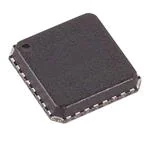



 工商网监
湘ICP备2023018690号
工商网监
湘ICP备2023018690号