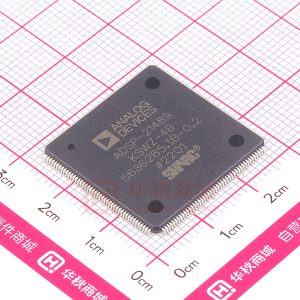
Mixed-Signal DSP Controller with CAN ADSP-21992
FEATURES
ADSP-2199x, 16-bit, fixed-point DSP core with up to 160 MIPS sustained performance 48K words of on-chip RAM, as 32K words on-chip 24-bit program RAM, and 16K words on-chip, 16-bit data RAM External memory interface Dedicated memory DMA controller for data/instruction transfer between internal/external memory Programmable PLL and flexible clock generation circuitry enables full-speed operation from low speed input clocks IEEE JTAG Standard 1149.1 test access port supports on-chip emulation and system debugging 8-channel, 14-bit analog-to-digital converter system, with up to 20 MSPS sampling rate (at 160 MHz core clock rate) 3-phase 16-bit center based PWM generation unit with 12.5 ns resolution at 160 MHz core clock (CCLK) rate Dedicated 32-bit encoder interface unit with companion encoder event timer
CLOCK GENERATOR/PLL
Dual 16-bit auxiliary PWM outputs 16 general-purpose flag I/O pins 3 programmable 32-bit interval timers SPI communications port with master or slave operation Synchronous serial communications port (SPORT) capable of software UART emulation Controller area network (CAN) module, fully compliant with V2.0B standard Integrated watchdog timer Dedicated peripheral interrupt controller with software priority control Multiple boot modes Precision 1.0 V voltage reference Integrated power-on-reset (POR) generator Flexible power management with selectable power-down and idle modes 2.5 V internal operation with 3.3 V I/O Operating temperature ranges of –40 C to +85 C and –40 C to +125 C
JTAG TEST AND EMULATION
ADSP-219x DSP CORE
32K 24 PM RAM
16K 16 DM RAM
4K 24 PM ROM
ADDRESS EXTERNAL MEMORY INTERFACE (EMI)
I/O BUS
DATA CONTROL
PM ADDRESS/DATA DM ADDRESS/DATA I/O REGISTERS SPI SPORT
CONTROLLER AREA NETWORK (CAN)
MEMORY DMA CONTROLLER
PWM GENERATION UNIT
ENCODER INTERFACE UNIT (AND EET)
TIMER 0 AUXILIARY PWM UNIT TIMER 1 TIMER 2 FLAG I/O WATCHDOG TIMER INTERRUPT CONTROLLER (ICNTL)
ADC CONTROL
PIPELINE FLASH ADC
POR
VREF
Figure 1. Functional Block Diagram Rev. A
Information furnished by Analog Devices is believed to be accurate and reliable. However, no responsibility is assumed by Analog Devices for its use, nor for any infringements of patents or other rights of third parties that may result from its use. Specifications subject to change without notice. No license is granted by implication or otherwise under any patent or patent rights of Analog Devices. Trademarks and registered trademarks are the property of their respective companies.
One Technology Way, P.O. Box 9106, Norwood, MA 02062-9106 U.S.A. Tel: 781.329.4700 www.analog.com Fax: 781.326.3113 ©2007 Analog Devices, Inc. All rights reserved.
�ADSP-21992
TABLE OF CONTENTS
General Description ................................................. 3 DSP Core Architecture ........................................... 3 Memory Architecture ............................................ 5 Bus Request and Bus Grant ..................................... 6 DMA Controller ................................................... 7 DSP Peripherals Architecture .................................. 7 Serial Peripheral Interface (SPI) Port ......................... 7 DSP Serial Port (SPORT) ........................................ 8 Controller Area Network (CAN) Module ................... 9 Analog-to-Digital Conversion System ........................ 9 Voltage Reference ................................................. 9 PWM Generation Unit ......................................... 10 Auxiliary PWM Generation Unit ............................ 10 Encoder Interface Unit ......................................... 10 Flag I/O (FIO) Peripheral Unit ............................... 11 Watchdog Timer ................................................ 11 General-Purpose Timers ....................................... 11 Interrupts ......................................................... 11 Peripheral Interrupt Controller .............................. 12 Low Power Operation .......................................... 12 Clock Signals ..................................................... 13 Reset and Power-On Reset (POR) ........................... 13 Power Supplies ................................................... 14 Booting Modes ................................................... 14 Instruction Set Description .................................... 14 Development Tools .............................................. 15 Designing an Emulator-Compatible DSP Board .......... 16 Additional Information ........................................ 16 Pin Function Descriptions ........................................ 17 Specifications ........................................................ 20 Operating Conditions ........................................... 20 Electrical Characteristics ....................................... 23 Absolute Maximum Ratings ................................... 30 ESD Caution ...................................................... 30 Timing Specifications ........................................... 30 Power Dissipation ............................................... 50 Test Conditions ..................................................... 51 Output Disable Time ............................................ 51 Output Enable Time ............................................ 51 Example System Hold Time Calculation ................... 51 Pin Configurations ................................................. 52 Outline Dimensions ................................................ 57 Ordering Guide ..................................................... 59
REVISION HISTORY
8/07—Rev. 0 to Rev. A Added RoHS part number to Ordering Guide ............... 59
Rev. A |
Page 2 of 60 |
August 2007
�ADSP-21992
GENERAL DESCRIPTION
The ADSP-21992 is a mixed-signal DSP controller based on the ADSP-2199x DSP core, suitable for a variety of high performance industrial motor control and signal processing applications that require the combination of a high performance DSP and the mixed-signal integration of embedded control peripherals, such as analog-to-digital conversion with communications interfaces such as CAN. Target applications include industrial motor drives, uninterruptible power supplies, optical networking control, data acquisition systems, test and measurement Systems, and portable instrumentation. The ADSP-21992 integrates the fixed-point ADSP-2199x family-based architecture with a serial port, an SPI-compatible port, a DMA controller, three programmable timers, general-purpose programmable flag pins, extensive interrupt capabilities, onchip program and data memory spaces, and a complete set of embedded control peripherals that permits fast motor control and signal processing in a highly integrated environment. The ADSP-21992 architecture is code compatible with previous ADSP-217x-based ADMCxxx products. Although the architectures are compatible, the ADSP-21992, with ADSP-2199x architecture, has a number of enhancements over earlier architectures. The enhancements to computational units, data address generators, and program sequencer make the ADSP-21992 more flexible and easier to program than the previous ADSP-21xx embedded DSPs. Indirect addressing options provide addressing flexibility—premodify with no update, pre- and post-modify by an immediate 8-bit, twos complement value and base address registers for easier implementation of circular buffering. The ADSP-21992 integrates 48K words of on-chip memory configured as 32K words (24-bit) of program RAM, and 16K words (16-bit) of data RAM. Fabricated in a high speed, low power, CMOS process, the ADSP-21992 operates with a 6.25 ns instruction cycle time for a 160 MHz CCLK, with a 6.67 ns instruction cycle time for a 150 MHz CCLK, and with a 10.0 ns instruction cycle time for a 100 MHz CCLK. All instructions, except two multiword instructions, execute in a single DSP cycle. The flexible architecture and comprehensive instruction set of the ADSP-21992 support multiple operations in parallel. For example, in one processor cycle, the ADSP-21992 can: • Generate an address for the next instruction fetch. • Fetch the next instruction. • Perform one or two data moves. • Update one or two data address pointers. • Perform a computational operation. These operations take place while the processor continues to: • Receive and transmit data through the serial port. • Receive or transmit data over the SPI port. • Access external memory through the external memory interface.
Rev. A | Page 3 of 60 |
• Decrement the timers. • Operate the embedded control peripherals (ADC, PWM, EIU, etc.).
DSP CORE ARCHITECTURE
• 6.25 ns instruction cycle time (internal), for up to 160 MIPS sustained performance (6.67 ns instruction cycle time for 150 MIPS sustained performance and 10.0 ns instruction cycle time for 100 MIPS sustained performance). • ADSP-218x family code compatible with the same easy to use algebraic syntax. • Single cycle instruction execution. • Up to 1M words of addressable memory space with 24 bits of addressing width. • Dual-purpose program memory for both instruction and data storage. • Fully transparent instruction cache allows dual operand fetches in every instruction cycle. • Unified memory space permits flexible address generation, using two independent DAG units. • Independent ALU, multiplier/accumulator, and barrel shifter computational units with dual 40-bit accumulators. • Single cycle context switch between two sets of computational and DAG registers. • Parallel execution of computation and memory instructions. • Pipelined architecture supports efficient code execution at speeds up to 160 MIPS. • Register file computations with all nonconditional, nonparallel computational instructions. • Powerful program sequencer provides zero overhead looping and conditional instruction execution. • Architectural enhancements for compiled C code efficiency. • Architecture enhancements beyond ADSP-218x family are supported with instruction set extensions for added registers, ports, and peripherals. The clock generator module of the ADSP-21992 includes clock control logic that allows the user to select and change the main clock frequency. The module generates two output clocks: the DSP core clock, CCLK; and the peripheral clock, HCLK. CCLK can sustain clock values of up to 160 MHz, while HCLK can be equal to CCLK or CCLK/2 for values up to a maximum 80 MHz peripheral clock at the 160 MHz CCLK rate. The ADSP-21992 instruction set provides flexible data moves and multifunction (one or two data moves with a computation) instructions. Every single word instruction can be executed in a single processor cycle. The ADSP-21992 assembly language uses
August 2007
�ADSP-21992
INTERNAL MEMORY FOUR INDEPENDENT BLOCKS DATA ADDRESS 24 BIT DATA ADDRESS 24 BIT ADDRESS 16 BIT DATA DATA ADDRESS 16 BIT
BLOCK0 BLOCK1
BLOCK3
ADSP-219x DSP CORE CACHE 64 24-BIT DAG1 DAG2 4 16 4 4 16 PROGRAM SEQUENCER
BLOCK2
JTAG TEST AND EMULATION
6
4
EXTERNAL PORT I/O ADDRESS 18 ADDR BUS MUX
PM ADDRESS BUS 24 DM ADDRESS BUS 24 DMA CONNECT PX PM DATA BUS DATA REGISTER FILE 24 DM DATA BUS 16 I/O DATA INPUT REGISTERS RESULT REGISTERS 16 16-BIT 16 I/O REGISTERS (MEMORY-MAPPED) BARREL SHIFTER ALU CONTROL STATUS BUFFERS DMA CONTROLLER SYSTEM INTERRUPT CONTROLLER PROGRAMMABLE FLAGS (16) TIMERS (3) 3 I/O PROCESSOR EMBEDDED CONTROL PERIPHERALS AND COMMUNICATIONS PORTS DMA ADDRESS 24 DMA DATA 24 DATA BUS MUX 16
20
MULT
Figure 2. Block Diagram
an algebraic syntax for ease of coding and readability. A comprehensive set of development tools supports program development. The block diagram (Figure 2) shows the architecture of the embedded SHARC core. It contains three independent computational units: the ALU, the multiplier/accumulator (MAC), and the shifter. The computational units process 16-bit data from the register file and have provisions to support multiprecision computations. The ALU performs a standard set of arithmetic and logic operations; division primitives are also supported. The MAC performs single cycle multiply, multiply/add, and multiply/subtract operations. The MAC has two 40-bit accumulators, which help with overflow. The shifter performs logical and arithmetic shifts, normalization, denormalization, and derive exponent operations. The shifter can be used to efficiently implement numeric format control, including multiword and block floating-point representations. Register usage rules influence placement of input and results within the computational units. For most operations, the data registers of the computational units act as a data register file, permitting any input or result register to provide input to any unit for a computation. For feedback operations, the computational units let the output (result) of any unit be input to any unit on the next cycle. For conditional or multifunction instructions, there are restrictions on which data registers may provide inputs or receive results from each computational unit. For more information, see the ADSP-2199x DSP Instruction Set Reference.
A powerful program sequencer controls the flow of instruction execution. The sequencer supports conditional jumps, subroutine calls, and low interrupt overhead. With internal loop counters and loop stacks, the ADSP-21992 executes looped code with zero overhead; no explicit jump instructions are required to maintain loops. Two data address generators (DAGs) provide addresses for simultaneous dual operand fetches (from data memory and program memory). Each DAG maintains and updates four 16-bit address pointers. Whenever the pointer is used to access data (indirect addressing), it is pre- or post-modified by the value of one of four possible modify registers. A length value and base address may be associated with each pointer to implement automatic modulo addressing for circular buffers. Page registers in the DAGs allow circular addressing within 64K word boundaries of each of the 256 memory pages, but these buffers may not cross page boundaries. Secondary registers duplicate all the primary registers in the DAGs; switching between primary and secondary registers provides a fast context switch. Efficient data transfer in the core is achieved with the use of internal buses: • Program memory address (PMA) bus • Program memory data (PMD) bus • Data memory address (DMA) bus • Data memory data (DMD) bus • Direct memory access address bus • Direct memory access data bus
Rev. A |
Page 4 of 60 |
August 2007
�ADSP-21992
The two address buses (PMA and DMA) share a single external address bus, allowing memory to be expanded off-chip, and the two data buses (PMD and DMD) share a single external data bus. Boot memory space and I/O memory space also share the external buses. Program memory can store both instructions and data, permitting the ADSP-21992 to fetch two operands in a single cycle, one from program memory and one from data memory. The DSP dual memory buses also let the embedded SHARC core fetch an operand from data memory and the next instruction from program memory in a single cycle.
0x00 0000 0x00 3FFF 0x00 4000 0x00 7FFF 0x00 8000 0x00 BFFF 0x00 C000 0x00 FFFF 0x01 0000
BLOCK 0: 16K BLOCK 1: 16K BLOCK 2: 16K
24-BIT PM RAM 24-BIT PM RAM 16-BIT DM RAM PAGE 0 (64K) ON-CHIP (0 WAIT STATE)
RESERVED (16K) EXTERNAL MEMORY (4M–64K)
0x40 0000
PAGES 1 TO 63 BANK 0 (OFF-CHIP) MS0 PAGES 64 TO 127 BANK 1 (OFF-CHIP) MS1 PAGES 128 TO 191 BANK 2 (OFF-CHIP) MS2 PAGES 192 TO 254 BANK 3 (OFF-CHIP) MS3
MEMORY ARCHITECTURE
The ADSP-21992 provides 48K words of on-chip SRAM memory. This memory is divided into three blocks: two 16K × 24-bit blocks (Blocks 0 and 1) and one 16K × 16-bit block (Block 2). In addition, the ADSP-21992 provides a 4K × 24-bit block of program memory boot ROM (that is reserved by ADI for boot load routines). The memory map of the ADSP-21992 is illustrated in Figure 2. As shown in Figure 2, the three internal memory RAM blocks reside in memory page 0. The entire DSP memory map consists of 256 pages (Pages 0 to 255), and each page is 64K words long. External memory space consists of four memory banks (Banks3–0) and supports a wide variety of memory devices. Each bank is selectable using unique memory select lines (MS3–0) and has configurable page boundaries, wait states, and wait state modes. The 4K words of on-chip boot ROM populates the top of Page 255, while the remaining 254 pages are addressable off-chip. I/O memory pages differ from external memory in that they are 1K word long, and the external I/O pages have their own select pin (IOMS). Pages 31–0 of I/O memory space reside on-chip and contain the configuration registers for the peripherals. Both the ADSP-2199x core and DMA capable peripherals can access the entire memory map of the DSP. NOTE: The physical external memory addresses are limited by 20 address lines, and are determined by the external data width and packing of the external memory space. The Strobe signals (MS3-0) can be programmed to allow the user to change starting page addresses at runtime.
EXTERNAL MEMORY (4M)
0x80 0000
EXTERNAL MEMORY (4M)
0xC0 0000
EXTERNAL MEMORY (4M–64K)
0xFF 0000 0xFF 0FFF 0xFF 1000 0xFF FFFF
BLOCK 3: 4K 24-BIT PM ROM UNUSED ON-CHIP MEMORY (60K)
PAGE 255 (INCLUDES ON-CHIP BOOT ROM)
Figure 3. Core Memory Map at Reset
Internal (On-Chip) Memory
The unified program and data memory space of the ADSP-21992 consists of 16M locations that are accessible through two 24-bit address buses, the PMA, and DMA buses. The DSP uses slightly different mechanisms to generate a 24-bit address for each bus. The DSP has three functions that support access to the full memory map. • The DAGs generate 24-bit addresses for data fetches from the entire DSP memory address range. Because DAG index (address) registers are 16 bits wide and hold the lower 16 bits of the address, each of the DAGs has its own 8-bit page register (DMPGx) to hold the most significant eight address bits. Before a DAG generates an address, the program must set the DAG DMPGx register to the appropriate memory page. The DMPG1 register is also used as a page register when accessing external memory. The program must set DMPG1 accordingly, when accessing data variables in external memory. A “C” program macro is provided for setting this register. • The program sequencer generates the addresses for instruction fetches. For relative addressing instructions, the program sequencer bases addresses for relative jumps, calls, and loops on the 24-bit program counter (PC). In direct addressing instructions (two word instructions), the instruction provides an immediate 24-bit address value. The PC allows linear addressing of the full 24-bit address range. • For indirect jumps and calls that use a 16-bit DAG address register for part of the branch address, the program sequencer relies on an 8-bit indirect jump page (IJPG)
Rev. A |
Page 5 of 60 |
August 2007
�ADSP-21992
register to supply the most significant eight address bits. Before a cross page jump or call, the program must set the program sequencer IJPG register to the appropriate memory page. The ADSP-21992 has 4K words of on-chip ROM that holds boot routines. The DSP starts executing instructions from the on-chip boot ROM, which starts the boot process. For more information, see Booting Modes on Page 14. The on-chip boot ROM is located on Page 255 in the DSP memory space map, starting at address 0xFF0000. 255) are available for external peripheral devices. External I/O pages have their own select pin (IOMS). The DSP instruction set provides instructions for accessing I/O space.
0x00::0x000 ON-CHIP PERIPHERALS 16-BITS 0x1F::0x3FF 0x20::0x000 PAGES 0 TO 31 1024 WORDS/PAGE 2 PERIPHERALS/PAGE
External (Off-Chip) Memory
Each of the off-chip memory spaces of the ADSP-21992 has a separate control register, so applications can configure unique access parameters for each space. The access parameters include read and write wait counts, wait state completion mode, I/O clock divide ratio, write hold time extension, strobe polarity, and data bus width. The core clock and peripheral clock ratios influence the external memory access strobe widths. For more information, see Clock Signals on Page 13. The off-chip memory spaces are: • External memory space (MS3–0 pins) • I/O memory space (IOMS pin) • Boot memory space (BMS pin) All of these off-chip memory spaces are accessible through the external port, which can be configured for 8-bit or 16-bit data widths.
OFF-CHIP PERIPHERALS 16-BITS PAGES 32 TO 255 1024 WORDS/PAGE
0xFF::0x3FF
Figure 4. I/O Memory Map
Boot Memory Space
Boot memory space consists of one off-chip bank with 254 pages. The BMS memory bank pin selects boot memory space. Both the ADSP-2199x core and DMA capable peripherals can access the DSP off-chip boot memory space. After reset, the DSP always starts executing instructions from the on-chip boot ROM.
External Memory Space
External memory space consists of four memory banks. These banks can contain a configurable number of 64K word pages. At reset, the page boundaries for external memory have Bank0 containing pages 1 to 63, Bank1 containing pages 64 to 127, Bank2 containing pages 128 to 191, and Bank3 containing pages 192 to 254. The MS3-0 memory bank pins select Banks 3-0, respectively. Both the ADSP-2199x core and DMA capable peripherals can access the DSP external memory space. All accesses to external memory are managed by the external memory interface unit (EMI).
0x01 0000
OFF-CHIP BOOT MEMORY 16-BITS PAGES 1 TO 254 64K WORDS/PAGE
0xFE 0000
Figure 5. Boot Memory Map
I/O Memory Space
The ADSP-21992 supports an additional external memory called I/O memory space. The I/O space consists of 256 pages, each containing 1024 addresses. This space is designed to support simple connections to peripherals (such as data converters and external registers) or to bus interface ASIC data registers. The first 32K addresses (I/O pages 0 to 31) are reserved for onchip peripherals. The upper 224K addresses (I/O pages 32 to
BUS REQUEST AND BUS GRANT
The ADSP-21992 can relinquish control of the data and address buses to an external device. When the external device requires access to the bus, it asserts the bus request (BR) signal. The (BR) signal is arbitrated with core and peripheral requests. External bus requests have the lowest priority. If no other internal request is pending, the external bus request will be granted. Due to synchronizer and arbitration delays, bus grants will be provided with a minimum of three peripheral clock delays. The ADSP-21992 will respond to the bus grant by: • Three-stating the data and address buses and the MS3–0, BMS, IOMS, RD, and WR output drivers. • Asserting the bus grant (BG) signal.
Rev. A |
Page 6 of 60 |
August 2007
�ADSP-21992
The ADSP-21992 will halt program execution if the bus is granted to an external device and an instruction fetch or data read/write request is made to external general-purpose or peripheral memory spaces. If an instruction requires two external memory read accesses, the bus will not be granted between the two accesses. If an instruction requires an external memory read and an external memory write access, the bus may be granted between the two accesses. The external memory interface can be configured so that the core will have exclusive use of the interface. DMA and bus requests will be granted. When the external device releases BR, the DSP releases BG and continues program execution from the point at which it stopped. The bus request feature operates at all times, even while the DSP is booting and RESET is active. The ADSP-21992 asserts the BGH pin when it is ready to start another external port access, but is held off because the bus was previously granted. This mechanism can be extended to define more complex arbitration protocols for implementing more elaborate multimaster systems.
DSP PERIPHERALS ARCHITECTURE
The ADSP-21992 contains a number of special purpose, embedded control peripherals, which can be seen in the functional block diagram on Page 1. The ADSP-21992 contains a high performance, 8-channel, 14-bit ADC system with dual-channel simultaneous sampling ability across four pairs of inputs. An internal precision voltage reference is also available as part of the ADC system. In addition, a 3-phase, 16-bit, center-based PWM generation unit can be used to produce high accuracy PWM signals with minimal processor overhead. The ADSP-21992 also contains a flexible incremental encoder interface unit for position sensor feedback; two adjustable frequency auxiliary PWM outputs, 16 lines of digital I/O; a 16-bit watchdog timer; three general-purpose timers, and an interrupt controller that manages all peripheral interrupts. Finally, the ADSP-21992 contains an integrated power-on-reset (POR) circuit that can be used to generate the required reset signal for device power-on. The ADSP-21992 has an external memory interface that is shared by the DSP core, the DMA controller, and DMA capable peripherals, which include the ADC, SPORT, and SPI communication ports. The external port consists of a 16-bit data bus, a 20-bit address bus, and control signals. The data bus is configurable to provide an 8- or 16-bit interface to external memory. Support for word packing lets the DSP access 16- or 24-bit words from external memory regardless of the external data bus width. The memory DMA controller lets the ADSP-21992 move data and instructions from between memory spaces: internal-toexternal, internal-to-internal, and external-to-external. On-chip peripherals can also use this controller for DMA transfers. The embedded SHARC core can respond to up to 17 interrupts at any given time: three internal (stack, emulator kernel, and power-down), two external (emulator and reset), and 12 userdefined (peripherals) interrupts. Programmers assign each of the 32 peripheral interrupt requests to one of the 12 userdefined interrupts. These assignments determine the priority of each peripheral for interrupt service. The following sections provide a functional overview of the ADSP-21992 peripherals.
DMA CONTROLLER
The ADSP-21992 has a DMA controller that supports automated data transfers with minimal overhead for the DSP core. Cycle stealing DMA transfers can occur between the ADSP-21992 internal memory and any of its DMA capable peripherals. Additionally, DMA transfers can be accomplished between any of the DMA capable peripherals and external devices connected to the external memory interface. DMA capable peripherals include the SPORT and SPI ports, and ADC control module. Each individual DMA capable peripheral has a dedicated DMA channel. To describe each DMA sequence, the DMA controller uses a set of parameters—called a DMA descriptor. When successive DMA sequences are needed, these DMA descriptors can be linked or chained together, so the completion of one DMA sequence autoinitiates and starts the next sequence. DMA sequences do not contend for bus access with the DSP core, instead DMAs “steal” cycles to access memory. All DMA transfers use the DMA bus shown in Figure 2 on Page 4. Because all of the peripherals use the same bus, arbitration for DMA bus access is needed. The arbitration for DMA bus access appears in Table 1. Table 1. I/O Bus Arbitration Priority
DMA Bus Master SPORT Receive DMA SPORT Transmit DMA ADC Control DMA SPI Receive/Transmit DMA Memory DMA Arbitration Priority 0—Highest 1 2 3 4—Lowest
SERIAL PERIPHERAL INTERFACE (SPI) PORT
The serial peripheral interface (SPI) port provides functionality for a generic configurable serial port interface based on the SPI standard, which enables the DSP to communicate with multiple SPI-compatible devices. Key features of the SPI port are: • Interface to host microcontroller or serial EEPROM. • Master or slave operation (3-wire interface MISO, MOSI, SCK). • Data rates to HCLK • 8- or 16-bit transfer. • Programmable clock phase and polarity. • Broadcast Mode–1 master, multiple slaves. • DMA capability and dedicated interrupts.
Rev. A | Page 7 of 60 | August 2007
4 (16-bit baud rate selector).
�ADSP-21992
• PF0 can be used as slave select input line. • PF1–PF7 can be used as external slave select output. SPI is a 3-wire interface consisting of 2 data pins (MOSI and MISO), one clock pin (SCK), and a single slave select input (SPISS) that is multiplexed with the PF0 Flag I/O line and seven slave select outputs (SPISEL1 to SPISEL7) that are multiplexed with the PF1 to PF7 flag I/O lines. The SPISS input is used to select the ADSP-21992 as a slave to an external master. The SPISEL1 to SPISEL7 outputs can be used by the ADSP-21992 (acting as a master) to select/enable up to seven external slaves in a multidevice SPI configuration. In a multimaster or a multidevice configuration, all MOSI pins are tied together, all MISO pins are tied together, and all SCK pins are tied together. During transfers, the SPI port simultaneously transmits and receives by serially shifting data in and out on the serial data line. The serial clock line synchronizes the shifting and sampling of data on the serial data line. In master mode, the DSP core performs the following sequence to set up and initiate SPI transfers: • Enables and configures the SPI port operation (data size and transfer format). • Selects the target SPI slave with the SPISELx output pin (reconfigured programmable flag pin). • Defines one or more DMA descriptors in Page 0 of I/O memory space (optional in DMA mode only). • Enables the SPI DMA engine and specifies transfer direction (optional in DMA mode only). • In nonDMA mode only, reads or writes the SPI port receive or transmit data buffer. The SCK line generates the programmed clock pulses for simultaneously shifting data out on MOSI and shifting data in on MISO. In DMA mode only, transfers continue until the SPI DMA word count transitions from 1 to 0. In slave mode, the DSP core performs the following sequence to set up the SPI port to receive data from a master transmitter: • Enables and configures the SPI slave port to match the operation parameters set up on the master (data size and transfer format) SPI transmitter. • Defines and generates a receive DMA descriptor in Page 0 of memory space to interrupt at the end of the data transfer (optional in DMA mode only). • Enables the SPI DMA engine for a receive access (optional in DMA mode only). • Starts receiving the data on the appropriate SCK edges after receiving an SPI chip select on the SPISS input pin (reconfigured programmable flag pin) from a master. In DMA mode only, reception continues until the SPI DMA word count transitions from 1 to 0. The DSP core could continue, by queuing up the next DMA descriptor. The slave mode transmit operation is similar, except the DSP core specifies the data buffer in memory space, generates and relinquishes control of the transmit DMA descriptor, and begins filling the SPI port data buffer. If the SPI controller is not ready on time to transmit, it can transmit a “zero” word.
DSP SERIAL PORT (SPORT)
The ADSP-21992 incorporates a complete synchronous serial port (SPORT) for serial and multiprocessor communications. The SPORT supports the following features: • Bidirectional: The SPORT has independent transmit and receive sections. • Double buffered: The SPORT section (both receive and transmit) has a data register for transferring data words to and from other parts of the processor and a register for shifting data in or out. The double buffering provides additional time to service the SPORT. • Clocking: The SPORT can use an external serial clock or generate its own in a wide range of frequencies down to 0 Hz. • Word length: Each SPORT section supports serial data word lengths from three to 16 bits that can be transferred either MSB first or LSB first. • Framing: Each SPORT section (receive and transmit) can operate with or without frame synchronization signals for each data-word; with internally generated or externally generated frame signals; with active high or active low frame signals; with either of two pulse widths and frame signal timing. • Companding in hardware: Each SPORT section can perform A law and μ law companding according to CCITT recommendation G.711. • Direct memory access with single cycle overhead: Using the built-in DMA master, the SPORT can automatically receive and/or transmit multiple memory buffers of data with an overhead of only one DSP cycle per data-word. The onchip DSP, via a linked list of memory space resident DMA descriptor blocks, can configure transfers between the SPORT and memory space. This chained list can be dynamically allocated and updated. • Interrupts: Each SPORT section (receive and transmit) generates an interrupt upon completing a data-word transfer, or after transferring an entire buffer or buffers if DMA is used. • Multichannel capability: The SPORT can receive and transmit data selectively from channels of a serial bit stream that is time division multiplexed into up to 128 channels. This is especially useful for T1 interfaces or as a network communication scheme for multiple processors. The SPORTs also support T1 and E1 carrier systems. • DMA Buffer: Each SPORT channel (Tx and Rx) supports a DMA buffer of up to eight 16-bit transfers.
Rev. A |
Page 8 of 60 |
August 2007
�ADSP-21992
• SPORT operates at a frequency of up to one-half the clock frequency of the HCLK. • SPORT: Capable of UART software emulation. ADSP-21992 CAN module represents only the controller part of the interface. The network I/O of this module is a single transmit line and a single receive line, which communicate to a line transceiver.
CONTROLLER AREA NETWORK (CAN) MODULE
The ADSP-21992 contains a controller area network (CAN) module. Key features of the CAN module are: • Conforms to the CAN V2.0B standard. • Supports both standard (11-bit) and extended (29-bit) identifiers. Supports data rates of up to 1 Mbps (and higher). • 16 configurable mailboxes (all receive or transmit). • Dedicated acceptance mask for each mailbox. • Data filtering (first 2 bytes) which can be used for acceptance filtering. • Error status and warning registers. • Transmit priority by identifier. • Universal counter module. • Readable receive and transmit counters. The CAN module is a low baud rate serial interface intended for use in applications where baud rates are typically under 1 Mbps. The CAN protocol incorporates a data CRC check, message error tracking and fault node confinement as means to improve network reliability to the level required for control applications. The CAN module architecture is based around a 16-entry mailbox RAM. The mailbox is accessed sequentially by the CAN serial interface or the host CPU. Each mailbox consists of eight 16-bit data words. The data is divided into fields, which includes a message identifier, a time stamp, a byte count, up to 8 bytes of data, and several control bits. Each node monitors the messages being passed on the network. If the identifier in the transmitted message matches an identifier in one of its mailboxes, then the module knows that the message was meant for it, passes the data into its appropriate mailbox, and signals the host of its arrival with an interrupt. The CAN network itself is a single, differential pair line. All nodes continuously monitor this line. There is no clock wire. Messages are passed in one of four standard message types or frames. Synchronization is achieved by an elaborate sync scheme performed in each CAN receiver. Message arbitration is accomplished one bit at a time. A dominant polarity is established for the network. All nodes are allowed to start transmitting at the same time following a frame sync pulse. As each node transmits a bit, it checks to see if the bus is the same state that it transmitted. If it is, it continues to transmit. If not, then another node has transmitted a dominant bit so the first node knows it has lost the arbitration and it stops transmitting. The arbitration continues, bit by bit until only one node is left transmitting. The electrical characteristics of each network connection are very stringent so the CAN interface is typically divided into two parts: a controller and a transceiver. This allows a single controller to support different drivers and CAN networks. The
Rev. A | Page 9 of 60 |
ANALOG-TO-DIGITAL CONVERSION SYSTEM
The ADSP-21992 contains a fast, high accuracy, multiple input analog-to-digital conversion system with simultaneous sampling capabilities. This analog-to-digital conversion system permits the fast, accurate conversion of analog signals needed in high performance embedded systems. Key features of the ADC system are: • 14-bit pipeline (6-stage pipeline) flash analog-to-digital converter. • 8 dedicated analog inputs. • Dual-channel simultaneous sampling capability. • Programmable ADC clock rate to maximum of HCLK • First channel ADC data valid approximately 375 ns after CONVST (at 20 MSPS). • All 8 inputs converted in approximately 725 ns (at 20 MSPS). • 2.0 V peak-to-peak input voltage range. • Multiple convert start sources. • Internal or external voltage reference. • Out of range detection. • DMA capable transfers from ADC to memory. The ADC system is based on a pipeline flash converter core, and contains dual input sample-and-hold amplifiers so that simultaneous sampling of two input signals is supported. The ADC system provides an analog input voltage range of 2.0 V p-p and provides 14-bit performance with a clock rate of up to HCLK 4. The ADC system can be programmed to operate at a clock rate from HCLK⁄4 to HCLK⁄30, to a maximum clock rate of 20 MHz (at 160 MHz CCLK rate). The ADC input structure supports eight independent analog inputs; four of which are multiplexed into one sample-and-hold amplifier (A_SHA) and four of which are multiplexed into the other sample-and-hold amplifier (B_SHA). At the 20 MHz sampling rate, the first data value is valid approximately 375 ns after the convert start command. All eight channels are converted in approximately 725 ns. The core of the ADSP-21992 provides 14-bit data such that the stored data values in the ADC data registers are 14 bits wide. 4.
VOLTAGE REFERENCE
The ADSP-21992 contains an on-board band gap reference that can be used to provide a precise 1.0 V output for use by the analog-to-digital system and externally on the VREF pin for biasing and level shifting functions. Additionally, the ADSP21992 may be configured to operate with an external reference applied to the VREF pin, if required.
August 2007
�ADSP-21992
PWM GENERATION UNIT
Key features of the 3-phase PWM generation unit are: • 16-bit, center-based PWM generation unit. • Programmable PWM pulse width, with resolutions to 12.5 ns (at 80 MHz HCLK Rate). • Single/double update modes • Programmable dead time and switching frequency. • Twos complement implementation which permits smooth transition into full ON and full OFF states. • Possibility to synchronize the PWM generation to an external synchronization. • Special provisions for BDCM operation (crossover and output enable functions). • Wide variety of special switched reluctance (SR) operating modes. • Output polarity and clock gating control. • Dedicated asynchronous PWM shutdown signal. • Multiple shutdown sources, independently for each unit. The ADSP-21992 integrates a flexible and programmable, 3phase PWM waveform generator that can be programmed to generate the required switching patterns to drive a 3-phase voltage source inverter for ac induction (ACIM) or permanent magnet synchronous (PMSM) motor control. In addition, the PWM block contains special functions that considerably simplify the generation of the required PWM switching patterns for control of the electronically commutated motor (ECM) or brushless dc motor (BDCM). Tying a dedicated pin, PWMSR, to GND, enables a special mode, for switched reluctance motors (SRM). The six PWM output signals consist of three high side drive pins (AH, BH, and CH) and three low side drive signals pins (AL, BL, and CL). The polarity of the generated PWM signals may be set via hardware by the PWMPOL input pin, so that either active HI or active LO PWM patterns can be produced. The switching frequency of the generated PWM patterns is programmable using the 16-bit PWMTM register. The PWM generator is capable of operating in two distinct modes, single update mode or double update mode. In single update mode the duty cycle values are programmable only once per PWM period, so that the resultant PWM patterns are symmetrical about the midpoint of the PWM period. In the double update mode, a second updating of the PWM registers is implemented at the midpoint of the PWM period. In this mode, it is possible to produce asymmetrical PWM patterns that produce lower harmonic distortion in 3-phase PWM inverters. • Separate auxiliary PWM synchronization signal and associated interrupt (can be used to trigger ADC convert start). • Separate auxiliary PWM shutdown signal (AUXTRIP). The ADSP-21992 integrates a 2-channel, 16-bit, auxiliary PWM output unit that can be programmed with variable frequency, variable duty cycle values and may operate in two different modes, independent mode or offset mode. In independent mode, the two auxiliary PWM generators are completely independent and separate switching frequencies and duty cycles may be programmed for each auxiliary PWM output. In offset mode the switching frequency of the two signals on the AUX0 and AUX1 pins is identical. Bit 4 of the AUXCTRL register places the auxiliary PWM channel pair in independent or offset mode. The auxiliary PWM generation unit provides two chip output pins, AUX0 and AUX1 (on which the switching signals appear), and one chip input pin, AUXTRIP, which can be used to shut down the switching signals—for example, in a fault condition.
ENCODER INTERFACE UNIT
The ADSP-21992 incorporates a powerful encoder interface block to incremental shaft encoders that are often used for position feedback in high performance motion control systems. • Quadrature rates to 53 MHz (at 80 MHz HCLK rate). • Programmable filtering of all encoder input signals. • 32-bit encoder counter. • Variety of hardware and software reset modes. • Two registration inputs to latch EIU count value with corresponding registration interrupt. • Status of A/B signals latched with reading of EIU count value. • Alternative frequency and direction mode. • Single north marker mode. • Count error monitor function with dedicated error interrupt. • Dedicated 16-bit loop timer with dedicated interrupt. • Companion encoder event (1⁄T) timer unit. The encoder interface unit (EIU) includes a 32-bit quadrature up-/downconverter, programmable input noise filtering of the encoder input signals and the zero markers, and has four dedicated chip pins. The quadrature encoder signals are applied at the EIA and EIB pins. Alternatively, a frequency and direction set of inputs may be applied to the EIA and EIB pins. In addition, two north marker/strobe inputs are provided on pins EIZ and EIS. These inputs may be used to latch the contents of the encoder quadrature counter into dedicated registers, EIZLATCH and EISLATCH, on the occurrence of external events at the EIZ and EIS pins. These events may be programmed to be either rising edge only (latch event) or rising edge if the encoder is moving in the forward direction and falling edge if the encoder is moving in the reverse direction (software latched north marker functionality).
AUXILIARY PWM GENERATION UNIT
Key features of the auxiliary PWM generation unit are: • 16-bit, programmable frequency, programmable duty cycle PWM outputs. • Independent or offset operating modes. • Double buffered control of duty cycle and period registers.
Rev. A |
Page 10 of 60 |
August 2007
�ADSP-21992
The encoder interface unit incorporates programmable noise filtering on the four encoder inputs to prevent spurious noise pulses from adversely affecting the operation of the quadrature counter. The encoder interface unit operates at a clock frequency equal to the HCLK rate. The encoder interface unit operates correctly with encoder signals at frequencies of up to 13.25 MHz, at the 80 MHz HCLK rate, corresponding to a maximum quadrature frequency of 53 MHz (assuming an ideal quadrature relationship between the input EIA and EIB signals). The EIU may be programmed to use the north marker on EIZ to reset the quadrature encoder in hardware, if required. Alternatively, the north marker can be ignored, and the encoder quadrature counter is reset according to the contents of a maximum count register, EIUMAXCNT. There is also a “single north marker” mode available in which the encoder quadrature counter is reset only on the first north marker pulse. The encoder interface unit can also be made to implement some error checking functions. If an encoder count error is detected (due to a disconnected encoder line, for example), a status bit in the EIUSTAT register is set, and an EIU count error interrupt is generated. The encoder interface unit of the ADSP-21992 contains a 16-bit loop timer that consists of a timer register, period register, and scale register so that it can be programmed to time out and reload at appropriate intervals. When this loop timer times out, an EIU loop timer timeout interrupt is generated. This interrupt could be used to control the timing of speed and position control loops in high performance drives. The encoder interface unit also includes a high performance encoder event timer (EET) block that permits the accurate timing of successive events of the encoder inputs. The EET can be programmed to time the duration between up to 255 encoder pulses and can be used to enhance velocity estimation, particularly at low speeds of rotation.
WATCHDOG TIMER
The ADSP-21992 integrates a watchdog timer that can be used as a protection mechanism against unintentional software events. It can be used to cause a complete DSP and peripheral reset in such an event. The watchdog timer consists of a 16-bit timer that is clocked at the external clock rate (CLKIN or crystal input frequency). In order to prevent an unwanted timeout or reset, it is necessary to periodically write to the watchdog timer register. During abnormal system operation, the watchdog count will eventually decrement to 0 and a watchdog timeout will occur. In the system, the watchdog timeout will cause a full reset of the DSP core and peripherals.
GENERAL-PURPOSE TIMERS
The ADSP-21992 contains a general-purpose timer unit that contains three identical 32-bit timers. The three programmable interval timers (Timer0, Timer1, and Timer2) generate periodic interrupts. Each timer can be independently set to operate in one of three modes: • Pulse waveform generation (PWM_OUT) mode. • Pulse width count/capture (WDTH_CAP) mode. • External event watchdog (EXT_CLK) mode. Each Timer has one bidirectional chip pin, TMR2-TMR0. For each timer, the associated pin is configured as an output pin in PWM_OUT mode and as an input pin in WDTH_CAP and EXT_CLK modes.
INTERRUPTS
The interrupt controller lets the DSP respond to 17 interrupts with minimum overhead. The DSP core implements an interrupt priority scheme as shown in Table 2. Applications can use the unassigned slots for software and peripheral interrupts. The peripheral interrupt controller is used to assign the various peripheral interrupts to the 12 user assignable interrupts of the DSP core. Table 2. Interrupt Priorities/Addresses
IMASK/ IRPTL NA
FLAG I/O (FIO) PERIPHERAL UNIT
The FIO module is a generic parallel I/O interface that supports 16 bidirectional multifunction flags or general-purpose digital I/O signals (PF15–PF0). All 16 FLAG bits can be individually configured as an input or output based on the content of the direction (DIR) register, and can also be used as an interrupt source for one of two FIO interrupts. When configured as input, the input signal can be programmed to set the FLAG on either a level (level sensitive input/interrupt) or an edge (edge sensitive input/interrupt). The FIO module can also be used to generate an asynchronous unregistered wake-up signal FIO_WAKEUP for DSP core wake up after power-down. The FIO lines, PF7–PF1 can also be configured as external slave select outputs for the SPI communications port, while PF0 can be configured to act as a slave select input. The FIO lines can be configured to act as a PWM shutdown source for the 3-phase PWM generation unit of the ADSP-21992.
Interrupt Emulator (NMI) —Highest Priority Reset (NMI) Power-Down (NMI) Loop and PC Stack Emulation Kernel User Assigned Interrupt (USR0)
Vector Address NA
0 1 2 3 4
0x00 0000 0x00 0020 0x00 0040 0x00 0060 0x00 0080
Rev. A |
Page 11 of 60 |
August 2007
�ADSP-21992
Table 2. Interrupt Priorities/Addresses (Continued)
IMASK/ IRPTL 5
Interrupt User Assigned Interrupt (USR1) User Assigned Interrupt (USR2) User Assigned Interrupt (USR3) User Assigned Interrupt (USR4) User Assigned Interrupt (USR5) User Assigned Interrupt (USR6) User Assigned Interrupt (USR7) User Assigned Interrupt (USR8) User Assigned Interrupt (USR9) User Assigned Interrupt (USR10) User Assigned Interrupt (USR11) —Lowest Priority
Vector Address 0x00 00A0
loop stack is eight levels deep, and the status stack is 16 levels deep. To prevent stack overflow, the PC stack can generate a stack level interrupt if the PC stack falls below three locations full or rises above 28 locations full. The following instructions globally enable or disable interrupt servicing, regardless of the state of IMASK. • Ena Int • Dis Int At reset, interrupt servicing is disabled. For quick servicing of interrupts, a secondary set of DAG and computational registers exist. Switching between the primary and secondary registers lets programs quickly service interrupts, while preserving the state of the DSP.
6
0x00 00C0
7
0x00 00E0
8
0x00 0100
PERIPHERAL INTERRUPT CONTROLLER
9 0x00 0120
10
0x00 0140
The peripheral interrupt controller is a dedicated peripheral unit of the ADSP-21992 (accessed via I/O mapped registers). The peripheral interrupt controller manages the connection of up to 32 peripheral interrupt requests to the DSP core. For each peripheral interrupt source, there is a unique 4-bit code that allows the user to assign the particular peripheral interrupt to any one of the 12 user assignable interrupts of the embedded ADSP-2199x core. Therefore, the peripheral interrupt controller of the ADSP-21992 contains eight 16-bit interrupt priority registers (Interrupt Priority Register 0 (IPR0) to Interrupt Priority Register 7 (IPR7)). Each interrupt priority register contains four 4-bit codes; one specifically assigned to each peripheral interrupt. The user may write a value between 0x0 and 0xB to each 4-bit location in order to effectively connect the particular interrupt source to the corresponding user assignable interrupt of the ADSP-2199x core. Writing a value of 0x0 connects the peripheral interrupt to the USR0 user assignable interrupt of the ADSP-2199x core while writing a value of 0xB connects the peripheral interrupt to the USR11 user assignable interrupt. The core interrupt USR0 is the highest priority user interrupt, while USR11 is the lowest priority. Writing a value between 0xC and 0xF effectively disables the peripheral interrupt by not connecting it to any ADSP-2199x core interrupt input. The user may assign more than one peripheral interrupt to any given ADSP-2199x core interrupt. In that case, the burden is on the user software in the interrupt vector table to determine the exact interrupt source through reading status bits. This scheme permits the user to assign the number of specific interrupts that are unique to their application to the interrupt scheme of the ADSP-2199x core. The user can then use the existing interrupt priority control scheme to dynamically control the priorities of the 12 core interrupts.
11
0x00 0160
12
0x00 0180
13
0x00 01A0
14
0x00 01C0
15
0x00 01E0
There is no assigned priority for the peripheral interrupts after reset. To assign the peripheral interrupts a different priority, applications write the new priority to their corresponding control bits (determined by their ID) in the interrupt priority control register. Interrupt routines can either be nested with higher priority interrupts taking precedence or processed sequentially. Interrupts can be masked or unmasked with the IMASK register. Individual interrupt requests are logically ANDed with the bits in IMASK; the highest priority unmasked interrupt is then selected. The emulation, power-down, and reset interrupts are nonmaskable with the IMASK register, but software can use the DIS INT instruction to mask the power-down interrupt. The interrupt control (ICNTL) register controls interrupt nesting and enables or disables interrupts globally. The IRPTL register is used to force and clear interrupts. Onchip stacks preserve the processor status and are automatically maintained during interrupt handling. To support interrupt, loop, and subroutine nesting, the PC stack is 33 levels deep, the
LOW POWER OPERATION
The ADSP-21992 has four low power options that significantly reduce the power dissipation when the device operates under standby conditions. To enter any of these modes, the DSP executes an IDLE instruction. The ADSP-21992 uses the
Rev. A |
Page 12 of 60 |
August 2007
�ADSP-21992
configuration of the PD, STCK, and STALL bits in the PLLCTL register to select between the low power modes as the DSP executes the IDLE instruction. Depending on the mode, an IDLE shuts off clocks to different parts of the DSP in the different modes. The low power modes are: • Idle • Power-down core • Power-down core/peripherals • Power-down all type and should be specified by the crystal manufacturer. A parallel resonant, fundamental frequency, microprocessor grade crystal should be used for this configuration. If a buffered, shaped clock is used, this external clock connects to the DSP CLKIN pin. CLKIN input cannot be halted, changed, or operated below the specified frequency during normal operation. This clock signal should be a TTL-compatible signal. When an external clock is used, the XTAL input must be left unconnected. The DSP provides a user-programmable 1 to 32 multiplication of the input clock, including some fractional values, to support 128 external to internal (DSP core) clock ratios. The BYPASS pin, and MSEL6–0 and DF bits, in the PLL configuration register, decide the PLL multiplication factor at reset. At runtime, the multiplication factor can be controlled in software. To support input clocks greater that 100 MHz, the PLL uses an additional bit (DF). If the input clock is greater than 100 MHz, DF must be set. If the input clock is less than 100 MHz, DF must be cleared. For clock multiplier settings, see the ADSP-2199x DSP Hardware Reference Manual. The peripheral clock is supplied to the CLKOUT pin. All on-chip peripherals for the ADSP-21992 operate at the rate set by the peripheral clock. The peripheral clock (HCLK) is either equal to the core clock rate or one half the DSP core clock rate (CCLK). This selection is controlled by the IOSEL bit in the PLLCTL register. The maximum core clock is 160 MHz for the ADSP-21992BST, 150 MHz for both the ADSP-21992BBC and ADSP-21992YBC, and 100 MHz for the ADSP-21992YST. The maximum peripheral clock is 80 MHz for the ADSP-21992BST, 75 MHz for both the ADSP-21992BBC and ADSP-21992YBC, and 50 MHz for the ADSP-21992YST—the combination of the input clock and core/peripheral clock ratios may not exceed these limits.
Idle Mode
When the ADSP-21992 is in idle mode, the DSP core stops executing instructions, retains the contents of the instruction pipeline, and waits for an interrupt. The core clock and peripheral clock continue running. To enter idle mode, the DSP can execute the IDLE instruction anywhere in code. To exit idle mode, the DSP responds to an interrupt and (after two cycles of latency) resumes executing instructions.
Power-Down Core Mode
When the ADSP-21992 is in power-down core mode, the DSP core clock is off, but the DSP retains the contents of the pipeline and keeps the PLL running. The peripheral bus keeps running, letting the peripherals receive data. To exit power-down core mode, the DSP responds to an interrupt and (after two cycles of latency) resumes executing instructions.
Power-Down Core/Peripherals Mode
When the ADSP-21992 is in power-down core/peripherals mode, the DSP core clock and peripheral bus clock are off, but the DSP keeps the PLL running. The DSP does not retain the contents of the instruction pipeline. The peripheral bus is stopped, so the peripherals cannot receive data. To exit power-down core/peripherals mode, the DSP responds to an interrupt and (after five to six cycles of latency) resumes executing instructions.
CLKIN
XTAL
Power-Down All Mode
When the ADSP-21992 is in power-down all mode, the DSP core clock, the peripheral clock, and the PLL are all stopped. The DSP does not retain the contents of the instruction pipeline. The peripheral bus is stopped, so the peripherals cannot receive data. To exit power-down core/peripherals mode, the DSP responds to an interrupt and (after 500 cycles to restabilize the PLL) resumes executing instructions.
ADSP-2199x
Figure 6. External Crystal Connections
RESET AND POWER-ON RESET (POR)
The RESET pin initiates a complete hardware reset of the ADSP-21992 when pulled low. The RESET signal must be asserted when the device is powered up to assure proper initialization. The ADSP-21992 contains an integrated power-on reset (POR) circuit that provides an output reset signal, POR, from the ADSP-21992 on power-up and if the power supply voltage falls below the threshold level. The ADSP-21992 may be reset
August 2007
CLOCK SIGNALS
The ADSP-21992 can be clocked by a crystal oscillator or a buffered, shaped clock derived from an external clock oscillator. If a crystal oscillator is used, the crystal should be connected across the CLKIN and XTAL pins, with two capacitors connected as shown in Figure 6. Capacitor values are dependent on crystal
Rev. A |
Page 13 of 60 |
�ADSP-21992
from an external source using the RESET signal, or alternatively, the internal power-on reset circuit may be used by connecting the POR pin to the RESET pin. During power-up the RESET line must be activated for long enough to allow the DSP core’s internal clock to stabilize. The power-up sequence is defined as the total time required for the crystal oscillator to stabilize after a valid VDD is applied to the processor and for the internal phase-locked loop (PLL) to lock onto the specific crystal frequency. A minimum of 512 cycles will ensure that the PLL has locked (this does not include the crystal oscillator start-up time). The RESET input contains some hysteresis. If an RC circuit is used to generate the RESET signal, the circuit should use an external Schmitt trigger. The master reset sets all internal stack pointers to the empty stack condition, masks all interrupts, and resets all registers to their default values (where applicable). When RESET is released, if there is no pending bus request, program control jumps to the location of the on-chip boot ROM (0xFF0000) and the booting sequence is performed. pins must be connected to the same supply. The ideal power-on sequence for the DSP is to provide power-up of all supplies simultaneously. If there is going to be some delay in power-up between the supplies, provide VDD first, then VDD_IO.
BOOTING MODES
The ADSP-21992 supports a number of different boot modes that are controlled by the three dedicated hardware boot mode control pins (BMODE2, BMODE1, and BMODE0). The use of three boot mode control pins means that up to eight different boot modes are possible. Of these only five modes are valid on the ADSP-21992. The ADSP-21992 exposes the boot mechanism to software control by providing a nonmaskable boot interrupt that vectors to the start of the on-chip ROM memory block (at address 0xFF0000). A boot interrupt is automatically initiated following either a hardware initiated reset, via the RESET pin, or a software initiated reset, via writing to the software reset register. Following either a hardware or a software reset, execution always starts from the boot ROM at address 0xFF0000, irrespective of the settings of the BMODE2, BMODE1, and BMODE0 pins. The dedicated BMODE2, BMODE1, and BMODE0 pins are sampled at hardware reset. The particular boot mode for the ADSP-21992 associated with the settings of the BMODE2, BMODE1, BMODE0 pins is defined in Table 3.
POWER SUPPLIES
The ADSP-21992 has separate power supply connections for the internal (VDDINT) and external (VDDEXT) power supplies. The internal supply must meet the 2.5 V requirement. The external supply must be connected to a 3.3 V supply. All external supply Table 3. Summary of Boot Modes
Boot Mode 0 1 2 3 4 5 6 7 BMODE2 0 0 0 0 1 1 1 1 BMODE1 0 0 1 1 0 0 1 1 BMODE0 0 1 0 1 0 1 0 1 Function
Illegal–Reserved Boot from External 8-Bit Memory over EMI Execute from External 8-Bit Memory Execute from External 16-Bit Memory Boot from SPI ≤ 4K Bits Boot from SPI > 4K Bits Illegal–Reserved Illegal–Reserved
Rev. A |
Page 14 of 60 |
August 2007
�ADSP-21992
INSTRUCTION SET DESCRIPTION
The ADSP-21992 assembly language instruction set has an algebraic syntax that was designed for ease of coding and readability. The assembly language, which takes full advantage of the unique architecture of the processor, offers the following benefits: • SHARC assembly language syntax is a superset of and source code compatible (except for two data registers and DAG base address registers) with ADSP-21xx family syntax. It may be necessary to restructure ADSP-21xx programs to accommodate the unified memory space of the ADSP-21992 and to conform to its interrupt vector map. • The algebraic syntax eliminates the need to remember cryptic assembler mnemonics. For example, a typical arithmetic add instruction, such as AR = AX0 + AY0, resembles a simple equation. • Every instruction, but two, assembles into a single, 24-bit word that can execute in a single instruction cycle. The exceptions are two dual word instructions. One writes 16- or 24-bit immediate data to memory, and the other is an absolute jump/call with the 24-bit address specified in the instruction. • Multifunction instructions allow parallel execution of an arithmetic, MAC, or shift instruction with up to two fetches or one write to processor memory space during a single instruction cycle. • Program flow instructions support a wider variety of conditional and unconditional jumps/calls and a larger set of conditions on which to base execution of conditional instructions. plexity, this capability can have a significant influence on the design development schedule by increasing productivity. Statistical profiling enables the programmer to nonintrusively poll the processor as it is running the program. This feature, unique to VisualDSP++, enables the software developer to passively gather important code execution metrics without interrupting the real-time characteristics of the program. Essentially, the developer can identify bottlenecks in software quickly and efficiently. By using the profiler, the programmer can focus on those areas in the program that impact performance and take corrective action. Debugging both C/C++ and assembly programs with the VisualDSP++ debugger, programmers can: • View mixed C/C++ and assembly code (interleaved source and object information) • Insert breakpoints • Set conditional breakpoints on registers, memory, and stacks • Trace instruction execution • Perform linear or statistical profiling of program execution • Fill, dump, and graphically plot the contents of memory • Perform source level debugging • Create custom debugger windows The VisualDSP++ IDDE lets programmers define and manage DSP software development. Its dialog boxes and property pages let programmers configure and manage all of the SHARC development tools, including the color syntax highlighting in the VisualDSP++ editor. This capability permits programmers to: • Control how the development tools process inputs and generate outputs • Maintain a one-to-one correspondence with the command line switches of the tool The VisualDSP++ Kernel (VDK) incorporates scheduling and resource management tailored specifically to address the memory and timing constraints of DSP programming. These capabilities enable engineers to develop code more effectively, eliminating the need to start from the very beginning, when developing new application code. The VDK features include threads, critical and unscheduled regions, semaphores, events, and device flags. The VDK also supports priority-based, preemptive, cooperative, and time-sliced scheduling approaches. In addition, the VDK was designed to be scalable. If the application does not use a specific feature, the support code for that feature is excluded from the target system. Because the VDK is a library, a developer can decide whether to use it or not. The VDK is integrated into the VisualDSP++ development environment, but can also be used via standard command line tools. When the VDK is used, the development environment assists the developer with many error-prone tasks and assists in managing system resources, automating the generation of various VDK-based objects, and visualizing the system state, when debugging an application that uses the VDK.
DEVELOPMENT TOOLS
The ADSP-21992 is supported with a complete set of CROSSCORE™ software and hardware development tools, including Analog Devices emulators and VisualDSP++™ development environment. The emulator hardware that supports other SHARC DSPs also fully emulates the ADSP-21992. The VisualDSP++ project management environment lets programmers develop and debug an application. This environment includes an easy to use assembler (which is based on an algebraic syntax), an archiver (librarian/library builder), a linker, a loader, a cycle-accurate instruction-level simulator, a C/C++ compiler, and a C/C++ runtime library that includes DSP and mathematical functions. A key point for these tools is C/C++ code efficiency. The compiler has been developed for efficient translation of C/C++ code to DSP assembly. The DSP has architectural features that improve the efficiency of compiled C/C++ code. The VisualDSP++ debugger has a number of important features. Data visualization is enhanced by a plotting package that offers a significant level of flexibility. This graphical representation of user data enables the programmer to quickly determine the performance of an algorithm. As algorithms grow in com-
Rev. A |
Page 15 of 60 |
August 2007
�ADSP-21992
VCSE is Analog Devices technology for creating, using, and reusing software components (independent modules of substantial functionality) to quickly and reliably assemble software applications. The user can also download components from the Web, drop them into the application and publish component archives from within VisualDSP++. VCSE supports component implementation in C/C++ or assembly language. Use the Expert Linker to visually manipulate the placement of code and data on the embedded system, view memory utilization in a color-coded graphical form, easily move code and data to different areas of the DSP or external memory with the drag of the mouse, and examine runtime stack and heap usage. The Expert Linker is fully compatible with existing linker definition file (LDF), allowing the developer to move between the graphical and textual environments. Analog Devices DSP emulators use the IEEE 1149.1 JTAG test access port of the ADSP-21992 processor to monitor and control the target board processor during emulation. The emulator provides full speed emulation, allowing inspection and modification of memory, registers, and processor stacks. Nonintrusive in-circuit emulation is assured by the use of the processor JTAG interface—target system loading and timing are not affected by the emulator. In addition to the software and hardware development tools available from Analog Devices, third parties provide a wide range of tools supporting the SHARC processor family. Hardware tools include SHARC DSP PC plug-in cards. Third-party software tools include DSP libraries, real-time operating systems, and block diagram design tools. communications ports and embedded control peripherals, refer to the ADSP-2199x Mixed Signal DSP Controller Hardware Reference Manual.
DESIGNING AN EMULATOR-COMPATIBLE DSP BOARD
The Analog Devices family of emulators are tools that every DSP developer needs to test and debug hardware and software systems. Analog Devices has supplied an IEEE 1149.1 JTAG test access port (TAP) on each JTAG DSP. The emulator uses the TAP to access the internal features of the DSP, allowing the developer to load code, set breakpoints, observe variables, observe memory, and examine registers. The DSP must be halted to send data and commands, but once an operation has been completed by the emulator, the DSP system is set running at full speed with no impact on system timing. To use these emulators, the target board must include a header that connects the DSP JTAG port to the emulator. For details on target board design issues including mechanical layout, single processor connections, multiprocessor scan chains, signal buffering, signal termination, and emulator pod logic, see the EE-68: JTAG Emulation Technical Reference on the Analog Devices website (www.analog.com)—use site search on “EE-68.” This document is updated regularly to keep pace with improvements to emulator support.
ADDITIONAL INFORMATION
This data sheet provides a general overview of the ADSP-21992 architecture and functionality. For detailed information on the ADSP-21992 embedded DSP core architecture, instruction set,
Rev. A |
Page 16 of 60 |
August 2007
�ADSP-21992
PIN FUNCTION DESCRIPTIONS
ADSP-21992 pin definitions are listed in Table 4. All ADSP-21992 inputs are asynchronous and can be asserted asynchronously to CLKIN (or to TCK for TRST). Unused inputs should be tied or pulled to VDDEXT or GND, except for ADDR21–0, DATA15–0, PF7–0, and inputs that have internal pull-up or pull-down resistors (TRST, BMODE0, BMODE1, BMODE2, BYPASS, TCK, TMS, TDI, PWMPOL, PWMSR, and RESET)—these pins can be left floating. These pins have a logic level hold circuit that prevents input from Table 4. Pin Descriptions
Name A19–A0 D15–D0 RD WR ACK BR BG BGH MS0 MS1 MS2 MS3 IOMS BMS CLKIN XTAL CLKOUT BYPASS RESET POR BMODE2 BMODE1 BMODE0 TCK TMS TDI TDO TRST EMU VIN0 VIN1 VIN2 VIN3 VIN4 VIN5 VIN6 VIN7 ASHAN Type D, OT D, BT D, OT D, OT D, I D, I, PU D, O D, O D, OT D, OT D, OT D, OT D, OT D, OT D, I, CKG D, O, CKG D, O D, I, PU D, I, PU D, O D, I, PU D, I, PD D, I, PU D, I D, I, PU D, I, PU D, OT D, I, PU D, OT, PU A, I A, I A, I A, I A, I A, I A, I A, I A, I Function External Port Address Bus External Port Data Bus External Port Read Strobe External Port Write Strobe External Port Access Ready Acknowledge External Port Bus Request External Port Bus Grant External Port Bus Grant Hang External Port Memory Select Strobe 0 External Port Memory Select Strobe 1 External Port Memory Select Strobe 2 External Port Memory Select Strobe 3 External Port IO Space Select Strobe External Port Boot Memory Select Strobe Clock Input/Oscillator Input/Crystal Connection 0 Oscillator Output/Crystal Connection 1 Clock Output (HCLK) PLL Bypass Mode Select Processor Reset Input Power on Reset Output Boot Mode Select Input 2 Boot Mode Select Input 1 Boot Mode Select Input 0 JTAG Test Clock JTAG Test Mode Select JTAG Test Data Input JTAG Test Data Output JTAG Test Reset Input Emulation Status ADC Input 0 ADC Input 1 ADC Input 2 ADC Input 3 ADC Input 4 ADC Input 5 ADC Input 6 ADC Input 7 Inverting SHA_A Input
floating internally. PWMTRIP has an internal pull-down, but should not be left floating to avoid unnecessary PWM shutdowns. The following symbols appear in the Type column of Table 4: G = ground, I = input, O = output, P = power supply, B = bidirectional, T = three-state, D = digital, A = analog, CKG = clock generation pin, PU = internal pull-up, PD = internal pull-down, and OD = open drain.
Rev. A |
Page 17 of 60 |
August 2007
�ADSP-21992
Table 4. Pin Descriptions (Continued)
Name BSHAN CAPT CAPB VREF SENSE CML CONVST CANRX CANTX PF15 PF14 PF13 PF12 PF11 PF10 PF9 PF8 PF7/SPISEL7 PF6/SPISEL6 PF5/SPISEL5 PF4/SPISEL4 PF3/SPISEL3 PF2/SPISEL2 PF1/SPISEL1 PF0/SPISS SCK MISO MOSI DT DR RFS TFS TCLK RCLK EIA EIB EIZ EIS AUX0 AUX1 AUXTRIP TMR2 TMR1 TMR0 AH AL BH BL CH CL Type A, I A, O A, O A, I, O A, I A, O D, I D, I D, OT D, BT, PD D, BT, PD D, BT, PD D, BT, PD D, BT, PD D, BT, PD D, BT, PD D, BT, PD D, BT, PD D, BT, PD D, BT, PD D, BT, PD D, BT, PD D, BT, PD D, BT, PD D, BT, PD D, BT D, BT D, BT D, OT D, I D, BT D, BT D, BT D, BT D, I D, I D, I D, I D, O D, O D, I, PD D, BT D, BT D, BT D, O D, O D, O D, O D, O D, O
Rev. A |
Function Inverting SHA_B Input Noise Reduction Pin Noise Reduction Pin Voltage Reference Pin (Mode Selected by State of SENSE) Voltage Reference Select Pin Common-Mode Level Pin ADC Convert Start Input Controller Area Network (CAN) Receive Controller Area Network (CAN) Transmit General-Purpose IO15 General-Purpose IO14 General-Purpose IO13 General-Purpose IO12 General-Purpose IO11 General-Purpose IO10 General-Purpose IO9 General-Purpose IO8 General-Purpose IO7/SPI Slave Select Output 7 General-Purpose IO6/SPI Slave Select Output 6 General-Purpose IO5/SPI Slave Select Output 5 General-Purpose IO4/SPI Slave Select Output 4 General-Purpose IO3/SPI Slave Select Output 3 General-Purpose IO2/SPI Slave Select Output 2 General-Purpose IO1/SPI Slave Select Output 1 General-Purpose IO0/SPI Slave Select Input 0 SPI Clock SPI Master In Slave Out Data SPI Master Out Slave In Data SPORT Data Transmit SPORT Data Receive SPORT Receive Frame Sync SPORT Transmit Frame Sync SPORT Transmit Clock SPORT Receive Clock Encoder A Channel Input Encoder B Channel Input Encoder Z Channel Input Encoder S Channel Input Auxiliary PWM Channel 0 Output Auxiliary PWM Channel 1 Output Auxiliary PWM Shutdown Pin Timer 0 Input/Output Pin Timer 1 Input/Output Pin Timer 2 Input/Output Pin PWM Channel A HI PWM PWM Channel A LO PWM PWM Channel B HI PWM PWM Channel B LO PWM PWM Channel C HI PWM PWM Channel C LO PWM
Page 18 of 60 | August 2007
�ADSP-21992
Table 4. Pin Descriptions (Continued)
Name PWMSYNC PWMPOL PWMTRIP PWMSR AVDD (2 pins) AVSS (2 pins) VDDINT (6 pins) VDDEXT (10 pins) GND (16 pins) Type D, BT D, I, PU D, I, PD D, I, PU A, P A, G D, P D, P D, G Function PWM Synchronization PWM Polarity PWM Trip PWM SR Mode Select Analog Supply Voltage Analog Ground Digital Internal Supply Digital External Supply Digital Ground
Rev. A |
Page 19 of 60 |
August 2007
�ADSP-21992
SPECIFICATIONS
Specifications subject to change without notice.
OPERATING CONDITIONS
Table 5. Recommended Operating Conditions—ADSP-21992BBC
Parameter VDDINT VDDEXT AVDD CCLK HCLK1, 2 CLKIN3 TJUNC4 TAMB
1 2
Conditions Internal (Core) Supply Voltage External (I/O) Supply Voltage Analog Supply Voltage DSP Instruction Rate, Core Clock Peripheral Clock Rate Input Clock Frequency Silicon Junction Temperature Ambient Operating Temperature
Min 2.375 3.135 2.375 0 0 0 –40
Typ 2.5 3.3 2.5
Max 2.625 3.465 2.625 150 75 150 140 +85
Unit V V V MHz MHz MHz C C
The HCLK frequency may be made to appear at the dedicated CLKOUT pin of the device. For low power operation, however, the CLKOUT pin can be disabled. The peripherals operate at the HCLK rate, which may be selected to be equal to CCLK or CCLK 2, up to a maximum of a 75 MHz HCLK for the ADSP-21992BBC. 3 In order to attain the correct CCLK and HCLK values, the input clock frequency or crystal frequency depends on the internal operation of the clock generation PLL circuit and the associated frequency ratio. 4 The maximum junction temperature is limited to 140°C in order to meet all of the electrical specifications. It is ultimately the responsibility of the user to ensure that the power dissipation of the ADSP-21992 (including all dc and ac loads) is such that the maximum junction temperature limit of 140°C is not exceeded.
Table 6. Recommended Operating Conditions—ADSP-21992YBC
Parameter VDDINT VDDEXT AVDD CCLK HCLK1, 2 CLKIN3 TJUNC4 TAMB
1 2
Conditions Internal (Core) Supply Voltage External (I/O) Supply Voltage Analog Supply Voltage DSP Instruction Rate, Core Clock Peripheral Clock Rate Input Clock Frequency Silicon Junction Temperature Ambient Operating Temperature
Min 2.375 3.135 2.375 0 0 0 –40
Typ 2.5 3.3 2.5
Max 2.625 3.465 2.625 150 75 150 140 +125
Unit V V V MHz MHz MHz C C
The HCLK frequency may be made to appear at the dedicated CLKOUT pin of the device. For low power operation, however, the CLKOUT pin can be disabled. The peripherals operate at the HCLK rate, which may be selected to be equal to CCLK or CCLK 2, up to a maximum of an 75 MHz HCLK for the ADSP-21992YBC. 3 In order to attain the correct CCLK and HCLK values, the input clock frequency or crystal frequency depends on the internal operation of the clock generation PLL circuit and the associated frequency ratio. 4 The maximum junction temperature is limited to 140°C in order to meet all of the electrical specifications. It is ultimately the responsibility of the user to ensure that the power dissipation of the ADSP-21992 (including all dc and ac loads) is such that the maximum junction temperature limit of 140°C is not exceeded.
Rev. A |
Page 20 of 60 |
August 2007
�ADSP-21992
Table 7. Recommended Operating Conditions—ADSP-21992BST
Parameter VDDINT VDDEXT AVDD CCLK HCLK1, 2 CLKIN3 TJUNC4 TAMB
1 2
Conditions Internal (Core) Supply Voltage External (I/O) Supply Voltage Analog Supply Voltage DSP Instruction Rate, Core Clock Peripheral Clock Rate Input Clock Frequency Silicon Junction Temperature Ambient Operating Temperature
Min 2.375 3.135 2.375 0 0 0 –40
Typ 2.5 3.3 2.5
Max 2.625 3.465 2.625 160 80 160 140 +85
Unit V V V MHz MHz MHz C C
The HCLK frequency may be made to appear at the dedicated CLKOUT pin of the device. For low power operation, however, the CLKOUT pin can be disabled. The peripherals operate at the HCLK rate, which may be selected to be equal to CCLK or CCLK 2, up to a maximum of a 80 MHz HCLK for the ADSP-21992BST. 3 In order to attain the correct CCLK and HCLK values, the input clock frequency or crystal frequency depends on the internal operation of the clock generation PLL circuit and the associated frequency ratio. 4 The maximum junction temperature is limited to 140°C in order to meet all of the electrical specifications. It is ultimately the responsibility of the user to ensure that the power dissipation of the ADSP-21992 (including all dc and ac loads) is such that the maximum junction temperature limit of 140°C is not exceeded.
Table 8. Recommended Operating Conditions—ADSP-21992YST
Parameter VDDINT VDDEXT AVDD CCLK HCLK1, 2 CLKIN3 TJUNC4 TAMB
1 2
Conditions Internal (Core) Supply Voltage External (I/O) Supply Voltage Analog Supply Voltage DSP Instruction Rate, Core Clock Peripheral Clock Rate Input Clock Frequency Silicon Junction Temperature Ambient Operating Temperature
Min 2.375 3.135 2.375 0 0 0 –40
Typ 2.5 3.3 2.5
Max 2.625 3.465 2.625 100 50 100 140 +125
Unit V V V MHz MHz MHz C C
The HCLK frequency may be made to appear at the dedicated CLKOUT pin of the device. For low power operation, however, the CLKOUT pin can be disabled. The peripherals operate at the HCLK rate, which may be selected to be equal to CCLK or CCLK 2, up to a maximum of an 50 MHz HCLK for the ADSP-21992YST. 3 In order to attain the correct CCLK and HCLK values, the input clock frequency or crystal frequency depends on the internal operation of the clock generation PLL circuit and the associated frequency ratio. 4 The maximum junction temperature is limited to 140°C in order to meet all of the electrical specifications. It is ultimately the responsibility of the user to ensure that the power dissipation of the ADSP-21992 (including all dc and ac loads) is such that the maximum junction temperature limit of 140°C is not exceeded.
Rev. A |
Page 21 of 60 |
August 2007
�ADSP-21992
Table 9. Electrical Characteristics—ADSP-21992BBC
Parameter VIH VIH VIL VOH VOL IIH IIH IIH IIL IIL IIL IOZH IOZL CI CO IDD-PEAK IDD-TYP IDD-IDLE IDD-STOPCLK IDD-STOPALL IDD-PDOWN IAVDD IAVDD-ADCOFF
1 2
Conditions High Level Input Voltage1 High Level Input Voltage2 High Level Input Voltage1, 2 High Level Output Voltage3 Low Level Output Voltage3 High Level Input Current4 High Level Input Current5 High Level Input Current6 Low Level Input Current Low Level Input Current Low Level Input Current Three-State Leakage Current7 Three-State Leakage Current7 Input Pin Capacitance Output Pin Capacitance Supply Current (Internal)8, 9 Supply Current (Internal)8 Supply Current (Idle)8 Supply Current (Power-Down)8, 10 Supply Current (Power-Down)8, 11 Supply Current (Power-Down)8, 12 Analog Supply Current13 Analog Supply Current12
Test Conditions @ VDDEXT = Maximum @ VDDEXT = Maximum @ VDDEXT = Minimum @ VDDEXT = Minimum, IOH = –0.5 mA @ VDDEXT = Minimum, IOL = 2.0 mA @ VDDINT = Maximum, VIN = 3.6 V @ VDDINT = Maximum, VIN = 3.6 V @ VDDINT = Maximum, VIN = 3.6 V @ VDDINT = Maximum, VIN = 0 V @ VDDINT = Maximum, VIN = 0 V @ VDDINT = Maximum, VIN = 0 V @ VDDINT = Maximum, VIN = 3.6 V @ VDDINT = Maximum, VIN = 0 V fIN = 1 MHz fIN = 1 MHz
Min 2.0 2.2 2.4
Typ
Max VDDEXT VDDEXT 0.8
Unit V V V V V μA μA μA μA μA μA μA μA pF pF mA mA mA mA mA mA mA mA
0.4 10 150 10 10 10 150 10 10 10 10 190 155 145 60 12 6 46 5
325 275 250 125 40 30 65 15
Applies to all input and bidirectional pins. Applies to input pins CLKIN, RESET, TRST. 3 Applies to all output and bidirectional pins. 4 Applies to all input only pins. 5 Applies to input pins with internal pull-down. 6 Applies to input pins with internal pull-up. 7 Applies to three-stateable pins. 8 The IDD supply currents are affected by the operating frequency of the device. The guaranteed numbers are based on an assumed CCLK = 150 MHz, HCLK = 75 MHz for the ADSP-21992BBC. IDD refers only to the current consumption on the internal power supply lines (VDDINT). The current consumption at the I/O on the VDDEXT power supply is very much dependent on the particular connection of the device in the final system. 9 IDD-PEAK represents worst-case processor operation and is not sustainable under normal application conditions. Actual internal power measurements made using typical applications are less than specified. Measured at VDDINT = maximum. 10 IDLE denotes the current consumption during execution of the IDLE instruction. Measured at VDDINT = maximum. 11 IDD-PDOWN represents the processor operation in full power-down mode with both core and peripheral clocks disabled. Measured at VDDINT = maximum. 12 IAVDD represents the power consumption of the analog system. Measured at AVDD = maximum. 13 The responsibility lies with the user to ensure that the device is operated in such a manner that the maximum allowable junction temperature is not exceeded.
Rev. A |
Page 22 of 60 |
August 2007
�ADSP-21992
ELECTRICAL CHARACTERISTICS
Table 10. Electrical Characteristics—ADSP-21992YBC
Parameter VIH VIH VIL VOH VOL IIH IIH IIH IIL IIL IIL IOZH IOZL CI CO IDD-PEAK IDD-TYP IDD-IDLE IDD-STOPCLK IDD-STOPALL IDD-PDOWN IAVDD IAVDD-ADCOFF
1 2
Conditions High Level Input Voltage1 High Level Input Voltage2 High Level Input Voltage1, 2 High Level Output Voltage3 Low Level Output Voltage3 High Level Input Current4 High Level Input Current5 High Level Input Current6 Low Level Input Current Low Level Input Current Low Level Input Current Three-State Leakage Current7 Three-State Leakage Current7 Input Pin Capacitance Output Pin Capacitance Supply Current (Internal)8, 9 Supply Current (Internal)8 Supply Current (Idle)8 Supply Current (Power-Down)8, 10 Supply Current (Power-Down)8, 11 Supply Current (Power-Down)8, 12 Analog Supply Current13 Analog Supply Current12
Test Conditions @ VDDEXT = Maximum @ VDDEXT = Maximum @ VDDEXT = Minimum @ VDDEXT = Minimum, IOH = –0.5 mA @ VDDEXT = Minimum, IOL = 2.0 mA @ VDDINT = Maximum, VIN = 3.6 V @ VDDINT = Maximum, VIN = 3.6 V @ VDDINT = Maximum, VIN = 3.6 V @ VDDINT = Maximum, VIN = 0 V @ VDDINT = Maximum, VIN = 0 V @ VDDINT = Maximum, VIN = 0 V @ VDDINT = Maximum, VIN = 3.6 V @ VDDINT = Maximum, VIN = 0 V fIN = 1 MHz fIN = 1 MHz
Min 2.0 2.2 2.4
Typ
Max VDDEXT VDDEXT 0.8
Unit V V V V V μA μA μA μA μA μA μA μA pF pF mA mA mA mA mA mA mA mA
0.4 10 150 10 10 10 150 10 10 10 10 190 155 145 60 12 6 46 5
325 275 250 125 40 30 65 15
Applies to all input and bidirectional pins. Applies to input pins CLKIN, RESET, TRST. 3 Applies to all output and bidirectional pins. 4 Applies to all input only pins. 5 Applies to input pins with internal pull-down. 6 Applies to input pins with internal pull-up. 7 Applies to three-stateable pins. 8 The IDD supply currents are affected by the operating frequency of the device. The guaranteed numbers are based on an assumed CCLK = 150 MHz, HCLK = 75 MHz for the ADSP-21992YBC. IDD refers only to the current consumption on the internal power supply lines (VDDINT). The current consumption at the I/O on the VDDEXT power supply is very much dependent on the particular connection of the device in the final system. 9 IDD-PEAK represents worst-case processor operation and is not sustainable under normal application conditions. Actual internal power measurements made using typical applications are less than specified. Measured at VDDINT = maximum. 10 IDLE denotes the current consumption during execution of the IDLE instruction. Measured at VDDINT = maximum. 11 IDD-PDOWN represents the processor operation in full power-down mode with both core and peripheral clocks disabled. Measured at VDDINT = maximum. 12 IAVDD represents the power consumption of the analog system. Measured at AVDD = maximum. 13 The responsibility lies with the user to ensure that the device is operated in such a manner that the maximum allowable junction temperature is not exceeded.
Rev. A |
Page 23 of 60 |
August 2007
�ADSP-21992
Table 11. Electrical Characteristics—ADSP-21992BST
Parameter VIH VIH VIL VOH VOL IIH IIH IIH IIL IIL IIL IOZH IOZL CI CO IDD-PEAK IDD-TYP IDD-IDLE IDD-STOPCLK IDD-STOPALL IDD-PDOWN IAVDD IAVDD-ADCOFF
1 2
Conditions High Level Input Voltage1 High Level Input Voltage2 High Level Input Voltage1, 2 High Level Output Voltage3 Low Level Output Voltage3 High Level Input Current4 High Level Input Current5 High Level Input Current6 Low Level Input Current Low Level Input Current Low Level Input Current Three-State Leakage Current7 Three-State Leakage Current7 Input Pin Capacitance Output Pin Capacitance Supply Current (Internal)8, 9 Supply Current (Internal)8 Supply Current (Idle)8 Supply Current (Power-Down)8, 10 Supply Current (Power-Down)8, 11 Supply Current (Power-Down)8, 12 Analog Supply Current13 Analog Supply Current12
Test Conditions @ VDDEXT = Maximum @ VDDEXT = Maximum @ VDDEXT = Minimum @ VDDEXT = Minimum, IOH = –0.5 mA @ VDDEXT = Minimum, IOL = 2.0 mA @ VDDINT = Maximum, VIN = 3.6 V @ VDDINT = Maximum, VIN = 3.6 V @ VDDINT = Maximum, VIN = 3.6 V @ VDDINT = Maximum, VIN = 0 V @ VDDINT = Maximum, VIN = 0 V @ VDDINT = Maximum, VIN = 0 V @ VDDINT = Maximum, VIN = 3.6 V @ VDDINT = Maximum, VIN = 0 V fIN = 1 MHz fIN = 1 MHz
Min 2.0 2.2 2.4
Typ
Max VDDEXT VDDEXT 0.8
Unit V V V V V μA μA μA μA μA μA μA μA pF pF mA mA mA mA mA mA mA mA
0.4 10 150 10 10 10 150 10 10 10 10 300 240 225 90 20 7 49 7
350 300 275 150 50 35 65 15
Applies to all input and bidirectional pins. Applies to input pins CLKIN, RESET, TRST. 3 Applies to all output and bidirectional pins. 4 Applies to all input only pins. 5 Applies to input pins with internal pull-down. 6 Applies to input pins with internal pull-up. 7 Applies to three-stateable pins. 8 The IDD supply currents are affected by the operating frequency of the device. The guaranteed numbers are based on an assumed CCLK = 160 MHz, HCLK = 80 MHz for the ADSP-21992BST. IDD refers only to the current consumption on the internal power supply lines (VDDINT). The current consumption at the I/O on the VDDEXT power supply is very much dependent on the particular connection of the device in the final system. 9 IDD-PEAK represents worst-case processor operation and is not sustainable under normal application conditions. Actual internal power measurements made using typical applications are less than specified. Measured at VDDINT = maximum. 10 IDLE denotes the current consumption during execution of the IDLE instruction. Measured at VDDINT = maximum. 11 IDD-PDOWN represents the processor operation in full power-down mode with both core and peripheral clocks disabled. Measured at VDDINT = maximum. 12 IAVDD represents the power consumption of the analog system. Measured at AVDD = maximum. 13 The responsibility lies with the user to ensure that the device is operated in such a manner that the maximum allowable junction temperature is not exceeded.
Rev. A |
Page 24 of 60 |
August 2007
�ADSP-21992
Table 12. Electrical Characteristics—ADSP-21992YST
Parameter VIH VIH VIL VOH VOL IIH IIH IIH IIL IIL IIL IOZH IOZL CI CO IDD-PEAK IDD-TYP IDD-IDLE IDD-STOPCLK IDD-STOPALL IDD-PDOWN IAVDD IAVDD-ADCOFF
1 2
Conditions High Level Input Voltage1 High Level Input Voltage2 High Level Input Voltage1, 2 High Level Output Voltage3 Low Level Output Voltage3 High Level Input Current4 High Level Input Current5 High Level Input Current6 Low Level Input Current Low Level Input Current Low Level Input Current Three-State Leakage Current7 Three-State Leakage Current7 Input Pin Capacitance Output Pin Capacitance Supply Current (Internal)8, 9 Supply Current (Internal)8 Supply Current (Idle)8 Supply Current (Power-Down)8, 10 Supply Current (Power-Down)8, 11 Supply Current (Power-Down)8, 12 Analog Supply Current13 Analog Supply Current12
Test Conditions @ VDDEXT = Maximum @ VDDEXT = Maximum @ VDDEXT = minimum @ VDDEXT = Minimum, IOH = –0.5 mA @ VDDEXT = Minimum, IOL = 2.0 mA @ VDDINT = Maximum, VIN = 3.6 V @ VDDINT = Maximum, VIN = 3.6 V @ VDDINT = Maximum, VIN = 3.6 V @ VDDINT = Maximum, VIN = 0 V @ VDDINT = Maximum, VIN = 0 V @ VDDINT = Maximum, VIN = 0 V @ VDDINT = Maximum, VIN = 3.6 V @ VDDINT = Maximum, VIN = 0 V fIN = 1 MHz fIN = 1 MHz
Min 2.0 2.2 2.4
Typ
Max VDDEXT VDDEXT 0.8
Unit V V V V V μA μA μA μA μA μA μA μA pF pF mA mA mA mA mA mA mA mA
0.4 10 150 10 10 10 150 10 10 10 10 190 155 145 60 12 6 46 5
250 210 180 100 40 35 65 15
Applies to all input and bidirectional pins. Applies to input pins CLKIN, RESET, TRST. 3 Applies to all output and bidirectional pins. 4 Applies to all input only pins. 5 Applies to input pins with internal pull-down. 6 Applies to input pins with internal pull-up. 7 Applies to three-stateable pins. 8 The IDD supply currents are affected by the operating frequency of the device. The guaranteed numbers are based on an assumed CCLK = 100 MHz, HCLK = 50 MHz for the ADSP-21992YST. IDD refers only to the current consumption on the internal power supply lines (VDDINT). The current consumption at the I/O on the VDDEXT power supply is very much dependent on the particular connection of the device in the final system. 9 IDD-PEAK represents worst-case processor operation and is not sustainable under normal application conditions. Actual internal power measurements made using typical applications are less than specified. Measured at VDDINT = maximum. 10 IDLE denotes the current consumption during execution of the IDLE instruction. Measured at VDDINT = maximum. 11 IDD-PDOWN represents the processor operation in full power-down mode with both core and peripheral clocks disabled. Measured at VDDINT = maximum. 12 IAVDD represents the power consumption of the analog system. Measured at AVDD = maximum. 13 The responsibility lies with the user to ensure that the device is operated in such a manner that the maximum allowable junction temperature is not exceeded.
Rev. A |
Page 25 of 60 |
August 2007
�ADSP-21992
Table 13. Peripherals Electrical Characteristics—ADSP-21992BBC
Parameter ANALOG-TO-DIGITAL CONVERTER AC Specifications SNR SNRD THD CTLK CMRR PSRR Accuracy INL DNL No Missing Codes Zero Error1 Gain Error1 Input Voltage VIN CIN Conversion Time FCLK tCONV VOLTAGE REFERENCE Internal Voltage Reference3 Output Voltage Tolerance Output Current Load Regulation4 Power Supply Rejection Ratio Reference Input Resistance POWER-ON RESET VRST VHYST
1 2
Description
Min
Typ
Max
Unit
Signal-to-Noise Ratio1 Signal-to-Noise and Distortion1 Total Harmonic Distortion1 Channel-Channel Crosstalk1 Common-Mode Rejection Ratio1 Power Supply Rejection Ratio1 Integral Nonlinearity1 Differential Nonlinearity1
68 66
72 71 –80 –80 –82 0.05 ±0.6 ±0.5 12 1.25 0.5 2.0 10
–66 –66 –66 0.2 ±2.0 ±1.25 2.5 1.5
dB dB dB dB dB %FSR LSB LSB Bits %FSR %FSR V pF
Input Voltage Span Input Capacitance2 ADC Clock Rate Total Conversion Time All 8 Channels 0.94
18.75 773 0.98 40 100 +0.5 +0.5 8 1.02
MHz ns V mV μA mV mV kΩ V mV
–2 –2
+2 +2
Reset Threshold Voltage Hysteresis Voltage
1.4 50
2.1
In all cases, the input frequency to the ADC system is assumed to be