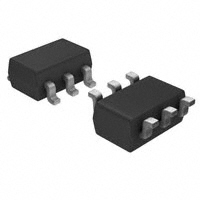
Low Cost, 2.7 V to 5.5 V, Pin-Selectable Temperature Switches in SOT-23 ADT6401/ADT6402
FEATURES
±0.5°C (typical) threshold accuracy Pin-selectable trip points from −45°C to +5°C in 10°C increments (undertemperature) 45°C to 115°C in 10°C increments (overtemperature) Maximum operating temperature of 125°C Open-drain output (ADT6401) Push-pull output (ADT6402) Pin-selectable hysteresis of 2°C and 10°C Supply current of 30 μA (typical) Space-saving, 6-lead SOT-23 package
FUNCTIONAL BLOCK DIAGRAM
VCC
4
GND
5
Σ-Δ TEMPERATURE-TODIGITAL CONVERTER
ADT6401
COMPARATOR
6
TOVER/TUNDER
S2 1 S1 2 S0 3
TRIP POINT AND HYSTERESIS DECODING
2ºC/10ºC
APPLICATIONS
Medical equipment Automotive Cell phones Hard disk drives Personal computers Electronic test equipment Domestic appliances Process control
Figure 1.
GENERAL DESCRIPTION
The ADT6401/ADT6402 are trip point temperature switches available in a 6-lead SOT-23 package. Each part contains an internal band gap temperature sensor for local temperature sensing. When the temperature crosses the trip point setting, the logic output is activated. The ADT6401 logic output is active low and open-drain. The ADT6402 logic output is active high and push-pull. The temperature is digitized to a resolution of 0.125°C (11-bit). The pin-selectable trip point settings are 10°C apart starting from −45°C to +5°C for undertemperature switching, and from 45°C to 115°C for overtemperature switching. These devices typically consume 30 μA of supply current. Hysteresis is pin selectable at 2°C and 10°C. The temperature switch is specified to operate over the supply range of 2.7 V to 5.5 V. When the ADT6401/ADT6402 are used for monitoring temperatures from 45°C to 115°C, the logic output pin becomes active when the temperature goes higher than the selected trip point temperature. When the ADT6401/ADT6402 are used for monitoring temperatures from −45°C to +5°C, the logic output pin becomes active when the temperature goes lower than the selected trip point temperature.
PRODUCT HIGHLIGHTS
1. 2. 3. 4. 5. 6. 7. 8. 9. Σ-Δ based temperature measurement gives high accuracy and noise immunity. Wide operating temperature range from −55°C to +125°C. ±0.5°C typical accuracy from −45°C to +115°C. Pin-selectable threshold settings from −45°C to +115°C in 10°C increments. Supply voltage is 2.7 V to 5.5 V. Supply current of 30 μA. Space-saving, 6-lead SOT-23 package. Pin-selectable temperature hysteresis of 2°C or 10°C. Temperature resolution of 0.125°C.
Rev. 0
Information furnished by Analog Devices is believed to be accurate and reliable. However, no responsibility is assumed by Analog Devices for its use, nor for any infringements of patents or other rights of third parties that may result from its use. Specifications subject to change without notice. No license is granted by implication or otherwise under any patent or patent rights of Analog Devices. Trademarks and registered trademarks are the property of their respective owners.
One Technology Way, P.O. Box 9106, Norwood, MA 02062-9106, U.S.A. Tel: 781.329.4700 www.analog.com Fax: 781.461.3113 ©2008 Analog Devices, Inc. All rights reserved.
07415-001
�ADT6401/ADT6402 TABLE OF CONTENTS
Features .............................................................................................. 1 Applications ....................................................................................... 1 Functional Block Diagram .............................................................. 1 General Description ......................................................................... 1 Product Highlights ........................................................................... 1 Revision History ............................................................................... 2 Specifications..................................................................................... 3 Absolute Maximum Ratings............................................................ 4 ESD Caution .................................................................................. 4 Pin Configurations and Function Descriptions ........................... 5 Typical Performance Characteristics ............................................. 6 Typical Application Circuits............................................................ 8 Theory of Operation .........................................................................9 Circuit Information.......................................................................9 Converter Details ..........................................................................9 Pin-Selectable Trip Point and Hysteresis ...................................9 Temperature Conversion ........................................................... 10 Applications Information .............................................................. 11 Thermal Response Time ........................................................... 11 Self-Heating Effects .................................................................... 11 Supply Decoupling ..................................................................... 11 Temperature Monitoring ........................................................... 11 Outline Dimensions ....................................................................... 12 Ordering Guide .......................................................................... 12
REVISION HISTORY
5/08—Revision 0: Initial Version
Rev. 0 | Page 2 of 12
�ADT6401/ADT6402 SPECIFICATIONS
TA = −55°C to +125°C, VCC = 2.7 V to 5.5 V, open-drain RPULL-UP = 10 kΩ, unless otherwise noted. Table 1.
Parameter TEMPERATURE SENSOR AND ADC Threshold Accuracy Min Typ ±0.5 ±0.5 ±0.5 ±0.5 11 30 600 2 10 10 0.3 0.4 10 0.3 0.4 0.8 × VCC VCC − 1.5 10 2.7 30 5.5 50 Max ±6 ±4 ±4 ±6 Unit °C °C °C °C Bits ms ms °C °C nA V V pF V V V V pF V μA Test Conditions/Comments TA = −45°C to −25°C TA = −15°C to +15°C TA = 35°C to 65°C TA = 75°C to 115°C Time necessary to complete a conversion Conversion started every 600 ms Pin selectable, depends on S0, S1, S2 settings Pin selectable, depends on S0, S1, S2 settings Leakage current, VCC = 2.7 V and VOH = 5.5 V IOL = 1.2 mA, VCC = 2.7 V IOL = 3.2 mA, VCC = 4.5 V RPULL-UP = 10 kΩ IOL = 1.2 mA, VCC = 2.7 V IOL = 3.2 mA, VCC = 4.5 V ISOURCE = 500 μA, VCC = 2.7 V ISOURCE = 800 μA, VCC = 4.5 V
ADC Resolution Temperature Conversion Time Update Rate Temperature Threshold Hysteresis DIGITAL OUTPUT (OPEN-DRAIN) Output High Current, IOH Output Low Voltage, VOL Output Capacitance, COUT1 DIGITAL OUTPUT (PUSH-PULL) Output Low Voltage, VOL Output High Voltage, VOH Output Capacitance, COUT1 POWER REQUIREMENTS Supply Voltage Supply Current
1
Guaranteed by design and characterization.
Rev. 0 | Page 3 of 12
�ADT6401/ADT6402 ABSOLUTE MAXIMUM RATINGS
Table 2.
Parameter VCC to GND S0, S1, S2 Input Voltage to GND Open-Drain Output Voltage to GND Push-Pull Output Voltage to GND Input Current on All Pins Output Current on All Pins ESD rating (HBM) Operating Temperature Range Storage Temperature Range Maximum Junction Temperature, TJMAX 6-Lead SOT-23 (RJ-6) Power Dissipation1 Thermal Impedance3 θJA, Junction-to-Ambient (Still Air) IR Reflow Soldering (RoHS-Compliant Package) Peak Temperature Time at Peak Temperature Ramp-Up Rate Ramp-Down Rate Time 25°C to Peak Temperature
1
MAXIMUM POWER DISSIPATION (W)
Rating −0.3 V to +7 V −0.3 V to VCC + 0.3 V −0.3 V to +7 V −0.3 V to VCC + 0.3 V 20 mA 20 mA 1.5 kV −55°C to +125°C −65°C to +160°C 150.7°C WMAX = ( TJMAX − TA2)/θJA 229.6°C/W
Stresses above those listed under Absolute Maximum Ratings may cause permanent damage to the device. This is a stress rating only; functional operation of the device at these or any other conditions above those indicated in the operational section of this specification is not implied. Exposure to absolute maximum rating conditions for extended periods may affect device reliability.
0.9 0.8 0.7 0.6 0.5 0.4 0.3 0.2 0.1 SOT-23 PD @ 125°C = 0.107W 0
07415-002
260°C (+0°C) 20 sec to 40 sec 3°C/sec maximum −6°C/sec maximum 8 minute maximum
–55 –40 –20 0 20 40 60 80 100 120 –50 –30 –10 10 30 50 70 90 110 125 TEMPERATURE (°C)
Figure 2. SOT-23 Maximum Power Dissipation vs. Temperature
Values relate to package being used on a standard 2-layer PCB, which gives a worst-case θJA. Refer to Figure 2 for a plot of maximum power dissipation vs. ambient temperature (TA). 2 TA = ambient temperature. 3 Junction-to-case resistance is applicable to components featuring a preferential flow direction, for example, components mounted on a heat sink. Junction-to-ambient resistance is more useful for air-cooled, PCB-mounted components.
ESD CAUTION
Rev. 0 | Page 4 of 12
�ADT6401/ADT6402 PIN CONFIGURATIONS AND FUNCTION DESCRIPTIONS
S2 1
6
TOVER/TUNDER GND
07415-003
S2 1
6
TOVER/TUNDER GND VCC
07415-004
ADT6401
S1 2 S0 3 TOP VIEW (Not to Scale)
5
ADT6402
S1 2 S0 3 TOP VIEW (Not to Scale)
5
4
VCC
4
Figure 3. ADT6401 Pin Configuration
Figure 4. ADT6402 Pin Configuration
Table 3. Pin Function Descriptions
Pin Number ADT6401 ADT6402 1 1 2 2 3 3 4 4 5 5 6 N/A N/A 6 Mnemonic S2 S1 S0 VCC GND TOVER/TUNDER TOVER/TUNDER Description Select Pin for Trip Point and Hysteresis Values. Select Pin for Trip Point and Hysteresis Values. Select Pin for Trip Point and Hysteresis Values. Supply Input (2.7 V to 5.5 V). Ground. Open-Drain, Active Low Output. Pull-up resistor required. This pin goes low when the temperature of the part exceeds the pin-selectable threshold. Push-Pull, Active High Output. This pin goes high when the temperature of the part exceeds the pin-selectable threshold.
Rev. 0 | Page 5 of 12
�ADT6401/ADT6402 TYPICAL PERFORMANCE CHARACTERISTICS
35 SAMPLE SIZE = 300
80 70
OUTPUT SINK RESISTANCE (Ω)
PERCENTAGE OF PARTS SAMPLED (%)
30 25 20 15 10 5 0
60 2.7V 50 40 5.5V 30 20 10 0 –80 3.3V
07415-015
–0.5
–0.4
–0.3
–0.2
–0.1
0.1
0.2
0.3
0.4
0.5
–60
–40
–20
0
20
40
60
80
100
120
140
TEMPERATURE ACCURACY (°C)
TEMPERATURE (°C)
Figure 5. Trip Threshold Accuracy
Figure 8. Output Sink Resistance vs. Temperature
45 40 35 30
120
5V 3.3V
100
TEMPERATURE (°C)
80
ICC (µA)
25 20 15 10
60
40
20
5
07415-016
TEMPERATURE (°C)
0.8
2.4
4.0
Figure 6. Operating Supply Current vs. Temperature
Figure 9. Thermal Step Response in Perfluorinated Fluid
180 160
140 120
OUTPUT SOURCE RESISTANCE (Ω)
140 120 100 80 60 40 20
07415-017
3.3V 5.5V
TEMPERATURE (°C)
2.7V
100 80 60 40 20 0 0
TEMPERATURE (°C)
7.2
Figure 7. ADT6402 Output Source Resistance vs. Temperature
Figure 10. Thermal Step Response in Still Air
Rev. 0 | Page 6 of 12
07415-020
0 –80
–60
–40
–20
0
20
40
60
80
100
120
140
3.6
10.8 18.0 25.2 32.4 39.6 46.8 54.0 61.2 14.4 21.6 28.8 36.0 43.2 50.4 57.6 TIME (s)
07415-019
0 –60
–40
–20
0
20
40
60
80
100
120
140
0
0
1.6
3.2
4.8
12.8 6.4 8.0 9.6 11.2 5.6 7.2 8.8 10.4 12.0 TIME (s)
07415-018
�ADT6401/ADT6402
11 10 9 8
VCC
10°C
HYSTERESIS (°C)
7 6 5 4 3 2 1
07415-021
VDD = 3.3V
1
TOVER
2°C
2
CH1 2.0V
CH2 2.0V
TEMPERATURE (°C)
M 10.0ms 50.0kS/s A CH1 1.68V
20.0µs/pt
Figure 11. Hysteresis vs. Trip Temperature
Figure 13. ADT6401 Start-Up Delay
45 40 35
VCC
1
30
ICC (µA)
25 20 15
TOVER
2
10 5
07415-022
CH1 2.0V
CH2 2.0V
M 10.0µs 50.0MS/s A CH1 1.68V
20.0ns/pt
VCC (V)
Figure 12. ADT6401 Start-Up and Power-Down Delay
Figure 14. Operating Supply Current vs. Voltage Over Temperature
Rev. 0 | Page 7 of 12
07415-024
0 2.4 2.6 2.8 3.0 3.2 3.4 3.6 3.8 4.0 4.2 4.4 4.6 4.8 5.0 5.2 5.4 5.6
–40ºC –10ºC +25ºC +75ºC +120ºC
07415-023
0
10
20
30
40
50
60
70
80
–60
–50
–40
–30
–20
–10
90
100
110
120
130
0
�ADT6401/ADT6402 TYPICAL APPLICATION CIRCUITS
3.3V 3.3V 12V
0.1µF 100kΩ VCC VCC MICROPROCESSOR INT S2 S1 S0 VCC
0.1µF
ADT6401
S2 S1 S0 GND TRIP POINT = 95°C HYSTERESIS = 2°C TOVER
ADT6402
TOVER GND
07415-011
GND TRIP POINT = 65°C HYSTERESIS = 10°C
07415-012 07415-013
Figure 15. Microprocessor Alarm
Figure 16. Overtemperature Fan Control
3.3V
0.1µF
VCC S2 S1 S0
ADT6402
TOVER OVER TEMPERATURE
GND TRIP POINT = +105°C HYSTERESIS = +2°C OUT OF RANGE
0.1µF VCC
ADT6402
S2 S1 S0 GND TRIP POINT = –35°C HYSTERESIS = +2°C TUNDER UNDER TEMPERATURE
Figure 17. Temperature Window Alarms
Rev. 0 | Page 8 of 12
�ADT6401/ADT6402 THEORY OF OPERATION
CIRCUIT INFORMATION
The ADT6401/ADT6402 are 11-bit digital temperature sensors with a 12th bit acting as the sign bit. An on-board temperature sensor generates a voltage precisely proportional to absolute temperature, which is compared to an internal voltage reference and input to a precision digital modulator. The 12-bit output from the modulator is input into a digital comparator, where it is compared with a pin-selectable trip level. The output trip pin is activated if the temperature measured is greater than, or less than, the pin-selectable trip level. Overall accuracy for the ADT6401/ ADT6402 is ±6°C (maximum) from −45°C to +115°C. The on-board temperature sensor has excellent accuracy and linearity over the entire rated temperature range without needing correction or calibration by the user. The ADT6401 has active low, open-drain output structures that can sink current. The ADT6402 has active high, push-pull output structures that can sink and source current. On power-up, the output becomes active when the first conversion is completed, which typically takes 30 ms. The sensor output is digitized by a first-order, ∑-Δ modulator, also known as the charge balance type analog-to-digital converter (ADC). This type of converter utilizes time domain oversampling and a high accuracy comparator to deliver 11 bits of effective accuracy in an extremely compact circuit.
PIN-SELECTABLE TRIP POINT AND HYSTERESIS
The temperature trip point and hysteresis values for the ADT6401/ADT6402 are selected using Pin S0, Pin S1, and Pin S2. These three pins can be connected to VCC, tied to GND, or left floating. The ADT6401/ADT6402 decode the inputs on S0, S1, and S2 to determine the temperature trip point and hysteresis value, as outlined in Table 4. The ADT6401 overtemperature/undertemperature output is intended to interface to reset inputs of microprocessors. The ADT6402 is intended for driving circuits of applications, such as fan control circuits. Table 4. Selecting Trip Points and Hysteresis1
S2 0 0 0 0 0 0 0 0 1 1 1 1 1 1 1 1 1 1 Float Float Float Float Float Float Float Float Float
1
CONVERTER DETAILS
The Σ-Δ modulator consists of an input sampler, a summing network, an integrator, a comparator, and a 1-bit digital-toanalog converter (DAC). Similar to the voltage-to-frequency converter, this architecture creates a negative feedback loop and minimizes the integrator output by changing the duty cycle of the comparator output in response to input voltage changes. The comparator samples the output of the integrator at a much higher rate than the input sampling frequency; this is called oversampling. Oversampling spreads the quantization noise over a much wider band than that of the input signal, improving overall noise performance and increasing accuracy.
S1 0 0 0 1 1 0 Float Float Float 0 0 0 1 1 1 Float Float Float 0 0 0 1 1 1 Float Float Float
S0 0 1 Float 0 1 Float 0 1 Float 0 1 Float 0 1 Float 0 1 Float 0 1 Float 0 1 Float 0 1 Float
Temperature Trip Point +45°C +55°C +65°C +75°C +85°C +95°C +105°C +115°C +55°C +65°C +75°C +85°C +95°C +105°C +115°C +5°C −5°C −15°C −25°C −35°C −45°C +5°C −5°C −15°C −25°C −35°C −45°C
Hysteresis 2°C 2°C 2°C 2°C 2°C 2°C 2°C 2°C 10°C 10°C 10°C 10°C 10°C 10°C 10°C 2°C 2°C 2°C 2°C 2°C 2°C 10°C 10°C 10°C 10°C 10°C 10°C
0 = pin tied to GND, 1 = pin tied to VCC, Float = pin left floating.
Rev. 0 | Page 9 of 12
�ADT6401/ADT6402
Hysteresis
A hysteresis value of 2°C or 10°C can be selected. The digital comparator ensures excellent accuracy for the hysteresis value. Hysteresis prevents oscillation on the output pin when the temperature is approaching the trip point and after the output pin is activated. For example, if the temperature trip is 45°C and the hysteresis selected is 10°C, the temperature must go as low as 35°C before the output deactivates. This temperature conversion typically takes 30 ms, after which the analog circuitry of the part automatically shuts down. The analog circuitry powers up again 570 ms later, when the 600 ms timer times out and the next conversion begins. The result of the most recent temperature conversion is compared with the factory-set trip point value. If the temperature measured is greater than the trip point value, the output is activated. The output is deactivated once the temperature crosses back over the trip point threshold, plus whatever temperature hysteresis is selected. Figure 18 to Figure 21 show the transfer function for the output trip pin of each generic model.
TEMPERATURE CONVERSION
The conversion clock for the part is generated internally. No external clock is required. The internal clock oscillator runs an automatic conversion sequence. During this automatic conversion sequence, a conversion is initiated every 600 ms. At this time, the part powers up its analog circuitry and performs a temperature conversion.
V TOVER
V TUNDER
COLD 10°C HYSTERESIS
HOT
COLD
HOT
TTH 2°C HYSTERESIS
TEMP
07415-006
TTH
Figure 18. ADT6401 TOVER Transfer Function
Figure 20. ADT6401 TUNDER Transfer Function
V TOVER COLD HOT
V TUNDER
COLD
HOT
07415-007
2°C HYSTERESIS
Figure 19. ADT6402 TOVER Transfer Function
Figure 21. ADT6402 TUNDER Transfer Function
Rev. 0 | Page 10 of 12
07415-009
10°C HYSTERESIS
TTH
TEMP
TTH
10°C HYSTERESIS 2°C HYSTERESIS
TEMP
07415-008
10°C HYSTERESIS 2°C HYSTERESIS
TEMP
�ADT6401/ADT6402 APPLICATIONS INFORMATION
THERMAL RESPONSE TIME
The time required for a temperature sensor to settle to a specified accuracy is a function of the thermal mass of the sensor and the thermal conductivity between the sensor and the object being sensed. Thermal mass is often considered equivalent to capacitance. Thermal conductivity is commonly specified using the symbol Q and can be thought of as thermal resistance. It is commonly specified in units of degrees per watt of power transferred across the thermal joint. Thus, the time required for the ADT6401/ADT6402 to settle to the desired accuracy is dependent on the characteristics of the SOT-23 package, the thermal contact established in that particular application, and the equivalent power of the heat source. In most applications, the settling time is best determined empirically. If possible, the ADT6401/ADT6402 should be powered directly from the system power supply. This arrangement, shown in Figure 22, isolates the analog section from the logic-switching transients. Even if a separate power supply trace is not available, generous supply bypassing reduces supply line induced errors. Local supply bypassing consisting of a 0.1 μF ceramic capacitor is advisable to achieve the temperature accuracy specifications. This decoupling capacitor must be placed as close as possible to the ADT6401/ADT6402 VCC pin.
TTL/CMOS LOGIC CIRCUITS
0.1µF
ADT6401/ ADT6402
The temperature measurement accuracy of the ADT6401/ ADT6402 can be degraded in some applications due to selfheating. Errors can be introduced from the quiescent dissipation and power dissipated when converting. The magnitude of these temperature errors depends on the thermal conductivity of the ADT6401/ADT6402 package, the mounting technique, and the effects of airflow. At 25°C, static dissipation in the ADT6401/ ADT6402 is typically 99 μW operating at 3.3 V. In the 6-lead SOT-23 package mounted in free air, this accounts for a temperature increase due to self-heating of ΔT = PDISS × θJA = 99 μW × 240°C/W = 0.024°C It is recommended that current dissipated through the device be kept to a minimum because it has a proportional effect on the temperature error.
POWER SUPPLY
Figure 22. Separate Traces Used to Reduce Power Supply Noise
TEMPERATURE MONITORING
The ADT6401/ADT6402 are ideal for monitoring the thermal environment within electronic equipment. For example, the surface-mount package accurately reflects the exact thermal conditions that affect nearby integrated circuits. The ADT6401/ADT6402 measure and convert the temperature at the surface of its own semiconductor chip. When the ADT6401/ ADT6402 are used to measure the temperature of a nearby heat source, the thermal impedance between the heat source and the ADT6401/ADT6402 must be as low as possible. As much as 60% of the heat transferred from the heat source to the thermal sensor on the ADT6401/ADT6402 die is discharged via the copper tracks, package pins, and bond pads. Of the pins on the ADT6401/ADT6402, the GND pin transfers most of the heat. Therefore, to monitor the temperature of a heat source, it is recommended that the thermal resistance between the ADT6401/ ADT6402 GND pin and the GND of the heat source be reduced as much as possible. For example, the unique properties of the ADT6401/ADT6402 can be used to monitor a high power dissipation microprocessor. The ADT6401/ADT6402 device in its SOT-23 package is mounted directly beneath the pin grid array (PGA) package of the microprocessor. The ADT6401/ADT6402 require no external characterization.
SUPPLY DECOUPLING
The ADT6401/ADT6402 should be decoupled with a 0.1 μF ceramic capacitor between VCC and GND. This is particularly important when the ADT6401/ADT6402 are mounted remotely from the power supply. Precision analog products such as the ADT6401/ADT6402 require well-filtered power sources. Because the ADT6401/ADT6402 operate from a single supply, it may seem convenient to tap into the digital logic power supply. Unfortunately, the logic supply is often a switch-mode design, which generates noise in the 20 kHz to 1 MHz range. In addition, fast logic gates can generate glitches that are hundreds of millivolts in amplitude due to wiring resistance and inductance.
Rev. 0 | Page 11 of 12
07415-010
SELF-HEATING EFFECTS
�ADT6401/ADT6402 OUTLINE DIMENSIONS
2.90 BSC
6 5 4
1.60 BSC
1 2 3
2.80 BSC
PIN 1 INDICATOR 0.95 BSC 1.30 1.15 0.90 1.90 BSC
1.45 MAX 0.50 0.30
0.22 0.08 10° 4° 0° 0.60 0.45 0.30
0.15 MAX
SEATING PLANE
COMPLIANT TO JEDEC STANDARDS MO-178-AB
Figure 23. 6-Lead Small Outline Transistor Package [SOT-23] (RJ-6) Dimensions shown in millimeters
ORDERING GUIDE
Model ADT6401SRJZ-RL71 ADT6402SRJZ-RL71
1
Temperature Range −55°C to +125°C −55°C to +125°C
Package Description 6-Lead SOT-23 6-Lead SOT-23
Package Option RJ-6 RJ-6
Ordering Quantity 3,000 3,000
Branding T30 T32
Z = RoHS Compliant Part.
©2008 Analog Devices, Inc. All rights reserved. Trademarks and registered trademarks are the property of their respective owners. D07415-0-5/08(0)
Rev. 0 | Page 12 of 12
�