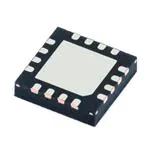
Small, Low Power, 3-Axis ±5 g Accelerometer ADXL325
FEATURES
3-axis sensing Small, low profile package 4 mm × 4 mm × 1.45 mm LFCSP Low power: 350 μA typical Single-supply operation: 1.8 V to 3.6 V 10,000 g shock survival Excellent temperature stability Bandwidth adjustment with a single capacitor per axis RoHS/WEEE lead-free compliant
GENERAL DESCRIPTION
The ADXL325 is a small, low power, complete 3-axis accelerometer with signal conditioned voltage outputs. The product measures acceleration with a minimum full-scale range of ±5 g. It can measure the static acceleration of gravity in tilt-sensing applications, as well as dynamic acceleration, resulting from motion, shock, or vibration. The user selects the bandwidth of the accelerometer using the CX, CY, and CZ capacitors at the XOUT, YOUT, and ZOUT pins. Bandwidths can be selected to suit the application with a range of 0.5 Hz to 1600 Hz for X and Y axes and a range of 0.5 Hz to 550 Hz for the Z axis. The ADXL325 is available in a small, low profile, 4 mm × 4 mm × 1.45 mm, 16-lead, plastic lead frame chip scale package (LFCSP_LQ).
APPLICATIONS
Cost-sensitive, low power, motion- and tilt-sensing applications Mobile devices Gaming systems Disk drive protection Image stabilization Sports and health devices
FUNCTIONAL BLOCK DIAGRAM
+3V VS
ADXL325
OUTPUT AMP 3-AXIS SENSOR CDC AC AMP DEMOD OUTPUT AMP
~32k Ω
XOUT CX
~32k Ω
YOUT CY
OUTPUT AMP
~32k Ω
ZOUT CZ
Figure 1.
Rev. 0
Information furnished by Analog Devices is believed to be accurate and reliable. However, no responsibility is assumed by Analog Devices for its use, nor for any infringements of patents or other rights of third parties that may result from its use. Specifications subject to change without notice. No license is granted by implication or otherwise under any patent or patent rights of Analog Devices. Trademarks and registered trademarks are the property of their respective owners.
One Technology Way, P.O. Box 9106, Norwood, MA 02062-9106, U.S.A. Tel: 781.329.4700 www.analog.com Fax: 781.461.3113 ©2009 Analog Devices, Inc. All rights reserved.
07946-001
COM
ST
�ADXL325 TABLE OF CONTENTS
Features .............................................................................................. 1 Applications ....................................................................................... 1 General Description ......................................................................... 1 Functional Block Diagram .............................................................. 1 Revision History ............................................................................... 2 Specifications..................................................................................... 3 Absolute Maximum Ratings............................................................ 4 ESD Caution .................................................................................. 4 Pin Configuration and Function Descriptions ............................. 5 Typical Performance Characteristics ............................................. 6 Theory of Operation ...................................................................... 10 Mechanical Sensor...................................................................... 10 Performance ................................................................................ 10 Applications Information .............................................................. 11 Power Supply Decoupling ......................................................... 11 Setting the Bandwidth Using CX, CY, and CZ .......................... 11 Self Test ........................................................................................ 11 Design Trade-Offs for Selecting Filter Characteristics: The Noise/BW Trade-Off .................................................................. 11 Use with Operating Voltages Other Than 3 V .......................... 11 Axes of Acceleration Sensitivity ............................................... 12 Layout and Design Recommendations ................................... 13 Outline Dimensions ....................................................................... 14 Ordering Guide .......................................................................... 14
REVISION HISTORY
8/09—Revision 0: Initial Version
Rev. 0 | Page 2 of 16
�ADXL325 SPECIFICATIONS
TA = 25°C, VS = 3 V, CX = CY = CZ = 0.1 μF, acceleration = 0 g, unless otherwise noted. All minimum and maximum specifications are guaranteed. Typical specifications are not guaranteed. Table 1.
Parameter SENSOR INPUT Measurement Range Nonlinearity Package Alignment Error Interaxis Alignment Error Cross-Axis Sensitivity 1 SENSITIVITY (RATIOMETRIC) 2 Sensitivity at XOUT, YOUT, ZOUT Sensitivity Change Due to Temperature 3 ZERO g BIAS LEVEL (RATIOMETRIC) 0 g Voltage at XOUT, YOUT, ZOUT 0 g Offset vs. Temperature NOISE PERFORMANCE Noise Density XOUT, YOUT, ZOUT FREQUENCY RESPONSE 4 Bandwidth XOUT, YOUT 5 Bandwidth ZOUT5 RFILT Tolerance Sensor Resonant Frequency SELF TEST 6 Logic Input Low Logic Input High ST Actuation Current Output Change at XOUT Output Change at YOUT Output Change at ZOUT OUTPUT AMPLIFIER Output Swing Low Output Swing High POWER SUPPLY Operating Voltage Range Supply Current Turn-On Time 7 TEMPERATURE Operating Temperature Range
1 2
Conditions Each axis Percent of full scale
Min ±5
Typ ±6 ±0.2 ±1 ±0.1 ±1 174 ±0.01 1.5 ±1 250
Max
Unit g % Degrees Degrees %
Each axis VS = 3 V VS = 3 V VS = 3 V
156
192
mV/g %/°C V mg/°C μg/√Hz rms Hz Hz kΩ kHz V V μA mV mV mV V V
1.3
1.7
No external filter No external filter
1600 550 32 ± 15% 5.5 +0.6 +2.4 +60 −190 +190 +320 0.1 2.8 1.8 3.6 350 1 −40 +85
Self test 0 to 1 Self test 0 to 1 Self test 0 to 1 No load No load
−90 +90 +90
−350 +350 +580
VS = 3 V No external filter
V μA ms °C
Defined as coupling between any two axes. Sensitivity is essentially ratiometric to VS. 3 Defined as the output change from ambient-to-maximum temperature or ambient-to-minimum temperature. 4 Actual frequency response controlled by user-supplied external filter capacitors (CX, CY, CZ). 5 Bandwidth with external capacitors = 1/(2 × π × 32 kΩ × C). For CX, CY = 0.003 μF, bandwidth = 1.6 kHz. For CZ = 0.01 μF, bandwidth = 500 Hz. For CX, CY, CZ = 10 μF, bandwidth = 0.5 Hz. 6 Self test response changes cubically with VS. 7 Turn-on time is dependent on CX, CY, CZ and is approximately 160 × CX or CY or CZ + 1 ms, where CX, CY, CZ are in μF.
Rev. 0 | Page 3 of 16
�ADXL325 ABSOLUTE MAXIMUM RATINGS
Table 2.
Parameter Acceleration (Any Axis, Unpowered) Acceleration (Any Axis, Powered) VS All Other Pins Output Short-Circuit Duration (Any Pin to Common) Temperature Range (Powered) Temperature Range (Storage) Rating 10,000 g 10,000 g −0.3 V to +3.6 V (COM − 0.3 V) to (VS + 0.3 V) Indefinite −55°C to +125°C −65°C to +150°C
Stresses above those listed under Absolute Maximum Ratings may cause permanent damage to the device. This is a stress rating only; functional operation of the device at these or any other conditions above those indicated in the operational section of this specification is not implied. Exposure to absolute maximum rating conditions for extended periods may affect device reliability.
ESD CAUTION
Rev. 0 | Page 4 of 16
�ADXL325 PIN CONFIGURATION AND FUNCTION DESCRIPTIONS
NC
16 15 14
NC ST COM NC
1 2 3 4 5
ADXL325
TOP VIEW (Not to Scale) +Y +Z +X
6 7 8
NC
13 12 11 10 9
VS
VS
XOUT NC YOUT NC
COM
COM
COM
ZOUT
NC = NO CONNECT
Figure 2. Pin Configuration
Table 3. Pin Function Descriptions
Pin No. 1 2 3 4 5 6 7 8 9 10 11 12 13 14 15 16 EP Mnemonic NC ST COM NC COM COM COM ZOUT NC YOUT NC XOUT NC VS VS NC Exposed pad Description No Connect (or Optionally Ground) Self Test Common No Connect Common Common Common Z Channel Output No Connect (or Optionally Ground) Y Channel Output No Connect X Channel Output No Connect Supply Voltage (1.8 V to 3.6 V) Supply Voltage (1.8 V to 3.6 V) No Connect Not internally connected. Solder for mechanical integrity.
Rev. 0 | Page 5 of 16
07946-003
�ADXL325 TYPICAL PERFORMANCE CHARACTERISTICS
N > 1000 for all typical performance plots, unless otherwise noted.
50
60
40
POPULATION (%)
50
30
POPULATION (%)
40
30
20
20
10
10
–0.22
–0.20
–0.18
–0.16
–0.14
–0.12
OUTPUT (V)
VOLTAGE (V)
Figure 3. X-Axis Zero g Bias at 25°C, VS = 3 V
40
Figure 6. X-Axis Self Test Response at 25°C, VS = 3 V
60
50
30
POPULATION (%)
20
POPULATION (%)
40
30
20
10
10
0
0.12 0.13 0.14 0.15 0.16 0.17 0.18 0.19 0.20 0.21 0.22 VOLTAGE (V)
OUTPUT (V)
Figure 4. Y-Axis Zero g Bias at 25°C, VS = 3 V
30
60
Figure 7. Y-Axis Self Test Response at 25°C, VS = 3 V
25
50
POPULATION (%)
15
POPULATION (%)
20
40
30
10
20
5
10
0.26 0.27 0.28 0.29 0.30 0.31 0.32 0.33 0.34 0.35 0.36
VOLTAGE (V)
OUTPUT (V)
Figure 5. Z-Axis Zero g Bias at 25°C, VS = 3 V
Figure 8. Z-Axis Self Test Response at 25°C, VS = 3 V
Rev. 0 | Page 6 of 16
07946-010
1.46
1.47
1.48
1.49
1.50
1.51
1.52
1.53
1.54
07946-007
0
0
07946-009
1.46
1.47
1.48
1.49
1.50
1.51
1.52
1.53
1.54
07946-006
0
07946-008
1.46
1.47
1.48
1.49
1.5
1.51
1.52
1.53
1.54
07946-005
0
0
�ADXL325
50 45 40 35
1.55 N=8 1.54 1.53 1.52
OUTPUT (V)
07946-011
POPULATION (%)
30 25 20 15 10 5 0 –1.4 –1.0 –0.6 –0.2 0.2 0.6 1.0 1.4
1.51 1.50 1.49 1.48 1.47 1.46 0 10 20 30 40 50 60 70 80 90 100
07946-014
07946-016 07946-015
1.45 –40 –30 –20 –10
TEMPERATURE COEFFICIENT (mg/°C)
TEMPERATURE (°C)
Figure 9. X-Axis Zero g Bias Temperature Coefficient, VS = 3 V
50
Figure 12. X-Axis Zero g Bias vs. Temperature, Eight Parts Soldered to PCB
1.55 N=8 1.54
40
POPULATION (%)
1.53 1.52 OUTPUT (V)
30
1.51 1.50 1.49 1.48
20
10
1.47 1.46
–1.4
–1.0
–0.6
–0.2
0.2
0.6
1.0
1.4
07946-012
0
1.45 –40 –30 –20 –10
0
10
20
30
40
50
60
70
80
90 100
TEMPERATURE COEFFICIENT (mg/°C)
TEMPERATURE (°C)
Figure 10. Y-Axis Zero g Bias Temperature Coefficient, VS = 3 V
40
Figure 13. Y-Axis Zero g Bias vs. Temperature, Eight Parts Soldered to PCB
1.54
N=8
35
1.52
30
POPULATION (%)
OUTPUT (V)
25 20 15 10 5 0
1.50 1.48 1.46 1.44 1.42 1.40 –40 –30 –20 –10
–3.5 –3.0 –2.5 –2.0 –1.5 –1.0 –0.5
0
0.5 1.0 1.5 2.0 2.5
07946-013
0
10
20
30
40
50
60
70
80
90 100
TEMPERATURE COEFFICIENT (mg/°C)
TEMPERATURE (°C)
Figure 11. Z-Axis Zero g Bias Temperature Coefficient, VS = 3 V
Figure 14. Z-Axis Zero g Bias vs. Temperature, Eight Parts Soldered to PCB
Rev. 0 | Page 7 of 16
�ADXL325
30
0.187
N=8
25
0.182
POPULATION (%)
20
SENSITIVITY (V/g)
0.177 0.172 0.167 0.162 0.157 –40 –30 –20 –10
15
10
5
0.164
0.166
0.168
0.170
0.172
0.174
0.176
0.178
0.180
0.182
07946-017
0
10
20
30
40
50
60
70
80
90 100
SENSITIVITY (V/g)
TEMPERATURE (°C)
Figure 15. X-Axis Sensitivity at 25°C, VS = 3 V
40 35 30
POPULATION (%)
0.187 0.182
Figure 18. X-Axis Sensitivity vs. Temperature, Eight Parts Soldered to PCB, VS = 3 V
N=8
25 20 15 10 5 0
0.164 0.166 0.168 0.170 0.172 0.174 0.176 0.178 0.180 0.182
SENSITIVITY (V/g)
0.177 0.172 0.167 0.162 0.157 –40 –30 –20 –10
07946-018
0
10
20
30
40
50
60
70
80
90 100
SENSITIVITY (V/g)
TEMPERATURE (°C)
Figure 16. Y-Axis Sensitivity at 25°C, VS = 3 V
35 30 25
POPULATION (%)
0.187
Figure 19. Y-Axis Sensitivity vs. Temperature, Eight Parts Soldered to PCB, VS = 3 V
N=8
0.182
20 15 10 5 0
0.164 0.166 0.168 0.170 0.172 0.174 0.176 0.178 0.180 0.182
SENSITIVITY (V/g)
0.177
0.172
0.167
0.162
07946-019
0
10
20
30
40
50
60
70
80
90 100
SENSITIVITY (V/g)
TEMPERATURE (°C)
Figure 17. Z-Axis Sensitivity at 25°C, VS = 3 V
Figure 20. Z-Axis Sensitivity vs. Temperature, Eight Parts Soldered to PCB, VS = 3 V
Rev. 0 | Page 8 of 16
07946-022
0.157 –40 –30 –20 –10
07946-021
07946-020
0
�ADXL325
600
CH4: ZOUT, 500mV/DIV CH3: Y OUT, 500mV/DIV
500
CURRENT (µA)
400
CH2: X OUT, 500mV/DIV
4 3
300
200
2
CH1: POWER, 2V/DIV
1
OUTPUTS ARE OFFSET FOR CLARITY
2.0
2.5
3.0
3.5
4.0
SUPPLY (V)
Figure 21. Typical Current Consumption vs. Supply Voltage
07946-023
0 1.5
TIME (1ms/DIV)
Figure 22. Typical Turn-On Time, VS = 3 V, CX = CY = CZ = 0.0047 μF
Rev. 0 | Page 9 of 16
07946-024
100
�ADXL325 THEORY OF OPERATION
The ADXL325 is a complete 3-axis acceleration measurement system. The ADXL325 has a measurement range of ±5 g minimum. It contains a polysilicon surface micromachined sensor and signal conditioning circuitry to implement an openloop acceleration measurement architecture. The output signals are analog voltages that are proportional to acceleration. The accelerometer can measure the static acceleration of gravity in tilt-sensing applications, as well as dynamic acceleration, resulting from motion, shock, or vibration. The sensor is a polysilicon surface micromachined structure built on top of a silicon wafer. Polysilicon springs suspend the structure over the surface of the wafer and provide a resistance against acceleration forces. Deflection of the structure is measured using a differential capacitor that consists of independent fixed plates and plates attached to the moving mass. The fixed plates are driven by 180° out-of-phase square waves. Acceleration deflects the moving mass and unbalances the differential capacitor resulting in a sensor output whose amplitude is proportional to acceleration. Phase-sensitive demodulation techniques are then used to determine the magnitude and direction of the acceleration. The demodulator output is amplified and brought off-chip through a 32 kΩ resistor. The user then sets the signal bandwidth of the device by adding a capacitor. This filtering improves measurement resolution and helps prevent aliasing.
MECHANICAL SENSOR
The ADXL325 uses a single structure for sensing the X, Y, and Z axes. As a result, the three axes sense directions are highly orthogonal with little cross-axis sensitivity. Mechanical misalignment of the sensor die to the package is the chief source of cross-axis sensitivity. Mechanical misalignment can, of course, be calibrated out at the system level.
PERFORMANCE
Rather than using additional temperature compensation circuitry, innovative design techniques ensure that high performance is built-in to the ADXL325. As a result, there is neither quantization error nor nonmonotonic behavior, and temperature hysteresis is very low (typically