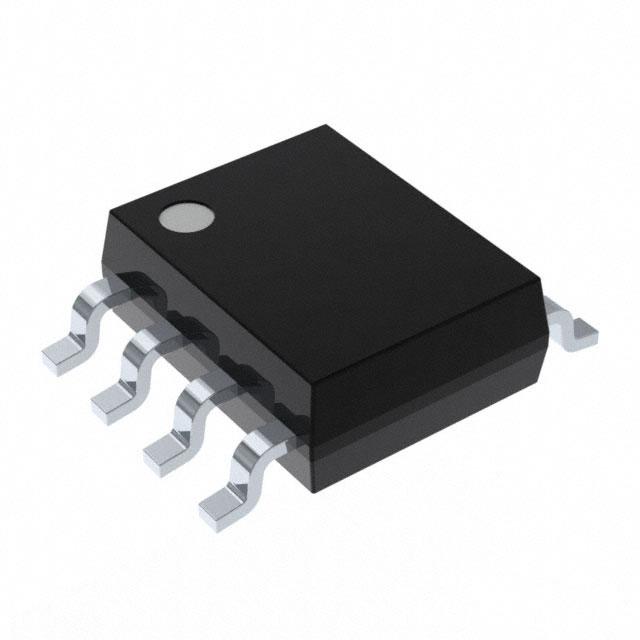
DS75LV
Digital Thermometer and Thermostat
General Description
The DS75LV low-voltage (1.7V to 3.7V) digital thermometer
and thermostat provides 9, 10, 11, or 12-bit digital temperature
readings over a -55°C to +125°C range with ±2°C accuracy
over a -25°C to +100°C range. At power-up, the DS75LV
defaults to 9-bit resolution for software compatibility with the
LM75. Communication with the DS75LV is achieved through
a simple 2-wire serial interface.
The DS75LV thermostat has a dedicated open-drain output
(OS) and programmable fault tolerance, which allows the
user to define the number of consecutive error conditions that
must occur before OS is activated. There are two thermostatic
operating modes that control thermostat operation based on
user-defined trip-points (TOS and THYST).
Applications
●●
●●
●●
●●
Benefits and Features
●● Extend Performance Range with Low-Voltage,
1.7V to 3.7V Operating Range
●● Maximize System Accuracy in Broad Range of
Thermal Management Applications
• Measures Temperature from -55°C to +125°C
(-67°F to +257°F)
• ±2°C Accuracy over a -25°C to 100°C Range
• User-Configurable Resolution from 9 Bits (Default)
to 12 Bits (0.5°C to 0.0625°C)
●● Easy Upgrade to LM75: Pin and Software Compatible
●● Simplify Distributed Temperature-Sensing
Applications with Multidrop Capability
• Up to Eight DS75LVs Can Operate on 2-Wire Bus
●● Increase Reliability and System Robustness
• Internally Filtered Data Lines for Noise Immunity
(50ns Deglitch)
• Bus Timeout Feature Prevents Lockup on 2-Wire
Interface
Personal Computers
Cellular Base Stations
Office Equipment
Any Thermally Sensitive System
Ordering Information appears at end of data sheet.
●● Minimize Power Consumption with Built-In Shutdown
Mode
●● Flexible User-Defined Thermostatic Modes with
Programmable Fault Tolerance
Functional Block Diagram
PRECISION
REFERENCE
OVERSAMPLING
MODULATOR
DIGITAL
DECIMATOR
VDD
CONFIGURATION
REGISTER
SCL
SDA
A0
A1
A2
ADDRESS
AND
I/O CONTROL
TEMPERATURE
REGISTER
OS
TOS AND THYST
REGISTERS
GND
19-7469; Rev 5; 11/16
DS75LV
THERMOSTAT
COMPARATOR
RP
�DS75LV
Digital Thermometer and Thermostat
Absolute Maximum Ratings
Voltage on VDD, Relative to Ground.....................-0.3V to +4.0V
Voltage on Any Other Pin, Relative to Ground ....-0.3V to +6.0V
Operating Temperature Range.......................... -55°C to +125°C
Storage Temperature Range............................. -55°C to +125°C
Lead Temperature (soldering, 10s).................................. +260°C
Stresses beyond those listed under “Absolute Maximum Ratings” may cause permanent damage to the device. These are stress ratings only, and functional operation of the device at these
or any other conditions beyond those indicated in the operational sections of the specifications is not implied. Exposure to absolute maximum rating conditions for extended periods may affect
device reliability.
DC Electrical Characteristics
(1.7V ≤ VDD ≤ 3.7V, TA = -55°C to +125°C, unless otherwise noted.)
PARAMETER
SYMBOL
Supply Voltage
VDD
Thermometer Error (Note 1)
TERR
Input Logic-High
Input Logic-Low
VIH
VIL
CONDITIONS
MIN
MAX
UNITS
3.7
V
-25 to +100
±2.0
°C
-55 to +125
±3.0
0 to +50
±0.5
(Note 2)
0.7 x VDD
(Note 2)
-0.5
SDA Output Logic Low Voltage
(Note 2)
VOL1
3mA sink current
0
VOL2
6mA sink current
0
OS Saturation Voltage
VOL
4mA sink current (Notes 1, 2)
Input Current Each I/O Pin
I/O Capacitance
CI/O
Standby Current
IDD1
Active Current (Notes 3, 4)
IDD
TYP
1.7
0.4 < VI/O< 0.9 x VDD
5.5
V
0.3 x VDD
V
0.4
0.6
-10
(Notes 3, 4)
V
0.8
V
+10
µA
10
pF
2
µA
Active temp conversions
1000
Communication only
100
µA
AC Electrical Characteristics
(1.7V ≤ VDD ≤ 3.7V, TA = -55°C to +125°C, unless otherwise noted.)
PARAMETER
SYMBOL
CONDITIONS
Resolution
MIN
9
9-bit conversions
Temperature Conversion Time
tCONVT
SCL Frequency
fSCL
Bus Free Time Between a
STOP and START Condition
tBUF
START and Repeated START
Hold Time from Falling SCL
www.maximintegrated.com
tHD:STA
TYP
MAX
UNITS
12
Bits
25
10-bit conversions
50
11-bit conversions
100
12-bit conversions
200
400
ms
kHz
(Note 5)
1.3
µs
(Notes 5, 6)
600
ns
Maxim Integrated │ 2
�DS75LV
Digital Thermometer and Thermostat
AC Electrical Characteristics (continued)
(1.7V ≤ VDD ≤ 3.7V, TA = -55°C to +125°C, unless otherwise noted.)
PARAMETER
SYMBOL
CONDITIONS
MIN
TYP
MAX
UNITS
tLOW
(Note 5)
1.3
µs
tHIGH
(Note 5)
0.6
µs
Repeated START Condition
Setup Time to Rising SCL
tSU:STA
(Note 5)
600
ns
Data-Out Hold Time from
Falling SCL
tHD:DAT
(Notes 5, 7)
Data-In Setup Time to Rising
SCL
tSU:DAT
(Note 5)
Rise Time of SDA and SCL
(Receive)
tR
(Note 5)
1000
ns
Fall Time of SDA and SCL
(Receive)
tF
(Note 5)
300
ns
50
ns
Low Period of SCL
High Period of SCL
Spike Suppression Filter Time
(Deglitch Filter)
STOP Setup Time to Rising
SCL
Capacitive Load for Each Bus
Line
Input Capacitance
Serial Interface Reset Time
tSS
tSU:STO
0
0.9
100
ns
0
(Note 5)
600
ns
CB
CI
tTIMEOUT
400
pF
325
ms
5
SDA time low (Note 8)
75
µs
pF
Note 1:
Note
Note
Note
Note
Note
Note
Note
Internal heating caused by OS loading causes the DS75LV to read approximately 0.5°C higher if OS is sinking the max
rated current.
2: All voltages are referenced to ground.
3: IDD specified with VDD at 3.0V and SDA, SCL = 3.0V, 0°C to +70°C.
4: IDD specified with OS pin open.
5: See Figure 2 for timing diagram. All timing is referenced to 0.9 x VDD and 0.1 x VDD.
6: After this period, the first clock pulse is generated.
7: The DS75LV provides an internal hold time of at least 75ns on the SDA signal to bridge the undefined region of SCL’s
falling edge.
8: This timeout applies only when the DS75LV is holding SDA low. Other devices can hold SDA low indefinitely and the
DS75LV does not reset.
www.maximintegrated.com
Maxim Integrated │ 3
�DS75LV
Digital Thermometer and Thermostat
Pin Description
PIN
NAME
FUNCTION
1
SDA
Data Input/Output. For 2-wire serial communication port. Open drain.
2
SCL
Clock Input. 2-wire serial communication port.
3
OS
Thermostat Output. Open drain.
4
GND
5
A2
Address Input
6
A1
Address Input
7
A0
Address Input
8
VDD
Ground
Supply Voltage. +1.7V to +3.7V supply pin.
PRECISION
REFERENCE
DIGITAL
DECIMATOR
OVERSAMPLING
MODULATOR
VDD
CONFIGURATION
REGISTER
SCL
SDA
ADDRESS
AND
I/O CONTROL
A0
A1
A2
TEMPERATURE
REGISTER
OS
THERMOSTAT
COMPARATOR
TOS AND THYST
REGISTERS
GND
RP
DS75LV
Figure 1. Block Diagram
SDA
tF
tLOW
tSU;DAT
tR
tF
tHD;STA
tSP
tR
tBUF
SCL
tHD;STA
S
tHD;DAT
tSU;STA
tSU;STO
Sr
P
S
Figure 2. Timing Diagram
www.maximintegrated.com
Maxim Integrated │ 4
�DS75LV
Digital Thermometer and Thermostat
Detailed Description
Measuring Temperature
The DS75LV measures temperature using a bandgap
temperature sensing architecture. An on-board delta-sigma
analog-to-digital converter (ADC) converts the measured
temperature to a digital value that is calibrated in degrees
centigrade; for Fahrenheit applications a lookup table or
conversion routine must be used. The DS75LV is factorycalibrated and requires no external components to measure
temperature.
At power-up the DS75LV immediately begins converting
temperature to a digital value. The resolution of the
digital output data is user-configurable to 9, 10, 11, or
12 bits, corresponding to temperature increments of
0.5°C, 0.25°C, 0.125°C, and 0.0625°C, respectively, with
9-bit default resolution at power-up. The resolution is
controlled via the R0 and R1 bits in the configuration
register as explained in the Configuration Register
section. Note that the conversion time doubles for each
additional bit of resolution.
After each temperature measurement and analog-to-digital
conversion, the DS75LV stores the temperature as a 16-bit
two’s complement number in the 2-byte temperature register
(see Figure 3). The sign bit (S) indicates if the temperature
is positive or negative: for positive numbers S = 0 and for
negative numbers S = 1. The most recently converted digital
measurement can be read from the temperature register at
any time. Since temperature conversions are performed in
the background, reading the temperature register does not
affect the operation in progress.
MS Byte
LS Byte
Bits 3 through 0 of the temperature register are hardwired
to 0. When the DS75LV is configured for 12-bit resolution,
the 12 MSbs (bits 15 through 4) of the temperature register
contain temperature data. For 11-bit resolution, the 11
MSbs (bits 15 through 5) of the temperature register
contain data, and bit 4 reads out as 0. Likewise, for 10-bit
resolution, the 10 MSbs (bits 15 through 6) contain data,
and for 9-bit the 9 MSbs (bits 15 through 7) contain data,
and all unused LSbs contain 0s. Table 1 gives examples
of 12-bit resolution digital output data and the corresponding
temperatures.
Table 1. 12-Bit Resolution Temperature/
Data Relationship
TEMPERATURE
(°C)
DIGITAL OUTPUT
(BINARY)
DIGITAL
OUTPUT
(HEX)
+125
0111 1101 0000 0000
7D00h
+25.0625
0001 1001 0001 0000
1910h
+10.125
0000 1010 0010 0000
0A20h
+0.5
0000 0000 1000 0000
0080h
0
0000 0000 0000 0000
0000h
-0.5
1111 1111 1000 0000
FF80h
-10.125
1111 0101 1110 0000
F5E0h
-25.0625
1110 0110 1111 0000
E6F0h
-55
1100 1001 0000 0000
C900h
bit 15
bit 14
bit 13
bit 12
bit 11
bit 10
bit 9
bit 8
S
26
25
24
23
22
21
20
bit 7
bit 6
bit 5
bit 4
bit 3
bit 2
bit 1
bit 0
2-1
2-2
2-3
2-4
0
0
0
0
Figure 3. Temperature, TOS, and THYST Register Format
www.maximintegrated.com
Maxim Integrated │ 5
�DS75LV
Shutdown Mode
For power-sensitive applications, the DS75LV offers
a low-power shutdown mode. The SD bit in the
configuration register controls shutdown mode. When SD
is changed to 1, the conversion in progress is completed
and the result stored in the temperature register after
which the DS75LV goes into a low-power standby state.
The OS output is cleared if the thermostat is operating in
interrupt mode and OS remains unchanged in comparator
mode. The 2-wire interface remains operational in shutdown mode, and writing a 0 to the SD bit returns the
DS75LV to normal operation.
Thermostat
The DS75LV thermostat has two operating modes, comparator mode and interrupt mode, which activate and
deactivate the open-drain thermostat output (OS) based
on user-programmable trip-points (TOS and THYST). The
DS75LV powers up with the thermostat in comparator
mode, active-low OS polarity, over-temperature trip-point
(TOS) register set to 80°C, and the hysteresis trip-point
(THYST) register set to 75°C. If these power-up settings
are compatible with the application, the DS75LV can be
used as a standalone thermostat (i.e., no 2–wire communication required). If interrupt mode operation, activehigh OS polarity or different TOS and THYST values are
desired, they must be programmed after power-up, so
standalone operation is not possible.
In both operating modes, the user can program the thermostat fault tolerance, which sets how many consecutive
temperature readings (1, 2, 4, or 6) must fall outside of
the thermostat limits before the thermostat output is triggered. The fault tolerance is set by the F1 and F0 bits in
the configuration register. At power-up the fault tolerance
is set to 1.
The data format of the TOS and THYST registers is identical
to that of the temperature register (see Figure 3), i.e., a
2-byte two’s complement representation of the trip-point
temperature in degrees centigrade with bits 3 through 0
hardwired to 0. After every temperature conversion, the
measurement is compared to the values stored in the TOS
www.maximintegrated.com
Digital Thermometer and Thermostat
and THYST registers. The OS output is updated based on
the result of the comparison and the operating mode of the
IC. The number of TOS and THYST bits used during the
thermostat comparison is equal to the conversion resolution
set by the R1 and R0 bits in the configuration register. For
example, if the resolution is 9 bits, only the 9 MSbs of TOS
and THYST are used by the thermostat comparator.
The active state of the OS output can be changed via the
POL bit in the configuration register. The power-up default
is active low.
If the user does not wish to use the thermostat capabilities
of the DS75LV, the OS output should be left floating. Note
that if the thermostat is not used, the TOS and THYST
registers can be used for general storage of system data.
Comparator Mode: When the thermostat is in comparator mode, OS can be programmed to operate with any
amount of hysteresis. The OS output becomes active
when the measured temperature exceeds the TOS value
a consecutive number of times as defined by the F1 and
F0 fault tolerance (FT) bits in the configuration register. OS
then stays active until the first time the temperature falls
below the value stored in THYST. Putting the device into
shutdown mode does not clear OS in comparator mode.
Thermostat comparator mode operation with FT = 2 is
illustrated in Figure 4.
Interrupt Mode: In interrupt mode, the OS output first
becomes active when the measured temperature exceeds
the TOS value a consecutive number of times equal to the
FT value in the configuration register. Once activated, OS
can only be cleared by either putting the DS75LV into
shutdown mode or by reading from any register (temperature,
configuration, TOS, or THYST ) on the device. Once OS
has been deactivated, it is only reactivated when the
measured temperature falls below the THYST value a
consecutive number of times equal to the FT value. Again,
OS can only be cleared by putting the device into shutdown mode or reading any register. Thus, this interrupt/
clear process is cyclical between TOS and THYST events
(i.e, TOS, clear, THYST, clear, TOS, clear, THYST, clear,
etc.). Thermostat interrupt mode operation with FT = 2 is
illustrated in Figure 4.
Maxim Integrated │ 6
�DS75LV
Digital Thermometer and Thermostat
Configuration Register
The configuration register allows the user to program
various DS75LV options such as conversion resolution,
thermostat fault tolerance, thermostat polarity, thermostat
operating mode, and shutdown mode. The configuration
IN THIS EXAMPLE THE DS75LV
IS CONFIGURED TO HAVE A FAULT
TOLERANCE OF 2.
register is arranged as shown in Figure 5 and detailed
descriptions of each bit are provided in Table 2. The
user has read/write access to all bits in the configuration
register except the MSb, which is a reserved read-only
bit. The entire register is volatile, and thus powers up in
its default state.
TOS
TEMPERATURE
THYST
INACTIVE
OS OUTPUT - COMPARATOR MODE
ACTIVE
INACTIVE
OS OUTPUT - INTERRUPT MODE
ACTIVE
ASSUMES A READ
HAS OCCURRED
CONVERSIONS
Figure 4. OS Output Operation Example
MSb
BIT 6
BIT 5
BIT 4
BIT 3
BIT 2
BIT 1
LSb
0
R1
R0
F1
F0
POL
TM
SD
Figure 5. Configuration Register
www.maximintegrated.com
Maxim Integrated │ 7
�DS75LV
Digital Thermometer and Thermostat
Table 2. Configuration Register Bit Descriptions
BIT NAME
FUNCTION
0
Reserved
Power-up state = 0
The master can write to this bit, but it will always read out as a 0.
R1
Conversion Resolution Bit 1
Power-up state = 0
Sets conversion resolution (see Table 3)
R0
Conversion Resolution Bit 0
Power-up state = 0
Sets conversion resolution (see Table 3)
F1
Thermostat Fault Tolerance Bit 1
Power-up state = 0
Sets the thermostat fault tolerance (see Table 4).
F0
Thermostat Fault Tolerance Bit 0
Power-up state = 0
Sets the thermostat fault tolerance (see Table 4).
POL
Thermostat Output (OS) Polarity
Power-up state = 0
POL = 0 — OS is active low.
POL = 1 — OS is active high.
TM
Thermostat Operating Mode
Power-up state = 0
TM = 0 — Comparator mode
TM = 1 — Interrupt mode
See the Thermostat section for a detailed description of these modes.
SD
Shutdown
Power-up state = 0
SD = 0 — Active conversion and thermostat operation.
SD = 1 — Shutdown mode.
See the Shutdown Mode section for a detailed description of this mode.
Table 3. Resolution Configuration
Table 5. Register Pointer Definition
REGISTER
P1
P0
0
0
R1
R0
THERMOMETER
RESOLUTION
MAX CONVERSION
TIME (ms)
Temperature
0
0
9-bit
25
Configuration
0
1
0
1
10-bit
50
1
0
1
0
11-bit
100
THYST
1
1
12-bit
200
TOS
1
1
Table 4. Fault Tolerance Configuration
F1
F0
CONSECUTIVE OUT-OF-LIMITS
CONVERSIONS TO TRIGGER OS
0
0
1
0
1
2
1
0
4
1
1
6
www.maximintegrated.com
Maxim Integrated │ 8
�DS75LV
Register Pointer
The four DS75LV registers each have a unique 2-bit
pointer designation, which is defined in Table 5. When
reading from or writing to the DS75LV, the user must
“point” the DS75LV to the register that is to be accessed.
When reading from the DS75LV, once the pointer is set,
it remains pointed at the same register until it is changed.
For example, if the user desires to perform consecutive
reads from the temperature register, then the pointer only
has to be set to the temperature register one time, after
which all reads are automatically from the temperature
register until the pointer value is changed. When writing
to the DS75LV, the pointer value must be refreshed each
time a write is performed, even if the same register is
being written to twice in a row.
At power-up, the pointer defaults to the temperature
register location. The temperature register can be read
immediately without resetting the pointer.
Changes to the pointer setting are accomplished as
described in the 2-Wire Serial Data Bus section of this
data sheet.
2-Wire Serial Data Bus
The DS75LV communicates over a standard bidirectional
2-wire serial data bus that consists of a serial clock (SCL)
signal and serial data (SDA) signal. The device interfaces
to the bus via the SCL input pin and open-drain SDA I/O
pin. All communication is MSb first.
The following terminology is used to describe 2-wire
communication:
Master Device: Microprocessor/microcontroller that controls
the slave devices on the bus. The master device generates
the SCL signal and START and STOP conditions.
Slave: All devices on the bus other than the master. The
DS75LV always functions as a slave.
Bus Idle or Not Busy: Both SDA and SCL remain high.
SDA is held high by a pullup resistor when the bus is idle,
and SCL must either be forced high by the master (if the
SCL output is push-pull) or pulled high by a pullup resistor
(if the SCL output is open-drain).
Transmitter: A device (master or slave) that is sending
data on the bus.
www.maximintegrated.com
Digital Thermometer and Thermostat
Receiver: A device (master or slave) that is receiving data
from the bus.
START Condition: Signal generated by the master to
indicate the beginning of a data transfer on the bus. The
master generates a START condition by pulling SDA from
high to low while SCL is high (see Figure 6). A “repeated”
START is sometimes used at the end of a data transfer
(instead of a STOP) to indicate that the master will
perform another operation.
STOP Condition: Signal generated by the master to
indicate the end of a data transfer on the bus. The master
generates a STOP condition by transitioning SDA from
low to high while SCL is high (see Figure 6). After the
STOP is issued, the master releases the bus to its idle state.
Acknowledge (ACK): When a device (either master
or slave) is acting as a receiver, it must generate an
acknowledge (ACK) on the SDA line after receiving every
byte of data. The receiving device performs an ACK by
pulling the SDA line low for an entire SCL period (see
Figure 6). During the ACK clock cycle, the transmitting
device must release SDA. A variation on the ACK signal is
the “not acknowledge” (NACK). When the master device
is acting as a receiver, it uses a NACK instead of an ACK
after the last data byte to indicate that it is finished receiving data. The master indicates a NACK by leaving the
SDA line high during the ACK clock cycle.
Slave Address: Every slave device on the bus has a
unique 7-bit address that allows the master to access that
device. The DS75LV’s 7-bit bus address is 1 0 0 1 A2 A1
A0, where A2, A1, and A0 are user-selectable via the corresponding input pins. The three address pins allow up
to eight DS75LVs to be multi-dropped on the same bus.
Address Byte: The control byte is transmitted by the
master and consists of the 7-bit slave address plus a
read/write (R/W) bit (see Figure 7). If the master is going
to read data from the slave device then R/W = 1, and if
the master is going to write data to the slave device then
R/W = 0.
Pointer Byte: The pointer byte is used by the master to
tell the DS75LV which register is going to be accessed
during communication. The six MSbs of the pointer byte
(see Figure 8) are always 0 and the two LSbs correspond
to the desired register as shown in Table 5.
Maxim Integrated │ 9
�DS75LV
Digital Thermometer and Thermostat
…
SDA
…
SCL
START
CONDITION
STOP
CONDITION
ACK (OR NACK)
FROM RECEIVER
Figure 6. START, STOP, and ACK Signals
BIT 7
BIT 6
BIT 5
BIT 4
BIT 3
BIT 2
BIT 1
BIT 0
1
0
0
1
A2
A1
A0
R/W
BIT 7
BIT 6
BIT 5
BIT 4
BIT 3
BIT 2
BIT 1
BIT 0
0
0
0
0
0
0
P1
P0
Figure 7. Address Byte
Figure 8. Pointer Byte
General 2-Wire Information
● All data is transmitted MSb first over the 2-wire bus.
● One bit of data is transmitted on the 2-wire bus each
SCL period.
● A pullup resistor is required on the SDA line and, when
the bus is idle, both SDA and SCL must remain in a
logic-high state.
● All bus communication must be initiated with a START
condition and terminated with a STOP condition.
During a START or STOP is the only time SDA is
allowed to change states while SCL is high. At all other
times, changes on the SDA line can only occur when
SCL is low: SDA must remain stable when SCL is high.
● After every 8-bit (1-byte) transfer, the receiving device
must answer with an ACK (or NACK), which takes one
SCL period. Therefore, nine clocks are required for
every one-byte data transfer.
www.maximintegrated.com
Writing to the DS75LV: To write to the DS75LV, the
master must generate a START followed by an address
byte containing the DS75LV bus address. The value of
the R/W bit must be a 0, which indicates that a write is
about to take place. The DS75LV responds with an ACK
after receiving the address byte. The master then sends
a pointer byte which tells the DS75LV which register is
being written to. The DS75LV again responds with an
ACK after receiving the pointer byte. Following this ACK
the master device must immediately begin transmitting
data to the DS75LV. When writing to the configuration
register, the master must send one byte of data (see
Figure 9b), and when writing to the TOS or THYST registers
the master must send two bytes of data (see Figure 9c).
After receiving each data byte, the DS75LV responds with
an ACK, and the transaction is finished with a STOP from
the master.
Maxim Integrated │ 10
�DS75LV
Software POR: The soft power-on reset (POR) command is 54h. The master sends a START followed by an
address byte containing the DS75LV bus address. The
R/W bit must be a 0. The DS75LV responds with an ACK.
If the next byte is a 0x54, the DS75LV resets as if power
had been cycled. No ACK is sent by the IC after the POR
command is received.
Reading from the DS75LV: When reading from the
DS75LV, if the pointer was already pointed to the desired
register during a previous transaction, the read can be
performed immediately without changing the pointer setting.
In this case the master sends a START followed by an
address byte containing the DS75LV bus address. The
R/W bit must be a 1, which tells the DS75LV that a read
is being performed. After the DS75LV sends an ACK in
response to the address byte, the DS75LV begins transmitting the requested data on the next clock cycle. When
reading from the configuration register, the DS75LV
transmits one byte of data, after which the master must
respond with a NACK followed by a STOP (see Figure
9e). For two-byte reads (i.e., from the Temperature, TOS
or THYST register), the DS75LV transmits two bytes
of data, and the master must respond to the first data
byte with an ACK and to the second byte with a NACK
followed by a STOP (see Figure 9a). If only the most
significant byte of data is needed, the master can issue
www.maximintegrated.com
Digital Thermometer and Thermostat
a NACK followed by a STOP after reading the first data
byte in which case the transaction is the same as for a
read from the configuration register.
If the pointer is not already pointing to the desired register,
the pointer must first be updated as shown in Figure 9d,
which shows a pointer update followed by a single-byte
read. The value of the R/W bit in the initial address byte
is a 0 (“write”) since the master is going to write a pointer
byte to the DS75LV. After the DS75LV responds to the
address byte with an ACK, the master sends a pointer byte
that corresponds to the desired register. The master must
then perform a repeated start followed by a standard one
or two byte read sequence (with R/W =1) as described in
the previous paragraph.
Bus Timeout: The DS75LV has a bus timeout feature
that prevents communication errors from leaving the IC
in a state where SDA is held low disrupting other devices
on the bus. If the DS75LV holds the SDA line low for a
period of tTIMEOUT, its bus interface automatically resets
and release the SDA line. Bus communication frequency
must be fast enough to prevent a reset during normal
operation. The bus timeout feature only applies to when
the DS75LV is holding SDA low. Other devices can hold
SDA low for an undefined period without causing the
interface to reset.
Maxim Integrated │ 11
�DS75LV
Digital Thermometer and Thermostat
A) READ 2 BYTES FROM THE TEMPERATURE, T OS, OR THYST REGISTER (CURRENT POINTER LOCATION)
SCL
SDA
S 1
0
START
0
1
A2 A1 A0 R
ADDRESS BYTE
A D7 D6 D5 D4 D3 D2 D1 D0 A D7 D6 D5 D4 D3 D2 D1 D0 N
ACK
(DS75LV)
MS DATA BYTE
(FROM DS75LV)
ACK
(MASTER)
LS DATA BYTE
(FROM DS75LV)
P
NACK STOP
(MASTER)
B) WRITE TO THE CONFIGURATION REGISTER
SCL
SDA
S 1
0
START
0
1
A2 A1 A0 W
ADDRESS BYTE
A
0
0
ACK
(DS75LV)
0
0
0
0
POINTER BYTE
0
1
A D7 D6 D5 D4 D3 D2 D1 D0 A
ACK
(DS75LV)
DATA BYTE
(FROM MASTER)
P
ACK STOP
(DS75LV)
C) WRITE TO THE TOS OR THYST REGISTER
SCL
SDA
S 1
0
START
0
1
A2 A1 A0 W
ADDRESS BYTE
A
0
0
ACK
(DS75LV)
0
0
0
0 P1 P0
POINTER BYTE
A D7 D6 D5 D4 D3 D2 D1 D0 A D7 D6 D5 D4 D3 D2 D1
ACK
(DS75LV)
MS DATA BYTE
(FROM MASTER)
ACK
(DS75LV)
LS DATA BYTE
(FROM MASTER)
A
P
ACK STOP
(DS75LV)
D) READ SINGLE BYTE (NEW POINTER LOCATION)
SCL
SDA
S 1
0
START
0
1
A2 A1 A0 W
ADDRESS BYTE
A
0
ACK
(DS75LV)
0
0
0
0
0 P1 P0 A
POINTER BYTE
ACK
(DS75LV)
S 1
REPEAT
START
0
0
1 A2 A1 A0 R
ADDRESS BYTE
A D7 D6 D5 D4 D3 D2 D1 D0 N
ACK
(DS75LV)
DATA BYTE
(FROM DS75LV)
P
NACK STOP
(MASTER)
E) READ FROM THE CONFIGURATION REGISTER (CURRENT POINTER LOCATION)
SCL
SDA
S 1
START
0
0
1
A2 A1 A0 R
ADDRESS BYTE
A D7 D6 D5 D4 D3 D2 D1 D0 N
ACK
(DS75LV)
DATA BYTE
(FROM DS75LV)
P
NACK STOP
(MASTER)
Figure 9. 2-Wire Interface Timing
www.maximintegrated.com
Maxim Integrated │ 12
�DS75LV
Digital Thermometer and Thermostat
Ordering Information
PART
TEMP RANGE
TOP MARK
PIN-PACKAGE
DS75LVS+
-55°C to +125°C
DS75L*
8 SO
DS75LVS+T&R
-55°C to +125°C
DS75L*
8 SO
DS75LVU+
-55°C to +125°C
DS75L
8 µSOP (µMAX®)
DS75LVU+T&R
-55°C to +125°C
DS75L
8 µSOP (µMAX)
+Denotes a lead(Pb)-free/RoHS-compliant package.
T&R = Tape and reel.
*A “+” symbol is also marked on the package near the pin 1 indicator.
Package Information
For the latest package outline information and land patterns (footprints), go to www.maximintegrated.com/packages. Note that a “+”,
“#”, or “-” in the package code indicates RoHS status only. Package drawings may show a different suffix character, but the drawing
pertains to the package regardless of RoHS status.
PACKAGE TYPE
PACKAGE CODE
OUTLINE NO.
LAND PATTERN NO.
8 SO
S8+2
21-0141
90-0096
8 µMAX
U8+1
21-0036
90-0092
µMAX is a registered trademark of Maxim Integrated Products, Inc.
www.maximintegrated.com
Maxim Integrated │ 13
�DS75LV
Digital Thermometer and Thermostat
Revision History
REVISION
NUMBER
REVISION
DATE
PAGES
CHANGED
0
5/06
Initial release
—
1
11/06
Changed the max conversion time for R1 and R0 in Table 4
8
2
12/14
Updated Benefits and Features section
3
4/15
Revised Electrical Characteristics, Table 3, and Ordering Information
4
3/16
Updated rise and fall time of SCL and SDA in Electrical Characteristics table
3
5
11/16
Added Thermistor Error typical specification
2
DESCRIPTION
1
2, 3, 8, 13
For pricing, delivery, and ordering information, please contact Maxim Direct at 1-888-629-4642, or visit Maxim Integrated’s website at www.maximintegrated.com.
Maxim Integrated cannot assume responsibility for use of any circuitry other than circuitry entirely embodied in a Maxim Integrated product. No circuit patent licenses
are implied. Maxim Integrated reserves the right to change the circuitry and specifications without notice at any time. The parametric values (min and max limits)
shown in the Electrical Characteristics table are guaranteed. Other parametric values quoted in this data sheet are provided for guidance.
Maxim Integrated and the Maxim Integrated logo are trademarks of Maxim Integrated Products, Inc.
© 2016 Maxim Integrated Products, Inc. │ 14
�