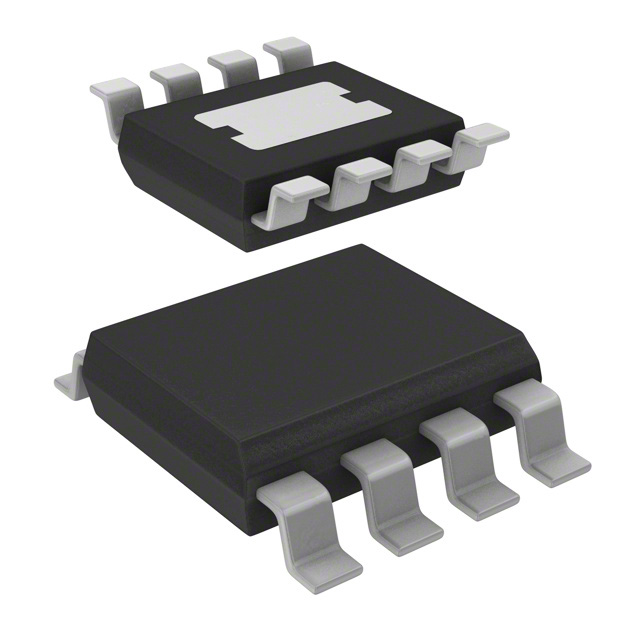
LT3002
36V 10W No-Opto Isolated
Flyback Converter
FEATURES
DESCRIPTION
4V to 36V Input Voltage Range
nn 3.6A, 65V Internal DMOS Power Switch
nn Low Quiescent Current
nn Quasi-Resonant Boundary Mode Operation at
Heavy Load
nn Low Ripple Burst Mode® Operation at Light Load
nn Minimum Load < 0.5% (Typ) of Full Output
nn No Transformer Third Winding or Opto-Isolator
Required for Output Voltage Regulation
nn Accurate EN/UVLO Threshold and Hysteresis
nn Temperature Compensation for Output Diode
nn Output Short-Circuit Protection
nn Thermally Enhanced 8-Lead SO Package
The LT®3002 is a monolithic micropower isolated flyback converter. By sampling the isolated output voltage
directly from the primary-side flyback waveform, the part
requires no third winding or opto-isolator for regulation.
The output voltage is programmed with two external
resistors and a third optional temperature compensation
resistor. Boundary mode operation provides a small magnetic solution with excellent load regulation. Low ripple
Burst Mode operation maintains high efficiency at light
load while minimizing the output voltage ripple. A 3.6A,
65V DMOS power switch is integrated along with all the
high voltage circuitry and control logic into a thermally
enhanced 8-lead SO package.
nn
APPLICATIONS
Isolated Automotive, Industrial, Medical
Power Supplies
nn Isolated Auxiliary/Housekeeping Power Supplies
nn
The LT3002 operates from an input voltage range of 4V
to 36V and delivers up to 10W of isolated output power.
The high level of integration and the use of boundary
and low ripple burst modes result in a simple to use, low
component count, and high efficiency application solution
for isolated power delivery.
All registered trademarks and trademarks are the property of their respective owners. Protected
by U.S. Patents, including 5438499, 7463497, 7471522.
TYPICAL APPLICATION
4V to 32VIN/5VOUT Isolated Flyback Converter
3:1
470pF
10µF
39Ω
VIN
SW
EN/UVLO
LT3002
GND
1µF
INTVCC
9µH
•
•
1µH
VOUT–
10mA TO 1.1A (VIN = 5V)
10mA TO 2.0A (VIN = 12V)
10mA TO 2.9A (VIN = 24V)
RREF
115k
TC
85
220µF
154k
RFB
90
VOUT+
5V
10k
EFFICIENCY (%)
VIN
4V TO 32V
Efficiency vs Load Current
80
75
70
VIN = 5V
VIN = 12V
VIN = 24V
65
3002 TA01a
60
0
0.5
2.0
1.5
1.0
LOAD CURRENT (A)
2.5
3.0
3002 TA01b
Rev. 0
Document Feedback
For more information www.analog.com
1
�LT3002
ABSOLUTE MAXIMUM RATINGS
(Note 1)
PIN CONFIGURATION
SW (Note 2)...............................................................65V
VIN.............................................................................42V
EN/UVLO.....................................................................VIN
RFB.........................................................VIN – 0.5V to VIN
Current Into RFB.....................................................200µA
INTVCC, RREF, TC..........................................................4V
Operating Junction Temperature Range (Notes 3, 4)
LT3002E, LT3002I.............................. –40°C to 125°C
Storage Temperature Range................... –65°C to 150°C
Lead Temperature (Soldering, 10 sec).................... 300°C
TOP VIEW
EN/UVLO 1
8
TC
INTVCC 2
7
RREF
6
RFB
5
SW
VIN 3
GND 4
9
GND
S8E PACKAGE
8-LEAD PLASTIC SO
θJA = 33°C/W
EXPOSED PAD (PIN 9) IS GND,
MUST BE SOLDERED TO PCB
ORDER INFORMATION
LEAD FREE FINISH
TAPE AND REEL
PART MARKING*
PACKAGE DESCRIPTION
TEMPERATURE RANGE
LT3002ES8E#PBF
LT3002ES8E#TRPBF
3002
8-Lead Plastic SO
–40°C to 125°C
LT3002IS8E#PBF
LT3002IS8E#TRPBF
3002
8-Lead Plastic SO
–40°C to 125°C
Contact the factory for parts specified with wider operating temperature ranges. *The temperature grade is identified by a label on the shipping container.
Tape and reel specifications. Some packages are available in 500 unit reels through designated sales channels with #TRMPBF suffix.
2
Rev. 0
For more information www.analog.com
�LT3002
ELECTRICAL CHARACTERISTICS
The l denotes the specifications which apply over the full operating
temperature range, otherwise specifications are at TA = 25°C. VIN = 5V, VEN/UVLO = VIN, CINTVCC = 1µF to GND, unless otherwise noted.
SYMBOL
PARAMETER
VIN
VIN Voltage Range
CONDITIONS
IQ
VIN Quiescent Current
VEN/UVLO = 0.2V
Active Mode
EN/UVLO Shutdown Threshold
For Lowest Off IQ
EN/UVLO Enable Threshold
Falling
MIN
TYP
4
0.5
380
0.2
0.75
1.178
1.214
EN/UVLO Enable Hysteresis
MAX
UNIT
36
V
2
µA
µA
V
1.250
14
V
mV
IHYS
EN/UVLO Hysteresis Current
VEN/UVLO = 1.1V
VEN/UVLO = 1.3V
2.3
–0.1
2.5
0
2.7
0.1
µA
µA
VINTVCC
INTVCC Regulation Voltage
IINTVCC = 0mA to 10mA
2.85
3
3.1
V
IINTVCC
INTVCC Current Limit
VINTVCC = 2.8V
mA
INTVCC UVLO Threshold
Falling
10
13
20
2.39
2.47
2.55
INTVCC UVLO Hysteresis
(RFB – VIN) Voltage
105
IRFB = 75µA to 125µA
–50
RREF Regulation Voltage
l
0.98
mV
50
1.00
V
mV
1.02
V
15
–200
18
µA
µA
12
12.7
kHz
VTC
TC Pin Voltage
ITC
TC Pin Current
1.00
fMIN
Minimum Switching Frequency
tON(MIN)
Minimum Switch-On Time
ISW(MAX)
Maximum Switch Current Limit
3.6
4.5
5.4
A
ISW(MIN)
Minimum Switch Current Limit
0.70
0.87
1.04
A
RDS(ON)
Switch On-Resistance
VTC = 1.2V
VTC = 0.8V
12
11.3
V
160
ISW = 1.5A
Note 1: Stresses beyond those listed under Absolute Maximum Ratings
may cause permanent damage to the device. Exposure to any Absolute
Maximum Rating condition for extended periods may affect device
reliability and lifetime.
Note 2: The SW pin is rated to 65V for transients. Depending on the
leakage inductance voltage spike, operating waveforms of the SW pin
should be derated to keep the flyback voltage spike below 65V.
Note 3: The LT3002E is guaranteed to meet performance specifications
from 0°C to 125°C junction temperature. Specifications over the –40°C
80
ns
mΩ
to 125°C operating junction temperature range are assured by design,
characterization and correlation with statistical process controls. The
LT3002I is guaranteed over the full –40°C to 125°C operating junction
temperature range.
Note 4: The LT3002 includes overtemperature protection that is intended
to protect the device during momentary overload conditions. Junction
temperature will exceed 150°C when overtemperature protection is active.
Continuous operation above the specified maximum operating junction
temperature may impair device reliability.
Rev. 0
For more information www.analog.com
3
�LT3002
TYPICAL PERFORMANCE CHARACTERISTICS
Output Load and Line Regulation
5.3
5.2
5.05
5.00
4.95
VIN = 5V
VIN = 12V
VIN = 24V
4.80
0
0.5
1.0
2.0
1.5
LOAD CURRENT (A)
2.5
RTC = 115k
5.0
RTC = OPEN
4.9
4.7
–50 –25
0
VSW
20V/DIV
VOUT
50mV/DIV
VOUT
50mV/DIV
3002 G04
VIN = 5V
VIN = 12V
VIN = 24V
0
2.0
1.0
1.5
LOAD CURRENT (A)
0.5
EN/UVLO Enable Threshold
1.010
2.5
3.0
3002 G03
Burst Mode Waveforms
VSW
20V/DIV
VOUT
50mV/DIV
2µs/DIV
FRONT PAGE APPLICATION
VIN = 12V
IOUT = 0.5A
1.240
3002 G05
20µs/DIV
FRONT PAGE APPLICATION
VIN = 12V
IOUT = 10mA
RREF Regulation Voltage
3002 G06
Switch Current Limit
5
1.008
1.235
RISING
1.006
1.230
4
MAXIMUM CURRENT LIMIT
1.004
1.220
FALLING
1.215
1.002
ISW (A)
1.225
VRREF (V)
VEN/UVLO (V)
0
25 50 75 100 125 150
TEMPERATURE (°C)
Discontinuous Mode Waveforms
VSW
20V/DIV
1.000
0.998
3
2
0.996
1.210
0.994
1.205
1
MINIMUM CURRENT LIMIT
0.992
0
25 50 75 100 125 150
TEMPERATURE (°C)
0.990
–50 –25
0
25 50 75 100 125 150
TEMPERATURE (°C)
3002 G07
4
200
3002 G02
Boundary Mode Waveforms
1.200
–50 –25
300
100
4.8
3.0
FRONT PAGE APPLICATION
400
5.1
3002 G01
2µs/DIV
FRONT PAGE APPLICATION
VIN = 12V
IOUT = 2A
500
FRONT PAGE APPLICATION
VIN = 12V
IOUT = 1A
FREQUENCY (kHz)
5.10
OUTPUT VOLTAGE (V)
OUTPUT VOLTAGE (V)
5.15
4.85
Switching Frequency
vs Load Current
Output Temperature Variation
5.20
4.90
TA = 25°C, unless otherwise noted.
3002 G08
0
–50 –25
0
25 50 75 100 125 150
TEMPERATURE (°C)
3002 G09
Rev. 0
For more information www.analog.com
�LT3002
PIN FUNCTIONS
EN/UVLO (Pin 1): Enable/Undervoltage Lockout. The
EN/UVLO pin is used to enable the LT3002. Pull the pin
below 0.3V to shut down the LT3002. This pin has an
accurate 1.214V threshold and can be used to program a
VIN undervoltage lockout (UVLO) threshold using a resistor divider from VIN to ground. A 2.5µA current hysteresis
allows the programming of VIN UVLO hysteresis. If neither
function is used, tie this pin directly to VIN.
INTVCC (Pin 2): Internal 3V Linear Regulator Output. The
INTVCC pin is supplied from VIN and powers the internal control circuitry and gate driver. Do not overdrive the
INTVCC pin with any external supply, such as a third winding supply. Locally bypass this pin to ground with a minimum 1µF ceramic capacitor.
VIN (Pin 3): Input Supply. The VIN pin supplies current to
the internal circuitry and serves as a reference voltage for
the feedback circuitry connected to the RFB pin. Locally
bypass this pin to ground with a capacitor.
GND (Pin 4, Exposed Pad Pin 9): Ground. The exposed
pad provides both electrical contact to ground and good
thermal contact to the printed circuit board. Solder the
exposed pad directly to the ground plane.
SW (Pin 5): Drain of the Internal DMOS Power Switch.
Minimize trace area at this pin to reduce EMI and
voltage spikes.
RFB (Pin 6): Input Pin for External Feedback Resistor.
Connect a resistor from this pin to the transformer primary SW pin. The ratio of the RFB resistor to the RREF
resistor, times the internal voltage reference, determines
the output voltage (plus the effect of any non-unity transformer turns ratio). Minimize trace area at this pin.
RREF (Pin 7): Input Pin for External Ground Referred
Reference Resistor. The resistor at this pin should be in
the range of 10k, but for convenience in selecting a resistor divider ratio, the value may range from 9.09k to 11.0k.
TC (Pin 8): Output Voltage Temperature Compensation.
The voltage at this pin is proportional to absolute temperature (PTAT) with temperature coefficient equal
to 3.35mV/°K, i.e., equal to 1V at room temperature
25°C. The TC pin voltage can be used to estimate the
LT3002 junction temperature. Connect a resistor from
this pin to the RREF pin to compensate the output diode
temperature coefficient.
OPERATION
The LT3002 is a current mode switching regulator IC
designed specially for the isolated flyback topology. The
key problem in isolated topologies is how to communicate the output voltage information from the isolated
secondary side of the transformer to the primary side
for regulation. Historically, opto-isolators or extra transformer windings communicate this information across
the isolation boundary. Opto-isolator circuits waste output
power, and the extra components increase the cost and
physical size of the power supply. Opto-isolators can also
cause system issues due to limited dynamic response,
nonlinearity, unit-to-unit variation and aging over lifetime.
Circuits employing extra transformer windings also exhibit
deficiencies, as using an extra winding adds to the transformer’s physical size and cost, and dynamic response
is often mediocre.
The LT3002 samples the isolated output voltage through
the primary-side flyback pulse waveform. In this manner, neither opto-isolator nor extra transformer winding
is required for regulation. Since the LT3002 operates
in either boundary conduction mode or discontinuous
conduction mode, the output voltage is always sampled
on the SW pin when the secondary current is zero. This
method improves load regulation without the need of
external load compensation components.
Rev. 0
For more information www.analog.com
5
�LT3002
APPLICATIONS INFORMATION
Output Voltage
tOFF(MIN) = Minimum switch-off time = 350ns (TYP)
The RFB and RREF resistors are external resistors used to
program the output voltage.
ISW(MIN) = Minimum switch current limit = 0.87A (TYP)
The output voltage is set by:
⎛ R ⎞ ⎛ 1 ⎞
VOUT = VREF • ⎜ FB ⎟ • ⎜
– VF
⎝ RREF ⎠ ⎝ NPS ⎟⎠
VF = Output diode forward voltage
NPS = Transformer effective primary-to-secondary
turns ratio
VREF = Internal reference voltage 1.00V
Output Temperature Compensation
To cancel the output diode temperature coefficient, the
following two equations should be satisfied:
VOUT = VREF •
(
VTC / T) •
RFB
1
•
– VF (T0 )
RREF
NPS
(
VTC / T ) = 3.35mV/ °C
The LT3002 obtains output voltage information from the
reflected output voltage on the SW pin. The conduction of
secondary current reflects the output voltage on the primary SW pin. The sample-and-hold error amplifier needs
a minimum 350ns to settle and sample the reflected output voltage. In order to ensure proper sampling, the secondary winding needs to conduct current for a minimum
of 350ns. The following equation gives the minimum
value for primary-side magnetizing inductance:
6
tOFF(MIN) •NPS • ( VOUT + VF )
ISW(MIN)
ISW(MIN)
Undervoltage Lockout (UVLO)
Primary Inductance Requirement
LPRI ≥
tON(MIN) • VIN(MAX)
In general, choose a transformer with its primary magnetizing inductance about 40% to 60% larger than the
minimum values calculated above. A transformer with
much larger inductance will have a bigger physical size
and may cause instability at light load.
T0 =Room temperature 25°C
VF / T ) = Output diode forward voltage
temperature coefficient
LPRI ≥
tON(MIN) = Minimum switch-on time = 160ns (TYP)
RFB
1
•
= – ( VF / T )
R TC
NPS
(
In addition to the primary inductance requirement for
the minimum switch-off time, the LT3002 has minimum
switch-on time that prevents the chip from turning on
the power switch shorter than approximately 160ns.
This minimum switch-on time is mainly for leading-edge
blanking the initial switch turn-on current spike. If the
inductor current exceeds the desired current limit during
that time, oscillation may occur at the output as the current control loop will lose its ability to regulate. Therefore,
the following equation relating to maximum input voltage
must also be followed in selecting primary-side magnetizing inductance:
A resistive divider from VIN to the EN/UVLO pin implements undervoltage lockout (UVLO). The EN/UVLO enable
falling threshold is set at 1.214V with 14mV hysteresis. In
addition, the EN/UVLO pin sinks 2.5µA when the voltage
on the pin is below 1.214V. This current provides user
programmable hysteresis based on the value of R1. The
programmable UVLO thresholds are:
1.228V • (R1+R2)
+ 2.5µA •R1
R2
1.214V • (R1+R2)
VIN(UVLO– ) =
R2
VIN(UVLO+ ) =
Figure 1 shows the implementation of external shutdown
control while still using the UVLO function. The NMOS
grounds the EN/UVLO pin when turned on, and puts the
LT3002 in shutdown with quiescent current less than 2µA.
Rev. 0
For more information www.analog.com
�LT3002
APPLICATIONS INFORMATION
Step 1: Select the transformer turns ratio.
VIN
R1
R2
LT3002
GND
Minimum Load Requirement
The LT3002 samples the isolated output voltage from the
primary-side flyback pulse waveform. The flyback pulse
occurs once the primary switch turns off and the secondary winding conducts current. In order to sample the
output voltage, the LT3002 has to turn on and off for a
minimum amount of time and with a minimum frequency.
The LT3002 delivers a minimum amount of energy even
during light load conditions to ensure accurate output
voltage information. The minimum energy delivery creates a minimum load requirement, which can be approximately estimated as:
ILOAD(MIN) =
LPRI •ISW(MIN)2 • fMIN
2 • VOUT
VOUT + VF
Example:
3002 F01
Figure 1. Undervoltage Lockout (UVLO)
65V – VIN(MAX) – VLEAKAGE
VLEAKAGE = Margin for transformer leakage spike = 15V
VF = Output diode forward voltage = ~0.3V
EN/UVLO
RUN/STOP
CONTROL
(OPTIONAL)
NPS <
NPS <
65V – 32V – 15V
= 3.4
5V + 0.3V
The choice of transformer turns ratio is critical in determining output current capability of the converter. Table 1
shows the switch voltage stress and output current capability at different transformer turns ratio.
Table 1. Switch Voltage Stress and Output Current Capability vs
Turns Ratio
NPS
VSW(MAX) at
VIN(MAX) (V)
IOUT(MAX) at
VIN(MIN) (A)
DUTY CYCLE (%)
1:1
37.3
0.92
14-40
2:1
42.6
1.31
25-57
3:1
47.9
1.53
33-67
Clearly, only NPS = 3 can meet the 1.5A output current
requirement, so NPS = 3 is chosen as the turns ratio in
this example.
Step 2: Determine the primary inductance.
LPRI = Transformer primary inductance
ISW(MIN) = Minimum switch current limit = 1.04A (MAX)
fMIN = Minimum switching frequency = 12.7kHz (MAX)
The LT3002 typically needs less than 0.5% of its full output power as minimum load. Alternatively, a Zener diode
with its breakdown of 10% higher than the output voltage
can serve as a minimum load if pre-loading is not acceptable. For a 5V output, use a 5.6V Zener with cathode connected to the output.
Design Example
Use the following design example as a guide to designing
applications for the LT3002. The design example involves
designing a 5V output with a 1.5A load current and an
input range from 8V to 32V.
Primary inductance for the transformer must be set above
a minimum value to satisfy the minimum switch-off and
switch-on time requirements:
LPRI ≥
LPRI ≥
tOFF(MIN) • NPS • ( VOUT + VF )
ISW(MIN)
tON(MIN) • VIN(MAX)
ISW(MIN)
tOFF(MIN) = 350ns
tON(MIN) = 160ns
ISW(MIN) = 0.87A
VIN(MIN) = 8V, VIN(NOM) = 12V, VIN(MAX) = 32V,
VOUT = 5V, IOUT = 1.5A
For more information www.analog.com
Rev. 0
7
�LT3002
APPLICATIONS INFORMATION
Example:
needs to conduct much higher current. Therefore, a conservative metric is 60% of the maximum switch current
limit multiplied by the turns ratio:
350ns • 3 • ( 5V + 0.3V )
= 6.4µH
0.87A
160ns • 32V
= 5.9µH
LPRI ≥
0.87A
LPRI ≥
IDIODE(MAX) = 0.6 • ISW(MAX) • NPS
Example:
Most transformers specify primary inductance with a tolerance of ±20%. With other component tolerance considered, choose a transformer with its primary inductance
40% to 60% larger than the minimum values calculated
above. LPRI = 9µH is then chosen in this example.
IDIODE(MAX) = 8.1A
Once the primary inductance has been determined, the
maximum load switching frequency can be calculated as:
1
1
fSW =
=
LPRI •ISW
tON + tOFF LPRI •ISW +
VIN
NPS • ( VOUT + VF )
ISW =
VOUT •IOUT • 2
η • VIN • D
VREVERSE = VOUT +
VIN(MAX)
NPS
Example:
VREVERSE = 5V +
32V
= 15.7V
3
The PDS835L (8A, 35V diode) from Diodes Inc. is chosen.
Step 4: Choose the output capacitor.
The output capacitor should be chosen to minimize the
output voltage ripple while considering the increase in size
and cost of a larger capacitor. Use the following equation
to calculate the output capacitance:
Example:
D=
Next calculate reverse voltage requirement using maximum VIN:
(5V + 0.3V ) • 3 = 0.57
(5V + 0.3V ) • 3 + 12V
5V • 1.5A • 2
ISW =
0.8 • 12V • 0.57
fSW = 277kHz
COUT =
LPRI •ISW2
2 • VOUT • ΔVOUT
Example:
The transformer also needs to be rated for the correct
saturation current level across line and load conditions.
A saturation current rating larger than 7A is necessary to
work with the LT3002.
Design for output voltage ripple less than ±1% of VOUT,
i.e., 100mV.
Step 3: Choose the output diode.
Two main criteria for choosing the output diode include
forward current rating and reverse-voltage rating. The
maximum load requirement is a good first-order guess
at the average current requirement for the output diode.
Under output short-circuit condition, the output diode
8
COUT
2
9µH • ( 4.5A )
=
= 182µF
2 • 5V • 0.1V
Remember ceramic capacitors lose capacitance with
applied voltage. The capacitance can drop to 40% of quoted
capacitance at the maximum voltage rating. So a 220µF,
6.3V rating X5R or X7R ceramic capacitor is chosen.
Rev. 0
For more information www.analog.com
�LT3002
APPLICATIONS INFORMATION
Step 5: Design snubber circuit.
Step 7: Adjust RFB resistor based on output voltage.
The snubber circuit protects the power switch from leakage inductance voltage spike. A (RC + DZ) snubber is
recommended for this application. A 470pF capacitor in
series with a 39Ω resistor is chosen as the RC snubber.
Build and power up the application with application components and measure the regulated output voltage. Adjust
RFB resistor based on the measured output voltage:
The maximum Zener breakdown voltage is set according
to the maximum VIN:
VZENNER(MAX) ≤ 60V – VIN(MAX)
A 24V Zener with a maximum of 26V will provide optimal
protection and minimize power loss. So a 24V, 1.5W Zener
from Central Semiconductor (CMZ5934B) is chosen.
VOUT
VOUT(MEASURED)
• RFB
Example:
Example:
VZENNER(MAX) ≤ 60V – 32V = 28V
RFB(NEW) =
RFB =
5V
• 158k = 154k
5.14V
Step 8: Select RTC resistor based on output voltage temperature variation.
VREVERSE > VSW(MAX)
Measure output voltage in a controlled temperature environment like an oven to determine the output temperature
coefficient. Measure output voltage at a consistent load
current and input voltage, across the operating temperature range.
VSW(MAX) = VIN(MAX) + VZENNER(MAX)
Calculate the temperature coefficient of VF:
Choose a diode that is fast and has sufficient reverse voltage breakdown:
Example:
VOUT ( T1) – VOUT ( T2)
T1– T2
3.35mV/°C ⎛ RFB ⎞
RTC =
•
– ( δVF /δT ) ⎜⎝ NPS ⎟⎠
– ( δVF /δT ) =
VREVERSE > 60V
A 100V, 1A diode from Diodes Inc. (DFLS1100) is chosen.
Step 6: Select the RREF and RFB resistors.
Use the following equation to calculate the starting values
for RREF and RFB:
Example:
RFB =
(
– ( δVF /δT ) =
)
RREF • NPS • VOUT + VF ( T0 )
VREF
RTC =
5.189V – 5.041V
= 1.48mV / °C
100°C – ( 0°C)
3.35mV/°C ⎛ 154 ⎞
•⎜
⎟ = 115k
1.48mV/°C ⎝ 3 ⎠
RREF = 10k
Example:
Step 9: Select the EN/UVLO resistors.
RFB =
Determine the amount of hysteresis required and calculate R1 resistor value:
10k • 3 • ( 5V + 0.3V )
= 159k
1.00V
For 1% standard values, a 158k resistor is chosen.
VIN(HYS) = 2.5µA • R1
Example:
Choose 2V of hysteresis, R1 = 806k
Rev. 0
For more information www.analog.com
9
�LT3002
APPLICATIONS INFORMATION
Determine the UVLO thresholds and calculate R2 resistor
value:
1.228V • (R1+ R2)
VIN(UVLO+) =
+ 2.5µA • R1
R2
Step 10: Ensure minimum load.
The theoretical minimum load can be approximately estimated as:
ILOAD(MIN) =
2
9µH • ( 1.04A ) • 12.7kHz
=12.4mA
2 • 5V
Example:
Set VIN UVLO rising threshold to 7.5V:
Remember to check the minimum load requirement in
real application. The minimum load occurs at the point
where the output voltage begins to climb up as the converter delivers more energy than what is consumed at
the output. The real minimum load for this application is
about 10mA. In this example, a 500Ω resistor is selected
as the minimum load.
R2 = 232k
VIN(UVLO+) = 7.5V
VIN(UNLO–) = 5.5V
10
Rev. 0
For more information www.analog.com
�LT3002
PACKAGE DESCRIPTION
S8E Package
8-Lead Plastic SOIC (Narrow .150 Inch) Exposed Pad
(Reference LTC DWG # 05-08-1857 Rev C)
.050
(1.27)
BSC
.189 – .197
(4.801 – 5.004)
NOTE 3
.045 ±.005
(1.143 ±0.127)
8
.089
.160 ±.005
(2.26) (4.06 ±0.127)
REF
.245
(6.22)
MIN
.150 – .157
.080 – .099
(2.032 – 2.530) (3.810 – 3.988)
NOTE 3
.228 – .244
(5.791 – 6.197)
1
.030 ±.005
(0.76 ±0.127)
TYP
.005 (0.13) MAX
7
5
6
.118
(2.99)
REF
3
2
.118 – .139
(2.997 – 3.550)
4
RECOMMENDED SOLDER PAD LAYOUT
.010 – .020
× 45°
(0.254 – 0.508)
.008 – .010
(0.203 – 0.254)
.053 – .069
(1.346 – 1.752)
0°– 8° TYP
.016 – .050
(0.406 – 1.270)
NOTE:
1. DIMENSIONS IN
.014 – .019
(0.355 – 0.483)
TYP
INCHES
(MILLIMETERS)
2. DRAWING NOT TO SCALE
3. THESE DIMENSIONS DO NOT INCLUDE MOLD FLASH OR PROTRUSIONS.
MOLD FLASH OR PROTRUSIONS SHALL NOT EXCEED .010" (0.254mm)
4.
STANDARD LEAD STANDOFF IS 4mils TO 10mils (DATE CODE BEFORE 542)
5.
LOWER LEAD STANDOFF IS 0mils TO 5mils (DATE CODE AFTER 542)
4
5
.004 – .010
0.0 – 0.005
(0.101 – 0.254) (0.0 – 0.130)
.050
(1.270)
BSC S8E 1015 REV C
Rev. 0
Information furnished by Analog Devices is believed to be accurate and reliable. However, no responsibility is assumed by Analog
Devices for its use, nor for any infringements of patents or other rights of third parties that may result from its use. Specifications
subject to change without notice. No license For
is granted
implication or
otherwise under any patent or patent rights of Analog Devices.
more by
information
www.analog.com
11
�LT3002
12
Rev. 0
08/19
www.analog.com
For more information www.analog.com
ANALOG DEVICES, INC. 2019
�