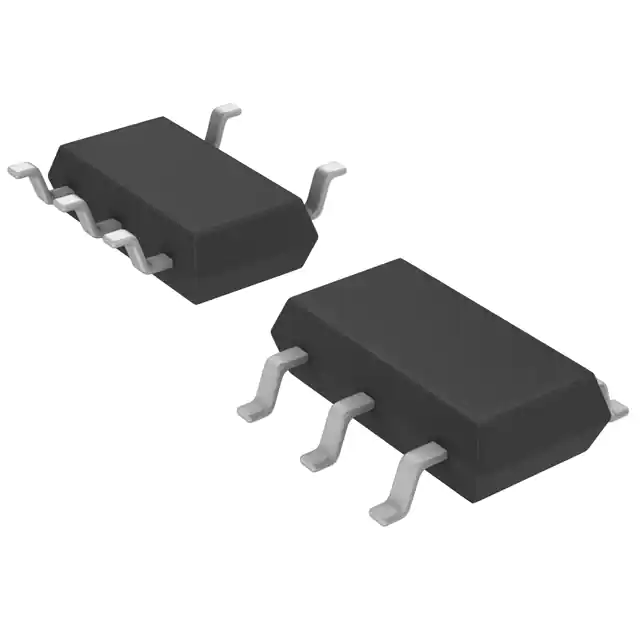
LT6274/LT6275
90MHz, 2200V/µs
30V Low Power Op Amps
FEATURES
DESCRIPTION
2200V/μs Slew Rate
nn 90MHz –3dB Bandwidth (A = +1)
V
nn 40MHz Gain-Bandwidth Product
nn 1.6mA Supply Current per Amplifier
nn C-Load™ Op Amp Drives All Capacitive Loads
nn ±4.5V to ±16V Operating Supply Range
nn Unity-Gain Stable
nn 10nV/√Hz Input Noise Voltage
nn 400µV Maximum Input Offset Voltage
nn 500nA Maximum Input Bias Current
nn 30nA Maximum Input Offset Current
nn ±13.25V Minimum Output Swing into 1k (±15V Supply)
nn ±3.5V Minimum Output Swing into 500Ω (±5V Supply)
nn 74dB Minimum Open-Loop Gain, R = 1k
L
nn 40ns Settling Time to 1%, 10V Step
nn Specified at ±5V and ±15V
nn Single in 5-Lead TSOT-23 Package
nn Dual in 8-Lead MSOP Package
The LT®6274/LT6275 are single/dual low power, high
speed, very high slew rate operational amplifiers with
outstanding AC and DC performance. The circuit topology
is a voltage feedback amplifier with matched high impedance inputs plus the enhanced slewing performance of a
current feedback amplifier. The high slew rate and single
stage design provide excellent settling characteristics that
make the circuit an ideal choice for data acquisition systems. Each output drives a 1k load to ±13.25V with ±15V
supplies and a 500Ω load to ±3.5V on ±5V supplies. The
LT6274/LT6275 are stable with any capacitive load making them useful in buffer or cable driving applications.
nn
APPLICATIONS
The LT6274 single op amp is available in a 5-lead TSOT‑23
package, and the LT6275 dual op amp is available in an
8-lead MSOP package. They operate with guaranteed
specifications over the –40°C to 85°C and –40°C to 125°C
temperature ranges.
All registered trademarks and trademarks are the property of their respective owners. All other
trademarks are the property of their respective owners.
Wideband Large Signal Amplification
Cable Drivers
nn Buffers
nn Automated Test Equipment
nn Data Acquisition Systems
nn High Fidelity Video and Audio Amplification
nn
nn
TYPICAL APPLICATION
Undistorted Output Swing vs Frequency
30
Wideband Large Signal Amplification
+
10V
VIN
–10V
1k
10V
LT6274
VOUT
–
–10V
–15V
1k
AV = –1
FPBW = 3MHz
6275 TA01
OUTPUT VOLTAGE (VP-P)
25
15V
AV = –1
20
15
10
AV = –10
AV = +1
5 VS = ±15V
RL = 1k
1% MAX DISTORTION
0
100k
1M
10M
FREQUENCY (Hz)
100M
6275 G31
6275fa
For more information www.linear.com/LT6275
1
�LT6274/LT6275
ABSOLUTE MAXIMUM RATINGS
(Note 1)
Total Supply Voltage
(V+ – V–)....................................................................34V
Differential Input Voltage
(Transient Only) (Note 2)......................................... ±10V
Input Voltage....................................................... V– to V+
Input Current
(+IN, –IN) (Note 3)................................................ ±10mA
Output Current (Note 12)................................115mARMS
Output Short-Circuit Current Duration
(Note 4)...........................................Thermally Limited
Operating Temperature Range (Note 5)
LT6274I/LT6275I...................................–40°C to 85°C
LT6274H/LT6275H.............................. –40°C to 125°C
Specified Temperature Range (Note 6)
LT6274I/LT6275I...................................–40°C to 85°C
LT6274H/LT6275H.............................. –40°C to 125°C
Maximum Junction Temperature........................... 150°C
Storage Temperature Range................... –65°C to 150°C
Lead Temperature (Soldering, 10 sec).................... 300°C
PIN CONFIGURATION
TOP VIEW
–
+
OUTA
–INA
+INA
V–
+IN 3
4 –IN
–
+
8
7
6
5
V+
OUTB
–INB
+INB
MS8 PACKAGE
8-LEAD PLASTIC MSOP
TJMAX = 150°C, qJA = 163°C/W
S5 PACKAGE
5-LEAD PLASTIC TSOT-23
θJA = 215°C/W
ORDER INFORMATION
1
2
3
4
+
–
V– 2
TOP VIEW
5 V+
OUT 1
http://www.linear.com/product/LT6275#orderinfo
TUBE
TAPE AND REEL
PART MARKING*
PACKAGE DESCRIPTION
SPECIFIED TEMPERATURE RANGE
LT6274IS5#PBF
LT6274IS5 #TRPBF
LTHCY
5-Lead Plastic TSOT-23
–40°C to 85°C
LT6274HS5#PBF
LT6274HS5 #TRPBF
LTHCY
5-Lead Plastic TSOT-23
–40°C to 125°C
LT6275IMS8#PBF
LT6275IMS8 #TRPBF
LTFYV
8-Lead Plastic MSOP
–40°C to 85°C
LT6275HMS8#PBF
LT6275HMS8 #TRPBF
LTFYV
8-Lead Plastic MSOP
–40°C to 125°C
*The temperature grade is identified by a label on the shipping container.
Consult LTC Marketing for parts specified with wider operating temperature ranges. Parts ending with PBF are RoHS and WEEE compliant.
For more information on lead free part marking, go to: http://www.linear.com/leadfree/
For more information on tape and reel specifications, go to: http://www.linear.com/tapeandreel/. Some packages are available in 500 unit reels through
designated sales channels with #TRMPBF suffix.
2
6275fa
For more information www.linear.com/LT6275
�LT6274/LT6275
ELECTRICAL CHARACTERISTICS
The l denotes the specifications which apply over the full operating
temperature range, otherwise specifications are at TA = 25°C. Unless noted otherwise, VCM = 0V, and specifications apply at both
VS = (V+ – V–) = ±5V and ±15V.
SYMBOL PARAMETER
VOS
CONDITIONS
MIN
Input Offset Voltage (Note 7)
TYP
MAX
UNITS
±0.15
±0.4
±1.2
mV
mV
±4
±10
µV/°C
±100
±500
±1000
nA
nA
±3
±30
±50
nA
nA
l
∆VOS/∆T
Input Offset Voltage Drift (Note 8)
IB
Input Bias Current
l
l
IOS
Input Offset Current
l
en
Input Voltage Noise Density
Low Frequency Integrated Voltage Noise
1/f
1/f Noise Corner Frequency
f = 1kHz
10
nV/√Hz
0.1Hz to 10Hz
1
µVP-P
Voltage Noise
Current Noise
30
70
Hz
Hz
in
Input Current Noise Density
f = 1kHz
RIN
Input Resistance
Common Mode, VCM = ±12V, VS = ±15V
Differential Mode
CIN
Input Capacitance
Common Mode
Differential Mode
VINCM
Input Voltage Range + (Note 9)
VS = ±15V
VS = ±5V
l
l
Input Voltage Range – (Note 9)
VS = ±15V
VS = ±5V
l
l
CMRR
Common Mode Rejection Ratio
VS = ±15V, VCM = ±12V
VS = ±5V, VCM = ±2.5V
l
l
90
80
110
102
PSRR
Power Supply Rejection Ratio
VS = ±4.5V to ±16V
l
90
115
VS
Supply Voltage Range (Note 10)
l
9
l
100
12
2.5
0.5
pA/√Hz
700
20
MΩ
MΩ
3
0.4
pF
pF
13.4
3.4
V
V
–13.2
–3.2
–12
–2.5
V
V
dB
dB
dB
32
V
Channel Separation
VS = ±15V, VOUT = ±1V, AV = 1, RL = 1kΩ
l
100
126
dB
AVOL
Open-Loop Voltage Gain
VS = ±15V, VOUT = ±12V, RL = 1kΩ
VS = ±5V, VOUT = ±2.5V, RL = 500Ω
l
l
74
68
90
84
dB
dB
VOUT
Maximum Output Voltage Swing
±40mV Input Overdrive
VS = ±15V, RL = 1kΩ
VS = ±5V, RL = 500Ω
l
l
±13.25
±3.5
±13.5
±3.8
V
V
IOUT
Output Current
VS = ±15V, VOUT = ±12V, VIN = ±40mV
VS = ±5V, VOUT = ±2.5V, VIN = ±40mV
l
l
±15
±12
±35
±30
mA
mA
ISC
Output Short-Circuit Current
VS = ±15V, VOUT = 0V, VIN = ±3V
VS = ±5V, VOUT = 0V, VIN = ±3V
l
l
±35
±30
±90
±80
mA
mA
IS
Supply Current
Per Amplifier, VS = ±15V
1.6
l
SR
Slew Rate (Note 11)
VS = ±15V, AV = 1
VS = ±15V, AV = –1
VS = ±15V, AV = –2
VS = ±5V, AV = –2
FPBW
Full Power Bandwidth
VS = ±15V, 10V Peak, AV = –1, 1 gain configurations slows down the response, but
increases the excursion. The resulting maximum slew rate
remains the same.
Figure 2 shows the output response to varying input step
amplitudes. Note that none of the exponential responses
is limited by the initial slew rate (which increases with
increasing amplitude).
The LT6274/LT6275 feature ample slew rate capability
with low power consumption. Because the input stage
architecture allows high slew rate with low input stage
quiescent currents, the overall power consumption when
amplifying pulses is very low; additional power is only
drawn from the supplies during the highest slew rate
moments of the exponential response.
Since GBW of the LT6274/LT6275 is 40MHz, Equation (3)
suggests that the maximum slew rate in a step response
whose output swings 25V (implying VINPUTSTEP = 25/11
= 2.27V) is 571V/µs. The LT6274/LT6275 high slew
14
As a particular example, with AV = +11V/V, 15V output
excursion, and 40 MHz GBW, Equation (3) predicts a
maximum slew rate of 343V/μs. Measurement on the corresponding curve in Figure 2 shows 390V/μs, which is in
good agreement with the prediction. As another example,
with an 18.5V output excursion, the predicted maximum
slew rate is 423V/μs; measurement shows 460V/μs.
As the peak to peak voltage of the input step changes, the
maximum initial slew rate changes. The 63% rise time
of the closed loop response, however, does not change
(as seen in Figure 2), because the closed loop bandwidth
stays constant for all input amplitudes.
6275fa
For more information www.linear.com/LT6275
�LT6274/LT6275
TYPICAL APPLICATIONS
Using the LT6274/LT6275 to Create a Composite
Amplifier with High Gain, High Bandwidth and Large
Output Signal Capability
While the LT6274/LT6275 provide ample slew rate and
large output swing capability, the GBW is not so large
as to achieve high gain, high bandwidth, and high amplitude at the same time. The circuit of Figure 3 harnesses
the high slew rate capability of the LT6275 by placing it
under control of the LTC6252, an op amp with greater
than 700MHz GBW. The LTC6252 offers high bandwidth
at low supply current, but with limited slew rate and limited output swing (since it is a 5V op amp). By creating a
composite amplifier adding the LT6275 as a high-voltage,
high-slew secondary op amp, this composite amplifier
enables large output swing at high frequencies with relatively low power dissipation.
Circuit Description
R4 and R1 realize inverting gain of –11V/V from VIN to
VOUT. The LT6275 op amp drives the output based on
whatever is commanded by the middle node, VMID. The
LTC6252 is very fast relative to the LT6275. As a consequence, the LTC6252 controlling first stage can force the
LT6275 output to move quickly by providing sufficient
differential input voltage to the LT6275. With the inverting
input of the LT6275 tied to a DC bias voltage, the LTC6252
needs merely to drive the noninverting input.
Unlike the LTC6252, the LT6275 slew rate increases linearly with its differential input voltage. Hence, the LTC6252
benefits from using the LT6275 as a slew enhancer.
reduces the LTC6252 phase shift, but it also adds to the
gain burden of the LT6275.
R2 was selected to take a gain of 2V/V in the LTC6252,
implying a gain of 5.5V/V being taken in the LT6275. The
5.5V/V gain is required to translate the 5V maximum output swing of the LTC6252 to the 27.5V maximum output
swing of the LT6275 (when operated at ±15V supplies). It
may be possible to achieve even higher bandwidth in the
composite amplifier if a high speed ±5V (rather than 5V,
0V) op amp replaces the LTC6252 as the first stage, with
the resulting increased first-stage output swing lowering
the gain that has to be taken in the LT6275.
Capacitor C7 in Figure 3 is adjusted to create a favorable
looking transient response. Figure 4 shows the transient
response at the output of the LT6275 as C7 varies. C7 =
3pF was chosen.
DC Biasing
In the circuit of Figure 3, LTC6252 supplies were chosen to be 5V and 0V, which are more practical than split
±2.5V supplies. R5 and R6 form a resistive divider to
bias the noninverting input of LTC6252 and the inverting
input of LT6275 at the middle of this rail, 2.5V. Note that
this approach results in the output of LT6275 having a DC
offset of 2.5V, which reduces the potential peak to peak
output excursion of the composite amplifier since LT6275
is powered up from split ±15V supplies.
C1
1µ
VIN
R1
1k
R4
C7
Optimizing the Loop
Larger R2 increases the local gain taken by the LTC6252.
Since the total gain is fixed by the global feedback around
the composite amplifier (AV = –R4/R1 = –11V/V), raising
the gain in the LTC6252 lowers the gain requirement of
the LT6275, increasing the overall bandwidth of the composite amplifier. Care must be taken to not take too much
gain in the LTC6252, as the reduction in the LTC6252
bandwidth and the resulting additional phase shift seen
at the output of the LTC6252 can lower the stability margins of the composite amplifier. Conversely, smaller R2
R2
2k
11k
3p
+15V
5V
5V
LTC6252
1/2 LT6275
VMID
–15V
C2
1µ
VOUT
R3
10k
R5
10k
R6
10k
6275 TA08
C5
1µ
Figure 3. Composite Amplifier Using
LTC6252 and LT6275 (AV = –11V/V)
6275fa
For more information www.linear.com/LT6275
15
�LT6274/LT6275
TYPICAL APPLICATIONS
Pulse Response
15
Sine Waves
9
OUTPUT VOLTAGE (V)
6
3
0
–3
–6
–9
–12
–15
200ns/DIV
6275 TA12
Figure 5. Composite Amplifier Step Response at
Various Output Step Amplitudes (AV = –11V/V)
25
225
20
180
15
135
10
90
5
45
0
0
–5
–45
–10
–90
PHASE (DEG)
The composite amplifier of Figure 3 was also tested with
sine waves. Figure 6 shows the small signal closed-loop
gain and phase response. Distortion was also evaluated
for this circuit: for a 20VP-P output signal at 1MHz, HD2/
HD3 were measured to be –55dBc/–47dBc, respectively.
These numbers are more impressive when considering the very low power dissipation of the composite
amplifier, as illustrated in Figure 7. For example, for the
20VP-P/1MHz output condition mentioned above, the 5V
rail supply current is 3.75mA, for 1/2 LT6275 the ±15V
rails supply current is 2.2mA, resulting in a total power
dissipation of 85mW.
12
GAIN (dB)
Figure 5 shows the output step response of the composite
amplifier (measured at the output of the LT6275) at many
different amplitudes. At 15V output excursion, the initial
slope is measured to be 725V/μs. This slope is faster than
the 390V/μs measured with a 15V output excursion using
the simple noninverting amplifier of Figure 1. According
to Equation (3), this improvement has been made possible because the effective bandwidth of the composite
amplifier is higher (and thus has a lower τo), as intended.
–135
–15
–20
–25
0.1
GAIN
PHASE
–180
–225
100
1
10
FREQUENCY (MHz)
6275 TA14
Figure 6. Composite Amplifier Closed-Loop
Gain/Phase vs Frequency
10
150
5
8
USING 1/2 LT6275
2
0
–2
SUPPLY CURRENT (mA)
8pF
5pF
3pF
1pF
NO CAP
4
–4
–6
250ns/DIV
6275 TA09
Figure 4. Composite Amplifier Step Response
vs LTC6252 Feedback Capacitance (AV = –11V/V)
16
120
3
90
2
60
5V SUPPLY CURRENT
±15V SUPPLY CURRENT
TOTAL POWER
1
–8
–10
4
0
30
OUTPUT = 20VP–P
0
0.5
1
1.5
FREQUENCY (MHz)
POWER (mW)
OUTPUT VOLTAGE (V)
6
2
0
6275 TA15
Figure 7. Composite Amplifier Supply
Current and Total Power Dissipation
6275fa
For more information www.linear.com/LT6275
�LT6274/LT6275
PACKAGE DESCRIPTION
Please refer to http://www.linear.com/product/LT6274#packaging for the most recent package drawings.
S5 Package
5-Lead Plastic TSOT-23
(Reference LTC DWG # 05-08-1635)
0.62
MAX
0.95
REF
2.90 BSC
(NOTE 4)
1.22 REF
1.4 MIN
3.85 MAX 2.62 REF
2.80 BSC
1.50 – 1.75
(NOTE 4)
PIN ONE
RECOMMENDED SOLDER PAD LAYOUT
PER IPC CALCULATOR
0.30 – 0.45 TYP
5 PLCS (NOTE 3)
0.95 BSC
0.80 – 0.90
0.20 BSC
0.01 – 0.10
1.00 MAX
DATUM ‘A’
0.30 – 0.50 REF
0.09 – 0.20
(NOTE 3)
NOTE:
1. DIMENSIONS ARE IN MILLIMETERS
2. DRAWING NOT TO SCALE
3. DIMENSIONS ARE INCLUSIVE OF PLATING
4. DIMENSIONS ARE EXCLUSIVE OF MOLD FLASH AND METAL BURR
5. MOLD FLASH SHALL NOT EXCEED 0.254mm
6. JEDEC PACKAGE REFERENCE IS MO-193
1.90 BSC
S5 TSOT-23 0302
6275fa
For more information www.linear.com/LT6275
17
�LT6274/LT6275
PACKAGE DESCRIPTION
Please refer to http://www.linear.com/product/LT6275#packaging for the most recent package drawings.
MS8 Package
8-Lead Plastic MSOP
(Reference LTC DWG # 05-08-1660 Rev G)
0.889 ±0.127
(.035 ±.005)
5.10
(.201)
MIN
3.20 – 3.45
(.126 – .136)
3.00 ±0.102
(.118 ±.004)
(NOTE 3)
0.65
(.0256)
BSC
0.42 ± 0.038
(.0165 ±.0015)
TYP
8
7 6 5
0.52
(.0205)
REF
RECOMMENDED SOLDER PAD LAYOUT
0.254
(.010)
3.00 ±0.102
(.118 ±.004)
(NOTE 4)
4.90 ±0.152
(.193 ±.006)
DETAIL “A”
0° – 6° TYP
GAUGE PLANE
0.53 ±0.152
(.021 ±.006)
DETAIL “A”
1
2 3
4
1.10
(.043)
MAX
0.86
(.034)
REF
0.18
(.007)
SEATING
PLANE
0.22 – 0.38
(.009 – .015)
TYP
0.65
(.0256)
BSC
0.1016 ±0.0508
(.004 ±.002)
MSOP (MS8) 0213 REV G
NOTE:
1. DIMENSIONS IN MILLIMETER/(INCH)
2. DRAWING NOT TO SCALE
3. DIMENSION DOES NOT INCLUDE MOLD FLASH, PROTRUSIONS OR GATE BURRS.
MOLD FLASH, PROTRUSIONS OR GATE BURRS SHALL NOT EXCEED 0.152mm (.006") PER SIDE
4. DIMENSION DOES NOT INCLUDE INTERLEAD FLASH OR PROTRUSIONS.
INTERLEAD FLASH OR PROTRUSIONS SHALL NOT EXCEED 0.152mm (.006") PER SIDE
5. LEAD COPLANARITY (BOTTOM OF LEADS AFTER FORMING) SHALL BE 0.102mm (.004") MAX
18
6275fa
For more information www.linear.com/LT6275
�LT6274/LT6275
REVISION HISTORY
REV
DATE
DESCRIPTION
A
12/17
Added LT6274
Updated Power Dissipation section
PAGE NUMBER
All
13
6275fa
Information furnished by Analog Devices is believed to be accurate and reliable. However, no responsibility is assumed by Analog
Devices for its use, nor for any infringements of patents or other rights of third parties that may result from its use. Specifications
subject to change without notice. No license
is granted
by implication
or otherwise under any patent or patent rights of Analog Devices.
For more
information
www.linear.com/LT6275
19
�LT6274/LT6275
TYPICAL APPLICATION
Composite Amplifier Provides 18-Bit Precision and Fast Settling
15V
12V
IN
LTC6655-5
+
OUT
LT1012
0.1µF
10µF
–
–15V
1
14
10k 23
10k 17
25
4
19
20
21
22
VDD
ROFS
5
3
RIN
RCOM
100pF
2
REF
RFB
LDAC
IOUT1
27, 28
VOUT
1k
26
LTC2756
CLR
10k
VOSADJ
M-SPAN
S0
–
1µF
LTC2054HV
S2
9
SDI
SCK
10
11
SRO
15V
+
+
10Ω
–5V
CCOMP
1/2 LT6275
–
–5V
5pF
1µF
6275 TA13
12
SPI BUS
1k
5V
LTC6240HV
+
IOUT2 7
6, 8, 13,
15, 16, 24
GND
S1
CS/LD
5V
10k
GEADJ
–
–15V
4.02k
DAC with Composite Amplifier Output Response
(Varying Compensation Capacitance)
1k
14
12
OUTPUT RESPONSE (V)
10
8
6
4
CCOMP
2
100pF
68pF
30pF
22pF
15pF
10pF
0
–2
–4
–6
–8
–10
–2
–1
0
1
2
3
4
TIME (µs)
5
6
7
6275 TA14
RELATED PARTS
PART NUMBER
DESCRIPTION
COMMENTS
LT1351/LT1352/LT1353
Single/Dual/Quad 3MHz, 200V/µs, C-Load Amplifiers
250µA Supply Current, 600µV Max VOS, 5V to 30V Supply Operation
LT1354/LT1355/LT1356
Single/Dual/Quad 12MHz, 400V/μs, C-Load Amplifiers
1mA Supply Current, 800µV Max VOS, 5V to 30V Supply Operation
LT1357/LT1358/LT1359
Single/Dual/Quad 25MHz, 600V/μs, C-Load Amplifiers
2mA Supply Current, 600µV Max VOS, 5V to 30V Supply Operation
LT1360/LT1361/LT1362
Single/Dual/Quad 50MHz, 800V/μs, C-Load Amplifiers
4mA Supply Current, 1mV Max VOS, 5V to 30V Supply Operation
LT1363/LT1364/LT1365
Single/Dual/Quad 70MHz, 1000V/μs, C-Load Amplifiers 6.3mA Supply Current, 1.5mV Max VOS, 5V to 30V Supply Operation
LT1812/LT1813/LT1814
Single/Dual/Quad 100MHz, 750V/μs Op Amps
3mA Supply Current, 1.5mV Max VOS, 4V to 11V Supply Operation
LTC6261/LTC6262/LTC6263 Single/Dual/Quad 30MHz, 7V/µs Op Amps
240µA Supply Current, 400µV Max VOS, 1.8V to 5.25V Supply Operation
LTC6246/LTC6247/LTC6248 Single/Dual/Quad 180MHz, 90V/µs Op Amps
0.95mA Supply Current, 500µV Max VOS, 2.5V to 5.25V Supply Operation
LTC6252/LTC6253/LTC6254 Single/Dual/Quad 720MHz, 280V/µs Op Amps
3.3mA Supply Current, 350µV Max VOS, 2.5V to 5.25V Supply Operation
20
6275fa
LT 1217 REV A • PRINTED IN USA
For more information www.linear.com/LT6275
www.linear.com/LT6275
ANALOG DEVICES, INC. 2017
�