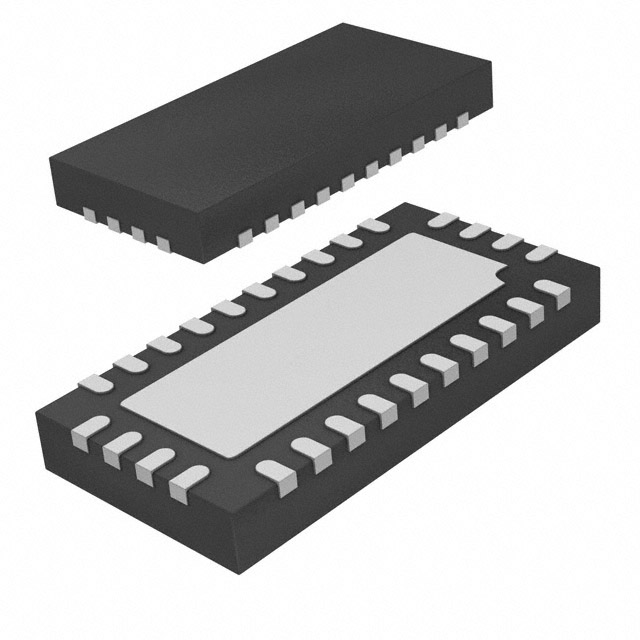
LT8613
42V, 6A Synchronous
Step-Down Regulator with
Current Sense and 3µA
Quiescent Current
DESCRIPTION
FEATURES
Rail-to-Rail Current Sense Amplifier with Monitor
n Wide Input Voltage Range: 3.4V to 42V
n Ultralow Quiescent Current Burst Mode® Operation:
n 3μA I Regulating 12V to 3.3V
Q
IN
OUT
n Output Ripple < 10mV
P-P
n High Efficiency Synchronous Operation:
n 95% Efficiency at 3A, 5V
OUT from 12VIN
n 94% Efficiency at 3A, 3.3V
OUT from 12VIN
n Fast Minimum Switch-On Time: 40ns
n Low Dropout Under All Conditions: 250mV at 3A
n Allows Use of Small Inductors
n Low EMI
n Adjustable and Synchronizable: 200kHz to 2.2MHz
n Current Mode Operation
n Accurate 1V Enable Pin Threshold
n Internal Compensation
n Output Soft-Start and Tracking
n Small Thermally Enhanced 3mm × 6mm 28-Lead
QFN Package
n
The LT®8613 is a compact, high efficiency, high speed
synchronous monolithic step-down switching regulator
that consumes only 3µA of quiescent current. Top and
bottom power switches are included with all necessary
circuitry to minimize the need for external components.
The built-in current sense amplifier with monitor and control pins allows accurate input or output current regulation
and limiting. Low ripple Burst Mode operation enables
high efficiency down to very low output currents while
keeping the output ripple below 10mVP-P. A SYNC pin
allows synchronization to an external clock. Internal compensation with peak current mode topology allows the use
of small inductors and results in fast transient response
and good loop stability. The EN/UV pin has an accurate
1V threshold and can be used to program VIN undervoltage lockout or to shut down the LT8613 reducing the
input supply current to 1µA. A capacitor on the TR/SS pin
programs the output voltage ramp rate during start-up.
The PG flag signals when VOUT is within ±9% of the programmed output voltage as well as fault conditions. The
LT8613 is available in a small 28-lead 3mm × 6mm QFN
package with exposed pad for low thermal resistance.
n
All registered trademarks and trademarks are the property of their respective owners.
n
APPLICATIONS
Automotive and Industrial Supplies
General Purpose Step-Down
n CCCV Power Supplies
TYPICAL APPLICATION
Efficiency at 5VOUT
5V Step-Down Converter with 6A Output Current Limit
10µF ON OFF
VIN
BST
EN/UV
SYNC
IMON
3.9µH
LT8613
ICTRL
10µF
1µF
60.4k
fSW = 700kHz
L: EPCOS B82559
Document Feedback
PGND
1µF
VOUT
5V
6A
ISP
ISN
PG
TR/SS
RT
8mΩ
SW
BIAS
INTVCC
GND
FB
VIN = 12V
95
0.1µF
10pF
VIN = 24V
90
EFFICIENCY (%)
VIN
5.8V TO 42V
100
85
80
75
70
65
1M
243k
100µF
60
fSW = 700kHz
L = 3.9µH
0
1
4
3
2
LOAD CURRENT (A)
5
6
8613 TA01a
8613 TA01b
Rev. A
For more information www.analog.com
1
�LT8613
PIN CONFIGURATION
VIN, EN/UV, PG, ISP, ISN............................................42V
BIAS...........................................................................25V
BST Pin Above SW Pin................................................4V
FB, TR/SS, RT, INTVCC, IMON, ICTRL..........................4V
SYNC Voltage ..............................................................6V
Operating Junction Temperature Range (Note 2)
LT8613E.............................................. –40°C to 125°C
LT8613I............................................... –40°C to 125°C
Storage Temperature Range................... –65°C to 150°C
ISP
ICTRL
TOP VIEW
ISN
(Note 1)
IMON
ABSOLUTE MAXIMUM RATINGS
28 27 26 25
SYNC 1
24 FB
TR/SS 2
23 PG
RT 3
22 BIAS
EN/UV 4
21 INTVCC
VIN 5
20 BST
29
GND
VIN 6
19 SW
VIN 7
18 SW
PGND 8
17 SW
PGND 9
16 SW
PGND 10
15 SW
GND
GND
GND
GND
11 12 13 14
UDE PACKAGE
28-LEAD (3mm × 6mm) PLASTIC QFN
θJA = 40°C/W, θJC(PAD) = 5°C/W
EXPOSED PAD (PIN 29) IS GND, MUST BE SOLDERED TO PCB
ORDER INFORMATION
LEAD FREE FINISH
TAPE AND REEL
PART MARKING*
PACKAGE DESCRIPTION
TEMPERATURE RANGE
LT8613EUDE#PBF
LT8613EUDE#TRPBF
LGHX
28-Lead (3mm × 6mm) Plastic QFN
–40°C to 125°C
LT8613IUDE#PBF
LT8613IUDE#TRPBF
LGHX
28-Lead (3mm × 6mm) Plastic QFN
–40°C to 125°C
Contact the factory for parts specified with wider operating temperature ranges. *The temperature grade is identified by a label on the shipping container.
Tape and reel specifications. Some packages are available in 500 unit reels through designated sales channels with #TRMPBF suffix.
ELECTRICAL
CHARACTERISTICS
The
l denotes the specifications which apply over the full operating
temperature range, otherwise specifications are at TA = 25°C.
PARAMETER
Minimum Input Voltage
VIN Quiescent Current
CONDITIONS
MIN
l
VEN/UV = 0V, VSYNC = 0V
l
VEN/UV = 2V, Not Switching, VSYNC = 0V
l
VIN Current in Regulation
Feedback Reference Voltage
Feedback Voltage Line Regulation
Feedback Pin Input Current
BIAS Pin Current Consumption
2
VEN/UV = 2V, Not Switching, VSYNC = 2V
VOUT = 0.97V, VIN = 6V, Output Load = 100µA
VOUT = 0.97V, VIN = 6V, Output Load = 1mA
VIN = 12V, ILOAD = 500mA
VIN = 12V, ILOAD = 500mA
VIN = 4.0V to 25V, ILOAD = 0.5A
VFB = 1V
VBIAS = 3.3V, ILOAD = 2A, 2MHz
l
l
l
0.964
0.958
l
–20
TYP
2.9
1.0
1.0
1.7
1.7
0.3
24
230
0.970
0.970
0.004
0.5
14
MAX
3.4
5
20
6
20
2.0
60
370
0.976
0.982
0.025
20
UNITS
V
µA
µA
µA
µA
mA
µA
µA
V
V
%/V
nA
mA
Rev. A
For more information www.analog.com
�LT8613
ELECTRICAL
CHARACTERISTICS
The
l denotes the specifications which apply over the full operating
temperature range, otherwise specifications are at TA = 25°C.
PARAMETER
Minimum On-Time
Minimum Off-Time
Oscillator Frequency
Top Power NMOS On-Resistance
Top Power NMOS Current Limit
Bottom Power NMOS On-Resistance
Valley Current Limit
SW Leakage Current
EN/UV Pin Threshold
EN/UV Pin Hysteresis
EN/UV Pin Current
PG Upper Threshold Offset from VFB
PG Lower Threshold Offset from VFB
PG Hysteresis
PG Leakage
PG Pull-Down Resistance
SYNC Threshold
SYNC Pin Current
TR/SS Source Current
TR/SS Pull-Down Resistance
Current Sense Voltage (VISP-ISN)
IMON Monitor Pin Voltage
CONDITIONS
ILOAD = 2A, SYNC = 0V
ILOAD = 2A, SYNC = 3.3V
l
l
l
MIN
20
20
50
180
665
1.85
l
7.5
l
6
–10
0.94
l
l
RT = 221k, ILOAD = 1.5A
RT = 60.4k, ILOAD = 1.5A
RT = 18.2k, ILOAD = 1.5A
ISW = 1A
VINTVCC = 3.4V, ISW = 1A
VINTVCC = 3.4V
VIN = 42V, VSW = 0V, 42V
EN/UV Rising
l
VEN/UV = 2V
VFB Falling
VFB Rising
l
l
VPG = 3.3V
VPG = 0.1V
SYNC Falling
SYNC Rising
VSYNC = 2V
–20
6.5
–6.5
TYP
40
35
85
210
700
2.00
65
9.7
29
10
0.1
1.0
40
1
9.0
–9.0
1.3
–40
l
l
Fault Condition, TR/SS = 0.1V
VICTRL = 1.5V, VISN = 3.3V
VICTRL = 1.5V, VISN = 0V
VICTRL = 800mV, VISN = 3.3V
VICTRL = 800mV, VISN = 0V
VICTRL = 200mV, VISN = 3.3V
VICTRL = 200mV, VISN = 0V
VISP-ISN = 50mV, VISN = 3.3V
VISP-ISN = 50mV, VISN = 0V
VISP-ISN = 10mV, VISN = 3.3V
VISP-ISN = 10mV, VISN = 0V
l
l
l
l
l
l
l
l
l
l
ISP, ISN Pin Bias Current
l
Note 1: Stresses beyond those listed under Absolute Maximum Ratings
may cause permanent damage to the device. Exposure to any Absolute
Maximum Rating condition for extended periods may affect device
reliability and lifetime.
Note 2: The LT8613E is guaranteed to meet performance specifications
from 0°C to 125°C junction temperature. Specifications over the –40°C
to 125°C operating junction temperature range are assured by design,
characterization, and correlation with statistical process controls. The
LT8613I is guaranteed over the full –40°C to 125°C operating junction
0.7
1.0
–100
1.4
48
46
38
37
5
4
0.960
0.890
130
110
–20
680
1.0
1.3
2.1
230
50
50.5
41
42
10
10.5
1.00
0.99
220
205
MAX
60
55
120
240
735
2.15
12.0
12
10
1.06
20
11.5
–11.5
40
2000
1.4
1.55
100
2.7
52
56
46
47
15
17
1.040
1.09
320
300
20
UNITS
ns
ns
ns
kHz
kHz
MHz
mΩ
A
mΩ
A
µA
V
mV
nA
%
%
%
nA
Ω
V
V
nA
µA
Ω
mV
mV
mV
mV
mV
mV
V
V
mV
mV
µA
temperature range. High junction temperatures degrade operating
lifetimes. Operating lifetime is derated at junction temperatures greater
than 125°C.
Note 3: This IC includes overtemperature protection that is intended to
protect the device during overload conditions. Junction temperature will
exceed 150°C when overtemperature protection is active. Continuous
operation above the specified maximum operating junction temperature
will reduce lifetime.
Rev. A
For more information www.analog.com
3
�LT8613
TYPICAL PERFORMANCE CHARACTERISTICS
Efficiency at 3.3VOUT
Efficiency at 5VOUT
VIN = 12V
95
VIN = 24V
EFFICIENCY (%)
EFFICIENCY (%)
VIN = 12V
80
75
VIN = 24V
85
80
75
70
65
fSW = 700kHz
L = 3.9µH, EPCOS B82559
0
4
3
2
LOAD CURRENT (A)
1
5
60
6
60
0
1
4
3
2
LOAD CURRENT (A)
5
fSW = 700kHz
L = 3.9µH
40
0.1
1
10
0.00001 0.0001 0.001 0.01
LOAD CURRENT (A)
6
8613 G02
Efficiency at 3.3VOUT
8613 G03
Efficiency vs Frequency
Reference Voltage
0.985
100
100
0.982
VIN = 12V
VIN = 24V
70
60
50
40
0.1
0.00001 0.0001 0.001 0.01
LOAD CURRENT (A)
1
90
85
80
VOUT = 3.3V
VIN = 12V
L = 3.9µH
LOAD = 2A
75
fSW = 700kHz
L = 3.9µH
70
10
REFERENCE VOLTAGE (V)
80
95
EFFICIENCY (%)
90
EFFICIENCY (%)
VIN = 24V
70
50
fSW = 700kHz
L = 3.9µH, EPCOS B82559
8613 G01
0
500
EN/UV Pin Thresholds
1500
1000
FREQUENCY (kHz)
2000
0.98
EN/UV FALLING
0.96
0
0.970
0.967
0.964
0.961
0.955
–55
2500
25 50 75 100 125 150
TEMPERATURE (°C)
–25
65
35
5
95
TEMPERATURE (°C)
125
Line Regulation
0.5
0.10
0.4
0.08
0.3
0.06
0.2
0.1
0
–0.1
VOUT = 5V
LOAD = 1A
0.04
0.02
0
–0.02
–0.2
–0.04
–0.3
–0.06
–0.4
–0.08
–0.5
155
8613 G06
CHANGE IN VOUT (%)
LOAD REGULATION (%)
EN/UV RISING
0.99
0.95
–55 –25
0.973
Load Regulation
1.00
0.97
0.976
8613 G05
1.02
1.01
0.979
0.958
8613 G04
EN/UV THRESHOLD (V)
80
70
65
0
1
4
2
3
OUTPUT LOAD (A)
5
6
8613 G08
8613 G07
4
VIN = 12V
90
90
85
60
100
95
90
Efficiency at 5VOUT
100
EFFICIENCY (%)
100
–0.10
0
10
30
20
INPUT VOLTAGE (V)
40
50
8613 G09
Rev. A
For more information www.analog.com
�LT8613
TYPICAL PERFORMANCE CHARACTERISTICS
Top FET Current Limit vs Duty Cycle
No Load Supply Current
3.6
TOP FET CURRENT LIMIT (A)
INPUT CURRENT (µA)
3.4
3.2
3.0
2.8
2.6
2.4
2.2
2.0
10
30
20
INPUT VOLTAGE (V)
40
11
9
10
8
7
6
5
VOUT = 5V
0
4
50
0
20
60
40
DUTY CYCLE (%)
80
VSYNC = 3.3V
20
5
0.5
90
85
80
75
70
60
–50 –25
6
800
0
690
680
660
–50 –25
0
25 50 75 100 125 150
TEMPERATURE (°C)
8613 G16
1
3
4
2
LOAD CURRENT (A)
5
60
50
600
500
400
300
200
0
6
Minimum Load to Full Frequency
(SYNC Hi)
Burst Frequency
40
30
20
10
100
670
0
8613 G15
MINIMUM LOAD (mA)
SWITCH FREQUENCY (kHz)
SWITCHING FREQUENCY (kHz)
730
700
0.2
0
25 50 75 100 125 150
TEMPERATURE (°C)
VIN = 12V
700 VOUT = 5V
L = 3.9µH
RT = 60.4k
710
0.3
8613 G14
Switching Frequency
720
0.4
0.1
8613 G13
740
25 50 75 100 125 150
TEMPERATURE (°C)
Dropout Voltage
65
4
2
3
LOAD CURRENT (A)
0
0.6
DROPOUT VOLTAGE (V)
MINIMUM OFF-TIME (ns)
MINIMUM ON-TIME (ns)
30
1
6
8613 G12
95
40
VSYNC = 0V
70% DUTY CYCLE
7
4
–50 –25
100
100
0
8
Minimum Off-Time
Minimum On-Time
25
9
8613 G11
45
35
15% DUTY CYCLE
5
8613 G10
15
Top FET Current Limit
10
CURRENT LIMIT (A)
3.8
0
100
200
300
400
LOAD CURRENT (mA)
500
8613 G17
0
0
10
20
30
INPUT VOLTAGE (V)
40
50
8613 G18
Rev. A
For more information www.analog.com
5
�LT8613
TYPICAL PERFORMANCE CHARACTERISTICS
Frequency Foldback
VOUT = 3.3V
VIN = 12V
VSYNC = 0V
RT = 60.4k
700
SWITCHING FREQUENCY (kHz)
Soft-Start Tracking
2.4
500
400
300
0.8
0.6
0.4
200
0.2
100
0
0
0.2
0.4
0.6
FB VOLTAGE (V)
0.8
0
1
2.2
2.1
2.0
1.9
1.8
1.7
0
0.2
1.0
0.4 0.6 0.8
TR/SS VOLTAGE (V)
1.2
8613 G19
1.6
–50 –25
1.4
200
FB FALLING
9.5
–8.5
–9.0
FB RISING
–9.5
FB FALLING
–10.0
9.0
RT PIN RESISTOR (kΩ)
225
–8.0
PG THRESHOLD OFFSET FROM VREF (%)
250
–7.5
PG THRESHOLD OFFSET FROM VREF (%)
–7.0
11.5
10.0
–10.5
8.5
8.0
7.5
7.0
–55
–25
65
35
5
95
TEMPERATURE (°C)
125
155
125
100
75
50
25
–25
65
35
5
95
TEMPERATURE (°C)
125
155
0
0.2
VIN UVLO
2.2
8613 G24
Switching Waveforms
Switching Waveforms
IL
1A/DIV
IL
1A/DIV
3.2
0.6
1.4
1.8
1
SWITCHING FREQUENCY (MHz)
8613 G23
3.4
INPUT VOLTAGE (V)
150
–11.5
8613 G22
3.6
175
–11.0
–12.0
–55
155
RT Programmed Switching
Frequency
PG Low Thresholds
FB RISING
125
8613 G21
12.0
10.5
95
65
35
TEMPERATURE (°C)
5
8613 G20
PG High Thresholds
11.0
VSS = 0.5V
2.3
1.0
FB VOLTAGE (V)
600
Soft-Start Current
1.2
SS PIN CURRENT (µA)
800
3.0
VSW
5V/DIV
2.8
2.6
5µs/DIV
2.4
8613 G26
12VIN TO 5VOUT AT 20mA; FRONT PAGE APP
VSYNC = 0V
2.2
2.0
–55 –25
VSW
5V/DIV
95
65
35
TEMPERATURE (°C)
5
125
1µs/DIV
8613 G27
12VIN TO 5VOUT AT 2A
FRONT PAGE APP
155
8613 G25
6
Rev. A
For more information www.analog.com
�LT8613
TYPICAL PERFORMANCE CHARACTERISTICS
Switching Waveforms
Transient Response
IL
1A/DIV
VSW
10V/DIV
500ns/DIV
ILOAD
1A/DIV
ILOAD
1A/DIV
VOUT
200mV/DIV
VOUT
200mV/DIV
8613 G28
50µs/DIV
36VIN TO 5VOUT AT 2A
FRONT PAGE APP
VIN
2V/DIV
VOUT
200mV/DIV
VOUT
2V/DIV
8613 G31
VIN
Start-Up Dropout Performance
VIN
2V/DIV
VOUT
100ms/DIV
2.5Ω LOAD
(2A IN REGULATION)
8613 G30
1A TO 2A TRANSIENT
12VIN TO 5VOUT
COUT = 2×47µF
FRONT PAGE APP
Start-Up Dropout Performance
ILOAD
1A/DIV
1A TO 3A TRANSIENT
12VIN TO 5VOUT
COUT = 2×47µF
FRONT PAGE APP
20µs/DIV
8613 G29
0.1A TO 1.1A TRANSIENT
12VIN TO 5VOUT
COUT = 2×47µF
FRONT PAGE APP
Transient Response
20µs/DIV
Transient Response
VOUT
2V/DIV
8613 G32
VIN
VOUT
100ms/DIV
20Ω LOAD
(250mA IN REGULATION)
8613 G33
Rev. A
For more information www.analog.com
7
�LT8613
TYPICAL PERFORMANCE CHARACTERISTICS
ICTRL Voltage
VISP-VISN Sense Voltage
40
30
20
10
0
VISP-VISN Sense Voltage
55
55
54
54
53
53
52
MAX VISP-VISN VOLTAGE (mV)
50
MAX VISP-VISN VOLTAGE (mV)
MAX VISP-VISN VOLTAGE (mV)
60
VISP = 0V
51
50
VISP = 3V
49
48
47
0
500
1000
1500
ICTRL VOLTAGE (mV)
0
50
49
48
47
45
25 50 75 100 125 150
TEMPERATURE (°C)
IMON Voltage
0.5
2
1.5
1
2.5
3
ISP-ISN COMMON MODE (V)
1000
1000
800
800
3.5
8613 G42
IMON Voltage
1200
VSYNC = 3.3V
0
8613 G41
8613 G40
1200
51
46
46
–50 –25
2000
52
IMON Voltage
1.10
VSYNC = 0V
VISP-VISN = 50mV
600
IMON VOLTAGE (V)
VIMON (mV)
VIMON (mV)
1.05
600
400
400
200
200
1.00
0.95
0
0
10
20
30
VISP-VISN (mV)
40
50
0
0
10
20
30
VISP-VISN (mV)
40
8613 G43
8
50
8613 G44
0.90
0
0.5
2.5
3
1
1.5
2
ISP-ISN COMMON MODE (V)
3.5
8613 G45
Rev. A
For more information www.analog.com
�LT8613
PIN FUNCTIONS
SYNC (Pin 1): External Clock Synchronization Input.
Ground this pin for low ripple Burst Mode operation at
low output loads. Tie to a clock source for synchronization to an external frequency. Apply a DC voltage of 3V or
higher or tie to INTVCC for pulse-skipping mode. When
in pulse-skipping mode, the IQ will increase to several
hundred µA. When SYNC is DC high or synchronized,
frequency foldback will be disabled. Do not float this pin.
GND (Pins 11, 12, 13, 14): It is recommended that
these be connected to GND so that the exposed pad
GND can be run to the top level GND copper to enhance
thermal performance.
TR/SS (Pin 2): Output Tracking and Soft-Start Pin. This
pin allows user control of output voltage ramp rate during
start-up. A TR/SS voltage below 0.97V forces the LT8613
to regulate the FB pin to equal the TR/SS pin voltage. When
TR/SS is above 0.97V, the tracking function is disabled and
the internal reference resumes control of the error amplifier. An internal 2.2μA pull-up current from INTVCC on this
pin allows a capacitor to program output voltage slew rate.
This pin is pulled to ground with an internal 230Ω MOSFET
during shutdown and fault conditions; use a series resistor
if driving from a low impedance output. This pin may be
left floating if the tracking function is not needed.
BST (Pin 20): This pin is used to provide a drive voltage,
higher than the input voltage, to the topside power switch.
Place a 0.1µF boost capacitor as close as possible to
the IC.
RT (Pin 3): A resistor is tied between RT and ground to
set the switching frequency.
EN/UV (Pin 4): The LT8613 is shut down when this pin
is low and active when this pin is high. The hysteretic
threshold voltage is 1.00V going up and 0.96V going
down. Tie to VIN if the shutdown feature is not used. An
external resistor divider from VIN can be used to program
a VIN threshold below which the LT8613 will shut down.
VIN (Pins 5, 6, 7): The VIN pins supply current to the
LT8613 internal circuitry and to the internal topside power
switch. These pins must be tied together and be locally
bypassed. Be sure to place the positive terminal of the
input capacitor as close as possible to the VIN pins, and
the negative capacitor terminal as close as possible to
the PGND pins.
PGND (Pins 8, 9, 10): Power Switch Ground. These pins
are the return path of the internal bottom-side power
switch and must be tied together. Place the negative terminal of the input capacitor as close to the PGND pins
as possible.
SW (Pins 15–19): The SW pins are the outputs of the
internal power switches. Tie these pins together and connect them to the inductor and boost capacitor. This node
should be kept small on the PCB for good performance.
INTVCC (Pin 21): Internal 3.4V Regulator Bypass Pin.
The internal power drivers and control circuits are powered from this voltage. INTVCC maximum output current is 20mA. Do not load the INTVCC pin with external
circuitry. INTVCC current will be supplied from BIAS if
VBIAS > 3.1V, otherwise current will be drawn from VIN.
Voltage on INTVCC will vary between 2.8V and 3.4V when
VBIAS is between 3.0V and 3.6V. Decouple this pin to
power ground with at least a 1μF low ESR ceramic capacitor placed close to the IC.
BIAS (Pin 22): The internal regulator will draw current
from BIAS instead of VIN when BIAS is tied to a voltage
higher than 3.1V. For output voltages of 3.3V and above
this pin should be tied to VOUT. If this pin is tied to a
supply other than VOUT use a 1µF local bypass capacitor
on this pin.
PG (Pin 23): The PG pin is the open-drain output of an
internal comparator. PG remains low until the FB pin is
within ±9% of the final regulation voltage, and there are
no fault conditions. PG is valid when VIN is above 3.4V,
regardless of EN/UV pin state.
FB (Pin 24): The LT8613 regulates the FB pin to 0.970V.
Connect the feedback resistor divider tap to this pin. Also,
connect a phase lead capacitor between FB and VOUT.
Typically, this capacitor is 4.7pF to 10pF.
Rev. A
For more information www.analog.com
9
�LT8613
PIN FUNCTIONS
ISP (Pin 25): Current Sense (+) Pin. This is the noninverting input to the current sense amplifier.
ISN (Pin 26): Current Sense (–) Pin. This is the inverting
input to the current sense amplifier.
IMON (Pin 27): Proportional-to-Current Monitor Output.
This pin sources a voltage 20 times the voltage between
the ISP and ISN pins such that:
VIMON = 20 • (VISP-VISN).
IMON can source 200µA and sink 10µA. Float IMON
if unused.
ICTRL (Pin 28): Current Adjustment Pin. ICTRL adjusts
the maximum ISP-ISN drop before the LT8613 reduces
output current. Connect directly to INTVCC or float for fullscale ISP-ISN threshold of 50mV or apply values between
GND and 1V to modulate current limit. There is an internal
1.4µA pull-up current on this pin. Float or tie to INTVCC
when unused.
GND (Exposed Pad Pin 29): Ground. The exposed pad
must be connected to the negative terminal of the input
capacitor and soldered to the PCB in order to lower the
thermal resistance.
BLOCK DIAGRAM
VIN
CIN
R3
OPT
EN/UV
R4
OPT
PG
1V
+
–
SHDN
±9%
R2
CSS
(OPT)
RT
R1
FB
TR/SS
BIAS
3.4V
REG
SLOPE COMP
ERROR
AMP
+
+
–
VOUT
C1
–
+
INTERNAL 0.97V REF
INTVCC
CVCC
OSCILLATOR
200kHz TO 2.2MHz
VC
BST
SWITCH
LOGIC
AND
ANTISHOOT
THROUGH
BURST
DETECT
SHDN
TSD
INTVCC UVLO
VIN UVLO
CBST
M1
L
SW
M2
PGND
SHDN
TSD
VIN UVLO
2.1µA
RT
+
+
–
VIN
SYNC
+
–
1.0V
R
ISP
R
ISN
CF RSEN
VOUT
COUT
20R
1×
1.4µA
GND
ICTRL
IMON
8613 BD
10
Rev. A
For more information www.analog.com
�LT8613
OPERATION
The LT8613 is a monolithic, constant frequency, current
mode step-down DC/DC converter. An oscillator, with
frequency set using a resistor on the RT pin, turns on
the internal top power switch at the beginning of each
clock cycle. Current in the inductor then increases until
the top switch current comparator trips and turns off the
top power switch. The peak inductor current at which
the top switch turns off is controlled by the voltage on
the internal VC node. The error amplifier servos the VC
node by comparing the voltage on the VFB pin with an
internal 0.97V reference. When the load current increases
it causes a reduction in the feedback voltage relative to
the reference leading the error amplifier to raise the VC
voltage until the average inductor current matches the
new load current. When the top power switch turns off,
the synchronous power switch turns on until the next
clock cycle begins or inductor current falls to zero. If overload conditions result in more than 10A flowing through
the bottom switch (valley current), the next clock cycle
will be delayed until switch current returns to a safe level.
To optimize efficiency at light loads, the LT8613 operates
in Burst Mode operation in light load situations. Between
bursts, all circuitry associated with controlling the output
switch is shut down, reducing the input supply current to
1.7μA. In a typical application, 3μA will be consumed from
the input supply when regulating with no load. The SYNC
pin is tied low to use Burst Mode operation and can be
tied to a logic high to use pulse-skipping mode. If a clock
is applied to the SYNC pin the part will synchronize to an
external clock frequency and operate in pulse-skipping
mode. While in pulse-skipping mode the oscillator operates continuously and positive SW transitions are aligned
to the clock. During light loads, switch pulses are skipped
to regulate the output and the quiescent current will be
several hundred µA.
The LT8613 includes a current control and monitoring
loop using the ISN, ISP, IMON and ICTRL pins. The ISP/
ISN pins monitor the voltage across an external sense
resistor such that the VISP-VISN does not exceed 50mV
by limiting the peak inductor current controlled by the
VC node. The current sense amplifier inputs (ISP/ISN)
are rail-to-rail such that input, output, or other system
currents may be monitored and regulated. The IMON pin
outputs a ground-referenced voltage equal to 20 times
the voltage between the ISP-ISN pins for monitoring system currents. The ICTRL pin can be used to override the
internal 50mV limit between the ISP, ISN pin to a lower
set point for the current control loop.
Comparators monitoring the FB pin voltage will pull the PG
pin low if the output voltage varies more than ±9% (typical) from the set point, or if a fault condition is present.
To improve efficiency across all loads, supply current to
internal circuitry can be sourced from the BIAS pin when
biased at 3.3V or above. Else, the internal circuitry will draw
current from VIN. The BIAS pin should be connected to
VOUT if the LT8613 output is programmed at 3.3V or above.
The oscillator reduces the LT8613’s operating frequency
when the voltage at the FB pin is low. This frequency
foldback helps to control the inductor current when the
output voltage is lower than the programmed value which
occurs during start-up or overcurrent conditions. When
a clock is applied to the SYNC pin or the SYNC pin is
held DC high, the frequency foldback is disabled and the
switching frequency will slow down only during overcurrent conditions.
If the EN/UV pin is low, the LT8613 is shut down and
draws 1µA from the input. When the EN/UV pin is above
1V, the switching regulator will become active.
Rev. A
For more information www.analog.com
11
�LT8613
APPLICATIONS INFORMATION
Achieving Ultralow Quiescent Current
To enhance efficiency at light loads, the LT8613 operates in low ripple Burst Mode operation, which keeps the
output capacitor charged to the desired output voltage
while minimizing the input quiescent current and minimizing output voltage ripple. In Burst Mode operation the
LT8613 delivers single small pulses of current to the output capacitor followed by sleep periods where the output
power is supplied by the output capacitor. While in sleep
mode the LT8613 consumes 1.7μA.
As the output load decreases, the frequency of single current pulses decreases (see Figure 1a) and the percentage
of time the LT8613 is in sleep mode increases, resulting in
Burst Frequency
800
VIN = 12V
VOUT = 5V
L = 3.9µH
SWITCH FREQUENCY (kHz)
700
600
500
400
300
200
100
0
0
100
200
300
400
LOAD CURRENT (mA)
(1a)
500
8613 F01a
Minimum Load to Full Frequency (SYNC DC High)
much higher light load efficiency than for typical converters. By maximizing the time between pulses, the converter
quiescent current approaches 2.5µA for a typical application when there is no output load. Therefore, to optimize
the quiescent current performance at light loads, the current in the feedback resistor divider must be minimized
as it appears to the output as load current.
While in Burst Mode operation the current limit of the top
switch is approximately 1A resulting in output voltage
ripple shown in Figure 2. Increasing the output capacitance will decrease the output ripple proportionally. As
load ramps upward from zero the switching frequency
will increase but only up to the switching frequency
programmed by the resistor at the RT pin as shown in
Figure 1a. The output load at which the LT8613 reaches
the programmed frequency varies based on input voltage,
output voltage, and inductor choice.
For some applications it is desirable for the LT8613 to
operate in pulse-skipping mode, offering two major differences from Burst Mode operation. First is the clock stays
awake at all times and all switching cycles are aligned to
the clock. In this mode much of the internal circuitry is
awake at all times, increasing quiescent current to several
hundred µA. Second is that full switching frequency is
reached at lower output load than in Burst Mode operation
(see Figure 1b). To enable pulse-skipping mode, the SYNC
pin is tied high either to a logic output or to the INTVCC
pin. When a clock is applied to the SYNC pin the LT8613
will also operate in pulse-skipping mode.
60
MINIMUM LOAD (mA)
50
IL
1A/DIV
40
VSW
5V/DIV
30
20
5µs/DIV
0
12VIN TO 5VOUT AT 20mA; FRONT PAGE APP
VSYNC = 0V
FRONT PAGE
APPLICATION
10
0
10
20
30
INPUT VOLTAGE (V)
(1b)
40
50
Figure 2. Burst Mode Operation
8613 F01b
Figure 1. SW Frequency vs Load Information in
Burst Mode Operation (1a) and Pulse-Skipping Mode (1b)
12
8613 F02
For more information www.analog.com
Rev. A
�LT8613
APPLICATIONS INFORMATION
FB Resistor Network
The output voltage is programmed with a resistor divider
between the output and the FB pin. Choose the resistor
values according to:
⎛ V
⎞
R1= R2 ⎜ OUT – 1⎟
⎝ 0.970V ⎠
where RT is in kΩ and fSW is the desired switching frequency in MHz.
Table 1. SW Frequency vs RT Value
fSW (MHz)
RT (kΩ)
0.2
232
0.3
150
0.4
110
0.5
88.7
0.6
71.5
0.7
60.4
0.8
52.3
1.0
41.2
1.2
33.2
14
28.0
1.6
23.7
1.8
20.5
2.0
18.2
2.2
15.8
(1)
Reference designators refer to the Block Diagram.
1% resistors are recommended to maintain output
voltage accuracy.
If low input quiescent current and good light-load efficiency are desired, use large resistor values for the FB
resistor divider. The current flowing in the divider acts as
a load current, and will increase the no-load input current
to the converter, which is approximately:
⎛ V
⎞⎛ V ⎞⎛ 1⎞
IQ = 1.7µA + ⎜ OUT ⎟⎜ OUT ⎟⎜ ⎟
⎝ R1+R2 ⎠⎝ VIN ⎠⎝ n ⎠
(2)
where 1.7µA is the quiescent current of the LT8613 and
the second term is the current in the feedback divider
reflected to the input of the buck operating at its light
load efficiency n. For a 3.3V application with R1 = 1M and
R2 = 412k, the feedback divider draws 2.3µA. With VIN =
12V and n = 80%, this adds 0.8µA to the 1.7µA quiescent
current resulting in 2.5µA no-load current from the 12V
supply. Note that this equation implies that the no-load
current is a function of VIN; this is plotted in the Typical
Performance Characteristics section.
When using large FB resistors, a 4.7pF to 10pF phase-lead
capacitor should be connected from VOUT to FB.
Setting the Switching Frequency
The LT8613 uses a constant frequency PWM architecture
that can be programmed to switch from 200kHz to 2.2MHz
by using a resistor tied from the RT pin to ground. A table
showing the necessary RT value for a desired switching
frequency is in Table 1.
The RT resistor required for a desired switching frequency
can be calculated using:
RT =
46.5
– 5.2
fSW
(3)
Operating Frequency Selection and Trade-Offs
Selection of the operating frequency is a trade-off between
efficiency, component size, and input voltage range. The
advantage of high frequency operation is that smaller
inductor and capacitor values may be used. The disadvantages are lower efficiency and a smaller input voltage range.
The highest switching frequency (fSW(MAX)) for a given
application can be calculated as follows:
fSW(MAX) =
(
VOUT + VSW(BOT)
tON(MIN) VIN – VSW(TOP) + VSW(BOT)
)
(4)
where VIN is the typical input voltage, VOUT is the output
voltage, VSW(TOP) and VSW(BOT) are the internal switch
drops (~0.4V, ~0.18V, respectively at maximum load)
and tON(MIN) is the minimum top switch on-time (see the
Electrical Characteristics). This equation shows that a
slower switching frequency is necessary to accommodate
a high VIN/VOUT ratio.
For transient operation, VIN may go as high as the absolute maximum rating of 42V regardless of the RT value,
however the LT8613 will reduce switching frequency
as necessary to maintain control of inductor current to
assure safe operation.
Rev. A
For more information www.analog.com
13
�LT8613
APPLICATIONS INFORMATION
The LT8613 is capable of a maximum duty cycle of greater
than 99%, and the VIN-to-VOUT dropout is limited by the
RDS(ON) of the top switch. In this mode the LT8613 skips
switch cycles, resulting in a lower switching frequency
than programmed by RT.
For applications that cannot allow deviation from the programmed switching frequency at low VIN/VOUT ratios use
the following formula to set switching frequency:
VIN(MIN) =
VOUT + VSW(BOT)
1– fSW • tOFF(MIN)
– VSW(BOT) + VSW(TOP) (5)
where ∆IL is the inductor ripple current as calculated in
Equation 9 and ILOAD(MAX) is the maximum output load
for a given application.
As a quick example, an application requiring 4A output
should use an inductor with an RMS rating of greater than
4A and an ISAT of greater than 5A. During long duration
overload or short-circuit conditions, the inductor RMS is
greater to avoid overheating of the inductor. To keep the
efficiency high, the series resistance (DCR) should be less
than 0.020Ω, and the core material should be intended
for high frequency applications.
where VIN(MIN) is the minimum input voltage without
skipped cycles, VOUT is the output voltage, VSW(TOP) and
VSW(BOT) are the internal switch drops (~0.4V, ~0.18V,
respectively at maximum load), fSW is the switching
frequency (set by RT), and tOFF(MIN) is the minimum
switch off-time. Note that higher switching frequency will
increase the minimum input voltage below which cycles
will be dropped to achieve higher duty cycle.
The LT8613 limits the peak switch current in order to protect the switches and the system from overload faults. The
top switch current limit (ILIM) is at least 7.5A at low duty
cycles and decreases linearly to 6A at DC = 0.8. The inductor value must then be sufficient to supply the desired
maximum output current (IOUT(MAX)), which is a function
of the switch current limit (ILIM) and the ripple current.
Inductor Selection and Maximum Output Current
The LT8613 is designed to minimize solution size by
allowing the inductor to be chosen based on the output
load requirements of the application. During overload or
short-circuit conditions the LT8613 safely tolerates operation with a saturated inductor through the use of a high
speed peak-current mode architecture.
The peak-to-peak ripple current in the inductor can be
calculated as follows:
A good first choice for the inductor value is:
L=
VOUT + VSW(BOT)
fSW
(6)
where fSW is the switching frequency in MHz, VOUT is
the output voltage, VSW(BOT) is the bottom switch drop
(~0.18V) and L is the inductor value in μH.
To avoid overheating and poor efficiency, an inductor must
be chosen with an RMS current rating that is greater than
the maximum expected output load of the application.
In addition, the saturation current (typically labeled ISAT)
rating of the inductor must be higher than the load current
plus 1/2 of in inductor ripple current:
1
IL(PEAK) = ILOAD(MAX) + ΔIL
2
14
(7)
IOUT(MAX) = ILIM –
ΔIL =
VOUT
L • fSW
ΔIL
2
⎞
⎛
V
• ⎜⎜1– OUT ⎟⎟
⎝ VIN(MAX) ⎠
(8)
(9)
where fSW is the switching frequency of the LT8613, and
L is the value of the inductor. Therefore, the maximum
output current that the LT8613 will deliver depends on
the switch current limit, the inductor value, and the input
and output voltages. The inductor value may have to be
increased if the inductor ripple current does not allow
sufficient maximum output current (IOUT(MAX)) given the
switching frequency, and maximum input voltage used in
the desired application.
The optimum inductor for a given application may differ
from the one indicated by this design guide. A larger value
inductor provides a higher maximum load current and
reduces the output voltage ripple. For applications requiring smaller load currents, the value of the inductor may
be lower and the LT8613 may operate with higher ripple
Rev. A
For more information www.analog.com
�LT8613
APPLICATIONS INFORMATION
current. This allows use of a physically smaller inductor,
or one with a lower DCR resulting in higher efficiency.
Be aware that low inductance may result in discontinuous mode operation, which further reduces maximum
load current.
For more information about maximum output current and
discontinuous operation, see Analog Devices Application
Note 44.
Finally, for duty cycles greater than 50% (VOUT/VIN > 0.5),
a minimum inductance is required to avoid sub-harmonic
oscillation. See Application Note 19.
Input Capacitor
Bypass the input of the LT8613 circuit with a ceramic
capacitor of X7R or X5R type placed as close as possible to the VIN and PGND pins. Y5V types have poor
performance over temperature and applied voltage, and
should not be used. A 10μF ceramic capacitor is adequate
to bypass the LT8613 and will easily handle the ripple
current. Note that larger input capacitance is required
when a lower switching frequency is used. If the input
power source has high impedance, or there is significant
inductance due to long wires or cables, additional bulk
capacitance may be necessary. This can be provided with
a low performance electrolytic capacitor.
Step-down regulators draw current from the input supply in pulses with very fast rise and fall times. The input
capacitor is required to reduce the resulting voltage ripple at the LT8613 and to force this very high frequency
switching current into a tight local loop, minimizing EMI.
A 10μF capacitor is capable of this task, but only if it is
placed close to the LT8613 (see the PCB Layout section).
A second precaution regarding the ceramic input capacitor concerns the maximum input voltage rating of the
LT8613. A ceramic input capacitor combined with trace
or cable inductance forms a high quality (under damped)
tank circuit. If the LT8613 circuit is plugged into a live
supply, the input voltage can ring to twice its nominal
value, possibly exceeding the LT8613’s voltage rating.
This situation is easily avoided (see Analog Devices
Application Note 88).
Output Capacitor and Output Ripple
The output capacitor has two essential functions. Along
with the inductor, it filters the square wave generated
by the LT8613 to produce the DC output. In this role it
determines the output ripple, thus low impedance at the
switching frequency is important. The second function is
to store energy in order to satisfy transient loads and stabilize the LT8613’s control loop. Ceramic capacitors have
very low equivalent series resistance (ESR) and provide
the best ripple performance. For good starting values, see
the Typical Application section.
Use X5R or X7R types. This choice will provide low output ripple and good transient response. Transient performance can be improved with a higher value output capacitor and the addition of a feedforward capacitor placed
between VOUT and FB. Increasing the output capacitance
will also decrease the output voltage ripple. A lower value
of output capacitor can be used to save space and cost
but transient performance will suffer and may cause loop
instability. See the Typical Applications in this data sheet
for suggested capacitor values.
When choosing a capacitor, special attention should be
given to the data sheet to calculate the effective capacitance under the relevant operating conditions of voltage
bias and temperature. A physically larger capacitor or one
with a higher voltage rating may be required.
Rev. A
For more information www.analog.com
15
�LT8613
APPLICATIONS INFORMATION
The LT8613 is in shutdown when the EN pin is low and
active when the pin is high. The rising threshold of the EN
comparator is 1.0V, with 40mV of hysteresis. The EN pin
can be tied to VIN if the shutdown feature is not used, or
tied to a logic level if shutdown control is required.
Adding a resistor divider from VIN to EN programs the
LT8613 to regulate the output only when VIN is above a
desired voltage (see the Block Diagram). Typically, this
threshold, VIN(EN), is used in situations where the input
supply is current limited, or has a relatively high source
resistance. A switching regulator draws constant power
from the source, so source current increases as source
voltage drops. This looks like a negative resistance load
to the source and can cause the source to current limit or
latch low under low source voltage conditions. The VIN(EN)
threshold prevents the regulator from operating at source
voltages where the problems might occur. This threshold
can be adjusted by setting the values R3 and R4 such that
they satisfy the following equation:
⎛ R3 ⎞
VIN(EN) = ⎜ + 1⎟ • 1.0V
⎝ R4 ⎠
(10)
where the LT8613 will remain off until VIN is above VIN(EN).
Due to the comparator’s hysteresis, switching will not
stop until the input falls slightly below VIN(EN).
When operating in Burst Mode operation for light load
currents, the current through the VIN(EN) resistor network
can easily be greater than the supply current consumed
by the LT8613. Therefore, the VIN(EN) resistors should be
large to minimize their effect on efficiency at low loads.
Current Control Loop
In addition to regulating the output voltage the LT8613
includes a current regulation loop for setting the average input or output current limit as shown in the Typical
Applications section.
The LT8613 measures voltage drop across an external
current sense resistor using the ISP and ISN pins. This
resistor may be connected between the inductor and the
16
output capacitor to sense the output current or may be
placed between the VIN bypass capacitor and the input
power source to sense input current. The current loop
modulates the internal cycle-by-cycle switch current limit
such that the average voltage across ISP-ISN pins does
not exceed 50mV.
Care must be taken and filters should be used to assure
the signal applied to the ISN and ISP pins has a peak-topeak ripple of less than 30mV for accurate operation. In
addition to high crest factor current waveforms such as
the input current of DC/DC regulators, another cause of
high ripple voltage across the sense resistor is excessive
resistor ESL. Typically the problem is solved by using a
small ceramic capacitor across the sense resistor or using
a filter network between the ISP and ISN pins.
The ICTRL pin allows the ISP-ISN set point to be linearly controlled from 50mV to 0mV as the ICTRL pin is
ramped from 1V down to 0V, respectively and as shown
in Figure 3. When this functionality is unused the ICTRL
pin may be tied to INTVCC or floated. In addition the ICTRL
pin includes a 2µA pull-up source such that a capacitor
may be added for soft-start functionality.
The IMON pin is a voltage output proportional to the
voltage across the current sense resistor such that VIMON
= 20 • (ISP-ISN) as shown in Figure 4. This output can be
used to monitor the input or output current of the LT8613
or may be an input to an ADC for further processing.
60
MAX VISP-VISN VOLTAGE (mV)
Enable Pin
50
40
30
20
10
0
0
500
1000
1500
ICTRL VOLTAGE (mV)
2000
8613 F03
Figure 3. LT8613 Sense Voltage vs ICTRL Voltage
Rev. A
For more information www.analog.com
�LT8613
APPLICATIONS INFORMATION
1200
capacitor on TR/SS enables soft starting the output to prevent current surge on the input supply. During the softstart ramp the output voltage will proportionally track the
TR/SS pin voltage. For output tracking applications, TR/SS
can be externally driven by another voltage source. From
0V to 0.97V, the TR/SS voltage will override the internal
0.97V reference input to the error amplifier, thus regulating
the FB pin voltage to that of TR/SS pin. When TR/SS is
above 0.97V, tracking is disabled and the feedback voltage
will regulate to the internal reference voltage. The TR/SS
pin may be left floating if the function is not needed.
VSYNC = 3.3V
1000
VIMON (mV)
800
600
400
200
0
0
10
20
30
VISP-VISN (mV)
40
50
8613 F04
Figure 4. LT8613 Sense Voltage vs IMON Voltage
INTVCC Regulator
An internal low dropout (LDO) regulator produces the
3.4V supply from VIN that powers the drivers and the
internal bias circuitry. The INTVCC can supply enough current for the LT8613’s circuitry and must be bypassed to
ground with a minimum of 1μF ceramic capacitor. Good
bypassing is necessary to supply the high transient currents required by the power MOSFET gate drivers. To
improve efficiency the internal LDO can also draw current
from the BIAS pin when the BIAS pin is at 3.1V or higher.
Typically the BIAS pin can be tied to the output of the
LT8613, or can be tied to an external supply of 3.3V or
above. If BIAS is connected to a supply other than VOUT,
be sure to bypass with a local ceramic capacitor. If the
BIAS pin is below 3.0V, the internal LDO will consume
current from VIN. Applications with high input voltage and
high switching frequency where the internal LDO pulls
current from VIN will increase die temperature because
of the higher power dissipation across the LDO. Do not
connect an external load to the INTVCC pin.
Output Voltage Tracking and Soft-Start
The LT8613 allows the user to program its output voltage
ramp rate by means of the TR/SS pin. An internal 2.2μA
pulls up the TR/SS pin to INTVCC. Putting an external
An active pull-down circuit is connected to the TR/SS pin
which will discharge the external soft-start capacitor in
the case of fault conditions and restart the ramp when the
faults are cleared. Fault conditions that clear the soft-start
capacitor are the EN/UV pin transitioning low, VIN voltage
falling too low, or thermal shutdown.
Output Power Good
When the LT8613’s output voltage is within the ±9% window of the regulation point, which is a VFB voltage in the
range of 0.883V to 1.057V (typical), the output voltage
is considered good and the open-drain PG pin goes high
impedance and is typically pulled high with an external
resistor. Otherwise, the internal pull-down device will pull
the PG pin low. To prevent glitching both the upper and
lower thresholds include 1.3% of hysteresis.
The PG pin is also actively pulled low during several fault
conditions: EN/UV pin is below 1V, INTVCC has fallen too
low, VIN is too low, or thermal shutdown.
Synchronization
To select low ripple Burst Mode operation, tie the SYNC pin
below 0.4V (this can be ground or a logic low output). To
synchronize the LT8613 oscillator to an external frequency
connect a square wave (with 20% to 80% duty cycle) to
the SYNC pin. The square wave amplitude should have valleys that are below 0.4V and peaks above 2.4V (up to 6V).
Rev. A
For more information www.analog.com
17
�LT8613
APPLICATIONS INFORMATION
The LT8613 will not enter Burst Mode operation at low
output loads while synchronized to an external clock, but
instead will pulse skip to maintain regulation. The LT8613
may be synchronized over a 200kHz to 2.2MHz range. The
RT resistor should be chosen to set the LT8613 switching frequency equal to or below the lowest synchronization input. For example, if the synchronization signal
will be 500kHz and higher, the RT should be selected for
500kHz. The slope compensation is set by the RT value,
while the minimum slope compensation required to avoid
subharmonic oscillations is established by the inductor
size, input voltage, and output voltage. Since the synchronization frequency will not change the slopes of the
inductor current waveform, if the inductor is large enough
to avoid subharmonic oscillations at the frequency set by
RT, then the slope compensation will be sufficient for all
synchronization frequencies.
For some applications it is desirable for the LT8613 to
operate in pulse-skipping mode, offering two major differences from Burst Mode operation. First is the clock stays
awake at all times and all switching cycles are aligned
to the clock. Second is that full switching frequency is
reached at lower output load than in Burst Mode operation. These two differences come at the expense of
increased quiescent current. To enable pulse-skipping
mode, the SYNC pin is tied high either to a logic output
or to the INTVCC pin.
Frequency foldback behavior depends on the state of
the SYNC pin: If the SYNC pin is low the switching frequency will slow while the output voltage is lower than
the programmed level. If the SYNC pin is connected to
a clock source or tied high, the LT8613 will stay at the
programmed frequency without foldback and only slow
switching if the inductor current exceeds safe levels.
There is another situation to consider in systems where
the output will be held high when the input to the LT8613 is
absent. This may occur in battery charging applications or
in battery-backup systems where a battery or some other
supply is diode ORed with the LT8613’s output. If the VIN
pin is allowed to float and the EN pin is held high (either
by a logic signal or because it is tied to VIN), then the
LT8613’s internal circuitry will pull its quiescent current
through its SW pin. This is acceptable if the system can
tolerate several μA in this state. If the EN pin is grounded
the SW pin current will drop to near 1µA. However, if
the VIN pin is grounded while the output is held high,
regardless of EN, parasitic body diodes inside the LT8613
can pull current from the output through the SW pin and
the VIN pin. Figure 5 shows a connection of the VIN and
EN/UV pins that will allow the LT8613 to run only when
the input voltage is present and that protects against a
shorted or reversed input.
The LT8613 does not operate in forced continuous mode
regardless of SYNC signal. Never leave the SYNC pin
floating.
D1
VIN
VIN
LT8613
EN/UV
GND
8613 F05
Shorted and Reversed Input Protection
The LT8613 will tolerate a shorted output. Several features
are used for protection during output short-circuit and
brownout conditions. The first is the switching frequency
will be folded back while the output is lower than the set
point to maintain inductor current control. Second, the
bottom switch current is monitored such that if inductor
current is beyond safe levels switching of the top switch
will be delayed until such time as the inductor current
falls to safe levels.
18
Figure 5. Reverse VIN Protection
Rev. A
For more information www.analog.com
�LT8613
APPLICATIONS INFORMATION
PCB Layout
For proper operation and minimum EMI, care must be taken
during printed circuit board layout. Figure 6 shows the recommended component placement with trace, ground plane
and via locations. Note that large, switched currents flow in
the LT8613’s VIN pins, PGND pins, and the input capacitor
(C1). The loop formed by the input capacitor should be as
small as possible by placing the capacitor adjacent to the
VIN and PGND pins. When using a physically large input
capacitor the resulting loop may become too large in which
case using a small case/value capacitor placed close to the
VIN and PGND pins plus a larger capacitor further away is
preferred. These components, along with the inductor and
output capacitor, should be placed on the same side of the
circuit board, and their connections should be made on
that layer. Place a local, unbroken ground plane under the
application circuit on the layer closest to the surface layer.
The SW and BOOST nodes should be as small as possible.
Finally, keep the FB and RT nodes small so that the ground
traces will shield them from the SW and BOOST nodes.
The exposed pad on the bottom of the package must be
soldered to ground so that the pad is connected to ground
electrically and also acts as a heat sink thermally. To keep
thermal resistance low, extend the ground plane as much as
possible, and add thermal vias under and near the LT8613
to additional ground planes within the circuit board and on
the bottom side.
ICTRL IMON
28
27
ISN
ISP
GND
26
25
1
24
TR/SS
2
23
RT
3
22 BIAS
4
21 INTVCC
5
20
6
19
7
18
8
17
9
16
10
15
SYNC
EN/UV
VIN
GND
11
12
13
VOUT
FB
PG
BST
SW
14
VOUT
VOUT LINE TO BIAS
VOUT LINE TO ISN
LINE TO ISP
VIAS TO GROUND PLANE
8613 F06
OUTLINE OF LOCAL
GROUND PLANE
Figure 6. Recommended PCB Layout for the LT8613
High Temperature Considerations
For higher ambient temperatures, care should be taken in
the layout of the PCB to ensure good heat sinking of the
LT8613. The exposed pad on the bottom of the package
must be soldered to a ground plane. This ground should be
tied to large copper layers below with thermal vias; these
layers will spread heat dissipated by the LT8613. Placing
additional vias can reduce thermal resistance further. The
maximum load current should be derated as the ambient
temperature approaches the maximum junction rating.
Power dissipation within the LT8613 can be estimated by
calculating the total power loss from an efficiency measurement and subtracting the inductor loss. The die temperature is calculated by multiplying the LT8613 power
dissipation by the thermal resistance from junction to
ambient. The LT8613 will stop switching and indicate a
fault condition if safe junction temperature is exceeded.
Rev. A
For more information www.analog.com
19
�LT8613
TYPICAL APPLICATIONS
5V Step-Down with 5A Output Current Limit
VIN
5.8V TO 42V
10µF ON OFF
VIN
BST
0.1µF
EN/UV
SYNC
IMON
3.3µH
1µF
ISP
ISN
BIAS
PG
ICTRL
INTVCC
0.010Ω
SW
LT8613
10pF
TR/SS
1µF
1M
FB
RT
PGND
52.3k
GND
VOUT
5V
5A
243k
100µF
8613 TA02
fSW = 800kHz
L: VISHAY IHLP2525EZ-01
3.3V Step-Down with 1A Input Current Limit
1µF
VIN
4.1V TO 42V
0.050Ω
10µF ON OFF
ISN
VIN
ISP
BST
0.10µF
EN/UV
SYNC
IMON
3.3µH
LT8613
ICTRL
SW
BIAS
PG
INTVCC
TR/SS
RT
1µF
41.2k
PGND GND
FB
VOUT
3.3V
4.7pF
1M
412k
100µF
8613 TA03
fSW = 1MHz
L: VISHAY IHLP2525EZ-01
3.3V Step-Down with 1A Input Current Limit and 7V VIN Undervoltage Lockout
VIN
4.1V TO 42V
0.050Ω
ISN
VIN
1µF
604k
10µF
ISP
BST
0.1µF
EN/UV
SYNC
100k
IMON
3.3µH
LT8613
ICTRL
SW
BIAS
PG
INTVCC
4.7pF
TR/SS
RT
1µF
20
60.4k
PGND GND
VOUT
3.3V
1M
FB
412k
fSW = 700kHz
L: VISHAY IHLP2525EZ-01
For more information www.analog.com
100µF
8613 TA04
Rev. A
�LT8613
TYPICAL APPLICATIONS
Digitally Controlled Current/Voltage Source
VIN
4.1V TO 42V
VIN
10µH ON OFF
BST
SYNC
µC
0.1µF
EN/UV
ADC
IMON
DAC
ICTRL
3.3µH
SW
LT8613
0.008Ω
1µF
VOUT
3.3V
6A
ISP
ISN
BIAS
INTVCC
4.7pF
PG
TR/SS
RT
1µF
PGND
60.4k
1M
FB
GND
412k
100µF
8613 TA05
fSW = 700kHz
L: VISHAY IHLP2525EZ-01
CCCV Battery Charger
VIN
5V TO 42V
D1
VIN
10µH ON OFF
BST
0.1µF
EN/UV
SYNC
IMON
3.3µH
1µF
ISP
ISN
BIAS
ICTRL
TR/SS
RT
1µF
60.4k
PGND GND
+
10pF
PG
INTVCC
VOUT
4.1V
5A
0.010Ω
SW
LT8613
Li-Ion
BATTERY
324k
FB
100k
47µF
8613 TA06
fSW = 700kHz
L: VISHAY IHLP2525EZ-01
–3.3V Negative Converter with 2A Output Current Limit
VIN
3.8V TO 38V
10µF
VIN
0.1µF
BST
EN/UV
SW
SYNC
4.7µF
ISP
LT8613
60.4k
IMON
ICTRL
0.1µF
4.7µH
ISN
BIAS
INTVCC
PG
1µF
10pF
TR/SS
RT
1µF
60.4k
PGND GND
1M
FB
412k
f = 700kHz
L: COILCRAFT XAL6060
47µF
0.025Ω
8613 TA07
VOUT
–3.3V
2A
Rev. A
For more information www.analog.com
21
�LT8613
TYPICAL APPLICATIONS
2MHz, 3.3V Step-Down with Power Good without Current Sense
VIN
4.1V TO 42V
10µF
VIN
BST
EN/UV
ON OFF
0.1µF
1µH
SW
ISP
ISN
BIAS
PG
SYNC
IMON LT8613
ICTRL
150k
TR/SS
1µF
PGND GND
18.2k
PGOOD
4.7pF
INTVCC
RT
VOUT
3.3V
6A
1M
FB
412k
f = 2MHz
L: VISHAY IHLP2525CZ-01
100µF
8613 TA08
1V Step-Down with 5A Output Current Limit
VIN
3.8V TO 42V
10µF
VIN
ON OFF
BST
EN/UV
SW
ISP
SYNC
IMON LT8613
ICTRL
INTVCC
0.1µF
1µH
0.010Ω
VOUT
0.97V
5A
1µF
ISN
BIAS
PG
FB
TR/SS
RT
1µF
150k
2×100µF
PGND GND
f = 300kHz
L: VISHAY IHLP2525CZ-01
8613 TA09
12V Step-Down with 5A Output Current Limit
VIN
13V TO 42V
10µF
VIN
ON OFF
BST
EN/UV
SW
ISP
SYNC
IMON LT8613
ICTRL
0.1µF
10µH
0.010Ω
VOUT
12V
5A
1µF
ISN
BIAS
PG
10pF
INTVCC
TR/SS
RT
1µF
60.4k
PGND GND
FB
f = 700kHz
L: COILCRAFT XAL6060
22
1M
88.7k
22µF
8613 TA10
Rev. A
For more information www.analog.com
�LT8613
TYPICAL APPLICATIONS
5A LED Driver
VIN
3.8V TO 42V
4.7µF
VIN
ON OFF
BST
EN/UV
SYNC
IMON
ICTRL
SW
ISP
LT8613
0.1µF
4.7µH
0.010Ω
D1
1µF
ISN
BIAS
PG
5A
10pF
INTVCC
TR/SS
RT
1µF
60.4k
PGND GND
FB
f = 700kHz
L: COILCRAFT XAL6060
420k
100k
10µF
8613 TA11
Rev. A
For more information www.analog.com
23
�LT8613
PACKAGE DESCRIPTION
UDE Package
28-Lead Plastic QFN (3mm × 6mm)
(Reference LTC DWG # 05-08-1926 Rev Ø)
0.70 ±0.05
3.50 ±0.05
2.10 ±0.05
4.75 ±0.05
1.50 REF
1.70 ±0.05
PACKAGE OUTLINE
0.25 ±0.05
0.50 BSC
4.50 REF
5.10 ±0.05
6.50 ±0.05
RECOMMENDED SOLDER PAD PITCH AND DIMENSIONS
APPLY SOLDER MASK TO AREAS THAT ARE NOT SOLDERED
3.00 ±0.10
0.75 ±0.05
1.50 REF
27
R = 0.05 TYP
PIN 1 NOTCH
R = 0.20 OR 0.35
× 45° CHAMFER
28
0.40 ±0.10
PIN 1
TOP MARK
(NOTE 6)
6.00 ±0.10
1
2
4.50 REF
4.75 ±0.10
1.70 ±0.10
(UDE28) QFN 0612 REV Ø
0.200 REF
0.00 – 0.05
R = 0.115
TYP
0.25 ±0.05
0.50 BSC
BOTTOM VIEW—EXPOSED PAD
NOTE:
1. DRAWING IS NOT A JEDEC PACKAGE OUTLINE
2. DRAWING NOT TO SCALE
3. ALL DIMENSIONS ARE IN MILLIMETERS
4. DIMENSIONS OF EXPOSED PAD ON BOTTOM OF PACKAGE DO NOT INCLUDE
MOLD FLASH. MOLD FLASH, IF PRESENT, SHALL NOT EXCEED 0.15mm ON ANY SIDE
5. EXPOSED PAD SHALL BE SOLDER PLATED
6. SHADED AREA IS ONLY A REFERENCE FOR PIN 1 LOCATION
ON THE TOP AND BOTTOM OF PACKAGE
24
Rev. A
For more information www.analog.com
�LT8613
REVISION HISTORY
REV
DATE
DESCRIPTION
PAGE NUMBER
A
5/20
Updated note under Order Information
2
Replaced Linear Technology to Analog Devices
15
Updated links for Related Parts
24
Rev. A
Information furnished by Analog Devices is believed to be accurate and reliable. However, no responsibility is assumed by Analog
Devices for its use, nor for any infringements of patents or other rights of third parties that may result from its use. Specifications
subject to change without notice. No license For
is granted
implication or
otherwise under any patent or patent rights of Analog Devices.
more by
information
www.analog.com
25
�LT8613
TYPICAL APPLICATION
Coincident Tracking Step-Downs Each with 5A Output Current Limit
VIN
4.1V TO 42V
10µF
VIN
ON OFF
BST
EN/UV
SYNC
IMON
SW
ISP
LT8611
ICTRL
0.1µF
3.3µH
VOUT
3.3V
2A
0.010Ω
1µF
ISN
BIAS
PG
16.5k
10pF
20k
INTVCC
0.1µF
1µF
TR/SS
RT
88.7k
PGND GND
232k
FB
97.6k
100µF
f = 500kHz
VIN
10µF
ON OFF
BST
EN/UV
SYNC
IMON
ICTRL
SW
ISP
LT8613
0.1µF
2.2µH
VOUT
1.8V
2A
0.010Ω
1µF
ISN
BIAS
PG
4.7pF
INTVCC
TR/SS
RT
1µF
88.7k
PGND GND
80.6k
FB
93.1k
100µF
×2
8613 TA12
f = 500kHz
L: VISHAY IHLP2525EZ-01
RELATED PARTS
PART NUMBER DESCRIPTION
COMMENTS
LT8610A/
LT8610AB
42V, 3.5A, 96% Efficiency, 2.2MHz Synchronous MicroPower Step-Down VIN = 3.4V to 42V, VOUT(MIN) = 0.97V, IQ = 2.5µA, ISD