Vol 53 No 4, October 2019
High Power Density
in a Small Form Factor
Steve Knoth
Background
Sophisticated high power density digital integrated circuits (ICs), such
as graphics processor units (GPUs) and field programmable gate arrays
(FPGAs), can be found in a broad range of feature-rich electronic environments, including:
XX
Automotive
XX
Medical
XX
Telecom
XX
Datacom
XX
Industrial
XX
Communications
XX
Gaming
XX
Consumer audio/video
Switching Regulators vs. Charge Pumps
vs. LDO Regulators
With this level of market penetration, it is no surprise that the global
demand for high current, low voltage digital ICs is exploding. The current
global market is assessed at more than US $1.8B, and this is expected to
rise annually by 10.87% to reach US $3.7B over the 2018 to 2025 period. As
one of the biggest slices of this market, FPGAs account for a projected US
$1.53B by the end of 2025. The rest of the digital IC market is represented
by GPUs, microcontrollers and microprocessors, programmable logic devices
(PLDs), digital signal processors (DSPs), and application-specific integrated
circuits (ASICs).
High power density digital ICs have penetrated virtually every embedded
system. FPGAs enable cutting-edge applications in the market segments
listed above. For example, in automotive applications, advanced driver
assistance systems (ADASs) and collision avoidance systems prevent
catastrophe due to human error. Likewise, government-mandated safety
features such as antilock brake systems, stability control, and electronically
controlled independent suspension systems require FPGAs to function.
In consumer electronics, the demand for Internet of Things (IoT) functionality,
sophisticated graphic engine functionality, and machine-to-machine (M2M)
functionality call for advanced digital ICs. Massive data storage and cloud
computing centers and expansive networks of optical networking modules
drive the need for FPGAs and digital ICs.
//
These digital ICs are powerful, yet temperamental, especially regarding
power requirements. Traditionally, efficient switching regulator controllers
that drive high power MOSFETs have been used to power FPGAs and ASICs,
but these controller-based power schemes have potential noise interference
issues, relatively slow transient response, and layout limitations. In recent
years, small and quiet low dropout (LDO) regulators that minimize heat have
been used as an alternative, but not without their own set of limitations.
Recent power conversion innovations have introduced high power monolithic switching regulators that are able to efficiently power digital ICs with
low noise and high efficiency while minimizing space requirements.
//
// // //
Visit analog.com
Low voltage, high current step-down conversion and regulation can be
achieved via a variety of methods, each with its own performance and
design trade-offs. Switching regulator controllers feature high efficiency at
high load currents over a wide range of voltages, but they require several
external components such as inductors, capacitors, and FETs to operate; and
they can be a source of high and low frequency noise. Inductorless charge
pumps (or switched capacitor voltage converters) can also be used to produce low voltages, but are limited in output current capability, suffer from
poor transient performance, and require several external components. For
these reasons, charge pumps are not commonly found in digital IC power
applications. Linear regulators—especially LDO regulators—are simple in
that they only require two external capacitors to operate. However, they
may be power limited depending on the size of the input-to-output voltage
differential across the IC and how much current is demanded by the load,
plus the thermal resistance characteristics of the package. This certainly
limits their ability to power digital ICs.
Monolithic Buck Converter Design Challenges
Moore’s Law has proven to be visionary and valid since its debut in 1965.
Wafer fabrication technology line widths are continually being reduced,
pushing digital IC voltages lower. Smaller geometry processes allow higher
integration of more power-hungry features in the end product. For example,
modern computer servers and optical communication routing systems demand
higher bandwidth to process more computing data and internet traffic;
these systems also generate a lot of heat, and therefore highly efficient
�ICs are required. Cars have more on-board electronics for entertainment,
navigation, self-driving features, and even engine control. As a result, there
is an increase in both the system’s current consumption and the associated
total power required. Therefore, state-of-the-art packaging and innovative,
internal power-stage design are required to drive the heat out of the power
IC while delivering unprecedented power.
XX
Multiphase operation enables parallel operation for high output currents
and reduced ripple
XX
Low EMI to meet low system noise requirements
XX
Synchronous operation for high efficiency and minimal power loss
XX
Easy design simplifies design cycle, qualification, and testing
High power supply rejection ratio (PSRR) and low output voltage noise, or
ripple, are important considerations. A device with high supply rejection can
filter and reject noise at the input, resulting in a clean and stable output.
Furthermore, power solutions with low output voltage noise across a wide
bandwidth or low output ripple are desirable—modern digital systems have
several rails where noise sensitivity is a major design consideration. As
speed requirements for high end FPGAs increase, supply noise tolerance
decreases in order to minimize bit errors. Noise-induced digital faults
drastically reduce the effective data throughput speeds for these high speed
PLDs. Input supply noise at high current is one of the more demanding
specifications placed on power supplies.
XX
Very low output ripple
XX
Fast transient response time
XX
Operation over a wide input/output voltage range
XX
High output current capability
XX
Excellent thermal performance
XX
Compact footprint
Higher transceiver speeds—in FPGAs, for example—dictate high current
levels due to high power consumption from fine geometry circuit switching.
These ICs are fast. They may cycle load current from near-zero to several
amps within tens to hundreds of nanoseconds, requiring a regulator with
ultrafast transient response.
With board area reserved for the power regulators ever-decreasing, many
system designers turn to monolithic switching regulators operating at
fast switching frequencies to reduce the size of external components and
total solution size—accepting the trade-off of some efficiency loss due
to switching losses at higher frequencies. This trade-off is eliminated by
a new generation of monolithic switching regulators. These new regulators feature synchronous operation with integrated high-side and low-side
switches, allowing for tight control of switch gate voltages, greatly reducing
dead time, and resulting in higher efficiencies even at high frequencies.
One of the biggest challenges with high current monolithic switchers is their
ability to dissipate heat that results from power loss in the IC. This challenge
can be met by using multiple power and ground pins, plus thermally enhanced
laminate-based packages with copper (Cu) pillars where the heat can be easily transferred from the IC into the board. The large copper planes on the board
connected to these power pins allow for the heat to spread more evenly.
These features can be found in Analog Devices’ Power by Linear™ LTC33xx
family of monolithic high, medium, and low current buck regulators. The
highest current member is the LTC3310S, a 5 V, 10 A, high power density,
low EMI, Silent Switcher® 2, monolithic, synchronous buck converter in a
9 mm2 package (power density = 1.11 A/mm2). The device’s fixed frequency
peak current-mode architecture is ideal for applications that demand fast
transient response. The LTC3310S uses the Silent Switcher 2 architecture
with integrated hot loop bypass capacitors to deliver a highly efficient,
small footprint solution at frequencies up to 5 MHz with excellent EMI
performance. Multiphase operation enables direct paralleling of up to four
devices for higher current up to 40 A.
The LTC3310S’ 2.25 V to 5.5 V input range supports a wide variety of
applications, including most intermediate bus voltages. Integrated low
on-resistance MOSFETs deliver continuous load currents as high as 10 A
with minimal thermal derating. Output voltages ranging from 0.5 V to VIN
are ideal for point-of-load applications such as high current, low voltage DSP/FPGA/GPU/ASIC designs. Other key applications include optical
networking, telecom/datacom, automotive systems, distributed power
architectures, or any medium-to-high power density systems. Figure 1
shows the simplicity of a typical design, while Figure 2 shows how easy
it is to produce a 4-phase, 40 A configuration.
VIN
2.25 V to 5 V
22 µF
New Family of Silent Switcher Buck Converters
It’s clear that buck converter solutions for high performance digital ICs must
have the following attributes:
XX
Fast switching frequency to minimize the size of external components
XX
Zero dead-time design to maximize efficiency at high frequency
XX
Monolithic chip on-board power device for smaller solution size
2
// Analog Dialogue 53-10, October 2019
22 µF
EN
0.1 µF
10 kΩ
VIN
SW
MODE/SYNC
LTC3310S
FB
PGOOD
SSTT
AGND
ITH
RT
PGND
100 nH
274 kΩ
220 pF
L = XEL4030-101ME, COILCRAFT
Figure 1. LTC3310S typical application.
VOUT
1.2 V
10 A
15 pF 140 kΩ
22 µF
×3
100 kΩ
�VIN
2.25 V to 5.5 V
1 µF
47 µF
0.22 µF
0.22 µF
VIN
PGOOD
MODE/SYNC
SW
EN
100 nH
6.8 pF
LTC3310S
ITH
10 kΩ
FB
RT
SSTT
390 pF
47 µF
140 kΩ
100 kΩ
AGND PGND
22 µF
×2
10 µF
×2
VOUT
1.2 V
40 A
274 kΩ
0.1 µF
VIN
1 µF
47 µF
0.22 µF
0.22 µF
VIN
PGOOD
MODE/SYNC
SW
EN
LTC3310S
100 nH
22 µF
×2
10 µF
×2
VIN
FB
ITH
301 kΩ
AGND PGND
47 µF
90°
RT
100 kΩ
VIN
1 µF
47 µF
0.22 µF
VIN
EN
0.22 µF
PGOOD
MODE/SYNC
100 nH
SW
LTC3310S
22 µF
×2
10 µF
×2
VIN
FB
ITH
AGND PGND
47 µF
180°
RT
VIN
1 µF
47 µF
0.22 µF
0.22 µF
VIN
EN
PGOOD
MODE/SYNC
100 nH
SW
LTC3310S
VIN
FB
ITH
100 kΩ
AGND PGND
47 µF
22 µF
×2
10 µF
×2
270°
RT
301 kΩ
L = COILCRAFT, XEL4030-101ME
Figure 2. Four LTC3310S monolithic regulators in parallel, forming a 4-phase, 40 A step-down regulator.
The LTC3310S’ low 35 ns minimum on-time enables a large step-down ratio
at high frequency, and 100% duty-cycle operation delivers low dropout
performance when the input and output voltages are close in value. The
operating frequency can be synchronized to an external clock. The LTC3310S
total reference voltage accuracy is better than ±1% over the –40°C to +125°C
operating junction temperature range. Additional features include a power
good signal when the output is in regulation, precision enable threshold,
output overvoltage protection, thermal shutdown, die temperature monitor,
programmable soft start, tracking, clock synchronization, mode selection, and
output short-circuit protection.
The LTC3310S is available in a thermally enhanced 18-lead, 3 mm × 3 mm ×
0.94 mm LQFN package. The E- and I-grades are specified from the –40°C to
+125°C operating junction temperature range, while the J- and H-grades are
specified from the –40°C to +150°C operating junction temperature range.
High Efficiency, Low EMI,
and Fast Transient Response
Silent Switcher buck regulator designs offer high efficiency at high switching frequencies (>2 MHz) with ultralow electromagnetic interference (EMI)
emissions, offering very compact and quiet step-down solutions. The Silent
Switcher family uses special design and packaging techniques to enable
>92% efficiency at 2 MHz while easily passing the CISPR 25 Class 5 peak
EMI limits. The next-generation Silent Switcher 2 technology internal
construction uses copper pillars in lieu of bond wires, adds internal bypass
capacitors, and an integrated substrate ground plane to further improve
EMI, which is not sensitive to PCB layout, simplifying designs and reducing
performance risks.
Visit analogdialogue.com
// 3
�The “S” in the LTC3310S part number indicates its second-generation
Silent Switcher technology. The IC has integrated VIN ceramic capacitors
to keep all fast ac current loops small, improving the EMI performance.
This technology allows fast switching edges for high efficiency at high
switching frequencies, while simultaneously achieving good EMI performance (see Figure 3, Figure 4, and Figure 5). Furthermore, it allows for
faster, cleaner, low overshoot switching edges, greatly improving efficiency
at high switching frequencies. The graph in Figure 6 shows the LTC3310S’s
high efficiency performance.
50
Vertical Polarization
45 Peak Detector
40
Amplitude (dBµV/m)
35
30
25
20
15
60
10
50
40
0
0
100
200
300
30
400
500
600
700
10
Figure 5. Radiated emissions for vertical polarization.
0
–10
Peak Limit
Peak
0
0
10
20
30
40
50
60
70
80
90
100
110
DC2629A Demo Board
(with EMI Filter Installed)
3.3 V Input to 1.2 V Output at 7.5 A, fSW = 2 MHz
Figure 3. CISPR 25 conducted EMI emissions with Class 5 peak limits (voltage method).
Efficiency (%)
Frequency (MHz)
100
3.0
90
2.7
80
2.4
70
2.1
60
1.8
50
1.5
1.2
40
30
50
20
Horizontal Polarization
45 Peak Detector
10
40
Amplitude (dBµV/m)
900 1 GHz
DC2629A Demo Board
(with EMI Filter Installed)
3.3 V Input to 1.2 V Output at 7.5 A, fSW = 2 MHz
20
0
35
0
1
2
3
4
5
6
7
VIN = 3.3 V
VOUT = 1.2 V
fOSC = 2 MHz
0.9
Efficiency
Power Loss
0.3
8
9
0.6
0
10
Load Current (A)
30
Figure 6. LTC3310S efficiency performance.
25
The LTC3310S’s fixed frequency peak-current mode architecture eases compensation and allows the IC to rapidly respond to transient steps. External
compensation components allow the control loop to be optimized for the
highest bandwidth and fastest transient response.
20
15
10
Peak Limit
Peak
5
0
800
Frequency (MHz)
Power Loss (W)
Amplitude (dBµV/m)
Peak Limit
Peak
5
0
100
200
300
400
500
600
700
800
Frequency (MHz)
DC2629A Demo Board
(with EMI Filter Installed)
3.3 V Input to 1.2 V Output at 7.5 A, fSW = 2 MHz
Figure 4. Radiated emissions for horizontal polarization.
900 1 GHz
6 A, 4 A, and 3 A Silent Switcher Bucks in a
2 mm × 2 mm Package
For increased power density, first-generation Silent Switcher architecture is
a good solution. Silent Switcher topology is like Silent Switcher 2 topology
except the VIN bypass capacitors are external instead of within the plastic
encapsulation flip-chip laminate style package. For full Silent Switcher, low
EMI performance, external VIN bypass capacitors are placed symmetrically,
external to the package. This split cap, symmetrical arrangement minimizes
the effective hot loop area, thereby reducing EMI and allowing for a smaller
package footprint size.
LTC3309A, LTC3308A, and LTC3307A are 5 V input regulators that can
support 6 A, 4 A, and 3 A (respectively), for high power density, low EMI
monolithic synchronous buck conversion. They all operate at up to 3 MHz
in a 4 mm2 footprint package (LTC3309A power density = 1.5 A/mm2).
4
// Analog Dialogue 53-10, October 2019
�Figure 7 shows a typical LTC3309A application. The fixed frequency peak
current-mode architecture is ideal for fast transient response, including
fast transient response during Burst Mode® operation (see Figure 8). The
LTC3309A features Silent Switcher architecture, utilizing external hot loop
bypass capacitors. This design enables highly efficient, small footprint solutions at high operating frequencies with excellent EMI performance.
The family’s 2.25 V to 5.5 V input voltage range supports a wide variety of
applications, including most intermediate bus voltages, and is compatible
with lithium and nickel-based battery types. Integrated low on-resistance
MOSFETs deliver continuous load currents as high as 6 A. Output voltages,
ranging from 0.5 V to VIN, are ideal for point-of-load applications such as
high current/low voltage DSP/FPGA/GPU/ASIC reference designs. Other key
applications include telecom/datacom and automotive systems, distributed
power architectures, and general-purpose power systems.
The LTC3309A, LTC3308A, and LTC3307A operate in forced continuous or
pulse skip modes for low noise, or low ripple, low IQ Burst Mode operation
for high efficiency at light loads, ideal for battery-powered systems. Low
22 ns minimum on-time enables high step-down ratios even as the power
supply operates at high frequency, and 100% duty cycle operation delivers
low dropout performance when input and output voltages are the same.
The operating frequency can be synchronized to an external clock. The total
reference voltage accuracy is better than ±1% over the –55°C to +150°C
operating junction temperature range. The device safely tolerates inductor
saturation in overload. Additional features include a power good signal
when the output is in regulation, internal soft start, precision enable threshold, output overvoltage and short-circuit protection, thermal shutdown, and
clock synchronization.
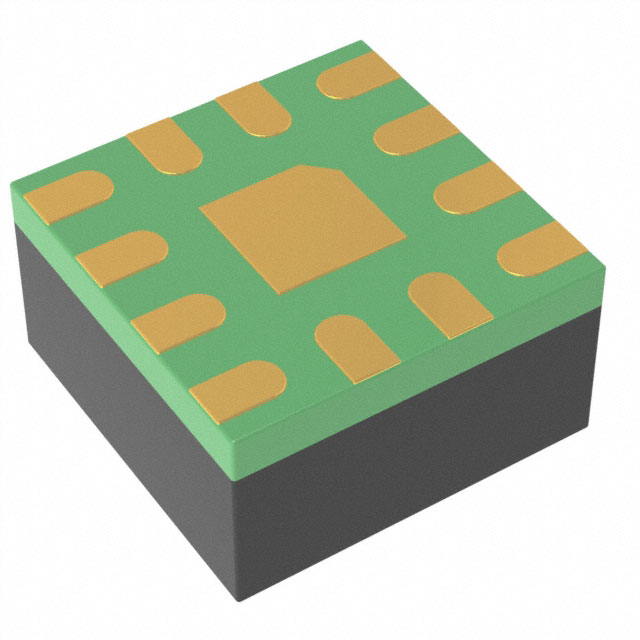
The LTC3309A, LTC3308A, and LTC3307A are all pin-compatible devices
available in a thermally enhanced, compact, and low profile 12-lead,
2 mm × 2 mm × 0.74 mm LQFN package. The E- and I-grades are specified
from a –40°C to +125°C operating junction temperature range. The J- and
H-grades are specified from a –40°C to +150°C operating junction temperature range, and the MP-grade is specified from a –55°C to +150°C
operating junction temperature range.
VIN = 2.25 V to 5.5 V
10 µF
0.1 µF
0201
220 nH
0.1 µF
0201
EN
VIN
SW
SW
LTC3309A
FB
VIN
6.8 pF
10 µF
VOUT
1.2 V
6A
140 kΩ
100 kΩ
33 µF
×2
MODE/SYNC
AGND
RT
PGND PGOOD
fOSC = 2 MHz
Figure 7. LTC3309A typical application circuit.
ILOAD
2.5 A/div
IL
2 A/div
VOUT
50 mV/div
10 µs/div
3.3 VIN to 1.2 VOUT, 2 MHz Typical Application
COUT = 66 µF, L = 220 nH
Load Step: 0.1 A to 4.5 A in 1 µs
Figure 8. LTC3309A transient response in Burst Mode operation.
Table 1 compares the features of the members of the LTC33xx Silent
Switcher and Silent Switcher 2 family.
Table 1. Fault Mode and Supported Range
Vendor
Part #
Topology
VIN Range
VOUT Range
Output Current
Efficiency
Switching Frequency
Control Mode
VREF Accuracy Room/Temp
Current Limit Accuracy
Minimum On-Time
Directly Parallelable x Phase?
IQ Supply Burst Mode/Non-Burst
Package Theta JA
Solution Size
Package
ADI
ADI
ADI
ADI
LTC3307A
LTC3308A
LTC3309A
LTC3310S
Single synchronous
Single synchronous
Single synchronous
Single synchronous
monolithic, Silent Switcher monolithic, Silent Switcher monolithic, Silent Switcher monolithic, Silent Switcher 2
2.25 V to 5.5 V
2.25 V to 5.5 V
2.25 V to 5.5 V
2.25 V to 5.5 V
0.5 V to VIN
0.5 V to VIN
0.5 V to VIN
0.5 V to VIN
3A
4A
6A
10 A
92%
92%
92%
92%
(3.3 VIN/1.2 VOUT/2 A)
(3.3 VIN/1.2 VOUT/2 A)
(3.3 VIN/1.2 VOUT/3 A)
(3.3 VIN/1.2 VOUT/2 A)
1 MHz to 3 MHz
1 MHz to 3 MHz
1 MHz to 3 MHz
500 kHz to 5 MHz
Constant-frequency,
Constant-frequency,
Constant-frequency,
Constant-frequency,
peak current mode
peak current mode
peak current mode
peak current mode
±0.2%/±1%
±0.2%/±1%
±0.2%/±1%
±1%
±15%
±15%
±15%
±9%
22 ns
22 ns
22 ns
35 ns
No
No
No
Yes, 4 phase
40 µA BM/1.3 mA
40 µA BM/1.3 mA
40 µA BM/1.3 mA
1.3 mA
51°C/W
51°C/W
51°C/W
40°C/W
~20 mm2
~20 mm2
~20 mm2
47 mm2
2 mm × 2 mm × 0.74 mm,
2 mm × 2 mm × 0.74 mm,
2 mm × 2 mm × 0.74 mm,
3 mm × 3 mm × 0.94 mm,
12-lead LQFN
12-lead LQFN
12-lead LQFN
18-lead LQFN
Visit analogdialogue.com
// 5
�Conclusion
The trend in high performance digital ICs—such as GPUs, FPGAs, and
microprocessors—is rapidly raising current demands coupled with dropping
operating voltages, a result of shrinking line width wafer fabrication technologies. Current and voltage demands are only part of the power supply
picture. Digital IC advancements come with a host of other requirements,
including fast transient response, low EMI, low noise/ripple, and efficient
operation to minimize heat.
Traditionally, digital ICs has been powered by LDO regulators or inductorbased switching regulator controllers with off-board power devices. With
increased power supply performance and space requirements, in many cases
these traditional approaches are not up to the task. ADI’s new generation
of monolithic power supplies are up to the task, including the LTC3310S,
LTC3309A, LTC3308A, and LTC3307A, which support 10 A, 6 A, 4 A, and 3 A,
respectively. These high power density Silent Switcher and Silent Switcher 2
buck regulators are housed in thermally efficient, compact flip-chip laminate
packages, and have a variety of feature sets to satisfy the requirements of a
wide range of digital IC power problems.
About the Author
Steve Knoth is a senior product marketing manager in Analog Devices’ Power Group. He is responsible for all power
management integrated circuit (PMIC) products, low dropout (LDO) regulators, battery chargers, charge pumps, charge
pump-based LED drivers, supercapacitor chargers, and low voltage monolithic switching regulators. Prior to rejoining
Analog Devices in 2004, Steve held various marketing and product engineering positions since 1990 at Micro Power
Systems, Analog Devices, and Micrel Semiconductor. He earned his bachelor’s degree in electrical engineering in 1988
and a master’s degree in physics in 1995, both from San Jose State University. Steve also received an M.B.A. in technology management from the University of Phoenix in 2000. In addition to enjoying time with his kids, Steve is an avid music
lover and can be found tinkering with pinball and arcade games or muscle cars, and buying, selling, and collecting vintage
toys, movie, sports, and automotive memorabilia. He can be reached at steve.knoth@analog.com.
6
// Analog Dialogue 53-10, October 2019
�