LTC3546
Dual Synchronous, 3A/1A
or 2A/2A Configurable
Step-Down DC/DC Regulator
FEATURES
DESCRIPTION
VIN Range: 2.3V to 5.5V
VOUT Range: 0.6V to 5V
n Programmable Frequency Operation; 2.25MHz, or
Adjustable Between 0.75MHz to 4MHz
n Low R
DS(ON) Internal Switches
n High Efficiency: Up to 96%
n No Schottky Diodes Required
n Short-Circuit Protected
n Current Mode Operation for Excellent Line and Load
Transient Response
n Low Ripple Burst Mode Operation (30mV
P-P),
IQ = 160µA
n Ultralow Shutdown Current: I < 1µA
Q
n Low Dropout Operation: 100% Duty Cycle
n Power Good Output For Each Channel
n Externally or Internally Programmable Burst Level
n External or Internal Soft-Start or Supply Tracking
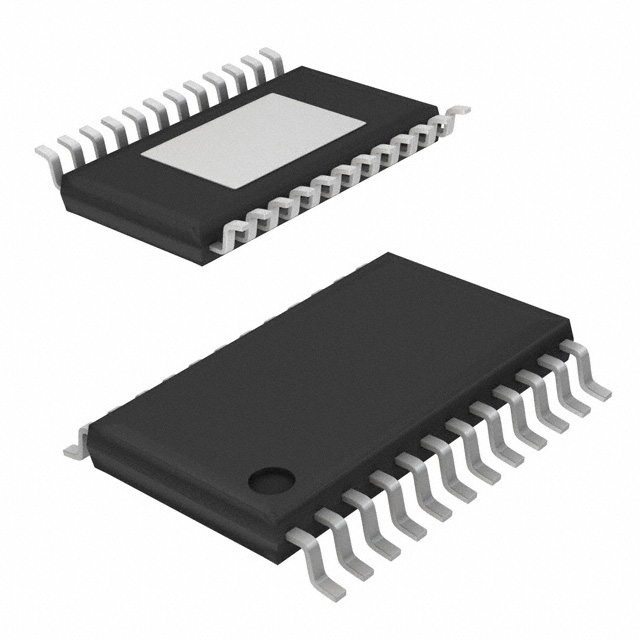
n Available in Thermally Enhanced 28-Lead
(4mm × 5mm) QFN and TSSOP Packages
The LTC®3546 is a dual, constant-frequency, synchronous
step down DC/DC converter for medium power applications.
The design consists of 2A and 1A primary output switches.
In addition to the 2A/1A capability, a 1A dependant output
switch can be externally connected to either of the primary
outputs to produce 3A/1A dual regulator or 2A/2A dual
regulator configurations.
n
n
APPLICATIONS
n
n
n
n
Supply operation is from 2.3V to 5.5V. The switching frequency can be set to 2.25MHz, adjustable from 0.75MHz
to 4MHz, or synchronized to an external clock. Each
output is adjustable from 0.6V to 5V and has output
tracking on power-up. Internal synchronous low RDS(ON)
power switches provide high efficiency without external
Schottky diodes.
User-selectable modes (Burst Mode® operation, pulse
skipping and forced continuous) allow a trade-off between
ripple noise and power efficiency. Burst Mode operation
provides high efficiency at light loads. Pulse-skipping
mode provides low ripple noise at light loads.
The device is capable of low dropout configurations and
both channels can operate at 100% duty cycle. In shutdown, the device draws (VIN – 0.5V), Burst Mode operation
is selected for both regulators. When the voltage on the
SYNC/MODE pin is 0.63V).
The Burst Mode peak inductor current can be set externally
via the BMC pin. When this pin is set somewhere between
0V to 0.6V, the voltage on this pin controls the Burst Mode
clamp level. When the BMC pin is pulled to VIN, an internal
Burst Mode clamp level is used.
The SYNC/MODE pin selects what mode the LTC3546 is in.
The SYNC/MODE pin sets the mode for both regulators.
For lower output voltage ripple at low currents, pulseskipping mode can be used. In this mode, the LTC3546
continues to switch at constant frequency down to very low
currents, where it will eventually begin skipping pulses.
Finally, in forced continuous mode, the inductor current
is constantly cycled which creates a fixed output voltage
ripple at all output current levels. This feature is desirable in
telecommunications since the noise is a constant frequency
and is thus easy to filter out. Another advantage of this mode
is that the regulator is capable of both sourcing current into
a load and sinking some current from the output. In forced
14
Dropout Operation
When the input supply voltage decreases toward the
output voltage, the duty cycle increases to 100% which
is the dropout condition. In the dropout condition, the
PMOS switch is turned on continuously with the output
voltage being equal to the input voltage minus the voltage drops across the internal P-channel MOSFETs and
inductors.
Low Supply Operation
The LTC3546 incorporates an undervoltage lockout circuit
which shuts down the part when the input voltage drops
below about 2.14V to prevent unstable operation.
3546fd
For more information www.linear.com/3546
�LTC3546
APPLICATIONS INFORMATION
A general LTC3546 application circuit is shown in Figure 7.
External component selection is driven by the load requirement, and begins with the selection of the inductors L1,
and L2. Once L1 and L2 are chosen, CIN, COUT1, and COUT2
can be selected.
Assuming a worst-case minimum on-time of 150ns, this
can be calculated as:
Operating Frequency
The minimum frequency is limited by leakage and noise
coupling due to the large resistance of RT.
Selection of the operating frequency is a trade-off between
efficiency and component size. High frequency operation
allows the use of smaller inductor and capacitor values.
Operation at lower frequencies improves efficiency by
reducing internal gate charge losses but requires larger
inductance values and/or capacitance to maintain low
output ripple voltage.
The operating frequency, fO, of the LTC3546 is determined
by pulling the FREQ pin to VIN, for 2.25MHz operation, by
connecting an external resistor from FREQ to ground, or
by driving an external clock signal into SYNC/MODE.
When using an external resistor to set the oscillator frequency use the following equation:
2.51•1011
RT =
(Ω) – 20kΩ
fO
for 0.75MHz ≤ fO ≤ 4MHz. Or use Figure 1 to select the
value for RT.
The maximum operating frequency is also constrained
by the minimum on-time (typically 70ns) and duty cycle,
especially when forced continuous mode is selected.
⎛ V
⎞
fO(MAX) ≈ 6.67 ⎜ OUT ⎟ (MHz )
⎝ VIN(MAX) ⎠
Inductor Selection
Although the inductor does not influence the operating
frequency, the inductor value has a direct effect on ripple
current. The inductor ripple current ΔIL decreases with
higher inductance and increases with higher VIN or VOUT.
ΔIL =
VOUT ⎛ VOUT ⎞
1−
fO •L ⎜⎝
VIN ⎟⎠
Accepting larger values of ΔIL allows the use of low
inductances, but results in higher output voltage ripple,
greater core losses, and lower output current capability.
A reasonable starting point for setting ripple current is ΔIL
= 0.35ILOAD(MAX), where ILOAD(MAX) is the maximum output
current. The largest ripple ΔIL occurs at the maximum
input voltage. To guarantee that the ripple current stays
below a specified maximum, the inductor value should be
chosen according to the following equation:
L≥
⎞
VOUT ⎛
V
1− OUT ⎟
⎜
fO • ΔIL ⎝ VIN(MAX) ⎠
500
450
400
RT (kΩ)
350
300
250
200
150
100
50
0
0
0.5 1.0 1.5 2.0 2.5 3.0 3.5 4.0 4.5
FREQUENCY (MHz)
3546 F01
Figure 1. Frequency vs RT
3546fd
For more information www.linear.com/3546
15
�LTC3546
APPLICATIONS INFORMATION
Burst Mode Operation Considerations
Inductor Core Selection
There are two factors that determine the load current at which
the LTC3546 enters Burst Mode operation: the inductor value
and the BMC pin voltage. The transition from low current
operation begins when the peak inductor current falls below
a level set by the burst clamp. Lower inductor values result in
higher ripple current which causes Burst Mode operation to
occur at lower load currents. Lower inductor values will also
cause a dip in efficiency in the upper range of low current
operation. Lower inductor values will also cause the burst
frequency to increase in Burst Mode operation.
Different core materials and shapes will change the size/current relationship of an inductor. Toroid or shielded pot cores
in ferrite or permalloy materials are small and don’t radiate
much energy, but generally cost more than powdered iron
core inductors with similar electrical characteristics. The
choice of which style inductor to use often depends more
on the price vs size requirements of any radiated field/EMI
requirements than on what the LTC3546 requires to operate. Table 1 shows some typical surface mount inductors
that work well in LTC3546 applications.
The burst clamp level can be set by the voltage on the BMC
pin. If BMC is tied to VIN, an internally set level is used. A
BMC pin voltage between 0V and 0.6V will set the burst
clamp level (see charts OUT1 Minimum Peak Current vs
VBMC1 and OUT2 Minimum Peak Current vs VBMC2 in the
Typical Performance Characteristics section). Generally, a
higher clamp level results in improved light load efficiency
and higher output voltage ripple, while a lower clamp level
results in small output voltage ripple at the expense of
efficiency. The BMC pin should be connected to ground
when Burst Mode operation is not selected.
Input Capacitor (CIN) Selection
In continuous mode, the input current of the converter can
be approximated by the sum of two square waves with
duty cycles of approximately VOUT1/VIN and VOUT2/VIN. To
prevent large voltage transients, a low equivalent series
resistance (ESR) input capacitor sized for the maximum
RMS current must be used. Some capacitors have a derating spec for maximum RMS current. If the capacitor
being used has this requirement it is necessary to calculate
Table 1.
MANUFACTURER
PART NUMBER
VALUE (µH)
MAX DC CURRENT (A)
DCR
DIMENSIONS L × W × H (mm)
Würth Elektronik
WE-PD2 MS
7447745012
1.2
4.6
0.017
5.2 × 5.8 × 2
Würth Elektronik
WE-PD2 MS
74477450056
0.56
6.5
0.0078
5.2 × 5.8 × 2
Vishay
IHLP-1616AB-11
1.2
3.75
0.068
4.06 × 4.45 × 1.20
Vishay
IHLP-1616AB-11
0.47
6
0.019
4.06 × 4.45 × 1.20
Coilcraft
LPS6225-122
1.2
5.4
0.04
6.2 × 6.2 × 2.5
Coilcraft
DO1813H-561
0.56
7.7
0.01
6.10 × 8.89 × 5.00
SD20-1R2
1.2
2.55
0.0275
5.2 × 5.2 × 2
SD20-R47
0.47
4
0.02
5.2 × 5.2 × 2
CDRH3D23NP-1R5NC
1
2.8
0.025
3.8 × 3.8 × 2.3
Coiltronics
Coiltronics
Sumida
16
3546fd
For more information www.linear.com/3546
�LTC3546
APPLICATIONS INFORMATION
the maximum RMS current. The RMS current calculation
is different if the part is used in-phase or out-of-phase.
For in-phase, there are two different equations:
VOUT1 > VOUT2:
IRMS =
(
) (
)
(
) (
)
2 •I1•I2 •D2 (1–D1) +I22 D2 –D22 +I12 D1–D12
VOUT2 > VOUT1:
IRMS =
2 •I1•I2 •D1(1–D2) +I22 D2 –D22 +I12 D1–D12
Where:
Note that capacitor manufacturer’s ripple current ratings
are often based on only 2000 hours lifetime. This makes
it advisable to further derate the capacitor, or choose a
capacitor rated at a higher temperature than required.
Several capacitors may also be paralleled to meet the
size or height requirements of the design. An additional
0.1µF to 1µF ceramic capacitor is also recommended on
VIN for high frequency decoupling, when not using an all
ceramic capacitor solution.
Output Capacitor (COUT1 and COUT2) Selection
V
V
D1= OUT1 and D2 = OUT2
VIN
VIN
When D1 = D2, then the equation simplifies to:
when VOUT1 – VIN/2 = VOUT2 and when VOUT2 – VIN/2 =
VOUT1. As a good rule of thumb, the amount of worst-case
ripple is about 75% of the worst-case ripple in the in-phase
mode. Note, that when VOUT1 = VOUT2 = VIN/2 and I1 = I2,
the ripple is at its minimum.
IRMS = (I1+I2) D(1–D)
The selection of COUT1 and COUT2 is driven by the required
ESR to minimize voltage ripple and load step transients.
Typically, once the ESR requirement is satisfied, the
capacitance is adequate for filtering. The output ripple
(ΔVOUT) is determined by:
or
IRMS = (I1+I2)
VOUT ( VIN – VOUT )
VIN
where the maximum average output currents I1 and
I2 equals the peak current minus half the peak-to-peak
ripple current:
ΔI
I1=ILIM1 – L1
2
ΔI
I2 =ILIM2 – L2
2
These formula have a maximum at VIN = 2VOUT, where
IRMS = (I1 + I2)/2. This simple worst-case is commonly
used to determine the worst-case IRMS.
For out-of-phase (PHASE pin is at ground), the ripple
current can be lower than the in-phase.
In the out-of-phase case, the maximum IRMS does not occur when VOUT1 = VOUT2. The maximum typically occurs
⎛
⎞
1
ΔVOUT ≈ ΔIL ⎜ ESR+
8• fO •COUT ⎟⎠
⎝
where fO = operating frequency, COUT = output capacitance
and ΔIL = ripple current in the inductor. The output ripple
is highest at maximum input voltage since ΔIL increases
with input voltage.
Once the ESR requirements for COUT have been met, the
RMS current rating generally far exceeds the IRIPPLE(P-P)
requirement, except for an all ceramic solution.
In surface mount applications, multiple capacitors may
have to be paralleled to meet the capacitance, ESR or RMS
current handling requirement of the application. Aluminum
electrolytic, special polymer, ceramic and dry tantalum
capacitors are all available in surface mount packages.
The OS-CON semiconductor dielectric capacitor available from Sanyo has the lowest ESR(size) product of any
aluminum electrolytic at a somewhat higher price. Special
polymer capacitors, such as Sanyo POSCAP, offer very
low ESR, but have a lower capacitance density than other
types. Tantalum capacitors have the highest capacitance
3546fd
For more information www.linear.com/3546
17
�LTC3546
APPLICATIONS INFORMATION
density, but it has a larger ESR and it is critical that the
capacitors are surge tested for use in switching power
supplies. An excellent choice is the AVX TPS series of
surface tantalums, available in case heights ranging from
2mm to 4mm. Aluminum electrolytic capacitors have a
significantly larger ESR, and are often used in extremely
cost-sensitive applications provided that consideration
is given to ripple current ratings and long term reliability.
Ceramic capacitors have the lowest ESR and cost but also
have the lowest capacitance density, high voltage and
temperature coefficient and exhibit audible piezoelectric
effects. In addition, the high Q of ceramic capacitors along
with trace inductance can lead to significant ringing. Other
capacitor types include the Panasonic specialty polymer
(SP) capacitors.
Ceramic Input and Output Capacitors
Higher value, lower cost ceramic capacitors are now
becoming available in smaller case sizes. Because the
LTC3546 control loop does not depend on the output
capacitor’s ESR for stable operation, ceramic capacitors
can be used freely to achieve very low output ripple and
small circuit size. When choosing the input and output
ceramic capacitors, choose the X5R or X7R dielectric
formulations. These dielectrics have the best temperature
and voltage characteristics of all the ceramics for a given
value and size.
Great care must be taken when using only ceramic input
and output capacitors. When a ceramic capacitor is used
at the input and the power is being supplied through long
wires, such as from a wall adapter, a load step at the output
can induce ringing at the VIN pin. At best, this ringing can
couple to the output and be mistaken as loop instability.
At worst, the ringing at the input can be large enough to
disrupt circuit operation or damage the part.
to support the load. The time required for the feedback
loop to respond is dependent on the compensation components and the output capacitor size. Typically, 3 to 4
cycles are required to respond to a load step, but only in
the first cycle does the output drop linearly. The output
droop, VDROOP, is usually about 2 to 3 times the linear
droop of the first cycle. Thus, a good place to start is with
the output capacitor size of approximately:
COUT ≈ 2.5
More capacitance may be required depending on the duty
cycle and load step requirements.
In most applications, the input capacitor is merely required
to supply high frequency bypassing, since impedance to
the supply is very low. A 10µF ceramic capacitor is usually
enough for these conditions.
Setting the Output Voltage
The LTC3546 generates a 0.6V reference voltage between
the feedback pin, VFB1 and VFB2, and the signal ground.
The output voltage is set by a resistive divider according
to the following formula:
⎛ R1⎞
VOUT1 ≈ 0.6V ⎜ 1+ ⎟
⎝ R2 ⎠
⎛ R3 ⎞
VOUT2 ≈ 0.6V ⎜ 1+ ⎟
⎝ R4 ⎠
Resistor locations are shown in Figure 2.
VOUT1
CFF1
Since the ESR of a ceramic capacitor is so low, the input
and output capacitor must instead fulfill a charge storage
requirement. During a load step, the output capacitor must
instantaneously supply the current to support the load
until the feedback loop raises the switch current enough
18
ΔIOUT
fOVDROOP
VOUT2
R1
R3
CFF2
LTC3546
VFB1
R2
VFB2
3546 F02
R4
Figure 2. Setting Output Voltages
3546fd
For more information www.linear.com/3546
�LTC3546
APPLICATIONS INFORMATION
Keeping the current small (










 工商网监
湘ICP备2023018690号
工商网监
湘ICP备2023018690号