LTC3615/LTC3615-1
Dual 4MHz, 3A Synchronous
Step-Down DC/DC Converter
Description
Features
n
n
n
n
n
n
n
n
n
n
n
n
n
n
n
n
n
n
High Efficiency: Up to 94%
Dual Outputs with 2 × 3A Output Current Capability
Low Output Ripple Burst Mode® Operation: IQ = 130µA
2.25V to 5.5V Input Voltage Range
±1% Output Voltage Accuracy
Output Voltages Down to 0.6V
Programmable Slew Rate at Switch Pins
Low Dropout Operation: 100% Duty Cycle
Shutdown Current ≤1µA
Adjustable Switching Frequency Up to 4MHz
Internal or External Compensation
Selectable Pulse-Skipping/Forced Continuous/
Burst Mode Operation with Adjustable Burst Clamp
Optional Active Voltage Positioning (AVP) with
Internal Compensation
Selectable 0°/90°/180° (LTC3615) or selectable
140°/180° (LTC3615-1) Phase Shift Between Channels
Fixed Internal and Programmable External Soft-Start
Accurate Start-Up Tracking Capability
DDR Memory Mode IOUT = ±1.5A
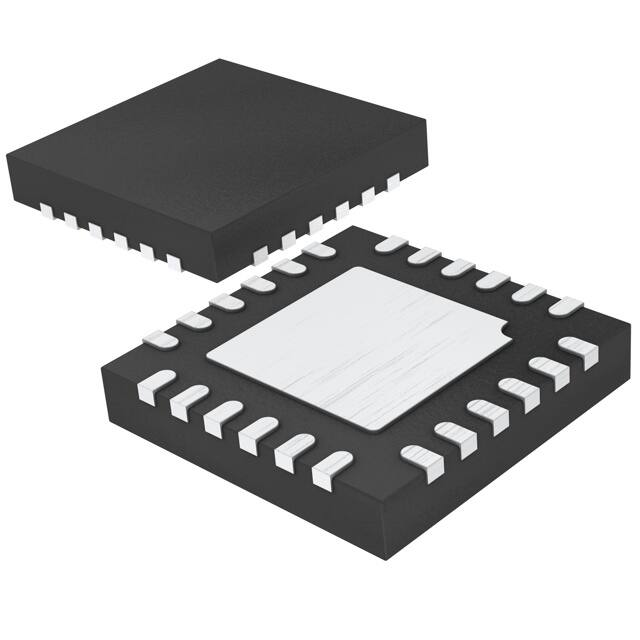
Available in 4mm × 4mm QFN-24 and TSSOP-24 Packages
n
n
n
n
The operating frequency is externally programmable up to
4MHz, allowing the use of small surface mount inductors.
0°, 90°, or 180° (LTC3615) or 140°/180° (LTC3615-1) of
phase shift between the two channels can be selected to
minimize input current ripple and output voltage ripple in a
dual 3A or single 6A output configuration. Programmable
slew rate limiting reduces EMI, and external synchronization can be applied up to 4MHz.
The internal synchronous switches increase efficiency
and eliminate the need for external catch diodes, saving
external components and board space.
The LTC3615/LTC3615-1 are offered in leadless 24-pin
4mm × 4mm QFN and thermally enhanced 24-pin TSSOP
packages.
Applications
n
The LTC®3615/LTC3615-1 are dual 3A synchronous stepdown regulators using a current mode, constant-frequency
architecture. The DC supply current is only 130µA (Burst
Mode operation at no-load) while maintaining the output
voltages, dropping to zero current in shutdown. The 2.25V
to 5.5V input supply range makes the parts ideally suited
for single Li-Ion applications. 100% duty cycle capability
provides low dropout operation, which extends operating
time in battery-operated systems.
Point-of-Load Supplies
Distributed Power Supplies
Portable Computer Systems
DDR Memory Termination
Handheld Devices
L, LT, LTC, LTM, Linear Technology, Burst Mode and the Linear logo are registered trademarks
of Linear Technology Corporation. All other trademarks are the property of their respective
owners. Protected by U.S. Patents, including 5481178, 5994885, 6304066, 6498466, 6580258,
6611131.
Typical Application
Efficiency and Power Loss vs Load Current
100
VIN
PHASE
RUN2
TRACK/SS2
PGOOD2
ITH2 SGND
PVIN2
SW1
0.47µH
422k
VOUT1
1.8V/3A
47µF
FB1
210k
SW2
0.47µH
665k
FB2
PGND
210k
3615 TA01a
VOUT2
2.5V/3A
47µF
80
1
70
60
0.1
50
40
0.01
30
POWER LOSS (W)
SVIN
PVIN1
RUN1
TRACK/SS1
PGOOD1
LTC3615
ITH1
SRLIM
RT /SYNC
MODE
EFFICIENCY (%)
100µF
10
90
20
0.001
VIN = 3.3V
VIN = 4V
10 2.25MHz
VIN = 5V
VOUT = 2.5V
0
0.0001
0.001
0.01
0.1
1
OUTPUT CURRENT (A)
3615 TA01b
3615fb
For more information www.linear.com/LTC3615
1
�LTC3615/LTC3615-1
Absolute Maximum Ratings
(Notes 1, 11)
PVIN1, PVIN2 Voltages..................... –0.3V to SVIN + 0.3V
SVIN Voltage................................................. –0.3V to 6V
SW1 Voltage ..............................–0.3V to (PVIN1 + 0.3V)
SW2 Voltage...............................–0.3V to (PVIN2 + 0.3V)
PGOOD1, PGOOD2 Voltages......................... –0.3V to 6V
All Other Pins............................... –0.3V to (SVIN + 0.3V)
Operating Junction Temperature
Range (Notes 2, 11)................................ –55°C to 150°C
Storage Temperature.............................. –65°C to 150°C
Lead Soldering Temperature (eTSSOP).................. 300°C
Reflow Peak Body Temperature (QFN)................... 260°C
Pin Configuration
21 TRACK/SS1
SGND
5
20 SVIN
PVIN2
6
19 PVIN1
MODE 3
PVIN2
7
18 PVIN1
PHASE 4
SW2
8
17 SW1
SW2
9
16 SW1
16 PGOOD2
15 RT/SYNC
FB2 5
14 RUN1
ITH2 6
13 PGOOD2
13 RUN2
8
9 10 11 12
SW2
7
SW2
14 SRLIM
RT/SYNC 12
17 SRLIM
25
PGND
PVIN2
15 PGOOD1
RUN1 11
18 PGOOD1
FB1 2
PVIN2
RUN2 10
24 23 22 21 20 19
ITH1 1
SGND
25
PGND
SW1
4
SW1
22 ITH1
TRACK/SS2
PVIN1
23 FB1
3
PVIN1
2
SVIN
FB2
ITH2
TOP VIEW
TRACK/SS2
PHASE
24 MODE
TRACK/SS1
TOP VIEW
1
UF PACKAGE
24-LEAD (4mm × 4mm) PLASTIC QFN
FE PACKAGE
24-LEAD PLASTIC eTSSOP
TJMAX = 150°C, θJA = 33°C/W
EXPOSED PAD (PIN 25) IS PGND, MUST BE SOLDERED TO PCB
TJMAX = 150°C, θJA = 37°C/W
EXPOSED PAD (PIN 25) IS PGND, MUST BE SOLDERED TO PCB
Order Information
LEAD FREE FINISH
TAPE AND REEL
PART MARKING*
PACKAGE DESCRIPTION
TEMPERATURE RANGE
LTC3615EFE#PBF
LTC3615EFE#TRPBF
LTC3615FE
24-Lead Plastic TSSOP
–40°C to 125°C
LTC3615IFE#PBF
LTC3615IFE#TRPBF
LTC3615FE
24-Lead Plastic TSSOP
–40°C to 125°C
LTC3615HFE#PBF
LTC3615HFE#TRPBF
LTC3615FE
24-Lead Plastic TSSOP
–40°C to 150°C
LTC3615MPFE#PBF
LTC3615MPFE#TRPBF
LTC3615FE
24-Lead Plastic TSSOP
–55°C to 150°C
LTC3615EUF#PBF
LTC3615EUF#TRPBF
3615
24-Lead (4mm × 4mm) Plastic QFN
–40°C to 125°C
LTC3615IUF#PBF
LTC3615IUF#TRPBF
3615
24-Lead (4mm × 4mm) Plastic QFN
–40°C to 125°C
LTC3615HUF#PBF
LTC3615HUF#TRPBF
3615
24-Lead (4mm × 4mm) Plastic QFN
–40°C to 150°C
LTC3615MPUF#PBF
LTC3615MPUF#TRPBF
3615
24-Lead (4mm × 4mm) Plastic QFN
–55°C to 150°C
LTC3615EFE-1#PBF
LTC3615EFE-1#TRPBF
LTC3615FE-1
24-Lead Plastic TSSOP
–40°C to 125°C
LTC3615IFE-1#PBF
LTC3615IFE-1#TRPBF
LTC3615FE-1
24-Lead Plastic TSSOP
–40°C to 125°C
LTC3615HFE-1#PBF
LTC3615HFE-1#TRPBF
LTC3615FE-1
24-Lead Plastic TSSOP
–40°C to 150°C
LTC3615MPFE-1#PBF
LTC3615MPFE-1#TRPBF
LTC3615FE-1
24-Lead Plastic TSSOP
–55°C to 150°C
LTC3615EUF-1#PBF
LTC3615EUF-1#TRPBF
36151
24-Lead (4mm × 4mm) Plastic QFN
–40°C to 125°C
LTC3615IUF-1#PBF
LTC3615IUF-1#TRPBF
36151
24-Lead (4mm × 4mm) Plastic QFN
–40°C to 125°C
36151
24-Lead (4mm × 4mm) Plastic QFN
–40°C to 150°C
LTC3615HUF-1#TRPBF
LTC3615HUF-1#PBF
LTC3615MPUF-1#PBF
LTC3615MPUF-1#TRPBF
36151
24-Lead (4mm × 4mm) Plastic QFN
–55°C to 150°C
Consult LTC Marketing for parts specified with wider operating temperature ranges. *The temperature grade is identified by a label on the shipping container.
Consult LTC Marketing for information on non-standard lead based finish parts.
For more information on lead free part marking, go to: http://www.linear.com/leadfree/
For more information on tape and reel specifications, go to: http://www.linear.com/tapeandreel/
2
For more information www.linear.com/LTC3615
3615fb
�LTC3615/LTC3615-1
Electrical
Characteristics
The l denotes the specifications which apply over the specified operating
junction temperature range, otherwise specifications are at TA = 25°C (Note 2), SVIN = PVINx = 3.3V, RT = 178k, RSRLIM = 40.2k, unless
otherwise specified.
SYMBOL
PARAMETER
VIN
Operating Voltage Range
VUVLO
Undervoltage Lockout Threshold
CONDITIONS
SVIN Ramping Down
MIN
l
2.25
l
1.7
TYP
5.5
Feedback Voltage Internal Reference
Feedback Voltage External Reference
(Note 7)
(Note 3) VTRACK = SVIN, VSRLIM = 0V
0°C < TJ < 85°C
–40°C < TJ < 125°C
–55°C < TJ < 150°C
l
l
(Note 3) VTRACK = 0.3V, VSRLIM = SVIN
(Note 3) VTRACK = 0.5V, VSRLIM = SVIN
UNITS
V
V
SVIN Ramping Up
VFB
MAX
2.25
V
0.592
0.590
0.588
0.6
0.608
0.610
0.612
V
V
V
0.289
0.3
0.311
V
0.489
0.5
0.511
V
0
±30
nA
0.2
%/ V
0.2
2
%
%
IFB
Feedback Input Current
VFBx = 0.6V
l
∆VLINEREG
Line Regulation
SVIN = PVINx = 2.25V to 5.5V (Note 4)
l
∆VLOADREG
Load Regulation
VITHx from 0.5V to 0.9V (Note 4)
VITHx = SVIN, VFBx = 0.6V (Note 5)
IS
Active Mode
VFB1 = 0.5V, VMODE = SVIN, VRUN2 = 0V (Note 6)
1100
µA
VFBx = 0.5V, VMODE = SVIN, VRUNx = SVIN (Note
6)
1900
µA
VFB1 = 0.7V, VRUN1 = SVIN, VRUN2 = 0V,
VMODE = 0V, VITH1 = SVIN (Note 5)
95
130
µA
VFBx = 0.7V, VRUN1 = SVIN, VRUN2 = 0V,
VMODE = 0V (Note 4)
145
220
µA
VFBx = 0.7V, VRUNx = SVIN, VMODE =0V,
VITHx = SVIN (Note 5)
130
200
µA
VFBx = 0.7V, VRUNx = SVIN, VMODE =0V,
ITH = (Note 4)
240
360
µA
Shutdown
SVIN = PVIN = 5.5V, VRUNx = 0V
0.1
1
µA
Top Switch On-Resistance
PVINx = 3.3V (Note 10)
75
mΩ
Bottom Switch On-Resistance
PVINx = 3.3V (Note 10)
55
mΩ
Top Switch Current Limit
Sourcing (Note 8), VFB = 0.5V
Duty Cycle 30ns
0.4
1.2
SYNC Level Low
V
0.3
V
3615fb
For more information www.linear.com/LTC3615
3
�LTC3615/LTC3615-1
Electrical Characteristics
The l denotes the specifications which apply over the specified operating
junction temperature range, otherwise specifications are at TA = 25°C (Note 2), SVIN = PVINx = 3.3V, RT = 178k, RSRLIM = 40.2k, unless
otherwise specified.
SYMBOL
PARAMETER
CONDITIONS
jSW1–SW2
Output Phase Shift Between SW1
and SW2 (LTC3615)
VPHASE < 0.15 • SVIN
0
Deg
0.35 • SVIN < VPHASE < 0.65 • SVIN
VPHASE > 0.85 • SVIN
90
Deg
180
Deg
Output Phase Shift Between SW1
and SW2 (LTC3615-1)
VPHASE < 0.65 • SVIN
140
Deg
VPHASE > 0.85 • SVIN
180
Deg
VSRLIM
Voltage at SRLIM to Enable DDR
Mode
(Note 9)
VMODE
(Note 9)
Internal Burst Mode Operation
PGOOD
MIN
MAX
SVIN – 0.3
SVIN – 0.3
Pulse-Skipping Mode
UNITS
V
0.3
V
V
Forced Continuous Mode
1.1
SVIN • 0.58
V
External Burst Mode Operation
0.5
0.85
V
Power Good Voltage Windows
TRACK/SSx = SVIN, Entering Window
VFBx Ramping Up
VFBx Ramping Down
–3.5
3.5
TRACK/SSx = SVIN , Leaving Window
VFBx Ramping Up
VFBx Ramping Down
tPGOOD
Power Good Blanking Time
RPGOOD
Power Good Pull-Down On-Resistance I = 10mA
VRUN
Enable Pin
Entering/Leaving Window
Input High
Input Low
l
l
Pull-Down Resistance
Note 1: Stresses beyond those listed under Absolute Maximum Ratings
may cause permanent damage to the device. Exposure to any Absolute
Maximum Rating condition for extended periods may affect device
reliability and lifetime.
Note 2: The LTC3615/LTC3615-1 are tested under pulsed load conditions
such that TJ ≈ TA. The LTC3615E/LTC3615E-1 are guaranteed to meet
performance specifications over the 0°C to 85°C operating junction
temperature range. Specifications over the –40°C to 125°C operating
junction temperature range are assured by design, characterization and
correlation with statistical process controls. The LTC3615I/LTC3615I-1
are guaranteed to meet specifications over the –40°C to 125°C operating
junction temperature range. The LTC3615H/LTC3615H-1 are guaranteed
to meet specifications over the –40°C to 150°C operating temperature
range. The LTC3615MP/LTC3615MP-1 are tested and guaranteed to meet
specifications over the full –55°C to 150°C operating junction temperature
range. High junction temperatures degrade operating lifetime; operating
lifetime is derated for junction temperatures greater than 125°C. Note that
the maximum ambient temperature consistent with these specifications
is determined by specific operating conditions in conjunction with board
layout, the rated package thermal impedance and other environmental
factors. The junction temperature (TJ, in °C) is calculated from the ambient
temperature
(TA, in °C) and power dissipation (PD, in watts) according to the formula:
TJ = TA + (PD • θJA)
where θJA (in °C/W) is the package thermal impedance.
4
TYP
–6
6
%
%
9
–9
11
–11
%
%
70
105
140
µs
8
12
30
Ω
0.4
V
V
1
4
MΩ
Note 3: This parameter is tested in a feedback loop which servos VFB1,2 to
the midpoint for the error amplifier (VITH1,2 = 0.75V).
Note 4: External compensation on ITH pin.
Note 5: Tying the ITH pin to SVIN enables internal compensation and AVP
mode for the selected channel.
Note 6: Dynamic supply current is higher due to the internal gate charge
being delivered at the switching frequency.
Note 7: See description of the TRACK/SS pin in the Pin Functions section.
Note 8: When sourcing current, the average output current is defined
as flowing out of the SW pin. When sinking current, the average output
current is defined as flowing into the SW pin. Sinking mode requires the
use of forced continuous mode.
Note 9: See description of the MODE pin in the Pin Functions section.
Note 10: Guaranteed by design and correlation to wafer level
measurements for QFN packages.
Note 11: This IC includes overtemperature protection that is intended
to protect the device during momentary overload conditions. Junction
temperature will exceed 150°C when overtemperature protection is active.
Continuous operation above the specified maximum operating junction
temperature may impair device reliability or permanently damage the
device.
3615fb
For more information www.linear.com/LTC3615
�LTC3615/LTC3615-1
Typical Performance Characteristics
100
100
VOUT = 1.8V
100
VOUT = 1.2V
90
80
80
70
70
70
60
50
40
30
40
30
0
0.001
3615 G01
Efficiency vs Load Current
(VMODE = 0.55 • SVIN)
100
90
100
90
80
70
70
EFFICIENCY (%)
80
60
50
40
30
20
60
50
40
30
0
0.001
80
75
70
65
IOUT = 3A
IOUT = 2A
IOUT = 1A
IOUT = 0.3A
IOUT = 0.2A
55
50
2.25
10
0.01
0.1
1
OUTPUT CURRENT (A)
3615 G04
2.75
3615 G05
3.25 3.75 4.25 4.75
INPUT VOLTAGE (V)
5.25
3615 G06
Line Regulation
0.20
0.15
0.10
0.1
0
EXTERNAL
–0.1 COMPENSATION
0.05
0
–0.05
–0.10
–0.2
–0.15
–0.3
–0.4
10
3615 G03
VOUT = 1.8V
60
VIN = 2.25V
VIN = 3.3V
VIN = 5V
VOUT ERROR (%)
0.3
0.01
0.1
1
OUTPUT CURRENT (A)
3615 G02
85
INTERNAL
COMPENSATION
(ITH = SVIN )
0.2
VIN = 3.3V
VIN = 4V
VIN = 5V
90
VMODE = 1.5V
0.4
30
Efficiency vs Input Voltage
(VMODE = 0V)
Load Regulation
0.5
40
95
10
10
0.01
0.1
1
OUTPUT CURRENT (A)
VOUT ERROR (%)
0
0.001
50
0
0.001
VOUT = 1.2V
20
VIN = 2.25V
VIN = 3.3V
VIN = 5V
10
60
Efficiency vs Load Current
(VMODE = 0.55 • SVIN)
VOUT = 1.8V
VOUT = 2.5V
10
10
0.01
0.1
1
OUTPUT CURRENT (A)
Efficiency vs Load Current
(VMODE = 0V)
20
VIN = 2.5V
VIN = 3.3V
VIN = 5V
10
10
0.01
0.1
1
OUTPUT CURRENT (A)
50
EFFICIENCY (%)
0
0.001
60
20
VIN = 2.5V
VIN = 3.3V
VIN = 5V
10
EFFICIENCY (%)
80
20
EFFICIENCY (%)
Efficiency vs Load Current
(VMODE = 0V)
90
EFFICIENCY (%)
EFFICIENCY (%)
90
Efficiency vs Load Current
(VMODE = 0V)
VIN = 3.3V, RT /SYNC = SVIN, unless otherwise noted.
0
0.5
1
1.5
2
OUTPUT CURRENT (A)
2.5
3
–0.20
2.25
2.75
3615 G07
3.25
3.75
4.25
INPUT VOLTAGE (V)
4.75
5.25
3615 G08
3615fb
For more information www.linear.com/LTC3615
5
�LTC3615/LTC3615-1
Typical Performance Characteristics
Forced Continuous Mode
Operation (FCM)
Pulse-Skipping Mode Operation
VOUT
20mV/DIV
IL
200mA/DIV
VOUT = 1.8V
IOUT = 100mA
VMODE = 1.5V
1µs/DIV
VIN = 3.3V, RT /SYNC = SVIN, unless otherwise noted.
Burst Mode Operation
VOUT
20mV/DIV
VOUT
20mV/DIV
IL
500mA/DIV
IL
500mA/DIV
VOUT = 1.8V
IOUT = 75mA
VMODE = 3.3V
3615 G09
Load Step Transient in
FCM External Compensation
20µs/DIV
3615 G10
VOUT = 1.8V
IOUT = 75mA
VMODE = 0V
VOUT
200mV/DIV
VOUT
200mV/DIV
IL
1A/DIV
IL
1A/DIV
IL
1A/DIV
3615 G12
VOUT = 1.8V
50µs/DIV
ILOAD = 100mA TO 3A
VMODE = 3.3V
COMPENSATION FIGURE 1
VOUT
100mV/DIV
Internal Start-Up in Forced
Continuous Mode
VOUT
500mV/DIV
IL
1A/DIV
PGOOD
2V/DIV
IL
1A/DIV
IL
2A/DIV 0A
6
3615 G14
RUN
1V/DIV
VOUT
200mV/DIV
VOUT = 1.8V
50µs/DIV
ILOAD = 100mA TO 3A
VMODE = 1.5V
VITH = 3.3V
OUTPUT CAPACITOR VALUE FIGURE 1
50µs/DIV
VOUT = 1.8V
ILOAD = 100mA TO 3A
VMODE = 0V
COMPENSATION FIGURE 1
3615 G13
Load Step Transient in Forced
Continuous Mode Sourcing and
Sinking Current
Load Step Transient in FCM
with AVP Mode
3615 G11
Load Step Transient in
Burst Mode Operation
Load Step Transient
in Pulse-Skipping Mode
VOUT
200mV/DIV
50µs/DIV
VOUT = 1.8V
ILOAD = 100mA TO 3A
VMODE = 1.5V
COMPENSATION FIGURE 1
20µs/DIV
3615 G15
50µs/DIV
VOUT = 1.8V
ILOAD = –1.5A TO 3A
VMODE = 1.5V
COMPENSATION FIGURE 1
3615 G16
VOUT = 1.8V
IOUT = 3A
VMODE = 1.5V
500µs/DIV
3615 G17
3615fb
For more information www.linear.com/LTC3615
�LTC3615/LTC3615-1
Typical Performance Characteristics
Reference Voltage
vs Temperature
Switch On-Resistance
vs Input Voltage
0.10
0.606
0.09
0.604
0.08
MAIN SWITCH
0.07
0.602
RDS(ON) (Ω)
REFERENCE VOLTAGE (V)
VIN = 3.3V, RT /SYNC = SVIN, unless otherwise noted.
0.600
0.598
0.06
0.05
SYNCHRONOUS SWITCH
0.04
0.03
0.02
0.596
0.01
0.594
–60
–25
80
10
45
TEMPERATURE (°C)
115
0
2.25
150
Switch On-Resistance
vs Temperature
4.0
100
90
2.4
fOSC (MHz)
SWITCH LEAKAGE (µA)
2.8
60
SYNCHRONOUS SWITCH
40
Frequency vs RT/SYNC
1.6
1.2
20
0.8
10
0.4
–25
3615 G19
2.0
30
0
–60
5.25
3.2
70
50
4.25
VIN (V)
3.6
MAIN SWITCH
80
3.25
3615 G18
10
45
80
TEMPERATURE (°C)
115
0
100 200 300 400 500 600 700 800 900 1000
RT/SYNC (kΩ)
150
3615 G20
3615 G22
Frequency vs Input Voltage
Frequency vs Temperature
2.7
2.60
2.6
2.50
2.40
2.5
fOSC (MHz)
fOSC (MHz)
RT /SYNC = SVIN
2.3
2.2
RT = 178k
2.1
2.20
2.10
RT/SYNC = 200k
2.00
1.90
2.0
1.80
1.9
1.70
1.8
–60
RT/SYNC = SVIN
2.30
2.4
–25
10
45
80
TEMPERATURE (°C)
115
150
1.60
2.25
3.00
3615 G23
3.75
VIN (V)
4.50
5.25
3615 G24
3615fb
For more information www.linear.com/LTC3615
7
�LTC3615/LTC3615-1
Typical Performance Characteristics
No Load Supply Current
vs Input Voltage
Switch Leakage vs Temperature
MODE = 0V
160 RUNx = ITHx = SVIN
3.5
140
SYNCHRONOUS SWITCH
2.0
1.5
1.0
0.5
–25
10
45
80
TEMPERATURE (°C)
120
100
80
60
40
20
MAIN SWITCH
0
–60
115
150
0
2.25
2.75
3.75 4.25
VIN (V)
4.75
5.25
120
100
80
60
40
20 MODE = 0V
RUNx = ITHx = SVIN
0
10
–60
45
80
–25
TEMPERATURE (°C)
3615 G26
Slew Rate of Rising Edge at
SW1/2 vs SRLIM Resistor
VIN = 3.3V
VOUT = 1.8V
IOUT = 1A
SRLIM =
SGND OR SVIN
40.2k
100k
3.25
3615 G25
Slew Rate of Falling Edge at
SW1/2 vs SRLIM Resistor
VIN = 3.3V
VOUT = 1.8V
IOUT = 1A
SUPPLY CURRENT (µA)
2.5
SRLIM =
SGND OR SVIN
100k
IL
500mA/DIV
VOUT = 1.2V
IOUT = –1A
VMODE = 1.5V
8
1µs/DIV
3615 G30
3615 G29
2ns/DIV
Tracking Up/Down in
Forced Continuous Mode,
SRLIM Pin Tied to 0V
Tracking Up/Down in
Forced Continuous Mode,
SRLIM Pin Tied to SVIN
VOUT1
1V/DIV
VOUT1
500mV/DIV
VTRACK/SS
500mV/DIV
VTRACK/SS
200mV/DIV
PGOOD
2V/DIV
PGOOD
2V/DIV
2ms/DIV
VOUT = 0V TO 1.8V
IOUT = 3A
VTRACK/SS = 0V TO 0.7V
VMODE = 1.5V
VSRLIM = 0V
3615 G27
SW
2V/DIV
OPEN
3615 G28
150
VOUT
20mV/DIV
1V/DIV
2ns/DIV
115
Sinking Current
40.2k
OPEN
No Load Supply Current
vs Temperature
160
140
3.0
SUPPLY CURRENT (µA)
SWITCH LEAKAGE (µA)
180
180
4.0
1V/DIV
VIN = 3.3V, RT /SYNC = SVIN, unless otherwise noted.
3615 G31
2ms/DIV
VOUT = 0V TO 1.2V
IOUT = 3A
VTRACK/SS = 0V TO 0.4V
VMODE = 1.5V
VSRLIM = 3.3V
3615 G32
3615fb
For more information www.linear.com/LTC3615
�LTC3615/LTC3615-1
Pin Functions
(FE/UF)
PHASE (Pin 1/Pin 4): Phase Shift Selection. If pin is tied
to SGND, the phase between SW1 and SW2 will be 0°
(LTC3615) or 140° (LTC3615-1). With the PHASE pin
tied to half of the SVIN voltage, 90° (LTC3615) or 140°
(LTC3615-1) of phase shift will be selected. Tying PHASE
to SVIN will select 180° (LTC3615 and LTC3615-1).
PGOOD2 (Pin 13/Pin 16): Power Good Output for
Channel 2. See PGOOD1.
VFB2 (Pin 2/Pin 5): Voltage Feedback Input Pin for Chan
nel 2. See VFB1.
2. Minimum slew rate is selected when the pin is open.
ITH2 (Pin 3/Pin 6): Error Amplifier Compensation of
Channel 2. See ITH1.
TRACK/SS2 (Pin 4 /Pin 7): Internal, External Soft-Start,
External Reference Input for Channel 2. See TRACK/SS1.
SGND (Pin 5/Pin 8): Signal Ground. All small-signal and
compensation components should connect to this ground
pin which, in turn, should be connected to PGND at one
point.
PVIN2 (Pins 6, 7/Pins 9, 10) Channel 2 Power Supply
Input. See PVIN1.
SW2 (Pins 8, 9/Pins 11, 12): Channel 2 Switching Node.
See SW1.
RUN2 (Pin 10/Pin 13): Enable Pin for Channel 2. See RUN1.
RUN1 (Pin 11/Pin 14): Enable Pin for Channel 1. Forcing
RUN1 above the input threshold enables the output SW1 of
channel 1. Forcing both RUNx pins to ground shuts down
the LTC3615. In shutdown, all functions are disabled and
the LTC3615 draws 1µF) supply bypass capacitors. The
discharged bypass capacitors are effectively put in parallel
with COUT, causing a rapid drop in VOUT. No regulator can
alter its delivery of current quickly enough to prevent this
sudden step change in output voltage if the load switch
resistance is low and it is driven quickly. More output
capacitance may be required depending on the duty cycle
and load step requirements.
If the ITH pin is tied to SVIN, the active voltage positioning
(AVP) mode and the internal compensation is selected.
In AVP mode, the load regulation performance is intentionally reduced, setting the output voltage at a point that
is dependent on the load current. When the load current
suddenly increases, the output voltage starts from a level
slightly higher than nominal so the output voltage can
droop more and stay within the specified voltage range.
When the load current suddenly decreases, the output
voltage starts at a level lower than nominal so the output
voltage can have more overshoot and stay within the
specified voltage range. This behavior is demonstrated
in Figure 6.
The benefit is a lower peak-to-peak output voltage deviation
for a given load step without having to increase the output
filter capacitance. Alternatively, the output voltage filter
capacitance can be reduced while maintaining the same
peak-to-peak transient response. For this operation mode,
the loop gain is reduced and no external compensation
is required.
Programmable Switch Pin Slew Rate
As switching frequencies rise, it is desirable to minimize the
transition time required when switching to minimize power
losses and blanking time for the switch to settle. However,
fast slewing of the switch node results in relatively high
external radiated EMI and high on-chip supply transients,
which can cause problems for some applications.
VOUT
100mV/DIV
VOUT
200mV/DIV
3A
IL
1A/DIV
IL
1A/DIV
100mA
50µs/DIV
VOUT = 1.8V
ILOAD = 100mA TO 3A
VMODE = 1.5V
VIN = VITH = 3.3V
OUTPUT CAPACITOR VALUE FIGURE 3
3615 F05
50µs/DIV
VOUT = 1.8V
ILOAD = 100mA TO 3A
VMODE = 1.5V
COMPENSATION AND OUTPUT CAPACITOR
VALUES OF FIGURE 3
Figure 5. Load Step Transient in FCM with External Compensation
20
3615 F06
Figure 6. Load Step Transient in FCM in AVP Mode
3615fb
For more information www.linear.com/LTC3615
�LTC3615/LTC3615-1
Applications Information
The LTC3615 allows the user to control the slew rate of
the switching node SW by using the SRLIM pin. Tying this
pin to ground selects the fastest slew rate. The slowest
slew rate is selected when the pin is open. Connecting a
resistor (between 10k to 100k) from SRLIM pin to ground
adjusts the slew rate between the maximum and minimum
values. The reduced dV/dt of the switch node results in a
significant reduction of the supply and ground ringing, as
well as lower radiated EMI. See Figure 7a and the Typical
Performance Characteristics section for examples.
SSx pin to SGND and discharging the external capacitor
CSS (see Figure 3).
Reducing the slew rate causes a trade-off between efficiency and low EMI (see Figure 7b).
2. If a longer soft-start period is desired, it can be set
externally with a resistor and capacitor on the TRACK/
SSx pins as shown in Figure 3. The voltage applied at
the TRACK/SSx pins sets the value of the internal reference at VFB until TRACK/SSx is pulled above 0.6V. The
external soft-start duration can be calculated by using
the following equation:
Particular attention should be used with very high switching
frequencies. Using the slowest slew rate (SRLIM open)
can reduce the minimum duty cycle capability.
Soft-Start
The RUNx pins provide a means to shut down each channel of the LTC3615. Pulling both pins below 0.3V places
the LTC3615 in a low quiescent current shutdown state
(IQ < 1µA).
After enabling the LTC3615 by bringing either one or both
RUNx pins above the threshold, the enabled channels
enter a soft-start-up state. The type of soft-start behavior
is set by the TRACK/SSx pins. The soft-start cycle begins
with an initial discharge pulse pulling down the TRACK/
1. Tying this pin to SVIN selects the internal soft-start
circuit. This circuit ramps the output voltage to the final
value within 1ms.
⎛ SVIN
⎞
tSS = RSS • CSS • In ⎜
⎟
SVIN – 0.6V ⎠
⎝
3. The TRACK/SSx pin can be used to track the output
voltage of another supply.
Regardless of either the internal or external soft-start
state, the MODE pin is ignored during start-up and the
regulator defaults to pulse-skipping mode. In addition,
the PGOODx pin is kept low, and the frequency foldback
function is disabled.
92
91
SRLIM =
SGND OR SVIN
90
EFFICIENCY (%)
VIN = 3.3V
VOUT = 1.8V
IOUT = 1A
The initial discharge is adequate to discharge capacitors
up to 33nF. If a larger capacitor is required, connect the
external soft-start resistor RSS to the RUN pin to fully
discharge the capacitor.
40.2k
100k
1V/DIV
OPEN
VOUT = 1.8V
IOUT = 1A
FCM
GND OR SVIN
89
88
40.2k
20k
OPEN
87
86
85
84
83
2ns/DIV
3615 F07a
(7a) Slew Rate of Rising Edge at SW1/2 vs SRLIM Resistor
82
2.25
3.06
3.88
VIN (V)
4.69
5.50
3615 07b
(7b) Efficiency vs SRLIM Resistor Programming
Figure 7. Slew Rate and the SRLIM Resistor
3615fb
For more information www.linear.com/LTC3615
21
�LTC3615/LTC3615-1
Applications Information
Through the TRACK/SS pin, the output voltage can be set
up to either coincidental or ratiometric tracking, as shown
in Figures 8 and 9.
Output Voltage Tracking Input
If SRLIM is low, once VTRACK/SS reaches or exceeds 0.6V
the run state is entered, and the MODE selection, power
good and current foldback circuits are enabled.
To implement the coincidental tracking waveform in
Figure 8, connect an extra resistive divider to the output
of the master channel and connect its midpoint to the
TRACK/SS pin for the slave channel. The ratio of this
divider should be selected the same as that of the slave
channel’s feedback divider (Figure 10).
In the run state, the TRACK/SS pin can be used to track
down/up the output voltage of another supply. If the VTRACK/
SS again drops below 0.6V, the LTC3615 enters the downtracking state and the VOUT is referenced to the TRACK/
SS voltage. If VTRACK/SS reaches 0.1V value the switching
frequency is reduced by 4x to ensure that the minimum
duty cycle limit does not prevent the output from following
the TRACK/SS pin. The run state will resume if the VTRACK/
SS again exceeds 0.6V and the VOUT is referenced to the
internal reference.
In this tracking mode, the master channel’s output must
be set higher than slave channel’s output. To implement
the ratiometric start-up in Figure 9, no extra divider is
needed; simply connect the TRACK/SS pin to the other
channel’s VFB pin (Figure 12).
VOUT1
OUTPUT VOLTAGE
OUTPUT VOLTAGE
VOUT1
VOUT2
TIME
VOUT2
3615 F08
3615 F09
TIME
Figure 8. Coincident Start-Up Tracking
Figure 9. Ratiometric Start-Up Tracking
VOUT1
VOUT1
R3
R1
R1
LTC3615
R2
FB1
R4
LTC3615
R1
FB1
R2
TRACK/SS2
R2
TRACK/SS2
VOUT2
R5
TRACK/SS2
VOUT2
R4
FB2
R3
FB2
R6
FB2
R5
3615 F10
Figure 10. Set for Coincidentally
Tracking (R3 = R5, R4 = R6)
LTC3615
FB1
R3
VOUT2
22
VOUT1
R4
3615 F11
Figure 11. Alternative Set-Up for Coincident
Start-Up Tracking (R1 = R3, R2 = R3 = R5)
3615 F12
Figure 12. Set-Up for
Ratiometric Tracking
3615fb
For more information www.linear.com/LTC3615
�LTC3615/LTC3615-1
Applications Information
External Reference Input (DDR Mode)
If SRLIM is tied to SVIN, the TRACK/SS pin can be used
as an external reference input between 0.3V and 0.5V, if
desired (see Figure 13).
In DDR mode, the maximum slew rate is selected. If VTRACK/
SS is within 0.3V and 0.5V, the PGOOD function is enabled.
If VTRACK/SS is less than 0.3V, the output current foldback
is disabled and the PGOOD pin is always pulled down.
VFB PIN 0.6V
VOLTAGE 0V
0.6V
TRACK/SS
PIN VOLTAGE 0.1V
0V
RUN PIN
VOLTAGE
SVIN PIN
VOLTAGE
VIN
0V
VIN
0V
TIME
SHUTDOWN SOFT-START
STATE
STATE
tSS > 1ms
RUN STATE
REDUCED
SWITCHING
FREQUENCY
DOWNTRACKING
STATE
RUN STATE
3615 F13
UPTRACKING
STATE
Figure 13. Tracking if VSRLIM Is Low
0.45V
VFB PIN 0.3V
VOLTAGE 0V
EXTERNAL
VOLTAGE
REFERENCE 0.45V
0.45V
TRACK/SS 0.3V
PIN VOLTAGE 0.1V
0V
RUN PIN
VOLTAGE
SVIN PIN
VOLTAGE
VIN
0V
VIN
0V
TIME
SHUTDOWN SOFT-START
STATE
STATE
tSS > 1ms
RUN STATE
REDUCED
SWITCHING
FREQUENCY
DOWNTRACKING
STATE
RUN STATE
3615 F14
UPTRACKING
STATE
Figure 14. Tracking if VSRLIM Is Tied to SVIN
3615fb
For more information www.linear.com/LTC3615
23
�LTC3615/LTC3615-1
Applications Information
DDR Application
The LTC3615 can be used in DDR memory power supply
applications by tying the SRLIM pin to SVIN. In DDR mode,
the maximum slew rate is selected. The output can both
source and sink current. Current sinking is typically limited
to 1.5A, for 1MHz frequency and 1µH inductance, but can
be lower at higher frequencies and low output voltages.
If higher ripple current can be tolerated, smaller inductor
values can increase the sink current limit. See the Typical
Performance Characteristics curves for more information.
In addition, in DDR mode, lower external reference voltages and tracking output voltages between channels are
possible. See the Output Voltage Tracking Input section.
Single, Low Ripple 6A Output Application
The LT3615 can generate a single, low ripple 6A output if
the outputs of the two switching regulators are tied together
and share a single output capacitor (see Figure 15 on back
of data sheet). In order to evenly share the current between
the two regulators, it is needed to connect pins FB1 to
FB2, ITH1 to ITH2 and to select forced continuous mode
at the MODE pin. To achieve lowest ripple, 90°, or better,
180°, antiphase is selected by connecting the PHASE pin
to midrail or SVIN. There are several advantages to this
2-phase buck regulator. Ripple currents at the input and
output are reduced, reducing voltage ripple and allowing
the use of smaller, less expensive capacitors. Although
two inductors are required, each will be smaller than the
inductor required for a single-phase regulator. This may
be important when there are tight height restrictions on
the circuit.
Efficiency Considerations
The efficiency of a switching regulator is equal to the output
power divided by the input power times 100%. It is often
useful to analyze individual losses to determine what is
limiting the efficiency and which change would produce
the most improvement. Efficiency can be expressed as:
losses, two main sources usually account for most of
the losses: VIN quiescent current and I2R losses. The VIN
quiescent current loss dominates the efficiency loss at
very low load currents whereas the I2R loss dominates
the efficiency loss at medium to high load currents. In a
typical efficiency plot, the efficiency curve at very low load
currents can be misleading since the actual power lost is
of little consequence.
1. The VIN quiescent current is due to two components: the
DC bias current as given in the Electrical Characteristics
and the internal main switch and synchronous switch
gate charge currents. The gate charge current results
from switching the gate capacitance of the internal power
MOSFET switches. Each time the gate is switched from
high to low to high again, a packet of charge dQ moves
from VIN to ground. The resulting dQ/dt is the current
out of VIN due to gate charge, and it is typically larger
than the DC bias current. Both the DC bias and gate
charge losses are proportional to VIN , thus, their effects
will be more pronounced at higher supply voltages.
2. I2R losses are calculated from the resistances of the
internal switches, RSW, and external inductor RL. In
continuous mode the average output current flowing
through inductor L is “chopped” between the main
switch and the synchronous switch. Thus, the series
resistance looking into the SW pin is a function of both
top and bottom MOSFET RDS(ON) and the duty cycle
(DC), as follows:
RSW = (RDS(ON)TOP)(DC) + (RDS(ON)BOT)(1 – DC)
The RDS(ON) for both the top and bottom MOSFETs can
be obtained from the Typical Performance Characteristics
curves. To obtain I2R losses, simply add RSW to RL and
multiply the result by the square of the average output
current.
Other losses, including CIN and COUT ESR dissipative losses
and inductor core losses, generally account for less than
2% of the total loss.
Efficiency = 100% – (L1 + L2 + L3 + ...)
Thermal Considerations
where L1, L2, etc. are the individual losses as a percentage of input power.
In most applications, the LTC3615 does not dissipate
much heat due to its high efficiency. However, in applications where the LTC3615 is running at high ambient
Although all dissipative elements in the circuit produce
24
3615fb
For more information www.linear.com/LTC3615
�LTC3615/LTC3615-1
Applications Information
temperature with low supply voltage and high duty cycles,
such as in dropout, the heat dissipated may exceed the
maximum junction temperature of the part. If the junction
temperature reaches approximately 170°C, all four power
switches will be turned off and the SW node will become
high impedance.
To prevent the LTC3615 from exceeding the maximum
junction temperature, the user will need to do some thermal analysis. To determine whether the power dissipated
exceeds the maximum junction temperature of the part.
The temperature rise is given by:
TRISE = PD • θJA
where PD is the power dissipated by the regulator, and
θJA is the thermal resistance from the junction of the die
to the ambient temperature. The junction temperature,
TJ, is given by:
Design Example
As a design example, consider using the LTC3615 in an
application with the following specifications:
VIN = 3.3V to 5.5V
VOUT1 = 2.5V
VOUT2 = 1.2V
IOUT1(MAX) = 1A
IOUT2(MAX) = 3A
IOUT(MIN) = 100mA
f = 2.25MHz
Because efficiency is important at both high and low load
current, Burst Mode operation will be selected by connecting the MODE pin to SGND.
First, calculate the timing resistor:
R RT /SYNC =
4E11 Ω • Hz
= 178k
2.25MHz
TJ = TA + TRISE
where TA is the ambient temperature.
Next, calculate the inductor values for about 1A ripple
current at maximum VIN :
As an example, consider this case: the LTC3615 is in
dropout at an input voltage of 3.3V with a load current for
each channel of 2A at an ambient temperature of 70°C.
Assuming a 20°C rise in junction temperature, to 90°C,
results in an RDS(ON) of 0.086mΩ (see the graph in the
Typical Performance Characteristics section). Therefore,
the power dissipated by the part is:
PD = (I12 + I22) • RDS(ON) = 0.69W
For the QFN package, the θJA is 37°C/W.
⎛
⎞ ⎛ 2.5V ⎞
2.5V
L1= ⎜
⎟ • ⎜1–
⎟ = 0.6µH
⎝ 2.25MHz • 1A ⎠ ⎝ 5.5V ⎠
⎛
⎞ ⎛ 1.2V ⎞
1.2V
L2 = ⎜
⎟ • ⎜1–
⎟ = 0.42µH
⎝
⎠
⎝
⎠
2.25MHz
•
1A
5.5V
Using a standard value of 0.56µH and 0.47µH inductors
results in maximum ripple currents of:
⎛
⎞ ⎛ 2.5V ⎞
2.5V
ΔI L1 = ⎜
⎟ • ⎜1–
⎟ = 1.08A
⎝ 2.25MHz • 0.56µH ⎠ ⎝ 5.5V ⎠
Therefore, the junction temperature of the regulator operating at 70°C ambient temperature is approximately:
TJ = 0.69W • 37°C/W + 70°C = 95°C
Note that for very low input voltage, the junction temperature will be higher due to increased switch resistance
RDS(ON). It is not recommended to use full load current at
high ambient temperature and low input voltage.
To maximize the thermal performance of the LTC3615,
the Exposed Pad should be soldered to a ground plane.
See the PC Board Layout Checklist.
⎛
⎞ ⎛ 1.2V ⎞
1.2V
ΔI L2 = ⎜
⎟ • ⎜1–
⎟ = 0.89A
2.25MHz • 0.47µH ⎠ ⎝ 5.5V ⎠
⎝
COUT will be selected based on the ESR that is required to
satisfy the output voltage ripple requirement and the bulk
capacitance needed for loop stability. For this design, 47µF
ceramic capacitors will be used with X5R or X7R dielectric.
CIN should be sized for a maximum current rating of:
IRMS(MAX) =
IOUT1 I OUT2
+
= 2A RMS
2
2
3615fb
For more information www.linear.com/LTC3615
25
�LTC3615/LTC3615-1
Applications Information
Decoupling the PVIN with two 47µF capacitors is adequate
for most applications.
Finally, it is possible to define the soft-start up time choosing the proper value for the capacitor and the resistor
connected to TRACK/SS pin. If one sets minimum TSS =
5ms and a resistor of 4.7M, the following equation can
be solved with the maximum SVIN = 5.5V:
CSS =
5ms
= 9.2nF
⎛ 5.5V
⎞
4.7M • In ⎜
⎟
⎝ 5.5V – 0.6V ⎠
The standard value of 10nF and 4.7M guarantees the
minimum soft-start time of 5ms. In Figure 3, channel 1
shows the schematic for this design example.
PC Board Layout Checklist
When laying out the printed circuit board, the following
checklist should be used to ensure proper operation of
the LTC3615:
1. A ground plane is recommended. If a ground plane
layer is not used, the signal and power grounds should
be segregated with all small signal components returning
to the SGND pin at one point which is then connected to
the PGND node at the exposed pad close to the LTC3615
2. Connect the (+) terminal of the input capacitors, CIN,
as close as possible to the PVINx pins, and the (–) terminal as close as possible to the exposed pad PGND.
This capacitor provides the AC current into the internal
power MOSFETs.
3. Keep the switching nodes, SWx, away from all sensitive
small signal nodes FBx, ITHx, RTSYNC, SRLIM.
4. Flood all unused areas on all layers with copper. Flooding with copper will reduce the temperature rise of
power components. Connect the copper areas to PGND
(exposed pad) for best performance.
5. Connect the VFBx pins directly to the feedback resistors. The resistor divider must be connected between
VOUTx and SGND.
Typical Applications
DDR Memory Termination
VIN
3.3V
CIN1
47µF
CIN2
47µF
CIN3
1µF
SVIN (2×) PVIN1 (2×) PVIN2
RUN1
TRACK/SS1
(2×) SW1
L1
0.47µH
PGOOD1
R10
15k
C2
1000pF
ITH1
C1
10pF
RT /SYNC
SRLIM
LTC3615
R9
226k
PHASE
R2
60.4k
R4
49.9k
(2×) SW2
R5
49.9k
FB2
TRACK/SS2
Ratiometric Start-Up
COUT1
47µF
VTT
0.9V
3A/–1.5A
VDD
500mV/
DIV
VTT
COUT2
47µF
R6
49.9k
PGOOD2
C3
10pF
R3
150k
L2
0.47µH
RUN2
R7
15k
R1
121k
FB1
MODE
R8
174k
VDDQ
1.8V/3A
500µs/DIV
3615 TA03b
ITH2 SGND PGND
3615 TA03a
C4
1000pF
26
3615fb
For more information www.linear.com/LTC3615
�LTC3615/LTC3615-1
Typical Applications
External Compensation, Forced Continuous Operation, In-Phase Switching, Slew Rate Limit, Common PGOOD Output
VIN
3.3V
47µF
47µF
1µF
SVIN
RUN
(2×) PVIN1
(2×) PVIN2
(2×) SW1
RUN1
0.47µH
R1
412k
TRACK/SS1
RC1
43k
CC1
220pF
R6
226k
PGOOD1
ITH1
RT
10pF
178k
R5
40.2k
R7
174k
100k
RT /SYNC
SRLIM
(2×) SW2
MODE
FB2
0.47µH
R3
665k
47µF
VOUT2
2.5V/3A
R4
210k
PHASE
PGOOD2
ITH2 SGND
10pF
PGND
3615 TA02
VOUT1 Waveform
VOUT2 Waveform
VOUT1
100mV/DIV
VOUT2
100mV/DIV
IOUT1
1A/DIV
IOUT2
1A/DIV
20µs/DIV
R2
205k
RUN2
TRACK/SS2
PGOOD
RC2
43k
CC2
220pF
FB1
MODE
LTC3615
47µF
VOUT1
1.8V/3A
3615 TA02b
20µs/DIV
3615 TA02c
3615fb
For more information www.linear.com/LTC3615
27
�LTC3615/LTC3615-1
Typical Applications
Master and Slave for Coincident Tracking Outputs Using a 2MHz External Clock
RF1
24Ω
CF1
1µF
VIN
3.3V
C1
47µF
C2
47µF
4.7M
SVIN (2×) PVIN1 (2×) PVIN2
(2×) SW1
RUN1
L1
0.47µH
R1
715k
TRACK/SS1
CSYNC
15pF PGOOD1
2MHz
CLOCK
RT
200k
R5
100k
RC1
15k
10nF
MODE
R9
226k
CO11
47µF
CO12
22µF
R4
453k
(2×) SW2
L2
0.47µH
PHASE
TRACK/SS2
R7
100k
ITH2
CC4
10pF
R5
294k
FB2
C7
22pF
CO21
47µF
CO22
22µF
VOUT2
1.2V/3A
R6
294k
PGOOD2
RC2
15k
R3
453k
SRLIM
RUN2
PGOOD2
R2
357k
PGOOD1
RT /SYNC
ITH1
CC2
10pF
R8
174k
VOUT1
1.8V/3A
FB1
LTC3615-1
CC1
1000pF
C3
22pF
SGND PGND
CC3
470pF
3615 TA04a
Coincident Start-Up
Coincident Tracking Up/Down
VOUT1
VOUT2
500mV/
DIV
2ms/DIV
28
VOUT1
500mV/
DIV
3615 TA04b
VOUT2
200ms/DIV
3615 TA04c
3615fb
For more information www.linear.com/LTC3615
�LTC3615/LTC3615-1
Package Description
FE Package
24-Lead Plastic TSSOP (4.4mm)
(Reference LTCFEDWG
# 05-08-1771 Rev B)
Package
24-Lead
Plastic
TSSOP
(4.4mm)
Exposed Pad Variation
AA
(Reference LTC DWG # 05-08-1771 Rev B)
Exposed Pad Variation AA
7.70 – 7.90*
(.303 – .311)
3.25
(.128)
3.25
(.128)
24 23 22 21 20 19 18 17 16 15 14 13
6.60 ±0.10
2.74
(.108)
4.50 ±0.10
6.40
2.74 (.252)
(.108) BSC
SEE NOTE 4
0.45 ±0.05
1.05 ±0.10
0.65 BSC
1 2 3 4 5 6 7 8 9 10 11 12
RECOMMENDED SOLDER PAD LAYOUT
4.30 – 4.50*
(.169 – .177)
0.09 – 0.20
(.0035 – .0079)
0.25
REF
0° – 8°
0.65
(.0256)
BSC
0.50 – 0.75
(.020 – .030)
NOTE:
1. CONTROLLING DIMENSION: MILLIMETERS
MILLIMETERS
2. DIMENSIONS ARE IN
(INCHES)
3. DRAWING NOT TO SCALE
1.20
(.047)
MAX
0.195 – 0.30
(.0077 – .0118)
TYP
0.05 – 0.15
(.002 – .006)
FE24 (AA) TSSOP REV B 0910
4. RECOMMENDED MINIMUM PCB METAL SIZE
FOR EXPOSED PAD ATTACHMENT
*DIMENSIONS DO NOT INCLUDE MOLD FLASH. MOLD FLASH
SHALL NOT EXCEED 0.150mm (.006") PER SIDE
3615fb
For more information www.linear.com/LTC3615
29
�LTC3615/LTC3615-1
Package Description
UF Package
24-Lead Plastic QFN (4mm × 4mm)
Package
(Reference LTCUF
DWG
# 05-08-1697 Rev B)
24-Lead Plastic QFN (4mm × 4mm)
(Reference LTC DWG # 05-08-1697 Rev B)
0.70 ±0.05
4.50 ±0.05
2.45 ±0.05
3.10 ±0.05 (4 SIDES)
PACKAGE OUTLINE
0.25 ±0.05
0.50 BSC
RECOMMENDED SOLDER PAD PITCH AND DIMENSIONS
4.00 ±0.10
(4 SIDES)
BOTTOM VIEW—EXPOSED PAD
R = 0.115
TYP
0.75 ±0.05
PIN 1 NOTCH
R = 0.20 TYP OR
0.35 × 45° CHAMFER
23 24
PIN 1
TOP MARK
(NOTE 6)
0.40 ±0.10
1
2
2.45 ±0.10
(4-SIDES)
(UF24) QFN 0105 REV B
0.200 REF
0.00 – 0.05
0.25 ±0.05
0.50 BSC
NOTE:
1. DRAWING PROPOSED TO BE MADE A JEDEC PACKAGE OUTLINE MO-220 VARIATION (WGGD-X)—TO BE APPROVED
2. DRAWING NOT TO SCALE
3. ALL DIMENSIONS ARE IN MILLIMETERS
4. DIMENSIONS OF EXPOSED PAD ON BOTTOM OF PACKAGE DO NOT INCLUDE
MOLD FLASH. MOLD FLASH, IF PRESENT, SHALL NOT EXCEED 0.15mm ON ANY SIDE, IF PRESENT
5. EXPOSED PAD SHALL BE SOLDER PLATED
6. SHADED AREA IS ONLY A REFERENCE FOR PIN 1 LOCATION
ON THE TOP AND BOTTOM OF PACKAGE
30
3615fb
For more information www.linear.com/LTC3615
�LTC3615/LTC3615-1
Revision History
REV
DATE
DESCRIPTION
A
7/10
LTC3615-1 added. Reflected throughout the data sheet.
PAGE NUMBER
B
6/13
Clarified temperature maximum ratings.
2
Clarified the Ordering Information section.
2
Clarified the Feedback Voltage specification in the Electrical Characteristics section.
3
Clarified the temperature specifications on Notes 2 and 11.
4
1 to 32
Clarified Typical Performance Characteristics graphs.
7, 8
Clarified paragraphs in the Inductor and Input Capacitor Selection sections.
17
Clarified the maximum junction temperature in the Thermal Considerations section.
25
3615fb
Information furnished by Linear Technology Corporation is believed to be accurate and reliable.
However, no responsibility is assumed for its use. Linear Technology Corporation makes no representation that the interconnection
of its information
circuits as described
herein will not infringe on existing patent rights.
For more
www.linear.com/LTC3615
31
�LTC3615/LTC3615-1
Typical Application
VIN
3.3V
47µF
1µF
(2×) (2×)
PVIN1 PVIN2
SVIN
RUN1
(2×)
SW1
TRACK/SS1
VSW1
L1
0.47µH
R1
102k
PGOOD1
ITH1
LTC3615
RT /SYNC
20pF
RC
7.5k
CC
2000pF
R9
174k
R8
226k
FB1
L2
0.47µH
SRLIM
(2×) SW2
MODE
FB2
VOUT
1.2V/6A
47µF
2V/DIV,
1A/DIV
R2
102k
VSW2
IL1
IL2
IL1 + IL2
MODE = FCM
200ns/DIV
3615 F16
Figure 16. Reduced Ripple Current
(Waveform IL1 + IL2) and Ripple Voltage
(Not Shown) Through 180° Phase Shift
Between SW1 and SW2
PHASE
RUN2
TRACK/SS2
PGOOD2
ITH2 SGND PGND
3615 F15
100
VOUT = 1.2V
90 MODE = FCM
Figure 15. Single, Low Ripple 6A Output
EFFICIENCY (%)
80
70
60
50
40
30
20
10
0
0.01
VIN = 2.5V
VIN = 3.3V
VIN = 5V
0.1
1
OUTPUT CURRENT (A)
10
3615 F17
Figure 17. Efficiency vs Load Current
for VOUT = 1.2V and IOUT Up to 6A
Related Parts
PART NUMBER
DESCRIPTION
COMMENTS
LTC3633
15V, Dual 3A, 4MHz, Synchronous Step-Down DC/DC
Converter
95% Efficiency, VIN: 3.60V to 15V, VOUT(MIN) = 0.6V, IQ = 500µA, ISD < 13µA,
4mm × 5mm QFN-28 and TSSOP-28E Packages
LTC3546
5.5V, Dual 3A/1A, 4MHz, Synchronous Step-Down DC/ 95% Efficiency, VIN: 2.25V to 5.5V, VOUT(MIN) = 0.6V, IQ = 160µA, ISD < 1µA,
4mm × 5mm QFN-28 Package
DC Converter
LTC3417A-2
5.5V, Dual 1.5A/1A, 4MHz, Synchronous Step-Down
DC/DC Converter
95% Efficiency, VIN: 2.25V to 5.5V, VOUT(MIN) = 0.8V, IQ = 125µA, ISD < 1µA,
TSSOP-16E and 3mm × 5mm DFN-16 Packages
LTC3612
5.5V, 3A, 4MHz, Synchronous Step-Down DC/DC
Converter
95% Efficiency, VIN: 2.25V to 5.5V, VOUT(MIN) = 0.6V, IQ = 75µA, ISD < 1µA,
3mm × 4mm QFN-20 and TSSOP-20E Packages
LTC3614
5.5V, 4A, 4MHz, Synchronous Step-Down DC/DC
Converter
95% Efficiency, VIN: 2.25V to 5.5V, VOUT(MIN) = 0.6V, IQ = 75µA, ISD < 1µA,
3mm × 4mm QFN-20 and TSSOP-20E Packages
LTC3616
5.5V, 6A, 4MHz, Synchronous Step-Down DC/DC
Converter
95% Efficiency, VIN: 2.25V to 5.5V, VOUT(MIN) = 0.6V, IQ = 75µA, ISD < 1µA,
3mm × 5mm QFN-24 Package
32 Linear Technology Corporation
1630 McCarthy Blvd., Milpitas, CA 95035-7417
For more information www.linear.com/LTC3615
(408) 432-1900 ● FAX: (408) 434-0507
●
www.linear.com/LTC3615
3615fb
LT 0613 REV B • PRINTED IN USA
LINEAR TECHNOLOGY CORPORATION 2010
�









 工商网监
湘ICP备2023018690号
工商网监
湘ICP备2023018690号