LTC3829
3-Phase, Single Output Synchronous
Step-Down DC/DC Controller with Diffamp
FEATURES
DESCRIPTION
Optional Nonlinear Control for Fast Response
n ±0.75%, 0.6V Reference Accuracy
n PWM, Stage Shedding™ or Burst Mode® Operation
n High Efficiency: Up to 95%
n R
SENSE or DCR Current Sensing
n Programmable DCR Temperature Compensation
n Phase-Lockable Fixed Frequency: 250kHz to 770kHz
n True Remote Sense Differential Amplifier
n Programmable Active Voltage Positioning (AVP)
n Triple N-Channel MOSFET Synchronous Drive
n Wide V Range: 4.5V to 38V Operation
IN
n V
OUT Range: 0.6V to 5V without Diffamp
n V
OUT Range: 0.6V to 3.3V with Diffamp
n Clock Input and Output for 6-Phase Operation
n Adjustable Soft-Start or V
OUT Tracking
n 38-Pin (5mm × 7mm) QFN and FE Packages
n AEC-Q100 Qualified for Automotive Applications
The LTC®3829 is a high performance 3-phase single output
synchronous step-down DC/DC switching controller that
drives all N‑channel synchronous power MOSFET stages.
A constant frequency current mode architecture allows a
phase-lockable frequency of up to 770kHz. Power loss and
noise due to ESR of the input capacitors are minimized by
operating the three controller output stages out of phase.
n
The LTC3829 can be configured for 6-phase operation,
has DCR temperature compensation, and output foldback
current limiting. This device features a precision 0.6V reference and a power good indicator.
Light load efficiency is optimized by using a choice of
output Stage Shedding or Burst Mode operation. A differential amplifier provides true remote sensing of the
output voltage at the point of load.
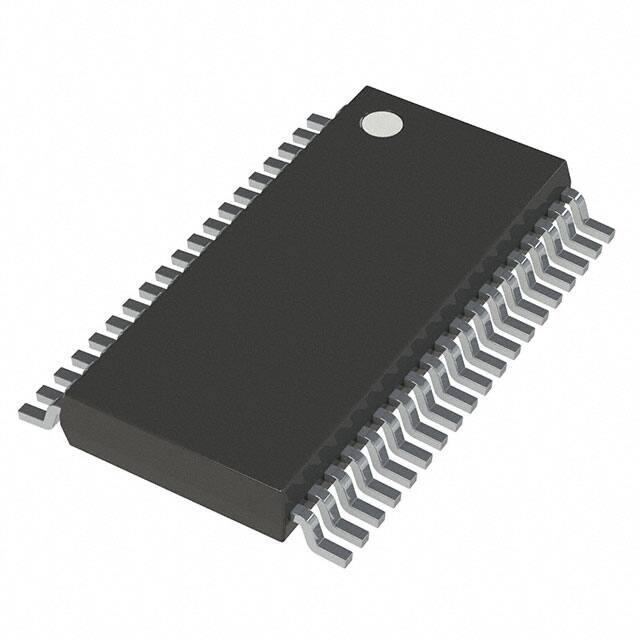
The LTC3829 is available in both low profile 38-pin 5mm
× 7mm QFN and Exposed Pad FE packages.
APPLICATIONS
All registered trademarks and trademarks are the property of their respective owners. Protected
by U.S. Patents, including 5481178, 5705919, 5929620, 6144194, 6177787, 6580258,
6498466, 6674274, 6611136.
Notebook and Palmtop Computers
n Telecom Systems
n DC Power Distribution Systems
n
TYPICAL APPLICATION
VIN
BOOST1
BOOST2
BOOST3
100k
680pF
5k
0.1µF
SENSE1+
SENSE1–
TG3
SW3
VFB
DIFFN
DIFFP
VIN = 12V
95 VOUT = 1.5V
VIN
0.6µH
VIN
0.6µH
0.002Ω
80
12
EFFICIENCY
10
75
8
70
6
65
4
POWER LOSS
2
55
50
0.1
1
10
LOAD CURRENT (A)
0
100
3829 TA01b
+
COUT
470µF
4V
×4
3829 TA01
Document Feedback
85
60
BG3
SENSE3+
SENSE3–
14
90
VOUT
1.2V
50A
0.002Ω
BG2
SENSE2+
SENSE2–
16
100
SW2
LTC3829
DIFFOUT
20k
Efficiency
BG1
FREQ
ITH
TK/SS
0.002Ω
PGND
TG2
SGND
20k
0.6µH
VIN
6V TO 28V
POWER LOSS (W)
SW3 SW2 SW1
TG1
SW1
22µF
35V
×3
EFFICIENCY (%)
INTVCC
4.7µF
+
For more information www.analog.com
Rev. E
1
�LTC3829
ABSOLUTE MAXIMUM RATINGS (Note 1)
Input Supply Voltage (VIN).......................... 40V to –0.3V
Topside Driver Voltages (BOOSTn).............. 46V to –0.3V
Switch Voltage (SWn).................................... 40V to –5V
Boosted Driver Voltage (BOOSTn – SWn)..... 6V to –0.3V
INTVCC, PGOOD, RUN, EXTVCC.................... 6V to –0.3V
ITEMP, IFAST, VFB Pin Voltages............. INTVCC to –0.3V
TK/SS, FREQ, DIFFP, DIFFN, DIFFOUT, ISET
AVP, ILIM, MODE, PLLIN Voltages.......... INTVCC to –0.3V
ITH Voltage............................................. INTVCC to –0.3V
SENSE+n, SENSE– n................................... 5.7V to –0.3V
Operating Junction Temperature Range
(Notes 2, 3)............................................. –45°C to 125°C
Storage Temperature Range................... –65°C to 125°C
Lead Temperature (Soldering, 10 sec) (FE)............ 300°C
PIN CONFIGURATION
TOP VIEW
TG1
BOOST1
CLKOUT
MODE
IFAST
ITEMP
DIFFOUT
TOP VIEW
38 37 36 35 34 33 32
DIFFN 1
31 SW1
DIFFP 2
30 BG1
RUN 3
29 BG2
AVP 4
28 SW2
SENSE1+ 5
27 TG2
SENSE1– 6
26 BOOST2
39
SENSE2+ 7
24 INTVCC
TK/SS 9
23 EXTVCC
FREQ 10
22 BG3
SENSE3+ 11
21 SW3
SENSE3– 12
20 TG3
BOOST3
PLLIN
PGOOD
ILIM
ISET
ITH
VFB
13 14 15 16 17 18 19
UHF PACKAGE
38-LEAD (5mm × 7mm) PLASTIC QFN
TJMAX = 125°C, θJA = 34°C/W
EXPOSED PAD (PIN 39) IS SGND/PGND, MUST BE SOLDERED TO PCB
38 IFAST
DIFFOUT
2
37 MODE
DIFFN
3
36 CLKOUT
DIFFP
4
35 BOOST1
RUN
5
34 TG1
AVP
6
33 SW1
SENSE1+
7
32 BG1
SENSE1–
8
31 BG2
SENSE2+
9
SENSE2– 10
25 VIN
SENSE2– 8
ITEMP
1
30 SW2
39
29 TG2
TK/SS 11
28 BOOST2
FREQ 12
27 VIN
SENSE3+
13
26 INTVCC
SENSE3–
14
25 EXTVCC
VFB 15
24 BG3
ITH 16
23 SW3
ISET 17
22 TG3
ILIM 18
21 BOOST3
PGOOD 19
20 PLLIN
FE PACKAGE
38-LEAD PLASTIC TSSOP
TJMAX = 125°C, θJA = 25°C/W
EXPOSED PAD (PIN 39) IS SGND/PGND, MUST BE SOLDERED TO PCB
ORDER INFORMATION
LEAD FREE FINISH
TAPE AND REEL
PART MARKING*
PACKAGE DESCRIPTION
TEMPERATURE RANGE
LTC3829EUHF#PBF
LTC3829EUHF#TRPBF
3829
38-Lead (5mm × 7mm) Plastic QFN
–40°C to 125°C
LTC3829IUHF#PBF
LTC3829IUHF#TRPBF
3829
38-Lead (5mm × 7mm) Plastic QFN
–40°C to 125°C
LTC3829EFE#PBF
LTC3829EFE#TRPBF
LTC3829
38-Lead Plastic TSSOP
–40°C to 125°C
LTC3829IFE#PBF
LTC3829IFE#TRPBF
LTC3829
38-Lead Plastic TSSOP
–40°C to 125°C
2
Rev. E
For more information www.analog.com
�LTC3829
ORDER INFORMATION
LEAD FREE FINISH
(Note 2)
TAPE AND REEL
PART MARKING*
PACKAGE DESCRIPTION
TEMPERATURE RANGE
LTC3829EFE#WPBF
LTC3829EFE#WTRPBF
LTC3829
38-Lead Plastic TSSOP
–40°C to 125°C
LTC3829IFE#WPBF
LTC3829IFE#WTRPBF
LTC3829
38-Lead Plastic TSSOP
–40°C to 125°C
AUTOMOTIVE PRODUCTS**
Contact the factory for parts specified with wider operating temperature ranges. *The temperature grade is identified by a label on the shipping container.
Tape and reel specifications. Some packages are available in 500 unit reels through designated sales channels with #TRMPBF suffix.
**Versions of this part are available with controlled manufacturing to support the quality and reliability requirements of automotive applications. These
models are designated with a #W suffix. Only the automotive grade products shown are available for use in automotive applications. Contact your
local Analog Devices account representative for specific product ordering information and to obtain the specific Automotive Reliability reports for
these models.
ELECTRICAL
CHARACTERISTICS
The
l denotes the specifications which apply over the full operating
junction temperature range, otherwise specifications are at TA = 25°C. VIN = 15V, VRUN = 5V, unless otherwise noted. (Note 2)
SYMBOL
PARAMETER
VIN
Input Voltage Range
CONDITIONS
MIN
VOUT
Output Voltage Range
VFB
Regulated Feedback Voltage
ITH Voltage = 1.2V (Note 4) –40°C to 85°C l
l
ITH Voltage = 1.2V (Note 4) TJ = 125°C
IFB
Feedback Current
(Note 4)
VREFLNREG
Reference Voltage Line Regulation
VIN = 4.5V to 38V (Note 4)
VLOADREG
Output Voltage Load Regulation
(Note 4)
Measured in Servo Loop,
∆ITH Voltage = 1.2V to 0.7V
Measured in Servo Loop,
∆ITH Voltage = 1.2V to 1.6V
TYP
4.5
0.6
MAX
UNITS
38
V
5.0
V
0.600
0.600
0.6045
0.607
V
V
–15
–50
nA
0.002
0.02
%/V
l
0.01
0.1
%
l
–0.01
–0.1
%
0.5955
0.593
gm
Transconductance Amplifier gm
ITH = 1.2V, Sink/Source 5µA (Note 4)
2.2
IQ
Input DC Supply Current
Normal Mode
Shutdown
(Note 5)
VIN = 15V
VRUN = 0V
4
40
DFMAX
Maximum Duty Factor
In Dropout, fOSC = 500kHz
93
94
UVLO
Undervoltage Lockout
VINTVCC Ramping Down
l
3.0
3.3
UVLO Hyst
UVLO Hysteresis
VOVL
Feedback Overvoltage Lockout
Measured at VFB
l
0.64
0.66
0.68
V
ISENSE1,2,3
SENSE+ Pins Bias Current
Each Channel, VSENSE1,2,3 = 3.3V,
VDIFFP = 3.3V
l
±1
±2
µA
ITEMP
DCR Tempco Compensation Current
VITEMP = 0.2V
l
9
10
11
µA
ITK/SS
Soft-Start Charge Current
VTK/SS = 0V
l
1.0
1.25
1.5
µA
VRUN
RUN Pin On Threshold
VRUN Rising
l
1.1
1.22
1.35
V
+
60
mA
µA
%
3.6
0.6
RUN Pin On Hysteresis
VSENSE(MAX)
mmho
V
V
100
mV
Maximum Current Sense Threshold
(E-Grade)
VFB = 0.5V, VSENSE1,2,3 = 3.3V
ILIM = 0V
ILIM = Float
ILIM = INTVCC
l
l
l
25
45
68
30
50
75
35
55
82
mV
mV
mV
Maximum Current Sense Threshold
(I-Grade)
VFB = 0.5V, VSENSE1,2,3 = 3.3V
ILIM = 0V
ILIM = Float
ILIM = INTVCC
l
l
l
23
43
66
30
50
75
37
57
84
mV
mV
mV
Rev. E
For more information www.analog.com
3
�LTC3829
ELECTRICAL
CHARACTERISTICS
The
l denotes the specifications which apply over the full operating
junction temperature range, otherwise specifications are at TA = 25°C. VIN = 15V, VRUN = 5V, unless otherwise noted. (Note 2)
SYMBOL
PARAMETER
CONDITIONS
TG1,2,3 tr
TG1,2,3 tf
TG Transition Time
Rise Time
Fall Time
(Note 6)
CLOAD = 3300pF
CLOAD = 3300pF
MIN
TYP
MAX
UNITS
25
25
ns
ns
BG1,2,3 tr
BG1,2,3 tf
BG Transition Time
Rise Time
Fall Time
(Note 6)
CLOAD = 3300pF
CLOAD = 3300pF
25
25
ns
ns
TG/BG t1D
Top Gate Off to Bottom Gate On Delay CLOAD = 3300pF Each Driver
Synchronous Switch-On Delay Time
30
ns
BG/TG t2D
Bottom Gate Off to Top Gate On Delay CLOAD = 3300pF Each Driver
Top Switch-On Delay Time
30
ns
tON(MIN)
Minimum On-Time
90
ns
(Note 7)
INTVCC Linear Regulator
VINTVCC
Internal VCC Voltage
6V < VIN ≤ 38V
VLDO INT
INTVCC Load Regulation
ICC = 0mA to 20mA
VEXTVCC
EXTVCC Switchover Voltage
EXTVCC Ramping Positive
VLDO EXT
EXTVCC Voltage Drop
ICC = 20mA, VEXTVCC = 5V
VLDOHYS
EXTVCC Hysteresis
4.8
l
4.5
5.0
5.2
V
0.5
2.0
%
4.7
50
V
100
200
mV
mV
Oscillator and Phase-Locked Loop
fNOM
Nominal Frequency
VFREQ = 1.2V
450
500
550
kHz
fLOW
Lowest Frequency
VFREQ = 0V
210
250
290
kHz
fHIGH
Highest Frequency
VFREQ ≥ 2.4V
700
770
850
kHz
RPLLN
PLLIN Input Resistance
IFREQ
Frequency Setting Current
IISET
Shed and Burst Mode Program
Current
CLKOUT
Phase (Relative to Controller 1)
CLKHIGH
Clock High Output Voltage
CLKLOW
Clock Low Output Voltage
100
kΩ
9
10
11
µA
6.5
7.5
8.5
µA
Non-Shedding Mode
Channel 2 and 3 Shedding
60
180
4
Deg
Deg
5
V
0
0.2
V
PGOOD Output
VPGL
PGOOD Voltage Low
IPGOOD = 2mA
0.1
0.3
V
IPGOOD
PGOOD Leakage Current
VPGOOD = 5V
0
±2
µA
VPG
PGOOD Trip Level, Either Controller
VFB with Respect to Set Output Voltage
VFB Ramping Negative
VFB Ramping Positive
–12
8
–10
10
–7
13
%
%
0.997
1
1.003
V/V
Differential Amplifier
ADA
Gain
RIN
Input Resistance
Measured at DIFFP Input
VOS
Input Offset Voltage
VDIFFP = VDIFFOUT = 1.5V,
IDIFFOUT = 100µA
PSRR
Power Supply Rejection Ratio
5V < VIN < 38V
ICL
Maximum Output Current
VOUT(MAX)
Maximum Output Voltage
INTVCC = 5V, IDIFFOUT = 300µA
GBW
Gain-Bandwidth Product
(Note 8)
3
MHz
SR
Slew Rate
(Note 8)
2
V/µs
4
l
80
kΩ
2.5
mV
100
dB
3
mA
VINTVCC – 1.4 VINTVCC – 1.1
V
Rev. E
For more information www.analog.com
�LTC3829
ELECTRICAL
CHARACTERISTICS
The
l denotes the specifications which apply over the full operating
junction temperature range, otherwise specifications are at TA = 25°C. VIN = 15V, VRUN = 5V, unless otherwise noted. (Note 2)
SYMBOL
PARAMETER
CONDITIONS
MIN
TYP
MAX
9
10
11
UNITS
Nonlinear Fast Transit Mode
IFAST
Fast Transient Programmable Current
VIFAST = 400mV
µA
AVP (Active Voltage Positioning)
ISINK
ISOURCE
Sink Current of AVP Pin
SENSE+ = 1.2V
250
µA
Source Current of AVP Pin
SENSE+ = 1.2V
2
mA
SENSE+ = 1.2V
180
mV
VAVP-VO(MAX) Maximum Voltage Drop VAVP to VO
VAVP
Maximum AVP Voltage
l
2.5
V
On-Chip Driver
TG RUP
TG Pull-Up RDS(ON)
TG High
2.6
Ω
TG RDOWN
TG Pull-Down RDS(ON)
TG Low
1.5
Ω
BG RUP
BG Pull-Up RDS(ON)
BG High
4
Ω
BG RDOWN
BG Pull-Down RDS(ON)
BG Low
1.1
Ω
Note 1: Stresses beyond those listed under Absolute Maximum Ratings
may cause permanent damage to the device. Exposure to any Absolute
Maximum Rating condition for extended periods may affect device
reliability and lifetime.
Note 2: The LTC3829 is tested under pulsed load conditions such that
TJ ≈ TA. The LTC3829E is guaranteed to meet performance specifications
from 0°C to 85°C operating junction temperature. Specifications over
the –40°C to 125°C operating junction temperature range are assured by
design, characterization and correlation with statistical process controls.
The LTC3829I is guaranteed to meet performance specifications over the
full –40°C to 125°C operating junction temperature range.
Note 3: TJ is calculated from the ambient temperature, TA, and power
dissipation, PD, according to the following formula:
LTC3829UHF: TJ = TA + (PD • 34°C/W)
LTC3829FE: TJ = TA + (PD • 25°C/W)
Note 4: The LTC3829 is tested in a feedback loop that servos VITH to a
specified voltage and measures the resultant VFB.
Note 5: Dynamic supply current is higher due to the gate charge being
delivered at the switching frequency. See Applications Information.
Note 6: Rise and fall times are measured using 10% and 90% levels. Delay
times are measured using 50% levels.
Note 7: The minimum on-time condition corresponds to the on inductor
peak-to-peak ripple current ≥40% of IMAX (see Minimum On-Time
Considerations in the Applications Information section).
Note 8: Guaranteed by design.
TYPICAL PERFORMANCE CHARACTERISTICS
Load Step-Up (0A to 75A, 75A/µs)
(Nonlinear Operation)
VOUT
100mV/DIV
AC-COUPLED
Load Step-Up (0A to 75A, 75A/µs)
(Normal Operation)
VOUT
100mV/DIV
AC-COUPLED
75mV
VSW1
10V/DIV
VSW1
10V/DIV
VSW2
10V/DIV
VSW2
10V/DIV
VSW3
10V/DIV
VSW3
10V/DIV
2µs/DIV
3829 G01
95mV
2µs/DIV
3829 G02
Rev. E
For more information www.analog.com
5
�LTC3829
TYPICAL PERFORMANCE CHARACTERISTICS
Phase Shedding Transition
Phase Shedding Transition
VSW1
10V/DIV
VSW1
10V/DIV
VSW2
10V/DIV
VSW2
10V/DIV
VSW3
10V/DIV
VSW3
10V/DIV
VOUT
50mV/DIV
AC-COUPLED
VOUT
50mV/DIV
AC-COUPLED
3829 G03
VIN = 12V
4µs/DIV
VOUT = 1.5V
TRANSITION LOAD CURRENT = 18.6A
Prebiased Output at 2V
Coincident Tracking
RUN
2V/DIV
VOUT1
VOUT1 = 3.3V
VOUT2 = 1.5V
1V/DIV
VOUT2
VOUT
1V/DIV
VFB
500mV/DIV
TK/SS
500mV/DIV
VIN = 12V
VOUT = 3.3V
5.3
4.9
4.7
4.5
4.3
4.1
3.9
3.7
3.5
4
24
14
INPUT VOLTAGE (V)
34
40
Current Sense Threshold
vs ITH Voltage
80
ILIM = INTVCC
60
ILIM = FLOAT
40
20
ILIM = GND
0
–20
0
5
10
15 20 25 30
INPUT VOLTAGE (V)
35
3829 G08
6
3829 G06
2ms/DIV
INTVCC Line Regulation
INTVCC VOLTAGE (V)
SUPPLY CURRENT (mA)
5.1
5.25
5.00
4.75
4.50
4.25
4.00
3.75
3.50
3.25
3.00
2.75
2.50
2.25
2.00
VIN = 12V
NO LOAD
VSENSE (mV)
5.5
3829 G05
2ms/DIV
Quiescent Current vs Input
Voltage without EXTVCC
3829 G04
VIN = 12V
4µs/DIV
VOUT = 1.5V
TRANSITION LOAD CURRENT = 5.3A
40
3829 G09
–40
0
0.5
1
VITH (V)
1.5
2
3829 G10
Rev. E
For more information www.analog.com
�LTC3829
TYPICAL PERFORMANCE CHARACTERISTICS
Maximum Current Sense Threshold
vs Common Mode Voltage
ILIM = INTVCC
80
70
60
ILIM = FLOAT
50
40
ILIM = GND
30
20
10
0
0
4
3
2
VSENSE COMMON MODE VOLTAGE (V)
1
5
100
MAXIMUM CURRENT SENSE VOLTAGE (mV)
MAXIMUM CURRENT SENSE VOLTAGE (mV)
CURRENT SENSE THRESHOLD (mV)
90
Maximum Current Sense Voltage
vs Feedback Voltage
(Current Foldback)
Maximum Current Sense Voltage
vs Duty Cycle
90
ILIM = INTVCC
80
70
60
ILIM = FLOAT
50
40
ILIM = GND
30
20
10
0
0
10 20 30 40 50 60 70 80 90 100
DUTY CYCLE (%)
100
90
80
ILIM = INTVCC
70
60
ILIM = FLOAT
50
40
ILIM = GND
30
20
10
0
0
0.1
0.3
0.4
0.5
0.2
FEEDBACK VOLTAGE (V)
3829 G12
3829 G11
TK/SS Pull-Up Current
vs Temperature
3829 G13
Shutdown (RUN) Threshold
vs Temperature
1.5
1.4
1.4
1.3
0.6
Regulated Feedback Voltage
vs Temperature
0.604
1.3
1.2
0.600
ON
VFB (V)
RUN PIN VOLTAGE (V)
TK/SS CURRENT (µA)
0.602
1.2
OFF
0.598
0.596
1.1
0.594
1.1
–50
–25
0
25
50
75
TEMPERATURE (°C)
100
1.0
–50
125
–25
0
25
50
75
TEMPERATURE (°C)
100
Oscillator Frequency
vs Temperature
400
300
200
–50 –25
VFREQ = 0V
50
25
75
0
TEMPERATURE (°C)
125
800
VFREQ ≥ 2.4V
RISING
600
FREQUENCY (kHz)
VFREQ = 1.2V
100
Oscillator Frequency
vs Input Voltage
3.9
UVLO THRESHOLD (V)
FREQUENCY (kHz)
4.1
VFREQ ≥ 2.4V
600
50
25
75
0
TEMPERATAURE (°C)
3829 G16
Undervoltage Lockout Threshold
(INTVCC) vs Temperature
4.3
500
0.592
–50 –25
3829 G15
3829 G14
700
125
3.7
3.5
FALLING
3.3
3.1
VFREQ = 1.2V
400
VFREQ = 0V
200
2.9
2.7
100
125
3829 G17
2.5
–50
–25
0
25
50
75
TEMPERATURE (°C)
100
125
3829 G18
0
0
5
10
15 20 25 30
INPUT VOLTAGE (V)
35
40
3829 G19
Rev. E
For more information www.analog.com
7
�LTC3829
TYPICAL PERFORMANCE CHARACTERISTICS
Shutdown Current
vs Input Voltage
70
6
30
20
10
QUIESCENT CURRENT (mA)
60
40
SHUTDOWN CURRENT (µA)
SHUTDOWN CURRENT (µA)
50
0
Quiescent Current vs Temperature
without EXTVCC
Shutdown Current vs Temperature
50
40
30
20
10
25
20
15
30
INPUT VOLTAGE (V)
35
40
0
–50 –25
50
25
75
0
TEMPERATURE (°C)
100
125
3829 G21
3829 G20
PIN FUNCTIONS
4
3
2
1
10
5
5
0
–50 –25
50
25
75
0
TEMPERATURE (°C)
100
125
3829 G22
(UHF/FE)
DIFFN (Pin 1/Pin 3): Negative Input of Remote Sensing
Differential Amplifier. Connect this to the remote load
ground pin.
DIFFP (Pin 2/Pin 4): Positive Input of Remote Sensing
Differential Amplifier. Must connect this to the remote load
positive terminal directly even when diffamp is not used.
RUN (Pin 3/Pin 5): Run Control Input. A voltage above
1.22V on this pin turns on the IC. There is a 1.0µA pull-up
current for this pin. Once the RUN pin rises above 1.22V,
an additional 4.5µA pull-up current is added to the pin.
AVP (Pin 4/Pin 6): Active Voltage Positioning Load Slope
Programming Pin. A resistor tied between this pin and
the DIFFP pin sets the load slope. The AVP function can
only be used with the remote sensing differential amplifier.
Float or connect a 1kΩ resistor to DIFFP pin when AVP
function is not used.
SENSE1+, SENSE2+, SENSE3+ (Pins 5, 7, 11/Pins 7, 9,
13): Current Sense Comparator Inputs. The (+) inputs to
the current comparators are normally connected to DCR
sensing networks or current sensing resistors.
TK/SS (Pin 9/Pin 11): Output Voltage Tracking and SoftStart Input. When one particular IC is configured to be the
master of two ICs, a capacitor to ground at this pin sets
the ramp rate for the master IC’s output voltage. When the
IC is configured to be the slave of two ICs, the VFB voltage
of the master IC is reproduced by a resistor divider and
applied to this pin. An internal soft-start current of 1.25µA
is charging this pin.
FREQ (Pin 10/Pin 12): There is a precision 10µA current
sourced out of this pin. A resistor to ground sets a voltage
which in turn programs the frequency. Alternatively, this
pin can be driven with a DC voltage to vary the frequency
of the internal oscillator.
VFB (Pin 13/Pin 15): Error Amplifier Feedback Input. This
pin receives the remotely sensed feedback voltage from
an external resistive divider.
ITH (Pin 14/Pin 16): Current Control Threshold and Error
Amplifier Compensation Point. Each associated channels’
current comparator tripping threshold increases with this
ITH control voltage.
SENSE1–, SENSE2–, SENSE3– (Pins 6, 8, 12/Pins 8, 10,
14): Current Sense Comparator Inputs. The (–) inputs
to the current comparators are connected to the output.
8
Rev. E
For more information www.analog.com
�LTC3829
PIN FUNCTIONS
(UHF/FE)
ISET (Pin 15/Pin 17): Stage Shedding Comparator and
Burst Mode Comparator Programming Pin. A resistor to
ground programs the stage shedding comparator threshold or Burst Mode comparator threshold and its current
limit depending on MODE pin setting.
TG1, TG2, TG3 (Pins 32, 27, 20/Pins 34, 29, 22): Top
Gate Driver Outputs. These are the outputs of floating
drivers with a voltage swing equal to INTVCC superimposed on the switch nodes voltages.
ILIM (Pin 16/Pin 18): Current Comparator Sense Voltage
Range Pin. This pin is to be programmed to SGND, FLOAT
or INTVCC to set the maximum current sense threshold to
one of three different levels for each comparator.
BOOST1, BOOST2, BOOST3 (Pins 33, 26, 19/Pins 35,
28, 21): Boosted Floating Driver Supplies. The (+) terminal of the bootstrap capacitors connect to these pins.
These pins swing from a diode voltage drop below INTVCC
up to VIN + INTVCC.
PGOOD (Pin 17/Pin 19): Power Good Indicator Output.
Open-drain logic out that is pulled to ground when the
output exceeds ±10% regulation window after the internal
100µs power bad mask timer expires.
CLKOUT (Pin 34/Pin 36): Clock Output Pin. CLKOUT is
60° out of phase relative to channel 1 in non-shedding
mode. During stage shedding, CLKOUT is 180° out of
phase with channel 1.
PLLIN (Pin 18/Pin 20): External Synchronization Pin. A
clock on the pin synchronizes the internal oscillator with
the clock on this pin.
MODE (Pin 35/Pin 37): Forced Continuous Mode, Burst
Mode or Shed Mode Selection Pin. Connect this pin
to SGND to force IC in continuous mode of operation.
Connect to INTVCC to enable shed mode operation. Leave
the pin floating to enable Burst Mode operation.
EXTVCC (Pin 23/Pin 25): External Power Input to an
Internal Switch Connected to INTVCC. This switch closes
and supplies the IC power, bypassing the internal low
dropout regulator, whenever EXTVCC is higher than 4.7V.
Do not exceed 6V on this pin and ensure VIN > VEXTVCC
at all times.
INTVCC (Pin 24/Pin 26): Internal 5V Regulator Output. The
control circuits are powered from this voltage. Decouple
this pin to PGND with a minimum of 4.7µF low ESR tantalum or ceramic capacitor.
VIN (Pin 25/Pin 27): Main Input Supply. Decouple this pin
to PGND with a capacitor (0.1µF to 1µF).
BG1, BG2, BG3 (Pins 30, 29, 22/Pins 32, 31, 24): Bottom
Gate Driver Outputs. These pins drive the gates of the bottom N-channel MOSFETs between PGND and INTVCC.
SW1, SW2, SW3 (Pins 31, 28, 21/Pins 33, 30, 23):
Switch Node Connections to Inductors. Voltage swing
at these pins is from a Schottky diode (external) voltage
drop below ground to VIN.
IFAST (Pin 36/Pin 38): Programmable Pin for Nonlinear
Control Trip Threshold. A resistor to ground programs the
tripping threshold for nonlinear control circuit. Connect
this pin to INTVCC to disable this feature. See Applications
Information section for details. Leave this pin floating
when it is not used.
ITEMP (Pin 37/Pin 1): Input of the Temperature Sensing
Comparator. Connect this pin to external NTC resistors
placed near inductors.
DIFFOUT (Pin 38/Pin 2): Output of Remote Sensing
Differential Amplifier. Connect this pin to VFB through a
resistive divider.
SGND/PGND (Exposed Pad Pin 39/Exposed Pad Pin
39): Combined Signal and Power Ground Pad. Connect
this pad closely to the sources of the bottom N-channel
MOSFETs, the (–) terminal of CVCC and the (–) terminal
of CIN. All small-signal components and compensation
components should also Kelvin-connect to this pad.
Rev. E
For more information www.analog.com
9
�LTC3829
FUNCTIONAL DIAGRAM
MODE
EXTVCC
ITEMP
PLLIN
4.7V
FREQ
+
–
TEMPSNS
0.6V
MODE/SYNC
DETECT
VIN
F
+
5V
REG
+
–
CIN
INTVCC
F
PLL-SYNC
VIN
INTVCC
BOOST
BURSTEN
CLKOUT
S
R Q
+
3k
ICOMP
M1
SENSE+
SWITCH
LOGIC
AND
ANTISHOOTTHROUGH
IREV
IFAST
DB
SENSE–
L1
VOUT
+
BG
RUN
COUT
M2
OV
IFAST
CB
SW
ON
–
+
–
TG
FCNT
OSC
CVCC
PGND
ILIM
PGOOD
SLOPE
COMPENSATION
+
INTVCC
1
51k
ITHB
UVLO
UV
SHED
COMP
SLEEP
R2
–
+
–
– + +
0.5V
–
EA
SS
RUN
1.25µA
DIFFP
40k
DIFFAMP
–
40k
R1
OV
+
ISET
+
0.6V
REF
VFB
+
ISET
40k
+
0.54V
–
SLOPE RECOVERY
ACTIVE CLAMP
VIN
RAVP
DIFFOUT
40k
DIFFN
0.66V
SGND
RPRE-AVP
AVP
1.22V
+
–
+
–
+
–
SENSE1+
SENSE1–
SENSE2+
SENSE2–
SENSE3+
SENSE3–
–
3829 BD
0.55V
1.0µA
ISET
ISET
10
ITH
RC
CC1
RUN
TK/SS CSS
Rev. E
For more information www.analog.com
�LTC3829
OPERATION (Refer to Functional Diagram)
Main Control Loop
The LTC3829 uses a constant frequency, current mode
step-down architecture. During normal operation, each
top MOSFET is turned on each cycle when the oscillator
sets the RS latch, and turned off when the main current
comparator, ICMP , resets each RS latch. The peak inductor current at which ICMP resets the RS latch is controlled
by the voltage on the ITH pin, which is the output of the
error amplifier, EA. The remote sense amplifier (DIFFAMP)
produces a signal equal to the differential voltage sensed
across the output capacitor and re-references it to the
local IC ground reference. The VFB pin receives a portion
of this feedback signal and compares it to the internal
0.6V reference. When the load current increases, it causes
a slight decrease in the VFB pin voltage relative to the
0.6V reference, which in turn causes the ITH voltage to
increase until each inductor’s average current equals onethird of the new load current (assuming all three current
sensing resistors are equal). After each top MOSFET has
turned off, the bottom MOSFET is turned on until either
the inductor current starts to reverse, as indicated by the
reverse current comparator, IREV , or the beginning of the
next cycle.
The main control loop is shut down by pulling the RUN
pin low. Releasing RUN allows an internal 1.0µA current
source to pull up the RUN pin. When the RUN pin reaches
1.22V, the main control loop is enabled and the IC is
powered up. When the RUN pin is low, all functions are
kept in a controlled state.
INTVCC/EXTVCC Power
Power for the top and bottom MOSFET drivers and most
other internal circuitry is derived from the INTVCC pin.
When the EXTVCC pin is left open or tied to a voltage less
than 4.7V, an internal 5V linear regulator supplies INTVCC
power from VIN. If EXTVCC is taken above 4.7V, the 5V
regulator is turned off and an internal switch is turned
on connecting EXTVCC. Using the EXTVCC pin allows the
INTVCC power to be derived from a high efficiency external source such as a switching regulator output. Each
top MOSFET driver is biased from the floating bootstrap
capacitor, CB, which normally recharges during each off
cycle through an external diode when the top MOSFET
turns off. If the input voltage, VIN, decreases to a voltage
close to VOUT , the loop may enter dropout and attempt to
turn on the top MOSFET continuously. The dropout detector detects this and forces the top MOSFET off for about
one-twelfth of the clock period plus 100ns every third
cycle to allow CB to recharge. However, it is recommended
that a load be present or the IC operates at low frequency
during the dropout transition to ensure CB is recharged.
Shutdown and Start-Up (RUN and TK/SS Pins)
The LTC3829 can be shut down using the RUN pin.
Pulling the RUN pin below 1.22V shuts down the main
control loop for the controller and most internal circuits,
including the INTVCC regulator. Releasing the RUN pin
allows an internal 1.0µA current to pull up the pin and
enable the controller. Alternatively, the RUN pin may be
externally pulled up or driven directly by logic. Be careful not to exceed the absolute maximum rating of 6V on
this pin. The start-up of the controller’s output voltage,
VOUT , is controlled by the voltage on the TK/SS pin. When
the voltage on the TK/SS pin is less than the 0.6V internal reference, the LTC3829 regulates the VFB voltage to
the TK/SS pin voltage instead of the 0.6V reference. This
allows the TK/SS pin to be used to program a soft-start
by connecting an external capacitor from the TK/SS pin
to SGND. An internal 1.25µA pull-up current charges this
capacitor, creating a voltage ramp on the TK/SS pin. As
the TK/SS voltage rises linearly from 0V to 0.6V (and
beyond), the output voltage, VOUT , rises smoothly from
zero to its final value. Alternatively, the TK/SS pin can be
used to cause the start-up of VOUT to track that of another
supply. Typically, this requires connecting to the TK/SS
pin an external resistor divider from the other supply to
ground (see the Applications Information section). When
the RUN pin is pulled low to disable the controller, or when
INTVCC drops below its undervoltage lockout threshold of
3.3V, the TK/SS pin is pulled low by an internal MOSFET.
When in undervoltage lockout, all phases of the controller
are disabled and the external MOSFETs are held off.
Rev. E
For more information www.analog.com
11
�LTC3829
OPERATION (Refer to Functional Diagram)
Light Load Current Operation (Burst Mode Operation,
Stage Shedding or Continuous Conduction)
The LTC3829 can be enabled to enter high efficiency Burst
Mode operation, Stage Shedding mode or forced continuous conduction mode. To select forced continuous
operation, tie the MODE pin to a DC voltage below 0.6V
(e.g., SGND). To select Stage Shedding mode of operation, tie the MODE pin to INTVCC. To select Burst Mode
operation, float the MODE pin.
When the controller is enabled for Burst Mode operation,
the peak current in the inductor is set to approximately
one-sixth of the maximum sense voltage even though
the voltage on the ITH pin indicates a lower value. The
peak current can be programmed through the ISET pin. If
the average inductor current is higher than the load current, the error amplifier, EA, will decrease the voltage on
the ITH pin. When the ITH voltage drops below 0.5V (can
also be programmed by the ISET pin), the internal sleep
signal goes high (enabling sleep mode) and the external
MOSFETs are turned off. In sleep mode, the load current
is supplied by the output capacitor. As the output voltage
decreases, the EA’s output begins to rise. When the output voltage drops enough, the sleep signal goes low, and
the controller resumes normal operation by turning on
the top external MOSFET on the next cycle of the internal
oscillator. When a controller is enabled for Burst Mode
operation, the inductor current is not allowed to reverse.
The reverse current comparator, IREV , turns off the bottom
external MOSFET just before the inductor current reaches
zero, preventing it from reversing and going negative.
Thus, the controller operates in discontinuous operation.
In forced continuous operation, the inductor current is
allowed to reverse at light loads or under large transient
conditions. The peak inductor current is determined by
the voltage on the ITH pin. In this mode, the efficiency
at light loads is lower than in Burst Mode operation.
However, continuous mode has the advantages of lower
output ripple and less interference with audio circuitry.
When the MODE pin is connected to INTVCC, the
LTC3829 operates in Stage Shedding mode at light
loads. The controller will turn off channels 2 and 3 and
increase the current gain of the first channel to ensure
12
smooth transition. The threshold where the controller
goes into Stage Shedding mode is when the ITH voltage
drops below 0.5V, but it can be programmed by ISET
pin. The inductor current is not allowed to reverse in
this mode (discontinuous operation). At very light loads,
the current comparator may remain tripped for several
cycles and force the external top MOSFET to stay off for
the same number of cycles (i.e., skipping pulses). This
mode exhibits low output ripple as well as low audio
noise and reduced RF interference as compared to Burst
Mode operation. It provides higher low current efficiency
than forced continuous mode, but not nearly as high as
Burst Mode operation.
2-Chip Operations (CLKOUT Pin)
The LTC3829’s three channels are 120° out of phase
providing multiphase operation. This configuration can
provide enough power for most high current applications.
However, for even higher power applications, the LTC3829
can be configured for PolyPhase® and 2-chip operation.
The LTC3829 features a CLKOUT pin which enables two
LTC3829s to operate out of phase. The CLKOUT signal is
60° out of phase with respect to phase 1 of the controller.
In Stage Shedding mode, however, the CLKOUT signal is
180° out of phase with respect to phase 1 of the controller.
Frequency Selection and Phase-Locked Loop
(FREQ and PLLIN Pins)
The selection of switching frequency is a trade-off between
efficiency and component size. Low frequency operation increases efficiency by reducing MOSFET switching
losses, but requires larger inductance and/or capacitance
to maintain low output ripple voltage.
If the PLLIN pin is not being driven by an external clock
source, the FREQ pin can be used to program the controller’s operating frequency from 250kHz to 770kHz. There
is a precision 10µA current flowing out of the FREQ pin
so that the user can program the controller’s switching
frequency with a single resistor to SGND. A curve is provided later in the Applications Information section showing the relationship between the voltage on the FREQ pin
and switching frequency.
Rev. E
For more information www.analog.com
�LTC3829
OPERATION (Refer to Functional Diagram)
A phase-locked loop (PLL) is available on the LTC3829
to synchronize the internal oscillator to an external clock
source that is connected to the PLLIN pin. The PLL loop
filter network is integrated inside the LTC3829. The phaselocked loop is capable of locking any frequency within the
range of 250kHz to 770kHz. The frequency setting resistor should always be present to set the controller’s initial
switching frequency before locking to the external clock.
The operating mode of the controller is still determined
by the MODE pin when it is synchronized.
Sensing the Output Voltage with a
Differential Amplifier
The LTC3829 includes a low offset, unity-gain, high bandwidth differential amplifier for applications that require
true remote sensing. Sensing the load across the load
capacitors directly greatly benefits regulation in high current, low voltage applications, where board interconnection losses can be a significant portion of the total error
budget.
The LTC3829 differential amplifier has a typical output
slew rate of 2V/µs. The amplifier is configured for unity
gain, meaning that the difference between DIFFP and
DIFFN is translated to DIFFOUT, relative to SGND.
Care should be taken to route the DIFFP and DIFFN PCB
traces parallel to each other all the way to the terminals
of the output capacitor or remote sensing points on the
board. In addition, avoid routing these sensitive traces
near any high speed switching nodes in the circuit. Ideally,
the DIFFP and DIFFN traces should be shielded by a low
impedance ground plane to maintain signal integrity.
The maximum output voltage when using the differential
amplifier is INTVCC – 1.4V (typically 3.6V). Above this output voltage the differential amplifier should not be used.
Power Good (PGOOD Pin)
The PGOOD pin is connected to an open drain of an internal N-channel MOSFET. The MOSFET turns on and pulls
the PGOOD pin low when the VFB pin voltage is not within
±10% of the 0.6V reference voltage. The PGOOD pin is
also pulled low when the RUN pin is below 1.22V or when
the LTC3829 is in the soft-start or tracking phase. When
the VFB pin voltage is within the ±10% regulation window,
the MOSFET is turned off and the pin is allowed to be
pulled up by an external resistor to a source of up to 6V.
The PGOOD pin will flag power good immediately when
the VFB pin is within the regulation window. However, there
is an internal 100µs power-bad mask when the VFB goes
out of the window.
Output Overvoltage Protection
An overvoltage comparator, OV, guards against transient
overshoots (>10%) as well as other more serious conditions that may overvoltage the output. In such cases,
the top MOSFET is turned off and the bottom MOSFET is
turned on until the overvoltage condition is cleared.
Undervoltage Lockout
The LTC3829 has two functions that help protect the
controller in case of undervoltage conditions. A precision UVLO comparator constantly monitors the INTVCC
voltage to ensure that an adequate gate-drive voltage is
present. It locks out the switching action when INTVCC is
below 3.3V. To prevent oscillation when there is a disturbance on the INTVCC, the UVLO comparator has 600mV
of precision hysteresis.
Another way to detect an undervoltage condition is to
monitor the VIN supply. Because the RUN pin has a precision turn-on reference of 1.22V, one can use a resistor
divider to VIN to turn on the IC when VIN is high enough.
An extra 4.5µA of current flows out of the RUN pin once
the RUN pin voltage passes 1.22V. The RUN comparator
itself has about 80mV of hysteresis. One can program
additional hysteresis for the RUN comparator by adjusting the values of the resistive divider. For accurate VIN
undervoltage detection, VIN needs to be higher than 4.5V.
Rev. E
For more information www.analog.com
13
�LTC3829
APPLICATIONS INFORMATION
The Typical Application on the first page of this data sheet
is a basic LTC3829 application circuit. The LTC3829 can
be configured to use either DCR (inductor resistance)
sensing or low value resistor sensing. The choice between
the two current sensing schemes is largely a design tradeoff between cost, power consumption and accuracy. DCR
sensing is becoming popular because it saves expensive
current sensing resistors and is more power efficient,
especially in high current applications. However, current
sensing resistors provide the most accurate current limits for the controller. Other external component selection
is driven by the load requirement, and begins with the
selection of RSENSE (if RSENSE is used) and inductor value.
Next, the power MOSFETs are selected. Finally, input and
output capacitors are selected.
Current Limit Programming
The ILIM pin is a tri-level logic input which sets the maximum current limit of the controller. When ILIM is either
grounded, floated or tied to INTVCC, the typical value for
the maximum current sense threshold will be 30mV,
50mV or 75mV, respectively.
Which setting should be used? For the best current limit
accuracy, use the 75mV setting. The 30mV setting will
allow for the use of very low DCR inductors or sense
resistors, but at the expense of current limit accuracy. The
50mV setting is a good balance between the two.
SENSE+ and SENSE– Pins
The SENSE+ and SENSE– pins are the inputs to the current
comparators. The common mode input voltage range of
the current comparators is 0V to 5V. All SENSE+ pins are
high impedance inputs with small currents of less than
1µA. The high impedance inputs to the current comparators allow accurate DCR sensing. All SENSE– pins and
DIFFP should be connected to VOUT directly when DCR
sensing is used. Care must be taken not to float these pins
during normal operation. Filter components mutual to the
sense lines should be placed close to the LTC3829, and
the sense lines should run close together to a Kelvin connection underneath the current sense element (shown in
Figure 1). Sensing current elsewhere can effectively add
parasitic inductance and capacitance to the current sense
14
element, degrading the information at the sense terminals
and making the programmed current limit unpredictable.
If DCR sensing is used (Figure 2b), sense resistor R1
should be placed close to the switching node, to prevent
noise from coupling into sensitive small-signal nodes.
The capacitor C1 should be placed close to the IC pins.
TO SENSE FILTER,
NEXT TO THE CONTROLLER
3829 F01
COUT
RSENSE
Figure 1. Sense Lines Placement with Sense Resistor
Low Value Resistors Current Sensing
A typical sensing circuit using a discrete resistor is shown
in Figure 2a. RSENSE is chosen based on the required
output current. The current comparator has a maximum
threshold VSENSE(MAX) determined by the ILIM setting. The
input common mode range of the current comparator
is 0V to 5V. The current comparator threshold sets the
peak of the inductor current, yielding a maximum average
output current IMAX equal to the peak value less half the
peak-to-peak ripple current, ∆IL. To calculate the sense
resistor value, use the equation:
R SENSE =
VSENSE(MAX)
IMAX +
∆IL
2
Because of possible PCB noise in the current sensing
loop, the AC current sensing ripple of ∆VSENSE = ∆IL •
RSENSE also needs to be checked in the design to get a
good signal-to-noise ratio. In general, for a reasonably
good PCB layout, a 10mV ∆VSENSE voltage is recommended as a conservative number to start with, either
for RSENSE or DCR sensing applications. For previous generation current mode controllers, the maximum sense
voltage was high enough (e.g., 75mV for the LTC1628/
LTC3728 family) that the voltage drop across the parasitic
inductance of the sense resistor represented a relatively
small error. For today’s highest current density solutions,
however, the value of the sense resistor can be less than
Rev. E
For more information www.analog.com
�LTC3829
APPLICATIONS INFORMATION
VIN
INTVCC
VIN
SENSE RESISTOR
PLUS PARASITIC
INDUCTANCE
BOOST
TG
LTC3829
RS
SW
BG
VOUT
CF • 2 • RF ≤ ESL/RS
POLE-ZERO
CANCELLATION
PGND
RF
SENSE+
ESL
CF
SENSE–
SGND
RF
FILTER COMPONENTS
PLACED NEAR SENSE PINS
3829 F02a
(2a) Using a Resistor to Sense Current
VIN
INTVCC
VIN
BOOST
OPTIONAL
TEMP COMP
NETWORK
L
SW
VOUT
BG
PGND
R1**
SENSE+
RNTC
DCR
LTC3829
ITEMP
RS
INDUCTOR
TG
RP
C1*
R2
SENSE–
SGND
L
R2
R
= DCR
*PLACE C1 NEAR SENSE+, R1||R2 × C1 =
DCR SENSE(EQ)
R1 + R2
– PINS
SENSE
**PLACE R1 NEXT TO INDUCTOR
3829 F02b
(2b) Using the Inductor DCR to Sense Current
Figure 2. Two Different Methods of Sensing Current
1mΩ and the peak sense voltage can be as low as 20mV.
In addition, inductor ripple currents greater than 50%
with operation up to 1MHz are becoming more common.
Under these conditions the voltage drop across the sense
resistor’s parasitic inductance is no longer negligible. A
typical sensing circuit using a discrete resistor is shown in
Figure 2a. In previous generations of controllers, a small
RC filter placed near the IC was commonly used to reduce
the effects of capacitive and inductive noise coupled in
the sense traces on the PCB. A typical filter consists of
two series 10Ω resistors connected to a parallel 1000pF
capacitor, resulting in a time constant of 20ns. This same
RC filter, with minor modifications, can be used to extract
the resistive component of the current sense signal in the
presence of parasitic inductance. For example, Figure 3
illustrates the voltage waveform across a 2mΩ sense
resistor with a 2010 footprint for the 1.2V/15A converter
operating at 100% load. The waveform is the superposition of a purely resistive component and a purely inductive
component. It was measured using two scope probes
and waveform math to obtain a differential measurement.
Based on additional measurements of the inductor ripple
Rev. E
For more information www.analog.com
15
�LTC3829
APPLICATIONS INFORMATION
current and the on-time and off-time of the top switch,
the value of the parasitic inductance was determined to
be 0.5nH using the equation:
ESL =
VESL(STEP) tON • tOFF
∆IL
tON + tOFF
(1)
If the RC time constant is chosen to be close to the
parasitic inductance divided by the sense resistor (L/R),
the resulting waveform looks resistive again, as shown
in Figure 4. For applications using low maximum sense
voltages, check the sense resistor manufacturer’s data
sheet for information about parasitic inductance. In the
absence of data, measure the voltage drop directly across
the sense resistor to extract the magnitude of the ESL step
and use Equation 1 to determine the ESL. However, do not
overfilter. Keep the RC time constant, less than or equal
to the inductor time constant to maintain a high enough
ripple voltage of ∆VSENSE. The above generally applies to
high density/high current applications where IMAX > 10A
and low values of inductors are used. For applications
VSENSE
20mV/DIV
VESL(STEP)
500ns/DIV
3829 F03
Figure 3. Voltage Waveform Measured
Directly Across the Sense Resistor
where IMAX < 10A, set RF to 10Ω and CF to 1000pF. This
will provide a good starting point. The filter components
need to be placed close to the IC. The positive and negative sense traces need to be routed as a differential pair
and Kelvin connected to the sense resistor.
Inductor DCR Sensing
For applications requiring the highest possible efficiency
at high load currents, the LTC3829 is capable of sensing
the voltage drop across the inductor DCR, as shown in
Figure 2b. The DCR of the inductor represents the small
amount of DC winding resistance of the copper, which
can be less than 1mΩ for today’s low value, high current
inductors. In a high current application requiring such an
inductor, conduction loss through a sense resistor would
cost several points of efficiency compared to DCR sensing. If the external R1|| R2 • C1 time constant is chosen to
be exactly equal to the L/DCR time constant, the voltage
drop across the external capacitor is equal to the drop
across the inductor DCR multiplied by R2/(R1 + R2). R2
scales the voltage across the sense terminals for applications where the DCR is greater than the target sense
resistor value. To properly dimension the external filter
components, the DCR of the inductor must be known. It
can be measured using a good RLC meter, but the DCR
tolerance is not always the same and varies with temperature; consult the manufacturers’ data sheets for detailed
information.
Using the inductor ripple current value from the Inductor
Value Calculation and Output Ripple Current section, the
target sense resistor value is:
R SENSE(EQUIV) =
VSENSE
20mV/DIV
500ns/DIV
3829 F04
Figure 4. Voltage Waveform Measured After the
Sense Resistor Filter. CF = 1000pF, RF = 100Ω
16
VSENSE(MAX)
IMAX +
∆IL
2
To ensure that the application will deliver full load current over the full operating temperature range, choose
the minimum value for the Maximum Current Sense
Threshold (VSENSE(MAX)) in the Electrical Characteristics
table (25mV, 45mV or 68mV, depending on the state of
the ILIM pin). Next, determine the DCR of the inductor.
Where provided, use the manufacturer’s maximum value,
usually given at 20°C. Increase this value to account
Rev. E
For more information www.analog.com
�LTC3829
APPLICATIONS INFORMATION
for the temperature coefficient of resistance, which is
approximately 0.4%/°C. A conservative value for TL(MAX)
is 100°C. To scale the maximum inductor DCR to the
desired sense resistor value, use the divider ratio:
RD =
R SENSE(EQUIV)
C1 is usually selected to be in the range of 0.047µF to
0.47µF. This forces R1|| R2 to around 2k, reducing error
that might have been caused by the SENSE+ pins’ ±1µA
current. TL(MAX) is the maximum inductor temperature.
The equivalent resistance R1|| R2 is scaled to the room
temperature inductance and maximum DCR:
L
(DCR at 20˚C ) • C1
The sense resistor values are:
R1 =
R1|| R2
RD
; R2 =
R1 • RD
1 – RD
The LTC3829 also features a DCR temperature compensation circuit by using a NTC temperature sensor. See the
Inductor DCR Sensing Temperature Compensation and
the ITEMP Pin section for details.
The maximum power loss in R1 is related to duty cycle,
and will occur in continuous mode at the maximum input
voltage:
PLOSS
V – VOUT VOUT
∆VSENSE = IN
R1• C1 VIN • fOSC
Inductor DCR Sensing Temperature Compensation
and the ITEMP Pin
DCR(MAX) at TL(MAX)
R1|| R2 =
application, the actual ripple voltage will be determined
by the equation:
Inductor DCR current sensing provides a lossless method
of sensing the instantaneous current. Therefore, it can
provide higher efficiency for applications of high output
currents. However, the DCR of the inductor, which is the
small amount of DC winding resistance of the copper,
typically has a positive temperature coefficient. As the
temperature of the inductor rises, its DCR value increases.
The current limit of the controller is therefore reduced.
The LTC3829 offers a method to counter this inaccuracy
by allowing the user to place an NTC temperature sensing
resistor near the inductor to actively correct this error.
The ITEMP pin, when left floating, is at a voltage around
5V and DCR temperature compensation is disabled. The
ITEMP pin has a constant 10µA precision current flowing out the pin. By connecting an NTC resistor from the
ITEMP pin to SGND, the maximum current sense threshold can be varied over temperature according the following equation:
VSENSEMAX(ADJ) = VSENSE(MAX) •
1.8 – VITEMP
1.3
where:
( VIN(MAX) – VOUT ) • VOUT
R1 =
VSENSEMAX(ADJ) is the maximum adjusted current
sense threshold.
R1
Ensure that R1 has a power rating higher than this value.
If high efficiency is necessary at light loads, consider this
power loss when deciding whether to use DCR sensing
or sense resistors. Light load power loss can be modestly higher with a DCR network than with a sense resistor, due to the extra switching losses incurred through
R1. However, DCR sensing eliminates a sense resistor,
reduces conduction losses and provides higher efficiency
at heavy loads. Peak efficiency is about the same with
either method. To maintain a good signal-to-noise ratio
for the current sense signal, use a minimum ∆VSENSE of
10mV for duty cycles less than 40%. For a DCR sensing
VSENSE(MAX) is the maximum current sense threshold
specified in the Electrical Characteristics table. It is
typically 75mV, 50mV or 30mV depending on the setting ILIM pins.
VITEMP is the voltage of the ITEMP pin.
The valid voltage range for DCR temperature compensation on the ITEMP pin is between 0.5V to 0.2V, with 0.5V
or above being no DCR temperature correction and 0.2V
the maximum correction. However, if the duty cycle of the
controller is less than 25%, the ITEMP range is extended
from 0.5V to 0V.
Rev. E
For more information www.analog.com
17
�LTC3829
APPLICATIONS INFORMATION
The NTC resistor has a negative temperature coefficient,
meaning its value decreases as temperature rises. The
VITEMP voltage, therefore, decreases as temperature
increases and in turn, the VSENSEMAX(ADJ) will increase
to compensate the DCR temperature coefficient. The NTC
resistor, however, is nonlinear and the user can linearize its value by building a resistor network with regular
resistors. Consult the NTC manufacture data sheets for
detailed information.
Another use for the ITEMP pins, in addition to NTC compensated DCR sensing, is adjusting VSENSE(MAX) to values
between the nominal values of 30mV, 50mV and 75mV
for a more precise current limit. This is done by applying
a voltage less than 0.5V to the ITEMP pin. VSENSE(MAX)
will be varied per the previous equation and the same
duty cycle limitations will apply. The current limit can be
adjusted using this method either with a sense resistor or
DCR sensing.
Calculate the values for RP and RS. A simple method is to
graph the following RS versus RP equations with RS on
the y-axis and RP on the x-axis.
RS = RITEMP25C – RNTC25C || RP
RS = RITEMP100C – RNTC100C || RP
Next, find the value of RP that satisfies both equations
which will be the point where the curves intersect. Once
RP is known, solve for RS.
The resistance of the NTC thermistor can be obtained
from the vendor’s data sheet either in the form of graphs,
tabulated data or formulas. The approximate value for the
NTC thermistor for a given temperature can be calculated
from the following equation:
⎛ ⎛ 1
1 ⎞⎞
R = RO • exp ⎜ B • ⎜
–
⎟⎟
⎝ ⎝ T + 273 TO + 273 ⎠ ⎠
NTC Compensated DCR Sensing
where:
For DCR sensing applications where a more accurate current limit is required, a network consisting of an NTC
thermistor placed from the ITEMP pin to ground will
provide correction of the current limit over temperature.
Figure 2b shows this network. Resistors RS and RP will
linearize the impedance the ITEMP pin sees. To implement
NTC compensated DCR sensing, design the DCR sense
filter network per the same procedure mentioned in the
previous selection, except calculate the divider components using the room temperature value of the DCR. For
a single output rail operating from one phase:
R = resistance at temperature T, which is in degrees C
1. Set the ITEMP pin resistance to 50k at 25°C. With 10µA
flowing out of the ITEMP pin, the voltage on the ITEMP
pin will be 0.5V at room temperature. Current limit correction will occur for inductor temperatures greater
than 25°C.
RO = resistance at temperature TO, typically 25°C
B = B-constant of the thermistor.
Figure 5 shows a typical resistance curve for a 100k
thermistor and the ITEMP pin network over temperature.
Starting values for the NTC compensation network are
listed below:
• NTC RO = 100k
• RS = 20k
• RP = 50k
But, the final values should be calculated using the above
equations and checked at 25°C and 100°C.
2. Calculate the ITEMP pin resistance and the maximum
inductor temperature which is typically 100°C. Use the
equations:
RITEMP100C =
VITEMP100C
10µA
• DCR(MAX) • R2 / (R1+ R2) • (100°C – 25°C) • 0.4 / 100
I
VITEMP100C = 0.5V – 1.3 MAX
VSENSE(MAX)
18
For more information www.analog.com
Rev. E
�LTC3829
APPLICATIONS INFORMATION
Generating the IMAX versus inductor temperature curve
plot first using the above values as a starting point and
then adjusting the RS and RP values as necessary is
another approach. Figure 6 shows a typical curve of IMAX
versus inductor temperature.
10000
THERMISTOR RESISTANCE
RO = 100k
TO = 25°C
B = 4334 FOR 25°C/100°C
RESISTANCE (kΩ)
1000
100
10
The same thermistor network can be used to correct for
temperatures less than 25°C. But make sure VITEMP is
greater than 0.2V for duty cycles of 25% or more, otherwise temperature correction may not occur at elevated
ambients. For the most accurate temperature detection,
place the thermistors next to the inductors as shown in
Figure 7. Take care to keep the ITEMP pin away from the
switch nodes.
RITMP
RS = 20k
RP = 43.2k
100k NTC
1
–40 –20 0
20 40 60 80 100 120
INDUCTOR TEMPERATURE (°C)
3829 F05
Figure 5. Resistance Versus Temperature for
the ITEMP Pin Network and the 100k NTC
After determining the components for the temperature
compensation network, check the results by plotting
IMAX versus inductor temperature using the following
equations:
( (
)
DCR(MAX) at 25°C • 1+ TL(MAX) – 25°C • 0.4 / 100
)
20
NOMINAL
IMAX
UNCORRECTED
RS = 20k
IMAX
RP = 43.2k
NTC THERMISTOR:
5 R = 100k
O
TO = 25°C
B = 4334
0
20 40
60 80 100 120
–40 –20 0
INDUCTOR TEMPERATURE (°C)
10
where:
VSENSEMAX(ADJ) = VSENSE(MAX) •
1.8V – VITEMP
1.3
–A
VITEMP = 10µA • (R S + RP || RNTC )
3829 F06
Use typical values for VSENSE(MAX). Subtracting constant
A will provide a minimum value for VSENSE(MAX). These
values are summarized in Table 1.
Table 1
Figure 6. Worst-Case IMAX Versus Inductor Temperature Curve
with and without NTC Temperature Compensation
VOUT
ILIM
GND
FLOAT
INTVCC
VSENSE(MAX) TYP
30mV
50mV
75mV
A
5mV
5mV
7mV
The resulting current limit should be greater than or
equal to IMAX for inductor temperatures between 25°C
and 100°C.
These are typical values for the NTC compensation network:
• NTC RO = 100k, B-constant = 3000 to 4000
• RS ≈ 20k
• RP ≈ 50k
CORRECTED
IMAX
15
IMAX (A)
VSENSEMAX(ADJ) – ΔVSENSE / 3
IMAX =
25
RNTC
L1
L2
L3
SW1
SW2
SW3
3829 F07
Figure 7. Thermistor Location. Place Thermistor Next to
Inductor(s) for Accurate Sensing of the Inductor Temperature,
But Keep the ITEMP Pin Away from the Switch Nodes and Gate
Drive Traces
Rev. E
For more information www.analog.com
19
�LTC3829
APPLICATIONS INFORMATION
Slope Compensation and Inductor Peak Current
Slope compensation provides stability in constant frequency current mode architectures by preventing subharmonic oscillation at high duty cycles. It is accomplished internally by adding a compensating ramp to the
inductor current signal at duty cycles in excess of 40%.
Normally, this results in a reduction of maximum inductor
peak current for duty cycles greater than 40%. However,
the LTC3829 uses a scheme that counteracts this compensating ramp, which allows the maximum inductor peak
current to remain unaffected throughout all duty cycles.
Inductor Value Calculation and Output Ripple Current
The operating frequency and inductor selection are interrelated in that higher operating frequencies allow the use
of smaller inductor and capacitor values. A higher frequency generally results in lower efficiency because of
MOSFET gate charge and transition losses. In addition to
this basic trade-off, the effect of inductor value on ripple
current and low current operation must also be considered. The PolyPhase approach reduces both input and
output ripple currents while optimizing individual output
stages to run at a lower fundamental frequency, enhancing efficiency.
1.0
ΔIL =
VOUT ⎛ VOUT ⎞
1–
f • L ⎜⎝
VIN ⎟⎠
where f is the individual output stage operating frequency.
In a PolyPhase converter, the net ripple current seen by
the output capacitor is much smaller than the individual
inductor ripple currents due to the ripple cancellation. The
details on how to calculate the net output ripple current
can be found in Application Note 77.
Figure 8 shows the net ripple current seen by the output
capacitors for the different phase configurations. The output ripple current is plotted for a fixed output voltage as
the duty factor is varied between 10% and 90% on the
x-axis. The output ripple current is normalized against the
inductor ripple current at zero duty factor. The graph can
be used in place of tedious calculations. The zero output
ripple current is obtained when:
VOUT
VIN
=
k
N
where k = 1, 2,...,N – 1
1-PHASE
2-PHASE
3-PHASE
4-PHASE
6-PHASE
12-PHASE
0.9
0.8
0.7
DIO(P-P)
VO/fL
The inductor value has a direct effect on ripple current.
The inductor ripple current, ∆IL, per individual section N,
decreases with higher inductance or frequency and
increases with higher VIN or VOUT :
0.6
0.5
0.4
0.3
0.2
0.1
0
0.1
0.2
0.3 0.4 0.5 0.6 0.7
DUTY FACTOR (VOUT/VIN)
0.8
0.9
3829 F08
Figure 8. Normalized Peak Output Current
vs Duty Factor [IRMS = 0.3(IOP-P)]
20
Rev. E
For more information www.analog.com
�LTC3829
APPLICATIONS INFORMATION
Power MOSFET and Schottky Diode
(Optional) Selection
At least two external power MOSFETs must be selected for
each of the three output sections: One N-channel MOSFET
for the top (main) switch and one or more N‑channel
MOSFET(s) for the bottom (synchronous) switch. The
number, type and on-resistance of all MOSFETs selected
take into account the voltage step-down ratio as well as
the actual position (main or synchronous) in which the
MOSFET will be used. A much smaller and much lower
input capacitance MOSFET should be used for the top
MOSFET in applications that have an output voltage that
is less than 1/3 of the input voltage. In applications where
VIN >> VOUT , the top MOSFETs’ on-resistance is normally
less important for overall efficiency than its input capacitance at operating frequencies above 300kHz. MOSFET
manufacturers have designed special purpose devices
that provide reasonably low on-resistance with significantly reduced input capacitance for the main switch
application in switching regulators.
The peak-to-peak MOSFET gate drive levels are set by the
voltage, VCC, requiring the use of logic-level threshold
MOSFETs in most applications. Pay close attention to the
BVDSS specification for the MOSFETs as well; many of the
logic-level MOSFETs are limited to 30V or less. Selection
criteria for the power MOSFETs include the on-resistance,
RDS(ON), input capacitance, input voltage and maximum
output current. MOSFET input capacitance is a combination of several components but can be taken from the
typical gate charge curve included on most data sheets
(Figure 9). The curve is generated by forcing a constant
input current into the gate of a common source, current
source loaded stage and then plotting the gate voltage
versus time.
The initial slope is the effect of the gate-to-source and the
gate-to-drain capacitance. The flat portion of the curve is
the result of the Miller multiplication effect of the drainto-gate capacitance as the drain drops the voltage across
the current source load. The upper sloping line is due to
the drain-to-gate accumulation capacitance and the gateto-source capacitance. The Miller charge (the increase
in coulombs on the horizontal axis from a to b while the
curve is flat) is specified for a given VDS drain voltage,
but can be adjusted for different VDS voltages by multiplying the ratio of the application VDS to the curve specified VDS values. A way to estimate the CMILLER term is to
take the change in gate charge from points a and b on a
manufacturer’s data sheet and divide by the stated VDS
voltage specified. CMILLER is the most important selection criteria for determining the transition loss term in
the top MOSFET but is not directly specified on MOSFET
data sheets. CRSS and COS are specified sometimes but
definitions of these parameters are not included. When
the controller is operating in continuous mode the duty
cycles for the top and bottom MOSFETs are given by:
Main Switch Duty Cycle =
MILLER EFFECT
a
PMAIN =
QIN
CMILLER = (QB – QA)/VDS
+
VGS
–
Figure 9. Gate Charge Characteristic
2
VOUT ⎛ IMAX ⎞
⎜
⎟ (1+ δ )RDS(ON) +
VIN ⎝ N ⎠
I
⎞
( VIN )2 ⎛⎜⎝ MAX
⎟ (RDR ) (CMILLER ) •
2 ⎠
⎡
1
1 ⎤
+
⎢
⎥•f
⎢⎣ VCC – VTH(IL) VTH(IL) ⎥⎦
V
b
⎛V –V ⎞
Synchronous Switch Duty Cycle = ⎜ IN OUT ⎟
VIN
⎝
⎠
The power dissipation for the main and synchronous
MOSFETs at maximum output current are given by:
VIN
VGS
VOUT
VIN
2
+V
DS
–
3729 F09
V –V
⎛I
⎞
PSYNC = IN OUT ⎜ MAX ⎟ (1+ δ )RDS(ON)
⎝ N ⎠
VIN
where N is the number of output stages, δ is the temperature dependency of RDS(ON), RDR is the effective top driver
Rev. E
For more information www.analog.com
21
�LTC3829
APPLICATIONS INFORMATION
resistance (approximately 2Ω at VGS = VMILLER), VIN is
the drain potential and the change in drain potential in
the particular application. VTH(IL) is the data sheet specified typical gate threshold voltage specified in the power
MOSFET data sheet at the specified drain current. CMILLER
is the calculated capacitance using the gate charge curve
from the MOSFET data sheet and the technique described
above.
Both MOSFETs have I2R losses while the topside N-channel
equation includes an additional term for transition losses,
which peak at the highest input voltage. For VIN < 20V,
the high current efficiency generally improves with larger
MOSFETs, while for VIN > 20V, the transition losses rapidly increase to the point that the use of a higher RDS(ON)
device with lower CMILLER actually provides higher efficiency. The synchronous MOSFET losses are greatest at
high input voltage when the top switch duty factor is low
or during a short-circuit when the synchronous switch is
on close to 100% of the period.
The term (1 + δ ) is generally given for a MOSFET in the
form of a normalized RDS(ON) vs temperature curve, but
δ = 0.005/°C can be used as an approximation for low
voltage MOSFETs.
The optional Schottky diodes conduct during the dead
time between the conduction of the two large power
MOSFETs. This prevents the body diode of the bottom
MOSFET from turning on, storing charge during the dead
time and requiring a reverse-recovery period which could
cost as much as several percent in efficiency. A 2A to 8A
Schottky is generally a good compromise for both regions
of operation due to the relatively small average current.
Larger diodes result in additional transition loss due to
their larger junction capacitance.
22
CIN and COUT Selection
In continuous mode, the source current of each top
N-channel MOSFET is a square wave of duty cycle VOUT/
VIN. A low ESR input capacitor sized for the maximum
RMS current must be used. The details of a close form
equation can be found in Application Note 77. Figure 10
shows the input capacitor ripple current for different
phase configurations with the output voltage fixed and
input voltage varied. The input ripple current is normalized
against the DC output current. The graph can be used in
place of tedious calculations. The minimum input ripple
current can be achieved when the product of phase number and output voltage, N(VOUT), is approximately equal
to the input voltage VIN or:
VOUT
VIN
=
k
N
where k = 1, 2,...,N – 1
So the phase number can be chosen to minimize the input
capacitor size for the given input and output voltages. In
the graph of Figure 10, the local maximum input RMS
capacitor currents are reached when:
VOUT
VIN
=
2k – 1
N
where k = 1, 2,...,N
These worst-case conditions are commonly used for
design because even significant deviations do not offer
much relief. Note that capacitor manufacturer’s ripple current ratings are often based on only 2000 hours of life.
This makes it advisable to further derate the capacitor
or to choose a capacitor rated at a higher temperature
than required. Several capacitors may also be paralleled to meet size or height requirements in the design.
Always consult the capacitor manufacturer if there is any
question.
Rev. E
For more information www.analog.com
�LTC3829
APPLICATIONS INFORMATION
The Figure 10 graph shows that the peak RMS input
current is reduced linearly, inversely proportional to the
number N of stages used. It is important to note that the
efficiency loss is proportional to the input RMS current
squared and therefore a 3-stage implementation results
in 90% less power loss when compared to a single-phase
design. Battery/input protection fuse resistance (if used),
PC board trace and connector resistance losses are also
reduced by the reduction of the input ripple current in a
PolyPhase system. The required amount of input capacitance is further reduced by the factor N, due to the effective
increase in the frequency of the current pulses. Ceramic
capacitors are becoming very popular for small designs
but several cautions should be observed. X7R, X5R and
Y5V are examples of a few of the ceramic materials used
as the dielectric layer, and these different dielectrics have
very different effect on the capacitance value due to the
voltage and temperature conditions applied. Physically,
if the capacitance value changes due to applied voltage
change, there is a concomitant piezo effect which results
in radiating sound! A load that draws varying current at an
audible rate may cause an attendant varying input voltage
on a ceramic capacitor, resulting in an audible signal. A
secondary issue relates to the energy flowing back into
a ceramic capacitor whose capacitance value is being
reduced by the increasing charge. The voltage can
increase at a considerably higher rate than the constant
current being supplied because the capacitance value is
decreasing as the voltage is increasing! Nevertheless,
ceramic capacitors, when properly selected and used,
can provide the lowest overall loss due to their extremely
low ESR.
The selection of COUT is driven by the required effective
series resistance (ESR). Typically once the ESR requirement is satisfied the capacitance is adequate for filtering.
The steady-state output ripple (∆VOUT) is determined by:
⎛
1 ⎞
ΔVOUT ≈ ΔIL ⎜ ESR +
8NfCOUT ⎟⎠
⎝
where f = operating frequency of each stage, N is the
number of output stages, COUT = output capacitance and
∆IL = ripple current in each inductor. The output ripple is
highest at maximum input voltage since ∆IL increases
with input voltage. The output ripple will be less than
50mV at maximum VIN with ∆IL = 0.4IOUT(MAX) assuming:
COUT required ESR < N • RSENSE
and
COUT >
1
( 8Nf) (RSENSE )
RMS INPUT RIPPLE CURRENT
DC LOAD CURRENT
0.6
0.5
1-PHASE
2-PHASE
3-PHASE
4-PHASE
6-PHASE
12-PHASE
0.4
0.3
0.2
0.1
0
0.1
0.2
0.3 0.4 0.5 0.6 0.7
DUTY FACTOR (VOUT/VIN)
0.8
0.9
3829 F10
Figure 10. Normalized Input RMS Ripple Current
vs Duty Factor for One to Six Output Stages
Rev. E
For more information www.analog.com
23
�LTC3829
APPLICATIONS INFORMATION
The emergence of very low ESR capacitors in small, surface mount packages makes very small physical implementations possible. The ability to externally compensate the switching regulator loop using the ITH pin allows
a much wider selection of output capacitor types. The
impedance characteristic of each capacitor type is significantly different than an ideal capacitor and therefore
requires accurate modeling or bench evaluation during
design. Manufacturers such as Nichicon, Nippon ChemiCon and Sanyo should be considered for high performance through-hole capacitors. The OS-CON semiconductor dielectric capacitors available from Sanyo and the
Panasonic SP surface mount types have a good (ESR)
(size) product.
Once the ESR requirement for COUT has been met, the
RMS current rating generally far exceeds the IRIPPLE(P-P)
requirement. Ceramic capacitors from AVX, Taiyo Yuden,
Murata and Tokin offer high capacitance value and very
low ESR, especially applicable for low output voltage
applications.
In surface mount applications, multiple capacitors may
have to be paralleled to meet the ESR or RMS current
handling requirements of the application. Aluminum electrolytic and dry tantalum capacitors are both available in
surface mount configurations. New special polymer surface mount capacitors offer very low ESR also but have
much lower capacitive density per unit volume. In the
case of tantalum, it is critical that the capacitors are surge
tested for use in switching power supplies. Several excellent choices are the AVX TPS, AVX TPSV, the KEMET T510
series of surface mount tantalums or the Panasonic SP
series of surface mount special polymer capacitors available in case heights ranging from 2mm to 4mm. Other
capacitor types include Sanyo POSCAP, Sanyo OS-CON,
Nichicon PL series and Sprague 595D series. Consult the
manufacturers for other specific recommendations.
24
Differential Amplifier
The LTC3829 has a true remote voltage sense capability.
The sensing connections should be returned from the
load, back to the differential amplifier’s inputs through a
common, tightly coupled pair of PC traces. The differential
amplifier rejects common mode signals capacitively or
inductively radiated into the feedback PC traces as well
as ground loop disturbances. The differential amplifier
output signal is divided by a pair of resistors and is compared with the internal, precision 0.6V voltage reference
by the error amplifier.
Active Voltage Positioning (AVP)
In an application, the AVP scheme modifies the regulated output voltage depending its current loading. AVP
can improve overall transient response and save power
consumption.
The LTC3829 senses inductor current information through
monitoring voltage drops on the sense resistor RSENSE or
DCR sensing network of all three channels. The voltage
drops are added together and applied as VPRE-AVP between
the AVP and DIFFP pins, which are connected through
resistor RPRE-AVP . Then VPRE-AVP is scaled through RAVP
and added to output voltage as the compensation for the
load voltage drop.
Let:
∆V = VSENSE1+ – VSENSE1–
∆V = VSENSE2+ – VSENSE2–
∆V = VSENSE3+ – VSENSE3–
then:
⎛ R AVP ⎞
ΔVDIFFP,VOUT = 3 • ΔV ⎜
⎝ RPRE-AVP ⎟⎠
Rev. E
For more information www.analog.com
�LTC3829
APPLICATIONS INFORMATION
The final load slope is defined by the inductor current
sense resistors and the two external resistors mentioned
above.
will be at INTVCC. The shed mode threshold voltage in this
case will be 0.5V. There is a 50mV hysteresis for the shed
mode threshold comparator.
In summary, the load slope is:
Programmable Burst Mode Operation
⎛
R AVP ⎞
⎜⎝ RSENSE • R
⎟ V/A
PRE-AVP ⎠
The recommended value for RAVP is 90Ω to 100Ω. The
maximum output voltage at AVP is 2.5V. Therefore, for
output higher than 2.5V, AVP function is not supported.
The DIFFP pin, however, should always be connected to
the output even when AVP or diffamp functions are not
used. When AVP function is not desired, float the AVP pin
or connect a resistor between the AVP pin and DIFFP pin.
RPRE-AVP on the order of 1kΩ is recommended.
Programmable Shed Mode
When the MODE pin is tied to INTVCC, the LTC3829 enters
shed mode. It means that the second and third channel will stop switching when ITH is below a certain programmed threshold. The threshold voltage on ITH when
LTC3829 goes into shed mode, is programmed according
to the following formula:
VSHED = 0.5 + (5/3) • (0.5 – VISET)
The valid range of VISET is between 0V to 0.5V and VISET
is the voltage on the ISET pin. There is a precision 7.5µA
flowing out of the ISET pin. Connecting a resistor to SGND
sets the VISET voltage. When left floating, VISET voltage
When the MODE pin is floating, the LTC3829 enters Burst
Mode operation. This means that all channels will stop
switching when ITH is below a certain threshold.
The Burst Mode clamp, which sets the current limit when
bursting, can be programmed through VISET according to
the following equation:
VCLAMP = 0.7 + 0.62 (0.5 – VISET)
The valid range of VISET is between 0.3V to 0.5V and VISET
is the voltage on the ISET pin. There is a precision 7.5µA
flowing out of ISET. Connecting a resistor to SGND sets
the VISET voltage. When left floating, the VISET voltage will
be at INTVCC. The Burst Mode clamp voltage in this case
will be 0.7V. There is a 50mV hysteresis for the Burst
Mode comparator.
Nonlinear Control Loop
The LTC3829 features a unique control loop that can
speed up transient response dramatically. This feature is
enabled and programmed through the IFAST pin. When
IFAST is tied to INTVCC, the nonlinear control loop is disabled. VIFAST is the voltage that can be programmed on
the IFAST pin. There is a precision 10µA flowing out of the
IFAST pin. Connecting a resistor to SGND sets the VIFAST
voltage. When VIFAST is set below 0.5V, the difference of
Rev. E
For more information www.analog.com
25
�LTC3829
APPLICATIONS INFORMATION
0.5V and VIFAST sets the threshold voltage that triggers
nonlinear control. Nonlinear control is only enabled when
VFB is within the UV and OV window. It should be enabled
only for forced continuous mode of operation.
Once nonlinear control is enabled, the top gate of all channels will turn on if:
VFB = VREF –
0.5 – VIFAST
5
• 1.2
The top gate of all channels will turn off if:
VFB = VREF +
0.5 – VIFAST
5
where VREF is the reference voltage, normally at 0.6V, and
VFB is the feedback voltage.
Soft-Start and Tracking
The LTC3829 has the ability to either soft-start by itself
with a capacitor or track the output of another channel
or external supply. When the controller is configured to
soft-start by itself, a capacitor should be connected to
its TK/SS pin. The controller is in the shutdown state if
its RUN pin voltage is below 1.22V and its TK/SS pin is
actively pulled to ground in this shutdown state. If the
RUN pin voltage is above 1.22V, the controller powers up.
A soft-start current of 1.25µA then starts to charge the TK/
SS soft-start capacitor. Note that soft-start or tracking is
achieved not by limiting the maximum output current of
the controller but by controlling the output ramp voltage
26
according to the ramp rate on the TK/SS pin. Current
foldback is disabled during this phase to ensure smooth
soft-start or tracking. The soft-start or tracking range is
defined to be the voltage range from 0V to 0.6V on the
TK/SS pin. The total soft-start time can be calculated as:
tSOFTSTART = 0.6 •
CSS
1.25µA
Regardless of the mode selected by the MODE pin, the
controller always starts in discontinuous mode up to TK/
SS = 0.5V. Between TK/SS = 0.5V and 0.54V, it will operate in forced continuous mode and revert to the selected
mode once TK/SS > 0.54V. The output ripple is minimized
during the 40mV forced continuous mode window ensuring a clean PGOOD signal. When the channel is configured
to track another supply, the feedback voltage of the other
supply is duplicated by a resistor divider and applied to
the TK/SS pin. Therefore, the voltage ramp rate on this
pin is determined by the ramp rate of the other supply’s
voltage. Note that the small soft-start capacitor charging
current is always flowing, producing a small offset error.
To minimize this error, select the tracking resistive divider
value to be small enough to make this error negligible.
In order to track down another channel or supply after
the soft-start phase expires, the LTC3829 is forced into
continuous mode of operation as soon as VFB is below the
undervoltage threshold of 0.54V regardless of the setting
on the MODE pin. However, the LTC3829 should always be
set in forced continuous mode tracking down when there
Rev. E
For more information www.analog.com
�LTC3829
APPLICATIONS INFORMATION
is no load. After TK/SS drops below 0.1V, the controller
operates in discontinuous mode.
The LTC3829 allows the user to program how its output ramps up and down by means of the TK/SS pins.
Through these pins, the output can be set up to either
coincidentally or ratiometrically track another supply’s
output, as shown in Figure 11. In the following discussions, VOUT1 refers to the LTC3829’s output as a master
and VOUT2 refers to another supply output as a slave. To
implement the coincident tracking in Figure 11a, connect
an additional resistive divider to VOUT1 and connect its
mid-point to the TK/SS pin of the slave controller. The
ratio of this divider should be the same as that of the slave
controller’s feedback divider shown in Figure 12a. In this
tracking mode, VOUT1 must be set higher than VOUT2. To
implement the ratiometric tracking in Figure 11b, the ratio
of the VOUT2 divider should be exactly the same as the
master controller’s feedback divider shown in Figure 12b
. By selecting different resistors, the LTC3829 can achieve
different modes of tracking including the two in Figure 11.
So which mode should be programmed? While either
mode in Figure 11 satisfies most practical applications,
some trade-offs exist. The ratiometric mode saves a pair
of resistors, but the coincident mode offers better output
regulation. Under ratiometric tracking, when the master
controller’s output experiences dynamic excursion (under
load transient, for example), the slave controller output
VOUT1
OUTPUT VOLTAGE
OUTPUT VOLTAGE
VOUT1
VOUT2
TIME
VOUT2
TIME
3829 F11a
(11a) Coincident Tracking
3829 F11b
(11b) Ratiometric Tracking
Figure 11. Two Different Modes of Output Voltage Tracking
VOUT1
TO
TK/SS2
PIN
VOUT2
R3
R1
R4
R2
TO
VFB1
PIN
TO
VFB2
PIN
R3
R4
VOUT1
TO
TK/SS2
PIN
VOUT2
R1
R2
TO
VFB1
PIN
TO
VFB2
PIN
R3
R4
3829 F12
(12a) Coincident Tracking Setup
(12b) Ratiometric Tracking Setup
Figure 12. Setup and Coincident and Ratiometric Tracking
Rev. E
For more information www.analog.com
27
�LTC3829
APPLICATIONS INFORMATION
will be affected as well. For better output regulation, use
the coincident tracking mode instead of ratiometric.
INTVCC (LDO) and EXTVCC
The LTC3829 features a true PMOS LDO that supplies
power to INTVCC from the VIN supply. INTVCC powers
the gate drivers and much of the LTC3829’s internal circuitry. The LDO regulates the voltage at the INTVCC pin
to 5V when VIN is greater than 5.5V. EXTVCC connects
to INTVCC through a P-channel MOSFET and can supply
the needed power when its voltage is higher than 4.7V.
Each of these can supply a peak current of 100mA and
must be bypassed to ground with a minimum of 4.7µF
ceramic capacitor or low ESR electrolytic capacitor. No
matter what type of bulk capacitor is used, an additional
0.1µF ceramic capacitor placed directly adjacent to the
INTVCC and PGND pins is highly recommended. Good
bypassing is needed to supply the high transient currents
required by the MOSFET gate drivers and to prevent interaction between the channels. High input voltage applications in which large MOSFETs are being driven at high
frequencies may cause the maximum junction temperature rating for the LTC3829 to be exceeded. The INTVCC
current, which is dominated by the gate charge current,
may be supplied by either the 5V LDO or EXTVCC. When
the voltage on the EXTVCC pin is less than 4.7V, the LDO is
enabled. Power dissipation for the IC in this case is highest and is equal to VIN • IINTVCC. The gate charge current
is dependent on operating frequency as discussed in the
Efficiency Considerations section. The junction temperature can be estimated by using the equations given in Note
3 of the Electrical Characteristics tables. For example, the
LTC3829 INTVCC current is limited to less than 42mA
from a 38V supply in the UHF package and not using the
EXTVCC supply:
TJ = 70°C + (42mA)(38V)(34°C/W) = 125°C
28
To prevent the maximum junction temperature from being
exceeded, the input supply current must be checked while
operating in continuous conduction mode (MODE = SGND)
at maximum VIN. When the voltage applied to EXTVCC
rises above 4.7V, the INTVCC LDO is turned off and the
EXTVCC is connected to the INTVCC. The EXTVCC remains
on as long as the voltage applied to EXTVCC remains
above 4.5V. Using the EXTVCC allows the MOSFET driver
and control power to be derived from one of switching
regulator outputs during normal operation and from the
INTVCC when the output is out of regulation (e.g., startup, short circuit). If more current is required through the
EXTVCC than is specified, an external Schottky diode can
be added between the EXTVCC and INTVCC pins. Do not
apply more than 6V to the EXTVCC pin and make sure that
EXTVCC < VIN.
Significant efficiency and thermal gains can be realized
by powering INTVCC from the output, since the VIN current resulting from the driver and control currents will be
scaled by a factor of (duty cycle)/(switcher efficiency).
Tying the EXTVCC pin to a 5V supply reduces the junction
temperature in the previous example from 125°C to:
TJ = 70°C + (42mA)(5V)(34°C/W) = 77°C
However, for low voltage outputs, additional circuitry is
required to derive INTVCC power from the output.
The following list summarizes the four possible connections for EXTVCC:
1. EXTVCC left open (or grounded). This will cause INTVCC
to be powered from the internal 5V LDO resulting
in an efficiency penalty of up to 10% at high input
voltages.
2. EXTVCC connected directly to VOUT . This is the normal
connection for a 5V regulator and provides the highest
efficiency.
Rev. E
For more information www.analog.com
�LTC3829
APPLICATIONS INFORMATION
3. EXTVCC connected to an external supply. If a 5V external supply is available, it may be used to power EXTVCC
providing it is compatible with the MOSFET gate drive
requirements.
node voltage, SW, rises to VIN and the BOOST pin follows.
With the topside MOSFET on, the boost voltage is above
the input supply:
4. EXTVCC connected to an output-derived boost network.
For 3.3V and other low voltage regulators, efficiency
gains can still be realized by connecting EXTVCC to an
output-derived voltage that has been boosted to greater
than 4.7V.
The value of the boost capacitor, CB, needs to be 100
times that of the total input capacitance of the topside
MOSFET(s). The reverse breakdown of the external
Schottky diode must be greater than VIN(MAX). When
adjusting the gate drive level, the final arbiter is the total
input current for the regulator. If a change is made and the
input current decreases, then the efficiency has improved.
If there is no change in input current, then there is no
change in efficiency.
For applications where the main input power is 5V, tie
the VIN and INTVCC pins together and tie the combined
pins to the 5V input with a 1Ω or 2.2Ω resistor as shown
in Figure 13 to minimize the voltage drop caused by the
gate charge current. This will override the INTVCC linear
regulator and will prevent INTVCC from dropping too low
due to the dropout voltage. Make sure the INTVCC voltage
is at or exceeds the RDS(ON) test voltage for the MOSFET
which is typically 4.5V for logic-level devices
Topside MOSFET Driver Supply (CB, DB)
External bootstrap capacitors, CB, connected to the
BOOST pins supply the gate drive voltages for the topside MOSFETs. Capacitor CB in the Functional Diagram
is charged though external diode DB from INTVCC when
the SW pin is low. When one of the topside MOSFETs is
to be turned on, the driver places the CB voltage across
the gate source of the desired MOSFET. This enhances
the MOSFET and turns on the topside switch. The switch
VBOOST = VIN + VINTVCC
Setting Output Voltage
The LTC3829 output voltage is set by an external feedback resistive divider carefully placed across the output,
as shown in Figure 14. The regulated output voltage is
determined by:
⎛ R ⎞
VOUT = 0.6V • ⎜ 1+ B ⎟
⎝ RA ⎠
To improve the frequency response, a feedforward capacitor, CFF , may be used. Great care should be taken to route
the VFB line away from noise sources, such as the inductor
or the SW line.
VOUT
LTC3829
VIN
INTVCC
LTC3829
RVIN
1Ω
CINTVCC
4.7µF
RB
CFF
VFB
+
5V
RA
CIN
3829 F14
3829 F13
Figure 13. Setup for a 5V Input
Figure 14. Setting Output Voltage
Rev. E
For more information www.analog.com
29
�LTC3829
APPLICATIONS INFORMATION
If diffamp is used, then the resistor, RB, should connect
to the output of the diffamp, DIFFOUT.
This type of phase detector does not exhibit false lock to
harmonics of the external clock.
Fault Conditions: Current Limit and Current Foldback
The output of the phase detector is a pair of complementary current sources that charge or discharge the internal filter network. There is a precision 10µA of current
flowing out of FREQ pin. This allows the user to use a
single resistor to SGND to set the switching frequency
when no external clock is applied to the PLLIN pin. The
internal switch between the FREQ pin and the integrated
PLL filter network is on, allowing the filter network to be
pre-charged at the same voltage as of the FREQ pin. The
relationship between the voltage on the FREQ pin and
operating frequency is shown in Figure 15 and specified
in the Electrical Characteristics table. If an external clock is
detected on the PLLIN pin, the internal switch mentioned
above turns off and isolates the influence of the FREQ
pin. Note that the LTC3829 can only be synchronized to
an external clock whose frequency is within range of the
LTC3829’s internal VCO. This is guaranteed to be between
250kHz and 770kHz. A simplified block diagram is shown
in Figure 16.
The LTC3829 includes current foldback to help limit load
current when the output is shorted to ground. If the output falls below 50% of its nominal output level, then the
maximum sense voltage is progressively lowered from
its maximum programmed value to one-third of the maximum value. Foldback current limiting is disabled during
the soft-start or tracking up. Under short-circuit conditions with very low duty cycles, the LTC3829 will begin
cycle skipping in order to limit the short-circuit current.
In this situation the bottom MOSFET will be dissipating
most of the power but less than in normal operation. The
short circuit ripple current is determined by the minimum
on-time tON(MIN) of the LTC3829 (≈90ns), the input voltage and inductor value:
V
∆IL(SC) = tON(MIN) • IN
L
The resulting short-circuit current is:
⎛ 1/3 VSENSE(MAX) 1
⎞
ISC = ⎜
– ΔIL(SC) ⎟ • 3
2
RSENSE
⎝
⎠
Phase-Locked Loop and Frequency Synchronization
The LTC3829 has a phase-locked loop (PLL) comprised
of an internal voltage-controlled oscillator (VCO) and a
phase detector. This allows the turn-on of the top MOSFET
of controller 1 to be locked to the rising edge of an external
clock signal applied to the PLLIN pin. The turn-on of the
second phases’ top MOSFETs is thus 120° out of phase
with the external clock and so on. The phase detector is
an edge sensitive digital type that provides zero degrees
phase shift between the external and internal oscillators.
30
If the external clock frequency is greater than the internal oscillator’s frequency, fOSC, then current is sourced
continuously from the phase detector output, pulling up
the filter network. When the external clock frequency is
less than fOSC, current is sunk continuously, pulling down
the filter network. If the external and internal frequencies
are the same but exhibit a phase difference, the current
sources turn on for an amount of time corresponding to
the phase difference. The voltage on the filter network is
adjusted until the phase and frequency of the internal and
external oscillators are identical. At the stable operating
point, the phase detector output is high impedance and
the filter capacitor CLP holds the voltage.
Typically, the external clock (on the PLLIN pin) input high
threshold is 1.6V, while the input low threshold is 1V.
Rev. E
For more information www.analog.com
�LTC3829
APPLICATIONS INFORMATION
900
800
FREQUENCY (kHz)
700
600
500
400
300
200
100
0
0.5
0
1
1.5
FREQ PIN VOLTAGE (V)
2
2.5
38501 F15
Figure 15. Relationship Between Oscillator
Frequency and Voltage at the FREQ Pin
2.4V
5V
10µA
RSET
FREQ
EXTERNAL
OSCILLATOR
PLLIN
DIGITAL
SYNC
PHASE/
FREQUENCY
DETECTOR
VCO
3829 F16
Figure 16. Phase-Locked Loop Block Diagram
Minimum On-Time Considerations
Minimum on-time, tON(MIN), is the smallest time duration
that the LTC3829 is capable of turning on the top MOSFET.
It is determined by internal timing delays and the gate
charge required to turn on the top MOSFET. Low duty
cycle applications may approach this minimum on-time
limit and care should be taken to ensure that:
tON(MIN) <
VOUT
VIN ( f )
If the duty cycle falls below what can be accommodated
by the minimum on-time, the controller will begin to skip
cycles. The output voltage will continue to be regulated,
but the ripple voltage and current will increase. The minimum on-time for the LTC3829 is approximately 90ns,
with reasonably good PCB layout, minimum 30% inductor current ripple and at least 10mV ripple on the current
sense signal. The minimum on-time can be affected by
PCB switching noise in the voltage and current loop. As
the peak sense voltage decreases the minimum on-time
gradually increases to 130ns. This is of particular concern
in forced continuous applications with low ripple current
at light loads. If the duty cycle drops below the minimum on-time limit in this situation, a significant amount
of cycle skipping can occur with correspondingly larger
current and voltage ripple.
Rev. E
For more information www.analog.com
31
�LTC3829
APPLICATIONS INFORMATION
Efficiency Considerations
The percent efficiency of a switching regulator is equal to
the output power divided by the input power times 100%.
It is often useful to analyze individual losses to determine
what is limiting the efficiency and which change would
produce the most improvement. Percent efficiency can
be expressed as:
%Efficiency = 100% – (L1 + L2 + L3 + ...)
where L1, L2, etc. are the individual losses as a percentage of input power.
Although all dissipative elements in the circuit produce
losses, four main sources usually account for most of the
losses in LTC3829 circuits: 1) IC VIN current, 2) INTVCC
regulator current, 3) I2R losses, 4) topside MOSFET transition losses.
1. The VIN current is the DC supply current given in
the Electrical Characteristics table, which excludes
MOSFET driver and control currents. VIN current typically results in a small (1µF) supply bypass capacitors. The discharged bypass
capacitors are effectively put in parallel with COUT , causing
a rapid drop in VOUT . No regulator can alter its delivery of
current quickly enough to prevent this sudden step change
in output voltage if the load switch resistance is low and
it is driven quickly. If the ratio of CLOAD to COUT is greater
than 1:50, the switch rise time should be controlled so
that the load rise time is limited to approximately 25 •
CLOAD. Thus a 10µF capacitor would require a 250µs rise
time, limiting the charging current to about 200mA.
Rev. E
For more information www.analog.com
33
�LTC3829
APPLICATIONS INFORMATION
PC Board Layout Checklist
When laying out the printed circuit board, the following
checklist should be used to ensure proper operation of
the IC. These items are also illustrated graphically in the
layout diagram of Figure 17. Check the following in the
PC layout:
1. Keep the SGND at one end of a printed circuit path thus
preventing MOSFET currents from traveling under the
IC. The INTVCC decoupling capacitor should be placed
immediately adjacent to the IC between the INTVCC pin
and PGND plane. A 1µF ceramic capacitor of the X7R
or X5R type is small enough to fit very close to the IC
to minimize the ill effects of the large current pulses
drawn to drive the bottom MOSFETs. An additional 5µF
to 10µF of ceramic, tantalum or other very low ESR
capacitance is recommended in order to keep the internal IC supply quiet. The power ground returns to the
sources of the bottom N-channel MOSFETs, anodes of
the Schottky diodes and (–) plates of CIN, which should
have as short lead lengths as possible.
2. Does the IC DIFFP pin connect to the (+) plates of
COUT? A 30pF to 300pF feedforward capacitor between
the DIFFP and VFB pins should be placed as close as
possible to the IC.
3. Are the SENSE– and SENSE+ printed circuit traces for
each channel routed together with minimum PC trace
spacing? The filter capacitors between SENSE+ and
SENSE– for each channel should be as close as possible to the pins of the IC. Connect the SENSE– and
SENSE+ pins to the pads of the sense resistor as illustrated in Figure 1.
34
4. Do the (+) plates of CPWR connect to the drains of the
topside MOSFETs as closely as possible? This capacitor provides the pulsed current to the MOSFETs.
5. Keep the switching nodes, SWn, BOOSTn and TGn
away from sensitive small-signal nodes (SENSE+,
SENSE–, DIFFP, DIFFN, VFB). Ideally the SWn, BOOSTn
and TGn printed circuit traces should be routed away
and separated from the IC and especially the quiet side
of the IC. Separate the high dv/dt traces from sensitive small-signal nodes with ground traces or ground
planes.
6. Use a low impedance source such as a logic gate
to drive the PLLIN pin and keep the lead as short as
possible.
7. The 47pF to 330pF ceramic capacitor between the
ITH pin and signal ground should be placed as close
as possible to the IC. Figure 17 illustrates all branch
currents in a 3-phase switching regulator. It becomes
very clear after studying the current waveforms why
it is critical to keep the high switching current paths
to a small physical size. High electric and magnetic
fields will radiate from these loops just as radio stations
transmit signals. The output capacitor ground should
return to the negative terminal of the input capacitor and not share a common ground path with any
switched current paths. The left half of the circuit gives
rise to the noise generated by a switching regulator. The
ground terminations of the synchronous MOSFETs and
Schottky diodes should return to the bottom plate(s)
of the input capacitor(s) with a short isolated PC trace
since very high switched currents are present. External
OPTI-LOOP® compensation allows overcompensation
for PC layouts which are not optimized but this is not
the recommended design procedure.
Rev. E
For more information www.analog.com
�LTC3829
APPLICATIONS INFORMATION
L1
SW1
RSENSE1
D1
L2
VIN
SW2
RIN
+
CIN
VOUT
RSENSE2
COUT
D2
BOLD LINES INDICATE HIGH,
SWITCHING CURRENTS.
KEEP LINES TO A MINIMUM
LENGTH.
+
RL
L3
SW3
RSENSE3
D3
3829 F17
Figure 17. Branch Current Waveform
Rev. E
For more information www.analog.com
35
�100pF
VOSENSE
0Ω
CSS
0.1µF
ITEMP
PGOOD
EXTVCC
1000Ω DIFFOUT
9
39
37
17
23
4
38
2
+
VOSENSE
15
14
13
–
40.2k
CLKOUT
34
1
13.5k
47pF
1nF
20.0k
TK/SS
GND
ITEMP
PGOOD
EXTVCC
AVP
DIFFOUT
DIFFP
DIFFN
ISET
ITH
VFB
CLKOUT
PLLIN
For more information www.analog.com
C21
1000pF
5
6
ILIM
C22
1000pF
7
LTC3829
FREQ
18 16 10 35 3
RUN
30.1k
PLLIN
SENSE1–
SENSE2+
MODE
36
25
0.1µF
22
21
20
R21 100Ω
R22 100Ω
R23 100Ω
R24 100Ω
R25 100Ω
S1P
S1N
S2P
S2N
S3P
S3N
BG3
SW3
TG3
29
19
BG2
D3 CMDSH-3
SW2
TG2
28
27
26
BG1
D2 CMDSH-3
SW1
TG1
30
0.1µF
0.1µF
VIN
D1 CMDSH-3
4.7µF
16V
INTVCC
0.1µF
2.2Ω
31
32
33
24
R26 100Ω
12
BG3
SW3
TG3
BOOST3
BG2
SW2
TG2
BOOST2
BG1
SW1
TG1
BOOST1
INTVCC
VIN
MODE
RUN
40.2k
C23
1000pF
8 11
SENSE2–
SENSE3+
DIFFOUT
IFAST
100k
SENSE3–
36
SENSE1+
VIN
VIN
VIN
Q11
Q9
10µF
16V
X5R
Q7
Q5
10µF
16V
X5R
Q3
Q1
10µF
16V
X5R
1.5V, 60A Converter Using Sense Resistors, fSW = 400kHz
S1N
RSENSE1
0.001Ω
S1P
100µF
6.3V
X5R
180µF
16V
+
Q12
L3
0.33µH
Q8
L2
0.33µH
S2N
S3N
RSENSE3
0.001Ω
S3P
RSENSE2
0.001Ω
S2P
100µF
6.3V
X5R
100µF
6.3V
X5R
Q1,Q5,Q9: RJK0305DPB
Q3,Q4,Q7,Q8,Q11,Q12: RJK0330DPB
Q4
L1
0.33µH
+
+
3829 TA02
330µF
2.5V
SANYO
×2
VOSENSE–
VOUT
1.5V
330µF 60A
2.5V
SANYO
×2
GND
10Ω
10Ω
VOUT
+
VOSENSE+
VOUT
GND
VIN
7V TO 14V
330µF
2.5V
SANYO
×2
180µF
16V
VOUT
+
VIN
LTC3829
TYPICAL APPLICATION
Rev. E
�LTC3829
PACKAGE DESCRIPTION
UHF Package
38-Lead Plastic QFN (5mm × 7mm)
(Reference LTC DWG # 05-08-1701 Rev C)
0.70 ±0.05
5.50 ±0.05
5.15 ±0.05
4.10 ±0.05
3.00 REF
3.15 ±0.05
PACKAGE
OUTLINE
0.25 ±0.05
0.50 BSC
5.5 REF
6.10 ±0.05
7.50 ±0.05
RECOMMENDED SOLDER PAD LAYOUT
APPLY SOLDER MASK TO AREAS THAT ARE NOT SOLDERED
5.00 ±0.10
0.75 ±0.05
PIN 1 NOTCH
R = 0.30 TYP OR
0.35 × 45° CHAMFER
3.00 REF
37
0.00 – 0.05
38
0.40 ±0.10
PIN 1
TOP MARK
(SEE NOTE 6)
1
2
5.15 ±0.10
5.50 REF
7.00 ±0.10
3.15 ±0.10
(UH) QFN REF C 1107
0.200 REF 0.25 ±0.05
0.50 BSC
R = 0.125
TYP
R = 0.10
TYP
BOTTOM VIEW—EXPOSED PAD
NOTE:
1. DRAWING CONFORMS TO JEDEC PACKAGE
OUTLINE M0-220 VARIATION WHKD
2. DRAWING NOT TO SCALE
3. ALL DIMENSIONS ARE IN MILLIMETERS
4. DIMENSIONS OF EXPOSED PAD ON BOTTOM OF PACKAGE DO NOT INCLUDE
MOLD FLASH. MOLD FLASH, IF PRESENT, SHALL NOT EXCEED 0.20mm ON ANY SIDE
5. EXPOSED PAD SHALL BE SOLDER PLATED
6. SHADED AREA IS ONLY A REFERENCE FOR PIN 1 LOCATION
ON THE TOP AND BOTTOM OF PACKAGE
Rev. E
For more information www.analog.com
37
�LTC3829
PACKAGE DESCRIPTION
FE Package
38-Lead Plastic TSSOP (4.4mm)
(Reference LTC DWG # 05-08-1772 Rev C)
Exposed Pad Variation AA
4.75 REF
38
9.60 – 9.80*
(.378 – .386)
4.75 REF
(.187)
20
6.60 ±0.10
4.50 REF
2.74 REF
SEE NOTE 4
6.40
2.74
REF (.252)
(.108)
BSC
0.315 ±0.05
1.05 ±0.10
0.50 BSC
RECOMMENDED SOLDER PAD LAYOUT
4.30 – 4.50*
(.169 – .177)
0.09 – 0.20
(.0035 – .0079)
0.50 – 0.75
(.020 – .030)
NOTE:
1. CONTROLLING DIMENSION: MILLIMETERS
2. DIMENSIONS ARE IN MILLIMETERS
(INCHES)
3. DRAWING NOT TO SCALE
38
1
0.25
REF
19
1.20
(.047)
MAX
0° – 8°
0.50
(.0196)
BSC
0.17 – 0.27
(.0067 – .0106)
TYP
0.05 – 0.15
(.002 – .006)
FE38 (AA) TSSOP REV C 0910
4. RECOMMENDED MINIMUM PCB METAL SIZE
FOR EXPOSED PAD ATTACHMENT
*DIMENSIONS DO NOT INCLUDE MOLD FLASH. MOLD FLASH
SHALL NOT EXCEED 0.150mm (.006") PER SIDE
Rev. E
For more information www.analog.com
�LTC3829
REVISION HISTORY
REV
DATE
DESCRIPTION
A
03/13
Note 2 clarification, updated Phase Shedding Transition curves
5, 6
Updated DIFFP, AVP, ITEMP pin functions and ∆VOUT equation
8, 9, 23
Updated schematic
B
C
09/14
11/14
PAGE NUMBER
40
Clarification of Pin 37 call out
2
Last paragraph change from ISET to IFAST
25
Updated AVP pin function
8
Added text
25
Changed resistor value
36
D
12/17
Clarified frequency selection and phase-locked loop section
12
E
01/20
Added AEC-Q100 Qualified Automotive parts
3
Rev. E
Information furnished by Analog Devices is believed to be accurate and reliable. However, no responsibility is assumed by Analog
Devices for its use, nor for any infringements of patents or other rights of third parties that may result from its use. Specifications
subject to change without notice. No license For
is granted
implication or
otherwise under any patent or patent rights of Analog Devices.
more by
information
www.analog.com
39
�LTC3829
TYPICAL APPLICATION
1.2V/60A Triple Phase Converter with Active Voltage Positioning, fSW = 400kHz, RDROOP = 1.33mΩ
4.7µF
SW3 SW2 SW1
220pF
10k
100k
0.1µF
INTVCC
EXTVCC
ITEMP
BOOST1
BOOST2
BOOST3
RUN
ILIM
MODE
FREQ
ITH
TK/SS
75Ω
20k
VIN
TG1
DIFFOUT
AVP
ISET
VFB
DIFFN
DIFFP
PGOOD
0.3µH
SW1
0.001Ω
VIN
22µF 6V TO 14V
35V
×3
BG1
PGND
SENSE1+
SENSE1–
TG2
VIN
0.3µH
SW2
LTC3829
SGND
20k
+
VOUT
1.2V
60A
0.001Ω
BG2
IFAST
SENSE2+
SENSE2–
TG3
VIN
0.3µH
SW3
0.001Ω
BG3
CLKOUT
SENSE3+
SENSE3–
+
100Ω
COUT1
330µF
4V
×6
COUT2
100µF
6.3V
×6
3829 TA03
RELATED PARTS
PART NUMBER
DESCRIPTION
COMMENTS
LTC3855
Dual, Multiphase, Synchronous DC/DC Step-Down Controller
with Differential Remote Sense
Phase-Lockable Fixed Frequency 250kHz to 770kHz,
4.5V ≤ VIN ≤ 38V, 0.8V ≤ VOUT ≤ 12.5V
LTC3860
Dual, Multiphase Step-Down DC/DC Controller with Differential Works with DRMOS and Power Blocks for High Current
Remote Sense and Accurate Current Share
Applications
LTC3853
Triple Output, Multiphase Synchronous Step-Down DC/DC
Controller, RSENSE or DCR Current Sensing and Tracking
LTC3850/LTC3850-1
LTC3850-2
Dual 2-Phase, High Efficiency Synchronous Step-Down DC/DC Phase-Lockable Fixed 250kHz to 780kHz Frequency,
Controller, RSENSE or DCR Current Sensing and Tracking
4V ≤ VIN ≤ 30V, 0.8V ≤ VOUT ≤ 5.25V
LTC3854
Small Footprint Wide VIN Range Synchronous Step-Down DC/
DC Controller, RSENSE or DCR Current Sensing
Fixed 400kHz Operating Frequency, 4.5V ≤ VIN ≤ 38V,
0.8V ≤ VOUT ≤ 5.25V, 2mm × 3mm QFN-12
LTC3851/LTC3851-1
No RSENSE™ Wide VIN Range Synchronous Step-Down DC/DC
Controller, RSENSE or DCR Current Sensing and Tracking
Phase-Lockable Fixed 250kHz to 750kHz Frequency,
4V ≤ VIN ≤ 38V, 0.8V ≤ VOUT ≤ 5.25V, MSOP-16E,
3mm × 3mm QFN-16, SSOP-16
LTC3775
High Frequency Synchronous Voltage Mode Step-Down
DC/DC Controller
Fast Transient Response, tON(MIN) = 30ns, 4V ≤ VIN ≤ 38V,
0.6V ≤ VOUT ≤ 0.8VIN, MSOP-16E, 3mm × 3mm QFN-16
LTC3878
No RSENSE Constant On-Time Synchronous Step-Down DC/DC Very Fast Transient Response, tON(MIN) = 43ns, 4V ≤ VIN ≤ 38V,
Controller, No RSENSE Required
0.8V ≤ VOUT ≤ 0.9VIN, SSOP-16
LTC3879
No RSENSE Constant On-Time Synchronous Step-Down DC/DC Very Fast Transient Response, tON(MIN) = 43ns, 4V ≤ VIN ≤ 38V,
Controller, No RSENSE Required
0.6V ≤ VOUT ≤ 0.9VIN, MSOP-16E, 3mm × 3mm QFN-16
40
Phase-Lockable Fixed 250kHz to 750kHz Frequency,
4V ≤ VIN ≤ 24V, VOUT3 Up to 13.5V
Rev. E
1/20
www.analog.com
For more information www.analog.com
ANALOG DEVICES, INC. 2010-2020
�