LTC3889
60V Dual Output
Step-Down Controller with Digital
Power System Management
DESCRIPTION
FEATURES
PMBus/I2C Compliant Serial Interface
– Telemetry Read-Back Includes VIN, IIN, VOUT, IOUT,
Temperature and Faults
– Programmable Voltage, Current Limit, Digital
Soft-Start/Stop, Sequencing, Margining, OV/UV/OC,
Frequency, and Control Loop Compensation
n Output Error Less Than ±0.5% Over Temperature
n Integrated 16-Bit ADC and 12-Bit DAC
n Integrated High Side Current Sense Amplifier
n Internal EEPROM with ECC and Fault Logging
n Integrated N-Channel MOSFET Gate Drivers
Power Conversion
n Wide V Range: 5V to 60V
IN
n V
,
OUT0 VOUT1 Range: 1V to 40V
n Analog Current Mode Control
n Accurate PolyPhase® Current Sharing for
Up to 6 Phases (85kHz to 500kHz)
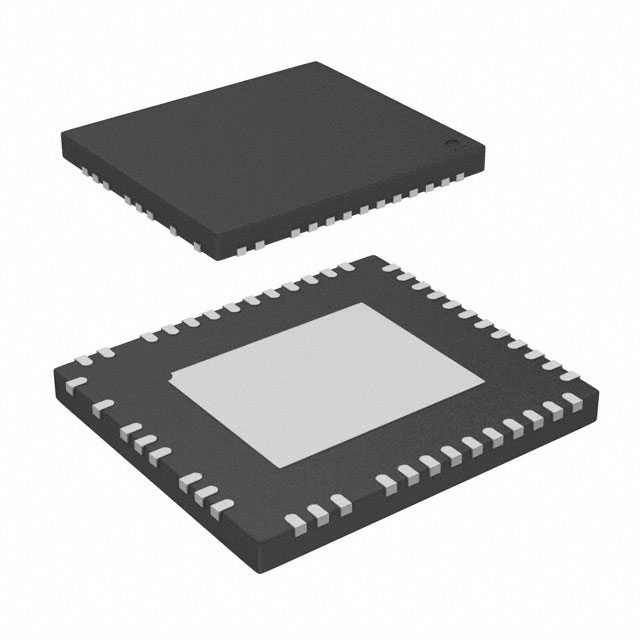
n Available in a 52-Lead (7mm × 8mm) QFN Package
The LTC®3889 is a dual PolyPhase DC/DC synchronous
step-down switching regulator controller with I2C-based
PMBus compliant serial interface. This controller employs
a constant-frequency, current-mode architecture, with high
voltage input and output capability along with programmable loop compensation. The LTC3889 is supported by
the LTpowerPlay™ software development tool with graphical
user interface (GUI).
n
The EXTVCC pin supports voltages up to 14V allowing for
optimized circuit efficiency and die temperature, and for
the controller output to supply the chip power. Switching
frequency, output voltage, and device address can be
programmed both by digital interface as well as external
configuration resistors. Parameters can be set via the
digital interface or stored in EEPROM. Both outputs have
an independent power good indicator and FAULT function.
The LTC3889 can be configured for discontinuous (pulseskipping) mode or continuous inductor current mode.
APPLICATIONS
All registered trademarks and trademarks are the property of their respective owners. Protected
by U.S. Patents including 5481178, 5705919, 5929620, 6100678, 6144194, 6177787, 5408150,
6580258, 6304066, 7420359, 8786268 Patent Pending. Licensed under U.S. Patent 7000125
and other related patents worldwide.
Telecom, Datacom, and Storage Systems
Industrial and Point of Load Applications
n
n
TYPICAL APPLICATION
0.1µF
2mΩ
x2
2mΩ
0.1µF
SW0
x2
30Ω
+
6.8µH
SW1
ISENSE0+
ISENSE1+
ISENSE0–
ISENSE1–
EXTVCC
VSENSE1
VSENSE0+
VSENSE0–
22µF
x4
10nF
BOOST1
BG1
LTC3889*
FAULT0
SDA
FAULT1
SCL
PGOOD0
ALERT
PGOOD1
RUN0
RUN1 SHARE_CLK
1000pF
4700pF
100pF
x2
TSNS0
TSNS1
ITH0
ITH1
ITHR0
ITHR1
VDD33 GND VDD25
1µF
1µF
5 to 60
1 to 40
6.3 to 9
No
45
4.5 to 60
0.5 to 13.8
5
Yes
90
Efficiency and Power Loss
1000pF 30Ω
30Ω
VOUT1
12V
20A
+
150µF
x2
98
8
96
7
94
6
92
5
VIN = 48V
VOUT = 12V
DRVSET = 2
EXTVCC = 12V
fsw = 150kHz
EFFICIENCY
POWER LOSS
90
88
86
100pF
*SOME DETAILS OMITTED FOR CLARITY
TON_MIN
(ns)
Efficiency and Power Loss
Load Current
vs LoadvsCurrent
FAULT
MANAGEMENT
TO/FROM
OTHER ADI DEVICES
10nF
LTC3870
COMPATIBLE
LTC3886
x2
4700pF
GATE
DRIVE
(V)
LTC3889
2mΩ
22µF
x4
VOUT
RANGE
(V)
0
4
8
12
LOAD CURRENT (A)
16
4
POWER LOSS (W)
30Ω
0.1µF
BG0
PMBus
INTERFACE
150µF
x2
TG1
BOOST0
8.6µH
VOUT0
24V
20A
TG0
10µF
x4
1µF
DRVCC VIN IIN+ IIN–
VIN
30V TO 54V
EFFICIENCY (%)
10µF
2Ω
VIN RANGE
(V)
3
20
2
3889 TA01b
3889 TA01a
Rev. A
Document Feedback
For more information www.analog.com
1
�LTC3889
TABLE OF CONTENTS
Features...................................................... 1
Applications................................................. 1
Typical Application ......................................... 1
Description.................................................. 1
Table of Contents........................................... 2
Absolute Maximum Ratings............................... 4
Order Information........................................... 4
Pin Configuration........................................... 4
Electrical Characteristics.................................. 5
Typical Performance Characteristics................... 10
Pin Functions............................................... 13
Block Diagram.............................................. 15
Operation................................................... 16
Overview.................................................................. 16
Main Control Loop................................................... 16
EEPROM.................................................................. 17
CRC Protection ................................................... 17
Power-Up and Initialization...................................... 18
Soft-Start................................................................. 18
Time-Based Sequencing.......................................... 19
Event-Based Sequencing......................................... 19
Shutdown................................................................ 19
Light-Load Current Operation..................................20
PWM Loop Compensation.......................................20
Switching Frequency and Phase..............................20
Output Voltage Sensing........................................... 21
Output Current Sensing........................................... 21
Input Current Sensing.............................................. 21
PolyPhase Load Sharing..........................................22
External/Internal Temperature Sense.......................22
RCONFIG (Resistor Configuration) Pins...................23
Fault Handling..........................................................23
Status Registers and ALERT Masking.................. 24
Mapping Faults to FAULT Pins.............................26
Power Good Pins.................................................26
Serial Interface........................................................26
Communication Protection .................................26
Device Addressing...................................................26
2
Responses to VOUT and IOUT Faults/WARNINGS..... 27
Output Overvoltage Fault Response.................... 27
Output Undervoltage Response .......................... 27
Peak Output Overcurrent Fault Response............ 28
Responses to Timing Faults..................................... 28
Responses to VIN OV Faults..................................... 28
Responses to OT/UT Faults...................................... 28
Internal Overtemperature Fault/Warn Response.28
External Overtemperature and Undertemperature
Fault Response ...................................................29
Responses to External Faults ..................................29
Fault Logging...........................................................29
Bus Timeout Protection...........................................29
Similarity Between PMBus, SMBus and I2C
2-Wire Interface.......................................................30
PMBus Serial Digital Interface.................................30
PMBus Command Summary............................. 35
PMBus Commands..................................................35
Applications Information................................. 40
Current Limit Programming.....................................40
ISENSE+ and ISENSE– Pins..........................................40
Low Value Resistor Current Sensing........................ 41
Inductor DCR Current Sensing................................. 42
Slope Compensation and Inductor Peak Current.....43
Inductor Value Calculation.......................................43
Inductor Core Selection...........................................44
Power MOSFET and Optional Schottky Diode
Selection..................................................................44
CIN and COUT Selection............................................45
Variable Delay Time, Soft-Start and Output Voltage
Ramping..................................................................45
Digital Servo Mode..................................................46
Soft Off (Sequenced Off)......................................... 47
DRVCC Regulator.....................................................48
Topside MOSFET Driver Supply (CB, DB).................48
Undervoltage Lockout.............................................. 49
Fault Indications...................................................... 49
Open-Drain Pins......................................................50
Rev. A
For more information www.analog.com
�LTC3889
TABLE OF CONTENTS
Phase-Locked Loop and Frequency Synchronization...
50
Minimum On-Time Considerations.......................... 51
External Temperature Sense.................................... 51
Derating EEPROM Retention at Temperature....... 52
Input Current Sense Amplifier..................................53
External Resistor Configuration Pins (RCONFIG).....53
Voltage Selection.................................................53
Frequency Selection ...........................................54
Phase Selection...................................................55
Address Selection Using RCONFIG......................55
Efficiency Considerations........................................55
Programmable Loop Compensation........................56
Checking Transient Response.................................. 57
PolyPhase Configuration.........................................58
PC Board Layout Checklist......................................60
PC Board Layout Debugging....................................60
Design Example.......................................................62
Additional Design Checks........................................63
Connecting the USB to I2C/SMBus/PMBus Adapter to
the LTC3889 In System...........................................63
LTpowerPlay: An Interactive GUI for Digital Power..64
PMBus Communication and Command Processing.65
PMBus Command Details................................ 67
Addressing and Write Protect.................................. 67
General Configuration COMMANDS.........................69
On/Off/Margin......................................................... 70
PWM Configuration................................................. 72
Voltage..................................................................... 76
Input Voltage and Limits...................................... 76
Output Voltage and Limits...................................77
Output Current and Limits.......................................80
Input Current and Limits ..................................... 82
Temperature.............................................................83
External Temperature Calibration........................83
Timing.....................................................................84
Timing—On Sequence/Ramp..............................84
Timing—Off Sequence/Ramp.............................85
Precondition for Restart......................................86
Fault Response........................................................ 87
Fault Responses All Faults................................... 87
Fault Responses Input Voltage............................ 87
Fault Responses Output Voltage.......................... 87
Fault Responses Output Current.......................... 91
Fault Responses IC Temperature.........................92
Fault Responses External Temperature................93
Fault Sharing............................................................94
Fault Sharing Propagation...................................94
Fault Sharing Response.......................................96
Scratchpad..............................................................96
Identification............................................................ 97
Fault Warning and Status.........................................98
Telemetry............................................................... 105
EEPROM Memory Commands............................... 109
Store/Restore.................................................... 109
Fault Logging..................................................... 110
Fault Log Operation........................................... 110
Block Memory Write/Read................................ 114
Typical Applications..................................... 115
Package Description.................................... 118
Revision History......................................... 119
Typical Application...................................... 120
Related Parts............................................. 120
Rev. A
For more information www.analog.com
3
�LTC3889
BG1
DRVCC
VIN
48 47 46
IIN–
BG0
50
IIN+
BOOST0
52
44 43 42
SW0 1
40 BOOST1
TG0 2
39 SW1
38 TG1
ISENSE0+ 4
ISENSE0– 5
36 TSNS1
35 VSENSE1+
TSNS0 6
VSENSE0+ 7
34 PGOOD0
53
GND
VSENSE0– 8
33 PGOOD1
ISENSE1+ 9
32 ITHR1
ISENSE1– 10
31 ITH1
30 VDD33
ITHR0 11
ITH0 12
29 SHARE_CLK
28 WP
SYNC 13
27 VDD25
SCL 14
PHAS_CFG
FREQ_CFG
VOUT1_CFG
VOUT0_CFG
ASEL1
ASEL0
RUN1
RUN0
FAULT1
FAULT0
15 16 17 18 19 20 21 22 23 24 25 26
SDA
Top Gate Transient Voltage (TG0, TG1)....... –0.3V to 76V
BOOST0, BOOST1....................................... –0.3V to 76V
Switch Transient Voltage (SW0, SW1)........... –5V to 65V
DRVCC, BG0, BG1, (BOOST0– SW0),
(BOOST1– SW1)......................................–0.3V to 11V
VSENSE0+, VSENSE1+, ISENSE0+, ISENSE1+,
ISENSE0 –, ISENSE1–................................... –0.3V to 42V
VSENSE0 –.................................................... –0.3V to 0.3V
EXTVCC....................................................... –0.3V to 15V
(EXTVCC – VIN).......................................................13.2V
RUN, SDA, SCL, ALERT.............................. –0.3V to 5.5V
ASELn, VOUTn_CFG, FREQ_CFG,
PHAS_CFG, VDD25............................... –0.3V to 2.75V
(VIN – IINP), (VIN – IINM),
(VSENSE0+ – ISENSE0+),
(VSENSE0+ – ISENSE0 –),
(VSENSE1+ – ISENSE1+),
(VSENSE1+ – ISENSE1–)............................ –0.3V to 0.3V
PGOOD0, PGOOD1, FAULT, SHARE_CLK,
ITH0, ITH1, ITHR0, ITHR1, VDD33, WP,
TSNS0, TSNS1, SYNC............................ –0.3V to 3.6V
DRVCC Peak Output Current..................................100mA
Operating Junction Temperature Range
(Note 2)............................................ –40°C to 125°C*
Storage Temperature Range................. –65°C to 150°C*
TOP VIEW
EXTVCC
PIN CONFIGURATION
(Note 1)
VIN, IIN+, IIN –............................................... –0.3V to 65V
ALERT
ABSOLUTE MAXIMUM RATINGS
UKG PACKAGE
VARIATION: UKG52(46)
52-LEAD (7mm × 8mm) PLASTIC QFN
TJMAX = 125°C, θJA = 31°C/W, θJC = 2°C/W
EXPOSED PAD (PIN 53) IS GND, MUST BE SOLDERED TO PCB
Note: Pins omitted to achieve high input voltage rating.
* See Derating EEPROM Retention at Temperature in the Applications
Information section for junction temperatures in excess of 125°C.
ORDER INFORMATION
LEAD FREE FINISH
TAPE AND REEL
PART MARKING*
PACKAGE DESCRIPTION
TEMPERATURE RANGE
(SEE NOTE 2)
LTC3889EUKG#PBF
LTC3889EUKG#TRPBF
LTC3889UKG
52-Lead (7mm × 8mm) Plastic QFN
–40°C to 125°C
LTC3889IUKG#PBF
LTC3889IUKG#TRPBF
LTC3889UKG
52-Lead (7mm × 8mm) Plastic QFN
–40°C to 125°C
Contact the factory for parts specified with wider operating temperature ranges. *The temperature grade is identified by a label on the shipping container.
Tape and reel specifications. Some packages are available in 500 unit reels through designated sales channels with #TRMPBF suffix.
4
Rev. A
For more information www.analog.com
�LTC3889
ELECTRICAL CHARACTERISTICS
The l denotes the specifications which apply over the specified operating
junction temperature range, otherwise specifications are at TJ = 25°C (Note 2). VIN = 16V, EXTVCC = 0V, VRUN0 = 1.8V, VRUN1 = 1.8V
fSYNC = 250kHz (externally driven), and all programmable parameters at factory default unless otherwise specified.
SYMBOL
PARAMETER
Input Voltage
Input Voltage Range
VIN
Input Voltage Supply Current
IQ
Normal Operation
VUVLO
TINIT
Undervoltage Lockout Threshold
When VIN > 4.2V
Initialization Time
Control Loop
Range 0 Maximum VOUT
VOUTR0
Range 0 Set Point Accuracy
Range 0 Resolution
Range 0 LSB Step Size, FSR = 41.48V
VOUTR1
Range 1 Maximum VOUT
Range 1 Set Point Accuracy
Range 1 Resolution
Range 1 LSB Step Size, FSR = 8.30V
VLINEREG
Line Regulation
Load Regulation
VLOADREG
gm0,1
RITHR0,1
IISENSE
VI(lLIMIT)
Resolution
Error Amplifier gm(MAX)
Error Amplifier gm(MIN)
Error Amplifier gm LSB Step Size
Resolution
Compensation Resistor RITHR(MAX)
Compensation Resistor RITHR(MIN)
Input Current
Resolution
VILIM(MAX)
VILIM(MIN)
Gate Driver (DRVCC = 9V)
TG Transition Time:
TG
Rise Time
tr
Fall Time
tf
BG Transition Time:
BG
Rise Time
tr
Fall Time
tf
Top Gate Off to Bottom Gate On Delay Time
TG/BG t1D
Bottom Gate Off to Top Gate On Delay Time
BG/TG t2D
Minimum On-Time
tON(MIN)
CONDITIONS
MIN
(Note 12)
(Note 14)
VRUN = 3.3V, No Caps on TG and BG
VRUN = 0V
VDRVCC Falling
VDRVCC Rising
Delay from RESTORE_USER_ALL,
MFR_REST, or VDRVCC > VUVLO Until
TON_DELAY Can Begin
l
6V ≤ VOUT ≤ 38V
l
5
(Notes 9, 10)
16V < VIN < 60V
∆VITH = 1.35V – 0.7V
∆VITH = 1.35V – 2.0V
–0.5
l
–0.5
60
40
12
10
8
12
2
l
l
l
ITH =1.35V
ITH =1.35V
ITH =1.35V
VISENSE = 40V
l
Hi Range
Lo Range
Hi Range
Lo Range
l
l
(Note 4)
CLOAD = 3300pF
CLOAD = 3300pF
(Note 4)
CLOAD = 3300pF
CLOAD = 3300pF
(Note 4) CLOAD = 3300pF
(Note 4) CLOAD = 3300pF
MAX
26
20
3.7
3.95
35
(Notes 9, 10)
3V ≤ VOUT ≤ 8V
TYP
68
44
0.01
–0.01
3
5.76
1.00
0.68
5
62
0
±1
3
75
50
37.5
25
UNITS
V
mA
mA
V
V
ms
0.5
0.5
±0.02
0.1
–0.1
±2
82
56
V
%
Bits
mV
V
%
Bits
mV
%/V
%
%
bits
mmho
mmho
mmho
bits
kΩ
kΩ
µA
bits
mV
mV
mV
mV
30
30
ns
ns
20
20
50
50
45
ns
ns
ns
ns
ns
Rev. A
For more information www.analog.com
5
�LTC3889
ELECTRICAL CHARACTERISTICS
The l denotes the specifications which apply over the specified operating
junction temperature range, otherwise specifications are at TJ = 25°C (Note 2). VIN = 16V, EXTVCC = 0V, VRUN0 = 1.8V, VRUN1 = 1.8V
fSYNC = 250kHz (externally driven), and all programmable parameters at factory default unless otherwise specified.
SYMBOL
PARAMETER
OV/UV Output Voltage Supervisor
N
Resolution
Range 0 Maximum Threshold
VRANGE0
Range 1 Maximum Threshold
VRANGE1
Range 0 Step Size, FSR = 41.48V
VOUSTP0
Range 1 Step Size, FSR = 8.30V
VOUSTP1
Range 0 Threshold Accuracy
VTHACC0
Range 1 Threshold Accuracy
VTHACC1
OV Comparator to FAULT Low Time
tPROPOV1
UV Comparator to FAULT Low Time
tPROPUV1
VIN Voltage Supervisor
N
Resolution
Maximum Threshold
VIN(RANGE)
Step Size
VIN(STP)
VIN(THACCH) Threshold Accuracy 6V < VIN < 30V
Comparator Response Time
tPROP(VIN)
(VIN_ON and VIN_OFF)
Output Voltage Readback
N
Resolution
LSB Step Size
Full-Scale Sense Voltage
VF/S
Total Unadjusted Error
VOUT_TUE
Zero-Code Offset Voltage
VOS
Conversion Time
tCONVERT
VIN Voltage Readback
N
Resolution
Full-Scale Input Voltage
VF/S
Total Unadjusted Error
VIN_TUE
CONDITIONS
MIN
l
l
l
VOD = 10% of Threshold
16
977
45
0.2
l
l
(Note 6)
(Note 5)
(Note 11)
TJ = 25°C, 5V < VIN < 60V
IF/S
IOUT_TUE
VOS
tCONVERT
6
Full-Scale Output Current
Total Unadjusted Error
Zero-Code Offset Voltage
Conversion Time
(Note 6)
±3
100
Bits
V
mV
%
µs
±0.5
±2
10
66.56
(Note 6)
(Note 5)
0V ≤ |VISENSE+ – VISENSE–| < 16mV
16mV ≤ |VISENSE+ – VISENSE–| < 32mV
32mV ≤ |VISENSE+ – VISENSE–| < 64mV
64mV ≤ |VISENSE+ – VISENSE–| < 100mV
(Note 7) RISENSE = 1mΩ
(Note 8) 10mV ≤ VISENSE ≤ 100mV
±2.5
±2.5
35
35
Bits
V
V
mV
mV
%
%
µs
µs
90
0.5
2
l
Conversion Time
tCONVERT
Output Current Readback
N
Resolution
LSB Step Size
UNITS
9
31.56
61.6
(Note 11)
(Note 10) VRUN = 0V (Note 8)
TJ = 25°C, 3V < VOUT < 38V
(Note 8)
MAX
9
40
8
81
16.2
(Note 10)
6V < VOUT < 38V
2.5V < VOUT < 8V
VOD = 10% of Threshold
VOD = 10% of Threshold
TYP
90
10
15.26
30.52
61
122
±100
±1.5
±32
l
90
Bits
µV
V
%
%
mV
ms
Bits
V
%
%
ms
Bits
µV
µV
µV
µV
A
%
µV
ms
Rev. A
For more information www.analog.com
�LTC3889
ELECTRICAL CHARACTERISTICS
The l denotes the specifications which apply over the specified operating
junction temperature range, otherwise specifications are at TJ = 25°C (Note 2). VIN = 16V, EXTVCC = 0V, VRUN0 = 1.8V, VRUN1 = 1.8V
fSYNC = 250kHz (externally driven), and all programmable parameters at factory default unless otherwise specified.
SYMBOL
PARAMETER
Input Current Readback
N
Resolution
LSB Step Size, Full-Scale Range = 16mV
LSB Step Size, Full-Scale Range = 32mV
LSB Step Size, Full-Scale Range = 64mV
Total Unadjusted Error (Note 8)
IIN_TUE
Input Current, IIN+ and IIN–
IIIN
Zero-Code Offset Voltage
VOS
Conversion Time
tCONVERT
Supply Current Readback
N
Resolution
LSB Step Size, Full-Scale Range = 256mV
Total Unadjusted Error
ICHIP_TUE
Conversion Time
tCONVERT
Temperature Readback (T0, T1)
Resolution
TRES_T
T0_TUE
External TSNS TUE (Note 8)
MFR_PWM_MODE_LTC3889[5] = 0
MFR_PWM_MODE_LTC3889[5] = 1
TI_TUE
Internal TSNS TUE
Update Rate
tCONVERT_T
DRVCC Regulator
VDRVCC_VIN DRVCC Voltage No Load
VLDO_VIN
VDRVCC_EXT
DRVCC Load Regulation
DRVCC Voltage No Load
VLDO_EXT
DRVCC Load Regulation
VEXT_THRES
EXTVCC Switchover Voltage
EXTVCC Hysteresis Voltage
VEXT_HYS
VDD33 Regulator
Internal VDD33 Voltage
VDD33
VDD33 Current Limit
ILIM
VDD33 Overvoltage Threshold
VDD33_OV
VDD33 Undervoltage Threshold
VDD33_UV
VDD25 Regulator
Internal VDD25 Voltage
VDD25
VDD25 Current Limit
ILIM
Oscillator and Phase-Locked Loop
Oscillator Frequency Accuracy
fOSC
CONDITIONS
(Note 5)
8x Gain, 0V ≤ |IIN+ – IIN–| ≤ 5mV
4x Gain, 0V ≤ |IIN+ – IIN–| ≤ 20mV
2x Gain, 0V ≤ |IIN+ – IIN–| ≤ 50mV
8x Gain, 2.5mV ≤ |IIN+ – IIN–| ≤ 5mV
4x Gain, 4mV ≤ |IIN+ – IIN–| ≤ 20mV
2x Gain, 6mV ≤ |IIN+ – IIN–| ≤ 50mV
VVIN = VIIN+ = VIIN– = 60V
MIN
TYP
10
15.26
30.52
61
±1.6
±1.3
±1.2
±2
±50
l
l
l
l
(Note 6)
90
(Note 5)
10
244
20mV ≤ |IIN+ – VIN| ≤ 200mV
(Note 6)
�VTSNS = 72mV (Note 17)
VTSNS ≤ 1.85V (Note 17)
VRUN = 0.0V, fSYNC = 0kHz (Note 8)
(Note 6)
°C
±3
±7
°C
°C
°C
ms
6.3
7.4
9
0.5
6.3
7.4
9
0.5
6.5
7.6
9.4
±2
6.5
7.6
9.4
±2
V
V
V
%
V
V
V
%
5.0
7.4
5.35
7.7
110
5.6
8.0
V
V
mV
3.2
3.3
35
3.5
3.1
3.4
V
mA
V
V
6.1
7.2
8.6
6.1
7.2
8.6
2.5
80
VDD25 = GND, VDD33 = 3.6V
85kHz < fSYNC < 500kHz Measured Falling
Edge-to-Falling Edge of SYNC with
FREQUENCY_SWITCH = 85kHz and 500.0kHz
0.25
±1
90
5.0V < VDRVCC
VDD33 = GND, VIN = DRVCC = 5.0V
l
Bits
µV
µV
µV
%
%
%
µA
µV
ms
90
±2.5
l
l
l
l
UNITS
Bits
µV
%
ms
l
8V < VIN < 60V, DRVSET = 0
11V < VIN < 60V, DRVSET = 1
11V < VIN < 60V, DRVSET = 2
ICC = 0mA to 50mA, EXTVCC = 0, DRVSET = 2
7V < EXTVCC < 14V, DRVSET = 0
11V < EXTVCC < 14V, DRVSET = 1
11V < EXTVCC < 14V, DRVSET = 2
ICC = 0mA to 50mA, EXTVCC = 12V, DRVSET = 2
EXTVCC Ramping Positive, DRVSET = 0
EXTVCC Ramping Positive, DRVSET = 1, 2
MAX
V
mA
±10
%
Rev. A
For more information www.analog.com
7
�LTC3889
ELECTRICAL CHARACTERISTICS
The l denotes the specifications which apply over the specified operating
junction temperature range, otherwise specifications are at TJ = 25°C (Note 2). VIN = 16V, EXTVCC = 0V, VRUN0 = 1.8V, VRUN1 = 1.8V
fSYNC = 250kHz (externally driven), and all programmable parameters at factory default unless otherwise specified.
SYMBOL
VTH(SYNC)
PARAMETER
SYNC Input Threshold
VOL(SYNC)
ILEAK(SYNC
θSYNC-θ0
SYNC Low Output Voltage
SYNC Leakage Current in Slave Mode
SYNC to Channel 0 Phase Relationship
Based on the Falling Edge of Sync and
Rising Edge of TG0
θSYNC-θ1
SYNC to Channel 1 Phase Relationship
Based on the Falling Edge of Sync and
Rising Edge of TG1
EEPROM Characteristics
Endurance
(Note 13)
Retention
Mass_Write
(Note 13)
Mass Write Operation Time
CONDITIONS
VCLKIN Falling
VCLKIN Rising
ILOAD = 2.5mA
0V ≤ VPIN ≤ 3.6V
MFR_PWM_CONFIG_LTC3889[2:0] = 0,2,3
MFR_PWM_CONFIG_LTC3889[2:0] = 5
MFR_PWM_CONFIG_LTC3889[2:0] = 1
MFR_PWM_CONFIG_LTC3889[2:0] = 4,6
MFR_PWM_CONFIG_LTC3889[2:0] = 3
MFR_PWM_CONFIG_LTC3889[2:0] = 0
MFR_PWM_CONFIG_LTC3889[2:0] = 2,4,5
MFR_PWM_CONFIG_LTC3889[2:0] = 1
MFR_PWM_CONFIG_LTC3889[2:0] = 6
0°C < TJ < 85°C During EEPROM Write
Operations
TJ < 125°C
STORE_USER_ALL, 0°C < TJ ≤ 85°C During
EEPROM Write Operations
Digital Inputs SCL, SDA, RUNn, FAULTn
Input High Threshold Voltage
SCL, SDA, RUN, FAULT
VIH
Input Low Threshold Voltage
SCL, SDA, RUN, FAULT
VIL
Input Hysteresis
SCL, SDA
VHYST
Input Capacitance
CPIN
Digital Input WP
Input Pull-Up Current
WP
IPUWP
Open-Drain Outputs SCL, SDA, FAULTn, ALERT, RUNn, SHARE_CLK, PGOODn
Output Low Voltage
ISINK = 3mA
VOL
Digital Inputs SHARE_CLK, WP
Input High Threshold Voltage
VIH
Input Low Threshold Voltage
VIL
Leakage Current SDA, SCL, ALERT, RUN
Input Leakage Current
0V ≤ VPIN ≤ 5.5V
IOL
Leakage Current FAULTn, PGOODn
Input Leakage Current
0V ≤ VPIN ≤ 3.6V
IGL
Digital Filtering of FAULTn
Input Digital Filtering FAULTn
tFAULT
Digital Filtering of PGOODn
Output Digital Filtering PG00Dn
tPGOOD
Digital Filtering of RUNn
Input Digital Filtering RUNn
tRUN
PMBus Interface Timing Characteristics
Serial Bus Operating Frequency
fSCL
Bus Free Time Between Stop and Start
tBUF
Hold Time After Start Condition. After This
tHD(STA)
Period, the First Clock Is Generated
8
MIN
l
TYP
1
1.5
0.2
MAX
0.4
±5
0
60
90
120
120
180
240
270
300
l
10,000
l
10
Cycles
440
l
4100
1.35
l
l
UNITS
V
V
V
µA
Deg
Deg
Deg
Deg
Deg
Deg
Deg
Deg
Deg
0.8
0.08
10
10
Years
ms
V
V
V
pF
µA
0.4
V
1.8
V
V
l
±5
µA
l
±2
µA
l
l
l
l
l
l
0.6
10
1.3
0.6
1.5
1.0
3
µs
60
µs
10
µs
400
kHz
µs
µs
Rev. A
For more information www.analog.com
�LTC3889
ELECTRICAL CHARACTERISTICS
The l denotes the specifications which apply over the specified operating
junction temperature range, otherwise specifications are at TJ = 25°C (Note 2). VIN = 16V, EXTVCC = 0V, VRUN0 = 1.8V, VRUN1 = 1.8V
fSYNC = 250kHz (externally driven), and all programmable parameters at factory default unless otherwise specified.
SYMBOL
tSU(STA)
tSU(STO)
tHD(DAT)
PARAMETER
Repeated Start Condition Setup Time
Stop Condition Setup Time
Data Hold Time
Receiving Data
Transmitting Data
Data Setup Time
tSU,DAT
Receiving Data
tTIMEOUT_SMB Stuck PMBus Timer Non-Block Reads
Stuck PMBus Timer Block Reads
Serial Clock Low Period
tLOW
Serial Clock High Period
tHIGH
CONDITIONS
l
MIN
0.6
0.6
l
l
0
0.3
l
0.1
l
Measured from the Last PMBus Start Event
MAX
10000
0.9
32/255
255
l
l
Note 1: Stresses beyond those listed under Absolute Maximum Ratings
may cause permanent damage to the device. Exposure to any Absolute
Maximum Rating condition for extended periods may affect device
reliability and lifetime.
Note 2: The LTC3889 is tested under pulsed load conditions such that TJ ≈
TA. The LTC3889E is guaranteed to meet performance specifications from
0°C to 85°C. Specifications over the –40°C to 125°C operating junction
temperature range are assured by design, characterization and correlation
with statistical process controls. The LTC3889I is guaranteed over the
–40°C to 125°C operating junction temperature range. TJ is calculated from
the ambient temperature, TA, and power dissipation, PD, according to the
following formula:
TJ = TA + (PD • θJA)
The maximum ambient temperature consistent with these specifications
is determined by specific operating conditions in conjunction with board
layout, the rated package thermal impedance and other environmental
factors.
Note 3: All currents into device pins are positive; all currents out of device
pins are negative. All voltages are referenced to ground unless otherwise
specified.
Note 4: Rise and fall times are measured using 10% and 90% levels. Delay
times are measured using 50% levels.
Note 5: The data format in PMBus is 5 bits exponent (signed) and 11 bits
mantissa (signed). This limits the output resolution to 10 bits though the
internal ADC is 16 bits and the calculations use 32-bit words.
Note 6: The data conversion is done in round robin fashion. All input
signals are continuously converted for a typical latency of 90ms unless the
MFR_ADC_CONTROL command is utilized.
Note 7: The IOUT_CAL_GAIN = 1.0mΩ and MFR_IOUT_TC = 0.0. Value as
read from READ_IOUT in amperes.
TYP
1.3
0.6
10000
UNITS
µs
µs
µs
µs
µs
ms
ms
µs
µs
Note 8: Part tested with PWM disabled. Evaluation in application
demonstrates capability. TUE (%) = ADC Gain Error (%) + 100 •
[Zero Code Offset + ADC Linearity Error]/Actual Value.
Note 9: All VOUT commands assume the ADC is used to auto-zero the
output to achieve the stated accuracy. LTC3889 is tested in a feedback
loop that servos VOUT to a specified value.
Note 10: The maximum programmable VOUT voltage is 40V.
Note 11: The maximum VIN voltage is 60V.
Note 12: When VIN < 6V, DRVCC must be tied to VIN.
Note 13: EEPROM endurance is guaranteed by design, characterization
and correlation with statistical process controls. Data retention is
production tested via a high temperature bake at wafer level.The minimum
retention specification applies for devices whose EEPROM has been cycled
less than the minimum endurance specification. The RESTORE_USER_ALL
command (EEPROM read) is valid over the entire operating temperature
range.
Note 14: The LTC3889 quiescent current (IQ) equals the IQ of VIN plus the
IQ of EXTVCC.
Note 15: The LTC3889 includes overtemperature protection that is
intended to protect the device during momentary overload conditions.
Junction temperature will exceed 125°C when overtemperature protection
is active. Continuous operation above the specified maximum operating
junction temperature may impair device reliability.
Note 16: Write operations above TJ = 85°C or below 0°C are possible
although the Electrical Characteristics are not guaranteed and the EEPROM
will be degraded. Read operations performed at temperatures between
–40°C and 125°C will not degrade the EEPROM. Writing to the EEPROM
above 85°C will result in a degradation of retention characteristics.
Note 17: Limits guaranteed by TSNS voltage and current measurements
during test, including ADC readback.
Rev. A
For more information www.analog.com
9
�LTC3889
TYPICAL PERFORMANCE CHARACTERISTICS
TA = 25C, VIN = 16V, EXTVCC = 0V, unless otherwise noted.
100
CCM
DCM
EFFICIENCY (%)
EFFICIENCY (%)
77
VIN = 48V
VOUT = 5V
fSW = 150kHz
L = 6.8µH
DCR = 0.88mΩ
71
65
0
4
8
12
LOAD CURRENT (A)
16
97.5
96
94
92
VIN = 48V
VOUT = 24V
fSW = 150kHz
L = 6.8µH
DCR = 0.88mΩ
90
88
20
0
4
8
12
LOAD CURRENT (A)
16
11
97.0
10
96.5
9
96.0
95.0
18
24
30
36
VIN (V)
42
48
3889 G02
3889 G01
EXTVCC Switchover
vs Temperature
8
IOUT = 20A
VOUT = 12V
fSW = 150kHz
L = 6.8µH
DCR = 0.88mΩ
95.5
20
12
EFFICIENCY
POWER LOSS
POWER LOSS (W)
83
98.0
CCM
DCM
98
89
Efficiency and Power Loss
vs Input Voltage
EFFICIENCY (%)
95
Efficiency vs Load Current,
VOUT = 24V
Efficiency vs Load Current,
VOUT = 5V
7
54
6
3889 G03
Load Step
(Forced Continuous Mode)
Load Step
(Pulse-Skipping Mode)
5.40
ILOAD
5A/DIV
ILOAD
5A/DIV
INDUCTOR
CURRENT
5A/DIV
INDUCTOR
CURRENT
5A/DIV
VOUT
100mV/DIV
AC-COUPLED
VOUT
100mV/DIV
AC-COUPLED
5.39
EXTVCC (V)
5.38
5.37
5.36
5.35
5.34
–50
VIN = 12V
50µs/DIV
VOUT = 1.8V
0.3A TO 5A STEP
–25
0
25
50
75
TEMPERATURE (°C)
100
3889 G05
VIN = 12V
50µs/DIV
VOUT = 1.8V
0.3A TO 5A STEP
3889 G06
125
3889 G04
Inductor Current at Light Load
Start-Up into a Pre-Biased Load
FORCED
CONTINUOUS
MODE
2A/DIV
Soft-Start Ramp
RUN
1V/DIV
RUN
1V/DIV
VOUT
2.5V/DIV
VOUT
2.5V/DIV
PULSE-SKIPPING
MODE
2A/DIV
VIN = 12V
VOUT = 1.8V
ILOAD = 100µA
10
1µs/DIV
3889 G07
tRISE = 10ms
tDELAY = 5ms
VOUT = 2V
5ms/DIV
3889 G08
tRISE = 10ms
tDELAY = 5ms
5ms/DIV
3889 G09
Rev. A
For more information www.analog.com
�LTC3889
TYPICAL PERFORMANCE CHARACTERISTICS
TA = 25C, VIN = 16V, EXTVCC = 0V, unless otherwise noted.
2.5010
Regulated 2.5V Output Voltage
vs Temperature
2.5004
VOUT (V)
RUN
1V/DIV
VOUT
1V/DIV
2.4998
2.4992
2.4986
tFALL = 5ms
tDELAY = 10ms
3889 G10
5ms/DIV
2.4980
–50
–25
0
25
50
75
TEMPERATURE (°C)
100
125
MAXIMUM CURRENT SENSE THRESHOLD (mV)
Soft-Off Ramp
Maximum Current Sense Threshold
vs Duty Cycle, VOUT = 0V
55
50mV SENSE CONDITION
54
53
52
51
50
49
48
47
46
45
30
0
3889 G11
70
50
DUTY CYCLE (%)
90
3889 G12
SHARE_CLK Frequency
vs Temperature
Quiescent Current vs Temperature
20.4
3.0
MEASURED ERROR (mV)
105
100
20.0
19.8
19.6
95
19.4
90
–50 –25
0
2.0
1.0
0
–1.0
–2.0
–3.0
19.2
–50
25 50 75 100 125 150
TEMPERATURE (°C)
VOUT Measurement Error vs VOUT
4.0
20.2
CURRENT (mA)
SHARE_CLK FREQUENCY (kHz)
110
–25
0
25
50
75
TEMPERATURE (°C)
100
–4.0
125
2
8
14
3889 G14
20
26
VOUT (V)
32
38
3889 G15
3889 G13
1.0
VOUT Command INL
0.6
VOUT Command DNL
DRVCC Line Regulation
6.5
0.4
6.2
0.5
0
DRVCC (V)
DNL (LSB)
INL (LSB)
0.2
0.0
5.9
5.6
–0.2
–0.5
5.3
–0.4
–1.0
2
8
14
20
VOUT (V)
26
32
38
3889 G16
–0.6
2
8
14
20
26
32
VOUT (V)
38
3889 G17
5.0
0
10
20
30
VIN (V)
40
50
60
3889 G18
Rev. A
For more information www.analog.com
11
�LTC3889
TYPICAL PERFORMANCE CHARACTERISTICS
TA = 25C, VIN = 16V, EXTVCC = 0V, unless otherwise noted.
VOUT OV Threshold
vs Temperature (2.5V Target)
VOUT OV Threshold
vs Temperature (12V Target)
2.498
2.494
12.010
24.05
12.006
24.03
12.002
11.998
11.994
2.490
–50
–25
0
25
50
75
TEMPERATURE (°C)
100
–25
0
25
50
75
TEMPERATURE (°C)
100
125
MEASUREMENT ERROR (mA)
0.6
0.4
0.2
0
–0.2
–0.4
–0.6
100
125
0
25
50
75
TEMPERATURE (°C)
5
6
4
4
2
0
–2
–4
–8
100
125
IIN Error vs IIN
8
–6
–0.8
–25
3889 G21
MEASUREMENT ERROR (mA)
0.8
25
0
75
50
TEMPERATURE (°C)
23.95
–50
IOUT Error vs IOUT
1.0
–25
23.99
3889 G20
External Temperature Error
vs Temperature
–1.0
–50
24.01
23.97
11.990
–50
125
3889 G19
MEASUREMENT ERROR (°C)
24V OV THRESHOLD (V)
2.502
12V OV THRESHOLD (V)
2.5V OV THRESHOLD (V)
2.506
VOUT OV Threshold
vs Temperature (24V Target)
3
2
1
0
–1
–2
0
10
5
15
OUTPUT CURRENT (A)
20
–3
0
1
2
3889 G23
3889 G22
3889 G24
Dynamic Current Sharing During a
Load Transient in a 4-Phase System
DC Output Current Matching in a
2-Phase System (LTC3889)
3
INPUT CURRENT (A)
Dynamic Current Sharing During a
Load Transient in a 4-Phase System
25
CHANNEL CURRENT (A)
20
15
CURRENT
5A/DIV
CURRENT
5A/DIV
10
5
0
CHAN 0
CHAN 1
0
5
25 30
10 15 20
TOTAL CURRENT (A)
35
40
3889 G25
12
VIN = 48V
10µs/DIV
VOUT = 5V
fSW = 150kHz
L = 6.8µH; RSENSE = 3mΩ
0A TO 10A LOAD STEP
3889 G26
VIN = 48V
10µs/DIV
VOUT = 5V
f SW = 150kHz
L = 6.8µH; RSENSE = 3mΩ
10A TO 0A LOAD STEP
3889 G27
Rev. A
For more information www.analog.com
�LTC3889
PIN FUNCTIONS
SW0/SW1 (Pins 1, 39): Switch Node Connections to
Inductors. Voltage swings at the pins are from a Schottky
diode (external) voltage drop below ground to VIN.
TG0/TG1 (Pins 2, 38): Top Gate Driver Outputs. These are
the outputs of floating drivers with a voltage swing equal
to DRVCC superimposed on the switch node voltages.
ISENSE0+/ISENSE1+ (Pins 4, 9): Current Sense Comparator
Inputs. The (+) input to the current comparator is normally
connected to the DCR sensing network or current sensing
resistor.
ISENSE0–/ISENSE1– (Pins 5, 10): Current Sense Comparator
Inputs. The (–) input is connected to the output.
TSNS0/TSNS1 (Pins 6, 36): External Diode Temperature
Sense. Connect to the anode of a diode-connected PNP
transistor in order to sense remote temperature. Directly
connect the cathode using a seperate ground return path
to Pin 53 of the LTC3889. A bypass capacitor between the
anode and cathode must be located in close proximity to the
transistor. If external temperature sense elements are not
installed, short pin to ground and set the UT_FAULT_LIMIT
to –275°C and the UT_FAULT_RESPONSE to ignore.
VSENSE0+/VSENSE1+ (Pins
Sense Inputs.
7, 35): Positive Output Voltage
VSENSE0– (Pin 8): Channel 0 Negative Output Voltage
Sense Input.
ITHR0/ITHR1 (Pins 11, 32): Loop Compensation Nodes.
ITH0/ITH1 (Pins 12, 31): Current Control Threshold and
Error Amplifier Compensation Nodes. Each associated
channel’s current comparator tripping threshold increases
with its ITH voltage.
SYNC (Pin 13): External Clock Synchronization Input and
Open-Drain Output Pin. If an external clock is present at
this pin, the switching frequency will be synchronized to
the external clock. If clock master mode is enabled, this
pin will pull low at the switching frequency with a 500ns
pulse width to ground. A resistor pull-up to 3.3V is required
in the application.
SCL (Pin 14): Serial Bus Clock Input. Open-drain output,
can hold the output low if clock stretching is enabled.
A pull-up resistor to a voltage between 1.8V to 3.3V is
required in the application.
SDA (Pin 15): Serial Bus Data Input and Output. A pull-up
resistor to a voltage between 1.8V to 3.3V is required in
the application.
ALERT (Pin 16): Open-Drain Digital Output. Connect the
SMBALERT signal to this pin. A pull-up resistor to 3.3V
is required in the application.
FAULT0/FAULT1 (Pins 17, 18): Digital Programmable
General Purpose Inputs and Outputs. Open-drain output.
A pull-up resistor to a voltage between 1.8V to 3.3V is
required in the application.
RUN0/RUN1 (Pins 19, 20): Enable Run Input and Output.
Logic high on this pin enables the controller. Open-drain
output holds the pin low until the LTC3889 is out of reset.
This pin should be driven by an open-drain digital output.
A pull-up resistor to a voltage between 1.8V to 3.3V is
required in the application.
ASEL0/ASEL1 (Pin 21/Pin 22): Serial Bus Address Select
Inputs. Connect optional 1% resistor dividers between
VDD25 and GND to these pins to select the serial bus
interface address. Refer to the Applications Information
section for more detail. Minimize capacitance when the
pin is open to assure accurate detection of the pin state.
VOUT_CFG0 /VOUT_CFG1 (Pins 23, 24): Output Voltage
Select Pins. Connect a ±1% resistor divider between the
chip VDD25, VOUT_CFG and GND in order to select output
voltage. If the pin is left open, the IC will use the value
programmed in the EEPROM. Refer to the Applications
Information section for more detail. Minimize capacitance
when the pin is open to assure accurate detection of the
pin state.
FREQ_CFG (Pin 25): Frequency Select Pin. Connect a
±1% resistor divider between the chip VDD25 FREQ_CFG
and GND in order to select switching frequency. If the pin
is left open, the IC will use the value programmed in the
EEPROM. Refer to the Applications Information section
for more detail. Minimize capacitance when the pin is open
to assure accurate detection of the pin state.
Rev. A
For more information www.analog.com
13
�LTC3889
PIN FUNCTIONS
PHAS_CFG (Pin 26): Phase Configuration Input. Connect
an optional 1% resistor divider between VDD25 and GND
to this pin to configure the phase of each PWM channel
relative to SYNC. Refer to the Applications Information
section for more detail. Minimize capacitance when the
pin is open to assure accurate detection of the pin state.
VDD25 (Pin 27): Internally Generated 2.5V Power Supply
Output. Bypass this pin to GND with a low ESR 1μF capacitor.
Do not load this pin externally except for the resistor dividers
needed for the LTC3889 resistor configuration pins.
WP (Pin 28): Write Protect Pin Active High. An internal
10µA current source pulls the pin to VDD33. If WP is high,
the PMBus writes are restricted.
SHARE_CLK (Pin 29): Share Clock, Bidirectional OpenDrain Clock Sharing Pin. Nominally 100kHz. Used to
synchronize the timing between multiple ADI controllers.
Tie all the SHARE_CLK pins together. All ADI controllers
will synchronize to the fastest clock. A pull-up resistor of
5.49k to 3.3V is required in the application.
VDD33 (Pin 30): Internally Generated 3.3V Power Supply
Output. Bypass this pin to GND with a low ESR 1μF capacitor. Do not load this pin with external current.
PGOOD0/PGOOD1 (Pins 34, 33): Power Good Indicator
Outputs. Open-drain logic output that is pulled to ground
when the output exceeds OV/UV thresholds. The output
is deglitched by an internal 60μs filter. A pull-up resistor
to 3.3V is required in the application.
BOOST1/BOOST0 (Pins 40, 52): Boosted Floating Driver
Supplies. The (+) terminal of the booststrap capacitor
connects to this pin. This pin swings from a diode voltage
drop below DRVCC up to VIN + DRVCC.
14
BG0/BG1 (Pins 50, 42): Bottom Gate Driver Outputs. This
pin drives the gates of the bottom N-channel MOSFET
between GND and DRVCC.
EXTVCC (Pin 43): External power input to an internal LDO
connected to DRVCC. This LDO supplies DRVCC power
bypassing the internal LDO powered from VIN whenever
EXTVCC is higher than 5.3V (7.7V if DRVSET = 1, 2). See
EXTVCC connection in the Applications Information Section.
Do not float or exceed 14V on this pin. Decouple this pin
to GND with a minimum of 4.7μF low ESR tantalum or
ceramic capacitor. If the EXTVCC pin is not used, tie the
pin to GND. The EXTVCC pin may be connected to a higher
voltage than the VIN pin.
DRVCC (Pin 44): Output of the VIN or EXTVCC Low Dropout
(LDO) Regulators. The gate drivers are powered from
this voltage source. The DRVCC output voltage is set by
the DRVSET value. The DRVCC pin must be decoupled to
ground with a minimum of 4.7µF ceramic or other low ESR
capacitor. Do not use the DRVCC pin for any other purpose.
IIN– (Pin 46): Negative Input of High Side Current Sense
Amplifier.
IIN+ (Pin 47): Positive Input of High Side Current Sense
Amplifier.
VIN (Pin 48): Main Input Supply. Decouple this pin to GND
with a capacitor (0.1µF to 1µF). For applications where
the main input power is 5V, tie the VIN and DRVCC pins
together. If the input current sense amplifier is not used,
this pin must be shorted to the IIN+ and IIN– pins.
GND (Exposed Pad Pin 53): Ground. All small-signal and
compensation components should connect to this ground,
at one point.
Rev. A
For more information www.analog.com
�LTC3889
BLOCK DIAGRAM
RIINSNS
IIN+
RVIN
VIN
34
+
PGOOD0
VIN
IIN–
47
46
EXTVCC
48
43
CIN
PGOOD
DRVCC
REG
–
+
OV
DRVCC
44
UV
xR
R
ICMP
yR
R
DRVCC
VDD33
30
DB
BOOST0
S
R Q
52
– IREV
+
3k
+
–
CVCC
VDD33
3.3V
SUBREG
PWM_CLOCK
EXTVCC
TG0
2
FCNT
SWITCH
LOGIC
AND
ANTISHOOTTHROUGH
UV
UVLO
SS
ILIM RANGE SELECT
HI: 1:1
LO: 1:1.5
M1
SW0
1
ON
REV
CB
ISENSE+
4
ISENSE–
5
RUN
+
BG0
OV
VOUT
COUT
M2
50
CVCC
SLOPE
COMPENSATION
DRVCC
UVLO
gm
ACTIVE
CLAMP
16-BIT
ADC
ILIM DAC
(3 BITS)
+
–
ITH0
12
CC1
ITHR0
2µA
11
EA
CC2
+ –
30µA
RTH
2R
R
–
AO
+
R
2R
PWM0
PWM1
+ –
8
VSENSE–
VSENSE+
7
TSNS0
OV
UV
+ –
GND
+
–
–
+
+
–
+
8:1 –
+
MUX –
+
–
+
–
+
–
6
TMUX
+ –
12R
53
GND
5R
GND
9-BIT
VIN_ON
THRESHOLD DAC
12-BIT
SET POINT
DAC
9-BIT
OV
DAC
9-BIT
UV
DAC
M2
VCO
PHASE SELECTOR
VSTBY
SHARE_CLK 29
WP 28
SCL 14
SDA 15
PMBus
INTERFACE
(400kHz
COMPATIBLE)
1.22V
VDD33
PWM
CLOCK
GND
VDD33
VDD25
CLOCK DIVIDER
VDD33
COMPARE
REF
13 SYNC
PHASE DET
2.5V
SUBREG
SLAVE
MISO
27 VDD25
GND
MAIN
CONTROL
ALERT 16
CLK MOSI
MASTER
SINC3
UVLO
OSC
(32MHz)
26 PHAS_CFG
25 FREQ_CFG
RUN0 19
FAULT0 17
CHANNEL
TIMING
MANAGEMENT
CONFIG
DETECT
SYNC
PROGRAM
ROM
RAM
EEPROM
23 VOUT0_CFG
21 ASEL0
22 ASEL1
3889 F01
Figure 1. Block Diagram, One of Two Channels (CH0) Shown
For more information www.analog.com
Rev. A
15
�LTC3889
OPERATION
OVERVIEW
The LTC3889 is a dual channel/dual phase, constant frequency, analog current mode controller for DC/DC stepdown applications with a digital interface. The LTC3889
digital interface is compatible with PMBus which supports
bus speeds of up to 400kHz. A typical application circuit
is shown on the first page of this data sheet.
The PMBus interface provides access to important power
management data during system operation including:
Internal Die Temperature
n
External System Temperature via Optional Diode Sense
Elements
n
Average Output Current
n
Average Output Voltage
Major features include:
n
Average Input Voltage
Programmable Output Voltage
n
Programmable Input Voltage Comparator
n
Programmable Current Limit
n
n
Average Input Current
n
Configurable, Latched and Unlatched Individual Fault
and Warning Status
n
Programmable Switching Frequency
n
Individual channels are accessed through the PMBus using
the PAGE command, i.e., PAGE 0 or 1.
Programmable OV and UV Comparators
n
Programmable On and Off Delay Times
n
Programmable Output Rise/Fall Times
n
Programmable Loop Compensation
n
Dedicated Power Good Pin for Each Channel
n
Phase-Locked Loop for Synchronous, PolyPhase
Operation (2, 3, 4 or 6 Phases)
n
Input and Output Voltage/Current, and Temperature
Telemetry
n
Fault reporting and shutdown behavior are fully configurable using the FAULTn outputs. A dedicated pin for ALERT
is provided. The shutdown operation also allows all faults
to be individually masked and can be operated in either
unlatched (retry) or latched modes.
Individual status commands enable fault reporting over
the serial bus to identify the specific fault event. Fault or
warning detection includes the following:
Output Undervoltage/Overvoltage
n
Fully Differential Remote Sense on Channel 0
n
Integrated Adjustable Gate Drivers
n
Nonvolatile Configuration Memory with ECC
n
n
Input Undervoltage/Overvoltage
Input and Output Overcurrent
n
n
Optional External Configuration Resistors for Key
Operating Parameters
n
Optional Time-Base Interconnect for Synchronization
Between Multiple Controllers
Internal Overtemperature
External Overtemperature
n
Communication, Memory or Logic (CML) Fault
n
n
Fault Logging
n
WP Pin to Protect Internal EEPROM Configuration
n
Standalone Operation After User Factory Configuration
n
PMBus Version1.2, 400kHz Compliant Interface
n
16
MAIN CONTROL LOOP
The LTC3889 is a constant-frequency, current-mode stepdown controller that operates at a user-defined relative
phasing. During normal operation the top MOSFET is
turned on when the clock for that channel sets the RS latch,
and turned off when the main current comparator, ICMP ,
resets the RS latch. The peak inductor current at which
ICMP resets the RS latch is controlled by the voltage on the
Rev. A
For more information www.analog.com
�LTC3889
OPERATION
ITH pin which is the output of the error amplifier, EA. The
EA negative terminal is equal to the VSENSE voltage divided
by 34 (6.8 if range = 1). The positive terminal of the EA is
connected to the output of a 12-bit DAC with values
ranging from 0V to 1.22V. The output voltage, through
feedback of the EA, will be regulated to 34 times the DAC
output (6.8 if range = 1). The DAC value is calculated by
the part to synthesize the users desired output voltage.
The output voltage is programmed by the user either with
the resistor configuration pins detailed in Table 3 or by
the VOUT command (either from EEPROM, or by PMBus
command). Refer to the PMBus command section of the
data sheet or the PMBus specification for more details.
The output voltage can be modified by the user at any
time with a PMBus VOUT_COMMAND. This command
will typically have a latency less than 10ms.
Continuing the basic operation description, the current
mode controller will turn off the top gate when the peak
current is reached. If the load current increases, VSENSE
will slightly droop with respect to the DAC reference.
This causes the ITH voltage to increase until the average
inductor current matches the new load current. After the
top MOSFET has turned off, the bottom MOSFET is turned
on. In continuous conduction mode, the bottom MOSFET
stays on until the end of the switching cycle.
EEPROM
The LTC3889 contains internal EEPROM with error correction coding (ECC) to store user configuration settings and
fault log information. EEPROM endurance and retention for
user space and fault log pages are specified in the Absolute
Maximum Ratings and Electrical Characteristics table. The
LTC3889 EEPROM also contains a manufacturing section
that has internal redundancy.
The integrity of the entire onboard EEPROM is checked with
a CRC calculation each time its data is to be read, such as
after a power-on reset or execution of a RESTORE_USER_
ALL command. If a CRC error occurs, the CML bit is set in
the STATUS_BYTE and STATUS_WORD commands, the
EEPROM CRC Error bit in the STATUS_MFR_SPECIFIC
command is set, and the ALERT and RUN pins pulled low
(PWM channels off). At that point the device will respond
at special address 0x7C, which is activated only after an
invalid CRC has been detected. The chip will also respond
at the global addresses 0x5A and 0x5B, but use of these
addresses when attempting to recover from a CRC issue is
not recommended. All power supply rails associated with
either PWM channel of a device reporting an invalid CRC
will remain disabled until the issue is resolved. Contact
the factory if EEPROM repair is unsuccessful.
ADI recommends that the EEPROM not be written when
die temperature is greater than 85°C. If internal die temperature exceeds 130°C, all EEPROM operations except
RESTORE_USER_ALL and MFR_RESET are disabled. Full
EEPROM operation is not re-enabled until die temperature
falls below 125°C. Refer to the Applications Information
section for equations to predict retention degradation due
to elevated operating temperatures.
See the Applications Information section or contact the
factory for details on efficient in-system EEPROM programming, including bulk EEPROM programming, which the
LTC3889 also supports.
CRC Protection
The integrity of the EEPROM memory is checked after a
power-on reset. A CRC error will prevent the controller from
leaving the reset state. If a CRC error occurs, the CML bit is
set in the STATUS_BYTE and STATUS_WORD commands,
the appropriate bit is set in the STATUS_MFR_SPECIFIC
command, and the ALERT pin will be pulled low. EEPROM
repair can be attempted by writing the desired configuration to the controller and executing a STORE_USER_ALL
command followed by a CLEAR_FAULTS command.
The LTC3889 protects the integrity of the manufacturing
data and the user data by implementing ECC and CRC checks
in the EEPROM. If the ECC cannot correct the contents of
a single bit fault in the EEPROM, a CRC failure will occur.
This assures that all double bit faults are detected. If the
CRC checks fail in either the manufacturing or user data
sections of the EEPROM, the “EEPROM CRC Fault” in
the STATUS_MFR_SPECIFIC command is set. If this bit
remains set after attempting to rewrite the user space and
issuing a CLEAR_FAULTS or writing a 1 to this bit, an
irrecoverable fault has occurred. There are no provisions
for field repair of the EEPROM for these types of faults.
Rev. A
For more information www.analog.com
17
�LTC3889
OPERATION
POWER-UP AND INITIALIZATION
The LTC3889 is designed to provide standalone supply
sequencing and controlled turn-on and turn-off operation.
As shown in the Figure 1 block diagram, the LTC3889 can
operate from a single VIN input supply (6V to 60V) while
two on-chip linear regulators generate internal 2.5V and
3.3V. If VIN does not exceed 6V, and the EXTVCC pin is
not driven by an external supply, the DRVCC and VIN pins
must be tied together. The LTC3889 EXTVCC pin can be
driven by an external supply to improve efficiency of the
circuit and minimize power on the LTC3889. The EXTVCC
pin must exceed approximately 5.3V (7.7V if DRVSET =
1, 2) before the DRVCC voltage LDO operates from the
EXTVCC pin. To minimize application power, the EXTVCC
pin can be supplied by a switching regulator, or an output
of the LTC3889. The EXTVCC pin voltage may exceed the
VIN pin voltage. The DRVCC voltage LDO operates from the
EXTVCC pin if the EXTVCC voltage exceeds the VIN voltage
by approximately 200mV. The controller configuration
is initialized by an internal threshold based UVLO where
VIN must be approximately 4.2V and the 3.3V and 2.5V
linear regulators must be within approximately 20% of
the regulated values. A PMBus RESTORE_USER_ALL or
MFR_RESET command forces this same initialization.
During initialization, the external configuration resistors
are identified and/or contents of the EEPROM are read into
the controller’s RAM. The BGn, TGn, PGOODn and RUNn
pins are held low. The FAULTn pins are in high impedance
mode. The LTC3889 will use the contents of Tables 3 to
6 to determine the resistor defined parameters. See the
Resistor Configuration section for more detail. The resistor
configuration pins only control some of the preset values
of the controller. The remaining values are programmed
in EEPROM either at the factory or by the user.
If the configuration resistors are not inserted or if the
ignore RCONFIG bit is asserted (bit 6 of the MFR_CONFIG_
ALL_LTC3889 configuration command), the LTC3889
will use only the contents of EEPROM to determine the
configuration. The ASEL0 and ASEL1 values read at powerup or reset are always respected unless the pins are open.
See the Applications Information section for more detail.
18
After the part has initialized, an additional comparator
monitors VIN. The VIN_ON threshold must be exceeded
before the output power sequencing can begin. After VIN
is initially applied, the part will typically require 35ms to
initialize and begin the TON_DELAY timer. The read back of
voltages and currents require an additional 0ms to 90ms.
SOFT-START
The part must enter the run state prior to soft-start. The
RUN pin is released by the LTC3889 after the part initializes
and VIN is greater than the VIN_ON threshold. If multiple
LTC3889s are used in an application, they all hold their
respective run pins low until all devices initialize and
VIN exceeds the VIN_ON threshold for every device. The
SHARE_CLK pin assures all the devices connected to the
signal use the same time base. The SHARE_CLK pin is
held low until the part has initialized after VIN is applied
and VIN exceeds the VIN_ON threshold. The LTC3889 can
be set to turn off (or remain off) if SHARE_CLK is low (set
bit 2 of MFR_CHAN_CONFIG_LTC3889 to a 1). This allows
the user to assure synchronization across numerous ADI
ICs even if the RUN pins can not be connected together
due to board constraints. In general, if the user cares
about synchronization between chips it is best to connect
all the respective RUN pins together and to connect all
the respective SHARE_CLK pins together and pull up to
VDD33 with a 5.49k resistor. This assures all chips begin
sequencing at the same time and use the same time base.
After the RUNn pin releases and prior to entering a
constant output voltage regulation state, the LTC3889
performs a monotonic initial ramp or “soft-start”. Refer
to Figure 28 in the applications section for more detail.
Soft-start is performed by actively regulating the load voltage while digitally ramping the target voltage from 0V to
the commanded voltage set-point. Once the LTC3889 is
commanded to turn on, (after power up and initialization)
the controller waits for the user specified turn-on delay
(TON_DELAY) prior to initiating this output voltage ramp.
The rise time of the voltage ramp can be programmed
using the TON_RISE command to minimize inrush currents
associated with the start-up voltage ramp. The soft-start
feature is disabled by setting the value of TON_RISE to
Rev. A
For more information www.analog.com
�LTC3889
OPERATION
any value less than 0.25ms. The LTC3889 PWM always
uses discontinuous mode during the TON_RISE operation. In discontinuous mode, the bottom gate is turned
off as soon as reverse current is detected in the inductor.
This will allow the regulator to start up into a pre-biased
load. When the TON_MAX_FAULT_LIMIT is reached, the
part transitions to continuous mode, if so programmed.
If TON_MAX_FAULT_LIMIT is set to zero, there is no time
limit and the part transitions to the desired conduction
mode after TON_RISE completes and VOUT has exceeded
the VOUT_UV_FAULT_LIMIT and IOUT_OC is not present.
Event-Based Sequencing by Cascading PGOODs Into RUN Pins
RUN 0
START
PG0OD0
LTC3889
RUN 1
PGOOD1
RUN 0
PGOOD0
LTC3889
RUN 1
PGOOD1
3889 F02
TO NEXT CHANNEL
IN THE SEQUENCE
Figure 2. Event (Voltage) Based Sequencing
TIME-BASED SEQUENCING
The default mode for sequencing the output on and off is
time based. The output is enabled after waiting TON_DELAY
amount of time following either the RUNn pin going high,
a PMBus command to turn on, or the VIN pin voltage rising
above a preprogrammed voltage. Off sequencing is handled
in a similar way. To assure proper sequencing, make sure
all ICs connect the SHARE_CLK pins together and RUN pins
together. If the RUN pins can not be connected together for
some reason, set bit 2 of MFR_CHAN_CONFIG_LTC3889
to a 1. This bit requires the SHARE_CLK pin to be clocking
before the power supply output can start. When the RUNn
pin is pulled low, the LTC3889 will hold the pin low for the
MFR_RESTART_DELAY. The minimum MFR_RESTART_
DELAY is TOFF_DELAY + TOFF_FALL + 136ms. This delay
assures proper sequencing of all rails. The LTC3889 calculates this delay internally and will not process a shorter
delay. However, a longer commanded MFR_RESTART_
DELAY will be used by the part. The maximum allowed
value is 65.52 seconds.
EVENT-BASED SEQUENCING
The PGOODn pin is asserted when the output UV threshold
is exceeded. It is possible to feed the PGOODn pin from
one LTC3889 into the RUN pin of the next LTC3889 in
the sequence. This can be implemented across multiple
LTC3889s. If a fault in the string of rails is detected, only
the faulted rail and downstream rails will fault off. The
rails in the string of devices in front of the faulted rail will
remain on unless commanded off.
SHUTDOWN
The LTC3889 supports three shutdown modes. The first
mode is continuous conduction mode, with user-defined
turn-off delay (TOFF_DELAY) and ramp down rate (TOFF_
FALL). The controller will draw current from the load to
force TOFF_FALL. The second mode is discontinuous
conduction mode. In discontinous conduction mode the
controller will not draw current from the load and the fall
time will be set by the output capacitance and load current.
The third shutdown mode occurs in response to a fault
condition or loss of SHARE_CLK (if bit 2 of MFR_CHAN_
CONFIG_LTC3889 is set to a 1) or VIN falling below the
VIN_OFF threshold or FAULTn pulled low externally (if the
MFR_FAULT_RESPONSE is set to inhibit). Under these
conditions the power stage is disabled in order to stop
the transfer of energy to the load as quickly as possible.
The shutdown state can be entered from the soft-start or
active regulation states.
In retry mode, the controller responds to a fault by shutting
down and entering the inactive state for a programmable
delay time (MFR_RETRY_DELAY). This delay minimizes
the duty cycle associated with autonomous retries if the
fault that caused the shutdown disappears once the output
is disabled. The retry delay time is determined by the
longer of the MFR_RETRY_DELAY command or the time
required for the regulated output to decay below 12.5% of
Rev. A
For more information www.analog.com
19
�LTC3889
OPERATION
the programmed value. If multiple outputs are controlled
by the same FAULTn pin, the decay time of the faulted
output determines the retry delay. If the natural decay time
of the output is too long, it is possible to remove the voltage requirement of the MFR_RETRY_DELAY command
by asserting bit 0 of MFR_CHAN_CONFIG_LTC3889.
Alternatively, the controller can be configured so that it
remains latched-off following a fault and re-enabling the
outputs requires user intervention such as toggling RUN
or commanding the part OFF then ON.
LIGHT-LOAD CURRENT OPERATION
The LTC3889 has two PWM modes of operation, discontinuous conduction mode or forced continuous conduction mode. Mode selection is done using the MFR_PWM_
MODE_LTC3889 command (discontinuous conduction is
always the start-up mode, forced continuous is the default
running mode).
If a controller is enabled for discontinuous conduction
operation, the inductor current is not allowed to reverse.
The reverse current comparator, IREV , turns off the bottom
gate external MOSFET just before the inductor current
reaches zero, preventing it from reversing and going negative. In forced continuous operation, the inductor current
is allowed to reverse at light loads or under large transient
conditions. The peak inductor current is determined solely
by the voltage on the ITH pin. In this mode, the efficiency
at light loads is lower than in discontinuous conduction
operation. However, continuous mode exhibits lower output
ripple and less interference with audio circuitry. Forced
continuous conduction mode may result in reverse inductor current, which can cause the input supply to boost.
The VIN_OV_FAULT_LIMIT can detect this and turn off
the offending channel. However, this fault is based on an
ADC read and can take up to 90ms to detect. If there is a
concern about the input supply boosting, keep the part in
discontinuous conduction.
PWM LOOP COMPENSATION
The internal PWM loop compensation resistors RITHn
of the LTC3889 can be adjusted using bit[4:0] of the
MFR_PWM_COMP command.
20
The transcondutance of the LTC3889 PWM error amplifier
can be adjusted using bit[7:5] of the MFR_PWM_COMP
command.
Refer to the Programmable Loop Compensation subsection
in the Applications Information section for further details.
SWITCHING FREQUENCY AND PHASE
The switching frequency of the PWM can be established
with an internal oscillator or an external time base. The
internal phase-locked loop (PLL) synchronizes PWM
control to this timing reference with proper phase relation, whether the clock is provided internally or externally.
The device can also be configured to provide the master
clock to other ICs through PMBus command, EEPROM
setting, or external configuration resistors as outlined in
Tables 4 and 5.
As clock master, the LTC3889 will drive its open-drain
SYNC pin at the selected rate with a pulse width of 500ns.
An external pull-up resistor between SYNC and VDD33
is required in this case. Only one device connected to
SYNC should be designated to drive the pin. If multiple
LTC3889s programmed as clock masters are wired to the
same SYNC line with a pull-up resistor, just one of the
devices is automatically elected to provide clocking, and
the others disable their SYNC outputs.
The LTC3889 will automatically accept an external
SYNC input, disabling its own SYNC drive if necessary.
Whether configured to drive SYNC or not, the LTC3889
can continue PWM operation using its own internal
oscillator if an external clock signal is subsequently lost.
The device can also be programmed to always require
an external oscillator for PWM operation by setting bit 4
of MFR_CONFIG_ALL_LTC3889. The status of the SYNC
driver circuit is indicated by bit 10 of MFR_PADS.
The MFR_PWM_CONFIG_LTC3889 command can be
used to configure the phase of each channel. Desired phase
can also be set from EEPROM or external configuration
resistors as outlined in Table 5. Designated phase is
the relationship between the falling edge of SYNC and
Rev. A
For more information www.analog.com
�LTC3889
OPERATION
the internal clock edge that sets the PWM latch to turn
on the top power switch. Additional small propagation
delays to the PWM control pins will also apply. Both
channels must be off before the FREQUENCY_SWITCH
and MFR_PWM_CONFIG_LTC3889 commands can be
written to the LTC3889.
The phase relationships and frequency are independent
of each other, providing numerous application options.
Multiple LTC3889 ICs can be synchronized to realize
a PolyPhase array. In this case the phases should be
separated by 360/n degrees, where n is the number of
phases driving the output voltage rail.
OUTPUT VOLTAGE SENSING
The channel 0 differential amplifier allows remote, differential sensing of the load voltage with VSENSE0n pins in low
range. In high range, the channel 0 sense pin (VSENSE0)
is referenced to GND. The channel 1 sense pin (VSENSE1)
is always referenced to GND. The (telemetry) ADC is fully
differential and makes measurements of channels 0 and
1 output voltages at the VSENSE0n and VSENSE1/GND pins,
respectively. The maximum allowed differential sense
voltage for VSENSE0+ to VSENSE0– is 40V.
OUTPUT CURRENT SENSING
For DCR current sense applications, a resistor in series
with a capacitor is placed across the inductor. In this
configuration, the resistor is tied to the FET side of the
inductor while the capacitor is tied to the load side of
the inductor as shown in Figure 3. If the RC values are
chosen such that the RC time constant matches the inductor
time constant (L/DCR, where DCR is the inductor series
resistance), the resultant voltage (VDCR) appearing across
the capacitor will equal the voltage across the inductor
series resistance and thus represent the current flowing
through the inductor. The RC calculations are based on
the room temperature DCR of the inductor.
The RC time constant should remain constant, as a function of temperature. This assures the transient response of
the circuit is the same regardless of the temperature. The
DCR of the inductor has a large temperature coefficient,
approximately 3900ppm/°C. The temperature coefficient
of the inductor must be written to the MFR_IOUT_CAL_
GAIN_TC command. The external temperature is sensed
near the inductor and is used to modify the internal current
limit circuit to maintain an essentially constant current
limit with temperature. In this application, the ISENSE+
pin is connected to the FET side of the capacitor while
the ISENSE– pin is placed on the load side of the capacitor.
The current sensed from the input is then given by the
expression VDCR/DCR. VDCR is digitized by the LTC3889’s
telemetry ADC with an input range of ±100mV, a noise
floor of 7µVRMS, and a peak-peak noise of approximately
46.5µV. The LTC3889 computes the inductor current
using the DCR value stored in the IOUT_CAL_GAIN command and the temperature coefficient stored in command
MFR_IOUT_CAL_GAIN_TC. The resulting current value is
returned by the READ_IOUT command.
INPUT CURRENT SENSING
To sense the total input current consumed by the LTC3889
and the power stage, a resistor is placed between the supply voltage and the drain of the top N-channel MOSFET.
The IIN+ and IIN– pins are connected to the sense resistor.
The filtered voltage is amplified by the internal high side
current sense amplifier and digitized by the LTC3889’s
telemetry ADC. The input current sense amplifier has
three gain settings of 2x, 4x, and 8x set by the bit[6:5] of
the MFR_PWM_CONFIG_3889 command. The maximum
differential input sense voltage for the three gain settings
is 50mV, 20mV, and 5mV respectively. The LTC3889
computes the input current using the R value stored in
the IIN_CAL_GAIN command. The resulting measured
powerstage current is returned by the READ_IIN command.
The LTC3889 uses the RVIN resistor to measure the VIN
pin supply current being consumed by the LTC3889. This
value is returned by the MFR_READ_ICHIP command. The
chip current is calculated by using the R value stored in the
MFR_RVIN command. Refer to the subsection titled Input
Current Sense Amplifier in the Applications Information
section for further detail.
Rev. A
For more information www.analog.com
21
�LTC3889
OPERATION
10k
10k
4.99k
10k
10k
LTC3889 + POWER STAGE
ITHR0
ITH0
ITH1
ISENSE0+
ITHR1
ISENSE0–
FAULT0
VSENSE0+
RUN0
VSENSE0–
RUN1
ALERT
FAULT1
SYNC (ENABLED)
ISENSE1+
SHARE_CLK
ISENSE1–
VDD33
PGOOD0
VSENSE1
PGOOD1
GND
10k
RUN
ALERT
FAULT
SYNC
SHARE_CLK
PGOOD
1µF
1µF
NOTE: SOME CONNECTORS
AND COMPONENTS OMITTED
FOR CLARITY
1/2 LTC3889 + POWER STAGE
ITH0
ITHR
VDD33
ISENSE0+
RUN0
ISENSE0–
ALERT
FAULT0
VSENSE0+
SYNC (DISABLED) VSENSE0–
SHARE_CLK
GND
PGOOD0
LOAD
3889 F03
Figure 3. Load Sharing Connections for 3-Phase Operation
PolyPhase LOAD SHARING
Multiple LTC3889’s can be connected in parallel in order
to provide a balanced load-share solution by connecting
the necessary pins. Figure 3 illustrates the shared connections required for load sharing.
The SYNC pin should only be enabled on one of the
LTC3889s. The other(s) should be programmed to
disable SYNC with the oscillator frequency set to the
nominal value. When bit[7] of the MFR_PWM_CONFIG
command is set, Channel 1 will use the feedback node of
Channel 0 as its point of regulation. Do not assert bit[7] of
MFR_PWM_CONFIG except in a PolyPhase application
when both VOUT pins are connected together and both
ITH pins are tied together.
EXTERNAL/INTERNAL TEMPERATURE SENSE
External temperature can best be measured using a remote,
diode-connected PNP transistor such as the MMBT3906.
The emitter should be connected to a TSNS pin while the
base and collector terminals of the PNP transistor must
be connected and returned directly to the Pin 53 of the
22
LTC3889 GND using a Kelvin connection. The bypass
capacitor between the emitter and collector must be located
near the transistor. Two different currents are applied to
the diode (nominally 2μA and 32μA) and the temperature
is calculated from a ΔVBE measurement made with the
internal 16-bit ADC.
The LTC3889 also supports direct VBE based external
temperature measurements. In this case the diode or
diode network is trimmed to a specific voltage at a specific
current and temperature. In general this method does not
yield as accurate of a result as the single PNP transistor,
but may function better in noisy applications. Refer to
MFR_PWM_MODE_LTC3889 in the PMBus Command
Details section for additional information on programming
the LTC3889 for these two external temperature sense
configurations.
The calculated temperature is returned by the PMBus
READ_TEMPERATURE_1 command. Refer to the
Applications Information section for details on proper
layout of external temperature sense elements and PMBus
commands that can be used to improve the accuracy of
calculated temperatures.
Rev. A
For more information www.analog.com
�LTC3889
OPERATION
The READ_TEMPERATURE_2 command returns the
internal junction temperature of the LTC3889 using an
on-chip diode with a ΔVBE measurement and calculation.
RCONFIG (RESISTOR CONFIGURATION) PINS
There are six input pins utilizing 1% resistor dividers
between VDD25 and GND to select key operating parameters. The pins are ASEL0, ASEL1, FREQ_CFG, VOUT0_CFG,
VOUT1_CFG, PHAS_CFG. If pins are floated, the value stored
in the corresponding EEPROM command is used. If bit 6 of
the MFR_CONFIG_ALL_LTC3889 configuration command
is asserted in EEPROM, the resistor inputs are ignored
upon power-up except for ASEL0 and ASEL1 which are
always respected. The resistor configuration pins are
only measured during power-up and an execution of a
RESTORE_USER_ALL or MFR_RESET command.
The VOUTn_CFG pin settings are described in Table 3. These
pins select the output voltages for the LTC3889’s analog
PWM controllers. If the pin is open, the VOUT_COMMAND
command is loaded from EEPROM to determine the
output voltage. If the VOUTn_CFG resistors are installed,
the PWM operation is set to the ON state, otherwise the
parts defaults to the OFF state.
The FREQ_CFG pin settings are described in Table 4. This
pin selects the switching frequency. The phase relationships
between the two channels and SYNC pin is determined by
the PHAS_CFG pin described in Table 5. To synchronize
to an external clock, the part should be put into external
clock mode (SYNC output disabled but frequency set
to the nominal value). If no external clock is supplied,
the part will clock at the programmed frequency. If the
application is multi-phase and the SYNC signal between
chips is lost, the parts will not be at the same frequency
increasing the ripple voltage on the output, possibly
producing undesirable operation. If the external SYNC
signal is being generated internally and external SYNC is
not selected, bit 10 of MFR_PADS will be asserted. If no
frequency is selected and the external SYNC frequency is
not present, a PLL_FAULT will occur. If the user does not
wish to see the ALERT from a PLL_FAULT even if there is
not a valid synchronization signal at power-up, the ALERT
mask for PLL_FAULT must be written. See the description
on SMBALERT_MASK for more details. If the SYNC pin
is connected between multiple ICs only one of the ICs
should have the SYNC pin enabled, all other ICs should
be configured to SYNC pin disabled.
The ASEL0 and ASEL1 pin settings are described in
Table 6. ASEL1 selects the top 3 bits of the slave address
for the LTC3889. ASEL0 selects the bottom 4 bits of the
slave address for the LTC3889. If ASEL1 is floating, the
3 most significant bits are retrieved from the EEPROM
MFR_ADDRESS command. If ASEL0 is floating, the 4
LSB bits stored in EEPROM MFR_ADDRESS command
are used to determine the 4 LSB bits of the slave address.
For more detail, refer to Table 6.
Note: Per the PMBus specification, pin programmed
parameters can be overridden by commands from the
digital interface with the exception of the ASELn pins
which are always honored. Do not set any part address
to 0x5A or 0x5B because these are global addresses and
all parts will respond to them.
FAULT HANDLING
A variety of fault and warning reporting and handling
mechanisms are available. Fault and warning detection
capabilities include:
Input OV/FAULT Protection and UV Warning
n
Average Input OC Warn
n
Output OV/UV Fault and Warn Protection
n
Output OC Fault and Warn Protection
n
Internal and External Overtemperature Fault and Warn
Protection
n
External Undertemperature Fault Protection
n
CML Fault (Communication, Memory or Logic)
n
External Fault Detection via the Bidirectional FAULTn
Pins.
n
Rev. A
For more information www.analog.com
23
�LTC3889
OPERATION
In addition, the LTC3889 can map any combination of
fault indicators to the FAULTn pin using the propagate
FAULTn response commands, MFR_FAULT_PROPAGATE_
LTC3889. Typical usage of the FAULTn pin is as a driver for
an external crowbar device, overtemperature alert, overvoltage alert or as an interrupt to cause a microcontroller to
poll the fault commands. Alternatively, the FAULTn pin can
be used as an input to detect external faults downstream
of the controller that require an immediate response.
As described in the Soft-Start section, it is possible to control
start-up through concatenated events. If FAULTn is used
to drive the RUN pin of another controller, the unfiltered
VOUT_UV fault limit should be mapped to the FAULTn pin.
Any fault or warning event will cause the ALERT pin to
assert low unless the fault or warning is masked by the
SMBALERT_MASK. The pin will remain asserted low
until the CLEAR_FAULTS command is issued, the device
acknowledges the ARA, the fault bit is written to a 1, bias
power is cycled or a MFR_RESET command is issued, the
RUN pin is toggled OFF/ON, or the part is commanded OFF/
ON via PMBus. The MFR_FAULT_PROPAGATE_LTC3889
command determines if the FAULTn pin is pulled low when
a fault is detected.
Output and input fault event handling is controlled by the
corresponding fault response byte as specified in Tables 7
to 11. Shutdown recovery from these types of faults can
either be autonomous or latched. For autonomous recovery, the faults are not latched, so if the fault condition is
not present after the retry interval has elapsed, a new
soft-start is attempted. If the fault persists, the controller
will continue to retry. The retry interval is specified by the
MFR_RETRY_DELAY command and prevents damage to
the regulator components by repetitive power cycling,
assuming the fault condition itself is not immediately
destructive. The MFR_RETRY_DELAY must be greater
than 120ms. It can not exceed 83.88 seconds.
24
Status Registers and ALERT Masking
Figure 4 summarizes the internal LTC3889 status registers accessible by PMBus command. These contain
indication of various faults, warnings and other important
operating conditions. As shown, the STATUS_BYTE and
STATUS_WORD commands also summarize contents of
other status registers. Refer to PMBus Command Details
for specific information.
NONE OF THE ABOVE in STATUS_BYTE indicates that
one or more of the bits in the most-significant byte of
STATUS_WORD are also set.
The SMBALERT_MASK command can be used to prevent
the LTC3889 from asserting ALERT low with some minor
exceptions. STATUS_ events that cause ALERT to be
asserted low can be masked by setting the corresponding
STATUS_ bit in the SMBALERT_MASK command. These
mask settings apply to STATUS_WORD and STATUS_BYTE
in the same fashion as the status bits themselves. For
example, if ALERT is masked for all bits in Channel 0
STATUS_VOUT, then ALERT is effectively masked for the
VOUT bit in STATUS_WORD for PAGE 0.
The BUSY bit in STATUS_BYTE also asserts ALERT low
and can be masked. This bit can be set as a result of various internal interactions with PMBus communication. This
fault occurs when a command is received that cannot be
safely executed with one or both channels enabled. As
discussed in Application Information, BUSY faults can be
avoided by polling MFR_COMMON before executing some
commands. If the user’s PMBus system can tolerate clock
stretching, most, if not all, BUSY faults can be avoided
by enabling CLOCK STRETCHING by setting bit 1 of the
MFR_CONFIG_ALL to a value of 1.
If masked faults occur immediately after power up, ALERT
may still be pulled low because there has not been time
to retrieve all of the programmed masking information
from EEPROM.
Rev. A
For more information www.analog.com
�LTC3889
OPERATION
STATUS_WORD
STATUS_VOUT
7
6
5
4
3
2
1
0
VOUT_OV Fault
VOUT_OV Warning
VOUT_UV Warning
VOUT_UV Fault
VOUT_MAX Warning
TON_MAX Fault
TOFF_MAX Warning
(reads 0)
15
14
13
12
11
10
9
8
VOUT
IOUT
INPUT
MFR_SPECIFIC
POWER_GOOD#
(reads 0)
(reads 0)
(reads 0)
7
6
5
4
3
2
1
0
BUSY
OFF
VOUT_OV
IOUT_OC
(reads 0)
TEMPERATURE
CML
NONE OF THE ABOVE
STATUS_BYTE
(PAGED)
STATUS_IOUT
7
6
5
4
3
2
1
0
IOUT_OC Fault
(reads 0)
IOUT_OC Warning
(reads 0)
(reads 0)
(reads 0)
(reads 0)
(reads 0)
MFR_COMMON
7
6
5
4
3
2
1
0
STATUS_TEMPERATURE
OT Fault
OT Warning
(reads 0)
UT Fault
(reads 0)
(reads 0)
(reads 0)
(reads 0)
(PAGED)
STATUS_CML
7
6
5
4
3
2
1
0
Chip Not Driving ALERT Low
Chip Not Busy
Internal Calculations Not Pending
Output Not In Transition
EEPROM Initialized
(reads 0)
SHARE_CLK_LOW
WP Pin High
Invalid/Unsupported Command
Invalid/Unsupported Data
Packet Error Check Failed
Memory Fault Detected
Processor Fault Detected
(reads 0)
Other Communication Fault
Other Memory or Logic Fault
Reserved
Reserved
Reserved
Reserved
Reserved
Reserved
Reserved
Reserved
Reserved
Reserved
Reserved
EEPROM ECC Status
Reserved
Reserved
Reserved
Reserved
DESCRIPTION
General Fault or Warning Event
General Non-Maskable Event
Dynamic
Status Derived from Other Bits
7
6
5
4
3
2
1
0
Internal Temperature Fault
Internal Temperature Warning
EEPROM CRC Error
Internal PLL Unlocked
Fault Log Present
VDD33 UV or OV Fault
VOUT Short Cycled
FAULT Pulled Low By External Device
(PAGED)
15
14
13
12
11
10
9
8
7
6
5
4
3
2
1
0
VDD33 OV Fault
VDD33 UV Fault
(reads 0)
(reads 0)
Invalid ADC Result(s)
SYNC Clocked by External Source
Channel 1 Power Good
Channel 0 Power Good
LTC3889 Forcing RUN1 Low
LTC3889 Forcing RUN0 Low
RUN1 Pin State
RUN0 Pin State
LTC3889 Forcing FAULT1 Low
LTC3889 Forcing FAULT0 Low
FAULT Pin State
FAULT Pin State
MFR_PADS
MFR_INFO
15
14
13
12
11
10
9
8
7
6
5
4
3
2
1
0
VIN_OV Fault
(reads 0)
VIN_UV Warning
(reads 0)
Unit Off for Insuffcient VIN
(reads 0)
IIN_OC Warning
(reads 0)
STATUS_MFR_SPECIFIC
(PAGED)
(PAGED)
7
6
5
4
3
2
1
0
STATUS_INPUT
7
6
5
4
3
2
1
0
3889 F04
MASKABLE GENERATES ALERT BIT CLEARABLE
Yes
No
No
No
Yes
Yes
No
Not Directly
Yes
Yes
No
No
Figure 4. LTC3889 Status Register Summary
Rev. A
For more information www.analog.com
25
�LTC3889
OPERATION
Status information contained in MFR_COMMON and
MFR_PADS can be used to further debug or clarify the
contents of STATUS_BYTE or STATUS_WORD as shown,
but the contents of these registers may not affect the state
of the ALERT pin and may not directly influence bits in
STATUS_BYTE or STATUS_WORD.
Mapping Faults to FAULT Pins
The FAULTn pins of the LTC3889 can share faults between
channels and with all ADI PMBus products including the
LTC3880, LTC2974, LTC2978, LTC4676 µModule®, etc. In
the event of an internal fault, one or more of the LTC3889s
is configured to pull the bussed FAULTn pins low. The other
LTC3889s are then configured to shut down when the
FAULTn pin bus is pulled low. For autonomous group retry,
the faulted LTC3889 channel is configured to release the
FAULTn pin bus after a retry interval, assuming the original
fault has cleared. All the channels in the group then begin
a soft-start sequence. If the fault response is LATCH_OFF,
the FAULTn pin remains asserted low until either the RUN
pin is toggled OFF/ON or the part is commanded OFF/ON.
The toggling of the RUN either by the pin or OFF/ON command will clear faults associated with the LTC3889. If it is
desired to have all faults cleared when either RUN pin is
toggled, set bit 0 of MFR_CONFIG_ALL_LTC3889 to a 1.
The status of all faults and warnings is summarized in the
STATUS_WORD and STATUS_BYTE commands.
The serial interface supports the following protocols
defined in the PMBus specifications: 1) send command,
2) write byte, 3) write word, 4) group, 5) read byte, 6) read
word, 7) read block, 8) write block, 9) PAGE_PLUS_READ,
10) PAGE_PLUS_WRITE, 11) SMBALERT_MASK read and
12) SMBALERT_MASK. All read operations will return a
valid PEC if the PMBus master requests it. If the PEC_
REQUIRED bit is set in the MFR_CONFIG_ALL_LTC3889
command, the PMBus write operations will not be acted
upon until a valid PEC has been received by the LTC3889.
Communication Protection
PEC write errors (if PEC_REQUIRED is active), if PEC is
active, the communication must have the correct PEC byte
or the command will be ignored. If PEC is not active but the
communication is sent with PEC, the LTC3889 will process
the command correctly. If there is a PEC error the part will
respond with a CML Packet Error Check Failed. will result
in a CML fault. The CML bit is set in the STATUS_BYTE
and STATUS_WORD commands, the appropriate bit is
set in the STATUS_CML command, and the ALERT pin
is pulled low.
DEVICE ADDRESSING
Power Good Pins
The PGOODn pins of the LTC3889 are connected to the
open drains of internal MOSFETs. The MOSFETs pull the
PGOODn pins low when the channel output voltage is not
within the channels UV and OV voltage thresholds. During
TON_DELAY and TON_RISE sequencing, the PGn pin is
held low. The PGOODn pin is also pulled low when the
respective RUNn pin is low. The PGOODn pin response is
deglitched by an internal 60µs digital filter. The PGOODn
pin and PGOOD status may be different at times due to
internal communication latency of up to 10µs.
SERIAL INTERFACE
The LTC3889 serial interface is a PMBus compliant slave
device and can operate at any frequency between 10kHz
26
and 400kHz. The address is configurable using either the
EEPROM or an external resistor divider. In addition the
LTC3889 always responds to the global broadcast address
of 0x5A (7-bit address) or 0x5B (7-bit address).
The LTC3889 offers four different types of addressing over
the PMBus interface, specifically: 1) global, 2) device, 3)
rail addressing and 4) alert response address (ARA).
Global addressing provides a means of the PMBus master
to address all LTC3889 devices on the bus. The LTC3889
global address is fixed 0x5A (7-bit address) or 0xB4 (8-bit
address) is not paged and cannot be disabled. Commands
sent to the global address act the same as if PAGE is set to a
value of 0xFF. Commands sent are written to both channels
simultaneously. Global command 0x5B (7-bit address) or
0xB6 (8-bit address) is paged and allows channel specific
command of all LTC3889 devices on the bus. Other ADI
device types may respond at one or both of these global
addresses; therefore do not read from global addresses.
Rev. A
For more information www.analog.com
�LTC3889
OPERATION
Rail addressing provides a means for the bus master to
simultaneously communicate with all channels connected
together to produce a single output voltage (PolyPhase).
While similar to global addressing, the rail address can
be dynamically assigned with the paged MFR_RAIL_
ADDRESS command, allowing for any logical grouping
of channels that might be required for reliable system
control. Do not read from rail addresses since multiple
ADI devices may respond.
Device addressing provides the standard means of the
PMBus master communicating with a single instance of
an LTC3889. The value of the device address is set by a
combination of the ASEL0 and ASEL1 configuration pins
and the MFR_ADDRESS command. Device addressing can be disabled by writing a value of 0x80 to the
MFR_ADDRESS.
All four means of PMBus addressing require the user to
employ disciplined planning to avoid addressing conflicts.
Communication to LTC3889 devices at global and rail
addresses should be limited to command write operations.
RESPONSES TO VOUT AND IOUT FAULTS/WARNINGS
VOUT OV and UV conditions are monitored by comparators.
The OV and UV limits are set in three ways.
As a Percentage of the VOUT if Using the Resistor
Configuration Pins
n
In EEPROM if Either Programmed at the Factory or
Through the GUI
n
By PMBus Command
n
The IIN and IOUT overcurrent monitors are performed by
ADC readings and calculations. Thus these values are
based on average currents and can have a time latency of
up to 120ms. The IOUT calculation accounts for the sense
resistor and the temperature coefficient of the resistor. The
input current is equal to the voltage measured across
the RIINSNS resistor divided by the resistors value as set
with the MFR_RVIN command. If this calculated input
current exceeds the IN_OC_WARN_LIMIT the ALERT pin
is pulled low and the IIN_OC_WARN bit is asserted in the
STATUS_INPUT command.
The digital processor within the LTC3889 provides the
ability to ignore the fault, shut down and latch off or shut
down and retry indefinitely (retry). The retry interval is
set in MFR_RETRY_DELAY and can be from 120ms to
83.88 seconds in 1ms increments. The shutdown for
OV/UV and OC can be done immediately or after a user
selectable deglitch time.
Output Overvoltage Fault Response
A programmable overvoltage comparator (OV) guards
against transient overshoots as well as long-term overvoltages at the output. In such cases, the top MOSFET is
turned off and the bottom MOSFET is turned on until the
overvoltage condition is cleared regardless of the PMBus
VOUT_OV_FAULT_RESPONSE command byte value. This
hardware level fault response delay is typically 2µs from
the overvoltage condition to BG asserted high. Using the
VOUT_OV_FAULT_RESPONSE command, the user can
select any of the following behaviors:
OV Pull-Down Only (OV Cannot Be Ignored)
n
Shut Down (Stop Switching) Immediately—Latch Off
n
Shut Down Immediately—Retry Indefinitely Using the
Time Interval Specified in MFR_RETRY_DELAY
n
Either the Latch Off or Retry fault responses can be
deglitched in increments of (0-7) • 10µs. See Table 7.
Output Undervoltage Response
The response to an undervoltage comparator output can
be either:
Ignore
n
Shut Down Immediately—Latch Off
n
Shut Down Immediately—Retry Indefinitely Using the
Time Interval Specified in MFR_RETRY_DELAY
n
The UV responses can be deglitched. See Table 8.
Rev. A
For more information www.analog.com
27
�LTC3889
OPERATION
Peak Output Overcurrent Fault Response
Due to the current mode control algorithm, peak output
current across the inductor is always limited on a cycle by
cycle basis. The value of the peak current limit is specified
in sense voltage in the EC table. The current limit circuit
operates by limiting the ITH maximum voltage. If DCR sensing is used, the ITH maximum voltage has a temperature
dependency directly proportional to the TC of the DCR
of the inductor. The LTC3889 automatically monitors the
external temperature sensors and modifies the maximum
allowed ITH to compensate for this term.
The overcurrent fault processing circuitry can execute the
following behaviors:
Current Limit Indefinitely
n Shut Down Immediately—Latch Off
n Shut Down Immediately—Retry Indefinitely Using the
Time Interval Specified in MFR_RETRY_DELAY
n
The overcurrent responses can be deglitched in increments
of (0-7) • 16ms. See Table 9.
RESPONSES TO TIMING FAULTS
TON_MAX_FAULT_LIMIT is the time allowed for VOUT to
rise and settle at start-up. The TON_MAX_FAULT_LIMIT
condition depends on crossing of the VOUT_UV_FAULT_
LIMIT as the output is undergoing a soft-start sequence. The
TON_MAX_FAULT_LIMIT time is started after TON_DELAY
has been reached and a soft-start sequence is started.
The resolution of the TON_MAX_FAULT_LIMIT is 10µs.
If the VOUT_UV_FAULT_LIMIT is not reached within the
TON_MAX_FAULT_LIMIT time, the response of this fault
is determined by the value of the TON_MAX_FAULT_
RESPONSE command value. This response may be one
of the following:
Ignore
n Shut Down (Stop Switching) Immediately—Latch Off
n Shut Down Immediately—Retry Indefinitely at the Time
Interval Specified in MFR_RETRY_DELAY
n
28
This fault response is not deglitched. A value of 0 in
TON_MAX_FAULT_LIMIT means the fault is ignored. The
TON_MAX_FAULT_LIMIT should be set longer than the
TON_RISE time.
See Table 11.
RESPONSES TO VIN OV FAULTS
VIN overvoltage is measured with the ADC. The response
is deglitched by the 90ms typical response time of the
ADC. The fault responses are:
Ignore
n Shut Down Immediately—Latch Off
n Shut Down Immediately—Retry Indefinitely Using the
Time Interval Specified in MFR_RETRY_DELAY
n
See Table 11.
RESPONSES TO OT/UT FAULTS
Internal Overtemperature Fault/Warn Response
An internal temperature sensor protects against EEPROM
damage. Above 85°C, no writes to EEPROM are recommended. Above 130°C, the internal overtemperature warn
threshold is exceeded and the part will NACK any EEPROM
related command except RESTORE_USER_ALL or MFR_
RESET and issue a CML fault for Invalid/Unsupported
Command. Full EEPROM operation is re-enabled when
the internal temperature has dropped below 125°C.
When the die temperature exceeds 160°C the internal
overtemperature fault response is enabled and the PWM
is disabled until the die temperature drops below 150°C.
Temperature is measured by the ADC. Internal temperature faults cannot be ignored. Internal temperature limits
cannot be adjusted by the user.
See Table 10.
Rev. A
For more information www.analog.com
�LTC3889
OPERATION
External Overtemperature and Undertemperature
Fault Response
An external temperature sensor can be used to sense
critical circuit elements like the inductor and power
MOSFETs. The OT_FAULT_RESPONSE and UT_FAULT_
RESPONSE commands are used to determine the appropriate response to an overtemperature and undertemperature
condition, respectively. If no external sense element is used
(not recommended) set the UT_FAULT_RESPONSE to
ignore and set the UT_FAULT_LIMIT to –275°C. However,
not using an external temperature sense element is not
recommended.
The fault responses are:
n Ignore
n Shut Down Immediately—Latch Off
n Shut Down Immediately—Retry Indefinitely Using the
Time Interval Specified in MFR_RETRY_DELAY
See Table 11.
the fault logging is delayed until the die temperature drops
below 125°C. The fault log data remains in EEPROM until
a MFR_FAULT_LOG_CLEAR command is issued. Issuing
this command re-enables the fault log feature. Before
re-enabling fault log, be sure no faults are present and a
CLEAR_FAULTS command has been issued.
When the LTC3889 powers-up or exits reset state,
it checks the EEPROM for a valid fault log. If a valid
fault log exists in EEPROM, the “Valid Fault Log” bit
in the STATUS_MFR_SPECIFIC command will be set
and an ALERT event will be generated. Also, fault logging will be blocked until the LTC3889 has received a
MFR_FAULT_LOG_CLEAR command before fault logging
will be re-enabled.
The information is stored in EEPROM in the event of any
fault that disables the controller. The FAULTn pin being
externally pulled low will not trigger a fault logging event.
BUS TIMEOUT PROTECTION
RESPONSES TO EXTERNAL FAULTS
When either FAULTn pin is pulled low, the respective FAULTn
bit is deasserted in the MFR_PADS command, the FAULTn
bit is set in the STATUS_MFR_SPECIFC command, the
NONE_OF_THE_ABOVE bit is set in the STATUS_BYTE
command, and the ALERT pin is pulled low. Responses are
not deglitched. Each channel can be configured to ignore or
shut down then retry in response to its FAULTn pin going
low by modifying the MFR_FAULT_RESPONSE command.
To avoid the ALERT pin asserting low when FAULT is pulled
low, assert bit 1 of MFR_CHAN_CONFIG_LTC3889, or
mask the ALERT using the SMBALERT_MASK command.
FAULT LOGGING
The LTC3889 has fault logging capability. Data is logged
into memory in the order shown in Table 13. The data is
stored in a continuously updated buffer in RAM. When
a fault event occurs, the fault log buffer is copied from
the RAM buffer into EEPROM. Fault logging is allowed at
temperatures above 85°C; however, retention of 10 years is
not guaranteed. When the die temperature exceeds 130°C,
The LTC3889 implements a timeout feature to avoid persistant faults on the serial interface. The data packet timer
begins at the first START event before the device address
write byte. Data packet information must be completed
within 30ms or the LTC3889 will three-state the bus and
ignore the given data packet. If more time is required,
assert bit 3 of MFR_CONFIG_ALL_LTC3889 to allow
typical bus timeouts of 255ms. Data packet information
includes the device address byte write, command byte,
repeat start event (if a read operation), device address
byte read (if a read operation), all data bytes and the PEC
byte if applicable.
The LTC3889 allows for PMBus timeouts proportional to
the length of the block read data packets. The part will
add 1ms for every byte of length in excess of 32 bytes.
The additional block read timeout applies primarily to the
MFR_FAULT_LOG command. The timeout period defaults
to 30ms.
The user is encouraged to use as high a clock rate as possible
to maintain efficient data packet transfer between all devices
sharing the serial bus interface. The LTC3889 supports the
full PMBus frequency range from 10kHz to 400kHz.
Rev. A
For more information www.analog.com
29
�LTC3889
OPERATION
SIMILARITY BETWEEN PMBus, SMBus AND I2C
2-WIRE INTERFACE
The PMBus 2-wire interface is an incremental extension
of the SMBus. SMBus is built upon I2C with some minor
differences in timing, DC parameters and protocol. The
PMBus/SMBus protocols are more robust than simple I2C
byte commands because PMBus/SMBus provide timeouts to prevent persistent bus errors and optional packet
error checking (PEC) to ensure data integrity. In general, a
master device that can be configured for I2C communication can be used for PMBus communication with little or
no change to hardware or firmware. Repeat start (restart)
is not supported by all I2C controllers but is required for
SMBus/PMBus reads. If a general purpose I2C controller
is used, check that repeat start is supported.
The LTC3889 supports the maximum SMBus clock
speed of 100kHz and is compatible with the higher speed
PMBus specification (between 100kHz and 400kHz) if
MFR_COMMON polling or clock stretching is enabled. For
robust communication and operation refer to the Note section in the PMBus Command Summary. Clock stretching is
enabled by assserting bit 1 of MFR_CONFIG_ALL_LTC3889.
For a description of the minor extensions and exceptions
PMBus makes to SMBus, refer to PMBus Specification
Part 1 Revision 1.1: Paragraph 5: Transport.
For a description of the differences between SMBus and I2C,
refer to System Management Bus (SMBus) Specification
Version 2.0: Appendix B—Differences Between SMBus
and I2C.
The LTC3889 is a slave device. The master can communicate with the LTC3889 using the following formats:
Master transmitter, slave receiver
n
Master receiver, slave transmitter
n
The following PMBus protocols are supported:
Write Byte, Write Word, Send Byte
n
Read Byte, Read Word, Block Read, Block Write
n
Alert Response Address
n
Figures 6-23 illustrate the aforementioned PMBus protocols. All transactions support PEC (parity error check) and
GCP (group command protocol). The Block Read supports
255 bytes of returned data. For this reason, the PMBus
timeout may be extended when reading the fault log.
Figure 6 is a key to the protocol diagrams in this section.
PEC is optional.
A value shown below a field in the following figures is a
mandatory value for that field.
The data formats implemented by PMBus are:
Master transmitter transmits to slave receiver. The
transfer direction in this case is not changed.
n
Master reads slave immediately after the first byte. At
the moment of the first acknowledgment (provided by
the slave receiver) the master transmitter becomes a
master receiver and the slave receiver becomes a slave
transmitter.
n
Combined format. During a change of direction within
a transfer, the master repeats both a start condition and
the slave address but with the R/W bit reversed. In this
case, the master receiver terminates the transfer by
generating a NACK on the last byte of the transfer and
a STOP condition.
n
PMBus SERIAL DIGITAL INTERFACE
The LTC3889 communicates with a host (master) using the
standard PMBus serial bus interface. The Timing Diagram,
Figure 5, shows the timing relationship of the signals on
the bus. The two bus lines, SDA and SCL, must be high
when the bus is not in use. External pull-up resistors or
current sources are required on these lines.
30
Refer to Figure 6 for a legend.
Handshaking features are included to ensure robust
system communication. Please refer to the PMBus
Communication and Command Processing subsection
of the Applications Information section for further details.
Rev. A
For more information www.analog.com
�LTC3889
OPERATION
SDA
tf
tr
tLOW
tSU(DAT)
tHD(SDA)
tf
tSP
tr
tBUF
SCL
tHD(STA)
tHD(DAT)
tSU(STA)
tHIGH
tSU(STO)
3889 F05
START
CONDITION
REPEATED START
CONDITION
STOP
CONDITION
START
CONDITION
Figure 5. Timing Diagram
Table 1. Abbreviations of Supported Data Formats
PMBus
TERMINOLOGY
SPECIFICATION
ADI
REFERENCE TERMINOLOGY DEFINITION
L11
Linear
Part II ¶7.1
Linear_5s_11s
L16
Linear VOUT_MODE
Part II ¶8.2
Linear_16u
CF
DIRECT
Part II ¶7.2
Varies
Reg
register bits
Part II ¶10.3
Reg
ASC
text characters
Part II ¶22.2.1
ASCII
Floating point 16-bit data: value = Y • 2N,
where N = b[15:11] and Y = b[10:0], both
two’s compliment binary integers.
EXAMPLE
b[15:0] = 0x9807 = 10011_000_0000_0111
value = 7 • 2–13 = 854E-6
Floating point 16-bit data: value = Y • 2–10, b[15:0] = 0x4C00 = 0100_1100_0000_0000
where Y = b[15:0], an unsigned integer.
value = 19456 • 2–10 = 19
16-bit data with a custom format
defined in the detailed PMBus command
description.
Often an unsigned or two’s compliment
integer.
Per-bit meaning defined in detailed PMBus PMBus STATUS_BYTE command.
command description.
ISO/IEC 8859-1 [A05]
LTC (0x4C5443)
Rev. A
For more information www.analog.com
31
�LTC3889
OPERATION
S
START CONDITION
Sr
REPEATED START CONDITION
Rd
READ (BIT VALUE OF 1)
Wr
WRITE (BIT VALUE OF 0)
A
ACKNOWLEDGE (THIS BIT POSITION MAY BE 0
FOR AN ACK OR 1 FOR A NACK)
P
STOP CONDITION
PEC PACKET ERROR CODE
MASTER TO SLAVE
SLAVE TO MASTER
...
CONTINUATION OF PROTOCOL
3889 F06
Figure 6. PMBus Packet Protocol Diagram Element Key
1
7
S
1
1
SLAVE ADDRESS Rd/Wr A
1
P
3889 F07
Figure 7. Quick Command Protocol
1
S
1
1
SLAVE ADDRESS Wr A COMMAND CODE A
7
1
1
8
P
3889 F08
Figure 8. Send Byte Protocol
1
S
7
1
1
8
1
SLAVE ADDRESS Wr A COMMAND CODE A
8
1
1
PEC
A
P
3889 F09
Figure 9. Send Byte Protocol with PEC
1
S
7
1
1
8
1
SLAVE ADDRESS Wr A COMMAND CODE A
8
1
1
DATA BYTE
A
P
3889 F10
Figure 10. Write Byte Protocol
1
S
7
1
1
8
1
SLAVE ADDRESS Wr A COMMAND CODE A
8
1
8
1
1
DATA BYTE
A
PEC
A
P
3889 F11
Figure 11. Write Byte Protocol with PEC
1
S
7
1
1
8
1
SLAVE ADDRESS Wr A COMMAND CODE A
8
1
8
1
1
DATA BYTE LOW
A
DATA BYTE HIGH
A
P
3889 F12
Figure 12. Write Word Protocol
1
S
7
1
1
8
1
SLAVE ADDRESS Wr A COMMAND CODE A
8
1
8
1
8
1
1
DATA BYTE LOW
A
DATA BYTE HIGH
A
PEC
A
P
3889 F13
Figure 13. Write Word Protocol with PEC
32
Rev. A
For more information www.analog.com
�LTC3889
OPERATION
1
S
7
1
1
8
1
1
1
7
1
SLAVE ADDRESS Wr A COMMAND CODE A Sr SLAVE ADDRESS Rd A
8
1
1
DATA BYTE
A
P
3889 F14
Figure 14. Read Byte Protocol
1
S
7
1
1
8
1
7
1
1
1
SLAVE ADDRESS Wr A COMMAND CODE A Sr SLAVE ADDRESS Rd A
8
1
DATA BYTE
A
PEC
1
1
A
P
3889 F15
Figure 15. Read Byte Protocol with PEC
1
S
7
1
1
8
1
1
SLAVE ADDRESS Wr A COMMAND CODE A
7
1
1
Sr SLAVE ADDRESS Rd A
8
1
DATA BYTE LOW
A
1
1
DATA BYTE HIGH A
8
P
3889 F16
Figure 16. Read Word Protocol
1
S
7
1
1
8
1
1
7
1
1
SLAVE ADDRESS Wr A COMMAND CODE A Sr SLAVE ADDRESS Rd A
8
1
DATA BYTE LOW
A
8
1
DATA BYTE HIGH A
8
1
1
PEC
A
P
3889 F17
Figure 17. Read Word Protocol with PEC
1
S
7
1
1
8
1
7
1
1
1
SLAVE ADDRESS Wr A COMMAND CODE A Sr SLAVE ADDRESS Rd A
8
1
BYTE COUNT = N A
8
1
8
1 …
8
1
1
DATA BYTE 1
A
DATA BYTE 2
A …
DATA BYTE N
A
P
…
3889 F18
Figure 18. Block Read Protocol
1
S
7
1
1
8
1
1
7
1
1
SLAVE ADDRESS Wr A COMMAND CODE A Sr SLAVE ADDRESS Rd A
8
1
BYTE COUNT = N A
8
1
8
1 …
8
1
8
1
1
DATA BYTE 1
A
DATA BYTE 2
A …
DATA BYTE N
A
PEC
A
P
…
3889 F19
Figure 19. Block Read Protocol with PEC
Rev. A
For more information www.analog.com
33
�LTC3889
OPERATION
1
S
7
1
1
8
1
8
1
SLAVE ADDRESS Wr A COMMAND CODE A BYTE COUNT = M A
8
1
DATA BYTE 2
1
7
1
8
A …
1
Sr SLAVE ADDRESS Rd A
1
A
…
1
A …
DATA BYTE M
8
8
DATA BYTE 1
1
BYTE COUNT = N A
8
1
1
DATA BYTE 1
A
…
8
1 …
8
1
1
DATA BYTE 2
A …
DATA BYTE N
A
P
3889 F20
Figure 20. Block Write – Block Read Process Call
1
S
7
1
1
8
1
8
1
SLAVE ADDRESS Wr A COMMAND CODE A BYTE COUNT = M A
8
1
DATA BYTE 2
1
7
1
8
A …
1
Sr SLAVE ADDRESS Rd A
1
A
…
1
DATA BYTE M
8
8
DATA BYTE 1
A …
1
BYTE COUNT = N A
8
1
1
DATA BYTE 1
A
…
8
1 …
8
1
8
1
1
DATA BYTE 2
A …
DATA BYTE N
A
PEC
A
P
3889 F21
Figure 21. Block Write – Block Read Process Call with PEC
1
7
1
1
8
1
1
S ALERT RESPONSE Rd A DEVICE ADDRESS A
ADDRESS
P
3889 F22
Figure 22. Alert Response Address Protocol
1
7
1
1
8
1
S ALERT RESPONSE Rd A DEVICE ADDRESS A
ADDRESS
8
1
PEC
A
1
P
3889 F23
Figure 23. Alert Response Address Protocol with PEC
34
Rev. A
For more information www.analog.com
�LTC3889
PMBus COMMAND SUMMARY
PMBus COMMANDS
The following tables list supported PMBus commands and
manufacturer specific commands. A complete description of these commands can be found in the PMBus
Power System Mgt Protocol Specification. Users are
encouraged to reference this specification. Exceptions or
manufacturer specific implementations are listed below
in Table 2. Floating point values listed in the “DEFAULT
VALUE” column are either Linear 16-bit Signed (PMBus
Section 8.3.1) or Linear_5s_11s (PMBus Section 7.1)
format, whichever is appropriate for the command. All
commands from 0xD0 through 0xFF not listed in this
table are implicitly reserved by the manufacturer. Users
should avoid blind writes within this range of commands
to avoid undesired operation of the part. All commands
from 0x00 through 0xCF not listed in this table are
implicitly not supported by the manufacturer. Attempting to
access non-supported or reserved commands may result
in a CML command fault event. All output voltage settings
and measurements are based on the VOUT_MODE setting
of 0x16. This translates to an exponent of 2–10.
If PMBus commands are received faster than they are being
processed, the part may become too busy to handle new
commands. In these circumstances the part follows the
protocols defined in the PMBus Specification v1.1, Part II,
Section 10.8.7, to communicate that it is busy. The part
includes handshaking features to eliminate busy errors
and simplify error handling software while ensuring robust
communication and system behavior. Please refer to the
subsection titled PMBus Communication and Command
Processing in the Applications Information section for
further details.
Table 2. Summary (Note: The Data Format abbreviations are detailed at the end of this table.)
COMMAND NAME
CMD
CODE DESCRIPTION
TYPE
DATA
DEFAULT
PAGED FORMAT UNITS EEPROM VALUE PAGE
PAGE
0x00 Provides integration with multi-page PMBus
devices.
R/W Byte
N
Reg
0x00
67
OPERATION
0x01 Operating mode control. On/off, margin high
and margin low.
R/W Byte
Y
Reg
Y
0x40
71
ON_OFF_CONFIG
0x02 RUN pin and PMBus bus on/off command
configuration.
R/W Byte
Y
Reg
Y
0x1E
71
CLEAR_FAULTS
0x03 Clear any fault bits that have been set.
Send Byte
N
PAGE_PLUS_WRITE
0x05 Write a command directly to a specified page.
W Block
N
NA
98
67
PAGE_PLUS_READ
0x06 Read a command directly from a specified
page.
Block R/W
N
68
WRITE_PROTECT
0x10 Level of protection provided by the device
against accidental changes.
R/W Byte
N
STORE_USER_ALL
0x15 Store user operating memory to EEPROM.
Send Byte
RESTORE_USER_ALL
0x16 Restore user operating memory from
EEPROM.
CAPABILITY
0x19 Summary of PMBus optional communication
protocols supported by this device.
SMBALERT_MASK
0x1B Mask ALERT activity
VOUT_MODE
0x20 Output voltage format and exponent.
VOUT_COMMAND
0x00
68
N
NA
109
Send Byte
N
NA
109
R Byte
N
Reg
0xB0
97
Block R/W
Y
Reg
see CMD
99
R Byte
Y
Reg
2–10
0x16
77
0x21 Nominal output voltage set point.
R/W Word
Y
L16
V
Y
5.0
0x1400
79
VOUT_MAX
0x24 Upper limit on the commanded output voltage
including VOUT_MARGIN_HI.
R/W Word
Y
L16
V
Y
40.0
0xA000
77
VOUT_MARGIN_HIGH
0x25 Margin high output voltage set point. Must be
greater than VOUT_COMMAND.
R/W Word
Y
L16
V
Y
5.25
0x1500
78
Reg
Y
Y
Rev. A
For more information www.analog.com
35
�LTC3889
PMBus COMMAND SUMMARY
COMMAND NAME
CMD
CODE DESCRIPTION
TYPE
DATA
DEFAULT
PAGED FORMAT UNITS EEPROM VALUE PAGE
VOUT_MARGIN_LOW
0x26 Margin low output voltage set point. Must be
less than VOUT_COMMAND.
R/W Word
Y
L16
V
Y
4.75
0x1300
79
VOUT_TRANSITION_
RATE
0X27 Rate the output changes when VOUT
commanded to a new value.
R/W Word
Y
L11
V/ms
Y
0.25
0xAA00
85
FREQUENCY_SWITCH
0x33 Switching frequency of the controller.
R/W Word
N
L11
kHz
Y
250
0xF3E8
75
VIN_ON
0x35 Input voltage at which the unit should start
power conversion.
R/W Word
N
L11
V
Y
6.5
0xCB40
76
VIN_OFF
0x36 Input voltage at which the unit should stop
power conversion.
R/W Word
N
L11
V
Y
6.0
0xCB00
76
IOUT_CAL_GAIN
0x38 The ratio of the voltage at the current sense
R/W Word
pins to the sensed current. For devices using a
fixed current sense resistor, it is the resistance
value in mΩ.
Y
L11
mΩ
Y
1.8
0xBB9A
80
VOUT_OV_FAULT_LIMIT
0x40 Output overvoltage fault limit.
R/W Word
Y
L16
V
Y
5.5
0x1600
78
VOUT_OV_FAULT_
RESPONSE
0x41 Action to be taken by the device when an
output overvoltage fault is detected.
R/W Byte
Y
Reg
Y
0xB8
88
VOUT_OV_WARN_LIMIT
0x42 Output overvoltage warning limit.
R/W Word
Y
L16
V
Y
5.375
0x1580
78
VOUT_UV_WARN_LIMIT
0x43 Output undervoltage warning limit.
R/W Word
Y
L16
V
Y
4.625
1280
79
VOUT_UV_FAULT_LIMIT
0x44 Output undervoltage fault limit.
R/W Word
Y
L16
V
Y
4.5
0x1200
79
VOUT_UV_FAULT_
RESPONSE
0x45 Action to be taken by the device when an
output undervoltage fault is detected.
R/W Byte
Y
Reg
Y
0xB8
89
IOUT_OC_FAULT_LIMIT
0x46 Output overcurrent fault limit.
R/W Word
Y
L11
Y
29.75
0xDBB8
81
IOUT_OC_FAULT_
RESPONSE
0x47 Action to be taken by the device when an
output overcurrent fault is detected.
R/W Byte
Y
Reg
Y
0x00
91
IOUT_OC_WARN_LIMIT
0x4A Output overcurrent warning limit.
R/W Word
Y
L11
A
Y
20.0
0xDA80
82
OT_FAULT_LIMIT
0x4F External overtemperature fault limit.
R/W Word
Y
L11
C
Y
100.0
0xEB20
83
OT_FAULT_RESPONSE
0x50 Action to be taken by the device when an
external overtemperature fault is detected,
R/W Byte
Y
Reg
Y
0xB8
93
OT_WARN_LIMIT
0x51 External overtemperature warning limit.
R/W Word
Y
L11
C
Y
85.0
0xEAA8
84
UT_FAULT_LIMIT
0x53 External undertemperature fault limit.
R/W Word
Y
L11
C
Y
–40.0
0xE580
84
UT_FAULT_RESPONSE
0x54 Action to be taken by the device when an
external undertemperature fault is detected.
R/W Byte
Y
Reg
Y
0xB8
93
VIN_OV_FAULT_LIMIT
0x55 Input supply overvoltage fault limit.
R/W Word
N
L11
Y
48.0
0xE300
76
VIN_OV_FAULT_
RESPONSE
0x56 Action to be taken by the device when an input
overvoltage fault is detected.
R/W Byte
Y
Reg
Y
0x80
87
VIN_UV_WARN_LIMIT
0x58 Input supply undervoltage warning limit.
R/W Word
N
L11
V
Y
6.3
0xCB26
76
IIN_OC_WARN_LIMIT
0x5D Input supply overcurrent warning limit.
R/W Word
N
L11
A
Y
10.0
0xD280
82
36
A
V
Rev. A
For more information www.analog.com
�LTC3889
PMBus COMMAND SUMMARY
COMMAND NAME
CMD
CODE DESCRIPTION
TYPE
DATA
DEFAULT
PAGED FORMAT UNITS EEPROM VALUE PAGE
TON_DELAY
0x60 Time from RUN and/or Operation on to output
rail turn-on.
R/W Word
Y
L11
ms
Y
0.0
0x8000
84
TON_RISE
0x61 Time from when the output starts to rise
until the output voltage reaches the VOUT
commanded value.
R/W Word
Y
L11
ms
Y
8.0
0xD200
85
TON_MAX_FAULT_LIMIT
0x62 Maximum time from the start of TON_RISE for R/W Word
VOUT to cross the VOUT_UV_FAULT_LIMIT.
Y
L11
ms
Y
10.00
0xD280
85
TON_MAX_FAULT_
RESPONSE
0x63 Action to be taken by the device when a TON_
MAX_FAULT event is detected.
R/W Byte
Y
Reg
Y
0xB8
90
TOFF_DELAY
0x64 Time from RUN and/or Operation off to the
start of TOFF_FALL ramp.
R/W Word
Y
L11
ms
Y
0.0
0x8000
85
TOFF_FALL
0x65 Time from when the output starts to fall until
the output reaches zero volts.
R/W Word
Y
L11
ms
Y
8.00
0xD200
86
TOFF_MAX_WARN_LIMIT 0x66 Maximum allowed time, after TOFF_FALL
completed, for the unit to decay below 12.5%.
R/W Word
Y
L11
ms
Y
150.0
0xF258
86
STATUS_BYTE
0x78 One byte summary of the unit’s fault
condition.
R/W Byte
Y
Reg
NA
100
STATUS_WORD
0x79 Two byte summary of the unit’s fault
condition.
R/W Word
Y
Reg
NA
100
STATUS_VOUT
0x7A Output voltage fault and warning status.
R/W Byte
Y
Reg
NA
101
STATUS_IOUT
0x7B Output current fault and warning status.
R/W Byte
Y
Reg
NA
101
STATUS_INPUT
0x7C Input supply fault and warning status.
R/W Byte
N
Reg
NA
102
STATUS_TEMPERATURE
0x7D External temperature fault and warning status
for READ_TEMERATURE_1.
R/W Byte
Y
Reg
NA
102
STATUS_CML
0x7E Communication and memory fault and
warning status.
R/W Byte
N
Reg
NA
103
STATUS_MFR_SPECIFIC
0x80 Manufacturer specific fault and state
information.
R/W Byte
Y
Reg
NA
103
READ_VIN
0x88 Measured input supply voltage.
R Word
N
L11
V
NA
105
READ_IIN
0x89 Measured input supply current.
R Word
N
L11
A
NA
106
READ_VOUT
0x8B Measured output voltage.
R Word
Y
L16
V
NA
106
READ_IOUT
0x8C Measured output current.
R Word
Y
L11
A
NA
106
READ_TEMPERATURE_1
0x8D External temperature sensor temperature. This
is the value used for all temperature related
processing, including IOUT_CAL_GAIN.
R Word
Y
L11
C
NA
106
READ_TEMPERATURE_2
0x8E Internal die junction temperature. Does not
affect any other commands.
R Word
N
L11
C
NA
106
READ_FREQUENCY
0x95 Measured PWM switching frequency.
R Word
Y
L11
kHz
NA
106
READ_POUT
0x96 Calculated output power.
R Word
Y
L11
W
NA
106
READ_PIN
0x97 Calculated input power
R Word
N
L11
W
NA
107
PMBUS_REVISION
0x98 PMBus revision supported by this device.
Current revision is 1.2.
R Byte
N
Reg
0x22
97
MFR_ID
0x99 The manufacturer ID of the LTC3889 in ASCII.
R String
N
ASC
LTC
97
MFR_MODEL
0x9A Manufacturer part number in ASCII.
R String
N
ASC
LTC3889
97
MFR_VOUT_MAX
0xA5 Maximum allowed output voltage including
VOUT_OV_FAULT_LIMIT.
R Word
Y
L16
40.5
0xA200
80
V
Rev. A
For more information www.analog.com
37
�LTC3889
PMBus COMMAND SUMMARY
COMMAND NAME
CMD
CODE DESCRIPTION
IC_DEVICE_ID
0xAD Identification of the IC
R Block
N
Reg
Y
LTC3889
97
IC_DEVICE_REV
0xAE Revision of the IC
R Block
N
Reg
Y
ACA1
98
USER_DATA_00
0xB0 OEM RESERVED. Typically used for part
serialization.
R/W Word
N
Reg
Y
NA
96
USER_DATA_01
0xB1 Manufacturer reserved for LTpowerPlay.
R/W Word
Y
Reg
Y
NA
96
USER_DATA_02
0xB2 OEM RESERVED. Typically used for part
serialization
R/W Word
N
Reg
Y
NA
96
USER_DATA_03
0xB3 An EEPROM word available for the user.
R/W Word
Y
Reg
Y
0x0000
96
USER_DATA_04
0xB4 An EEPROM word available for the user.
R/W Word
N
Reg
Y
0x0000
96
MFR_INFO
0xB6 Manufacturing specific information.
R Word
N
Reg
NA
105
MFR_EE_UNLOCK
0xBD Contact factory.
114
MFR_EE_ERASE
0xBE Contact factory.
114
TYPE
DATA
DEFAULT
PAGED FORMAT UNITS EEPROM VALUE PAGE
114
MFR_EE_DATA
0xBF Contact factory.
MFR_CHAN_CONFIG_
LTC3889
0xD0 Configuration bits that are channel specific.
R/W Byte
Y
Reg
Y
0x1D
70
MFR_CONFIG_ALL_
LTC3889
0xD1 General configuration bits.
R/W Byte
N
Reg
Y
0x21
70
MFR_FAULT_
PROPAGATE_LTC3889
0xD2 Configuration that determines which faults are
propagated to the FAULT pin.
R/W Word
Y
Reg
Y
0x6993
94
MFR_PWM_COMP
0xD3 PWM loop compensation configuration
R/W Byte
Y
Reg
Y
0x70
73
MFR_PWM_MODE_
LTC3889
0xD4 Configuration for the PWM engine.
R/W Byte
Y
Reg
Y
0xC1
72
MFR_FAULT_RESPONSE
0xD5 Action to be taken by the device when the
FAULT pin is externally asserted low.
R/W Byte
Y
Reg
Y
0xC0
96
MFR_OT_FAULT_
RESPONSE
0xD6 Action to be taken by the device when an
internal overtemperature fault is detected.
R Byte
N
Reg
0xC0
92
MFR_IOUT_PEAK
0xD7 Report the maximum measured value of
READ_IOUT since last MFR_CLEAR_PEAKS.
R Word
Y
L11
NA
107
MFR_ADC_CONTROL
0xD8 ADC telemetry parameter selected for repeated
fast ADC read back
R/W Byte
N
Reg
0x00
107
MFR_RETRY_DELAY
0xDB Retry interval during FAULT retry mode.
R/W Word
Y
L11
ms
Y
350.0
0xFABC
87
MFR_RESTART_DELAY
0xDC Minimum time the RUN pin is held low by the
LTC3889.
R/W Word
Y
L11
ms
Y
500.0
0xFBE8
86
MFR_VOUT_PEAK
0xDD Maximum measured value of READ_VOUT
since last MFR_CLEAR_PEAKS.
R Word
Y
L16
V
NA
108
MFR_VIN_PEAK
0xDE Maximum measured value of READ_VIN since
last MFR_CLEAR_PEAKS.
R Word
N
L11
V
NA
108
MFR_TEMPERATURE_1_
PEAK
0xDF Maximum measured value of external
Temperature (READ_TEMPERATURE_1) since
last MFR_CLEAR_PEAKS.
R Word
Y
L11
C
NA
108
MFR_READ_IIN_PEAK
0xE1 Maximum measured value of READ_IIN
command since last MFR_CLEAR_PEAKS
R Word
N
L11
A
NA
108
MFR_CLEAR_PEAKS
0xE3 Clears all peak values.
Send Byte
N
NA
100
MFR_READ_ICHIP
0xE4 Measured supply current of the LTC3889
R Word
N
L11
A
NA
108
38
A
Rev. A
For more information www.analog.com
�LTC3889
PMBus COMMAND SUMMARY
COMMAND NAME
CMD
CODE DESCRIPTION
MFR_PADS
0xE5 Digital status of the I/O pads.
TYPE
Sets the 7-bit I2C address byte.
DATA
DEFAULT
PAGED FORMAT UNITS EEPROM VALUE PAGE
R Word
N
Reg
R/W Byte
N
Reg
R Word
N
Reg
L11
NA
104
0x4F
69
0x490X
97
5.0
0xCA80
82
MFR_ADDRESS
0xE6
MFR_SPECIAL_ID
0xE7 Manufacturer code representing the LTC3889
and revision
MFR_IIN_CAL_GAIN
0xE8 The resistance value of the input current sense R/W Word
element in mΩ.
N
MFR_FAULT_LOG_STORE 0xEA Command a transfer of the fault log from RAM Send Byte
to EEPROM.
N
NA
111
MFR_FAULT_LOG_CLEAR 0xEC Initialize the EEPROM block reserved for fault
logging.
N
NA
114
NA
110
NA
104
NA
109
NA
108
Y
0x10
75
Send Byte
Y
mΩ
Y
MFR_FAULT_LOG
0xEE Fault log data bytes.
R Block
N
Reg
MFR_COMMON
0xEF Manufacturer status bits that are common
across multiple ADI chips.
R Byte
N
Reg
MFR_COMPARE_USER_
ALL
0xF0 Compares current command contents with
EEPROM.
Send Byte
N
MFR_TEMPERATURE_2_
PEAK
0xF4 Peak internal die temperature since last
MFR_CLEAR_PEAKS.
R Word
N
L11
MFR_PWM_CONFIG_
LTC3889
0xF5 Set numerous parameters for the DC/DC
controller including phasing.
R/W Byte
N
Reg
MFR_IOUT_CAL_GAIN_
TC
0xF6 Temperature coefficient of the current sensing
element.
R/W Word
Y
CF
ppm/
˚C
Y
0
0x0000
80
MFR_RVIN
0xF7 The resistance value of the VIN pin filter
element in mΩ.
R/W Word
N
L11
mΩ
Y
2000
0x0BE8
77
MFR_TEMP_1_GAIN
0xF8 Sets the slope of the external temperature
sensor.
R/W Word
Y
CF
Y
1.0
0x4000
83
MFR_TEMP_1_OFFSET
0xF9 Sets the offset of the external temperature
sensor with respect to –273.1°C
R/W Word
Y
L11
Y
0.0
0x8000
83
MFR_RAIL_ADDRESS
0xFA Common address for PolyPhase outputs to
adjust common parameters.
R/W Byte
Y
Reg
Y
0x80
69
MFR_RESET
0xFD Commanded reset without requiring a power
down.
Send Byte
N
NA
72
Note 1: Commands indicated with Y in the EEPROM column indicate that
these commands are stored and restored using the STORE_USER_ALL
and RESTORE_USER_ALL commands, respectively.
Note 2: Commands with a default value of NA indicate “not applicable”.
Commands with a default value of FS indicate “factory set on a per part
basis”.
Note 3: The LTC3889 contains additional commands not listed in this
table. Reading these commands is harmless to the operation of the IC;
however, the contents and meaning of these commands can change
without notice.
Y
C
C
Note 4: Some of the unpublished commands are read-only and will
generate a CML bit 6 fault if written.
Note 5: Writing to commands not published in this table is not permitted.
Note 6: The user should not assume compatibility of commands
between different parts based upon command names. Always refer to
the manufacturer’s data sheet for each part for a complete definition of a
command’s function.
ADI strives to keep command functionality compatible between all ADI
devices. Differences may occur to address specific product requirements.
Rev. A
For more information www.analog.com
39
�LTC3889
APPLICATIONS INFORMATION
The Typical Application on the last page of this data sheet
is a common LTC3889 application circuit. The LTC3889
can be configured to use either DCR (inductor resistance)
sensing or low value resistor sensing. The choice between
the two current sensing schemes is largely a design tradeoff between cost, power consumption and accuracy. DCR
sensing is popular because it saves expensive current
sensing resistors and is more power efficient, especially
in high current applications. The LTC3889 can nominally
account for the temperature dependency of the DCR
sensing element. The accuracy of the current reading
and current limit are typically limited by the accuracy of
the DCR of the inductor (which is programmed as the
IOUT_CAL_GAIN register of the LTC3889). However, current sensing resistors provide the most accurate current
sense and limiting. Other external component selections
are driven by the load requirement, and begins with the
selection of RSENSE (if RSENSE is used) and inductor value.
Next, the power MOSFETs are selected. Then the input and
output capacitors are selected. Finally the current limit is
selected. All of these components and ranges are required
to be determined prior to selecting the RITH and EA_GM
values in the MFR_PWM_COMP register and calculating
the external compensation components. The current limit
range is required because the two ranges (25mV to 50mV
vs 37.5mV to 75mV) have different EA gains set with bit 7
of the MFR_PWM_MODE_LTC3889 command. The voltage RANGE bit also affects the loop gain and impacts the
compensation network. The voltage RANGE is set with bit
1 of MFR_PWM_MODE_LTC3889. All other programmable
parameters do not affect the loop gain, allowing parameters
to be modified without impacting the transient response
to load changes.
CURRENT LIMIT PROGRAMMING
The LTC3889 has two ranges of current limit programming
and a total of eight levels within each range. Refer to the
IOUT_OC_FAULT_LIMIT section of the PMBus commands.
Within each range the error amp gain is fixed, resulting in
constant loop gain. The LTC3889 will account for the temperature coefficient of the inductor DCR and automatically
adjust the current limit when indutor temperature changes.
The temperature coefficient of the DCR is stored in the
MFR_IOUT_CAL_GAIN_TC command.
40
For the best current limit accuracy, use the 75mV setting.
The 25mV setting will allow for the use of very low DCR
inductors or sense resistors, but at the expense of current
limit accuracy. Peak current limiting is on a cycle-by-cycle
basis. The average inductor current is monitored by the
ADC converter and can provide a warning if too much
average output current is detected. An overcurrent fault
is detected when the ITH voltage exceeds the limit set by
IOUT_OC_FAULT_LIMIT. The digital processor within the
LTC3889 provides the ability to either ignore the fault, shut
down and latch off or shut down and retry indefinitely
(retry). Refer to the overcurrent portion of the Operation
section for more detail.
ISENSE+ and ISENSE– PINS
The ISENSE+ and ISENSE– pins are the inputs to the current
comparator and the A/D. The common mode input voltage
range of the current comparators is 0V to 40V. Both the
SENSE pins are high impedance inputs with small input
currents typically less than 1µA. The high impedance
inputs to the current comparators enable accurate DCR
sensing. Do not float these pins during normal operation.
Filter components connected to the ISENSE traces should
be placed close to the IC. The positive and negative traces
should be routed differentially and Kelvin connected to the
current sense element, see Figure 24. A non-Kelvin connection or improper placement can add parasitic inductance
and capacitance to the current sense element, degrading the
signal at the sense terminals and making the programmed
current limit perform poorly. In a PolyPhase system, poor
placement of the sensing element will result in sub-optimal
current sharing between power stages. If DCR sensing is
used (Figure 25a), sense resistor R1 should be placed
close to the inductor to prevent noise from coupling into
sensitive small-signal nodes. The capacitor C1 should
be placed close to the IC pins. Any impedance difference
TO SENSE FILTER,
NEXT TO THE CONTROLLER
COUT
INDUCTOR OR RSENSE
3889 F24
Figure 24. Optimal Sense Line Placement
Rev. A
For more information www.analog.com
�LTC3889
APPLICATIONS INFORMATION
between the ISENSE+ and ISENSE– signal paths can result
in loss of accuracy in the current reading of the ADC. The
current reading accuracy can be improved by matching
the impedance of the two signal paths. To accomplish
this add a series resistor between VOUT and ISENSE– equal
to R1. A capacitor of 1µF or greater should be placed in
parallel with this resistor. If the peak voltage is 1µF
GND
ISENSE–
A typical sensing circuit using a discrete resistor is shown
in Figure 25b. RSENSE is chosen based on the required
output current.
INDUCTOR
SW
ISENSE+
LOW VALUE RESISTOR CURRENT SENSING
For previous generation current mode controllers, the
maximum sense voltage was high enough (e.g., 75mV for
the LTC1628/LTC3728 family) that the voltage drop across
the parasitic inductance of the sense resistor represented
a relatively small error. In the newer and higher current
density solutions, the value of the sense resistor can be
less than 1mΩ and the peak sense voltage can be less than
20mV. Also, inductor ripple currents greater than 50%
with operation up to 750kHz are becoming more common.
Under these conditions, the voltage drop across the sense
resistor’s parasitic inductance is no longer negligible. A
typical sensing circuit using a discrete resistor is shown in
Figure 25b. In previous generations of controllers, a small
RC filter placed near the IC was commonly used to reduce
the effects of the capacitive and inductive noise coupled
in the sense traces on the PCB. A typical filter consists of
two series 100Ω resistors connected to a parallel 1000pF
capacitor, resulting in a time constant of 200ns.
Figure 25b. Resistor Current Sense Circuit
Rev. A
For more information www.analog.com
41
�LTC3889
APPLICATIONS INFORMATION
This same RC filter with minor modifications, can be used
to extract the resistive component of the current sense
signal in the presence of parasitic inductance. For example,
Figure 26 illustrates the voltage waveform across a 2mΩ
resistor with a PCB footprint of 2010. The waveform is
the superposition of a purely resistive component and a
purely inductive component. It was measured using two
scope probes and waveform math to obtain a differential
measurement. Based on additional measurements of the
inductor ripple current and the on-time, tON, and off-time,
tOFF, of the top switch, the value of the parasitic inductance
was determined to be 0.5nH using the equation:
ESL =
VESL(STEP) tON • tOFF
•
ΔIL
tON + tOFF
(1)
If the RC time constant is chosen to be close to the parasitic inductance divided by the sense resistor (L/R), the
resultant waveform looks resistive, as shown in Figure 27.
For applications using low maximum sense voltages,
check the sense resistor manufacturer’s data sheet for
information about parasitic inductance. In the absence of
data, measure the voltage drop directly across the sense
VSENSE
20mV/DIV
VESL(STEP)
resistor to extract the magnitude of the ESL step and use
Equation 1 to determine the ESL. However, do not overfilter
the signal. Keep the RC time constant less than or equal to
the inductor time constant to maintain a sufficient ripple
voltage on VRSENSE for optimal operation of the current
loop controller.
INDUCTOR DCR CURRENT SENSING
For applications requiring the highest possible efficiency
at high load currents, the LTC3889 is capable of sensing
the voltage drop across the inductor DCR, as shown in
Figure 25a. The DCR of the inductor represents the small
amount of DC winding resistance of the copper, which
can be less than 1mΩ for today’s low value, high current
inductors. In a high current application requiring such an
inductor, conduction loss through a sense resistor would
reduce the efficiency by a few percent compared to DCR
sensing.
If R1 = R3 and the external (R1 + R3)||R2 • C1 time constant is chosen to be exactly equal to the 2 • L/DCR time
constant, assuming R1 = R3, the voltage drop across
the external capacitor,C1, is equal to the drop across the
inductor DCR multiplied by R2/(R1 + R2 + R3). R2 scales
the voltage across the sense terminals for applications
where the DCR is greater than the target sense resistor
value. The DCR value is entered as the IOUT_CAL_GAIN
in mΩ unless R2 is required. If R2 is used:
500ns/DIV
3889 F26
Figure 26. Voltage Measured Directly Across RSENSE
VSENSE
20mV/DIV
500ns/DIV
3889 F27
Figure 27. Voltage Measured After the RSENSE Filter
42
IOUT _ CAL _ GAIN = DCR •
R2
R1+ R2 + R3
R2 can be removed if there is no need to attenuate the
current sense signal in order to remain within the desired
current sense range. To properly select the external filter
components, the DCR of the inductor must be known. It
can be measured using an accurate RLC meter, but the
DCR tolerance is not always the same and varies with
temperature. Consult the inductor manufacturers’ data
sheets for detailed information. The LTC3889 will correct
for temperature variation if the correct temperature coefficient value is entered into the MFR_IOUT_CAL_GAIN_TC
command. Typically the resistance has a 3900ppm/°C
coefficient.
Rev. A
For more information www.analog.com
�LTC3889
APPLICATIONS INFORMATION
Assuming R1 = R3, C2 can be optimized for a flat frequency
response using the following equation:
C2 =
L
( 2R1+ R2 )
DCR
R12
2R1• R2 • C1–
Using the inductor ripple current value from the Inductor
Value Calculation section, the target sense resistor value is:
RSENSE(EQUIV) =
VSENSE(MAX)
ΔI
IMAX + L
2
To ensure that the application will deliver full load current
over the full operating temperature range, be sure to pick
the optimum ILIMIT value accounting for tolerance in the
DCR versus the MFR_IOUT_CAL_GAIN parameter entered.
power loss when deciding whether to use DCR sensing or
sense resistors. Light load power loss can be modestly
higher with a DCR network than with a sense resistor
due to the extra switching losses incurred through R1.
However, DCR sensing eliminates a sense resistor, reducing conduction losses and provides higher efficiency at
heavy loads. Peak efficiency is about the same with either
method. Selecting discontinuous mode will improve the
converter efficiency at light loads regardless of the current
sensing method.
To maintain a good signal-to-noise ratio for the current
sense signal, use a minimum ∆VISENSE of 10mV to 15mV.
For a DCR sensing application, the actual ripple voltage
will be determined by the equation:
ΔVISENSE =
VIN – VOUT
V
• OUT
R1•C1
VIN • fOSC
Next, determine the DCR of the inductor. Use the manufacturer’s maximum value, which is usually specified at
20°C. Increase this value to account for tolerances in
the temperature sensing element of 3°C to 5°C and any
additional temperature differences associated with the
proximity of the temperature sensor element to the inductor.
DCR sensing is not recommended at input voltages above
24V. The voltage coefficient of R1 at higher input voltages
can cause significant errors in current sense voltage. If
DCR sensing must be used at higher input voltages, the R1
resistor must have the lowest voltage coefficient possible.
C1 is usually selected to be in the range of 0.047µF to
4.7µF. This forces (R1 + R3)||R2 to be approximately 2k.
Adding optional elements R3 and C2 shown in Figure 25a
will minimize offset errors associated with the ISENSE leakage currents. Set R3 equal to the value of R1. Set C2 to a
value of 1µF or greater to ensure adequate noise filtering.
SLOPE COMPENSATION AND INDUCTOR PEAK
CURRENT
The equivalent resistance (R1 + R3)||R2 is scaled to the
room temperature inductance and maximum DCR:
(R1+R3) ||R2 =
2 •L
(DCR at 20°C) •C1
The maximum power loss in R1 is related to the duty
cycle, and will occur in continuous mode at the maximum
input voltage:
PLOSS R1=
( VIN(MAX) – VOUT ) • VOUT
Slope compensation provides stability in constant
frequency current mode architectures by preventing
sub-harmonic oscillations at high duty cycles. This is
accomplished internally by adding a compensation ramp to
the inductor current signal. The LTC3889 uses a patented
current limit technique that cancels the effect of the compensating ramp. This allows the maximum inductor peak
current to remain unaffected throughout all duty cycles.
INDUCTOR VALUE CALCULATION
Given the desired input and output voltages, the inductor
value and operating frequency, fOSC, directly determine
the inductor peak-to-peak ripple current:
R1
Ensure that R1 has a power rating higher than this value.
If high efficiency is necessary at light loads, consider this
IRIPPLE =
VOUT ( VIN – VOUT )
VIN • fOSC • L
Rev. A
For more information www.analog.com
43
�LTC3889
APPLICATIONS INFORMATION
Lower ripple current reduces core losses in the inductor,
ESR losses in the output capacitors, and output voltage
ripple. Thus, highest efficiency operation is obtained at the
lowest frequency with a small ripple current. Achieving
this, however, requires a large inductor.
A reasonable starting point is to choose a ripple current
that is about 40% of IOUT(MAX). Note that the largest ripple
current occurs at the highest input voltage. To guarantee
that the ripple current does not exceed a specified maximum, the inductor should be chosen according to:
L≥
VOUT ( VIN – VOUT )
VIN • fOSC •IRIPPLE
Selection criteria for the power MOSFETs include the
on-resistance, RDS(ON) , Miller capacitance, CMILLER, input
voltage and maximum output current. Miller capacitance,
CMILLER, can be approximated from the gate charge curve
usually provided on the MOSFET manufacturers’ data
sheet. CMILLER is equal to the increase in gate charge
along the horizontal axis while the curve is approximately
flat divided by the specified change in VDS. This result is
then multiplied by the ratio of the application applied VDS
to the gate charge curve specified VDS. When the IC is
operating in continuous mode the duty cycles for the top
and bottom MOSFETs are given by:
V
Main Switch Duty Cycle = OUT
VIN
INDUCTOR CORE SELECTION
Once the inductor value is determined, the type of inductor must be selected. Core loss is independent of core
size for a fixed inductor value, but it is very dependent
on inductance. As the inductance increases, core losses
go down. Unfortunately, increased inductance requires
more turns of wire and therefore copper losses increase.
V –V
Synchronous Switch Duty Cycle = IN OUT
VIN
The MOSFET power dissipations at maximum output
current are given by:
PMAIN =
Ferrite designs have very low core loss and are preferred
at high switching frequencies, so design goals can concentrate on copper loss and preventing saturation. Ferrite
core materials saturate hard, which means that the inductance collapse abruptly when the peak design current is
exceeded. This results in an abrupt increase in inductor
ripple current and consequent output voltage ripple. Do
not allow the core to saturate!
POWER MOSFET AND OPTIONAL SCHOTTKY DIODE
SELECTION
Two external power MOSFETs must be selected for each
output channel in the LTC3889: one N-channel MOSFET
for the top (main) switch, and one N-channel MOSFET for
the bottom (synchronous) switch.
The peak-to-peak gate drive levels are set by the DRVCC
voltage. Pay close attention to the BVDSS specification for
the MOSFETs as well; most of the logic-level MOSFETs are
limited to 30V or less.
44
VOUT
2
IMAX ) (1+ δ )RDS(ON) +
(
VIN
⎞
( VIN )2 ⎛⎜⎝ IMAX
)•
⎟ (R ) (C
2 ⎠ DR MILLER
⎡
1 ⎤
1
+
⎢
⎥ • fOSC
⎢⎣ VDRVCC – VTH(MIN) VTH(MIN) ⎥⎦
PSYNC =
VIN – VOUT
2
IMAX ) (1+ δ )RDS(ON)
(
VIN
where d is the temperature dependency of RDS(ON) and
RDR (approximately 2Ω) is the effective driver resistance
at the MOSFET’s Miller threshold voltage. VTH(MIN) is the
typical MOSFET minimum threshold voltage.
Both MOSFETs have I2R losses while the topside N-channel
equation includes an additional term for transition losses,
which are highest at high input voltages. For VIN < 20V
the high current efficiency generally improves with larger
MOSFETs, while for VIN > 20V the transition losses rapidly
increase to the point that the use of a higher RDS(ON) device
with lower CMILLER actually provides higher efficiency. The
Rev. A
For more information www.analog.com
�LTC3889
APPLICATIONS INFORMATION
synchronous MOSFET losses are greatest at high input
voltage when the top switch duty factor is low or during
a short-circuit when the synchronous switch is on close
to 100% of the period.
The term (1 + d) is generally given for a MOSFET in the
form of a normalized RDS(ON) vs Temperature curve, but
d = 0.005/°C can be used as an approximation for low
voltage MOSFETs.
The optional Schottky diodes connected from ground to
SWn conduct during the dead time between the conduction
of the two power MOSFETs. These prevent the body diodes
of the bottom MOSFETs from turning on, storing charge
during the dead time and requiring a reverse recovery
period that could cost as much as 3% in efficiency at high
VIN. A 1A to 3A Schottky is generally a good compromise
for both regions of operation due to the relatively small
average current. Larger diodes result in additional transition
losses due to their larger junction capacitance.
CIN AND COUT SELECTION
In continuous mode, the source current of the top MOSFET
is a square wave of duty cycle (VOUT)/(VIN). To prevent
large voltage transients, a low ESR capacitor sized for the
maximum RMS current of one channel must be used. The
maximum RMS capacitor current is given by:
CIN Required IRMS ≈
1/2
IMAX
⎡⎣( VOUT ) ( VIN – VOUT ) ⎤⎦
VIN
This formula has a maximum at VIN = 2 • VOUT, where
IRMS = IOUT/2. This simple worst-case condition is commonly used for design because even significant deviations
do not offer much relief. Note that capacitor manufacturers’
ripple current ratings are often based on only 2000 hours
of life. This makes it advisable to further derate the capacitor, or to choose a capacitor rated at a higher temperature
than required. Several capacitors may be paralleled to meet
size or height requirements in the design. Due to the high
operating frequency of the LTC3889, ceramic capacitors
can also be used for CIN. Always consult the manufacturer
if there is any question.
The benefit of using a LTC3889 in 2-phase operation can
be calculated by using the equation above for the higher
power channel and then calculating the loss that would
have resulted if both controller channels switched on at
the same time. The total RMS power lost is lower when
both channels are operating due to the reduced overlap of
current pulses required through the input capacitor’s ESR.
This is why the input capacitor’s requirement calculated
above for the worst-case scenario is adequate for the dual
controller design. Also, if applicable the power losses
due to the input protection fuse resistance, VIN source
impedance, and PC board trace resistance losses are also
reduced due to the reduced peak currents in a 2-phase
system. The overall benefit of a multiphase design will only
be fully realized when the source impedance of the VIN
power supply/battery is included in the efficiency testing.
The drain terminals of the top MOSFETs should be placed
within 1cm of each other and share a common CIN(s).
Separating the sources and CIN may produce undesirable
voltage and current resonances on VIN.
A small (0.1µF to 1µF) bypass capacitor between the chip
VIN pin and ground, placed close to the LTC3889, is also
suggested. A 2.2Ω to 10Ω RVIN resistor placed between
CIN (C1) and the VIN pin provides further isolation if multiple LTC3889s are used.
The selection of COUT is driven by the effective series
resistance (ESR). Typically, once the ESR requirement
is satisfied, the capacitance is adequate for filtering. The
output ripple (∆VOUT) is approximated by:
⎛
1 ⎞
ΔVOUT ≈IRIPPLE ⎜ ESR+
8fCOUT ⎟⎠
⎝
where f is the operating frequency, COUT is the output
capacitance and IRIPPLE is the ripple current in the
inductor. The output ripple is highest at maximum input
voltage since IRIPPLE increases with input voltage.
VARIABLE DELAY TIME, SOFT-START AND OUTPUT
VOLTAGE RAMPING
The LTC3889 must enter the run state prior to soft-start.
The RUNn pin is released after the part initializes and VIN
is greater than the VIN_ON threshold. If multiple LTC3889s
are used in an application, they should be configured to
share the same RUNn pins. They all hold their respective
Rev. A
For more information www.analog.com
45
�LTC3889
APPLICATIONS INFORMATION
RUNn pins low until all devices initialize and VIN exceeds
the VIN_ON threshold for all devices. The SHARE_CLK
pin assures all the devices connected to the signal use
the same time base for time delay operations.
After the RUNn pin releases, the controller waits for the userspecified turn-on delay (TON_DELAY) prior to initiating
an output voltage ramp. Multiple LTC3889s and other ADI
parts can be configured to start with equal or unique delay
times. To work within a desired synchronization scheme
all devices must use the same timing clock (SHARE_CLK)
and all devices must share the RUNn pin. This allows the
relative delay of all parts to be synchronized. The actual
variation in the delays will be dependent on the highest
clock rate of the devices connected to the SHARE_CLK pin
(all Analog Devices ICs are configured to allow the fastest
SHARE_CLK signal to control the timing of all devices).
The SHARE_CLK signal can be ±10% in frequency, thus
the actual time delays will have proportional variance.
Soft-start is performed by actively regulating the load voltage while digitally ramping the target voltage from 0.0V
to the commanded voltage set point. The rise time of the
voltage ramp can be programmed using the TON_RISE
command to minimize inrush currents associated with the
start-up voltage ramp. The soft-start feature is disabled
by setting TON_RISE to any value less than 0.250ms. The
LTC3889 will perform the necessary math to assure the
voltage ramp is controlled to the desired slope. However,
the voltage slope can not be any faster than the fundamental
limits of the power stage. The shorter TON_RISE time is
set, the larger the discrete steps in the TON_RISE ramp
will appear. The number of steps in the ramp is equal to
TON_RISE/0.1ms.
The LTC3889 PWM will always use discontinuous mode
during the TON_RISE operation. In discontinuous mode,
the bottom gate is turned off as soon as reverse current
is detected in the inductor. This will allow the regulator to
start up into a pre-biased load.
The LTC3889 does not include a traditional tracking feature.
However, two outputs can be given the same TON_RISE
and TON_DELAY times to effectively ramp up at the same
time. If the RUN pin is released at the same time and both
46
LTC3889s use the same time base, the outputs will track
very closely. If the circuit is in a PolyPhase configuration,
all timing parameters for that rail must be the same.
The previously described method of start-up sequencing
is time based. For concatenated events it is possible to
control the RUNn pins based on the FAULTn pin of a different controller, or the PGOODn pin(s) of the LTC3889.
The FAULTn pins can be configured to release when the
output voltage of the converter is greater than the VOUT_
UV_FAULT_LIMIT. It is recommended to use the deglitched
VOUT UV fault limit because there is little appreciable time
delay between the converter crossing the UV threshold and
the FAULTn pin releasing. The deglitched output can be
enabled by setting the MFR_FAULT_propagate_vout_uvuf
bit in the MFR_FAULT_PROPAGATE_LTC3889 command.
Refer to the MFR section of the PMBus commands in this
document. The UV comparator output signal may have
some glitching as the VOUT signal transitions through the
comparator threshold. The LTC3889 includes a 70µs digital
deglitch filter to greatly reduce the probability of multiple
transitions. To minimize the risk of FAULTn pins glitching,
make the TON_RISE times less than 100ms. If unwanted
transitions still occur on FAULTn, place a capacitor to
ground on the FAULTn pin to filter the waveform. The RC
time-constant of the filter should be set sufficiently fast to
assure no appreciable delay is incurred. A delay of 300µs
to 500µs will provide some additional filtering without
significantly delaying the trigger event.
DIGITAL SERVO MODE
For maximum accuracy in the regulated output voltage,
enable the digital servo loop by asserting bit 6 of the
MFR_PWM_MODE_LTC3889 command. In digital servo
mode the LTC3889 will adjust the regulated output voltage
based on the ADC voltage reading. Every 90ms the digital
servo loop will step the LSB of the DAC (nominally 10mV
or 2mV depending on the voltage range bit) until the output is at the correct ADC reading. At power-up this mode
engages after TON_MAX_FAULT_LIMIT unless the limit
is set to 0 (infinite). If the TON_MAX_FAULT_LIMIT is set
to 0 (infinite), the servo begins after TON_RISE is complete
and VOUT has exceeded the VOUT_UV_FAULT_LIMIT.
Rev. A
For more information www.analog.com
�LTC3889
APPLICATIONS INFORMATION
RUN
TON_MAX_FAULT_LIMIT
DIGITAL SERVO
MODE ENABLED FINAL OUTPUT
VOLTAGE REACHED
VOUT
VOUT_UV_FAULT_LIMIT
DAC VOLTAGE
ERROR (NOT
TO SCALE)
VOUT
RUN
TIME DELAY OF
200ms TO 400ms
TOFF_DELAY
TON_DELAY
TON_RISE
TIME
3889 F28
Figure 28. Timing Controlled VOUT Rise
This same point in time is when the output changes from
discontinuous to the programmed mode as indicated in
MFR_PWM_MODE_LTC3889 bit 0. Refer to Figure 28
for details on the VOUT waveform under time-based
sequencing.
If the TON_MAX_FAULT_LIMIT is set to a value greater
than 0 and the TON_MAX_FAULT_RESPONSE is set to
ignore (0x00), the servo begins:
1. After the TON_RISE sequence is complete
2. After the TON_MAX_FAULT_LIMIT time is reached.
3. After the VOUT_UV_FAULT_LIMIT has been exceed or
the IOUT_OC_FAULT_LIMIT is not longer active.
If the TON_MAX_FAULT_LIMIT is set to a value greater
than 0 and the TON_MAX_FAULT_RESPONSE is not set
to ignore 0X00, the servo begins:
1. After the TON_RISE sequence is complete;
2. After the TON_MAX_FAULT_LIMIT time has expired
and both VOUT_UV_FAULT and IOUT_OC_FAULT are
not present.
The maximum rise time is limited to 1.3 seconds.
In a PolyPhase application only one phase should have
digital servo mode enabled. This will ensure the phases
servo to the same output regulation point.
TOFF_FALL
TIME
3889 F29
Figure 29. TOFF_DELAY and TOFF_FALL
SOFT OFF (SEQUENCED OFF)
In addition to a controlled start-up, the LTC3889 also
supports controlled turn-off. The TOFF_DELAY and
TOFF_FALL functions are shown in Figure 29. TOFF_FALL
is processed when the RUN pin goes low or if the part is
commanded off. If the part faults off or FAULTn is pulled
low externally and the part is programmed to respond to
FAULTn, the output will three-state by turning off both the
main and synchronous MOSFETs turned off. The output
will decay as a function of the load rather than exhibiting
a controlled ramp.
The output voltage will ramp as shown in Figure 29 so
long as the part is in forced continuous mode and the
TOFF_FALL time is slow enough that the power stage can
achieve the desired slope. The TOFF_FALL time can only
be met if the power stage and controller can sink sufficient
current to assure the output is at zero volts by the end of
the fall time interval. If the TOFF_FALL time is set shorter
than the time required to discharge the load capacitance,
the output will not reach the desired zero volt state. At the
end of TOFF_FALL, the controller will cease to sink current
and VOUT will decay at the natural rate determined by the
load impedance. If the controller is in discontinuous mode,
the controller will not pull negative current and the output
will be pulled low by the load, not the power stage. The
maximum fall time is limited to 1.3 seconds. The shorter
TOFF_FALL time is set, the larger the discrete steps of the
TOFF_FALL ramp will appear. The number of steps in the
ramp is typically TOFF_FALL/0.1ms.
Rev. A
For more information www.analog.com
47
�LTC3889
APPLICATIONS INFORMATION
DRVCC REGULATOR
The LTC3889 features a PMOS linear regulator that supplies power to DRVCC from the VIN or EXTVCC supply.
DRVCC powers the gate drivers, VDD33 and much of the
LTC3889 internal circuitry. The linear regulator produces
6.3V at the DRVCC pin when VIN or EXTVCC is greater than
approximately 8V when DRVSET = 0. The linear regulator produces 9V at the DRVCC pin when VIN or EXTVCC
is greater than approximately 10V when DRVSET = 2.
The DRVCC voltage is set to 7.4V when DRVSET = 1. The
regulator can supply a peak current of 100mA and must
be bypassed to ground with a minimum of 1µF ceramic
capacitor or low ESR electrolytic capacitor. No matter
what type of bulk capacitor is used, an additional 0.1µF
ceramic capacitor placed directly adjacent to the DRVCC
and GND pins is highly recommended. Good bypassing
is needed to supply the high transient currents required
by the MOSFET gate drivers.
High input voltage applications in which large MOSFETs
are being driven at high frequencies may cause the
maximum die junction temperature rating for the
LTC3889 to be exceeded. To reduce die temperature,
the DRVCC current, of which a large percentage is due
to the gate charge current, may be supplied from either
the VIN or EXTVCC pin. If the LTC3889 internal regulator is powered from the VIN pin, the power through the
IC is equal to VIN • IDRVCC. The gate charge current is
dependent on operating frequency as discussed in the
Efficiency Considerations section. The junction temperature can be estimated by using the equations in Note 2
of the Electrical Characteristics. For example, at 70°C
ambient, the LTC3889 DRVCC current is limited to less
than 44mA from a 40V supply:
TJ = 70°C + 44mA • 40V • 31°C/W = 125°C
To prevent the maximum junction temperature from being
exceeded, the LTC3889 internal LDO can be can powered
from the EXTVCC pin. If the EXTVCC pin is not used to
power DRVCC, the EXTVCC pin must be tied to GND, do
not float this pin. The VIN current resulting from the gate
driver and control circuitry will be reduced to a minimum
by supplying the DRVCC current from the EXTVCC pin with
an external supply or an output derived source.
48
Tying the EXTVCC pin to a 5V supply reduces the junction
temperature in the previous example from 125°C to:
TJ = 70°C + 44mA • 5V • 31°C/W + 2mA • 40V • 31°C/W
= 80°C
Do not tie DRVCC on the LTC3889 to an external supply
because DRVCC will attempt to pull the external supply
high and hit current limit, significantly increasing the
die temperature.
For applications where the input voltage is less than 6V,
tie the VIN and DRVCC pins together and tie the combined
pins to the input with a 1Ω or 2.2Ω resistor as shown in
Figure 30. To minimize the voltage drop caused by the gate
charge current a low ESR capacitor must be connected
to the VIN/DRVCC pins. This configuration will override
the DRVCC linear regulator and will prevent DRVCC from
dropping too low. Make sure the DRVCC voltage exceeds
the RDS(ON) test voltage for the MOSFETs which is typically
4.5V for logic level devices. The UVLO on DRVCC is set
to approximately 4V.
VIN
LTC3889
DRVCC
RVIN
1Ω
CDRVCC
4.7µF
+
5V
CIN
3889 F30
Figure 30. Setup for a 5V Input
TOPSIDE MOSFET DRIVER SUPPLY (CB, DB)
External bootstrap capacitors, CB, connected to the
BOOSTn pin supplies the gate drive voltages for the topside
MOSFETs. Capacitor CB in the Block Diagram is charged
though external diode DB from DRVCC when the SWn pin
is low. When one of the topside MOSFETs is to be turned
on, the driver places the CB voltage across the gate source
of the desired MOSFET. This enhances the MOSFET and
turns on the topside switch. The switch node voltage, SWn,
rises to VIN and the BOOSTn pin follows. With the topside
MOSFET on, the boost voltage is above the input supply:
VBOOST = VIN + VDRVCC. The value of the boost capacitor
Rev. A
For more information www.analog.com
�LTC3889
APPLICATIONS INFORMATION
VIN
1Ω TO 5Ω
BOOST
TGATE
VIN
CB
0.2µF
DB
LTC3889
SW
DRVCC
BGATE
CDRVCC
10µF
GND
3889 F31
Figure 31. Boost Circuit to Minimize PWM Jitter
CB needs to be 100 times that of the total input capacitance
of the topside MOSFET(s). The reverse breakdown of the
external Schottky diode must be greater than VIN(MAX).
PWM jitter has been observed in some designs operating
at higher VIN/VOUT ratios. This jitter does not substantially
affect the circuit accuracy. Referring to Figure 31, PWM
jitter can be removed by inserting a series resistor with a
value of 1Ω to 5Ω between the cathode of the diode and
the BOOSTn pin.
UNDERVOLTAGE LOCKOUT
The LTC3889 is initialized by an internal threshold-based
UVLO where VIN must be approximately 4V and DRVCC,
VDD33, VDD25 must be within approximately 20% of
the regulated values. In addition, VDD33 must be within
approximately 7% of the targeted value before the RUN
pin is released. After the part has initialized, an additional
comparator monitors VIN. The VIN_ON threshold must be
exceeded before the power sequencing can begin. When
VIN drops below the VIN_OFF threshold, the SHARE_CLK
pin will be pulled low and VIN must increase above the
VIN_ON threshold before the controller will restart. The
normal start-up sequence will be allowed after the VIN_ON
threshold is crossed. If FAULTn is held low when VIN is
applied, ALERT will be asserted low even if the part is
programmed to not assert ALERT when FAULTn is held
low. If I2C communication occurs before the LTC3889 is
out of reset and only a portion of the command is seen by
the part, this can be interpreted as a CML fault. If a CML
fault is detected, ALERT is asserted low.
It is possible to program the contents of the EEPROM in the
application if the VDD33 supply is externally driven. This will
activate the digital portion of the LTC3889 without engaging the high voltage sections. PMBus communications
are valid in this supply configuration. If VIN has not been
applied to the LTC3889, bit 3 (EEPROM Not Initialized)in
MFR_COMMON will be asserted low. If this condition is
detected, the part will only respond to addresses 5A and 5B.
To initialize the part issue the following set of commands:
global address 0x5B command 0xBD data 0x2B followed
by global address 0x5B command 0xBD and data 0xC4.
The part will now respond to the correct address. Configure
the part as desired then issue a STORE_USER_ALL. When
VIN is applied a MFR_RESET command must be issued to
allow the PWM to be enabled and valid ADC conversions
to be read.
FAULT INDICATIONS
The LTC3889 FAULTn pins are configurable to indicate a
variety of faults including OV, UV, OC, OT, timing faults,
peak overcurrent faults. In addition the FAULTn pins can
be pulled low by external sources indicating a fault in
some other portion of the system. The fault response is
configurable and allows the following options:
Ignore
n
Shut Down Immediately—Latch Off
n
Shut Down Immediately—Retry Indefinitely at the Time
Interval Specified in MFR_RETRY_DELAY
n
Refer to the PMBus section of the data sheet and the PMBus
specification for more details regarding fault responses.
The OV response is always automatic. If an OV condition
is detected, TGn goes low and BGn is asserted.
Rev. A
For more information www.analog.com
49
�LTC3889
APPLICATIONS INFORMATION
OPEN-DRAIN PINS
The LTC3889 has the following open-drain pins:
3.3V Pins
1. FAULTn
2. SYNC
3. SHARE_CLK
4. PGOODn
5V Pins (5V pins operate correctly when pulled to 1.8V.)
1. RUNn
2. ALERT
3. SCL
4. SDA
All the above pins have on-chip pull-down transistors that
can sink 3mA at 0.4V. Unless there are transient speed
issues associated with the RC time constant of the resistor
pull-up and parasitic capacitance to ground, a 10k resistor
or larger is generally recommended.
For high speed signals such as the SDA, SCL and SYNC,
a lower value resistor may be required. The RC time constant should be set to 1/3 to 1/5 the required rise time
to avoid timing issues. For a 100pF load and a 400kHz
PMBus communication rate, the rise time must be less
than 300ns. The resistor pull-up on the SDA and SCL pins
with the time constant set to 1/3 the rise time:
R PULLUP =
t RISE
3 • 100pF
= 1k
3x time constant is required, the resistor calculation is
as follows:
R PULLUP =
2µs – 500ns
3 • 100pF
= 5k
If timing errors are occurring or if the SYNC frequency is
not as fast as desired, monitor the waveform and determine
if the RC time constant is too long for the application. If
possible reduce the parasitic capacitance. If not reduce
the pull up resistor sufficiently to assure proper timing.
The SHARE_CLK pull-up resistor has a similar equation
with a period of 10us and a pull-down time of 1µs. The
RC time constant should be approximately 3µs or faster.
PHASE-LOCKED LOOP AND FREQUENCY
SYNCHRONIZATION
The LTC3889 has a phase-locked loop (PLL) comprised
of an internal voltage-controlled oscillator (VCO) and a
phase detector. The PLL is locked to the falling edge of
the SYNC pin. The phase relationship between the PWM
controller and the falling edge of SYNC is controlled by the
lower 3 bits of the MFR_PWM_CONFIG_LTC3889 command. For PolyPhase applications, it is recommended all
the phases be spaced evenly. Thus for a 2-phase system
the signals should be 180° out of phase and a 4-phase
system should be spaced 90°.
The phase detector is an edge-sensitive digital type that
provides a known phase shift between the external and
internal oscillators. This type of phase detector does not
exhibit false lock to harmonics of the external clock.
Minimize parasitic capacitance on the SDA and SCL
pins to avoid communication problems. To estimate the
loading capacitance, monitor the signal in question and
measure how long it takes for the desired signal to reach
approximately 63% of the output value. This is one time
constant.
The output of the phase detector is a pair of complementary current sources that charge or discharge the internal
filter network. The PLL lock range is guaranteed between
85kHz to 500kHz. Nominal parts will have a range beyond
this; however, operation to a wider frequency range is not
guaranteed.
The SYNC pin has an on-chip pull-down transistor with
the output held low for nominally 500ns. If the internal
oscillator is set for 500kHz and the load is 100pF and a
The PLL has a lock detection circuit. If the PLL should lose
lock during operation, bit 4 of the STATUS_MFR_SPECIFIC
command is asserted and the ALERT pin is pulled low. The
fault can be cleared by writing a 1 to the bit. If the user
50
Rev. A
For more information www.analog.com
�LTC3889
APPLICATIONS INFORMATION
does not want the ALERT pin to assert if a PLL_FAULT
occurs, the SMBALERT_MASK command can be used to
prevent the alert.
If there is no external signal applied to the SYNC pin in
the application, the nominal programmed frequency will
control the PWM circuitry. If FREQUENCY_SWITCH is
programmed to external oscillator, and no external SYNC
signal is present, the LTC3889 PWM engine will run at the
lowest free running frequency of the PLL oscillator. This
may result in excess inductor current and undesirable
operation. If multiple parts share the SYNC signal and
the external SYNC signal is not present, the parts will not
be synchronized and excess voltage ripple on the output
may be present.
Multiple LTC3889s are required to share one SYNC signal
in PolyPhase configurations, for other configurations
connecting the SYNC pins to form a single SYNC signal
is optional. If the SYNC pin is shared between LTC3889s,
only one LTC3889 should be programmed with a frequency
output. All the other LTC3889s should be programmed
to disable their SYNC output. However their frequency
should be programmed to the nominal desired value.If
the LTC3889 is programmed with a frequency output, and
an external signal is present. Bit 10 of MFR_PADS will be
asserted low if this condition exists.
If the PWM signal appears to be running at too high a
frequency, monitor the SYNC pin. Extra transitions on
the falling edge will result in the PLL trying to lock on to
noise versus the intended signal. Review routing of digital
control signals and minimize crosstalk to the SYNC signal
to avoid this problem.
MINIMUM ON-TIME CONSIDERATIONS
Minimum on-time, tON(MIN), is the smallest time duration
that the LTC3889 is capable of turning on the top MOSFET.
It is determined by internal timing delays and the gate
charge required to turn off the top MOSFET. Low duty
cycle applications may approach this minimum on-time
limit and care should be taken to ensure that:
t ON(MIN) <
If the duty cycle falls below what can be accommodated
by the minimum on-time, the controller will begin to skip
cycles. The output voltage will continue to be regulated,
but the ripple voltage and current will increase.
The minimum on-time for the LTC3889 is approximately
45ns. Good PCB layout, minimum 30% inductor current
ripple and at least 10mV to 15mV ripple on the current
sense signal are required to avoid increasing the minimum
on-time. The minimum on-time can be affected by PCB
switching noise in the voltage and current loop. As the peak
current sense voltage decreases, the minimum on-time
gradually increases to 130ns. This is of particular concern
in forced continuous applications with low ripple current
at light loads. If the duty cycle drops below the minimum
on-time limit in this situation, a significant amount of cycle
skipping can occur with correspondingly larger current
and voltage ripple.
EXTERNAL TEMPERATURE SENSE
The LTC3889 is capable of measuring the temperature of
the power stage temperature of each channel. Multiple
methods using silicon junction remote sensors are supported. The voltage produced by the remote sense circuit is
digitized by the internal ADC, and the computed temperature
value is returned by the paged READ_TEMPERATURE_1
telemetry command.
The most accurate external temperature measurement
can be made using a diode-connected PNP transistor
such as the MMBT3906 as shown in Figure 32. Bit 5 of
MFR_PWM_MODE_LTC3889 should be set to 0 (ΔVBE
method) when using this sensor configuration. The transistor should be placed in contact with or immediately
adjacent to the power stage inductor. Its emitter should
be connected to the TSNSn pin while the base and collector terminals of the PNP transistor must be connected
TSNS
LTC3889
GND
GND
VOUT
VIN • fOSC
10nF
MMBT3906
3889 F32
Figure 32. External ΔVBE Temperature Sense
Rev. A
For more information www.analog.com
51
�LTC3889
APPLICATIONS INFORMATION
and returned directly to Pin 53 of the LTC3889 using a
Kelvin connection. For best noise immunity, the connections should be routed differentially and a 10nF capacitor
should be placed in parallel with the diode-connected PNP.
Parasitic PCB trace inductance between the capacitor and
transistor should be minimized. Avoid placing PCB vias
between the transistor and capacitor.
The LTC3889 also supports direct junction voltage measurements when bit 5 of MFR_PWM_MODE_LTC3889 is
set to one. The factory defaults support a resistor-trimmed
dual diode network as shown in Figure 33. This second
measurement method is not generally as accurate as the
first, but it supports legacy power blocks or may prove
necessary if high noise environments prevent use of the
∆VBE approach with its lower signal levels.
495µA
TSNS
LTC3889
GND
GND
1nF
1.35V AT 25°C
To ensure proper use of these temperature adjustment
parameters, refer to the specific formulas given for the
two methods in the MFR_PWM_MODE_LTC3889 command section.
Derating EEPROM Retention at Temperature
EEPROM read operations between –40°C and 125°C will
not affect data storage. But retention will be degraded if
the EEPROM is written above 85°C or stored or operated
above 125°C. If an occasional fault log is generated above
85°C, the slight reduction in data retention in the EEPROM
fault log area will not affect the use of the function or other
EEPROM storage. See the Operation section for other high
temperature EEPROM functional details. Degradation in
data can be approximated by calculating the dimensionless
acceleration factor using the following equation.
3889 F33
Figure 33. 2D+R Temperature Sense
For either method, the slope of the external temperature
sensor can be modified with the coefficient stored in
MFR_TEMP_1_GAIN. With the ∆VBE approach, typical
PNPs require temperature slope adjustments slightly
less than 1. The MMBT3906 has a recommended value of
approximately MFR_TEMP_1_GAIN = 0.991 based on the
ideality factor of 1.01. Simply invert the ideality factor to
calculate the MFR_TEMP_1_GAIN. Different manufacturers
and different lots may have different ideality factors. Consult
with the manufacturer to set this value. Characterization
over temperature of a prototype or prototypes is recommended before selecting a final MFR_TEMP_1_GAIN value
when using the direct p-n junction measurement method.
The offset of the external temperature sense can be adjusted
using MFR_TEMP_1_OFFSET.
52
If an external temperature sense element is not used, the
TSNSn pin must be shorted to GND. The UT_FAULT_LIMIT
must be set to –275°C, the UT_FAULT_RESPONSE must be
set to ignore, and the IOUT_CAL_GAIN_TC to a value of 0.
AF = e
⎡⎛ Ea ⎞ ⎛
⎞⎤
1
1
–
⎢⎜⎝ ⎟⎠ •⎜
⎟⎠ ⎥
+273
+273
T
T
k
⎝ USE
STRESS
⎦
⎣
where:
AF = acceleration factor
Ea = activation energy = 1.4eV
k = 8.617 • 10–5 eV/°K
TUSE = is the specified junction temperature
TSTRESS = actual junction temperature in °C
As an example, if the device is stored at 130°C for 10 hours,
TSTRESS = 130°C, and
1 ⎞⎤
1.4
⎡⎛
⎞ ⎛ 1
⎢⎜⎝ 8.617•10 –5 ⎟⎠ •⎜⎝ 398 – 403 ⎟⎠ ⎥
⎦
AF = e ⎣
= 1.66
indicating the effect is the same as operating the device at
125°C for 10 • 1.66 = 16.6 hours, resulting in a retention
derating of 6.6 hours.
Rev. A
For more information www.analog.com
�LTC3889
APPLICATIONS INFORMATION
INPUT CURRENT SENSE AMPLIFIER
The LTC3889 input current sense amplifier can sense the
supply current into the VIN pin using an external resistor
as well as the power stage current using an external sense
resistor. Unless care is taken to mitigate the frequency noise
caused by the discontinuous input current, significant input
current measurement error may occur. The noise will be
the greatest in high current applications and at large stepdown ratios. Careful layout and filtering at the VIN pin is
recommended to minimize measurement error. The VIN pin
should be filtered with a resistor and a ceramic capacitor.
The filter should be located as close to the VIN pin as possible. The supply side of the VIN pin filter should be Kelvin
connected to the supply side of the RIINSNS resistor. A 2Ω
resistor should be sufficient for most applications. The
resistor will cause an IR voltage drop from the supply to
the VIN pin due to the current flowing into the VIN pin. To
compensate for this voltage drop, the MFR_RVIN command value should be set to the nominal resistor value. The
LTC3889 will multiply the MFR_READ_ICHIP measurement
value by the user defined MFR_RVIN value and add this
voltage to the measured voltage at the VIN pin.
READ_VIN = VVIN_PIN + (MFR_READ_ICHIP • MFR_RVIN)
Therefore, the READ_VIN command will return the value
of the voltage at the supply side of the VIN pin filter. If no
VIN filter element is used, set MFR_RVIN = 0.
An RC filter of 1kΩ and 10nF capacitors from the IIN+
and IIN– pins to the VIN pin may be required at higher
input voltage levels. The capacitor from the drain of the
topside MOSFET to ground should be a low ESR ceramic
capacitor. It should be placed as close as possible to the
drain of the topside MOSFET to supply high frequency
RIINSNS
VIN
10µF
1k
1k
10nF
2Ω
10nF
10µF
IIN- LTC3889
TG
IIN+
SW
VIN
BG
M1
M2
3889 F34
transient input current. This will help prevent noise from
the top gate MOSFET from feeding into the input current
sense amplifier inputs and supply.
If the input current sense amplifier is not used, short the
VIN, IIN+ and IIN– and pins together.
EXTERNAL RESISTOR CONFIGURATION PINS
(RCONFIG)
The LTC3889 is factory programmed to use external
resistor configuration. This allows output voltage, PWM
frequency, PWM phasing, and the PMBus address to be
set by the user without programming the part through the
PMBus interface or purchasing custom programmed parts.
To use resistor programming, the RCONFIG pin(s) require
a resistor divider between VDD25 and GND. The RCONFIG
pins are only interrogated at initial power up and during a
reset, so modifying their values on the fly while the part is
powered will have no effect. RCONFIG pins on the same IC
can be shared with a single resistor divider if they require
identical programming. Resistors with a tolerance of 1%
or better must be used to assure proper operation. In the
following tables, RTOP is connected between VDD25 and
the RCONFIG pin while RBOT is connected between the
pin and GND. Noisy clock signals should not be routed
near these pins.
Voltage Selection
When an output voltage is set using the VOUT_CFGn pins
the following parameters are set as a percentage of the
output voltage:
n
n
n
n
n
n
n
VOUT_OV_FAULT_LIMIT.................................... +10%
VOUT_OV_WARN_LIMIT................................... +7.5%
VOUT_MAX....................................................... +7.5%
VOUT_MARGIN_HIGH..........................................+5%
VOUT_MARGIN_LOW...........................................–5%
VOUT_UV_WARN_LIMIT.................................. –6.5%
VOUT_UV_FAULT_LIMIT...................................... –7%
Refer to Table 3 to set the output voltage using the VOUT_
CFGn pins. 1% resistors must be used to assure proper
operation. If VOUT is set to 7V or lower, low range is used.
Figure 34. Low Noise Input Current Sense Circuit
Rev. A
For more information www.analog.com
53
�LTC3889
APPLICATIONS INFORMATION
When VOUT is set using the VOUTn_CFG pins, the part will
turn on the rail modifying the ON_OFF_CONFIG command,
if required, to respond to PMBus commands.
Table 3. VOUT_CFGn
For LTC3889 chip 1, set the frequency to 250kHz with 90°
and 270° phase shift with the SYNC pin enabled:
Frequency: RTOP = 24.9kΩ and RBOT = 9.09kΩ
Phase: RTOP = 30.1kΩ and RBOT = 1.96kΩ
RTOP (kΩ)
RBOTTOM (kΩ)
VOUT (V)
ON/OFF
0 or Open
Open
EEPROM
EEPROM
10
23.2
36
ON
10
15.8
28
ON
Frequency: RTOP = 24.9kΩ and RBOT = 9.09kΩ
Phase: RTOP = 24.9kΩ and RBOT = 11.3kΩ
16.2
20.5
24
ON
16.2
17.4
18
ON
20
17.8
15
ON
20
15
12
ON
20
12.7
8
ON
20
11
7
ON
24.9
11.3
5
ON
24.9
9.09
3.3
ON
24.9
7.32
2.5
ON
24.9
5.76
1.8
ON
24.9
4.32
1.5
ON
30.1
3.57
1.2
ON
30.1
1.96
1
ON
Open
0
EEPROM
OFF
Frequency Selection
The PWM switching frequency is set according to Table 4.
The SYNC pins must be shared in poly-phase configurations where multiple LTC3889s or multiple LTC3889s and
LTC3870s are used to produce the output. If the configuration is not PolyPhase the SYNC pins do not have to be
shared. If the SYNC pins are shared between LTC3889s
only one SYNC pin should be enabled, all other SYNC pins
should be disabled. A pull-up resistor to VDD33 is required
on the SYNC pin.
For example in a 4-phase configuration clocked at 250kHz,
all of the LTC3889s must be set to the desired frequency
and phase and one LTC3889 should be set to the desired
frequency with the SYNC pin disabled. All phasing is with
respect to the falling edge of SYNC.
54
For LTC3889 chip 2, set the frequency to 250kHz with 0°
and 180° phase shift and the SYNC pin disabled:
All configurations in frequency and phase can be achieved
using the FREQ_CFG and PHAS_CFG pins. In the above
application, if the SYNC pin connection is lost from chip 1,
chip 2 will internally detect the frequency as missing and
continue switching at 250kHz. However, because the
SYNC pin is disconnected between the chips, the output
voltage ripple will likely be higher than desired. Bit 10 of
MFR_PADS will assert low on chip 2 indicating chip 2 is
providing its own internal oscillator when it is expecting
an external SYNC input.
Table 4. FREQ_CFG Resistor Programming
RTOP (kΩ)
RBOT (kΩ)
SWITCHING
FREQUENCY (kHz)
0 or Open
Open
EEPROM
10
23.2
EEPROM
10
15.8
EEPROM
16.2
20.5
EEPROM
16.2
17.4
EEPROM
20
17.8
500
20
15
425
20
12.7
350
20
11
300
24.9
11.3
275
24.9
9.09
250
24.9
7.32
200
24.9
5.76
150
24.9
4.32
125
30.1
3.57
100
30.1
1.96
85
Open
0
External SYNC Only
Rev. A
For more information www.analog.com
�LTC3889
APPLICATIONS INFORMATION
Phase Selection
Table 6. ASELn Resistor Programming
The phase of the channels with respect to the falling edge
of SYNC is set using the values in Table 5.
Table 5. PHAS_CFG Resistor Programming
RTOP (kΩ) RBOT (kΩ)
RTOP (kΩ)
RBOT (kΩ)
θSYNC TO θ0
θSYNC TO θ1
SYNC
OUTPUT
0 or Open
Open
EEPROM
EEPROM
EEPROM
10
23.2
EEPROM
EEPROM
EEPROM
EEPROM
10
15.8
EEPROM
EEPROM
16.2
20.5
120°
300°
16.2
17.4
60°
240°
20
17.8
120°
240°
20
15
0°
120°
20
12.7
0°
240°
20
11
90°
270°
24.9
11.3
0°
180°
24.9
9.09
120°
300°
24.9
7.32
60°
240°
24.9
5.76
120°
240°
24.9
4.32
0°
120°
30.1
3.57
0°
240°
30.1
1.96
90°
270°
Open
0
0°
180°
DISABLED
ENABLED
ASEL1
ASEL0
LTC3889 DEVICE
ADDRESS BITS[6:4]
LTC3889 DEVICE
ADDRESS BITS[3:0]
BINARY
HEX
EEPROM
BINARY
0 or Open
Open
10
23.2
1111
HEX
EEPROM
F
10
15.8
1110
E
16.2
20.5
1101
D
16.2
17.4
1100
C
20
17.8
1011
B
20
15
1010
A
20
12.7
1001
9
20
11
1000
8
24.9
11.3
111
7
0111
7
24.9
9.09
110
6
0110
6
24.9
7.32
101
5
0101
5
24.9
5.76
100
4
0100
4
24.9
4.32
011
3
0011
3
30.1
3.57
010
2
0010
2
30.1
1.96
001
1
0001
1
Open
0
000
0
0000
0
EFFICIENCY CONSIDERATIONS
Address Selection Using RCONFIG
The LTC3889 address is selected based on the programming of the two configuration pins ASEL0 and ASEL1
according to Table 6. ASEL0 programs the bottom four
bits of the device address for the LTC3889, and ASEL1
programs the three most-significant bits. Either portion of
the address can also be retrieved from the MFR_ADDRESS
value in EEPROM. If both pins are left open, the full 7-bit
MFR_ADDRESS value stored in EEPROM is used to determine the device address. The LTC3889 always responds
to 7-bit global addresses 0x5A and 0x5B. MFR_ADDRESS
should not be set to either of these values because these
are global addresses and all parts will respond to them.
The percent efficiency of a switching regulator is equal to
the output power divided by the input power times 100%.
It is often useful to analyze individual losses to determine
what is limiting the efficiency and which change would
produce the most improvement. Percent efficiency can
be expressed as:
%Efficiency = 100% – (L1 + L2 + L3 + ...)
where L1, L2, etc. are the individual losses as a percentage of input power.
Rev. A
For more information www.analog.com
55
�LTC3889
APPLICATIONS INFORMATION
Although all dissipative elements in the circuit produce
losses, four main sources usually account for most of the
losses in LTC3889 circuits: 1) IC VIN current, 2) DRVCC
regulator current, 3) I2R losses, 4) Topside MOSFET
transition losses.
1. The VIN current is the DC supply current given in
the Electrical Characteristics table, which excludes
MOSFET driver and control currents. Supplying the
DRVCC current from the EXTVCC pin with an external
supply will reduce the VIN current required to a minimum.
2. DRVCC current is the sum of the MOSFET driver and
control currents. The MOSFET driver current results
from switching the gate capacitance of the power
MOSFETs. Each time a MOSFET gate is switched from
low to high to low again, a packet of charge dQ moves
from DRVCC to ground. The resulting dQ/dt is a current out of DRVCC that is typically much larger than the
control circuit current. In continuous mode, IGATECHG
= f(QT + QB), where QT and QB are the gate charges of
the topside and bottom side MOSFETs.
3. I2R losses are predicted from the DC resistances of
the fuse (if used), MOSFET, inductor and current sense
resistor. In continuous mode, the average output current
flows through L and RSENSE, but is “chopped” between
the topside MOSFET and the synchronous MOSFET.
If the two MOSFETs have approximately the same
RDS(ON), then the resistance of one MOSFET can simply
be summed with the resistances of L and RSENSE to
obtain I2R losses. For example, if each RDS(ON) = 10mΩ,
RL = 10mΩ, RSENSE = 5mΩ, then the total resistance
is 25mΩ. This results in losses ranging from 2% to
8% as the output current increases from 3A to 15A for
a 5V output, or a 3% to 12% loss for a 3.3V output.
Efficiency varies as the inverse square of VOUT for the
same external components and output power level. The
combined effects of increasingly lower output voltages
and higher currents required by high performance digital
systems is not doubling but quadrupling the importance
of loss terms in the switching regulator system!
56
4. Transition losses apply only to the topside MOSFET(s),
and become significant only when operating at high
input voltages (typically 15V or greater). Transition
losses can be estimated from:
Transition Loss = (1.7) VIN2 IO(MAX) CRSS f
Other “hidden” losses such as copper trace and internal
battery resistances can account for an additional 5% to
10% efficiency degradation in portable systems. It is very
important to include these “system” level losses during
the design phase. The internal battery and fuse resistance
losses can be minimized by making sure that CIN has
adequate charge storage and very low ESR at the switching
frequency. A 25W supply will typically require a minimum
of 20µF to 40µF of capacitance having a maximum of
20mΩ to 50mΩ of ESR. The LTC3889 2-phase architecture
typically halves this input capacitance requirement over
competing solutions. Other losses including Schottky conduction losses during dead time and inductor core losses
generally account for less than 2% total additional loss.
PROGRAMMABLE LOOP COMPENSATION
The LTC3889 offers programmable loop compensation
to optimize the transient response without any hardware
change. As shown in Figure 35, the error amplifier gain
gm varies from 1.0mmho to 5.73mmho, and the compensation resistor RTH varies from 0kΩ to 62kΩ inside the
controller. Two compensation capacitors, CTH and CTHP,
are required in the design and the typical ratio between
CTH and CTHP is 10.
gm
RTH
ITH_R
ITH
CTH
CTHP
+
VREF
–
FB
3889 F35
Figure 35. Programmable Loop Compensation
Rev. A
For more information www.analog.com
�LTC3889
APPLICATIONS INFORMATION
By adjusting the gm and RTH only, the LTC3889 can provide
a flexible type II compensation network to optimize the
loop over a wide range of output capacitors. Adjusting
the gm will change the gain of the compensation over the
whole frequency range without moving the pole and zero
location, as shown in Figure 36.
TYPE II COMPENSATION
GAIN
INCREASE gm
FREQUENCY
3889 F36
Figure 36. Error Amp gm Adjust
Adjusting the RTH will change the pole and zero location,
as shown in Figure 37. It is recommended that the user
determines the appropriate value for the gm and RTH using
the LTPowerCADtool.
TYPE II COMPENSATION
GAIN
INCREASE RTH
FREQUENCY
3889 F37
Figure 37. RITH Adjust
CHECKING TRANSIENT RESPONSE
The regulator loop response can be checked by looking at
the load current transient response. Switching regulators
take several cycles to respond to a step in DC (resistive)
load current. When a load step occurs, VOUT shifts by an
amount equal to ∆ILOAD (ESR), where ESR is the effective
series resistance of COUT . ∆ILOAD also begins to charge or
discharge COUT generating the feedback error signal that
forces the regulator to adapt to the current change and
return VOUT to its steady-state value. During this recovery time VOUT can be monitored for excessive overshoot
or ringing, which would indicate a stability problem.
The availability of the ITH pin not only allows optimization
of control loop behavior but also provides a DC-coupled
and AC-filtered closed-loop response test point. The DC
step, rise time and settling at this test point truly reflects
the closed-loop response. Assuming a predominantly
second order system, phase margin and/or damping factor can be estimated using the percentage of overshoot
seen at this pin. The bandwidth can also be estimated
by examining the rise time at the pin. The ITHR external
capacitor shown in the Typical Application circuit will
provide an adequate starting point for most applications. The programmable parameters that affect loop
gain are the voltage range, bit[1] of the MFR_PWM_
CONFIG_LTC3889 command, the current range, bit 7 of
the MFR_PWM_MODE_LTC3889 command, the gm of the
PWM channel amplifier, bits [7:5] of MFR_PWM_COMP,
and the internal RITH compensation resistor, bits[4:0] of
MFR_PWM_COMP. Be sure to establish these settings
prior to compensation calculation.
The ITH series internal RITH - external CC filter sets the
dominant pole-zero loop compensation. The internal RITH
value can be modified (from 0Ω to 62kΩ) using bits[4:0]
of the MFR_PWM_COMP command. Adjust the value
of RITH to optimize transient response once the final PC
layout is done and the particular CC filter capacitor and
output capacitor type and value have been determined. The
output capacitors need to be selected because the various
types and values determine the loop gain and phase. An
output current pulse of 20% to 80% of full-load current
having a rise time of 1µs to 10µs will produce output voltage and ITH pin waveforms that will give a sense of the
overall loop stability without breaking the feedback loop.
Placing a power MOSFET with a resistor to ground directly
across the output capacitor and driving the gate with an
appropriate signal generator is a practical way to produce
a load step. The MOSFET + RSERIES will produce output
currents approximately equal to VOUT/RSERIES. RSERIES
values from 0.1Ω to 2Ω are valid depending on the current
limit settings and the programmed output voltage. The
initial output voltage step resulting from the step change
in output current may not be within the bandwidth of the
Rev. A
For more information www.analog.com
57
�LTC3889
APPLICATIONS INFORMATION
feedback loop, so this signal cannot be used to determine
phase margin. This is why it is better to look at the ITH pin
signal which is in the feedback loop and is the filtered and
compensated control loop response. The gain of the loop
will be increased by increasing RITH and the bandwidth
of the loop will be increased by decreasing CC. If RITH is
increased by the same factor that CC is decreased, the zero
frequency will be kept the same, thereby keeping the phase
shift the same in the most critical frequency range of the
feedback loop. The gain of the loop will be proportional to
the transconductance of the error amplifier which is set
using bits[7:5] of the MFR_PWM_COMP command. The
output voltage settling behavior is related to the stability
of the closed-loop system and will demonstrate the actual
overall supply performance.
A second, more severe transient is caused by switching
in loads with large (>1µF) supply bypass capacitors. The
discharged bypass capacitors are effectively put in parallel
with COUT , causing a rapid drop in VOUT . No regulator can
alter its delivery of current quickly enough to prevent this
sudden step change in output voltage if the load switch
resistance is low and it is driven quickly. If the ratio of
VIN
CLOAD to COUT is greater than 1:50, the switch rise time
should be controlled so that the load rise time is limited
to approximately 25 • CLOAD . Thus a 10µF capacitor would
require a 250µs rise time, limiting the charging current
to about 200mA.
PolyPhase CONFIGURATION
When configuring a PolyPhase rail with multiple LTC3889s,
the user must share the SYNC, ITH, SHARE_CLK,
FAULTn, PGOODn and ALERT pins of both parts. Be sure
to use pull-up resistors on FAULTn, PGOODn, SYNC,
SHARE_CLK and ALERT. One of the LTC3889’s SYNC
pin must be set to the desired switching frequency, and
all other FREQUENCY_SWITCH commands must be set
to External Clock. If an external oscillator is provided, set
the FREQUENCY_SWITCH command to External Clock
for all LTC3889s. The relative phasing of all the channels
should be spaced equally. The MFR_RAIL_ADDRESS of
all the devices should be set to the same value.
When connecting a PolyPhase rail with LTC3889s, connect
the VIN pins of the LTC3889s directly back to the supply
voltage through the VIN pin filter networks.
RIINSNS
IIN–
TSNS
IIN+
Q1
LTC3889
RVIN
C1
ISENSE+
ISENSE–
VIN
CVIN
L
TG
SW
CB
BOOST
SYNC
RUN
VSENSE+
VSENSE–
M1
BG
RSENSE
VOUT
M2
D1
1µF
CERAMIC
ITHR
DRVCC
ITH
VDD25
+
+
CDRVCC
CIN
COUT
+
VDD33
GND
3889 F38
Figure 38. Recommended Printed Circuit Layout Diagram, Single Phase Shown
58
Rev. A
For more information www.analog.com
�LTC3889
APPLICATIONS INFORMATION
SW1
L1
RSENSE1
D1
VOUT1
COUT1
RL1
VIN
RIN
CIN
SW0
BOLD LINES INDICATE
HIGH SWITCHING
CURRENT. KEEP LINES
TO A MINIMUM LENGTH.
L0
RSENSE0
D0
VOUT0
COUT0
RL0
3889 F39
Figure 39. Branch Current Waveforms
Rev. A
For more information www.analog.com
59
�LTC3889
APPLICATIONS INFORMATION
PC BOARD LAYOUT CHECKLIST
When laying out the printed circuit board, the following
checklist should be used to ensure proper operation of
the IC. These items are also illustrated graphically in the
layout diagram of Figure 38. Figure 39 illustrates the current waveforms present in the various branches of the
synchronous regulator operating in the continuous mode.
Check the following in your layout:
1. Is the top N-channel MOSFET, M1, located within 1cm
of CIN?
2. Are signal ground and power ground kept separate? The
ground return of CDRVCC must return to the combined
COUT (–) terminals.
3. The ITH trace should be as short as possible.
4. The loop formed by the top N-channel MOSFET,
Schottky diode and the CIN capacitor should have
short leads and PC trace lengths.
5. The output capacitor (–) terminals should be connected
as close as possible to the (–) terminals of the input
capacitor by placing the capacitors next to each other
and away from the Schottky loop described in item 4.
6. Are the ISENSE+ and ISENSE– leads routed together
with minimum PC trace spacing? The filter capacitor
between ISENSE+ and ISENSE– should be as close as
possible to the IC. Ensure accurate current sensing with
Kelvin connections at the sense resistor or inductor,
whichever is used for current sensing.
7. Is the DRVCC decoupling capacitor connected close
to the IC, between the DRVCC and the power ground
pins? This capacitor carries the MOSFET driver current
peaks. An additional 1µF ceramic capacitor placed
immediately next to the DRVCC and GND pins can
help improve noise performance substantially.
8. Keep the switching nodes (SWn), top gate nodes
(TGn), and boost nodes (BOOSTn) away from sensitive
small-signal nodes, especially from the voltage and
current sensing feedback pins. All of these nodes
have very large and fast moving signals and therefore
should be kept on the “output side” of the LTC3889
60
and occupy minimum PC trace area. If DCR sensing
is used, place the top resistor (Figure 25a, R1) close
to the switching node.
9. Use a modified “star ground” technique: a low impedance, large copper area central grounding point on
the same side of the PC board as the input and output
capacitors with tie-ins for the bottom of the DRVCC and
EXTVCC decoupling capacitors, the bottom of the voltage
feedback resistive divider and the GND pin of the IC.
10. Are the IIN+ and IIN– pins Kelvin connected to the
RSENSEIN sense resistor? This will prevent the PCB
trace resistance from causing errors in the input
current measurement. These traces should be as short
as possible and routed away from any noisy nodes
such as the switching or boost nodes.
11. Is the VIN filter Kelvin connected to the input side
of the RSENSEIN resistor? This can help improve
the noise performance of the input current sense
amplifier by reducing the voltage transients between
the amplifier inputs and amplifier supply caused by
the discontinuous power stage current.
PC BOARD LAYOUT DEBUGGING
It is helpful to use a DC-50MHz current probe to monitor the
current in the inductor while testing the circuit. Monitor the
output switching node (SWn pin) to synchronize the oscilloscope to the internal oscillator and probe the actual output
voltage as well. Check for proper performance over the operating voltage and current range expected in the application.
The frequency of operation should be maintained over
the input voltage range down to dropout and until the
output load drops below the low current operation
threshold.
The duty cycle percentage should be maintained from cycle
to cycle in a well-designed, low noise PCB implementation.
Variation in the duty cycle at a subharmonic rate can suggest noise pickup at the current or voltage sensing inputs
or inadequate loop compensation. Overcompensation of
the loop can be used to tame a poor PC layout if regulator
bandwidth optimization is not required.
Rev. A
For more information www.analog.com
�LTC3889
APPLICATIONS INFORMATION
the current sensing pins needs to be placed immediately
adjacent to the pins of the IC. This capacitor helps to minimize the effects of differential noise injection due to high
frequency capacitive coupling. If problems are encountered
with high current output loading at lower input voltages,
look for inductive coupling between CIN, Schottky and
the top MOSFET components to the sensitive current and
voltage sensing traces. In addition, investigate common
ground path voltage pickup between these components
and the GND pin of the IC.
Reduce VIN from its nominal level to verify operation
of the regulator in dropout. Check the operation of the
undervoltage lockout circuit by further lowering VIN while
monitoring the outputs to verify operation.
Investigate whether any problems exist only at higher output currents or only at higher input voltages. If problems
coincide with high input voltages and low output currents,
look for capacitive coupling between the BOOSTn, SWn,
TGn, and possibly BGn connections and the sensitive
voltage and current pins. The capacitor placed across
10nF
10nF
1nF
10µF
1k
1k
2Ω
2mΩ
10µF
10µF
M1
5mΩ
L0
5.6µH
0.1µF
D1 DRV V I + I –
CC IN IN IN
TG0
TG1
BOOST0
5k
10k
10k
10k
VDD33
10k
10k
10k
10k
10k
10k
10k
30Ω
VOUT0
5V
10A
+
150µF
2×
SYNC
LTC3889
L1
10µH
5mΩ
M4
BG1
PGOOD0
PGOOD1
VDD25
SDA
SCL
ALERT
24.9k
20k
10k
24.9k
11.3k
15k
23.2k
9.09k
VOUT0_CFG
FAULT0
FAULT1
VOUT1_CFG
ASEL0
ASEL1
FREQ_CFG
SHARE_CLK
RUN0
RUN1
WP
PHAS_CFG
ISENSE0
+
ISENSE1+
ISENSE0–
ISENSE1–
30Ω
1000pF
VSENSE1
EXTVCC
TSNS1
ITH1
ITHR1
V
GND VDD25
4700pF DD33
100pF
VIN
48V TO 55V
M2
SW1
VSENSE0+
VSENSE0–
TSNS0
ITH0
ITHR0
10nF
10µF
0.1µF
1000pF
30Ω
22µF
4×
BG0
1µF
BOOST1
SW0
M3
D2
10µF
x2
1µF
1µF
30Ω
VOUT1
12V
10A
D3
10nF
2200pF
4.7µF
22µF
4×
+
150µF
2×
47pF
L0: WÜRTH 7443556560 5.6µH
L1: WÜRTH 74435561100 10µH
M1, M2: INFINEON BSC034N06NS
M3, M4: INFINEON BSC014N06NS
D3: DIODES INC DFLS1100-7
3889 F40
Figure 40. High Efficiency Dual 250kHz 12V/5V Step-Down Converter
Rev. A
For more information www.analog.com
61
�LTC3889
APPLICATIONS INFORMATION
DESIGN EXAMPLE
As a design example for a medium current regulator,
assume VIN = 48V nominal, VIN = 55V maximum, VOUT0
= 3.3V, VOUT1 = 12V, IMAX0,1 = 10A and f = 250kHz (see
Figure 40).
The regulated outputs are established by the VOUT_
COMMAND stored in EEPROM or placing the following
resistor divider between VDD25 the VOUTn_CFG pin and GND:
1. VOUT0_CFG, RTOP = 24.9k, RBOTTOM = 11.3k
2. VOUT1_CFG, RTOP = 20k, RBOTTOM = 15k
The frequency and phase are set by EEPROM or by setting
the resistor dividers between VDD25 and GND.
1. FREQ_CFG, RTOP = 24.9k, RBOTTOM = 11.3k
2. PHAS_CFG, RTOP = Open, RBOTTOM = 0
The address is set to XF where X is the MSB stored in
EEPROM.
The following parameters are set as a percentage of the
output voltage if the resistor configuration pins are used
to determined output voltage:
n
n
n
n
n
n
n
VOUT_OV_FAULT_LIMIT..................................... +10%
VOUT_OV_WARN_LIMIT................................... +7.5%
VOUT_MAX....................................................... +7.5%
VOUT_MARGIN_HIGH..........................................+5%
VOUT_MARGIN_LOW...........................................–5%
VOUT_UV_WARN_LIMIT...................................–6.5%
VOUT_UV_FAULT_LIMIT.......................................–7%
All other user defined parameters must be programmed
into the EEPROM. The GUI can be utilized to quickly set
up the part with the desired operating parameters.
The inductance values are based on a 35% maximum
ripple current assumption (3.5A). The highest value of
ripple current occurs at the maximum input voltage:
L=
⎤
VOUT ⎡
V
⎢1– OUT ⎥
f • ΔIL(MAX) ⎢⎣ VIN(MAX) ⎥⎦
62
Channel 0 will require 5.2µH and channel 1 will require
10.7µH. The nearest standard values are 5.6µH and10µH
respectively. At the nominal input the ripple will be:
ΔIL(NOM) =
VOUT
f •L
⎤
⎡
V
⎢1– OUT ⎥
⎢⎣ VIN(NOM) ⎥⎦
Channel 0 will have 3.2A (32%) ripple, and channel 1 will
have 3.6A (36%) ripple. The peak inductor current will
be the maximum DC value plus one-half the ripple current or 11.6A for channel 0 and 11.8A for channel 1. The
minimum on time occurs on channel 0 at the maximum
VIN, and should not be less than 45ns:
t ON(MIN) =
VOUT
VIN(MAX) • f
=
5V
55V ( 250kHz )
= 363ns
The Würth 7443556560 5.6uH (3.7mΩ DCR typ at 25°C)
channel 0 and the Würth 74435561100 10uH (6.9mΩ DCR
typ at 25°C) channel 1
The minimum current sense resistor value must be large
enough to maintain a 15mV signal.
RSENSEMIN =
∆ VISENSE 15mV
=
= 4.68mΩ
∆IL
3.2A
The maximum current sense resistor value must be small
enough to not exceed the 75mV maximum current sense
threshold.
RSENSEMAX =
VIPEAK 75mV
=
= 6.46mΩ
IPEAK 11.6A
Set RSENSE0 = 5mΩ
IOUT_CAL_GAIN = 5mΩ
Set the respective values for channel 1 to:
RSENSE0 = 5mΩ
IOUT_CAL_GAIN = 5mΩ
VILIMIT = IPEAK • RSENSE = 5mV • 11.6A = 58mV
Rev. A
For more information www.analog.com
�LTC3889
APPLICATIONS INFORMATION
The closest VILIMIT setting is 58.9mV in high range. The
values are entered with the IOUT_OC_FAULT_LIMIT command. Based on expected variation and measurement in the
lab across the sense capacitor the user can determine the
optimal setting. For channel 1 the VILIMIT value is 59mV.
The closest value is 58.9mV.
ADDITIONAL DESIGN CHECKS
The power dissipation on the topside MOSFET can be
easily estimated. Choose an INFINEON BSC034N06NS
topside MOSFET. RDS(ON) = 3.4mΩ, CMILLER = 75pF.
At maximum input voltage with T estimated = 50°C
and a bottom side INFINEON BSC014N06NS MOSFET,
RDS(ON) = 1.45mΩ:
If there are other ADI PSM parts, connect the RUN pins
between chips and connect the FAULT pins between chips.
5V
2
PMAIN =
• (11.6 ) • ⎡⎣1+ ( 0.005) ( 50°C – 25°C) ⎤⎦
55V
1 ⎞
⎛ 1
2
•0.0034Ω + ( 55V ) ( 5.8A ) • ⎜
+
⎝ 5 – 2.8 2.8 ⎟⎠
(75pF )(250kHz ) = 0.314W
The loss in the bottom side MOSFET is:
PSYNC =
(55V – 5V ) •
(11.6A )2 •
55V
⎡⎣1+ ( 0.005) ( 50°C – 25°C) ⎤⎦ • 0.00145Ω
= 0.2W
Both MOSFETS have I2R losses while the PMAIN equation
includes an additional term for transition losses, which
are highest at high input voltages.
CIN is chosen for an RMS current rating of:
IRMS =
11.6
(5) • (55 – 5)]1/2 = 3.33A
[
55
at temperature. COUT is chosen with an ESR of 0.01Ω for
low output ripple. The output ripple in continuous mode
will be highest at the maximum input voltage. The output
voltage ripple due to ESR is
VORIPPLE = R(∆IL) = 0.01Ω • 3.2A = 32mV.
Tie FAULT0 and FAULT1 together and pull up to VDD33
with a 10k resistor.
Tie RUN0 and RUN1 together and pull up to VDD33 with
a 10k resistor.
Be sure all PMBus pins have resistor pull-up to VDD33
and connect these inputs across all ADI PSM parts in the
application.
Tie SHARE_CLK high with a 10k resistor to VDD33 and
share between all ADI PSM parts in the application.
Be sure a unique address for each chip can be decoded
with the ASEL0 and ASEL1 pins. Refer to Table 6.
For maximum flexibility, allow board space for RTOP and
RBOTTOM for any parameter that is set with resistors such
as ASEL0 and ASEL1.
CONNECTING THE USB TO I2C/SMBus/PMBus
ADAPTER TO THE LTC3889 IN SYSTEM
The ADI USB to I2C/SMBus/PMBus adapter (DC1613A or
equivalent) can be interfaced to the LTC3889 on the user’s
board for programming, telemetry and system debug.
The adapter, when used in conjunction with LTpowerPlay,
provides a powerful way to debug an entire power system.
Faults are quickly diagnosed using telemetry, fault status
commands and the fault log. The final configuration can
be quickly developed and stored to the LTC3889 EEPROM.
Figure 41 illustrates the application schematic for powering, programming and communication with one or
more LTC3889s via the ADI I2C/SMBus/PMBus adapter
regardless of whether or not system power is present. If
system power is not present, the adapter will power the
LTC3889 through the VDD33 supply pin. To initialize the
part when VIN is not applied and the VDD33 pin is powered
use global address 0x5B command 0xBD data 0x2B followed by address 0x5B command 0xBD data 0xC4. The
LTC3889 will now communicate normally, and the project
file can be updated. To write the updated project file to
the EEPROM issue a STORE_USER_ALL command. When
Rev. A
For more information www.analog.com
63
�LTC3889
APPLICATIONS INFORMATION
VIN
LTC
CONTROLLER
HEADER
ISOLATED
3.3V
SDA
100k
100k
VIN
VDD33
TP0101K
SCL
1µF
10k
VDD25
1µF
LTC3889
SDA
10k
SCL
WP GND
TO LTC DC1613
USB TO I2C/SMBus/PMBus
CONTROLLER
VIN
TP0101K
VDD33
1µF
VDD25
1µF
LTC3889
SDA
VGS MAX ON THE TP0101K IS 8V IF VIN > 16V
CHANGE THE RESISTOR DIVIDER ON THE PFET GATE
SCL
WP GND
3889 F41
Figure 41. ADI Controller Connection
VIN is applied, a MFR_RESET must be issued to allow the
PWM to be enabled and valid ADCs to be read.
Because of the adapter’s limited current sourcing capability, only the LTC3889s, their associated pull-up resistors
and the I2C pull-up resistors should be powered from
the ORed 3.3V supply. In addition any device sharing
the I2C bus connections with the LTC3889 should not
have body diodes between the SDA/SCL pins and their
respective VDD node because this will interfere with bus
communication in the absence of system power. If VIN
is applied the DC1613A will not supply power to the
LTC3889s on the board. It is recommended the RUNn
pins be held low or no voltage configuration resistors
inserted to avoid providing power to the load until the
part is fully configured.
The LTC3889 is fully isolated from the host PC’s ground
by the DC1613A. The 3.3V from the adapter and the
LTC3889 VDD33 pin must be driven to each LTC3889 with
a separate p-channel MOSFET. If VIN is not applied, the
VDD33 pins can be in parallel because the on-chip LDO
is off. The DC1613A’s 3.3V current limit is 100mA but
typical VDD33 currents are under 15mA. The VDD33 does
back drive the DRVCC/EXTVCC pins. Normally this is not
an issue if VIN is open.
64
LTPowerPlay: AN INTERACTIVE GUI FOR DIGITAL POWER
LTpowerPlay is a powerful Windows-based development
environment that supports Analog Devices digital power
ICs including the LTC3889. The software supports a variety
of different tasks. LTpowerPlay can be used to evaluate
Analog Devices ICs by connecting to a demo board or the
user application. LTpowerPlay can also be used in an offline
mode (with no hardware present) in order to build multiple
IC configuration files that can be saved and re-loaded at a
later time. LTpowerPlay provides unprecedented diagnostic
and debug features. It becomes a valuable diagnostic tool
during board bring-up to program or tweak the power
system or to diagnose power issues when bringing up
rails. LTpowerPlay utilizes Analog Devices’s USB-to-I2C/
SMBus/PMBus adapter to communication with one of the
many potential targets including the DC2155A demo board,
or a customer target system. The software also provides
an automatic update feature to keep the revision current
with the latest set of device drivers and documentation.
A great deal of context sensitive help is available with
LTpowerPlay along with several tutorial demos. Complete
information is available at LTpowerPlay.
For more information www.analog.com
Rev. A
�LTC3889
APPLICATIONS INFORMATION
Figure 42. LTpowerPlay Screen Shot
CMD
PMBus
WRITE
WRITE COMMAND
DATA BUFFER
DECODER
CMDS
DATA
MUX
CALCULATIONS
PENDING
S
R
PAGE
•
•
•
VOUT_COMMAND
0x00
0x21
•
•
•
MFR_RESET
INTERNAL
PROCESSOR
FETCH,
CONVERT
DATA
AND
EXECUTE
0xFD
x1
3889 F43
Figure 43. Write Command Data Processing
PMBus COMMUNICATION AND COMMAND
PROCESSING
The LTC3889 has a one deep buffer to hold the last data
written for each supported command prior to processing
as shown in Figure 43; Write Command Data Processing.
When the part receives a new command from the bus,
it copies the data into the Write Command Data Buffer,
indicates to the internal processor that this command
data needs to be fetched, and converts the command to
its internal format so that it can be executed.
Two distinct parallel blocks manage command buffering
and command processing (fetch, convert, and execute) to
ensure the last data written to any command is never lost.
Command data buffering handles incoming PMBus writes
by storing the command data to the Write Command Data
Buffer and marking these commands for future processing. The internal processor runs in parallel and handles
the sometimes slower task of fetching, converting and
executing commands marked for processing.
Some computationally intensive commands (e.g., timing
parameters, temperatures, voltages and currents) have
internal processor execution times that may be long relative
Rev. A
For more information www.analog.com
65
�LTC3889
APPLICATIONS INFORMATION
// wait until chip is not busy
do
{
mfrCommonValue = PMBUS_READ_BYTE(0xEF);
partReady = (mfrCommonValue & 0x68) == 0x68;
}while(!partReady)
// now the part is ready to receive the next command
PMBUS_WRITE_WORD(0x21, 0x2000); //write VOUT_COMMAND to 2V
Figure 44. Example of a Command Write of VOUT_COMMAND
to PMBus timing. If the part is busy processing a command,
and new command(s) arrive, execution may be delayed
or processed in a different order than received. The part
indicates when internal calculations are in process via bit 5
of MFR_COMMON (‘calculations not pending’). When the
part is busy calculating, bit 5 is cleared. When this bit is
set, the part is ready for another command. An example
polling loop is provided in Figure 44 which ensures that
commands are processed in order while simplifying error
handling routines.
When the part receives a new command while it is busy,
it will communicate this condition using standard PMBus
protocol. Depending on part configuration it may either
NACK the command or return all ones (0xFF) for reads. It
may also generate a BUSY fault and ALERT notification, or
stretch the SCL clock low. Clock stretching can be enabled
by asserting bit 1 of MFR_CONFIG_ALL_LTC3889. Clock
stretching will only occur if enabled and the bus communication speed exceeds 100kHz.
PMBus busy protocols are well accepted standards, but
can make writing system level software somewhat complex. The part provides three ‘hand shaking’ status bits
which reduce complexity while enabling robust system
level communication.
The three hand shaking status bits are in the MFR_
COMMON register. When the part is busy executing an
internal operation, it will clear bit 6 of MFR_COMMON
66
(‘chip not busy’). When the part is busy specifically
because it is in a transitional VOUT state (margining hi/lo,
power off/on, moving to a new output voltage set point,
etc.) it will clear bit 4 of MFR_COMMON (‘output not in
transition’). When internal calculations are in process, the
part will clear bit 5 of MFR_COMMON (‘calculations not
pending’). These three status bits can be polled with a
PMBus read byte of the MFR_COMMON register until all
three bits are set. A command immediately following the
status bits being set will be accepted without NACKing or
generating a BUSY fault/ALERT notification. The part can
NACK commands for other reasons, however, as required
by the PMBus spec (for instance, an invalid command or
data). An example of a robust command write algorithm
for the VOUT_COMMAND register is provided in Figure 44.
It is recommended that all command writes (write byte,
write word, etc. ) be preceded with a polling loop to avoid
the extra complexity of dealing with busy behavior and
unwanted ALERT notification. A simple way to achieve this
is to create a SAFE_WRITE_BYTE() and SAFE_WRITE_
WORD() subroutine. The above polling mechanism allows
your software to remain clean and simple while robustly
communicating with the part. For a detailed discussion
of these topics and other special cases please refer to the
application note section located at:
www.linear.com/designtools/app_notes
When communicating using bus speeds at or below
100kHz, the polling mechanism shown here provides a
simple solution that ensures robust communication without
clock stretching. At bus speeds in excess of 100kHz, it
is strongly recommended that the part be configured to
enable clock stretching. This requires a PMBus master that
supports clock stretching. System software that detects
and properly recovers from the standard PMBus NACK/
BUSY faults is required.
The LTC3889 is not recommended in applications with
bus speeds in excess of 400kHz.
Rev. A
For more information www.analog.com
�LTC3889
PMBus COMMAND DETAILS
ADDRESSING AND WRITE PROTECT
CMD
CODE DESCRIPTION
0x00 Provides integration with multi-page PMBus devices.
0x05 Write a supported command directly to a PWM
channel.
0x06 Read a supported command directly from a PWM
channel.
0x10 Level of protection provided by the device against
accidental changes.
0xE6 Sets the 7-bit I2C address byte.
0xFA Common address for PolyPhase outputs to adjust
common parameters.
COMMAND NAME
PAGE
PAGE_PLUS_WRITE
PAGE_PLUS_READ
WRITE_PROTECT
MFR_ADDRESS
MFR_RAIL_ADDRESS
DATA
DEFAULT
TYPE
PAGED FORMAT UNITS EEPROM VALUE
R/W Byte
N
Reg
0x00
W Block
N
Block
R/W
R/W Byte
N
N
Reg
Y
0x00
R/W Byte
R/W Byte
N
Y
Reg
Reg
Y
Y
0x4F
0x80
PAGE
The PAGE command provides the ability to configure, control and monitor both PWM channels through only one physical address, either the MFR_ADDRESS or GLOBAL device address. Each PAGE contains the operating commands for
one PWM channel.
Pages 0x00 and 0x01 correspond to Channel 0 and Channel 1, respectively, in this device.
Setting PAGE to 0xFF applies any following paged commands to both outputs. Reading from the device with PAGE
set to 0xFF is not recommended.
This command has one data byte.
PAGE_PLUS_WRITE
The PAGE_PLUS_WRITE command provides a way to set the page within a device, send a command, and then send
the data for the command, all in one communication packet. Commands allowed by the present write protection level
may be sent with PAGE_PLUS_WRITE.
The value stored in the PAGE command is not affected by PAGE_PLUS_WRITE. If PAGE_PLUS_WRITE is used to send
a non-paged command, the Page Number byte is ignored.
This command uses Write Block protocol. An example of the PAGE_PLUS_WRITE command with PEC sending a command that has two data bytes is shown in Figure 45.
1
7
S
SLAVE
ADDRESS
1
1
W
PAGE_PLUS
A
A
COMMAND CODE
8
8
LOWER DATA
BYTE
1
8
BLOCK COUNT
(= 4)
1
8
A
PAGE
NUMBER
1
8
1
8
1
A
UPPER DATA
BYTE
A
PEC BYTE
A
1
8
1
A
COMMAND
CODE
A
…
1
P
3889 F45
Figure 45. Example of PAGE_PLUS_WRITE
Rev. A
For more information www.analog.com
67
�LTC3889
PMBus COMMAND DETAILS
PAGE_PLUS_READ
The PAGE_PLUS_READ command provides the ability to set the page within a device, send a command, and then read
the data returned by the command, all in one communication packet .
The value stored in the PAGE command is not affected by PAGE_PLUS_READ. If PAGE_PLUS_READ is used to access
data from a non-paged command, the Page Number byte is ignored.
This command uses Block Write-Block Read Process Call protocol. An example of the PAGE_PLUS_READ command
with PEC is shown in Figure 46.
1
7
S
SLAVE
ADDRESS
1
7
Sr
SLAVE
ADDRESS
1
R
1
1
W
PAGE_PLUS
A
A
COMMAND CODE
8
1
8
A
BLOCK COUNT
(= 2)
1
8
BLOCK COUNT
(= 2)
1
8
A
LOWER DATA
BYTE
1
8
A
PAGE
NUMBER
1
8
1
A
COMMAND
CODE
A
1
8
1
8
A
UPPER DATA
BYTE
A
PEC BYTE
1
…
1
NA P
3889 F46
Figure 46. Example of PAGE_PLUS_READ
Note: PAGE_PLUS commands cannot be nested. A PAGE_PLUS command cannot be used to read or write another
PAGE_PLUS command. If this is attempted, the LTC3889 will NACK the entire PAGE_PLUS packet and issue a CML
fault for Invalid/Unsupported Data.
WRITE_PROTECT
The WRITE_PROTECT command is used to control writing to the LTC3889 device. This command does not indicate
the status of the WP pin which is defined in the MFR_COMMON command. The WP pin takes precedence over the
value of this command.
BYTE MEANING
0x80 Disable all writes except to the WRITE_PROTECT, PAGE, MFR_
EE_UNLOCK, and STORE_USER_ALL command.
0x40 Disable all writes except to the WRITE_PROTECT, PAGE,
MFR_EE_UNLOCK, MFR_CLEAR_PEAKS, STORE_USER_ALL,
OPERATION and CLEAR_FAULTS command. Individual fault
bits can be cleared by writing a 1 to the respective bits in the
STATUS commands.
0x20 Disable all writes except to the WRITE_PROTECT, OPERATION,
MFR_EE_UNLOCK, MFR_CLEAR_PEAKS, CLEAR_FAULTS,
PAGE, ON_OFF_CONFIG, VOUT_COMMAND and STORE_USER_
ALL. Individual fault bits can be cleared by writing a 1 to the
respective bits in the STATUS commands.
0x10 Reserved, must be 0
0x08 Reserved, must be 0
0x04 Reserved, must be 0
0x02 Reserved, must be 0
0x01 Reserved, must be 0
68
Rev. A
For more information www.analog.com
�LTC3889
PMBus COMMAND DETAILS
When WRITE_PROTECT is set to 0x00, writes to all commands are enabled.
If WP pin is high, PAGE, OPERATION, MFR_CLEAR_PEAKS, MFR_EE_UNLOCK, WRITE_PROTECT and CLEAR_FAULTS
commands are supported. Individual fault bits can be cleared by writing a 1 to the respective bits in the STATUS
commands.
MFR_ADDRESS
The MFR_ADDRESS command byte sets the 7 bits of the PMBus slave address for this device.
Setting this command to a value of 0x80 disables device addressing. The GLOBAL device address, 0x5A and 0x5B,
cannot be deactivated. If RCONFIG is set to ignore, the ASEL0 and ASEL1 pins are still used to determine the LSB
and MSB, respectively, of the channel address. If the ASEL0 and ASEL1 pins are both open, the LTC3889 will use the
address value stored in EEPROM. If the ASEL0 pin is open, the LTC3889 will use the lower 4 bits of the MFR_ADDRESS
value stored in EEPROM to construct the effective address of the part. If the ASEL1 pin is open, the LTC3889 will use
the upper 3 bits of the MFR_ADDRESS value stored in EEPROM to construct the effective address of the part.
This command has one data byte.
MFR_RAIL_ADDRESS
The MFR_RAIL_ADDRESS command enables direct device address access to the PAGE activated channel. The value
of this command should be common to all devices attached to a single power supply rail.
The user should only perform command writes to this address. If a read is performed from this address and the rail
devices do not respond with EXACTLY the same value, the LTC3889 will detect bus contention and may set a CML
communications fault.
Setting this command to a value of 0x80 disables rail device addressing for the channel.
This command has one data byte.
GENERAL CONFIGURATION COMMANDS
COMMAND NAME
CMD CODE DESCRIPTION
TYPE
DATA
DEFAULT
PAGED FORMAT UNITS EEPROM VALUE
MFR_CHAN_CONFIG_LTC3889
0xD0
Configuration bits that are channel
specific.
R/W Byte
Y
Reg
Y
0x1D
MFR_CONFIG_ALL_LTC3889
0xD1
General configuration bits.
R/W Byte
N
Reg
Y
0x21
Rev. A
For more information www.analog.com
69
�LTC3889
PMBus COMMAND DETAILS
MFR_CHAN_CONFIG_LTC3889
General purpose configuration command common to multiple ADI products.
BIT
MEANING
7
Reserved
6
Reserved
5
Reserved
4
Disable RUN Low. When asserted the RUN pin is not pulsed low if commanded OFF.
3
Short Cycle. When asserted the output will immediate off if commanded ON while waiting for TOFF_DELAY or TOFF_FALL. TOFF_MIN of 120ms
is honored then the part will command ON.
2
SHARE_CLOCK control. If SHARE_CLOCK is held low, the output is disabled.
1
ALERT is not pulled low if FAULT is pulled low externally.
0
Disables the VOUT decay value requirement for MFR_RETRY_TIME processing. When this bit is set to a 0, the output must decay to less than
12.5% of the programmed value before the PWM will restart. This applies to any action that turns off the PWM including a fault, an OFF/ON
command, or a RUN pin transition from high to low. A TOFF_MAX warning status will not be generated when this bit is set to a 1.
This command has one data byte.
MFR_CONFIG_ALL_LTC3889
General purpose configuration command common to multiple ADI products.
BIT
MEANING
7
Enable Fault Logging
6
Ignore Resistor Configuration Pins
5
Disable CML Fault for Quick Command Message.
4
Disable SYNC output
3
Enable 255ms PMBus timeout
2
PMBus command writes require a valid Packet Error Checking, PEC, byte to be accepted.*
1
Enable the use of PMBus clock stretching
0
Execute CLEAR_FAULTS on rising edge of either RUN pin.
*PMBus command writes that have a valid PEC byte are always processed. PMBus command writes
that have an invalid PEC byte are not processed and set a CML status fault.
This command has one data byte.
ON/OFF/MARGIN
COMMAND NAME
CMD
CODE DESCRIPTION
ON_OFF_CONFIG
0x02
OPERATION
MFR_RESET
70
DATA
DEFAULT
FORMAT UNITS EEPROM VALUE
TYPE
PAGED
RUN pin and PMBus bus on/off command configuration.
R/W Byte
Y
Reg
Y
0x1E
0x01
Operating mode control. On/off, margin high and margin
low.
R/W Byte
Y
Reg
Y
0x40
0xFD
Commanded reset without requiring a power-down.
Send Byte
N
NA
Rev. A
For more information www.analog.com
�LTC3889
PMBus COMMAND DETAILS
ON_OFF_CONFIG
The ON_OFF_CONFIG command specifies the combination of RUNn pin input state and PMBus commands needed to
turn the PWM channel on and off.
Supported Values:
VALUE
MEANING
0x1F
OPERATION value and RUNn pin must both command the device to start/run. Device executes immediate off when commanded off.
0x1E
OPERATION value and RUNn pin must both command the device to start/run. Device uses TOFF_ command values when commanded off.
0x17
RUNn pin control with immediate off when commanded off. OPERATION on/off control ignored.
0x16
RUNn pin control using TOFF_ command values when commanded off. OPERATION on/off control ignored.
Programming an unsupported ON_OFF_CONFIG value will generate a CML fault and the command will be ignored.
This command has one data byte.
OPERATION
The OPERATION command is used to turn the unit on and off in conjunction with the input from the RUNn pins. It
is also used to cause the unit to set the output voltage to the upper or lower MARGIN VOLTAGEs. The unit stays in
the commanded operating mode until a subsequent OPERATION command or change in the state of the RUNn pin
instructs the device to change to another mode. If the part is stored in the MARGIN_LOW/HIGH state, the next RESET
or POWER_ON cycle will ramp to that state. If the OPERATION command is modified, for example ON is changed
to MARGIN_LOW, the output will move at a fixed slope set by the VOUT_TRANSITION_RATE. The default operation
command is sequence off. If VIN is applied to a part with factory default programming and the VOUT_CONFIG resistor
configuration pins are not installed, the outputs will be commanded off.
The part defaults to the Sequence Off state.
This command has one data byte.
Supported Values:
VALUE
MEANING
0xA8
Margin high.
0x98
Margin low.
0x80
On (VOUT back to nominal even if bit 3 of ON_OFF_CONFIG is not set).
0x40*
Soft off (with sequencing).
0x00*
Immediate off (no sequencing).
*Device does not respond to these commands if bit 3 of ON_OFF_CONFIG is not set.
Programming an unsupported OPERATION value will generate a CML fault and the command will be ignored.
This command has one data byte.
Rev. A
For more information www.analog.com
71
�LTC3889
PMBus COMMAND DETAILS
MFR_RESET
This command provides a means to reset the LTC3889 from the serial bus. This forces the LTC3889 to turn off both
PWM channels, load the operating memory from internal EEPROM, clear all faults and then perform a soft-start of
both PWM channels, if enabled.
This write-only command has no data bytes.
PWM CONFIGURATION
COMMAND NAME
CMD CODE DESCRIPTION
TYPE
PAGED
DATA
DEFAULT
FORMAT UNITS EEPROM VALUE
MFR_PWM_COMP
0xD3
PWM loop compensation configuration
R/W Byte
Y
Reg
Y
0x70
MFR_PWM_MODE_
LTC3889
0xD4
Configuration for the PWM engine.
R/W Byte
Y
Reg
Y
0xC1
MFR_PWM_CONFIG_
LTC3889
0xF5
Set numerous parameters for the DC/DC controller R/W Byte
including phasing.
N
Reg
Y
0x10
FREQUENCY_SWITCH
0x33
Switching frequency of the controller.
N
L11
Y
250
0xF3E8
R/W
Word
kHz
MFR_PWM_MODE_LTC3889
The MFR_PWM_MODE_LTC3889 command sets important PWM controls for each channel. Bits [0] and [6] may be
changed when the addressed channel(s) is on,however the channel(s) must be turned off if any other bits are changed
when the command is issued. The LTC3889 will issue a CML fault and ignore the command and its data if the channel
is on and any bits other than [0] and [6] are changed.
The MFR_PWM_MODE_LTC3889 command allows the user to program the PWM controller to use discontinuous
(pulse-skipping mode), or forced continuous conduction mode.
BIT
MEANING
7
0b
1b
Use High Range of ILIMIT
Low Current Range
High Current Range
6
Enable Servo Mode
5
External temperature sense:
0: ΔVBE measurement.
1: Direct voltage measurement.
[4]
[3:2]*
00b
01b
10b
1
0b
1b
Bit[0]
0b
1b
Reserved
DRVSET: DRVCC voltage select and EXTVCC switch over threshold
DRVCC = 6.3V, EXTVCC threshold = 5.3V
DRVCC = 7.4V, EXTVCC threshold = 7.7V
DRVCC = 9.0V, EXTVCC threshold = 7.7V
VOUT Range
The maximum output voltage is 40V
The maximum output voltage is 8V
Mode
Discontinuous
Forced Continuous
*Page 0 only. Page 1 bits[3:2] are reserved.
72
Rev. A
For more information www.analog.com
�LTC3889
PMBus COMMAND DETAILS
Bit [7] of this command determines if the part is in high range or low range of the IOUT_OC_FAULT_LIMIT command.
Changing this bit value changes the PWM loop gain and compensation.
Bit [6] The LTC3889 will not servo while the part is OFF, ramping on or ramping off. When set to a one, the output servo
is enabled. The output set point DAC will be slowly adjusted to minimize the difference between the READ_VOUT_ADC
and the VOUT_COMMAND (or the appropriate margined value).
When Bit[5] is cleared, the LTC3889 computes temperature in °C from ∆VBE measured by the ADC at the TSNSn pin as
T = (G • ΔVBE • q/(K • ln(16))) – 273.15 + O
When Bit[5] is set, the LTC3889 computes temperature in °C from TSNSn voltage measured by the ADC as
T = (G • (1.35 – VTSNSn + O)/4.3e-3) + 25
For both equations,
G = MFR_TEMP_1_GAIN • 2–14, and
O = MFR_TEMP_1_OFFSET
Bits[3:2] of this command on Page 0 determine the DRVCC voltage and the EXTVCC switch over threshold. Changing
the value of these bits when the channel output is active will generate a CML fault. These bits are reserved on Page 1.
Bit[1] of this command determines if the part is in high range or low voltage range. Changing this bit value changes
the PWM loop gain and compensation. This bit value cannot be changed when the channel output is active. Changing
this bit when the channel is active will generate a CML fault.
Bit[0] determines if the PWM mode of operation is discontinuous (pulse-skipping mode), or forced continuous conduction
mode. This command has one data byte.Whenever the channel is ramping on, the PWM mode will be discontinuous,
regardless of the value of this command.
MFR_PWM_COMP
The MFR_PWM_COMP command sets the gm of the PWM channel error amplifiers and the value of the internal RITHn
compensation resistors. This command affects the loop gain of the PWM output which may require modifications to
the external compensation network.
BIT
MEANING
BIT [7:5]
EAgm (mS)
000b
1.00
001b
1.68
010b
2.35
011b
3.02
100b
3.69
101b
4.36
110b
5.04
111b
5.73
Rev. A
For more information www.analog.com
73
�LTC3889
PMBus COMMAND DETAILS
BIT
MEANING
BIT [4:0]
RITH (kΩ)
00000b
0
00001b
0.25
00010b
0.5
00011b
0.75
00100b
1
00101b
1.25
00110b
1.5
00111b
1.75
01000b
2
01001b
2.5
01010b
3
01011b
3.5
01100b
4
01101b
4.5
01110b
5
01111b
5.5
10000b
6
10001b
7
10010b
8
10011b
9
10100b
11
10101b
13
10110b
15
10111b
17
11000b
20
11001b
24
11010b
28
11011b
32
11100b
38
11101b
46
11110b
54
11111b
62
This command has one data byte.
74
Rev. A
For more information www.analog.com
�LTC3889
PMBus COMMAND DETAILS
MFR_PWM_CONFIG_LTC3889
The MFR_PWM_CONFIG_LTC3889 command sets the switching frequency phase offset with respect to the falling
edge of the SYNC signal. The part must be in the OFF state to process this command. Either the RUN pins must be low
or the part must be commanded off. If either channel is in the RUN state and this command is written, the command
will be NACK’d and a BUSY fault will be asserted.
BIT
MEANING
7
0b
1b
Use VFBO
Feedback nodes of both channels are independent.
Channel 1 uses the Channel 0 feedback node.
[6:5]
00b
01b
10b
11b
Input current sense gain.
2x gain. 0mV to 50mV range.
4x gain. 0mV to 20mV range.
8x gain. 0mV to 5mV range.
Not supported. Do not use.
4
Share Clock Enable : If this bit is 1, the
SHARE_CLK pin will not be released until
VIN > VIN_ON. The SHARE_CLK pin will be
pulled low when VIN < VIN_OFF. If this bit is 0, the
SHARE_CLK pin will not be pulled low when VIN <
VIN_OFF except for the initial application of VIN.
BIT [2:0]
CHANNEL 0 (DEGREES) CHANNEL 1 (DEGREES)
000b
0
180
001b
90
270
010b
0
240
011b
0
120
100b
120
240
101b
60
240
110b
120
300
Do not assert Bit[7] except for use in a PolyPhase configuration. The VSENSEn+n, ITHn, PGOODn and RUNn must be
shared between channels when this bit is asserted.
FREQUENCY_SWITCH
The FREQUENCY_SWITCH command sets the switching frequency, in kHz, of the LTC3889. This command can be set
to any value between 85 and 500.
The part must be in the OFF state to process this command. The RUN pin must be low or both channels must be
commanded off. If the part is in the RUN state and this command is written, the command will be NACK'd and a BUSY
fault will be asserted. When the part is commanded off and the frequency is changed, a PLL_UNLOCK status may be
detected as the PLL locks onto the new frequency.
This command has two data bytes and is formatted in Linear_5s_11s format.
Rev. A
For more information www.analog.com
75
�LTC3889
PMBus COMMAND DETAILS
VOLTAGE
Input Voltage and Limits
COMMAND NAME
CMD CODE DESCRIPTION
TYPE
PAGED
DATA
FORMAT
UNITS
EEPROM
DEFAULT
VALUE
VIN_OV_FAULT_LIMIT
0x55
Input supply overvoltage fault limit.
R/W
Word
N
L11
V
Y
48.0
0xE300
VIN_UV_WARN_LIMIT
0x58
Input supply undervoltage warning limit.
R/W
Word
N
L11
V
Y
6.3
0xCB26
VIN_ON
0x35
Input voltage at which the unit should start
power conversion.
R/W
Word
N
L11
V
Y
6.5
0xCB40
VIN_OFF
0x36
Input voltage at which the unit should stop
power conversion.
R/W
Word
N
L11
V
Y
6.0
0xCB00
MFR_RVIN
0xF7
The resistance value of the VIN pin filter
element in milliohms
R/W
Word
N
L11
mΩ
Y
2000
0x0BE8
VIN_OV_FAULT_LIMIT
The VIN_OV_FAULT_LIMIT command sets the value of the input voltage measured by the ADC, in volts, that causes
an input overvoltage fault.
This command has two data bytes in Linear_5s_11s format.
VIN_UV_WARN_LIMIT
The VIN_UV_WARN_LIMIT command sets the value of input voltage measured by the ADC that causes an input undervoltage warning. This warning is disabled until the input exceeds the input startup threshold value set by the VIN_ON
command and the unit has been enabled. If the VIN_UV_WARN_LIMIT is then exceeded, the device:
• Sets the INPUT Bit Is the STATUS_WORD
• Sets the VIN Undervoltage Warning Bit in the STATUS_INPUT Command
• Notifies the Host by Asserting ALERT, Unless Masked
VIN_ON
The VIN_ON command sets the input voltage, in volts, at which the unit should start power conversion.
This command has two data bytes and is formatted in Linear_5s_11s format.
VIN_OFF
The VIN_OFF command sets the input voltage, in volts, at which the unit should stop power conversion.
This command has two data bytes and is formatted in Linear_5s_11s format.
76
Rev. A
For more information www.analog.com
�LTC3889
PMBus COMMAND DETAILS
MFR_RVIN
The MFR_RVIN command is used to set the resistance value of the VIN pin filter element in milliohms. (See also
READ_VIN). Set MFR_RVIN equal to 0 if no filter element is used.
This command has two data bytes and is formatted in Linear_5s_11s format.
Output Voltage and Limits
COMMAND NAME
VOUT_MODE
CMD CODE DESCRIPTION
0x20
Output voltage format and exponent
VOUT_MAX
0x24
VOUT_OV_FAULT_ LIMIT
0x40
Upper limit on the output voltage
the unit can command regardless of
any other commands.
Output overvoltage fault limit.
VOUT_OV_WARN_ LIMIT
0x42
Output overvoltage warning limit.
VOUT_MARGIN_HIGH
0x25
VOUT_COMMAND
0x21
Margin high output voltage set
point. Must be greater than
VOUT_COMMAND.
Nominal output voltage set point.
VOUT_MARGIN_LOW
0x26
VOUT_UV_WARN_ LIMIT
0x43
Margin low output voltage
set point. Must be less than
VOUT_COMMAND.
Output undervoltage warning limit.
VOUT_UV_FAULT_ LIMIT
0x44
Output undervoltage fault limit.
MFR_VOUT_MAX
0xA5
Maximum allowed output voltage.
TYPE
R Byte
PAGED
Y
DATA
FORMAT
Reg
UNITS
EEPROM
R/W
Word
Y
L16
V
Y
R/W
Word
R/W
Word
R/W
Word
Y
L16
V
Y
Y
L16
V
Y
Y
L16
V
Y
R/W
Word
R/W
Word
Y
L16
V
Y
Y
L16
V
Y
R/W
Word
R/W
Word
R Word
Y
L16
V
Y
Y
L16
V
Y
Y
L16
V
DEFAULT
VALUE
2–10
0x16
40
0xA000
5.5
0x1600
5.375
0x1580
5.25
0x1500
5.0
0x1400
4.75
0x1300
4.625
1280
4.5
0x1200
40.5
0xA200
VOUT_MODE
The data byte for VOUT_MODE command, used for commanding and reading output voltage, consists of a 3-bit mode
(only linear format is supported) and a 5-bit parameter representing the exponent used in output voltage Read/Write
commands.
This read-only command has one data byte.
VOUT_MAX
The VOUT_MAX command sets an upper limit on any voltage, including VOUT_MARGIN_HIGH, the unit can command
regardless of any other commands or combinations. The maximum allowed value of this command is 40.5 volts.
The maximum output voltage the LTC3889 can produce is 40.5 volts including VOUT_MARGIN_HIGH. However, the
VOUT_OV_FAULT_LIMIT can only be commanded as high as 40.5 volts.
This command has two data bytes and is formatted in Linear_16u format.
Rev. A
For more information www.analog.com
77
�LTC3889
PMBus COMMAND DETAILS
VOUT_OV_FAULT_LIMIT
The VOUT_OV_FAULT_LIMIT command sets the value of the output voltage measured by the OV supervisor comparator at the sense pins, in volts, which causes an output overvoltage fault.
If the VOUT_OV_FAULT_LIMIT is modified and the part is in the RUN state, allow 10ms after the command is modified
to assure the new value is being honored. The part indicates if it is busy making a calculation. Monitor bits 5 and 6 of
MFR_COMMON. Either bit is low if the part is busy. If this wait time is not met, and the VOUT_COMMAND is modified
above the old overvoltage limit, an OV condition might temporarily be detected resulting in undesirable behavior and
possible damage to the switcher.
If VOUT_OV_FAULT_RESPONSE is set to OV_PULLDOWN or 0x00, the FAULT pin will not assert if VOUT_OV_FAULT
is propagated. The LTC3889 will pull the TG low and assert the BG bit as soon as the overvoltage condition is detected.
This command has two data bytes and is formatted in Linear_16u format.
VOUT_OV_WARN_LIMIT
The VOUT_OV_WARN_LIMIT command sets the value of the output voltage measured by the ADC at the sense pins,
in volts, which causes an output voltage high warning. The MFR_VOUT_PEAK value will be used to determine if this
limit has been exceeded.
In response to the VOUT_OV_WARN_LIMIT being exceeded, the device:
• Sets the NONE_OF_THE_ABOVE bit in the STATUS_BYTE
• Sets the VOUT bit in the STATUS_WORD
• Sets the VOUT Overvoltage Warning bit in the STATUS_VOUT command
• Notifies the host by asserting ALERT pin, unless masked
This condition is detected by the ADC so the response time may be up to 120ms.
This command has two data bytes and is formatted in Linear_16u format.
VOUT_MARGIN_HIGH
The VOUT_MARGIN_HIGH command loads the unit with the voltage to which the output is to be changed, in volts, when
the OPERATION command is set to “Margin High”. The value must be greater than VOUT_COMMAND. The maximum
guaranteed value on VOUT_MARGIN_HIGH is 40.5V.
This command will not be acted on during TON_RISE and TOFF_FALL output sequencing. The VOUT_TRANSITION_RATE
will be used if this command is modified while the output is active and in a steady-state condition.
This command has two data bytes and is formatted in Linear_16u format.
78
Rev. A
For more information www.analog.com
�LTC3889
PMBus COMMAND DETAILS
VOUT_COMMAND
The VOUT_COMMAND consists of two bytes and is used to set the output voltage, in volts. The maximum guaranteed
value on VOUT is 40.5 volts.
This command will not be acted on during TON_RISE and TOFF_FALL output sequencing. The VOUT_TRANSITION_RATE
will be used if this command is modified while the output is active and in a steady-state condition.
This command has two data bytes and is formatted in Linear_16u format.
VOUT_MARGIN_LOW
The VOUT_MARGIN_LOW command loads the unit with the voltage to which the output is to be changed, in volts,
when the OPERATION command is set to “Margin Low”. The value must be less than VOUT_COMMAND.
This command will not be acted on during TON_RISE and TOFF_FALL output sequencing. The VOUT_TRANSITION_RATE
will be used if this command is modified while the output is active and in a steady-state condition.
This command has two data bytes and is formatted in Linear_16u format.
VOUT_UV_WARN_LIMIT
The VOUT_UV_ WARN_LIMIT command reads the value of the output voltage measured by the ADC at the sense pins,
in volts, which causes an output voltage low warning.
In response to the VOUT_UV_WARN_LIMIT being exceeded, the device:
• Sets the NONE_OF_THE_ABOVE bit in the STATUS_BYTE
• Sets the VOUT bit in the STATUS_WORD
• Sets the VOUT Undervoltage Warning bit in the STATUS_VOUT command
• Notifies the host by asserting ALERT pin, unless masked
This command has two data bytes and is formatted in Linear_16u format.
VOUT_UV_FAULT_LIMIT
The VOUT_UV_FAULT_LIMIT command reads the value of the output voltage measured by the UV supervisor comparator at the sense pins, in volts, which causes an output undervoltage fault.
This command has two data bytes and is formatted in Linear_16u format.
Rev. A
For more information www.analog.com
79
�LTC3889
PMBus COMMAND DETAILS
MFR_VOUT_MAX
The MFR_VOUT_MAX command is the maximum output voltage in volts for each channel, including VOUT_OV_FAULT_
LIMIT. If the output voltages are set to high range (Bit 1 of MFR_PWM_MODE_LTC3889 set to a 0) MFR_VOUT_MAX is
40.5V. If the output voltage is set to low range (Bit 1 of MFR_PWM_MODE_LTC3889 set to a 1) the MFR_VOUT_MAX
is 8V. Entering a VOUT_COMMAND value greater than this will result in a CML fault and the output voltage setting will
be clamped to the maximum level. This will also result in Bit 3 VOUT_MAX_Warning in the STATUS_VOUT command
being set.
This read only command has 2 data bytes and is formatted in Linear_16u format.
OUTPUT CURRENT AND LIMITS
COMMAND NAME
CMD CODE DESCRIPTION
TYPE
PAGED
DATA
FORMAT
UNITS
EEPROM
DEFAULT
VALUE
mΩ
Y
1.8 0xBB9A
Y
0
0x0000
IOUT_CAL_GAIN
0x38
The ratio of the voltage at the current R/W Word
sense pins to the sensed current. For
devices using a fixed current sense
resistor, it is the resistance value in
mΩ.
Y
L11
MFR_IOUT_CAL_GAIN_TC
0xF6
Temperature coefficient of the current R/W Word
sensing element.
Y
CF
IOUT_OC_FAULT_LIMIT
0x46
Output overcurrent fault limit.
R/W Word
Y
L11
A
Y
29.75
0xDBB8
IOUT_OC_WARN_LIMIT
0x4A
Output overcurrent warning limit.
R/W Word
Y
L11
A
Y
20.0
0xDA80
IOUT_CAL_GAIN
The IOUT_CAL_GAIN command is used to set the resistance value of the current sense resistor in milliohms. (see
also MFR_IOUT_CAL_GAIN_TC).
This command has two data bytes and is formatted in Linear_5s_11s format.
MFR_IOUT_CAL_GAIN_TC
The MFR_IOUT_CAL_GAIN_TC command allows the user to program the temperature coefficient of the IOUT_CAL_GAIN
sense resistor or inductor DCR in ppm/°C.
This command has two data bytes and is formatted in 16-bit 2’s complement integer ppm. N = –32768 to 32767 •
10–6. Nominal temperature is 27°C. The IOUT_CAL_GAIN is multiplied by:
[1.0 + MFR_IOUT_CAL_GAIN_TC • (READ_TEMPERATURE_1‑27)]. DCR sensing will have a typical value of 3900.
The IOUT_CAL_GAIN and MFR_IOUT_CAL_GAIN_TC impact all current parameters including: READ_IOUT, MFR_
READ_IIN_CHAN, IOUT_OC_FAULT_LIMIT and IOUT_OC_WARN_LIMIT.
80
Rev. A
For more information www.analog.com
�LTC3889
PMBus COMMAND DETAILS
IOUT_OC_FAULT_LIMIT
The IOUT_OC_FAULT_LIMIT command sets the value of the peak output current limit, in amperes. When the controller
is in current limit, the overcurrent detector will indicate an overcurrent fault condition. The programmed overcurrent
fault limit value is rounded up to the nearest one of the following set of discrete values:
25mV/IOUT_CAL_GAIN
28.6mV/IOUT_CAL_GAIN
32.1mV/IOUT_CAL_GAIN
35.7mV/IOUT_CAL_GAIN
39.3mV/IOUT_CAL_GAIN
42.9mV/IOUT_CAL_GAIN
46.4mV/IOUT_CAL_GAIN
50mV/IOUT_CAL_GAIN
37.5mV/IOUT_CAL_GAIN
42.9mV/IOUT_CAL_GAIN
48.2mV/IOUT_CAL_GAIN
53.6mV/IOUT_CAL_GAIN
58.9mV/IOUT_CAL_GAIN
64.3mV/IOUT_CAL_GAIN
69.6mV/IOUT_CAL_GAIN
75mV/IOUT_CAL_GAIN
Low Range (1.5x Nominal Loop Gain)
MFR_PWM_MODE_LTC3889 [7]=0
High Range (Nominal Loop Gain)
MFR_PWM_MODE_LTC3889 [7]=1
Note: This is the peak of the current waveform. The READ_IOUT command returns the average current. The peak output
current limits are adjusted with temperature based on the MFR_IOUT_CAL_GAIN_TC using the equation:
Peak Current Limit = IOUT_CAL_GAIN • (1 + MFR_IOUT_CAL_GAIN_TC • (READ_TEMPERTURE_1-27.0)).
The LTpowerPlay GUI automatically convert the voltages to currents.
The IOUT range is set with bit 7 of the MFR_PWM_MODE_LTC3889 command.
The IOUT_OC_FAULT_LIMIT is ignored during TON_RISE and TOFF_FALL.
If the IOUT_OC_FAULT_LIMIT is exceeded, the device:
• Sets the IOUT bit in the STATUS word
• Sets the IOUT Overcurrent fault bit in the STATUS_IOUT
• Notifies the host by asserting ALERT, unless masked
This command has two data bytes and is formatted in Linear_5s_11s format.
Rev. A
For more information www.analog.com
81
�LTC3889
PMBus COMMAND DETAILS
IOUT_OC_WARN_LIMIT
This command sets the value of the output current measured by the ADC that causes an output overcurrent warning
in amperes. The READ_IOUT value will be used to determine if this limit has been exceeded.
In response to the IOUT_OC_WARN_LIMIT being exceeded, the device:
• Sets the NONE_OF_THE_ABOVE bit in the STATUS_BYTE
• Sets the IOUT bit in the STATUS_WORD
• Sets the IOUT Overcurrent Warning bit in the STATUS_IOUT command, and
• Notifies the host by asserting ALERT pin, unless masked
The IOUT_OC_FAULT_LIMIT is ignored during TON_RISE and TOFF_FALL.
This command has two data bytes and is formatted in Linear_5s_11s format
Input Current and Limits
COMMAND NAME
MFR_IIN_CAL_GAIN
CMD
CODE DESCRIPTION
0xE8 The resistance value of the input
current sense element in mΩ.
TYPE
R/W Word
PAGED
N
DATA
FORMAT
L11
UNITS
mΩ
EEPROM
Y
IIN_OC_WARN_LIMIT
0x5D
R/W Word
N
L11
A
Y
Input overcurrent warning limit.
DEFAULT
VALUE
5.000
0xCA80
10.0
0xD280
MFR_IIN_CAL_GAIN
The MFR_IIN_CAL_GAIN command is used to set the resistance value of the input current sense resistor in milliohms.
(see also READ_IIN).
This command has two data bytes and is formatted in Linear_5s_11s format.
IIN_OC_WARN_LIMIT
The IIN_OC_WARN_LIMIT command sets the value of the input current measured by the ADC, in amperes, that causes
a warning indicating the input current is high. The READ_IIN value will be used to determine if this limit has been
exceeded.
In response to the IIN_OC_WARN_LIMIT being exceeded, the device:
• Sets the NONE_OF_THE_ABOVE bit in the STATUS_BYTE
• Sets the INPUT bit in the upper byte of the STATUS_WORD
• Sets the IIN Overcurrent Warning bit[1] in the STATUS_INPUT command, and
• Notifies the host by asserting ALERT pin
This command has two data bytes and is formatted in Linear_5s_11s format.
82
Rev. A
For more information www.analog.com
�LTC3889
PMBus COMMAND DETAILS
TEMPERATURE
External Temperature Calibration
COMMAND NAME
CMD CODE DESCRIPTION
TYPE
PAGED
DATA
DEFAULT
FORMAT UNITS EEPROM VALUE
MFR_TEMP_1_GAIN
0xF8
Sets the slope of the external temperature
sensor.
R/W Word
Y
CF
MFR_TEMP_1_OFFSET
0xF9
Sets the offset of the external temperature
sensor.
R/W Word
Y
L11
C
Y
1.0
0x4000
Y
0.0
0x8000
MFR_TEMP_1_GAIN
The MFR_TEMP_1_GAIN command will modify the slope of the external temperature sensor to account for non-idealities
in the element and errors associated with the remote sensing of the temperature in the inductor.
This command has two data bytes and is formatted in 16-bit 2’s complement integer. The effective gain adjustment is
N • 2–14. The nominal value is 1.
MFR_TEMP_1_OFFSET
The MFR_TEMP_1_OFFSET command will modify the offset of the external temperature sensor to account for nonidealities in the element and errors associated with the remote sensing of the temperature in the inductor.
This command has two data bytes and is formatted in Linear_5s_11s format.
External Temperature Limits
COMMAND NAME
CMD CODE DESCRIPTION
TYPE
PAGED
DATA
FORMAT
UNITS
EEPROM
DEFAULT
VALUE
OT_FAULT_LIMIT
0x4F
External overtemperature fault limit.
R/W Word
Y
L11
C
Y
100.0
0xEB20
OT_WARN_LIMIT
0x51
External overtemperature warning
limit.
R/W Word
Y
L11
C
Y
85.0
0xEAA8
UT_FAULT_LIMIT
0x53
External undertemperature fault limit.
R/W Word
Y
L11
C
Y
–40.0
0xE580
OT_FAULT_LIMIT
The OT_FAULT_LIMIT command sets the value of the external sense temperature measured by the ADC, in degrees
Celsius, which causes an overtemperature fault. The READ_TEMPERATURE_1 value will be used to determine if this
limit has been exceeded.
This command has two data bytes and is formatted in Linear_5s_11s format.
Rev. A
For more information www.analog.com
83
�LTC3889
PMBus COMMAND DETAILS
OT_WARN_LIMIT
The OT_WARN_LIMIT command sets the value of the external sense temperature measured by the ADC, in degrees
Celsius, which causes an overtemperature warning. The READ_TEMPERATURE_1 value will be used to determine if
this limit has been exceeded.
In response to the OT_WARN_LIMIT being exceeded, the device:
• Sets the TEMPERATURE bit in the STATUS_BYTE
• Sets the Overtemperature Warning bit in the STATUS_TEMPERATURE command, and
• Notifies the host by asserting ALERT pin, unless masked
This command has two data bytes and is formatted in Linear_5s_11s format.
UT_FAULT_LIMIT
The UT_FAULT_LIMIT command sets the value of the external sense temperature measured by the ADC, in degrees Celsius,
which causes an undertemperature fault. The READ_TEMPERATURE_1 value will be used to determine if this limit has been
exceeded.
Note: If the temp sensors are not installed, the UT_FAULT_LIMIT can be set to –275°C and UT_FAULT_LIMIT response
set to ignore to avoid ALERT being asserted.
This command has two data bytes and is formatted in Linear_5s_11s format.
TIMING
Timing—On Sequence/Ramp
COMMAND NAME
TON_DELAY
CMD CODE DESCRIPTION
0x60
Time from RUN and/or Operation on to
output rail turn-on.
TON_RISE
0x61
Time from when the output starts to
rise until the output voltage reaches the
VOUT commanded value.
TON_MAX_FAULT_LIMIT
0x62
Maximum time from the start of
TON_RISE for VOUT to cross the
VOUT_UV_FAULT_LIMIT.
VOUT_TRANSITION_RATE
0x27
Rate the output changes when VOUT
commanded to a new value.
TYPE
PAGED
R/W Word
Y
DATA
FORMAT
L11
UNITS
ms
EEPROM
Y
DEFAULT
VALUE
0.0
0x8000
8.0
0xD200
R/W Word
Y
L11
ms
Y
R/W Word
Y
L11
ms
Y
10.0
0xD280
R/W Word
Y
L11
V/ms
Y
0.25
0xAA00
TON_DELAY
The TON_DELAY command sets the time, in milliseconds, from when a start condition is received until the output
voltage starts to rise. Values from 0ms to 83 seconds are valid. The resulting turn-on delay will have a typical delay of
270µs for TON_DELAY = 0 and an uncertainty of ±50µs for all values of TON_DELAY.
This command has two data bytes and is formatted in Linear_5s_11s format.
84
Rev. A
For more information www.analog.com
�LTC3889
PMBus COMMAND DETAILS
TON_RISE
The TON_RISE command sets the time, in milliseconds, from the time the output starts to rise to the time the output
enters the regulation band. Values from 0 to 1.3 seconds are valid. The part will be in discontinuous mode during
TON_RISE events. If TON_RISE is less than 0.25ms, the LTC3889 digital slope will be bypassed and the output voltage
transition will only be controlled by the analog performance of the PWM switcher. The number of steps in TON_RISE
is equal to TON_RISE (in ms)/0.1ms with an uncertainty of ±0.1ms.
This command has two data bytes and is formatted in Linear_5s_11s format.
TON_MAX_FAULT_LIMIT
The TON_MAX_FAULT_LIMIT command sets the value, in milliseconds, on how long the unit can attempt to power
up the output without reaching the output undervoltage fault limit, or output overcurrent limit.
A data value of 0ms means that there is no limit and that the unit can attempt to bring up the output voltage indefinitely.
The maximum limit is 83 seconds.
This command has two data bytes and is formatted in Linear_5s_11s format.
VOUT_TRANSITION_RATE
When a PMBus device receives either a VOUT_COMMAND or OPERATION (Margin High, Margin Low) that causes the
output voltage to change this command set the rate in V/ms at which the output voltage changes. This commanded
rate of change does not apply when the unit is commanded on or off. The maximum allowed slope is 4V/ms.
This command has two data bytes and is formatted in Linear_5s_11s format.
Timing—Off Sequence/Ramp
COMMAND NAME
TOFF_DELAY
TOFF_FALL
TOFF_MAX_WARN_LIMIT
CMD CODE DESCRIPTION
TYPE
0x64
Time from RUN and/or Operation off to
R/W Word
the start of TOFF_FALL ramp.
Time from when the output starts to fall R/W Word
0x65
until the output reaches zero volts.
Maximum allowed time, after TOFF_FALL R/W Word
0x66
completed, for the unit to decay below
12.5%.
PAGED
Y
DATA
FORMAT
L11
UNITS
ms
EEPROM
Y
Y
L11
ms
Y
Y
L11
ms
Y
DEFAULT
VALUE
0.0
0x8000
8.0
0xD200
150
0xF258
TOFF_DELAY
The TOFF_DELAY command sets the time, in milliseconds, from when a stop condition is received until the output
voltage starts to fall. Values from 0 to 83 seconds are valid. The resulting turn off delay will have a typical delay of
270µs for TOFF_DELAY = 0 and an uncertainty of ±50µs for all values of TOFF_DELAY. TOFF_DELAY is not applied
when a fault event occurs
This command has two data bytes and is formatted in Linear_5s_11s format.
Rev. A
For more information www.analog.com
85
�LTC3889
PMBus COMMAND DETAILS
TOFF_FALL
The TOFF_FALL command sets the time, in milliseconds, from the end of the turn-off delay time until the output voltage is commanded to zero. It is the ramp time of the VOUT DAC. When the VOUT DAC is zero, the PWM output will be
set to high impedance state.
The part will maintain the mode of operation programmed. For defined TOFF_FALL times, the user should set the part
to continuous conduction mode. Loading the max value indicates the part will ramp down at the slowest possible rate.
The minimum supported fall time is 0.25ms. A value less than 0.25ms will result in a 0.25ms ramp. The maximum
fall time is 1.3 seconds. The number of steps in TOFF_FALL is equal to TOFF_FALL (in ms)/0.1ms with an uncertainty
of ±0.1ms.
In discontinuous conduction mode, the controller will not draw current from the load and the fall time will be set by
the output capacitance and load current.
This command has two data bytes and is formatted in Linear_5s_11s format.
TOFF_MAX_WARN_LIMIT
The TOFF_MAX_WARN_LIMIT command sets the value, in milliseconds, on how long the unit can attempt to turn off
the output until a warning is asserted. The output is considered off when the VOUT voltage is less than 12.5% of the
programmed VOUT_COMMAND value. The calculation begins after TOFF_FALL is complete.
A data value of 0ms means that there is no limit and that the unit can attempt to turn off the output voltage indefinitely.
Other than 0, values from 120ms to 524 seconds are valid.
This command has two data bytes and is formatted in Linear_5s_11s format.
Precondition for Restart
COMMAND NAME
MFR_RESTART_ DELAY
CMD CODE DESCRIPTION
0xDC
Minimum time the RUN pin is held
low by the LTC3889.
TYPE
PAGED
DATA
FORMAT
UNITS
EEPROM
R/W Word
Y
L11
ms
Y
DEFAULT
VALUE
500
0xFBE8
MFR_RESTART_DELAY
This command specifies the minimum RUN off time in milliseconds. This device will pull the RUN pin low for this length
of time once a falling edge of RUN has been detected. The minimum recommended value is 136ms.
Note: The restart delay is different than the retry delay. The restart delay pulls RUN low for the specified time, after
which a standard start-up sequence is initiated. The minimum restart delay should be equal to TOFF_DELAY + TOFF_
FALL + 136ms. Valid values are from 136ms to 65.52 seconds in 16ms increments. To assure a minimum off time,
set the MFR_RESTART_DELAY 16ms longer than the desired time. The output rail can be off longer than the MFR_
RESTART_DELAY after the RUN pin is pulled high if the output decay bit 0 is enabled in MFR_CHAN_CONFIG_LTC3889
and the output takes a long time to decay below 12.5% of the programmed value.
This command has two data bytes and is formatted in Linear_5s_11s format.
86
Rev. A
For more information www.analog.com
�LTC3889
PMBus COMMAND DETAILS
FAULT RESPONSE
Fault Responses All Faults
COMMAND NAME
CMD CODE DESCRIPTION
MFR_RETRY_ DELAY
0xDB
Retry interval during FAULT retry
mode.
TYPE
PAGED
DATA
FORMAT
UNITS
EEPROM
R/W Word
Y
L11
ms
Y
DEFAULT
VALUE
350
0xFABC
MFR_RETRY_DELAY
This command sets the time in milliseconds between retries if the fault response is to retry the controller at specified
intervals. This command value is used for all fault responses that require retry. The retry time starts once the fault has
been detected by the offending channel. Valid values are from 120ms to 83.88 seconds in 1ms increments.
Note: The retry delay time is determined by the longer of the MFR_RETRY_DELAY command or the time required
for the regulated output to decay below 12.5% of the programmed value. If the natural decay time of the output is
too long, it is possible to remove the voltage requirement of the MFR_RETRY_DELAY command by asserting bit 0 of
MFR_CHAN_CONFIG_LTC3889.
This command has two data bytes and is formatted in Linear_5s_11s format.
Fault Responses Input Voltage
COMMAND NAME
VIN_OV_FAULT_RESPONSE
CMD CODE DESCRIPTION
0x56
Action to be taken by the device when an
input supply overvoltage fault is detected.
TYPE
R/W Byte
DATA
PAGED FORMAT
Y
Reg
UNITS
EEPROM
DEFAULT
VALUE
Y
0x80
VIN_OV_FAULT_RESPONSE
The VIN_OV_FAULT_RESPONSE command instructs the device on what action to take in response to an input overvoltage fault. The data byte is in the format given in Table 11.
The device also:
• Sets the NONE_OF_THE_ABOVE bit in the STATUS_BYTE
• Set the INPUT bit in the upper byte of the STATUS_WORD
• Sets the VIN Overvoltage Fault bit in the STATUS_INPUT command, and
• Notifies the host by asserting ALERT pin, unless masked
This command has one data byte.
Fault Responses Output Voltage
COMMAND NAME
CMD CODE DESCRIPTION
TYPE
PAGED
DATA
FORMAT
UNITS EEPROM
DEFAULT
VALUE
VOUT_OV_FAULT_RESPONSE
0x41
Action to be taken by the device when an
output overvoltage fault is detected.
R/W Byte
Y
Reg
Y
0xB8
VOUT_UV_FAULT_RESPONSE
0x45
Action to be taken by the device when an
output undervoltage fault is detected.
R/W Byte
Y
Reg
Y
0xB8
TON_MAX_FAULT_
RESPONSE
0x63
Action to be taken by the device when a
TON_MAX_FAULT event is detected.
R/W Byte
Y
Reg
Y
0xB8
Rev. A
For more information www.analog.com
87
�LTC3889
PMBus COMMAND DETAILS
VOUT_OV_FAULT_RESPONSE
The VOUT_OV_FAULT_RESPONSE command instructs the device on what action to take in response to an output
overvoltage fault. The data byte is in the format given in Table 7.
The device also:
• Sets the VOUT_OV bit in the STATUS_BYTE
• Sets the VOUT bit in the STATUS_WORD
• Sets the VOUT Overvoltage Fault bit in the STATUS_VOUT command
• Notifies the host by asserting ALERT pin, unless masked
The only values recognized for this command are:
0x00–Part performs OV pull down only, or OV_PULLDOWN.
0x80–The device shuts down (disables the output) and the unit does not attempt to retry. (PMBus, Part II, Section 10.7).
0xB8–The device shuts down (disables the output) and device attempts to retry continuously, without limitation, until
it is commanded OFF (by the RUN pin or OPERATION command or both), bias power is removed, or another fault
condition causes the unit to shut down.
0x4n The device shuts down and the unit does not attempt to retry. The output remains disabled until the part is commanded OFF then ON or the RUN pin is asserted low then high or RESET through the command or removal of VIN.
The OV fault must remain active for a period of n • 10µs, where n is a value from 0 to 7.
0x78+n The device shuts down and the unit attempts to retry continuously until either the fault condition is cleared
or the part is commanded OFF then ON or the RUN pin is asserted low then high or RESET through the command or
removal of VIN. The OV fault must remain active for a period of n • 10µs, where n is a value from 0 to 7.
Any other value will result in a CML fault and the write will be ignored.
This command has one data byte.
Table 7. VOUT_OV_FAULT_RESPONSE Data Byte Contents
BITS
7:6
DESCRIPTION
Response
VALUE
00
For all values of bits [7:6], the LTC3889:
• Sets the corresponding fault bit in the status commands and
• Notifies the host by asserting ALERT pin, unless masked.
01
The fault bit, once set, is cleared only when one or more of the
following events occurs:
• The device receives a CLEAR_FAULTS command.
• The output is commanded through the RUN pin, the OPERATION
command, or the combined action of the RUN pin and
OPERATION command, to turn off and then to turn back on, or
10
11
MEANING
Part performs OV pull down only or OV_PULLDOWN
(i.e., turns off the top MOSFET and turns on lower MOSFET
while VOUT is > VOUT_OV_FAULT).
The PMBus device continues operation for the delay time
specified by bits [2:0] and the delay time unit specified for that
particular fault. If the fault condition is still present at the end of
the delay time, the unit responds as programmed in the Retry
Setting (bits [5:3]).
The device shuts down immediately (disables the output) and
responds according to the retry setting in bits [5:3].
Not supported. Writing this value will generate a CML fault.
• Bias power is removed and reapplied to the LTC3889.
88
Rev. A
For more information www.analog.com
�LTC3889
PMBus COMMAND DETAILS
BITS
5:3
2:0
DESCRIPTION
Retry Setting
VALUE
000
MEANING
The unit does not attempt to restart. The output remains
disabled until the fault is cleared until the device is commanded
OFF bias power is removed.
111
The PMBus device attempts to restart continuously, without
limitation, until it is commanded OFF (by the RUN pin or
OPERATION command or both), bias power is removed, or
another fault condition causes the unit to shut down without
retry. Note: The retry interval is set by the MFR_RETRY_DELAY
command.
000-111 The delay time in 10µs increments. This delay time determines
how long the controller continues operating after a fault is
detected. Only valid for deglitched off state.
Delay Time
VOUT_UV_FAULT_RESPONSE
The VOUT_UV_FAULT_RESPONSE command instructs the device on what action to take in response to an output
undervoltage fault. The data byte is in the format given in Table 8.
The device also:
• Sets the NONE_OF_THE_ABOVE bit in the STATUS_BYTE
• Sets the VOUT bit in the STATUS_WORD
• Sets the VOUT undervoltage fault bit in the STATUS_VOUT command
• Notifies the host by asserting ALERT pin, unless masked
The UV fault and warn are masked until the following criteria are achieved:
1) The TON_MAX_FAULT_LIMIT has been reached
2) The TON_DELAY sequence has completed
3) The TON_RISE sequence has completed
4) The VOUT_UV_FAULT_LIMIT threshold has been reached
5) The IOUT_OC_FAULT_LIMIT is not present
The UV fault and warn are masked whenever the channel is not active.
The UV fault and warn are masked during TON_RISE and TOFF_FALL sequencing.
This command has one data byte.
Rev. A
For more information www.analog.com
89
�LTC3889
PMBus COMMAND DETAILS
Table 8. VOUT_UV_FAULT_RESPONSE Data Byte Contents
BITS
7:6
DESCRIPTION
VALUE
Response
MEANING
00
The PMBus device continues operation without interruption.
(Ignores the fault functionally)
01
The PMBus device continues operation for the delay time
specified by bits [2:0] and the delay time unit specified for
that particular fault. If the fault condition is still present at the
end of the delay time, the unit responds as programmed in the
Retry Setting (bits [5:3]).
• The device receives a CLEAR_FAULTS command.
10
• The output is commanded through the RUN pin, the OPERATION
command, or the combined action of the RUN pin and
OPERATION command, to turn off and then to turn back on, or
The device shuts down (disables the output) and responds
according to the retry setting in bits [5:3].
11
Not supported. Writing this value will generate a CML fault.
000
The unit does not attempt to restart. The output remains
disabled until the fault is cleared until the device is commanded
OFF bias power is removed.
111
The PMBus device attempts to restart continuously, without
limitation, until it is commanded OFF (by the RUN pin or
OPERATION command or both), bias power is removed, or
another fault condition causes the unit to shut down without
retry. Note: The retry interval is set by the MFR_RETRY_DELAY
command.
For all values of bits [7:6], the LTC3889:
• Sets the corresponding fault bit in the status commands and
• Notifies the host by asserting ALERT pin, unless masked.
The fault bit, once set, is cleared only when one or more of the
following events occurs:
• The device receives a RESTORE_USER_ALL command.
• The device receives a MFR_RESET command.
• The device supply power is cycled.
5:3
2:0
Retry Setting
Delay Time
000-111 The delay time in 10µs increments. This delay time determines
how long the controller continues operating after a fault is
detected. Only valid for deglitched off state.
TON_MAX_FAULT_RESPONSE
The TON_MAX_FAULT_RESPONSE command instructs the device on what action to take in response to a TON_MAX
fault. The data byte is in the format given in Table 11.
The device also:
• Sets the NONE_OF_THE_ABOVE bit in the STATUS_BYTE
• Sets the VOUT bit in the STATUS_WORD
• Sets the TON_MAX_FAULT bit in the STATUS_VOUT command, and
• Notifies the host by asserting ALERT pin, unless masked
A value of 0 disables the TON_MAX_FAULT_RESPONSE. It is not recommended to use 0.
This command has one data byte.
90
Rev. A
For more information www.analog.com
�LTC3889
PMBus COMMAND DETAILS
Fault Responses Output Current
COMMAND NAME
IOUT_OC_FAULT_RESPONSE
CMD CODE DESCRIPTION
0x47
Action to be taken by the device when an
output overcurrent fault is detected.
TYPE
PAGED
DATA
FORMAT
R/W Byte
Y
Reg
UNITS EEPROM
DEFAULT
VALUE
Y
0x00
IOUT_OC_FAULT_RESPONSE
The IOUT_OC_FAULT_RESPONSE command instructs the device on what action to take in response to an output
overcurrent fault. The data byte is in the format given in Figure 9.
The device also:
• Sets the NONE_OF_THE_ABOVE bit in the STATUS_BYTE
• Sets the IOUT_OC bit in the STATUS_BYTE
• Sets the IOUT bit in the STATUS_WORD
• Sets the IOUT Overcurrent Fault bit in the STATUS_IOUT command, and
• Notifies the host by asserting ALERT pin, unless masked
This command has one data byte.
Table 9. IOUT_OC_FAULT_RESPONSE Data Byte Contents
BITS
7:6
DESCRIPTION
VALUE
Response
00
The LTC3889 continues to operate indefinitely while maintaining
the output current at the value set by IOUT_OC_FAULT_LIMIT
without regard to the output voltage (known as constantcurrent or brick-wall limiting).
01
Not supported.
10
The LTC3889 continues to operate, maintaining the output
current at the value set by IOUT_OC_FAULT_LIMIT without
regard to the output voltage, for the delay time set by bits [2:0].
If the device is still operating in current limit at the end of the
delay time, the device responds as programmed by the Retry
Setting in bits [5:3].
11
The LTC3889 shuts down immediately and responds as
programmed by the Retry Setting in bits [5:3].
000
The unit does not attempt to restart. The output remains
disabled until the fault is cleared by cycling the RUN pin or
removing bias power.
111
The device attempts to restart continuously, without limitation,
until it is commanded OFF (by the RUN pin or OPERATION
command or both), bias power is removed, or another fault
condition causes the unit to shut down. Note: The retry interval
is set by the MFR_RETRY_DELAY command.
For all values of bits [7:6], the LTC3889:
• Sets the corresponding fault bit in the status commands and
• Notifies the host by asserting ALERT pin, unless masked.
The fault bit, once set, is cleared only when one or more of the
following events occurs:
• The device receives a CLEAR_FAULTS command.
• The output is commanded through the RUN pin, the OPERATION
command, or the combined action of the RUN pin and
OPERATION command, to turn off and then to turn back on, or
• The device receives a RESTORE_USER_ALL command.
MEANING
• The device receives a MFR_RESET command.
• The device supply power is cycled.
5:3
2:0
Retry Setting
Delay Time
000-111 The number of delay time units in 16ms increments. This
delay time is used to determine the amount of time a unit is
to continue operating after a fault is detected before shutting
down. Only valid for deglitched off response.
Rev. A
For more information www.analog.com
91
�LTC3889
PMBus COMMAND DETAILS
Fault Responses IC Temperature
COMMAND NAME
MFR_OT_FAULT_RESPONSE
CMD CODE DESCRIPTION
0xD6
Action to be taken by the device when an
internal overtemperature fault is detected.
TYPE
PAGED
DATA
FORMAT
R Byte
N
Reg
UNITS
EEPROM
DEFAULT
VALUE
0xC0
MFR_OT_FAULT_RESPONSE
The MFR_OT_FAULT_RESPONSE command byte instructs the device on what action to take in response to an internal
overtemperature fault. The data byte is in the format given in Table 10.
The LTC3889 also:
• Sets the NONE_OF_THE_ABOVE bit in the STATUS_BYTE
• Sets the MFR bit in the STATUS_WORD, and
• Sets the Overtemperature Fault bit in the STATUS_MFR_SPECIFIC command
• Notifies the host by asserting ALERT pin, unless masked
This command has one data byte.
Table 10. Data Byte Contents MFR_OT_FAULT_RESPONSE
BITS
7:6
DESCRIPTION
VALUE
MEANING
Response
00
Not supported. Writing this value will generate a CML fault.
For all values of bits [7:6], the LTC3889:
01
Not supported. Writing this value will generate a CML fault
• Sets the corresponding fault bit in the status commands and
10
The device shuts down immediately (disables the output) and
responds according to the retry setting in bits [5:3].
11
The device’s output is disabled while the fault is present.
Operation resumes and the output is enabled when the fault
condition no longer exists.
000
The unit does not attempt to restart. The output remains
disabled until the fault is cleared.
• Notifies the host by asserting ALERT pin, unless masked.
The fault bit, once set, is cleared only when one or more of the
following events occurs:
• The device receives a CLEAR_FAULTS command.
• The output is commanded through the RUN pin, the OPERATION
command, or the combined action of the RUN pin and
OPERATION command, to turn off and then to turn back on, or
• Bias power is removed and reapplied to the LTC3889.
5:3
Retry Setting
2:0
Delay Time
001-111 Not supported. Writing this value will generate CML fault.
92
XXX
Not supported. Value ignored
Rev. A
For more information www.analog.com
�LTC3889
PMBus COMMAND DETAILS
Fault Responses External Temperature
COMMAND NAME
CMD CODE DESCRIPTION
TYPE
PAGED
DATA
FORMAT
UNITS EEPROM
DEFAULT
VALUE
OT_FAULT_ RESPONSE
0x50
Action to be taken by the device when an
external overtemperature fault is detected,
R/W Byte
Y
Reg
Y
0xB8
UT_FAULT_ RESPONSE
0x54
Action to be taken by the device when an
external undertemperature fault is detected.
R/W Byte
Y
Reg
Y
0xB8
OT_FAULT_RESPONSE
The OT_FAULT_RESPONSE command instructs the device on what action to take in response to an external overtemperature fault on the external temp sensors. The data byte is in the format given in Table 11.
The device also:
• Sets the TEMPERATURE bit in the STATUS_BYTE
• Sets the Overtemperature Fault bit in the STATUS_TEMPERATURE command, and
• Notifies the host by asserting ALERT pin, unless masked
This command has one data byte.
UT_FAULT_RESPONSE
The UT_FAULT_RESPONSE command instructs the device on what action to take in response to an external undertemperature fault on the external temp sensors. The data byte is in the format given in Table 11.
The device also:
• Sets the TEMPERATURE bit in the STATUS_BYTE
• Sets the Undertemperature Fault bit in the STATUS_TEMPERATURE command, and
• Notifies the host by asserting ALERT pin, unless masked
This condition is detected by the ADC so the response time may be up to 90ms.
This command has one data byte.
Rev. A
For more information www.analog.com
93
�LTC3889
PMBus COMMAND DETAILS
Table 11. Data Byte Contents: TON_MAX_FAULT_RESPONSE, VIN_OV_FAULT_RESPONSE,
OT_FAULT_RESPONSE, UT_FAULT_RESPONSE
BITS
7:6
DESCRIPTION
VALUE
MEANING
Response
00
The PMBus device continues operation without interruption.
For all values of bits [7:6], the LTC3889:
01
Not supported. Writing this value will generate a CML fault.
• Sets the corresponding fault bit in the status commands, and
10
The device shuts down immediately (disables the output) and
responds according to the retry setting in bits [5:3].
11
Not supported. Writing this value will generate a CML fault.
000
The unit does not attempt to restart. The output remains
disabled until the fault is cleared until the device is commanded
OFF bias power is removed.
111
The PMBus device attempts to restart continuously, without
limitation, until it is commanded OFF (by the RUN pin or
OPERATION command or both), bias power is removed, or
another fault condition causes the unit to shut down without
retry. Note: The retry interval is set by the MFR_RETRY_DELAY
command.
XXX
Not supported. Values ignored
• Notifies the host by asserting ALERT pin, unless masked.
The fault bit, once set, is cleared only when one or more of the
following events occurs:
• The device receives a CLEAR_FAULTS command.
• The output is commanded through the RUN pin, the OPERATION
command, or the combined action of the RUN pin and
OPERATION command, to turn off and then to turn back on, or
• The device receives a RESTORE_USER_ALL command.
• The device receives a MFR_RESET command.
• The device supply power is cycled.
5:3
2:0
Retry Setting
Delay Time
FAULT SHARING
Fault Sharing Propagation
COMMAND NAME
MFR_FAULT_
PROPAGATE_LTC3889
CMD CODE
0xD2
DESCRIPTION
Configuration that determines which faults
are propagated to the FAULT pins.
TYPE
PAGED
DATA
FORMAT
R/W Word
Y
Reg
UNITS EEPROM
Y
DEFAULT
VALUE
0x6993
MFR_FAULT_PROPAGATE_LTC3889
The MFR_FAULT_PROPAGATE_LTC3889 command enables the faults that can cause the FAULTn pin to assert low. The
command is formatted as shown in Table 12. Faults can only be propagated to the FAULTn pin if they are programmed
to respond to faults.
This command has two data bytes.
94
Rev. A
For more information www.analog.com
�LTC3889
PMBus COMMAND DETAILS
Table 12. FAULTn Propagate Fault Configuration
The FAULT0 and FAULT1 pins are designed to provide electrical notification of selected events to the user. Some of these events are common to both output
channels. Others are specific to an output channel. They can also be used to share faults between channels.
BIT(S)
B[15]
SYMBOL
VOUT disabled while not decayed.
B[14]
Mfr_FAULT_propagate_short_CMD_
cycle
b[13]
Mfr_FAULT_propagate_ton_max_fault
OPERATION
This is used in a PolyPhase configuration when bit 0 of the MFR_CHAN_CONFIG_LTC3889 is a
zero. If the channel is turned off, by toggling the RUN pin or commanding the part OFF, and then
the RUN is reasserted or the part is commanded back on before the output has decayed, VOUT
will not restart until the 12.5% decay is honored. The FAULT pin is asserted during this condition
if bit 15 is asserted.
0: No action
1: Asserts low if commanded off then on before the output has sequenced off. Re-asserts high
120ms after sequence off.
0: No action if a TON_MAX_FAULT fault is asserted
1: Associated output will be asserted low if a TON_MAX_FAULT fault is asserted
FAULT0 is associated with page 0 TON_MAX_FAULT faults
b[12]
b[11]
Reserved
Mfr_FAULT0_propagate_int_ot,
FAULT1 is associated with page 1 TON_MAX_FAULT faults
Must be 0
0: No action if the MFR_OT_FAULT_LIMIT fault is asserted
b[10]
b[9]
b[8]
Mfr_FAULT1_propagate_int_ot
Reserved
Reserved
Mfr_FAULT0_propagate_ut,
1: Associated output will be asserted low if the MFR_OT_FAULT_LIMIT fault is asserted
Must be 0
Must be 0
0: No action if the UT_FAULT_LIMIT fault is asserted
Mfr_FAULT1_propagate_ut
1: Associated output will be asserted low if the UT_FAULT_LIMIT fault is asserted
FAULT0 is associated with page 0 UT faults
b[7]
Mfr_FAULT0_propagate_ot,
FAULT1 is associated with page 1 UT faults
0: No action if the OT_FAULT_LIMIT fault is asserted
Mfr_FAULT1_propagate_ot
1: Associated output will be asserted low if the OT_FAULT_LIMIT fault is asserted
FAULT0 is associated with page 0 OT faults
FAULT1 is associated with page 1 OT faults
b[6]
b[5]
b[4]
Reserved
Reserved
Mfr_FAULT0_propagate_input_ov,
1: Associated output will be asserted low if the VIN_OV_FAULT_LIMIT fault is asserted
b[3]
b[2]
Mfr_FAULT1_propagate_input_ov
Reserved
Mfr_FAULT0_propagate_iout_oc,
Mfr_FAULT1_propagate_iout_oc
1: Associated output will be asserted low if the IOUT_OC_FAULT_LIMIT fault is asserted
0: No action if the VIN_OV_FAULT_LIMIT fault is asserted
0: No action if the IOUT_OC_FAULT_LIMIT fault is asserted
FAULT0 is associated with page 0 OC faults
b[1]
Mfr_FAULT0_propagate_vout_uv,
FAULT1 is associated with page 1 OC faults
0: No action if the VOUT_UV_FAULT_LIMIT fault is asserted
Mfr_FAULT1_propagate_vout_uv
1: Associated output will be asserted low if the VOUT_UV_FAULT_LIMIT fault is asserted
FAULT0 is associated with page 0 UV faults
b[0]
Mfr_FAULT0_propagate_vout_ov,
FAULT1 is associated with page 1 UV faults
0: No action if the VOUT_OV_FAULT_LIMIT fault is asserted
Mfr_FAULT1_propagate_vout_ov
1: Associated output will be asserted low if the VOUT_OV_FAULT_LIMIT fault is asserted
FAULT0 is associated with page 0 OV faults
FAULT1 is associated with page 1 OV faults
Rev. A
For more information www.analog.com
95
�LTC3889
PMBus COMMAND DETAILS
Fault Sharing Response
COMMAND NAME
CMD CODE DESCRIPTION
MFR_FAULT_RESPONSE
0xD5
Action to be taken by the device when the
FAULT pin is asserted low.
TYPE
R/W Byte
PAGED
Y
DATA
FORMAT
Reg
UNITS
EEPROM
Y
DEFAULT
VALUE
0xC0
MFR_FAULT_RESPONSE
The MFR_FAULT_RESPONSE command instructs the device on what action to take in response to the FAULTn pin
being pulled low by an external source.
Supported Values:
VALUE
MEANING
0xC0
FAULT_INHIBIT The LTC3889 will disable the respective PWM channel in response to the FAULT pin pulled low.
0x00
FAULT_IGNORE The LTC3889 continues operation without interruption.
The device also:
• Sets the MFR_SPECIFIC Bit in the STATUS_WORD.
• Sets Bit 0 in the STATUS_MFR_SPECIFIC Command to Indicate FAULTn Is Being Pulled Low
• Notifies the Host by Asserting ALERT, Unless Masked
This command has one data byte.
SCRATCHPAD
COMMAND NAME
USER_DATA_00
USER_DATA_01
USER_DATA_02
USER_DATA_03
USER_DATA_04
CMD CODE DESCRIPTION
0xB0
OEM reserved. Typically used for part
serialization.
0xB1
Manufacturer reserved for LTpowerPlay.
0xB2
OEM reserved. Typically used for part
serialization.
0xB3
A EEPROM word available for the user.
0xB4
A EEPROM word available for the user.
TYPE
R/W Word
PAGED
N
DATA
FORMAT
Reg
EEPROM
Y
DEFAULT
VALUE
NA
R/W Word
R/W Word
Y
N
Reg
Reg
Y
Y
NA
NA
R/W Word
R/W Word
Y
N
Reg
Reg
Y
Y
0x0000
0x0000
UNITS
USER_DATA_00 through USER_DATA_04
These commands are non-volatile memory locations for customer storage. The customer has the option to write any
value to the USER_DATA_nn at any time. However, the LTpowerPlay software and contract manufacturers use some of
these commands for inventory control. Modifying the reserved USER_DATA_nn commands may lead to undesirable
inventory control and incompatibility with these products.
These commands have 2 data bytes and are in register format.
96
Rev. A
For more information www.analog.com
�LTC3889
PMBus COMMAND DETAILS
IDENTIFICATION
COMMAND NAME
PMBUS_REVISION
CAPABILITY
MFR_ID
MFR_MODEL
MFR_SPECIAL_ID
IC_DEVICE_ID
IC_DEVICE_REV
CMD CODE DESCRIPTION
0x98
PMBus revision supported by this device.
Current revision is 1.2.
0x19
Summary of PMBus optional communication
protocols supported by this device.
0x99
The manufacturer ID of the LTC3889 in ASCII.
0x9A
Manufacturer part number in ASCII.
0xE7
Manufacturer code representing the LTC3889.
0xAD
Identification of the IC
0xAE
Revision of the IC
TYPE
R Byte
PAGED
N
DATA
FORMAT
Reg
R Byte
N
Reg
0xB0
R String
R String
R Word
R Block
R Block
N
N
N
N
N
ASC
ASC
Reg
Reg
Reg
LTC
LTC3889
0x490X
UNITS
EEPROM
FS
DEFAULT
VALUE
0x22
Y
Y
PMBus_REVISION
The PMBUS_REVISION command indicates the revision of the PMBus to which the device is compliant. The LTC3889
is PMBus Version 1.2 compliant in both Part I and Part II.
This read-only command has one data byte.
CAPABILITY
This command provides a way for a host system to determine some key capabilities of a PMBus device.
The LTC3889 supports packet error checking, 400kHz bus speeds, and ALERT pin.
This read-only command has one data byte.
MFR_ID
The MFR_ID command indicates the manufacturer ID of the LTC3889 using ASCII characters.
This read-only command is in block format.
MFR_MODEL
The MFR_MODEL command indicates the manufacturer’s part number of the LTC3889 using ASCII characters.
This read-only command is in block format.
MFR_SPECIAL_ID
The 16-bit word representing the part name and revision. 0x49 denotes the part is an LTC3889, X is adjustable by the
manufacturer.
This read-only command has two data bytes.
IC_DEVICE_ID
The IC_DEVICE_ID command indicates the manufacturer’s ID of the LTC3889 using ASCII characters.
This read-only command is in block format.
Rev. A
For more information www.analog.com
97
�LTC3889
PMBus COMMAND DETAILS
IC_DEVICE_REV
The IC_DEVICE_REV command indicates the revision of the LTC3889 using ASCII characters.
This read-only command is in block format.
FAULT WARNING AND STATUS
COMMAND NAME
CLEAR_FAULTS
SMBALERT_MASK
CMD CODE DESCRIPTION
0x03
Clear any fault bits that have been set.
0x1B
Mask activity.
MFR_CLEAR_PEAKS
STATUS_BYTE
0xE3
0x78
STATUS_WORD
0x79
STATUS_VOUT
0x7A
STATUS_IOUT
0x7B
STATUS_INPUT
STATUS_ TEMPERATURE
0x7C
0x7D
STATUS_CML
0x7E
STATUS_MFR_ SPECIFIC
0x80
MFR_PADS
MFR_COMMON
0xE5
0xEF
MFR_INFO
0xB6
TYPE
Send Byte
Block R/W
Clears all peak values.
Send Byte
One byte summary of the unit’s fault
R/W Byte
condition.
Two byte summary of the unit’s fault
R/W Word
condition.
Output voltage fault and warning
R/W Byte
status.
Output current fault and warning
R/W Byte
status.
Input supply fault and warning status. R/W Byte
External temperature fault and warning R/W Byte
status for READ_TEMERATURE_1.
Communication and memory fault and R/W Byte
warning status.
Manufacturer specific fault and state
R/W Byte
information.
Digital status of the I/O pads.
R Word
Manufacturer status bits that are
R Byte
common across multiple ADI chips.
Manufacturing specific information.
R Word
N
Y
Reg
DEFAULT
VALUE
NA
See CMD
Details
NA
NA
Y
Reg
NA
Y
Reg
NA
Y
Reg
NA
N
Y
Reg
Reg
NA
NA
N
Reg
NA
Y
Reg
NA
N
N
Reg
Reg
NA
NA
N
Reg
NA
PAGED
N
Y
FORMAT
Reg
UNITS
EEPROM
Y
CLEAR_FAULTS
The CLEAR_FAULTS command is used to clear any fault bits that have been set. This command clears all bits in all
status commands simultaneously. At the same time, the device negates (clears, releases) its ALERT pin signal output
if the device is asserting the ALERT pin signal. If the fault is still present when the bit is cleared, the fault bit will remain
set and the host notified by asserting the ALERT pin low. CLEAR_FAULTS can take up to 10µs to process. If a fault
occurs within that time frame it may be cleared before the status register is set.
This write-only command has no data bytes.
The CLEAR_FAULTS does not cause a unit that has latched off for a fault condition to restart. Units that have shut
down for a fault condition are restarted when:
• The output is commanded through the RUN pin, the OPERATION command, or the combined action of the RUN pin
and OPERATION command, to turn off and then to turn back on, or
• MFR_RESET command is issued.
• Bias power is removed and reapplied to the integrated circuit
98
Rev. A
For more information www.analog.com
�LTC3889
PMBus COMMAND DETAILS
SMBALERT_MASK
The SMBALERT_MASK command can be used to prevent a particular status bit or bits from asserting ALERT as they
are asserted.
Figure 47 shows an example of the Write Word format used to set an ALERT mask, in this case without PEC. The bits in
the mask byte align with bits in the specified status register. For example, if the STATUS_TEMPERATURE command code
is sent in the first data byte, and the mask byte contains 0x40, then a subsequent External Overtemperature Warning
would still set bit 6 of STATUS_TEMPERATURE but not assert ALERT. All other supported STATUS_TEMPERATURE
bits would continue to assert ALERT if set.
Figure 48 shows an example of the Block Write – Block Read Process Call protocol used to read back the present state
of any supported status register, again without PEC.
SMBALERT_MASK cannot be applied to STATUS_BYTE, STATUS_WORD, MFR_COMMON or MFR_PADS. Factory default
masking for applicable status registers is shown below. Providing an unsupported command code to SMBALERT_MASK
will generate a CML for Invalid/Unsupported Data.
SMBALERT_MASK Default Setting: (Refer Also to Figure 2)
STATUS RESISTER
ALERT Mask Value MASKED BITS
STATUS_VOUT
STATUS_IOUT
STATUS_TEMPERATURE
STATUS_CML
STATUS_INPUT
STATUS_MFR_SPECIFIC
0x00
0x00
0x00
0x00
0x00
0x11
None
None
None
None
None
Bit 4 (internal PLL unlocked), bit 0 (FAULT pulled low by external device)
1
7
S
SLAVE
ADDRESS
1
1
W
A SMBALERT_MASK A
COMMAND CODE
8
1
8
1
STATUS_x
A
COMMAND CODE
8
1
MASK BYTE
A
1
P
3889 F47
Figure 47. Example of Setting SMBALERT_MASK
1
7
S
SLAVE
ADDRESS
1
1
W
A SMBALERT_MASK A
COMMAND CODE
8
1
8
1
BLOCK COUNT
(= 1)
1
7
1
1
8
1
Sr
SLAVE
ADDRESS
R
A
BLOCK COUNT
(= 1)
A
A
8
1
STATUS_x
A
COMMAND CODE
8
MASK BYTE
1
…
1
NA P
3889 F48
Figure 48. Example of Reading SMBALERT_MASK
Rev. A
For more information www.analog.com
99
�LTC3889
PMBus COMMAND DETAILS
MFR_CLEAR_PEAKS
The MFR_CLEAR_PEAKS command clears the MFR_*_PEAK data values. A MFR_RESET command will also clear the
MFR_*_PEAK data values.
This write-only command has no data bytes.
STATUS_BYTE
The STATUS_BYTE command returns one byte of information with a summary of the most critical faults. This is the
lower byte of the status word.
STATUS_BYTE Message Contents:
BIT
7*
6
STATUS BIT NAME
BUSY
OFF
5
4
3
2
1
0*
VOUT_OV
IOUT_OC
VIN_UV
TEMPERATURE
CML
NONE OF THE ABOVE
MEANING
A fault was declared because the LTC3889 was unable to respond.
This bit is set if the channel is not providing power to its output, regardless of the reason, including simply not
being enabled.
An output overvoltage fault has occurred.
An output overcurrent fault has occurred.
Not supported (LTC3889 returns 0).
A temperature fault or warning has occurred.
A communications, memory or logic fault has occurred.
A fault Not listed in bits[7:1] has occurred.
*ALERT can be asserted if either of these bits is set. They may be cleared by writing a 1 to their bit position in the STATUS_BYTE, in lieu of a CLEAR_
FAULTS command.
This command has one data byte.
STATUS_WORD
The STATUS_WORD command returns a two-byte summary of the channel's fault condition. The low byte of the
STATUS_WORD is the same as the STATUS_BYTE command.
STATUS_WORD High Byte Message Contents:
BIT
STATUS BIT NAME
15
VOUT
An output voltage fault or warning has occurred.
MEANING
14
IOUT
An output current fault or warning has occurred.
13
INPUT
An input voltage fault or warning has occurred.
12
MFR_SPECIFIC
A fault or warning specific to the LTC3889 has occurred.
11
POWER_GOOD#
The POWER_GOOD state is false if this bit is set.
10
FANS
Not supported (LTC3889 returns 0).
9
OTHER
Not supported (LTC3889 returns 0).
8
UNKNOWN
Not supported (LTC3889 returns 0).
If any of the bits in the upper byte are set, NONE_OF_THE_ABOVE is asserted.
This command has two data bytes.
100
Rev. A
For more information www.analog.com
�LTC3889
PMBus COMMAND DETAILS
STATUS_VOUT
The STATUS_VOUT command returns one byte of VOUT status information.
STATUS_VOUT Message Contents:
BIT
7
6
5
4
3
2
1
0
MEANING
VOUT overvoltage fault.
VOUT overvoltage warning.
VOUT undervoltage warning.
VOUT undervoltage fault.
VOUT max warning.
TON max fault.
TOFF max fault.
Not supported (LTC3889 returns 0).
The user is permitted to write a 1 to any bit in this command to clear a specific fault. This permits the user to clear
status by means other than using the CLEAR_FAULTS command.
Any supported fault bit in this command will initiate an ALERT event.
This command has one data byte.
STATUS_IOUT
The STATUS_IOUT command returns one byte of IOUT status information.
STATUS_IOUT Message Contents:
BIT
MEANING
7
IOUT overcurrent fault.
6
Not supported (LTC3889 returns 0).
5
IOUT overcurrent warning.
4:0
Not supported (LTC3889 returns 0).
The user is permitted to write a 1 to any bit in this command to clear a specific fault. This permits the user to clear
status by means other than using the CLEAR_FAULTS command.
Any supported fault bit in this command will initiate an ALERT event. This command has one data byte.
Rev. A
For more information www.analog.com
101
�LTC3889
PMBus COMMAND DETAILS
STATUS_INPUT
The STATUS_INPUT command returns one byte of VIN (VINSNS) status information.
STATUS_INPUT Message Contents:
BIT
7
6
5
4
3
2
1
0
MEANING
VIN overvoltage fault.
Not supported (LTC3889 returns 0).
VIN undervoltage warning.
Not supported (LTC3889 returns 0).
Unit off for insufficient VIN.
Not supported (LTC3889 returns 0).
IIN overcurrent warning.
Not supported (LTC3889 returns 0).
The user is permitted to write a 1 to any bit in this command to clear a specific fault. This permits the user to clear
status by means other than using the CLEAR_FAULTS command.
Any supported fault bit in this command will initiate an ALERT event. Bit 3 of this command is not latched and will not
generate an ALERT even if it is set. This command has one data byte.
STATUS_TEMPERATURE
The STATUS_TEMPERATURE commands returns one byte with status information on temperature. This is a paged
command and is related to the respective READ_TEMPERATURE_1 value.
STATUS_TEMPERATURE Message Contents:
BIT
MEANING
7
External overtemperature fault.
6
External overtemperature warning.
5
Not supported (LTC3889 returns 0).
4
External undertemperature fault.
3:0
Not supported (LTC3889 returns 0).
.
The user is permitted to write a 1 to any bit in this command to clear a specific fault. This permits the user to clear
status by means other than using the CLEAR_FAULTS command.
This command has one data byte.
102
Rev. A
For more information www.analog.com
�LTC3889
PMBus COMMAND DETAILS
STATUS_CML
The STATUS_CML command returns one byte of status information on received commands, internal memory and logic.
STATUS_CML Message Contents:
BIT
MEANING
7
Invalid or unsupported command received.
6
Invalid or unsupported data received.
5
Packet error check failed.
4
Memory fault detected.
3
Processor fault detected.
2
Reserved (LTC3889 returns 0).
1
Other communication fault.
0
Other memory or logic fault.
If either bit 3 or bit 4 of this command is set, a serious and significant internal error has been detected. Continued
operation of the part is not recommended if these bits are continuously set.
The user is permitted to write a 1 to any bit in this command to clear a specific fault. This permits the user to clear
status by means other than using the CLEAR_FAULTS command.
Any supported fault bit in this command will initiate an ALERT event.
This command has one data byte.
STATUS_MFR_SPECIFIC
The STATUS_MFR_SPECIFIC commands returns one byte with the manufacturer specific status information.
The format for this byte is:
BIT
MEANING
7
Internal Temperature Fault Limit Exceeded.
6
Internal Temperature Warn Limit Exceeded.
5
Factory Trim Area EEPROM CRC Fault.
4
PLL is Unlocked
3
Fault Log Present
2
VDD33 UV or OV Fault
0
FAULT Pin Asserted Low by External Device
If any of these bits are set, the MFR bit in the STATUS_WORD will be set, and ALERT may be asserted.
The user is permitted to write a 1 to any bit in this command to clear a specific fault. This permits the user to clear
status by means other than using the CLEAR_FAULTS command. However, the fault log present bit can only be cleared
by issuing the MFR_FAULT_LOG_CLEAR command.
Any supported fault bit in this command will initiate an ALERT event.
This command has one data byte.
Rev. A
For more information www.analog.com
103
�LTC3889
PMBus COMMAND DETAILS
MFR_PADS
This command provides the user a means of directly reading the digital status of the I/O pins of the device. The bit
assignments of this command are as follows:
BIT
15
14
13
12
11
10
9
8
7
6
5
4
3
2
1
0
ASSIGNED DIGITAL PIN
VDD33 OV Fault
VDD33 UV Fault
Reserved
Reserved
ADC Values Invalid, Occurs During Start-Up. May Occur Briefly on Current Measurement Channels During Normal Operation
SYNC clocked by external device (when LTC3889 configured to drive SYNC pin)
Channel 1 Power Good
Channel 0 Power Good
LTC3889 Driving RUN1 Low
LTC3889 Driving RUN0 Low
RUN1 Pin State
RUN0 Pin State
LTC3889 Driving FAULT1 Low
LTC3889 Driving FAULT0 Low
FAULT1 Pin State
FAULT0 Pin State
A 1 indicates the condition is true.
This read-only command has two data bytes.
MFR_COMMON
The MFR_COMMON command contains bits that are common to all ADI digital power and telemetry products.
BIT
MEANING
7
Chip Not Driving ALERT Low
6
LTC3889 Not Busy
5
Calculations Not Pending
4
LTC3889 Outputs Not in Transition
3
EEPROM Initialized
2
Reserved
1
SHARE_CLK Timeout
0
WP Pin Status
This read-only command has one data byte.
104
Rev. A
For more information www.analog.com
�LTC3889
PMBus COMMAND DETAILS
MFR_INFO
The MFR_INFO command contains the EEPROM status bit.
MFR_INFO Data Contents
BIT
MEANING
15:6
Reserved
5
EEPROM ECC status
0b
Corrections made in the EEPROM user space
1b
No corrections made in the EEPROM user space
4:0
Reserved
EEPROM ECC status is updated after each RESTORE_USER_ALL or RESET command, a power-on reset or a EEPROM
bulk read operation. This read-only command has two data bytes.
TELEMETRY
COMMAND NAME
READ_VIN
READ_IIN
READ_VOUT
READ_IOUT
READ_TEMPERATURE_1
CMD
CODE
0x88
0x89
0x8B
0x8C
0x8D
READ_TEMPERATURE_2
0x8E
READ_FREQUENCY
READ_POUT
READ_PIN
MFR_IOUT_PEAK
0x95
0x96
0x97
0xD7
MFR_ADC_CONTROL
0xD8
MFR_VOUT_PEAK
0xDD
MFR_VIN_PEAK
0xDE
MFR_TEMPERATURE_1_PEAK
0xDF
MFR_READ_IIN_PEAK
0xE1
MFR_READ_ICHIP
MFR_TEMPERATURE_2_PEAK
0xE4
0xF4
DESCRIPTION
Measured input supply voltage.
Measured input supply current.
Measured output voltage.
Measured output current.
External diode junction temperature. This
is the value used for all temperature related
processing, including IOUT_CAL_GAIN.
Internal junction temperature. Does not affect
any other commands.
Measured PWM switching frequency.
Calculated output power.
Calculated input power.
Report the maximum measured value of
READ_IOUT since last MFR_CLEAR_PEAKS.
TYPE
R Word
R Word
R Word
R Word
R Word
PAGED FORMAT UNITS EEPROM
N
L11
V
N
L11
A
Y
L16
V
Y
L11
A
Y
L11
C
DEFAULT
VALUE
NA
NA
NA
NA
NA
R Word
N
L11
C
NA
R Word
R Word
R Word
R Word
Y
Y
N
Y
L11
L11
L11
L11
kHz
W
W
A
NA
NA
NA
NA
ADC telemetry parameter selected for repeated
fast ADC read back
R/W Byte
N
Reg
Maximum measured value of READ_VOUT
since last MFR_CLEAR_PEAKS.
Maximum measured value of READ_VIN since
last MFR_CLEAR_PEAKS.
Maximum measured value of external
Temperature (READ_TEMPERATURE_1) since
last MFR_CLEAR_PEAKS.
Maximum measured value of READ_IIN
command since last MFR_CLEAR_PEAKS.
Measured current used by the LTC3889.
Peak internal die temperature since last
MFR_CLEAR_PEAKS.
R Word
Y
L16
V
NA
R Word
N
L11
V
NA
R Word
Y
L11
C
NA
R Word
N
L11
A
NA
R Word
R Word
N
N
L11
L11
A
C
NA
NA
0x00
READ_VIN
The READ_VIN command returns the measured VIN pin voltage, in volts added to READ_ICHIP • MFR_RVIN. This
compensates for the IR voltage drop across the VIN filter element due to the supply current of the LTC3889.
Rev. A
For more information www.analog.com
105
�LTC3889
PMBus COMMAND DETAILS
This read-only command has two data bytes and is formatted in Linear_5s_11s format.
READ_VOUT
The READ_VOUT command returns the measured output voltage in the same format as set by the VOUT_MODE
command.
This read-only command has two data bytes and is formatted in Linear_16u format.
READ_IIN
The READ_IIN command returns the input current, in Amperes, as measured across the input current sense resistor
(see also MFR_IIN_CAL_GAIN).
This read-only command has two data bytes and is formatted in Linear_5s_11s format.
READ_IOUT
The READ_IOUT command returns the average output current in amperes. The IOUT value is a function of:
a) the differential voltage measured across the ISENSE pins
b) the IOUT_CAL_GAIN value
c) the MFR_IOUT_CAL_GAIN_TC value, and
d) READ_TEMPERATURE_1 value
e) The MFR_TEMP_1_GAIN and the MFR_TEMP_1_OFFSET
This read-only command has two data bytes and is formatted in Linear_5s_11s format.
READ_TEMPERATURE_1
The READ_TEMPERATURE_1 command returns the temperature, in degrees Celsius, of the external sense element.
This read-only command has two data bytes and is formatted in Linear_5s_11s format.
READ_TEMPERATURE_2
The READ_TEMPERATURE_2 command returns the LTC3889’s die temperature, in degrees Celsius, of the internal
sense element.
This read-only command has two data bytes and is formatted in Linear_5s_11s format.
READ_FREQUENCY
The READ_FREQUENCY command is a reading of the PWM switching frequency in kHz.
This read-only command has 2 data bytes and is formatted in Linear_5s_11s format.
READ_POUT
The READ_POUT command is a reading of the DC/DC converter output power in Watts. POUT is calculated based on
the most recent correlated output voltage and current reading.
This read-only command has 2 data bytes and is formatted in Linear_5s_11s format.
106
Rev. A
For more information www.analog.com
�LTC3889
PMBus COMMAND DETAILS
READ_PIN
The READ_PIN command is a reading of the DC/DC converter input power in Watts. PIN is calculated based on the
most recent input voltage and current reading.
This read-only command has 2 data bytes and is formatted in Linear_5s_11s format.
MFR_IOUT_PEAK
The MFR_IOUT_PEAK command reports the highest current, in amperes, reported by the READ_IOUT measurement.
This command is cleared using the MFR_CLEAR_PEAKS command.
This read-only command has two data bytes and is formatted in Linear_5s_11s format.
MFR_ADC_CONTROL
The MFR_ADC_CONTROL command determines the ADC read back selection. A default value of 0 in the command
runs the standard telemetry loop with all parameters updated in a round robin fashion with a typical latency of 90ms.
The user can command a non-zero value to monitored a single parameter with an approximate update rate of 8ms.
This command has a latency of up to 2 ADC conversions or approximately 16ms (external temperature conversions
may have a latency of up to 3 ADC conversion or approximately 24ms). It is recommended the part remain in standard
telemetry mode except for special cases where fast ADC updates of a single parameter is required. The part should be
commanded to monitor the desired parameter for a limited period of time (less then 1 second) then set the command
back to standard round robin mode. If this command is set to any value except standard round robin telemetry (0) all
warnings and faults associated with telemetry other than the selected parameter are effectively disabled and voltage
servoing is disabled. When round robin is reasserted, all warnings and faults and servo mode are re-enabled.
COMMANDED VALUE
0x0F
0x0E
0x0D
0x0C
0x0B
0x0A
0x09
0x08
0x07
0x06
0x05
0x04
0x03
0x02
0x01
0x00
TELEMETRY COMMAND NAME
READ_TEMPERATURE_1
READ_IOUT
READ_VOUT
READ_TEMPERATURE_1
READ_IOUT
READ_VOUT
READ_TEMPERATURE_2
READ_IIN
MFR_READ_ICHIP
READ_VIN
DESCRIPTION
Reserved
Reserved
Reserved
Channel 1 external temperature
Reserved
Channel 1 measured output current
Channel 1 measured output voltage
Channel 0 external temperature
Reserved
Channel 0 measured output current
Channel 0 measured output voltage
Internal junction temperature
Measured input supply current
Measured supply current of the LTC3889
Measured input supply voltage
Standard ADC round robin telemetry
If a reserved command value is entered, the telemetry will default to Internal IC Temperature and issue a CML fault.
CML faults will continue to be issued by the LTC3889 until a valid command value is entered. The accuracy of the
measured input supply voltage is only guaranteed if the MFR_ADC_CONTROL command is set to standard round robin
telemetry. This write-only command has 1 data byte and is formatted in register format.
Rev. A
For more information www.analog.com
107
�LTC3889
PMBus COMMAND DETAILS
MFR_VOUT_PEAK
The MFR_VOUT_PEAK command reports the highest voltage, in volts, reported by the READ_VOUT measurement.
This command is cleared using the MFR_CLEAR_PEAKS command.
This read-only command has two data bytes and is formatted in Linear_16u format.
MFR_VIN_PEAK
The MFR_VIN_PEAK command reports the highest voltage, in volts, reported by the READ_VIN measurement.
This command is cleared using the MFR_CLEAR_PEAKS command.
This read-only command has two data bytes and is formatted in Linear_5s_11s format.
MFR_TEMPERATURE_1_PEAK
The MFR_TEMPERATURE_1_PEAK command reports the highest temperature, in degrees Celsius, reported by the
READ_TEMPERATURE_1 measurement.
This command is cleared using the MFR_CLEAR_PEAKS command.
This read-only command has two data bytes and is formatted in Linear_5s_11s format.
MFR_READ_IIN_PEAK
The MFR_READ_IIN_PEAK command reports the highest current, in Amperes, reported by the READ_IIN measurement.
This command is cleared using the MFR_CLEAR_PEAKS command.
This command has two data bytes and is formatted in Linear_5s_11s format.
MFR_READ_ICHIP
The MFR_READ_ICHIP command returns the measured input current, in Amperes, used by the LTC3889.
This command has two data bytes and is formatted in Linear_5s_11s format.
MFR_TEMPERATURE_2_PEAK
The MFR_TEMPERATURE_2_PEAK command reports the highest temperature, in degrees Celsius, reported by the
READ_TEMPERATURE_2 measurement.
This command is cleared using the MFR_CLEAR_PEAKS command.
This read-only command has two data bytes and is formatted in Linear_5s_11s format.
108
Rev. A
For more information www.analog.com
�LTC3889
PMBus COMMAND DETAILS
EEPROM MEMORY COMMANDS
Store/Restore
COMMAND NAME
STORE_USER_ALL
CMD
CODE
0x15
RESTORE_USER_ALL
0x16
MFR_COMPARE_USER_ALL
0xF0
DESCRIPTION
TYPE
Store user operating memory to
Send Byte
EEPROM.
Restore user operating memory from Send Byte
EEPROM.
Compares current command contents Send Byte
with EEPROM.
PAGED
N
FORMAT
UNITS
EEPROM
DEFAULT
VALUE
NA
N
NA
N
NA
STORE_USER_ALL
The STORE_USER_ALL command instructs the PMBus device to copy the non-volatile user contents of the Operating
Memory to the matching locations in the non-volatile User EEPROM memory.
Executing this command if the die temperature exceeds 85°C or is below 0°C is not recommended and the data retention of 10 years cannot be guaranteed. If the die temperature exceeds 130°C, the STORE_USER_ALL command is
disabled. The command is re-enabled when the IC temperature drops below 125°C.
Communication with the LTC3889 and programming of the EEPROM can be initiated when VDD33 is available and VIN
is not applied. To enable the part in this state, using global address 0x5B write MFR_EE_UNLOCK to 0x2B followed by
0xC4. The LTC3889 will now communicate normally, and the project file can be updated. To write the updated project
file to the EEPROM issue a STORE_USER_ALL command. When VIN is applied, a MFR_RESET must be issued to allow
the PWM to be enabled and valid ADCs to be read.
STORE_USER_ALL, MFR_COMPARE_USER_ALL and FAULT_LOG_STORE, and FAULT_LOG_CLEAR commands are
disabled if the die exceeds 130°C and are not re-enabled until the die temperature drops below 125°C.
This write-only command has no data bytes.
RESTORE_USER_ALL
The RESTORE_USER_ALL command instructs the PMBus device to copy the contents of the non-volatile User memory
to the matching locations in the Operating Memory. The values in the Operating Memory are overwritten by the value
retrieved from the User commands. The LTC3889 ensures both channels are off, loads the operating memory from
the internal EEPROM, clears all faults, reads the resistor configuration pins, and then performs a soft-start of both
PWM channels if applicable.
This write-only command has no data bytes.
MFR_COMPARE_USER_ALL
The MFR_COMPARE_USER_ALL command instructs the PMBus device to compare current command contents with
what is stored in non-volatile memory. If the compare operation detects differences, a CML fault will be generated.
This write-only command has no data bytes.
Rev. A
For more information www.analog.com
109
�LTC3889
PMBus COMMAND DETAILS
Fault Logging
COMMAND NAME
MFR_FAULT_LOG
MFR_FAULT_LOG_ STORE
MFR_FAULT_LOG_CLEAR
CMD
DATA
DEFAULT
CODE DESCRIPTION
TYPE
PAGED FORMAT UNITS EEPROM VALUE
0xEE Fault log data bytes.
R Block
N
CF
Y
NA
0xEA Command a transfer of the fault log from RAM to
Send Byte
N
NA
EEPROM.
0xEC Initialize the EEPROM block reserved for fault logging. Send Byte
N
NA
Fault Log Operation
A conceptual diagram of the fault log is shown in Figure 49. The fault log provides black box capability for the LTC3889.
During normal operation the contents of the status registers, the output voltage/current/temperature readings, the input
voltage readings, as well as the peak values of these quantities, are stored in a continuously updated buffer in RAM.
You can think of the operation as being similar to a strip chart recorder. When a fault occurs, the contents are written
into EEPROM for non volatile storage. The EEPROM fault log is then locked. The part can be powered down with the
fault log available for reading at a later time.
RAM
EEPROM
8
ADC READINGS
CONTINUOUSLY
FILL BUFFER
TIME OF FAULT
TRANSFER TO
EEPROM AND
LOCK
...
...
AFTER FAULT
READ FROM
EEPROM AND
LOCK BUFFER
3889 F49
Figure 49. Fault Logging
MFR_FAULT_LOG
The MFR_FAULT_LOG command allows the user to read the contents of the FAULT_LOG after the first fault occurrence since the last MFR_FAULT_LOG_CLEAR command was written. The contents of this command are stored in
non-volatile memory, and are cleared by the MFR_FAULT_LOG_CLEAR command. The length and content of this
command are listed in Table 13. If the user accesses the MFR_FAULT_LOG command and no fault log is present, the
command will return a data length of 0. If a fault log is present, the MFR_FAULT_LOG will return a block of data 147
bytes long. The area available for the fault log in EEPROM is smaller than the area in RAM. When reading the fault log
from RAM, all six events of cyclical data remain. However, when the fault log is read from EEPROM (after a reset), the
last two events are lost. The read length of 147 bytes remains the same, but the fifth and sixth events are a repeat of
the fourth event. If a fault occurs within the first second of applying power, some of the earlier pages in the fault log
may not contain valid data.
NOTE: The approximate transfer time for this command is 3.4ms using a 400kHz clock.
This read-only command is in block format.
110
Rev. A
For more information www.analog.com
�LTC3889
PMBus COMMAND DETAILS
MFR_FAULT_LOG_STORE
The MFR_FAULT_LOG_STORE command forces the fault log operation to be written to EEPROM just as if a fault event
occurred. This command will set bit 3 of the STATUS_MFR_SPECIFIC fault if bit 7 “Enable Fault Logging” is set in the
MFR_CONFIG_ALL_LTC3889 command.
If the die temperature is in excess of 130°C when the MFR_FAULT_LOG_STORE command is issued, the fault log is
captured in the device’s volatile RAM, but it is not written to the EEPROM. If and when the die temperature drops below
125°C, the part will then transfer the contents of the fault log from the device’s volatile RAM into the partition of the
EEPROM reserved for the fault log. This is also applicable to a standard fault log event if the fault log is enabled. This
limitation in operation is to protect the EEPROM circuits from damage which may occur when the die temperature is
in excess of 130°C.
This write-only command has no data bytes.
Table 13. Fault Logging
This table outlines the format of the block data from a read block data of the MFR_FAULT_LOG command.
Data Format Definitions
LIN 11 = PMBus = Rev 1.1, Part 2, section 7.1
LIN 16 = PMBus Rev 1.1, Part 2, section 8. Mantissa portion only
BYTE = 8 bits interpreted per definition of this command
DATA
BITS
Block Length
DATA
FORMAT
BYTE
BYTE NUM BLOCK READ COMMAND
147
The MFR_FAULT_LOG command is a fixed length of 147 bytes
The block length will be zero if a data log event has not been captured
HEADER INFORMATION
Fault Log Preface
[7:0]
ASC
[7:0]
[15:8]
0
1
Reg
[7:0]
Returns LTxx beginning at byte 0 if a partial or complete fault log exists.
Word xx is a factory identifier that may vary part to part.
2
3
Fault Source
[7:0]
Reg
4
Refer to Table 13a.
MFR_REAL_TIME
[7:0]
Reg
5
48 bit share-clock counter value when fault occurred (200µs resolution).
[15:8]
6
[23:16]
7
[31:24]
8
[39:32]
9
[47:40]
MFR_VOUT_PEAK (PAGE 0)
[15:8]
10
L16
[7:0]
MFR_VOUT_PEAK (PAGE 1)
[15:8]
[15:8]
[7:0]
Peak READ_VOUT on Channel 0 since last power-on or CLEAR_PEAKS
command.
12
L16
[7:0]
MFR_IOUT_PEAK (PAGE 0)
11
13
Peak READ_VOUT on Channel 1 since last power-on or CLEAR_PEAKS
command.
14
L11
15
Peak READ_IOUT on Channel 0 since last power-on or CLEAR_PEAKS
command.
16
Rev. A
For more information www.analog.com
111
�LTC3889
PMBus COMMAND DETAILS
MFR_IOUT_PEAK (PAGE 1)
[15:8]
MFR_VIN_PEAK
[15:8]
READ_TEMPERATURE1 (PAGE 0)
[15:8]
L11
17
L11
19
[7:0]
18
[7:0]
[15:8]
[15:8]
21
External temperature sensor 0 during last event.
22
L11
[7:0]
READ_TEMPERATURE2
Peak READ_VIN since last power-on or CLEAR_PEAKS command.
20
L11
[7:0]
READ_TEMPERATURE1 (PAGE 1)
Peak READ_IOUT on Channel 1 since last power-on or CLEAR_PEAKS
command.
23
External temperature sensor 1 during last event.
24
L11
[7:0]
25
LTC3889 die temperature sensor during last event.
26
CYCLICAL DATA
EVENT n
Event “n” represents one complete cycle of ADC reads through the MUX
at time of fault. Example: If the fault occurs when the ADC is processing
step 15, it will continue to take readings through step 25 and then store
the header and all 6 event pages to EEPROM
(Data at Which Fault Occurred; Most Recent Data)
READ_VOUT (PAGE 0)
[15:8]
LIN 16
27
[7:0]
LIN 16
28
READ_VOUT (PAGE 1)
[15:8]
LIN 16
29
[7:0]
LIN 16
30
READ_IOUT (PAGE 0)
[15:8]
LIN 11
31
[7:0]
LIN 11
32
[15:8]
LIN 11
33
[7:0]
LIN 11
34
[15:8]
LIN 11
35
[7:0]
LIN 11
36
[15:8]
LIN 11
37
[7:0]
LIN 11
38
BYTE
39
READ_IOUT (PAGE 1)
READ_VIN
READ_IIN
STATUS_VOUT (PAGE 0)
STATUS_VOUT (PAGE 1)
BYTE
40
[15:8]
WORD
41
[7:0]
WORD
42
[15:8]
WORD
43
[7:0]
WORD
44
STATUS_MFR_SPECIFIC (PAGE 0)
BYTE
45
STATUS_MFR_SPECIFIC (PAGE 1)
BYTE
46
STATUS_WORD (PAGE 0)
STATUS_WORD (PAGE 1)
EVENT n-1
(data measured before fault was detected)
READ_VOUT (PAGE 0)
[15:8]
LIN 16
47
[7:0]
LIN 16
48
READ_VOUT (PAGE 1)
[15:8]
LIN 16
49
[7:0]
LIN 16
50
112
Rev. A
For more information www.analog.com
�LTC3889
PMBus COMMAND DETAILS
READ_IOUT (PAGE 0)
[15:8]
LIN 11
51
[7:0]
LIN 11
52
[15:8]
LIN 11
53
[7:0]
LIN 11
54
READ_VIN
[15:8]
LIN 11
55
[7:0]
LIN 11
56
READ_IIN
[15:8]
LIN 11
57
[7:0]
READ_IOUT (PAGE 1)
LIN 11
58
STATUS_VOUT (PAGE 0)
BYTE
59
STATUS_VOUT (PAGE 1)
BYTE
60
[15:8]
WORD
61
[7:0]
WORD
62
STATUS_WORD (PAGE 0)
STATUS_WORD (PAGE 1)
[15:8]
WORD
63
[7:0]
WORD
64
STATUS_MFR_SPECIFIC (PAGE 0)
BYTE
65
STATUS_MFR_SPECIFIC (PAGE 1)
BYTE
66
*
*
*
EVENT n-5
(Oldest Recorded Data)
READ_VOUT (PAGE 0)
[15:8]
LIN 16
127
[7:0]
LIN 16
128
READ_VOUT (PAGE 1)
[15:8]
LIN 16
129
[7:0]
LIN 16
130
[15:8]
LIN 11
131
[7:0]
LIN 11
132
[15:8]
LIN 11
133
[7:0]
LIN 11
134
READ_VIN
[15:8]
LIN 11
135
[7:0]
LIN 11
136
READ_IIN
[15:8]
LIN 11
137
[7:0]
LIN 11
138
STATUS_VOUT (PAGE 0)
BYTE
139
STATUS_VOUT (PAGE 1)
BYTE
140
[15:8]
WORD
141
[7:0]
WORD
142
[15:8]
WORD
143
[7:0]
READ_IOUT (PAGE 0)
READ_IOUT (PAGE 1)
STATUS_WORD (PAGE 0)
STATUS_WORD (PAGE 1)
WORD
144
STATUS_MFR_SPECIFIC (PAGE 0)
BYTE
145
STATUS_MFR_SPECIFIC (PAGE 1)
BYTE
146
Rev. A
For more information www.analog.com
113
�LTC3889
PMBus COMMAND DETAILS
Table 13a. Explanation of Position_Fault Values
POSITION_FAULT VALUE
SOURCE OF FAULT LOG
0xFF
MFR_FAULT_LOG_STORE
0x00
TON_MAX_FAULT Channel 0
0x01
VOUT_OV_FAULT Channel 0
0x02
VOUT_UV_FAULT Channel 0
0x03
IOUT_OC_FAULT Channel 0
0x05
TEMP_OT_FAULT Channel 0
0x06
TEMP_UT_FAULT Channel 0
0x07
VIN_OV_FAULT
0x0A
MFR_TEMPERATURE_2_OT_FAULT
0x10
TON_MAX_FAULT Channel 1
0x11
VOUT_OV_FAULT Channel 1
0x12
VOUT_UV_FAULT Channel 1
0x13
IOUT_OC_FAULT Channel 1
0x15
OT_FAULT Channel 1
0x16
UT_FAULT Channel 1
0x17
VIN_OV_FAULT
0x1A
MFR_TEMPERATURE_2_OT_FAULT
MFR_FAULT_LOG_CLEAR
The MFR_FAULT_LOG_CLEAR command will erase the fault log file stored values. It will also clear bit 3 in the
STATUS_MFR_SPECIFIC command. After a clear is issued, the status can take up to 8ms to clear.
This write-only command is send bytes.
Block Memory Write/Read
COMMAND NAME
CMD CODE DESCRIPTION
TYPE
DATA
DEFAULT
PAGED FORMAT UNITS EEPROM VALUE
MFR_EE_UNLOCK
0xBD
Unlock user EEPROM for access by MFR_EE_ERASE
and MFR_EE_DATA commands.
R/W Byte
N
Reg
NA
MFR_EE_ERASE
0xBE
Initialize user EEPROM for bulk programming by
MFR_EE_DATA.
R/W Byte
N
Reg
NA
MFR_EE_DATA
0xBF
Data transferred to and from EEPROM using
sequential PMBus word reads or writes. Supports bulk
programming.
R/W
Word
N
Reg
NA
All the EEPROM commands are disabled if the die temperature exceeds 130°C. EEPROM commands are re-enabled
when the die temperature drops below 125°C.
MFR_EE_xxxx
The MFR_EE_xxxx commands facilitate bulk programming of the LTC3889 internal EEPROM. Contact the factory for
details.
114
Rev. A
For more information www.analog.com
�LTC3889
TYPICAL APPLICATIONS
High Efficiency 150kHz/12V and 24V Step-Down Converter with Sense Resistors
10nF
10nF
0.1µF
1k
1k
1nF
2Ω
2mΩ
10µF 4.7µF
M1
2mΩ
L0
10µH
BOOST0
M3
BG0
5k
10k
10k
10k
10k
VDD33
10k
10k
10k
10k
10k
10k
30Ω
M4
BG1
PGOOD1
VDD25
SDA
SCL
ALERT
100pF
16.2k
20k
10k
24.9k
24.9k
20.5k
15k
23.2k
7.32k
5.76k
VOUT0_CFG
FAULT0
FAULT1
VOUT1_CFG
ASEL0
ASEL1
FREQ_CFG
SHARE_CLK
RUN0
RUN1
WP
PHAS_CFG
30Ω
ISENSE1+
1000pF
1000pF
4700pF
2mΩ
PGOOD0
ISENSE0
150µF
2×
10nF
LTC3889
VIN
36V TO 48V
56μF
x2
22µF
L1
8.6µH
SW1
+
30Ω
+
22µF
4×
SYNC
10μF
x2
M2
0.1µF
BOOST1
SW0
VOUT0
24V
15A
10μF
D1 DRV V I + I –
CC IN IN IN
TG0
TG1
0.1µF
+
ISENSE0–
ISENSE1–
VSENSE1
VSENSE0+
VSENSE0–
EXTVCC
TSNS1
TSNS0
ITH0
ITH1
ITHR0
ITHR1
VDD33 GND VDD25
1µF
1µF
30Ω
VOUT1
12V
15A
4.7μF
D3
4700pF
100pF
10nF
22µF
4×
L0: WÜRTH 7443631000 10µH
L1: WÜRTH 7443630860 8.6µH
M1, M2: INFINEON BSC034N06NS
M3, M4: INFINEON BSC014N06NS
D3: DIODES INC DFLS1100-7
+
150µF
2×
3889 TA02
Rev. A
For more information www.analog.com
115
�116
For more information www.analog.com
+
22µF
4×
3mΩ
L3
15µH
150µF
2×
30Ω
30Ω
10nF
1000pF
M7
M5
10µF 4.7µF
0.1µF
VOUT0_CFG
BG1
SW1
ISENSE0–
ISENSE1–
VSENSE0+
VSENSE1
VSENSE0–
EXTVCC
TSNS0
TSNS1
ITH0
ITH1
ITHR0
ITHR1
VDD33 GND VDD25
VOUT1_CFG
SHARE_CLK ASEL0
ASEL1
RUN0
FREQ_CFG
RUN1
PHAS_CFG
WP
ISENSE1+
ISENSE0+
FAULT1
FAULT0
ALERT
SCL
SDA
PGOOD1
TG1
BOOST1
LTC3889
PGOOD0
SYNC
BG0
SW0
BOOST0
TG0
D3 DRV V I + I –
CC IN IN IN
12V
20.5k
16.2k
VDD25
0.1µF
D4
20.5k
16.2k
10nF
M8
M6
7.32k
24.9k
1000pF
15.8k
10k
10µF
22µF
4×
+
11k
20k
150µF
2×
30Ω
30Ω
5.76k
24.9k
3mΩ
L2
15µH
22µF
4×
+
150µF
2×
3mΩ
L0
15µH
10nF
30Ω
30Ω
VDD33
M3
M1
10µF
100pF
1000pF
10k
10k
10k
10k
10k
10k
10k
5k
4.7µF
0.1µF
10nF
1nF
VOUT0_CFG
BG1
SW1
–
ISENSE1+
PHAS_CFG
4700pF
1µF
10nF
1000pF
M4
10µF
23.2k
10k
1mΩ
M2
10nF
20.5k
16.2k
1k
1k
30Ω
30Ω
7.32k
24.9k
+
5.76k
24.9k
56μF
x3
2Ω
22µF
4×
10μF
x4
+
0.1µF
L0, L1, L2, L3: WÜRTH 7443641500 15µH
M1, M2, M5, M6: INFINEON BSC034N06NS
M3, M4, M7, M8:INFINEON BSC034N06NS
12V
20.5k
16.2k
0.1µF
D2
VDD25
1µF
ISENSE1
ISENSE0–
VSENSE0+
VSENSE1
VSENSE0–
EXTVCC
TSNS0
TSNS1
ITH0
ITH1
ITHR0
ITHR1
VDD33 GND VDD25
ISENSE0+
RUN1
WP
VOUT1_CFG
SHARE_CLK ASEL0
ASEL1
RUN0
FREQ_CFG
FAULT1
FAULT0
ALERT
SCL
SDA
PGOOD1
TG1
BOOST1
LTC3889
PGOOD0
SYNC
BG0
SW0
BOOST0
TG0
D1 DRV V I + I –
CC IN IN IN
High Efficiency 150kHz 4-phase Single Output 24V Step-Down Converter
3889 TA03
150µF
2×
VOUT
24V
60A
3mΩ
L1
15µH
VIN
48V
LTC3889
TYPICAL APPLICATIONS
Rev. A
�For more information www.analog.com
22µF
4×
2×
3mΩ
+
150µF
VOUT1
8V
15A
L3
5.5µH
30Ω
30Ω
10nF
1000pF
M7
M5
10µF
4.7µF
0.1µF
22µF
1k
VOUT0_CFG
100pF
2200pF
ISENSE0–
ISENSE1–
VSENSE0+
VSENSE1
VSENSE0–
EXTVCC
TSNS0
TSNS1
ITH0
ITH1
ITHR0
ITHR1
VDD33 GND VDD25
VOUT1_CFG
SHARE_CLK ASEL0
ASEL1
RUN0
FREQ_CFG
RUN1
PHAS_CFG
WP
ISENSE1+
ISENSE0+
FAULT1
FAULT0
ALERT
SCL
SDA
PGOOD1
BG1
SW1
BOOST1
LTC3889
PGOOD0
SYNC
BG0
SW0
BOOST0
12.7k
20k
0.1µF
D4
10nF
VDD25
1nF
10nF
D3 DRV V I + I –
CC IN IN IN
TG0
TG1
1k
2mΩ
D6
4.7μF
20.5k
16.2k
M8
M6
0.1µF
2Ω
10nF
22µF
4×
7.32k
24.9k
1000pF
23.2k
10k
10µF
2×
17.4k
16.2k
+
100µF
30Ω
30Ω
7.32k
24.9k
22µF
3mΩ
L2
10µH
22µF
4×
+
150µF
2×
3mΩ
L0
10µH
10nF
30Ω
30Ω
10k
10k
10k
10k
10k
10k
10k
5k
100pF
1000pF
VDD33
M3
M1
10µF
4.7µF
0.1µF
VOUT0_CFG
ISENSE1+
PHAS_CFG
3300pF
1µF
10nF
20.5k
16.2k
1k
30Ω
4.7μF
7.32k
24.9k
10μF
x4
+
0.1µF
7.32k
24.9k
56μF
x2
2Ω
22µF
4×
+
4.32k
24.9k
VIN
48V
L0, L1, L2: WÜRTH 7443641000 10µH
L3: WURTH 7443630550 5.5µH
M1, M2, M5, M6: RENESAS RJK0651DPB
M3, M4, M7, M8: RENESAS RJK0653DPB
D5, D6: DIODES INC DFLS1100-7
D5
10µF
23.2k
30Ω
M4
10k
2mΩ
M2
10nF
20.5k
16.2k
1k
1000pF
0.1µF
D2
VDD25
1µF
ISENSE0–
ISENSE1–
VSENSE0+
VSENSE1
VSENSE0–
EXTVCC
TSNS0
TSNS1
ITH0
ITH1
ITHR0
ITHR1
VDD33 GND VDD25
ISENSE0+
RUN1
WP
VOUT1_CFG
SHARE_CLK ASEL0
ASEL1
RUN0
FREQ_CFG
FAULT1
FAULT0
ALERT
SCL
SDA
PGOOD1
BG1
SW1
BOOST1
LTC3889
PGOOD0
SYNC
BG0
SW0
BOOST0
D1 DRV V I + I –
CC IN IN IN
TG0
TG1
1nF
10nF
High Efficiency 200kHz 3-Phase 24V Plus 1-Phase 8V Step-Down Converter with Sense Resistors
3889 TA04
150µF
2×
VOUT0
24V
45A
3mΩ
L1
10µH
LTC3889
TYPICAL APPLICATIONS
Rev. A
117
�LTC3889
PACKAGE DESCRIPTION
UKG Package
Variation: UKG52(46)
52-Lead Plastic QFN (7mm × 8mm)
(Reference LTC DWG # 05-08-1947 Rev A)
7.00 ±0.10
(2 SIDES)
5.00 REF
0.75 ±0.05
0.00 – 0.05
PIN 1 TOP MARK
(SEE NOTE 6)
41
42
45
49
50
51
52
0.40 ±0.10
40
1
2
3
PIN 1 NOTCH
R = 0.30 TYP OR
0.35 × 45°C
CHAMFER
37
4.90 ±0.10
6.50 REF
(2 SIDES)
8.00 ±0.10
(2 SIDES)
R = 0.115
TYP
3.90 ±0.10
1.15 REF
14
27
R = 0.10
TYP
TOP VIEW
26
0.200 REF
0.00 – 0.05
0.75 ±0.05
15
0.25 ±0.05
0.50 BSC
BOTTOM VIEW—EXPOSED PAD
(UKG52(46)) QFN REV A 0521
SIDE VIEW
NOTE:
1. DRAWING IS NOT A JEDEC PACKAGE OUTLINE
2. DRAWING NOT TO SCALE
3. ALL DIMENSIONS ARE IN MILLIMETERS
4. DIMENSIONS OF EXPOSED PAD ON BOTTOM OF PACKAGE DO NOT INCLUDE
MOLD FLASH. MOLD FLASH, IF PRESENT, SHALL NOT EXCEED 0.20mm ON ANY SIDE, IF PRESENT
5. EXPOSED PAD SHALL BE SOLDER PLATED
6. SHADED AREA IS ONLY A REFERENCE FOR PIN 1 LOCATION ON THE TOP AND BOTTOM OF PACKAGE
7.50 ±0.05
6.10 ±0.05
5.00 REF
0.70 ±0.05
4.90 ±0.05
6.50 REF 7.10 ±0.05 8.50 ±0.05
(2 SIDES)
3.90 ±0.05
PACKAGE OUTLINE
0.25 ±0.05
0.50 BSC
RECOMMENDED SOLDER PAD PITCH AND DIMENSIONS
APPLY SOLDER MASK TO AREAS THAT ARE NOT SOLDERED
118
Rev. A
Information furnished by Analog Devices is believed to be accurate and reliable. However, no responsibility is assumed by Analog
Devices for its use, nor for any infringements of patents or other rights of third parties that may result from its use. Specifications
subject to change without notice. No license For
is granted
implication or
otherwise under any patent or patent rights of Analog Devices.
more by
information
www.analog.com
�LTC3889
REVISION HISTORY
REV
DATE
DESCRIPTION
A
11/21
Changes to various application figures.
Changes to Operation.
PAGE NUMBER
1, 61, 116, 117, 118, 120
17, 18, 23, 24, 26, 28
Reduced digital deglitch filter time.
46
Changes to Application Information.
62
Changes to PMBus Command Details.
109, 112
Rev. A
Information furnished by Analog Devices is believed to be accurate and reliable. However, no responsibility is assumed by Analog
Devices for its use, nor for any infringements of patents or other rights of third parties that may result from its use. Specifications
subject to change without notice. No license For
is granted
implication or
otherwise under any patent or patent rights of Analog Devices.
moreby
information
www.analog.com
119
�LTC3889
TYPICAL APPLICATION
High Efficiency 250kHz 2-Phase Single Output 24V Step-Down Converter with Sense Resistors
10nF
1k
10nF
0.1µF
1k
1nF
2Ω
2mΩ
10µF 4.7µF
M1
2mΩ
D1 DRV V I + I –
CC IN IN IN
TG0
0.1µF
L0
7µH
5k
10k
10k
10k
10k
VDD33
10k
10k
10k
10k
10k
10k
30Ω
30Ω
+
150µF
2×
SW1
BG0
BG1
LTC3889
PGOOD0
10µF
x2
L1
7µH
2mΩ
M4
EXTVCC
PGOOD1
12V
VDD25
SDA
SCL
ALERT
16.2k
16.2k
10k
24.9k
24.9k
20.5k
20.5k
23.2k
7.32k
9.09k
VOUT0_CFG
FAULT0
FAULT1
VOUT1_CFG
SHARE_CLK ASEL0
ASEL1
RUN0
FREQ_CFG
RUN1
WP
PHAS_CFG
ISENSE0+
30Ω
ISENSE1+
1000pF
1000pF
10nF
M2
0.1µF
BOOST1
SW0
SYNC
10µH
D2
TG1
BOOST0
M3
22µF
4×
VIN
48V
56µF
x2
+
ISENSE0–
ISENSE1–
VSENSE1
VSENSE0+
–
VSENSE0
TSNS0
TSNS1
ITH0
ITH1
ITHR0
ITHR1
VDD33 GND VDD25
6800pF
1µF
1µF
30Ω
VOUT
24V
30A
22µF
4×
10nF
100pF
3886 TA05
+
150µF
2×
L0, L1: WÜRTH 7443630700 7µH
M1, M2: INFINEON BSC034N06NS
M3, M4: INFINEON BSC034N06NS
RELATED PARTS
PART NUMBER DESCRIPTION
COMMENTS
LTM4676A
Dual 13A or Single 26A Step-Down DC/DC µModule
Regulator with Digital Power System Management
VIN Up to 26.5V; 0.5V ≤ VOUT (±0.5%) ≤ 5.4V, ±2% IOUT Accuracy, Fault
Logging, I2C/PMBus Interface, 16mm × 16mm × 5mm, BGA Package
LTM4675
Dual 9A or Single 18A Step-Down DC/DC μModule
Regulator with Digital Power System Management
4.5V ≤ VIN ≤17V; 0.5V ≤ VOUT ≤ 5.5V, ±0.5% VOUT Accuracy I2C/PMBus
Interface, 11.9mm × 16mm × 3.51mm, BGA Package
LTM4677
Dual 18A or Single 36A μModule Regulator with Digital
Power System Management
4.5V ≤ VIN ≤16V; 0.5V ≤ VOUT (±0.5%) ≤ 1.8V, I2C/PMBus Interface, 16mm ×
16mm × 5.01mm, BGA Package
LTC3870/
LTC3870-1
60V Dual Output Multiphase Step-Down Slave Controller VIN Up to 60V, 0.5V ≤ VOUT ≤ 14V, Very High Output Current Applications with
for Current Mode Control Applications with Digital Power Accurate Current Share Between Phases Supporting LTC3880/LTC3880-1,
LTC3883/LTC3883-1, LTC3886, LTC3887/LTC3887-1
System Management
LTC3884/
LTC3884-1
Dual Output Multiphase Step-Down Controller with Sub
MilliOhm DCR Sensing Current Mode Control and Digital
Power System Management
4.5V ≤ VIN ≤ 38V, 0.5V ≤ VOUT (±0.5%) ≤ 5.5V, I2C/PMBus Interface,
Programmable Analog Loop Compensation, Input Current Sense
LTC3887/
LTC3887-1
Dual Output Multiphase Step-Down DC/DC Controller
with Digital Power System Management
VIN Up to 24V, 0.5V ≤ VOUT0,1 ≤ 5.5V, Analog Control Loop, I2C/PMBus
Interface with EEPROM and 16-Bit ADC
LTC3882/
LTC3882-1
Dual Output Multiphase Step-Down DC/DC Voltage Mode VIN Up to 38V, 0.5V ≤ VOUT1,2 ≤ 5.25V, ±0.5% VOUT Accuracy I2C/PMBus
Interface with EEPROM and 16-Bit ADC
Controller with Digital Power System Management
LTC3886
60V Dual Output Step-Down Controller with PSM
4.5V < VIN < 60V, 0.5V ≤ VOUT (±0.5%) ≤ 13.8V, Input Current Sense,
I2C/PMBus Interface with EEPROM and 16-Bit ADC
LTC2977
8-Channel PMBus Power System Manager Featuring
Accurate Output Voltage Measurement
Fault Logging to Internal EEPROM Monitors Eight Output Voltages, Input
Voltage and Die Temperature
LTC3815
6A Monolithic Synchronous DC/DC Step-Down Converter 2.25V ≤ VIN ≤ 5.5V, 0.4V ≤ VOUT ≤ 0.72VIN, Programmable VOUT Range ±25%
with 0.1% Resolution, Up to 3MHz Operation with 13-Bit ADC
with Digital Power System Management
LTC3874
Multiphase Step-Down Synchronous Slave Controller
with Sub MilliOhm DCR Sensing
120
4.5V ≤ VIN ≤ 38V, VOUT up to 5.5V, Very High Output Current, Accurate
Current Sharing, Current Mode Applications
Rev. A
11/21
www.analog.com
For more information www.analog.com
ANALOG DEVICES, INC. 2021
�