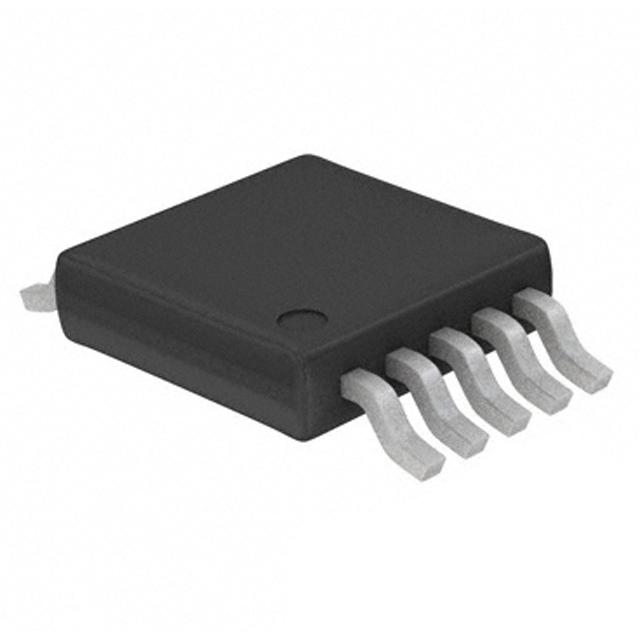
LTC4402-1/LTC4402-2
Multiband RF Power
Controllers for EDGE/TDMA
U
FEATURES
■
■
■
■
■
■
■
■
■
■
■
■
■
■
■
■
DESCRIPTIO
Supports AM Modulation in EDGE/TDMA (ANSI-136)
Applications
Single Output RF Power Amplifier Control
(LTC4402-1)
Dual Output RF Power Amplifier Control (LTC4402-2)
Internal Schottky Diode Detector with >40dB Range
Wide Input Frequency Range: 300MHz to 2.4GHz
Autozero Loop Cancels Offset Errors and
Temperature Dependent Offsets
Wide VIN Range: 2.7V to 6V
450kHz Loop Bandwidth
Allows Direct Connection to Battery
RF Output Power Set by External DAC
Internal Frequency Compensation
Rail-to-Rail Power Control Outputs
Low Operating Current: 1mA
Low Shutdown Current: < 10µA
PCTL Input Filter
Available in a 8-Pin MSOP Package (LTC4402-1)
and 10-Pin MSOP (LTC4402-2)
U
APPLICATIO S
■
■
■
Multiband GSM/GPRS/EDGE Cellular Phones
PCS Devices
Wireless Data Modems
U.S. TDMA Cellular Phones
RF power is controlled by driving the RF amplifier power
control pins and sensing the resultant RF output power.
The RF sense voltage is peak detected using an on-chip
Schottky diode. This detected voltage is compared to the
DAC voltage at the PCTL pin to control the output power.
The LTC4402-1 is a single output RF power controller
with identical performance to the LTC4402-2. The
LTC4402-1 has one output to control a single TX PA or
dual TX PA module with a single control input and is
available in an 8-pin MSOP package.
Internal and external offsets are cancelled over temperature by an autozero control loop. The shutdown feature
disables the part and reduces the supply current to
< 10µA.
, LTC and LT are registered trademarks of Linear Technology Corporation.
U
■
The LTC®4402-2 is a multiband RF power controller for
RF power amplifiers operating in the 300MHz to 2.4GHz
range. The LTC4402-2 has two outputs to control dual TX
PA modules with two control inputs. An internal sample
and hold circuit enables the LTC4402-2 to be used with
AM modulation via the carrier or PA supply. The input
voltage range is optimized for operation from a single
lithium-ion cell or 3× NiMH.
TYPICAL APPLICATIO
LTC4402-2 Multiband EDGE Cellular Telephone Transmitter
LTC4402-2
1
Li-Ion
0.1µF
BSEL
VHOLD
SHDN
DAC
9
8
7
6
VIN
BSEL
RF
VPCA
VHOLD
VPCB
SHDN
GND
PCTL
GND
50Ω
10
2
0.4pF
± 0.05pF
3
4
850MHz/
900MHz
RF PA
5
DIPLEXER
1.8GHz /
1.9GHz
RF PA
4402 TA01
4402f
1
�LTC4402-1/LTC4402-2
W W
W
AXI U
U
ABSOLUTE
RATI GS
(Note 1)
VIN to GND ............................................... – 0.3V to 6.5V
VPCA, VPCB Voltage .................................. – 0.3V to 4.6V
PCTL Voltage ............................... – 0.3V to (VIN + 0.3V)
RF Voltage ........................................ (VIN ± 2.6V) to 7V
SHDN, VHOLD, BSEL Voltage
to GND ......................................... – 0.3V to (VIN + 0.3V)
IVPCA/B .................................................................................. 10mA
Operating Temperature Range (Note 2) .. – 40°C to 85°C
Storage Temperature Range ................ – 65°C to 150°C
Maximum Junction Temperature ........................ 125°C
Lead Temperature (Soldering, 10 sec)................ 300°C
U
U
W
PACKAGE/ORDER I FOR ATIO
ORDER PART
NUMBER
TOP VIEW
VIN
VPCA
GND
GND
1
2
3
4
8
7
6
5
RF
VHOLD
SHDN
PCTL
MS8 PACKAGE
8-LEAD PLASTIC MSOP
LTC4402-1EMS8
VIN
VPCA
VPCB
GND
GND
MS8 PART MARKING
TJMAX = 125°C, θJA = 160°C/W
ORDER PART
NUMBER
TOP VIEW
LTXF
1
2
3
4
5
10 RF
9 BSEL
8 VHOLD
7 SHDN
6 PCTL
LTC4402-2EMS
MS PART MARKING
MS PACKAGE
10-LEAD PLASTIC MSOP
TJMAX = 125°C, θJA = 160°C/W
LTXH
Consult LTC Marketing for parts specified with wider operating temperature ranges.
ELECTRICAL CHARACTERISTICS
The ● denotes specifications which apply over the full operating
temperature range, otherwise specifications are at TA = 25°C. VIN = 3.6V, SHDN = VIN unless otherwise noted.
PARAMETER
CONDITIONS
MIN
VIN Operating Voltage
●
TYP
2.7
MAX
6
UNITS
V
IVIN Shutdown Current
SHDN = 0V
●
10
20
µA
IVIN Operating Current
IVPCA = IVPCB = 0mA
●
1.5
2
mA
VPCA/B VOL
RLOAD = 400Ω, Enabled
●
VPCA/B Dropout Voltage
ILOAD = 6mA, VIN = 2.7V
●
VPCA/B Output Current
VPCA/B = 2.4V, VIN = 2.7V, ∆VOUT = 10mV
●
0
0.1
VIN – 0.25
6
V
V
mA
9
SHDN = High (Note 5)
VPCA/B Bandwidth
CLOAD = 33pF, RLOAD = 400 (Note 7)
VPCA/B Load Capacitance
(Note 6)
VPCA/B Slew Rate
VPCTL = 2V Step, CLOAD = 100pF, RLOAD = 400 (Note 3)
VPCA/B VHOLD Droop
Unity Gain, VPCTL = 2V, VHOLD = High
VHOLD Time
Time from VHOLD High to Hold Switch Opening
VPCA/B Start Voltage
Open Loop
●
250
450
550
mV
VPCA/B Voltage Clamp
PCTL = 1V, VIN = 5V
●
3.6
4
4.4
V
SHDN, VHOLD, BSEL Input Threshold Low
VIN = 2.7V to 6V
●
●
PCTL < 80mV
PCTL > 160mV
450
260
V/µs
1
µV/ms
ns
0.35
1.4
●
16
PCTL Input Voltage Range
●
0
●
60
pF
2
100
●
(Note 4)
kHz
kHz
100
●
SHDN, VHOLD, BSEL Input Threshold High VIN = 2.7V to 6V
SHDN, BSEL, VHOLD Input Current
SHDN, BSEL, VHOLD = VIN = 3.6V
PCTL Input Resistance
11
µs
VPCA/B Enable Time
V
V
µA
24
36
2.4
V
90
120
kΩ
4402f
2
�LTC4402-1/LTC4402-2
ELECTRICAL CHARACTERISTICS
The ● denotes specifications which apply over the full operating
temperature range, otherwise specifications are at TA = 25°C. VIN = 3.6V, SHDN = VIN, unless otherwise noted.
PARAMETER
CONDITIONS
MIN
TYP
PCTL Input Filter
MAX
UNITS
270
Autozero Range
Maximum DAC Zero-Scale Offset Voltage
that can be applied to PCTL
●
RF Input Frequency Range
(Note 6)
●
RF Input Power Range
F = 900MHz (Note 6)
F = 1800MHz (Note 6)
F = 2400MHz (Note 6)
RF Input Resistance
Referenced to VIN
300
kHz
400
mV
2400
MHz
–27 to 18
–25 to 18
–23 to 16
●
Note 1: Absolute Maximum Ratings are those values beyond which the life
of a device may be impaired.
Note 2: Specifications are assured over the –40°C to 85°C temperature
range by design characterization and correlation with statistical process
controls.
Note 3: Slew rate is measured open loop. The rise time at VPCA or VPCB is
measured between 1V and 2V.
150
250
dBm
dBm
dBm
Ω
350
Note 4: Includes maximum DAC offset voltage and maximum control
voltage.
Note 5: This is the time from SHDN rising edge 50% switch point to
VPCA/B = 250mV.
Note 6: Guaranteed by design. This parameter is not production tested.
Note 7: Bandwidth is calculated using the 10% to 90% rise time:
BW = 0.35/rise time
U W
1000
100
0.9GHz
AT 25°C
0.9GHz AT –30°C
10
0.9GHz AT 75°C
1
–26
–20 –14 –8
–2
4
10
RF INPUT POWER (dBm)
16
Detector Characteristics at 1800MHz
10000
1000
1.8GHz AT –30°C
100
1.8GHz
AT 25°C
10
1.8GHz AT 75°C
1
–26 –20
–14 –8
–2
4
10
RF INPUT POWER (dBm)
4402 G01
U
U
U
PI FU CTIO S
16
PCTL REFERENCED DETECTOR OUTPUT VOLTAGE (mV)
Detector Characteristics at 900MHz
10000
PCTL REFERENCED DETECTOR OUTPUT VOLTAGE (mV)
PCTL REFERENCED DETECTOR OUTPUT VOLTAGE (mV)
TYPICAL PERFOR A CE CHARACTERISTICS
Detector Characteristics at 2400MHz
10000
1000
100
2.4GHz AT –30°C
2.4GHz AT 25°C
10
2.4GHz AT 75°C
1
–20
4402 G02
–14
–8
–2
4
RF INPUT POWER (dBm)
10
16
4402 G03
(LTC4402-1/LTC4402-2)
VIN (Pin 1): Input Supply Voltage, 2.7V to 6V. VIN should
be bypassed with 0.1µF and 100pF ceramic capacitors.
VPCA (Pin 2): Power Control Voltage Output. This pin
drives an external RF power amplifier power control pin.
The maximum load capacitance is 100pF. The output is
capable of rail-to-rail swings at low load currents. Selected
when BSEL is low.
VPCB (Pin 3): (LTC4402-2 Only) Power Control Voltage
Output. This pin drives an external RF power amplifier
power control pin. The maximum load capacitance is
100pF. The output is capable of rail-to-rail swings at low
load currents. Selected when BSEL is high.
GND (Pin 3/4): System Ground.
4402f
3
�LTC4402-1/LTC4402-2
U
U
U
PI FU CTIO S
(LTC4402-1/LTC4402-2)
GND (Pin 4/5): System Ground.
VHOLD (Pin 7/8): Asserted high prior to AM modulation,
opens control loop and holds voltage at VPCA or VPCB during
EDGE modulation.
PCTL (Pin 5/6): Analog Input. The external power control
DAC drives this input. The amplifier servos the RF power
until the RF detected signal equals the DAC signal applied
at this pin.
BSEL (Pin 9): (LTC4402-2 Only) Selects VPCA when low
and VPCB when high. This input has an internal 150k
resistor to ground.
SHDN (Pin 6/7): Shutdown Input. A logic low on the SHDN
pin places the part in shutdown mode. A logic high enables
the part after 10µs. SHDN has an internal 150k pull-down
resistor to ensure that the part is in shutdown when no input
is applied.
W
BLOCK DIAGRA
RF (Pin 8/10): Coupled RF Feedback Voltage . This input
is referenced to VIN. The frequency range is 300MHz to
2400MHz. This pin has an internal 250Ω termination, an
internal Schottky diode detector and peak detector
capacitor.
(LTC4402-2)
DIPLEXER
0.4pF
±0.05pF
850MHz/900MHz
50Ω
RF PA
RF PA
1.8GHz/1.9GHz
Li-Ion
VIN
1
TXENB
AUTOZERO
–
AZ
+
+
–
GAIN
COMPRESSION
–
GM
250Ω
VIN
+
10
VHOLD
RF
+
–
30k
60µA
+
–
CHOLD
+
28pF
30k
70mV
2
BUFFER
VPCA
3
270kHz
FILTER
RFDET
VPCB
38k
–
60µA
22k
4
5
VHOLD
GND
12Ω
9µs
DELAY
TXENB
VREF
PB
CREF
MUX
CONTROL
VHOLD
150k
150k
150k
7
SHDN
8
VHOLD
6
PCTL
12Ω
PA
51k
9
BSEL
100Ω
100Ω
4402 BD
4402f
4
�LTC4402-1/LTC4402-2
U
W
U
U
APPLICATIONS INFORMATION
Operation
Autozero
The LTC4402-1/-2 single/dual band RF power controller
integrates several functions to provide RF power control
over frequencies ranging from 300MHz to 2.4GHz. These
functions include an internally compensated amplifier to
control the RF output power, an autozero section to cancel
internal and external voltage offsets, an RF Schottky diode
peak detector and amplifier to convert the RF feedback
signal to DC, a multiplexer to switch the controller output
to either VPCA or VPCB, a VPCA/B overvoltage clamp, compression and a bandgap reference.
An autozero system is included to improve power programming accuracy over temperature. This section cancels internal offsets associated with the Schottky diode
detector and control amplifier. External offsets associated
with the DAC driving the PCTL pin are also cancelled.
Offset drift due to temperature is cancelled between each
burst. The maximum offset allowed at the DAC output is
limited to 400mV. Autozeroing is performed after SHDN
is asserted high. An internal delay of typically 9µs enables
the VPCA/B output after the autozero has settled. When the
part is enabled, the autozero capacitors are held and the
VPCA or VPCB pin is connected to the buffer amplifier
output. The hold droop voltage of typically < 1µV/ms
provides for accurate offset cancellation.
Band Selection
The LTC4402-2 is designed for multiband operation. The
BSEL pin will select output VPCA when low and output
VPCB when high. For example, VPCA could be used to drive
an 850MHz/900MHz channel and VPCB a 1.8GHz/1.9GHz
channel. BSEL must be established before the part is
enabled. The LTC4402-1 can be used to drive a single RF
channel or dual channel with integral multiplexer.
Filter
There is a 270kHz filter included in the PCTL path. This
filter is trimmed at test.
Modes of Operation
Control Amplifier
The control amplifier supplies the power control voltage to
the RF power amplifier. A portion (typically – 19dB for low
frequencies and –14dB for high frequencies) of the RF
output voltage is coupled into the RF pin, to close the gain
control loop. When a DAC voltage is applied to PCTL, the
amplifier quickly servos VPCA or VPCB positive until the
detected feedback voltage applied to the RF pin matches
the voltage at PCTL. This feedback loop provides accurate
RF power control. VPCA or VPCB are capable of driving a
6mA load current and 100pF load capacitor.
RF Detector
The internal RF Schottky diode peak detector and amplifier convert the coupled RF feedback voltage to a low
frequency voltage. This voltage is compared to the DAC
voltage at the PCTL pin by the control amplifier to close
the RF power control loop. The RF pin input resistance is
typically 250Ω and the frequency range of this pin is
300MHz to 2400MHz. The detector demonstrates excellent efficiency and linearity over a wide range of input
power. The Schottky detector is biased at about 60µA and
drives an on-chip peak detector capacitor of 28pF.
Shutdown: The part is in shutdown mode when SHDN is
low. VPCA and VPCB are held at ground and the power
supply current is typically 10µA.
Enable: When SHDN is asserted high the part will automatically calibrate out all offsets. This takes about 9µs and
is controlled by an internal delay circuit. After 9µs VPCA or
VPCB will step up to the starting voltage of 450mV. The
user can then apply the ramp signal. The user should wait
at least 11µs after SHDN has been asserted high before
applying the ramp. The DAC should be settled 2µs after
asserting SHDN high.
Hold: When the VHOLD pin is low, the RF power control
feedback loop is closed and the LTC4402-X servos the
VPCA/VPCB pins according to the voltages at the PCTL and
RF inputs. When the VHOLD pin is asserted high, the RF
power control feedback loop is opened and the power
control voltage at VPCA or VCPB is held at its present level.
Generally, the VHOLD pin is asserted high after the power
up ramp has been completed and the desired RF output
power has been achieved. The power control voltage is
then held at a constant voltage during the EDGE modulation time. After the EDGE modulation is completed and
prior to power ramping down, the VHOLD pin is set low.
4402f
5
�LTC4402-1/LTC4402-2
U
U
W
U
APPLICATIONS INFORMATION
This closes the RF power control loop and the RF power is
then controlled during ramp down.
LTC4402-1 Description
The LTC4402-1 is identical in performance to the
LTC4402-2 except that only one control output (VPCA) is
available. The LTC4402-1 can drive a single band (300MHz
to 2400MHz) or a dual RF channel module with an
internal multiplexer. Several manufacturers offer dual RF
channel modules with an internal multiplexer.
General Layout Considerations
The LTC4402-X should be placed near the coupling components. The feedback signal line to the RF pin should be
a 50Ω transmission line.
Capacitive Coupling
An alternative to a directional coupler is illustrated on the
first page of this data sheet. This method couples RF from
the power amplifier to the power controller through a
0.4pF ±0.05pF capacitor and 50Ω series resistor, completely eliminating the directional coupler.
LTC4402-X Timing Diagram
28µs
2µs
11µs
28µs
543µs
SHDN
VPCA/B
VSTART
PCTL
VHOLD
AM MODULATION PERIOD
4402 TD
T1
T2 T3
T4 T5
T6 T7 T8
T1: PART COMES OUT OF SHUTDOWN 11µs PRIOR TO BURST.
T2: INTERNAL TIMER COMPLETES AUTOZERO CORRECTION, TYPICALLY 9µs.
T3: BASEBAND CONTROLLER STARTS RF POWER RAMP UP AT LEAST 11µs AFTER
SHDN IS ASSERTED HIGH.
T4: BASEBAND CONTROLLER COMPLETES RAMP UP.
T5: CONTROL LOOP OPENS, VPCA/B VOLTAGE HELD, AM MODULATION STARTS.
T6: AM MODULATION STOPS, CONTROL LOOP CLOSES, VPCA/B WILL FOLLOW DAC.
T7: BASEBAND CONTROLLER STARTS RF POWER RAMP DOWN AT END OF BURST.
T8: RETURNS TO SHUTDOWN MODE BETWEEN BURSTS.
Application Note AN91 describes the capacitive coupling
scheme in full detail. Demo boards featuring this coupling
method are available upon request.
Power Ramp Profiles
The external voltage gain associated with the RF channel
can vary significantly between RF power amplifier types.
Frequency compensation generally defines the loop dynamics that impact the power/time response and possibly
(slow loops) the power ramp sidebands. The LTC4402-X
operates open loop until an RF voltage appears at the RF
pin, at which time the loop closes and the output power
follows the DAC profile. The RF power amplifier will
require a certain control voltage level (threshold) before an
RF output signal is produced. The LTC4402-X VPCA/B
outputs must quickly rise to this threshold voltage in order
to meet the power/time profile. To reduce this time, the
LTC4402-X starts at 450mV. However, at very low power
levels the PCTL input signal is small, and the VPCA/B
outputs may take several microseconds to reach the RF
power amplifier threshold voltage. To reduce this time, it
may be necessary to apply a positive pulse at the start of
the ramp to quickly bring the VPCA/B outputs to the
threshold voltage. This can generally be achieved with
DAC programming. The magnitude of the pulse is dependent on the RF amplifier characteristics.
Power ramp sidebands and power/time are also a factor
when ramping to zero power. For RF amplifiers requiring
high control voltages, it may be necessary to further adjust
the DAC ramp profile. When the power is ramped down,
the loop will eventually open at power levels below the
LTC4402-X detector threshold. The LTC4402-X will then
go open loop and the output voltage at VPCA or VPCB will
stop falling. If this voltage is high enough to produce RF
output power, the power/time or power ramp sidebands
may not meet specification. This problem can be avoided
by starting the DAC ramp from 200mV (Figure 1). At the
end of the cycle, the DAC can be ramped down to 0mV.
This applies a negative signal to the LTC4402-X thereby
ensuring that the VPCA/B outputs will ramp to 0V. The
200mV ramp step must be applied at least 2µs after SHDN
is asserted high to allow the autozero to cancel the step.
4402f
6
�LTC4402-1/LTC4402-2
U
W
U U
APPLICATIO S I FOR ATIO
below the 0dB axis. The extra voltage gain can vary
significantly over input/output power ranges, frequency,
power supply, temperature and manufacturer. RF power
amplifier gain control transfer functions are often not
available and must be generated by the user. Loop oscillations are most likely to occur in the midpower range
where the external voltage gain associated with the RF
power amplifier typically peaks. It is useful to measure the
oscillation or ringing frequency to determine whether it
corresponds to the expected loop bandwidth and thus is
due to high gain bandwidth.
10
0
RFOUT (dBc)
–10
–20
–30
–40
–50
–60
–70
–80
–28
–18
–10
0
543
553
561
571
DAC VOLTAGE
TIME (µs)
START
PULSE
START
CODE
ZERO
CODE
200mV
SHDN
11µs MINIMUM, ALLOWS TIME
FOR AUTOZERO TO SETTLE
4402 F01
Figure 1. LTC4402 Ramp Timing
Demo Board
The LTC4402-X demo board is available upon request. The
demo board has a 900MHz and an 1800MHz RF channel
and VHOLD controlled by the LTC4402-X. Timing signals
for SHDN are generated on the board using a 13MHz
crystal oscillator reference. The PCTL power control pin is
driven by a 10-bit DAC and the DAC profile can be loaded
via a serial port. The serial port data is stored in a flash
memory which is capable of storing eight ramp profiles.
The board is supplied preloaded with four GSM power
profiles and four DCS power profiles covering the entire
power range. External timing signals can be used in place
of the internal crystal controlled timing. A power ramp
software package is available which allows the user to
create power control ramps.
LTC4402 Control Loop Stability
There are several factors that can improve or degrade loop
frequency stability.
1) The additional voltage gain supplied by the RF power
amplifier increases the loop gain, raising poles normally
2) Loop voltage losses supplied by the coupler network
will improve phase margin. The larger the coupler loss the
more stable the loop will become. However, larger losses
reduce the RF signal to the LTC4402-X and detector
performance may be degraded at low power levels. (See
RF Detector Characteristics.)
3) Additional poles within the loop due to filtering or the
turn-on response of the RF power amplifier can degrade
the phase margin if these pole frequencies are near the
effective loop bandwidth frequency. Generally loops using
RF power amplifiers with fast turn-on times have more
phase margin. Extra filtering below 16MHz should never
be placed within the control loop, as this will only degrade
phase margin.
4) Control loop instability can also be due to open loop
issues. RF power amplifiers should first be characterized
in an open loop configuration to ensure self oscillation is
not present. Self-oscillation is often related to poor power
supply decoupling, ground loops, coupling due to poor
layout and extreme VSWR conditions. The oscillation frequency is generally in the 100kHz to 10MHz range. Power
supply related oscillation suppression requires large value
ceramic decoupling capacitors placed close to the RF
power amp supply pins. The range of decoupling capacitor
values is typically 1nF to 3.3µF.
5) Poor layout techniques associated with the coupler
network may result in high frequency signals bypassing
the coupler. This could result in stability problems due to
the reduction in the coupler loss.
4402f
7
�LTC4402-1/LTC4402-2
U
W
U U
APPLICATIO S I FOR ATIO
Determining External Loop Gain and Bandwidth
The external loop voltage gain contributed by the RF channel and coupler network should be measured in a closed
loop configuration. A voltage step is applied to PCTL and
the change in VPCA (or VPCB) is measured. The detected RF
voltage is 0.6 • PCTL and the external voltage gain contributed by the RF power amplifier and coupler network is
0.6 • ∆VPCTL/∆VVPCA. Measuring voltage gain in the closed
loop configuration accounts for the nonlinear detector
gain that is dependent on RF input voltage and frequency.
The LTC4402-X unity gain bandwidth specified in the data
sheet assumes that the net voltage gain contributed by the
RF power amplifier and coupler network is unity. The
bandwidth is calculated by measuring the rise time between 10% and 90% of the voltage change at VPCA or VPCB
for a small step in voltage applied to PCTL.
BW1 = 0.35/rise time
The LTC4402-X control amplifier unity gain bandwidth
(BW1) is typically 450kHz. For PCTL 10kV ESD on All SIM Contact Pins
LT1615
Step-Up DC/DC Converter
ThinSOT, Low 20µA Quiescent Current, VIN as Low as 1V, 300mA IOUT
LT1617
Inverting DC/DC Converter
ThinSOT, Low 20µA Quiescent Current, VIN as Low as 1V, 300mA IOUT
LTC1682
Low Noise Charge Pump with LDO
60µVRMS Output Noise, Small MSOP Package
LT1761
Low Dropout, Low Noise Linear Regulator
ThinSOT, 300mV Dropout at 100mA, 20µVRMS Output Noise (10Hz to 100kHz)
LTC1878
Step-Down DC/DC Converter
Integrated Synchronous Operation, Up to 95% Efficiency, 1A Switch Current
LTC1928
Low Noise Charge Pump
ThinSOT, 90µVRMS Output Noise (100kHz BW), IOUT Up to 30mA
LT1932
White LED Driver
ThinSOT, 1.2MHz DC/DC Constant-Current LED Driver, Dimming Control
LT1944
Step-Up DC/DC Converter
Dual Output for LCD Bias, Low Quiescent Current of 20µA, 1.2V ≤ VIN ≤ 15V
LTC1986
SIM Power Supply
ThinSOT, 3V and 5V, Ultralow Supply Current of 14µA,