LTC4421
High Power Prioritized
PowerPath Controller
FEATURES
DESCRIPTION
0V to 36V Wide Operating Range (60V Tolerant)
n Drives Large External N-Channel MOSFETs for High
Output Current Applications
n Accurately Limits Inrush Current
n Connects Highest Priority Valid Supply to Output Load
n Changes Channel Priority in Real Time
n ±2% OV, UV Input Comparators
n Individually Adjustable Current Limit Time-Out for
Each Channel
n Adjustable Input Validation Time
n Fast Switchover Minimizes V
OUT Droop
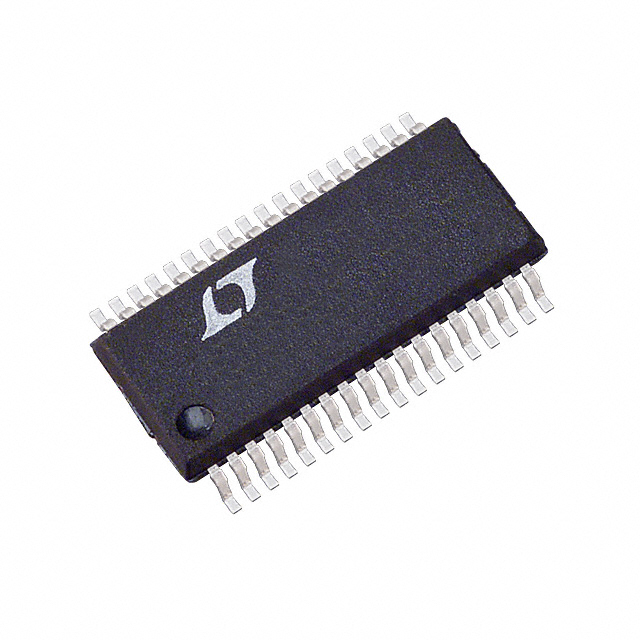
n 36-Lead 5mm × 6mm QFN and SSOP Packages
The LTC®4421 connects one of two input supplies to a
common output based on user-defined priority and validity. By definition, the supply connected to V1 is the higher
priority supply, although this can be changed dynamically.
External resistive dividers set the undervoltage and overvoltage thresholds that bound the valid voltage window.
APPLICATIONS
External sense resistors set the maximum inrush and current limit currents. During current limiting, the LTC4421
controls the N-channel MOSFET gate to regulate 25mV
across the sense resistor. When the sense resistor voltage
has been regulated to 25mV for a user-settable time, the
channel is disconnected and a fault is set.
n
Strong gate drivers switch the large external N-channel
MOSFETs quickly. Fast switchover circuitry minimizes
output droop when changing channels while preventing
reverse and cross conduction. A fast comparator detects
input short circuits and quickly turns off the N-channel
MOSFETs to minimize disruption.
High Reliability Systems
Server Based Back-Up Systems
n Industrial Handheld Instruments
n Battery Back-Up Systems
n
n
All registered trademarks and trademarks are the property of their respective owners.
TYPICAL APPLICATION
ILIM1 = 10A
2.5mΩ
PRIMARY
12V
VOUT
1.21Ω
220µF
1µF
SECONDARY
28V
ILIM2 = 10A
2.5mΩ
2.8Ω
1µF
1MΩ
V1
47nF
47nF
1µF
GATE1 SOURCE1
SENSE1
OUT1 CPO CPOREF V2
GATE2 SOURCE2
SENSE2
OUT2
EXTVCC
UVF1
0.1µF
20k
UVR1
12.7k
OV1
35.7k
LTC4421
1MΩ
UVF2
8.06k
UV1FALLING = 7.81V
UV1RISING = 11.04V
OV1RISING = 14.96V
UV2FALLING = 18.1V
UV2RISING = 25.2V
OV2RISING = 31.2V
UVR2
3.92k
OV2
16.5k
GND
QUAL
TMR1
470pF
TMR2
47nF
INTVCC
47nF
1µF
VALID1
VALID2
CH1
CH2
FAULT1
FAULT2
CASOUT
DIGITAL
STATUS
OUTPUTS
RETRY
DISABLE1
DISABLE2
SHDN
CASIN
DIGITAL
CONTROL
INPUTS
4421 TA01
Rev. 0
Document Feedback
For more information www.analog.com
1
�LTC4421
ABSOLUTE MAXIMUM RATINGS
(Notes 1, 2)
Supply Voltages
V1, V2, EXTVCC.........................................–10V to 60V
OUT1, OUT2, CPOREF...............................–10V to 45V
Input Voltages
DISABLE1, DISABLE2, SHDN…............... –0.3V to 60V
CASIN....................................................... –0.3V to 6V
SENSE1, SENSE2, SOURCE1, SOURCE2...–10V to 45V
UVF1, UVF2, UVR1, UVR2, OV1, OV2..... –0.3V to 60V
RETRY, TMR1, TMR2, QUAL....–0.3V to INTVCC+0.3V
Output Voltages
VALID1, VALID2, CH1, CH2,
FAULT1, FAULT2, CPO.............................. –0.3V to 60V
INTVCC...................................................... –0.3V to 6V
GATE1, GATE2 (Note 3) ..............................–0.3V to CPO
CASOUT….................................................... –0.3V to 6V
Output Currents
FAULT1, FAULT2, CH1, CH2, VALID1, VALID2,
CASOUT................................................................5mA
Operating Ambient Temperature Range
LTC4421C................................................. 0°C to 70°C
LTC4421I..............................................–40°C to 85°C
LTC4421H........................................... –40°C to 125°C
Storage Temperature Range................... –65°C to 150°C
PIN CONFIGURATION
TOP VIEW
SENSE2
OUT2
GND
EXTVCC
CPO
CPOREF
OUT1
SENSE1
TOP VIEW
36 35 34 33 32 31 30 29
SOURCE1 1
37
OV1 6
TMR1 7
32 SOURCE2
GATE1
6
31 GATE2
V1
7
30 V2
24 UVR2
UVF1
8
29 UVF2
23 OV2
UVR1
9
28 UVR2
21 DISABLE2
CH1 9
20 CH2
19 VALID2
VALID1 10
FAULT2
SHDN
RETRY
QUAL
CASOUT
INTVCC
CASIN
11 12 13 14 15 16 17 18
FAULT1
34 OUT2
33 SENSE2
22 TMR2
DISABLE1 8
OUT1
5
25 UVF2
UVR1 5
35 GND
3
4
26 V2
UVF1 4
36 EXTVCC
2
SENSE1
27 GATE2
V1 3
1
SOURCE1
28 SOURCE2
GATE1 2
CPO
CPOREF
UHE PACKAGE
36-LEAD (5mm × 6mm) PLASTIC QFN
TJMAX = 150°C, θJA = 43°C/W, θJC = 5°C/W
EXPOSED PAD (Pin 37), PCB GND CONNECTION OPTIONAL
OV1 10
TMR1 11
DISABLE1 12
CH1 13
27 OV2
26 TMR2
25 DISABLE2
24 CH2
VALID1 14
23 VALID2
FAULT1 15
22 FAULT2
CASIN 16
21 SHDN
INTVCC 17
20 RETRY
CASOUT 18
19 QUAL
G PACKAGE
36-LEAD PLASTIC SSOP
TJMAX = 150°C, θJA = 70°C/W
Rev. 0
2
For more information www.analog.com
�LTC4421
ORDER INFORMATION
TUBE
TAPE AND REEL
PART MARKING
PACKAGE DESCRIPTION
TEMPERATURE RANGE
LTC4421CG#PBF
LTC4421CG#TRPBF
LTC4421G
36-Lead Plastic SSOP
0°C to 70°C
LTC4421IG#PBF
LTC4421IG#TRPBF
LTC4421G
36-Lead Plastic SSOP
–40°C to 85°C
LTC4421HG#PBF
LTC4421HG#TRPBF
LTC4421G
36-Lead Plastic SSOP
–40°C to 125°C
LTC4421CUHE#PBF
LTC4421CUHE#TRPBF
4421
36-Lead Plastic QFN
0°C to 70°C
LTC4421IUHE#PBF
LTC4421IUHE#TRPBF
4421
36-Lead Plastic QFN
–40°C to 85°C
LTC4421HUHE#PBF
LTC4421HUHE#TRPBF
4421
36-Lead Plastic QFN
–40°C to 125°C
Contact the factory for parts specified with wider operating temperature ranges.
Tape and reel specifications. Some packages are available in 500 unit reels through designated sales channels with #TRMPBF suffix.
ELECTRICAL CHARACTERISTICS
The l denotes the specifications which apply over the full operating
temperature range, otherwise specifications are at TA = 25°C. See the LTC4421 Data Sheet Nomenclature section for more details on pin
conditions. V1 = 12V, V2 = 13V, EXTVCC = CPOREF = OUT1 = OUT2 = SENSE1 = SENSE2 = 11V, OV1 = OV2 = TMR1 = TMR2 = OV, UVR1 =
UVR2 = UVF1 = UVF2 = DISABLE1 = DISABLE2 = SHDN = RETRY = CASIN = 4V, CPO = 23.5V, QUAL = INTVCC, unless otherwise noted.
SYMBOL
PARAMETER
CONDITIONS
VIN
V1, V2 Operating Voltage Range
(Note 4)
VINT(UVL)
INTVCC Undervoltage Lockout Threshold Voltage
ΔVINT(HYS)
INTVCC Undervoltage Lockout Hysteresis
VINTVCC
INTVCC Output Voltage
ΔVINTVCC
MIN
TYP
MAX
36
V
2
2.3
2.6
V
l
3.3
3.9
4.5
IINTVCC = 0 to –500µA
l
–35
–85
–200
CPO–CPOREF
l
5.7
6.7
7.7
l
3.0
l
IINTVCC = 0µA
INTVCC Voltage Change from Zero to Full Load
VCPO(UVL)
CPOGOOD Threshold Voltage
VCPO(HYS)
CPOGOOD Hysteresis
70
UNITS
mV
1.4
V
mV
V
V
ICC(TOT)
Total Input Supply Current
V1, V2, OUT1, OUT2, EXTVCC, CPOREF
l
0.53
1
mA
ICC(SHDN)
Total Input Supply Current in Shutdown
V1, V2, EXTVCC
l
5.4
12
µA
ICC(PRIO)
Input Supply Current of Highest Priority Valid
Supply
Measure I(EXTVCC)
l
360
750
µA
ICC(VMAX)
Input Supply Current of Highest Voltage Input
Supply
Measure I(V2)
l
25
50
µA
ICC(CPOREF)
CPOREF Charge Pump Supply Current
CPOREF = 11V
l
160
300
µA
–0.6
–1.5
V
PRIORITIZER CONTROL (V1, V2, SENSE1, SENSE2, GATE1, GATE2, SOURCE1, SOURCE2, OUT1, OUT2)
ΔVG(OFF)
External N-Channel MOSFET Off Threshold
Voltage
(GATE1 – V1), (GATE2 – V2), GATE Falling
l
0
ΔVREV
Input to Output Reverse Voltage Connect Threshold
(V1– OUT1), (V2–OUT2), OUT1, OUT2 Falling
l
0
40
80
mV
ΔVGATE(CL)
External N-Channel MOSFET Gate Drive,
(GATE – CPOREF)
CPOREF = 3.2V, EXTVCC = 3.0V, I = 0, –1µA
CPOREF = 12V, 36V, I = 0, –1µA
l
l
9
10
10.8
11.6
14
14
V
V
ISOURCE, HLD
SOURCE Hold Current
SOURCE = 12V, Channel Off
l
2.5
5
10
µA
ISOURCE, OFF
SOURCE Fast Off Current
SOURCE = 12V, Channel Off
l
0.7
1.6
3.2
mA
IGATE(ON)
GATE On Pull-Up Current
V(SENSE) – V(OUT) = 0V, GATE = 16V,
OUT = 10V, V1 = V2 = 12V
l
–8
–16.5
–26
mA
V(SENSE)–V(OUT) = 100mV, GATE = 16V,
OUT = 10V, V1 = V2 = 12V
l
30
54
124
mA
IGATE(OFF,FWD) GATE Off Pull-Down Current, Large Forward
Sense Voltage
Rev. 0
For more information www.analog.com
3
�LTC4421
ELECTRICAL CHARACTERISTICS
The l denotes the specifications which apply over the full operating
temperature range, otherwise specifications are at TA = 25°C. See the LTC4421 Data Sheet Nomenclature section for more details on pin
conditions. V1 = 12V, V2 = 13V, EXTVCC = CPOREF = OUT1 = OUT2 = SENSE1 = SENSE2 = 11V, OV1 = OV2 = TMR1 = TMR2 = OV, UVR1 =
UVR2 = UVF1 = UVF2 = DISABLE1 = DISABLE2 = SHDN = RETRY = CASIN = 4V, CPO = 23.5V, QUAL = INTVCC, unless otherwise noted.
SYMBOL
PARAMETER
CONDITIONS
MIN
TYP
MAX
IGATE(OFF,REV)
GATE Off Pull-Down Current, Negative Sense
Voltage
V(SENSE)–V(OUT) = –50mV, GATE = 16V,
OUT = 10V, V1 = V2 = 12V
l
30
50
92
mA
ΔVSNS
Current Limit Sense Voltage,
ΔVSNS = (SENSE – OUT)
OUT = 1V, 12V, 32V
EXTVCC = 3.0V, OUT = 1V
l
l
20
20
25
25
30
30
mV
mV
ΔVSNS,FLD
Current Limit Sense Voltage in Foldback,
ΔVSNS,FLD = (SENSE – OUT)
OUT = 0V
l
7.5
12.5
17.5
mV
OUT1
l
380
480
580
mV
VFLD,TH
Foldback Threshold Voltage
VFLD,HYST
Foldback Hysteresis
VSNSDIS,FWD
Forward Overcurrent Disconnect Voltage
SENSE – OUT, Rising
VSNSDIS,REV
Reverse Current Disconnect Voltage
SENSE – OUT, Falling
ISNS
SENSE Input Current
SENSE = OUT = 12V
l
UNITS
50
mV
50
mV
–30
mV
±1
μA
tG(SWITCH)
Gate Break-Before-Make Time
CGATE = 47nF
l
10.3
15
µs
tPG(DIS, OFF)
Gate Turn-Off Delay from DISABLE
Falling DISABLE to Gate < 12V
l
1.4
2.7
µs
tPG(DIS, ON)
Gate Turn-On Delay from DISABLE
Rising DISABLE to Gate > 12V
l
1.3
2.1
µs
tPG(CAS)
CASIN to CASOUT Propagation Delay
High-to-Low
tPG(DIS, CAS)
DISABLE to CASOUT Propagation Delay
DISABLE High-to-Low
1
μs
2.8
µs
CURRENT LIMIT TIMER (TMR1, TMR2)
ITMR(UP)
TMR Pull-Up Current
l
–3
–6
–9
µA
ITMR(DN)
TMR Pull-Down Current
l
1
2
3
µA
tTMR,FLT
TMR Fault Time
l
550
830
1250
µs
CTMR = 10nF
%TMR(COOL) TMR Cool Down Ratio to Fault Time
0.1
%
OV, UV PROTECTION CIRCUITRY (OV1, OV2, UVF1, UVF2, UVR1, UVR2, QUAL)
VTH,OVUV
OV, UV Threshold Voltage
VHYST, OV
OV Hysteresis
ILK,OVUV
UVR, UVF, OV Input Leakage Current
IQUAL,SRC
QUAL Source Current
IQUAL,SNK
QUAL Sink Current
tVALID
OV, UV Validation Time
tINVALID
OV, UV Invalidation Filter Time
OV Rising, UVF Falling, UVR Rising
l
490
500
510
mV
l
40
50
60
mV
±10
nA
l
–1
–2
–3
µA
l
1
2
3
µA
QUAL = INTVCC
CQUAL = 470pF
l
l
1.75
5
5
7.5
8
11
µs
ms
Overdrive = 50mV
l
1.75
5
8
µs
l
0.5
1.0
1.5
V
V = 0.5V
l
DIGITAL INPUTS (DISABLE1, DISABLE2, SHDN, CASIN, RETRY)
VTH
Rising Threshold Voltage
VHYST
Hysteresis Voltage
ILK,HV
Input Leakage Current
V = 36V, DISABLE, SHDN
l
±0.1
±1
µA
ILK,LV
Input Leakage Current
V = 5.5V, CASIN
Retry = INTVCC
l
l
±0.1
±0.1
±1
±1
µA
µA
ICASIN
CASIN Pull-Up Current
CASIN = 0V
l
5
10
µA
150
2.5
mV
Rev. 0
4
For more information www.analog.com
�LTC4421
ELECTRICAL CHARACTERISTICS
The l denotes the specifications which apply over the full operating
temperature range, otherwise specifications are at TA = 25°C. See the LTC4421 Data Sheet Nomenclature section for more details on pin
conditions. V1 = 12V, V2 = 13V, EXTVCC = CPOREF = OUT1 = OUT2 = SENSE1 = SENSE2 = 11V, OV1 = OV2 = TMR1 = TMR2 = OV, UVR1 =
UVR2 = UVF1 = UVF2 = DISABLE1 = DISABLE2 = SHDN = RETRY = CASIN = 4V, CPO = 23.5V, QUAL = INTVCC, unless otherwise noted.
SYMBOL
PARAMETER
CONDITIONS
MIN
TYP
MAX
UNITS
185
0.58
450
1.35
mV
V
±1
µA
DIGITAL OUTPUTS (CH1, CH2, VALID1, VALID2, FAULT1, FAULT2, CASOUT)
VOL,HV
Output Voltage Low, CH, VALID, FAULT
I = 1mA, V1 = V2 = EXTVCC = 3.0V
I = 3mA, V1 = V2 = EXTVCC = 3.0V
l
l
IOH,HV
Open Drain, Output High Leakage Current
V = 36V, CH, VALID, FAULT
l
VCASO,OH
CASOUT Output High Voltage
I = –1µA , SHDN = 0V
l
VCASO,OL
CASOUT Output Low Voltage
I = 1mA
l
ICASO
CASOUT Pull-Up Current
CASOUT = 1V
l
ILK,CASO
CASOUT Leakage Current
CASOUT = 5.5V
l
Note 1. Stresses beyond those listed under Absolute Maximum Ratings
may cause permanent damage to the device. Exposure to any Absolute
Maximum Rating condition for extended periods may affect device
reliability and lifetime.
Note 2. All currents into pins are positive; all voltages are referenced to
GND unless otherwise noted.
2
–11
3.4
4.5
V
85
200
mV
–22
–40
µA
±1
µA
Note 3. Do not drive GATE1 and GATE2 above CPO. Doing so can cause
excessive voltage on CPO.
Note 4. V1 can operate down to 0V, provided V2 ≥ 3.0V or EXTVCC ≥ 3.0V.
Likewise, V2 can operate down to 0V, provided V1 ≥ 3.0V or EXTVCC ≥ 3.0V.
LTC4421 DATA SHEET NOMENCLATURE
The LTC4421 dedicates 13 pins per channel for the purposes of monitoring each input supply and controlling
its connection to the output. Pin names having suffix “1”
apply to Channel 1, while those having suffix “2” apply to
Channel 2. When no suffix is used when referencing one
of these pins, it means that the text applies to the pins
on both channels. For example, “Connect a capacitor
CTMR from TMR to ground” means “Connect a capacitor
CTMR1 between the TMR1 pin and ground” and “Connect
a capacitor CTMR2 between the TMR2 pin and ground”.
References to multiple pin names with no suffix are meant
to describe functionality within a channel but apply to both
channels. These references occur for the following cases:
1. Connecting two pins together: “Tie FAULT to DISABLE”
means “Tie FAULT1 to DISABLE1” and “Tie FAULT2 to
DISABLE2”.
2. Referring to differential voltages: “SENSE to OUT”
means “SENSE1 to OUT1” and “SENSE2 to OUT2”.
3. Causation: “The VALID pins pull low when their V1-V2
supplies have been validated” means “The VALID1 pin
pulls low when the V1 supply has been validated” and
“The VALID2 pin pulls low when the V2 supply has
been validated”.
Rev. 0
For more information www.analog.com
5
�LTC4421
TYPICAL PERFORMANCE CHARACTERISTICS
GATE Drive Voltage vs CPOREF
Voltage
13
6
SENSE VOLTAGE (mV)
5
VOLTAGE (V)
TRANSITION TO
Burst Mode OPERATION
9
4
3
8
7
EXTVCC = 3.0
EXTVCC ≥ 4.0
0
2
4
6
8
10
2
12
2
3
CPOREF VOLTAGE (V)
4
5
26
25
24
23
−50
6
−25
EXTVCC VOLTAGE (V)
50
75
100
0.505
0.500
Total Supply Current vs EXTVCC
Voltage
700
650
RISING
SUPPLY CURRENT (µA)
0.525
THRESHOLD VOLTAGE (V)
0.510
125
4421 G03
Overvoltage Thresholds vs
Temperature
0.495
25
4421 G02
Undervoltage Threshold vs
Temperature
0.500
0
TEMPERATURE (°C)
4421 G01
THRESHOLD VOLTAGE (V)
27
INTVCC, RLOAD = 10k
INTVCC, NO LOAD
EXTVCC
11
10
SENSE Voltage vs Temperature
INTVCC Voltage vs EXTVCC Voltage
12
GATE-CPOREF VOLTAGE (V)
TA = 25°C, EXTVCC = 11V, unless otherwise noted.
0.475
FALLING
0.450
T = 25°C
T = 125°C
T = −40°C
600
550
500
450
0.490
−50
−25
0
25
50
75
100
125
0.425
−50
−25
TEMPERATURE (°C)
0
25
50
75
100
−15
2
4
6
8
10
12
GATE-OUT VOLTAGE (V)
20
25
500
5
4
3
V1 + V2 + EXTVCC
EXTVCC
V1
V2
2
1
0
30
Supply Current vs EXTVCC Voltage
(V1
= 12V,
V2 = 13V)
(V1=12V,
V2=13V)
0
5
10
15
20
25
30
EXTVCC VOLTAGE (V)
4421 G07
V1, V2, EXTVCC CURRENT (µA)
V1, V2, EXTVCC CURRENT (µA)
GATE CURRENT (mA)
SENSE = 0mV
SENSE = 6.25mV
SENSE = 12.5mV
SENSE = 18.75mV
15
4421 G06
6
−5
10
EXTVCC VOLTAGE (V)
Shutdown Current vs EXTVCC
Voltage (V1 = 12V, V2 = 13V)
0
0
5
4421 G05
GATE On Pull-Up Current vs GATE
Voltage
−10
0
TEMPERATURE (°C)
4421 G04
−20
400
125
400
300
V1 + V2 + EXTVCC
EXTVCC
V1
V2
200
100
0
0
5
10
15
20
25
30
EXTVCC VOLTAGE (V)
4421 G08
4421 G09
Rev. 0
6
For more information www.analog.com
�LTC4421
TYPICAL PERFORMANCE CHARACTERISTICS
VOUT Switching from Higher to
Lower Voltage
V2
5V/DIV
V2
4V/DIV
OV, UV Validation Time vs QUAL
Capacitance
VOUT Switching from Lower to
Higher Voltage
100
VOUT
VOUT
V1
5V/DIV
10
TIME (ms)
V1
4V/DIV
0V
IV1
2A/DIV
0V, 0A
IV2
2A/DIV
0A
4421 G10
50µs/DIV
COUT = 100µF
ILOAD = 5A
30V NCH SiR158DP
1000
0.1
10
4421 G12
40
EXTVCC = 3.1V
t INVALID (µs)
TIME (µs)
400
1000
50
13
–40°C
100
CQUAL (pF)
OV, UV Propagation Delay vs
Overdrive
14
800
600
4421 G11
GATE Break-Before-Make Time vs
Temperature
25°C
125°C
1
50µs/DIV
COUT = 100µF
ILOAD = 5A
30V NCH SiR158DP
VALID, CH, FAULT Output Low
Voltage vs Pull-Up Current
12
11
30
20
EXTVCC = 11V
200
EXTVCC = 3V
0
1
2
3
4
PULL–UP CURRENT (mA)
9
–50
5
–25
0
25
50
75
TEMPERATURE (°C)
100
4421 G13
12.0
CPOREF:
3V
3.2V
5V
12V
36V
10.0
9.0
8.0
0
2
4
6
IGATE (µA)
1
10
100
OVERDRIVE (mV)
8
1000
4421 G15
GATE Drive vs Temperature
GATE Drive vs GATE Current
12.0
11.0
0
125
4421 G14
10
GATE–CPOREF VOLTAGE (V)
0
10
10
GATE-CPOREF VOLTAGE (V)
VOL (mV)
TA = 25°C, EXTVCC = 11V, unless otherwise noted.
IGATE = 1µA
11.6
CPOREF = 12V
11.2
10.8
CPOREF = 3.2V
10.4
10.0
–50
4421 G16
–25
0
25
50
75
TEMPERATURE (°C)
100
125
4421 G17
Rev. 0
For more information www.analog.com
7
�LTC4421
PIN FUNCTIONS
CASIN: Digital Input for Cascading. Connect to CASOUT
of another, higher priority LTC4421 when cascading.
Connect to INTVCC or drive to a supply voltage above 1V
if not used.
CASOUT: Digital Output for Cascading. Connect to the
CASIN of another, lower priority LTC4421 when cascading. Leave open if not used.
CH1: Voltage Power Source Indicator Output. This opendrain output pulls low when V1 is powering the output
voltage and releases high otherwise. Connect a pull-up
resistor to a supply less than or equal to 36V to provide
the pull-up. Connect to ground or leave open if unused.
CH2: Voltage Power Source Indicator Output. This opendrain output pulls low when V2 is powering the output
voltage and releases high otherwise. Connect a pull-up
resistor to a supply less than or equal to 36V to provide
the pull-up. Connect to ground or leave open if unused.
CPO: Charge Pump Output. This is the output of the charge
pump, which is used to provide overdrive to the GATE pins.
Connect a ceramic capacitor between CPO and CPOREF
whose value must be at least 10 times the combined
capacitance of the GATE compensation capacitor plus the
gate capacitance of the back-to-back external N-Channel
MOSFETs of one channel. When the (CPO–CPOREF) voltage
is lower than the CPOGOOD threshold voltage VCPO(UVL),
the input supplies are prevented from powering the output.
See the Operation section for details of the initial start-up
delay due to the time required to charge the CPO capacitor.
CPOREF: Charge Pump Reference Output. This is the
reference point for the charge pump, which is used to
provide overdrive to the GATE pins. Connect to the system
output voltage using a short PCB trace. Do not connect
to the OUT1 or OUT2 sense resistor Kelvin connections.
DISABLE1, DISABLE2: Digital Inputs for Input Disconnect
and Current Limit Fault Reset. Voltages below 1V prevent
the corresponding input V1, V2 supply from powering the
output voltage. Driving DISABLE low, then high after a current limit fault resets the current limit timer circuitry and
releases the corresponding FAULT pin high. Connecting
DISABLE to the corresponding FAULT pin configures the
device in auto-retry mode, with a cool-down period between
retries that is 1024 times longer than the current limit fault
time. See Applications Information for more details. Tie to
INTVCC or drive to a supply voltage above 1V if not used.
EXTVCC: External High Priority Supply Input. When EXTVCC
exceeds 2.45V, an internal LDO generates a low voltage
supply rail from EXTVCC to power the low voltage internal circuitry. Most of the LTC4421’s ICC is drawn from
EXTVCC. Connect EXTVCC to a supply voltage ranging from
3.0V to 36V. Connect EXTVCC to the output voltage (OUT1
or OUT2) to make the output voltage provide the internal
bias current to the LTC4421. If unused, connect to ground,
and the LDO will be powered from another supply.
FAULT1, FAULT2: Current Limit Fault Indicators. These
open-drain outputs pull low when an overcurrent fault
occurs on their corresponding inputs and remain low during the cool down cycle. Connect pull-up resistors to a
supply voltage less than or equal to 36V to provide the
pull-up. Tie to ground or leave open if unused.
GATE1, GATE2: Gate Drives for External N-Channel
MOSFETs. Connect these pins to the gates of the external back-to-back N-Channel MOSFETs. The charge pump
drives these pins with up to 12V of enhancement. Connect
a capacitor between each GATE pin and the sources of the
corresponding MOSFETs to compensate the current limit
regulation loop.
GND: Device Ground.
INTVCC: Internal Low Voltage Supply Decoupling Output.
An internal LDO generates a low voltage rail to power the
low voltage internal circuitry. It is capable of supplying
up to 500µA of external current. Connect a 1µF or larger
capacitor between this pin and ground to provide bypassing. This pin has an undervoltage lockout threshold voltage of 2.3V.
OUT1, OUT2: Output Voltage Sense. The LTC4421 prevents input supplies from connecting to the corresponding OUT until OUT is at least 35mV below the connecting
supply. These pins are also used in conjunction with the
SENSE pins to set the current limit values for the input
supplies. Connect OUT directly to the output side of the
sense resistor with Kelvin connection.
OV1, OV2: Overvoltage Comparator Inputs. Rising input
voltages that cross above 0.5V cause an overvoltage
Rev. 0
8
For more information www.analog.com
�LTC4421
PIN FUNCTIONS
event. Connect OV1 and OV2 to a resistive divider between
the respective V1, V2 and ground to set the overvoltage
threshold. See Applications Information section for connecting unused OV1 and OV2 pins.
QUAL: OV, UV Qualification Timer. Connect a capacitor
CQUAL from this pin to ground to set an OV, UV qualification time of 16ms/nF. Alternatively, connect this pin to
INTVCC to set a default time of 3.5µs. Do not leave open.
RETRY: Digital Input for Retry after Current Limit Fault.
When this pin is above 1V, after a current limit fault disconnect occurs, the LTC4421 reconnects the input to the
output up to 6 additional times, waiting for a cool down
period between each reconnection. If current limit faults
occur in each of 6 additional reconnections, the LTC4421
keeps the input disconnected until the input’s DISABLE
pin is toggled. See the Applications section for more
details. Connect to ground if unused. Do not leave open.
SENSE1, SENSE2: Current Sense Non-Inverting Inputs.
The current limit regulation circuits control the GATE pins
to limit the sense voltages between SENSE and OUT to
25mV. If the OUT1 voltage drops below 0.45V, the regulation voltage is reduced from 25mV to 12.5mV. Connect
SENSE1, SENSE2 directly to the input sides of the sense
resistors with Kelvin connections.
SHDN: Digital Input Shutdown to Disconnect Output and
Set Low Current Mode. Voltages below 1V turn off all
external MOSFETs, invalidate both channels and cause
the LTC4421 to enter a low current mode. CASOUT is
pulled high to allow a lower priority LTC4421 in a cascaded system to provide power to the output. All circuitry
is debiased, except for the shutdown comparator and low
voltage rail generators, and total device current is reduced
to 6µA. When SHDN is driven back above 1V, the external
MOSFETs are held off until the OV and UV comparators
revalidate. Connect to INTVCC if unused.
SOURCE1, SOURCE2: Connections to Common Sources
of External Back-to-Back N-Channel MOSFETs. Leave
open or connect to the sources of the external MOSFETs.
To minimize channel switchover time, a 5µA pull-down
current biases the MOSFETs on the edge of conduction
when their input supply is not connected to the output.
Add resistors from the MOSFET sources to ground to
increase the MOSFET VGS bias voltage and reduce switchover time.
TMR1, TMR2: Current Limit Fault Timers. Connect a capacitor between each TMR pin and ground to set a 83ms/µF
duration for current limit before an overcurrent fault occurs.
When a fault occurs, the external N-Channel MOSFETs are
turned off and the corresponding FAULT pin is pulled low.
The LTC4421 can be configured to latch-off, auto-retry
indefinitely or auto-retry 6 additional times after an overcurrent fault. See the Applications Information for more details.
UVR1, UVR2: Undervoltage Comparator Inputs for Rising
Voltages. Rising input voltages that cross above 0.5V
are considered valid, provided that the OV pin voltage
is below 0.5V. Connect UVR1 and UVR2 to a resistive
divider between the respective V1, V2 and ground to set
the rising undervoltage threshold. Set the UVR threshold
voltage above the corresponding UVF threshold voltage
to ensure proper operation. See Applications Information
section for connecting unused UVR1 and UVR2 pins.
UVF1, UVF2: Undervoltage Comparator Inputs for
Falling Voltages. Falling input voltages that cross below
0.5V cause an undervoltage event. Connect UVF1 and
UVF2 to a resistive divider between the respective V1,
V2 and ground to set the falling undervoltage threshold.
Set the UVR threshold voltage above the corresponding
UVF threshold voltage to ensure proper operation. See
Applications Information section for connecting unused
UVF1 and UVF2 pins.
V1, V2: Input Power Supply Voltages. Typically V1 and V2
are connected to input supply voltages ranging from 3.0V
to 36V, but each supply can operate down to 0V, provided
another supply voltage ≥3.0V powers the LTC4421. In
normal operation, V1 is the higher priority supply and V2
is the lower priority supply.
VALID1, VALID2: Voltage Valid Indicator Outputs. These
open-drain outputs pull low when their corresponding V1,
V2 inputs are within their OV, UV window for the required
qualification time. Connect pull-up resistors to a supply
voltage less than or equal to 36V to provide the pull-up.
Connect to ground or leave open if unused.
Exposed Pad (Pin 37, UHE Package only): Exposed Pad
may be left open or connected to device ground.
Rev. 0
For more information www.analog.com
9
�LTC4421
BLOCK DIAGRAM
V1
V2
GATE1
GATE2
SOURCE1 SOURCE2
CHANNEL
OFF
0.6V
VGSOFF
CP'S
CH1OFF
CPO
0.6V
OUT1
5µA
ISRC
GATE
DRIVER
+ILIM
CH1
CH2OFF
CONNECT
LOGIC
M1
ON1
CH2
OV CP
0.5V/0.45V
VALID1
OV1
VALID1
OV, UV
TIMER
OV2
UVR1
ILIM
AMP
UV CP
0.5V
UVF1
HYS
Q
UVF2
RD
UVR2
DISABLE2
ON1
VALID2
25mV/12.5mV
REV
CP
S
SENSE1
FOLDBACK
CP
0.46V/
0.41V
V1
SENSE2
OUT1
VREV
OUT2
35mV
DIS CP
DISABLE1
M5
1V/0.85V
CURRENT
LIMIT
LOGIC
INTVCC
I2
8µA
REVCUR
CP
VSNSREV
COOL
DOWN
COUNTER
1.3V
25mV
FAULT1
TMR1
M2
FAULT1
0.8V
FAULT2
I1
2µA
CHANNEL 1
TMR2
CHANNEL 2
QUAL
RETRY CP
RETRY
1V/0.85V
INTVCC
VMAX
OF 2
CHARGE
PUMP/LDO
f = 2MHz
CPO
CPOGOOD CP
POR
6.7V/5.3V
INTVCC GOOD CP
INTVCC
CPOREF
SHUTDOWN CP
2.4V/2.3V
SHDN
GND
BG
1.211V
BGGOOD
1V/0.85V
EXTVCC
1
PRIORITIZED
2
3.9V
3
REGULATOR
4
V1
V2
INTVCC
5μA
D2
VMAX OF 4
CASCADE CP
OUT1
CASIN
1V/0.85V
CH1OFF
CH2OFF
CASCADE
LOGIC
INTVCC
20µA
ICAS
D1
INTVCC
CASOUT
M12
NMOS
LTC4421 BD
Rev. 0
10
For more information www.analog.com
�LTC4421
OPERATION
The LTC4421 is a Prioritized PowerPath™ Controller that
drives external N-Channel MOSFETs to connect one of
two input supplies to a common output based on userdefined priority and validity. By definition, the supply connected to V1 is the higher priority supply, and the supply
connected to V2 is lower priority, although this can be
changed dynamically. The V1 voltage can be lower than,
equal to or higher than the V2 voltage.
At initial power-up, the LTC4421 prevents the input supplies from validating and connecting to the output until it
has enough bias voltage to function properly. Referring
to the Block Diagram, the LTC4421 prevents OV, UV
validation and connection to the output until the INTVCC
voltage exceeds 2.3V (VINT(UVL)) as detected by comparator INTVCC GOOD CP, the bandgap reference voltage
has reached its final regulated value as indicated by the
BGGOOD signal, and the CPO voltage exceeds the higher
of the CPOREF and INTVCC voltages by 6.7V (VCPO(UVL)) as
detected by comparator CPOGOOD CP. With a 1µF capacitor connected between CPO and CPOREF, the Charge
Pump/LDO circuit can take several hundred milliseconds
to charge to 6.7V. See the Applications Information for
methods to reduce the charging time.
After initial power-up is complete, the LTC4421 monitors the V1 and V2 voltages via resistive dividers to precision overvoltage (OV CP) and undervoltage (UV CP)
comparators. The UVR and UVF pins set the rising and
falling undervoltage thresholds for the UV comparators.
When an input voltage has been inside its OV, UV voltage window for a time (tVALID) set by the QUAL pin, it is
considered valid and is eligible to power the output. If the
input supply voltage falls out of the OV, UV window and
remains outside for at least 3.5µs (tINVALID), the supply is
disconnected from the output. Open drain output status
pins provide information regarding a channel’s validity
and connection status to the output. VALID1 and VALID2
are pulled low when V1 and V2, respectively, are valid.
CH1 and CH2 are pulled low when V1 and V2, respectively,
are powering VOUT.
The GATE DRIVER circuit provides strong sourcing and
sinking currents to external N-Channel MOSFETs to connect and disconnect the input supplies to and from the
output. When turning on the MOSFETs, GATE DRIVER
sources current from the CPO pin to pull the GATE voltage up to the CPO voltage. A charge pump regulates the
CPO voltage 12V (VGATE(CL)) above the CPOREF voltage
to provide 12V of VGS enhancement to the MOSFETs.
Strong sinking currents ensure rapid turnoff of the
external MOSFETs when a channel is no longer valid, a
higher priority channel takes precedence or when comparator REVCUR CP detects a reverse voltage of –25mV
(VSNSDIS,REV) across the external sense resistor. Such a
reverse voltage occurs when an input supply powering
the output is shorted. Fast charge and discharge of the
external NMOS gates ensure fast switching between supplies, minimizing droop at the output.
During channel transitions, monitoring circuitry prevents
cross conduction between input supplies and reverse current from the output using a break-before-make architecture. Two VGS comparators (VGSOFF CPs) monitor
the disconnecting channel’s gate pin voltage (GATE1 or
GATE2). When the GATE voltage is 600mV (VGS(OFF))
lower than either the input or output voltage of the channel
turning off, the VGS comparators determine the external
N-channel MOSFETs to be off and allow the other channel
to connect to the output. The VGS comparator outputs are
latched in the off state; the latch is reset when the channel
is commanded to turn back on.
To prevent reverse conduction from the output to the
inputs during channel switchover, the reverse comparator
(REV CP) monitors the connecting V1, V2 supply and the
corresponding OUT1, OUT2 output. The REV comparator
prevents connection until the output droops 35mV (VREV)
below the connecting supply. The connection is latched,
resetting when the channel is commanded to disconnect.
Rev. 0
For more information www.analog.com
11
�LTC4421
OPERATION
The current limit amplifier (ILIM AMP) monitors the load
current using the difference between the SENSE and OUT
pin voltages. The amplifier and gate driver work together
to limit the current in the load by reducing the GATE-toSOURCE voltage in an active control loop. The SENSE-toOUT differential voltage is regulated to 25mV (ΔVSNS). An
external sense resistor placed between SENSE and OUT
sets the current limit value for each channel. Foldback
comparator (FOLDBACK CP) reduces the SENSE-toOUT differential voltage from 25mV (ΔVSNS) to 12.5mV
(ΔVSNS,FLD) to conserve power when the OUT1 voltage is
low. The foldback comparator’s rising and falling threshold voltages are 460mV and 410mV, respectively. If the
SENSE–OUT voltage on a channel remains in current limit
for the time programmed by the TMR pin, the LTC4421
registers a current limit fault. Additionally, pulsed output
load currents exceeding current limit and occurring at
duty cycles of 25% or higher will integrate over time and
cause a current limit fault.
and CASOUT pins of multiple LTC4421’s can be configured to prioritize as many input supplies as desired. The
DISABLE1, DISABLE2 and CASIN inputs are connected
to comparators having 1V (VTH) threshold and 150mV
(VTH,HYST) hysteresis. See the Applications Information
section for circuits that use the DISABLE, FAULT2 and
VALID2 pins to redefine input supply priorities in real time
and to prevent the primary input from powering the output
until a valid back-up supply is available.
When a current limit fault occurs, the LTC4421 disconnects the channel and drives the FAULT pin low to indicate
that a current limit fault has occurred. After a current
fault occurs, driving DISABLE low initiates a cool down
period that is 1024 times longer than the time-out period.
Driving DISABLE back high terminates the cool-down
period, resets FAULT high and allows reconnection to the
output. Alternatively, if RETRY and DISABLE are both high
when a current limit fault occurs, the LTC4421 will try
to reconnect up to 6 additional times after the first fault,
with a cool-down period between attempted connections
that is 1024 times longer than the current limit fault time.
When SHDN is driven high, the LTC4421 reactivates all
circuits. It may take several hundred milliseconds for a
valid input to connect to the output, because the external
charge pump capacitor CCPO must charge to 6.7V before
connection is allowed.
Driving DISABLE1 and DISABLE2 low disconnects V1 and
V2, respectively, from powering the output. The CASIN
Driving SHDN low causes the device to turn off the external N-Channel MOSFETs, enter a low current state and
invalidate V1 and V2. All circuitry is debiased except the
INTVCC rail generator and shutdown comparator. The total
internal bias current is reduced dramatically to 6µA to
conserve power. The INTVCC voltage is reduced to 3V and
is powered from the highest of the V1, V2, EXTVCC and
OUT1 voltages. The CASOUT pin is driven high to allow
a lower priority LTC4421 in a cascading application to
power VOUT.
The LTC4421 includes its own internally generated low
voltage rail (INTVCC) that provides power to the low voltage sections of the device. Because most of the device’s
quiescent current is provided by INTVCC, the INTVCC
power source is prioritized to minimize current draw from
lower priority sources. The INTVCC rail is powered from
one of 4 prioritized sources. These sources in order of
priority are EXTVCC, V1 and V2. If none of these three
inputs is valid, INTVCC is powered by the highest of the
V1, V2, EXTVCC and OUT1 voltages.
Rev. 0
12
For more information www.analog.com
�LTC4421
APPLICATIONS INFORMATION
Introduction
High availability systems employ multiple input supplies
to power a single common output. When individual supplies such as wall adapters and batteries are unplugged at
various points in time, output power must not brown out
as control of the output power is transferred to the other
supply. Power ORing diodes are often used in these systems, but the highest input supply voltage always powers the output. The LTC4421 powers the output from
the highest priority supply available, even if it is lower
in voltage than the lower priority supplies. When switching between supplies, output voltage droop is minimized,
and backfeeding current is prevented. A typical LTC4421
application circuit is shown in Figure 1, where the primary
RSENSE1
M1
M2
PSMN4R8100BSE PSMN1R440YLD 2.5mΩ
PRIMARY
12V
D1
Setting Valid Operating Voltage Range
The LTC4421 requires an input supply remain inside a
user-defined voltage window for a user-defined amount of
time to be considered valid. The valid voltage window is
set by a resistive divider from the input supply to ground
that allows three thresholds voltages to be configured:
the UV rising threshold (VUVRISE), the UV falling threshold (VUVFALL) and the OV rising threshold (VOVRISE). The
OV falling threshold is set by internal hysteresis to be
10% below the OV rising threshold. Using the 500mV
ILIM1 = 10A
RSN1
1.2Ω
CSN1
10µF
SMDJ36A
SECONDARY
28V
input supply is 12V and the secondary is 28V. External
component selection is discussed in detail in the following sections.
COUT
220µF
ILIM2 = 10A
M3
M4
RSENSE2
PSMN4R8100BSE PSMN1R440YLD 2.5mΩ
RSN2
2.8Ω
CSN2
10µF
D2
SMDJ36A
R4
1MΩ
VOUT
CG1
47nF
V1 GATE1
CG2
47nF
CCP0
1µF
SOURCE1
SENSE1 OUT1 CPO CPOREF V2 GATE2 SOURCE2
UVR1
R2
12.7k
R1
35.7k
OV1
VALID1
VALID2
CH1
CH2
FAULT1
FAULT2
CASOUT
LTC4421
R8
1MΩ
UVF2
UVF1 = 7.81V
UVR1 = 11.04V
OV1 = 14.96V
UVF2 = 5.97V
UVR2 = 25.28V
OV2 = 35.4V
R7
69.8k
R6
6.19k
R5
15.4k
RETRY
DISABLE1
DISABLE2
SHDN
CASIN
UVR2
OV2
OUT2
EXTVCC
UVF1
R3
20k
SENSE2
GND
QUAL
TMR1
TMR2
INTVCC
C2
0.1µF
DIGITAL
STATUS
OUTPUTS
DIGITAL
CONTROL
INPUTS
LTC4421 F01
CQUAL
470pF
CTMR1
47nF
CTMR2
47nF
CINTVCC
1µF
Figure 1. Typical LTC4421 Application Circuit
Rev. 0
For more information www.analog.com
13
�LTC4421
APPLICATIONS INFORMATION
comparator threshold, the resistor values can be calculated as shown in Equation 1 through Equation 5.
(1)
R
= R1+R2+R3+R4
TOTAL
R1=
(0.5 • RTOTAL )
VOVRISE
During channel turn-on, the relatively large inrush current
causes a voltage drop across the input supply source
resistance and the parasitic resistances of PCB traces and
any cable. This voltage drop can cause UV faults that
trigger a phenomenon called UV motorboating, where
the input supply repeatedly connects and disconnects
from the output. UV motorboating can lead to component damage and undesirable/erratic behavior. To prevent UV motorboating, set the VUVRISE and VUVFALL as
far apart as possible to maximize hysteresis and prevent
channel disconnect during the inrush. Ideally, quantify the
worst-case input resistance RSRC,MAX, and set (VUVRISEVUVFALL) larger than (ILIM • RSRC,MAX), where ILIM is the
current limit. The OV hysteresis is fixed at 10% above the
OV threshold voltage.
(2)
⎛V
⎞
R2 = ⎜ OVRISE – 1⎟ • R1
⎝ VUVRISE ⎠
(3)
⎞
⎛V
⎞ ⎛V
R3 = ⎜ UVRISE – 1⎟ • ⎜ OVRISE ⎟ • R1
⎝ VUVFALL ⎠ ⎝ VUVRISE ⎠
(4)
⎞
⎛V
R4 = R1• ⎜ OVRISE – 1⎟ – R3 – R2
⎝ 0.5
⎠
(5)
For better accuracy, use one resistive divider per channel to set the UVF and UVR thresholds, and a second,
separate resistive divider to set the OV threshold. For
ease of calculation, use three individual resistive divider
strings per channel – one for OV, one for UVF and one for
UVR. However, to ensure the UVR threshold is always
higher than the UVF threshold on a given channel,
do not use separate strings for UVR and UVF when
setting their thresholds close together in voltage.
Figure 2 shows these various resistive divider possibilities, using Channel 1 as an example.
When setting the resistor values, take into account the
tolerance of the input supply voltage, the tolerance of the
resistors, the ±2% error in the 500mV reference and the
±10nA maximum leakage of the UVR, UVF and OV pins.
To permanently invalidate a channel, connect OV, UVR
and UVF to ground.
VI INPUT SUPPLY
VPU
V1
R4
UVF1
M3
R11
R13
R15
R9
R3
R7
UVR1
R16
LTC4421
0.5V
VALID1
M2
UVF1
UVF1
R10
UVR1
R12
OV1
R14
OV1
QUAL
TIMER
R2
R6
M1
0.5V/0.45V
R8
UVR1
R5
OV1
R1
QUAL
EASIEST TO CALCULATE
ENSURES UVR1
THRESHOLD > UVF1
THRESHOLD
FEWEST
RESISTORS
LTC4421 F02
Figure 2. Three Resistive Divider Options For Setting the OV, UVR and UVF Threshold Voltages
Rev. 0
14
For more information www.analog.com
�LTC4421
APPLICATIONS INFORMATION
Current Limit Regulation and Setting the Current Limit
The LTC4421 provides independently settable current limit
values for each input. On a given channel, the LTC4421
regulates the maximum voltage across the SENSE and
OUT pins to 25mV (ΔVSNS). Connect a sense resistor
RSENSE between SENSE and OUT to set the current limit
value ILIM, is given by Equation 6.
ILIM =
25mV
RSENSE
(6)
Ensure the input supply is capable of sourcing more current than ILIM, so that the input supply does not drop out
and cause UV motorboating. Use standard 1% resistor
values and choose RSENSE to set ILIM at least 25% higher
than the maximum output load current ILOAD(MAX) to
account for tolerances in the current limit and to provide
sufficient charging current to the output capacitor when
charging the output.
ILIM and COUT set the rate at which the output voltage
will rise.
The minimum output rise rate is shown by Equation 7.
dVOUT
(ILIM – ILOAD(MAX) )
(min) =
dt
COUT
(7)
Equation 7 assumes that the output voltage is charging
under maximum output load current conditions, so that
only the difference between the programmed current limit
V1
current and the maximum DC load current is available to
charge COUT. It is essential to set ILIM to ensure that
the output is fully charged before an overcurrent fault
timeout occurs.
The LTC4421 implements a stepped current limit foldback
feature. A foldback comparator monitors the voltage on the
OUT1 pin and reduces the current limit regulation voltage
from 25mV (ΔVSNS) to 12.5mV (ΔVSNS,FLD) for low OUT1
voltages, thereby cutting the current limit in half to reduce
power consumption. The comparator rising and falling
threshold voltages are 460mV (VFLD,TH) and 410mV, respectively. When the OUT1 voltage is initially being powered up
from 0V, the current limit regulation voltage is 12.5mV until
OUT1 rises above 460mV, at which point it is increased
to 25mV. For output voltages below 460mV, ensure the
maximum output load current is lower than the foldback
current limit to ensure the output powers up. When the
OUT1 voltage is initially powered and then discharges, for
example due to an input or output short circuit, the current
limit regulation voltage will be 25mV until OUT1 drops below
410mV, at which point it is reduced to 12.5mV.
Use Kelvin connections from the RSENSE terminals to
the LTC4421’s SENSE and OUT pins for best accuracy.
Choose sense resistors having low inductance to minimize the sense resistor’s impact on the current limit regulation loop stability. A single sense resistor can be used if
the current limit is the same on both channels, as shown
in Figure 3.
RSENSE
2.5mΩ
M1
M2
PSMN4R060YS PSMN1R440YLD
M3
PSMN4R060YS
V2
CG1
47nF
VOUT
M4
PSMN1R440YLD
CG2
CCPO
1µF
V1
GATE1 SOURCE1
V2
GATE2 SOURCE2
SENSE1 SENSE2 OUT1 OUT2 CPOREF CPO
LTC4421
LTC4421 F03
Figure 3. Using a Single Sense Resistor RSENSE to Set the Same Current Limit for Both Channels
For more information www.analog.com
Rev. 0
15
�LTC4421
APPLICATIONS INFORMATION
Selecting the Output Capacitor
When switching connection to the output between the
two input supplies, the LTC4421 utilizes break-beforemake circuitry to ensure the first channel has completely
disconnected from the output before the second turns
on. This prevents current from flowing from one input to
the other via the output, a phenomenon known as crossconduction. As a result, there is a dead time during switchover when neither supply is powering the output.
Users must choose an output capacitance COUT to support
the output load current and minimize the output voltage
step and droop during switchover. When the first channel
disconnects, a voltage step occurs at the output due to
the load current flowing through COUT’s equivalent series
resistance RESR. The magnitude of the voltage step is
given by Equation 8.
(8)
VSTEP = (ILOAD • R ESR )
For the duration of the dead time, the output voltage
droops as the load current discharges COUT. The maximum magnitude of the droop is given by Equation 9.
VDROOP =
(I
LOAD(MAX)
• tG(SWITCH),MAX )
COUT
(9)
Set COUT to optimize the trade-off between minimizing
output voltage droop and minimizing the time required to
fully charge the output from 0V. Set VDROOP(MAX) as high
as possible; usually, VDROOP(MAX) ≤ 0.1 • VOUT is acceptable. Typically, using 10µF to 50µF of output capacitance
per Ampere of maximum load current achieves a reasonable trade-off.
Figure 4 shows an output voltage waveform during switchover for a system having 5A output load current and
a 220µF output capacitor with 100mΩ RESR. When the
first channel is turned off, the 5A load is provided by the
220µF capacitor. With 5A flowing through the 100mΩ
RESR, VSTEP = 500mV. Following the ESR step, the output
discharges at a rate dV/dt = 5A/220µF until the second
channel is switched in.
Because of the high output currents, it is imperative
to choose capacitors having very low ESR to minimize
VSTEP. Also, consult the capacitor vendor’s curves of
capacitance versus DC bias voltage and capacitance versus temperature, and account for temperature and voltage
coefficients of COUT.
Determining the Maximum Time to Charge the Output
Voltage
Whenever the output is being charged from a lower
voltage to a higher voltage, it charges in current limit.
As a result, the overcurrent fault timer is running during charging. It is imperative to determine the maximum
time t(CHG,MAX) required to charge the output and set the
overcurrent fault time tTMR,FLT > t(CHG,MAX). The maximum
charge time is given by Equation 10.
t(CHG,MAX) =
(COUT • VIN,MAX )
(ILIM– ILOAD,CHG )
(10)
where VIN,MAX is the highest input voltage and ILOAD,CHG
is the maximum DC load current present when COUT is
being charged. The worst case occurs when ILOAD,CHG
= ILOAD,MAX. If possible, disable the output load current
VOUT
ESR STEP
0.5/DIV
DROOP DUE TO
SWITCHOVER DELAY
10µs/DIV
4421 F04
Figure 4. Output Voltage ESR Step and Linear Discharge During Channel Switchover
Rev. 0
16
For more information www.analog.com
�LTC4421
APPLICATIONS INFORMATION
when initially charging the output from 0V, so that
ILOAD,CHG = 0. The application circuit in Figure 5 utilizes
an LTC2965 voltage monitor on the output to disable the
output DC/DC converter until VOUT rises above 9V. Once
VOUT rises above 9V, the DC/DC remains enabled until
VOUT drops below 1V.
information. Choose MOSFETs having VGS,MAX = ±20V, to
handle the LTC4421’s 14V maximum gate drive voltage.
When the back-to-back MOSFETs turn on and conduct
current to the output, large drain-source voltages can
occur on the input side MOSFET as the output is charging. However, the drain-source voltage of the output side
MOSFET is limited to about 1V due to the body diode turning on, so the output side MOSFET is always in triode. As
a result, the input side MOSFET has much more stringent
SOA requirements. A MOSFET with lower SOA and lower
VGS(TH) can be used on the output side to minimize power
loss in that MOSFET.
N-Channel MOSFET Selection
The LTC4421 drives N-Channel MOSFETs to conduct or
block current from an input supply voltage and an output
load current. The important features of the MOSFETs are:
1. BVDSS, the absolute maximum drain-source
voltage
The chosen MOSFET must be able to withstand an output short circuit for longer than tTMR,FLT. During output
shorts, the LTC4421 regulates the short-circuit current
using its current limit regulation circuitry and runs the
overcurrent fault timer. When the short persists longer
than the programmed tTMR,FLT time, the LTC4421 turns
off the MOSFETs. The worst-case occurs when the output is resistively shorted and the output voltage, VSHORT,
remains above the foldback comparator falling threshold
voltage, which is 410mV. In this case, the power during
the short circuit is given in Equation 11.
2. VGS,MAX, the absolute maximum VGS voltage
3. VGS(TH), the threshold voltage
4. RDS(ON), the on-resistance
5. SOA, the safe operating area
The maximum allowable drain-source voltage, BVDSS,
must be higher than all supply voltages, as there are various scenarios where the output voltage can be at the highest supply voltage when the input is at 0V, and vice versa.
Additionally, it must be higher than the clamping voltage
of Transient Voltage Suppressor (TVS) diodes D1 and D2.
Supplies with high input parasitic inductance may require
additional precautions. See the Input and Output Short
Circuits and Supply Transient Protection section for more
M1
SiR158DP
V1
12V
M2
SiR158DP
POWER ≈ VIN •ILIM =
VOUT
GATE1
CCP0
1µF
SOURCE1
(11)
DC/DC
COUT
220µF
V1
RSENSE
where VIN is in the input voltage and VIN >> VSHORT.
RSENSE1
2.5mΩ
CG1
47nF
( VIN • 25mV )
SENSE1 OUT1 CPOREF CPO
ENABLE
VIN
REF
RTH3
619k
INH
LTC2965
RTH2
332k
LTC4421
OUT
INL
LTC4421 F05
RTH1
42.2k
PS RS GND
Figure 5. Load Current Hold Off. The LTC2965 Voltage Monitor Disables the DC/DC Output Load Current Until VOUT > 9V
Rev. 0
For more information www.analog.com
17
�LTC4421
APPLICATIONS INFORMATION
After calculating the power, refer to the SOA curves in the
MOSFET manufacturer’s data sheet. The SOA curves are
usually specified at 25°C and must be adjusted to account
for the highest operating ambient temperature TA as given
by Equation 12.
SOA(TA ) = SOA(25°C) •
(TJMAX – TA )
(TJMAX – 25°C)
(12)
Where TJMAX is the maximum allowed junction temperature of the MOSFET. Most of the recommended MOSFETs
have TJMAX =175°C. As a result, multiply the y-axis values
of the SOA curves by 0.6 for TA = 85°C, and multiply by
0.333 for TA = 125°C.
Note that MOSFET data sheets usually show a family
of 5-6 SOA curves, with each curve separated from the
next by a factor of 10 in time (e.g., 100µs, 1ms, 10ms,
etc.). To be conservative, choose the time curve closest
to and higher than tTMR,FLT and make sure the MOSFET
can handle the power in Equation 11.
When the output is hard-shorted to ground, such that the
output voltage is below 410mV, the LTC4421 implements
a stepped foldback feature, reducing the short circuit current, and hence the power, by a factor of two. As a result,
the LTC4421 provides more SOA margin for the MOSFET
for hard shorts than resistive shorts. See procedures outlined in this section and the SOA curves in the chosen
MOSFET manufacturer’s data sheet to verify suitability
for the application.
OUT1
Overcurrent Faults and Retry
The LTC4421 features an adjustable current limit that protects
against output short circuits and excessive load current. An
overcurrent fault occurs when the current limit circuitry has
been engaged for longer than the time set by the TMR pin.
When the output load current is less than ILIM, the LTC4421
pre-biases the TMR pin voltage to its DC TMR Parking
Voltage. When the LTC4421 is regulating the output current
to ILIM, it sources 6µA out of the TMR pin to charge the external TMR capacitor. When the TMR pin voltages increases
by 500mV from the TMR Parking Voltage, an overcurrent
fault occurs. The FAULT open-drain output pull-down pin is
latched low, and the input is disconnected from the output.
Connect a capacitor CTMR between TMR and ground and use
Equation 13 to set the overcurrent fault time tTMR,FLT.
(13)
t TMR,FLT = CTMR • 83 [µs/nF ]
Note that pulsed current loads exceeding the programmed
current limit and having duty cycle > 25% will integrate
over time and cause a current limit fault.
After an overcurrent fault occurs, the subsequent functionality depends on the configuration of the DISABLE,
FAULT and RETRY pins. Figure 6 shows a timing diagram
for an overcurrent fault occurring on Channel 1 where
the RETRY pin is set low, FAULT1 is pulled up to a supply
voltage with a 100k resistor and the user drives DISABLE1
with a digital signal. For simplicity, there is no input supply
connected to V2.
OUTPUT SHORT
RELEASED
OUTPUT SHORT
TO GROUND
I(RSENSE1)
TMR1
FAULT1
OVERCURRENT
FAULT
COOL DOWN
COMPLETE
USER
INITIATES
COOL DOWN
DISABLE1
tTMR,FLT
RECONNECT
LTC4421 F06
COOL DOWN TIME = (1024 • tTMR,FLT)
Figure 6. Manual Retry after Overcurrent Fault on Channel 1. Conditions: RETRY = 0V,
User Driven DISABLE1 and Output Short Released During Cool Down Time
Rev. 0
18
For more information www.analog.com
�LTC4421
APPLICATIONS INFORMATION
When output voltage OUT1 is shorted to ground, the
LTC4421 limits the current I(RSENSE1) flowing in the
sense resistor and simultaneously sources 6µA out the
TMR1 pin to charge the CTMR1 capacitor. At time tTMR,FLT
after the short, an overcurrent fault occurs as described
above, and the LTC4421 drives FAULT1 low. The user
detects FAULT1 being low and drives DISABLE1 low to
initiate the cool down cycle.
In this example, the short circuit is released during the cool
down cycle, as indicated in the waveforms. Because V1 is
disconnected from the output, the output voltage remains
low when the short is released. At the end of cool-down,
FAULT1 releases high and the input is allowed to reconnect
to the output. Driving DISABLE1 high reconnects Channel
1’s input to the output. With the output short removed, the
output successfully powers up, and no further faults occur.
Note: driving DISABLE1 low-to-high at any point in the
cool down cycle asynchronously terminates the cool down
cycle and allows reconnection to the output. It is strongly
recommended not to terminate the cool down cycle early,
as the MOSFETs may not have sufficient time to cool
down, and the subsequent overcurrent fault time may be
significantly shorter than the time set by the TMR pin.
OUT1
Figure 7 shows the functionality with RETRY = 0V, but
with the FAULT1 pin connected to DISABLE1. In this case
the user does not drive DISABLE1. When the overcurrent fault occurs, the FAULT1 pin is driven low. Because
FAULT1 is connected to DISABLE1, DISABLE1 also pulls
low, initiating the cool down cycle. At the end of the cool
down cycle, the LTC4421 releases FAULT1 high, which
drives DISABLE1 high, causing the V1 input supply to
reconnect to the output, a process called “auto-retry”.
This process repeats indefinitely until the output short
is removed. In this example, the output short is released
during the second cool down cycle, so the output voltage
successfully powers up on the third connection.
Figure 8 shows the functionality with DISABLE1 pulled
high, FAULT1 pulled up to a supply voltage with a 100k
resistor but not connected to DISABLE1, and RETRY set
high. In this example, we are leaving the output shorted
permanently. In this case, the LTC4421 reconnects the V1
supply 6 additional times after the first overcurrent fault
occurs. Each reconnection results in an overcurrent fault,
followed by a cool down cycle. After a total of 7 faults, the
LTC4421 keeps the inputs disconnected from the output
until the DISABLE1 is toggled low, then high.
OUTPUT SHORT
RELEASED
OUTPUT SHORT
TO GROUND
I(RSENSE1)
TMR1
FAULT1
DISABLE1
OVERCURRENT
FAULT
COOL DOWN
COMPLETE
OVERCURRENT
FAULT
COOL DOWN
COMPLETE
INITIATE
COOL DOWN
RECONNECT
INITIATE
COOL DOWN
RECONNECT
tTMR,FLT
COOL DOWN TIME = (1024 • tTMR,FLT)
tTMR,FLT
COOL DOWN TIME = (1024 • tTMR,FLT)
LTC4421 F07
Figure 7. Auto-Retry After Overcurrent Fault on Channel 1. Conditions: RETRY = 0V, FAULT1
Connected to DISABLE1 and Output Short Released During Second Cool Down Time
OUT1
OUTPUT SHORT
TO GROUND
I(RSENSE1)
TMR1
OVERCURRENT
FAULT
FAULT1
DISABLE1
LTC4421 F08
COOL DOWN TIME =
(1024 • tTMR,FLT)
tTMR,FLT
Figure 8. 6 Retries After Overcurrent Fault on Channel 1. Conditions: RETRY = 3V, DISABLE1 = 4V and Output Short Never Released
Rev. 0
For more information www.analog.com
19
�LTC4421
APPLICATIONS INFORMATION
The overcurrent fault times are independently settable for
each channel. Set the time to ensure the output can charge
from 0V to the maximum input voltage, as described
above. Whenever Channel 1 experiences a current limit
fault, Channel 2 is allowed to power the output, presuming
Channel 2 is valid. Channel 2 powers the output until the
fault on Channel 1 is cleared.
The RETRY count of 6 counter on a channel is reset whenever its input supply is invalid, its DISABLE is driven low, or
a higher priority supply becomes valid. It is also reset when
INTVCC is below the INTVCC GOOD Threshold Voltage and
CPO is below the CPOGOOD Threshold Voltage. Toggling
the RETRY pin low, then high also resets the counter.
Iterating the Application Circuit Solution for MOSFET SOA
If the selected MOSFET does not meet the SOA requirements imposed by the initial current limit and output
capacitor values, take one or more of the following steps:
1. Reduce tTMR,FLT to meet the MOSFET SOA requirements. This requires reducing t(CHG,MAX) from
Equation 10 to ensure tTMR,FLT > t(CHG,MAX). One
way to do this is to reduce COUT. The trade-off is
an increase in output voltage droop during channel
switchover.
2. Reduce tTMR,FLT and t(CHG,MAX) by increasing the current limit ILIM. This is only helpful if the reduction
in t(CHG,MAX) provides a larger SOA benefit than the
SOA loss caused by the increased power dissipated
in the MOSFET. For example, assume ILIM = 11A and
ILOAD,CHG = 10A. Using Equation 14.
t(CHG,MAX) =
(COUT • VIN,MAX ) (COUT • VIN,MAX )
=
11A − 10A
1A
(14)
If ILIM is then increased from 11A to 20A, the new result is
given by Equation 15.
t(CHG,MAX) =
(COUT • VIN,MAX ) (COUT • VIN,MAX )
=
20A − 10A
10A
(15)
With t(CHG,MAX) reduced by a factor of 10, we can
reduce tTMR,FLT by a factor of 10. By doubling ILIM,
the maximum power during output short circuits has
doubled, but t(CHG,MAX) has decreased by a factor of
10, so there is a net reduction in the SOA stress. Be
sure the input power supply is capable of sourcing
more current than the new, higher value of ILIM. Also,
ensure the new ILIM does not cause UV motorboating.
3. Choose a MOSFET with higher SOA. Look for
MOSFET’s having high BVDSS, as they usually have
better SOA performance.
Charge Pump and Gate Driver Circuitry
The gate drive is provided by a charge pump circuit
that powers CPO. A curve of GATE pin voltage versus
output voltage is shown in the Typical Performance
Characteristics curves. For output voltages less than 4V,
the minimum gate drive voltage is 9V. When the output
voltage is higher than 5V, the gate drive is at least 10V.
A burst mode comparator ensures the gate drive never
exceeds 14V.
When an input supply is invalid, the LTC4421 drives the
GATE pin voltage close to ground using a 50mA pulldown current. When a supply is valid but turned off, gate
driver parking circuitry regulates the GATE voltage to
1V below the lower of the channel input voltage and the
output voltage. This is called the GATE Parking Voltage.
The LTC4421 also sinks 5µA from the SOURCE pin to
bias the external MOSFETs at their threshold voltages,
to minimize the ΔVGS and hence the turn-on time during
channel switchover when the MOSFETs are turned back
on. If possible, choose a lower threshold MOSFET for
the output MOSFET to preferentially draw the SOURCE
current from VOUT instead of the input supply of the off
channel, and add a resistor from SOURCE to ground to
increase current and hence the VGS.
CPO Charge Pump Capacitor Selection
Connect a reservoir capacitor CCPO between CPO and
CPOREF to provide the charge necessary to turn on the
MOSFETs quickly. The recommended value is approximately 10× the combined input CISS capacitances of the
two back-to-back MOSFETs on one channel, plus any discrete GATE-to-SOURCE capacitor CG that has been added
to stabilize the current limit loop. A larger CCPO capacitor
Rev. 0
20
For more information www.analog.com
�LTC4421
APPLICATIONS INFORMATION
takes a correspondingly longer time to charge up by the
internal charge pump, resulting in longer delays from initial power-up of the first input supply to first connection
to the output. A smaller capacitor suffers more voltage
drop during a channel turn-on event as it shares charge
with CG and the MOSFET CISS capacitances. Given the
limited charging capability of the charge pump, continuously changing channels at rates higher than 80Hz (typical) eventually depletes the CCPO capacitor, causing disconnection of both inputs from the output. At that point,
the charge pump charges the CCPO capacitor above 6.7V,
the inputs are then allowed to reconnect to the output, and
the process repeats.
Analog Current Limit Loop Stability
The active current limit loop is compensated by adding a
capacitor CG between the gate and source of the external
MOSFETs. Choosing 47nF for CG ensures stability for all
recommended MOSFETs. In addition, add a snubber from
the input supply to ground consisting of resistor RSN in
series with capacitor CSN. Choose RSN using Equation 16.
R SN =
VIN
ILIM
(16)
where VIN is the maximum input supply voltage and ILIM
is the current limit being set by RSENSE. Setting CSN to
10µF works well for all applications. Applications having
small input inductance and low output load current may
use values as low as 1µF for CSN.
If possible, set a qualification time on the order of 10ms
or longer. This allows the LTC4421’s gate driver parking
circuitry to pre-bias the GATE1 voltage to its GATE Parking
Voltage when hot-plugging the V1 input supply. This will
reduce switchover time and hence output voltage droop
when switching from Channel 2 to Channel 1.
Optional Charge Pump Pre-Charge Circuit
The LTC4421 prevents the input supplies from being
validated and powering the output until the external CCPO
capacitor voltage is charged to 6.7V (VCPO(UVL)) above the
higher of the CPOREF and INTVCC voltages. With a typical
CCPO capacitor of 1µF, the charge pump voltage may take
several hundred milliseconds to charge to 6.7V. For input
supplies ≥ 12V, this time can be shortened by pre-charging
the CPO pin with the circuit shown in Figure 9. The 12V
Zener diode Z1 and NPN transistor Q1 are used to quickly
charge the CPO voltage to about 10.8V above ground. For
V1, V2 voltages below 12V, the circuit pre-charges CPO
to a voltage approximately 1.8V below the higher of the
V1 and V2 voltages. Diode D3 prevents reverse current
conduction when an input supply is connected to VOUT
and causes the CPO voltage to rise above 9V. Diodes D1
and D2 form a diode-OR circuit that powers the Z1 and Q1
from the higher of the V1 and V2 input supply voltages.
V1
R1
1k
VOUT
Setting Qualification Time for Validity
COUT
220µF
The QUAL pin sets the amount of time a supply must
be inside the OV, UV voltage window to be valid.
Connect a capacitor CQUAL from QUAL to ground and
use Equation 17 to set the validation time:
(17)
t VALID = C QUAL • 16[ms/nF]
where tVALID is the validation time. Note that the validation
time is the same for both channels. To set a fixed qualification time of 3.5µs, connect QUAL to INTVCC instead of
connecting a capacitor to ground.
V2
D1
1N4148
CCPO
1µF
CPOREF
Q1
2N2222
D2
1N4148
R2
100k
D4
1N4148
D3
1N4148
12V
Z1
BZX84C12L
CPO
LTC4421
LTC4421 F09
Figure 9. Optional CPO Pre-Charge. The Higher Voltage of Input
Supplies V1 and V2 Pre-Charges the CPO Voltage to Reduce
System Power-Up Time
Rev. 0
For more information www.analog.com
21
�LTC4421
APPLICATIONS INFORMATION
Minimizing Bias Current Draw from Lower Priority
Supplies
In order to minimize current draw from lower priority
power sources, the LTC4421 draws the vast majority of
its supply current from the highest priority available supply. When SHDN is high and EXTVCC is connected to the
system output voltage, the LTC4421 consumes 600µA
from the supply powering the output and only 10µA to
26µA from the other supplies. When SHDN is low, the 6µA
(typical) is drawn from the highest of the V1, V2, EXTVCC
and OUT1 voltages, and the supply current in each of the
other, lower voltage pins is a miniscule 250nA.
from the output and allows V2 to connect to the output.
This configuration permanently flips V1 and V2 priority,
so that V2 is always the higher priority input.
In Figure 11, inverter U1 is used to connect the logically
inverted VALID2 signal to DISABLE1. This configuration
prevents Channel 1 from connecting to the output whenever Channel 2 is invalid. This prevents the primary input
from powering the output unless a valid secondary supply
is available to power the output when the primary fails.
5V
RFLT2
100k
Digital Status Outputs VALID1, VALID2, CH1, CH2
The LTC4421 provides open-drain pull-down digital outputs to provide system status information. The VALID1
and VALID2 pins pull low when their respective V1 and V2
input supplies have been validated. The CH1 and CH2 pins
pull low when their input supply is connected to the output
voltage. Connect large value pull-up resistors between
these pins and INTVCC to provide the logic high, taking
care not to exceed the 500µA maximum current draw
from INTVCC. The pull-downs are capable of driving low
power LED’s, but they cannot be pulled up to INTVCC in
that case due to the LED current required. When using
LED’s, power the pull-up from a supply voltage up to 36V.
These outputs can be used in conjunction with the DISABLE
pins in a variety of application circuits to change V1, V2 priority over time. For example, consider what happens when
CH2 is connected to DISABLE1. Once V2 is connected to
the output, it will continue to power the output regardless of
V1’s validity. In effect, V2 became the higher priority supply,
but only after it connected to the output. This configuration
can be used in systems where, after switching to the secondary supply, it is desirable to run the secondary supply
to full discharge before re-connecting to the primary. For
proper operation at power up, it is essential that Channel 1
becomes valid before Channel 2.
In Figure 10, logic gates U1 and U2 disable channel 1
whenever V2 is valid, enabled and does not have a latched
overcurrent fault. Disabling channel 1 disconnects V1
DIS2
DISABLE2
RVLD2
100k
FAULT2
LTC4421
U2
DISABLE1
VALID2
U1
LTC4421 F10
Figure 10. Flip Priority. Two External Logic Gates Are Used to
Flip Priorities of Channel 1 and Channel 2
Input and Output Short Circuits and Supply Transient
Protection
When an input supply powering the output is shorted
to ground, the LTC4421 senses reverse current through
the sense resistor. When the reverse voltage developed
5V
RVLD2
100k
DISABLE1
LTC4421
VALID2
LTC4421 F11
Figure 11. Valid Secondary Required. Preventing the Primary
Input Supply from Powering the Output Unless a Valid Secondary
Supply Is Present
Rev. 0
22
For more information www.analog.com
�LTC4421
APPLICATIONS INFORMATION
across the sense resistor exceeds 30mV, the LTC4421
sinks 50mA from the GATE pin of the shorted channel to
turn off the N-Channel MOSFETs, thereby disconnecting
the input from the output. Assuming the input is still valid,
reconnection occurs when the output voltage drops 35mV
below the input.
When the output is shorted to ground, the voltage across
the sense resistor may exceed 25mV until the current
limit loop enters regulation. When the forward voltage
across the sense resistors exceeds 50mV, the LTC4421
sinks 50mA from the GATE pin to quickly reduce the VGS
of the N-Channel MOSFETs. The 50mA sink current is
turned off when the voltage across the sense resistor falls
below 25mV.
When the output is shorted to ground, the current limit
circuitry will regulate the current to ILIM. When the current limit circuitry has been engaged for longer than the
time set by the TMR pin, a current limit fault is registered.
The input is disconnected from the output, and FAULT is
driven low.
For large input and output inductances, rapid changes
in current during short circuit events and channel turnoff can cause transient voltages that exceed the Absolute
Maximum ratings of the input and output pins and/or violate the BVDSS limits of the external MOSFETs. To minimize
INPUT
PARASITIC
INDUCTANCE
such transients, use wider PCB traces and heavier trace
plating to reduce power trace inductance. External to
the PCB, twist the power and ground wires together to
minimize inductance. Although the input snubber helps
dissipate the input inductive energy at channel turn-off,
transient voltage suppressor (TVS) D1 is still needed to
clamp the peak input voltage, as shown in Figure 12.
When selecting transient voltage suppressors, ensure the
reverse standoff voltage (VR) is equal to or greater than
the application operating voltage, the peak pulse current
(IPP) is higher than the peak transient voltage divided by
the source impedance, and the maximum clamping voltage (VCLAMP) at the rated IPP is less than the Absolute
Maximum ratings of the LTC4421 and the BVDSS of the
external MOSFETs. The LTC4421’s Absolute Maximum
Voltage Ratings of V1 and V2 allow it to withstand supply
side inductive voltage spikes up to 60V. A range of TVS’s
can be used accommodating VR ratings up to 36V and
VCLAMP ratings up to 60V.
Cascading
Multiple LTC4421’s can be cascaded to prioritize more
than two input supplies. To prioritize three or four supplies, use two LTC4421’s with their OUT pins connected
together, and connect CASOUT of the higher priority
M1
PSMN4R060YS
V1
D1
M2
RSENSE
PSMN1R440YLD 2.5mΩ
COUT1
220µF
RSN
SMDJ36A
VOUT
CSN
CG1
47nF
V1
GATE1 SOURCE1
SENSE1
OUT1
LTC4421
LTC4421 F12
Figure 12. Supply Voltage Transient Suppression Circuitry
Rev. 0
For more information www.analog.com
23
�LTC4421
APPLICATIONS INFORMATION
master LTC4421 to CASIN of the lower priority slave
LTC4421, as shown in Figure 13.
When both master input supplies are invalid, the master
verifies that it has disconnected both supplies from the
output before driving its CASOUT pin high. This ensures
the reverse conduction paths from the output back to the
master inputs are blocked before the slave is allowed to
power the output. The master LTC4421 pulls CASOUT
up to INTVCC using a 20µA current source, allowing the
slave LTC4421 to connect its highest priority valid supply
to the output.
When the slave is powering the output and one of the
master’s inputs becomes valid, the master simultaneously connects its valid channel to the output and drives
M1
SiR158DP
V1
M2
SiR158DP
RSENSE1
2.5mΩ
its CASOUT pin low to force the slave to disconnect its
inputs. To prevent cross conduction, make the connection
between the master’s CASOUT and slave’s CASIN as short
as possible. This minimizes the capacitance of the connection and hence the turn-off delay of the slave channel.
This scheme can be extended to prioritize as many input
supplies as necessary. Connect each additional lower
priority LTC4421’s OUT pins to the common output voltage and connect its CASIN pin to the CASOUT pin of the
next higher priority LTC4421. Note that driving the master LTC4421’s CASIN pin low disconnects all input supplies in the system. Driving the master’s DISABLE1 and
DISABLE2 pins low disconnects the master’s inputs from
the output and allows the slave LTC4421’s to connect to
the output.
VOUT
CG1
47nF
V1
GATE1 SOURCE1
SENSE1
OUT1
CASIN
LTC4421
MASTER
DISABLE1
L = DISCONNECT ALL CHANNELS
H = CONNECT HIGHEST PRIORITY VALID CHANNEL
L = DISABLE MASTER, ENABLE SLAVE
DISABLE2
CASOUT
M5
SiR158DP
V3
M6
SiR158DP
RSENSE3
2.5mΩ
CG3
47nF
V1
GATE1 SOURCE1
LTC4421
SLAVE
SENSE1
OUT1
CASIN
SHDN
CONNECT HIGH
CASOUT
LTC4421 F13
Figure 13. Using Two LTC4421’s in a Cascading Application to Prioritize Four Input
Supplies. (The Master and Slave V2 Power Paths are Omitted for Clarity)
Rev. 0
24
For more information www.analog.com
�LTC4421
APPLICATIONS INFORMATION
Design Example
As a design example, take the following specifications for
the circuit in Figure 14. For simplicity, the same specifications and hence the same component values are used for
each channel. The application is rated for an input voltage
of 12V, maximum output load current of 8A, UV rising =
11V, UV falling = 8V, OV Rising = 15V and maximum output
voltage drop during switchover = 1.2V (10% of the input
supply voltages). The minimum and maximum operating
ambient temperatures are –40°C and 85°C, respectively.
Start by setting the current limit to 16A, so that the output voltage can be charged at full DC load conditions in
a reasonable amount of time as shown by Equation 18
(from Equation 6).
RSENSE =
PRIMARY
12V
25mV
= 1.5625mΩ
16A
The nearest standard value sense resistor is 1.5mΩ,
which results in a current limit of 16.7A.
Choose an electrolytic output capacitor having
RESR = 50mΩ. During switchover is given by Equation 19
(from Equation 8).
(19)
VSTEP = (8A • 50mΩ) = 400mV
To keep the total output voltage drop during switchover
to less than 1.2V, the maximum droop must be ≤ 800mV.
Therefore is given by Equation 20 (from Equation 9).
COUT ≥
(8A • 15µs) = 150µF
800mV
(20)
so we choose COUT = 220µF for margin.
(18)
ILIM1 = 16.7A
RSENSE1
M1
M2
PSMN4R060YS PSMN1R440YLD 1.5mΩ
VOUT
8A
RSN1
1.2Ω
CSN1
10µF
D1
SMBJ24CA
ILIM2 = 16.7A
RSENSE2
M3
M4
PSMN4R060YS PSMN1R440YLD 1.5mΩ
SECONDARY
12V
D2
SMBJ24CA
RSN2
1.2Ω
CSN2
10µF
COUT
220µF
CG2
47nF
CG1
47nF
CCP0
1µF
R4
931k
V1
GATE1 SOURCE1
SENSE1 OUT1 CPO
CPOREF V2
GATE2 SOURCE2
R3
16.9k
UVR1
R2
12.1k
R1
33.2k
VUVFALL1 = 8V
VUVRISE1 = 11V
VOVRISE1 = 15V
VUVFALL2 = 8V
VUVRISE2 = 11V
VOVRISE = 15V
OV1
LTC4421
R8
931k
R7
16.9k
R6
12.1k
R5
33.2k
UVF2
UVR2
OV2
SENSE2
OUT2
EXTVCC
UVF1
GND
QUAL
TMR1
CQUAL
1nF
TMR2
CTMR1
6.8nF
INTVCC
CTMR2
6.8nF
CINTVCC
1µF
C2
0.1µF
VALID1
VALID2
CH1
CH2
FAULT1
FAULT2
CASOUT
DIGITAL
STATUS
OUTPUTS
RETRY
DISABLE1
DISABLE2
SHDN
CASIN
DIGITAL
CONTROL
INPUTS
LTC4421 F14
Figure 14. Dual 12V, 8A Application Circuit for Design Example
Rev. 0
For more information www.analog.com
25
�LTC4421
APPLICATIONS INFORMATION
Next, calculate the time it takes to charge the output voltage from 0V to 12V at the maximum DC load current as
shown in Equation 21 (from Equation 10).
tCHG(MAX) =
(220µF • 12V)
= 303µs
(16.7A – 8A)
(21)
To ensure the output will fully charge before triggering an overcurrent fault time-out, choose CTMR1 to set
tTMR,FLT = 450µs. See Equation 22 (from Equation 13).
⎛ 450µs ⎞
CTMR1 = ⎜
⎟ = 5.4nF
83[µs/nF]
⎝
⎠
(22)
Using the nearest standard value and accounting for tolerance, we choose 6.8nF, which yields tTMR,FLT = 564µs.
The power dissipation during short circuits is given by
Equation 23 (from Equation 11).
(23)
Power = (12V • 16.7A) = 200W
Referring to the SOA curves in the PSMN4R060YS data
sheet, the MOSFET can withstand 720W for 1ms at 25°C
and 12V. Derating the SOA for the maximum operating
temperature is given by Equation 24 (from Equation 12).
SOA(85°C) = 720W •
(175 – 85)
= 432W at 1ms (24)
(175 – 25)
Our overcurrent fault time-out will occur for 200W at
564µs, so the requirement is satisfied.
Next, select 47nF capacitors CG1 and CG2 to compensate
the current limit regulation loops of channels 1 and 2,
respectively. D1 and D2 are bidirectional Transient Voltage
Suppression (TVS) diodes that clamp the input voltages
below 40V at channel turn-off, thereby protecting the
LTC4421 and the N-Channel MOSFETs.
The OV, UV monitoring resistors should be chosen to yield
a total divider resistance of between 1MΩ and 2MΩ for
both low power and good transient response time. Using
Equation 1 through Equation 4 and rounding up to the
nearest 1% accurate standard resistor values, R1-R4 are
calculated by Equation 25.
(25)
Choose R1 + R2 + R3 + R4 = 1000kΩ
From Equation 2, R1 = (0.5/15) • 1000kΩ = 33.3kΩ. The
nearest standard resistor value is 33.2kΩ.
From Equation 3, R2 = (15/11 – 1) • 33.2kΩ = 12.07kΩ.
The nearest standard value is 12.1kΩ.
From Equation 4, R3 = (11/8 – 1) • (15/11) • 33.2kΩ =
16.98kΩ. The nearest standard value is 16.9kΩ.
From Equation 5, R4 = (15/0.5 – 1) • 33.2kΩ – 12.1kΩ –
16.9kΩ = 933.8kΩ. The nearest standard value is 931kΩ.
From Equation 17, CQUAL is set to 1nF to set an OV, UV
validation time of 16ms. This gives the LTC4421 time to
pre-charge the GATE1 voltage to minimize turn-on time
when V2 is powering the output and the V1 input supply
is plugged in.
PCB Layout Considerations
To achieve accurate current sensing, Kelvin connections
are recommended for the sense resistors. The PCB layout for the sense resistors should be balanced and symmetrical to minimize wiring errors. In addition, the PCB
layout for the sense resistors and power MOSFETs should
include good thermal management techniques for optimal device power dissipation. Small resistances add up
quickly in high current applications. Note that 1oz copper
exhibits a sheet resistance of about 530µΩ/square. The
minimum trace width for 1oz copper is 0.02" per amp
(0.5mm per amp) to make sure the trace stays at a reasonable temperature. Using 0.03” per amp (0.8mm per
amp) is recommended.
To improve noise immunity, put the OV, UVR, UVF resistive dividers close to the LTC4421 and keep traces to GND
pin and the input supply pin short. It is also important to
put CINTVCC, the bypass capacitor for the INTVCC pin, as
close as possible between INTVCC and GND. Place CCPO,
the charge pump reservoir capacitor, as close as possible
between the CPO and CPOREF pins. Transient voltage suppressors D1 and D2 are located close to the LTC4421 and
are connected between the input supply and ground using
wide traces. Figure 15 shows a recommended PCB layout
for a 2-layer board.
Rev. 0
26
For more information www.analog.com
�LTC4421
APPLICATIONS INFORMATION
VOUT
METAL
RSENSE2
RSENSE1
FROM V1
INPUT SOURCE
G
S
M1 D
D M2
G
G
S
S
G
M4 D
S
FROM V2
INPUT SOURCE
D M3
RSN1
RSN2
CCPO
R4
4
UVF1
5
UVR1
6
OV1
31
30
29
OUT2
3
V1
32
SENSE2
GATE1
33
GND
2
34
CPO
SOURCE1
35
EXTVCC
1
36
OUT1
CSN1
D1
TRANSIENT
VOLTAGE
SUPPRESSOR
CPOREF
0.03" PER
AMPERE
SENSE1
0.03" PER
AMPERE
CSN2
GATE2 27
V2 26
UVF2 25
R3
TMR1
TMR2 22 CTMR2
8
DISABLE1
9
CH1
R5
Layer 1
Layer 2
FAULT2
13
SHDN
12
RETRY
11
QUAL
CH2 20
CASOUT
10 VALID1
DISABLE2 21
INTVCC
CTMR1 7
R6
OV2 23
CASIN
R1
R8
R7
UVR2 24
37
FAULT1
R2
R2
D2
TRANSIENT
VOLTAGE
SUPPRESSOR
SOURCE2 28
14
15
16
17
18
VALID2 19
CINTVCC
GND
GND
NOT TO SCALE
LTC4421 F15
Figure 15. Recommended 2-Layer PCB Layout
Preventing Input Hold-Up During Unplug Events
SOA Doubler
Figure 16 includes a backplane connector with a kelvin
sense. The resistive divider network that sets the OV
and UV thresholds is connected to the kelvin sense.
Disconnecting the supply powering V1 causes a nearly
immediate UV fault, because there is no hold-up capacitance on the OV1, UVF1 or UVR1 pins. The output voltage discharges minimally before the UV fault occurs, as
the output discharge rate is very slow compared to the
UV fault time. Without a kelvin sense connection, upon
input supply disconnection the resistive divider would
stay connected to the drain of M1. The output, OV1, UVF1
and UVR1 pin voltages would all fall at the rate dictated
by the output discharge, and the channel would not be
disconnected until the output voltage dropped below the
UVF1 threshold voltage.
Multiple LTC4421’s can be used to control parallel MOSFET
pathways from each input to the output, as shown in Figure 17.
This is valuable in very high current applications to cut the
SOA and load current carrying burdens of each MOSFET in
half. LTC4421 #1 acts as a master and performs all monitoring functions, including OV, UV, fault and reverse current. After
LTC4421 #2 drives the VALID12 and VALID22 signals low to
indicate that it has successfully powered up, it acts as a slave
to LTC4421 #1, turning its external MOSFETs on and off at
LTC4421 #1’s command. Connecting LTC4421 #1’s CH1 and
CH2 outputs through inverters U3 and U4 to LTC4421 #2’s
DISABLE1 and DISABLE2 inputs, respectively, synchronizes
channel turn-on and turn-off of the two LTC4421’s. NOR gates
U1 and U2 prevent LTC4421 #1 from turning on its MOSFETs
until LTC4421 #2’s inputs are validated. This ensures that
LTC4421 #1 never turns on its MOSFETs when LTC4421 #2
is unable to turn on its MOSFETs.
Rev. 0
For more information www.analog.com
27
�LTC4421
APPLICATIONS INFORMATION
RSENSE1
M1
M2
PSMN4R060YS PSMN1R440YLD 2.5mΩ
VOUT
COUT
220µF
CONNECTOR2
CONNECTOR1
VIN
ILOAD
CG1
47nF
CCPO
1µF
KELVIN
R4
1MΩ
UVF1
V1
GATE1 SOURCE1
SENSE1
OUT1 CPOREF CPO
R3
20k
UVR1
R2
12.7k
LTC4421
OV1
R1
35.7k
LTC4421 F16
GND
Figure 16. Preventing Input Hold-Up During Unplug Events with a Staggered
Connector to Decouple OV and UV Pins from VOUT
Rev. 0
28
For more information www.analog.com
�VPULLUP
Q1
2N2222
RLIM1
10k
RESERVE
28V
MAIN
12V
CPULL
1µF
D5
1N4148
D7
1N750
RLIM2
100k
D6
1N4148
RSN2
1.4Ω
CSN2
10µF
R1
35.7k
R2
12.7k
R3
20k
R4
1MΩ
UV2FALLING = 5.97V
UV2RISING = 25.28V
OV2RISING = 35.4V
UV1FALLING = 7.81V
UV1RISING = 11.04V
OV1RISING = 14.96V
RSN1
0.6Ω
CSN1
10µF
For more information www.analog.com
R5
15.4k
R6
6.19k
R7
69.8k
R8
1MΩ
GND
QUAL
SOURCE1
OV2
UVR2
UVF2
OV1
UVR1
UVF1
V1 GATE1
GND
QUAL
SOURCE1
CG3
47nF
CCPO1
1µF
47nF
CG2
CQUAL
470pF
TMR1
CTMR1
47nF
CINTVCC1
1µF
LTC4421 #2
SLAVE
TMR2
OUT2
VALID1
VALID2
CH1
CH2
FAULT1
FAULT2
CASOUT
EXTVCC
RETRY
DISABLE1
DISABLE2
SHDN
CASIN
SENSE2
CG4
47nF
1µF
CINTVCC2
INTVCC
VALID1
VALID2
CH1
CH2
FAULT1
FAULT2
CASOUT
EXTVCC
OUT2
LTC4421 F17
RETRY
DISABLE1
DISABLE2
SHDN
CASIN
SENSE2
M8
M7
RSENSE4
PSMN4R8100BSE PSMN1R440YLD 2.5m
CTMR2
47nF
INTVCC
OUT1 CPO CPOREF V2 GATE2 SOURCE2
TMR1
SENSE1
CCPO2
1µF
TMR2
LTC4421 #1
MASTER
SENSE1 OUT1 CPO CPOREF V2 GATE2 SOURCE2
M6
M5
RSENSE3
PSMN4R8100BSE PSMN1R440YLD 2.5mΩ
OV2
UVR2
UVF2
OV1
UVR1
UVF1
V1 GATE1
CG1
47nF
RSENSE2
M3
M4
PSMN4R8100BSE PSMN1R440YLD 2.5mΩ
0.1µF
U2
U1
C2
0.1µF
VALID12
VALID22
ENABLE2
ENABLE1
RVLD1
10k
RVLD3
10k
U4
U3
CH2
CH1
RVLD4
10k
RCH2
10k
VPULLUP
COUT2
470µF
RCH1
10k
VPULLUP
RVLD2
10k
COUT1
470µF
Figure 17. SOA Doubler. Using Two LTC4421’s in a Master–Slave Configuration to Split
Current and SOA Burden Between Parallel Pairs of MOSFETs in High Current Applications
D2
SMDJ36A
D1
SMDJ36A
RSENSE1
M1
M2
PSMN4R8100BSE PSMN1R440YLD 2.5mΩ
RFLT1
10k
RFLT2
10k
ILIM1(TOT) = 20A
ILIM2(TOT) = 20A
VOUT
LTC4421
APPLICATIONS INFORMATION
Rev. 0
29
�LTC4421
PACKAGE DESCRIPTION
UHE Package
36-Lead Plastic QFN (5mm × 6mm)
(Reference LTC DWG # 05-08-1876 Rev Ø)
0.70 ±0.05
5.50 ±0.05
4.10 ±0.05
3.50 REF
PACKAGE
OUTLINE
3.60 ±0.05
4.60 ±0.05
0.25 ±0.05
0.50 BSC
4.50 REF
5.10 ±0.05
6.50 ±0.05
PIN 1 NOTCH
R = 0.30 TYP
OR 0.35 × 45°
CHAMFER
RECOMMENDED SOLDER PAD LAYOUT
APPLY SOLDER MASK TO AREAS THAT ARE NOT SOLDERED
5.00 ±0.10
0.00 – 0.05
0.200 REF
3.50 REF
R = 0.10
TYP
29
36
0.40 ±0.10
PIN 1
TOP MARK
(SEE NOTE 6)
28
6.00 ±0.10
1
4.50 REF
4.60 ±0.10
3.60
±0.10
20
10
(UHE36) QFN 0410 REV Ø
0.75 ±0.05
19
0.25 ±0.05
11
R = 0.125
TYP
0.50 BSC
BOTTOM VIEW—EXPOSED PAD
NOTE:
1. DRAWING IS NOT A JEDEC PACKAGE OUTLINE
2. DRAWING NOT TO SCALE
3. ALL DIMENSIONS ARE IN MILLIMETERS
4. DIMENSIONS OF EXPOSED PAD ON BOTTOM OF PACKAGE DO NOT INCLUDE
MOLD FLASH. MOLD FLASH, IF PRESENT, SHALL NOT EXCEED 0.20mm ON ANY SIDE
5. EXPOSED PAD SHALL BE SOLDER PLATED
6. SHADED AREA IS ONLY A REFERENCE FOR PIN 1 LOCATION
ON THE TOP AND BOTTOM OF PACKAGE
Rev. 0
30
For more information www.analog.com
�LTC4421
PACKAGE DESCRIPTION
G Package
36-Lead Plastic SSOP (5.3mm)
(Reference LTC DWG # 05-08-1640)
12.50 – 13.10*
(.492 – .516)
1.25 ±0.12
7.8 – 8.2
36 35 34 33 32 31 30 29 28 27 26 25 24 23 22 21 20 19
5.3 – 5.7
0.42 ±0.03
7.40 – 8.20
(.291 – .323)
0.65 BSC
1 2 3 4 5 6 7 8 9 10 11 12 13 14 15 16 17 18
RECOMMENDED SOLDER PAD LAYOUT
2.0
(.079)
MAX
5.00 – 5.60**
(.197 – .221)
0° – 8°
0.09 – 0.25
(.0035 – .010)
0.55 – 0.95
(.022 – .037)
NOTE:
1. CONTROLLING DIMENSION: MILLIMETERS
MILLIMETERS
2. DIMENSIONS ARE IN
(INCHES)
0.65
(.0256)
BSC
0.22 – 0.38
(.009 – .015)
TYP
0.05
(.002)
MIN
G36 SSOP 0204
3. DRAWING NOT TO SCALE
*DIMENSIONS DO NOT INCLUDE MOLD FLASH. MOLD FLASH
SHALL NOT EXCEED .152mm (.006") PER SIDE
**DIMENSIONS DO NOT INCLUDE INTERLEAD FLASH. INTERLEAD
FLASH SHALL NOT EXCEED .254mm (.010") PER SIDE
Rev. 0
Information furnished by Analog Devices is believed to be accurate and reliable. However, no responsibility is assumed by Analog
Devices for its use, nor for any infringements of patents or other rights of third parties that may result from its use. Specifications
subject to change without notice. No license For
is granted
implication or
otherwise under any patent or patent rights of Analog Devices.
more by
information
www.analog.com
31
�LTC4421
TYPICAL APPLICATION
Secondary Supply Run Down to 500mV Using LTC3119 to Power EXTVCC
L1
4.7µH
C7
0.1µF
M1
M2
RSENSE1
PSMN4R060YS PSMN1R440YLD 1.5mΩ
PRIMARY
12V
D1
SMBJ24CA
RSN1
1.2Ω
CSN1
10µF
COUT1
220µF
R14
100k
D2
SMBJ24CA
RSN2
1.2Ω
CSN2
10µF
PVOUT
SENSE1 OUT1CPO
V1 GATE1 SOURCE1
LTC3119
FB
PGOOD
SVCC
VC
RT
C8
4.7µF
SOURCE2
SENSE2
R13
316k
PWM/SYNC
CG2
47nF
CPOREF V2 GATE2
VOUT
3.3V
C10
220µF
RUN
VCC
CCPO
1µF
R4
1MΩ
PVIN
MPPC
CG1
47nF
C9
0.1µF
SW2
BST2
VIN
M3
RSENSE2
M4
PSMN4R060YS PSMN1R440YLD 1.5mΩ
SECONDARY
12V
SW1
BST1
R10
162k
PGND
GND
OUT2
R12
100k
R9
78.7k
C11
820pF
UVF1
R3
20k
UVR1
R2
12.7k
OV1
LTC4421
R1
35.7k
R7
1.02M
UVR1 = 11.04V
UVF1 = 7.81V
OV1 = 14.96V
UVR2 = 11.04V
UVF2 = 500mV
OV2 = 14.96V
R6
12.7k
R5
35.7k
UVF2
UVR2
OV2
GND
QUAL
TMR1
CQUAL
470pF
TMR2
CTMR1
47nF
DIGITAL
STATUS
OUTPUTS
RETRY
DISABLE1
DISABLE2
SHDN
CASIN
DIGITAL
CONTROL
INPUTS
EXTVCC
INTVCC
CTMR2
47nF
D3
VALID1
VALID2
CH1
CH2
FAULT1
FAULT2
CASOUT
CINTVCC
1µF
LTC4421 TA02
C2
0.1µF
RELATED PARTS
PART NUMBER
DESCRIPTION
COMMENTS
LTC4417
Triple Prioritized PowerPath Controller
2.5V to 36V Operation; Ext P-Channel MOSFET; –42V Reverse Protection
LTC4418
Dual Prioritized PowerPath Controller
2.5V to 40V Operation; Ext P-Channel MOSFET; –42V Reverse Protection
LTC4419
Dual Prioritized PowerPath Controller
1.8V to 18V Operation; 0.5A Switches; Freshness Seal
LTC4420
Dual Prioritized PowerPath Controller
1.8V to 18V Operation; 0.5A Switches; Freshness Seal; Backup Disconnect
LTC4411
Single 2.6A Ideal Diode
2.6V to 5.5V Operation; 140mΩ RON; 40µA IQ
LTC4358
Single 5A Ideal Diode
9V to 26.5V Operation; 20mΩ RON; 780µA IQ
LTC4413
Dual 2.6A Ideal Diode
2.5V to 5.5V Operation; 140mΩ RON; 25µA IQ
LTC4415
Dual 4A Ideal Diode
1.7V to 5.5V Operation; 50mΩ RON; 44µA IQ
Rev. 0
32
11/19
www.analog.com
ANALOG DEVICES, INC. 2019
�