EVALUATION KIT AVAILABLE
MAX2605–MAX2609
45MHz to 650MHz, Integrated IF
VCOs with Differential Output
LE
AVAILAB
General Description
Features
The MAX2605–MAX2609 are compact, high-performance
intermediate-frequency (IF) voltage-controlled oscillators
(VCOs) designed specifically for demanding portable
wireless communication systems. They combine monolithic construction with low-noise, low-power operation in a
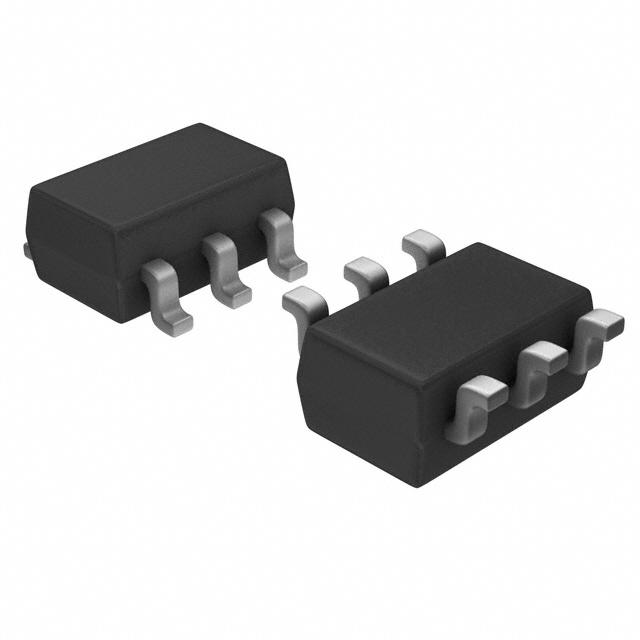
tiny 6-pin SOT23 package.
♦ Small Size
These low-noise VCOs feature an on-chip varactor and
feedback capacitors that eliminate the need for external
tuning elements, making the MAX2605–MAX2609 ideal
for portable systems. Only an external inductor is
required to set the oscillation frequency. In addition, an
integrated differential output buffer is provided for driving a mixer or prescaler. The buffer output is capable
of supplying up to -8dBm (differential) with a simple
power match. It also provides isolation from load
impedance variations.
The MAX2605–MAX2609 operate from a single +2.7V to
+5.5V supply and offer low current consumption. These IF
oscillators can cover the 45MHz to 650MHz frequency
range.
♦ Differential or Single-Ended Outputs
Applications
Cellular and PCS Mobile Phones
♦ Integrated Varactor for Tuning
♦ Low Phase Noise
♦ Wide Application Frequency Range
♦ Single +2.7V to +5.5V Supply
♦ Ultra-Small SOT23-6 Package
♦ On-Chip Temperature-Stable Bias
♦ Low-Current Operation
Ordering Information
PART
TEMP. RANGE
PINPACKAGE
TOP
MARK
MAX2605EUT-T
-40°C to +85°C
6 SOT23-6
AABB
MAX2606EUT-T
-40°C to +85°C
6 SOT23-6
AABC
MAX2607EUT-T
-40°C to +85°C
6 SOT23-6
AABD
2.4GHz ISM Band
MAX2608EUT-T
-40°C to +85°C
6 SOT23-6
AABE
902MHz to 928MHz ISM Band
MAX2609EUT-T
-40°C to +85°C
6 SOT23-6
AABF
Land Mobile Radio
GPS Receivers
Functional Diagrams
General-Purpose IF Oscillators
Pin Configuration/
Functional Diagram
Selector Guide
FREQUENCY
RANGE
(MHz)
SUPPLY
CURRENT
(mA)
PHASE
NOISE
(dBc/Hz)
MAX2605
45 to 70
1.9
-117
MAX2606
MAX2607
MAX2608
MAX2609
70 to 150
150 to 300
300 to 500
500 to 650
2.1
2.1
2.7
3.6
-112
-107
-100
-93
PART
TOP VIEW
IND 1
GND 2
MAX2605
MAX2606
MAX2607
MAX2608
MAX2609
TUNE 3
Pin Configurations appear at end of data sheet.
Functional Diagrams continued at end of data sheet.
UCSP is a trademark of Maxim Integrated Products, Inc.
6
OUT+
5
VCC
4
OUT-
SOT23-6
For pricing, delivery, and ordering information, please contact Maxim Direct
at 1-888-629-4642, or visit Maxim’s website at www.maximintegrated.com.
19-1673; Rev 0a; 4/02
�MAX2605–MAX2609
45MHz to 650MHz, Integrated IF
VCOs with Differential Output
ABSOLUTE MAXIMUM RATINGS
VCC to GND ..............................................................-0.3V to +6V
IND to GND ................................................-0.6V to (VCC + 0.3V)
TUNE to GND .............................................-0.3V to (VCC + 0.3V)
OUT+, OUT- to GND ..................................-0.3V to (VCC + 0.6V)
Continuous Power Dissipation (TA = +85°C)
6-Pin SOT23 (derate 8.7mW/°C above +70°C) ...........696mW
Operating Temperature Range ...........................-40°C to +85°C
Junction Temperature ......................................................+150°C
Storage Temperature Range .............................-65°C to +150°C
Lead Temperature (soldering, 10s) .................................+300°C
Stresses beyond those listed under “Absolute Maximum Ratings” may cause permanent damage to the device. These are stress ratings only, and functional
operation of the device at these or any other conditions beyond those indicated in the operational sections of the specifications is not implied. Exposure to
absolute maximum rating conditions for extended periods may affect device reliability.
DC ELECTRICAL CHARACTERISTICS
(VCC = +2.7V to +5.5V, VTUNE = 0.4V to 2.4V, TA = -40°C to +85°C, unless otherwise noted. Typical values are at VCC = +2.75V,
VTUNE = 1.5V, and TA = +25°C.) (Note1)
PARAMETER
CONDITIONS
Supply Voltage
MAX2606
MAX2607
MAX2608
MAX2609
DC Output Current (Note 3)
TUNE Input Current
2
TYP
MAX
1.9
2.6
2.7
MAX2605
Supply Current (Note 2)
MIN
OUT+ plus OUT-
TA = +25°C
5.5
TA = -40°C to +85°C
UNITS
V
2.8
TA = +25°C
2.1
2.7
2.1
3.2
TA = -40°C to +85°C
3.0
TA = +25°C
TA = -40°C to +85°C
3.5
TA = +25°C
2.7
4.4
3.6
6.8
1.0
1.5
TA = -40°C to +85°C
mA
5.5
TA = +25°C
TA = -40°C to +85°C
7.5
0.5
0.03
mA
nA
Maxim Integrated
�MAX2605–MAX2609
45MHz to 650MHz, Integrated IF
VCOs with Differential Output
AC ELECTRICAL CHARACTERISTICS
(MAX2605–MAX2609 EV kits, VCC = +2.7V to +5.5V, VTUNE = 0.4V to 2.4V, TA = -40°C to +85°C, unless otherwise noted. Typical values are at VCC = +2.75V, VTUNE = 1.5V, and TA = +25°C.) (Note 1)
PARAMETER
Oscillator Nominal Frequency
Range (Note 4)
CONDITIONS
45
70
70
150
MAX2607
150
300
MAX2608
300
500
MAX2609
500
650
TA = +25°C
-4.1
+3.2
TA = -40°C to +85°C
-2.25
+2.25
TA = +25°C
-4.4
+3.4
TA = -40°C to +85°C
-2.5
+2.5
TA = +25°C
-4.6
+3.6
TA = -40°C to +85°C
-2.75
+2.75
TA = +25°C
-4.7
+3.6
TA = -40°C to +85°C
-2.8
+2.8
TA = +25°C
-5.0
+3.8
TA = -40°C to +85°C
-3.0
MAX2607
MAX2608
MAX2609
VTUNE = 0.4V to 0.6V step (Note 6)
Single-Ended Output Power
(Note 7)
Phase Noise (Note 8)
Maxim Integrated
MAX
MAX2605
MAX2606
Peak Tuning Gain
TYP
MAX2606
MAX2605
Guaranteed Frequency Limits
(relative to nominal) (Note 5)
MIN
fOFFSET = 100kHz
UNITS
MHz
%
+3.0
14.5
%/V
-10
dBm
MAX2605, QL ≥ 35
-117
MAX2606, QL ≥ 35
-112
MAX2607, QL ≥ 35
-107
MAX2608, QL ≥ 40
-100
MAX2609, QL ≥ 40
-93
dBc/Hz
3
�MAX2605–MAX2609
45MHz to 650MHz, Integrated IF
VCOs with Differential Output
AC ELECTRICAL CHARACTERISTICS (continued)
(MAX2605–MAX2609 EV kits, VCC = +2.7V to +5.5V, VTUNE = 0.4V to 2.4V, TA = -40°C to +85°C, unless otherwise noted. Typical values are at VCC = +2.75V, VTUNE = 1.5V, and TA = +25°C.) (Note 1)
PARAMETER
CONDITIONS
Even-Order Harmonics
Supply Pushing (Note 9)
MIN
TYP
Differential, RL = 50Ω each side
-30
MAX2605
60
MAX2606
120
MAX2607
220
MAX2608
480
MAX2609
720
MAX
UNITS
dBc
kHz/V
Note 1: Production tested at TA = +25°C. Maximum and minimum over temperature limits are guaranteed by design and
characterization.
Note 2: Supply current is measured while the part is oscillating and inductor Q ≥ QMIN. For MAX2605/MAX2606/MAX2607, QMIN = 35;
for MAX2608/MAX2609, QMIN = 40.
Note 3: The DC output current is the total available output signal current.
Note 4: Application range of the part is achieved using external inductance as specified in Figures 1-5 and shown in Figure 6. The internal varactors support center frequencies of 45MHz to 650MHz. The center frequency is defined by the value of the external
inductor element, LF. The application frequency limits are guaranteed by design and characterization.
Note 5: The guaranteed (tested) limits ƒMIN and ƒMAX are measured at VTUNE = 0.4V and VTUNE = 2.4V, respectively. Passing
requirements are: ƒ ≤ ƒMIN at VTUNE = 0.4 and ƒ ≥ ƒMAX at VTUNE = 2.4V. The nominal frequency of oscillation is defined by
the inductor.
Note 6: Describes peak tuning gain, which occurs at VTUNE = 0.4V.
Note 7: Measurement at OUT+ or OUT- matched for optimum power transfer into 50Ω load near the center of the operating frequency
range.
Note 8: The phase-noise specifications listed apply to the typical operating circuit shown in Figure 6. Apply over the entire operating
frequency range of the MAX2605–MAX2609.
Note 9: Supply pushing is measured with VCC stepped from +2.7V to +3.2V.
Typical Operating Characteristics
(MAX260_ EV kit, VCC = +2.75V, VTUNE = 1.4V, TA = +25°C, unless otherwise noted.)
SUPPLY CURRENT
vs. TEMPERATURE
MAX2608 MAX2607
MAX2606
2.5
2.0
0.08
MAX2605/9-03
MAX2605/9-02
65
60
FREQUENCY (MHz)
MAX2609
LEAKAGE CURRENT (nA)
SUPPLY CURRENT (mA)
3.5
0.06
0.04
55
50
0.02
1.5
MAX2605
1.0
45
0
-40
-20
0
20
40
TEMPERATURE (°C)
4
0.10
MAX2605/9-01
4.0
3.0
MAX2605
VCO TUNING CURVE
TUNE INPUT LEAKAGE CURRENT
vs. TEMPERATURE
60
80
-40
-20
0
20
40
TEMPERATURE (°C)
60
80
0
0.5
1.0
1.5
2.0
2.5
3.0
VTUNE (V)
Maxim Integrated
�MAX2605–MAX2609
45MHz to 650MHz, Integrated IF
VCOs with Differential Output
Typical Operating Characteristics (continued)
(MAX260_ EV kit, VCC = +2.75V, VTUNE = 1.4V, TA = +25°C, unless otherwise noted.)
MAX2607
VCO TUNING CURVE
430
MAX2605/9-05
260
MAX2605/9-04
130
MAX2608
VCO TUNING CURVE
240
110
100
FREQUENCY (MHz)
400
FREQUENCY (MHz)
FREQUENCY (MHz)
120
MAX2605/9-06
MAX2606
VCO TUNING CURVE
220
200
340
180
160
90
0
0.5
1.0
1.5
2.0
2.5
310
0
3.0
0.5
1.0
1.5
2.0
2.5
3.0
0
0.5
1.0
VTUNE (V)
VTUNE (V)
1.5
2.0
2.5
3.0
VTUNE (V)
MAX2609
VCO TUNING CURVE
OUTPUT SPECTRUM
640
MAX2605/9-08
0
MAX2605/9-07
680
-10
600
-20
(dB)
FREQUENCY (MHz)
370
560
-30
520
-40
-50
480
0
0.5
1.0
1.5
2.0
2.5
3.0
fo
2fo
3fo 4fo
5fo 6fo 7fo
FREQUENCY
VTUNE (V)
Pin Description
PIN
NAME
1
IND
Tuning Inductor Port. Connect an inductor from IND to GND to set VCO center frequency (see Oscillation
Frequency).
2
GND
Ground. Connect to the ground plane with a low-inductance path.
3
TUNE
Voltage-Control Input for Frequency Tuning. Input voltage range from +0.4V to +2.4V.
4
OUT-
High-Impedance Open-Collector Output. An external pull-up resistor or inductor to VCC is required. Output
power is dependent on external load impedance. OUT- is complementary to OUT+.
5
VCC
Supply Voltage Connection. Connect an external bypass capacitor to ground for low noise and low spurious-output content. See Layout Issues for more details.
6
OUT+
Maxim Integrated
FUNCTION
High-Impedance Open-Collector Output. An external pull-up resistor or inductor to VCC is required. Output
power is dependent on external load impedance. OUT+ is complementary to OUT-.
5
�MAX2605–MAX2609
45MHz to 650MHz, Integrated IF
VCOs with Differential Output
Detailed Description
The MAX2605–MAX2609 are low-noise VCOs designed
for fixed/single-frequency IF applications. The core
oscillator circuit is based on the well-known Colpitts
topology. The varactor and feedback capacitors are
integrated on-chip so that only an external inductor is
required to establish the frequency of oscillation and
produce a properly operating VCO. The tuning range,
biasing, startup, etc., are all managed within the IC. This
highly integrated design dramatically simplifies the
parts’ application.
The tuning range is wide enough so that, with the use
of ±2% tolerance inductors, no board-level adjustments
to the oscillation frequency are necessary. Once the
correct inductor value is chosen, the VCO is guaranteed always to tune to the desired operating frequency.
In addition, with the use of inductors of moderate Q (35
to 40), the VCO achieves excellent phase-noise performance.
Applications Information
Desired Oscillation Frequency
The desired VCO operating frequency is set by the
value of the external inductance, LF. Figures 1–5 show
the inductance value LF required to achieve the desired
oscillation frequency. The inductor value can be taken
directly from these figures. Inductance must be selected accurately to ensure proper operation over all conditions.
that required for LF. Choose LF2 to be a standard-value
inductor with a value just less than (LF - L F1 ). L F1
should adhere to the minimum Q requirements, but LF2
may be implemented as a lower-cost, lower-Q, thin-film
SMT inductor. Its lower Q has only a small impact on
the overall Q of the total inductance because it is










 工商网监
湘ICP备2023018690号
工商网监
湘ICP备2023018690号