MAX31820
1-Wire Ambient Temperature Sensor
General Description
Benefits and Features
The MAX31820 ambient temperature sensor provides
9-bit to 12-bit Celsius temperature measurements with
±0.5°C accuracy over a +10°C to +45°C temperature
range. Over its entire -55°C to +125°C operating range,
the device has ±2.0°C accuracy.
The device communicates over a 1-Wire® bus that, by
definition, requires only one data line (and ground) for
communication with a central microprocessor. In addition,
the device can derive power directly from the data line
(“parasite power”), eliminating the need for an external
power supply. Requiring so few pins enables the device
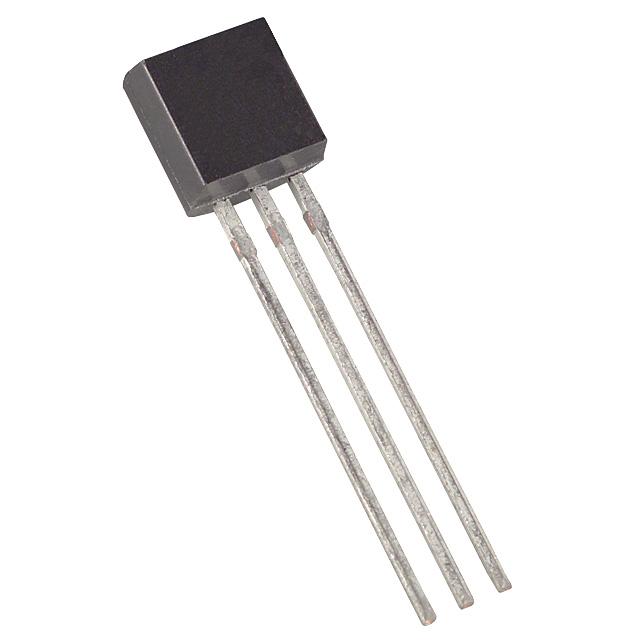
to be placed in a 3-pin TO-92 package. The form factor
of this package allows the device to be placed above
the board and thus measure the ambient temperature of
a system, as opposed to the board temperature that a
surface-mount package would measure.
Each MAX31820 has a unique 64-bit serial code, which
allows multiple MAX31820 devices to function on the same
1-Wire bus. Therefore, it is simple to use one microprocessor to control many devices distributed over a large area.
Applications
● HVAC Environmental Controls
● Temperature Monitoring Systems Inside Buildings,
Equipment, or Machinery
● Process Monitoring and Control Systems
● Thermostatic Controls
● Industrial Systems
● Consumer Products
● Thermometers
● Any Thermally Sensitive System
Block Diagram
● Unique 1-Wire Interface Requires Only One Port Pin
for Communication
● Each Device has a Unique 64-Bit Serial Code Stored
in On-Board ROM
● Multidrop Capability Simplifies Distributed
Temperature-Sensing Applications
● Requires No External Components
● Can Be Powered from Data Line; 3.0V to 3.7V
Power-Supply Range
● Measures Temperatures from -55°C to +125°C (-67°F
to +257°F)
● ±0.5°C Accuracy from +10°C to +45°C
● Thermometer Resolution is User-Selectable from
9 Bits to 12 Bits
● Converts Temperature to 12-Bit Digital Word in
750ms (Max)
● User-Definable Nonvolatile (NV) Alarm Settings
● Alarm Search Command Identifies and Addresses
Devices Whose Temperature is Outside Programmed
Limits (Temperature Alarm Condition)
● Available in 3-Pin TO-92 Package
● TO-92 Package Allows Measurement of Ambient
Temperature
● Software Compatible with the DS1822 and DS18B20
Ordering Information appears at end of data sheet.
For related parts and recommended products to use with this part, refer
to www.maximintegrated.com/MAX31820.related.
VPU
4.7kΩ
DQ
MEMORY
CONTROL LOGIC
PARASITEPOWER
CIRCUIT
GND
CPP
TEMPERATURE REGISTER
64-BIT ROM
AND
1-Wire PORT
ALARM HIGH TRIGGER
(TH) REGISTER (EEPROM)
SCRATCHPAD
VDD
POWERSUPPLY
SENSE
1-Wire is a registered trademark of Maxim Integrated Products, Inc.
19-6731; Rev 0; 6/13
MAX31820
ALARM LOW TRIGGER
(TL) REGISTER (EEPROM)
CONFIGURATION REGISTER (EEPROM)
8-BIT CRC GENERATOR
�MAX31820
1-Wire Ambient Temperature Sensor
Absolute Maximum Ratings
Voltage Range on Any Pin Relative to Ground.....-0.5V to +6.0V
Operating Temperature Range.......................... -55°C to +125°C
Storage Temperature Range............................. -55°C to +125°C
Soldering Temperature (reflow)........................................+260°C
Stresses beyond those listed under “Absolute Maximum Ratings” may cause permanent damage to the device. These are stress ratings only, and functional operation of the device at these
or any other conditions beyond those indicated in the operational sections of the specifications is not implied. Exposure to absolute maximum rating conditions for extended periods may affect
device reliability.
DC Electrical Characteristics
(VDD = 3.0V to 3.7V, TA = -55°C to +125°C, unless otherwise noted.) (Note 1)
PARAMETER
SYMBOL
Supply Voltage
VDD
Pullup Supply Voltage
(Notes 2, 3)
VPU
Thermometer Error (Note 4)
TERR
Input Logic-Low
VIL
MAX
UNITS
Local power (Note 2)
CONDITIONS
+3.0
+3.7
V
Parasite power
+3.0
+3.7
Local power
+3.0
VDD
Sink Current
Standby Current
±0.5
-55°C to +125°C
±2
(Notes 2, 5, 6)
-0.3
+0.8
+2.2
lower
of 3.7
or
(VDD +
0.3)
Parasite power
+3.0
lower
of 3.7
or
(VDD +
0.3)
VI/O = 0.4V (Note 2)
4.0
VIH
IL
IDDS
(Notes 8, 9)
Active Current
IDD
DQ Input Current
IDQ
Drift
www.maximintegrated.com
TYP
+10°C to +45°C
Local power
Input Logic-High (Notes 2, 7)
MIN
V
°C
V
V
mA
750
1000
nA
VDD = 5V (Note 10)
1
1.5
mA
(Note 11)
5
µA
(Note 12)
±0.2
°C
Maxim Integrated │ 2
�MAX31820
1-Wire Ambient Temperature Sensor
AC Electrical Characteristics
(VDD = 3.0V to 3.7V, TA = -55°C to +125°C, unless otherwise noted.) (Note 1)
PARAMETER
SYMBOL
CONDITIONS
MIN
TYP
MAX
9-bit resolution
93.75
10-bit resolution
187.5
11-bit resolution
375
UNITS
Temperature Conversion Time
tCONV
12-bit resolution
750
Time to Strong Pullup On
tSPON
Start Convert T command
10
µs
Time Slot
tSLOT
(Note 13)
60
120
µs
Recovery Time
tREC
(Note 13)
1
Write-Zero Low Time
tLOW0
(Note 13)
60
120
µs
Write-One Low Time
1
15
µs
15
µs
ms
µs
tLOW1
(Note 13)
Read Data Valid
tRDV
(Note 13)
Reset Time High
tRSTH
(Note 13)
480
µs
Reset Time Low
tRSTL
(Notes 13, 14)
480
µs
tPDHIGH
(Note 13)
15
60
Presence-Detect Low
tPDLOW
(Note 13)
60
240
µs
Capacitance
CIN/OUT
25
pF
10
ms
Presence-Detect High
µs
NONVOLATILE MEMORY (TA = -55°C to +100°C)
Nonvolatile Write Cycle Time
EEPROM Writes
EEPROM Data Retention
tWR
2
NEEWR
-55°C to +55°C
50k
Writes
tEEDR
-55°C to +55°C
10
Years
Note 1: Limits are 100% tested at TA = +25°C and TA = +85°C. Limits over the operating temperature range and relevant supply
voltage are guaranteed by design and characterization.
Note 2: All voltages are referenced to ground.
Note 3: The pullup supply voltage specification assumes that the pullup device is ideal, and therefore the high level of the pullup
is equal to VPU. In order to meet the device’s VIH spec, the actual supply rail for the strong pullup transistor must include
margin for the voltage drop across the transistor when it is turned on; thus: VPU_ACTUAL = VPU_IDEAL + VTRANSISTOR.
Note 4: See typical performance curve.
Note 5: Logic-low voltages are specified at a sink current of 4mA.
Note 6: To guarantee a presence pulse under low-voltage parasite-power conditions, VILMAX may have to be reduced to as low as
0.5V.
Note 7: Logic-high voltages are specified at a source current of 1mA.
Note 8: Standby current specified up to +70°C. Standby current typically is 3µA at +125°C.
Note 9: To minimize IDDS, DQ should be within the following ranges: VGND ≤ VDQ ≤ VGND + 0.3V or VDD - 0.3V ≤ VDQ ≤ VDD.
Note 10: Active current refers to supply current during active temperature conversions or EEPROM writes.
Note 11: DQ line is high (high-Z state).
Note 12: Drift data is based on a 1000-hour stress test at +125°C.
Note 13: See the 1-Wire Timing Diagrams.
Note 14: Under parasite power, if tRSTL > 960µs, a power-on reset may occur.
www.maximintegrated.com
Maxim Integrated │ 3
�MAX31820
1-Wire Ambient Temperature Sensor
1-Wire Timing Diagrams
1-Wire WRITE-ZERO TIME SLOT
START OF NEXT CYCLE
tSLOT
tREC
tLOW0
1-Wire READ-ZERO TIME SLOT
tSLOT
tREC
START OF NEXT CYCLE
tRDV
1-Wire RESET PULSE
RESET PULSE FROM HOST
tRSTL
tRSTH
1-Wire PRESENCE DETECT
PRESENCE DETECT
tPDHIGH
tPDLOW
www.maximintegrated.com
Maxim Integrated │ 4
�MAX31820
1-Wire Ambient Temperature Sensor
Pin Configuration
SIDE VIEW
FRONT VIEW
1
GND
1
DQ
2
2
VDD
3
3
MAX31820
TO-92
Pin Description
PIN
NAME
FUNCTION
1
GND
2
DQ
Data In/Out
3
VDD
Optional Power Supply
Ground
Detailed Description
The MAX31820 ambient temperature sensor provides
9-bit to 12-bit Celsius temperature measurements with
±0.5°C accuracy over a +10°C to +45°C temperature
range. Over its entire -55°C to +125°C operating range,
the device has ±2.0°C accuracy. The device communicates over a 1-Wire bus that, by definition, requires
only one data line (and ground) for communication with
a central microprocessor. In addition, the device can
derive power directly from the data line (“parasite power”),
eliminating the need for an external power supply.
Requiring so few pins enables the device to be placed
in a 3-pin TO-92 package. The form factor of this package allows the device to be placed above the board and
thus measure the ambient temperature of a system, as
opposed to the board temperature that a surface-mount
package would measure.
Each device has a unique 64-bit serial code, allowing
multiple MAX31820 devices to function on the same
1-Wire bus. Therefore, it is simple to use one microprocessor to control many devices distributed over a
large area. The 64-bit ROM stores the device’s unique
serial code. The scratchpad memory contains the 2-byte
temperature register that stores the digital output from
the temperature sensor. In addition, the scratchpad provides access to the 1-byte upper and lower alarm trigger
registers (TH and TL) and the 1-byte configuration register. The configuration register allows the user to set the
resolution of the temperature-to-digital conversion to 9, 10,
11, or 12 bits. The TH, TL, and configuration registers are
www.maximintegrated.com
nonvolatile (EEPROM), so they retain data when the
device is powered down.
The device uses Maxim Integrated’s exclusive 1-Wire
bus protocol that implements bus communication using
one control signal. The control line requires a weak pullup
resistor since all devices are linked to the bus through a
three-state or open-drain port (i.e., the MAX31820’s DQ
pin). In this bus system, the microprocessor (the master
device) identifies and addresses devices on the bus
using each device’s unique 64-bit code. Because each
device has a unique code, the number of devices that
can be addressed on one bus is virtually unlimited. The
1-Wire bus protocol, including detailed explanations of the
commands and time slots, is covered in the 1-Wire Bus
System section.
The device can also operate without an external power
supply. Power is instead supplied through the 1-Wire
pullup resistor through the DQ pin when the bus is high.
The high bus signal also charges an internal capacitor
(CPP), which then supplies power to the device when the
bus is low. This method of deriving power from the 1-Wire
bus is referred to as “parasite power.” Alternatively, an
external supply on VDD can also power the device.
Operation
Measuring Ambient Temperature
A conventional surface-mount temperature sensor IC has
an excellent thermal connection to the circuit board on
which it is mounted. Heat travels from the board through
the leads to the sensor die. Air temperature can affect
Maxim Integrated │ 5
�MAX31820
1-Wire Ambient Temperature Sensor
the die temperature, but the sensor’s package does not
conduct heat as well as the leads, so board temperature
has the greatest influence on the measured temperature.
sion, the master must issue a Convert T [44h] command.
Following the conversion, the resulting thermal data is
stored in the 2-byte temperature register in the scratchpad memory and the device returns to its idle state. If the
device is powered by an external supply, the master can
issue read time slots (see the 1-Wire Bus System section)
after the Convert T command, and the device responds
by transmitting 0 while the temperature conversion is in
progress and 1 when the conversion is done. If the device
is powered with parasite power, this notification technique
cannot be used since the bus must be pulled high by a
strong pullup during the entire temperature conversion.
The bus requirements for parasite power are explained in
detail in the Powering the MAX31820 section.
The device’s TO-92 package allows the sensor die to be
positioned above the board. The leads still conduct some
heat from the board, but because there is significant lead
area in contact with air, their temperature is also strongly
affected by air temperature. Follow the guidelines below to
get the best results when measuring ambient temperature:
• If air is moving (e.g., due to cooling fans), place the
sensor in the path of the air stream. This causes the
ambient temperature to influence the sensor temperature more strongly.
• If the board contains components that will heat it,
mount the sensor as far as possible from those components. This makes the temperature in the vicinity of
the sensor closer to the temperature of the ambient air.
The output temperature data is calibrated in degrees
Celsius; for Fahrenheit applications, a lookup table or
conversion routine must be used. The temperature data
is stored as a 16-bit sign-extended two’s complement
number in the temperature register (see the Temperature
Register Format). The sign bits (S) indicate if the temperature is positive or negative: for positive numbers S = 0 and
for negative numbers S = 1. If the device is configured
for 12-bit resolution, all bits in the temperature register
contain valid data. For 11-bit resolution, bit 0 is undefined.
For 10-bit resolution, bits 1 and 0 are undefined, and for
9-bit resolution bits 2, 1, and 0 are undefined. Table 1
gives examples of digital output data and the corresponding temperature reading for 12-bit resolution conversions.
• PCB traces and ground planes conduct heat from
other components to the sensor. As much as practical,
avoid copper in the vicinity of the sensor.
The device’s core functionality is its direct-to-digital temperature sensor. The resolution of the temperature sensor
is user-configurable to 9, 10, 11, or 12 bits, corresponding
to increments of 0.5°C, 0.25°C, 0.125°C, and 0.0625°C,
respectively. The default resolution at power-up is 12
bits. The device powers up in a low-power idle state. To
initiate a temperature measurement and A-to-D conver-
Temperature Register Format
MSB
LSB
BIT 15
BIT 14
BIT 13
BIT 12
BIT 11
BIT 10
BIT 9
BIT 8
S
S
S
S
S
26
25
24
BIT 7
BIT 6
BIT 5
BIT 4
BIT 3
BIT 2
BIT 1
BIT 0
23
22
21
20
2-1
2-2
2-3
2-4
Table 1. Temperature/Data Relationship
TEMPERATURE (°C)
DIGITAL OUTPUT (BINARY)
DIGITAL OUTPUT (HEX)
+125
0000 0111 1101 0000
07D0h
+85*
0000 0101 0101 0000
0550h
+25.0625
0000 0001 1001 0001
0191h
+10.125
0000 0000 1010 0010
00A2h
+0.5
0000 0000 0000 1000
0008h
0
0000 0000 0000 0000
0000h
-0.5
1111 1111 1111 1000
FFF8h
FF5Eh
-10.125
1111 1111 0101 1110
-25.0625
1111 1110 0110 1111
FE6Fh
-55
1111 1100 1001 0000
FC90h
*The power-on-reset value of the temperature register is +85°C.
www.maximintegrated.com
Maxim Integrated │ 6
�MAX31820
1-Wire Ambient Temperature Sensor
Alarm Signaling
After the device performs a temperature conversion, the
temperature value is compared to the user-defined two’s
complement alarm trigger values stored in the 1-byte TH
and TL registers (see TH and TL Register Format). The
sign bit (S) indicates if the value is positive or negative;
for positive numbers S = 0 and for negative numbers S
= 1. The TH and TL registers are nonvolatile (EEPROM)
so they retain data when the device is powered down.
TH and TL can be accessed through bytes 2 and 3 of the
scratchpad, as explained in the Memory section.
Only bits 11:4 of the temperature register are used in the
TH and TL comparison since TH and TL are 8-bit registers.
If the measured temperature is lower than or equal to TL
or higher than or equal to TH, an alarm condition exists
and an alarm flag is set inside the device. This flag is
updated after every temperature measurement; therefore,
if the alarm condition goes away, the flag is turned off after
the next temperature conversion.
The master device can check the alarm flag status of
all MAX31820 devices on the bus by issuing an Alarm
Search [ECh] command. Any devices with a set alarm flag
respond to the command, so the master can determine
exactly which devices have experienced an alarm condition. If an alarm condition exists and the TH or TL settings
have changed, another temperature conversion should be
done to validate the alarm condition.
Powering the MAX31820
The device can be powered by an external supply on
the VDD pin, or it can operate in “parasite power” mode,
which allows the device to function without a local external supply. Parasite power is very useful for applications
that require remote temperature sensing, or those that
are very space constrained. Figure 1 shows the device’s
parasite-power control circuitry, which “steals” power
from the 1-Wire bus through the DQ pin when the bus is
high. The stolen charge powers the device while the bus
is high, and some of the charge is stored on the parasitepower capacitor (CPP) to provide power when the bus is
low. When the device is used in parasite-power mode,
the VDD pin must be connected to ground.
In parasite-power mode, the 1-Wire bus and CPP can
provide sufficient current to the device for most operations as long as the specified timing and voltage requirements are met (see the DC Electrical Characteristics and
AC Electrical Characteristics tables). However, when the
device is performing temperature conversions or copying data from the scratchpad memory to EEPROM, the
operating current can be as high as 1.5mA. This current
can cause an unacceptable voltage drop across the weak
1-Wire pullup resistor and is more current than can be
supplied by CPP. To ensure that the device has sufficient
supply current, it is necessary to provide a strong pullup
on the 1-Wire bus whenever temperature conversions
TH and TL Register Format
BIT 7
BIT 6
BIT 5
BIT 4
BIT 3
BIT 2
BIT 1
BIT 0
S
26
25
24
23
22
21
20
VPU
MAX31820
VPU
µP
GND
DQ
VDD
4.7kΩ
1-Wire BUS
TO OTHER 1-Wire DEVICES
Figure 1. Supplying the Parasite-Powered MAX31820 During Temperature Conversions
www.maximintegrated.com
Maxim Integrated │ 7
�MAX31820
1-Wire Ambient Temperature Sensor
are taking place, or data is being copied from the scratchpad to EEPROM. This can be accomplished by using a
MOSFET to pull the bus directly to the rail, as shown in
Figure 1. The 1-Wire bus must be switched to the strong
pullup within 10µs (max) after a Convert T [44h] or Copy
Scratchpad [48h] command is issued, and the bus must
be held high by the pullup for the duration of the conversion (tCONV) or data transfer (tWR = 10ms). No other
activity can take place on the 1-Wire bus while the pullup
is enabled.
by external supplies. The master needs this information
to determine if the strong bus pullup should be used
during temperature conversions. To get this information, the master can issue a Skip ROM [CCh] command
followed by a Read Power Supply [B4h] command,
followed by a read time slot. During the read time slot,
parasite-powered devices pull the bus low, and externally powered devices let the bus remain high. If the
bus is pulled low, the master knows that it must supply
the strong pullup on the 1-Wire bus during temperature
conversions.
The device can also be powered by the conventional
method of connecting an external power supply to the
VDD pin, as shown in Figure 2. The advantage of this
method is that the MOSFET pullup is not required, and
the 1-Wire bus is free to carry other traffic during the
temperature-conversion time.
64-Bit Lasered ROM Code
Each device contains a unique 64-bit code stored in ROM
(Figure 3). The least significant 8 bits of the ROM code
contain the device’s 1-Wire family code, 28h. The next
48 bits contain a unique serial number. The most significant 8 bits contain a cyclic-redundancy-check (CRC)
byte that is calculated from the first 56 bits of the ROM
code. A detailed explanation of the CRC bits is provided
in the CRC Generation section. The 64-bit ROM code and
associated ROM function control logic allow the device to
operate as a 1-Wire device using the protocol detailed in
the 1-Wire Bus System section.
The use of parasite power is not recommended for
temperatures above +100°C since the device may not be
able to sustain communications due to the higher leakage
currents that can exist at these temperatures. For applications in which such temperatures are likely, it is strongly
recommended that the device be powered by an external
power supply.
In some situations the bus master might not know whether
the devices on the bus are parasite powered or powered
MAX31820
VPU
µP
GND
DQ
VDD (EXTERNAL SUPPLY)
VDD
4.7kΩ
1-Wire BUS
TO OTHER 1-Wire DEVICES
Figure 2. Powering the MAX31820 with an External Supply
MSb
LSb
8-BIT
CRC CODE
MSb
8-BIT FAMILY CODE
(28h)
48-BIT SERIAL NUMBER
LSb MSb
LSb MSb
LSb
Figure 3.64-Bit Lasered ROM Code
www.maximintegrated.com
Maxim Integrated │ 8
�MAX31820
1-Wire Ambient Temperature Sensor
Memory
The device’s memory is organized as shown in Figure 4.
The memory consists of an SRAM scratchpad with nonvolatile EEPROM storage for the high and low alarm trigger registers (TH and TL) and configuration register. Note
that if the device alarm function is not used, the TH and TL
registers can serve as general-purpose memory. All memory commands are described in detail in the MAX31820
Function Commands section.
Byte 0 and byte 1 of the scratchpad contain the LSB and
the MSB of the temperature register, respectively. These
bytes are read-only. Bytes 2 and 3 provide access to TH
and TL registers. Byte 4 contains the configuration register data, which is explained in detail in the Configuration
Register section. Bytes 7:5 are reserved for internal use by
the device and cannot be overwritten. Byte 8 of the scratchpad is read-only and contains the CRC code for bytes 7:0
of the scratchpad. The device generates this CRC using
the method described in the CRC Generation section.
Data is written to bytes 4:2 of the scratchpad using the
Write Scratchpad [4Eh] command; the data must be
transmitted to the device starting with the least significant
bit of byte 2. To verify data integrity, the scratchpad can
be read (using the Read Scratchpad [BEh] command)
after the data is written. When reading the scratchpad,
data is transferred over the 1-Wire bus starting with the
least significant bit of byte 0. To transfer the TH, TL, and
configuration data from the scratchpad to EEPROM, the
master must issue the Copy Scratchpad [48h] command.
Data in the EEPROM registers is retained when the
device is powered down; at power-up the EEPROM data
is reloaded into the corresponding scratchpad locations.
Data can also be reloaded from EEPROM to the scratchpad at any time using the Recall E2 [B8h] command. The
master can issue read time slots following the Recall
E2 command, and the device indicates the status of the
recall by transmitting 0 while the recall is in progress and
1 when the recall is done.
Configuration Register
Byte 4 of the scratchpad memory contains the configuration register, which is organized as shown in Configuration
Register Format. The user can set the conversion resolution of the device using the R0 and R1 bits in this register,
as shown in Table 2. The power-up default of these bits is
R0 = 1 and R1 = 1 (12-bit resolution). Note that there is
a direct trade-off between resolution and conversion time.
Bit 7 and bits 4:0 in the configuration register are reserved
for internal use by the device and cannot be overwritten.
SCRATCHPAD (POWER-UP STATE
SHOWN IN PARENTHESES)
BYTE 0
TEMPERATURE REGISTER LSB (50h)
BYTE 1
TEMPERATURE REGISTER MSB (05h)
EEPROM
BYTE 2
TH REGISTER OR USER BYTE 1*
TH REGISTER OR USER BYTE 1
BYTE 3
TL REGISTER OR USER BYTE 2*
TL REGISTER OR USER BYTE 2
BYTE 4
CONFIGURATION REGISTER*
CONFIGURATION REGISTER
BYTE 5
RESERVED (FFh)
BYTE 6
RESERVED
BYTE 7
RESERVED (10h)
BYTE 8
CRC*
*POWER-UP STATE DEPENDS ON VALUE(S) STORED IN EEPROM.
Figure 4. Memory Map
Configuration Register Format
BIT 7
BIT 6
BIT 5
BIT 4
BIT 3
BIT 2
BIT 1
BIT 0
0
R1
R0
1
1
1
1
1
www.maximintegrated.com
Maxim Integrated │ 9
�MAX31820
1-Wire Ambient Temperature Sensor
Table 2. Thermometer Resolution Configuration
R1
R0
RESOLUTION (BITS)
0
0
9
93.75ms
MAX CONVERSION TIME
(tCONV/8)
0
1
10
187.5ms
(tCONV/4)
1
0
11
375ms
(tCONV/2)
1
1
12
750ms
(tCONV)
POLYNOMIAL = X8 + X5 + X4 + 1
1ST
STAGE
X0
2ND
STAGE
X1
3RD
STAGE
X2
4TH
STAGE
X3
5TH
STAGE
X4
6TH
STAGE
X5
7TH
STAGE
X6
8TH
STAGE
X7
X8
INPUT DATA
Figure 5. CRC Generator
CRC Generation
CRC bytes are provided as part of the device’s 64-bit
ROM code and in the 9th byte of the scratchpad memory.
The ROM code CRC is calculated from the first 56 bits
of the ROM code and is contained in the most significant
byte of the ROM. The scratchpad CRC is calculated
from the data stored in the scratchpad, and therefore
changes when the data in the scratchpad changes. The
CRCs provide the bus master with a method of data validation when data is read from the device. To verify that
data has been read correctly, the bus master must recalculate the CRC from the received data and then compare
this value to either the ROM code CRC (for ROM reads)
or to the scratchpad CRC (for scratchpad reads). If the
calculated CRC matches the read CRC, the data has
been received error free. The comparison of CRC values
and the decision to continue with an operation are determined entirely by the bus master. There is no circuitry
inside the device that prevents a command sequence
from proceeding if the device CRC (ROM or scratchpad)
does not match the value generated by the bus master.
The equivalent polynomial function of the CRC (ROM or
scratchpad) is:
CRC = X8 + X5 + X4 + 1
The bus master can recalculate the CRC and compare it
to the CRC values from the device using the polynomial
generator shown in Figure 5. This circuit consists of a
shift register and XOR gates, and the shift register bits
are initialized to 0. Starting with the least significant bit of
the ROM code or the least significant bit of byte 0 in the
scratchpad, one bit at a time should be shifted into the
shift register. After shifting in the 56th bit from the ROM
or the most significant bit of byte 7 from the scratchpad,
the polynomial generator contains the recalculated CRC.
Next, the 8-bit ROM code or scratchpad CRC from the
device must be shifted into the circuit. At this point, if
the recalculated CRC was correct, the shift register
contains all 0s. Additional information about the Maxim
Integrated 1-Wire CRC is available in Application Note 27:
Understanding and Using Cyclic Redundancy Checks
with Maxim iButton® Products.
iButton is a registered trademark of Maxim Integrated
Products, Inc.
www.maximintegrated.com
Maxim Integrated │ 10
�MAX31820
1-Wire Ambient Temperature Sensor
VPU
BUS MASTER
MAX31820 1-Wire PORT
4.7kΩ
DQ
RX
TX
OPEN-DRAIN
PORT PIN
RX = RECEIVE
TX = TRANSMIT
RX
5µA
TYP
TX
100Ω MOSFET
Figure 6. Hardware Configuration
1-Wire Bus System
The 1-Wire bus system uses a single bus master to control one or more slave devices. The MAX31820 is always
a slave. When there is only one slave on the bus, the
system is referred to as a single-drop system; the system
is multidrop if there are multiple slaves on the bus. All data
and commands are transmitted least significant bit first
over the 1-Wire bus.
The following discussion of the 1-Wire bus system is
broken down into three topics: hardware configuration,
transaction sequence, and 1-Wire signaling (signal types
and timing).
Hardware Configuration
The 1-Wire bus has, by definition, only a single data line.
Each device (master or slave) interfaces to the data line
through an open-drain or three-state port. This allows
each device to release the data line when the device is
not transmitting data so the bus is available for use by
another device. The 1-Wire port of the MAX31820 (the
DQ pin) is open drain with an internal circuit equivalent to
that shown in Figure 6.
The 1-Wire bus requires an external pullup resistor of approximately 5kΩ; thus, the idle state for the
1-Wire bus is high. If for any reason a transaction needs
to be suspended, the bus must be left in the idle state if
the transaction is to resume. Infinite recovery time can
occur between bits so long as the 1-Wire bus is in the
inactive (high) state during the recovery period. If the bus
www.maximintegrated.com
is held low for more than 480µs, all components on the
bus are reset.
Transaction Sequence
The transaction sequence for accessing the device is as
follows:
1) Step 1: Initialization
2) Step 2: ROM command (followed by any required data
exchange)
3) Step 3: MAX31820 Function command (followed by
any required data exchange)
It is very important to follow this sequence every time
the device is accessed, as the device does not respond
if any steps in the sequence are missing or out of order.
Exceptions to this rule are the Search ROM [F0h] and
Alarm Search [ECh] commands. After issuing either of
these ROM commands, the master must return to Step 1
in the sequence.
Initialization
All transactions on the 1-Wire bus begin with an initialization sequence. The initialization sequence consists
of a reset pulse transmitted by the bus master, followed
by presence pulse(s) transmitted by the slave(s). The
presence pulse lets the bus master know that slave
devices (such as the MAX31820) are on the bus and
are ready to operate. Timing for the reset and presence
pulses is detailed in the 1-Wire Signaling section.
Maxim Integrated │ 11
�MAX31820
ROM Commands
After the bus master has detected a presence pulse, it
can issue a ROM command. These commands operate
on the unique 64-bit ROM codes of each slave device
and allow the master to single out a specific device if
many are present on the 1-Wire bus. These commands
also allow the master to determine how many and what
types of devices are present on the bus or if any device
has experienced an alarm condition. There are five ROM
commands, and each command is 8 bits long. The master
device must issue an appropriate ROM command before
issuing a MAX31820 Function command. Figure 7 shows
a flowchart for operation of the ROM commands.
Search ROM [F0h]
When a system is initially powered up, the master must
identify the ROM codes of all slave devices on the bus,
which allows the master to determine the number of
slaves and their device types. The master learns the ROM
codes through a process of elimination that requires the
master to perform a Search ROM cycle (i.e., Search ROM
command followed by data exchange) as many times as
necessary to identify all the slave devices. If there is only
one slave on the bus, the simpler Read ROM command
can be used in place of the Search ROM process. For a
detailed explanation of the Search ROM procedure, refer
to Application Note 937: Book of iButton Standards. After
every Search ROM cycle, the bus master must return to
Step 1 (initialization) in the transaction sequence.
Read ROM [33h]
This command can only be used when there is one slave
on the bus. It allows the bus master to read the slave’s
64-bit ROM code without using the Search ROM procedure. If this command is used when there is more than
one slave present on the bus, a data collision occurs
when all the slaves attempt to respond at the same time.
www.maximintegrated.com
1-Wire Ambient Temperature Sensor
Match ROM [55h]
The match ROM command, followed by a 64-bit ROM
code sequence, allows the bus master to address a
specific slave device on a multidrop or single-drop bus.
Only the slave that exactly matches the 64-bit ROM code
sequence responds to the function command issued
by the master; all other slaves on the bus wait for a
reset pulse.
Skip ROM [CCh]
The master can use this command to address all devices
on the bus simultaneously, without sending out any ROM
code information. For example, the master can make all
devices on the bus perform simultaneous temperature
conversions by issuing a Skip ROM command followed
by a Convert T [44h] command.
Note that the Read Scratchpad [BEh] command can
follow the Skip ROM command only if there is a single
slave device on the bus. In this case, time is saved by
allowing the master to read from the slave without sending the device’s 64-bit ROM code. A Skip ROM command
followed by a Read Scratchpad command causes a data
collision on the bus if there is more than one slave since
multiple devices attempt to transmit data simultaneously.
Alarm Search [ECh]
The operation of this command is identical to the operation of the Search ROM command except that only
slaves with a set alarm flag respond. This command
allows the master device to determine if any MAX31820s
experienced an alarm condition during the most recent
temperature conversion. After every Alarm Search cycle
(i.e., Alarm Search command followed by data exchange),
the bus master must return to Step 1 (initialization) in the
transaction sequence. See the Alarm Signaling section
for an explanation of alarm flag operation.
Maxim Integrated │ 12
�MAX31820
1-Wire Ambient Temperature Sensor
INITIALIZATION
SEQUENCE
MASTER TX
RESET PULSE
DEVICE TX
PRESENCE PULSE
MASTER TX
ROM COMMAND
33h
READ
ROM?
N
Y
55h
MATCH
ROM?
F0h
SEARCH
ROM?
N
Y
Y
DEVICE TX BIT 0
MASTER TX
BIT 0
BIT 0
MATCH?
N
N
DEVICE TX
SERIAL NUMBER
6 BYTES
DEVICE TX
CRC BYTE
N
Y
CCh
SKIP
ROM?
N
Y
DEVICE TX BIT
DEVICE TX BIT 0
DEVICE TX BIT
MASTER TX BIT 0
BIT 0
MATCH?
DEVICE(S)
WITH ALARM
FLAG SET?
Y
N
Y
DEVICE TX BIT 1
MASTER TX
BIT 1
BIT 1
MATCH?
ECh
ALARM SEARCH
COMMAND
MASTER TX BIT 0
Y
DEVICE TX
FAMILY CODE
1 BYTE
N
DEVICE TX BIT 1
MASTER TX BIT 1
N
N
BIT 1
MATCH?
Y
Y
DEVICE TX BIT 63
MASTER TX
BIT 63
BIT 63
MATCH?
DEVICE TX BIT 63
MASTER TX BIT 63
N
N
BIT 63
MATCH?
Y
Y
MASTER TX
FUNCTION COMMAND
Figure 7.ROM Commands Flowchart
www.maximintegrated.com
Maxim Integrated │ 13
�MAX31820
1-Wire Ambient Temperature Sensor
MAX31820 Function Commands
Write Scratchpad [4Eh]
After the bus master has used a ROM command to
address the device with which it wishes to communicate, the master can issue one of the device function
commands. These commands allow the master to write
to and read from the device’s scratchpad memory,
initiate temperature conversions, and determine the
power-supply mode. Table 3 summarizes the device
function commands, and Figure 8 illustrates the function
commands.
This command allows the master to write 3 bytes of data
to the device’s scratchpad. The first data byte is written
into the TH register (byte 2 of the scratchpad), the second
byte is written into the TL register (byte 3), and the third
byte is written into the configuration register (byte 4). Data
must be transmitted least significant bit first. All three
bytes must be written before the master issues a reset,
or the data may be corrupted.
Convert T [44h]
This command allows the master to read the contents
of the scratchpad. The data transfer starts with the least
significant bit of byte 0 and continues through the scratchpad until the 9th byte (byte 8 – CRC) is read. The master
can issue a reset to terminate reading at any time if only
part of the scratchpad data is needed.
Read Scratchpad [BEh]
This command initiates a single temperature conversion.
Following the conversion, the resulting thermal data is
stored in the 2-byte temperature register in the scratchpad memory and the device returns to its low-power
idle state. If the device is being used in parasite-power
mode, within 10µs (max) after this command is issued
the master must enable a strong pullup on the 1-Wire bus
for the duration of the conversion (tCONV), as described
in the Powering the MAX31820 section. If the device is
powered by an external supply, the master can issue
read time slots after the Convert T command and the
device responds by transmitting a 0 while the temperature
conversion is in progress and a 1 when the conversion is
done. In parasite-power mode, this notification technique
cannot be used since the bus is pulled high by the strong
pullup during the conversion.
Copy Scratchpad [48h]
This command copies the contents of the scratchpad
TH, TL and configuration registers (bytes 2, 3, and 4) to
EEPROM. If the device is being used in parasite power
mode, within 10µs (max) after this command is issued
the master must enable a strong pullup on the 1-Wire
bus for at least 10ms, as described in the Powering the
MAX31820 section.
Table 3. MAX31820 Function Command Set
COMMAND
Convert T
(Note 1)
DESCRIPTION
PROTOCOL
1-Wire BUS ACTIVITY AFTER COMMAND IS
ISSUED
Initiates temperature conversion.
44h
The device transmits conversion status to master
(not applicable for parasite-powered devices).
Read Scratchpad
(Note 2)
Reads the entire scratchpad
including the CRC byte.
BEh
The device transmits up to 9 data bytes to master.
Write Scratchpad
(Note 3)
Writes to scratchpad bytes 2, 3,
and 4 (TH, TL, and configuration
registers).
4Eh
The master transmits 3 data bytes to the device.
Copy Scratchpad
(Note 1)
Copies TH, TL, and configuration
register data from the scratchpad to
EEPROM.
48h
None.
Recall E2
Recalls TH, TL, and configuration
register data from EEPROM to the
scratchpad.
B8h
The device transmits recall status to the master.
Signals the device’s power-supply
B4h
The device transmits supply status to the master.
mode to the master.
Note 1: For parasite-powered devices, the master must enable a strong pullup on the 1-Wire bus during temperature conversions
and copies from the scratchpad to EEPROM. No other bus activity can take place during this time.
Note 2: The master can interrupt the transmission of data at any time by issuing a reset.
Note 3: All 3 bytes must be written before a reset is issued.
Read Power Supply
www.maximintegrated.com
Maxim Integrated │ 14
�MAX31820
1-Wire Ambient Temperature Sensor
44h
CONVERT T?
MASTER TX
FUNCTION COMMAND
48h
COPY
SCRATCHPAD?
N
N
Y
N
Y
MASTER RX
“0s”
MASTER RX
“1s”
B4h
READ POWER
SUPPLY?
PARASITE
POWER?
MASTER RX
“1s”
COPY
IN PROGRESS?
N
MASTER DISABLES
STRONG PULLUP
N
Y
MASTER DISABLES
STRONG PULLUP
MASTER RX
“0s”
B8h
RECALL E2
?
N
MASTER RX
“1s”
BEh
READ
SCRATCHPAD
?
N
Y
Y
Y
N
DATA COPIED FROM
SCRATCHPAD TO EEPROM
DEVICE CONVERTS
TEMPERATURE
N
4Eh
WRITE
SCRATCHPAD
?
Y
MASTER TX TH BYTE
TO SCRATCHPAD
Y
MASTER RX
“0s”
Y
MASTER ENABLES
STRONG PULLUP ON DQ
MASTER ENABLES
STRONG PULLUP ON DQ
DEVICE
CONVERTING
TEMPERATURE?
N
Y
PARASITE
POWER?
DEVICE BEGINS
CONVERSION
PARASITE
POWER?
N
MASTER BEGINS DATA
RECALL FROM E2 PROM
MASTER TX
RESET?
DEVICE
BUSY RECALLING
DATA
?
Y
MASTER RX
“0s”
MASTER TX TL BYTE
TO SCRATCHPAD
MASTER RX DATA BYTE
FROM SCRATCHPAD
N
N
N
MASTER RX
“1s”
Y
MASTER TX CONFIG.
BYTE TO SCRATCHPAD
HAVE 8 BYTES
BEEN READ?
Y
MASTER RX SCRATCHPAD
CRC BYTE
RETURN TO INITIALIZATION SEQUENCE
FOR NEXT TRANSACTION
Figure 8. MAX31820 Function Commands Flowchart
www.maximintegrated.com
Maxim Integrated │ 15
�MAX31820
1-Wire Ambient Temperature Sensor
Recall E2 [B8h]
This command recalls the alarm trigger values (TH and
TL) and configuration data from EEPROM and places the
data in bytes 2, 3, and 4, respectively, in the scratchpad
memory. The master device can issue read time slots following the Recall E2 command and the device indicates
the status of the recall by transmitting 0 while the recall
is in progress and 1 when the recall is done. The recall
operation happens automatically at power-up, so valid
data is available in the scratchpad as soon as power is
applied to the device.
Read Power Supply [B4h]
The master device issues this command followed by a
read time slot to determine if any devices on the bus are
using parasite power. During the read time slot, parasitepowered devices pull the bus low, and externally powered devices let the bus remain high. See the Powering
the MAX31820 section for usage information for this
command.
1-Wire Signaling
The MAX31820 uses a strict 1-Wire communication protocol to ensure data integrity. Several signal types are
defined by this protocol: reset pulse, presence pulse, write
0, write 1, read 0, and read 1. The bus master initiates all
these signals, with the exception of the presence pulse.
Initialization Procedure: Reset and Presence
Pulses
All communication with the device begins with an initialization sequence that consists of a reset pulse from the
master followed by a presence pulse from the device, as
illustrated in Figure 9. When the device sends the presence pulse in response to the reset, it is indicating to the
master that it is on the bus and ready to operate.
During the initialization sequence, the bus master
transmits (TX) the reset pulse by pulling the 1-Wire bus
low for a minimum of 480µs. The bus master then releases the bus and goes into receive mode (RX). When the
bus is released, the 5kΩ pullup resistor pulls the 1-Wire
bus high. When the device detects this rising edge, it
waits 15µs to 60µs and then transmits a presence pulse
by pulling the 1-Wire bus low for 60µs to 240µs.
Read/Write Time Slots
The bus master writes data to the device during write time
slots and reads data from the device during read time
slots. One bit of data is transmitted over the 1-Wire bus
per time slot.
MASTER TX RESET PULSE
480µs MINIMUM
VPU
DEVICE WAITS
15µs TO 60µs
MASTER RX
480µs MINIMUM
DEVICE TX PRESENCE PULSE
60µs TO 240µs
1-Wire BUS
GND
BUS MASTER PULLING LOW
DEVICE PULLING LOW
RESISTOR PULLUP
Figure 9. Initialization Timing
www.maximintegrated.com
Maxim Integrated │ 16
�MAX31820
1-Wire Ambient Temperature Sensor
Write Time Slots
continue to hold the bus low for the duration of the time
slot (at least 60µs).
There are two types of write time slots: write-one time
slots and write-zero time slots. The bus master uses a
write-one time slot to write a logic 1 to the device and a
write-zero time slot to write a logic 0 to the device. All write
time slots must be a minimum of 60µs in duration with a
minimum of a 1µs recovery time between individual write
slots. Both types of write time slots are initiated by the
master pulling the 1-Wire bus low (Figure 10).
The device samples the 1-Wire bus during a window that
lasts from 15µs to 60µs after the master initiates the write
time slot. If the bus is high during the sampling window,
a 1 is written to the device. If the line is low, a 0 is written
to the device.
Read Time Slots
The device can only transmit data to the master when the
master issues read time slots. Therefore, the master must
generate read time slots immediately after issuing a Read
Scratchpad [BEh] or Read Power Supply [B4h] command,
so that the device can provide the requested data. In
To generate a write-one time slot, after pulling the 1-Wire
bus low, the bus master must release the 1-Wire bus
within 15µs. When the bus is released, the 5kΩ pullup
resistor pulls the bus high. To generate a write-zero time
slot, after pulling the 1-Wire bus low, the bus master must
START
OF SLOT
START
OF SLOT
MASTER WRITE-ZERO SLOT
1µs < tREC < ∞
60µs < TX “0” < 120µs
MASTER WRITE-ONE SLOT
> 1µs
VPU
1-Wire BUS
GND
DEVICE SAMPLES
MIN
15µs
TYP
15µs
DEVICE SAMPLES
MAX
MIN
30µs
15µs
MASTER READ-ZERO SLOT
TYP
MAX
15µs
30µs
MASTER READ-ONE SLOT
1µs < tREC < ∞
VPU
1-Wire BUS
GND
MASTER SAMPLES
> 1µs
MASTER SAMPLES
> 1µs
15µs
45µs
BUS MASTER PULLING LOW
15µs
DEVICE PULLING LOW
RESISTOR PULLUP
Figure 10. Read/Write Time Slot Timing Diagram
www.maximintegrated.com
Maxim Integrated │ 17
�MAX31820
1-Wire Ambient Temperature Sensor
addition, the master can generate read time slots after
issuing Convert T [44h] or Recall E2 [B8h] commands to
find out the status of the operation, as explained in the
Powering the MAX31820 section.
All read time slots must be a minimum of 60µs in duration
with a minimum of a 1µs recovery time between slots. A
read time slot is initiated by the master device pulling the
1-Wire bus low for a minimum of 1µs and then releasing
the bus (Figure 10). After the master initiates the read
time slot, the device begins transmitting a 1 or 0 on the
bus. The device transmits a 1 by leaving the bus high and
transmits a 0 by pulling the bus low. When transmitting
a 0, the device releases the bus by the end of the time
slot, and the bus is pulled back to its high idle state by
the pullup resister. Output data from the device is valid
for 15µs after the falling edge that initiated the read time
slot. Therefore, the master must release the bus and then
sample the bus state within 15µs from the start of the slot.
Figure 11 illustrates that the sum of tINIT, tRC, and
tSAMPLE must be less than 15µs for a read time slot.
Figure 12 shows that system timing margin is maximized
by keeping tINIT and tRC as short as possible and by
locating the master sample time during read time slots
towards the end of the 15µs period.
VPU
VIH OF MASTER
1-Wire BUS
GND
tINIT > 1µs
tRC
MASTER SAMPLES
15µs
BUS MASTER PULLING LOW
RESISTOR PULLUP
Figure 11. Detailed Master Read-One Timing
VPU
VIH OF MASTER
1-Wire BUS
GND
tINIT =
SMALL
MASTER SAMPLES
tRC =
SMALL
15µs
BUS MASTER PULLING LOW
RESISTOR PULLUP
Figure 12. Recommended Master Read-One Timing
www.maximintegrated.com
Maxim Integrated │ 18
�MAX31820
1-Wire Ambient Temperature Sensor
Operation Examples
Example 2
Example 1
In Table 4 there are multiple devices on the bus using
parasite power. The bus master initiates a temperature
conversion in a specific MAX31820 and then reads its
scratchpad and recalculates the CRC to verify the data.
In Table 5 there is only one device on the bus using
parasite power. The master writes to the TH, TL, and
configuration registers in the device’s scratchpad and
then reads the scratchpad and recalculates the CRC to
verify the data. The master then copies the scratchpad
contents to EEPROM.
Table 4. Operation Example 1
MASTER
MODE
DATA
(LSB FIRST)
Tx
Reset
Rx
Presence
COMMENTS
Master issues reset pulse.
Devices respond with presence pulse.
Tx
55h
Tx
64-bit ROM code
Master issues Match ROM command for desired address.
Tx
44h
Tx
DQ line held high by
strong pullup
Tx
Reset
Rx
Presence
Devices respond with presence pulse.
Tx
55h
Master issues Match ROM command.
Tx
64-bit ROM code
Tx
BEh
Rx
9 data bytes
Master sends device ROM code.
Master issues Convert T command.
Master applies strong pullup to DQ for the duration of the conversion (tCONV).
Master issues reset pulse.
Master sends device ROM code.
Master issues Read Scratchpad command.
Master reads entire scratchpad including CRC. The master then recalculates the CRC of the
first 8 data bytes from the scratchpad and compares the calculated CRC with the read CRC
(byte 9). If they match, the master continues; if not, the read operation is repeated.
Table 5. Operation Example 2
MASTER
MODE
DATA
(LSB FIRST)
COMMENTS
Tx
Reset
Rx
Presence
Master issues reset pulse.
Tx
CCh
Master issues Skip ROM command.
Tx
4Eh
Master issues Write Scratchpad command.
Tx
3 data bytes
Tx
Reset
Rx
Presence
Tx
CCh
Master issues Skip ROM command.
Tx
BEh
Master issues Read Scratchpad command.
Rx
9 data bytes
Device responds with presence pulse.
Master sends 3 data bytes to the scratchpad (TH, TL, and configuration registers).
Master issues reset pulse.
Device responds with presence pulse.
Master reads entire scratchpad including CRC. The master then recalculates the CRC of the
first 8 data bytes from the scratchpad and compares the calculated CRC with the read CRC
(byte 9). If they match, the master continues; if not, the read operation is repeated.
Tx
Reset
Rx
Presence
Tx
CCh
Master issues Skip ROM command.
Tx
48h
Master issues Copy Scratchpad command.
Tx
DQ line held high by
strong pullup
www.maximintegrated.com
Master issues reset pulse.
Device responds with presence pulse.
Master applies strong pullup to DQ for at least 10ms while copy operation is in progress.
Maxim Integrated │ 19
�MAX31820
1-Wire Ambient Temperature Sensor
Ordering Information
PART
TEMP RANGE
PIN-PACKAGE
MAX31820MCR+
-55°C to +125°C
3 TO-92 (straight leads)
MAX31820MCR+T
-55°C to +125°C
3 TO-92 (formed leads)
MAX31820SLMCR+T
-55°C to +125°C
3 TO-92 (straight leads)
+Denotes a lead(Pb)-free/RoHS-compliant package.
T = Tape and reel.
Package Information
For the latest package outline information and land patterns (footprints), go to www.maximintegrated.com/packages. Note that a “+”,
“#”, or “-” in the package code indicates RoHS status only. Package drawings may show a different suffix character, but the drawing
pertains to the package regardless of RoHS status.
PACKAGE TYPE
PACKAGE CODE
OUTLINE NO.
LAND PATTERN NO.
3 TO-92 (straight leads)
Q3+1
21-0248
—
3 TO-92 (formed leads)
Q3+4
21-0250
—
www.maximintegrated.com
Maxim Integrated │ 20
�MAX31820
1-Wire Ambient Temperature Sensor
Revision History
REVISION
NUMBER
REVISION
DATE
0
6/13
DESCRIPTION
Initial release
PAGES
CHANGED
—
For pricing, delivery, and ordering information, please contact Maxim Direct at 1-888-629-4642, or visit Maxim Integrated’s website at www.maximintegrated.com.
Maxim Integrated cannot assume responsibility for use of any circuitry other than circuitry entirely embodied in a Maxim Integrated product. No circuit patent licenses
are implied. Maxim Integrated reserves the right to change the circuitry and specifications without notice at any time. The parametric values (min and max limits)
shown in the Electrical Characteristics table are guaranteed. Other parametric values quoted in this data sheet are provided for guidance.
Maxim Integrated and the Maxim Integrated logo are trademarks of Maxim Integrated Products, Inc.
© 2013 Maxim Integrated Products, Inc. │ 21
�










 工商网监
湘ICP备2023018690号
工商网监
湘ICP备2023018690号