Filterless, High Efficiency, Mono 3 W Class-D Audio Amplifier SSM2335
FEATURES
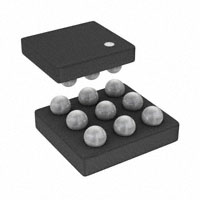
Filterless Class-D amplifier with Σ-Δ modulation No sync necessary when using multiple Class-D amplifiers from Analog Devices, Inc. 3 W into 3 Ω load and 1.4 W into 8 Ω load at 5.0 V supply with 96 dB signal-to-noise ratio (SNR) Single-supply operation from 2.5 V to 5.5 V 20 nA ultralow shutdown current Short-circuit and thermal protection Available in 9-ball, 1.5 mm × 1.5 mm WLCSP Pop-and-click suppression Built-in resistors reduce board component count Default fixed 18 dB or user-adjustable gain setting
The SSM2335 features a high efficiency, low noise modulation scheme that requires no external LC output filters. The modulation continues to provide high efficiency even at low output power. It operates with 93% efficiency at 1.4 W into 8 Ω or 85% efficiency at 3 W into 3 Ω from a 5.0 V supply and has an SNR of >96 dB. Spread-spectrum pulse density modulation is used to provide lower EMI-radiated emissions compared with other Class-D architectures. The SSM2335 has a micropower shutdown mode with a typical shutdown current of 20 nA. Shutdown is enabled by applying a logic low to the SD pin. The device also includes pop-and-click suppression circuitry. This suppression circuitry minimizes voltage glitches at the output during turn-on and turn-off, reducing audible noise on activation and deactivation. The fully differential input of the SSM2335 provides excellent rejection of common-mode noise on the input. Input coupling capacitors can be omitted if the input dc common-mode voltage is approximately VDD/2. The default gain of the SSM2335 is 18 dB, but users can reduce the gain by using a pair of external resistors (see the Gain section). The SSM2335 is specified over the industrial temperature range of −40°C to +85°C. It has built-in thermal shutdown and output short-circuit protection. It is available in a 9-ball, 1.5 mm × 1.5 mm wafer level chip scale package (WLCSP).
APPLICATIONS
Mobile phones MP3 players Portable gaming Portable electronics Educational toys
GENERAL DESCRIPTION
The SSM2335 is a fully integrated, high efficiency, Class-D audio amplifier. It is designed to maximize performance for mobile phone applications. The application circuit requires a minimum of external components and operates from a single 2.5 V to 5.5 V supply. It is capable of delivering 3 W of continuous output power with 100 44 96 Min Typ Max Unit
Efficiency Total Harmonic Distortion + Noise Input Common-Mode Voltage Range Common-Mode Rejection Ratio Average Switching Frequency Differential Output Offset Voltage POWER SUPPLY Supply Voltage Range Power Supply Rejection Ratio Supply Current
η THD + N VCM CMRRGSM fSW VOOS VDD PSRRDC PSRRGSM ISY
1.48 0.75 1.84 0.94 2.72 1.38 3.40 2 1.72 3.432 1.72 4.282 2.14 93 0.01 0.01 VDD − 1.0
W W W W W W W W W W W W % % % V dB kHz mV V dB dB mA mA mA mA mA mA nA dB kΩ V V ms μs kΩ μV rms dB
Shutdown Current GAIN CONTROL Closed-Loop Gain Differential Input Impedance SHUTDOWN CONTROL Input Voltage High Input Voltage Low Turn-On Time Turn-Off Time Output Impedance NOISE PERFORMANCE Output Voltage Noise Signal-to-Noise Ratio
1 2
ISD Gain ZIN VIH VIL tWU tSD ZOUT en SNR
SD = VDD ISY ≥ 1 mA ISY ≤ 300 nA SD rising edge from GND to VDD SD falling edge from VDD to GND SD = GND VDD = 3.6 V, f = 20 Hz to 20 kHz, inputs are ac-grounded, gain = 18 dB, A-weighted PO = 1.4 W, RL = 8 Ω
Although the SSM2335 has good audio quality above 3 W, continuous output power beyond 3 W must be avoided due to device packaging limitations. This value represents measured performance; packaging limitations must not be exceeded.
Rev. 0 | Page 3 of 16
�SSM2335 ABSOLUTE MAXIMUM RATINGS
Absolute maximum ratings apply at 25°C, unless otherwise noted. Table 2.
Parameter Supply Voltage Input Voltage Common-Mode Input Voltage Continuous Output Power Storage Temperature Range Operating Temperature Range Junction Temperature Range Lead Temperature (Soldering, 60 sec) ESD Susceptibility Rating 6V VDD VDD 3W −65°C to +150°C −40°C to +85°C −65°C to +165°C 300°C 2.5 kV
THERMAL RESISTANCE
θJA is specified for the worst-case conditions, that is, a device soldered in a circuit board for surface-mount packages. Table 3. Thermal Resistance
Package Type 9-Ball, 1.5 mm × 1.5 mm WLCSP PCB 1S0P 2S0P θJA 162 76 θJB 39 21 Unit °C/W °C/W
ESD CAUTION
Stresses above those listed under Absolute Maximum Ratings may cause permanent damage to the device. This is a stress rating only; functional operation of the device at these or any other conditions above those indicated in the operational section of this specification is not implied. Exposure to absolute maximum rating conditions for extended periods may affect device reliability.
Rev. 0 | Page 4 of 16
�SSM2335 PIN CONFIGURATION AND FUNCTION DESCRIPTIONS
BALL A1 CORNER
1 A 2 3
B
C
SSM2335
07551-002
TOP VIEW BALL SIDE DOWN (Not to Scale)
Figure 2. Pin Configuration
Table 4. Pin Function Descriptions
Pin No. 1A 1B 1C 2A 2B 2C 3A 3B 3C Mnemonic IN+ VDD IN− GND PVDD SD OUT− GND OUT+ Description Noninverting Input. Power Supply. Inverting Input. Ground. Power Supply. Shutdown Input. Active low digital input. Inverting Output. Ground. Noninverting Output.
Rev. 0 | Page 5 of 16
�SSM2335 TYPICAL PERFORMANCE CHARACTERISTICS
100 RL= 8Ω, 33µH GAIN = 18dB fIN = 1kHz
100
VDD = 2.5V
10
RL = 8Ω, 33µH GAIN = 18dB VDD = 5V
10
VDD = 3.6V
THD + N (%)
THD + N (%)
1
1 0.5W 0.1 1W 0.01 0.25W
0.1 VDD = 5V 0.01
07551-003
0.001
0.01
0.1
1
10
10
100
1k FREQUENCY (Hz)
10k
100k
OUTPUT POWER (W)
Figure 3. THD + N vs. Output Power into 8 Ω + 33 μH, Gain = 18 dB
100
Figure 6. THD + N vs. Frequency, VDD = 5 V, RL = 8 Ω + 33 μH, Gain = 18 dB
100
RL= 4Ω, 33µH GAIN = 18dB fIN = 1kHz
VDD = 2.5V
10
RL = 4Ω, 33µH GAIN = 18dB VDD = 5V
10 VDD = 3.6V
THD + N (%)
0.1
THD + N (%)
1
1
0.1
2W 0.5W
0.01 VDD = 5V
0.01 1W
07551-004
0.001
0.01
0.1
1
10
10
100
1k FREQUENCY (Hz)
10k
100k
OUTPUT POWER (W)
Figure 4. THD + N vs. Output Power into 4 Ω + 33 μH, Gain = 18 dB
100
Figure 7. THD + N vs. Frequency, VDD = 5 V, RL = 4 Ω + 33 μH, Gain = 18 dB
100
RL = 3Ω, 33µH GAIN = 18dB fIN = 1kHz
VDD = 2.5V
RL = 3Ω, 33µH GAIN = 18dB VDD = 5V
10
VDD = 3.6V
10
THD + N (%)
THD + N (%)
1
1
3W
0.1
0.1
1.5W
0.01
VDD = 5V
0.01
0.75W
07551-005
0.001
0.01
0.1
1
10
10
100
1k FREQUENCY (Hz)
10k
100k
OUTPUT POWER (W)
Figure 5. THD + N vs. Output Power into 3 Ω + 33 μH, Gain = 18 dB
Figure 8. THD + N vs. Frequency, VDD = 5 V, RL = 3 Ω + 33 μH, Gain = 18 dB
Rev. 0 | Page 6 of 16
07551-008
0.001 0.0001
0.001
07551-007
0.001 0.0001
0.001
07551-006
0.001 0.0001
0.001
�SSM2335
100 RL = 8Ω, 33µH GAIN = 18dB VDD = 3.6V
100 RL = 8Ω, 33µH GAIN = 18dB VDD = 2.5V
10
10
THD + N (%)
0.1 0.5W 0.01 0.125W
THD + N (%)
1
1
0.1
0.25W 0.0625W
0.01
10
100
1k FREQUENCY (Hz)
10k
100k
10
100
1k FREQUENCY (Hz)
10k
100k
Figure 9. THD + N vs. Frequency, VDD = 3.6 V, RL = 8 Ω + 33 μH, Gain = 18 dB
100
Figure 12. THD + N vs. Frequency, VDD = 2.5 V, RL = 8 Ω + 33 μH, Gain = 18 dB
100
RL = 4Ω, 33µH GAIN = 18dB VDD = 3.6V
RL = 4Ω, 33µH GAIN = 18dB VDD = 2.5V
10
10
THD + N (%)
0.1
THD + N (%)
1
1
1W 0.5W
0.1
0.5W
0.01
0.01
0.125W
07551-010
100
1k FREQUENCY (Hz)
10k
100k
10
100
1k FREQUENCY (Hz)
10k
100k
Figure 10. THD + N vs. Frequency, VDD = 3.6 V, RL = 4 Ω + 33 μH, Gain = 18 dB
100
Figure 13. THD + N vs. Frequency, VDD = 2.5 V, RL = 4 Ω + 33 μH, Gain = 18 dB
100
RL = 3Ω, 33µH GAIN = 18dB VDD = 3.6V
RL = 3Ω, 33µH GAIN = 18dB VDD = 2.5V
10
10
THD + N (%)
THD + N (%)
1
1.5W
1 0.75W 0.1 0.375W 0.01
0.1 0.75W 0.01 0.375W
0.188W 0.001 10
07551-011
10
100
1k FREQUENCY (Hz)
10k
100k
100
1k FREQUENCY (Hz)
10k
100k
Figure 11. THD + N vs. Frequency, VDD = 3.6 V, RL = 3 Ω + 33 μH, Gain = 18 dB
Figure 14. THD + N vs. Frequency, VDD = 2.5 V, RL = 3 Ω + 33 μH, Gain = 18 dB
Rev. 0 | Page 7 of 16
07551-014
0.001
07551-013
0.001 10
0.25W
0.001
0.25W
07551-012
07551-009
0.001
0.25W
0.001
0.125W
�SSM2335
3.8 3.6 RL = 4Ω, 33µH 3.4
4.5 4.0 3.5
RL = 3Ω, 33µH GAIN = 18dB f = 1kHz
SUPPLY CURRENT (mA)
OUTPUT POWER (W)
3.0 2.5 2.0 1% 1.5 1.0 0.5 10%
3.2 3.0
RL = 8Ω, 33µH RL = 3Ω, 33µH
2.8 2.6 2.4
NO LOAD
07551-015
3.0
3.5
4.0
4.5
5.0
5.5
6.0
3.0
3.5
4.0
4.5
5.0
SUPPLY VOLTAGE (V)
SUPPLY VOLTAGE (V)
Figure 15. Supply Current vs. Supply Voltage
2.0 1.8 1.6 RL = 8Ω, 33µH GAIN = 18dB f = 1kHz
Figure 18. Maximum Output Power vs. Supply Voltage, RL = 3 Ω + 33 μH, Gain = 18 dB
100 90 80 70 VDD = 3.6V VDD = 5V VDD = 2.5V
OUTPUT POWER (W)
1.4 1.2 1.0 10% 0.8 0.6 0.4 0.2
07551-016
EFFICIENCY (%)
60 50 40 30 20 10 RL = 8Ω, 33µH 0 0.2 0.4 0.6 0.8 1.0 1.2 1.4 1.6 1.8
07551-019 07551-020
1%
0 2.5
3.0
3.5
4.0
4.5
5.0
0
SUPPLY VOLTAGE (V)
OUTPUT POWER (W)
Figure 16. Maximum Output Power vs. Supply Voltage, RL = 8 Ω + 33 μH, Gain = 18 dB
4.0 3.5 3.0 RL = 4Ω, 33µH GAIN = 18dB f = 1kHz 100 90 80 70 2.5 2.0 1.5 1.0 0.5
07551-017
Figure 19. Efficiency vs. Output Power into 8 Ω + 33 μH
VDD = 3.6V VDD = 2.5V
VDD = 5V
OUTPUT POWER (W)
EFFICIENCY (%)
60 50 40 30 20 10 RL = 4Ω, 33µH 0 0.4 0.8 1.2 1.6 2.0 2.4 2.8 3.2 3.6
10% 1%
0 2.5
3.0
3.5
4.0
4.5
5.0
0
SUPPLY VOLTAGE (V)
OUTPUT POWER (W)
Figure 17. Maximum Output Power vs. Supply Voltage, RL = 4 Ω + 33 μH, Gain = 18 dB
Figure 20. Efficiency vs. Output Power into 4 Ω + 33 μH
Rev. 0 | Page 8 of 16
07551-018
2.2 2.5
0 2.5
�SSM2335
0.12 RL = 8Ω, 33µH VDD = 5V 0.18 0.16 0.14 0.12 0.10 0.08 0.06 0.04 0.02
07551-021
RL = 4Ω, 33µH VDD = 3.6V
0.10
POWER DISSIPATION (W)
0.08
0.06
0.04
0.02
POWER DISSIPATION (W)
0
0.3
0.6
0.9
1.2
1.5
1.8
0
0.2
0.4
0.6
0.8
1.0
1.2
1.4
1.6
OUTPUT POWER (W)
OUTPUT POWER (W)
Figure 21. Power Dissipation vs. Output Power into 8 Ω + 33 μH, VDD = 5 V
0.30
Figure 24. Power Dissipation vs. Output Power into 4 Ω + 33 μH, VDD = 3.6 V
450
RL = 4Ω, 33µH VDD = 5V
RL = 8Ω, 33µH
400 350
VDD = 5.0V
0.25
POWER DISSIPATION (W)
SUPPLY CURRENT (mA)
0.20
300 250 VDD = 2.5V 200 150 100
VDD = 3.6V
0.15
0.10
0.05 50
07551-022
0
0.5
1.0
1.5
2.0
2.5
3.0
3.5
0
0.2
0.4
0.6
0.8
1.0
1.2
1.4
1.6
1.8
2.0
OUTPUT POWER (W)
OUTPUT POWER (W)
Figure 22. Power Dissipation vs. Output Power into 4 Ω + 33 μH, VDD = 5 V
0.08
Figure 25. Supply Current vs. Output Power into 8 Ω + 33 μH
800
RL = 8Ω, 33µH VDD = 3.6V
RL = 4Ω, 33µH VDD = 5.0V VDD = 3.6V
700 600 500 400 300 200 100
07551-023 07551-026
POWER DISSIPATION (W)
SUPPLY CURRENT (mA)
0.06
0.04
VDD = 2.5V
0.02
0 0 0.1 0.2 0.3 0.4 0.5 0.6 0.7 0.8 0.9 OUTPUT POWER (W)
0
0
0.5
1.0
1.5
2.0
2.5
3.0
3.5
4.0
OUTPUT POWER (W)
Figure 23. Power Dissipation vs. Output Power into 8 Ω + 33 μH, VDD = 3.6 V
Figure 26. Supply Current vs. Output Power into 4 Ω + 33 μH
Rev. 0 | Page 9 of 16
07551-025
0
0
07551-024
0
0
�SSM2335
0 –10 –20 4 –30 6 5 SD INPUT
PSRR (dB)
–40 –50 –60 –70
VOLTAGE (V)
3 2 1 0
OUTPUT
–80 –90 10 100 1k FREQUENCY (Hz) 10k 100k
07551-027
–1
07551-029 07551-030
–100
–2 –2 0 2 4 6 8 TIME (ms) 10 12 14 16 18
Figure 27. Power Supply Rejection Ratio (PSRR) vs. Frequency
0 –10 –20 –30
7 6 OUTPUT 5 4
Figure 29. Turn-On Response
CMRR (dB)
–40 –50 –60 –70 –80 –90 10 100 1k FREQUENCY (Hz) 10k 100k
07551-028
VOLTAGE (V)
3 2 1 0 –1 –2 –90 SD INPUT
–100
–70
–50
–30
–10
10
30
50
70
90
TIME (µs)
Figure 28. Common-Mode Rejection Ratio (CMRR) vs. Frequency
Figure 30. Turn-Off Response
Rev. 0 | Page 10 of 16
�SSM2335 TYPICAL APPLICATION CIRCUITS
EXTERNAL GAIN SETTINGS = 160kΩ/(20kΩ + REXT ) 10µF 0.1µF VBATT 2.5V TO 5.5V VDD OUT– MODULATOR (Σ-Δ) FET DRIVER OUT+
SSM2335
47nF* AUDIO IN+ AUDIO IN– 47nF* REXT REXT IN+ IN– 20kΩ 20kΩ
160kΩ
160kΩ SD BIAS INTERNAL OSCILLATOR POP-AND-CLICK SUPPRESSION
SHUTDOWN
GND
*INPUT CAPACITORS ARE OPTIONAL IF INPUT DC COMMON-MODE VOLTAGE IS APPROXIMATELY VDD/2.
Figure 31. Differential Input Configuration, User-Adjustable Gain
EXTERNAL GAIN SETTINGS = 160kΩ/(20kΩ + REXT ) 10µF 0.1µF VBATT 2.5V TO 5.5V VDD OUT– MODULATOR (Σ-Δ) FET DRIVER OUT+
SSM2335
47nF AUDIO IN+ REXT REXT 47nF IN+ IN– 20kΩ 20kΩ
160kΩ
160kΩ SD INTERNAL OSCILLATOR POP-AND-CLICK SUPPRESSION
SHUTDOWN
BIAS
Figure 32. Single-Ended Input Configuration, User-Adjustable Gain
Rev. 0 | Page 11 of 16
07551-032
GND
07551-031
�SSM2335 THEORY OF OPERATION
OVERVIEW
The SSM2335 mono Class-D audio amplifier features a filterless modulation scheme that greatly reduces the external component count, conserving board space and, thus, reducing systems cost. The SSM2335 does not require an output filter but, instead, relies on the inherent inductance of the speaker coil and the natural filtering of the speaker and human ear to fully recover the audio component of the square wave output. Most Class-D amplifiers use some variation of pulse-width modulation (PWM), but the SSM2335 uses Σ-Δ modulation to determine the switching pattern of the output devices, resulting in a number of important benefits. Σ-Δ modulators do not produce a sharp peak with many harmonics in the AM frequency band, as pulse-width modulators often do. Σ-Δ modulation provides the benefits of reducing the amplitude of spectral components at high frequencies, that is, reducing EMI emission that might otherwise be radiated by speakers and long cable traces. The SSM2335 does not require external EMI filtering for twisted speaker cable lengths shorter than 10 cm. Due to the inherent spread-spectrum nature of Σ-Δ modulation, the need for oscillator synchronization is eliminated for designs incorporating multiple SSM2335 amplifiers. The SSM2335 also offers protection circuits for overcurrent and temperature protection.
OUTPUT MODULATION DESCRIPTION
The SSM2335 uses three-level, Σ-Δ output modulation. Each output can swing from GND to VDD and vice versa. Ideally, when no input signal is present, the output differential voltage is 0 V because there is no need to generate a pulse. In a real-world situation, there are always noise sources present. Due to this constant presence of noise, a differential pulse is generated, when required, in response to this stimulus. A small amount of current flows into the inductive load when the differential pulse is generated. Most of the time, however, output differential voltage is 0 V, due to the Analog Devices patent pending, three-level, Σ-Δ output modulation. This feature ensures that the current flowing through the inductive load is small. When the user wants to send an input signal, an output pulse is generated to follow the input voltage. The differential pulse density is increased by raising the input signal level. Figure 33 depicts three-level, Σ-Δ output modulation with and without input stimulus.
OUTPUT = 0V OUT+ OUT–
+5V 0V +5V 0V +5V 0V –5V
GAIN
The SSM2335 has a default gain of 18 dB that can be reduced by using a pair of external resistors with a value calculated as follows: External Gain Settings = 160 kΩ/(20 kΩ + REXT)
VOUT OUTPUT > 0V OUT+ OUT– VOUT OUTPUT < 0V OUT+ OUT– VOUT
+5V 0V +5V 0V +5V 0V +5V 0V +5V 0V 0V –5V
07551-033
POP-AND-CLICK SUPPRESSION
Voltage transients at the output of audio amplifiers can occur when shutdown is activated or deactivated. Voltage transients as low as 10 mV can be heard as an audio pop in the speaker. Clicks and pops can also be classified as undesirable audible transients generated by the amplifier system and, therefore, as not coming from the system input signal. Such transients may be generated when the amplifier system changes its operating mode. For example, the following may be sources of audible transients: system power-up and power-down, mute and unmute, input source change, and sample rate change. The SSM2335 has a pop-and-click suppression architecture that reduces these output transients, resulting in noiseless activation and deactivation.
Figure 33. Three-Level, Σ-Δ Output Modulation With and Without Input Stimulus
Rev. 0 | Page 12 of 16
�SSM2335
LAYOUT
As output power continues to increase, care must be taken to lay out PCB traces and wires properly among the amplifier, load, and power supply. A good practice is to use short, wide PCB tracks to decrease voltage drops and minimize inductance. Ensure that track widths are at least 200 mil for every inch of track length for lowest DCR, and use 1 oz or 2 oz of copper PCB traces to further reduce IR drops and inductance. A poor layout increases voltage drops, consequently affecting efficiency. Use large traces for the power supply inputs and amplifier outputs to minimize losses due to parasitic trace resistance. Proper grounding guidelines help to improve audio performance, minimize crosstalk between channels, and prevent switching noise from coupling into the audio signal. To maintain high output swing and high peak output power, the PCB traces that connect the output pins to the load, as well as the PCB traces to the supply pins, should be as wide as possible to maintain the minimum trace resistances. It is also recommended that a large ground plane be used for minimum impedances. In addition, good PCB layout isolates critical analog paths from sources of high interference. High frequency circuits (analog and digital) should be separated from low frequency circuits. Properly designed multilayer PCBs can reduce EMI emission and increase immunity to the RF field by a factor of 10 or more, compared with double-sided boards. A multilayer board allows a complete layer to be used for the ground plane, whereas the ground plane side of a double-sided board is often disrupted by signal crossover. If the system has separate analog and digital ground and power planes, the analog ground plane should be directly beneath the analog power plane, and, similarly, the digital ground plane should be directly beneath the digital power plane. There should be no overlap between analog and digital ground planes or between analog and digital power planes.
INPUT CAPACITOR SELECTION
The SSM2335 does not require input coupling capacitors if the input signal is biased from 1.0 V to VDD − 1.0 V. Input capacitors are required if the input signal is not biased within this recommended input dc common-mode voltage range, if high-pass filtering is needed, or if a single-ended source is used. If highpass filtering is needed at the input, the input capacitor and the input resistor of the SSM2335 form a high-pass filter whose corner frequency is determined by the following equation: fC = 1/(2π × RIN × CIN) The input capacitor can significantly affect the performance of the circuit. Not using input capacitors degrades both the output offset of the amplifier and the dc PSRR performance.
POWER SUPPLY DECOUPLING
To ensure high efficiency, low total harmonic distortion (THD), and high PSRR, proper power supply decoupling is necessary. Noise transients on the power supply lines are short-duration voltage spikes. Although the actual switching frequency can range from 10 kHz to 100 kHz, these spikes can contain frequency components that extend into the hundreds of megahertz. The power supply input needs to be decoupled with a good quality, low ESL, low ESR capacitor, with a minimum value of 4.7 μF. This capacitor bypasses low frequency noises to the ground plane. For high frequency transient noises, use a 0.1 μF capacitor as close as possible to the VDD pin of the device. Placing the decoupling capacitor as close as possible to the SSM2335 helps to maintain efficient performance.
Rev. 0 | Page 13 of 16
�SSM2335 OUTLINE DIMENSIONS
A1 BALL CORNER 1.490 1.460 SQ 1.430 0.655 0.600 0.545 SEATING PLANE 0.350 0.320 0.290
3 2 1 A
B
0.50 BALL PITCH TOP VIEW
(BALL SIDE DOWN)
C
0.385 0.360 0.335
BOTTOM VIEW 0.270 0.240 0.210
(BALL SIDE UP)
Figure 34. 9-Ball Wafer Level Chip Scale Package [WLCSP] (CB-9-2) Dimensions shown in millimeters
ORDERING GUIDE
Model SSM2335CBZ-R2 1 SSM2335CBZ-REEL1 SSM2335CBZ-REEL71 EVAL-SSM2335Z1
1
Temperature Range −40°C to +85°C −40°C to +85°C −40°C to +85°C
Package Description 9-Ball Wafer Level Chip Scale Package [WLCSP] 9-Ball Wafer Level Chip Scale Package [WLCSP] 9-Ball Wafer Level Chip Scale Package [WLCSP] Evaluation Board
Package Option CB-9-2 CB-9-2 CB-9-2
101507-C
Branding Y1L Y1L Y1L
Z = RoHS Compliant Part.
Rev. 0 | Page 14 of 16
�SSM2335 NOTES
Rev. 0 | Page 15 of 16
�SSM2335 NOTES
©2008 Analog Devices, Inc. All rights reserved. Trademarks and registered trademarks are the property of their respective owners. D07551-0-10/08(0)
Rev. 0 | Page 16 of 16
�







 工商网监
湘ICP备2023018690号
工商网监
湘ICP备2023018690号