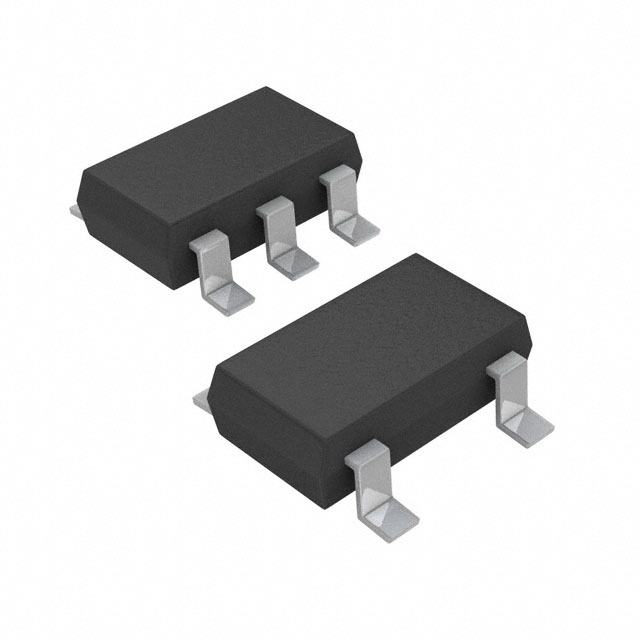
A1160
Chopper-Stabilized Precision Hall-Effect Switch
with Advanced Diagnostics
FEATURES AND BENEFITS
DESCRIPTION
• AEC-Q100 automotive qualified
• Unipolar switch points
• Externally enabled diagnostics feature
• Diagnostics feature exercises the entire magnetic and
electrical signal path within the IC
• Resistant to physical stress
• Superior temperature stability through advanced chopper
stabilization techniques
• Output short-circuit protection
• Internal regulator enables operation from unregulated
supplies
• Reverse-battery protection
• Solid-state reliability
• Small surface-mount package
The A1160 is a unipolar, Hall-effect switch with an externally
enabled diagnostic function. In normal operating mode, the
A1160 functions as a standard, unipolar Hall-effect switch.
The output transistor turns on (output signal switches low)
in the presence of a sufficient magnetic field (>BOP(max)).
Additionally, the output transistor of the A1160 switches
off (output signal switches high) when the magnetic field is
removed ( BOP
–
185
400
mV
IOM
B > BOP
30
–
60
mA
Power-On Time [3]
tPN
VCC > 3.8 V , B < BRP(min) – 10 G,
B > BOP(max) + 10 G
–
–
25
µs
Chopping Frequency
fC
–
400
–
kHz
Output Current Limit
Output Rise
Time [3][4]
Output Fall Time [3][4]
Supply Current [5]
Reverse Battery Current
tr
RLOAD = 820 Ω, CL = 20 pF
–
0.2
2
µs
tf
RLOAD = 820 Ω, CL = 20 pF
–
0.1
2
µs
ICC(ON)
B < BRP , VCC = 12 V
–
–
5
mA
ICC(OFF)
B > BOP , VCC = 12 V
–
–
5
mA
ICC(DIAG)
VCC = 12 V, DIAG = 1
–
16
25
mA
VRCC = –18 V
–
–
–10
mA
V
IRCC
Supply Zener Clamp Voltage
VZSUP
ICC = 8 mA, TA = 25°C
30
–
–
Output Zener Voltage
VZOUT
IOUT = 3 mA, TA = 25°C
28
–
–
V
PWM Carrier Frequency
fPWMout
With Diagnostic mode enabled
–
3
–
kHz
DFAIL
DIAG = 1, device malfunction
–
≈ 0 or
≈ 100
–
%
DPASS
DIAG = 1, device normal
40
50
60
%
DIAG Pin Input Resistance
RDIAG
Internal pulldown resistor
–
1
–
MΩ
DIAG Pin Input Low Voltage
Threshold
VIL
Device in Normal mode
–
–
0.6
V
DIAG Pin Input High Voltage
Threshold
VIH
Device in Diagnostic mode
1.5
–
5.0
V
Diagnostic Enable Time
tD
Diagnostic feature should be enabled for at least
tD in order to obtain accurate PWM signal
1
–
–
ms
Diagnostic Disable Time
tDIS
Time from DIAG pin release (high to low
transition) until valid normal sensor IC output
–
–
25
µs
DIAGNOSTIC CHARACTERISTICS
Duty Cycle (Diagnostic Mode) [6]
Continued on the next page…
Allegro MicroSystems
955 Perimeter Road
Manchester, NH 03103-3353 U.S.A.
www.allegromicro.com
3
�Chopper-Stabilized Precision Hall-Effect Switch
with Advanced Diagnostics
A1160
OPERATING CHARACTERISTICS (continued): Valid across full operating voltage and ambient temperature ranges,
unless otherwise specified
Characteristic
Magnetic
Symbol
Test Conditions
Min.
Typ. [1]
Max.
Unit [2]
Characteristics [7]
Operate Point
BOP
115
180
245
G
Release Point
BRP
60
125
190
G
Hysteresis
BHYS
30
55
80
G
BEXT(DIAG)
800
10,000
–
G
Operate Point Drift
BOP(DRIFT)
30
–
420
G
Release Point Drift
BRP(DRIFT)
15
–
325
G
Maximum External Field in Diagnostic
Mode [8]
BOP – BRP
Drift Detection Threshold
[1] Typical
data is at TA = 25°C and VCC = 12 V and it is for design information only.
G (gauss) = 0.1 mT (millitesla).
[3] Power-On Time, Output Rise Time, and Output Fall Time are ensured through device characterization and not final test.
[4] C = oscilloscope probe capacitance.
L
[5] In Diagnostic mode the supply current level is different from the Normal mode operation current level. This is important when determining the power
derating for Diagnostic mode.
[6] When the A1160 passes the diagnostic tests, it outputs a 50% duty cycle signal. Any other output indicates the test failed. Please see the Diagnostic
Mode of Operation section for more information.
[7] Magnetic flux density, B, is indicated as a negative value for north-polarity magnetic fields, and as a positive value for south-polarity magnetic fields.
[8] 800 G is the maximum test capability due to practical equipment limitations. Design simulations show that a 10,000 G external field will not
adversely affect the A1160 in Diagnostic mode when a 1% sensitivity mismatch between the Hall elements in the IC is assumed.
[2] 1
Allegro MicroSystems
955 Perimeter Road
Manchester, NH 03103-3353 U.S.A.
www.allegromicro.com
4
�Chopper-Stabilized Precision Hall-Effect Switch
with Advanced Diagnostics
A1160
THERMAL CHARACTERISTICS: May require derating at maximum conditions; see application information
Characteristic
Symbol
Test Conditions*
RθJA
Package Thermal Resistance
Value
Unit
124
°C/W
On 4-layer PCB based on JEDEC standard
Maximum Allowable VCC (V)
*Additional thermal information available on the Allegro website
Power Derating Curve
25
24
23
22
21
20
19
18
17
16
15
14
13
12
11
10
9
8
7
6
5
4
3
2
VCC(max)
Normal Mode
(ICC(max) = 5 mA)
Diagnostic Mode
(ICC(max) = 25 mA)
VCC(min)
20
40
60
80
100
120
140
160
180
Power Dissipation, PD (m W)
Temperature (ºC)
Power Dissipation versus Ambient Temperature
1900
1800
1700
1600
1500
1400
1300
1200
1100
1000
900
800
700
600
500
400
300
200
100
0
Diagnostic Mode (ICC(max) = 25 mA)
Normal Mode (ICC(max) = 5 mA)
20
40
60
80
100
120
Temperature (°C)
140
160
180
Allegro MicroSystems
955 Perimeter Road
Manchester, NH 03103-3353 U.S.A.
www.allegromicro.com
5
�Chopper-Stabilized Precision Hall-Effect Switch
with Advanced Diagnostics
A1160
VOUT(SAT) vs. TA
400
VCC
3.8 V
12 V
24 V
350
300
250
200
150
100
50
0
-50
0
50
100
150
200
Output Saturation Voltage, VOUT(SAT) (V)
Output Saturation Voltage, VOUT(SAT) (V)
CHARACTERISTIC PERFORMANCE
VOUT(SAT) vs. VCC
400
TA
-40°C
25°C
150°C
350
300
250
200
150
100
50
0
0
5
5.0
4.5
4.0
3.5
3.0
2.5
2.0
1.5
1.0
0.5
0
VCC
3.8 V
12 V
24 V
0
50
100
150
200
100
0
5
150
Supply Current, I CC(OFF) (mA)
Supply Current, I CC(OFF) (mA)
200
30
TA
-40°C
25°C
150°C
0
Supply Current, I CC(DIAG) (mA)
Supply Current, I CC(DIAG) (mA)
25
5
10
15
20
25
30
ICC(DIAG) vs. VCC
20
15
10
VCC
3.8 V
12 V
24 V
5
0
100
20
Supply Voltage, VCC (V)
25
50
15
5.0
4.5
4.0
3.5
3.0
2.5
2.0
1.5
1.0
0.5
0
ICC(DIAG) vs. TA
0
10
ICC(OFF) vs. VCC
Ambient Temperature, TA (°C)
-50
30
Supply Voltage, VCC (V)
VCC
3.8 V
12 V
24 V
50
25
TA
-40°C
25°C
150°C
ICC(OFF) vs. TA
0
20
5.0
4.5
4.0
3.5
3.0
2.5
2.0
1.5
1.0
0.5
0
Ambient Temperature, TA (°C)
5.0
4.5
4.0
3.5
3.0
2.5
2.0
1.5
1.0
0.5
0
-50
15
ICC(ON) vs. VCC
Supply Current, I CC(ON) (mA)
Supply Current, I CC(ON) (mA)
ICC(ON) vs. TA
-50
10
Supply Voltage, VCC (V)
Ambient Temperature, TA (°C)
150
Ambient Temperature, TA (°C)
200
25
20
15
10
TA
-40°C
25°C
150°C
5
0
0
5
10
15
20
25
30
Supply Voltage, VCC (V)
Allegro MicroSystems
955 Perimeter Road
Manchester, NH 03103-3353 U.S.A.
www.allegromicro.com
6
�Chopper-Stabilized Precision Hall-Effect Switch
with Advanced Diagnostics
fPWMout vs. TA
fPWMout vs. VCC
6
VCC
3.8 V
12 V
24 V
5
4
3
2
1
0
-50
0
50
100
150
200
PWM Carrier Frequency, fPWMout (kHz)
PWM Carrier Frequency, fPWMout (kHz)
A1160
6
TA
-40°C
25°C
150°C
5
4
3
2
1
0
0
5
Ambient Temperature, TA (°C)
60
58
56
54
52
50
48
46
44
42
40
VCC
3.8 V
12 V
24 V
0
50
100
15
20
25
30
DPASS vs. VCC
Normal DIAG Duty Cycle, DPASS (%)
Normal DIAG Duty Cycle, DPASS (%)
DPASS vs. TA
-50
10
Supply Voltage, VCC (V)
150
Ambient Temperature, TA (°C)
200
60
58
56
54
52
50
48
46
44
42
40
TA
-40°C
25°C
150°C
0
5
10
15
20
25
30
Supply Voltage, VCC (V)
Allegro MicroSystems
955 Perimeter Road
Manchester, NH 03103-3353 U.S.A.
www.allegromicro.com
7
�Chopper-Stabilized Precision Hall-Effect Switch
with Advanced Diagnostics
A1160
BOP vs. VCC
250
Magnetic Operate Point, BOP (G)
Magnetic Operate Point, BOP (G)
BOP vs. TA
VCC
3.8 V
12 V
24 V
230
210
190
170
150
130
110
-50
0
50
100
150
250
TA
-40°C
25°C
150°C
230
210
190
170
150
130
110
200
0
5
Ambient Temperature, TA (°C)
Magnetic Release Point, BRP (G)
Magnetic Release Point, BRP (G)
195
VCC
3.8 V
12 V
24 V
175
155
135
115
95
75
55
0
50
100
150
155
135
115
TA
-40°C
25°C
150°C
95
75
55
0
200
5
Magnetic Hysteresis, BHYS (G)
Magnetic Hysteresis, BHYS (G)
10
15
20
25
30
Supply Voltage, VCC (V)
VCC
3.8 V
12 V
24 V
100
30
BHYS vs. VCC
80
75
70
65
60
55
50
45
40
35
30
50
25
175
BHYS vs. TA
0
20
195
Ambient Temperature, TA (°C)
-50
15
BRP vs. VCC
BRP vs. TA
-50
10
Supply Voltage, VCC (V)
150
Ambient Temperature, TA (°C)
200
80
75
70
65
60
55
50
45
40
35
30
TA
-40°C
25°C
150°C
0
5
10
15
20
25
30
Supply Voltage, VCC (V)
Allegro MicroSystems
955 Perimeter Road
Manchester, NH 03103-3353 U.S.A.
www.allegromicro.com
8
�Chopper-Stabilized Precision Hall-Effect Switch
with Advanced Diagnostics
A1160
FUNCTIONAL DESCRIPTION
Applications
It is strongly recommended that an external bypass capacitor be
connected between the supply and ground of the A1160 (in close
proximity to the device) to reduce both external noise and noise
generated by the chopper stabilization technique. As is shown in
figure 2, a 0.1 μF capacitor is typical.
Extensive applications information on magnets and Hall-effect
sensor ICs is available on the Allegro website, including the following application notes:
• Hall-Effect IC Applications Guide, AN27701
• Soldering Methods for Allegro’s Products – SMT and ThroughHole, AN26009
Switch to High
VOUT(SAT)
0
BRP
0
BOP
Powering-on the IC in the hysteresis range (applied magnetic
lower than BOP but also higher than BRP ) results in output at the
high state. The output will not switch until there is a valid transition beyond BOP or BRP . The correct output state is attained after
the first excursion beyond BOP or BRP .
VCC
VOUT
The difference in the magnetic operate and release points is the
hysteresis, BHYS , of the IC. This built-in hysteresis allows clean
switching of the output, including when in the presence of external mechanical vibration and electrical noise.
V+
Switch to Low
Operation
The output of the A1160 switches low (turns on) when a magnetic field perpendicular to the Hall element exceeds the operate point threshold, BOP . After turn-on, the output is capable of
sinking 25 mA and the output voltage is VOUT(SAT) . When the
magnetic field is reduced below the release point, BRP , the output
goes high (turns off). This is illustrated in figure 1.
B+
BHYS
Figure 1. Switching behavior of Hall effect switches. On the horizontal
axis, the B+ direction indicates increasing south polarity magnetic field
strength, and the B– direction indicates decreasing south polarity field
strength (including the case of increasing north polarity).
V+
CBYPASS
From
Controller
RL
VCC
A1160
DIAG
VOUT
GND
Output
CL
(Optional)
Figure 2. Typical application circuit
Allegro MicroSystems
955 Perimeter Road
Manchester, NH 03103-3353 U.S.A.
www.allegromicro.com
9
�Chopper-Stabilized Precision Hall-Effect Switch
with Advanced Diagnostics
A1160
Diagnostic Mode of Operation
The Diagnostic mode is accessed by applying a voltage of VIH on
the diagnostic enable pin (DIAG). The Diagnostic mode uses an
internally generated magnetic signal to exercise the signal path.
This signal is compared to two reference signals in the Schmitt
trigger.
If the diagnostic signal is between the two reference signals, the
device is considered to be working within specification and a
50% PWM signal is set at the output pin (VOUT), as shown in
figure 3. If the diagnostic signal is above the upper reference or
below the lower reference, the output PWM is set at a fixed value
that is either at nearly 0% or at nearly 100% duty cycle.
The Diagnostic mode of operation not only detects catastrophic
failures but also identifies drifts in the magnetic switch points. If
BOP or BRP drift to values below or above the values stated in the
Drift Detection Threshold section of the Operating Characteristics table, the output PWM is set at a fixed value that is either at
nearly 0% or at nearly 100% duty cycle.
DIAG
DIAG
t
VOUT
t
VOUT
Device OK
Duty = 50%
t
Device Failure
Duty 50%
or
Duty 50%
t
Figure 3. Diagnostics Functional Diagram. When the A1160 passes the diagnostic test, a 50% duty cycle signal is
sent out (left panel). In the event of a failure, the output will be forced either high or low (right panel). Diagnostic
mode is only active when the DIAG input pin is pulled high.
Allegro MicroSystems
955 Perimeter Road
Manchester, NH 03103-3353 U.S.A.
www.allegromicro.com
10
�Chopper-Stabilized Precision Hall-Effect Switch
with Advanced Diagnostics
A1160
Chopper Stabilization Technique
When using Hall-effect technology, a limiting factor for switch
point accuracy is the small signal voltage developed across the
Hall element. This voltage is disproportionally small relative to
the offset that can be produced at the output of the Hall IC. This
makes it difficult to process the signal while maintaining an accurate, reliable output across the specified operating temperature
and voltage ranges.
Chopper stabilization is a unique approach used to minimize
Hall offset on the chip. The Allegro technique, namely Dynamic
Quadrature Offset Cancellation, removes key sources of the output drift induced by thermal and mechanical stresses. This offset
reduction technique is based on a signal modulation-demodulation process. The unwanted offset signal is separated from the
magnetic field-induced signal in the frequency domain, through
modulation. The subsequent demodulation acts as a modulation
process for the offset, causing the magnetic field induced signal
to recover its original spectrum at baseband, while the DC offset
becomes a high-frequency signal. The magnetic sourced signal
then can pass through a low-pass filter, while the modulated DC
offset is suppressed. This configuration is illustrated in figure 4.
The chopper stabilization technique uses a 400 kHz, high
frequency clock. For demodulation process, a sample-and-hold
technique is used, where the sampling is performed at twice the
chopper frequency (800 kHz). This high-frequency operation
allows a greater sampling rate, which results in higher accuracy
and faster signal-processing capability. This approach desensitizes the chip to the effects of thermal and mechanical stresses
and produces devices that have extremely stable quiescent Hall
output voltages and precise recoverability after temperature
cycling. This technique is made possible through the use of a
BiCMOS process, which allows the use of low-offset, low-noise
amplifiers in combination with high-density logic integration and
sample-and-hold circuits.
The repeatability of magnetic field-induced switching is affected
slightly by a chopper technique. However, the Allegro high
frequency chopping approach minimizes the effect of jitter and
makes it imperceptible in most applications. Applications that are
more likely to be sensitive to such degradation are those requiring
precise sensing of alternating magnetic fields; for example, speed
sensing of ring-magnet targets. For such applications, Allegro
recommends its digital sensor IC families with lower sensitivity
to jitter. For more information on those products, contact your
Allegro sales representative.
Regulator
Hall Element
Amp
Sample and
Hold
Clock/Logic
Low-Pass
Filter
Figure 4. Chopper stabilization circuit (Dynamic Quadrature Offset Cancellation)
Allegro MicroSystems
955 Perimeter Road
Manchester, NH 03103-3353 U.S.A.
www.allegromicro.com
11
�Chopper-Stabilized Precision Hall-Effect Switch
with Advanced Diagnostics
A1160
Package LH, 5-Pin SOT23W
+0.12
2.98 –0.08
0.20 MIN
4°±4°
5
A
+0.02
0.18 –0.05
+0.10
2.90 –0.20
+0.19
1.91 –0.06
2.40
0.70
D
0.25 MIN
1.00
2
1
0.55 REF
0.25 BSC
0.95
Seating Plane
Gauge Plane
8X 12° REF
B
PCB Layout Reference View
Branded Face
1.00 ±0.13
SEATING
PLANE
0.95 BSC
+0.10
0.05 –0.05
0.40 ±0.10
NNN
C
1
C
Standard Branding Reference View
N = Last three digits of device part number
For Reference Only; not for tooling use
Dimensions in millimeters
Dimensions exclusive of mold flash, gate burrs, and dambar protrusions
Exact case and lead configuration at supplier discretion within limits shown
A
Active Area Depth, 0.28 mm REF
B
Reference land pattern layout
All pads a minimum of 0.20 mm from all adjacent pads; adjust as necessary
to meet application process requirements and PCB layout tolerances
C
Branding scale and appearance at supplier discretion
D
Hall element, not to scale, location application dependant
Allegro MicroSystems
955 Perimeter Road
Manchester, NH 03103-3353 U.S.A.
www.allegromicro.com
12
�Chopper-Stabilized Precision Hall-Effect Switch
with Advanced Diagnostics
A1160
REVISION HISTORY
Number
Date
Description
–
December 12, 2013
Initial Release
1
September 21, 2015
Added AEC-Q100 qualification under Features and Benefits
2
January 25, 2019
Minor editorial updates
3
February 4, 2020
Minor editorial updates
4
May 27, 2020
Updated Diagnostic Enable Time test condition (page 3)
Copyright 2020, Allegro MicroSystems.
Allegro MicroSystems reserves the right to make, from time to time, such departures from the detail specifications as may be required to permit
improvements in the performance, reliability, or manufacturability of its products. Before placing an order, the user is cautioned to verify that the
information being relied upon is current.
Allegro’s products are not to be used in any devices or systems, including but not limited to life support devices or systems, in which a failure of
Allegro’s product can reasonably be expected to cause bodily harm.
The information included herein is believed to be accurate and reliable. However, Allegro MicroSystems assumes no responsibility for its use; nor
for any infringement of patents or other rights of third parties which may result from its use.
Copies of this document are considered uncontrolled documents.
For the latest version of this document, visit our website:
www.allegromicro.com
Allegro MicroSystems
955 Perimeter Road
Manchester, NH 03103-3353 U.S.A.
www.allegromicro.com
13
�