A1233
Dual-Channel Hall-Effect Direction Detection Sensor IC
2
-
FEATURES AND BENEFITS
▪
▪
▪
▪
▪
▪
▪
▪
▪
▪
▪
▪
DESCRIPTION
AEC-Q100 automotive qualified
Quality Managed (QM), ISO 26262:2011 compliant
Precisely aligned dual Hall elements
Tightly matched magnetic switchpoints
Speed and direction outputs
Individual Hall element outputs (L package)
Output short-circuit protection
Operation from an unregulated power supply
Wide operating temperature range
Wide operating voltage range
Integrated EMC-ESD protection
Superior temperature stability and industry-leading
jitter performance through use of advanced chopper
stabilization topology
PACKAGES
The A1233 is a dual-channel Hall-effect sensor IC ideal for
use in speed and direction sensing applications incorporating
encoder ring-magnet targets. The A1233 provides various output
signals that indicate speed and direction of target rotation. The
Hall elements are both photolithographically aligned to better
than 1 μm. Maintaining accurate displacement between the two
active Hall elements eliminates the major manufacturing hurdle
encountered in fine-pitch detection applications. The A1233 is
a highly sensitive, temperature-stable magnetic device ideal for
use in harsh automotive and industrial environments.
The Hall elements of the A1233 are spaced 1.63 mm apart,
which provides excellent speed and direction information
for small-geometry targets. Extremely low-drift amplifiers
guarantee symmetry between the switches to maintain signal
quadrature. An on-chip regulator allows the use of this device
over a wide operating voltage range of 3.5 to 24 V.
4-pin SIP
(suffix K)
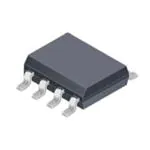
8-pin SOIC
(suffix L)
End-of-line trimming of the Hall element switchpoints provides
tight matching capability. The Allegro™ high-frequency
chopper stabilization technique cancels offsets in each channel,
providing stable operation over the full specified temperature
and voltage ranges.
Continued on the next page…
Not to scale
Functional Block Diagram
LDO Regulator
VCC
Programmable
Trim
L Package Only
OUTA
Amp
LowPass
Filter
Low Noise Signal
Recovery
Dynamic Offset
Cancellation
Hall
Element
E1
Output
Drive
2 Bit
Channel A
DIR
Direction
Logic
Output
Drive
SPD
2 Bit
Amp
LowPass
Filter
Low Noise Signal
Recovery
Dynamic Offset
Cancellation
Channel B
Hall
Element
E2
Output
Drive
L Package Only
OUTB
Output
Drive
GND
A1233-DS, Rev. 4
MCO-0000313
November 21, 2019
�A1233
Dual-Channel Hall-Effect Direction Detection Sensor IC
DESCRIPTION (continued)
The A1233 has integrated protection against transients on the supply
and output pins and short-circuit protection on all outputs.
The A1233 is available in a 4-pin SIP and a plastic 8-pin SOIC
surface-mount package. Both packages are lead (Pb) free, with
100% matte-tin leadframe plating.
SELECTION GUIDE
Part Number
Package
Packing [1]
A1233LK-T
4-pin through hole SIP
Bulk bag, 500 pieces/bag
A1233LLTR-T
8-pin surface mount SOIC
Tape and reel, 3000 pieces/reel
[1]
TA (°C)
–40 to 150
RoHS
Contact Allegro for additional packing options.
COMPLIANT
ABSOLUTE MAXIMUM RATINGS
Characteristic
Supply
Voltage [2]
Reverse Battery Voltage [2]
Output Off Voltage [2]
Reverse Output Voltage [2]
Reverse Output Current
Output Sink Current
Magnetic Flux
Density [3]
Symbol
Rating
Units
VCC
26.5
V
VRCC
–18
V
VOUTPUT
VCC
V
VROUT
–0.5
V
IROUT
–10
mA
IOUTPUT(Sink)
30
mA
B
Unlimited
–
–40 to 150
°C
TJ(max)
165
°C
Tstg
–65 to 170
°C
Operating Ambient Temperature
TA
Maximum Junction Temperature
Storage Temperature
Notes
Range L
This rating does not apply to extremely short voltage transients such as Load Dump and/or ESD. Those events have individual ratings, specific to the respective transient voltage event.
[3] Guaranteed by design.
[2]
Allegro MicroSystems
955 Perimeter Road
Manchester, NH 03103-3353 U.S.A.
www.allegromicro.com
2
�A1233
Dual-Channel Hall-Effect Direction Detection Sensor IC
PINOUT DIAGRAMS AND TERMINAL LIST
Pinout Diagrams
7 NC
OUTA
3
6 NC
SPD
4
5 OUTB
2
VCC
1
L Package
3
4
SPD
8 GND
2
GND
1
DIR
DIR
VCC
K Package
Terminal List Table
Number
Name
Description
K
L
1
1
VCC
Input power supply; tie to GND with bypass capacitor
2
2
DIR
Output signal indicating direction of target movement
–
3
OUTA
Output from E1 via a Schmitt circuit
3
4
SPD
Output signal indicating speed of target movement
–
5
OUTB
–
6, 7
NC
4
8
GND
Output from E2 via a Schmitt circuit
No connection
Ground connection
Allegro MicroSystems
955 Perimeter Road
Manchester, NH 03103-3353 U.S.A.
www.allegromicro.com
3
�A1233
Dual-Channel Hall-Effect Direction Detection Sensor IC
OPERATING CHARACTERISTICS: Valid over operating voltage and temperature ranges, unless otherwise noted; typical
data applies to VCC = 12 V, and TA = 25°C
Characteristic
Symbol
Test Conditions
Min.
Typ.
Max.
Unit [1]
3.5
–
24
V
–
BOP(A) and B > BOP(B)
2.5
4.5
8.0
mA
All outputs, Output = On, IOUTPUT(SINK) = 20 mA
–
160
500
mV
All outputs
30
–
70
mA
–
520
–
kHz
Output Current Limit
IOUTLIM
Chopping Frequency
fC
Output Rise Time
tr
CLOAD = 20 pF, RLOAD = 820 Ω
–
0.3
–
µs
Output Fall Time
tf
CLOAD = 20 pF, RLOAD = 820 Ω
–
0.2
–
µs
Delay between direction output changing and speed
output transition, VCC = 5 V, CLOAD = 12 pF, RLOAD =
820 Ω, RLOAD connected to 5 V
–
2
5
µs
Speed Output Delay
ΔtDIRSPD
Power-On Time
tON
B > BOP + 10 G or B < BRP – 10 G
–
35
–
µs
Power-Off Time
tOFF
B > BOP + 10 G or B < BRP – 10 G
–
36
–
µs
Power-On State
POS
B = 0 G (reference Typical Application diagram)
–
High
–
–
TRANSIENT PROTECTION CHARACTERISTICS
Supply Zener Voltage
VZ
ICC = ICC(max) + 3 mA, TA = 25°C
28
–
–
V
Supply Zener Current [3]
IZ
VS = 28 V
–
–
11
mA
Reverse-Battery Current
IRCC
VRCC = –18 V, TJ < TJ(max)
–
2
15
mA
–
–
3.4
V
Undervoltage Lockout
VUVLO
MAGNETIC CHARACTERISTICS [4]
Operate Point (Channel A and Channel B)
BOP
B(A) > BOP(A), B(B) > BOP(B)
–35
15
55
G
Release Point (Channel A and Channel B)
BRP
B(A) < BOP(A), B(B) < BOP(B)
–55
–15
35
G
Bhys
BOP – BRP
10
30
60
G
Operate Symmetry
SYMOP(AB)
BOP(A) – BOP(B)
–50
–
50
G
Release Symmetry
SYMRP(AB)
BRP(A) – BRP(B)
–50
–
50
G
Hysteresis (Channel A and Channel B)
[1] 1
G (gauss) = 0.1 mT (millitesla).
operating at maximum voltage, never exceed maximum junction temperature, TJ(max). Refer to power derating curve charts.
[3] Maximum specification limit is equivalent to I
CC(max) + 3 mA.
[4] Magnetic flux density, B, is indicated as a negative value for north-polarity magnetic fields, and as a positive value for south-polarity magnetic fields.
This so-called algebraic convention supports arithmetic comparison of north and south polarity values, where the relative strength of the field is
indicated by the absolute value of B, and the sign indicates the polarity of the field (for example, a –100 G field and a 100 G field have equivalent
strength, but opposite polarity).
Output Signal, VOUTPUT
[2] When
tf
tr
VOUTPUT(OFF)
90% VOUTPUT
10% VOUTPUT
VOUTPUT(ON)
Time
Definition of Output Fall Time, tf , and Output Rise Time, tr
Allegro MicroSystems
955 Perimeter Road
Manchester, NH 03103-3353 U.S.A.
www.allegromicro.com
4
�A1233
Dual-Channel Hall-Effect Direction Detection Sensor IC
THERMAL CHARACTERISTICS: May require derating at maximum conditions; see application information
Characteristic
Symbol
Package Thermal Resistance
RθJA
Test Conditions*
Value
Unit
Package K, single-sided PCB with copper limited to solder pads
177
°C/W
Package L, single-sided PCB with copper limited to solder pads
140
°C/W
Package L, 4-layer PCB based on JEDEC standard
80
°C/W
Maximum Allowable VCC (V)
*Additional thermal information available on Allegro website.
Power Derating Curve
27
26
25
24
23
22
21
20
19
18
17
16
15
14
13
12
11
10
9
8
7
6
5
4
3
2
VCC(max)
Package L
(RθJA = 80 ºC/W)
Package L
(RθJA = 140 ºC/W)
Package K
(RθJA = 177 ºC/W)
VCC(min)
20
40
60
80
100
120
140
160
180
Temperature (ºC)
Power Dissipation versus Ambient Temperature
2000
Power Dissipation, PD (mW)
1800
1600
Package L
(RθJA = 80 ºC/W)
1400
1200
1000
Package L
(RθJA = 147 ºC/W)
800
600
400
Package K
(RθJA = 177 ºC/W)
200
0
20
40
60
80
100
120
Temperature (°C)
140
160
180
Allegro MicroSystems
955 Perimeter Road
Manchester, NH 03103-3353 U.S.A.
www.allegromicro.com
5
�A1233
Dual-Channel Hall-Effect Direction Detection Sensor IC
CHARACTERISTIC PERFORMANCE DATA
Supply Current versus Supply Voltage
7.5
7.5
6.5
6.5
5.5
VCC = 24 V
4.5
VCC = 12 V
VCC = 3.5 V
3.5
2.5
-60
ICC (mA)
ICC (mA)
Supply Current versus Ambient Temperature
-40
-20
0
20
40
60
80
100
TA = 25°C
5.5
4.5
3.5
120
140
2.5
160
0
5
10
TA (°C)
Low Output Voltage versus Ambient Temperature
35
350
250
200
150
15
5
-5
100
-15
50
-25
-40
-20
0
20
40
60
80
100
120
140
-35
-60
160
VCC (V)
3.5
12
24
-40
-20
0
20
TA (°C)
40
60
80
100
120
140
160
TA (°C)
Release Point versus Ambient Temperature
Switchpoint Hysteresis versus Ambient Temperature
35
60
25
50
45
BHYS (G)
5
VCC (V)
3.5
12
24
55
VCC (V)
3.5
12
24
15
BRP (G)
30
25
300
BOP (G)
VOUTPUT(ON) (mV)
45
400
-5
-15
-25
40
35
30
25
-35
20
-45
15
-55
-60
25
55
450
0
-60
20
Operate Point versus Ambient Temperature
VCC = 12 V
500
15
VCC (V)
-40
-20
0
20
40
60
TA (°C)
80
100
120
140
160
10
-60
-40
-20
0
20
40
60
80
100
120
140
160
TA (°C)
Allegro MicroSystems
955 Perimeter Road
Manchester, NH 03103-3353 U.S.A.
www.allegromicro.com
6
�A1233
Dual-Channel Hall-Effect Direction Detection Sensor IC
FUNCTIONAL DESCRIPTION
The integrated circuit contains an internal voltage regulator
that powers the Hall elements and both the analog and digital
circuitry. This regulator allows operation over a wide supply
voltage range and provides some immunity to supply noise. The
device also contains logic circuitry that decodes the direction of
rotation of the ring magnet.
Quadrature/Direction Detection Internal logic circuitry pro-
vides outputs representing the speed and direction of the magnetic field across the face of the package. For the direction signal
to be appropriately updated, a quadrature relationship must be
maintained between the target magnetic pole width, the pitch
between the two Hall elements (E1 and E2) in the device, and, to
a lesser extent, the magnetic switchpoints.
For optimal design, the device should be actuated by a ring
magnet that presents to the front of the device a field with a pole
width two times the Hall element-to-element spacing. This will
produce a sinusoidal magnetic field whose period (denoted as Τ)
is then four times the element-to-element spacing. A quadrature
relationship can also be maintained for a ring magnet with fields
having a period that satisfies the relationship:
nΤ/4 = 1.63 mm ,
where n is any odd integer. Therefore, ring magnets with polepair spacing equal to 6.52 mm (n = 1), 2.17 mm (n = 3), 1.3 mm
(n = 5), and so forth, are permitted. The response of the device
to the magnetic field produced by a rotating ring magnet is
shown in figure 1. Note the phase shift between the two integrated Hall elements.
Outputs The device provides up to four outputs: target direction
(DIR pin), E1 element output (OUTA pin), E2 element output
(OUTB pin), and target speed (SPD pin).
DIR provides the direction output of the device and is defined
as off (high) for targets moving in the direction from E1 to E2
and on (low) for the direction E2 to E1. SPD provides an XORed
output of the two Hall elements (see figure 1). Because of internal delays, DIR is always updated before SPD and is updated at
every transition of OUTA and OUTB (internal) allowing the use
of up-down counters without the loss of pulses.
Power-on State At power on, the logic circuitry is reset to provide an off (high) state for all the outputs. If any of the channels
is subjected to a field greater than BOP, the internal logic will set
accordingly, and the outputs will switch to the expected state.
Power-on Time This characteristic, tON, is the elapsed time from
when the supply voltage reaches the device supply minimum
until the device output becomes valid (see figure 2).
Target changes direction of rotation
+B
Channel A
0
Magnetic Field at
Hall Element E1 –B
Channel B
Magnetic Field at
Hall Element E2
B > BOP + 10 G
+B
0
–B
OUTA
OUTB
SPD
(OUTA XOR
OUTB)
DIR
ΔtDIRSPD
Figure 1
Figure 2
Allegro MicroSystems
955 Perimeter Road
Manchester, NH 03103-3353 U.S.A.
www.allegromicro.com
7
�A1233
Dual-Channel Hall-Effect Direction Detection Sensor IC
APPLICATION INFORMATION
Functional Safety. The A1233 complies with the
below). This rotation decreases the effective Hall element-toelement spacing, provided that the Hall elements are not rotated
beyond the width of the target.
2
international standard for automotive functional
safety, ISO 26262:2011, as a Quality Managed
(QM) product. The device is classified as a SEooC
(Safety Element out of Context) and can be easily integrated into
safety-critical systems requiring higher ASIL ratings that incorporate external diagnostics or use measures such as redundancy.
Safety documentation will be provided to support and guide the
integration process. For further information, contact your local
Allegro field applications engineer or sales representative.
-
Applications. It is strongly recommended that an external
0.1 µF bypass capacitor be connected (in close proximity to the
device) between the supply and ground of the device to reduce
both external noise and noise generated by the internal logic.
The simplest form of magnet that will operate these devices is a
ring magnet. Other methods of operation, such as linear magnets,
are possible. Extensive applications information on magnets and
Hall-effect sensor ICs is also available in the “Hall-Effect IC
Applications Guide” which can be found on the Allegro website,
www.allegromicro.com.
Operation with Fine-Pitch Ring Magnets. For targets with a
circular pitch of less than 4 mm, a performance improvement
can be observed by rotating the front face of the device (see
Normal Coplanar Alignment
Rotated Alignment
D cos α
D
Target Profile of Rotation
S
N
S
E1
E1
E2
E2
α
Target Circular Pitch, P
Target Face Width, F
F < D sin α
Typical Application
(Using regulated supply; K package configuration shown)
VSPD
VDIR
RLOAD
2
DIR
RLOAD
VSupply
1
CLOAD
A1233
VCC
CLOAD
SPD
3
A 100 Ω
0.1 µF
GND
4
A Resistor is optional, depending on Conducted Immunity requirements
Allegro MicroSystems
955 Perimeter Road
Manchester, NH 03103-3353 U.S.A.
www.allegromicro.com
8
�A1233
Dual-Channel Hall-Effect Direction Detection Sensor IC
POWER DERATING
The device must be operated below the maximum junction
temperature of the device, TJ(max). Under certain combinations of
peak conditions, reliable operation may require derating supplied power or improving the heat dissipation properties of the
application. This section presents a procedure for correlating
factors affecting operating TJ. (Thermal data is also available on
the Allegro MicroSystems website.)
The Package Thermal Resistance, RθJA, is a figure of merit summarizing the ability of the application and the device to dissipate
heat from the junction (die), through all paths to the ambient air.
Its primary component is the Effective Thermal Conductivity,
K, of the printed circuit board, including adjacent devices and
traces. Radiation from the die through the device case, RθJC, is
relatively small component of RθJA. Ambient air temperature,
TA, and air motion are significant external factors, damped by
overmolding.
The effect of varying power levels (Power Dissipation, PD), can
be estimated. The following formulas represent the fundamental
relationships used to estimate TJ, at PD.
PD = VIN × IIN
(1)
ΔT = PD × RθJA
(2)
TJ = TA + ΔT
(3)
For example, given common conditions such as: TA= 25°C,
VCC = 12 V, ICC = 4.5 mA, and RθJA = 177°C/W, then:
Example: Reliability for VCC at TA = 150°C.
Observe the worst-case ratings for the device, specifically:
RθJA = 177°C/W, TJ(max) = 165°C, VCC(max) = 24 V, and
ICC(max) = 8 mA.
Calculate the maximum allowable power level, PD(max). First,
invert equation 3:
ΔT(max) = TJ(max) – TA = 165 °C – 150 °C = 15 °C
This provides the allowable increase to TJ resulting from internal
power dissipation.
Then, invert equation 2:
PD(max) = ΔT(max) ÷ RθJA = 15°C ÷ 177°C/W = 84.7 mW
Finally, invert equation 1 with respect to voltage:
VCC(est) = PD(max) ÷ ICC(max) = 84.7 mW ÷ 8 mA = 10.59 V
The result indicates that, at TA, the application and device can
dissipate adequate amounts of heat at voltages ≤VCC(est).
Compare VCC(est) to VCC(max). If VCC(est) ≤ VCC(max), then reliable operation between VCC(est) and VCC(max) requires enhanced
RθJA. If VCC(est) ≥ VCC(max), then operation between VCC(est) and
VCC(max) is reliable under these conditions.
PD = VCC × ICC = 12 V × 4.5 mA = 54 mW
ΔT = PD × RθJA = 54 mW × 177°C/W = 9.6°C
TJ = TA + ΔT = 25°C + 9.6°C = 34.6°C
A worst-case estimate, PD(max), represents the maximum allowable power level, without exceeding TJ(max), at a selected
RθJA and TA.
Allegro MicroSystems
955 Perimeter Road
Manchester, NH 03103-3353 U.S.A.
www.allegromicro.com
9
�A1233
Dual-Channel Hall-Effect Direction Detection Sensor IC
Package K, 4-Pin SIP
+0.08
5.21 –0.05
45°
B
E
1.63
E
1.55 ±0.05
1.79
D
1.32 E
+0.08
3.43 –0.05
E1
E2
2.16
MAX
Branded
Face
2
3
1
D Standard Branding Reference View
0.84 REF
N = Device part number
Y = Last two digits of year of manufacture
W = Week of manufacture
For Reference Only; not for tooling use (reference DWG-9010)
Dimensions in millimeters
Dimensions exclusive of mold flash, gate burrs, and dambar protrusions
Exact case and lead configuration at supplier discretion within limits shown
4
14.73 ±0.51
+0.06
0.38 –0.03
+0.07
0.41 –0.05
YYWW
45°
A
1
NNNN
Mold Ejector
Pin Indent
A
Dambar removal protrusion (8X)
B
Gate and tie bar burr area
C
Branding scale and appearance at supplier discretion
D Active Area Depth, .0.42 mm
E Hall elements (E1 and E2); not to scale
1.27 NOM
Allegro MicroSystems
955 Perimeter Road
Manchester, NH 03103-3353 U.S.A.
www.allegromicro.com
10
�A1233
Dual-Channel Hall-Effect Direction Detection Sensor IC
Package L, 8-Pin SOIC
4.90 ±0.10
1.63 E
1.63 E
8
A
1
8°
0°
0.65
3.90 ±0.10
6.00 ±0.20
2
SEATING
PLANE
0.10 C
PCB Layout Reference View
C
NNNNNNN
YYWW
LLLLL
1.75 MAX
0.25
0.10
For Reference Only; not for tooling use (reference MS-012AA)
Dimensions in millimeters
Dimensions exclusive of mold flash, gate burrs, and dambar protrusions
Exact case and lead configuration at supplier discretion within limits shown
A Terminal #1 mark area
B Branding scale and appearance at supplier discretion
C
C
2
SEATING PLANE
GAUGE PLANE
Branded Face
8X
1.27 BSC
1
1.27
0.40
0.25 BSC
0.51
0.31
5.60
1.04 REF
E2
E 1.09
1.27
8
1.75
0.25
0.17
1.95 E
E1
D
1
B Standard Branding Reference View
N = Device part number
= Supplier emblem
Y = Last two digits of year of manufacture
W = Week of manufacture
L = Lot number
Reference land pattern layout (reference IPC7351
SOIC127P600X175-8M); all pads a minimum of 0.20 mm from all
adjacent pads; adjust as necessary to meet application process
requirements and PCB layout tolerances
D
Active Area Depth 0.40 NOM
E
Hall elements (E1 and E2); not to scale
Allegro MicroSystems
955 Perimeter Road
Manchester, NH 03103-3353 U.S.A.
www.allegromicro.com
11
�A1233
Dual-Channel Hall-Effect Direction Detection Sensor IC
Revision History
Number
Date
Description
–
January 15, 2013
1
September 21, 2015
Initial Release
Added AEC-Q100 qualification under Features and Benefits
2
September 26, 2017
Added Functional Safety information; added footnote to Absolute Maximum Ratings table
3
October 12, 2018
4
November 21, 2019
Added footnote to Magnetic Flux Density (page 2); minor editorial updates
Minor editorial updates
Copyright 2019, Allegro MicroSystems.
Allegro MicroSystems reserves the right to make, from time to time, such departures from the detail specifications as may be required to permit
improvements in the performance, reliability, or manufacturability of its products. Before placing an order, the user is cautioned to verify that the
information being relied upon is current.
Allegro’s products are not to be used in any devices or systems, including but not limited to life support devices or systems, in which a failure of
Allegro’s product can reasonably be expected to cause bodily harm.
The information included herein is believed to be accurate and reliable. However, Allegro MicroSystems assumes no responsibility for its use; nor
for any infringement of patents or other rights of third parties which may result from its use.
Copies of this document are considered uncontrolled documents.
For the latest version of this document, visit our website:
www.allegromicro.com
Allegro MicroSystems
955 Perimeter Road
Manchester, NH 03103-3353 U.S.A.
www.allegromicro.com
12
�