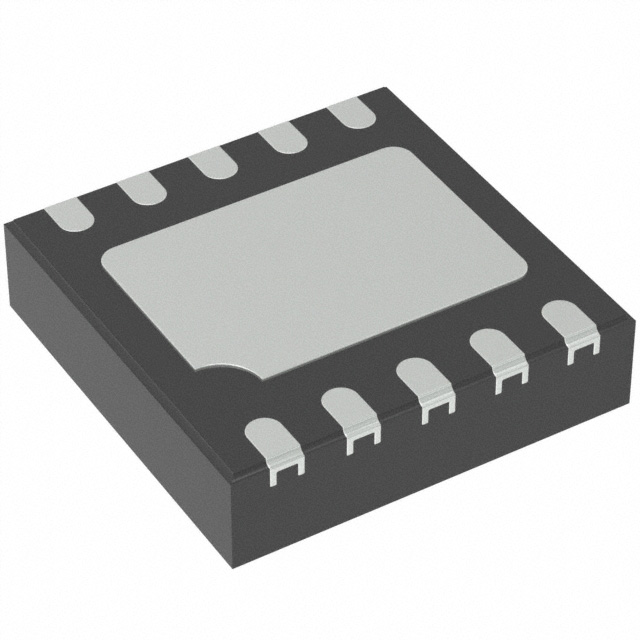
ALT80802
Wide Input Voltage, Adjustable Frequency,
Buck-Boost or Buck 2 Amp LED Driver
FEATURES AND BENEFITS
• Automotive AEC-Q100 qualified
• Supports buck-boost or buck mode operation
• Supply voltage from 3.8 to 50 V
▫▫ Handles automotive load dump and cold crank
▫▫ Can be run in buck mode from a pre-boost supply
• 150 mΩ integrated MOSFET switch
• Supports up to 16 V output in buck-boost mode for
4 WLEDs
• Programmable switching frequency up to 2.5 MHz for
small solution size and operation above AM band
• Designed for low EMC with frequency dithering
• Integrated level shifting allows ground-referenced enable
and fault flag in buck-boost mode
• PWM dimming via direct logic input or power supply
voltage
• Robust protection against:
▫▫ Adjacent pin-to-pin short
▫▫ Pin-to-VSS (IC ground) short
▫▫ Component open/short faults
• Turn/stop lights
• Map light
• Dimmable interior lights
PACKAGE:
10-Pin DFN with Exposed Thermal Pad and Wettable Flank
(suffix EJ)
Not to scale
The ALT80802 is a high-frequency switching regulator that
provides constant output current to drive high-power LEDs. It
integrates a power MOSFET for step-down or inverting buckboost conversion. With current-mode control and simple external
compensation, the ALT80802 can achieve fast transient response.
The wide input range of 3.8 to 50 V makes the ALT80802
suitable for a wide range of lighting applications, including
those in an automotive input environment. The device rating also
enables a simple solution for driving 3 to 4 WLEDs in buckboost configuration—a very common application requirement
for automotive lighting applications.
The ALT80802 is designed to aid in EMC/EMI design by
frequency dithering, soft freewheel diode turn-off, and wellcontrolled switch node slew rates. A programmable oscillator
allows the ALT80802 to switch outside EMI-sensitive frequency
bands such as the AM band.
With current-mode control and simple external compensation,
the ALT80802 can achieve fast transient response. The control
loop of the ALT80802 is designed for PWM dimming operation
to achieve low dimming on-time and low turn-on overshoot.
In buck-boost operation, the ALT80802 reduces the current
overshoot normally caused by right half plane zero effect
during a PWM dimming turn-off transient.
Extensive protection features of the ALT80802 include pulse-bypulse current limit, hiccup mode short-circuit protection, open/
short freewheeling diode protection, BOOT open/short voltage
protection, VIN undervoltage lockout, and thermal shutdown.
Also, it includes internal clamp to prevent output voltage runaway
if output LED string is opened in buck-boost operation.
The ALT80802 is available in industry-standard 10 pin DFNpackage with thermal pad and wettable flank.
CBST
CBST
LO
BST
LO
LED+
SW
GND
CIN
RFREQ
COUT
VSS
COMP
FREQ
+
VIN
–
CZ
RZ
D
RSENSE
Downloaded from Arrow.com.
CS
EN
FFn
CIN
CIC
RFREQ
COUT
COMP
GND
LED–
Figure 1: ALT80802 Buck Simplified Schematic
ALT80802-DS
MCO-0000502
+
VIN
–
VIN
FREQ
CS
EN
FFn
LED+
SW
BST
VIN
VSS
APPLICATIONS
Automotive lighting
• Daytime running lights
• Front and rear fog lights
DESCRIPTION
CZ
RZ
D
LED–
RSENSE
Figure 2: ALT80802 Buck-Boost Simplified Schematic
September 10, 2018
�Wide Input Voltage, Adjustable Frequency,
Buck or Buck-Boost 2 Amp LED Driver
ALT80802
SPECIFICATIONS
SELECTION GUIDE
Part Number
Package
Packing [1]
ALT80802KEJJTR
10-pin DFN with thermal pad and wettable flank
1500 pieces per 7-inch reel
[1]
Contact Allegro for additional packing options.
ABSOLUTE MAXIMUM RATINGS [2]
Characteristic
Symbol
Input Voltage
VIN
Switch Node Voltage
VSW
Notes
t < 250 ns
t < 50 ns
Bootstrap Pin to Switch Node
VBST-SW
VSS to GND
VGND-VSS
Limits output to –20 V
Rating
Unit
−0.3 to 55
V
−0.3 to VIN + 0.3
V
−1.5
V
VIN + 3
V
−0.3 to 6
V
−0.3 to 20
V
EN, FREQ, CS, FFn
With respect to VSS pin
−0.3 to VIN + 0.3
V
All other pins
With respect to VSS pin
−0.3 to 6
V
Junction Temperature
TJ
−40 to 150
°C
Storage Temperature Range
Tstg
−40 to 150
°C
Stresses beyond those listed in this table may cause permanent damage to the device. The absolute maximum ratings are stress ratings only, and functional operation
of the device at these or any other conditions beyond those indicated in the Electrical Characteristics table is not implied. Exposure to absolute-maximum-rated conditions
for extended periods may affect device reliability.
[2]
RECOMMENDED OPERATING CONDITIONS
Characteristic
Symbol
Test Conditions
Value
Unit
DC Input voltage
VIN
GND connected to VSS
6 to 36
V
Transient Input Voltage
VIN
GND connected to VSS
3.8 to 50
V
Junction Temperature
TJ
−40 to 150
°C
THERMAL CHARACTERISTICS: May require derating at maximum conditions; see application information
Characteristic
Symbol
Junction-to-Ambient Thermal Resistance
RθJA
[3] Additional
Test Conditions [3]
Value
Unit
45
°C/W
DFN-10 (EJ) package on 4-layer PCB based on JEDEC standard
thermal information available on the Allegro website.
Allegro MicroSystems, LLC
955 Perimeter Road
Manchester, NH 03103-3353 U.S.A.
www.allegromicro.com
Downloaded from Arrow.com.
2
�Wide Input Voltage, Adjustable Frequency,
Buck or Buck-Boost 2 Amp LED Driver
ALT80802
Table of Contents
Frequency Dithering..........................................................11
Pulse-by-Pulse Current Limit..............................................11
Switch Overcurrent Protection and Hiccup Mode..................11
Secondary Switch Overcurrent Protection............................11
BOOT Capacitor Protection. ..............................................11
Freewheeling Diode Protection...........................................11
Output Overcurrent Protection........................................... 12
Output Overvoltage Protection. ......................................... 12
Thermal Shutdown. ......................................................... 12
Applications Information. ..................................................... 13
Setting the Switching Frequency. ...................................... 13
Setting the Output Voltage................................................ 13
Inductor.......................................................................... 13
Freewheeling Diode......................................................... 14
Input Capacitor................................................................ 14
Output Capacitor............................................................. 15
Compensation Components.............................................. 15
Design Example.............................................................. 18
Typical Application Schematics............................................. 21
PCB Component Placement and Routing. ............................. 22
Buck LED Driver.............................................................. 22
Buck-Boost LED Driver. ................................................... 24
Application Circuit Examples................................................ 26
Package Outline Drawing. ................................................... 33
Features and Benefits. .......................................................... 1
Description........................................................................... 1
Applications. ........................................................................ 1
Package.............................................................................. 1
Simplified Schematics. .......................................................... 1
Specifications....................................................................... 2
Selection Guide................................................................. 2
Absolute Maximum Ratings. ............................................... 2
Recommended Operating Conditions................................... 2
Thermal Characteristics...................................................... 2
Functional Block Diagram...................................................... 3
Pinout Diagram and Terminal List. .......................................... 5
Electrical Characteristics........................................................ 6
Fault Table........................................................................... 8
Functional Description........................................................... 9
Overview.......................................................................... 9
PWM Control. ................................................................... 9
Error Amplifier................................................................... 9
Slope Compensation........................................................ 10
Internal Regulator............................................................ 10
Enable and PWM Dimming............................................... 10
Undervoltage Lockout (UVLO). ......................................... 10
Startup and Shutdown...................................................... 10
MOSFET Driver and Bootstrap Capacitor. .......................... 10
Boot
Charge
UVLO
BST
SW
VIN
EN
Level
Shi�
Off
Delay
ON
LDO
Fault
Detect
FFn
VREG
BST
Level
Shi�
ON
FREQ
Osc
PWM
Generator
CS
-
Dither
Generator
GND
+
18 V
+
0.2 V
COMP
VSS
Figure 3: Functional Block Diagram
Allegro MicroSystems, LLC
955 Perimeter Road
Manchester, NH 03103-3353 U.S.A.
www.allegromicro.com
Downloaded from Arrow.com.
3
�Wide Input Voltage, Adjustable Frequency,
Buck or Buck-Boost 2 Amp LED Driver
ALT80802
PINOUT DIAGRAM AND TERMINAL LIST
VIN
1
EN
2
FFn
3
FREQ
GND
10 BST
9
SW
8
CS
4
7
COMP
5
6
VSS
PAD
Package EJ Pinouts
Terminal List Table
Pin
Name
Pin
Number
Description
VIN
1
Power input for the control circuits and the drain of the internal high-side N-channel MOSFET. Connect this pin to a
power source. A high quality ceramic capacitor should be placed very close to this pin and GND.
EN
2
Input for Enable and PWM dimming; rated up to VIN and logic-level compatible.
FFn
3
Open-drain fault flag output which is pulled low in case of fault. Connect through an external pull-up resistor to the
desired level. This pin should be left open if not used.
FREQ
4
Frequency setting pin. A resistor, RFREQ, from this pin to VSS sets the PWM switching frequency. See Table 2 to
determine the value of RFREQ.
GND
5
Enable and fault flag ground reference. Connect to input supply ground.
VSS
6
ALT80802 return. Connect to lowest circuit potential. This is input ground when configured as a buck converter
and should be connected to the GND pin. It is the negative output when configured as a buck-boost converter. See
typical application schematics for more detail.
COMP
7
Output of the error amplifier and compensation node for the current-mode control loop. Connect a series RC
network from this pin to VSS for loop compensation. See the Applications section of this datasheet for further
details.
CS
8
Feedback (negative) input to the error amplifier. Connect a resistor from this pin to VSS to program the output load
current.
SW
9
The source of the internal MOSFET. The output inductor (LO) and cathode of the free-wheeling diode (D) should
be connected to this pin. LO and D should be placed as close as possible to this pin and connected with relatively
wide traces.
BST
10
Bootstrap capacitor connection. A 0.22 µF or higher capacitor is recommended between this pin and SW pin. The
voltage on this capacitor drives the internal MOSFET via the high side gate driver.
Allegro MicroSystems, LLC
955 Perimeter Road
Manchester, NH 03103-3353 U.S.A.
www.allegromicro.com
Downloaded from Arrow.com.
4
�Wide Input Voltage, Adjustable Frequency,
Buck or Buck-Boost 2 Amp LED Driver
ALT80802
ELECTRICAL CHARACTERISTICS [1]: Valid for VIN = 12 V, VEN = 2.5 V, VCOMP = 1.4 V, VSS = GND,
–40°C ≤ TJ ≤ 125°C, typical values at TJ = 25°C, unless otherwise specified
Characteristics
Symbol
Test Conditions
Min.
Typ.
Max.
Unit
VEN ≥ 2.5 V, VIN with respect to VSS
3.8
12
50
V
GENERAL SPECIFICATIONS
Operating Input Voltage
VIN
VIN UVLO Start
VIN(START)
VIN rising, with respect to VSS
3.0
3.3
3.6
V
VIN UVLO Stop
VIN(STOP)
VIN falling, with respect to VSS
2.7
3.0
3.3
V
IQ(SLEEP)
VEN = 0 V
–
11
20
µA
Supply Quiescent
Current [1]
PWM SWITCHING FREQUENCY
Switching Frequency
fSW
RFSET = 8.06 kΩ
1.8
2.0
2.2
MHz
RFSET = 41.2 kΩ
360
400
440
kHz
Dither Frequency Sweep
∆fSW
–
±5
–
%
Dither Modulation Frequency
fMOD
–
12
–
kHz
THERMAL PROTECTION
Thermal Shutdown Threshold [2]
TTSD
–
170
–
°C
Thermal Shutdown Hysteresis [2]
THYS
–
20
–
°C
Minimum On-Time
tON(MIN)
–
80
100
ns
Minimum Off-Time
tOFF(MIN)
–
100
–
ns
–
150
–
mΩ
0.192
0.200
0.208
V
TJ rising
PULSE-WIDTH MODULATION (PWM)
INTERNAL MOSFET
MOSFET On Resistance
RDS(on)
VBOOT-SW = 5 V, TJ = 25°C [2]
ERROR AMPLIFIER
Current Sense Voltage
VCS
Current Sense Pin Bias Current
Error Amplifier Voltage Gain
Error Amplifier Transconductance
Error Amplifier Min. Source Current [3]
Error Amplifier Min. Sink
Current [3]
3.8 V ≤ VIN ≤ 50 V, –40°C ≤ TJ ≤ 150°C
ICS
–
–
100
nA
AVOL
–
1000
–
V/V
gm
ICOMP = ±3 µA
–
120
–
µA/V
IEA(SOURCE)
VCS = 0.1 V
–
–13.6
–
µA
IEA(SINK)
VCS = 0.3 V
–
13.6
–
µA
For input and output current specifications, negative current is defined as coming out of the node or pin (sourcing), positive current is defined as going into the node or
pin (sinking).
[2] Ensured by design and characterization; not production tested.
[3] Minimum source and sink current is the minimum current ensured to be provided when COMP demands maximum sink/source current.
[1]
Continued on next page...
Allegro MicroSystems, LLC
955 Perimeter Road
Manchester, NH 03103-3353 U.S.A.
www.allegromicro.com
Downloaded from Arrow.com.
5
�Wide Input Voltage, Adjustable Frequency,
Buck or Buck-Boost 2 Amp LED Driver
ALT80802
ELECTRICAL CHARACTERISTICS [1] (continued): Valid for VIN = 12 V, VEN = 2.5 V, VCOMP = 1.4 V, VSS = GND,
–40°C ≤ TJ ≤ 125°C, typical values at TJ = 25°C, unless otherwise specified
Characteristics
Symbol
Test Conditions
Min.
Typ.
Max.
Unit
CURRENT PROTECTION
Pulse-by-Pulse Switch Current Limit
ILIM
Duty cycle 0 to 85%
3.5
5.5
6.5
A
Secondary Current Limit
ILIM(SEC)
Hiccup after 2 counts
–
7.1
–
A
COMP to Current Sense
Transconductance [2]
GCS
–
9
–
A/V
Slope Compensation
Output Overcurrent
SE(2MHz)
Measured at fSW = 2 MHz
–
3.1
–
A/µs
VOCP
With respect to nominal VCS voltage
–
400
–
%
VOVP
GND – VSS, when in buck-boost topology
16
18
20
V
VEN(H)
VEN with respect to GND
1.8
–
–
V
VEN(L)
VEN with respect to GND
–
–
0.4
V
–
100
–
mV
OVERVOLTAGE PROTECTION
Maximum Output Voltage
LOGIC ENABLE
EN Logic High Voltage
EN Logic Low Voltage
EN Hysteresis
EN Pin Pull-Down Resistance
VEN(HYS)
RENPN
VEN = 5 V
–
80
–
kΩ
tPWML
Measured while EN = low, during dimming
control, and internal references are powered-on
(exceeding tPWML results in shutdown)
12
20
–
ms
Fault Pull-Down Voltage
VFFn(PD)
Fault condition asserted, pull-up current = 1 mA
–
–
0.4
V
Fault Pin Leakage Current
IFFn(LKG)
Fault condition cleared, pull-up to 12 V
–
–
1
µA
Maximum PWM Dimming Off Time
FAULT PIN (FFn)
Cooldown Timer for Fault Retry
tRETRY
–
6
–
ms
Delay Timer for Reporting
Open LED Fault
tOPEN
–
50
–
µs
For input and output current specifications, negative current is defined as coming out of the node or pin (sourcing), positive current is defined as going into the node or
pin (sinking).
[2] Ensured by design and characterization, not production tested.
[1]
Allegro MicroSystems, LLC
955 Perimeter Road
Manchester, NH 03103-3353 U.S.A.
www.allegromicro.com
Downloaded from Arrow.com.
6
�Wide Input Voltage, Adjustable Frequency,
Buck or Buck-Boost 2 Amp LED Driver
ALT80802
Table 1: Fault Table
Failure Mode
Symptom Observed
Fault Flag
Asserted?
Protection
Mode
ALT80802 Response
Inductor shorted
Dim light from LED
Yes
Hiccup
Internal MOSFET switch is shorted. Current spike trips secondary current
limit after 2 counts. IC enters hiccup mode with 6 ms retry timer.
In buck topology, IC continues to switch at maximum tON (since this fault
cannot be distinguished from VIN too low for LED forward drop). Output
voltage, VOUT, increases until it reaches input voltage, VIN. Fault flag will
be asserted if current sense pin voltage, VCS, drops below 150 mV for
more than 50 µs.
In buck-boost topology, IC continues to switch at maximum tON. Output
voltage VOUT keeps increasing until it is clamped to VOVP. Fault flag will be
asserted if current sense pin voltage, VCS, drops below 150 mV for more
than 50 µs.
LED string open
No light from LED
Depends*
Clamp
LED string shorted
No light from LED
No
No
VOUT will be regulated to current sense voltage VCS (200 mV typical), no
fault is detected.
LED string
partially shorted
Some LEDs are not on
No
No
Normal operation, no fault is detected.
Diode open
Dim light from LED
Yes
Hiccup
Detects missing diode fault and shuts off switching. IC enters hiccup
mode with 6 ms retry timer.
Diode shorted
No light from LED
Yes
Hiccup
Current spike trips SW secondary current limit. IC enters hiccup mode. IC
enters hiccup mode with 6 ms retry timer.
Output capacitor
shorted
No light from LED
Yes
Hiccup
IC unable to regulate LED current at VOUT = 0 V. Switch current increases
until it trips current limit protection. IC enters hiccup mode with 6 ms retry
timer.
Output capacitor
open
LED may flicker
Depends
Depends
Sense resistor open
No light from LED
Yes
Hiccup
Output overcurrent protection is triggered. IC enters hiccup mode with
6 ms retry timer.
Sense resistor
shorted
Dim light from LED
Yes*
Hiccup
SW current increases, which eventually trips pulse-by-pulse SW current
limit. IC enters hiccup mode with 6 ms retry timer.
FSET resistor open
Dim light from LED
Yes
No
Operates at 772 kHz switching frequency. May hit thermal limit.
FSET resistor
shorted
Dim light from LED
Yes
No
Operates at 772 kHz switching frequency. May hit thermal limit.
Boot capacitor open
Dim light from LED
Yes
Hiccup
IC triggers missing Boot protection. IC enters hiccup mode with 6 ms retry
timer.
Boot capacitor
shorted
No light from LED
Yes
Hiccup
IC triggers Boot shorted protection. IC enters hiccup mode with 6 ms retry
timer.
LED current ripple increases.
Note (*)
• In case of LED current not in regulation, fault flag is asserted after approximately 50 μs timeout delay. In buck-boost topology, if binning resistors
are used, fault flag may not be asserted during an open LED fault.
• If sense resistor is shorted with high resistance wire, protection may not be triggered.
Allegro MicroSystems, LLC
955 Perimeter Road
Manchester, NH 03103-3353 U.S.A.
www.allegromicro.com
Downloaded from Arrow.com.
7
�Wide Input Voltage, Adjustable Frequency,
Buck or Buck-Boost 2 Amp LED Driver
ALT80802
FUNCTIONAL DESCRIPTION
Overview
The ALT80802 is a buck or buck-boost regulator that incorporates all the control and protection circuitry necessary to satisfy
a wide range of LED driver applications. The device employs
current-mode control to provide fast transient response, simple
compensation, and excellent stability.
The ALT80802 is designed to satisfy the most demanding automotive applications. Extensive protection features prevent the
device and the external components from most of the common
fault conditions. Care was taken when defining the device pinout
to optimize protection against adjacent pin-to-pin short circuits
and pin-to-ground (VSS) short circuits.
PWM Control
A high-speed PWM comparator, with minimum on-time less than
100 ns, is included in the ALT80802. The inverting input of the
comparator is connected to the output of the error amplifier. The
non-inverting input is connected to the current sense signal.
At the beginning of each PWM cycle, the clock signal sets the
PWM flip-flop and the internal power MOSFET is turned on.
When the current sense signal rises above the error amplifier
voltage (COMP pin voltage), the comparator resets the PWM
flip-flop and the high-side MOSFET is turned off.
If current sense signal is still higher than the error amplifier voltage before the next clock on signal, the PWM flip-flop will not be
set and the next PWM cycle is skipped to prevent output overcharged. This pulse-skipping mode of operation usually happens
at high input voltage and low output voltage when extremely
small duty cycle is required. Note that in pulse-skipping mode,
output ripple will be much higher.
In buck topology, the device will start to pulse skip when:
Equation 1:
1
In buck-boost topology, the device will start to pulse skip when:
Equation 2:
1
where fSW is the switching frequency and tON(MIN) is the minimum on-time.
If the current sense signal is lower than the error amplifier voltage for the entire PWM cycle, the PWM flip-flop will be reset
100 ns before the next PWM cycle. This maximum on-time
mode of operation means the regulator is in dropout region where
output cannot be regulated up to its target value. LED cannot be
turned on if output voltage cannot reach to its turn-on threshold.
In buck topology, the device will be in dropout region when:
Equation 3:
1
In buck-boost topology, the device will be in dropout region
when:
Equation 4:
1
where fSW is the switching frequency and tOFF(MAX) is the maximum on-time.
It is recommended to keep VIN above dropout region to avoid
LED brightness change. ALT80802 does not support dropout
region operation with PWM dimming.
Error Amplifier
The primary function of the transconductance error amplifier is to
regulate the voltage at the CS pin. By connecting a CS resistor in
series with the LED, output current is regulated. The negative input
of the error amplifier is connected to the CS pin, and the positive
input is connected to the internal reference voltage of 200 mV. The
voltage difference between the two inputs is amplified to charge or
discharge the compensation network connected to the COMP pin.
To stabilize the regulator, a series RC compensation network (RZCZ) must be connected from the error amplifier output (COMP
pin) to VSS as shown in the typical application schematic. In most
applications, an additional low-value capacitor (CP) should be connected in parallel with the RZ-CZ compensation network to roll-off
the loop gain at higher frequencies. However, if the CP capacitor
is too large, the phase margin of the regulator may be reduced. In
most cases, a CP value of 39 pF or less is recommended.
The minimum COMP voltage is clamped to 750 mV and its
maximum is clamped to 1.5 V. COMP is internally pulled down
to VSS during hiccup mode.
Allegro MicroSystems, LLC
955 Perimeter Road
Manchester, NH 03103-3353 U.S.A.
www.allegromicro.com
Downloaded from Arrow.com.
8
�ALT80802
Wide Input Voltage, Adjustable Frequency,
Buck or Buck-Boost 2 Amp LED Driver
Slope Compensation
The ALT80802 incorporates internal slope compensation (SE) to
allow PWM duty cycles above 50% for a wide range of input/
output voltages and inductor values. The slope compensation signal is added to the sum of the current sense amplifier output and
the PWM ramp offset. The amount of slope compensation scales
with the maximum on-time (1/fSW – tOFF(MIN)) centered around
3.1 A/μs at 2 MHz. The value of the output inductor should be
chosen such that SE is between 0.5× and 2× the down slope of the
inductor current (SLD).
Internal Regulator
An internal series-pass regulator (LDO) generates around 2.9 V
for most of the internal circuits of the ALT80802. The power for
this LDO is derived from VIN. The LDO is in full regulation once
VIN is greater than 3.0 V.
Enable and PWM Dimming
The enable (EN) input allows the system to selectively turn on/
off the ALT80802 control loop. The EN pin is rated to 55 V, so
the EN pin can be connected directly to VIN if there is no suitable logic signal available to wake up the regulator.
be overcharged and an LED current spike will be seen. To reduce
this current spike, the ALT80802 incorporates an internal bleeding circuit that will divert the extra current away from the LED
during the PWM dimming turn-off period.
If EN is low for more than tPWML, the IC enters shutdown mode
to reduce power consumption. The next high signal on EN will
initialize a full startup sequence before LED current starts to
build. Note that this startup sequence is not present during PWM
dimming operation.
The EN signal is referenced to the GND pin of the ALT80802. This
allows the user to use system-referenced signals to this pin even
when the output is configured as an inverting buck-boost regulator.
Undervoltage Lockout (UVLO)
An undervoltage lockout (UVLO) comparator monitors the
voltage at the VIN pin (with reference to VSS) and keeps the
regulator disabled if the voltage is below the lockout threshold
(VIN(START)). The UVLO comparator incorporates enough hysteresis (VIN(HYS)) to prevent on/off cycling of the regulator due to IR
drops in the VIN path during heavy loading or during startup.
Startup and Shutdown
An external logic signal can be applied to the EN pin to control
the on/off of LED current. Average brightness of the LED is
directly proportional to the duty cycle of the control signal. This
technique is commonly known as PWM dimming.
If both VIN and VEN are higher than their thresholds, the IC starts
up. The reference block starts first, generating stable reference
voltages and currents, and then the internal regulator is enabled.
The regulator provides stable supply for the remaining circuits.
When the EN pin is forced from high to low, the power MOSFET and the error amplifier are turned off, but the IC remains
in standby mode for tPWML (20 ms typical) before it completely
shuts down. This delay allows PWM dimming frequency down
to 100 Hz. In standby mode, the COMP pin is disconnected from
the error amplifier and the COMP pin voltage stays at the level
before EN turns low. In this way, the steady-state control signal
is stored. When the IC receives another EN turn-on signal within
tPWML, the system immediately recovers to steady-state operation. As a result, ALT80802 allows down to 15 µs PWM dimming on-time.
Three events can shut down the IC: EN low, VIN low, and thermal
shutdown. In the shutdown procedure, the power MOSFET is
turned off first to avoid any fault triggering. The COMP voltage
and the internal supply rail are then pulled down.
In buck-boost topology, the average inductor current is the sum
of the average input current and output current. When EN is
forced off during PWM dimming operation, the power MOSFET is turned off, cutting the connection from inductor to input
capacitor. The inductor current will dump all its energy in terms
of current to the output capacitor. This current is much higher
than the output current as it also contains the input current portion in buck-boost topology. As a result, the output capacitor will
MOSFET Driver and Bootstrap Capacitor
The position of the internal N-channel power MOSFET requires
special consideration when driving it. The source of this MOSFET is connected to the SW node and its voltage can be either
close to VIN or VSS. For this reason, a floating gate charge driver
is required. This driver requires a voltage greater than VIN to
ensure the MOSFET can be turned on.
A simple charge pump—consisting of an internal charge circuit,
an external capacitor (BST capacitor), and the freewheeling diode
—is required to power the high-side gate driver. The internal
charge circuit is power by VIN. When the SW node is sufficiently
below VIN, the charge circuit will charge the BST capacitor to
around 5 V with respect to the SW node. This BST voltage is
used to turn the high-side MOSFET on. As the SW node rises, the
Allegro MicroSystems, LLC
955 Perimeter Road
Manchester, NH 03103-3353 U.S.A.
www.allegromicro.com
Downloaded from Arrow.com.
9
�ALT80802
Wide Input Voltage, Adjustable Frequency,
Buck or Buck-Boost 2 Amp LED Driver
BST capacitor will maintain the BST pin at 5 V above SW, ensuring sufficient voltage to keep the MOSFET on.
Also, the BST charge circuit incorporates its own UVLO of 1.8 V
rising and 0.4 V hysteresis. When BST voltage (with respect to
SW pin) is less than UVLO, the power MOSFET is turned off.
Frequency Dithering
The ALT80802 includes a dithering function, which changes the
switching frequency within a certain frequency range. By shifting the switching frequency of the regulator in a triangle fashion
around the programmed switching frequency, the overall system
noise magnitude can be greatly reduced.
The dithering sweep is internally set at ±5%. The switching
frequency will ramp from a low of 0.95 times the programmed
frequency to a high of 1.05 times the programmed frequency. The
rate or modulation at which the frequency sweeps is governed by
an internal 12 kHz triangle pattern.
Pulse-by-Pulse Current Limit
A high-bandwidth current sense amplifier monitors the current in
the power MOSFET. The current signal is supplied to the PWM
comparator and overcurrent comparator. If the MOSFET current
exceeds ILIM, the MOSFET will be turned off. This protects the
MOSFET from excessive current and possible damage.
Switch Overcurrent Protection
and Hiccup Mode
A switch overcurrent (OC) counter and hiccup mode circuit
protect the regulator when the output of the regulator is shorted
to VSS (shorting output capacitor) or when the load current is too
high (shorting CS resistor).
The OC counter is enabled and begin counting every clock cycle
when COMP pin voltage, VCOMP, is clamped at its maximum
voltage. If VCOMP remains at its maximum voltage, the counter
keeps counting pulses from the overcurrent comparator. If VCOMP
decreases, the OC counter is cleared. If the OC counter reaches
120 counts, a hiccup latch is set, and the part enters hiccup mode.
In hiccup mode, the COMP pin is quickly pulled down by a relatively low resistance (4 kΩ). Switching is halted for 6 ms to provide time for the device to cool down. The FFn pin is pulled low
to indicate a fault condition. After the hiccup off time expires, the
device begins a startup sequence. If the fault condition remains,
another hiccup cycle occurs. If the fault has been removed, the
device starts up normally and the output automatically recovers
to target value.
Secondary Switch Overcurrent Protection
If the switch current continues to rise during the OC counting
period, a secondary switch current limit of 7.1 A can be reached
and the power MOSFET is turned off. If this secondary overcurrent is detected for more than 1 clock cycle, the hiccup latch
is set immediately, and the part enters hiccup mode. This usually
happens when SW is shorted to VSS.
BOOT Capacitor Protection
The ALT80802 monitors the voltage across the BOOT capacitor to detect if the capacitor is missing or short-circuited. If the
BOOT capacitor is missing, the device enters hiccup mode after 7
clock cycles. If the BOOT capacitor is shorted, the device enters
hiccup mode after 120 clock cycles. If BOOT capacitor voltage is
overcharged to more than 6.3 V, BOOT overvoltage protection is
triggered, and the IC enters hiccup mode after 7 PWM cycles.
Freewheeling Diode Protection
If the freewheeling diode is missing or damaged (open), the SW
pin is subjected to unusually high negative voltages. This negative voltage may cause the device to malfunction and could lead
to damage. The ALT80802 includes protection circuitry to detect
when the freewheeling diode is missing. If the SW pin is below
−1.25 V for more than 50 ns, the device enters hiccup mode
after detecting one missing diode fault. Also, if the freewheeling
diode is shorted, the device experiences extremely high currents
through the high-side MOSFET. If this occurs, the device triggers
a secondary switch current limit and enters hiccup mode.
During a diode short-circuit fault in buck-boost topology, VIN is
directly connected to VSS pin when the power MOSFET turns
on. This might cause a voltage spike from VSS to GND. Note
that the maximum rating for GND is –0.3 V with respect to VSS.
If the VSS voltage spike is higher than GND, it may cause a logic
error in the IC. As a result, for buck-boost topology, a Schottky
diode must be connected between VSS to GND to clamp the voltage spike during this fault.
Note that the reverse breakdown voltage of the diode must be
higher than the maximum output voltage (18 V) and the current
rating should be higher than 500 mA.
ALT80802
GND
VSS
Figure 4: VSS to GND Positive Clamp in Buck-Boost Applications
Allegro MicroSystems, LLC
955 Perimeter Road
Manchester, NH 03103-3353 U.S.A.
www.allegromicro.com
Downloaded from Arrow.com.
10
�ALT80802
Wide Input Voltage, Adjustable Frequency,
Buck or Buck-Boost 2 Amp LED Driver
Output Overcurrent Protection
The ALT80802 provides an always-on output overcurrent protection that monitors CS pin voltage to protect against extremely
high LED current. If CS pin voltage, VCS, rises to 800 mV, the
device enters hiccup mode immediately.
Output Overvoltage Protection in Buck-Boost
In buck-boost topology, during an open LED fault, output current
drops to zero and the control loop will try to compensate the loss
of current by demanding higher inductor current. Output voltage
across the capacitor is charged up immediately. In the ALT80802,
an 18 V Zener diode is placed between the positive output (GND)
to the negative input of the error amplifier. When output voltage rises to over 18 V, the negative input of the error amplifier
is charged up, forcing the inductor current to drop. In this way,
output voltage can be clamped to 18 V.
However, if the part starts up with an open LED fault, it may take
much longer time for the error amplifier to discharge the COMP
pin voltage. This delay time may cause the output voltage to rise
beyond 20 V, which is higher than the maximum rating for the IC.
If inductor current happens to be at a high level, a large current
may flow into the IC via the GND pin and the IC may be damaged. To prevent any damage to the IC, it is suggested to use an
external circuit, as shown in Figure 5, to stop the switching event
before high current flows into the GND pin.
10 kΩ
EN or PWM
Dimming
100 Ω
LED+
Input
Ground
40.2 Ω
COUT
IC
Ground
EN
NPN
ALT80802
GND
VSS
Figure 5: VSS to GND Positive Clamp
in Buck-Boost Applications
During an open LED fault, the CS pin voltage drops to zero and
the FFn pin will be pulled low if the CS pin voltage stays below
150 mV for more than 50 µs. Note that this undervoltage timer
is halted during the PWM dimming off period and will resume
when the next dimming cycle starts.
Thermal Shutdown
The ALT80802 protects itself from overheating by means of an
internal thermal monitoring circuit. If the junction temperature
exceeds the thermal shutdown threshold (TTSD, 170°C typical),
the COMP pin will be pulled to VSS and the power MOSFET
will be turned off. The ALT80802 will automatically restart when
the junction temperature decreases more than the thermal shutdown hysteresis (THYS, 20°C typical).
Allegro MicroSystems, LLC
955 Perimeter Road
Manchester, NH 03103-3353 U.S.A.
www.allegromicro.com
Downloaded from Arrow.com.
11
�Wide Input Voltage, Adjustable Frequency,
Buck or Buck-Boost 2 Amp LED Driver
ALT80802
APPLICATIONS INFORMATION
Setting the Switching Frequency
The switching frequency (fSW) of a regulator using the ALT80802
can be set by connecting a resistor from the FREQ pin (RFREQ)
to VSS. The recommended RFREQ value for various switching
frequencies can be obtained from Table 2:
Table 2: RFREQ vs. fSW
fSW (MHz)
RFREQ (kΩ)
2.5
6.34
2.0
8.06
1.8
8.87
1.5
10.7
1.0
16.2
0.8
20.5
0.5
33.2
0.4
41.2
0.3
56.2
0.2
84.5
0.2
619
RFREQ resistor can also be calculated with following equation:
mal foldback of the LED current or changing current based on
binning resistors.
Figure 6 shows the application schematic for adjusting LED current based on binning resistors. In this schematic, R1 is in parallel
with R3 and RBIN. These 3 resistors combining with R2 form a
resistor divider that raises the voltage across the sense resistor.
1
2
3
4
9
BST
VIN
ALT80802
LED+
LED+
BIN
BIN
U1
SW
CS
EN
FFn
COMP
FREQ
GND
VSS
5
6
10
R3
8
LED1
LED2
RBIN
R1
7
LED-
R2
LED-
LED3
Rsense
Figure 6: Application Circuit Example
for Binning Resistors
The regulated voltage across RSENSE can be calculated with the
following equation:
Equation 7:
Equation 5:
Output current can be calculated with the following equation:
where RFREQ is in kΩ and fSW is in MHz.
While the ALT80802 can switch at frequencies up to 2.5 MHz,
care must be taken when operating at higher frequencies. The
minimum controllable on-time for the ALT80802 is around 80 ns.
This means that at higher frequencies, high input voltages, and
low output voltages, pulse skipping may be seen.
Setting the Output Voltage
A resistor (RSENSE) from the CS pin to VSS sets the output current.
The output current can be calculated with following equation:
Equation 6:
The bias current of the CS is sufficiently low that is allows for a
series resistor between RSENSE and CS pin. This resistor allows
the user to perform analog dimming. This can be useful for ther-
Equation 8:
In this way, the regulated output current can be tuned by changing RBIN. Note that the purpose of R3 is to filter potential high
frequency noise coming from the long LED string cable.
Inductor
To ensure that the inductor operates in continuous mode, the
value of the inductor should be set such that half of the peak-topeak inductor current is not greater than the average inductor current. In buck topology, the average inductor current is the average
output current. In buck-boost topology, the average inductor
current is the sum of average input current and output current.
As a result, for buck regulators, the following must be guaranteed:
Equation 9:
Allegro MicroSystems, LLC
955 Perimeter Road
Manchester, NH 03103-3353 U.S.A.
www.allegromicro.com
Downloaded from Arrow.com.
12
�ALT80802
Wide Input Voltage, Adjustable Frequency,
Buck or Buck-Boost 2 Amp LED Driver
For buck-boost regulators, the following must be guaranteed:
For buck regulators, the peak inductor current can be calculated by:
Equation 10:
Equation 16:
where Dmin is the minimum duty cycle at maximum input voltage.
For buck-boost regulators, the peak inductor current can be calculated by:
To avoid subharmonic oscillation in the current-mode controlled
regulators when duty cycle is greater than 50%, the inductor
value should be set to match the slope compensation value at the
designed frequency.
Equation 17:
Slope compensation (SE) will vary with switching frequency.
SE can be calculated with the following equation:
The saturation current of the inductor should be higher than the
pulse-by-pulse current limit of the IC (5.5 A typical).
Equation 11:
Freewheeling Diode
The freewheeling diode allows the current in the inductor to flow to
the load when the high-side switch is off. To reduce losses due to the
diode forward voltage and recovery times, use a Schottky diode.
where SE is in A/µs and fSW is in MHz. The typical value of
SE(2MHz) is 3.1 A/µs.
For a stable system, the following is recommended:
Equation 12:
where SLD is the down slope of the inductor. For buck or buckboost regulators:
Equation 13:
where L is the inductor value in µH.
As a result, the following must be guaranteed:
Equation 14:
The recommended inductor value based on SE can be calculated
using the following equation:
Equation 15:
where Dmax is the maximum duty cycle at minimum input voltage.
The current rating of the inductor should be higher than the peak
current during operation.
In buck topology, the voltage rating of the diode must be higher
than the maximum input voltage. The average current rating of
the diode must be higher than maximum output current. In buckboost topology, the voltage rating of the diode must be higher
than the maximum sum of input voltage and output voltage. The
average current rating of the diode must be higher than maximum
sum of output current and input current. Note that the peak current of the diode is the peak inductor current.
If the application requires PWM dimming, it is recommended to
choose a diode with low reverse current IR. During PWM dimming off period, output capacitor voltage is discharged mostly by
the reverse current of the diode, especially at high temperature. A
smaller IR helps to reduce voltage drop of the output capacitor.
Input Capacitor
Three factors should be considered when choosing the input
capacitors. First, they must be chosen to support the maximum
expected input voltage with adequate design margin.
Second, their RMS current rating must be higher than the
expected RMS input current to the regulator. For simplification,
choose the input capacitor with an RMS current rating greater
than half of the load current. Generally, a MLCC capacitor can
provide enough RMS current with low heat generation.
Third, they must have enough capacitance and a low enough ESR
to limit the input voltage dv/dt to much less than the hysteresis of
the VIN pin UVLO circuitry (350 mV (typ)) at maximum loading
and minimum input voltage.
Allegro MicroSystems, LLC
955 Perimeter Road
Manchester, NH 03103-3353 U.S.A.
www.allegromicro.com
Downloaded from Arrow.com.
13
�ALT80802
Wide Input Voltage, Adjustable Frequency,
Buck or Buck-Boost 2 Amp LED Driver
The input capacitor(s) must limit the voltage deviations at the
VIN pin to something significantly less than the ALT80802 VIN
pin UVLO hysteresis during maximum load and minimum input
voltage.
For buck regulators, the minimum input capacitance can be
calculated as:
Equation 18:
For buck-boost regulators, the minimum input capacitance can be
calculated as:
Equation 21:
where ∆IL is the peak-to-peak inductor current, ILPK is the peak
inductor current.
To reduce the overall output ripple, it is recommended to use
ceramic output capacitors, especially for buck-boost regulators.
The ESR and ESL of the ceramic capacitors are virtually zero.
If ceramic output capacitors are used, for buck regulators, calculate:
Equation 22:
Equation 19:
For buck-boost regulators, calculate:
where ΔVIN is the output capacitor voltage deviation, η is the
estimated efficiency of the regulator. ΔVIN should be chosen to be
much less than the hysteresis of the VIN pin, UVLO comparator
(ΔVIN ≤ 100 mV is recommended).
Note that the DC bias on the capacitor can derate the capacitance
value. For example, a 50 V, 4.7 µF rated ceramic capacitor can be
less than 3 µF when 30 V DC bias is applied. Capacitance value
can also change due to temperature. X7R capacitors are recommended for low capacitance variation over temperature.
In general, for 2 MHz applications, a 4.7 µF ceramic capacitor
with X7R dielectric is sufficient.
Output Capacitor
The output capacitors filter the output voltage to provide an
acceptable level of ripple voltage, and they store energy to help
maintain voltage regulation during a transient event. The voltage
rating of the output capacitors must support the output voltage
with sufficient design margin.
The output voltage ripple (ΔVOUT) is a function of the output
capacitor parameters: COUT, ESR, and ESL.
For buck regulators, the output voltage ripple can be calculated by:
Equation 20:
For buck-boost regulators, the output voltage ripple can be calculated by:
Equation 23:
In general, for 2 MHz applications, a 1 µF ceramic output capacitor with X7R dielectric is sufficient.
Compensation Components
The ALT80802 employs current-mode control for easy compensation and fast transient response. The system stability and transient response are controlled through the COMP pin. The COMP
pin is the output of the internal transconductance error amplifier.
A series capacitor-resistor combination sets a pole-zero pair to
control the characteristics of the control system.
Power
Stage
Vc
GCS
COUT
Error
Amplifier
Stage
COMP
CP
I OUT
RZ
CZ
RO
CS
gm
RSENSE
0.2 V
Figure 7: Basic Current-Mode Control Schematic
Allegro MicroSystems, LLC
955 Perimeter Road
Manchester, NH 03103-3353 U.S.A.
www.allegromicro.com
Downloaded from Arrow.com.
14
�Wide Input Voltage, Adjustable Frequency,
Buck or Buck-Boost 2 Amp LED Driver
ALT80802
The objective of the selection of compensation components is to
ensure a high DC gain and wide bandwidth for optimal smallsignal transient response, and adequate margin to avoid instability. As an LED driver or current regulator, output current is the
controlled target.
The small-signal loop can be modeled as shown in Figure 7,
where the loop is broken into two blocks: power stage and error
amplifier stage.
1200
1000
IF (mA)
800
di
The power stage includes an inner current loop of the currentmode controller, COUT and LED load. Although the peak inductor
current is being controlled, to a first approximation for simplifying the equations, it is acceptable to use the output current IOUT.
The error amplifier stage includes a current sense resistor
RSENSE, an error amplifier, and compensation components.
Compensation Design for Buck Regulators
dv
1500
600
400
200
2.4
2.6
2.8 3.0
VF (V)
3.2
3.4
3.6
Figure 8: Typical I-V Curve of a White LED
Equation 24:
There is also a zero in the power stage formed by the ESR of the
output capacitor. However, if ceramic capacitors are used, this
zero can be ignored.
where GCS is the current sense gain of the current amplifier. The
typical value of GCS is 9 A/V.
For the error amplifier stage, the DC gain of the amplifier is
1000 V/V, and the transconductance gm value is 120 µA/V. The
effective output impedance of the error amplifier RO can be given
as:
The power stage DC gain can be calculated as:
The output capacitor integrates the ripple current through the
inductor, effectively forming a single pole with the output load.
The pole fP(ps) can be found at:
Equation 27:
Equation 25:
The DC gain of the error amplifier is high enough to ensure good
output current regulation. The gain is rolled off with a single
pole formed by the output impedance of the amplifier RO and the
capacitor CZ connected to the COMP pin. The position of this
pole is:
1
where RLED is the effective resistance for the LED when conducting target output current IOUT. The small signal LED resistance
can be calculated as:
1000
Equation 28:
1
Equation 26:
Note that this dv and di can be found by the I-V curve of the
LED. For example, if the target output current is 700 mA, dV and
dI are set around that level as shown in Figure 8.
MΩ
A zero is positioned at a higher frequency to cancel the effects of
the power stage pole. This zero can be found at:
Equation 29:
1
Allegro MicroSystems, LLC
955 Perimeter Road
Manchester, NH 03103-3353 U.S.A.
www.allegromicro.com
Downloaded from Arrow.com.
15
�Wide Input Voltage, Adjustable Frequency,
Buck or Buck-Boost 2 Amp LED Driver
ALT80802
A second pole is needed to suppressed high-frequency noise. It
should be placed far away from the crossover frequency to have
minimal effect on the control. This pole can be found at:
Equation 32:
Equation 30:
where D is the duty cycle, and GCS is 9 A/V.
1
The power stage pole can be calculated as:
The current sense resistor introduces a DC gain for the control
loop, which can be calculated as:
where RLED is the effective resistance for the LED.
Equation 31:
Overall loop response is the combination of the power stage and
error amplifier stage. This feedback loop should be designed to
have a suitable crossover frequency and phase margin.
Gain
dB
Equation 33:
The power stage also includes a right half plane zero, which
frequency can be calculated as:
Equation 34:
where L is the inductor in the power stage.
Power Stage
Recommended Control Loop Design Strategy
Gain
dB
f P(ps)
Gain
dB
Overall Loop
–20 dB/decade
fC
Frequency
f P1(ea)
f Z(ea)
f P2(ea)
Frequency
Error Amplifier Stage
Figure 9: Basic Current-Mode Control Schematic
It is recommended to achieve a –20 dB/decade roll-off for the overall loop, which means that the error amplifier zero should be placed
at the same frequency of the power stage pole. Figure 9 shows recommended gain plot of the power stage, the error amplifier stage,
and the combined overall loop response.
Compensation Design for Buck-Boost Regulators
The compensation design for buck-boost regulators follows the
same idea as the buck. The error amplifier stage of the buckboost regulators is the same as the buck. The only difference is
the power stage response.
1. Choose a crossover frequency fC to be 1/10 of the switching
frequency fSW. However, the maximum fC should be set below 75 kHz to have good noise suppression. For buck-boost
regulators, cross-over frequency should be less than 1/5 of
the right half plane zero frequency.
2. Calculate DC gain of the overall loop in dB, which is:
GLOOP(dB) = GPS(dB) + gm(dB) + GFB(dB)
3. The estimated –20 dB/decade roll-off slew rate from the first
amplifier pole to the crossover frequency will set the position
of the pole fP1(ea). Calculate the CZ value.
4. Calculate the position of the power stage pole fP(ps).
5. Set the error amplifier zero fZ(ea) to be at the same frequency
of the power stage pole. Calculate the RZ value. If the power
stage pole fP(ps) is significantly higher than the crossover
frequency (more than 5×), RZ can be removed. However, RZ
is helpful in instant transient response.
6. Set the high frequency error amplifier pole to be higher than
the error amplifier zero and calculate the CP value. Typically,
choose a CP value between 22 pF and 39 pF.
7. If possible, test the overall loop bode plot of the system.
Adjust the RZ and CZ to fine-tune the control loop crossover
frequency and phase margin. Typically, phase margin should
be more than 45 degrees to guarantee stability.
The power stage DC gain of buck-boost regulators can be calculated as:
Allegro MicroSystems, LLC
955 Perimeter Road
Manchester, NH 03103-3353 U.S.A.
www.allegromicro.com
Downloaded from Arrow.com.
16
�Wide Input Voltage, Adjustable Frequency,
Buck or Buck-Boost 2 Amp LED Driver
ALT80802
Design Example
can be calculated as:
Equation 39:
Buck LED Driver
This example application is a buck LED driver using the
ALT80802. The operating voltage range is 9 to 18 V, nominal
input voltage is 12 V, and the target switching frequency is
2 MHz; the output load is 2 white LEDs (LUW CQAR) with 3 V
forward voltage; target output current is 700 mA.
The power stage DC gain can be calculated as:
Equation 40:
To set the output current to 700 mA, current sense resistor
RSENSE is:
The current sense DC gain is:
Equation 35:
Equation 41:
Note that 280 mΩ is the common resistor value with 1% accuracy. As a result, 280 mΩ is chosen.
The DC gain of the error amplifier is 1000 V/V.
The nominal duty cycle can be calculated as:
Equation 42:
Equation 36:
6
12
To guarantee CCM operation over all input range, inductor L
must satisfy:
The overall loop gain can be calculated as:
with estimated –20 dB/decade roll-off slew, the position of the
first amplifier pole can be calculated as:
Equation 43:
40 kHz
Equation 37:
10
The CZ value can be calculated as:
A 3.3 µH inductor can be selected. The down slope of the inductor can be calculated as:
Equation 44:
1
Equation 38:
3.1
1.82
⁄
The slope compensation to inductor down slope ratio is within
the range of 0.5 to 2. As a result, the slope compensation should
have little influence on the overall loop response.
Input capacitors and output capacitors are selected to the standard
values of 4.7 µF and 1 µF.
For a 2 MHz design, the maximum crossover frequency should
be set below 75 kHz. The crossover frequency can be set to
40 kHz in this application.
From LUW CQAR datasheet, the small signal LED resistance
1
To match the standard capacitor value, a 1.5 nF CZ can be selected.
The power stage pole can be calculated as:
Equation 45:
1
1
This power stage pole is at much higher frequency than the
designed crossover frequency. As a result, RZ is not needed. However, to improve the instant response, a 2.49 kΩ resistor is selected.
For CP, a typical value of 22 pF can be chosen to suppress high
frequency noise.
If PWM binning applications, the binning circuit resistors and
binning resistor selected by the design tools.
Allegro MicroSystems, LLC
955 Perimeter Road
Manchester, NH 03103-3353 U.S.A.
www.allegromicro.com
Downloaded from Arrow.com.
17
�Wide Input Voltage, Adjustable Frequency,
Buck or Buck-Boost 2 Amp LED Driver
ALT80802
Equation 50:
Buck-Boost LED Driver
This example application is a buck-boost LED driver using the
ALT80802. The operating voltage range is 6 to 18 V, nominal
input voltage is 12 V, and the target switching frequency is
2 MHz; the output load is 4 white LEDs (LUW CQAR) with 3 V
forward voltage; target output current is 350 mA.
To set the output current to 700 mA, current sense resistor
RSENSE is:
Equation 46:
The right half plane zero of buck-boost regulators can be calculated as:
Equation 51:
As a result, the crossover frequency can be set at 20 kHz.
The power stage DC gain can be calculated as:
Note that 560 mΩ is the common resistor value with 1% accuracy. As a result, 560 mΩ is chosen. The nominal output current
with 560 mΩ is 357 mA.
Equation 52:
The nominal duty cycle can be calculated as:
The current sense DC gain is:
Equation 47:
Equation 53:
To guarantee CCM operation over all input range, inductor L
must satisfy:
The DC gain of the error amplifier is 1000 V/V.
Equation 48:
0.5
1.5
The overall loop gain can be calculated as:
Equation 54:
To reduce the output ripple, a 4.7 µH inductor can be selected.
The down slope of the inductor can be calculated as:
With estimated –20 dB/decade roll-off slew, the position of the
first amplifier pole can be calculated as:
Equation 49:
Equation 55:
3.1
2.55
⁄
The slope compensation to inductor down slope ratio is within
the range of 0.5 to 2. As a result, the slope compensation should
have little influence on the overall loop response.
Input capacitors and output capacitors are selected to be the standard values of 4.7 µF and 1 µF.
As a buck-boost regulator, crossover frequency should be less
than 1/5 of the right half plane zero.
20 kHz
10
The CZ value can be calculated as:
Equation 56:
1
1
To match the standard capacitor value, a 1.5 nF CZ can be selected.
The power stage pole can be calculated as:
Equation 57:
From the LUW CQAR datasheet, the small signal LED resistance
can be calculated as:
Allegro MicroSystems, LLC
955 Perimeter Road
Manchester, NH 03103-3353 U.S.A.
www.allegromicro.com
Downloaded from Arrow.com.
18
�ALT80802
Wide Input Voltage, Adjustable Frequency,
Buck or Buck-Boost 2 Amp LED Driver
This power stage pole is at much higher frequency than the
designed crossover frequency. As a result, RZ is not needed.
However, to improve the instant response, a 2.49 kΩ resistor is
selected.
For CP, a typical value of 22 pF can be chosen to suppress high
frequency noise.
For PWM binning applications, the binning circuit resistors and
binning resistor can be selected by the design tools.
To improve the EMI/EMC performance, a 100 nF capacitor
should be placed between VIN and VSS to supply the Boot
capacitor during boot charging transients. Note that this capacitor cannot be too large, or it will affect the output stability during
VIN transients.
Allegro MicroSystems, LLC
955 Perimeter Road
Manchester, NH 03103-3353 U.S.A.
www.allegromicro.com
Downloaded from Arrow.com.
19
�Wide Input Voltage, Adjustable Frequency,
Buck or Buck-Boost 2 Amp LED Driver
ALT80802
TYPICAL APPLICATION SCHEMATICS
C4
220 nF
U1
BST
VIN
EN/PWM
FFn
C1
4.7 µF
C3
100 nF
VIN
SW
EN
CS
ALT80802
FFn
R1
8.06 kΩ
EXT
(5 V Supply)
LED+
D1
R4
0.28 Ω
C5
1.5 nF
VSS
GND
LED+
LED–
COMP
FREQ
C2
R2
100 nF 10 kΩ
L1
3.3 µH
R3
2.49 kΩ
LED1
C8
100 nF
C7
1.0 µF
LED2
LED–
C6
22 pF
LED MODULE
2 White LEDs
(Vf = 3.05 V)
GND
DC Input Voltage Range
9-18 V
PWM Dimming Range (200 Hz)
1%-100%
Figure 10: 2 MHz, 700 mA, 2 LEDs Buck LED Driver with Fault Flag and PWM Dimming
C1
VIN
GND
C2
4.7 µF
C4
EXT
(5 V Supply )
D1
U1
BST
VIN
FFn
R5
10 kΩ
R1
8.06 kΩ
Suggested Circuit
for Open LED Fault
during Startup Event
GND
LED 2
COMP
EN
VSS
D2
LED 3
C5
1.5 nF
R2
2.49 kΩ
NPN
R7
100 Ω
LED +
LED 1
LED –
CS
FREQ
EN/PWM
C8
100 nF
C7
0.47 µF
SW
ALT80802
FFn
LED +
4.7 µH
220 nF
R3
10 kΩ
C3
100 nF
L1
100 nF
C6
22 pF
R4
0.56 Ω
LED 4
LED –
LED MODULE
2 White LEDs
(Vf = 3.05 V)
R6
40.2 Ω
DC Input Voltage Range
6-18 V
PWM Dimming Range (200 Hz)
1%-100%
Figure 11: 2 MHz, 350 mA, 4 LEDs Inverting Buck-Boost LED Driver with Fault Flag and PWM Dimming
Allegro MicroSystems, LLC
955 Perimeter Road
Manchester, NH 03103-3353 U.S.A.
www.allegromicro.com
Downloaded from Arrow.com.
20
�Wide Input Voltage, Adjustable Frequency,
Buck or Buck-Boost 2 Amp LED Driver
ALT80802
PCB COMPONENT PLACEMENT AND ROUTING
Buck LED Driver
A good PCB layout is critical for the ALT80802 to provide clean,
stable output voltages. Figure 12 shows a typical ALT80802-based
buck LED driver schematic with the critical power paths/loops.
Figure 13 shows an example PCB component placement and
routing with the same critical power paths/loops as shown in the
schematic. Follow these guidelines to ensure a good PCB layout.
1. The high di/dt pulsating current loop for a buck regulator is
formed by the ceramic input capacitor (C1 and C2), power
MOSFET inside of the IC, and freewheeling diode (D1).
These components must be closely placed with wide traces
and the loop area must be minimized. Ideally, these components are all connected using only the top metal layer.
2. Another pulsating current loop is the boot charging path
which includes the input capacitor (C1 and C2), boot charge
capacitor (C4), and freewheeling diode. The current of this
3.
4.
5.
6.
loop should be less than 300 mA, and the trace width should
be set accordingly.
A 100 nF capacitor, C3, from VIN to GND provides a solid
ground reference for the input of the internal LDO. This
capacitor should be placed close to VIN pin and VSS pin of
the IC.
VSS and GND pins should be tied together with a single
solid ground plane. Note that to ensure the lowest junction
temperature, multiple vias are recommended to connect the
thermal pad to the bottom layer ground plane.
Compensation components, FSET resistor, and current sense
resistors should be connected close to the IC with clean
ground reference.
SW node is a high dv/dt node. This high dv/dt copper area
should be minimized to reduce any voltage coupling to the
other layers.
C4
220 nF
U1
EN/PWM
FFn
C3
C2
C1
4.7 µF 100 nF 100 nF
R2
10 kΩ
EXT
(5 V Supply)
GND
2
BST
VIN
L1
VIN
SW
EN
CS
ALT80802
FFn
GND
R1
8.06 kΩ
1
LED–
LED+
D1
COMP
FREQ
VSS
LED+
3.3 µH
R4
0.28 Ω
C5
1.5nF
R3
2.49 kΩ
C6
22 pF
C7
1.0 µF
C8
100 nF
LED1
LED2
LEDLED MODULE
2 White LEDs
(Vf = 3.05 V)
Figure 12: Typical Buck LED Driver Application with Critical Loops Shown
Allegro MicroSystems, LLC
955 Perimeter Road
Manchester, NH 03103-3353 U.S.A.
www.allegromicro.com
Downloaded from Arrow.com.
21
�Wide Input Voltage, Adjustable Frequency,
Buck or Buck-Boost 2 Amp LED Driver
ALT80802
LOOP 1 (RED)
LOOP 2 (BLUE)
This loop contains the main switching frequency pulsating current during operation. The loop area should be minimized to
reduce the loop inductance and noise antenna size.
This loop contains pulsating current when the Boot capacitor is
charged. The frequency of this pulsating current can also be as
high as the switching frequency. The loop area should be minimized.
The turn-on and turn-off of the power MOSFET will generate
high di/dt transients. Parasitic inductance within this loop will
cause oscillation during these transients. Also, the peak current in
this loop can be as high as 5.5 A. It is recommended to use short
and wide traces to reduce the parasitic inductance and resistance.
1
2
Figure 13: Example PCB Layout for Buck LED Driver Application
Allegro MicroSystems, LLC
955 Perimeter Road
Manchester, NH 03103-3353 U.S.A.
www.allegromicro.com
Downloaded from Arrow.com.
22
�Wide Input Voltage, Adjustable Frequency,
Buck or Buck-Boost 2 Amp LED Driver
ALT80802
Buck-Boost LED Driver
Figure 14 shows a typical ALT80802-based buck-boost LED
driver schematic with the critical power paths/loops. Figure 15
shows an example PCB component placement and routing with
the same critical power paths/loops as shown in the schematic.
Follow the following guidelines to ensure a good PCB layout.
ceramic capacitor should be connected as close as possible to
the IC.
The solid ground reference for the IC is VSS instead of GND.
In buck topology, these two pins should be tied together with
a single solid ground plane. In buck-boost topology, these
two pins are completely separated. The ground plane on the
PCB should be tied to VSS pin and thermal pad of the IC.
Note that to ensure the lowest junction temperature, multiple
vias are recommended to connect the thermal pad to the bottom layer ground plane.
Compensation components, FSET resistor, and current sense
resistors should be connected close to the IC with clean
ground reference.
The clamping diode from VSS to GND should be connected
close to these two pins.
SW node is a high dv/dt node. This high dv/dt copper area
should be minimized to reduce any voltage coupling to the
other layers.
3.
1. The high di/dt pulsating current loop for a buck-boost regulator is formed by the ceramic input capacitor (C1 and C2),
power MOSFET inside of the IC, freewheeling diode (D1),
and the ceramic output capacitor (C7 and C8). These components need to be placed closely with wide traces and the loop
area needs to be minimized. Ideally, these components are all
connected using only the top metal layer.
2. Another pulsating current loop is the boot charging path
which includes the VIN to VSS ceramic capacitor (C3), boot
charge capacitor, and freewheeling diode. The current of this
loop should be less than 300 mA, and the trace width should
be set accordingly. The boot capacitor and the VIN to VSS
4.
5.
6.
C1
VIN
4.7 µF
C4
1
GND
C2
100 nF
L1
LED+
4.7 µH
220 nF
C8
100 nF
D1
U1
BST
VIN
SW
EN
FFn
C3
100 nF
2
R3
10 kΩ
EXT
(5 V Supply)
LED2
COMP
FREQ
VSS
GND
R1
8.06 kΩ
LED–
CS
FFn
D2
LED+
LED1
ALT80802
EN/PWM
C7
0.47 µF
LED3
C5
1.5 nF
R2
2.49 kΩ
C6
22 pF
R4
0.56 Ω
LED4
LED–
LED MODULE
4 White LEDs
(Vf = 3.05 V)
Figure 14: Typical Buck-Boost LED Driver Application with Critical Loops Shown
Allegro MicroSystems, LLC
955 Perimeter Road
Manchester, NH 03103-3353 U.S.A.
www.allegromicro.com
Downloaded from Arrow.com.
23
�ALT80802
Wide Input Voltage, Adjustable Frequency,
Buck or Buck-Boost 2 Amp LED Driver
LOOP 1 (RED)
LOOP 2 (BLUE)
This loop contains the main switching frequency pulsating current during operation. The loop area should be minimized to
reduce the loop inductance and noise antenna size.
This loop contains pulsating current when the Boot capacitor is
charged. The frequency of this pulsating current can also be as
high as the switching frequency. The loop area should be minimized.
The turn-on and turn-off of the power MOSFET will generate
high di/dt transients. Parasitic inductance within this loop will
cause oscillation during these transients. Also, the peak current in
this loop can be as high as 5.5 A. It is recommended to use short
and wide traces to reduce the parasitic inductance and resistance.
1
2
c
Figure 15: Example PCB Layout for Buck-Boost LED Driver Application
Allegro MicroSystems, LLC
955 Perimeter Road
Manchester, NH 03103-3353 U.S.A.
www.allegromicro.com
Downloaded from Arrow.com.
24
�Wide Input Voltage, Adjustable Frequency,
Buck or Buck-Boost 2 Amp LED Driver
ALT80802
APPLICATION CIRCUIT EXAMPLES
Application 1: CHMSL with 10 Red LEDs
C1
VIN
4.7 µF
C4
EXT
(5 V Supply)
SW
FFn
CS
VSS
GND
D2
LED1
LED2
LED3
LED4
LED5
LED6
LED7
LED8
LED9
LED10
C8
100 nF
LED–
LED MODULE
10 Red LEDs
Vf = 2.32 V
C5
1.5 nF
R3
2.49 kΩ
Q1
Suggested Circuit
R7
for Open LED
100 Ω
Fault during
Startup Event
C7
1 µF
COMP
EN
R5
10 kΩ
LED+
4.7 µH
ALT80802
EN/PWM
LED+
L1
BST
FREQ
R1
8.06 kΩ
100 nF
D1
VIN
FFn
C2
100 nF
C3
220 nF
U1
R2
10 kΩ
GND
R4
0.4 Ω
C6
22 pF
R6
40.2 Ω
LED–
DC Input Voltage Range
6-18 V
PWM Dimming Range (200 Hz)
1%-100%
Figure 16: 2 MHz, 250 mA, 10 Red LEDs Inverting Buck-Boost LED Driver with Fault Flag
Application 1: Recommended Bill of Materials
Reference
Description
C1
4.7 µF, ceramic capacitor, X7R, 50 V, 1210
C2, C3, C8
100 nF, ceramic capacitor, X7R, 50 V, 0603
C4
220 nF, ceramic capacitor, X7R, 16 V, 0402 or 0603
C5
1.5 nF, ceramic capacitor, X7R, 16 V, 0603
C6
22 pF, ceramic capacitor, X7R, 16 V, 0603
C7
1 µF, ceramic capacitor, X7R, 50 V, 0805
R1
8.06 kΩ resistor, 1/10 W, 1%
R2
10 kΩ resistor, 1/10 W, 1%
R3
2.49 kΩ resistor, 1/10 W, 1%
Manufacturer/Part Number
R4
400 mΩ resistor, 1/2 W, 1%
R6
40.2 Ω resistor, 1/10 W, 1%
R7
100 Ω resistor, 1/10 W, 1%
D1
Diode, Schottky, 60 V, 5 A, 670 mV @ 5 A
Diodes Incorporated, PDS560-13
D2
Diode, Schottky, 40 V, 1 A, 410 mV @ 1 A
Diodes Incorporated, 1N5819HW-7-F
Q1
Transistor, NPN, 65 V, 0.1 A, SOT23
On Semiconductor, BC846ALT1G
L1
Inductor, 4.7 µH, 9.8 A(sat), 15.32 mΩ (max)
Vishay, IHLP4040DZER4R7M8A
Allegro MicroSystems, LLC
955 Perimeter Road
Manchester, NH 03103-3353 U.S.A.
www.allegromicro.com
Downloaded from Arrow.com.
25
�Wide Input Voltage, Adjustable Frequency,
Buck or Buck-Boost 2 Amp LED Driver
ALT80802
Application 1: Performance
System Efficiency with Full Brightness
LED Current Line Regula�on
Switching Waveform
SW 10V/div
ILED 200mA/div
Time: 500ns/div
Startup Waveform
10% LED Dimming Waveform
6-18 V Fast VIN Transient
VIN 5V/div
VIN 5V/div
EN 5V/div
VIN 5V/div
ILED 200mA/div
ILED 200mA/div
Time: 5ms/div
200mA/div
Time: 500µs/div
Time: 1ms/div
Allegro MicroSystems, LLC
955 Perimeter Road
Manchester, NH 03103-3353 U.S.A.
www.allegromicro.com
Downloaded from Arrow.com.
26
�Wide Input Voltage, Adjustable Frequency,
Buck or Buck-Boost 2 Amp LED Driver
ALT80802
Application 2: Buck-Boost LED Driver with Binning Resistor
C1
VIN
C2
4.7 µF
100 nF
C4
220 nF
BST
VIN
SW
FFn
CS
R4
ALT80802
FREQ
R1
8.06 kΩ
EN
VSS
GND
D2
Suggested Circuit
for Open LED
Fault during
Startup Event
R2
2.49 kΩ
Q1
R9
100 Ω
LED+
R5
1 kΩ
R3
2 kΩ
C5
1.5 nF
C6
22 pF
C8
100 nF
BIN
120 Ω
COMP
EN/PWM
R7
10 kΩ
C7
0.47 µF
D1
U1
C3
100 nF
LED+
L1
4.7 µH
LED1
BIN
LED–
LED2
RBIN
R6
0.82 Ω
LED–
R8
40.2 Ω
LED3
LED4
LED MODULE
4 White LEDs
(Vf = 3.05 V)
Input Range
6-18 V
PWM Dimming Range (200 Hz)
1%-100%
Binning resistor values for LED current reduction:
LED Current
100%
90%
80%
70%
RBIN
Open
2.21 kΩ
549 Ω
Short
Figure 17: 2 MHz, 350 mA Inverting Buck-Boost LED Driver for 1-4 LEDs with Binning Resistor on LED Module
Application 2: Recommended Bill of Materials
Reference
Description
C1
4.7 µF, ceramic capacitor, X7R, 50 V, 1210
C2, C3, C8
100 nF, ceramic capacitor, X7R, 50 V, 0603
C4
220 nF, ceramic capacitor, X7R, 16 V, 0402 or 0603
C5
1.5 nF, ceramic capacitor, X7R, 16 V, 0603
C6
22 pF, ceramic capacitor, X7R, 16 V, 0603
C7
1 µF, ceramic capacitor, X7R, 50 V, 0805
R1
8.06 kΩ resistor, 1/10 W, 1%
R2
2.49 kΩ resistor, 1/10 W, 1%
R3
2 kΩ resistor, 1/10 W, 1%
Manufacturer/Part Number
Allegro MicroSystems, LLC
955 Perimeter Road
Manchester, NH 03103-3353 U.S.A.
www.allegromicro.com
Downloaded from Arrow.com.
27
�Wide Input Voltage, Adjustable Frequency,
Buck or Buck-Boost 2 Amp LED Driver
ALT80802
Application 2: Recommended Bill of Materials (continued)
Reference
Description
R4
120 Ω resistor, 1/10 W, 1%
R5
120 Ω resistor, 1/10 W, 1%
R6
820 mΩ resistor, 1/2 W, 1%
R7
10 kΩ resistor, 1/10 W, 1%
Manufacturer/Part Number
R8
40.2 Ω resistor, 1/10 W, 1%
D1
Diode, Schottky, 60 V, 5 A, 670 mV @ 5 A
Diodes Incorporated, PDS560-13
D2
Diode, Schottky, 40 V, 1 A, 410 mV @ 1 A
Diodes Incorporated, 1N5819HW-7-F
Q1
Transistor, NPN, 65 V, 0.1 A, SOT23
On Semiconductor, BC846ALT1G
L1
Inductor, 4.7 µH, 9.8 A(sat), 15.32 mΩ (max)
Vishay, IHLP4040DZER4R7M8A
Application 2: Performance
System Efficiency with Full Brightness
LED Current Line Regula�on
Switching Waveform
SW 10V/div
ILED 200mA/div
Time: 500ns/div
Startup Waveform
10% LED Dimming Waveform
6-18 V Fast VIN Transient
VIN 5V/div
VIN 5V/div
EN 5V/div
VIN 5V/div
ILED 200mA/div
200mA/div
ILED 200mA/div
Time: 5ms/div
Time: 500µs/div
Time: 1ms/div
Allegro MicroSystems, LLC
955 Perimeter Road
Manchester, NH 03103-3353 U.S.A.
www.allegromicro.com
Downloaded from Arrow.com.
28
�Wide Input Voltage, Adjustable Frequency,
Buck or Buck-Boost 2 Amp LED Driver
ALT80802
Application 3: High Input Voltage Buck with 8 White LEDs
C5
220 nF
U1
BST
VIN
VIN
EN/PWM
FFn
C1
4.7 µF
C2
4.7 µF
C3
100 nF
L1
SW
ALT80802
EN
FFn
GND
D1
COMP
EXT
(5 V Supply)
R4
0.56 Ω
C6
4.7 nF
VSS
R1
41.2 kΩ
LED+
LED1
LED-
CS
FREQ
C4
R2
100 nF 10 kΩ
LED+
47 µH
R3
3.24 kΩ
C8
4.7 µF
LED MODULE
8 White LEDs
(Vf = 3.05 V)
GND
PWM Dimming Range (200 Hz)
LED8
LED-
C7
22 pF
Input Range
C9
100 nF
28-36 V
5%-100%
Figure 18: 32 VIN, 400 kHz, 350 mA, 8 White LEDs Buck LED Driver with Fault Flag
Application 3: Recommended Bill of Materials
Reference
Description
C1, C2, C8
4.7 µF, ceramic capacitor, X7R, 50 V, 1210
C3, C4, C9
100 nF, ceramic capacitor, X7R, 50 V, 0603
C5
220 nF, ceramic capacitor, X7R, 16 V, 0402 or 0603
C6
4.7 nF, ceramic capacitor, X7R, 16 V, 0603
C7
22 pF, ceramic capacitor, X7R, 16 V, 0603
R1
41.2 kΩ resistor, 1/10 W, 1%
R2
10 kΩ resistor, 1/10 W, 1%
R3
3.24 kΩ resistor, 1/10 W, 1%
R4
560 mΩ resistor, 1/4 W, 1%
D1
Diode, Schottky, 60 V, 5 A, 670 mV @ 5 A
L1
Inductor, 47 µH, >5 A(sat)
Manufacturer/Part Number
Diodes Incorporated, PDS560-13
Allegro MicroSystems, LLC
955 Perimeter Road
Manchester, NH 03103-3353 U.S.A.
www.allegromicro.com
Downloaded from Arrow.com.
29
�Wide Input Voltage, Adjustable Frequency,
Buck or Buck-Boost 2 Amp LED Driver
ALT80802
Application 3: Performance
System Efficiency with Full Brightness
LED Current Line Regula�on
Switching Waveform
SW 10V/div
ILED 200mA/div
Time: 2µs/div
Startup Waveform
20% LED Dimming Waveform
6-18 V Fast VIN Transient
VIN 10V/div
EN 5V/div
VIN 5V/div
EN 2V/div
ILED 200mA/div
200mA/div
ILED 200mA/div
Time: 500µs/div
Time: 500µs/div
Time: 2ms/div
Allegro MicroSystems, LLC
955 Perimeter Road
Manchester, NH 03103-3353 U.S.A.
www.allegromicro.com
Downloaded from Arrow.com.
30
�Wide Input Voltage, Adjustable Frequency,
Buck or Buck-Boost 2 Amp LED Driver
ALT80802
Current Sense Block with NTC and Binning Resistor Example
1
2
3
4
9
BST
U1
VIN
SW
EN
CS
ALT80802
FFn
COMP
10
R3
30.1 Ω
LED+
LED+
BIN
BIN
CS
CS
8
7
R1
1.58 kΩ
5
RBIN
NTC
FREQ
GND
LED1
LED2
LED3
LED–
LED–
VSS
6
R2
1.0 kΩ
Rsense
1.47 Ω
NTC: 47 kΩ
B57352V5473H060
Binning resistor values for LED current reduction
BIN1
BIN2
BIN3
LED Current
100%
90%
80%
RBIN
Open
8.06 kΩ
3.24 kΩ
Figure 19: 350 mA Inverting Buck-Boost LED Driver with Binning Resistor on LED Module
Allegro MicroSystems, LLC
955 Perimeter Road
Manchester, NH 03103-3353 U.S.A.
www.allegromicro.com
Downloaded from Arrow.com.
31
�Wide Input Voltage, Adjustable Frequency,
Buck or Buck-Boost 2 Amp LED Driver
ALT80802
PACKAGE OUTLINE DRAWING
For Reference Only – Not for Tooling Use
(Reference JEDEC MO-229)
Dimensions in millimeters – NOT TO SCALE
Exact case and lead configuration at supplier discretion within limits shown
0.30
3.00 ±0.05
0.50
10
10
0.85
3.00 ±0.05
1.64 3.10
A
1
2
DETAIL A
10X
D
0.05
1
0.75 ±0.05
C
0.25 ±0.05
SEATING
PLANE
C
PCB Layout Reference View
0.05
0.00
0.5 BSC
1
2.38
C
0.40 ±0.10
0.08 REF
2
0.203 REF
0.40 ±0.10
0.05 REF
Detail A
1.65 ±0.10
B
0.05 REF
A Terminal #1 mark area
B Exposed thermal pad (reference only, terminal #1 identifier appearance at supplier discretion)
10
2.38 ±0.10
C Reference land pattern layout (reference IPC7351 SON50P300X300X80-11WEED3M);
all pads a minimum of 0.20 mm from all adjacent pads; adjust as necessary to meet
application process requirements and PCB layout tolerances; when mounting on a
multilayer PCB, thermal vias at the exposed thermal pad land can improve thermal
dissipation (reference EIA/JEDEC Standard JESD51-5)
D Coplanarity includes exposed thermal pad and terminals
Figure 20: Package EJ, 10-Pin DFN with Exposed Thermal Pad and Wettable Flank
Allegro MicroSystems, LLC
955 Perimeter Road
Manchester, NH 03103-3353 U.S.A.
www.allegromicro.com
Downloaded from Arrow.com.
32
�Wide Input Voltage, Adjustable Frequency,
Buck or Buck-Boost 2 Amp LED Driver
ALT80802
Revision History
Number
Date
Description
–
September 10, 2018
Initial release
Copyright ©2018, Allegro MicroSystems, LLC
Allegro MicroSystems, LLC reserves the right to make, from time to time, such departures from the detail specifications as may be required to
permit improvements in the performance, reliability, or manufacturability of its products. Before placing an order, the user is cautioned to verify that
the information being relied upon is current.
Allegro’s products are not to be used in any devices or systems, including but not limited to life support devices or systems, in which a failure of
Allegro’s product can reasonably be expected to cause bodily harm.
The information included herein is believed to be accurate and reliable. However, Allegro MicroSystems, LLC assumes no responsibility for its
use; nor for any infringement of patents or other rights of third parties which may result from its use.
Copies of this document are considered uncontrolled documents.
For the latest version of this document, visit our website:
www.allegromicro.com
Allegro MicroSystems, LLC
955 Perimeter Road
Manchester, NH 03103-3353 U.S.A.
www.allegromicro.com
Downloaded from Arrow.com.
33
�