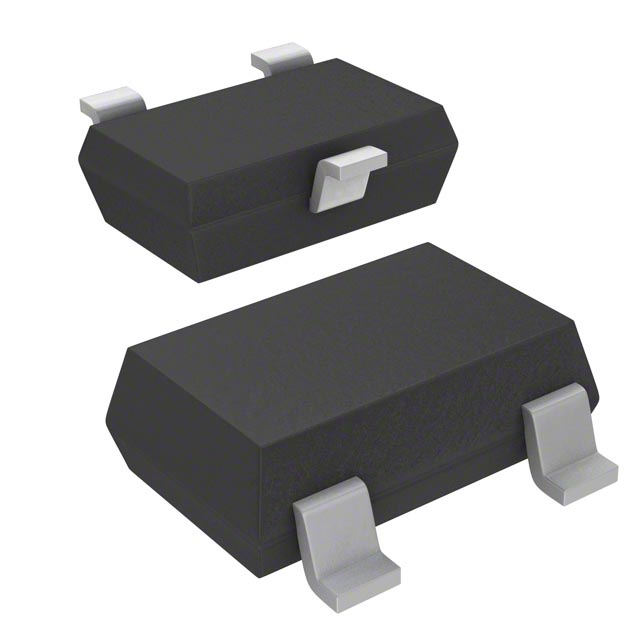
APS13295
Precision Hall-Effect Switch
for Consumer and Industrial Applications
FEATURES AND BENEFITS
DESCRIPTION
•
•
•
•
•
•
•
•
•
•
•
•
The APS13295 Hall-effect switch is a three-wire, planar
Hall-effect sensor integrated circuit (IC) especially suited for
operation over extended temperature ranges (up to 125°C).
Unipolar switch points
Superior ruggedness and fault tolerance
Reverse-polarity and transient protection
Operation from –40°C to 175°C junction temperature
Output short-circuit and overvoltage protection
Superior temperature stability
Resistant to physical stress
High EMC immunity, ±12 kV HBM ESD
Operation from unregulated supplies, 2.8 to 24 V
Chopper stabilization
Solid-state reliability
Industry-standard packages and pinouts
PACKAGES:
Not to scale
3-pin SIP
(suffix UA)
This Hall-effect switch IC is ideal for industrial and consumer
applications and features performance enhancements permitting
high-temperature operation up to 175°C junction temperatures.
In addition, the APS13295 includes a number of features
designed specifically to maximize system robustness such as
reverse-polarity protection, output current limiter, overvoltage,
and EMC protection.
The single silicon chip includes: a voltage regulator, a Hall
plate, small signal amplifier, chopper stabilization, Schmitt
trigger, and a short-circuit-protected open-drain output. A
south pole of sufficient strength turns the output on. Removal
of the magnetic field—or a north pole—turns the output off.
The devices include on-board transient protection for all pins,
permitting operation directly from unregulated or regulated
supplies from 2.8 to 24 V.
Two package styles provide a choice of through-hole or surface
mounting. Package type LH is a modified SOT23W, surfacemount package, while UA is a three-lead ultra-mini SIP for
through-hole mounting. Both packages are lead (Pb) free and
RoHs compliant with 100% matte-tin leadframe plating.
3-pin SOT23W
(suffix LH)
Functional Block Diagram
VCC
REGULATOR
Hall
Element
DYNAMIC OFFSET
CANCELLATION
TO ALL SUBCIRCUITS
LOW-PASS
FILTER
HALL
AMP.
SAMPLE, HOLD &
AVERAGING
SCHMITT
TRIGGER
VOUT
CONTROL
CURRENT
LIMIT
GND
APS13295-DS, Rev. 3
MCO-0000386
October 4, 2021
�Precision Hall-Effect Switch
for Consumer and Industrial Applications
APS13295
SELECTION GUIDE
Part Number
Packing [1]
Mounting
Branding
APS13295KLHALX
13-in. reel, 10000 pieces/reel
3-pin SOT23W surface mount
A33
APS13295KLHALT [2]
7-in. reel, 3000 pieces/reel
3-pin SOT23W surface mount
A33
APS13295KUAA
Bulk, 500 pieces/bag
3-pin SIP through hole
A34
Ambient Temperature,
TA
–40°C to 125°C
Switch
Points (Typ.)
BOP
BRP
35 G
25 G
[1] Contact Allegro
[2] Available
for additional packing options.
through authorized Allegro distributors only.
RoHS
COMPLIANT
VSUPPLY
RPULL-UP =
1 kΩ
APS13295
1
CBYP =
0.1 µF
VCC
VOUT
2
VOUT
GND
3
Figure 1: Typical Application Circuit
Allegro MicroSystems
955 Perimeter Road
Manchester, NH 03103-3353 U.S.A.
www.allegromicro.com
2
�Precision Hall-Effect Switch
for Consumer and Industrial Applications
APS13295
ABSOLUTE MAXIMUM RATINGS
Characteristic
Voltage [1]
Forward Supply
Reverse Supply Voltage [1]
Output Off
Voltage [1]
Symbol
Notes
Rating
Units
VCC
30
V
VRCC
–18
V
VOUT
30
V
Output Current [2]
IOUT
60
mA
Reverse Output Current
IROUT
–50
mA
Magnetic Flux Density [3]
B
Unlimited
–
165
°C
175
°C
Maximum Junction Temperature
Storage Temperature
TJ(max)
For 500 hours
Tstg
ESD Voltage
–65 to 170
°C
VESD(HBM)
Human Body Model according to AEC-Q100-002
±12
kV
VESD(CDM)
Charged Device Model according to AEC-Q100-011
±1
kV
This rating does not apply to extremely short voltage transients such as load dump and/or ESD. Those events have individual ratings,
specific to the respective transient voltage event.
[2] Through short-circuit current limiting device.
[3] Guaranteed by design.
[1]
GND
PINOUT DIAGRAMS AND TERMINAL LIST
3
Terminal List
Name
1
VOUT
VCC
3-pin SOT23W
(suffix LH)
2
3
VOUT
2
GND
1
VCC
VCC
Description
Number
LH
UA
Connects power supply to chip
1
1
VOUT
Output from circuit
2
3
GND
Ground
3
2
3-pin SIP
(suffix UA)
Allegro MicroSystems
955 Perimeter Road
Manchester, NH 03103-3353 U.S.A.
www.allegromicro.com
3
�Precision Hall-Effect Switch
for Consumer and Industrial Applications
APS13295
ELECTRICAL CHARACTERISTICS: Valid over full operating voltage, ambient temperature range TA = –40°C to 125°C,
and with CBYP = 0.1 µF, unless otherwise specified
Characteristics
Symbol
Test Conditions
Min.
Typ.[1]
Max.
Unit [2]
2.8
–
24
V
1
2
3
mA
ELECTRICAL CHARACTERISTICS
Forward Supply Voltage
VCC
Supply Current
ICC
Output Leakage Current
VOUTOFF = 24 V, B < BRP
–
–
10
µA
Output Saturation Voltage
VOUT(SAT)
IOUT = 20 mA, B > BOP
–
200
500
mV
Output Off Voltage
VOUTOFF
B < BRP
–
–
24
V
VCC ≥ VCC(min), B < BRP(min) – 10 G,
B > BOP(max) + 10 G
–
–
25
µs
Power-On Time [3]
Power-On State, Output [3]
IOUTOFF
Operating, TJ < 175°C
tON
POS
Chopping Frequency
fC
Output Rise Time [4]
tr
Output Fall Time [4]
tf
VCC ≥ VCC(min), t < tON
Low
–
–
800
–
kHz
RPULL-UP = 1 kΩ, CL = 20 pF
–
0.2
2
µs
RPULL-UP = 1 kΩ, CL = 20 pF
–
0.1
2
µs
30
–
60
mA
IOUTOFF = 3 mA; TA = 25°C, Output Off
30
–
–
V
VRCC = –18 V, TA = 25°C
–
–
–5
mA
ICC = ICC(max) + 3 mA, TA = 25°C
30
–
–
V
TRANSIENT PROTECTION CHARACTERISTICS
Output Short-Circuit Current Limit
Output Zener Clamp Voltage
Reverse Battery Current
Supply Zener Clamp Voltage
IOM
VZoutput
IRCC
VZ
MAGNETIC CHARACTERISTICS
Operate Point
BOP
–
35
50
G
Release Point
BRP
5
25
–
G
Hysteresis
BHYS
7
10
20
G
(BOP – BRP)
[1] Typical
data are at TA = 25°C and VCC = 12 V.
G (gauss) = 0.1 mT (millitesla).
[3] Guaranteed by device design and characterization.
[4] C = oscilloscope probe capacitance.
L
[2] 1
Allegro MicroSystems
955 Perimeter Road
Manchester, NH 03103-3353 U.S.A.
www.allegromicro.com
4
�Precision Hall-Effect Switch
for Consumer and Industrial Applications
APS13295
THERMAL CHARACTERISTICS: May require derating at maximum conditions; see application information
Characteristic
Symbol
Test Conditions
RθJA
Package Thermal Resistance
Value
Units
Package LH, 1-layer PCB with copper limited to solder pads
228
°C/W
Package LH, 2-layer PCB with 0.463 in.2 of copper area each side
connected by thermal vias
110
°C/W
Package UA, 1-layer PCB with copper limited to solder pads
165
°C/W
Power Derating Curve
Maximum Allowable VCC (V)
TJ(max) = 175°C; ICC = ICC(max), IOUT = 0 mA (Output Off)
25
24
23
22
21
20
19
18
17
16
15
14
13
12
11
10
9
8
7
6
5
4
3
2
VCC(max)
Package LH, 2-layer PCB
(RθJA = 110 °C/W)
Package UA, 1-layer PCB
(RθJA = 165 °C/W)
Package LH, 1-layer PCB
(RθJA = 228 °C/W)
VCC(min)
25
45
65
85 105 125 145
Temperature (°C)
165
185
TJ(max)
Power Dissipation, PD (mW)
Power Dissipation versus Ambient Temperature
1900
1800
1700
1600
1500
1400
1300
1200
1100
1000
900
800
700
600
500
400
300
200
100
0
Package LH, 2-layer PCB
(RθJA = 110°C/W)
Package UA, 1-layer PCB
(RθJA = 165°C/W)
Package LH, 1-layer PCB
(RθJA = 228°C/W)
25
45
65
85
105
125
145
165
185
Temperature (°C)
Allegro MicroSystems
955 Perimeter Road
Manchester, NH 03103-3353 U.S.A.
www.allegromicro.com
5
�Precision Hall-Effect Switch
for Consumer and Industrial Applications
APS13295
CHARACTERISTIC PERFORMANCE DATA
Average Supply Current versus Supply Voltage
Average Supply Current versus Ambient Temperature
4.0
4.0
3.5
3.5
TA (°C)
2.5
-40
2.0
25
1.5
3.0
ICC (mA)
ICC (mA)
3.0
125
1.0
12
1.5
24
0.5
2
6
10
14
VCC (V)
18
22
0.0
26
TA (°C)
TA (°C)
-40
-40
25
25
125
125
6
6
10
10
14
VCC14(V)
VCC
(V)
18
18
22
22
26
26
VOUT(SAT)
VOUT(SAT)(mV)
(mV)
500
500
450
450
400
400
350
350
300
300
250
250
200
200
150
150
100
100
50
50
0
0 2
2
-60
-40
-20
0
20
40
TA (°C)
60
80
100
120
140
Average Low Output Voltage versus Ambient Temperature for IOUT = 20 mA
Average Low Output Voltage versus Ambient Temperature for IOUT = 20 mA
Average Low Output Voltage versus Supply Voltage for IOUT = 20 mA
Average Low Output Voltage versus Supply Voltage for IOUT = 20 mA
VOUT(SAT)
VOUT(SAT)(mV)
(mV)
2.8
2.0
1.0
0.5
0.0
VCC (V)
2.5
500
500
450
450
400
400
350
350
300
300
250
250
200
200
150
150
100
100
50
50
0
0 -60
-60
VCC (V)
VCC (V)
2.8
2.8
12
12
24
24
-40
-40
-20
-20
0
0
20
20
40
40
T (°C)
TAA (°C)
60
60
80
80
100
100
120
120
Allegro MicroSystems
955 Perimeter Road
Manchester, NH 03103-3353 U.S.A.
www.allegromicro.com
140
140
6
�Precision Hall-Effect Switch
for Consumer and Industrial Applications
APS13295
CHARACTERISTIC PERFORMANCE DATA (continued)
Average Operate Point versus Ambient Temperature
Average Operate Point versus Supply Voltage
60
60
55
55
50
-40
40
35
25
30
25
45
BOP (G)
45
BOP (G)
50
TA (°C)
125
2.8
35
30
12
25
24
20
20
15
15
10
VCC (V)
40
10
2
6
10
14
VCC (V)
18
22
26
-60
50
45
45
-40
30
25
25
BRP (G)
BRP (G)
35
20
20
40
TA (°C)
60
80
100
120
140
VCC (V)
35
30
2.8
25
12
20
125
15
24
15
10
10
5
2
6
10
14
VCC (V)
18
22
26
-60
Average Switchpoint Hysteresis versus Supply Voltage
-40
-20
0
20
40
TA (°C)
60
80
100
120
140
Average Switchpoint Hysteresis versus Ambient Temperature
25
25
23
23
21
TA (°C)
19
17
-40
15
13
25
11
125
9
VCC (V)
19
BHYS (G)
21
BHYS (G)
0
40
TA (°C)
40
17
2.8
15
12
13
24
11
9
7
7
5
-20
Average Release Point versus Ambient Temperature
Average Release Point versus Supply Voltage
50
5
-40
5
2
6
10
14
VCC (V)
18
22
26
-60
-40
-20
0
20
40
TA (°C)
60
80
100
120
Allegro MicroSystems
955 Perimeter Road
Manchester, NH 03103-3353 U.S.A.
www.allegromicro.com
140
7
�Precision Hall-Effect Switch
for Consumer and Industrial Applications
APS13295
FUNCTIONAL DESCRIPTION
OPERATION
The output of the APS13295 switches low (turns on) when a
south-polarity magnetic field perpendicular to the Hall element
exceeds the operate point threshold, BOP (see Figure 2). After
turn-on, the output voltage is VOUT(SAT). The output transistor is
capable of continuously sinking up to 30 mA. When the magnetic
field is reduced below the release point, BRP, the device output
goes high (turns off) to VOUTOFF.
V+
VOUT(OFF)
BRP
VOUT
VOUT
0
Key
POS
B > BOP
B < BRP, BRP < B < BOP
V
VOUT(SAT)
BOP
0
Powering-on the device in the hysteresis range (less than BOP and
higher than BRP) will give an output state of VOUTOFF. The correct state is attained after the first excursion beyond BOP or BRP .
Switch to Low
Switch to High
VOUTOFF
POWER-ON BEHAVIOR
Device power-on occurs once tON has elapsed. During the
time prior to tON, and after VCC ≥ VCC(min), the output state is
VOUT(SAT). After tON has elapsed, the output will correspond with
the applied magnetic field for B > BOP or B < BRP. See Figure 3
for an example.
VOUT (SAT)
B+
(south)
V
The difference in the magnetic operate and release points is the
hysteresis, BHYS , of the device. This built-in hysteresis allows
clean switching of the output even in the presence of external
mechanical vibration and electrical noise.
VCC
On the horizontal axis, the B+ direction indicates increasing
south polarity magnetic field strength.
POS
t
BHYS
Figure 2: Device Switching Behavior
Output State
Undefined for
VCC< VCC (min)
VCC (min)
0
t ON
t
Figure 3: Power-On Sequence and Timing
Allegro MicroSystems
955 Perimeter Road
Manchester, NH 03103-3353 U.S.A.
www.allegromicro.com
8
�Precision Hall-Effect Switch
for Consumer and Industrial Applications
APS13295
Applications
It is strongly recommended that an external bypass capacitor be
connected (in close proximity to the Hall element) between the
supply and ground of the device to guarantee correct performance
under harsh environmental conditions and to reduce noise from
internal circuitry. As is shown in Figure 1: Typical Application
Circuit, a 0.1 µF capacitor is required. In applications where maximum robustness is required, additional measures may be taken.
In Figure 4: Enhanced Protection Circuit, a resistor in series with
the VCC pin and a capacitor on the VOUT pin enhance the EMC
immunity of the device. It is up to the user to fully qualify the
Allegro sensor IC in their end system to ensure they achieve their
system requirements.
These devices are sensitive in the direction perpendicular to the
branded package face, and may be configured to sense magnetic
fields in a variety of orientations, such as the ones shown in
Figure 5.
VPULL-UP
VSUPPLY
RPULL-UP =
1 kΩ
A
RS =
100 Ω
CBYP =
0.1 µF
A
APS13295
1
VCC
VOUT
VOUT
2
GND
3
A
COUT =
4.7 nF
RS and C OUT are recommended for maximum
robustness in an automotive environment.
Figure 4: Enhanced Protection Circuit
Extensive applications information for Hall-effect devices is
available in:
• Hall-Effect IC Applications Guide, AN27701,
• Hall-Effect Devices: Guidelines for Designing Subassemblies
Using Hall-Effect Devices AN27703.1
• Soldering Methods for Allegro’s Products – SMD and
Through-Hole, AN26009
All are provided on the Allegro website:
www.allegromicro.com
N
S
N
S
B
PC
Figure 5: Sensing Configurations
Allegro MicroSystems
955 Perimeter Road
Manchester, NH 03103-3353 U.S.A.
www.allegromicro.com
9
�APS13295
Precision Hall-Effect Switch
for Consumer and Industrial Applications
CHOPPER STABILIZATION
A limiting factor for switch point accuracy when using Halleffect technology is the small-signal voltage developed across
the Hall plate. This voltage is proportionally small relative to the
offset that can be produced at the output of the Hall sensor. This
makes it difficult to process the signal and maintain an accurate,
reliable output over the specified temperature and voltage range.
Chopper stabilization is a proven approach used to minimize Hall
offset.
The Allegro technique, dynamic quadrature offset cancellation,
removes key sources of the output drift induced by temperature
and package stress. This offset reduction technique is based on
a signal modulation-demodulation process. Figure 6: Model of
Chopper Stabilization Circuit (Dynamic Offset Cancellation)
illustrates how it is implemented.
The undesired offset signal is separated from the magnetically
induced signal in the frequency domain through modulation.
The subsequent demodulation acts as a modulation process for
the offset causing the magnetically induced signal to recover its
original spectrum at baseband while the DC offset becomes a
high-frequency signal. Then, using a low-pass filter, the signal
passes while the modulated DC offset is suppressed. Allegro’s
innovative chopper stabilization technique uses a high-frequency
clock. The high-frequency operation allows a greater sampling
rate that produces higher accuracy, reduced jitter, and faster signal processing. Additionally, filtering is more effective and results
in a lower noise analog signal at the sensor output. Devices such
as the APS13295 that use this approach have an extremely stable
quiescent Hall output voltage, are immune to thermal stress,
and have precise recoverability after temperature cycling. This
technique is made possible through the use of a BiCMOS process
which allows the use of low-offset and low-noise amplifiers
in combination with high-density logic and sample-and-hold
circuits.
Regulator
Hall Element
Amp
Sample and
Hold
Clock/Logic
Low-Pass
Filter
Figure 6: Model of Chopper Stabilization Circuit
(Dynamic Offset Cancellation)
Allegro MicroSystems
955 Perimeter Road
Manchester, NH 03103-3353 U.S.A.
www.allegromicro.com
10
�APS13295
Precision Hall-Effect Switch
for Consumer and Industrial Applications
POWER DERATING
The device must be operated below the maximum junction temperature of the device, TJ(max). Under certain combinations of
peak conditions, reliable operation may require derating supplied
power or improving the heat dissipation properties of the application. This section presents a procedure for correlating factors
affecting operating TJ. (Thermal data is also available on the
Allegro MicroSystems website.)
The Package Thermal Resistance, RθJA, is a figure of merit summarizing the ability of the application and the device to dissipate
heat from the junction (die), through all paths to the ambient air.
Its primary component is the Effective Thermal Conductivity, K,
of the printed circuit board, including adjacent devices and traces.
Radiation from the die through the device case, RθJC, is relatively
small component of RθJA. Ambient air temperature, TA, and air
motion are significant external factors, damped by overmolding.
The resulting power dissipation capability directly reflects upon
the ability of the device to withstand extreme operating conditions. The junction temperature mission profile specified in the
Absolute Maximum Ratings table designates a total operating life
capability based on qualification for the most extreme conditions,
where TJ may reach 175°C.
The silicon IC is heated internally when current is flowing into
the VCC terminal. When the output is on, current sinking into the
VOUT terminal generates additional heat. This may increase the
junction temperature, TJ, above the surrounding ambient temperature. The APS13295 is permitted to operate up to TJ = 175°C. As
mentioned above, an operating device will increase TJ according
to equations 1, 2, and 3 below. This allows an estimation of the
maximum ambient operating temperature.
For example, given common conditions such as: TA= 25°C,
VCC = 12 V, ICC = 2 mA, VOUT = 185 mV, IOUT = 20 mA (output
on), and RθJA = 165°C/W, then:
PD = (VCC × ICC) + (VOUT × IOUT) =
(12 V × 2 mA) + (185 mV × 20 mA) =
24 mW + 3.7 mW = 27.7 mW
ΔT = PD × RθJA = 27.7 mW × 165°C/W = 4.6°C
TJ = TA + ΔT = 25°C + 4.6°C = 29.6°C
A worst-case estimate, PD(max), represents the maximum allowable power level (VCC(max), ICC(max)), without exceeding
TJ(max), at a selected RθJA.
For example, given the conditions RθJA = 228°C/W, TJ(max) =
175°C, VCC(max) = 24 V, ICC(max) = 4 mA, VOUT = 500 mV,
and IOUT = 25 mA (output on), the maximum allowable operating
ambient temperature can be determined.
The power dissipation required for the output is shown below:
PD(VOUT) = VOUT × IOUT = 500 mV × 25 mA = 12.5 mW
The power dissipation required for the IC supply is shown below:
PD(VCC) = VCC × ICC = 24 V × 4 mA = 96 mW
Next, by inverting using equation 2:
ΔT = PD × RθJA = [PD(VOUT) + PD(VCC)] × 228°C/W =
(12.5 mW + 96 mW) × 228°C/W =
108.5 mW × 228°C/W = 24.7°C
Finally, by inverting equation 3 with respect to voltage:
TA(est) = TJ(max) – ΔT = 175°C – 24.7°C = 150.3°C
(1) In the above case, there is sufficient power dissipation capability
to operate up to TA(est).The example indicates that TA(max) can
ΔT = PD × RθJA
(2) be as high as 150.3°C without exceeding TJ(max). However, the
TA(max) rating of the device is 125°C; the APS13295 perforTJ = TA + ΔT (3) mance
is not guaranteed above TA = 125°C.
PD = VIN × IIN
Allegro MicroSystems
955 Perimeter Road
Manchester, NH 03103-3353 U.S.A.
www.allegromicro.com
11
�Precision Hall-Effect Switch
for Consumer and Industrial Applications
APS13295
Package LH, 3-Pin (SOT-23W)
For Reference Only – Not for Tooling Use
(Reference Allegro DWG-0000628, Rev. 1)
NOT TO SCALE
Dimensions in millimeters
Dimensions exclusive of mold flash, gate burrs, and dambar protrusions
Exact case and lead configuration at supplier discretion within limits shown
+0.125
2.975 –0.075
1.49
4°±4°
Active Area Depth
0.28 ±0.04 mm
3
Die Rotation
Error 4° Max
+0.020
0.180–0.053
0.96
+0.10
2.90 –0.20
+0.19
1.91 –0.06
Hall Element
(not to scale)
0.25 MIN
0.38 NOM
Package Centerline
to Die Centerline ±0.20
8× 10° ±5°
0.55 REF
0.25 BSC
Seating Plane
Gauge Plane
0.95 BSC
Lead Foot Centerline
To Package Centerline ±0.18
All pads a minimum of 0.20 mm from all adjacent pads; adjust as necessary
to meet application process requirements and PCB layout tolerances
Branded Face
0.41 ±0.04
C
0.95
PCB Layout Reference View
0.57 ±0.04
3×
1.00
Package Centerline
to Die Centerline ±0.15
2
1
0.10
2.40
0.70
+0.10
0.05 –0.05
0.40 ±0.10
1.00 ±0.13
SEATING
PLANE
C
A33
1
Standard Branding Reference View
Allegro MicroSystems
955 Perimeter Road
Manchester, NH 03103-3353 U.S.A.
www.allegromicro.com
12
�Precision Hall-Effect Switch
for Consumer and Industrial Applications
APS13295
Package UA, 3-Pin SIP
For Reference Only – Not For Tooling Use
(Reference DWG-0000404, Rev. 1)
NOT TO SCALE
Dimensions in millimeters
Exact case and lead configuration at supplier discretion within limits shown
Mold gate and tie bar
protrusion zone
Ejector pin flash
protrusion
R0.25 MAX (2×)
5° (2×)
0.56 MAX
A34
45° (2×)
0.10 MAX
1.52 ±0.05
1.68 MAX
5° (2×)
1
Standard Branding Reference View
+0.08
4.09 –0.05
3.00 ±0.05
2.04
Mold gate and tie bar
protrusion zone
0.15 MAX
Ejector pin
(far side)
Including gate and
tie bar burrs
+0.08
3.02 –0.05
3.10 MAX
Sensor element location tolerance
Standard ±0.20
+0.05
0.08 –0.00
0.50 ±0.08 Active Area Depth
Ejector pin flash
protrusion
Sensor element location tolerance
Standard ±0.20
1.44
Hall Element
(not to scale)
45°
10° (3×)
1.02 MAX
0.79 REF
0.51 REF
0.05 NOM
0.05 NOM
14.99 ±0.25
+0.03
0.41 –0.06
0.10 MAX
0.10 MAX
Dambar Trim Detail
1.27 NOM (2×)
+0.05
0.43 –0.07 (3×)
Allegro MicroSystems
955 Perimeter Road
Manchester, NH 03103-3353 U.S.A.
www.allegromicro.com
13
�Precision Hall-Effect Switch
for Consumer and Industrial Applications
APS13295
Revision History
Number
Date
Description
–
February 26, 2018
Initial release
1
May 10, 2018
Corrected part numbers in selection guide (page 2); renamed RLOAD to RPULL-UP (page 2, 4, 9).
2
August 2, 2019
Minor editorial updates
3
October 4, 2021
Updated package drawings (pages 12-13)
Copyright 2021, Allegro MicroSystems.
Allegro MicroSystems reserves the right to make, from time to time, such departures from the detail specifications as may be required to permit
improvements in the performance, reliability, or manufacturability of its products. Before placing an order, the user is cautioned to verify that the
information being relied upon is current.
Allegro’s products are not to be used in any devices or systems, including but not limited to life support devices or systems, in which a failure of
Allegro’s product can reasonably be expected to cause bodily harm.
The information included herein is believed to be accurate and reliable. However, Allegro MicroSystems assumes no responsibility for its use; nor
for any infringement of patents or other rights of third parties which may result from its use.
Copies of this document are considered uncontrolled documents.
For the latest version of this document, visit our website:
www.allegromicro.com
Allegro MicroSystems
955 Perimeter Road
Manchester, NH 03103-3353 U.S.A.
www.allegromicro.com
14
�