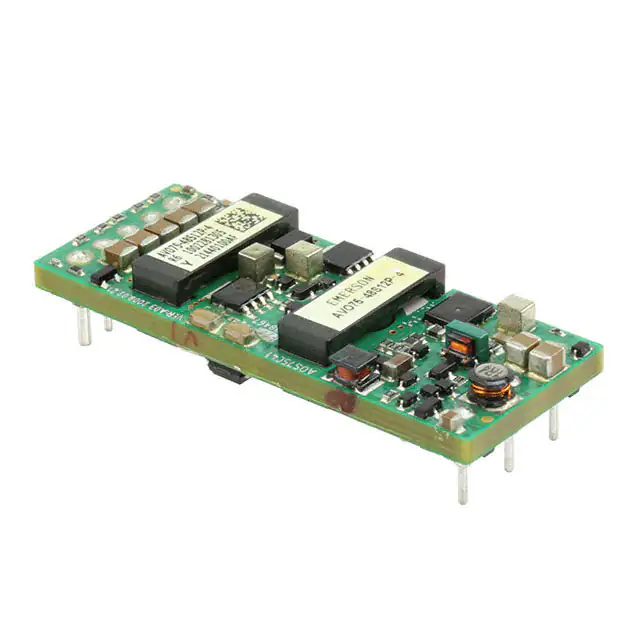
AVO75 Series DC/DC Converter TRN
AVO75 Series DC/DC Converter
Technical Reference Notes
Industry Standard Eighth Brick: 36~75V Input, 1.2V~12V Single Output
Features
•
•
•
•
•
Industry standard eighth brick: 2.28” × 0.9’’ × 0.34’’
Options
•
•
Choice of positive logic or negative logic
for CNT function
Choice of short pins or long pins
Description
•
•
•
•
•
•
•
•
•
•
•
Delivers up to 25A output current
Industry standard eighth brick foot print
57.9mm × 22.9mm × 8.5mm
(2.28” × 0.9” × 0.34”)
Basic isolation
Ultra high efficiency: 92% at 5V full load
(Vin = 48Vdc)
Improved thermal performance:
full load at 55ºC at 1m/s (200LFM) for 5Vo
High power density
Low output noise
2:1 wide input voltage of 36V-75V
CNT function
Remote sense
Trim function: +10%/-20%
Input under-voltage lockout
Output over-current protection
Output over-voltage protection
Over-temperature protection
RoHS compliant
The AVO75 series DC/DC converter is a new open frame DC/DC converter for optimum efficiency
and power density. The series provides up to 25A output current in an industry standard eighth brick,
which makes it an ideal choice for small space, high current and low voltage applications. The
AVO75 series uses an industry standard eighth brick: 57.9mm × 22.9mm × 8.9mm (2.28” × 0.9” ×
0.35”) and standard pin-out configuration, provides CNT and trim functions. AVO75 series can
provide 1.2V ~ 12V single output, and outputs are isolated from inputs. The series can achieve ultra
high efficiency, and for most applications, a heat sink is not required.
TEL: (86) 755-86010808
BOM: 31020683
www.emersonnetworkpower.com.cn
DATE: 2008-12-03
1/32
REV1.3
�AVO75 Series DC/DC Converter TRN
Module Numbering
AVO
75
- 48
S
1V5
P - 4
Pin length
CNT logic, P---positive logic control,
default is negative logic control
.
Output rated voltage: 1V2--1.2V, 1V5--1.5V, 1V8--1.8V,
2V5--2.5V, 3V3--3.3V, 05--5V, 12--12V
Output number: S ---single output, D---dual output
Input rated voltage
Output rated power
Series name
TEL: (86) 755-86010808
www.emersonnetworkpower.com.cn
2/32
�AVO75 Series DC/DC Converter TRN
Electrical Specifications
Unless otherwise indicated, specifications apply over all operating input voltage and temperature
conditions. Standard test condition on a single unit is as follows:
Tc (board): 25 °C
+Vin:
48V± 2%
-Vin:
return pin for +Vin
CNT:
connected to -Vin for negative logic
open for positive logic
+Vout:
-Vout:
+Sense:
-Sense:
Trim (Vadj):
connected to load
connected to load (return)
connected to +Vout
connected to -Vout
open
Input Specifications
Parameter
Symbol
Min
Typ
Max
Unit
VI
36
48
75
VDC
II,max
-
-
2.5
A
Input Reflected-ripple Current
(5Hz to 20MHz, 12µH source impedance,
TA = 25 ºC)
II
-
-
20
mAp-p
Supply Voltage Rejection
(1kHz)
-
50
60
-
dB
Operating Input Voltage
Maximum Input Current
(VI = 0 to VI,max, Io = Io,max)
Caution: This power module is not internally fused. An input line fuse must always be used.
TEL: (86) 755-86010808
www.emersonnetworkpower.com.cn
3/32
�AVO75 Series DC/DC Converter TRN
Absolute Maximum Ratings
Stresses in excess of the absolute maximum ratings can cause permanent damage to the device.
These are absolute stress ratings only. Functional operation of the device is not implied at these or
any other conditions in excess of those given in the operational sections of the IPS. Exposure to
absolute maximum ratings for extended periods can adversely affect device reliability.
Parameter
Device
Symbol
Min
Typ
Max
Unit
All
VI
0
-
75
Vdc
All
VI, trans
0
-
100
Vdc
All
Ta
-40
-
85
°C
Operating Board Temperature
All
Tc
-
-
100
°C
Storage Temperature
All
TSTG
-55
-
125
°C
Operating Humidity
All
-
-
-
85
%
All
-
2000
Vdc
Continuous
Input Voltage
Transient
(100ms)
Operating Ambient Temperature
(See Thermal Consideration)
Basic Input-Output Isolation
(Conditions: 1mA for 60 sec, slew rate of
1500V/10sec)
Output Power
TEL: (86) 755-86010808
1.2V
30
1.5V
37.5
1.8V
45
2.5V
Po,max
0
-
62.5
3.3V
66
5V
75
12V
75
www.emersonnetworkpower.com.cn
W
4/32
�AVO75 Series DC/DC Converter TRN
Output Specifications
Parameter
Output ripple and noise peak-to-peak (5Hz
to 20MHz)
(across 1µF @50V, X7R ceramic capacitor &
470µF @25V LOW ESR aluminum
capacitor)
External load capacitance
Output voltage setpoint
(VI=VI,min to VI,max: Io=Io,max; Ta=25°C)
Output
regulation
Line (VI,min to VI,max)
TEL: (86) 755-86010808
Device
Symbol
Min
Typ
1.2V
50
1.5V
55
1.8V
45
2.5V
-
-
50
3.3V
50
5V
55
12V
55
Max
Unit
-
mVp-p
1.2V
10,000
1.5V
10,000
1.8V
10,000
2.5V
-
220
470
10,000
3.3V
10,000
5V
5000
12V
1000
1.2V
1.18
1.2
1.22
1.5V
1.48
1.5
1.52
1.8V
1.77
1.8
1.83
2.46
2.5
2.54
3.3V
3.25
3.3
3.35
5V
4.95
5
5.05
12V
11.85
12
12.15
2.5V
Vo,set
1.2V
1
1.5V
1
1.8V
1
2.5V
-
-
1
3.3V
1
5V
4
12V
9
www.emersonnetworkpower.com.cn
-
µF
Vdc
mV
5/32
�AVO75 Series DC/DC Converter TRN
Parameter
Load (Io,min to Io,max)
Temperature
(Tc=-40 °C to +100°C)
Rated output current
Output current-limit inception (hiccup)
Efficiency (VI=VI,nom; 100%Io,max ; TA=25°C)
Efficiency (VI=VI,nom ; 50%Io,max; Ta=25°C)
TEL: (86) 755-86010808
Device
Symbol
Min
Typ
1.2V
1
1.5V
1
1.8V
1
2.5V
-
-
1
3.3V
1
5V
5
12V
5
All
-
-
-
Max
Unit
-
mV
0.02
%Vo/°C
1.2V,
25
1.5V
25
1.8V
25
2.5V
Io
0
-
25
3.3V
20
5V
15
12V
6.3
1.2V
28
35
1.5V
28
35
1.8V
28
35
2.5V
Io
28
-
35
3.3V
22
28
5V
16.5
21
12V
6.9
10
1.2V
88
1.5V
87
1.8V
89
2.5V
-
-
90.5
3.3V
91
5V
92
12V
91
1.2V
87
1.5V
88
1.8V
88.5
2.5V
-
-
89.5
3.3V
91
5V
91
12V
90
www.emersonnetworkpower.com.cn
A
A
-
%
-
%
6/32
�AVO75 Series DC/DC Converter TRN
Output Specifications (Cont)
Parameter
Device
Load change from Io =
50% to 75% to 50%
Io,max
Symbol
Min
Typ
1.2V
60
1.5V
50
1.8V
50
2.5V
-
60
3.3V
85
5V
110
Dynamic response
12V
150
(∆Io/∆t=1A/10µs,
VI=VI,nom; Ta=25°C)
1.2V
300
1.5V
115
1.8V
125
Peak deviation settling Time
(to Vo,nom)
Load change from
Io=50% to 75% to 50%
Io,max
2.5V
-
70
3.3V
70
5V
120
12V
120
1.2V
130
1.5V
130
1.8V
120
2.5V
-
170
3.3V
130
Dynamic response
5V
130
(∆Io/∆t=1A/1µs;
12V
120
1.2V
300
1.5V
100
1.8V
115
VI=VI,nom; Ta=25°C,
additional 220µF
load capacitor)
Peak deviation settling
time (to Vo,nom)
2.5V
Max
-
150
3.3V
80
5V
130
12V
320
Unit
mV
-
µsec
-
mv
-
µsec
20
msec
Turn-On time (Io=Io,max; Vo within 1%)
All
-
-
-
Output voltage overshoot (Io=Io,max; Ta=25°C)
All
-
-
0
%Vo
Switching frequency
All
-
310
kHz
TEL: (86) 755-86010808
www.emersonnetworkpower.com.cn
7/32
�AVO75 Series DC/DC Converter TRN
Feature Specifications
Parameter
Device
Symbol
Min
Typ
Max
Unit
Logic low
All
-0.7
-
1.2
V
Logic high
All
3.5
-
12
V
Enable pin current
Logic low
All
-
-
1.0
mA
(leakage current,
@10V)
Logic high
All
-
-
-
µA
80
-
110
%Vo
Enable pin voltage
Output voltage adjustment range
Output over-voltage (hiccup)
Over-temperature protection
(auto-recovery)
All*
-
1.2V
1.4
2.0
1.5V
1.8
2.5
1.8V
2.2
3.0
2.5V
Vo,clamp
3.0
-
3.8
V
3.3V
3.9
5.0
5V
6.0
7.5
12V
14.4
18
All
110
120
135
C
Under-voltage
Lockout
Turn-on point
All
-
31
34
36
V
Turn-off point
All
-
30
33
35
V
AVO75-48S12-6/D
under-voltage
lockout
Turn-on point
All
-
34.8
37
38
V
Turn-off point
All
-
33.8
35.5
37
V
Isolation capacitance
All
-
-
1000
-
PF
Isolation resistance
All
-
10
-
-
MΩ
Calculated MTBF (Io=Io,max; Tc=25°C)
All
-
-
2,500,000
-
Hours
Weight
All
-
-
-
30
g(oz.)
Note: Output voltage adjustment rang of 12V module is 90% to 110%.
TEL: (86) 755-86010808
www.emersonnetworkpower.com.cn
8/32
�AVO75 Series DC/DC Converter TRN
Characteristic Curves
90
85
85
80
80
Vin=36V
75
Vin=48V
Vin=75V
70
0
5
10
15
20
75
Efficiency (%)
Effiency(%)
90
70
65
36V
48V
75V
60
25
55
Load(A)
0
5
10
15
20
25
Load (A)
Fig. 1
Typical efficiency of AVO75-48S1V2
Fig. 2
Typical efficiency of AVO75-48S1V5
95
90
Effiency(%)
Effiency(%)
90
85
80
Vin=36V
75
5
10
15
20
Vin=36V
Vin=48V
Vin=75V
Vin=75V
0
80
75
Vin=48V
70
85
70
25
0
5
10
Load(A)
Fig. 3
20
25
Load(A)
Typical efficiency of AVO75-48S1V8
Fig. 4
95
Typical efficiency of AVO75-48S2V5
95
90
Effiency(%)
90
Ef f iciency(%)
15
85
80
36V
48V
75V
75
2
4
6
8
10
12
14
16
18
85
80
Vin=36V
75
Vin=48V
Vin=75V
70
20
0
3
6
Typical efficiency of AVO75-48S3V3
TEL: (86) 755-86010808
12
15
Load(A)
Load (A)
Fig. 5
9
Fig. 6
Typical efficiency of AVO75-48S05
www.emersonnetworkpower.com.cn
9/32
�AVO75 Series DC/DC Converter TRN
95
Effiency(%)
90
85
80
Vin=36V
Vin=48V
75
Vin=75V
70
0
1
2
3
4
5
6
Output current(A)
Typical efficiency of AVO75-48S12
1.4
1.2
1.6
1
0.8
0.6
0.4
1.2
1.4
0.2
0
0
Fig. 8
5
10
15
20
25
Output Current (A)
30
35
Output voltage (V)
Output Voltage (V)
Fig. 7
1
0.8
0.6
0.4
0.2
0
0
Typical output over-current of AVO75-48S1V2
Fig. 9
5
10
15
20
25
Output current (A)
30
35
40
Typical output over-current of AVO75-48S1V5
Output Voltage (V)
Output Voltage (V)
3
1.8
1.5
1.2
0.9
0.6
0.3
2
1.5
1
0.5
0
0
0
Fig. 10
2.5
5
10
15
20
25
Output Current (A)
30
Typical output over-current of AVO75-48S1V8
TEL: (86) 755-86010808
0
35
Fig. 11
5
10
15
20
25
Output Current (A)
30
35
Typical output over-current of AVO75-48S2V5
www.emersonnetworkpower.com.cn
10/32
�3.5
6
3
5
Output Voltage (V)
Output Voltage(V)
AVO75 Series DC/DC Converter TRN
2.5
2
1.5
1
0.5
4
3
2
1
0
0
0
0
5
10
15
20
25
30
35
4
8
12
Output Current (A)
40
16
20
Output Current( A)
Fig. 12
Typical output over-current of AVO75-48S3V3
Fig. 13
Typical output over-current of AVO75-48S05
14
Output Voltage (V)
12
10
8
6
4
2
0
0
Fig. 14
2
4
6
Output Current (A)
10
Typical output over-current of AVO75-48S12
7
5
6
4
3
2
Vin=36V
1
Vin=48V
Vin=75V
0
0
5
10
15
20
25
Power dissipation (W)
Dissipation(W)
8
5
4
3
2
36V
48V
75V
1
0
0
Load(A)
5
10
15
20
25
Load (A)
Fig. 15
Typical power dissipation of AVO75-48S1V2
TEL: (86) 755-86010808
Fig. 16
Typical power dissipation of AVO75-48S1V5
www.emersonnetworkpower.com.cn
11/32
�7
6
5
4
3
2
1
0
9
8
7
Dissipation(W)
Dissipation(W)
AVO75 Series DC/DC Converter TRN
Vin=36V
0
5
10
15
6
5
4
3
Vin=48V
2
Vin=75V
1
20
Vin=36V
Vin=48V
Vin=75V
0
25
0
5
10
Load(A)
Fig. 17
Fig. 18
8
25
Typical power dissipation of AVO75-48S2V5
8
Dissipation(W)
Pow er Dissipation (W)
20
Load(A)
Typical power dissipation of AVO75-48S1V8
6
4
2
36V
48V
75V
0
6
4
Vin=36V
2
Vin=48V
Vin=75V
0
0
2
4
6
8
10
12
14
16
18
3
6
20
9
12
15
Load(A)
Load (A)
Fig. 19
15
Typical power dissipation of AVO75-48S3V3
Fig. 20
Typical power dissipation of AVO75-48S05
Dissipation(W)
10
8
6
4
Vin=36V
2
Vin=48V
Vin=75V
0
0
1
2
3
4
5
6
Output current(A)
Fig. 21
TEL: (86) 755-86010808
Typical power dissipation of AVO75-48S12
www.emersonnetworkpower.com.cn
12/32
�AVO75 Series DC/DC Converter TRN
Fig. 22 AVO75-48S1V2 typical transient response to
step decrease in load from 50% to 25% of full load,
room temperature, 48Vdc input
Fig. 23 AVO75-48S1V2 typical transient response to
step increase in load from 50% to 75% of full load,
room temperature, 48Vdc input
Fig. 24 AVO75-48S1V5 typical transient response to
step decrease in load from 50% to 25% of full load,
room temperature, 48Vdc input
Fig. 25 AVO75-48S1V5 typical transient response to
step increase in load from 50% to 75% of full load,
Fig. 26 AVO75-48S1V5 typical transient response to
step decrease in load from 50% to 25% of full load,
Fig. 27 AVO75-48S1V5 typical transient response to
step increase in load from 50% to 75% of full load,
room temperature, 48Vdc input (∆Io/∆t=0.1A/1µs)
room temperature, 48Vdc input (∆Io/∆t=0.1A/1µs)
TEL: (86) 755-86010808
room temperature, 48Vdc input (∆Io/∆t=1A/1µs)
www.emersonnetworkpower.com.cn
13/32
�AVO75 Series DC/DC Converter TRN
Fig. 28 AVO75-48S1V5 typical transient response to
step decrease in load from 50% to 25% of full load,
Fig. 29 AVO75-48S1V5 typical transient response to
step increase in load from 50% to 75% of full load,
room temperature, 48Vdc input (∆Io/∆t=1A/1µs)
room temperature, 48Vdc input (∆Io/∆t=1A/1µs)
Fig. 30 AVO75-48S1V8 typical transient response to
step decrease in load from 50% to 25% of full load,
Fig. 31 AVO75-48S1V8 typical transient response to
step increase in load from 50% to 75% of full load,
room temperature, 48Vdc input (∆Io/∆t=0.1A/1µs)
room temperature, 48Vdc input (∆Io/∆t=0.1A/1µs)
Fig. 32 AVO75-48S1V8 typical transient response to
step decrease in load from 50% to 25% of full load,
Fig. 33 AVO75-48S1V8 typical transient response to
step increase in load from 50% to 75% of full load,
room temperature, 48Vdc input (∆Io/∆t=1A/1µs)
room temperature, 48Vdc input (∆Io/∆t=1A/1µs)
TEL: (86) 755-86010808
www.emersonnetworkpower.com.cn
14/32
�AVO75 Series DC/DC Converter TRN
Fig. 34 AVO75-48S2V5 typical transient response to
step decrease in load from 50% to 25% of full load,
Fig. 35 AVO75-48S2V5 typical transient response to
step increase in load from 50% to 75% of full load,
room temperature, 48Vdc input (∆Io/∆t=0.1A/1µs)
room temperature, 48Vdc input (∆Io/∆t=0.1A/1µs)
Fig. 36 AVO75-48S2V5 typical transient response to
step decrease in load from 50% to 25% of full load,
Fig. 37 AVO75-48S2V5 typical transient response to
step increase in load from 50% to 75% of full load,
room temperature, 48Vdc input (∆Io/∆t=1A/1µs)
room temperature, 48Vdc input (∆Io/∆t=1A/1µs)
Fig. 38 AVO75-48S3V3 typical transient response to
step decrease in load from 50% to 25% of full load,
Fig. 39 AVO75-48S3V3 typical transient response to
step increase in load from 50% to 75% of full load,
room temperature, 48Vdc input (∆Io/∆t=0.1A/1µs)
room temperature, 48Vdc input (∆Io/∆t=0.1A/1µs)
TEL: (86) 755-86010808
www.emersonnetworkpower.com.cn
15/32
�AVO75 Series DC/DC Converter TRN
Fig. 40 AVO75-48S3V3 typical transient response to
step decrease in load from 50% to 25% of full load,
Fig. 41 AVO75-48S3V3 typical transient response to
step increase in load from 50% to 75% of full load,
room temperature, 48Vdc input (∆Io/∆t=1A/1µs)
room temperature, 48Vdc input (∆Io/∆t=1A/1µs)
Fig. 42 AVO75-48S05 typical transient response to
step decrease in load from 50% to 25% of full load,
Fig. 43 AVO75-48S05 typical transient response to
step increase in load from 50% to 75% of full load,
room temperature, 48Vdc input (∆Io/∆t=0.1A/1µs)
room temperature, 48Vdc input (∆Io/∆t=0.1A/1µs)
Fig. 44 AVO75-48S05 typical transient response to
step decrease in load from 50% to 25% of full load,
Fig. 45 AVO75-48S05 typical transient response to
step increase in load from 50% to 75% of full load,
room temperature, 48Vdc input (∆Io/∆t=1A/1µs)
room temperature, 48Vdc input (∆Io/∆t=1A/1µs)
TEL: (86) 755-86010808
www.emersonnetworkpower.com.cn
16/32
�AVO75 Series DC/DC Converter TRN
Fig. 46 AVO75-48S12 typical transient response to
step decrease in load from 50% to 25% of full load,
Fig. 47 AVO75-48S12 typical transient response to
step increase in load from 50% to 75% of full load,
room temperature, 48Vdc input (∆Io/∆t=0.1A/1µs)
room temperature, 48Vdc input (∆Io/∆t=0.1A/1µs)
Fig. 48 AVO75-48S12 typical transient response to
step decrease in load from 50% to 25% of full load,
Fig. 49 AVO75-48S12 typical transient response to
step increase in load from 50% to 75% of full load,
room temperature, 48Vdc input (∆Io/∆t=1A/1µs)
room temperature, 48Vdc input (∆Io/∆t=1A/1µs)
Fig. 50 Typical output ripple voltage of
AVO75-48S1V2 room temperature, Io=Io,max
Fig. 51 Typical output ripple voltage of
AVO75-48S1V5 room temperature, Io=Io,max
TEL: (86) 755-86010808
www.emersonnetworkpower.com.cn
17/32
�AVO75 Series DC/DC Converter TRN
Fig. 52 Typical output ripple voltage of
AVO75-48S1V8 room temperature, Io=Io,max
Fig. 53 Typical output ripple voltage of
AVO75-48S2V5 room temperature, Io=Io,max
Fig. 54 Typical output ripple voltage of
AVO75-48S3V3 room temperature, Io=Io,max
Fig. 55 Typical output ripple voltage of AVO75-48S05
room temperature, Io=Io,max
Fig. 56
Typical output ripple voltage of AVO75-48S12
room temperature, Io=Io,max
TEL: (86) 755-86010808
www.emersonnetworkpower.com.cn
18/32
�AVO75 Series DC/DC Converter TRN
Fig. 57
Fig. 59
Fig. 61
AVO75-48S1V2 typical start-up from power on
AVO75-48S1V5 typical start-up from power on
AVO75-48S1V8 typical start-up from power on
TEL: (86) 755-86010808
Fig. 58
AVO75-48S1V2 typical start-up from CNT on
Fig. 60
AVO75-48S1V5 typical start-up from CNT on
Fig. 62
AVO75-48S1V8 typical start-up from CNT on
www.emersonnetworkpower.com.cn
19/32
�AVO75 Series DC/DC Converter TRN
Fig. 63
AVO75-48S2V5 typical start-up from power on
Fig. 65
Fig. 67
AVO75-48S3V3 typical start-up from power on
AVO75-48S05 typical start-up from power on
TEL: (86) 755-86010808
Fig. 64
AVO75-48S2V5 typical start-up from CNT on
Fig. 66
AVO75-48S3V3 typical start-up from CNT on
Fig. 68
AVO75-48S05 typical start-up from CNT on
www.emersonnetworkpower.com.cn
20/32
�AVO75 Series DC/DC Converter TRN
Fig. 69
AVO75-48S12 typical start-up from power on
TEL: (86) 755-86010808
Fig. 70
AVO75-48S12 typical start-up from CNT on
www.emersonnetworkpower.com.cn
21/32
�AVO75 Series DC/DC Converter TRN
Feature Description
CNT Function
The converter is equipped with a primary
ON/OFF pin used to remotely turn the
converter on or off via a system signal. Two
CNT logic options are available. For the
positive logic model a system logic low signal
will turn the unit off. For the negative logic
model a system logic high signal will turn the
converter off. For negative logic models where
no control signal will be used the ON/OFF pin
should be connected directly to -Vin to ensure
proper operation. For positive logic models
where no control signal will be used the
ON/OFF pin should be left unconnected.
The following Fig. shows a few simple CNT
circuits.
CNT
CNT
-Vin
-Vin
Simple CNT
Transistor CNT
CNT
CNT
-Vin
-Vin
Isolated CNT
Fig. 71
Relay CNT
CNT circuits
drops in distribution and maintain a regulated
voltage at the point of load.
When the converter is supporting loads far
away, or is used with undersized cabling,
significant voltage drop can occur at the load.
The best defense against such drops is to
locate the load close to the converter and to
ensure adequately sized cabling is used. When
this is not possible, the converter can
compensate for a drop of up to 10%Vo, through
use of the sense leads.
When used, the + Sense and - Sense leads
should be connected from the converter to the
point of load as shown in Fig. 72, using
twisted pair wire, or parallel pattern to reduce
noise effect. The converter will then regulate its
output voltage at the point where the leads are
connected. Care should be taken not to
reverse the sense leads. If reversed, the
converter will trigger OVP protection.
When not used, the +Sense lead must be
connected with +Vo, and -Sense with -Vo.
Although the output voltage can be increased
by both the remote sense and by the trim, the
maximum increase for the output voltage is not
the sum of both.
The maximum increase is the larger of either
the remote sense or the trim.
Note that at elevated output voltages the
maximum power rating of the module remains
the same, and the output current capability will
decrease correspondingly.
Remote Sense
+Vo
The AVO75 converter can remotely sense both
lines of its output which moves the effective
output voltage regulation point from the output
terminals of the unit to the point of connection
of the remote sense pins. This feature
automatically adjusts the real output voltage of
the AVO75 in order to compensate for voltage
TEL: (86) 755-86010808
+S
+Sense
Twisted pair
Load
-Sense
-S
-Vo
Fig. 72
Sense connections
www.emersonnetworkpower.com.cn
22/32
�AVO75 Series DC/DC Converter TRN
Trim
△=(1.98-1.8)×100/1.8=10
The +Vo output voltage of the AVO75 series
can be trimmed with the trim pin provided.
Applying a resistor to the trim pin through a
voltage divider from the output will cause the
+Vo output to increase by up to 10%or
decrease by up to 20%. Trimming up by more
than 10% of the nominal output may activate
the OVP circuit or damage the converter.
Trimming down more than 20% can cause the
converter to regulate improperly. If the trim pin
is not needed, it should be left open.
Radj −up =
5.1 × 1.8 × (100 + 10 ) 510
−
− 10.2(kΩ )
1.225 × 10
10
Radj −up = 21.23( kΩ )
Trim down
With an external resistor between the TRIM
and -SENSE pins, the output voltage set point
decreases (see Fig. 74).
Vo(+)
Vi(+)
SENSE(+)
CNT
TRIM
Trim up
With an external resistor connected between
the TRIM and +SENSE pins, the output voltage
set point increases (see Fig. 73).
Vi(+)
SENSE(+)
Radj-up
TRIM
Vi(-)
SENSE(-)
Vi(-)
Vo(-)
Fig. 74
Trim down circuit
The following equation determines the required
external-resistor value to obtain a percentage
output voltage change of 1%.
For output voltage: 1.2V ~ 12V
Vo(+)
CNT
RLOAD
Radj-down
RLOAD
SENSE(-)
Radj −down =
Vo(-)
510
− 10.2(kΩ)
∆%
Note: △= (Vnom-Vo) % 100/Vnom
Fig. 73
Trim up circuit
The following equation determines the required
external-resistor value to obtain a percentage
output voltage change of 1%.
For Output Voltage: 1.5V ~ 12V
5.1× Vnom × (100 + ∆ % ) 510
Radj −up =
−
− 10.2(kΩ)
1.225 × ∆ %
∆%
For output voltage: 1.2V
5.1× Vnom × (100 + ∆ % ) 510
Radj −up =
−
− 10.2(kΩ)
0. 6 × ∆ %
∆%
Note: △=(Vnom-Vo)×100/Vnom
Vtrim tolerance: < ±2%,
Radj tolerance: ±1%
For example: trim
up
the
output
of
Vtrim tolerance: