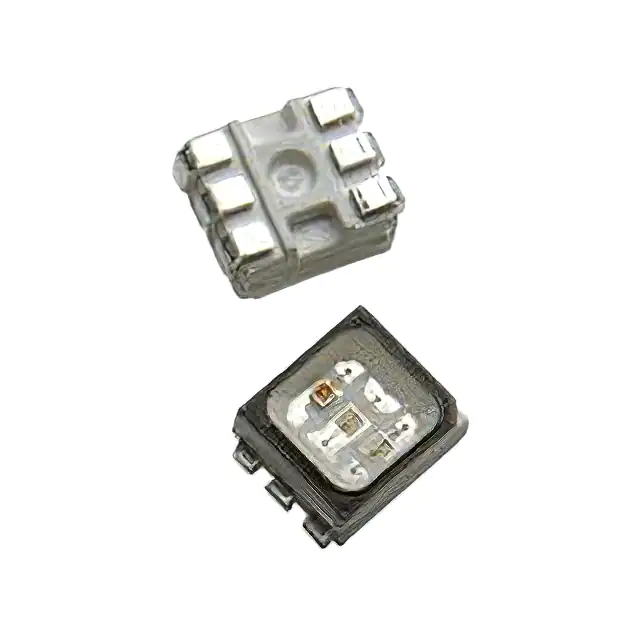
ASMT-YTC7-0AA02
Tricolor PLCC6 Black Body LED
Data Sheet
Description
Features
This family of SMT LEDs is packaged in the form of PLCC-6 with
a separate heat path for each LED die, enabling it to be driven
at a higher current.
Individually addressable pin-outs give higher flexibility in
circuitry design. With closely matched radiation pattern along
the package’s X-axis, these LEDs are suitable for indoor full
color display applications.
For easy pick and place, the LEDs are shipped in tape and reel.
Every reel is shipped from a single intensity and color bin for
better uniformity. The full black body of the LED provides
extreme contrast enhancement for short distance viewing of
fine pitch full color display.
* The test is conducted at the component level by
mounting the components on the PCB with proper
potting to protect the leads. Customers should perform
the necessary tests on the components for their final
applications.
These LEDs are compatible with the reflow soldering process.
CAUTION
CAUTION
These LEDs are Class 1C ESD sensitive. Please
observe appropriate precautions during
handling and processing. Refer to Avago
Application Note AN-1142 for additional details.
Standard PLCC-6 package (Plastic Leaded Chip Carrier)
with individual addressable pin-out for higher flexibility of
driving configuration
LED package with diffused silicone encapsulation
Using AlInGaP and InGaN dice technologies
Typical viewing angle 110°
Compatible with reflow soldering process
JEDEC MSL 3
Water-Resistance (IPX6*) per IEC 60529:2001
Applications
Customers should keep the LED in the MBB
when not in use because prolonged exposure to
the environment might cause the silver-plated
leads to tarnish, which might cause difficulties in
soldering.
Avago Technologies
-1-
Full color display
�ASMT-YTC7-0AA02
Data Sheet
Package Dimensions
Package Dimensions
3
5
2
6
1
3.00
0.50
4
2.30
2.80
2.30
3.40
4
3
Red
2
1.80
5
Green
0.20
6
1
Blue
0.90
Lead Configuration
1
Cathode (Blue)
2
Cathode (Green)
3
Cathode (Red)
4
Anode (Red)
5
Anode (Green)
6
Anode (Blue)
NOTE
1.
2.
3.
4.
All dimensions are in millimeters (mm).
Unless otherwise specified, tolerance is ± 0.20 mm.
Encapsulation = silicone.
Terminal finish = silver plating.
Avago Technologies
-2-
�ASMT-YTC7-0AA02
Data Sheet
Table 1. Absolute Maximum Ratings (TJ = 25 °C)
Table 1. Absolute Maximum Ratings (TJ = 25 °C)
Parameter
Red
Green & Blue
Unit
DC forward currenta
50
25
mA
Peak forward current b
100
100
mA
Power dissipation
125
90
mW
Maximum junction temperature Tj max
110
°C
Operating temperature range
–40 to + 100
°C
Storage temperature range
–40 to +100
°C
a.
Derate linearly as shown in Figure 7 to Figure 10.
b.
Duty Factor = 10%, frequency = 1 kHz.
Table 2. Optical Characteristics (TJ = 25 °C)
Luminous Intensity,
IV (mcd) @ IF = 20 mAa
Color
Red
Green
Blue
Dominant Wavelength,
d (nm) @IF = 20 mAb
Peak
Wavelength, P
(nm)
@IF = 20 mA
Viewing Angle,
2½ (°)c
Min.
Typ.
Max.
Min.
Typ.
Max.
Typ.
Typ.
224
330
450
617
623
627
630
110
560
840
1125
525
529
537
522
110
112.5
160
224
465
469
475
465
110
Test Current
(mA)
20
a.
The luminous intensity Iv is measured at the mechanical axis of the LED package at a single current pulse condition. The actual peak of the spatial radiation
pattern may not be aligned with the axis.
b.
The dominant wavelength is derived from the CIE Chromaticity Diagram and represents the perceived color of the device.
c.
½ is the off-axis angle where the luminous intensity is ½ the peak intensity.
Table 3. Electrical Characteristics (TJ = 25 °C)
Forward Voltage,
VF (V) @IF = 20 mAa
Color
Reverse Voltage,
VR (V) @ IR = 100 μAb
Reverse Voltage,
VR (V) @ IR = 10 μAb
Min.
1 Chip On
3 Chips On
Thermal Resistance,
RJ-S (°C/W)
Min.
Typ.
Max.
Min.
Red
1.8
2.1
2.5
4.0
—
280
330
Green
2.8
3.1
3.6
—
4.0
240
357
Blue
2.8
3.1
3.6
—
4.0
240
357
a.
Tolerance = ±0.1V.
b.
Indicates product final testing condition. Long-term reverse bias is not recommended.
Avago Technologies
-3-
�ASMT-YTC7-0AA02
Data Sheet
Part Numbering System
Part Numbering System
A
S
M
T
-
Y
T
C
7
-
0
x1
Code
A
A
0
2
x2
x3
x4
x5
Description
Option
x1
Package type
C
Black body
x2
Minimum intensity bin
A
Red:
bin S2
Green: bin U2
Blue:
bin R1
x3
Number of intensity bins
A
3 intensity bins from minimum
x4
Color bin combination
0
Red:
full distribution
Green: bin A, B, C
Blue:
x5
Test option
2
bin A, B, C, D
Test current = 20 mA
Avago Technologies
-4-
Red: bin S2, T1, T2
Green: bin U2, V1, V2
Blue: bin R1, R2, S1
�ASMT-YTC7-0AA02
Data Sheet
Table 4. Bin Information
Table 4. Bin Information
Color Bins (BIN) – Red
Intensity Bins (CAT)
Luminous Intensity (mcd)
Bin ID
Min
Max
R1
112.5
140.0
R2
140.0
180.0
S1
180.0
224.0
S2
224.0
285.0
T1
285.0
355.0
T2
355.0
450.0
U1
450.0
560.0
U2
560.0
715.0
V1
715.0
900.0
V2
900.0
1125.0
Bin ID
—
A
Color Bins (BIN) – Green
A
B
C
Max.
Cx
Cy
525.0
531.0
0.1142
0.8262
0.1624
0.7178
531.0
534.0
537.0
Max.
Cx
Cy
617.0
627.0
0.6850
0.3149
0.6815
0.3150
0.7000
0.2966
0.7037
0.2962
Dominant Wavelength
(nm)
0.2001
0.6983
0.1625
0.8012
0.1387
0.8148
0.1815
0.7089
0.2179
0.6870
0.1854
0.7867
0.1625
0.8012
0.2001
0.6983
0.2353
0.6747
0.2077
0.7711
B
C
D
Max.
Cx
Cy
465.0
469.0
0.1355
0.0399
0.1751
0.0986
0.1680
0.1094
0.1267
0.0534
0.1314
0.0459
0.1718
0.1034
0.1638
0.1167
0.1215
0.0626
0.1267
0.0534
0.1680
0.1094
0.1593
0.1255
0.1158
0.0736
0.1215
0.0626
0.1638
0.1167
0.1543
0.1361
0.1096
0.0868
467.0
469.0
471.0
Tolerance: ±1 nm.
Tolerance: ±1 nm.
Avago Technologies
-5-
Chromaticity coordinate
(for Reference)
Min.
Chromaticity Coordinate
(for Reference)
Min.
528.0
Min.
Color Bins (BIN) – Blue
Bin ID
Bin ID
Chromaticity Coordinate
(for Reference)
Tolerance: ±1 nm.
Tolerance: ±12%
Dominant Wavelength
(nm)
Dominant Wavelength
(nm)
471.0
473.0
475.0
�ASMT-YTC7-0AA02
Data Sheet
Table 4. Bin Information
Figure 1 Relative Intensity vs. Wavelength
Figure 2 Forward Current vs. Forward Voltage
100
1.0
Blue
Green
Red
Red
0.6
0.4
0.2
0.0
60
40
20
0
380
480
580
WAVELENGTH - nm
DOMINANT WAVELENGTH SHIFT - nm
RELATIVE INTENSITY
2.0
1.5
1.0
0.5
0
10
20
30
FORWARD CURRENT - mA
40
4
6
5
Blue
Green
Red
5
4
3
2
1
0
-1
-2
50
Figure 5 Relative Intensity vs. Junction Temperature
0
10
20
30
FORWARD CURRENT - mA
40
50
Figure 6 Forward Voltage vs. Junction Temperature
10
0.5
Blue
Green
Red
FORWARD VOLTAGE SHIFT - V
RELATIVE INTENSITY
2
3
FORWARD VOLTAGE - V
7
Blue
Green
Red
2.5
1
0.1
1
Figure 4 Dominant Wavelength Shift vs. Forward Current
3.0
0.0
0
680
Figure 3 Relative Intensity vs. Forward Current
Green/Blue
80
FORWARD CURRENT - mA
RELATIVE INTENSITY
0.8
-40
-20
0
20
40
60
80
TJ - JUNCTION TEMPERATURE - °C
100
0.3
0.2
0.1
0
-0.1
-0.2
-0.3
-40
120
Avago Technologies
-6-
Blue
Green
Red
0.4
-20
0
20
40
60
80
TJ - JUNCTION TEMPERATURE - °C
100
120
�ASMT-YTC7-0AA02
Data Sheet
Table 4. Bin Information
Figure 7 Maximum Forward Current vs. Temperature for Red
(1 Chip On)
Figure 8 Maximum Forward Current vs. Temperature for Red
(3 Chips On)
60
MAXIMUM FORWARD CURRENT - mA
MAXIMUM FORWARD CURRENT - mA
60
50
TS
40
30
TA
20
10
0
0
20
40
60
80
TEMPERATURE (°C)
100
TA
20
10
0
20
40
60
80
TEMPERATURE (°C)
100
120
30
MAXIMUM FORWARD CURRENT - mA
MAXIMUM FORWARD CURRENT - mA
30
Figure 10 Maximum Forward Current vs. Temperature for Green
and Blue (3 Chips On)
30
25
TS
20
TA
15
10
5
NOTE
TS
40
0
120
Figure 9 Maximum Forward Current vs. Temperature for Green
and Blue (1 Chip On)
0
50
0
20
40
60
80
TEMPERATURE (°C)
100
Thermal Resistance from LED Junction to
Ambient, RJ-A (°C/W)
Red
Green and Blue
1 chip on
450
410
3 chips on
630
690
Avago Technologies
-7-
TS
20
TA
15
10
5
0
120
Maximum forward current graphs based on
ambient temperature, TA are with reference to
thermal resistance RJ-A as follows. For more
details, see Precautionary Notes (4).
Condition
25
0
20
40
60
80
TEMPERATURE (°C)
100
120
�ASMT-YTC7-0AA02
Data Sheet
Table 4. Bin Information
Figure 12 Radiation Pattern Along Y-Axis of the Package
1.0
1.0
0.8
0.8
NORMALIZED INTENSITY
NORMALIZED INTENSITY
Figure 11 Radiation Pattern Along X-Axis of the Package
0.6
0.4
Red
Green
Blue
0.2
0.0
-90
-60
-30
0
30
60
ANGULAR DISPLACEMENT-DEGREE
90
0.6
0.4
0.2
0.0
-90
Figure 13 Illustration of Package Axis for Radiation Pattern
Y
X
X
Y
Avago Technologies
-8-
Red
Green
Blue
-60
-30
0
30
60
ANGULAR DISPLACEMENT-DEGREE
90
�ASMT-YTC7-0AA02
Data Sheet
Table 4. Bin Information
Figure 14 Recommended Soldering Land Pattern
2.30
0.50
4.55
1.35
1.60
0.40
Maximize the size of copper pad of PIN 1, PIN 4, PIN5
for better heat dissipation.
Copper pad
Solder mask
Figure 15 Carrier Tape Dimensions
Package Marking
4.00 ±0.10
4.00 ±0.10
2.00 ±0.05
+0.10
O 1.50 0
1.75 ±0.10
2.29 ±0.10
3.50 ±0.05
+0.30
8.00 -0.10
3.05 ±0.10
+0.10
O 1.00 0
3.81 ±0.10
0.229 ±0.01
Figure 16 Reeling Orientation
USER FEED DIRECTION
PACKAGE MARKING
PRINTED LABEL
Avago Technologies
-9-
�ASMT-YTC7-0AA02
Data Sheet
Table 4. Bin Information
Figure 17 Reel Dimensions
8.0 ± 1.0 (0.315 ± 0.039)
10.50 ± 1.0 (0.413 ± 0.039)
13.1 ± 0.5
Ø (0.516 ± 0.020)
20.20 MIN.
Ø (0.795 MIN.)
3.0 ± 0.5
(0.118 ± 0.020)
59.60 ± 1.00
(2.346 ± 0.039)
178.40 ± 1.00
(7.024 ± 0.039)
4.0 ± 0.5
(0.157 ± 0.020)
6
PS
5.0 ± 0.5
(0.197 ± 0.020)
Avago Technologies
- 10 -
�ASMT-YTC7-0AA02
Data Sheet
Packing Label
Packing Label
(i) Standard label (attached on moisture barrier bag)
(1P) Item: Part Number
STANDARD LABEL LS0002
RoHS Compliant Halogen Free
e4 Max Temp 260C MSL3
(1T) Lot: Lot Number
(Q) QTY: Quantity
LPN:
CAT: Intensity Bin
(9D)MFG Date: Manufacturing Date
BIN: Color Bin
(P) Customer Item:
(9D) Date Code: Date Code
(V) Vendor ID:
DeptID:
Made In: Country of Origin
(ii) Baby label (attached on plastic reel)
(1P) PART #: Part Number
BABY LABEL COSB001B V0.0
(1T) LOT #: Lot Number
(9D)MFG DATE: Manufacturing Date
QUANTITY: Packing Quantity
C/O: Country of Origin
(9D): DATE CODE:
(1T) TAPE DATE:
D/C: Date Code
VF:
CAT: INTENSITY BIN
BIN: COLOR BIN
Example of luminous intensity (lv) bin information on label:
Example of color bin information on label:
CAT: S2 U2 R1
BIN: A B
Intensity bin for Blue: R1
Color bin for Blue: B
Color bin for Green: A
Intensity bin for Green: U2
Intensity bin for Red: S2
NOTE
Avago Technologies
- 11 -
There is no color bin ID for the Red color
because there is only one range, as stated in
Table 4.
�ASMT-YTC7-0AA02
Data Sheet
Soldering
Soldering
Recommended reflow soldering condition
(ii) Lead-Free Reflow Soldering
(i) Leaded Reflow Soldering
20 SEC. MAX.
TEMPERATURE
TEMPERATURE
10 to 30 SEC.
240°C MAX.
3°C/SEC. MAX.
183°C
100-150°C
-6°C/SEC.
MAX.
3°C/SEC.
MAX.
217°C
200°C
255 - 260 °C
3°C/SEC. MAX.
6°C/SEC. MAX.
150°C
3 °C/SEC. MAX.
100 SEC. MAX.
60 - 120 SEC.
120 SEC. MAX.
60-150 SEC.
TIME
TIME
1.
Do not perform reflow soldering more than twice. Observe
the necessary precautions for handling moisture-sensitive
devices as stated in the following section.
2.
Recommended board reflow direction is as follows.
3.
Do not apply any pressure or force on the LED during
reflow and after reflow when the LED is still hot.
4.
Use reflow soldering to solder the LED. Use hand soldering
for rework only if this is unavoidable, and it must be strictly
controlled to the following conditions:
Soldering iron tip temperature = 320 °C maximum
— Soldering duration = 3 sec maximum
— Number of cycles = 1 only
— Power of soldering iron = 50W maximum
—
5.
Do not touch the LED body with a hot soldering iron
except the soldering terminals because it might damage
the LED.
6.
For de-soldering, you should use a double flat tip.
7.
Confirm beforehand whether hand soldering will affect
the functionality and performance of the LED.
REFLOW DIRECTION
Avago Technologies
- 12 -
�ASMT-YTC7-0AA02
Data Sheet
Precautionary Notes
Precautionary Notes
2. Handling of moisture sensitive device
1. Handling precautions
The encapsulation material of the LED is made of silicone
for better product reliability. Compared to epoxy
encapsulant that is hard and brittle, silicone is softer and
flexible. Observe pecial handling precautions during
assembly of silicone encapsulated LED products. Failure to
comply might lead to damage and premature failure of the
LED. Refer to Application Note AN5288, Silicone
Encapsulation for LED: Advantages and Handling
Precautions for more information.
a.
b.
c.
d.
e.
Do not poke sharp objects into the silicone
encapsulant. Sharp objects, such as tweezers or
syringes, might apply excessive force or even pierce
through the silicone and cause failures to the LED die
or wire bond.
Do not touch the silicone encapsulant. Uncontrolled
forces acting on the silicone encapsulant might result
in excessive stress on the wire bond. Hold the LED only
by the body.
Do not stack assembled PCBs together. Use an
appropriate rack to hold the PCBs.
The surface of the silicone material attracts dust and
dirt easier than epoxy due to its surface tackiness. To
remove foreign particles on the surface of silicone, use
a cotton bud with isopropyl alcohol (IPA). During
cleaning, rub the surface gently without putting
pressure on the silicone. Ultrasonic cleaning is not
recommended.
For automated pick and place, Avago has tested the
following nozzle size to work with this LED. However,
due to the possibility of variations in other
parameters, such as pick and place machine
maker/model and other settings of the machine,
customers should verify that the selected nozzle will
not cause damage to the LED.
This product has a Moisture Sensitive Level 3 rating per
JEDEC J-STD-020. Refer to Avago Application Note
AN5305, Handling of Moisture Sensitive Surface Mount
Devices, for additional details and a review of proper
handling procedures.
a.
Before use:
An unopened moisture barrier bag (MBB) can be
stored at < 40 °C / 90% RH for 12 months. If the
actual shelf life has exceeded 12 months and the
humidity indicator card (HIC) indicates that
baking is not required, then it is safe to reflow the
LEDs per the original MSL rating.
Do not open the MBB prior to assembly (e.g.,
for IQC).
Control after opening the MBB:
Read the humidity indicator card (HIC)
immediately upon opening of the MBB.
Keep the LEDs at < 30 °C / 60% RH at all times, and
all high temperature-related processes, including
soldering, curing or rework, must be completed
within 168 hours.
Control for unfinished reel:
Store unused LEDs in a sealed MBB with desiccant
or desiccator at < 5% RH.
Control of assembled boards:
If the PCB soldered with the LEDs is to be
subjected to other high-temperature processes,
store the PCB in a sealed MBB with desiccant or
desiccator at < 5% RH to ensure that all LEDs have
not exceeded their floor life of 168 hours.
Baking is required if:
The HIC indicator is not BROWN at 10% and is
AZURE at 5%.
The LEDs are exposed to condition of > 30 °C /
60% RH at any time.
The LED floor life exceeded 168 hrs.
b.
c.
d.
e.
The recommended baking condition is: 60 °C ±5 °C for
20 hrs.
Baking should only be done once.
f.
Storage
The soldering terminals of these Avago LEDs are
silver plated. If the LEDs are exposed too long in
the ambient environment, the silver plating might
become oxidized and, thus, affect its solderability
performance. As such, keep unused LEDs in a
sealed MBB with desiccant or in desiccator at