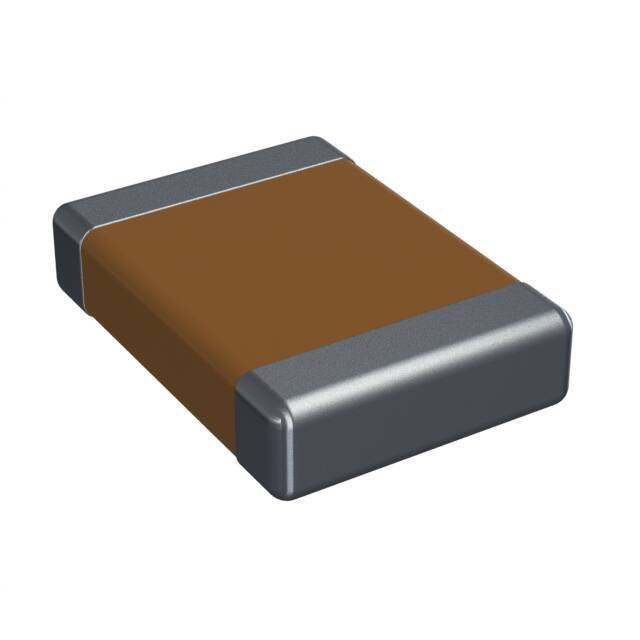
Y5V Dielectric
General Specifications
Y5V formulations are for general-purpose use in a limited
temperature range. They have a wide temperature characteristic of +22% –82% capacitance change over the operating
temperature range of –30°C to +85°C.
Y5V’s high dielectric constant allows the manufacture of the
highest capacitance value in a given case size.
These characteristics make Y5V ideal for decoupling applications within limited temperature range.
PART NUMBER (see page 3 for complete part number explanation)
0805
3
G
104
Z
A
T
2
A
Size
(L" x W")
Voltage
10V = Z
16V = Y
25V = 3
50V = 5
Dielectric
Y5V = G
Capacitance
Code
Capacitance
Tolerance
Z = +80 –20%
Failure
Rate
A = Not
Applicable
Terminations
T = Plated Ni
and Solder
Packaging
2 = 7" Reel
4 = 13" Reel
Special
Code
A = Std.
Product
PERFORMANCE CHARACTERISTICS
Capacitance Range
Capacitance Tolerances
Operating Temperature Range
Temperature Characteristic
Voltage Ratings
Dissipation Factor
Insulation Resistance (+25°C, RVDC)
Dielectric Strength
Test Voltage
Test Frequency
16
2200 pF to 22 µF
+80 –20%
–30°C to +85°C
+22% to –82% max. within operating temperature
10, 16, 25 and 50 VDC (+85°C)
For 50 volts: 5.0% max.
For 16 and 25 volts: 7% max.
For 10 volts: 10% max.
10,000 megohms min. or 1000 MΩ - µF min., whichever is less
250% of rated voltage for 5 seconds at 50 mamp max. current
1.0 Vrms ± 0.2 Vrms
1 KHz
�Y5V Dielectric
Typical Characteristic Curves**
0.1 F - 0603
Impedance vs. Frequency
Temperature Coefficient
10,000
1,000
100
|Z| (Ohms)
% ⌬ Capacitance
+20
+10
0
-10
-20
-30
-40
-50
-60
-70
-80
10
1
0.1
-55
-35 -15
0.01
10,000
+5 +25 +45 +65 +85 +105 +125
Temperature °C
100,000
1,000,000
10,000,000
Frequency (Hz)
0.22 F - 0805
Impedance vs. Frequency
Capacitance Change
vs. DC Bias Voltage
1,000
+40
100
|Z| (Ohms)
⌬ c/c (%)
+20
0
-20
-40
-60
10
1
0.1
-80
-100
0
20
40
60
80
0.01
10,000
100
Insulation Resistance vs. Temperature
1,000,000
10,000,000
1 F - 1206
Impedance vs. Frequency
10,000
1,000
100
1,000
|Z| (Ohms)
Insulation Resistance (Ohm-Farads)
100,000
Frequency (Hz)
DC Bias Voltage
100
10
1
0.1
0
+20
+30
+40
+50
+60
+70
0.01
10,000
+80 +85
Temperature °C
100,000
1,000,000
10,000,000
Frequency (Hz)
SUMMARY OF CAPACITANCE RANGES VS. CHIP SIZE
Style
0402*
0603*
0805*
1206*
1210*
1812*
1825*
2220
2225
10V
2.2nF - 0.1µF
2.2nF - 1µF
10nF - 4.7µF
10nF - 10µF
10nF - 22µF
→
→
—
→
16V
2.2nF - 0.1µF
2.2nF - 0.33µF
10nF - 2.2µF
10nF - 4.7µF
0.1µF - 10µF
→
→
—
→
25V
2.2nF - 22nF
2.2nF - 0.22µF
10nF - 1µF
10nF - 2.2µF
0.1µF - 4.7µF
0.15µF - 1.5µF
0.47µF - 1.5µF
—
0.68µF - 2.2µF
50V
2.2nF - 10nF
2.2nF - 56nF
10nF - 0.33µF
10nF - 1µF
0.1µF - 1µF
1.5nF - 1.5µF
0.47µF - 1.5µF
1µF - 1.5µF
0.68µF - 1.5µF
* Standard Sizes
** For additional information on performance changes with operating conditions consult AVX’s software SpiCap.
17
�Y5V Dielectric
Capacitance Range
PREFERRED SIZES ARE SHADED
1.00 ± .10
(.040 ± .004)
.50 ± .10
(.020 ± .004)
.60
(.024)
.25 ± .15
(.010 ± .006)
1.60 ± .15
(.063 ± .006)
.81 ± .15
(.032 ± .006)
.90
(.035)
.35 ± .15
(.014 ± .006)
MM
(in.)
MM
(in.)
MM
(in.)
MM
(in.)
(L) Length
(W) Width
(T) Max. Thickness
(t) Terminal
WVDC
10
16
25
50
10
16
25
1210
2.01 ± .20
(.079 ± .008)
1.25 ± .20
(.049 ± .008)
1.30
(.051)
.50 ± .25
(.020 ± .010)
50
10
16
25
3.20 ± .20
(.126 ± .008)
1.60 ± .20
(.063 ± .008)
1.50
(.059)
.50 ± .25
(.020 ± .010)
50
10
16
25
3.20 ± .20
(.126 ± .008)
2.50 ± .20
(.098 ± .008)
1.70
(.067)
.50 ± .25
(.020 ± .010)
50
10
16
25
50
1812*
1825*
2220*
2225*
All Embossed
All Embossed
All Embossed
All Embossed
4.50 ± .30
(.177 ± .012)
3.20 ± .20
(.126 ± .008)
1.70
(.067)
.61 ± .36
(.024 ± .014)
4.50 ± .30
(.252 ± .016)
6.40 ± .40
(.252 ± .016)
1.70
(.067)
.61 ± .36
(.024 ± .014)
5.7 ± 0.4
(.225 ± .016)
5.0 ± 0.4
(.197 ± .016)
2.30
(.090)
.64 ± .39
(.025 ± .015)
5.72 ± .25
(.225 ± .010)
6.35 ± .25
(.250 ± .010)
1.70
(.067)
.64 ± .39
(.025 ± .015)
25
25
50
50
䉲
2200
2700
3300
1206
50
25
䉲
Cap
(pF)
0805
Paper/Embossed Paper/Embossed Paper/Embossed
L
W
䉲
䉲
Cap
(µF)
T
䉲
3900
4700
5600
6800
8200
50
䉲
0603*
All Paper
䉲
0402*
All Paper
䉲
SIZE
Standard Reel
Packaging
t
.01
.012
.015
.018
.022
.027
.033
.039
.047
.056
.068
.082
.10
.12
.15
.18
.22
.27
.33
.39
.47
.56
.68
.82
1.0
1.2
1.5
1.8
2.2
2.7
3.3
3.9
4.7
5.6
6.8
8.2
10.0
12.0
15.0
18.0
22.0
*Reflow soldering only.
= Paper Tape
NOTES: For low profile product, see page 19.
18
= Embossed Tape
�Basic Capacitor Formulas
I. Capacitance (farads)
English: C = .224 K A
TD
Metric: C = .0884 K A
TD
XI. Equivalent Series Resistance (ohms)
E.S.R. = (D.F.) (Xc) = (D.F.) / (2 π fC)
XII. Power Loss (watts)
Power Loss = (2 π fCV2) (D.F.)
XIII. KVA (Kilowatts)
KVA = 2 π fCV2 x 10 -3
II. Energy stored in capacitors (Joules, watt - sec)
E = 1⁄2 CV2
XIV. Temperature Characteristic (ppm/°C)
T.C. = Ct – C25 x 106
C25 (Tt – 25)
III. Linear charge of a capacitor (Amperes)
dV
I=C
dt
XV. Cap Drift (%)
C1 – C2
C.D. =
C1
IV. Total Impedance of a capacitor (ohms)
Z = 冑 RS + (XC - XL )
V. Capacitive Reactance (ohms)
1
xc =
2 π fC
2
2
XVI. Reliability of Ceramic Capacitors
Vt
L0
X
Tt
Y
=
Lt
Vo
To
( ) ( )
VI. Inductive Reactance (ohms)
xL = 2 π fL
XVII. Capacitors in Series (current the same)
Any Number:
1 = 1 + 1 --- 1
CT
C1
C2
CN
C1 C2
Two: CT =
C1 + C2
VII. Phase Angles:
Ideal Capacitors: Current leads voltage 90°
Ideal Inductors: Current lags voltage 90°
Ideal Resistors: Current in phase with voltage
XVIII. Capacitors in Parallel (voltage the same)
CT = C1 + C2 --- + CN
VIII. Dissipation Factor (%)
D.F.= tan ␦ (loss angle) = E.S.R. = (2 πfC) (E.S.R.)
Xc
IX. Power Factor (%)
P.F. = Sine ␦ (loss angle) = Cos (phase angle)
f
P.F. = (when less than 10%) = DF
XIX. Aging Rate
A.R. = %
D C/decade of time
XX. Decibels
db = 20 log V1
V2
X. Quality Factor (dimensionless)
Q = Cotan ␦ (loss angle) = 1
D.F.
METRIC PREFIXES
Pico
Nano
Micro
Milli
Deci
Deca
Kilo
Mega
Giga
Tera
2
X 10-12
X 10-9
X 10-6
X 10-3
X 10-1
X 10+1
X 10+3
X 10+6
X 10+9
X 10+12
x 100
SYMBOLS
K
= Dielectric Constant
f
= frequency
Lt
= Test life
A
= Area
L
= Inductance
Vt
= Test voltage
TD
= Dielectric thickness
␦
= Loss angle
Vo
= Operating voltage
V
= Voltage
f
= Phase angle
Tt
= Test temperature
t
= time
X&Y
= exponent effect of voltage and temp.
To
= Operating temperature
Rs
= Series Resistance
Lo
= Operating life
�How to Order
Part Number Explanation
EXAMPLE: 08055A101JAT2A
0805
Size
(L" x W")
0402
0504
0603
0805
1005
0907
1206
1210
1505
1805
1808
1812
1825
2225
3640
5
A
101
Dielectric
C0G (NP0) = A
X7R = C
X5R = D
Z5U = E
Y5V = G
Voltage
10V = Z
16V = Y
25V = 3
50V = 5
100V = 1
200V = 2
250V = V
500V = 7
600V = C
1000V = A
1500V = S
2000V = G
2500V = W
3000V = H
4000V = J
5000V = K
J
C
D
F
G
J
K
M
Z
P
A
Capacitance
Tolerance
= ±.25 pF*
= ±.50 pF*
= ±1% (≥ 25 pF)
= ±2% (≥ 13 pF)
= ±5%
= ±10%
= ±20%
= +80%, -20%
= +100%, -0%
Capacitance
Code
(2 significant
digits + no. of
zeros)
Examples:
10 pF = 100
100 pF = 101
1,000 pF = 102
22,000 pF = 223
220,000 pF = 224
1 µF = 105
For values below 10 pF,
use “R” in place of
decimal point, e.g., 9.1
pfd = 9R1.
T
2
Terminations
Standard:
T = Ni and Tin
Plated
Others:
7 = Plated Ni
Gold Plated
1 = Pd/Ag
Failure
Rate
A = Not
Applicable
A
Special**
Code
A = Standard
Product
Non-Standard
P = Embossed
unmarked
M = Embossed
marked
E = Standard
packaging
marked
Low Profile
Chips Only
Max. Thickness
T = .66mm (.026")
S = .56mm (.022")
R = .46mm (.018")
Packaging**
Recommended:
2 =7" Reel
4 =13" Reel
Others:
7 = Bulk Cassette
9 = Bulk
* C&D tolerances for ⱕ10 pF values.
** Standard Tape and Reel material depends upon chip size and thickness.
See individual part tables for tape material type for each capacitance value.
Note: Unmarked product is standard. Marked product is available on special request, please contact AVX.
Standard packaging is shown in the individual tables.
Non-standard packaging is available on special request, please contact AVX.
3
�General Specifications
Environmental
THERMAL SHOCK
MOISTURE RESISTANCE
Specification
Appearance
No visual defects
Capacitance Variation
C0G (NP0): ± 2.5% or ± .25pF, whichever is greater
X7R: ≤ ± 7.5%
Z5U: ≤ ± 20%
Y5V: ≤ ± 20%
Q, Tan Delta
To meet initial requirement
Insulation Resistance
C0G (NP0), X7R: To meet initial requirement
Z5U, Y5V: ≥ Initial Value x 0.1
Dielectric Strength
No problem observed
Measuring Conditions
Step
Temperature °C
Time (minutes)
C0G (NP0), X7R: -55° ± 2°
1
Z5U: +10° ± 2°
30 ± 3
Y5V: -30° ± 2°
2
Room Temperature
#3
C0G
(NP0),
X7R:
+125°
±
2°
3
30 ± 3
Z5U, Y5V: +85° ± 2°
4
Room Temperature
#3
Repeat for 5 cycles and measure after 48 hours ± 4 hours
(24 hours for C0G (NP0)) at room temperature.
Specification
Appearance
No visual defects
Capacitance Variation
C0G (NP0): ± 5% or ± .5pF, whichever is greater
X7R: ≤ ± 10%
Z5U: ≤ ± 30%
Y5V: ≤ ± 30%
Q, Tan Delta
C0G (NP0):≥ 30pF........................Q ≥ 350
≥ 10pF, < 30pF ...........Q ≥ 275+5C/2
< 10pF ........................Q ≥ 200+10C
X7R: Initial requirement + .5%
Z5U: Initial requirement + 1%
Y5V: Initial requirement + 2%
IMMERSION
Specification
Appearance
No visual defects
Capacitance Variation
C0G (NP0): ± 2.5% or ± .25pF, whichever is greater
X7R: ≤ ± 7.5%
Z5U: ≤ ± 20%
Y5V: ≤ ± 20%
Q, Tan Delta
To meet initial requirement
Insulation Resistance
C0G (NP0), X7R: To meet initial requirement
Z5U, Y5V: ≥ Initial Value x 0.1
Dielectric Strength
No problem observed
Measuring Conditions
Step
Temperature °C
Time (minutes)
+65
+5/-0
1
15 ± 2
Pure Water
0±3
2
15 ± 2
NaCl solution
Repeat cycle 2 times and wash with water and dry.
Store at room temperature for 48 ± 4 hours (24 hours for
C0G (NP0)) and measure.
22
Insulation Resistance
≥ Initial Value x 0.3
Measuring Conditions
Step
Temp. °C
Humidity % Time (hrs)
1
+25->+65
90-98
2.5
2
+65
90-98
3.0
3
+65->+25
80-98
2.5
4
+25->+65
90-98
2.5
5
+65
90-98
3.0
6
+65->+25
80-98
2.5
7
+25
90-98
2.0
7a
-10
uncontrolled
–
7b
+25
90-98
–
Repeat 20 cycles (1-7) and store for 48 hours (24 hours
for C0G (NP0)) at room temperature before measuring.
Steps 7a & 7b are done on any 5 out of first 9 cycles.
�General Specifications
Environmental
STEADY STATE HUMIDITY
(No Load)
Specification
Appearance
No visual defects
Capacitance Variation
C0G (NP0): ± 5% or ± .5pF, whichever is greater
X7R: ≤ ± 10%
Z5U: ≤ ± 30%
Y5V: ≤ ± 30%
Q, Tan Delta
C0G (NP0): ≥ 30pF......................Q ≥ 350
≥ 10pF, < 30pF.........Q ≥ 275+5C/2
< 10pF ....................Q ≥ 200+10C
X7R: Initial requirement + .5%
Z5U: Initial requirement + 1%
Y5V: Initial requirement + 2%
Insulation Resistance
≥ Initial Value x 0.3
Measuring Conditions
Store at 85 ± 5% relative humidity and 85°C for 1000
hours, without voltage. Remove from test chamber
and stabilize at room temperature and humidity for
48 ± 4 hours (24 ±2 hours for C0G (NP0)) before
measuring.
Charge and discharge currents must be less than
50ma.
LOAD HUMIDITY
Specification
Appearance
No visual defects
Capacitance Variation
C0G (NP0): ± 5% or ± .5pF, whichever is greater
X7R: ≤ ± 10%
Z5U: ≤ ± 30%
Y5V: ≤ ± 30%
Q, Tan Delta
C0G (NP0): ≥ 30pF .....................Q ≥ 350
≥ 10pF,< 30pF .........Q ≥ 275+5C/2
< 10pF ....................Q ≥ 200+10C
X7R: Initial requirement + .5%
Z5U: Initial requirement + 1%
Y5V: Initial requirement + 2%
Insulation Resistance
C0G (NP0), X7R: To meet initial value x 0.3
Z5U, Y5V: ≥ Initial Value x 0.1
Charge devices with rated voltage in test chamber set
at 85 ± 5% relative humidity and 85°C for 1000
(+48,-0) hours. Remove from test chamber and
stabilize at room temperature and humidity for 48 ± 4
hours (24 ±2 hours for C0G (NP0)) before measuring.
Charge and discharge currents must be less than
50ma.
LOAD LIFE
Specification
Appearance
No visual defects
Capacitance Variation
C0G (NP0): ± 3% or ± .3pF, whichever is greater
X7R: ≤ ± 10%
Z5U: ≤ ± 30%
Y5V: ≤ ± 30%
Q, Tan Delta
C0G (NP0): ≥ 30pF......................Q ≥ 350
≥ 10pF, < 30pF.........Q ≥ 275+5C/2
< 10pF ....................Q ≥ 200+10C
X7R: Initial requirement + .5%
Z5U: Initial requirement + 1%
Y5V: Initial requirement + 2%
Insulation Resistance
C0G (NP0), X7R: To meet initial value x 0.3
Z5U, Y5V: ≥ Initial Value x 0.1
Charge devices with twice rated voltage in test
chamber set at +125°C ± 2°C for C0G (NP0) and X7R,
+85° ± 2°C for Z5U, and Y5V for 1000 (+48,-0) hours.
Remove from test chamber and stabilize at room
temperature for 48 ± 4 hours (24 ±2 hours for C0G
(NP0)) before measuring.
Charge and discharge currents must be less than
50ma.
23
�General Specifications
Mechanical
END TERMINATION ADHERENCE
Specification
No evidence of peeling of end terminal
Measuring Conditions
After soldering devices to circuit board apply 5N
(0.51kg f) for 10 ± 1 seconds, please refer to Figure 1.
BEND STRENGTH
Speed = 1mm/sec
2mm
Deflection
R340mm
45mm
5N FORCE
45mm
Supports
Figure 2. Bend Strength
DEVICE UNDER TEST
TEST BOARD
Figure 1.
Terminal Adhesion
RESISTANCE TO VIBRATION
Specification
Appearance:
No visual defects
Capacitance
Within specified tolerance
Q, Tan Delta
To meet initial requirement
Insulation Resistance
C0G (NP0), X7R ⱖ Initial Value x 0.3
Z5U, Y5V ⱖ Initial Value x 0.1
Measuring Conditions
Vibration Frequency
10-2000 Hz
Maximum Acceleration
20G
Swing Width
1.5mm
Test Time
X, Y, Z axis for 2 hours each, total 6 hours of test
SOLDERABILITY
Specification
ⱖ 95% of each termination end should be covered with
fresh solder
Measuring Conditions
Dip device in eutectic solder at 230 ± 5°C for
2 ± .5 seconds
24
Specification
Appearance:
No visual defects
Capacitance Variation
C0G (NP0): ± 5% or ± .5pF, whichever is larger
X7R: ≤ ± 12%
Z5U: ≤ ± 30%
Y5V: ≤ ± 30%
Insulation Resistance
C0G (NP0): ≥ Initial Value x 0.3
X7R: ≥ Initial Value x 0.3
Z5U: ≥ Initial Value x 0.1
Y5V: ≥ Initial Value x 0.1
Measuring Conditions
Please refer to Figure 2
Deflection:
2mm
Test Time:
30 seconds
RESISTANCE TO SOLDER HEAT
Specification
Appearance:
No serious defects,