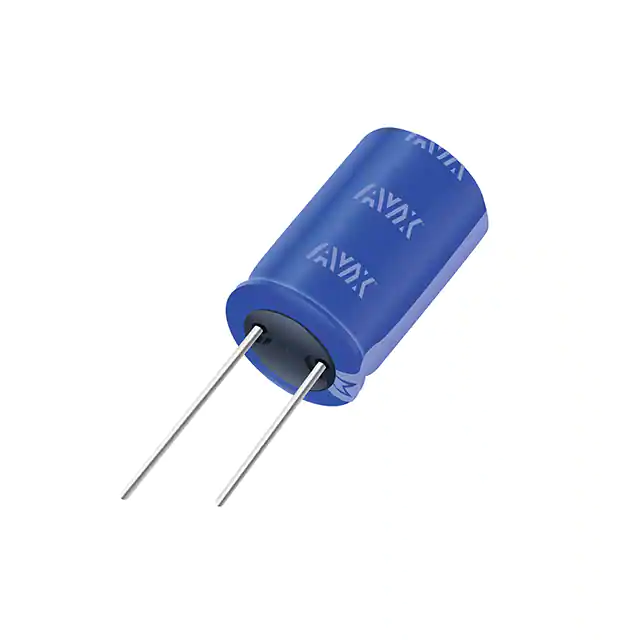
3.0V SCC Series
High Capacitance Cylindrical SuperCapacitors
The new series of cylindrical electrochemical double-layer capacitors offers excellent pulse power
handling characteristics based on the combination of very high capacitance and very low ESR. Used by
themselves or in conjunction with primary or secondary batteries, they provide extended back up time,
longer battery life, and provide instantaneous power pulses as needed. Offers great solutions to Hold-Up,
Energy Harvesting, and Pulse Power Applications.
FEATURES
APPLICATIONS
•
•
•
•
•
•
•
•
•
•
•
•
•
Cap Values from 1F – 100F
High pulse power capability
Low ESR
Low Leakage Current
Capability to couple with battery
Camera Flash Systems
Energy Harvesting
GSM/GPRS Pulse Applications
UPS/Industrial
Wireless Alarms
Remote Metering
Scanners
Toys and Games
HOW TO ORDER
SCC
S
30
E
106
S
R
B
–
Series
SuperCap
Cylindrical
Diameter
Q = 6.3mm
R = 8mm
S = 10mm
T = 12.5mm
U = 16mm
V = 18mm
Case Length
Two digits
represent case
length in mm
Voltage Code
E = 3.0V
Capacitance Code
1st two digits
represent significant
figures 3rd digit
represents multiplier
(number of zeros to
follow)
Tolerance
P = +100%/-0%
S = +30%/-10%
Lead Format
R = Radial
Package
B = Bulk
T = Tray*
Custom Code
A1= 4mm Bent Leads*
C1 = 2mm Bent Leads*
*Inquire about availability
OPERATING
TEMPERATURE
QUALITY INSPECTION
TERMINATION
Parts are tested for Life Cycle, high temperature
load life, temperature characteristics, vibration
resistance, and humidity characteristics. See
page 2 for more information.
These SuperCapacitors are compatible with hand
soldering and wave soldering processes, so long as
appropriate precautions are followed. See page 4
for more information.
-40°C to +65°C @ 3.0V
-40°C to +85°C @ 2.5V
LEAD-FREE COMPATIBLE
COMPONENT
For RoHS compliant products, please
select correct termination style.
The Important Information/Disclaimer is incorporated in the catalog where these specifications came from or
available online at www.avx.com/disclaimer/ by reference and should be reviewed in full before placing any order.
062520
– supercapacitors –
1
�3.0V SCC Series
High Capacitance Cylindrical SuperCapacitors
RATINGS & PART NUMBER REFERENCE
AVX Part Number
Diameter
(mm)
Length
(mm)
Rated
Capacitance
(F)
Capacitance
Tolerance
Rated
Voltage
(V)
Rated
Temperature
(°C)
DCL Max
@ 72 Hrs
(µA)
ESR Max
ESR Max
@ 1000 Hz
@ DC (mΩ)
(mΩ)
Peak
Current
(A)
Power
Density
(W/kg)
Max
Energy
(Wh)
Energy
Density
(Wh/kg)
SCCQ12E105PRB
6.3
12
1
+100%/-0%
3.0/2.5*
65/85*
6
240
1500
0.60
1108
0.0013
1.92
SCCR12E105PRB
8
12
1
+100%/-0%
3.0/2.5*
65/85*
6
180
860
0.81
1322
0.0013
1.32
SCCR16E205PRB
8
16
2
+100%/-0%
3.0/2.5*
65/85*
10
100
360
1.74
2609
0.0025
2.17
SCCR20E335PRB
8
20
3.3
+100%/-0%
3.0/2.5*
65/85*
12
95
280
2.57
2660
0.0041
2.84
3.68
Radial Lead
SCCR25E505PRB
8
25
5
+100%/-0%
3.0/2.5*
65/85*
15
85
220
3.57
2888
0.0063
SCCS20E505PRB
10
20
5
+100%/-0%
3.0/2.5*
65/85*
15
70
170
4.05
3025
0.0063
2.98
SCCS25E705PRB
10
25
7
+100%/-0%
3.0/2.5*
65/85*
24
60
150
5.12
2769
0.0088
3.37
SCCS30E106SRB
10
30
10
+30%/-10%
3.0/2.5*
65/85*
30
50
75
8.57
4645
0.0125
4.03
SCCT20E106SRB
12.5
20
10
+30%/-10%
3.0/2.5*
65/85*
30
50
75
8.57
4235
0.0125
3.68
SCCT30E156SRB
12.5
30
15
+30%/-10%
3.0/2.5*
65/85*
50
40
60
11.84
4000
0.0188
4.17
SCCU25E256SRB
16
25
25
+30%/-10%
3.0/2.5*
65/85*
60
27
50
16.67
2959
0.0313
4.28
SCCU30E356SRB
16
30
35
+30%/-10%
3.0/2.5*
65/85*
70
20
40
21.88
3103
0.0438
5.03
SCCV40E506SRB
18
40
50
+30%/-10%
3.0/2.5*
65/85*
75
18
20
37.50
4154
0.0625
4.81
SCCV60E107SRB
18
60
100
+30%/-10%
3.0/2.5*
65/85*
260
15
18
53.57
2904
0.1250
6.05
*with appropriate voltage derating operating temperature can be extended to 85°C
QUALIFICATION TEST SUMMARY
Test
Life Cycle
High Temperature
Load Life
Storage
Temperature
Characteristics
Vibration
Resistance
Test Method
Capacitors are cycled between rated voltage and
half-rated voltage under constant current at +25°C for
500,000 cycles
Temperature: +65°C
Voltage: Rated Voltage
Test Duration: 1,000 hours
Storage Duration: 2 years
No Load
Temperature: +35°C
Amplitude: 1.5mm
Frequency: 10 ~ 55Hz
Direction: X, Y, Z for 2 hours each
Parameter
Limits
Capacitance
ESR
Appearance
≤30% of spec value
≤200% of spec value
No remarkable defects
Capacitance
ESR
Appearance
≤30% of spec value
≤200% of spec value
No remarkable defects
Capacitance
ESR
Appearance
≤30% of spec value
≤200% of spec value
No remarkable defects
Capacitance
ESR
Appearance
≤30% of spec value
≤200% of spec value
No remarkable defects
Capacitance
ESR
Appearance
≤30% of spec value
≤200% of spec value
No remarkable defects
Voltage: Rated Voltage
Humidity
RH: 90%
Temperature: +60°C
Test Duration: 1,000 hours
2
The Important Information/Disclaimer is incorporated in the catalog where these specifications came from or
available online at www.avx.com/disclaimer/ by reference and should be reviewed in full before placing any order.
111120
– supercapacitors –
�3.0V SCC Series
High Capacitance Cylindrical SuperCapacitors
QUALITY AND RELIABILITY
CAPACITANCE VS. TEMPERATURE
Percent of 25°C Reading
200%
150%
100%
50%
0%
-40°C
-20°C
0°C
20°C
40°C
60°C
80°C
Percent of 25°C Reading
Temperature (ºC)
700%
600%
500%
400%
300%
200%
100%
0%
-40°C
LEAKAGE CURRENT VS. TEMPERATURE
-20°C
0°C
20°C
40°C
60°C
80°C
60°C
80°C
Temperatue (ºC)
EQUIVALENT SERIES RESISTANCE VS. TEMPERATURE
Percent of 25°C Reading
300%
250%
200%
150%
100%
50%
0%
-40°C
-20°C
0°C
20°C
40°C
Temperature (°C)
The Important Information/Disclaimer is incorporated in the catalog where these specifications came from or
available online at www.avx.com/disclaimer/ by reference and should be reviewed in full before placing any order.
011519
– supercapacitors –
3
�3.0V SCC Series
High Capacitance Cylindrical SuperCapacitors
MECHANICAL SPECIFICATIONS
RADIAL LEAD TYPE 1F – 100F
D (mm)
P (mm)
d (mm)
6.3
2.3
0.6
8
3.2
0.6
10
5.0
0.6
12.5
5.5
0.6*
16
7.3
0.8
18
8.0
0.8
L ± 2.0 mm
øD+1.0/-0mm
*For parts with Diameter (D)=12.5mm:
If Length ≤ 30mm, Lead Diameter (d)=0.6mm
If Length ≥ 35mm, Lead Diameter (d)=0.8mm
RADIAL BENT LEAD TYPE
SOLDERING RECOMMENDATIONS
When soldering SuperCapacitors to a PCB, the temperature & time that the
body of the SuperCapacitor sees during soldering can have a negative effect
on performance. We advise following these guidelines:
• Do not immerse the SuperCapacitors in solder. Only the leads should come
in contact with the solder.
• Ensure that the body of the SuperCapacitor is never in contact with the
molten solder, the PCB or other components during soldering.
• Excessive temperatures or excessive temperature cycling during soldering
may cause the safety vent to burst or the case to shrink or crack, potentially
damaging the PCB or other components, and significantly reduce the life
of the capacitor.
PRECAUTION: For all products with shrink wrap sleeves, washing in any type of cleaning
agent is prohibited. During all soldering processes, it’s recommended to protect the
shrink wrap from any kind of liquid (including but not limited to: water, strong acid, strong
alkali, strong oxidizing solutions, and strong solvents) to avoid the risk of damage,
cracking, and fading of the outer shrink wrap.
P ± 0.5 mm
øD+1.0/-0mm
L ± 2.0 mm
Style
B (mm)
A1
4
C1
2
that the soldering iron temperature should be less than 350°C, and contact
time should be limited to less than 4 seconds. Too much exposure to
terminal heat during soldering can cause heat to transfer to the body of
the SuperCapacitor, potentially damaging the electrical properties of the
SuperCapacitor.
WAVE SOLDERING
Only use wave soldering on Radial type SuperCapacitors. The PCB should
be preheated only from the bottom and for less than 60 seconds, with
temperature at, or below, 100°C on the top side of the board for PCBs equal
to or greater than 0.8 mm thick.
Solder
Temperature (ºC)
Suggested Solder
Time (s)
Maximum Solder
Time (s)
220
7
9
240
7
9
250
5
7
260
3
5
HAND SOLDERING
Keep distance between the SuperCapacitor body and the tip of the soldering
iron and the tip should never touch the body of the capacitor. Contact between
SuperCapacitor body and soldering iron will cause extensive damage to the
SuperCapacitor, and change its electrical properties. It is recommended
4
The Important Information/Disclaimer is incorporated in the catalog where these specifications came from or
available online at www.avx.com/disclaimer/ by reference and should be reviewed in full before placing any order.
063021
– supercapacitors –
�3.0V SCC Series
High Capacitance Cylindrical SuperCapacitors
TEST METHODS
IEC CAPACITANCE TEST METHOD
Procedure:
Charge module under constant current to rated voltage at room temperature, then hold 10 minutes on charge under constant voltage. After
10 minutes, discharge under constant current (as shown in chart below), recording voltage at V1, V2, and time intervals at t1 and t2. Use the
capacitance formula to determine cap value.
Voltage
(V)
10
30min
min
VR
I – Discharge Current, 4 × C × VR (mA)
V3 ESR Drop
V1
VR – Rated Voltage (V)
V1 – Initial Test Voltage, 80% Of VR (V)
V2 – Final Test Voltage, 40% Of VR (V)
t1 – Initial Test Time (s)
T2 – Final Test Time (s)
V2
C=
t2
t1
DC ESR MEASUREMENT
VR
•
•
•
•
•
Rest 10 Seconds
Charge under constant current (I1) to rated voltage (VR)
Rest 5 seconds
Rest 10 seconds, record V3 and t4
Discharge under constant current (I2) to half rated voltage,
Record I2, V4, And t5
• Rest 5 seconds, record V5 And t6
Repeat steps 1-6 recording I, V, And t accordingly, finally discharging to
below 0.1V under constant current (I2).
• Two cycle discharge capacitances: Cdch1 = I2 ×
• Discharge capacitance: Cdch =
(Cdch1 + Cdch2)
(t5 − t4)
V3 - V4
; Cdch2 = I2 ×
50% VR
(t11−t10 )
(V9−V10 )
2
• Two cycle discharge DC ESR: ESRdch1 =
• Discharge DC ESR: ESRdch =
V1 - V2
Time (s)
A six-step ESRDC test method is illustrated to the
right and carried out as follows:
Formulas to calculate:
I × (t2 − t1)
(V5 −V4)
I2
(ESRdch1+ ESRdch2)
;ESRdch2=
(V11 −V10)
I2
2
Note: I1 = I2 = 75mA/F, the rated capacitance in the chart means discharge capacitance, and DC ESR (ESRDC) means discharge DC resistance.
The Important Information/Disclaimer is incorporated in the catalog where these specifications came from or
available online at www.avx.com/disclaimer/ by reference and should be reviewed in full before placing any order.
062121
– supercapacitors –
5
�3.0V SCC Series
High Capacitance Cylindrical SuperCapacitors
TEST METHODS (continued)
MAXIMUM CONTINUOUS CURRENT
• This is the maximum current when temperature rise of the supercapacitor during its operation is less than 15°C
MAXIMUM PEAK CURRENT
• This is the maximum current during 1 second time interval (dt)
WATT DENSITY
• Watt Density = (0.12*V2 / RDC ) / mass
ENERGY DENSITY
• Energy Density = (½ CV2) / (3600*mass)
POLARITY AND REVERSE VOLTAGE
For product consistency and optimum performance, it is recommended that the capacitor be connected with polarity indicated. Reversing polarity could result
in permanent damage to the circuit including much higher leakage current for a short duration of time and the life time of the supercapacitors will be reduced.
LIFE TIME AND TEMPERATURE PERFORMANCE
The life of a supercapacitor is impacted by a combination of operating voltage and the operating temperature according to the following
Time to Failure equation:
( −Q )
t ∝ Vn × e kT
where V is the operating voltage, Q is the activation energy in electron volts (eV), k is the Boltzmann constant in eV, and T is the operating temperature in Kelvin
(K). Typical values for the voltage exponent, n, is between 2.5-3.5, and Q is between 1.0-1.2 eV in the normal operating temperature range of -40° to 65°C.
The industry standard for supercapacitor end of life is when the equivalent series resistance, ESR, increases to 200% of the specified value and the capacitance
drops by 30% from specified value. Typically a supercapacitor shows an initial “jump” in the ESR value and then levels off. If the supercapacitors are exposed
to excessive temperatures the ESR will show a continuous degradation (increase). In the extreme case, if the temperature or voltage are substantially higher
than the rated specifications, this could result in the part venting and the product showing a faster degradation of capacitance and ESR, which may be many
times the specified value.
6
The Important Information/Disclaimer is incorporated in the catalog where these specifications came from or
available online at www.avx.com/disclaimer/ by reference and should be reviewed in full before placing any order.
062121
– supercapacitors –
�3.0V SCC Series
High Capacitance Cylindrical SuperCapacitors
The Important Information/Disclaimer is incorporated in the catalog where these specifications came from or
available online at www.avx.com/disclaimer/ by reference and should be reviewed in full before placing any order.
062121
– supercapacitors –
7
�3.0V SCC Series
High Capacitance Cylindrical SuperCapacitors
SAFETY RECOMMENDATIONS
REGULATORY
WARNINGS
•
•
•
•
• To Avoid Short Circuit, after usage or test, SuperCapacitor voltage needs
to discharge to ≤ 0.1V
• Do not Apply Overvoltage, Reverse Charge, Burn or Heat Higher than
150°C, explosion-proof valve may break open
• Do not Press, Damage or disassemble the SuperCapacitor, housing could
heat to high temperature causing Burns
• If you observe Overheating or Burning Smell from the capacitor
disconnect Power immediately, and do not touch
UL 810A
RoHS Compliant
REACH Compliant
Halogen free according to IEC 61249-2-21: 2003 and IPC/JEDEC-JSTD-709
STORAGE
Capacitors may be stored within the temperature range of -40°C to +70°C
with humidity < 60%. Lower storage temperature is preferred as it extends
the shelf life of the capacitor. Product over one year and within two years of
the date code, we recommend recharging the product at the beginning of
use for at least 24 hours.
EMERGENCY APPLICATIONS
If Housing is Leaking:
• Skin Contact: Use soap and water thoroughly to wash the area of the skin
• Eye Contact: Flush with flowing water or saline, and immediately seek
medical treatment
• Ingestion: Immediately wash with water and seek medical treatment
TRANSPORTATION
Not subjected to US DOT or IATA regulations
UN3499,