R50E13.pdf 04.6.11
catalog
to prevent
smoking
and/or
burning,
Pleaseread
readrating
ratingand
and!CAUTION
!CAUTION(for
(forstorage,
storage,operating,
operating,rating,
rating,soldering,
soldering,mounting
mountingand
andhandling)
handling)ininthis
thisPDF
catalog
to prevent
smoking
and/or
burning,
etc. etc.
!Note •Please
you are
requested
approvespecifications.
our product specifications
or to transact
approval
for product
before ordering.
•This
Thiscatalog
cataloghas
hasonly
onlytypical
typicalspecifications.
specificationsTherefore,
because there
is no
space fortodetailed
Therefore, please
approvethe
our
productsheet
specifications
or specifications
transact the approval
sheet for product specifications before ordering.
Trimmer Potentiometers
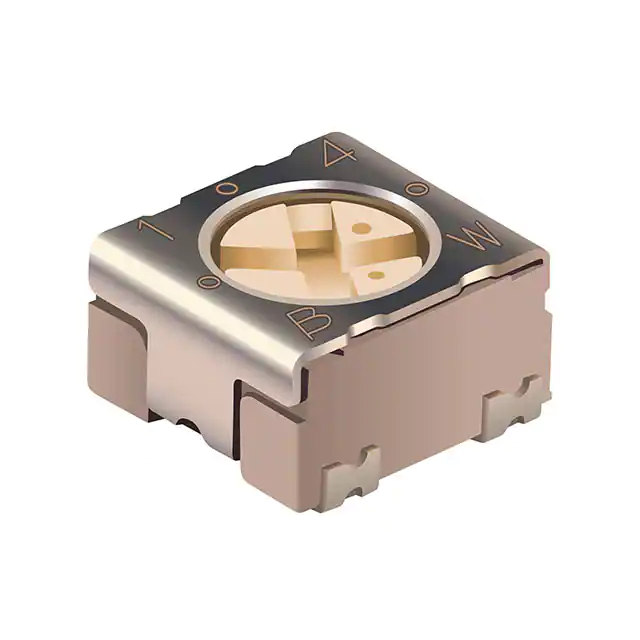
SMD Sealed Type 3mm Size PVG3 Series
3.6
■ Features
#3
3.4
2.2 Dia.
1. Sealed construction protects the interior from dust
and liquid, which achieves stable performance.
2. Driver plate with cross-slot is suitable for
automatic adjustment.
3. Rotor with large diameter and deep groove improves
driver insertion.
4. J-hook, Gull wing terminal shape. Rear and through
hole terminal shape.
5. 3mm and 4mm land pattern can be used without change.
(Gull wing is suitable for 4mm size land pattern.)
6. Heat resistance performance enables high
temperature peak re-flow soldering.
7. To be complied with RoHS directive by new Cd free
cermet resistive material. Pb free terminals with
Sn plating.
2.0
0.45
0.4 Depth
#2
0.1 Min.
#1
0.6
2.3
2.7
3.6
1.00±0.15
#2
#1
CLOCKWISE
PVG3A
#3
0.75±0.15
mm
(Tolerancein: ±0.3
)
3.6
3.4
2.2 Dia.
0.1 Min.
#1
2.3
1.00±0.15
4.5
1. Small sensors
2. Optical Transceiver Module
3. Copier
4. Printer
5. Compact Power Supply 6. Wireless Radio module
2.7
#3
■ Applications
4
2.0
0.45
0.4 Depth
#2
#2
#1
CLOCKWISE
PVG3G
#3
0.75±0.15
mm
(Tolerance in: ±0.3
)
3.6
(2.5)
1.1
2.0
0.5
2.3
#1
0.5
0.55 Depth
0.5
3.4
2.2Dia.
2.8
5.6
2.8
#3
0.8±0.2
0.1 min. 0.1 min.
#2
0.5
#2
#1
PVG3K
#3
CLOCKWISE
mm
(Tolerance in: ±0.3
)
Power Rating
Soldering Method
Number of Turns
(Effective Rotation Angle)
Total Resistance Value
TCR
PVG3p100C01
0.25W(70°C)
Reflow/Soldering Iron
1(210°±10°)
10ohm ±20%
±150ppm/°C
PVG3p200C01
0.25W(70°C)
Reflow/Soldering Iron
1(210°±10)
20ohm ±20%
±150ppm/°C
PVG3p500C01
0.25W(70°C)
Reflow/Soldering Iron
1(210°±10°)
50ohm ±20%
±150ppm/°C
PVG3p101C01
0.25W(70°C)
Reflow/Soldering Iron
1(210°±10°)
100ohm ±20%
±150ppm/°C
PVG3p201C01
0.25W(70°C)
Reflow/Soldering Iron
1(210°±10°)
200ohm ±20%
±150ppm/°C
PVG3p501C01
0.25W(70°C)
Reflow/Soldering Iron
1(210°±10°)
500ohm ±20%
±150ppm/°C
PVG3p102C01
0.25W(70°C)
Reflow/Soldering Iron
1(210°±10°)
1k ohm ±20%
±150ppm/°C
PVG3p202C01
0.25W(70°C)
Reflow/Soldering Iron
1(210°±10°)
2k ohm ±20%
±150ppm/°C
PVG3p502C01
0.25W(70°C)
Reflow/Soldering Iron
1(210°±10°)
5k ohm ±20%
±150ppm/°C
PVG3p103C01
0.25W(70°C)
Reflow/Soldering Iron
1(210°±10°)
10k ohm ±20%
±150ppm/°C
PVG3p203C01
0.25W(70°C)
Reflow/Soldering Iron
1(210°±10°)
20k ohm ±20%
±150ppm/°C
PVG3p503C01
0.25W(70°C)
Reflow/Soldering Iron
1(210°±10°)
50k ohm ±20%
±150ppm/°C
Part Number
Continued on the following page.
23
�R50E13.pdf 04.6.11
catalog
to prevent
smoking
and/or
burning,
Pleaseread
readrating
ratingand
and!CAUTION
!CAUTION(for
(forstorage,
storage,operating,
operating,rating,
rating,soldering,
soldering,mounting
mountingand
andhandling)
handling)ininthis
thisPDF
catalog
to prevent
smoking
and/or
burning,
etc. etc.
!Note •Please
you are
requested
approvespecifications.
our product specifications
or to transact
approval
for product
before ordering.
•This
Thiscatalog
cataloghas
hasonly
onlytypical
typicalspecifications.
specificationsTherefore,
because there
is no
space fortodetailed
Therefore, please
approvethe
our
productsheet
specifications
or specifications
transact the approval
sheet for product specifications before ordering.
Continued from the preceding page.
Power Rating
Soldering Method
Number of Turns
(Effective Rotation Angle)
Total Resistance Value
TCR
PVG3p104C01
0.25W(70°C)
Reflow/Soldering Iron
1(210°±10°)
100k ohm ±20%
±150ppm/°C
PVG3p204C01
0.25W(70°C)
Reflow/Soldering Iron
1(210°±10°)
200k ohm ±20%
±150ppm/°C
PVG3p504C01
0.25W(70°C)
Reflow/Soldering Iron
1(210°±10°)
500k ohm ±20%
±150ppm/°C
PVG3p105C01
0.25W(70°C)
Reflow/Soldering Iron
1(210°±10°)
1M ohm ±20%
±150ppm/°C
PVG3p205C01
0.25W(70°C)
Reflow/Soldering Iron
1(210°±10°)
2M ohm ±20%
±150ppm/°C
Part Number
The blank column is filled with the code of adjustment direction and lead type A (top, J-hook), G (top, gull-wing), or K (rear).
Power Rating
(W)
Soldering Method
Number of Turns
(Effective Rotation Angle)
Total Resistance Value
TCR
(ppm/°C)
PVG3p100A01
0.25(70°C)
Reflow/Soldering Iron
1(210°±10°)
10 ohm±20%
±250
PVG3p200A01
0.25(70°C)
Reflow/Soldering Iron
1(210°±10°)
20 ohm±20%
±250
PVG3p500A01
0.25(70°C)
Reflow/Soldering Iron
1(210°±10°)
50 ohm±20%
±250
PVG3p101A01
0.25(70°C)
Reflow/Soldering Iron
1(210°±10°)
100 ohm±20%
±250
PVG3p201A01
0.25(70°C)
Reflow/Soldering Iron
1(210°±10°)
200 ohm±20%
±100
PVG3p501A01
0.25(70°C)
Reflow/Soldering Iron
1(210°±10°)
500 ohm±20%
±100
PVG3p102A01
0.25(70°C)
Reflow/Soldering Iron
1(210°±10°)
1k ohm±20%
±100
PVG3p202A01
0.25(70°C)
Reflow/Soldering Iron
1(210°±10°)
2k ohm±20%
±100
Non Standard
PVG3p502A01
0.25(70°C)
Reflow/Soldering Iron
1(210°±10°)
5k ohm±20%
±100
Product
PVG3p103A01
0.25(70°C)
Reflow/Soldering Iron
1(210°±10°)
10k ohm±20%
±100
(Cd included)
PVG3p203A01
0.25(70°C)
Reflow/Soldering Iron
1(210°±10°)
20k ohm±20%
±100
PVG3p503A01
0.25(70°C)
Reflow/Soldering Iron
1(210°±10°)
50k ohm±20%
±100
PVG3p104A01
0.25(70°C)
Reflow/Soldering Iron
1(210°±10°)
100k ohm±20%
±100
PVG3p204A01
0.25(70°C)
Reflow/Soldering Iron
1(210°±10°)
200k ohm±20%
±100
PVG3p504A01
0.25(70°C)
Reflow/Soldering Iron
1(210°±10°)
500k ohm±20%
±100
PVG3p105A01
0.25(70°C)
Reflow/Soldering Iron
1(210°±10°)
1M ohm±20%
±100
PVG3p205A01
0.25(70°C)
Reflow/Soldering Iron
1(210°±10°)
2M ohm±20%
±100
Part Number
■ Construction
PVG3A/PVG3G
PVG3K
Rotor
Cover
Rotor
2
#2-Terminal
Cover
#2-Terminal
2
Case
M
Case
M
#3-Terminal
#3-Terminal
Resistive
Element
Wiper
Resistive
Element
Wiper
Ceramic
Substrate
Ceramic
Substrate
#1-Terminal
O-Ring
#1-Terminal
O-Ring
■ Standard Land Pattern
PVG3A
PVG3G
1.2
1.1
mm
(Tolerancein: ±0.1
)
1.1
1.2
1.1
1.3
1.1
.2.5
2.1
.2.5
2.1
0.9
1.3
1.4
1.4
0.9
4
Remarks
mm
(Tolerancein: ±0.1
)
Continued on the following page.
24
�catalog
to prevent
smoking
and/or
burning,
Pleaseread
readrating
ratingand
and!CAUTION
!CAUTION(for
(forstorage,
storage,operating,
operating,rating,
rating,soldering,
soldering,mounting
mountingand
andhandling)
handling)ininthis
thisPDF
catalog
to prevent
smoking
and/or
burning,
etc. etc.
!Note •Please
R50E13.pdf 04.6.11
you are
requested
approvespecifications.
our product specifications
or to transact
approval
for product
before ordering.
•This
Thiscatalog
cataloghas
hasonly
onlytypical
typicalspecifications.
specificationsTherefore,
because there
is no
space fortodetailed
Therefore, please
approvethe
our
productsheet
specifications
or specifications
transact the approval
sheet for product specifications before ordering.
Continued from the preceding page.
■ Standard Land Pattern
PVG3K
3.1
1.0
1.5
1.0
3.1
3.2 dia.
1.2
1.1
1.2
mm
(Tolerance in: ±0.1
)
■ Characteristics
Temperature Cycle
∆TR
∆TR
Humidity
Vibration (20G)
Shock (100G)
Temperature Load Life
Low Temperature Exposure
High Temperature Exposure
Rotational Life (50cycles)
±2%
∆V.S.S ±1%
±2%
∆V.S.S ±1%
IR
10Mohm min.
∆TR
±1%
4
∆V.S.S ±1%
∆TR
±1%
∆V.S.S ±1%
∆TR
±3% or 3ohm max., whichever is greater
∆V.S.S ±1%
∆TR
±2%
∆V.S.S ±2%
∆TR
±3%
∆V.S.S ±2%
∆TR
RV100ohm ... ±3% or 2ohm max., whichever is greater
RG100kohm ... +0/-10%
∆TR
∆V.S.S
IR
R
: Total Resistance Change
: Voltage Setting Stability
: Insulation ResistanceR
: Standard Total Resistance
25
�catalog
to prevent
smoking
and/or
burning,
Pleaseread
readrating
ratingand
and!CAUTION
!CAUTION(for
(forstorage,
storage,operating,
operating,rating,
rating,soldering,
soldering,mounting
mountingand
andhandling)
handling)ininthis
thisPDF
catalog
to prevent
smoking
and/or
burning,
etc. etc.
!Note •Please
R50E13.pdf 04.6.11
you are
requested
approvespecifications.
our product specifications
or to transact
approval
for product
before ordering.
•This
Thiscatalog
cataloghas
hasonly
onlytypical
typicalspecifications.
specificationsTherefore,
because there
is no
space fortodetailed
Therefore, please
approvethe
our
productsheet
specifications
or specifications
transact the approval
sheet for product specifications before ordering.
PVG3 Series Notice
■ Notice (Operating and Storage Conditions)
1. Store in temperatures of -10 to +40 deg. C and
relative humidity of 30-85%RH.
2. Do not store in or near corrosive gases.
3. Use within six months after delivery.
4. Open the package just before using.
5. Do not store under direct sunlight.
6. If you use the trimmer potentiometer in an
environment other than listed below, please
consult with a Murata factory representative prior
to using.
The trimmer potentiometer should not be used under
the following environmental conditions:
(1) Corrosive gaseous atmosphere
(Ex. Chlorine gas, Hydrogen sulfide gas, Ammonia
gas, Sulfuric acid gas, Nitric oxide gas, etc.)
(2) In liquid
(Ex. Oil, Medical liquid, Organic solvent, etc.)
(3) Dusty / dirty atmosphere
(4) Direct sunlight
(5) Static voltage nor electric/magnetic fields
(6) Direct sea breeze
(7) Other variations of the above
■ Notice (Rating)
4
1. When using with partial load (rheostat), minimize
the power depending on the resistance value.
2. The maximum input voltage to a trimmer
potentiometer should not exceed (P.R)^1/2 or the
maximum operating voltage, whichever is smaller.
3. The maximum input current to a trimmer
potentiometer should not exceed (P/R)^1/2 or the
allowable wiper current, whichever is smaller.
■ Notice (Soldering and Mounting)
1. Soldering
(1) Standard soldering condition
(a) Reflow soldering :
Refer to the standard temperature profile.
(b) Soldering iron
Temperature of tip : 400 deg. C max.
Soldering time
: 3 sec. max.
Diameter of tip
: 2mm dia. max.
Wattage of iron
: 30W max.
Before using other soldering conditions more
than those listed above, please consult with a
Murata factory representative prior to using.
If the soldering conditions are not
suitable, e.g., excessive time and/or excessive
temperature, the trimmer potentiometer may
deviate from the specified characteristics.
(2) Cannot be soldered using the flow soldering
method. If you use the flow soldering method,
the trimmer potentiometer may not function.
(3) The soldering iron should not come in contact
with the case of the trimmer potentiometer. If
such contact does occur, the trimmer
potentiometer may be damaged.
(4) Apply the appropriate amount of solder paste.
If the amount of solder paste applied to the
land is insufficient, the required adhesive
strength cannot be obtained. If an excessive
amount of solder paste is applied, solder
bridging or flux overflow to the resistive
element surface can occur.
2. Mounting
(1) Use our standard land dimension. Excessive land
area causes displacement due to the effect of the
surface tension of the solder. Insufficient
land area leads to insufficient soldering
strength of the chip.
(2) Do not apply excessive force (preferably 4.9N
(Ref.; 500gf) max.), when the trimmer
potentiometer is mounted to the PCB.
(3) Do not warp and/or bend PC board to prevent
trimmer potentiometer from breakage.
(4) In chip placers, the size of the cylindrical
pick-up nozzle should be outer dimension
2.5-3.0mm dia. and inner dimension
2.0-2.5mm dia..
3. Cleaning
(1) Isopropyl-alcohol and Ethyl-alcohol are
applicable solvents for cleaning. If you use any
other types of solvents, please consult with a
Murata factory representative prior to using.
(2) Less than 3 minutes of total cleaning time by
dipping, vapor and ultra-sonic method.
(3) In case of ultra-sonic cleaning method, cleaning
conditions should be as follows.
(a) Power: 600W (67lit.) max.
(b) Frequency: 28kHz
(c) Temperature: Ambient temperature
Due to ultra-sonic cleaning equipment's peculiar
self-resonance point and that cleaning
compatibility usually depends on the jig
Continued on the following page.
26
�catalog
to prevent
smoking
and/or
burning,
Pleaseread
readrating
ratingand
and!CAUTION
!CAUTION(for
(forstorage,
storage,operating,
operating,rating,
rating,soldering,
soldering,mounting
mountingand
andhandling)
handling)ininthis
thisPDF
catalog
to prevent
smoking
and/or
burning,
etc. etc.
!Note •Please
R50E13.pdf 04.6.11
you are
requested
approvespecifications.
our product specifications
or to transact
approval
for product
before ordering.
•This
Thiscatalog
cataloghas
hasonly
onlytypical
typicalspecifications.
specificationsTherefore,
because there
is no
space fortodetailed
Therefore, please
approvethe
our
productsheet
specifications
or specifications
transact the approval
sheet for product specifications before ordering.
PVG3 Series Notice
Continued from the preceding page.
construction and/or the cleaning condition such
as the depth of immersion, please check the
cleaning equipment to determine the suitable
conditions. If the condition is not suitable,
the trimmer potentiometer may deviate from
specified characteristics.
■ Reflow Soldering Standard Profile
Pre-heating in air
Soldering
Gradual cooling
in air
260
Temperature (°C)
230
200
150
100
0
60-120 sec.
40 sec. max.
Time
(Melting zone)
4
■ Notice (Handling)
1. Use suitable screwdrivers that fit comfortably in
driver slot.
* Recommended screwdriver for manual adjustment
TORAY INDUSTRIES, INC. : SA-2225
(Murata P/N : KMDR070)
* Recommended screwdriver bit for automatic
adjustment
TORAY INDUSTRIES, INC. : JB-2225
(Mutata P/N : KMBT070)
We can supply the screwdrivers above.
If you place order, please specify the Murata P/N.
2. Don't apply more than 9.8N (Ref.; 1kgf) of twist
and stress after mounting onto PCB to prevent
contact intermittence.
3. When adjusting with an adjustment tool, the applied
force to the adjustment screw should not exceed
4.9N (Ref.; 500gf). If excessive force is applied,
the trimmer potentiometer may not function due to
damage.
4. When using a lock paint to fix slot position,
please use adhesive resin without chlorine or
sulfur (Three-bond "1401 series").
■ Notice (Other)
1. Please make sure that your product has been
evaluated and confirmed against your
specifications when our product is mounted to your
product.
2. Murata cannot guarantee trimmer potentiometer
integrity when used under conditions other than
those specified in this document.
27
�R50E13.pdf 04.6.11
catalog
to prevent
smoking
and/or
burning,
Pleaseread
readrating
ratingand
and!CAUTION
!CAUTION(for
(forstorage,
storage,operating,
operating,rating,
rating,soldering,
soldering,mounting
mountingand
andhandling)
handling)ininthis
thisPDF
catalog
to prevent
smoking
and/or
burning,
etc. etc.
!Note •Please
you are
requested
approvespecifications.
our product specifications
or to transact
approval
for product
before ordering.
•This
Thiscatalog
cataloghas
hasonly
onlytypical
typicalspecifications.
specificationsTherefore,
because there
is no
space fortodetailed
Therefore, please
approvethe
our
productsheet
specifications
or specifications
transact the approval
sheet for product specifications before ordering.
SMD
Sealed
Type/Lead Sealed Type Specifications and Test Methods
Specifications
and
Test Methods
The following describes trimmer potentiometer testing conducted by Murata Manufacturing Co., Ltd. in accordance with MIL-R-22097 (Military specification
for variable resistors, non-wirewound) and MIL-STD-202 (Test methods for electronic and electrical component parts).
No.
Item
Test Methods
Measure total resistance between the resistance element and terminals (#1 and #3) with the contact arm positioned
against a stop. The positioning of the contact arm and terminal should be the same for subsequent total resistance
measurements on the same device. Use the test voltage specified in Table 1 for total resistance measurements.
This voltage should be used for all subsequent total resistance measurements.
1
Total Resistance
Total Resistance,
Nominal (ohm)
10VRV100
100FRV1k
1kFRV10k
10kFRV100k
100kFR
Maximum Test
Voltage (V)
1.0
3.0
10.0
30.0
100.0
Table 1: Total resistance test voltage
2
Residual Resistance
Position the contact arm at the extreme counterclockwise limit of mechanical travel and measure the resistance
between the contact arm and the corresponding end terminal. Then, position the contact arm at the extreme clockwise limit of mechanical travel and measure the resistance between the contact arm and the corresponding end terminal. During this test, take suitable precautions to ensure that the rated current of the resistance element is not
exceeded.
Contact resistance variation should be measured with the measuring circuit shown in Figure 1, or its equivalent. The
adjustment rotor (screw) should be rotated in both directions through 90% of the actual effective-electrical rotational
angle (number of turns) for a total of 6 cycles. Only the last 3 cycles should count in determining whether or not a
contact resistance variation is observed at least twice in the same location, exclusive of the roll-on or roll-off points
where the contact arm moves from the termination, on or off, the resistance element. The rate of rotation of the
adjustment rotor (screw) should be such that the adjustment rotor (screw) completes 1 cycle for 5 seconds minimum
to 2 minutes maximum. The test current used should follow the value given in Table 2 unless otherwise limited by
power rating.
3
Contact Resistance
Variation
Standard Total Resistance
R (ohm)
RV100
100FRF500
500VRF1k
1kVRF2k
2kVRF50k
50kVRF200k
200kVRF1M
1MVRF2M
2MVR
Test Current
20mA
10mA
4mA
2mA
1mA
200µA
100µA
50µA
30µA
Rx
#1
Oscilloscope
#3
#2
Constant Current Source
(Test current shown in Table2)
Proofread
Resistance
AC
Amplifier
Rx : Trimmer Potentiometer
Oscilloscope bandwidth :100Hz to 50kHz
Figure 1: CRV measuring circuit
Table 2: Test current for CRV
The trimmer potentiometer should be subjected to each of the following temperatures (see Table 3) for 30-45 minutes. Temperature coefficient of resistance should be applied to the following formula.
R2 – R1
TCR= R1 (T2 – T1) Z 106 (ppm/°C)
4
Temperature Coefficient of
Resistance
T1
T2
R1
R2
: Reference temperature in degrees celsius
: Test temperature in degrees celsius
: Resistance at reference temperature ohm
: Resistance at test temperature in ohm
Sequence
1*
2
Temperature (°C)
+25
-15
3
Min. operating
Temperature
4*
5
+25
+65
6
Max. operating
Temperature
Note*: Reference temperature
Table 3: Test temperatures
The wiper should be set at approximately 40% of the actual effective-electrical rotational angle (number of turns). An
adequate DC test potential should be applied between terminal #1 and terminal #3. The voltage between terminal #1
and terminal #3, and the voltage between terminal #1 and terminal #2, should be measured and applied to the
following formula.
E
5
Voltage Setting
Stability
Voltage setting stability=
9
( e'E – Ee ) Z100 (%)
e : Before test
(The voltage between terminal #1 and terminal #2)
e': After test
(The voltage between terminal #1 and terminal #2)
E : The voltage between terminal #1 and terminal #3
#1
#3
#2
e
Figure 2
Continued on the following page.
1
79
�R50E13.pdf 04.6.11
catalog
to prevent
smoking
and/or
burning,
Pleaseread
readrating
ratingand
and!CAUTION
!CAUTION(for
(forstorage,
storage,operating,
operating,rating,
rating,soldering,
soldering,mounting
mountingand
andhandling)
handling)ininthis
thisPDF
catalog
to prevent
smoking
and/or
burning,
etc. etc.
!Note •Please
you are
requested
approvespecifications.
our product specifications
or to transact
approval
for product
before ordering.
•This
Thiscatalog
cataloghas
hasonly
onlytypical
typicalspecifications.
specificationsTherefore,
because there
is no
space fortodetailed
Therefore, please
approvethe
our
productsheet
specifications
or specifications
transact the approval
sheet for product specifications before ordering.
SMD
Sealed Type/Lead
Type Specifications and Test Methods
Specifications
and TestSealed
Methods
Continued from the preceding page.
No.
Item
Test Methods
The trimmer potentiometer should be subjected to Table 4 temperature for 5 cycles. The trimmer potentiometer
should be removed from the chamber, and maintained at a temperature of 25±5°C for 1~2 hours.
6
Temperature Cycle
1
Sequence
PV-- series
Temp.
-55±3
PV22 series
(°C)
PVF2 series -25±3
Time (min.)
30
2
3
4
+125±3
+25±2 +150±3 +25±2
+60±3
30
5 max.
5 max.
Table 4: One cycle of temperature cycle.
1) PVC6, PV12, PV32, PV34 PVM4A---D01 series
The trimmer potentiometer should be placed in a chamber at a temperature of 40±2°C and a humidity of 90~95%
without loading for 250±8 hours (500±12 hours for PVM4A---D01 series). The trimmer potentiometer should be
removed from the chamber, and maintained at a temperature of 25±5°C for 5±1/6 hours.
2) PVF2 series
The trimmer potentiometer should be placed in a chamber at 60±2°C and 90~95% without loading for 1000±12
hours. The trimmer potentiometer should be removed from the chamber, and maintained at a temperature of 25±5°C
for 5±1/6 hours
2) PVG3, PVG5, PV01, PV22, PV23, PV36, PV37 series
The trimmer potentiometer should be subjected Figure-3 the programmed humidity environment for 10 cycle. The trimmer potentiometer should be removed from the chamber, and maintained at a temperature of 25±5°C for 1.5±1/2
hours.
MIL-STD-202 METHOD 106
80-98%RH
70
65
60
55
Humidity
45
40
90-98%RH
90-98%RH
24 HOURS
RATE OF CHANGE OF TEMPERATURE IS UNSPECIFIED.
HOWEVER, SPECIMENS SHOULD NOT BE SUBJECTED
TO RADIANT HEAT FROM CHAMBER-CONDITIONING
PROCESSES
50
TEMPERATURE (DEGREES CELSIUS)
7
80-98%RH
90-98%RH
INITIAL CONDITIONING
IN A DRY OVEN
HUMIDITY
UNCONTROLLED
35
30
+10°C
-2°C
CIRCULATION OF CONDITIONING AIR SHOULD
BE AT A MINIMUM CUBIC RATE PER MINUTE
EQUIVALENT TO 5 TIMES THE VOLUME OF
THE CHAMBER
25
20
15
INITIAL MEASUREMENTS
AS SPECIFIED IN 3.2
10
5
0
-5
-10
END OF FINAL CYCLE
MEASUREMENTS AS
SPECIFIED IN 3.6
VOLTAGE APPLIED AS SPECIFIED IN 3.5
UNLESS OTHERWISE SPECIFIED
TEMPERATURE TOLERANCE IS,
±2°C AT ALL POINTS WITHIN THE
CHAMBER EXCEPT THE IMMEDIATE
VICINITY OF THE SPECIMENS AND
THE CHAMBER SURFACES
PRIOR TO FIRST CYCLE
STEP 1
UNLESS OTHERWISE
SPECIFIED
STEPS 7a AND 7b PERFORMED DURING ANY
5 OF THE FIRST 9 CYCLES. HUMIDITY
UNCONTROLLED DURING STEPS 7a AND 7b
ONLY
STEP 2
STEP 3 STEP 4
STEP 5
STEP 6
STEP 7b
STEP 7a
STEP 7
ONE CYCLE 24 HOURS. REPEAT AS SPECIFIED IN 3.3
0
1
2
3
4
5
6
7
8
9 10 11 12 13 14 15 16 17 18 19 20 21 22 23 24
Figure 3
Vibration
1) PV-- series
The trimmer potentiometer should be vibrated throughout the frequency range at the 20G level. A complete frequency range, 10Hz to 2000Hz and back, should be made within 15 minutes for a total of 4 sweeps in each of the three
axis direction for a total of 12 sweeps.
2) PVF2 series
The trimmer potentiometer should be subjected to vibration at 0.3 inch amplitude. The frequency should be varied
uniformly between the approximate limits of 10Hz and 55Hz. This motion should be applied for period of 2 hours in
each of 3 mutually perpendicular directions (total of 6 hours).
9
Shock
1) PV-- series
The trimmer potentiometer should be shocked at the 100G (50G for PV22 and PV23 series) level and should be
subjected to 4 shocks in each of the three axis directions for a total of 12 shocks.
2) PVM4A---D01 series
The trimmer potentiometer should be shocked at the 100G level and should be subjected to 3 shocks in each of the
six axis directions for a total of 18 shocks.
10
Temperature Road Life
Full rated continuous working voltage not exceeding the maximum rated voltage should be applied intermittently
between terminal #1 and terminal #3 of the trimmer potentiometer, 1.5 hours on and 0.5 hours off, for a total of
1000±12 hours, at a temperature of 70±2°C (85±2°C for PV01 and PV37 series, 50±2°C for PVF2 series). The trimmer potentiometer should be removed from the chamber, and maintained at a temperature of 25±5°C for 1 to 2 hours.
11
High Temperature Exposure
(Except for PVF2)
The trimmer potentiometer should be placed in a chamber at a temperature of 125±3°C (150±3°C for PV22 series)
250±8 hours without loading. The trimmer potentiometer should be removed from the chamber, and maintained at a
temperature of 25±5°C for 1 to 2 hours.
12
Low Temperature Exposure
(Except for PVF2 and
PVM4A---D01)
The trimmer potentiometer should be placed in a chamber at a temperature of -55±3°C for 1 hours without loading.
Full rated continuous working voltage not exceeding the maximum rated voltage should be applied for 45 minutes.
The trimmer potentiometer should be removed from the chamber, and maintained at a temperature of 25±5°C for
approximately 24 hours.
8
9
Continued on the following page.
80
1
�catalog
to prevent
smoking
and/or
burning,
Pleaseread
readrating
ratingand
and!CAUTION
!CAUTION(for
(forstorage,
storage,operating,
operating,rating,
rating,soldering,
soldering,mounting
mountingand
andhandling)
handling)ininthis
thisPDF
catalog
to prevent
smoking
and/or
burning,
etc. etc.
!Note •Please
R50E13.pdf 04.6.11
you are
requested
approvespecifications.
our product specifications
or to transact
approval
for product
before ordering.
•This
Thiscatalog
cataloghas
hasonly
onlytypical
typicalspecifications.
specificationsTherefore,
because there
is no
space fortodetailed
Therefore, please
approvethe
our
productsheet
specifications
or specifications
transact the approval
sheet for product specifications before ordering.
SMD
Sealed
Type/Lead Sealed Type Specifications and Test Methods
Specifications
and
Test Methods
Continued from the preceding page.
No.
13
Item
Low Temperature Operation
(Only for PVF2 and
PVM4A---D01)
Test Methods
The trimmer potentiometer should be placed in a chamber at a temperature of -25±3°C (-55±3°C for PVM4A--D01 series) 48±4 hours without loading. The trimmer potentiometer should be removed from the chamber, and maintained at a temperature of 25±5°C for 1-2 hours
1)PV-- series
Full rated continuous working voltage not exceeding the maximum rated voltage should be applied with the circuit
shown in the figure. The adjustment rotor (screw) should be continuously cycled through not less than 90% of effective-electrical rotational angle (number of turns), at the rate of 1 cycle for 5 seconds minimum to 2.5 minutes maximum for total of 200 cycles.
End Terminal Resistor 1 End Terminal
14
End Terminal
Resistor 2 End Terminal
Rotational Life
DC supply
Figure 4
2) PVG3, PVG5 series
The adjustment rotor (screw) should be continuously cycled though not less than 90% of effective-electrical rotational angle (number of turns), at the rate of 1 cycle for 5 seconds minimum to 2.5 minutes maximum for a total of 50
(100 for PVG5) cycles, without loading.
3) PVF2, PVM4A---D01 series
The wiper should be rotated over 90% of the effective rotational angle without loading at a speed of 10 cycles per
minute, for 100 cycles continuously.
9
81
�