AM26C32-EP
QUADRUPLE DIFFERENTIAL LINE RECEIVER
www.ti.com
SLLS870 – NOVEMBER 2007
FEATURES
1
•
•
•
•
•
•
(1)
Controlled Baseline
– One Assembly
– One Test Site
– One Fabrication Site
Extended Temperature Performance of
–55°C to 125°C
Enhanced Diminishing Manufacturing Sources
(DMS) Support
Enhanced Product-Change Notification
Qualification Pedigree (1)
Meets or Exceeds the Requirements of ANSI
TIA/EIA-422-B, TIA/EIA-423-B, and ITU
Recommendation V.10 and V.11
•
•
•
•
•
•
•
•
Low Power, ICC = 10 mA Typ
±7 V Common-Mode Range With ±200 mV
Sensitivity
Input Hysteresis . . . 60 mV Typ
tpd = 17 ns Typ
Operates From a Single 5 V Supply
3-State Outputs
Input Fail-Safe Circuitry
Improved Replacements for AM26LS32
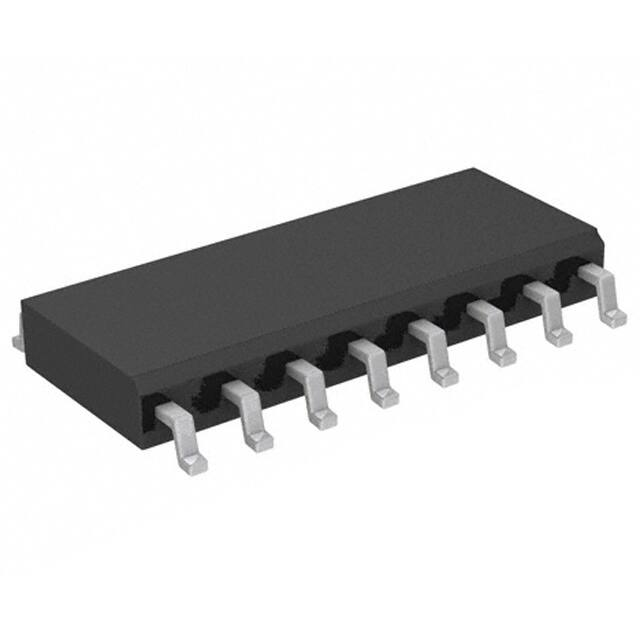
AM26C32... D PACKAGE
Component qualification in accordance with JEDEC and
industry standards to ensure reliable operation over an
extended temperature range. This includes, but is not limited
to, Highly Accelerated Stress Test (HAST) or biased 85/85,
temperature cycle, autoclave or unbiased HAST,
electromigration, bond intermetallic life, and mold compound
life. Such qualification testing should not be viewed as
justifying use of this component beyond specified
performance and environmental limits.
DESCRIPTION/ORDERING INFORMATION
The AM26C32 is a quadruple differential line receiver for balanced or unbalanced digital data transmission. The
enable function is common to all four receivers and offers a choice of active-high or active-low input. The 3-state
outputs permit connection directly to a bus-organized system. Fail-safe design specifies that if the inputs are
open, the outputs always are high.
The AM26C32 devices are manufactured using a BiCMOS process, which is a combination of bipolar and CMOS
transistors. This process provides the high voltage and current of bipolar with the low power of CMOS to reduce
the power consumption to about one-fifth that of the standard AM26LS32, while maintaining ac and dc
performance.
The AM26C32 is characterized for operation over the extended temperature range of –55°C to 125°C.
ORDERING INFORMATION (1)
PACKAGE (2)
TA
–55°C to 125°C
(1)
(2)
SOIC – D
Reel of 2500
ORDERABLE PART NUMBER
AM26C32MDREP
TOP-SIDE MARKING
26C32EP
For the most current package and ordering information, see the Package Option Addendum at the end of this document, or see the TI
website at www.ti.com.
Package drawings, thermal data, and symbolization are available at www.ti.com/packaging.
1
Please be aware that an important notice concerning availability, standard warranty, and use in critical applications of
Texas Instruments semiconductor products and disclaimers thereto appears at the end of this data sheet.
PRODUCTION DATA information is current as of publication date.
Products conform to specifications per the terms of the Texas
Instruments standard warranty. Production processing does not
necessarily include testing of all parameters.
Copyright © 2007, Texas Instruments Incorporated
On products compliant to MIL-PRF-38535, all parameters are
tested unless otherwise noted. On all other products, production
processing does not necessarily include testing of all parameters.
�AM26C32-EP
QUADRUPLE DIFFERENTIAL LINE RECEIVER
www.ti.com
SLLS870 – NOVEMBER 2007
FUNCTION TABLE
(each receiver)
DIFFERENTIAL
INPUT
VID ≥ VIT+
VIT– < VID < VIT+
VID ≤ VIT–
X
2
Submit Documentation Feedback
ENABLES
G
G
OUTPUT
Y
H
X
H
X
L
H
H
X
?
X
L
?
H
X
L
X
L
L
L
H
Z
Copyright © 2007, Texas Instruments Incorporated
�AM26C32-EP
QUADRUPLE DIFFERENTIAL LINE RECEIVER
www.ti.com
SLLS870 – NOVEMBER 2007
LOGIC DIAGRAM (POSITIVE LOGIC)
SCHEMATICS
EQUIVALENT OF G OR G INPUT
EQUIVALENT OF A OR B INPUT
VCC
VCC
17 kΩ
NOM
TYPICAL OF ALL OUTPUTS
VCC
1.7 kΩ
NOM
Input
288 kΩ
NOM
Input
Output
GND
GND
1.7 kΩ
NOM
VCC (A inputs)
or
GND (B inputs)
GND
Copyright © 2007, Texas Instruments Incorporated
Submit Documentation Feedback
3
�AM26C32-EP
QUADRUPLE DIFFERENTIAL LINE RECEIVER
www.ti.com
SLLS870 – NOVEMBER 2007
ABSOLUTE MAXIMUM RATINGS (1)
over operating free-air temperature range (unless otherwise noted)
MIN
VCC
MAX
Supply voltage (2)
UNIT
7
V
A or B inputs
–11
14
V
G or G inputs
VI
Input voltage range
–0.5
VCC + 0.5
V
VID
Differential input voltage range
–14
14
V
VO
Output voltage range
–0.5
VCC + 0.5
V
IO
Output current
±25
D package
73
mA
θJA
Package thermal impedance (3) (4)
TJ
Operating virtual junction temperature
150
°C
Lead temperature 1,6 mm (1/16 inch) from case for 10 seconds
260
°C
150
°C
Tstg
(1)
(2)
(3)
(4)
PW package
108
Storage temperature range
–65
°C/W
Stresses beyond those listed under "absolute maximum ratings" may cause permanent damage to the device. These are stress ratings
only, and functional operation of the device at these or any other conditions beyond those indicated under "recommended operating
conditions" is not implied. Exposure to absolute-maximum-rated conditions for extended periods may affect device reliability.
All voltage values, except differential output voltage, VOD, are with respect to network GND. Currents into the device are positive and
currents out of the device are negative.
Maximum power dissipation is a function of TJ(max), θJA, and TA. The maximum allowable power dissipation at any allowable ambient
temperature is PD = (TJ(max) – TA)/θJA. Operating at the absolute maximum TJ of 150°C can affect reliability.
The package thermal impedance is calculated in accordance with JESD 51-7.
RECOMMENDED OPERATING CONDITIONS
MIN
NOM
MAX
4.5
5
5.5
UNIT
VCC
Supply voltage
VIH
High-level input voltage
VIL
Low-level input voltage
0.8
VIC
Common-mode input voltage
±7
V
IOH
High-level output current
–6
mA
IOL
Low-level output current
6
mA
TA
Operating free-air temperature
125
°C
4
Submit Documentation Feedback
2
–55
V
V
V
Copyright © 2007, Texas Instruments Incorporated
�AM26C32-EP
QUADRUPLE DIFFERENTIAL LINE RECEIVER
www.ti.com
SLLS870 – NOVEMBER 2007
ELECTRICAL CHARACTERISTICS
over recommended ranges of VCC, VIC, and operating free-air temperature (unless otherwise noted)
PARAMETER
MIN TYP (1)
TEST CONDITIONS
MAX
VO = VOH (min),
VIC = –7 V to 7 V
0.2
IOH = –440 µA
VIC = 0 to 5.5 V
0.1
VO = 0.45 V,
VIC = –7 V to 7 V
–0.2 (2)
IOL = 8 mA
VIC = 0 to 5.5 V
–0.1 (2)
VIT+
Differential input high-threshold voltage
VIT–
Differential input low-threshold voltage
Vhys
Hysteresis voltage (VIT+ – VIT–)
VIK
Enable input clamp voltage
VCC = 4.5 V,
II = –18 mA
VOH
High-level output voltage
VID = 200 mV,
IOH = –6 mA
VOL
Low-level output voltage
VID = –200 mV,
IOL = 6 mA
IOZ
Off-state (high-impedance state) output
current
VO = VCC or GND
II
Line input current
IIH
High-level enable current
VI = 2.7 V
20
IIL
Low-level enable current
VI = 0.4 V
–100
rI
Input resistance
One input to ground
ICC
Supply current
VCC = 5.5 V
(1)
(2)
V
V
60
mV
–1.5
3.8
V
V
0.2
0.3
V
±0.5
±5
µA
VI = 10 V,
Other input at 0 V
1.5
VI = –10 V,
Other input at 0 V
–2.5
12
UNIT
17
mA
µA
µA
kΩ
10
15
mA
All typical values are at VCC = 5 V, VIC = 0, and TA = 25°C.
The algebraic convention, in which the less positive (more negative) limit is designated minimum, is used in this data sheet for
common-mode input voltage.
SWITCHING CHARACTERISTICS
over recommended ranges of operation conditions, CL = 50 pF (unless otherwise noted)
PARAMETER
tPLH
Propagation delay time, low- to high-level output
tPHL
Propagation delay time, high- to low-level output
tTLH
Output transition time, low- to high-level output
tTHL
Output transition time, high- to low-level output
tPZH
Output enable time to high level
tPZL
Output enable time to low level
tPHZ
Output disable time from high level
tPLZ
Output disable time from low level
(1)
TEST CONDITIONS
See Figure 1
See Figure 1
See Figure 2
See Figure 2
MIN
TYP (1)
MAX
9
17
27
ns
9
17
27
ns
4
10
ns
4
9
ns
13
22
ns
13
22
ns
13
26
ns
13
25
ns
UNIT
All typical values are at VCC = 5 V, TA = 25°C.
Copyright © 2007, Texas Instruments Incorporated
Submit Documentation Feedback
5
�AM26C32-EP
QUADRUPLE DIFFERENTIAL LINE RECEIVER
www.ti.com
SLLS870 – NOVEMBER 2007
PARAMETER MEASUREMENT INFORMATION
tTHL
tTLH
VCC
90%
Output
A
Input
B
VOH
90%
10%
Device
Under
Test
10%
50%
VOL
tPHL
tPLH
CL = 50 pF
(see Note A)
2.5 V
0V
−2.5 V
Input
TEST CIRCUIT
A.
VOLTAGE WAVEFORMS
CL includes probe and jig capacitance.
Figure 1. Switching Test Circuit and Voltage Waveforms
VCC
S1
VID = ±2.5 V
G Input
G Input
A Input
B Input
RL = 1 kΩ
Device
Under
Test
tPZL, tPLZ Measurement: S1 to VCC
tPZH, tPHZ Measurement: S1 to GND
CL = 50 pF
(see Note A)
TEST CIRCUIT
3V
G
1.3 V
0V
3V
G
(see Note B)
1.3 V
0V
tPZH
Output
(with VID = 2.5 V)
tPHZ
50%
tPZH
VOH −0.5 V
tPHZ
VOH −0.5 V
VOH
VOL
tPZL
Output
(with VID = −2.5 V)
tPLZ
tPZL
tPLZ
VOH
50%
VOL + 0.5 V
VOL + 0.5 V
VOL
VOLTAGE WAVEFORMS
A.
CL includes probe and jig capacitance.
B.
The input pulse is supplied by a generator having the following characteristics: PRR = 1 MHz, duty cycle ≤ 50%, tr = tf
= 6 ns.
Figure 2. Enable/Disable Time Test Circuit and Output Voltage Waveforms
6
Submit Documentation Feedback
Copyright © 2007, Texas Instruments Incorporated
�PACKAGE OPTION ADDENDUM
www.ti.com
10-Dec-2020
PACKAGING INFORMATION
Orderable Device
Status
(1)
Package Type Package Pins Package
Drawing
Qty
Eco Plan
(2)
Lead finish/
Ball material
MSL Peak Temp
Op Temp (°C)
Device Marking
(3)
(4/5)
(6)
AM26C32MDREP
ACTIVE
SOIC
D
16
2500
RoHS & Green
Call TI | NIPDAU
Level-1-260C-UNLIM
-55 to 125
26C32EP
V62/07648-01XE
ACTIVE
SOIC
D
16
2500
RoHS & Green
NIPDAU
Level-1-260C-UNLIM
-55 to 125
26C32EP
(1)
The marketing status values are defined as follows:
ACTIVE: Product device recommended for new designs.
LIFEBUY: TI has announced that the device will be discontinued, and a lifetime-buy period is in effect.
NRND: Not recommended for new designs. Device is in production to support existing customers, but TI does not recommend using this part in a new design.
PREVIEW: Device has been announced but is not in production. Samples may or may not be available.
OBSOLETE: TI has discontinued the production of the device.
(2)
RoHS: TI defines "RoHS" to mean semiconductor products that are compliant with the current EU RoHS requirements for all 10 RoHS substances, including the requirement that RoHS substance
do not exceed 0.1% by weight in homogeneous materials. Where designed to be soldered at high temperatures, "RoHS" products are suitable for use in specified lead-free processes. TI may
reference these types of products as "Pb-Free".
RoHS Exempt: TI defines "RoHS Exempt" to mean products that contain lead but are compliant with EU RoHS pursuant to a specific EU RoHS exemption.
Green: TI defines "Green" to mean the content of Chlorine (Cl) and Bromine (Br) based flame retardants meet JS709B low halogen requirements of