bq3285LF
Y2K-Enhanced
Real-Time Clock (RTC)
Features
General Description
➤ ACPI-compliant day-of-month
alarm
The CMOS bq3285LF is a low-power
microprocessor peripheral providing
a time-of-day clock and 100-year calendar with alarm features and battery operation. The architecture is
based on the bq3285 RTC with added
features: century bit, low-voltage operation, 32.768kHz output, 126 additional bytes of CMOS, two shadow
registers of last address used, and a
day-of-month alarm to be compliant
with the ACPI RTC specification.
➤ Y2K century bit
➤ Direct clock/calendar replacement for IBM® AT-compatible
computers and other applications
➤ 2 index shadow registers
➤ 2.7–5.5V operation
➤ 240 bytes of general nonvolatile
storage
➤ Dedicated 32.768kHz output pin
➤ System wake-up capability—
alarm interrupt output active in
battery-backup mode
➤ Less than 0.55µA load under battery operation
➤ Selectable Intel or Motorola bus
timing
A 32.768kHz output is available for
sustaining power-management activities. The bq3285LF 32kHz output is always on whenever VCC is
valid. In V CC standby mode, the
32kHz is active, and the bq3285LF
typically draws 100µA. Wake-up capability is provided by an alarm interrupt, which is active in batterybackup mode. In battery-backup
mode, current drain is less than
550nA.
The bq3285LF write-protects the
clock, calendar, and storage registers
during power failure. A backup
battery then maintains data and operates the clock and calendar.
The bq3285LF is a fully compatible
real-time clock for IBM ATcompatible computers and other applications. The only external components are a 32.768kHz crystal and a
backup battery.
The bq3285LF is intended for use in
3V systems; however, it may also operate at 5V and then go into a 3V
power-down state, write-protecting
as if in a 3V system.
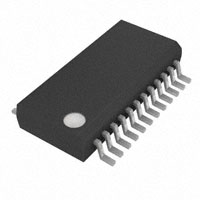
➤ 24-pin plastic SSOP
Pin Connections
Pin Names
AD0–AD7
Multiplexed address/
data input/output
MOT
Bus type select input
CS
Chip select input
AS
Address strobe input
DS
Data strobe input
R/W
Read/write input
INT
Interrupt request output
RST
Reset input
32K
32.768kHz output
EXTRAM Extended RAM enable
MOT
X1
X2
AD0
AD1
AD2
AD3
AD4
AD5
AD6
AD7
VSS
1
2
3
4
5
6
7
8
9
10
11
12
24
23
22
21
20
19
18
17
16
15
14
13
VCC
32k
EXTRAM
RCL
BC
INT
RST
DS
VSS
R/W
AS
CS
RCL
RAM clear input
BC
3V backup cell input
X1–X2
Crystal inputs
VCC
Supply voltage input
VSS
Ground
24-Pin SSOP
PN3285ED/LD.eps
6/99 B
1
�bq3285LF
Block Diagram
X1
TimeBase
Oscillator
X2
4
3
RST
÷8
÷ 64
÷ 64
16 : 1 MUX
MOT
32K
32K
Driver
Control/Status
Registers
CS
µP
Bus
I/F
R/W
AS
AD0–AD7
DS
MUX
EXTRAM
INT
Interupt
Generator
Clock/Calendar, Alarm
and Control Bytes
User Buffer
(14 Bytes)
Control/Calendar
Update
Storage Registers
(114 Bytes)
RCL
Storage Registers
(126 Bytes)
CS
VCC
BC
PowerFail
Control
Index Registers
(2 Bytes)
VOUT
Write
Protect
BD3285ID.eps
AD0–AD7
Pin Descriptions
MOT
Bus type select input
The bq3285LF bus cycle consists of two
p h a s e s : th e a d d re s s p h a s e a n d the
data-transfer phase. The address phase
precedes the data-transfer phase. During
the address phase, an address placed on
AD0–AD7 is latched into the bq3285LF on
the falling edge of the AS signal. During
the data-transfer phase of the bus cycle, the
AD0–AD7 pins serve as a bidirectional data
bus.
MOT selects bus timing for either Motorola
or Intel architecture. This pin should be
tied to VCC for Motorola timing or to VSS for
Intel timing (see Table 1). The setting
should not be changed during system operation. MOT is internally pulled low by a 30K
Ω resistor.
Table 1. Bus Setup
AS
Bus
Type
MOT
DS
R/W
AS
Level Equivalent Equivalent Equivalent
Motorola
VCC
DS, E, or
Φ2
R/W
Intel
VSS
RD,
MEMR, or
I/OR
WR,
MEMW, or ALE
I/OW
Multiplexed address/data
input/output
Address strobe input
AS serves to demultiplex the address/data
bus. The falling edge of AS latches the address on AD0–AD7. This demultiplexing process is independent of the CS signal. For
DIP and SOIC packages with MOT = VSS,
the AS input is provided a signal similar to
ALE in an Intel-based system.
AS
2
�bq3285LF
A low input on EXTRAM during the falling
e dg e o f AS lat che s t he add re s s i n to
standard bank address latch. A high input
on the EXTRAM input during the falling
edge of AS latches the address into the
extended bank address latch. The contents
of the address latches are copied into the
standard bank index and the extended bank
index registers respectively. EXTRAM is not
latched.
DS
INT
INT is an open-drain output. This allows
alarm INT to be valid in battery-backup
mode. To use this feature, connect INT
through a resistor to a power supply other
than VCC. INT is asserted low when any
event flag is set and the corresponding event
enable bit is also set. INT becomes
high-impedance whenever register C is read
(see the Control/Status Registers section).
Data strobe input
32K
When MOT = VCC, DS controls data transfer during a bq3285LF bus cycle. During a
read cycle, the bq3285LF drives the bus after the rising edge on DS. During a write
cycle, the falling edge on DS is used to latch
write data into the chip.
EXTRAM
Extended RAM enable
Enables 128 bytes of additional nonvolatile
SRAM. It is connected internally to a 30kΩ
pull-down resistor. To access the RTC registers, EXTRAM must be low.
The input on this pin also selects the latch
to be used in the data transfer. A low value
selects the standard bank latch. A high
value selects the extended the bank latch.
EXTRAM should be valid for complete address, read or write cycle.
The state of the EXTRAM input selects the
address latch used during data access. A
low input on EXTRAM selects the standard
bank latch and the location in the standard
bank pointed to by the value in this latch. A
high input on the EXTRAM selects the extended bank latch and the location in the
extended bank pointed to by the value in
this latch.
RCL
RAM clear input
A low level on the RCL pin causes the contents of each of the 240 storage bytes to be
set to FF(hex). RCL clears the shadow index registers to 00(hex). The contents of the
clock and control registers are unaffected.
This pin should be used as a user-interface
input (pushbutton to ground) and not connected to the output of any active component. RCL input is only recognized when
held low for at least 125ms in the presence
of VCC. Using RAM clear does not affect the
battery load. This pin is connected internally to a 30kΩ pull-up resistor.
Read/write input
When MOT = VCC, the level on R/W identifies the direction of data transfer. A high
level on R/W indicates a read bus cycle,
whereas a low on this pin indicates a write
bus cycle.
When MOT = VSS, R/W is provided a signal
similar to WR, MEMW, or I/OW in an Intelbased system. The rising edge on R/W
latches data into the bq3285LF.
CS
32.768 kHz output
32K provides a buffered 32.768 kHz output.
The frequency remains on and fixed at
32.768kHz as long as VCC is valid.
When MOT = VSS, the DS input is provided
a signal similar to RD, MEMR, or I/OR in
an Intel-based system. The falling edge on
DS is used to enable the outputs during a
read cycle.
R/W
Interrupt request output
BC
Chip select input
3V backup cell input
BC should be connected to a 3V backup cell
for RTC operation and storage register
nonvolatility in the absence of system power.
When VCC slews down past VBC (3V typical),
the integral control circuitry switches the
power source to BC. When VCC returns above
VBC, the power source is switched to VCC.
CS should be driven low and held stable
during the data-transfer phase of a bus cycle accessing the bq3285LF.
On power-up, a voltage within the V BC
range must be present on the BC pin for
the oscillator to start up.
3
�bq3285LF
RST
Reset input
Functional Description
The bq3285LF is reset when RST is pulled
low. When reset, INT becomes high impedance,
and the bq3285LF is not accessible. Table 4 in
the Control/Status Registers section lists the
register bits that are cleared by a reset.
Address Map
The bq3285LF provides 14 bytes of clock and control/status registers and 242 bytes of general nonvolatile
storage. Figure 1 illustrates the address map for the
bq3285LF.
Reset may be disabled by connecting RST to
VCC. This allows the control bits to retain
their states through power-down/power-up
cycles.
X1–X2
Update Period
Crystal inputs
The update period for the bq3285LF is one second. The
bq3285LF updates the contents of the clock and calendar locations during the update cycle at the end of each
update period (see Figure 2). The alarm flag bit may
also be set during the update cycle.
The X1–X2 inputs are provided for an external 32.768kHz quartz crystal, Daiwa DT-26
or equivalent, with 6pF load capacitance. A
trimming capacitor may be necessary for
extremely precise time-base generation.
The bq3285LF copies the local register updates into the
user buffer accessed by the host processor. When a 1 is
written to the update transfer inhibit bit (UTI) in register B, the user copy of the clock and calendar bytes re-
In the absence of a crystal, a 32.768kHz
waveform can be fed into the X1 input.
0
14 Bytes
13
Clock and
Control Status
Registers
14
00
0
1
0D
0E
Storage
Registers
with
EXTRAM = 0
114
Bytes
2
Minutes
02
3
Minutes Alarm
03
4
Hours
04
5
Hours Alarm
05
127
7F
6
Day of Week
06
0
00
7
Date of Month
07
8
Month
08
9
Year
09
10
Register A
0A
11
Register B
Register C
Day of Month
Alarm
0B
Storage
Registers
with
EXTRAM = 1
126
Bytes
12
125
2
Bytes
00
Seconds
Seconds Alarm 01
126
127
13
7D
Index
Registers
7E
BCD
or
Binary
Format
0C
0D
Standard Index Register
7F
Extended Index Register
plus Century bit
FG3285ID.eps
Figure 1. Address Map
Update Period
(1 sec.)
UIP
tUC (Update Cycle)
tBUC
TD3285e1.eps
Figure 2. Update Period Timing and UIP
4
�bq3285LF
mains unchanged, while the local copy of the same bytes
continues to be updated every second.
a.
Write a 1 to the UTI bit to prevent transfers between RTC bytes and user buffer.
The update-in-progress bit (UIP) in register A is set tBUC
time before the beginning of an update cycle (see Figure
2). This bit is cleared and the update-complete flag (UF)
is set at the end of the update cycle.
b.
Write the appropriate value to the data
format (DF) bit to select BCD or binary
format for all time, alarm, and calendar
bytes.
c.
Write the appropriate value to the hour
format (HF) bit.
Programming the RTC
The time-of-day, alarm, and calendar bytes can be written in either the BCD or binary format (see Table 2).
2.
Write new values to all the time, alarm, and
calendar locations.
3.
The CENT bit in location 7Fh (bit 7) of the extended SRAM bank is read only. Writing year
in location 09h automatically updates CENT.
4.
Clear the UTI bit to allow update transfers.
These steps may be followed to program the time, alarm,
and calendar:
1.
Modify the contents of register B:
Table 2. Time, Alarm, Calendar, and Index Formats
Range
Address
RTC Bytes
Decimal
Binary
Binary-Coded
Decimal
0
Seconds
0–59
00H–3BH
00H–59H
1
Seconds alarm
0–59
00H–3BH
00H–59H
2
Minutes
0–59
00H–3BH
00H–59H
3
Minutes alarm
0–59
00H–3BH
00H–59H
Hours, 12-hour format
1–12
01H–OCH AM;
81H–8CH PM
01H–12H AM;
81H–92H PM
Hours, 24-hour format
0–23
00H–17H
00H–23H
Hours alarm, 12-hour format
1–12
01H–OCH AM;
81H–8CH PM
01H–12H AM;
81H–92H PM
Hours alarm, 24-hour format
0–23
00H–17H
00H–23H
6
Day of week (1=Sunday)
1–7
01H–07H
01H–07H
7
Day of month
1–31
01H–1FH
01H–31H
8
Month
1–12
01H–0CH
01H–12H
9
Year (see note)
0–99
00H–63H
00H–99H
D
Day of month alarm
1–31
01H-1FH
01–31H
4
5
Note:
Century for “Year” is shown in location 7Fh (Extended Index Register, bit 7) .
5
�bq3285LF
Each of the three interrupt events is enabled by an individual interrupt-enable bit in register B. When an event
occurs, its event flag bit in register C is set. If the corresponding event enable bit is also set, then an interrupt
request is generated. The interrupt request flag bit
(INTF) of register C is set with every interrupt request.
Reading register C clears all flag bits, including INTF,
and makes INT high-impedance.
On the next update cycle, the RTC updates all 10 bytes
in the selected format.
32kHz Output
The bq3285LF provides for a 32.768kHz output, and the
output is always active whenever VCC is valid (VPFD +
tCSR). The bq3285LF output is not affected by the bit
settings in Register A. Time-keeping aspects, however,
still require setting OS0-OS2.
Two methods can be used to process bq3285LF interrupt
events:
�
Interrupts
�
The bq3285LF allows three individually selected interrupt events to generate an interrupt request. These
three interrupt events are:
�
�
�
Enable interrupt events and use the interrupt
request output to invoke an interrupt service routine.
Do not enable the interrupts and use a polling routine
to periodically check the status of the flag bits.
The individual interrupt sources are described in detail
in the following sections.
The periodic interrupt, programmable to occur once
every 122µs to 500ms.
Periodic Interrupt
The alarm interrupt, programmable to occur once per
second to once per day, is active in battery-backup
mode, providing a “wake-up” feature.
If the periodic interrupt event is enabled by writing a 1
to the periodic interrupt enable bit (PIE) in register C,
an interrupt request is generated once every 122µs to
500ms. The period between interrupts is selected with
bits RS3-RS0 in register A (see Table 3).
The update-ended interrupt, which occurs at the end
of each update cycle.
Table 3. Periodic Interrupt Rate
Register A Bits
Periodic Interrupt
OSC2
OSC1
OSC0
RS3
RS2
RS1
RS0
0
1
0
0
0
0
0
0
1
0
0
0
0
1
3.90625
ms
0
1
0
0
0
1
0
7.8125
ms
0
1
0
0
0
1
1
122.070
µs
0
1
0
0
1
0
0
244.141
µs
0
1
0
0
1
0
1
488.281
µs
0
1
0
0
1
1
0
976.5625
0
1
0
0
1
1
1
1.95315
ms
0
1
0
1
0
0
0
3.90625
ms
0
1
0
1
0
0
1
7.8125
ms
0
1
0
1
0
1
0
15.625
ms
0
1
0
1
0
1
1
31.25
ms
0
1
0
1
1
0
0
62.5
0
1
0
1
1
0
1
125
ms
0
1
0
1
1
1
0
250
ms
0
1
0
1
1
1
1
500
ms
0
1
1
X
X
X
6
X
Period
Units
None
µs
ms
same as above defined
by RS3–RS0
�bq3285LF
inhibit bit (UTI) in register B is 0, then an interrupt request is generated at the end of each update cycle.
Alarm Interrupt
The alarm interrupt is active in battery-backup mode,
providing a “wake-up” capability. During each update
cycle, the RTC compares the day-of-the-month, hours,
minutes, and seconds bytes with the four corresponding
alarm bytes. If a match of all bytes is found, the alarm
interrupt event flag bit, AF in register C, is set to 1. If
the alarm event is enabled, an interrupt request is generated.
Accessing RTC bytes
The EXTRAM pin must be low to access the RTC registers. Time and calendar bytes read during an update
cycle may be in error. Three methods to access the time
and calendar bytes without ambiguity are:
An alarm byte may be removed from the comparison by
setting it to a “don't care” state. The seconds, minutes,
and hours alarm bytes are set to a “don't care” state by
writing a 1 to each of its two most-significant bits. The
day-of-the-month alarm byte is set to a “don’t care” state
by setting DA5–DA0, in register D, to all zeros. A “don't
care” state may be used to select the frequency of alarm
interrupt events as follows:
�
�
�
�
�
�
�
If none of the four alarm bytes is “don't care,” the
frequency is once per month, when day-of-the-month,
hours, minutes, and seconds match.
�
If only the day-of-the-month alarm byte is “don’t
care”, the frequency is once per day, when hours,
minutes, and seconds match.
Enable the update interrupt event to generate
interrupt requests at the end of the update cycle.
The interrupt handler has a maximum of 999ms to
access the clock bytes before the next update cycle
begins (see Figure 3).
Poll the update-in-progress bit (UIP) in register A. If
UIP = 0, the polling routine has a minimum of tBUC
time to access the clock bytes (see Figure 3).
Use the periodic interrupt event to generate
interrupt requests every tPI time, such that UIP = 1
always occurs between the periodic interrupts. The
interrupt handler has a minimum of tPI/2 + tBUC
time to access the clock bytes (see Figure 3).
Oscillator Control
If only the day-of-the-month and hour alarm byte is
“don't care,” the frequency is once per hour, when
minutes and seconds match.
When power is first applied to the bq3285LF and VCC is
above VPFD, the internal oscillator and frequency divider
are turned on by writing a 010 pattern to bits 4 through
6 of register A. A pattern of 11X turns the oscillator on
but keeps the frequency divider disabled. Any other pattern to these bits keeps the oscillator off. A pattern of
010 must be set for the bq3285LF to keep time in battery backup mode.
If only the day-of-the-month, hour and minute alarm
bytes are “don't care,” the frequency is once per
minute, when seconds match.
If the day-of-the-month, hour, minute, and second
alarm bytes are “don't care,” the frequency is once per
second.
Update Cycle Interrupt
Power-Down/Power-Up Cycle
The update cycle ended flag bit (UF) in register C is set to
a 1 at the end of an update cycle. If the update interrupt
enable bit (UIE) of register B is 1, and the update transfer
The bq3285LF continuously monitors VCC for out-oftolerance. During a power failure, when VCC falls below
1 Sec.
UIP
tUC
(tPl)/2
(tPl)/2
tPl
tBUC
PF
UF
T3285L02.eps
Figure 3. Update-Ended/Periodic Interrupt Relationship
7
�bq3285LF
VPFD (2.53V typical), the bq3285LF write-protects the
clock and storage registers. The power source is switched
to BC when VCC is less than VPFD and BC is greater than
VPFD, or when VCC is less than VBC and VBC is less than
VPFD. RTC operation and storage data are sustained by a
valid backup energy source. When VCC is above VPFD, the
power source is VCC. Write-protection continues for tCSR
time after VCC rises above VPFD.
RS0–RS3 - Frequency Select
7
-
6
-
5
-
4
-
3
RS3
2
RS2
1
RS1
0
RS0
These bits select the periodic interrupt rate, as shown in
Table 3.
OS0–OS2 - Oscillator Control
Control/Status Registers
7
-
The four control/status registers of the bq3285LF are accessible regardless of the status of the update cycle (see
Table 4).
6
OS2
5
OS1
Register A Bits
4
3
2
OS0 RS3 RS2
1
RS1
5
OS1
4
OS0
3
-
2
-
1
-
0
-
These three bits control the state of the oscillator and
divider stages. A pattern of 010 or 011 enables RTC operation by turning on the oscillator and enabling the frequency divider. This pattern must be set to turn the oscillator on and to ensure that the bq3285LF keeps time
in battery-backup mode. A pattern of 11X turns the oscillator on, but keeps the frequency divider disabled.
When 010 is written, the RTC begins its first update after 500ms.
Register A
7
UIP
6
OS2
0
RS0
Register A programs:
�
The frequency of the periodic event rate.
�
Oscillator operation.
�
Time-keeping
UIP - Update Cycle Status
7
UIP
5
-
4
-
3
-
2
-
1
-
0
-
This read-only bit is set prior to the update cycle. When
UIP equals 1, an RTC update cycle may be in progress.
UIP is cleared at the end of each update cycle. This bit
is also cleared when the update transfer inhibit (UTI)
bit in register B is 1.
Register A provides:
�
6
-
Status of the update cycle.
Table 4. Control/Status/Index Registers
Loc.
Reg. (Hex) Read Write
A
0A
Yes
Yes1
B
0B
Yes
C
0C
Yes
D
0D
SI
EI
Notes:
Bit Name and State on Reset
7 (MSB)
6
5
4
3
1
0 (LSB)
na OS2 na OS1 na OS0 na
Yes
UTI
na PIE
0
AIE
0
UIE
0
-
0
DF
na
HF
No
INTF
0
PF
0
AF
0
UF
0
-
0
-
na
-
Yes
Yes2
VRT
na
-
0
7E
Yes
No
NMI
0
SI6
0
SI5
0
SI4
0
SI3
0
SI2
0
SI1
0
SI0
0
7F
Yes
No
CENT 0
EI6
0
EI5
0
EI4
0
EI3
0
EI2
0
EI1
0
EI0
0
DA5 na DA4 na
na = not affected.
x = unknown
1. Except bit 7.
2. Except bits 6 and 7.
8
RS3
2
UIP
DA3
na RS2 na RS1 na
RS0 na
na DSE na
0
na DA2 na DA1 na
-
0
DA0 na
�bq3285LF
Register B
7
UTI
6
PIE
UIE - Update Cycle Interrupt Enable
5
AIE
Register B Bits
4
3
2
UIE
DF
1
HF
7
-
0
DSE
�
Update cycle transfer operation
�
Interrupt events
�
Daylight saving adjustment
7
-
0
-
4
-
6
-
5
AIE
4
-
3
-
2
-
1
-
0
-
This bit enables an interrupt request due to an alarm
interrupt event:
DSE - Daylight Saving Enable
3
-
2
-
1
-
0
DSE
1 = Enabled
0 = Disabled
This bit enables daylight-saving time adjustments when
written to 1:
�
1
-
AIE - Alarm Interrupt Enable
Bit 3 is unused.
�
2
-
0 = Disabled
All bits of register B are read/write.
5
-
3
-
The UIE bit is automatically cleared when the UTI bit
equals 1.
Clock and calendar data formats
6
-
4
UIE
1 = Enabled
Register B selects:
7
-
5
-
This bit enables an interrupt request due to an update
ended interrupt event:
Register B enables:
�
6
-
PIE - Periodic Interrupt Enable
On the last Sunday in October, the first time the
bq3285LF increments past 1:59:59 AM, the time falls
back to 1:00:00 AM.
7
-
6
PIE
5
-
4
-
3
-
2
-
1
-
0
-
This bit enables an interrupt request due to a periodic
interrupt event:
On the first Sunday in April, the time springs
forward from 2:00:00 AM to 3:00:00 AM.
1 = Enabled
HF - Hour Format
0 = Disabled
7
-
6
-
5
-
4
-
3
-
2
-
1
HF
0
-
UTI - Update Transfer Inhibit
7
UTI
This bit selects the time-of-day and alarm hour format:
1 = 24-hour format
0 = 12-hour format
6
-
5
-
5
-
4
-
3
-
2
-
1
-
0
-
This bit inhibits the transfer of RTC bytes to the user
buffer:
DF - Data Format
7
-
6
-
1 = Inhibits transfer and clears UIE
4
-
3
-
2
DF
1
-
0
-
0 = Allows transfer
Register C
This bit selects the numeric format in which the time,
alarm, and calendar bytes are represented:
7
INTF
1 = Binary
0 = BCD
6
PF
5
AF
Register C Bits
4
3
UF
0
2
-
1
0
Register C is the read-only event status register.
9
0
0
�bq3285LF
Bits 0, 1, 2, 3 - Unused Bits
7
-
6
-
5
-
4
-
Bits 6 - Unused Bit
3
0
2
-
1
0
0
0
7
-
6
0
5
-
4
-
These bits are always set to 0.
This bit is always set to 0.
UF - Update Event Flag
VRT - Valid RAM and Time
7
-
6
-
5
-
4
UF
3
-
2
-
1
-
0
-
7
VRT
This bit is set to a 1 at the end of the update cycle.
Reading register C clears this bit.
6
-
5
AF
4
-
3
-
2
-
1
-
5
-
4
-
3
-
2
-
1
-
0
-
7
-
5
-
4
-
2
-
1
-
1
-
0
-
6
-
5
DA5
4
DA4
3
DA3
2
DA2
1
DA1
0
DA0
Standard Bank Index
7
NMI
3
-
2
-
These bits store the value for the day-of-the-month
alarm. If DA0–DA5 are set to zero, then the day-of-themonth alarm is disabled . These bits are not affected by
a reset.
0
-
INTF - Interrupt Request Flag
6
-
3
-
DA0–DA5
This bit is set to a 1 every tPI time, where tPI is the time
period selected by the settings of RS0–RS3 in register A.
Reading register C clears this bit.
7
INTF
0
-
When the backup energy source is depleted (VRT = 0),
data integrity of the RTC and storage registers is not
guaranteed.
PF - Periodic Event Flag
6
PF
4
-
1
-
0 = Backup energy source is depleted
This bit is set to a 1 when an alarm event occurs. Reading register C clears this bit.
7
-
5
-
2
-
1 = Valid backup energy source
AF - Alarm Event Flag
7
-
6
-
3
-
0
-
6
SI6
5
SI5
4
SI4
3
SI3
2
SI2
1
SI1
0
SI0
This register contains a copy of the last index value used
for the standard bank of SRAM, and non-maskable interrupt, and is read only.
This flag is set to a 1 when any of the following is true:
Extended Bank Index
AIE = 1 and AF = 1
7
CENT
PIE = 1 and PF = 1
UIE = 1 and UF = 1
Register D
6
0
5
DA5
Register D Bits
4
3
2
DA4 DA3 DA2
5
EI5
4
EI4
3
EI3
2
EI2
1
EI1
0
EI0
This register contains a copy of the last index value used
for the extended bank of SRAM and century bit. For
years 80–90, set CENT = 1. For years 00–79, set CENT
= 0.
Reading register C clears this bit.
7
VRT
6
EI6
1
DA1
0
DA0
Register D provides for the read-only data integrity
status bit, and the day-of-the-month alarm.
10
�bq3285LF
Absolute Maximum Ratings
Value
Unit
VCC
Symbol
DC voltage applied on VCC relative to VSS
-0.3 to 7.0
V
VT
DC voltage applied on any pin excluding VCC
relative to VSS
-0.3 to 7.0
V
VT ≤ VCC + 0.3
TOPR
Operating temperature
0 to +70
°C
Commercial
TSTG
Storage temperature
-55 to +125
°C
TBIAS
Temperature under bias
-40 to +85
°C
TSOLDER
Soldering temperature
260
°C
Note:
Parameter
Conditions
For 10 seconds
Permanent device damage may occur if Absolute Maximum Ratings are exceeded. Functional operation should be limited to the Recommended DC Operating Conditions detailed in this data sheet. Exposure to conditions beyond the operational limits for extended periods of time may affect device reliability.
Recommended DC Operating Conditions (TA = TOPR, VCC = 3V unless otherwise noted)
Symbol
Parameter
Minimum
Typical
Maximum
Unit
VCC
Supply voltage
2.7
3.0
5.5
V
VSS
Supply voltage
0
0
0
V
VIL
Input low voltage
-0.3
-
0.6
V
VIH
Input high voltage
VBC
Backup cell voltage
Note:
2.2
-
VCC + 0.3
V
2.8
-
VCC + 0.3
V
2.4
-
4.0
V
Notes
VCC = 5V
Typical values indicate operation at TA = 25°C.
Crystal Specifications (DT-26 or Equivalent)
Symbol
Parameter
fO
Oscillation frequency
CL
Load capacitance
TP
Temperature turnover point
k
Parabolic curvature constant
Q
Quality factor
R1
Minimum
Typical
Maximum
Unit
-
32.768
-
kHz
-
6
-
pF
20
25
30
°C
ppm/°C
-
-
-0.042
40,000
70,000
-
Series resistance
-
-
45
KΩ
C0
Shunt capacitance
-
1.1
1.8
pF
C0/C1
Capacitance ratio
-
430
600
DL
Drive level
-
-
1
µW
∆f/fO
Aging (first year at 25°C)
-
1
-
ppm
11
�bq3285LF
DC Electrical Characteristics (TA = TOPR, VCC = 3V)
Symbol
Parameter
Minimum Typical1 Maximum
Unit
Conditions/Notes
ILI
Input leakage current
-
-
±1
µA
VIN = VSS to VCC
ILO
Output leakage current
-
-
±1
µA
AD0–AD7 and INT in high
impedance,
VOUT = VSS to VCC
VOH
Output high voltage
2.2
-
-
V
IOH = -1.0 mA
VOL
Output low voltage
-
-
0.4
V
IOL = 2.0 mA
ICC
Operating supply current
-
52
9
mA
Min. cycle, duty = 100%,
IOH = 0mA, IOL = 0mA
ICCSB
Standby supply current
-
1003
-
µA
VIN = VSS or VCC,
CS ≥ VCC - 0.2
-
VPFD
-
V
VBC > VPFD
VSO
Supply switch-over voltage
-
VBC
-
V
VBC < VPFD
VBC = 3V, TA = 25°C,
VCC < VBC
ICCB
Battery operation current
-
0.4
0.55
µA
VPFD
Power-fail-detect voltage
2.4
2.53
2.65
V
IRCL
Input current when RCL = VSS.
-
-
120
µA
Internal 30K pull-up
Input current when MOT = VCC
-
-
-120
µA
Internal 30K pull-down
Input current when MOT = VSS
-
-
0
µA
Internal 30K pull-down
Input current when EXTRAM = VCC
-
-
-120
µA
Internal 30K pull-down
Input current when EXTRAM = VSS
-
-
0
µA
Internal 30K pull-down
IMOTH
IXTRAM
Notes:
1. Typical values indicate operation at TA = 25°C, VCC = 3V.
2. 7mA at VCC = 5V
3. 300µA at VCC = 5V
12
�bq3285LF
Capacitance (TA = 25°C, F = 1MHz, VCC = 5.0V)
Symbol
Parameter
Minimum
Typical
Maximum
Unit
Conditions
CI/O
Input/output capacitance
-
-
7
pF
VOUT = 0V
CIN
Input capacitance
-
-
5
pF
VIN = 0V
Note:
This parameter is sampled and not 100% tested. It does not include the X1 or X2 pin.
AC Test Conditions
Parameter
Test Conditions
0 to 2.3 V, VCC = 3V
Input pulse levels
Input rise and fall times
5 ns
Input and output timing reference levels
1.2 V (unless otherwise specified)
Output load (including scope and jig)
See Figures 6 and 7
+3.3V
+3.3V
1238
1.45k
For all outputs
except INT
1164
INT
130pF
50pF
Figure 6. Output Load
Figure 7. Output Load B
13
�bq3285LF
Read/Write Timing (TA = TOPR, VCC = 3V)
Symbol
Parameter
Minimum
Typical
Maximum
Unit
tCYC
Cycle time
285
-
-
ns
tDSL
DS low or RD/WR high time
135
-
-
ns
tDSH
DS high or RD/WR low time
90
-
-
ns
tRWH
R/W hold time
0
-
-
ns
tRWS
R/W setup time
15
-
-
ns
tCS
Chip select setup time
8
-
-
ns
tCH
Chip select hold time
0
-
-
ns
tDHR
Read data hold time
0
-
40
ns
tDHW
Write data hold time
0
-
-
ns
tAS
Address setup time
30
-
-
ns
tAH
Address hold time
15
-
-
ns
tDAS
Delay time, DS to AS rise
30
-
-
ns
tASW
Pulse width, AS high
50
-
-
ns
tASD
Delay time, AS to DS rise (RD/WR fall)
55
-
-
ns
tOD
Output data delay time from DS rise
(RD fall)
-
-
100
ns
tDW
Write data setup time
50
-
-
ns
tBUC
Delay time before update cycle
-
244
-
µs
tPI
Periodic interrupt time interval
-
-
-
-
tUC
Time of update cycle
-
1
-
µs
tEXT
EXTRAM input setup and hold time
15
-
-
ns
14
Notes
See Table 3
�bq3285LF
Motorola Bus Read/Write Timing
EXTRAM
tEXT
tASW
tEXT
AS
tDAS
tASD
tCYC
DS
tDSL
tDSH
tRWS
tRWH
R/W
tCS
tCH
CS
tAS
tAH
tDW
tDHW
AD0 -AD7
(WRITE)
tOD
tAS
tAH
tDHR
AD0 -AD7
(READ)
T3285LF3.eps
15
�bq3285LF
Intel Bus Read Timing
tCYC
EXTRAM
tEXT
AS (ALE)
tASW
tASD
tEXT
DS (RD)
tDSH
tDSL
R/W (WR)
tOD
tCS
tDAS
tCH
CS
tAS
tAH
tDHR
AD0 -AD7
T3285LF4.eps
Intel Bus Write Timing
tCYC
EXTRAM
tEXT
tEXT
AS (ALE)
tDAS
tASW
tASD
DS (RD)
tDSL
tDSH
R/W (WR)
tCS
tCH
CS
tAS
tAH
AD0 -AD
tDW
tDHW
T3285LF5.eps
16
�bq3285LF
Power-Down/Power-Up Timing (TA = TOPR)
Symbol
Parameter
Minimum
Typical
Maximum
Unit
tF
VCC slew from 2.7V to 0V
300
-
-
µs
tR
VCC slew from 0V to 2.7V
100
-
-
µs
tCSR
CS at VIH after power-up
20
-
200
ms
Conditions
Internal write-protection
period after VCC passes VPFD
on power-up.
Caution: Negative undershoots below the absolute maximum rating of -0.3V in battery-backup mode
may affect data integrity.
Power-Down/Power-Up Timing
tF
tR
2.7
VCC
2.7
VPFD
VPFD
VSO
VSO
tCSR
CS
INT
(Alarm)
T3285L06.eps
17
�bq3285LF
Interrupt Delay Timing (TA = TOPR)
Symbol
Parameter
Minimum
Typical
Maximum
Unit
tRSW
Reset pulse width
5
-
-
µs
tIRR
INT release from RST
-
-
2
µs
tIRD
INT release from DS
-
-
2
µs
Interrupt Delay Timing
RD (Intel)
DS (Mot)
tRSW
RST
INT
tIRD
tIRR
T3285L07.eps
18
�bq3285LF
24-Pin SSOP (SS)
24-Pin SS (0.150" SSOP)
Inches
Dimension
Max.
Min.
Max.
A
0.061
0.068
1.55
1.73
A1
0.004
0.010
0.10
0.25
B
0.008
0.012
0.20
0.30
C
0.007
0.010
0.18
0.25
D
0.337
0.344
8.56
8.74
E
0.150
0.157
3.81
3.99
e
.025 BSC
Page No.
1
All
Notes:
0.230
0.244
5.84
6.20
L
0.016
0.035
0.41
0.89
Description of Change
“Final” changes from “Preliminary”
Change 1 = June 1999 B “Final” changes from April 1999 “Preliminary.”
Ordering Information
bq3285LF
Temperature:
blank = Commercial (0 to +70°C)
Package Option:
SS= 24-pin SSOP (0.150)
Device:
bq3285LF Real-Time Clock with 240
bytes of general storage
19
0.64 BSC
H
Data Sheet Revision History
ChangeNo.
Millimeters
Min.
�IMPORTANT NOTICE
Texas Instruments and its subsidiaries (TI) reserve the right to make changes to their products or to discontinue
any product or service without notice, and advise customers to obtain the latest version of relevant information
to verify, before placing orders, that information being relied on is current and complete. All products are sold
subject to the terms and conditions of sale supplied at the time of order acknowledgement, including those
pertaining to warranty, patent infringement, and limitation of liability.
TI warrants performance of its semiconductor products to the specifications applicable at the time of sale in
accordance with TI’s standard warranty. Testing and other quality control techniques are utilized to the extent
TI deems necessary to support this warranty. Specific testing of all parameters of each device is not necessarily
performed, except those mandated by government requirements.
CERTAIN APPLICATIONS USING SEMICONDUCTOR PRODUCTS MAY INVOLVE POTENTIAL RISKS OF
DEATH, PERSONAL INJURY, OR SEVERE PROPERTY OR ENVIRONMENTAL DAMAGE (“CRITICAL
APPLICATIONS”). TI SEMICONDUCTOR PRODUCTS ARE NOT DESIGNED, AUTHORIZED, OR
WARRANTED TO BE SUITABLE FOR USE IN LIFE-SUPPORT DEVICES OR SYSTEMS OR OTHER
CRITICAL APPLICATIONS. INCLUSION OF TI PRODUCTS IN SUCH APPLICATIONS IS UNDERSTOOD TO
BE FULLY AT THE CUSTOMER’S RISK.
In order to minimize risks associated with the customer’s applications, adequate design and operating
safeguards must be provided by the customer to minimize inherent or procedural hazards.
TI assumes no liability for applications assistance or customer product design. TI does not warrant or represent
that any license, either express or implied, is granted under any patent right, copyright, mask work right, or other
intellectual property right of TI covering or relating to any combination, machine, or process in which such
semiconductor products or services might be or are used. TI’s publication of information regarding any third
party’s products or services does not constitute TI’s approval, warranty or endorsement thereof.
Copyright 1999, Texas Instruments Incorporated
�IMPORTANT NOTICE
Texas Instruments and its subsidiaries (TI) reserve the right to make changes to their products or to discontinue
any product or service without notice, and advise customers to obtain the latest version of relevant information
to verify, before placing orders, that information being relied on is current and complete. All products are sold
subject to the terms and conditions of sale supplied at the time of order acknowledgment, including those
pertaining to warranty, patent infringement, and limitation of liability.
TI warrants performance of its semiconductor products to the specifications applicable at the time of sale in
accordance with TI’s standard warranty. Testing and other quality control techniques are utilized to the extent
TI deems necessary to support this warranty. Specific testing of all parameters of each device is not necessarily
performed, except those mandated by government requirements.
Customers are responsible for their applications using TI components.
In order to minimize risks associated with the customer’s applications, adequate design and operating
safeguards must be provided by the customer to minimize inherent or procedural hazards.
TI assumes no liability for applications assistance or customer product design. TI does not warrant or represent
that any license, either express or implied, is granted under any patent right, copyright, mask work right, or other
intellectual property right of TI covering or relating to any combination, machine, or process in which such
semiconductor products or services might be or are used. TI’s publication of information regarding any third
party’s products or services does not constitute TI’s approval, warranty or endorsement thereof.
Mailing Address:
Texas Instruments
Post Office Box 655303
Dallas, Texas 75265
Copyright 2001, Texas Instruments Incorporated
�









 工商网监
湘ICP备2023018690号
工商网监
湘ICP备2023018690号