Product
Folder
Order
Now
Technical
Documents
Tools &
Software
Support &
Community
Reference
Design
MSP430FR2633, MSP430FR2632, MSP430FR2533, MSP430FR2532
ZHCSET6E – NOVEMBER 2015 – REVISED DECEMBER 2019
MSP430FR263x、
、MSP430FR253x 电容式触控感应混合信号微控制器
1 器件概述
1.1
特性
1
• CapTIvate ™技术 – 电容式触控
– 性能
– 四路同步快速电极扫描
– 支持点数高达 1024 的高分辨率滑块
– 接近感应
– 可靠性
– 提高了针对电力线、射频及其他环境噪声的抗
扰度
– 内置扩展频谱、自动调优、噪声滤除和消抖算
法
– 提供可靠的触控解决方案,具有 10V RMS 共
模噪声、4kV 电气快速瞬变以及 15kV 静电放
电,符合 IEC‑61000-4-6、IEC‑61000-4-4 和
IEC‑61000-4-2 标准
– 降低了射频辐射,简化了电气设计
– 支持金属触控和防水设计
– 灵活性
– 多达 16 个自电容式电极和 64 个互电容式电极
– 在同一设计中混合使用自电容式电极和互电容
式电极
– 支持多点触控功能
– 宽电容检测范围;0 至 300pF 宽电极范围
– 低功耗
– 四个传感器的触摸唤醒电流小于 5µA
– 触摸唤醒状态机支持在 CPU 休眠过程中进行
电极扫描
– 用于环境补偿、滤波和阈值检测的硬件加速
– 易于使用
– CapTIvate 设计中心 PC GUI 允许工程师对电
容按钮进行实时设计和调试,无需编写代码
– 存储于 ROM 中的 CapTIvate 软件库为客户应
用提供充足的 FRAM
• 嵌入式微控制器
– 16 位 RISC 架构
– 支持的时钟频率最高可达 16MHz
– 3.6V 至 1.8V 的宽电源电压范围(最低电源电压
受限于 SVS 电平,请参阅 SVS 规格)
• 优化的超低功耗模式
– 激活模式:126µA/MHz(典型值)
– 待机模式:四个传感器的触摸唤醒电流小于 5µA
– 采用 32768Hz 晶振的 LPM3.5 实时时钟 (RTC)
计数器:730nA(典型值)
– 关断电流 (LPM4.5):16nA(典型值)
• 高性能模拟
– 8 通道 10 位模数转换器 (ADC)
– 1.5V 的内部基准电压
– 采样与保持 200ksps
• 增强型串行通信
– 两个增强型通用串行通信接口 (eUSCI_A) 支持
UART、IrDA 和 SPI
– 一个 eUSCI (eUSCI_B) 支持 SPI 和 I2C
• 智能数字外设
– 四个 16 位计时器
– 两个计时器,每个计时器具有三个捕捉/比较寄
存器 (Timer_A3)
– 两个计时器,每个计时器具有两个捕捉/比较寄
存器 (Timer_A2)
– 一个采用 CapTIvate 技术的 16 位计时器
– 一个仅用作计数器的 16 位 RTC
– 16 位循环冗余校验 (CRC)
• 低功耗铁电 RAM (FRAM)
– 容量高达 15.5KB 的非易失性存储器
– 内置错误修正码 (ECC)
– 可配置的写保护
– 对程序、常量和存储的统一存储
– 耐写次数达 1015 次
– 抗辐射和非磁性
– FRAM 与 SRAM 之比高达 4:1
1
本文档旨在为方便起见,提供有关 TI 产品中文版本的信息,以确认产品的概要。 有关适用的官方英文版本的最新信息,请访问 www.ti.com,其内容始终优先。 TI 不保证翻译的准确
性和有效性。 在实际设计之前,请务必参考最新版本的英文版本。
English Data Sheet: SLAS942
�MSP430FR2633, MSP430FR2632, MSP430FR2533, MSP430FR2532
ZHCSET6E – NOVEMBER 2015 – REVISED DECEMBER 2019
• 时钟系统 (CS)
– 片上 32kHz RC 振荡器 (REFO)
– 带有锁频环 (FLL) 的片上 16MHz 数控振荡器
(DCO)
– 室温下的精度为 ±1%(具有片上基准)
– 片上超低频 10kHz 振荡器 (VLO)
– 片上高频调制振荡器 (MODOSC)
– 外部 32kHz 晶振 (LFXT)
– 可编程 MCLK 预分频器(1 至 128)
– 通过可编程预分频器(1、2、4 或 8)从 MCLK
获得的 SMCLK
• 通用输入/输出和引脚功能
– 共计 19 个 I/O(采用 TSSOP-32 封装)
– 16 个中断引脚(P1 和 P2)可以将 MCU 从低功
耗模式下唤醒
• 开发工具和软件
– 开发工具
– MSP CapTIvate™ MCU 开发套件评估:与
CAPTIVATE-PGMR 编程器和电容式触控
MSP430FR2633 MCU 板
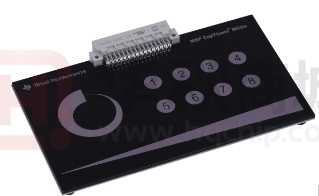
CAPTIVATE‑FR2633 配合使用
1.2
•
•
•
•
•
•
– 目标开发板 (MSP‑TS430RGE24A)
– 易于使用的生态系统
– CapTIvate 设计中心 – 代码生成、可自定义
GUI、实时调优
• 系列成员(另请参阅 器件比较)
– MSP430FR2633:15KB 程序 FRAM、512 字节
信息 FRAM、4KB RAM、多达 16 个自电容式传
感器或 64 个互电容式传感器
– MSP430FR2533:15KB 程序 FRAM、512 字节
信息 FRAM、2KB RAM、多达 16 个自电容式传
感器或 24 个互电容式传感器
– MSP430FR2632:8KB 程序 FRAM、512 字节
信息 FRAM、2KB RAM、多达 8 个自电容式传
感器或 16 个互电容式传感器
– MSP430FR2532:8KB 程序 FRAM、512 字节
信息 FRAM、1KB RAM、多达 8 个自电容式传
感器或 8 个互电容式传感器
• 封装选项
– 32 引脚:VQFN (RHB)
– 32 引脚:TSSOP (DA)
– 24 引脚:VQFN (RGE)
– 24 引脚:DSBGA (YQW)
应用
电子智能锁、门键盘和读取器
车库门系统
入侵 HMI 键盘和控制面板
电动百叶窗
遥控器
个人电子产品
1.3
www.ti.com.cn
•
•
•
•
•
•
无线扬声器和耳机
手持式视频游戏控制器
A/V 接收器
白色家电
小型电器
园艺和电动工具
说明
MSP430FR263x 和 MSP430FR253x 是用于电容式触控检测的超低功耗 MSP430™ 微控制器,采用
CapTIvate™ 触控技术,适用于按钮、滑块、滚轮及接近传感 应用中的数字输入 D 类音频放大器。采用
CapTIvate 技术的 MSP430 MCU 提供市面上最高集成度和自主性的电容式触控解决方案,具有高可靠性和
抗噪能力以及最低功耗。TI 的电容式触控技术支持在同一设计方案中同时使用自电容式和互电容式电极,最
大限度地提高了灵活性。采用 CapTIvate 技术的 MSP430 MCU 可以穿透厚玻璃、塑料外壳、金属和木材,
在恶劣的环境(包括潮湿、油腻和脏污环境)中工作。
TI 电容式触控感应 MSP430 MCU 由一个由各种软、硬件资源组成的生态系统提供支持,并配套提供有参考
设计和代码示例,可帮助您快速开展设计。开发套件包括 MSP-CAPT-FR2633 CapTIvate 技术开发套件。
TI 还提供免费的软件,如 CapTIvate 设计中心,工程师可以在其中 借助 方便易用的 GUI 和
MSP430Ware™ 软件以及包括 CapTIvate 技术指南在内的综合性文档快速进行应用开发。
TI 的 MSP430 超低功耗 (ULP) FRAM 微控制器平台将独特的嵌入式 FRAM 和全面的超低功耗系统架构相
结合,从而使系统设计人员能够在降低能耗的同时提升性能。FRAM 技术将 RAM 的低能耗快速写入、灵活
性和耐用性与闪存的非易失性相结合。
有关完整的模块说明,请参阅《MSP430FR4xx 和 MSP430FR2xx 系列器件用户指南》。
2
器件概述
版权 © 2015–2019, Texas Instruments Incorporated
�MSP430FR2633, MSP430FR2632, MSP430FR2533, MSP430FR2532
www.ti.com.cn
ZHCSET6E – NOVEMBER 2015 – REVISED DECEMBER 2019
器件信息 (1)
器件型号
MSP430FR2633IRHB
封装
封装尺寸 (2)
VQFN (32)
5mm x 5mm
MSP430FR2533IRHB
VQFN (32)
5mm × 5mm
MSP430FR2633IDA
TSSOP (32)
11mm × 6.2mm
MSP430FR2533IDA
TSSOP (32)
11mm × 6.2mm
MSP430FR2632IRGE
超薄四方扁平无引线 (VQFN) (24)
4mm x 4mm
MSP430FR2532IRGE
超薄四方扁平无引线 (VQFN) (24)
4mm x 4mm
MSP430FR2633IYQW
DSBGA (24)
2.29mm × 2.34mm
MSP430FR2632IYQW
DSBGA (24)
2.29mm × 2.34mm
(1)
(2)
要获得最新的产品、封装和订购信息,请参见封装选项附录(节 9),或者访问德州仪器 (TI) 网站
www.ti.com.cn。
这里显示的尺寸为近似值。要获得包含误差值的封装尺寸,请参见机械数据(节 9中)。
CAUTION
系统级静电放电 (ESD) 保护必须符合器件级 ESD 规范,以防发生电气过载或对
数据或代码存储器造成干扰。有关更多信息,请参阅《MSP430 系统级 ESD 注
意事项》。
版权 © 2015–2019, Texas Instruments Incorporated
器件概述
3
�MSP430FR2633, MSP430FR2632, MSP430FR2533, MSP430FR2532
ZHCSET6E – NOVEMBER 2015 – REVISED DECEMBER 2019
1.4
www.ti.com.cn
功能框图
图 1-1 给出了功能框图。
DVCC
DVSS
Power
Management
Module
RST/NMI
P1.x/P2.x
P3.x
I/O Ports
P3
1×3 IOs
32-bit
Hardware
Multiplier
I/O Ports
P1, P2
2×8 IOs
Interrupt
and Wakeup
PA
1×16 IOs
2×eUSCI_A
eUSCI_B0
XOUT
XIN
LFXT
ADC
FRAM
RAM
Clock
System
Up to 8-ch
single-ended
10 bit
200 ksps
15KB+512B
8KB+512B
4KB
2KB
2×TA
2×TA
VREG
MPY32
PB
1×3 IOs
CapTIvate
16-channel
8-channel
MAB
16-MHz CPU
including
16 Registers
MDB
EEM
CRC16
SYS
TCK
TMS
TDI/TCLK
TDO
SBWTCK
SBWTDIO
JTAG
Watchdog
Timer_A3
3 CC
Registers
Timer_A2
2 CC
Registers
(UART,
IrDA, SPI)
2
(SPI, I C)
RTC
Counter
BAKMEM
16-bit
Real-Time
Clock
32-byte
Backup
Memory
LPM3.5 Domain
SBW
•
•
•
•
•
•
4
16-bit
Cyclic
Redundancy
Check
图 1-1. 功能框图
MCU 的主电源对 DVCC 和 DVSS 分别为数字模块和模拟模块供电。推荐的旁路电容和去耦电容分别为
4.7μF 至 10μF 和 0.1μF,精度为 ±5%。
VREG 是 CapTIvate 稳压器的去耦电容。所需去耦电容的建议值为 1µF,最大等效串联电阻 (ESR) ≤
200mΩ。
P1 和 P2 特有引脚中断功能,可将 MCU 从所有低功耗模式 (LPM) 唤醒(包括 LPM3.5 和 LPM4)。
每个 Timer_A3 具有三个捕捉/比较寄存器。仅 CCR1 和 CCR2 从外部连接。CCR0 寄存器仅用于内部周
期时序和生成中断。
每个 Timer_A2 具有两个捕捉/比较寄存器。两个寄存器仅用于内部周期时序和生成中断。
在 LPM3 模式下,CapTIvate 可在其他外设停止工作的情况下继续工作。
器件概述
版权 © 2015–2019, Texas Instruments Incorporated
�MSP430FR2633, MSP430FR2632, MSP430FR2533, MSP430FR2532
www.ti.com.cn
ZHCSET6E – NOVEMBER 2015 – REVISED DECEMBER 2019
内容
1
器件概述 .................................................... 1
20
............................................
.................................................
6.3
Operating Modes ....................................
6.4
Interrupt Vector Addresses..........................
6.5
Bootloader (BSL) ....................................
6.6
JTAG Standard Interface............................
6.7
Spy-Bi-Wire Interface (SBW)........................
6.8
FRAM................................................
6.9
Memory Protection ..................................
6.10 Peripherals ..........................................
6.11 Input/Output Diagrams ..............................
6.12 Device Descriptors ..................................
6.13 Memory ..............................................
6.14 Identification .........................................
Applications, Implementation, and Layout........
7.1
Device Connection and Layout Fundamentals ......
20
7.2
77
Peripheral- and Interface-Specific Design
Information .......................................... 80
7.3
CapTIvate Technology Evaluation .................. 83
1.1
特性 ................................................... 1
1.2
应用 ................................................... 2
1.3
说明 ................................................... 2
1.4
功能框图 .............................................. 4
2
3
修订历史记录............................................... 6
Device Comparison ..................................... 8
4
Terminal Configuration and Functions .............. 9
3.1
4.1
Pin Diagrams ......................................... 9
4.2
Pin Attributes ........................................ 13
4.3
Signal Descriptions .................................. 16
.....................................
4.5
Buffer Types.........................................
4.6
Connection of Unused Pins .........................
Specifications ...........................................
5.1
Absolute Maximum Ratings .........................
5.2
ESD Ratings ........................................
5.3
Recommended Operating Conditions ...............
4.4
5
Pin Multiplexing
19
19
19
20
Active Mode Supply Current Into VCC Excluding
External Current ..................................... 21
5.5
5.6
Active Mode Supply Current Per MHz ..............
Low-Power Mode LPM0 Supply Currents Into VCC
Excluding External Current..........................
Low-Power Mode (LPM3 and LPM4) Supply
Currents (Into VCC) Excluding External Current ....
Low-Power Mode LPMx.5 Supply Currents (Into
VCC) Excluding External Current ....................
Typical Characteristics - Low-Power Mode Supply
Currents .............................................
5.8
5.9
7
Overview
6.2
CPU
20
5.4
5.7
6
Related Products ..................................... 8
6.1
8
21
21
22
23
24
5.10
Thermal Resistance Characteristics ................ 25
5.11
Timing and Switching Characteristics ............... 26
45
45
47
48
49
49
49
49
50
60
67
68
76
77
器件和文档支持 .......................................... 84
8.1
入门和后续步骤...................................... 84
8.2
器件命名规则 ........................................ 84
8.3
工具和软件
8.4
文档支持 ............................................. 87
8.5
相关链接 ............................................. 88
8.6
社区资源 ............................................. 88
8.7
商标.................................................. 88
8.8
静电放电警告 ........................................ 89
..........................................
...............................
8.10 Glossary .............................................
机械、封装和可订购信息................................
8.9
9
45
Export Control Notice
85
89
89
90
Detailed Description ................................... 45
版权 © 2015–2019, Texas Instruments Incorporated
内容
5
�MSP430FR2633, MSP430FR2632, MSP430FR2533, MSP430FR2532
ZHCSET6E – NOVEMBER 2015 – REVISED DECEMBER 2019
www.ti.com.cn
2 修订历史记录
注:之前版本的页码可能与当前版本有所不同。
从修订版本 D 更改为修订版本 E
Changes from August 20, 2019 to December 9, 2019
•
•
•
•
•
•
•
•
•
•
Page
Changed the note that begins "Supply voltage changes faster than 0.2 V/µs can trigger a BOR reset..." in
Section 5.3, Recommended Operating Conditions .............................................................................
Added the note that begins "TI recommends that power to the DVCC pin must not exceed the limits..." in
Section 5.3, Recommended Operating Conditions .............................................................................
Changed the note that begins "A capacitor tolerance of ±20% or better is required..." in Section 5.3,
Recommended Operating Conditions ............................................................................................
Changed the note that begins "Requires external capacitors at both terminals..." in Table 5-4, XT1 Crystal
Oscillator (Low Frequency) ........................................................................................................
Added the t(int) parameter in Table 5-10, Digital Inputs ........................................................................
Added the tTA,cap parameter in Table 5-13, Timer_A ............................................................................
Corrected the test conditions for the RI,MUX parameter in Table 5-20, ADC, Power Supply and Input Range
Conditions ............................................................................................................................
Added the note that begins "tSample = ln(2n+1) × τ ..." in Table 5-21, ADC, 10-Bit Timing Parameters....................
Moved CREG and CELECTRODE from Section 5.3, Recommended Operating Conditions to Table 5-23, CapTIvate
Electrical Characteristics ...........................................................................................................
Changed the CRC covered end address to 0x1AF5 in note (1) in Table 6-22, Device Descriptors .....................
20
20
20
28
32
34
40
40
42
67
从修订版本 C 更改为修订版本 D
Changes from August 29, 2018 to August 19, 2019
•
•
•
•
•
•
•
•
•
•
•
•
•
•
•
•
•
•
•
6
Page
更新了节 1.1特性...................................................................................................................... 1
在 节 1.1,特性 中添加了“目标开发板”信息 ....................................................................................... 2
Changed "fCONVER = 2 MHz" to "fCONVER = 4 MHz" in the note that begins "CapTIvate technology works in LPM3
with 64 mutual-capacitance buttons" on Section 5.7, Low-Power Mode (LPM3 and LPM4) Supply Currents (Into
VCC) Excluding External Current .................................................................................................. 22
Added the tTA,cap parameter in Table 5-13, Timer_A ............................................................................ 34
Changed the parameter symbol from RI to RI,MUX in Table 5-20 , ADC, Power Supply and Input Range Conditions . 40
Added RI,Misc TYP value of 34 kΩ in Table 5-20 , ADC, Power Supply and Input Range Conditions ................... 40
Added formula for RI calculation in Table 5-21 , ADC, 10-Bit Timing Parameters ......................................... 40
Removed the description of "±3°C" in table note that starts "The device descriptor structure ..." of Table 5-22,
ADC, 10-Bit Linearity Parameters ................................................................................................. 41
Moved CREG and CELECTRODE from Section 5.3, Recommended Operating Conditions to Table 5-23, CapTIvate
Electrical Characteristics ........................................................................................................... 42
Added test condition for CELECTRODE in Table 5-23 , CapTIvate Electrical Characteristics ................................. 42
Changed the symbol and description of the DCCAPCLK parameter in Table 5-23, CapTIvate Electrical
Characteristics ...................................................................................................................... 42
Moved the SNR parameter to Table 5-24, CapTIvate Signal-to-Noise Ratio Characteristics ............................ 42
Corrected bitfield from IRDSEL to IRDSSEL in Section 6.10.8, Timers (Timer0_A3, Timer1_A3, Timer2_A2 and
Timer3_A2), in the description that starts "The interconnection of Timer0_A3 and ..." .................................... 56
Corrected the ADCINCHx column heading in Table 6-15, ADC Channel Connections ................................... 58
Corrected the ADCSHSx column heading in Table 6-16, ADC Trigger Signal Connections .............................. 58
Added P1SELC information in Table 6-32, Port P1, P2 Registers (Base Address: 0200h) .............................. 71
Added P2SELC information in Table 6-32, Port P1, P2 Registers (Base Address: 0200h) .............................. 71
Added P3SELC information in Table 6-33, Port P3 Registers (Base Address: 0220h) ................................... 71
Updated Section 7.2.2, CapTIvate Peripheral .................................................................................. 81
修订历史记录
版权 © 2015–2019, Texas Instruments Incorporated
�MSP430FR2633, MSP430FR2632, MSP430FR2533, MSP430FR2532
www.ti.com.cn
ZHCSET6E – NOVEMBER 2015 – REVISED DECEMBER 2019
从修订版本 B 更改为修订版本 C
Changes from June 9, 2017 to August 28, 2018
•
•
•
•
•
•
•
•
•
•
•
Page
删除了节 1.1,特性 中“接近感应”项的“30cm” .................................................................................... 1
Updated Section 3.1, Related Products ........................................................................................... 8
Corrected package type in VQFN row (changed from QFN to VQFN) in Table 4-2, Signal Descriptions .............. 18
Changed HBM limit to ±1000 V and CDM limit to ±250 V in Section 5.2, ESD Ratings .................................. 20
Added note to VSVSH- and VSVSH+ parameters in Table 5-2, PMM, SVS and BOR .......................................... 26
Added the tTA,cap parameter in Table 5-13, Timer_A ............................................................................ 34
Moved CREG and CELECTRODE from Section 5.3, Recommended Operating Conditions to Table 5-23, CapTIvate
Electrical Characteristics ........................................................................................................... 42
Added the SNR parameter in Table 5-23, CapTIvate Electrical Characteristics ........................................... 42
Moved "FRAM access time error" to "System Reset" row and added ACCTEIFG to interrupt flag column in
Table 6-2, Interrupt Sources, Flags, and Vectors ............................................................................... 47
Corrected the offset for P2SEL1 in Table 6-32, Port P1, P2 Registers (Base Address: 0200h) ......................... 71
更新了节 8.2器件命名规则 中的文本和图 ........................................................................................ 84
从修订版本 A 更改为修订版本 B
Changes from December 10, 2015 to June 8, 2017
•
•
•
•
•
•
•
•
•
•
•
•
•
•
•
•
•
•
•
•
•
•
Page
更改了 “特性” 列表的组织结构 ...................................................................................................... 1
在节 1.1,特性 中的“封装选项”列表中添加了 DSBGA (YQW) 封装 ............................................................ 2
更新了节 1.2,应用 中的列表 ....................................................................................................... 2
更新节 1.3,说明...................................................................................................................... 2
在器件信息 表(位于节 1.3“说明”中)中添加了 DSBGA (YQW) 封装选项 .................................................... 3
Added MSP430FR2633IYQW and MSP430FR2632IYQW to Table 3-1, Device Comparison ............................. 8
Added Section 3.1, Related Products .............................................................................................. 8
Added DSBGA (YQW) pinout ..................................................................................................... 12
Added DSBGA (YQW) package to Table 4-1, Pin Attributes .................................................................. 13
Added DSBGA (YQW) package to Table 4-2, Signal Descriptions ........................................................... 16
Added row for VQFN thermal pad in Table 4-2, Signal Descriptions......................................................... 18
Removed FRAM reflow note ....................................................................................................... 20
Updated the notes on ILPM3, CapTIvate, 16 buttons and ILPM3, CapTIvate, 64 buttons in Section 5.7, Low-Power Mode (LPM3
and LPM4) Supply Currents (Into VCC) Excluding External Current ......................................................... 22
Added DSBGA (YQW) package and changed notes for Section 5.10, Thermal Resistance Characteristics ........... 25
Added the tTA,cap parameter in Table 5-13, Timer_A ............................................................................ 34
Removed ADCDIV from the formula for the TYP value in the second row of the tCONVERT parameter in Table 521, ADC, 10-Bit Timing Parameters (removed because ADCCLK is after division) ........................................ 40
Moved CREG and CELECTRODE from Section 5.3, Recommended Operating Conditions to Table 5-23, CapTIvate
Electrical Characteristics ........................................................................................................... 42
Add description of blank device detection ....................................................................................... 48
Changed the paragraph that starts "Quickly switching digital signals and ..." in Section 7.2.1.2, Design
Requirements ........................................................................................................................ 80
更新了图 8-1,器件命名规则 ...................................................................................................... 84
将先前的开发工具支持 部分替换为节 8.3“工具和软件” ......................................................................... 85
更新了节 8.4“文档支持”的格式和内容 ............................................................................................. 87
从初始发行版更改为修订版本 A
Changes from November 6, 2015 to December 9, 2015
•
•
•
•
Page
将文档状态从“产品预览”更改为“生产数据” ......................................................................................... 1
更改了开头为“提供可靠的触控解决方案...”的列表项.............................................................................. 1
向开头为“宽电源电压范围...”的列表项添加了说明 ................................................................................ 1
In the note that starts "Low-power mode 3, VLO, excludes SVS test conditions...", changed "fXT1 = 0 Hz" to
"fXT1 = 32768 Hz" .................................................................................................................... 22
Copyright © 2015–2019, Texas Instruments Incorporated
Submit Documentation Feedback
Product Folder Links: MSP430FR2633 MSP430FR2632 MSP430FR2533 MSP430FR2532
修订历史记录
7
�MSP430FR2633, MSP430FR2632, MSP430FR2533, MSP430FR2532
ZHCSET6E – NOVEMBER 2015 – REVISED DECEMBER 2019
•
•
•
•
•
•
8
www.ti.com.cn
Added note that starts "The VLO clock frequency is reduced by 15%..."....................................................
Added the tTA,cap parameter in Table 5-13, Timer_A ............................................................................
Moved CREG and CELECTRODE from Section 5.3, Recommended Operating Conditions to Table 5-23, CapTIvate
Electrical Characteristics ...........................................................................................................
Added note to "Clock" in Table 6-1, Operating Modes .........................................................................
Added note that starts "XT1CLK and VLOCLK can be active during LPM4..." .............................................
Corrected description in Section 6.10.10, Backup Memory (BKMEM) .......................................................
修订历史记录
31
34
42
46
46
57
Copyright © 2015–2019, Texas Instruments Incorporated
Submit Documentation Feedback
Product Folder Links: MSP430FR2633 MSP430FR2632 MSP430FR2533 MSP430FR2532
�MSP430FR2633, MSP430FR2632, MSP430FR2533, MSP430FR2532
www.ti.com.cn
ZHCSET6E – NOVEMBER 2015 – REVISED DECEMBER 2019
3 Device Comparison
Table 3-1 summarizes the features of the available family members.
Table 3-1. Device Comparison (1) (2)
PROGRAM FRAM
+ INFORMATION
FRAM (BYTES)
SRAM
(BYTES)
TA0 TO TA3
eUSCI_A
MSP430FR2633IRHB
15360 + 512
4096
MSP430FR2533IRHB
15360 + 512
MSP430FR2633IDA
eUSCI_B
10-BIT ADC
CHANNELS
CapTIvate™
CHANNELS
GPIOs
PACKAGE
TYPE
up to 2
1
8
16 (4)
19
32 RHB
(VQFN)
up to 2
up to 2
1
8
16 (4)
19
32 RHB
(VQFN)
2, 3 × CCR (3)
2, 2 × CCR
up to 2
up to 2
1
8
16 (4)
19
32 DA
(TSSOP)
2048
2, 3 × CCR (3)
2, 2 × CCR
up to 2
up to 2
1
8
16 (4)
19
32 DA
(TSSOP)
8192 + 512
2048
2, 3 × CCR (3)
2, 2 × CCR
up to 2
1
1
8
8 (5)
15
24 RGE
(VQFN)
MSP430FR2532IRGE
8192 + 512
1024
2, 3 × CCR (3)
2, 2 × CCR
up to 2
1
1
8
8 (5)
15
24 RGE
(VQFN)
MSP430FR2633IYQW
15360 + 512
4096
2, 3 × CCR (3)
2, 2 × CCR
up to 2
1
1
8
8 (6)
17
24 YQW
(DSBGA)
up to 2
1
1
8
8 (6)
17
24 YQW
(DSBGA)
DEVICE
UART
SPI
2, 3 × CCR (3)
2, 2 × CCR
up to 2
2048
2, 3 × CCR (3)
2, 2 × CCR
15360 + 512
4096
MSP430FR2533IDA
15360 + 512
MSP430FR2632IRGE
(3)
MSP430FR2632IYQW
(1)
(2)
(3)
(4)
(5)
(6)
3.1
8192 + 512
2048
2, 3 × CCR
2, 2 × CCR
For the most current package and ordering information, see the Package Option Addendum in 节 9, or see the TI website at www.ti.com
Package drawings, standard packing quantities, thermal data, symbolization, and PCB design guidelines are available at
www.ti.com/packaging
A CCR register is a configurable register that provides internal and external capture or compare inputs, or internal and external PWM
outputs.
Eight dedicated CapTIvate channels are included.
Four dedicated CapTIvate channels are included.
Two dedicated CapTIvate channels are included.
Related Products
For information about other devices in this family of products or related products, see the following links.
TI 16-bit and 32-bit microcontrollers
High-performance, low-power solutions to enable the autonomous future
Products for MSP430 ultra-low-power sensing & measurement MCUs
One platform. One ecosystem. Endless possibilities.
Companion products for MSP430FR2633
Review products that are frequently purchased or used with this product.
Reference designs for MSP430FR2633
Find reference designs leveraging the best in TI technology – from analog and power management to
embedded processors
Device Comparison
Submit Documentation Feedback
Product Folder Links: MSP430FR2633 MSP430FR2632 MSP430FR2533 MSP430FR2532
Copyright © 2015–2019, Texas Instruments Incorporated
9
�MSP430FR2633, MSP430FR2632, MSP430FR2533, MSP430FR2532
ZHCSET6E – NOVEMBER 2015 – REVISED DECEMBER 2019
www.ti.com.cn
4 Terminal Configuration and Functions
4.1
Pin Diagrams
P2.7/CAP3.0
P3.2/CAP3.2
CAP3.1
CAP3.3
P2.1/XIN
P2.0/XOUT
DVSS
DVCC
Figure 4-1 shows the pinout for the 32-pin RHB package.
RST/NMI/SBWTDIO
1
26 25
24
CAP2.3
TEST/SBWTCK
2
23
CAP2.2
P1.4/UCA0TXD/UCA0SIMO/TA1.2/TCK/A4/VREF+
3
22
CAP2.1
P1.5/UCA0RXD/UCA0SOMI/TA1.1/TMS/A5
4
21
CAP2.0
P1.6/UCA0CLK/TA1CLK/TDI/TCLK/A6
5
20
VREG
P2.6/UCA1TXD/UCA1SIMO/CAP1.3
P2.5/UCA1RXD/UCA1SOMI/CAP1.2
32 31 30 29 28 27
MSP430FR2633IRHB
MSP430FR2533IRHB
P1.7/UCA0STE/SMCLK/TDO/A7
6
19
P1.0/UCB0STE/TA0CLK/A0/Veref+
7
18
P1.1/UCB0CLK/TA0.1/A1
8
P2.4/UCA1CLK/CAP1.1
P3.1/UCA1STE/CAP1.0
CAP0.3
P2.3/CAP0.2
CAP0.1
P3.0/CAP0.0
P2.2/SYNC/ACLK
17
10 11 12 13 14 15 16
P1.3/UCB0SOMI/UCB0SCL/MCLK/A3
P1.2/UCB0SIMO/UCB0SDA/TA0.2/A2/Veref-
9
Figure 4-1. 32-Pin RHB Package (Top View)
10
Terminal Configuration and Functions
Copyright © 2015–2019, Texas Instruments Incorporated
Submit Documentation Feedback
Product Folder Links: MSP430FR2633 MSP430FR2632 MSP430FR2533 MSP430FR2532
�MSP430FR2633, MSP430FR2632, MSP430FR2533, MSP430FR2532
www.ti.com.cn
ZHCSET6E – NOVEMBER 2015 – REVISED DECEMBER 2019
Figure 4-2 shows the pinout for the 32-pin DA package.
P2.0/XOUT
1
32
CAP3.3
P2.1/XIN
2
31
P3.2/CAP3.2
DVSS
3
30
CAP3.1
DVCC
4
29
P2.7/CAP3.0
RST/NMI/SBWTDIO
5
28
CAP2.3
TEST/SBWTCK
6
27
CAP2.2
P1.4/UCA0TXD/UCA0SIMO/TA1.2/TCK/A4/VREF+
7
26
CAP2.1
P1.5/UCA0RXD/UCA0SOMI/TA1.1/TMS/A5
8
25
CAP2.0
MSP430FR2633IDA
MSP430FR2533IDA
P1.6/UCA0CLK/TA1CLK/TDI/TCLK/A6
9
24
VREG
P1.7/UCA0STE/SMCLK/TDO/A7
10
23
P2.6/UCA1TXD/UCA1SIMO/CAP1.3
P1.0/UCB0STE/TA0CLK/A0/Veref+
11
22
P2.5/UCA1RXD/UCA1SOMI/CAP1.2
P1.1/UCB0CLK/TA0.1/A1
12
21
P2.4/UCA1CLK/CAP1.1
P1.2/UCB0SIMO/UCB0SDA/TA0.2/A2/Veref-
13
20
P3.1/UCA1STE/CAP1.0
P1.3/UCB0SOMI/UCB0SCL/MCLK/A3
14
19
CAP0.3
P2.2/SYNC/ACLK
15
18
P2.3/CAP0.2
P3.0/CAP0.0
16
17
CAP0.1
Figure 4-2. 32-Pin DA Package (Top View)
Terminal Configuration and Functions
Submit Documentation Feedback
Product Folder Links: MSP430FR2633 MSP430FR2632 MSP430FR2533 MSP430FR2532
Copyright © 2015–2019, Texas Instruments Incorporated
11
�MSP430FR2633, MSP430FR2632, MSP430FR2533, MSP430FR2532
ZHCSET6E – NOVEMBER 2015 – REVISED DECEMBER 2019
www.ti.com.cn
CAP3.1
P2.7/CAP3.0
P2.0/XOUT
DVSS
P2.1/XIN
DVCC
Figure 4-3 shows the pinout for the 24-pin RGE package.
24 23 22 21 20 19
RST/NMI/SBWTDIO
1
18
CAP2.1
TEST/SBWTCK
2
17
CAP2.0
P1.4/UCA0TXD/UCA0SIMO/TA1.2/TCK/A4/VREF+
3
16
VREG
P1.5/UCA0RXD/UCA0SOMI/TA1.1/TMS/A5
4
15
P2.6/UCA1TXD/UCA1SIMO/CAP1.3
P1.6/UCA0CLK/TA1CLK/TDI/TCLKA6
5
14
P2.5/UCA1RXD/UCA1SOMI/CAP1.2
P1.7/UCA0STE/SMCLK/TDO/A7
6
13
CAP0.3
P1.1/UCB0CLK/TA0.1/A1
P1.2/UCB0SIMO/UCB0SDA/TA0.2/A2/Veref-
10 11 12
P2.3/CAP0.2
9
P2.2/SYNC/ACLK
8
P1.3/UCB0SOMI/UCB0SCL/MCLK/A3
7
P1.0/UCB0STE/TA0CLK/A0/Veref+
MSP430FR2632IRGE
MSP430FR2532IRGE
Figure 4-3. 24-Pin RGE Package (Top View)
12
Terminal Configuration and Functions
Copyright © 2015–2019, Texas Instruments Incorporated
Submit Documentation Feedback
Product Folder Links: MSP430FR2633 MSP430FR2632 MSP430FR2533 MSP430FR2532
�MSP430FR2633, MSP430FR2632, MSP430FR2533, MSP430FR2532
www.ti.com.cn
ZHCSET6E – NOVEMBER 2015 – REVISED DECEMBER 2019
Figure 4-4 shows the top view of the YQW package, and Figure 4-5 shows the bottom (ball-side) view.
Top View
SIGNAL NAME
PIN NO.
E5
D5
D
C5
E4
D4
C4
E3
E2
D2
D3
E1
D1
C2
C3
B5
B4
B3
B2
A5
A4
A3
A2
B1
SIGNAL NAME
PIN NO.
A1
P1.1/UCB0CLK/TA0.1/A1
C4
CAP2.0
A2
P1.3/UCB0SOMI/UCB0SCL/MCLK/A3
C5
VREG
A3
P2.2/SYNC/ACLK
D1
P1.4/UCA0TXD/UCA0SIMO/TA1.2/TCK/A4/VREF+
A4
P3.0/CAP0.0
D2
TEST/SBWTCK
A5
P2.3/CAP0.2
D3
DVSS
B1
P1.0/UCB0STE/TA0CLK/A0/Veref+
D4
P3.2/CAP3.2
B2
P1.2/UCB0SIMO/UCB0SDA/TA0.2/A2/Veref-
D5
CAP2.2
B3
P1.7/UCA0STE/SMCLK/TDO/A7
E1
RST/NMI/SBWTDIO
B4
P2.5/UCA1RXD/CAP1.2
E2
DVCC
B5
P2.6/UCA1TXD/CAP1.3
E3
P2.1/XIN
C2
P1.5/UCA0RXD/UCA0SOMI/TA1.1/TMS/A5
E4
P2.0/XOUT
C3
P1.6/UCA0CLK/TA1CLK/TDI/TCLK/A6
E5
P2.7/CAP3.0
A1
E
Figure 4-4. 24-Pin YQW Package (Top View)
Ball-SIde View
SIGNAL NAME
PIN NO.
E1
E2
E3
E4
E5
D1
D2
D3
D4
D5
C2
D
B1
A1
B2
A2
C3
B3
A3
C4
B4
A4
C5
B5
A5
SIGNAL NAME
PIN NO.
A1
P1.1/UCB0CLK/TA0.1/A1
C4
CAP2.0
A2
P1.3/UCB0SOMI/UCB0SCL/MCLK/A3
C5
VREG
A3
P2.2/SYNC/ACLK
D1
P1.4/UCA0TXD/UCA0SIMO/TA1.2/TCK/A4/VREF+
A4
P3.0/CAP0.0
D2
TEST/SBWTCK
A5
P2.3/CAP0.2
D3
DVSS
B1
P1.0/UCB0STE/TA0CLK/A0/Veref+
D4
P3.2/CAP3.2
B2
P1.2/UCB0SIMO/UCB0SDA/TA0.2/A2/Veref-
D5
CAP2.2
B3
P1.7/UCA0STE/SMCLK/TDO/A7
E1
RST/NMI/SBWTDIO
B4
P2.5/UCA1RXD/CAP1.2
E2
DVCC
B5
P2.6/UCA1TXD/CAP1.3
E3
P2.1/XIN
C2
P1.5/UCA0RXD/UCA0SOMI/TA1.1/TMS/A5
E4
P2.0/XOUT
C3
P1.6/UCA0CLK/TA1CLK/TDI/TCLK/A6
E5
P2.7/CAP3.0
E
Figure 4-5. 24-Pin YQW Package (Bottom View)
Terminal Configuration and Functions
Submit Documentation Feedback
Product Folder Links: MSP430FR2633 MSP430FR2632 MSP430FR2533 MSP430FR2532
Copyright © 2015–2019, Texas Instruments Incorporated
13
�MSP430FR2633, MSP430FR2632, MSP430FR2533, MSP430FR2532
ZHCSET6E – NOVEMBER 2015 – REVISED DECEMBER 2019
4.2
www.ti.com.cn
Pin Attributes
Table 4-1 lists the attributes of all pins.
Table 4-1. Pin Attributes
PIN NUMBER
RHB
DA
RGE
SIGNAL NAME (1)
(2)
YQW
RST (RD)
1
2
3
4
5
6
5
6
7
8
9
10
1
2
3
4
5
6
E1
D2
D1
C2
C3
B3
NMI
(1)
(2)
(3)
(4)
(5)
(6)
14
11
7
B1
BUFFER TYPE (4)
POWER
SOURCE (5)
RESET STATE
AFTER BOR (6)
I
LVCMOS
DVCC
OFF
–
I
LVCMOS
DVCC
SBWTDIO
I/O
LVCMOS
DVCC
–
TEST (RD)
I
LVCMOS
DVCC
OFF
SBWTCK
I
LVCMOS
DVCC
–
P1.4 (RD)
I/O
LVCMOS
DVCC
OFF
UCA0TXD
O
LVCMOS
DVCC
–
UCA0SIMO
I/O
LVCMOS
DVCC
–
TA1.2
I/O
LVCMOS
DVCC
–
TCK
I
LVCMOS
DVCC
–
A4
I
Analog
DVCC
–
VREF+
O
Power
DVCC
–
P1.5 (RD)
I/O
LVCMOS
DVCC
OFF
UCA0RXD
I
LVCMOS
DVCC
–
UCA0SOMI
I/O
LVCMOS
DVCC
–
TA1.1
I/O
LVCMOS
DVCC
–
TMS
I
LVCMOS
DVCC
–
A5
I
Analog
DVCC
–
P1.6 (RD)
I/O
LVCMOS
DVCC
OFF
UCA0CLK
I/O
LVCMOS
DVCC
–
TA1CLK
I
LVCMOS
DVCC
–
TDI
I
LVCMOS
DVCC
–
TCLK
I
LVCMOS
DVCC
–
A6
I
Analog
DVCC
–
P1.7 (RD)
I/O
LVCMOS
DVCC
OFF
UCA0STE
I/O
LVCMOS
DVCC
–
SMCLK
O
LVCMOS
DVCC
–
TDO
O
LVCMOS
DVCC
–
A7
7
SIGNAL
TYPE (3)
I
Analog
DVCC
–
P1.0 (RD)
I/O
LVCMOS
DVCC
OFF
UCB0STE
I/O
LVCMOS
DVCC
–
TA0CLK
I
LVCMOS
DVCC
–
A0
I
Analog
DVCC
–
Veref+
I
Power
DVCC
–
Signals names with (RD) denote the reset default pin name.
To determine the pin mux encodings for each pin, see Section 6.11, Input/Output Diagrams.
Signal Types: I = Input, O = Output, I/O = Input or Output
Buffer Types: LVCMOS, Analog, or Power (see Table 4-3)
The power source shown in this table is the I/O power source, which may differ from the module power source.
Reset States:
OFF = High-impedance with Schmitt trigger and pullup or pulldown (if available) disabled
N/A = Not applicable
Terminal Configuration and Functions
Copyright © 2015–2019, Texas Instruments Incorporated
Submit Documentation Feedback
Product Folder Links: MSP430FR2633 MSP430FR2632 MSP430FR2533 MSP430FR2532
�MSP430FR2633, MSP430FR2632, MSP430FR2533, MSP430FR2532
www.ti.com.cn
ZHCSET6E – NOVEMBER 2015 – REVISED DECEMBER 2019
Table 4-1. Pin Attributes (continued)
PIN NUMBER
RHB
8
DA
12
RGE
8
SIGNAL NAME (1)
SIGNAL
TYPE (3)
BUFFER TYPE (4)
POWER
SOURCE (5)
RESET STATE
AFTER BOR (6)
P1.1 (RD)
I/O
LVCMOS
DVCC
OFF
UCB0CLK
I/O
LVCMOS
DVCC
–
TA0.1
I/O
LVCMOS
DVCC
–
(2)
YQW
A1
A1
9
10
13
14
9
10
B2
A2
I
Analog
DVCC
–
P1.2 (RD)
I/O
LVCMOS
DVCC
OFF
UCB0SIMO
I/O
LVCMOS
DVCC
–
UCB0SDA
I/O
LVCMOS
DVCC
–
TA0.2
I/O
LVCMOS
DVCC
–
A2
I
Analog
DVCC
–
Veref-
I
Power
DVCC
–
P1.3 (RD)
I/O
LVCMOS
DVCC
OFF
UCB0SOMI
I/O
LVCMOS
DVCC
–
UCB0SCL
I/O
LVCMOS
DVCC
–
MCLK
O
LVCMOS
DVCC
–
A3
I
Analog
DVCC
–
I/O
LVCMOS
DVCC
OFF
SYNC
I
LVCMOS
DVCC
–
ACLK
O
LVCMOS
DVCC
–
P3.0 (RD)
I/O
LVCMOS
DVCC
OFF
CAP0.0
I/O
Analog
VREG
–
CAP0.1
I/O
Analog
VREG
OFF
P2.3 (RD)
I/O
LVCMOS
DVCC
OFF
CAP0.2
I/O
Analog
VREG
–
CAP0.3
I/O
Analog
VREG
OFF
P3.1 (RD)
I/O
LVCMOS
DVCC
OFF
UCA1STE
I/O
LVCMOS
DVCC
–
CAP1.0
I/O
Analog
VREG
–
P2.4 (RD)
I/O
LVCMOS
DVCC
OFF
UCA1CLK
I/O
LVCMOS
DVCC
–
CAP1.1
I/O
Analog
VREG
–
P2.5 (RD)
I/O
LVCMOS
DVCC
OFF
UCA1RXD
I
LVCMOS
DVCC
–
UCA1SOMI
I/O
LVCMOS
DVCC
–
CAP1.2
I/O
Analog
VREG
–
P2.6 (RD)
I/O
LVCMOS
DVCC
OFF
UCA1TXD
O
LVCMOS
DVCC
–
UCA1SIMO
I/O
LVCMOS
DVCC
–
CAP1.3
I/O
Analog
VREG
–
P
Power
VREG
N/A
P2.2 (RD)
11
15
11
A3
12
16
–
A4
13
17
–
–
14
18
12
A5
15
19
13
–
16
17
18
19
20
21
22
23
–
–
14
15
–
–
B4
B5
20
24
16
C5
VREG
21
25
17
C4
CAP2.0
I/O
Analog
VREG
OFF
22
26
18
–
CAP2.1
I/O
Analog
VREG
OFF
23
27
–
D5
CAP2.2
I/O
Analog
VREG
OFF
24
28
–
–
CAP2.3
I/O
Analog
VREG
OFF
25
29
19
E5
P2.7 (RD)
I/O
LVCMOS
DVCC
OFF
CAP3.0
I/O
Analog
VREG
–
26
30
20
–
CAP3.1
I/O
Analog
VREG
OFF
Terminal Configuration and Functions
Submit Documentation Feedback
Product Folder Links: MSP430FR2633 MSP430FR2632 MSP430FR2533 MSP430FR2532
Copyright © 2015–2019, Texas Instruments Incorporated
15
�MSP430FR2633, MSP430FR2632, MSP430FR2533, MSP430FR2532
ZHCSET6E – NOVEMBER 2015 – REVISED DECEMBER 2019
www.ti.com.cn
Table 4-1. Pin Attributes (continued)
PIN NUMBER
16
SIGNAL NAME (1)
RHB
DA
RGE
YQW
27
31
–
D4
28
32
–
–
29
1
21
E4
SIGNAL
TYPE (3)
BUFFER TYPE (4)
POWER
SOURCE (5)
RESET STATE
AFTER BOR (6)
P3.2 (RD)
I/O
LVCMOS
DVCC
OFF
CAP3.2
I/O
Analog
VREG
–
CAP3.3
I/O
Analog
VREG
OFF
P2.0 (RD)
I/O
LVCMOS
DVCC
OFF
XOUT
O
LVCMOS
DVCC
–
P2.1 (RD)
I/O
LVCMOS
DVCC
OFF
(2)
30
2
22
E3
XIN
I
LVCMOS
DVCC
–
31
3
23
D3
DVSS
P
Power
DVCC
N/A
32
4
24
E2
DVCC
P
Power
DVCC
N/A
Terminal Configuration and Functions
Copyright © 2015–2019, Texas Instruments Incorporated
Submit Documentation Feedback
Product Folder Links: MSP430FR2633 MSP430FR2632 MSP430FR2533 MSP430FR2532
�MSP430FR2633, MSP430FR2632, MSP430FR2533, MSP430FR2532
www.ti.com.cn
4.3
ZHCSET6E – NOVEMBER 2015 – REVISED DECEMBER 2019
Signal Descriptions
Table 4-2 describes the signals for all device variants and package options.
Table 4-2. Signal Descriptions
FUNCTION
ADC
CapTIvate
Clock
Debug
(1)
SIGNAL NAME
PIN NUMBER
RGE YQW
PIN
TYPE (1)
DESCRIPTION
RHB
DA
A0
7
11
7
B1
I
Analog input A0
A1
8
12
8
A1
I
Analog input A1
A2
9
13
9
B2
I
Analog input A2
A3
10
14
10
A2
I
Analog input A3
A4
3
7
3
D1
I
Analog input A4
A5
4
8
4
C2
I
Analog input A5
A6
5
9
5
C3
I
Analog input A6
A7
6
10
6
B3
I
Analog input A7
Veref+
7
11
7
B1
I
ADC positive reference
Veref-
9
13
9
B2
I
ADC negative reference
CAP0.0
12
16
–
A4
I/O
CapTIvate channel
CAP0.1
13
17
–
–
I/O
CapTIvate channel
CAP0.2
14
18
12
A5
I/O
CapTIvate channel
CAP0.3
15
19
13
–
I/O
CapTIvate channel
CAP1.0
16
20
–
–
I/O
CapTIvate channel
CAP1.1
17
21
–
–
I/O
CapTIvate channel
CAP1.2
18
22
14
B4
I/O
CapTIvate channel
CAP1.3
19
23
15
B5
I/O
CapTIvate channel
CAP2.0
21
25
17
C4
I/O
CapTIvate channel
CAP2.1
22
26
18
–
I/O
CapTIvate channel
CAP2.2
23
27
–
D5
I/O
CapTIvate channel
CAP2.3
24
28
–
–
I/O
CapTIvate channel
CAP3.0
25
29
19
E5
I/O
CapTIvate channel
CAP3.1
26
30
20
–
I/O
CapTIvate channel
CAP3.2
27
31
–
D4
I/O
CapTIvate channel
CAP3.3
28
32
–
–
I/O
CapTIvate channel
SYNC
11
15
11
A3
I
CapTIvate synchronous trigger input for processing and
conversion
ACLK
11
15
11
A3
O
ACLK output
MCLK
10
14
10
A2
O
MCLK output
SMCLK
6
10
6
B3
O
SMCLK output
XIN
30
2
22
E3
I
Input terminal for crystal oscillator
XOUT
29
1
21
E4
O
Output terminal for crystal oscillator
SBWTCK
2
6
2
D2
I
Spy-Bi-Wire input clock
SBWTDIO
1
5
1
E1
I/O
TCK
3
7
3
D1
I
Test clock
TCLK
5
9
5
C3
I
Test clock input
TDI
5
9
5
C3
I
Test data input
TDO
6
10
6
B3
O
Test data output
TEST
2
6
2
D2
I
Test Mode pin – selected digital I/O on JTAG pins
TMS
4
8
4
C2
I
Test mode select
Spy-Bi-Wire data input/output
Pin Types: I = Input, O = Output, I/O = Input or Output, P = Power
Terminal Configuration and Functions
Submit Documentation Feedback
Product Folder Links: MSP430FR2633 MSP430FR2632 MSP430FR2533 MSP430FR2532
Copyright © 2015–2019, Texas Instruments Incorporated
17
�MSP430FR2633, MSP430FR2632, MSP430FR2533, MSP430FR2532
ZHCSET6E – NOVEMBER 2015 – REVISED DECEMBER 2019
www.ti.com.cn
Table 4-2. Signal Descriptions (continued)
FUNCTION
GPIO
I2C
Power
SPI
System
(2)
18
SIGNAL NAME
PIN NUMBER
RGE YQW
PIN
TYPE (1)
DESCRIPTION
RHB
DA
P1.0
7
11
7
B1
I/O
General-purpose I/O
P1.1
8
12
8
A1
I/O
General-purpose I/O
P1.2
9
13
9
B2
I/O
General-purpose I/O
P1.3
10
14
10
A2
I/O
General-purpose I/O
P1.4
3
7
3
D1
I/O
General-purpose I/O (2)
P1.5
4
8
4
C2
I/O
General-purpose I/O (2)
P1.6
5
9
5
C3
I/O
General-purpose I/O (2)
P1.7
6
10
6
B3
I/O
General-purpose I/O (2)
P2.0
29
1
21
E4
I/O
General-purpose I/O
P2.1
30
2
22
E3
I/O
General-purpose I/O
P2.2
11
15
11
A3
I/O
General-purpose I/O
P2.3
14
18
12
A5
I/O
General-purpose I/O
P2.4
17
21
–
–
I/O
General-purpose I/O
P2.5
18
22
14
B4
I/O
General-purpose I/O
P2.6
19
23
15
B5
I/O
General-purpose I/O
P2.7
25
29
19
E5
I/O
General-purpose I/O
P3.0
12
16
–
A4
I/O
General-purpose I/O
P3.1
16
20
–
–
I/O
General-purpose I/O
P3.2
27
31
–
D4
I/O
General-purpose I/O
UCB0SCL
10
14
10
A2
I/O
eUSCI_B0 I2C clock
UCB0SDA
9
13
9
B2
I/O
eUSCI_B0 I2C data
DVCC
32
4
24
E2
P
Power supply
DVSS
31
3
23
D3
P
Power ground
VREF+
3
7
3
D1
P
Output of positive reference voltage with ground as
reference
VREG
20
24
16
C5
O
CapTIvate regulator external decoupling capacitor
UCA0CLK
5
9
5
C3
I/O
eUSCI_A0 SPI clock input/output
UCA0SIMO
3
7
3
D1
I/O
eUSCI_A0 SPI slave in/master out
UCA0SOMI
4
8
4
C2
I/O
eUSCI_A0 SPI slave out/master in
UCA0STE
6
10
6
B3
I/O
eUSCI_A0 SPI slave transmit enable
UCA1CLK
17
21
–
–
I/O
eUSCI_A1 SPI clock input/output
UCA1SIMO
19
23
15
B5
I/O
eUSCI_A1 SPI slave in/master out
UCA1SOMI
18
22
14
B4
I/O
eUSCI_A1 SPI slave out/master in
UCA1STE
16
20
–
–
I/O
eUSCI_A1 SPI slave transmit enable
UCB0CLK
8
12
8
A1
I/O
eUSCI_B0 clock input/output
UCB0SIMO
9
13
9
B2
I/O
eUSCI_B0 SPI slave in/master out
UCB0SOMI
10
14
10
A2
I/O
eUSCI_B0 SPI slave out/master in
UCB0STE
7
11
7
B1
I/O
eUSCI_B0 slave transmit enable
NMI
1
5
1
E1
I
Nonmaskable interrupt input
RST
1
5
1
E1
I
Active-low reset input
Because this pin is multiplexed with the JTAG function, TI recommends disabling the pin interrupt function while in JTAG debug to
prevent collisions.
Terminal Configuration and Functions
Copyright © 2015–2019, Texas Instruments Incorporated
Submit Documentation Feedback
Product Folder Links: MSP430FR2633 MSP430FR2632 MSP430FR2533 MSP430FR2532
�MSP430FR2633, MSP430FR2632, MSP430FR2533, MSP430FR2532
www.ti.com.cn
ZHCSET6E – NOVEMBER 2015 – REVISED DECEMBER 2019
Table 4-2. Signal Descriptions (continued)
FUNCTION
Timer_A
UART
VQFN Pad
SIGNAL NAME
PIN NUMBER
DESCRIPTION
DA
TA0.1
8
12
8
A1
I/O
Timer TA0 CCR1 capture: CCI1A input, compare: Out1
outputs
TA0.2
9
13
9
B2
I/O
Timer TA0 CCR2 capture: CCI2A input, compare: Out2
outputs
TA0CLK
7
11
7
B1
I
TA1.1
4
8
4
C2
I/O
Timer TA1 CCR1 capture: CCI1A input, compare: Out1
outputs
TA1.2
3
7
3
D1
I/O
Timer TA1 CCR2 capture: CCI2A input, compare: Out2
outputs
TA1CLK
5
9
5
C3
I
Timer clock input TACLK for TA1
UCA0RXD
4
8
4
C2
I
eUSCI_A0 UART receive data
UCA0TXD
3
7
3
D1
O
eUSCI_A0 UART transmit data
UCA1RXD
18
22
14
B4
I
eUSCI_A1 UART receive data
UCA1TXD
19
23
15
B5
O
eUSCI_A1 UART transmit data
Pad
N/A
Pad
N/A
VQFN thermal pad
RGE YQW
PIN
TYPE (1)
RHB
Timer clock input TACLK for TA0
VQFN package exposed thermal pad. TI recommends
connecting to VSS.
Terminal Configuration and Functions
Submit Documentation Feedback
Product Folder Links: MSP430FR2633 MSP430FR2632 MSP430FR2533 MSP430FR2532
Copyright © 2015–2019, Texas Instruments Incorporated
19
�MSP430FR2633, MSP430FR2632, MSP430FR2533, MSP430FR2532
ZHCSET6E – NOVEMBER 2015 – REVISED DECEMBER 2019
4.4
www.ti.com.cn
Pin Multiplexing
Pin multiplexing for these MCUs is controlled by both register settings and operating modes (for example,
if the MCU is in test mode). For details of the settings for each pin and schematics of the multiplexed
ports, see Section 6.11.
4.5
Buffer Types
Table 4-3 defines the pin buffer types that are listed in Table 4-1.
Table 4-3. Buffer Types
NOMINAL
VOLTAGE
HYSTERESIS
PU OR PD
NOMINAL
PU OR PD
STRENGTH
(µA)
OUTPUT
DRIVE
STRENGTH
(mA)
LVCMOS
3.0 V
Y (1)
Programmable
See
Section 5.11.4
See
Section 5.11.4
Analog
3.0 V
N
N/A
N/A
N/A
See analog modules in
Section 5 for details.
Power (DVCC)
3.0 V
N
N/A
N/A
N/A
SVS enables hysteresis on
DVCC.
Power (AVCC)
3.0 V
N
N/A
N/A
N/A
BUFFER TYPE
(STANDARD)
(1)
OTHER
CHARACTERISTICS
Only for input pins.
4.6
Connection of Unused Pins
Table 4-4 lists the correct termination of unused pins.
Table 4-4. Connection of Unused Pins (1)
PIN
POTENTIAL
COMMENT
Px.0 to Px.7
Open
Switched to port function, output direction (PxDIR.n = 1)
RST/NMI
DVCC
47-kΩ pullup or internal pullup selected with 10-nF (or 1.1-nF) pulldown (2)
TEST
Open
This pin always has an internal pulldown enabled.
CAP2.x, CAPx.1, CAPx.3
Open
These pins have internal pullup and pulldown resistors, and high impedance is their
default setting.
(1)
(2)
20
Any unused pin with a secondary function that is shared with general-purpose I/O should follow the Px.0 to Px.7 unused pin connection
guidelines.
The pulldown capacitor should not exceed 1.1 nF when using MCUs with Spy-Bi-Wire interface in Spy-Bi-Wire mode with TI tools like
FET interfaces or GANG programmers.
Terminal Configuration and Functions
Copyright © 2015–2019, Texas Instruments Incorporated
Submit Documentation Feedback
Product Folder Links: MSP430FR2633 MSP430FR2632 MSP430FR2533 MSP430FR2532
�MSP430FR2633, MSP430FR2632, MSP430FR2533, MSP430FR2532
www.ti.com.cn
ZHCSET6E – NOVEMBER 2015 – REVISED DECEMBER 2019
5 Specifications
Absolute Maximum Ratings (1)
5.1
over operating free-air temperature range (unless otherwise noted)
Voltage applied at DVCC pin to VSS
Voltage applied to any dedicated CapTIvate pin or pin in CapTIvate mode
Voltage applied to any other pin
(2)
(3)
MIN
MAX
–0.3
4.1
V
–0.3
VREG
V
–0.3
VCC + 0.3
(4.1 V Max)
V
Diode current at any device pin
Maximum junction temperature, TJ
Storage temperature, Tstg (4)
(1)
(2)
(3)
(4)
–40
UNIT
±2
mA
85
°C
125
°C
Stresses beyond those listed under Absolute Maximum Ratings may cause permanent damage to the device. These are stress ratings
only, and functional operation of the device at these or any other conditions beyond those indicated under Recommended Operating
Conditions is not implied. Exposure to absolute-maximum-rated conditions for extended periods may affect device reliability.
This applies to dedicated CapTIvate I/Os only or I/Os worked in CapTIvate mode.
All voltages referenced to VSS.
Higher temperature may be applied during board soldering according to the current JEDEC J-STD-020 specification with peak reflow
temperatures not higher than classified on the device label on the shipping boxes or reels.
5.2
ESD Ratings
VALUE
V(ESD)
(1)
(2)
Electrostatic discharge
Human-body model (HBM), per ANSI/ESDA/JEDEC JS‑001
(1)
±1000
Charged-device model (CDM), per JEDEC specification JESD22‑C101 (2)
Recommended Operating Conditions
MIN
VCC
Supply voltage applied at DVCC pin (1) (2) (3) (4)
VSS
Supply voltage applied at DVSS pin
TA
Operating free-air temperature
–40
TJ
Operating junction temperature
–40
CDVCC
Recommended capacitor at DVCC (5)
4.7
fSYSTEM
Processor frequency (maximum MCLK frequency)
fACLK
Maximum ACLK frequency
fSMCLK
Maximum SMCLK frequency
(2)
(3)
(4)
(5)
(6)
(7)
(8)
V
±250
JEDEC document JEP155 states that 500-V HBM allows safe manufacturing with a standard ESD control process. Pins listed as
±1000 V may actually have higher performance.
JEDEC document JEP157 states that 250-V CDM allows safe manufacturing with a standard ESD control process. Pins listed as ±250 V
may actually have higher performance.
5.3
(1)
UNIT
NOM
1.8
MAX
V
85
°C
0
(6)
UNIT
3.6
V
85
10
°C
µF
No FRAM wait states
(NWAITSx = 0)
0
8
With FRAM wait states
(NWAITSx = 1) (7)
0
16 (8)
MHz
40
kHz
16 (8)
MHz
Supply voltage changes faster than 0.2 V/µs can trigger a BOR reset even within the recommended supply voltage range. Following the
data sheet recommendation for capacitor CDVCC limits the slopes accordingly.
Modules may have a different supply voltage range specification. See the specification of the respective module in this data sheet.
TI recommends that power to the DVCC pin must not exceed the limits specified in Recommended Operating Conditions. Exceeding the
specified limits can cause malfunction of the device including erroneous writes to RAM and FRAM.
The minimum supply voltage is defined by the SVS levels. See the SVS threshold parameters in Table 5-2.
A capacitor tolerance of ±20% or better is required. A low-ESR ceramic capacitor of 100 nF (minimum) should be placed as close as
possible (within a few millimeters) to the respective pin pair.
Modules may have a different maximum input clock specification. See the specification of the respective module in this data sheet.
Wait states only occur on actual FRAM accesses (that is, on FRAM cache misses). RAM and peripheral accesses are always executed
without wait states.
If clock sources such as HF crystals or the DCO with frequencies >16 MHz are used, the clock must be divided in the clock system to
comply with this operating condition.
Copyright © 2015–2019, Texas Instruments Incorporated
Submit Documentation Feedback
Product Folder Links: MSP430FR2633 MSP430FR2632 MSP430FR2533 MSP430FR2532
Specifications
21
�MSP430FR2633, MSP430FR2632, MSP430FR2533, MSP430FR2532
ZHCSET6E – NOVEMBER 2015 – REVISED DECEMBER 2019
www.ti.com.cn
Active Mode Supply Current Into VCC Excluding External Current (1)
5.4
VCC = 3 V, TA = 25°C (unless otherwise noted)
FREQUENCY (fMCLK = fSMCLK)
EXECUTION
MEMORY
PARAMETER
TEST
CONDITION
1 MHz
0 WAIT STATES
(NWAITSx = 0)
TYP
IAM,
FRAM(0%)
IAM,
FRAM(100%)
IAM,
RAM
(1)
(2)
(2)
8 MHz
0 WAIT STATES
(NWAITSx = 0)
MAX
TYP
16 MHz
1 WAIT STATE
(NWAITSx = 1)
MAX
TYP
MAX
3480
FRAM
0% cache hit ratio
3 V, 25°C
504
2772
3047
3 V, 85°C
516
2491
2871
FRAM
100% cache hit
ratio
3 V, 25°C
203
625
1000
3 V, 85°C
212
639
1016
RAM
3 V, 25°C
229
818
1377
UNIT
µA
1215
µA
µA
All inputs are tied to 0 V or to VCC. Outputs do not source or sink any current. Characterized with program executing typical data
processing.
fACLK = 32768 Hz, fMCLK = fSMCLK = fDCO at specified frequency
Program and data entirely reside in FRAM. All execution is from FRAM.
Program and data reside entirely in RAM. All execution is from RAM. No access to FRAM.
5.5
Active Mode Supply Current Per MHz
VCC = 3 V, TA = 25°C (unless otherwise noted)
PARAMETER
dIAM,FRAM/df
5.6
TEST CONDITIONS
Active mode current consumption per MHz,
execution from FRAM, no wait states
TYP
UNIT
126
µA/MHz
[IAM (75% cache hit rate) at 8 MHz –
IAM (75% cache hit rate) at 1 MHz)] / 7 MHz
Low-Power Mode LPM0 Supply Currents Into VCC Excluding External Current
VCC = 3 V, TA = 25°C (unless otherwise noted) (1) (2)
FREQUENCY (fSMCLK)
PARAMETER
VCC
1 MHz
TYP
ILPM0
(1)
(2)
22
8 MHz
MAX
TYP
16 MHz
MAX
TYP
2V
156
328
420
3V
166
342
433
UNIT
MAX
µA
All inputs are tied to 0 V or to VCC. Outputs do not source or sink any current.
Current for watchdog timer clocked by SMCLK included.
fACLK = 32768 Hz, fMCLK = 0 MHz, fSMCLK at specified frequency.
Specifications
Copyright © 2015–2019, Texas Instruments Incorporated
Submit Documentation Feedback
Product Folder Links: MSP430FR2633 MSP430FR2632 MSP430FR2533 MSP430FR2532
�MSP430FR2633, MSP430FR2632, MSP430FR2533, MSP430FR2532
www.ti.com.cn
5.7
ZHCSET6E – NOVEMBER 2015 – REVISED DECEMBER 2019
Low-Power Mode (LPM3 and LPM4) Supply Currents (Into VCC) Excluding External Current
over recommended ranges of supply voltage and operating free-air temperature (unless otherwise noted)
PARAMETER
ILPM3,XT1
Low-power mode 3, 12.5-pF crystal, includes
SVS (2) (3) (4)
ILPM3,VLO
Low-power mode 3, VLO, excludes SVS (5)
ILPM3,
Low-power mode 3, RTC, excludes SVS (6)
(see Figure 5-1)
RTC
ILPM3, CapTIvate,
VCC
–40°C
TYP
MAX
25°C
(1)
85°C
TYP
MAX
TYP
1.65
3.24
3V
0.98
1.18
2V
0.96
1.16
3V
0.78
0.98
2V
0.76
0.96
3.01
3V
0.93
1.13
3.19
MAX
3.21
1.40
3.04
UNIT
µA
µA
µA
Low-power mode 3, CapTIvate, excludes
SVS (7)
3.3 V
5
µA
Low-power mode 3, CapTIvate, excludes
SVS (8)
3.3 V
3.4
µA
Low-power mode 3, CapTIvate, excludes
SVS (9)
3.3 V
3.6
µA
Low-power mode 3, CapTIvate, excludes
SVS (10)
3.3 V
27.2
µA
Low-power mode 3, CapTIvate, excludes
SVS (11)
3.3 V
109.2
µA
64 buttons
ILPM4,
Low-power mode 4, includes SVS
1 proximity, wake on touch
ILPM3, CapTIvate,
1 button, wake on touch
ILPM3, CapTIvate,
4 buttons, wake on touch
ILPM3, CapTIvate,
16 buttons
ILPM3, CapTIvate,
SVS
ILPM4
Low-power mode 4, excludes SVS
ILPM4, CapTIvate,
Low-power mode 4, CapTIvate, excludes
SVS (12)
1 proximity, wake on touch
3V
0.51
0.65
2.65
2V
0.49
0.64
2.63
3V
0.35
0.49
2.49
2V
0.34
0.48
2.46
3V
4.4
µA
µA
µA
(1)
(2)
(3)
All inputs are tied to 0 V or to VCC. Outputs do not source or sink any current.
Not applicable for MCUs with HF crystal oscillator only.
Characterized with a Micro Crystal MS1V-T1K crystal with a load capacitance of 12.5 pF. The internal and external load capacitance are
chosen to closely match the required 12.5-pF load.
(4) Low-power mode 3, 12.5-pF crystal, includes SVS test conditions:
Current for watchdog timer clocked by ACLK and RTC clocked by XT1 included. Current for brownout and SVS included (SVSHE = 1).
CPUOFF = 1, SCG0 = 1 SCG1 = 1, OSCOFF = 0 (LPM3),
fXT1 = 32768 Hz, fACLK = fXT1, fMCLK = fSMCLK = 0 MHz
(5) Low-power mode 3, VLO, excludes SVS test conditions:
Current for watchdog timer clocked by VLO included. RTC disabled. Current for brownout included. SVS disabled (SVSHE = 0).
CPUOFF = 1, SCG0 = 1 SCG1 = 1, OSCOFF = 0 (LPM3)
fXT1 = 32768 Hz, fACLK = fMCLK = fSMCLK = 0 MHz
(6) RTC periodically wakes up every second with external 32768-Hz input as source.
(7) CapTIvate technology works in LPM3 with one proximity sensor for wake on touch. CapTIvate BSWP demonstration board with 1.5-mm
overlay. Current for brownout included. SVS disabled (SVSHE = 0).
fSCAN = 8 Hz, fCONVER = 2 MHz, COUNTS = 800
(8) CapTIvate technology works in LPM3 with one button, wake on touch. CapTIvate BSWP demonstration board with 1.5-mm overlay,
Current for brownout included. SVS disabled (SVSHE = 0).
fSCAN = 8 Hz, fCONVER = 2 MHz, COUNTS = 250
(9) CapTIvate technology works in LPM3 with four self-capacitance buttons, wake on touch. CapTIvate BSWP demonstration board with
1.5-mm overlay. Current for brownout included. SVS disabled (SVSHE = 0).
fSCAN = 8 Hz, fCONVER = 2 MHz, COUNTS = 250
(10) CapTIvate technology works in LPM3 with 16 self-capacitance buttons. The CPU enters active mode between time cycles to configure
the conversions and read the results. CapTIvate BSWP demonstration board with 1.5-mm overlay. Current for brownout included. SVS
disabled (SVSHE = 0).
fSCAN = 8 Hz, fCONVER = 2 MHz, COUNTS = 250
(11) CapTIvate technology works in LPM3 with 64 mutual-capacitance buttons. The CPU enters active mode between time cycles to
configure the conversions and read the results. TIDM-CAPTIVATE-64-BUTTON 64-Button Capacitive Touch Panel. Current for
brownout included. SVS disabled (SVSHE = 0).
fSCAN = 8 Hz, fCONVER = 4 MHz, COUNTS = 250
(12) CapTIvate technology works in LPM4 with one proximity sensor for wake on touch. CapTIvate BSWP demonstration board with 1.5-mm
overlay. Current for brownout included. SVS disabled (SVSHE = 0). VLO (10 kHz) sources to CapTIvate timer, no external crystal.
fSCAN = 8 Hz, fCONVER = 2 MHz, COUNTS = 800
Copyright © 2015–2019, Texas Instruments Incorporated
Submit Documentation Feedback
Product Folder Links: MSP430FR2633 MSP430FR2632 MSP430FR2533 MSP430FR2532
Specifications
23
�MSP430FR2633, MSP430FR2632, MSP430FR2533, MSP430FR2532
ZHCSET6E – NOVEMBER 2015 – REVISED DECEMBER 2019
www.ti.com.cn
Low-Power Mode (LPM3 and LPM4) Supply Currents (Into VCC) Excluding External
Current (continued)
over recommended ranges of supply voltage and operating free-air temperature (unless otherwise noted)
PARAMETER
ILPM4, CapTIvate,
1 button, wake on touch
ILPM4, CapTIvate,
4 buttons, wake on touch
VCC
–40°C
TYP
25°C
MAX
TYP
(1)
85°C
MAX
TYP
MAX
UNIT
Low-power mode 4, CapTIvate, excludes
SVS (13)
3V
2.7
µA
Low-power mode 4, CapTIvate, excludes
SVS (14)
3 V
3.0
µA
(13) CapTIvate technology works in LPM4 with one button, wake on touch. CapTIvate BSWP demonstration board with 1.5-mm overlay,
Current for brownout included. SVS disabled (SVSHE = 0). VLO (10 kHz) sources to CapTIvate timer, no external crystal.
fSCAN = 8 Hz, fCONVER = 2 MHz, COUNTS = 250
(14) CapTIvate technology works in LPM4 with four self-capacitance buttons, wake on touch. CapTIvate BSWP demonstration board with
1.5-mm overlay. Current for brownout included. SVS disabled (SVSHE = 0). VLO (10 kHz) sources to CapTIvate timer, no external
crystal.
fSCAN = 8 Hz, fCONVER = 2 MHz, COUNTS = 250
5.8
Low-Power Mode LPMx.5 Supply Currents (Into VCC) Excluding External Current
over recommended ranges of supply voltage and operating free-air temperature (unless otherwise noted)
PARAMETER
VCC
–40°C
TYP
MAX
25°C
MAX
TYP
MAX
0.95
0.99
1.42
ILPM3.5,
Low-power mode 3.5, 12.5-pF crystal, includes
SVS (1) (2) (3) (see Figure 5-2)
3V
0.65
0.73
XT1
2V
0.63
0.71
ILPM4.5,
Low-power mode 4.5, includes SVS (4) (see Figure 53)
3V
0.22
0.24
SVS
2V
0.21
0.23
3V
0.012
0.016
2V
0.002
0.007
ILPM4.5
(1)
(2)
(3)
(4)
(5)
24
Low-power mode 4.5, excludes SVS (5)
85°C
TYP
0.87
0.31
0.30
0.38
0.28
0.055
0.061
0.044
0.120
UNIT
µA
µA
µA
Not applicable for MCUs with HF crystal oscillator only.
Characterized with a Micro Crystal MS1V-T1K crystal with a load capacitance of 12.5 pF. The internal and external load capacitance are
chosen to closely match the required 12.5-pF load.
Low-power mode 3.5, 12.5-pF crystal, includes SVS test conditions:
Current for RTC clocked by XT1 included. Current for brownout and SVS included (SVSHE = 1). Core regulator disabled.
PMMREGOFF = 1, CPUOFF = 1, SCG0 = 1 SCG1 = 1, OSCOFF = 1 (LPMx.5),
fXT1 = 32768 Hz, fACLK = 0, fMCLK = fSMCLK = 0 MHz
Low-power mode 4.5, includes SVS test conditions:
Current for brownout and SVS included (SVSHE = 1). Core regulator disabled.
PMMREGOFF = 1, CPUOFF = 1, SCG0 = 1 SCG1 = 1, OSCOFF = 1 (LPMx.5),
fXT1 = 0 Hz, fACLK = fMCLK = fSMCLK = 0 MHz
Low-power mode 4.5, excludes SVS test conditions:
Current for brownout included. SVS disabled (SVSHE = 0). Core regulator disabled.
PMMREGOFF = 1, CPUOFF = 1, SCG0 = 1 SCG1 = 1, OSCOFF = 1 (LPMx.5),
fXT1 = 0 Hz, fACLK = fMCLK = fSMCLK = 0 MHz
Specifications
Copyright © 2015–2019, Texas Instruments Incorporated
Submit Documentation Feedback
Product Folder Links: MSP430FR2633 MSP430FR2632 MSP430FR2533 MSP430FR2532
�MSP430FR2633, MSP430FR2632, MSP430FR2533, MSP430FR2532
www.ti.com.cn
5.9
ZHCSET6E – NOVEMBER 2015 – REVISED DECEMBER 2019
Typical Characteristics - Low-Power Mode Supply Currents
3.0
10
LPM3.5 Supply Current (µA)
LPM3 Supply Current (µA)
9
8
7
6
5
4
3
2
2.5
2.0
1.5
1.0
0.5
1
0.0
0
-40
-30
-20
-10
0
10
20
30
40
50
60
70
-40
80
-30
-20
-10
0
VCC = 3 V
10
20
30
40
50
60
70
80
Temperature (°C)
Temperature (°C)
RTC
SVS Disabled
VCC = 3 V
Figure 5-1. LPM3 Supply Current vs Temperature
XT1
SVS Enabled
Figure 5-2. LPM3.5 Supply Current vs Temperature
0.50
LPM4.5 Supply Current (µA)
0.45
0.40
0.35
0.30
0.25
0.20
0.15
0.10
0.05
0.00
-40
-30
-20
-10
0
10
20
30
40
50
60
70
80
Temperature (°C)
VCC = 3 V
SVS Enabled
Figure 5-3. LPM4.5 Supply Current vs Temperature
Table 5-1. Typical Characteristics – Current Consumption Per Module
MODULE
TEST CONDITIONS
Timer_A
REFERENCE CLOCK
MIN
TYP
MAX
UNIT
Module input clock
5
µA/MHz
eUSCI_A
UART mode
Module input clock
7
µA/MHz
eUSCI_A
SPI mode
Module input clock
5
µA/MHz
eUSCI_B
SPI mode
Module input clock
5
µA/MHz
5
µA/MHz
eUSCI_B
2
I C mode, 100 kbaud
RTC
CRC
From start to end of operation
Module input clock
32 kHz
85
nA
MCLK
8.5
µA/MHz
Copyright © 2015–2019, Texas Instruments Incorporated
Submit Documentation Feedback
Product Folder Links: MSP430FR2633 MSP430FR2632 MSP430FR2533 MSP430FR2532
Specifications
25
�MSP430FR2633, MSP430FR2632, MSP430FR2533, MSP430FR2532
ZHCSET6E – NOVEMBER 2015 – REVISED DECEMBER 2019
www.ti.com.cn
5.10 Thermal Resistance Characteristics
THERMAL METRIC (1)
RθJA
Junction-to-ambient thermal resistance, still air
RθJC(top)
RθJB
(1)
(2)
26
Junction-to-case (top) thermal resistance
Junction-to-board thermal resistance
VALUE (2)
VQFN 32 pin (RHB)
33.5
TSSOP 32 pin (DA)
69.4
VQFN 24 pin (RGE)
32.6
DSBGA 24 pin (YQW)
63.7
VQFN 32 pin (RHB)
25.7
TSSOP 32 pin (DA)
18.1
VQFN 24 pin (RGE)
32.4
DSBGA 24 pin (YQW)
0.3
VQFN 32 pin (RHB)
7.6
TSSOP 32 pin (DA)
33.1
VQFN 24 pin (RGE)
10.1
DSBGA 24 pin (YQW)
9.2
UNIT
ºC/W
ºC/W
ºC/W
For more information about traditional and new thermal metrics, see Semiconductor and IC Package Thermal Metrics.
These values are based on a JEDEC-defined 2S2P system (with the exception of the Theta JC (RθJC) value, which is based on a
JEDEC-defined 1S0P system) and will change based on environment and application. For more information, see these EIA/JEDEC
standards:
• JESD51-2, Integrated Circuits Thermal Test Method Environmental Conditions - Natural Convection (Still Air)
• JESD51-3, Low Effective Thermal Conductivity Test Board for Leaded Surface Mount Packages
• JESD51-7, High Effective Thermal Conductivity Test Board for Leaded Surface Mount Packages
• JESD51-9, Test Boards for Area Array Surface Mount Package Thermal Measurements
Specifications
Copyright © 2015–2019, Texas Instruments Incorporated
Submit Documentation Feedback
Product Folder Links: MSP430FR2633 MSP430FR2632 MSP430FR2533 MSP430FR2532
�MSP430FR2633, MSP430FR2632, MSP430FR2533, MSP430FR2532
www.ti.com.cn
ZHCSET6E – NOVEMBER 2015 – REVISED DECEMBER 2019
5.11 Timing and Switching Characteristics
5.11.1 Power Supply Sequencing
Table 5-2 lists the characteristics of the SVS and BOR.
Table 5-2. PMM, SVS and BOR
over recommended ranges of supply voltage and operating free-air temperature (unless otherwise noted) (see Figure 5-4)
PARAMETER
TEST CONDITIONS
(2)
Safe BOR reset delay
ISVSH,AM
SVSH current consumption, active mode
VCC = 3.6 V
ISVSH,LPM
SVSH current consumption, low-power modes
VCC = 3.6 V
VSVSH-
SVSH power-down level (3)
SVSH power-up level
SVSH hysteresis
tPD,SVSH, AM
SVSH propagation delay, active mode
tPD,SVSH, LPM
SVSH propagation delay, low-power modes
VREF,
1.2-V REF voltage (4)
ms
240
µA
nA
1.71
1.80
1.86
1.74
1.89
1.99
80
1.158
UNIT
V
1.5
(3)
VSVSH_hys
(4)
MAX
10
VSVSH+
1.2V
TYP
0.1
tBOR, safe
(1)
(2)
(3)
MIN
Safe BOR power-down level (1)
VBOR, safe
V
V
mV
1.20
10
µs
100
µs
1.242
V
A safe BOR can be correctly generated only if DVCC drops below this voltage before it rises.
When an BOR occurs, a safe BOR can be correctly generated only if DVCC is kept low longer than this period before it reaches VSVSH+.
For additional information, see the Dynamic Voltage Scaling Power Solution for MSP430 Devices With Single-Channel LDO Reference
Design.
This is a characterized result with external 1-mA load to ground from –40°C to 85°C.
V
Power Cycle Reset
V SVS+
SVS Reset
BOR Reset
V SVS–
V BOR
t BOR
t
Figure 5-4. Power Cycle, SVS, and BOR Reset Conditions
Copyright © 2015–2019, Texas Instruments Incorporated
Submit Documentation Feedback
Product Folder Links: MSP430FR2633 MSP430FR2632 MSP430FR2533 MSP430FR2532
Specifications
27
�MSP430FR2633, MSP430FR2632, MSP430FR2533, MSP430FR2532
ZHCSET6E – NOVEMBER 2015 – REVISED DECEMBER 2019
www.ti.com.cn
5.11.2 Reset Timing
Table 5-3 lists the wake-up times.
Table 5-3. Wake-up Times From Low-Power Modes and Reset
over recommended ranges of supply voltage and operating free-air temperature (unless otherwise noted)
TEST
CONDITIONS
PARAMETER
VCC
tWAKE-UP FRAM
Additional wake-up time to activate the FRAM in
AM if previously disabled by the FRAM controller or
from a LPM if immediate activation is selected for
wakeup (1)
tWAKE-UP LPM0
Wake-up time from LPM0 to active mode
(1)
3V
tWAKE-UP LPM3
Wake-up time from LPM3 to active mode
(2)
3V
tWAKE-UP LPM4
Wake-up time from LPM4 to active mode
tWAKE-UP LPM3.5
Wake-up time from LPM3.5 to active mode
3V
(2)
(2)
SVSHE = 1
µs
200 +
2.5 / fDCO
ns
10
µs
3V
350
µs
350
µs
1
ms
1
ms
tWAKE-UP-RESET
3V
tRESET
Pulse duration required at RST/NMI pin to accept a
reset
3V
28
10
UNIT
3V
Wake-up time from RST or BOR event to active
mode (2)
(2)
MAX
µs
Wake-up time from LPM4.5 to active mode
SVSHE = 0
TYP
10
tWAKE-UP LPM4.5
(1)
MIN
3V
2
µs
The wake-up time is measured from the edge of an external wake-up signal (for example, port interrupt or wake-up event) to the first
externally observable MCLK clock edge.
The wake-up time is measured from the edge of an external wake-up signal (for example, port interrupt or wake-up event) until the first
instruction of the user program is executed.
Specifications
Copyright © 2015–2019, Texas Instruments Incorporated
Submit Documentation Feedback
Product Folder Links: MSP430FR2633 MSP430FR2632 MSP430FR2533 MSP430FR2532
�MSP430FR2633, MSP430FR2632, MSP430FR2533, MSP430FR2532
www.ti.com.cn
ZHCSET6E – NOVEMBER 2015 – REVISED DECEMBER 2019
5.11.3 Clock Specifications
Table 5-4 lists the characteristics of XT1.
Table 5-4. XT1 Crystal Oscillator (Low Frequency)
over recommended ranges of supply voltage and operating free-air temperature (unless otherwise noted) (1)
PARAMETER
TEST CONDITIONS
fXT1, LF
XT1 oscillator crystal, low
frequency
LFXTBYPASS = 0
DCXT1, LF
XT1 oscillator LF duty cycle
Measured at MCLK,
fLFXT = 32768 Hz
fXT1,SW
XT1 oscillator logic-level squarewave input frequency
LFXTBYPASS = 1
DCXT1, SW
LFXT oscillator logic-level squareLFXTBYPASS = 1
wave input duty cycle
OALFXT
Oscillation allowance for
LF crystals (4)
LFXTBYPASS = 0, LFXTDRIVE = {3},
fLFXT = 32768 Hz, CL,eff = 12.5 pF
CL,eff
Integrated effective load
capacitance (5)
See
tSTART,LFXT Start-up time
fFault,LFXT
(1)
(2)
(3)
(4)
(5)
(6)
(7)
(8)
(9)
MIN
TYP
(8)
MAX
32768
30%
(2) (3)
Hz
32.768
40%
(6)
XTS = 0 (9)
UNIT
70%
fOSC = 32768 Hz,
LFXTBYPASS = 0, LFXTDRIVE = {3},
TA = 25°C, CL,eff = 12.5 pF
(7)
Oscillator fault frequency
VCC
kHz
60%
200
kΩ
1
pF
1000
ms
0
3500
Hz
To improve EMI on the LFXT oscillator, observe the following guidelines:
• Keep the trace between the device and the crystal as short as possible.
• Design a good ground plane around the oscillator pins.
• Prevent crosstalk from other clock or data lines into oscillator pins XIN and XOUT.
• Avoid running PCB traces underneath or adjacent to the XIN and XOUT pins.
• Use assembly materials and processes that avoid any parasitic load on the oscillator XIN and XOUT pins.
• If conformal coating is used, make sure that it does not induce capacitive or resistive leakage between the oscillator pins.
When LFXTBYPASS is set, LFXT circuits are automatically powered down. Input signal is a digital square wave with parametrics
defined in the Schmitt-trigger inputs section of this data sheet. Duty cycle requirements are defined by DCLFXT, SW.
Maximum frequency of operation of the entire device cannot be exceeded.
Oscillation allowance is based on a safety factor of 5 for recommended crystals. The oscillation allowance is a function of the
LFXTDRIVE settings and the effective load. In general, comparable oscillator allowance can be achieved based on the following
guidelines, but should be evaluated based on the actual crystal selected for the application:
• For LFXTDRIVE = {0}, CL,eff = 3.7 pF
• For LFXTDRIVE = {1}, 6 pF ≤ CL,eff ≤ 9 pF
• For LFXTDRIVE = {2}, 6 pF ≤ CL,eff ≤ 10 pF
• For LFXTDRIVE = {3}, 6 pF ≤ CL,eff ≤ 12 pF
Includes parasitic bond and package capacitance (approximately 2 pF per pin).
Requires external capacitors at both terminals to meet the effective load capacitance specified by crystal manufacturers. Recommended
effective load capacitance values supported are 3.7 pF, 6 pF, 9 pF, and 12.5 pF. Maximum shunt capacitance of 1.6 pF. The PCB adds
additional capacitance, so it must also be considered in the overall capacitance. Verify that the recommended effective load capacitance
of the selected crystal is met.
Includes start-up counter of 1024 clock cycles.
Frequencies above the MAX specification do not set the fault flag. Frequencies between the MIN and MAX specifications might set the
flag. A static condition or stuck at fault condition sets the flag.
Measured with logic-level input frequency but also applies to operation with crystals.
Table 5-5 lists the characteristics of the FLL.
Table 5-5. DCO FLL, Frequency
over recommended operating free-air temperature (unless otherwise noted)
PARAMETER
FLL lock frequency, 16 MHz, 25°C
fDCO,
FLL lock frequency, 16 MHz, –40°C to 85°C
TEST CONDITIONS
Measured at MCLK, Internal
trimmed REFO as reference
VCC
MIN
TYP
MAX
3V
–1.0%
1.0%
3V
–2.0%
2.0%
3V
–0.5%
0.5%
UNIT
FLL
FLL lock frequency, 16 MHz, –40°C to 85°C
Measured at MCLK, XT1
crystal as reference
Copyright © 2015–2019, Texas Instruments Incorporated
Submit Documentation Feedback
Product Folder Links: MSP430FR2633 MSP430FR2632 MSP430FR2533 MSP430FR2532
Specifications
29
�MSP430FR2633, MSP430FR2632, MSP430FR2533, MSP430FR2532
ZHCSET6E – NOVEMBER 2015 – REVISED DECEMBER 2019
www.ti.com.cn
Table 5-5. DCO FLL, Frequency (continued)
over recommended operating free-air temperature (unless otherwise noted)
PARAMETER
fDUTY
Duty cycle
Jittercc
Cycle-to-cycle jitter, 16 MHz
Jitterlong
Long term jitter, 16 MHz
tFLL, lock
FLL lock time
tstart-up
DCO start-up time, 2 MHz
TEST CONDITIONS
Measured at MCLK, XT1
crystal as reference
Measured at MCLK
VCC
MIN
TYP
MAX
3V
40%
50%
60%
UNIT
3V
0.25%
3V
0.022%
3V
280
ms
3V
16
µs
Table 5-6 lists the characteristics of the DCO.
Table 5-6. DCO Frequency
over recommended operating free-air temperature (unless otherwise noted) (also see Figure 5-5)
PARAMETER
TEST CONDITIONS
VCC
DCORSEL = 101b, DISMOD = 1b, DCOFTRIMEN = 1b,
DCOFTRIM = 000b, DCO = 0
fDCO,
fDCO,
fDCO,
fDCO,
fDCO,
16MHz
12MHz
8MHz
4MHz
2MHz
DCO frequency, 16 MHz
DCO frequency, 12 MHz
DCO frequency, 8 MHz
DCO frequency, 4 MHz
DCO frequency, 2 MHz
DCORSEL = 101b, DISMOD = 1b, DCOFTRIMEN = 1b,
DCOFTRIM = 000b, DCO = 511
DCORSEL = 101b, DISMOD = 1b, DCOFTRIMEN = 1b,
DCOFTRIM = 111b, DCO = 0
12.26
3V
Specifications
MHz
17.93
DCORSEL = 101b, DISMOD = 1b, DCOFTRIMEN = 1b,
DCOFTRIM = 111b, DCO = 511
29.1
DCORSEL = 100b, DISMOD = 1b, DCOFTRIMEN = 1b,
DCOFTRIM = 000b, DCO = 0
5.75
DCORSEL = 100b, DISMOD = 1b, DCOFTRIMEN = 1b,
DCOFTRIM = 000b, DCO = 511
DCORSEL = 100b, DISMOD = 1b, DCOFTRIMEN = 1b,
DCOFTRIM = 111b, DCO = 0
9.5
3V
MHz
13.85
DCORSEL = 100b, DISMOD = 1b, DCOFTRIMEN = 1b,
DCOFTRIM = 111b, DCO = 511
22.5
DCORSEL = 011b, DISMOD = 1b, DCOFTRIMEN = 1b,
DCOFTRIM = 000b, DCO = 0
3.91
DCORSEL = 011b, DISMOD = 1b, DCOFTRIMEN = 1b,
DCOFTRIM = 000b, DCO = 511
DCORSEL = 011b, DISMOD = 1b, DCOFTRIMEN = 1b,
DCOFTRIM = 111b, DCO = 0
6.49
3V
MHz
9.5
DCORSEL = 011b, DISMOD = 1b, DCOFTRIMEN = 1b,
DCOFTRIM = 111b, DCO = 511
15.6
DCORSEL = 010b, DISMOD = 1b, DCOFTRIMEN = 1b,
DCOFTRIM = 000b, DCO = 0
2.026
DCORSEL = 010b, DISMOD = 1b, DCOFTRIMEN = 1b,
DCOFTRIM = 000b, DCO = 511
DCORSEL = 010b, DISMOD = 1b, DCOFTRIMEN = 1b,
DCOFTRIM = 111b, DCO = 0
3.407
3V
MHz
4.95
DCORSEL = 010b, DISMOD = 1b, DCOFTRIMEN = 1b,
DCOFTRIM = 111b, DCO = 511
8.26
DCORSEL = 001b, DISMOD = 1b, DCOFTRIMEN = 1b,
DCOFTRIM = 000b, DCO = 0
1.0225
DCORSEL = 001b, DISMOD = 1b, DCOFTRIMEN = 1b,
DCOFTRIM = 000b, DCO = 511
DCORSEL = 001b, DISMOD = 1b, DCOFTRIMEN = 1b,
DCOFTRIM = 111b, DCO = 0
UNIT
7.46
1.729
3V
DCORSEL = 001b, DISMOD = 1b, DCOFTRIMEN = 1b,
DCOFTRIM = 111b, DCO = 511
30
TYP
MHz
2.525
4.25
Copyright © 2015–2019, Texas Instruments Incorporated
Submit Documentation Feedback
Product Folder Links: MSP430FR2633 MSP430FR2632 MSP430FR2533 MSP430FR2532
�MSP430FR2633, MSP430FR2632, MSP430FR2533, MSP430FR2532
www.ti.com.cn
ZHCSET6E – NOVEMBER 2015 – REVISED DECEMBER 2019
Table 5-6. DCO Frequency (continued)
over recommended operating free-air temperature (unless otherwise noted) (also see Figure 5-5)
PARAMETER
TEST CONDITIONS
VCC
DCORSEL = 000b, DISMOD = 1b, DCOFTRIMEN = 1b,
DCOFTRIM = 000b, DCO = 0
fDCO,
1MHz
UNIT
0.5319
DCORSEL = 000b, DISMOD = 1b, DCOFTRIMEN = 1b,
DCOFTRIM = 000b, DCO = 511
DCO frequency, 1 MHz
TYP
0.9029
3V
DCORSEL = 000b, DISMOD = 1b, DCOFTRIMEN = 1b,
DCOFTRIM = 111b, DCO = 0
MHz
1.307
DCORSEL = 000b, DISMOD = 1b, DCOFTRIMEN = 1b,
DCOFTRIM = 111b, DCO = 511
2.21
30
DCOFTRIM = 7
25
DCOFTRIM = 7
Frequency (MHz)
20
DCOFTRIM = 7
15
10
DCOFTRIM = 7
DCOFTRIM = 7
5
DCOFTRIM = 0
DCOFTRIM = 0
DCOFTRIM = 7
DCOFTRIM = 0
DCOFTRIM = 0
0
DCOFTRIM = 0
DCO
511
0
DCORSEL
0
DCOFTRIM = 0
511
0
511
0
1
VCC = 3 V
511
0
2
3
511
0
4
511
0
5
TA = –40°C to 85°C
Figure 5-5. Typical DCO Frequency
Table 5-7 lists the characteristics of the REFO.
Table 5-7. REFO
over recommended operating free-air temperature (unless otherwise noted)
PARAMETER
IREFO
TEST CONDITIONS
VCC
REFO oscillator current consumption
TA = 25°C
REFO calibrated frequency
Measured at MCLK
REFO absolute calibrated tolerance
–40°C to 85°C
dfREFO/dT
REFO frequency temperature drift
Measured at MCLK (1)
dfREFO/
dVCC
REFO frequency supply voltage drift
Measured at MCLK at 25°C (2)
1.8 V to 3.6 V
fDC
REFO duty cycle
Measured at MCLK
1.8 V to 3.6 V
tSTART
REFO start-up time
40% to 60% duty cycle
fREFO
(1)
(2)
MIN
3V
MAX
15
3V
1.8 V to 3.6 V
TYP
µA
32768
–3.5%
3V
40%
UNIT
Hz
+3.5%
0.01
%/°C
1
%/V
50%
60%
50
µs
Calculated using the box method: (MAX(–40°C to 85°C) – MIN(–40°C to 85°C)) / MIN(–40°C to 85°C) / (85°C – (–40°C))
Calculated using the box method: (MAX(1.8 V to 3.6 V) – MIN(1.8 V to 3.6 V)) / MIN(1.8 V to 3.6 V) / (3.6 V – 1.8 V)
Copyright © 2015–2019, Texas Instruments Incorporated
Submit Documentation Feedback
Product Folder Links: MSP430FR2633 MSP430FR2632 MSP430FR2533 MSP430FR2532
Specifications
31
�MSP430FR2633, MSP430FR2632, MSP430FR2533, MSP430FR2532
ZHCSET6E – NOVEMBER 2015 – REVISED DECEMBER 2019
www.ti.com.cn
Table 5-8 lists the characteristics of the VLO.
NOTE
The VLO clock frequency is reduced by 15% (typical) when the device switches from active
mode to LPM3 or LPM4, because the reference changes. This lower frequency is not a
violation of the VLO specifications (see Table 5-8).
Table 5-8. Internal Very-Low-Power Low-Frequency Oscillator (VLO)
over recommended ranges of supply voltage and operating free-air temperature (unless otherwise noted)
PARAMETER
TEST CONDITIONS
VCC
TYP
UNIT
fVLO
VLO frequency
Measured at MCLK
3V
10
kHz
dfVLO/dT
VLO frequency temperature drift
Measured at MCLK (1)
3V
0.5
%/°C
dfVLO/dVCC
VLO frequency supply voltage drift
Measured at MCLK (2)
2 V to 3.6 V
4
%/V
fVLO,DC
Duty cycle
Measured at MCLK
(1)
(2)
3V
50%
Calculated using the box method: (MAX(–40°C to 85°C) – MIN(–40°C to 85°C)) / MIN(–40°C to 85°C) / (85°C – (–40°C))
Calculated using the box method: (MAX(1.8 V to 3.6 V) – MIN(1.8 V to 3.6 V)) / MIN(1.8 V to 3.6 V) / (3.6 V – 1.8 V)
Table 5-9 lists the characteristics of the MODOSC.
Table 5-9. Module Oscillator (MODOSC)
over recommended ranges of supply voltage and operating free-air temperature (unless otherwise noted)
VCC
MIN
TYP
MAX
fMODOSC
MODOSC frequency
PARAMETER
3V
3.8
4.8
5.8
fMODOSC/dT
MODOSC frequency temperature drift
3V
0.102
%/℃
fMODOSC/dVCC
MODOSC frequency supply voltage drift
1.8 V to 3.6 V
1.02
%/V
fMODOSC,DC
Duty cycle
32
Specifications
3V
40%
50%
UNIT
MHz
60%
Copyright © 2015–2019, Texas Instruments Incorporated
Submit Documentation Feedback
Product Folder Links: MSP430FR2633 MSP430FR2632 MSP430FR2533 MSP430FR2532
�MSP430FR2633, MSP430FR2632, MSP430FR2533, MSP430FR2532
www.ti.com.cn
ZHCSET6E – NOVEMBER 2015 – REVISED DECEMBER 2019
5.11.4 Digital I/Os
Table 5-10 lists the characteristics of the digital inputs.
Table 5-10. Digital Inputs
over recommended ranges of supply voltage and operating free-air temperature (unless otherwise noted)
PARAMETER
TEST CONDITIONS
VCC
MIN
TYP
MAX
2V
0.90
1.50
3V
1.35
2.25
2V
0.50
1.10
3V
0.75
1.65
2V
0.3
0.8
3V
0.4
1.2
UNIT
VIT+
Positive-going input threshold voltage
VIT–
Negative-going input threshold voltage
Vhys
Input voltage hysteresis (VIT+ – VIT–)
RPull
Pullup or pulldown resistor
For pullup: VIN = VSS
For pulldown: VIN = VCC
CI,dig
Input capacitance, digital only port pins
VIN = VSS or VCC
3
pF
CI,ana
Input capacitance, port pins with shared analog
VIN = VSS or VCC
functions
5
pF
Ilkg(Px.y)
High-impedance leakage current
See
External interrupt timing (external trigger pulse
duration to set interrupt flag) (3)
Ports with interrupt capability
(see block diagram and
terminal function descriptions)
t(int)
(1)
(2)
(3)
(1) (2)
20
2 V, 3 V
–20
2 V, 3 V
50
35
50
20
V
V
V
kΩ
nA
ns
The leakage current is measured with VSS or VCC applied to the corresponding pins, unless otherwise noted.
The leakage of the digital port pins is measured individually. The port pin is selected for input and the pullup or pulldown resistor is
disabled.
An external signal sets the interrupt flag every time the minimum interrupt pulse duration t(int) is met. It may be set by trigger signals
shorter than t(int).
Table 5-11 lists the characteristics of the digital outputs.
Table 5-11. Digital Outputs
over recommended ranges of supply voltage and operating free-air temperature (unless otherwise noted) (also see Figure 56, Figure 5-7, Figure 5-8, and Figure 5-9)
PARAMETER
VCC
MIN
I(OHmax) = –3 mA (1)
TEST CONDITIONS
2V
1.4
2.0
I(OHmax) = –5 mA (1)
3V
2.4
3.0
I(OLmax) = 3 mA (1)
2V
0.0
0.60
I(OHmax) = 5 mA (1)
3V
0.0
0.60
2V
16
3V
16
VOH
High-level output voltage
VOL
Low-level output voltage
fPort_CLK
Clock output frequency
CL = 20 pF (2)
trise,dig
Port output rise time, digital only port pins
CL = 20 pF
tfall,dig
Port output fall time, digital only port pins
CL = 20 pF
(1)
(2)
TYP
MAX
UNIT
V
V
MHz
2V
10
3V
7
2V
10
3V
5
ns
ns
The maximum total current, I(OHmax) and I(OLmax), for all outputs combined should not exceed ±48 mA to hold the maximum voltage drop
specified.
The port can output frequencies at least up to the specified limit and might support higher frequencies.
Copyright © 2015–2019, Texas Instruments Incorporated
Submit Documentation Feedback
Product Folder Links: MSP430FR2633 MSP430FR2632 MSP430FR2533 MSP430FR2532
Specifications
33
�MSP430FR2633, MSP430FR2632, MSP430FR2533, MSP430FR2532
ZHCSET6E – NOVEMBER 2015 – REVISED DECEMBER 2019
www.ti.com.cn
5.11.4.1 Typical Characteristics – Outputs at 3 V and 2 V
10
Low-Level Output Current (mA)
Low-Level Output Current (mA)
25
20
15
10
5
85°C
0
25°C
0.5
1
1.5
2
Low-Level Output Voltage (V)
2.5
5
85°C
2.5
25°C
–40°C
–40°C
0
–5
0
7.5
0
3
DVCC = 3 V
0.75
1
1.25
1.5
Low-Level Output Voltage (V)
1.75
2
Figure 5-7. Typical Low-Level Output Current vs Low-Level
Output Voltage
5
0
0
High-Level Output Current (mA)
85°C
High-Level Output Current (mA)
0.5
DVCC = 2 V
Figure 5-6. Typical Low-Level Output Current vs Low-Level
Output Voltage
25°C
–40°C
–5
–10
–15
–20
–25
85°C
25°C
–2.5
–40°C
–5
–7.5
–10
–30
0
0.5
1
1.5
2
High-Level Output Voltage (V)
2.5
DVCC = 3 V
Specifications
3
0
0.25
0.5
0.75
1
1.25
1.5
1.75
2
High-Level Output Voltage (V)
DVCC = 2 V
Figure 5-8. Typical High-Level Output Current vs High-Level
Output Voltage
34
0.25
Figure 5-9. Typical High-Level Output Current vs High-Level
Output Voltage
Copyright © 2015–2019, Texas Instruments Incorporated
Submit Documentation Feedback
Product Folder Links: MSP430FR2633 MSP430FR2632 MSP430FR2533 MSP430FR2532
�MSP430FR2633, MSP430FR2632, MSP430FR2533, MSP430FR2532
www.ti.com.cn
ZHCSET6E – NOVEMBER 2015 – REVISED DECEMBER 2019
5.11.5 VREF+ Built-in Reference
Table 5-12 lists the characteristics of VREF+.
Table 5-12. VREF+
over recommended ranges of supply voltage and operating free-air temperature (unless otherwise noted)
PARAMETER
TEST CONDITIONS
VREF+
Positive built-in reference voltage
TCREF+
Temperature coefficient of built-in
reference voltage
EXTREFEN = 1 with 1-mA load current
VCC
MIN
TYP
MAX
UNIT
2 V, 3 V
1.15
1.19
1.23
V
30
µV/°C
5.11.6 Timer_A
Table 5-13 lists the characteristics of Timer_A.
Table 5-13. Timer_A
over recommended ranges of supply voltage and operating free-air temperature (unless otherwise noted) (see Figure 5-10
and Figure 5-11)
PARAMETER
TEST CONDITIONS
VCC
fTA
Timer_A input clock frequency
Internal: SMCLK or ACLK,
External: TACLK,
duty cycle = 50% ±10%
2 V, 3 V
tTA,cap
Timer_A capture timing
All capture inputs, minimum pulse
duration required for capture
2 V, 3 V
MIN
TYP
MAX
UNIT
16
MHz
20
ns
tTIMR
Timer Clock
Timer
CCR0-1
CCR0
0h
CCR0-1
1h
CCR0
0h
tHD,PWM
tVALID,PWM
TAx.1
Figure 5-10. Timer PWM Mode
Capture
tTIMR
Timer Clock
tSU,CCIA
t,HD,CCIA
TAx.CCIA
Figure 5-11. Timer Capture Mode
Copyright © 2015–2019, Texas Instruments Incorporated
Submit Documentation Feedback
Product Folder Links: MSP430FR2633 MSP430FR2632 MSP430FR2533 MSP430FR2532
Specifications
35
�MSP430FR2633, MSP430FR2632, MSP430FR2533, MSP430FR2532
ZHCSET6E – NOVEMBER 2015 – REVISED DECEMBER 2019
www.ti.com.cn
5.11.7 eUSCI
Table 5-14 lists the supported frequencies of the eUSCI in UART mode.
Table 5-14. eUSCI (UART Mode) Clock Frequency
over recommended ranges of supply voltage and operating free-air temperature (unless otherwise noted)
PARAMETER
TEST CONDITIONS
feUSCI
eUSCI input clock frequency
fBITCLK
BITCLK clock frequency
(equals baud rate in Mbaud)
VCC
Internal: SMCLK or MODCLK, External: UCLK,
duty cycle = 50% ±10%
MIN
MAX
UNIT
2 V, 3 V
16
MHz
2 V, 3 V
5
MHz
Table 5-15 lists the characteristics of the eUSCI in UART mode.
Table 5-15. eUSCI (UART Mode)
over recommended ranges of supply voltage and operating free-air temperature (unless otherwise noted)
PARAMETER
TEST CONDITIONS
VCC
TYP
UCGLITx = 0
tt
UART receive deglitch time
UCGLITx = 1
(1)
40
2 V, 3 V
UCGLITx = 2
68
UCGLITx = 3
(1)
UNIT
12
ns
110
Pulses on the UART receive input (UCxRX) shorter than the UART receive deglitch time are suppressed. To ensure that pulses are
correctly recognized, their duration should exceed the maximum specification of the deglitch time.
Table 5-16 lists the supported frequencies of the eUSCI in SPI master mode.
Table 5-16. eUSCI (SPI Master Mode) Clock Frequency
over recommended ranges of supply voltage and operating free-air temperature (unless otherwise noted)
PARAMETER
feUSCI
eUSCI input clock frequency
TEST CONDITIONS
MIN
MAX
UNIT
8
MHz
Internal: SMCLK or MODCLK, duty cycle = 50% ±10%
Table 5-17 lists the characteristics of the eUSCI in SPI master mode.
Table 5-17. eUSCI (SPI Master Mode)
over recommended ranges of supply voltage and operating free-air temperature (unless otherwise noted) (1)
PARAMETER
TEST CONDITIONS
UCSTEM = 0, UCMODEx = 01 or 10
tSTE,LEAD
STE lead time, STE active to clock
tSTE,LAG
STE lag time, last clock to STE inactive
tSU,MI
SOMI input data setup time
tHD,MI
SOMI input data hold time
tVALID,MO
SIMO output data valid time (2)
UCLK edge to SIMO valid,
CL = 20 pF
tHD,MO
SIMO output data hold time (3)
CL = 20 pF
(1)
(2)
(3)
36
VCC
UCSTEM = 1, UCMODEx = 01 or 10
UCSTEM = 0, UCMODEx = 01 or 10
UCSTEM = 1, UCMODEx = 01 or 10
MIN
MAX
UNIT
1
UCxCLK
cycles
1
UCxCLK
cycles
2V
45
3V
35
2V
0
3V
0
ns
ns
2V
20
3V
20
2V
0
3V
0
ns
ns
fUCxCLK = 1 / 2tLO/HI with tLO/HI = max(tVALID,MO(eUSCI) + tSU,SI(Slave), tSU,MI(eUSCI) + tVALID,SO(Slave))
For the slave parameters tSU,SI(Slave) and tVALID,SO(Slave), see the SPI parameters of the attached slave.
Specifies the time to drive the next valid data to the SIMO output after the output changing UCLK clock edge. See the timing diagrams
in Figure 5-12 and Figure 5-13.
Specifies how long data on the SIMO output is valid after the output changing UCLK clock edge. Negative values indicate that the data
on the SIMO output can become invalid before the output changing clock edge observed on UCLK. See the timing diagrams in Figure 512 and Figure 5-13.
Specifications
Copyright © 2015–2019, Texas Instruments Incorporated
Submit Documentation Feedback
Product Folder Links: MSP430FR2633 MSP430FR2632 MSP430FR2533 MSP430FR2532
�MSP430FR2633, MSP430FR2632, MSP430FR2533, MSP430FR2532
www.ti.com.cn
ZHCSET6E – NOVEMBER 2015 – REVISED DECEMBER 2019
1/fUCxCLK
CKPL = 0
UCLK
CKPL = 1
tLOW/HIGH
tLOW/HIGH
tSU,MI
tHD,MI
SOMI
tVALID,MO
SIMO
Figure 5-12. SPI Master Mode, CKPH = 0
1/fUCxCLK
CKPL = 0
UCLK
CKPL = 1
tLOW/HIGH
tLOW/HIGH
tSU,MI
tHD,MI
SOMI
tVALID,MO
SIMO
Figure 5-13. SPI Master Mode, CKPH = 1
Copyright © 2015–2019, Texas Instruments Incorporated
Submit Documentation Feedback
Product Folder Links: MSP430FR2633 MSP430FR2632 MSP430FR2533 MSP430FR2532
Specifications
37
�MSP430FR2633, MSP430FR2632, MSP430FR2533, MSP430FR2532
ZHCSET6E – NOVEMBER 2015 – REVISED DECEMBER 2019
www.ti.com.cn
Table 5-18 lists the characteristics of the eUSCI in SPI slave mode.
Table 5-18. eUSCI (SPI Slave Mode)
over recommended ranges of supply voltage and operating free-air temperature (unless otherwise noted) (1)
PARAMETER
tSTE,LEAD
STE lead time, STE active to clock
tSTE,LAG
STE lag time, Last clock to STE inactive
tSTE,ACC
STE access time, STE active to SOMI data out
tSTE,DIS
STE disable time, STE inactive to SOMI high
impedance
tSU,SI
SIMO input data setup time
tHD,SI
SIMO input data hold time
tVALID,SO
SOMI output data valid time (2)
tHD,SO
SOMI output data hold time
(1)
(2)
(3)
38
(3)
TEST CONDITIONS
UCLK edge to SOMI valid,
CL = 20 pF
CL = 20 pF
VCC
MIN
2V
55
3V
45
2V
20
3V
20
MAX
ns
ns
2V
65
3V
40
2V
40
3V
35
2V
6
3V
4
2V
12
3V
12
65
40
3V
5
ns
ns
3V
5
ns
ns
2V
2V
UNIT
ns
ns
fUCxCLK = 1/2tLO/HI with tLO/HI ≥ max(tVALID,MO(Master) + tSU,SI(eUSCI), tSU,MI(Master) + tVALID,SO(eUSCI))
For the master parameters tSU,MI(Master) and tVALID,MO(Master), see the SPI parameters of the attached master.
Specifies the time to drive the next valid data to the SOMI output after the output changing UCLK clock edge. See the timing diagrams
in Figure 5-14 and Figure 5-15.
Specifies how long data on the SOMI output is valid after the output changing UCLK clock edge. See the timing diagrams in Figure 5-14
and Figure 5-15.
Specifications
Copyright © 2015–2019, Texas Instruments Incorporated
Submit Documentation Feedback
Product Folder Links: MSP430FR2633 MSP430FR2632 MSP430FR2533 MSP430FR2532
�MSP430FR2633, MSP430FR2632, MSP430FR2533, MSP430FR2532
www.ti.com.cn
ZHCSET6E – NOVEMBER 2015 – REVISED DECEMBER 2019
tSTE,LEAD
tSTE,LAG
STE
1/fUCxCLK
CKPL = 0
UCLK
CKPL = 1
tLOW/HIGH
tSU,SIMO
tLOW/HIGH
tHD,SIMO
SIMO
tACC
tDIS
tVALID,SOMI
SOMI
Figure 5-14. SPI Slave Mode, CKPH = 0
tSTE,LAG
tSTE,LEAD
STE
1/fUCxCLK
CKPL = 0
UCLK
CKPL = 1
tLOW/HIGH
tLOW/HIGH
tHD,SI
tSU,SI
SIMO
tACC
tVALID,SO
tDIS
SOMI
Figure 5-15. SPI Slave Mode, CKPH = 1
Copyright © 2015–2019, Texas Instruments Incorporated
Submit Documentation Feedback
Product Folder Links: MSP430FR2633 MSP430FR2632 MSP430FR2533 MSP430FR2532
Specifications
39
�MSP430FR2633, MSP430FR2632, MSP430FR2533, MSP430FR2532
ZHCSET6E – NOVEMBER 2015 – REVISED DECEMBER 2019
www.ti.com.cn
Table 5-19 lists the characteristics of the eUSCI in I2C mode.
Table 5-19. eUSCI (I2C Mode)
over recommended ranges of supply voltage and operating free-air temperature (unless otherwise noted) (see Figure 5-16)
PARAMETER
TEST CONDITIONS
feUSCI
eUSCI input clock frequency
fSCL
SCL clock frequency
VCC
MIN
TYP
Internal: SMCLK or MODCLK,
External: UCLK
Duty cycle = 50% ±10%
2 V, 3 V
fSCL = 100 kHz
UNIT
16
MHz
400
kHz
4.0
tHD,STA
Hold time (repeated) START
tSU,STA
Setup time for a repeated START
tHD,DAT
Data hold time
2 V, 3 V
0
ns
tSU,DAT
Data setup time
2 V, 3 V
250
ns
tSU,STO
tSP
fSCL > 100 kHz
fSCL = 100 kHz
fSCL > 100 kHz
fSCL = 100 kHz
Setup time for STOP
fSCL > 100 kHz
Pulse duration of spikes suppressed by
input filter
2 V, 3 V
0
MAX
2 V, 3 V
2 V, 3 V
µs
0.6
4.7
µs
0.6
4.0
µs
0.6
UCGLITx = 0
50
600
UCGLITx = 1
25
300
12.5
150
UCGLITx = 2
2 V, 3 V
UCGLITx = 3
6.3
75
UCCLTOx = 1
tTIMEOUT Clock low time-out
UCCLTOx = 2
27
2 V, 3 V
30
UCCLTOx = 3
tSU,STA
tHD,STA
ns
ms
33
tHD,STA
tBUF
SDA
tLOW
tHIGH
tSP
SCL
tSU,DAT
tSU,STO
tHD,DAT
Figure 5-16. I2C Mode Timing
40
Specifications
Copyright © 2015–2019, Texas Instruments Incorporated
Submit Documentation Feedback
Product Folder Links: MSP430FR2633 MSP430FR2632 MSP430FR2533 MSP430FR2532
�MSP430FR2633, MSP430FR2632, MSP430FR2533, MSP430FR2532
www.ti.com.cn
ZHCSET6E – NOVEMBER 2015 – REVISED DECEMBER 2019
5.11.8 ADC
Table 5-20 lists the input requirements of the ADC.
Table 5-20. ADC, Power Supply and Input Range Conditions
over operating free-air temperature range (unless otherwise noted)
PARAMETER
TEST CONDITIONS
DVCC
ADC supply voltage
V(Ax)
Analog input voltage range
IADC
Operating supply current into DVCC
terminal, reference current not
included, repeat-single-channel
mode
fADCCLK = 5 MHz, ADCON = 1,
REFON = 0, SHT0 = 0, SHT1 = 0,
ADCDIV = 0, ADCCONSEQx = 10b
CI
Input capacitance
Only one terminal Ax can be selected at one
time, from the pad to the ADC capacitor
array, including wiring and pad
RI,MUX
Input MUX ON resistance
DVCC = 2 V, 0 V ≤ VAx ≤ DVCC
RI,Misc
Input miscellaneous resistance
VCC
MIN
All ADC pins
TYP
MAX
UNIT
2.0
3.6
V
0
DVCC
V
2V
185
3V
207
2.2 V
1.6
µA
2.0
pF
2
kΩ
34
kΩ
Table 5-21 lists the timing parameters of the ADC.
Table 5-21. ADC, 10-Bit Timing Parameters
over operating free-air temperature range (unless otherwise noted)
PARAMETER
VCC
MIN
TYP
MAX
UNIT
For specified performance of ADC linearity
parameters
2 V to
3.6 V
0.45
5
5.5
MHz
Internal ADC oscillator
(MODOSC)
ADCDIV = 0, fADCCLK = fADCOSC
2 V to
3.6 V
4.5
5.0
5.5
MHz
2 V to
3.6 V
2.18
Conversion time
REFON = 0, Internal oscillator,
10 ADCCLK cycles, 10-bit mode,
fADCOSC = 4.5 MHz to 5.5 MHz
External fADCCLK from ACLK or SMCLK,
ADCSSEL ≠ 0
2 V to
3.6 V
fADCCLK
fADCOSC
tCONVERT
TEST CONDITIONS
tADCON
Turnon settling time of
the ADC
The error in a conversion started after tADCON is
less than ±0.5 LSB,
Reference and input signal already settled
tSample
Sampling time
RS = 1000 Ω, RI (1) = 36000 Ω, CI = 3.5 pF,
Approximately 8 Tau (t) are required for an error
of less than ±0.5 LSB (2)
(1)
(2)
2.67
µs
12 ×
1 / fADCCLK
100
2V
1.5
3V
2.0
ns
µs
RI = RI,MUX + RI,Misc
tSample = ln(2n+1) × τ, where n = ADC resolution, τ = (RI + RS) × CI
Copyright © 2015–2019, Texas Instruments Incorporated
Submit Documentation Feedback
Product Folder Links: MSP430FR2633 MSP430FR2632 MSP430FR2533 MSP430FR2532
Specifications
41
�MSP430FR2633, MSP430FR2632, MSP430FR2533, MSP430FR2532
ZHCSET6E – NOVEMBER 2015 – REVISED DECEMBER 2019
www.ti.com.cn
Table 5-22 lists the linearity parameters of the ADC.
Table 5-22. ADC, 10-Bit Linearity Parameters
over operating free-air temperature range (unless otherwise noted)
PARAMETER
TEST CONDITIONS
Integral linearity error (10-bit mode)
EI
Veref+ as reference
Integral linearity error (8-bit mode)
Differential linearity error (10-bit mode)
ED
Veref+ as reference
Differential linearity error (8-bit mode)
Offset error (10-bit mode)
EO
Veref+ as reference
Offset error (8-bit mode)
Gain error (10-bit mode)
EG
Gain error (8-bit mode)
Total unadjusted error (10-bit mode)
ET
Total unadjusted error (8-bit mode)
VSENSOR
See
(1)
TCSENSOR
See
(2)
tSENSOR
(sample)
(1)
(2)
(3)
42
Sample time required if channel 12 is
selected (3)
Veref+ as reference
Internal 1.5-V reference
Veref+ as reference
Internal 1.5-V reference
Veref+ as reference
Internal 1.5-V reference
Veref+ as reference
Internal 1.5-V reference
VCC
MIN
TYP
MAX
2.4 V to
3.6 V
–2
2
2 V to
3.6 V
–2
2
2.4 V to
3.6 V
–1
1
2 V to
3.6 V
–1
1
2.4 V to
3.6 V
–6.5
6.5
2 V to
3.6 V
–6.5
6.5
LSB
LSB
mV
2.4 V to
3.6 V
–2.0
2.0
–3.0%
3.0%
2 V to
3.6 V
–2.0
2.0
–3.0%
3.0%
2.4 V to
3.6 V
–2.0
2.0
–3.0%
3.0%
–2.0
2.0
–3.0%
3.0%
2 V to
3.6 V
UNIT
LSB
LSB
LSB
LSB
ADCON = 1, INCH = 0Ch,
TA = 0°C
3V
913
mV
ADCON = 1, INCH = 0Ch
3V
3.35
mV/°C
ADCON = 1, INCH = 0Ch, Error
of conversion result ≤1 LSB,
AM and all LPMs above LPM3
3V
ADCON = 1, INCH = 0Ch, Error
of conversion result ≤1 LSB,
LPM3
3V
30
µs
100
The temperature sensor offset can vary significantly. TI recommends a single-point calibration to minimize the offset error of the built-in
temperature sensor.
The device descriptor structure contains calibration values for 30°C and 85°C for each available reference voltage level. The sensor
voltage can be computed as VSENSE = TCSENSOR × (Temperature, °C) + VSENSOR , where TCSENSOR and VSENSOR can be computed
from the calibration values for higher accuracy.
The typical equivalent impedance of the sensor is 700 kΩ. The sample time required includes the sensor on time, tSENSOR(on).
Specifications
Copyright © 2015–2019, Texas Instruments Incorporated
Submit Documentation Feedback
Product Folder Links: MSP430FR2633 MSP430FR2632 MSP430FR2533 MSP430FR2532
�MSP430FR2633, MSP430FR2632, MSP430FR2533, MSP430FR2532
www.ti.com.cn
ZHCSET6E – NOVEMBER 2015 – REVISED DECEMBER 2019
5.11.9 CapTIvate
Table 5-23 lists the characteristics of the CapTIvate module.
Table 5-23. CapTIvate Electrical Characteristics
over operating free-air temperature range (unless otherwise noted)
PARAMETER
TEST CONDITIONS
MIN
VREG
Reference voltage output
CREG
External buffer capacitor
ESR ≤ 200 mΩ
CELECTRODE
Maximum capacitance of all external
electrodes on all CapTIvate blocks
Running a conversion at 4 MHz
tWAKEUP,COLD
Voltage regulator wake-up time
LDO completely off then turned on
tWAKEUP,WARM
Voltage regulator wake-up time
LDO in low-power mode then turned on
fCAPCLK
Captivate oscillator frequency, nominal
TA = 25ºC, CAPCLK0, FREQSHFT = 00b
–3%
DCCAPCLK
CapTIvate oscillator duty cycle
Excluding first clock cycle, DC = thigh × f
40%
TYP MAX
UNIT
1.5
1.55
1.6
V
0.8
1
1.2
µF
300
pF
1
ms
300
us
16
+3%
MHz
50%
60%
Table 5-24 lists the signal-to-noise ratio of the CapTIvate module.
Table 5-24. CapTIvate Signal-to-Noise Ratio Characteristics
over operating free-air temperature range from –40°C to 105°C ambient (TA), unless otherwise noted
PARAMETER
TEST CONDITIONS
TA = 25°C, Ct > 0.5 pF, Cp < 20 pF, >2.5% change in
capacitance (2)
Signal-to-noise ratio (1)
SNR
(1)
(2)
MIN
TYP
5:1
36:1
TA = 0°C, Ct > 0.5 pF, Cp < 20 pF, >2.5% change in
capacitance (2)
28:1
TA = –40°C, Ct > 0.5 pF, Cp < 20 pF, >2.5% change in
capacitance (2)
19:1
MAX
UNIT
SNR is defined as the ratio of the measured change in electrode capacitance due to a touch compared with the measured change in
capacitance due to the device noise floor. For additional detail on SNR in capacitive sensing applications and how to measure it in your
system, see Sensitivity, SNR, and Design Margin in Capacitive Touch Applications.
Ct represents the increase or decrease in electrode capacitance due to a touch. Cp represents the inherent parasitic capacitance of the
sensing electrode that is present when no touch is applied. Therefore, the touch signal is defined as Ct/Cp, expressed as a percent
change in capacitance. Increasing Ct or decreasing Cp increases signal.
5.11.10 FRAM
Table 5-25 lists the characteristics of the FRAM.
Table 5-25. FRAM
over recommended ranges of supply voltage and operating free-air temperature (unless otherwise noted)
PARAMETER
TEST CONDITIONS
tRetention
Data retention duration
IWRITE
Current to write into FRAM
IERASE
Erase current
tWRITE
tREAD
(1)
(2)
(3)
(4)
MIN
TYP
1015
Read and write endurance
TJ = 25°C
100
TJ = 70°C
40
TJ = 85°C
10
Write time
UNIT
cycles
years
IREAD (1)
nA
N/A (2)
nA
(3)
ns
tREAD
Read time
MAX
NWAITSx = 0
1/fSYSTEM (4)
NWAITSx = 1
2/fSYSTEM (4)
ns
Writing to FRAM does not require a setup sequence or additional power when compared to reading from FRAM. The FRAM read
current IREAD is included in the active mode current consumption parameter IAM,FRAM.
FRAM does not require a special erase sequence.
Writing into FRAM is as fast as reading.
The maximum read (and write) speed is specified by fSYSTEM using the appropriate wait state settings (NWAITSx).
Copyright © 2015–2019, Texas Instruments Incorporated
Submit Documentation Feedback
Product Folder Links: MSP430FR2633 MSP430FR2632 MSP430FR2533 MSP430FR2532
Specifications
43
�MSP430FR2633, MSP430FR2632, MSP430FR2533, MSP430FR2532
ZHCSET6E – NOVEMBER 2015 – REVISED DECEMBER 2019
www.ti.com.cn
5.11.11 Debug and Emulation
Table 5-26 lists the characteristics of the Spy-Bi-Wire interface.
Table 5-26. JTAG, Spy-Bi-Wire Interface
over recommended ranges of supply voltage and operating free-air temperature (unless otherwise noted) (see Figure 5-17)
PARAMETER
VCC
MIN
TYP
MAX
UNIT
fSBW
Spy-Bi-Wire input frequency
2 V, 3 V
0
10
MHz
tSBW,Low
Spy-Bi-Wire low clock pulse duration
2 V, 3 V
0.028
15
µs
tSU, SBWTDIO
SBWTDIO setup time (before falling edge of SBWTCK in TMS and
TDI slot, Spy-Bi-Wire)
2 V, 3 V
4
ns
tHD,
SBWTDIO hold time (after rising edge of SBWTCK in TMS and TDI
slot, Spy-Bi-Wire)
2 V, 3 V
19
ns
tValid, SBWTDIO
SBWTDIO data valid time (after falling edge of SBWTCK in TDO
slot, Spy-Bi-Wire)
2 V, 3 V
31
ns
tSBW, En
Spy-Bi-Wire enable time (TEST high to acceptance of first clock
edge) (1)
2 V, 3 V
110
µs
tSBW,Ret
Spy-Bi-Wire return to normal operation time (2)
2 V, 3 V
15
100
µs
Rinternal
Internal pulldown resistance on TEST
2 V, 3 V
20
50
kΩ
(1)
(2)
SBWTDIO
35
Tools that access the Spy-Bi-Wire interface must wait for the tSBW,En time after pulling the TEST/SBWTCK pin high before applying the
first SBWTCK clock edge.
Maximum tSBW,Ret time after pulling or releasing the TEST/SBWTCK pin low until the Spy-Bi-Wire pins revert from their Spy-Bi-Wire
function to their application function. This time applies only if the Spy-Bi-Wire mode is selected.
tSBW,EN
1/fSBW
tSBW,Low
tSBW,High
tSBW,Ret
TEST/SBWTCK
tEN,SBWTDIO
tValid,SBWTDIO
RST/NMI/SBWTDIO
tSU,SBWTDIO
tHD,SBWTDIO
Figure 5-17. JTAG Spy-Bi-Wire Timing
44
Specifications
Copyright © 2015–2019, Texas Instruments Incorporated
Submit Documentation Feedback
Product Folder Links: MSP430FR2633 MSP430FR2632 MSP430FR2533 MSP430FR2532
�MSP430FR2633, MSP430FR2632, MSP430FR2533, MSP430FR2532
www.ti.com.cn
ZHCSET6E – NOVEMBER 2015 – REVISED DECEMBER 2019
Table 5-27 lists the characteristics of the 4-wire JTAG interface.
Table 5-27. JTAG, 4-Wire Interface
over recommended ranges of supply voltage and operating free-air temperature (unless otherwise noted) (see Figure 5-18)
PARAMETER
VCC
MIN
TYP
MAX
UNIT
10
MHz
fTCK
TCK input frequency (1)
2 V, 3 V
0
tTCK,Low
TCK low clock pulse duration
2 V, 3 V
15
ns
tTCK,High
TCK high clock pulse duration
2 V, 3 V
15
ns
tSU,TMS
TMS setup time (before rising edge of TCK)
2 V, 3 V
11
ns
tHD,TMS
TMS hold time (after rising edge of TCK)
2 V, 3 V
3
ns
tSU,TDI
TDI setup time (before rising edge of TCK)
2 V, 3 V
13
ns
tHD,TDI
TDI hold time (after rising edge of TCK)
2 V, 3 V
5
tZ-Valid,TDO
TDO high impedance to valid output time (after falling edge of TCK)
2 V, 3 V
26
ns
tValid,TDO
TDO to new valid output time (after falling edge of TCK)
2 V, 3 V
26
ns
tValid-Z,TDO
TDO valid to high-impedance output time (after falling edge of TCK)
2 V, 3 V
26
ns
tJTAG,Ret
Spy-Bi-Wire return to normal operation time
100
µs
Rinternal
Internal pulldown resistance on TEST
50
kΩ
(1)
ns
15
2 V, 3 V
20
35
fTCK may be restricted to meet the timing requirements of the module selected.
1/fTCK
tTCK,Low
tTCK,High
TCK
TMS
tSU,TMS
tHD,TMS
TDI
(or TDO as TDI)
tSU,TDI
tHD,TDI
TDO
tZ-Valid,TDO
tValid,TDO
tValid-Z,TDO
tJTAG,Ret
TEST
Figure 5-18. JTAG 4-Wire Timing
Copyright © 2015–2019, Texas Instruments Incorporated
Submit Documentation Feedback
Product Folder Links: MSP430FR2633 MSP430FR2632 MSP430FR2533 MSP430FR2532
Specifications
45
�MSP430FR2633, MSP430FR2632, MSP430FR2533, MSP430FR2532
ZHCSET6E – NOVEMBER 2015 – REVISED DECEMBER 2019
www.ti.com.cn
6 Detailed Description
6.1
Overview
The MSP430FR263x and MSP430FR253x ultra-low-power MCUs are the first FRAM-based MCUs with
integrated high-performance charge-transfer CapTIvate technology in ultra-low-power high-reliability highflexibility MCUs. The MSP430FR263x and MSP430FR253x MCUs feature up to 16 self-capacitance or 64
mutual-capacitance electrodes, proximity sensing, and high accuracy up to 1-fF detection. The MCUs also
include four 16-bit timers, eUSCIs that support UART, SPI, and I2C, a hardware multiplier, an RTC module
with alarm capabilities, and a high-performance 10-bit ADC.
6.2
CPU
The MSP430 CPU has a 16-bit RISC architecture that is highly transparent to the application. All
operations, other than program-flow instructions, are performed as register operations in conjunction with
seven addressing modes for source operand and four addressing modes for destination operand.
The CPU is integrated with 16 registers that provide reduced instruction execution time. The register-toregister operation execution time is one cycle of the CPU clock.
Four of the registers, R0 to R3, are dedicated as program counter (PC), stack pointer (SP), status register
(SR), and constant generator (CG), respectively. The remaining registers are general-purpose registers.
Peripherals are connected to the CPU using data, address, and control buses. Peripherals can be
managed with all instructions.
6.3
Operating Modes
The MSP430FR263x and MSP430FR253x MCUs have one active mode and several software-selectable
low-power modes of operation (see Table 6-1). An interrupt event can wake the MCU from low-power
mode (LPM0 or LPM3), service the request, and restore the MCU back to the low-power mode on return
from the interrupt program. Low-power modes LPM3.5 and LPM4.5 disable the core supply to minimize
power consumption.
Table 6-1. Operating Modes
MODE
Maximum system clock
Power consumption at 25°C, 3 V
Wake-up time
LPM3
LPM4
LPM3.5
LPM4.5
CPU OFF
STANDBY
OFF
ONLY RTC
SHUTDOWN
16 MHz
16 MHz
40 kHz
0
40 kHz
0
126 µA/MHz
40 µA/MHz
1.7 µA/button
average with
8-Hz scan
0.49 µA
without SVS
0.73 µA with
RTC counter
only in LFXT
16 nA without
SVS
N/A
Instant
10 µs
10 µs
350 µs
350 µs
RTC
I/O
I/O
N/A
All
All
Full
Regulation
Full
Regulation
Partial Power
Down
Partial Power
Down
Partial Power
Down
Power Down
SVS
On
On
Optional
Optional
Optional
Optional
Brownout
On
On
On
On
On
On
Regulator
46
LPM0
CapTIvate
I/O
Wake-up events
Power
AM
ACTIVE
MODE
(FRAM ON)
Detailed Description
Copyright © 2015–2019, Texas Instruments Incorporated
Submit Documentation Feedback
Product Folder Links: MSP430FR2633 MSP430FR2632 MSP430FR2533 MSP430FR2532
�MSP430FR2633, MSP430FR2632, MSP430FR2533, MSP430FR2532
www.ti.com.cn
ZHCSET6E – NOVEMBER 2015 – REVISED DECEMBER 2019
Table 6-1. Operating Modes (continued)
Clock (1)
Core
Peripherals
I/O
(1)
(2)
AM
LPM0
LPM3
LPM4
LPM3.5
LPM4.5
MODE
ACTIVE
MODE
(FRAM ON)
CPU OFF
STANDBY
OFF
ONLY RTC
SHUTDOWN
MCLK
Active
Off
Off
Off
Off
Off
SMCLK
Optional
Optional
Off
Off
Off
Off
FLL
Optional
Optional
Off
Off
Off
Off
DCO
Optional
Optional
Off
Off
Off
Off
MODCLK
Optional
Optional
Off
Off
Off
Off
REFO
Optional
Optional
Optional
Off
Off
Off
ACLK
Optional
Optional
Optional
Off
Off
Off
XT1CLK
Optional
Optional
Optional
Off
Optional
Off
VLOCLK
Optional
Optional
Optional
Off
Optional
Off
CapTIvate MODCLK
Optional
Optional
Optional
Off
Off
Off
CPU
On
Off
Off
Off
Off
Off
FRAM
On
On
Off
Off
Off
Off
RAM
On
On
On
On
Off
Off
Backup memory (2)
On
On
On
On
On
Off
Timer0_A3
Optional
Optional
Optional
Off
Off
Off
Timer1_A3
Optional
Optional
Optional
Off
Off
Off
Timer2_A2
Optional
Optional
Optional
Off
Off
Off
Timer3_A2
Optional
Optional
Optional
Off
Off
Off
WDT
Optional
Optional
Optional
Off
Off
Off
eUSCI_A0
Optional
Optional
Off
Off
Off
Off
eUSCI_A1
Optional
Optional
Off
Off
Off
Off
eUSCI_B0
Optional
Optional
Off
Off
Off
Off
CRC
Optional
Optional
Off
Off
Off
Off
ADC
Optional
Optional
Optional
Off
Off
Off
RTC
Optional
Optional
Optional
Off
Optional
Off
CapTIvate
Optional
Optional
Optional
Off
Off
Off
On
Optional
State Held
State Held
State Held
State Held
General-purpose
digital input/output
The status shown for LPM4 applies to internal clocks only.
Backup memory contains 32 bytes of register space in peripheral memory. See Table 6-24 and Table 6-43 for its memory allocation.
NOTE
XT1CLK and VLOCLK can be active during LPM4 if requested by low-frequency peripherals,
such as RTC, WDT, or CapTIvate.
Detailed Description
Submit Documentation Feedback
Product Folder Links: MSP430FR2633 MSP430FR2632 MSP430FR2533 MSP430FR2532
Copyright © 2015–2019, Texas Instruments Incorporated
47
�MSP430FR2633, MSP430FR2632, MSP430FR2533, MSP430FR2532
ZHCSET6E – NOVEMBER 2015 – REVISED DECEMBER 2019
6.4
www.ti.com.cn
Interrupt Vector Addresses
The interrupt vectors and the power-up start address are in the address range 0FFFFh to 0FF80h (see
Table 6-2). The vector contains the 16-bit address of the appropriate interrupt-handler instruction
sequence.
Table 6-2. Interrupt Sources, Flags, and Vectors
48
SYSTEM
INTERRUPT
WORD
ADDRESS
PRIORITY
Reset
FFFEh
63, Highest
Nonmaskable
FFFCh
62
NMIIFG
OFIFG
Nonmaskable
FFFAh
61
Timer0_A3
TA0CCR0 CCIFG0
Maskable
FFF8h
60
Timer0_A3
TA0CCR1 CCIFG1, TA0CCR2 CCIFG2,
TA0IFG (TA0IV)
Maskable
FFF6h
59
Timer1_A3
TA1CCR0 CCIFG0
Maskable
FFF4h
58
Timer1_A3
TA1CCR1 CCIFG1, TA1CCR2 CCIFG2,
TA1IFG (TA1IV)
Maskable
FFF2h
57
Timer2_A2
TA2CCR0 CCIFG0
Maskable
Timer2_A2
TA2CCR1 CCIFG1, TA2IFG (TA2IV)
INTERRUPT SOURCE
INTERRUPT FLAG
System Reset
Power up, Brownout, Supply supervisor
External reset RST
Watchdog time-out, Key violation
FRAM access time error
FRAM uncorrectable bit error detection
Software POR, BOR
FLL unlock error
PMMPORIFG, PMMBORIFG, SVSHIFG
PMMRSTIFG
WDTIFG
ACCTEIFG
UBDIFG
SYSRSTIV
FLLUNLOCKIFG
System NMI
Vacant memory access
JTAG mailbox
FRAM bit error detection
VMAIFG
JMBINIFG, JMBOUTIFG
CBDIFG, UBDIFG
User NMI
External NMI
Oscillator fault
Maskable
FFF0h
56
FFEEh
55
FFECh
54
FFEAh
53
Timer3_A2
TA3CCR0 CCIFG0
Timer3_A2
TA3CCR1 CCIFG1, TA3IFG (TA3IV)
RTC
RTCIFG
Maskable
FFE8h
52
Watchdog timer interval mode
WDTIFG
Maskable
FFE6h
51
eUSCI_A0 receive or transmit
UCTXCPTIFG, UCSTTIFG, UCRXIFG,
UCTXIFG (UART mode)
UCRXIFG, UCTXIFG (SPI mode)
(UCA0IV)
Maskable
FFE4h
50
eUSCI_A1 receive or transmit
UCTXCPTIFG, UCSTTIFG, UCRXIFG,
UCTXIFG (UART mode)
UCRXIFG, UCTXIFG (SPI mode)
(UCA1IV)
Maskable
FFE2h
49
eUSCI_B0 receive or transmit
UCB0RXIFG, UCB0TXIFG (SPI mode)
UCALIFG, UCNACKIFG, UCSTTIFG,
UCSTPIFG, UCRXIFG0, UCTXIFG0,
UCRXIFG1, UCTXIFG1, UCRXIFG2,
UCTXIFG2, UCRXIFG3, UCTXIFG3,
UCCNTIFG, UCBIT9IFG (I2C mode)
(UCB0IV)
Maskable
FFE0h
48
ADC
ADCIFG0, ADCINIFG, ADCLOIFG,
ADCHIIFG, ADCTOVIFG, ADCOVIFG
(ADCIV)
Maskable
FFDEh
47
P1
P1IFG.0 to P1IFG.7 (P1IV)
Maskable
FFDCh
46
P2
P2IFG.0 to P2IFG.7 (P2IV)
Maskable
FFDAh
45
CapTIvate
(See CapTivate Design Center for details)
Maskable
FFD8h
44, Lowest
Reserved
Reserved
Maskable
FFD6h to
FF88h
Detailed Description
Copyright © 2015–2019, Texas Instruments Incorporated
Submit Documentation Feedback
Product Folder Links: MSP430FR2633 MSP430FR2632 MSP430FR2533 MSP430FR2532
�MSP430FR2633, MSP430FR2632, MSP430FR2533, MSP430FR2532
www.ti.com.cn
ZHCSET6E – NOVEMBER 2015 – REVISED DECEMBER 2019
Table 6-2. Interrupt Sources, Flags, and Vectors (continued)
INTERRUPT SOURCE
Signatures
6.5
SYSTEM
INTERRUPT
INTERRUPT FLAG
WORD
ADDRESS
BSL Signature 2
0FF86h
BSL Signature 1
0FF84h
JTAG Signature 2
0FF82h
JTAG Signature 1
0FF80h
PRIORITY
Bootloader (BSL)
The BSL lets users program the FRAM or RAM using either the UART serial interface or the I2C interface.
Access to the MCU memory through the BSL is protected by an user-defined password. Use of the BSL
requires four pins (see Table 6-3 and Table 6-4). BSL entry requires a specific entry sequence on the
RST/NMI/SBWTDIO and TEST/SBWTCK pins. This device supports the blank device detection to
automatically invoke the BSL, skipping this special entry sequence, to save time and simplify onboard
programming. For a complete description of the features of the BSL, see the MSP430 FRAM Device
Bootloader (BSL) User's Guide.
Table 6-3. UART BSL Pin Requirements and Functions
DEVICE SIGNAL
BSL FUNCTION
RST/NMI/SBWTDIO
Entry sequence signal
TEST/SBWTCK
Entry sequence signal
P1.4
Data transmit
P1.5
Data receive
VCC
Power supply
VSS
Ground supply
Table 6-4. I2C BSL Pin Requirements and Functions
DEVICE SIGNAL
BSL FUNCTION
RST/NMI/SBWTDIO
Entry sequence signal
TEST/SBWTCK
Entry sequence signal
P1.2
Data transmit and receive
P1.3
Clock
VCC
Power supply
VSS
Ground supply
Detailed Description
Submit Documentation Feedback
Product Folder Links: MSP430FR2633 MSP430FR2632 MSP430FR2533 MSP430FR2532
Copyright © 2015–2019, Texas Instruments Incorporated
49
�MSP430FR2633, MSP430FR2632, MSP430FR2533, MSP430FR2532
ZHCSET6E – NOVEMBER 2015 – REVISED DECEMBER 2019
6.6
www.ti.com.cn
JTAG Standard Interface
The MSP low-power microcontrollers support the standard JTAG interface, which requires four signals for
sending and receiving data. The JTAG signals are shared with general-purpose I/O. The TEST/SBWTCK
pin enables the JTAG signals. In addition to these signals, the RST/NMI/SBWTDIO is required to interface
with MSP430 development tools and device programmers. Table 6-5 lists the JTAG pin requirements. For
further details on interfacing to development tools and device programmers, see the MSP430 Hardware
Tools User's Guide. For details on using the JTAG interface, see MSP430 Programming With the JTAG
Interface.
Table 6-5. JTAG Pin Requirements and Function
6.7
DEVICE SIGNAL
DIRECTION
P1.4/UCA0TXD/UCA0SIMO/TA1.2/TCK/A4/VREF+
IN
JTAG FUNCTION
JTAG clock input
P1.5/UCA0RXD/UCA0SOMI/TA1.1/TMS/A5
IN
JTAG state control
P1.6/UCA0CLK/TA1CLK/TDI/TCLK/A6
IN
JTAG data input, TCLK input
P1.7/UCA0STE/SMCLK/TDO/A7
OUT
JTAG data output
TEST/SBWTCK
IN
Enable JTAG pins
RST/NMI/SBWTDIO
IN
External reset
DVCC
–
Power supply
DVSS
–
Ground supply
Spy-Bi-Wire Interface (SBW)
The MSP low-power microcontrollers support the 2-wire SBW interface. SBW can be used to interface
with MSP development tools and device programmers. Table 6-6 lists the SBW interface pin requirements.
For further details on interfacing to development tools and device programmers, see the MSP430
Hardware Tools User's Guide. For details on using the SBW interface, see the MSP430 Programming
With the JTAG Interface.
Table 6-6. Spy-Bi-Wire Pin Requirements and Functions
DEVICE SIGNAL
6.8
DIRECTION
SBW FUNCTION
TEST/SBWTCK
IN
Spy-Bi-Wire clock input
RST/NMI/SBWTDIO
IN, OUT
Spy-Bi-Wire data input and output
DVCC
–
Power supply
DVSS
–
Ground supply
FRAM
The FRAM can be programmed using the JTAG port, SBW, the BSL, or in-system by the CPU. Features
of the FRAM include:
• Byte and word access capability
• Programmable wait state generation
• Error correction coding (ECC)
6.9
Memory Protection
The device features memory protection for user access authority and write protection, including options to:
• Secure the whole memory map to prevent unauthorized access from JTAG port or BSL, by writing
JTAG and BSL signatures using the JTAG port, SBW, the BSL, or in-system by the CPU.
• Enable write protection to prevent unwanted write operation to FRAM contents by setting the control
bits in the System Configuration 0 register. For detailed information, see the System Resets, Interrupts,
and Operating Modes, System Control Module (SYS) chapter in the MP430FR4xx and MP430FR2xx
Family User's Guide.
50
Detailed Description
Copyright © 2015–2019, Texas Instruments Incorporated
Submit Documentation Feedback
Product Folder Links: MSP430FR2633 MSP430FR2632 MSP430FR2533 MSP430FR2532
�MSP430FR2633, MSP430FR2632, MSP430FR2533, MSP430FR2532
www.ti.com.cn
ZHCSET6E – NOVEMBER 2015 – REVISED DECEMBER 2019
6.10 Peripherals
Peripherals are connected to the CPU through data, address, and control buses. All peripherals can be
handled by using all instructions in the memory map. For complete module description, see the
MP430FR4xx and MP430FR2xx Family User's Guide.
6.10.1 Power-Management Module (PMM)
The PMM includes an integrated voltage regulator that supplies the core voltage to the device. The PMM
also includes supply voltage supervisor (SVS) and brownout protection. The brownout reset circuit (BOR)
is implemented to provide the proper internal reset signal to the device during power on and power off.
The SVS circuitry detects if the supply voltage drops below a user-selectable safe level. SVS circuitry is
available on the primary supply.
The device contains two on-chip reference: 1.5 V for internal reference and 1.2 V for external reference.
The 1.5-V reference is internally connected to ADC channel 13. DVCC is internally connected to ADC
channel 15. When DVCC is set as the reference voltage for ADC conversion, the DVCC can be easily
represent as Equation 1 by using ADC sampling 1.5-V reference without any external components
support.
DVCC = (1023 × 1.5 V) ÷ 1.5-V reference ADC result
(1)
A 1.2-V reference voltage can be buffered and output to P1.4/MCLK/TCK/A4/VREF+, when
EXTREFEN = 1 in the PMMCTL1 register. ADC channel 4 can also be selected to monitor this voltage.
For more detailed information, see the MP430FR4xx and MP430FR2xx Family User's Guide.
6.10.2 Clock System (CS) and Clock Distribution
The clock system includes a 32-kHz crystal oscillator (XT1), an internal very-low-power low-frequency
oscillator (VLO), an integrated 32-kHz RC oscillator (REFO), an integrated internal digitally controlled
oscillator (DCO) that may use frequency-locked loop (FLL) locking with internal or external 32-kHz
reference clock, and an on-chip asynchronous high-speed clock (MODOSC). The clock system is
designed for cost-effective designs with minimal external components. A fail-safe mechanism is included
for XT1. The clock system module offers the following clock signals.
• Main Clock (MCLK): The system clock used by the CPU and all relevant peripherals accessed by the
bus. All clock sources except MODOSC can be selected as the source with a predivider of 1, 2, 4, 8,
16, 32, 64, or 128.
• Sub-Main Clock (SMCLK): The subsystem clock used by the peripheral modules. SMCLK derives from
the MCLK with a predivider of 1, 2, 4, or 8. This means SMCLK is always equal to or less than MCLK.
• Auxiliary Clock (ACLK): This clock is derived from the external XT1 clock or internal REFO clock up to
40 kHz.
Detailed Description
Submit Documentation Feedback
Product Folder Links: MSP430FR2633 MSP430FR2632 MSP430FR2533 MSP430FR2532
Copyright © 2015–2019, Texas Instruments Incorporated
51
�MSP430FR2633, MSP430FR2632, MSP430FR2533, MSP430FR2532
ZHCSET6E – NOVEMBER 2015 – REVISED DECEMBER 2019
www.ti.com.cn
All peripherals may have one or several clock sources depending on specific functionality. Table 6-7 lists
the clock distribution used in this device.
Table 6-7. Clock Distribution
CLOCK
SOURCE
SELECT
BITS
Frequency
Range
MCLK
SMCLK
ACLK
MODCLK
XT1CLK
VLOCLK
EXTERNAL PIN
DC to
16 MHz
DC to
16 MHz
DC to
40 kHz
5 MHz
±10%
DC to
40 kHz
10 kHz
±50%
–
CPU
N/A
Default
–
–
–
–
–
–
FRAM
N/A
Default
–
–
–
–
–
–
RAM
N/A
Default
–
–
–
–
–
–
CRC
N/A
Default
–
–
–
–
–
–
I/O
N/A
Default
–
–
–
–
–
–
TA0
TASSEL
–
10b
01b
–
–
–
00b (TA0CLK pin)
TA1
TASSEL
–
10b
01b
–
–
–
00b (TA1CLK pin)
TA2
TASSEL
–
10b
01b
–
–
–
–
TA3
TASSEL
–
10b
01b
–
–
–
–
eUSCI_A0
UCSSEL
–
10b or 11b
–
01b
–
–
00b (UCA0CLK pin)
eUSCI_A1
UCSSEL
–
10b or 11b
–
01b
–
–
00b (UCA1CLK pin)
eUSCI_B0
UCSSEL
–
10b or 11b
–
01b
–
–
00b (UCB0CLK pin)
WDT
WDTSSEL
–
00b
01b
–
–
10b or 11b
–
ADC
ADCSSEL
–
11b
01b
00b
–
–
–
CAPTSSEL
–
00b
–
–
01b
–
CAPCLKSEL
–
1b
–
–
–
–
–
RTCSS
–
01b
–
–
10b
11b
–
CapTIvate
RTC
6.10.3 General-Purpose Input/Output Port (I/O)
Up to 19 I/O ports are implemented.
• P1 and P2 are full 8-bit ports; P3 has 3 bits implemented.
• All individual I/O bits are independently programmable.
• Any combination of input, output, and interrupt conditions is possible.
• All ports support programmable pullup or pulldown.
• Edge-selectable interrupt and LPM3.5 and LPM4.5 wake-up input capability is available for P1 and P2.
• Read and write access to port-control registers is supported by all instructions.
• Ports can be accessed byte-wise or word-wise in pairs.
• CapTIvate functionality is supported on all CAPx.y pins.
NOTE
Configuration of digital I/Os after BOR reset
To prevent any cross currents during start-up of the device, all port pins are high-impedance
with Schmitt triggers and module functions disabled. To enable the I/O functions after a BOR
reset, the ports must be configured first and then the LOCKLPM5 bit must be cleared. For
details, see the Configuration After Reset section in the Digital I/O chapter of the
MP430FR4xx and MP430FR2xx Family User's Guide.
52
Detailed Description
Copyright © 2015–2019, Texas Instruments Incorporated
Submit Documentation Feedback
Product Folder Links: MSP430FR2633 MSP430FR2632 MSP430FR2533 MSP430FR2532
�MSP430FR2633, MSP430FR2632, MSP430FR2533, MSP430FR2532
www.ti.com.cn
ZHCSET6E – NOVEMBER 2015 – REVISED DECEMBER 2019
6.10.4 Watchdog Timer (WDT)
The primary function of the WDT module is to perform a controlled system restart after a software problem
occurs. If the selected time interval expires, a system reset is generated. If the watchdog function is not
needed in an application, the module can be configured as interval timer and can generate interrupts at
selected time intervals. Table 6-8 lists the system clocks that can be used to source the WDT.
Table 6-8. WDT Clocks
WDTSSEL
NORMAL OPERATION
(WATCHDOG AND INTERVAL TIMER MODE)
00
SMCLK
01
ACLK
10
VLOCLK
11
Reserved
Detailed Description
Submit Documentation Feedback
Product Folder Links: MSP430FR2633 MSP430FR2632 MSP430FR2533 MSP430FR2532
Copyright © 2015–2019, Texas Instruments Incorporated
53
�MSP430FR2633, MSP430FR2632, MSP430FR2533, MSP430FR2532
ZHCSET6E – NOVEMBER 2015 – REVISED DECEMBER 2019
www.ti.com.cn
6.10.5 System (SYS) Module
The SYS module handles many of the system functions within the device. These features include poweron reset (POR) and power-up clear (PUC) handling, NMI source selection and management, reset
interrupt vector generators, bootloader entry mechanisms, and configuration management (device
descriptors). The SYS module also includes a data exchange mechanism through SBW called a JTAG
mailbox mail box that can be used in the application. Table 6-9 summarizes the interrupts that are
managed by the SYS module.
Table 6-9. System Module Interrupt Vector Registers
INTERRUPT VECTOR
REGISTER
SYSRSTIV, System Reset
SYSSNIV, System NMI
SYSUNIV, User NMI
54
Detailed Description
ADDRESS
015Eh
015Ch
015Ah
INTERRUPT EVENT
VALUE
No interrupt pending
00h
Brownout (BOR)
02h
RSTIFG RST/NMI (BOR)
04h
PMMSWBOR software BOR (BOR)
06h
LPMx.5 wake up (BOR)
08h
Security violation (BOR)
0Ah
Reserved
0Ch
SVSHIFG SVSH event (BOR)
0Eh
Reserved
10h
Reserved
12h
PMMSWPOR software POR (POR)
14h
WDTIFG watchdog time-out (PUC)
16h
WDTPW password violation (PUC)
18h
FRCTLPW password violation (PUC)
1Ah
Uncorrectable FRAM bit error detection
1Ch
Peripheral area fetch (PUC)
1Eh
PMMPW PMM password violation (PUC)
20h
FLL unlock (PUC)
24h
Reserved
22h, 26h to 3Eh
No interrupt pending
00h
SVS low-power reset entry
02h
Uncorrectable FRAM bit error detection
04h
Reserved
06h
Reserved
08h
Reserved
0Ah
Reserved
0Ch
Reserved
0Eh
Reserved
10h
VMAIFG Vacant memory access
12h
JMBINIFG JTAG mailbox input
14h
JMBOUTIFG JTAG mailbox output
16h
Correctable FRAM bit error detection
18h
Reserved
1Ah to 1Eh
No interrupt pending
00h
NMIIFG NMI pin or SVSH event
02h
OFIFG oscillator fault
04h
Reserved
06h to 1Eh
PRIORITY
Highest
Lowest
Highest
Lowest
Highest
Lowest
Copyright © 2015–2019, Texas Instruments Incorporated
Submit Documentation Feedback
Product Folder Links: MSP430FR2633 MSP430FR2632 MSP430FR2533 MSP430FR2532
�MSP430FR2633, MSP430FR2632, MSP430FR2533, MSP430FR2532
www.ti.com.cn
ZHCSET6E – NOVEMBER 2015 – REVISED DECEMBER 2019
6.10.6 Cyclic Redundancy Check (CRC)
The 16-bit cyclic redundancy check (CRC) module produces a signature based on a sequence of data
values and can be used for data checking purposes. The CRC generation polynomial is compliant with
CRC-16-CCITT standard of x16 + x12 + x5 + 1.
6.10.7 Enhanced Universal Serial Communication Interface (eUSCI_A0, eUSCI_B0)
The eUSCI modules are used for serial data communications. The eUSCI_A module supports either
UART or SPI communications. The eUSCI_B module supports either SPI or I2C communications.
Additionally, eUSCI_A supports automatic baud-rate detection and IrDA. Table 6-10 lists the pin
configurations that are required for each eUSCI mode.
Table 6-10. eUSCI Pin Configurations
eUSCI_A0
eUSCI_A1
eUSCI_B0
PIN
UART
SPI
P1.4
TXD
SIMO
P1.5
RXD
SOMI
P1.6
–
SCLK
P1.7
–
STE
P2.6
TXD
SIMO
P2.5
RXD
SOMI
P2.4
–
SCLK
P3.1
–
STE
PIN
2
I C
SPI
P1.0
–
STE
P1.1
–
SCLK
P1.2
SDA
SIMO
P1.3
SCL
SOMI
Detailed Description
Submit Documentation Feedback
Product Folder Links: MSP430FR2633 MSP430FR2632 MSP430FR2533 MSP430FR2532
Copyright © 2015–2019, Texas Instruments Incorporated
55
�MSP430FR2633, MSP430FR2632, MSP430FR2533, MSP430FR2532
ZHCSET6E – NOVEMBER 2015 – REVISED DECEMBER 2019
www.ti.com.cn
6.10.8 Timers (Timer0_A3, Timer1_A3, Timer2_A2 and Timer3_A2)
The Timer0_A3 and Timer1_A3 modules are 16-bit timers and counters with three capture/compare
registers each. Both timers support multiple captures or compares, PWM outputs, and interval timing (see
Table 6-11 and Table 6-12). Both timers have extensive interrupt capabilities. Interrupts may be generated
from the counter on overflow conditions and from each capture/compare register.
The CCR0 registers on Timer0_A3 and Timer1_A3 are not externally connected and can be used only for
hardware period timing and interrupt generation. In Up mode, these CCR0 registers can be used to set the
overflow value of the counter.
Table 6-11. Timer0_A3 Signal Connections
PORT PIN
DEVICE INPUT
SIGNAL
MODULE INPUT
NAME
TA0CLK
TACLK
P1.0
ACLK (internal)
ACLK
SMCLK (internal)
SMCLK
MODULE BLOCK
MODULE OUTPUT
SIGNAL
DEVICE OUTPUT
SIGNAL
Timer
N/A
CCR0
TA0
Timer1_A3 CCI0B
input
CCI0A
CCI0B
DVSS
VCC
TA0.1
CCI1A
TA0.1
from RTC (internal)
CCI1B
TA1
Timer1_A3 CCI1B
input
DVSS
GND
DVCC
VCC
TA0.2
CCI2A
TA0.2
CCI2B
TA2
Timer1_A3 CCI2B
input,
IR Input
P1.1
P1.2
56
GND
DVCC
Detailed Description
DVSS
GND
DVCC
VCC
CCR1
CCR2
Copyright © 2015–2019, Texas Instruments Incorporated
Submit Documentation Feedback
Product Folder Links: MSP430FR2633 MSP430FR2632 MSP430FR2533 MSP430FR2532
�MSP430FR2633, MSP430FR2632, MSP430FR2533, MSP430FR2532
www.ti.com.cn
ZHCSET6E – NOVEMBER 2015 – REVISED DECEMBER 2019
Table 6-12. Timer1_A3 Signal Connections
PORT PIN
P1.6
DEVICE INPUT
SIGNAL
MODULE INPUT
NAME
TA1CLK
TACLK
ACLK (internal)
ACLK
SMCLK (internal)
SMCLK
MODULE BLOCK
MODULE OUTPUT
SIGNAL
Timer
N/A
CCR0
TA0
DEVICE OUTPUT
SIGNAL
CCI0A
Timer0_A3 CCR0B
output (internal)
CCI0B
DVSS
GND
DVCC
VCC
TA1.1
CCI1A
Timer0_A3 CCR1B
output (internal)
CCI1B
DVSS
GND
P1.5
DVCC
VCC
TA1.2
CCI2A
Timer0_A3 CCR2B
output (internal)
CCI2B
DVSS
GND
DVCC
VCC
P1.4
TA1.1
CCR1
TA1
to ADC trigger
TA1.2
CCR2
TA2
IR Input
The interconnection of Timer0_A3 and Timer1_A3 can be used to modulate the eUSCI_A pin of
UCA0TXD/UCA0SIMO in either ASK or FSK mode, with which a user can easily acquire a modulated
infrared command for directly driving an external IR diode. The IR functions are fully controlled by SYS
configuration registers 1 including IREN (enable), IRPSEL (polarity select), IRMSEL (mode select),
IRDSSEL (data select), and IRDATA (data) bits. For more information, see the System Resets, Interrupts,
and Operating Modes, System Control Module (SYS) chapter in the MP430FR4xx and MP430FR2xx
Family User's Guide.
The Timer2_A2 and Timer3_A2 modules are 16-bit timers and counters with two capture/compare
registers each. Both timers support multiple captures or compares and interval timing (see Table 6-13 and
Table 6-14). Both timers have extensive interrupt capabilities. Interrupts may be generated from the
counter on overflow conditions and from each capture register.
The CCR0 registers on Timer2_TA2 and Timer3_TA2 are not externally connected and can be used only
for hardware period timing and interrupt generation. In Up mode, these CCR0 registers can be used to set
the overflow value of the counter. Timer2_A2 and Timer3_A2 are only internally connected and do not
support PWM output.
Table 6-13. Timer2_A2 Signal Connections
DEVICE INPUT SIGNAL
MODULE INPUT NAME
ACLK (internal)
ACLK
SMCLK (internal)
SMCLK
MODULE BLOCK
MODULE OUTPUT
SIGNAL
Timer
N/A
CCR0
TA0
CCR1
CCR1
DEVICE OUTPUT SIGNAL
CCI0A
CCI0B
DVSS
GND
DVCC
VCC
Timer3_A3 CCI0B input
CCI1A
CCI1B
DVSS
GND
DVCC
VCC
Timer3_A3 CCI1B input
Detailed Description
Submit Documentation Feedback
Product Folder Links: MSP430FR2633 MSP430FR2632 MSP430FR2533 MSP430FR2532
Copyright © 2015–2019, Texas Instruments Incorporated
57
�MSP430FR2633, MSP430FR2632, MSP430FR2533, MSP430FR2532
ZHCSET6E – NOVEMBER 2015 – REVISED DECEMBER 2019
www.ti.com.cn
Table 6-14. Timer3_A2 Signal Connections
DEVICE INPUT SIGNAL
MODULE INPUT NAME
ACLK (internal)
ACLK
SMCLK (internal)
SMCLK
MODULE BLOCK
MODULE OUTPUT
SIGNAL
Timer
N/A
CCR0
TA0
CCR1
CCR1
DEVICE OUTPUT SIGNAL
CCI0A
Timer3_A3 CCI0B input
CCI0B
DVSS
GND
DVCC
VCC
CCI1A
Timer3_A3 CCI1B input
CCI1B
DVSS
GND
DVCC
VCC
6.10.9 Hardware Multiplier (MPY)
The multiplication operation is supported by a dedicated peripheral module. The module performs
operations with 32-, 24-, 16-, and 8-bit operands. The MPY module supports signed multiplication,
unsigned multiplication, signed multiply-and-accumulate, and unsigned multiply-and-accumulate
operations.
6.10.10 Backup Memory (BAKMEM)
The BAKMEM supports data retention during LPM3.5. This device provides up to 32 bytes that are
retained during LPM3.5.
6.10.11 Real-Time Clock (RTC)
The RTC is a 16-bit modulo counter that is functional in AM, LPM0, LPM3, and LPM3.5. This module may
periodically wake up the CPU from LPM0, LPM3, and LPM3.5 based on timing from a low-power clock
source such as the XT1 and VLO clocks. In AM, SMCLK can drive the RTC to generate high-frequency
timing events and interrupts. The RTC overflow events trigger:
• Timer0_A3 CCR1B
• ADC conversion trigger when ADCSHSx bits are set as 01b
58
Detailed Description
Copyright © 2015–2019, Texas Instruments Incorporated
Submit Documentation Feedback
Product Folder Links: MSP430FR2633 MSP430FR2632 MSP430FR2533 MSP430FR2532
�MSP430FR2633, MSP430FR2632, MSP430FR2533, MSP430FR2532
www.ti.com.cn
ZHCSET6E – NOVEMBER 2015 – REVISED DECEMBER 2019
6.10.12 10-Bit Analog-to-Digital Converter (ADC)
The 10-bit ADC module supports fast 10-bit analog-to-digital conversions with single-ended input. The
module implements a 10-bit SAR core, sample select control, reference generator and a conversion result
buffer. A window comparator with lower and upper limits allows CPU-independent result monitoring with
three window comparator interrupt flags.
The ADC supports 10 external inputs and 4 internal inputs (see Table 6-15).
Table 6-15. ADC Channel Connections
ADCINCHx
ADC CHANNELS
EXTERNAL PINOUT
0
A0/Veref+
P1.0
1
A1
P1.1
2
A2/Veref-
P1.2
3
A3
P1.3
4
(1)
A4
(1)
P1.4
5
A5
P1.5
6
A6
P1.6
7
A7
P1.7
8
A8
NA
9
A9
NA
10
Not used
N/A
11
Not used
N/A
12
On-chip temperature sensor
N/A
13
Reference voltage (1.5 V)
N/A
14
DVSS
N/A
15
DVCC
N/A
When A4 is used, the PMM 1.2-V reference voltage can be output to this pin by setting the PMM
control register. The 1.2-V voltage can be directly measured by A4 channel.
Software or a hardware trigger can start the analog-to-digital conversion. Table 6-16 lists the trigger
sources that are available.
Table 6-16. ADC Trigger Signal Connections
ADCSHSx
TRIGGER SOURCE
BINARY
DECIMAL
00
0
ADCSC bit (software trigger)
01
1
RTC event
10
2
TA1.1B
11
3
--
Detailed Description
Submit Documentation Feedback
Product Folder Links: MSP430FR2633 MSP430FR2632 MSP430FR2533 MSP430FR2532
Copyright © 2015–2019, Texas Instruments Incorporated
59
�MSP430FR2633, MSP430FR2632, MSP430FR2533, MSP430FR2532
ZHCSET6E – NOVEMBER 2015 – REVISED DECEMBER 2019
www.ti.com.cn
6.10.13 CapTIvate Technology
The CapTIvate module detects the capacitance changed with a charge-transfer method and is functional
in AM, LPM0, LPM3, and LPM4. The CapTIvate module can periodically wake the CPU from LPM0,
LPM3, or LPM4 based on a CapTIvate timer source such as ACLK or VLO clock. The CapTIvate module
supports the following touch-sensing capability:
• Up to 64 CapTIvate buttons composed of 4 CapTIvate blocks. Each block consists of 4 I/Os, and these
blocks scan in parallel of 4 electrodes.
• Each block can be individually configured in self or mutual mode. Each CapTIvate I/O can be used for
either self or mutual electrodes.
• Supports a wake-on-touch state machine.
• Supports synchronized conversion on a zero-crossing event trigger.
• Processing logic to perform filter calculation and threshold detection.
To learn more about MSP MCUs featuring CapTIvate technology, see the CapTIvate™ Technology Guide.
6.10.14 Embedded Emulation Module (EEM)
The EEM supports real-time in-system debugging. The EEM on these devices has the following features:
• Three hardware triggers or breakpoints on memory access
• One hardware trigger or breakpoint on CPU register write access
• Up to four hardware triggers that can be combined to form complex triggers or breakpoints
• One cycle counter
• Clock control on module level
• EEM version: S
60
Detailed Description
Copyright © 2015–2019, Texas Instruments Incorporated
Submit Documentation Feedback
Product Folder Links: MSP430FR2633 MSP430FR2632 MSP430FR2533 MSP430FR2532
�MSP430FR2633, MSP430FR2632, MSP430FR2533, MSP430FR2532
www.ti.com.cn
ZHCSET6E – NOVEMBER 2015 – REVISED DECEMBER 2019
6.11 Input/Output Diagrams
6.11.1 Port P1 Input/Output With Schmitt Trigger
Figure 6-1 shows the port diagram. Table 6-17 summarizes the selection of pin function.
A0..A7
From SYS (ADCPCTLx)
P1REN.x
P1DIR.x
From Module1
00
01
10
11
2 bit
DVSS
0
DVCC
1
00
01
10
11
P1OUT.x
From Module1
From Module2
DVSS
2 bit
P1SEL.x
EN
To module
D
P1IN.x
P1IE.x
P1 Interrupt
Q
D
S
P1IFG.x
P1IES.x
From JTAG
Edge
Select
Bus
Keeper
P1.0/UCB0STE/TA0CLK/A0/Veref+
P1.1/UCB0CLK/TA0.1/A1
P1.2/UCB0SIMO/UCB0SDA/TA0.2/A2/VerefP1.3/UCB0SOMI/UCB0SCL/MCLK/A3
P1.4/UCA0TXD/UCA0SIMO/TA1.2/TCK/A4/VREF+
P1.5/UCA0RXD/UCA0SOMI/TA1.1/TMS/A5
P1.6/UCA0CLK/TA1CLK/TDI/TCLK/A6
P1.7/UCA0STE/SMCLK/TDO/A7
To JTAG
Figure 6-1. Port P1 (P1.0 to P1.7) Input/Output With Schmitt Trigger
Detailed Description
Submit Documentation Feedback
Product Folder Links: MSP430FR2633 MSP430FR2632 MSP430FR2533 MSP430FR2532
Copyright © 2015–2019, Texas Instruments Incorporated
61
�MSP430FR2633, MSP430FR2632, MSP430FR2533, MSP430FR2532
ZHCSET6E – NOVEMBER 2015 – REVISED DECEMBER 2019
www.ti.com.cn
Table 6-17. Port P1 (P1.0 to P1.7) Pin Functions
PIN NAME (P1.x)
x
P1.0/UCB0STE/
TA0CLK/A0
0
P1.1/UCB0CLK/TA0.1/
A1
1
FUNCTION
P1DIR.x
P1SELx
ADCPCTLx (2)
JTAG
P1.0 (I/O)
I: 0; O: 1
00
0
N/A
UCB0STE
X
01
0
N/A
TA0CLK
0
10
0
N/A
A0/Veref+
X
X
1 (x = 0)
N/A
P1.1 (I/O)
I: 0; O: 1
00
0
N/A
UCB0CLK
X
01
0
N/A
TA0.CCI1A
0
TA0.1
1
10
0
N/A
A1
X
X
1 (x = 1)
N/A
I: 0; O: 1
00
0
N/A
UCB0SIMO/UCB0SDA
X
01
0
N/A
TA0.CCI2A
0
TA0.2
1
10
0
N/A
P1.2 (I/O)
P1.2/UCB0SIMO/
UCB0SDA/TA0.2/A2
2
P1.3/UCB0SOMI/
UCB0SCL/MCLK/A3
3
A2/Veref-
X
X
1 (x = 2)
N/A
P1.3 (I/O)
I: 0; O: 1
00
0
N/A
UCB0SOMI/UCB0SCL
X
01
0
N/A
MCLK
1
10
0
N/A
A3
X
X
1 (x = 3)
N/A
P1.4 (I/O)
P1.4/UCA0TXD/
UCA0SIMO/TA1.2/TCK/
A4 /VREF+
P1.5/UCA0RXD/
UCA0SOMI/TA1.1/TMS/
A5
P1.6/UCA0CLK/
TA1CLK/TDI/TCLK/A6
62
5
6
P1.7/UCA0STE/SMCLK/
TDO/A7
(1)
(2)
4
7
CONTROL BITS AND SIGNALS (1)
I: 0; O: 1
00
0
Disabled
UCA0TXD/UCA0SIMO
X
01
0
Disabled
TA1.CCI2A
0
TA1.2
1
10
0
Disabled
A4, VREF+
X
X
1 (x = 4)
Disabled
JTAG TCK
X
X
X
TCK
P1.5 (I/O)
I: 0; O: 1
00
0
Disabled
UCA0RXD/UCA0SOMI
X
01
0
Disabled
TA1.CCI1A
0
TA1.1
1
10
0
Disabled
A5
X
X
1 (x = 5)
Disabled
JTAG TMS
X
X
X
TMS
P1.6 (I/O)
I: 0; O: 1
00
0
Disabled
UCA0CLK
X
01
TA1CLK
0
10
0
A6
X
X
1 (x = 6)
Disabled
JTAG TDI/TCLK
X
X
X
TDI/TCLK
P1.7 (I/O)
I: 0; O: 1
00
0
Disabled
UCA0STE
X
01
0
Disabled
SMCLK
1
10
0
Disabled
A7
X
X
1 (x = 7)
Disabled
JTAG TDO
X
X
X
TDO
Disabled
Disabled
X = don't care
Setting the ADCPCTLx bit in SYSCFG2 register disables both the output driver and input Schmitt trigger to prevent leakage when
analog signals are applied.
Detailed Description
Copyright © 2015–2019, Texas Instruments Incorporated
Submit Documentation Feedback
Product Folder Links: MSP430FR2633 MSP430FR2632 MSP430FR2533 MSP430FR2532
�MSP430FR2633, MSP430FR2632, MSP430FR2533, MSP430FR2532
www.ti.com.cn
ZHCSET6E – NOVEMBER 2015 – REVISED DECEMBER 2019
6.11.2 Port P2 (P2.0 to P2.2) Input/Output With Schmitt Trigger
Figure 6-2 shows the port diagram. Table 6-18 summarizes the selection of pin function.
P2REN.x
P2DIR.x
00
01
10
11
2 bit
DVSS
0
DVCC
1
00
01
10
11
P2OUT.x
From Module1
DVSS
DVSS
2 bit
P2SEL.x
EN
D
To module
P2IN.x
P2IE.x
P2 Interrupt
Q
D
S
P2IFG.x
Bus
Keeper
P2.0/XOUT
P2.1/XIN
P2.2/SYNC/ACLK
Edge
Select
P2IES.x
Figure 6-2. Port P2 (P2.0 to P2.2) Input/Output With Schmitt Trigger
Table 6-18. Port P2 (P2.0 to P2.2) Pin Functions
PIN NAME (P2.x)
x
P2.0/XOUT
0
P2.1/XIN
1
FUNCTION
P2DIR.x
P2SELx
I: 0; O: 1
00
X
01
I: 0; O: 1
00
X
01
I: 0; O: 1
00
SYNC
0
01
ACLK
1
10
P2.0 (I/O)
XOUT
P2.1 (I/O)
XIN
P2.2 (I/O)
P2.2/SYNC/ACLK
(1)
2
CONTROL BITS AND SIGNALS (1)
X = don't care
Detailed Description
Submit Documentation Feedback
Product Folder Links: MSP430FR2633 MSP430FR2632 MSP430FR2533 MSP430FR2532
Copyright © 2015–2019, Texas Instruments Incorporated
63
�MSP430FR2633, MSP430FR2632, MSP430FR2533, MSP430FR2532
ZHCSET6E – NOVEMBER 2015 – REVISED DECEMBER 2019
www.ti.com.cn
6.11.3 Port P2 (P2.3 to P2.7) Input/Output With Schmitt Trigger
Figure 6-3 shows the port diagram. Table 6-19 summarizes the selection of pin function.
CAP0.2, CAP1.1, CAP1.2
CAP1.3, CAP3.0
From CapTIvate
P2REN.x
P2DIR.x
From Module1
00
01
10
11
2 bit
DVSS
0
DVCC
1
00
01
10
11
P2OUT.x
From Module1
DVSS
DVSS
2 bit
P2SEL.x
EN
To module
D
P2IN.x
P2IE.x
P2 Interrupt
Q
D
S
P2IFG.x
P2IES.x
Edge
Select
Bus
Keeper
P2.3/CAP0.2
P2.4/UCA1CLK/CAP1.1
P2.5/UCA1RXD/UCA1SOMI/CAP1.2
P2.6/UCA1TXD/UCA1SIMO/CAP1.3
P2.7/CAP3.0
Figure 6-3. Port P2 (P2.3 to P2.7) Input/Output With Schmitt Trigger
64
Detailed Description
Copyright © 2015–2019, Texas Instruments Incorporated
Submit Documentation Feedback
Product Folder Links: MSP430FR2633 MSP430FR2632 MSP430FR2533 MSP430FR2532
�MSP430FR2633, MSP430FR2632, MSP430FR2533, MSP430FR2532
www.ti.com.cn
ZHCSET6E – NOVEMBER 2015 – REVISED DECEMBER 2019
Table 6-19. Port P2 (P2.3 to P2.7) Pin Functions
CONTROL BITS AND SIGNALS (1)
PIN NAME (P2.x)
P2.3/CAP0.2
P2.4/UCA1CLK/
CAP1.1
x
3
FUNCTION
P2.3 (I/O)
CAP0.2
4
P2.7/CAP3.0
(1)
6
7
I: 0; O: 1
00
0
X
X
1
00
0
UCA1CLK
X
01
0
X
X
1
I: 0; O: 1
00
0
UCA1RXD/UCA1SOMI
X
01
0
CAP1.2
X
X
1
P2.6 (I/O)
P2.6/UCA1TXD/
UCA1SIMO/CAP1.3
ANALOG
FUNCTION
I: 0; O: 1
P2.5 (I/O)
5
P2SELx
P2.4 (I/O)
CAP1.1
P2.5/UCA1RXD/
UCA1SOMI/CAP1.2
P2DIR.x
I: 0; O: 1
00
0
UCA1TXD/UCA1SIMO
X
01
0
CAP1.3
X
X
1
I: 0; O: 1
0
0
X
X
1
P2.7 (I/O)
CAP3.0
X = don't care
Detailed Description
Submit Documentation Feedback
Product Folder Links: MSP430FR2633 MSP430FR2632 MSP430FR2533 MSP430FR2532
Copyright © 2015–2019, Texas Instruments Incorporated
65
�MSP430FR2633, MSP430FR2632, MSP430FR2533, MSP430FR2532
ZHCSET6E – NOVEMBER 2015 – REVISED DECEMBER 2019
www.ti.com.cn
6.11.4 Port P3 (P3.0 to P3.2) Input/Output With Schmitt Trigger
Figure 6-4 shows the port diagram. Table 6-20 summarizes the selection of pin function.
CAP0.0, CAP1.0, CAP3.2
From CapTIvate
P3REN.x
P3DIR.x
From Module1
00
01
10
11
2 bit
DVSS
0
DVCC
1
00
01
10
11
P3OUT.x
From Module1
DVSS
DVSS
2 bit
P3SEL.x
EN
To module
D
P3IN.x
Bus
Keeper
P3.0/CAP0.0
P3.1/UCA1STE/CAP1.0
P3.2/CAP3.2
Figure 6-4. Port P3 (P3.0 to P3.2) Input/Output With Schmitt Trigger
NOTE
CapTIvate shared with I/Os configuration
The CapTIvate function and GPIOs are powered by different power supplies (1.5 V and
3.3 V, respectively).
To prevent pad damage when changing the function, TI recommends checking the external
application circuit of each pad before enabling the alternate function.
66
Detailed Description
Copyright © 2015–2019, Texas Instruments Incorporated
Submit Documentation Feedback
Product Folder Links: MSP430FR2633 MSP430FR2632 MSP430FR2533 MSP430FR2532
�MSP430FR2633, MSP430FR2632, MSP430FR2533, MSP430FR2532
www.ti.com.cn
ZHCSET6E – NOVEMBER 2015 – REVISED DECEMBER 2019
Table 6-20. Port P3 (P3.0 to P3.2) Pin Functions
CONTROL BITS AND SIGNALS (1)
PIN NAME (P3.x)
P3.0/CAP0.0
P3.1/UCA1STE/
CAP1.0
x
0
1
FUNCTION
P3.0 (I/O)
CAP0.0
(1)
2
P3SEL.x
ANALOG
FUNCTION
I: 0; O: 1
00
0
X
X
1
P3.1 (I/O)
I: 0; O: 1
00
0
UCA1STE
X
01
0
CAP1.0
P3.2/CAP3.2
P3DIR.x
P3.2 (I/O)
CAP3.2
X
X
1
I: 0; O: 1
00
0
X
X
1
X = don't care
Detailed Description
Submit Documentation Feedback
Product Folder Links: MSP430FR2633 MSP430FR2632 MSP430FR2533 MSP430FR2532
Copyright © 2015–2019, Texas Instruments Incorporated
67
�MSP430FR2633, MSP430FR2632, MSP430FR2533, MSP430FR2532
ZHCSET6E – NOVEMBER 2015 – REVISED DECEMBER 2019
www.ti.com.cn
6.12 Device Descriptors
Table 6-21 lists the Device IDs of the devices. Table 6-22 lists the contents of the device descriptor taglength-value (TLV) structure for the devices.
Table 6-21. Device IDs
DEVICE ID
DEVICE
1A05h
1A04h
MSP430FR2633
82h
3Ch
MSP430FR2533
82h
3Dh
MSP430FR2632
82h
3Eh
MSP430FR2532
82h
3Fh
Table 6-22. Device Descriptors
DESCRIPTION
ADDRESS
VALUE
Info length
1A00h
06h
CRC length
1A01h
06h
1A02h
Per unit
1A03h
Per unit
CRC value (1)
Information Block
Device ID
See Table 6-21.
1A06h
Per unit
1A07h
Per unit
Die record tag
1A08h
08h
Die Record
Die X position
Die Y position
Test result
1A09h
0Ah
1A0Ah
Per unit
1A0Bh
Per unit
1A0Ch
Per unit
1A0Dh
Per unit
1A0Eh
Per unit
1A0Fh
Per unit
1A10h
Per unit
1A11h
Per unit
1A12h
Per unit
1A13h
Per unit
ADC calibration tag
1A14h
Per unit
ADC calibration length
1A15h
Per unit
1A16h
Per unit
1A17h
Per unit
1A18h
Per unit
ADC gain factor
ADC offset
ADC 1.5-V reference temperature 30°C
ADC 1.5-V reference temperature 85°C
68
1A05h
Firmware revision
Lot wafer ID
(1)
1A04h
Hardware revision
Die record length
ADC Calibration
MSP430FR2633, MSP430FR2632,
MSP430FR2533, MSP430FR2532
1A19h
Per unit
1A1Ah
Per unit
1A1Bh
Per unit
1A1Ch
Per unit
1A1Dh
Per unit
The CRC value covers the checksum from 0x1A04h to 0x1AF5h by applying the CRC-CCITT-16 polynomial of x16 + x12 + x5 + 1.
Detailed Description
Copyright © 2015–2019, Texas Instruments Incorporated
Submit Documentation Feedback
Product Folder Links: MSP430FR2633 MSP430FR2632 MSP430FR2533 MSP430FR2532
�MSP430FR2633, MSP430FR2632, MSP430FR2533, MSP430FR2532
www.ti.com.cn
ZHCSET6E – NOVEMBER 2015 – REVISED DECEMBER 2019
Table 6-22. Device Descriptors (continued)
MSP430FR2633, MSP430FR2632,
MSP430FR2533, MSP430FR2532
DESCRIPTION
ADDRESS
VALUE
Calibration tag
1A1Eh
12h
Calibration length
1A1Fh
04h
1A20h
Per unit
1A21h
Per unit
1A22h
Per unit
1A23h
Per unit
Reference and DCO Calibration 1.5-V reference factor
DCO tap setting for 16 MHz, temperature 30°C (2)
(2)
This value can be directly loaded into DCO bits in CSCTL0 registers to get accurate 16-MHz frequency at room temperature, especially
when the MCU exits from LPM3 and below. TI suggests using the predivider to decrease the frequency if the temperature drift might
result an overshoot beyond 16 MHz.
6.13 Memory
6.13.1 Memory Organization
Table 6-23 summarizes the memory map of the devices.
Table 6-23. Memory Organization
ACCESS
MSP430FR2633
MSP430FR2632
MSP430FR2533
MSP430FR2532
Read/Write
(Optional Write
Protect) (1)
15KB
FFFFh to FF80h
FFFFh to C400h
8KB
FFFFh to FF80h
FFFFh to E000h
15KB
FFFFh to FF80h
FFFFh to C400h
8KB
FFFFh to FF80h
FFFFh to E000h
Read/Write
4KB
2FFFh to 2000h
2KB
27FFh to 2000h
2KB
27FFh to 2000h
1KB
23FFh to 2000h
Read/Write
(Optional Write
Protect) (2)
512 bytes
19FFh to 1800h
512 bytes
19FFh to 1800h
512 bytes
19FFh to 1800h
512 bytes
19FFh to 1800h
Bootstrap loader (BSL1)
Memory (ROM)
Read only
2KB
17FFh to 1000h
2KB
17FFh to 1000h
2KB
17FFh to 1000h
2KB
17FFh to 1000h
Bootstrap loader (BSL2)
Memory (ROM)
Read only
1KB
FFFFFh to FFC00h
1KB
FFFFFh to FFC00h
1KB
FFFFFh to FFC00h
1KB
FFFFFh to FFC00h
CapTIvate Libraries and
Driver Libraries (ROM)
Read only
12KB
6FFFh to 4000h
12KB
6FFFh to 4000h
12KB
6FFFh to 4000h
12KB
6FFFh to 4000h
Peripherals
Read/Write
4KB
0FFFh to 0000h
4KB
0FFFh to 0000h
4KB
0FFFh to 0000h
4KB
0FFFh to 0000h
Memory (FRAM)
Main: interrupt vectors and
signatures
Main: code memory
RAM
Information Memory (FRAM)
(1)
(2)
The Program FRAM can be write protected by setting the PFWP bit in the SYSCFG0 register. See the SYS chapter in the
MSP430FR4xx and MSP430FR2xx Family User's Guide for more details.
The Information FRAM can be write protected by setting the DFWP bit in the SYSCFG0 register. See the SYS chapter in the
MSP430FR4xx and MSP430FR2xx Family User's Guide for more details.
Detailed Description
Submit Documentation Feedback
Product Folder Links: MSP430FR2633 MSP430FR2632 MSP430FR2533 MSP430FR2532
Copyright © 2015–2019, Texas Instruments Incorporated
69
�MSP430FR2633, MSP430FR2632, MSP430FR2533, MSP430FR2532
ZHCSET6E – NOVEMBER 2015 – REVISED DECEMBER 2019
www.ti.com.cn
6.13.2 Peripheral File Map
Table 6-24 lists the available peripherals and the register base address for each. Table 6-25 to list the
registers and address offsets for each peripheral.
Table 6-24. Peripherals Summary
BASE ADDRESS
SIZE
Special Functions (See Table 6-25)
MODULE NAME
0100h
0010h
PMM (See Table 6-26)
0120h
0020h
SYS (See Table 6-27)
0140h
0040h
CS (See Table 6-28)
0180h
0020h
FRAM (See Table 6-29)
01A0h
0010h
CRC (See Table 6-30)
01C0h
0008h
WDT (See Table 6-31)
01CCh
0002h
Port P1, P2 (See Table 6-32)
0200h
0020h
Port P3 (See Table 6-33)
0220h
0020h
RTC (See Table 6-34)
0300h
0010h
Timer0_A3 (See Table 6-35)
0380h
0030h
Timer1_A3 (See Table 6-36)
03C0h
0030h
Timer2_A2 (See Table 6-37)
0400h
0030h
Timer3_A2 (See Table 6-38)
0440h
0030h
MPY32 (See Table 6-39)
04C0h
0030h
eUSCI_A0 (See Table 6-40)
0500h
0020h
eUSCI_A1 (See Table 6-41)
0520h
0020h
eUSCI_B0 (See Table 6-42)
0540h
0030h
Backup Memory (See Table 6-43)
0660h
0020h
ADC (See Table 6-44)
0700h
0040h
CapTIvate (See CapTivate Design Center for details)
0A00h
0200h
Table 6-25. Special Function Registers (Base Address: 0100h)
REGISTER DESCRIPTION
SFR interrupt enable
SFR interrupt flag
SFR reset pin control
ACRONYM
OFFSET
SFRIE1
00h
SFRIFG1
02h
SFRRPCR
04h
Table 6-26. PMM Registers (Base Address: 0120h)
ACRONYM
OFFSET
PMM control 0
REGISTER DESCRIPTION
PMMCTL0
00h
PMM control 1
PMMCTL1
02h
PMM control 2
PMMCTL2
04h
PMM interrupt flags
PMMIFG
0Ah
PM5 control 0
PM5CTL0
10h
70
Detailed Description
Copyright © 2015–2019, Texas Instruments Incorporated
Submit Documentation Feedback
Product Folder Links: MSP430FR2633 MSP430FR2632 MSP430FR2533 MSP430FR2532
�MSP430FR2633, MSP430FR2632, MSP430FR2533, MSP430FR2532
www.ti.com.cn
ZHCSET6E – NOVEMBER 2015 – REVISED DECEMBER 2019
Table 6-27. SYS Registers (Base Address: 0140h)
REGISTER DESCRIPTION
ACRONYM
OFFSET
SYSCTL
00h
Bootloader configuration area
SYSBSLC
02h
JTAG mailbox control
SYSJMBC
06h
JTAG mailbox input 0
SYSJMBI0
08h
JTAG mailbox input 1
SYSJMBI1
0Ah
JTAG mailbox output 0
SYSJMBO0
0Ch
JTAG mailbox output 1
SYSJMBO1
0Eh
Bus error vector generator
SYSBERRIV
18h
User NMI vector generator
SYSUNIV
1Ah
System control
System NMI vector generator
SYSSNIV
1Ch
Reset vector generator
SYSRSTIV
1Eh
System configuration 0
SYSCFG0
20h
System configuration 1
SYSCFG1
22h
System configuration 2
SYSCFG2
24h
Table 6-28. CS Registers (Base Address: 0180h)
ACRONYM
OFFSET
CS control 0
REGISTER DESCRIPTION
CSCTL0
00h
CS control 1
CSCTL1
02h
CS control 2
CSCTL2
04h
CS control 3
CSCTL3
06h
CS control 4
CSCTL4
08h
CS control 5
CSCTL5
0Ah
CS control 6
CSCTL6
0Ch
CS control 7
CSCTL7
0Eh
CS control 8
CSCTL8
10h
Table 6-29. FRAM Registers (Base Address: 01A0h)
REGISTER DESCRIPTION
ACRONYM
OFFSET
FRAM control 0
FRCTL0
00h
General control 0
GCCTL0
04h
General control 1
GCCTL1
06h
Table 6-30. CRC Registers (Base Address: 01C0h)
REGISTER DESCRIPTION
ACRONYM
OFFSET
CRC16DI
00h
CRC data input reverse byte
CRCDIRB
02h
CRC initialization and result
CRCINIRES
04h
CRC result reverse byte
CRCRESR
06h
CRC data input
Table 6-31. WDT Registers (Base Address: 01CCh)
REGISTER DESCRIPTION
Watchdog timer control
ACRONYM
OFFSET
WDTCTL
00h
Detailed Description
Submit Documentation Feedback
Product Folder Links: MSP430FR2633 MSP430FR2632 MSP430FR2533 MSP430FR2532
Copyright © 2015–2019, Texas Instruments Incorporated
71
�MSP430FR2633, MSP430FR2632, MSP430FR2533, MSP430FR2532
ZHCSET6E – NOVEMBER 2015 – REVISED DECEMBER 2019
www.ti.com.cn
Table 6-32. Port P1, P2 Registers (Base Address: 0200h)
REGISTER DESCRIPTION
ACRONYM
OFFSET
P1IN
00h
Port P1 output
P1OUT
02h
Port P1 direction
P1DIR
04h
Port P1 input
Port P1 pulling enable
P1REN
06h
Port P1 selection 0
P1SEL0
0Ah
Port P1 selection 1
P1SEL1
0Ch
Port P1 interrupt vector word
P1IV
0Eh
Port P1 complement selection
P1SELC
16h
Port P1 interrupt edge select
P1IES
18h
Port P1 interrupt enable
Port P1 interrupt flag
Port P2 input
P1IE
1Ah
P1IFG
1Ch
P2IN
01h
P2OUT
03h
Port P2 direction
P2DIR
05h
Port P2 pulling enable
P2REN
07h
Port P2 selection 0
P2SEL0
0Bh
Port P2 selection 1
Port P2 output
P2SEL1
0Dh
Port P2 interrupt vector word
P2IV
1Eh
Port P2 complement selection
P2SELC
17h
Port P2 interrupt edge select
P2IES
19h
P2IE
1Bh
P2IFG
1Dh
Port P2 interrupt enable
Port P2 interrupt flag
Table 6-33. Port P3 Registers (Base Address: 0220h)
REGISTER DESCRIPTION
ACRONYM
OFFSET
P3IN
00h
Port P3 output
P3OUT
02h
Port P3 direction
P3DIR
04h
Port P3 pulling enable
P3REN
06h
Port P3 selection 0
P3SEL0
0Ah
Port P3 selection 1
P3SEL1
0
Port P3 complement selection
P3SELC
16h
Port P3 input
Table 6-34. RTC Registers (Base Address: 0300h)
REGISTER DESCRIPTION
RTC control
RTC interrupt vector
ACRONYM
OFFSET
RTCCTL
00h
RTCIV
04h
RTC modulo
RTCMOD
08h
RTC counter
RTCCNT
0Ch
72
Detailed Description
Copyright © 2015–2019, Texas Instruments Incorporated
Submit Documentation Feedback
Product Folder Links: MSP430FR2633 MSP430FR2632 MSP430FR2533 MSP430FR2532
�MSP430FR2633, MSP430FR2632, MSP430FR2533, MSP430FR2532
www.ti.com.cn
ZHCSET6E – NOVEMBER 2015 – REVISED DECEMBER 2019
Table 6-35. Timer0_A3 Registers (Base Address: 0380h)
REGISTER DESCRIPTION
ACRONYM
OFFSET
TA0CTL
00h
Capture/compare control 0
TA0CCTL0
02h
Capture/compare control 1
TA0CCTL1
04h
Capture/compare control 2
TA0CCTL2
06h
TA0R
10h
Capture/compare 0
TA0CCR0
12h
Capture/compare 1
TA0CCR1
14h
Capture/compare 2
TA0CCR2
16h
TA0EX0
20h
TA0IV
2Eh
TA0 control
TA0 counter
TA0 expansion 0
TA0 interrupt vector
Table 6-36. Timer1_A3 Registers (Base Address: 03C0h)
REGISTER DESCRIPTION
TA1 control
ACRONYM
OFFSET
TA1CTL
00h
Capture/compare control 0
TA1CCTL0
02h
Capture/compare control 1
TA1CCTL1
04h
Capture/compare control 2
TA1CCTL2
06h
TA1R
10h
Capture/compare 0
TA1CCR0
12h
Capture/compare 1
TA1CCR1
14h
Capture/compare 2
TA1CCR2
16h
TA1 counter
TA1 expansion 0
TA1 interrupt vector
TA1EX0
20h
TA1IV
2Eh
Table 6-37. Timer2_A2 Registers (Base Address: 0400h)
REGISTER DESCRIPTION
TA2 control
ACRONYM
OFFSET
TA2CTL
00h
Capture/compare control 0
TA2CCTL0
02h
Capture/compare control 1
TA2CCTL1
04h
TA2 counter
TA2R
10h
Capture/compare 0
TA2CCR0
12h
Capture/compare 1
TA2CCR1
14h
TA2EX0
20h
TA2IV
2Eh
TA2 expansion 0
TA2 interrupt vector
Table 6-38. Timer3_A2 Registers (Base Address: 0440h)
REGISTER DESCRIPTION
ACRONYM
OFFSET
TA3CTL
00h
Capture/compare control 0
TA3CCTL0
02h
Capture/compare control 1
TA3CCTL1
04h
TA3R
10h
Capture/compare 0
TA3CCR0
12h
Capture/compare 1
TA3CCR1
14h
TA3 control
TA3 counter
TA3 expansion 0
TA3 interrupt vector
TA3EX0
20h
TA3IV
2Eh
Detailed Description
Submit Documentation Feedback
Product Folder Links: MSP430FR2633 MSP430FR2632 MSP430FR2533 MSP430FR2532
Copyright © 2015–2019, Texas Instruments Incorporated
73
�MSP430FR2633, MSP430FR2632, MSP430FR2533, MSP430FR2532
ZHCSET6E – NOVEMBER 2015 – REVISED DECEMBER 2019
www.ti.com.cn
Table 6-39. MPY32 Registers (Base Address: 04C0h)
REGISTER DESCRIPTION
16-bit operand 1 – multiply
16-bit operand 1 – signed multiply
16-bit operand 1 – multiply accumulate
16-bit operand 1 – signed multiply accumulate
16-bit operand 2
16 × 16 result low word
16 × 16 result high word
ACRONYM
OFFSET
MPY
00h
MPYS
02h
MAC
04h
MACS
06h
OP2
08h
RESLO
0Ah
RESHI
0Ch
16 × 16 sum extension
SUMEXT
0Eh
32-bit operand 1 – multiply low word
MPY32L
10h
32-bit operand 1 – multiply high word
MPY32H
12h
32-bit operand 1 – signed multiply low word
MPYS32L
14h
32-bit operand 1 – signed multiply high word
MPYS32H
16h
MAC32L
18h
32-bit operand 1 – multiply accumulate low word
32-bit operand 1 – multiply accumulate high word
MAC32H
1Ah
32-bit operand 1 – signed multiply accumulate low word
MACS32L
1Ch
32-bit operand 1 – signed multiply accumulate high word
MACS32H
1Eh
32-bit operand 2 – low word
OP2L
20h
32-bit operand 2 – high word
OP2H
22h
32 × 32 result 0 – least significant word
RES0
24h
32 × 32 result 1
RES1
26h
32 × 32 result 2
RES2
28h
32 × 32 result 3 – most significant word
RES3
2Ah
MPY32CTL0
2Ch
MPY32 control 0
Table 6-40. eUSCI_A0 Registers (Base Address: 0500h)
REGISTER DESCRIPTION
ACRONYM
OFFSET
eUSCI_A control word 0
UCA0CTLW0
00h
eUSCI_A control word 1
UCA0CTLW1
02h
eUSCI_A control rate 0
UCA0BR0
06h
UCA0BR1
07h
eUSCI_A control rate 1
eUSCI_A modulation control
UCA0MCTLW
08h
UCA0STAT
0Ah
eUSCI_A receive buffer
UCA0RXBUF
0Ch
eUSCI_A transmit buffer
UCA0TXBUF
0Eh
eUSCI_A LIN control
UCA0ABCTL
10h
eUSCI_A IrDA transmit control
lUCA0IRTCTL
12h
eUSCI_A IrDA receive control
IUCA0IRRCTL
13h
UCA0IE
1Ah
UCA0IFG
1Ch
UCA0IV
1Eh
eUSCI_A status
eUSCI_A interrupt enable
eUSCI_A interrupt flags
eUSCI_A interrupt vector word
74
Detailed Description
Copyright © 2015–2019, Texas Instruments Incorporated
Submit Documentation Feedback
Product Folder Links: MSP430FR2633 MSP430FR2632 MSP430FR2533 MSP430FR2532
�MSP430FR2633, MSP430FR2632, MSP430FR2533, MSP430FR2532
www.ti.com.cn
ZHCSET6E – NOVEMBER 2015 – REVISED DECEMBER 2019
Table 6-41. eUSCI_A1 Registers (Base Address: 0520h)
ACRONYM
OFFSET
eUSCI_A control word 0
REGISTER DESCRIPTION
UCA1CTLW0
00h
eUSCI_A control word 1
UCA1CTLW1
02h
eUSCI_A control rate 0
UCA1BR0
06h
UCA1BR1
07h
eUSCI_A control rate 1
eUSCI_A modulation control
UCA1MCTLW
08h
UCA1STAT
0Ah
eUSCI_A receive buffer
UCA1RXBUF
0Ch
eUSCI_A transmit buffer
UCA1TXBUF
0Eh
eUSCI_A LIN control
UCA1ABCTL
10h
eUSCI_A IrDA transmit control
lUCA1IRTCTL
12h
eUSCI_A IrDA receive control
IUCA1IRRCTL
13h
UCA1IE
1Ah
UCA1IFG
1Ch
UCA1IV
1Eh
eUSCI_A status
eUSCI_A interrupt enable
eUSCI_A interrupt flags
eUSCI_A interrupt vector word
Table 6-42. eUSCI_B0 Registers (Base Address: 0540h)
ACRONYM
OFFSET
eUSCI_B control word 0
REGISTER DESCRIPTION
UCB0CTLW0
00h
eUSCI_B control word 1
UCB0CTLW1
02h
eUSCI_B bit rate 0
UCB0BR0
06h
eUSCI_B bit rate 1
UCB0BR1
07h
eUSCI_B status word
UCB0STATW
08h
eUSCI_B byte counter threshold
UCB0TBCNT
0Ah
eUSCI_B receive buffer
UCB0RXBUF
0Ch
eUSCI_B transmit buffer
UCB0TXBUF
0Eh
eUSCI_B I2C own address 0
UCB0I2COA0
14h
eUSCI_B I2C own address 1
UCB0I2COA1
16h
eUSCI_B I2C own address 2
UCB0I2COA2
18h
eUSCI_B I2C own address 3
UCB0I2COA3
1Ah
UCB0ADDRX
1Ch
UCB0ADDMASK
1Eh
eUSCI_B receive address
eUSCI_B address mask
eUSCI_B I2C slave address
eUSCI_B interrupt enable
eUSCI_B interrupt flags
eUSCI_B interrupt vector word
UCB0I2CSA
20h
UCB0IE
2Ah
UCB0IFG
2Ch
UCB0IV
2Eh
Detailed Description
Submit Documentation Feedback
Product Folder Links: MSP430FR2633 MSP430FR2632 MSP430FR2533 MSP430FR2532
Copyright © 2015–2019, Texas Instruments Incorporated
75
�MSP430FR2633, MSP430FR2632, MSP430FR2533, MSP430FR2532
ZHCSET6E – NOVEMBER 2015 – REVISED DECEMBER 2019
www.ti.com.cn
Table 6-43. Backup Memory Registers (Base Address: 0660h)
ACRONYM
OFFSET
Backup memory 0
REGISTER DESCRIPTION
BAKMEM0
00h
Backup memory 1
BAKMEM1
02h
Backup memory 2
BAKMEM2
04h
Backup memory 3
BAKMEM3
06h
Backup memory 4
BAKMEM4
08h
Backup memory 5
BAKMEM5
0Ah
Backup memory 6
BAKMEM6
0Ch
Backup memory 7
BAKMEM7
0Eh
Backup memory 8
BAKMEM8
10h
Backup memory 9
BAKMEM9
12h
Backup memory 10
BAKMEM10
14h
Backup memory 11
BAKMEM11
16h
Backup memory 12
BAKMEM12
18h
Backup memory 13
BAKMEM13
1Ah
Backup memory 14
BAKMEM14
1Ch
Backup memory 15
BAKMEM15
1Eh
Table 6-44. ADC Registers (Base Address: 0700h)
REGISTER DESCRIPTION
ACRONYM
OFFSET
ADC control 0
ADCCTL0
00h
ADC control 1
ADCCTL1
02h
ADC control 2
ADCCTL2
04h
ADCLO
06h
ADC window comparator low threshold
ADC window comparator high threshold
ADCHI
08h
ADC memory control 0
ADCMCTL0
0Ah
ADC conversion memory
ADCMEM0
12h
ADC interrupt enable
ADC interrupt flags
ADC interrupt vector word
76
Detailed Description
ADCIE
1Ah
ADCIFG
1Ch
ADCIV
1Eh
Copyright © 2015–2019, Texas Instruments Incorporated
Submit Documentation Feedback
Product Folder Links: MSP430FR2633 MSP430FR2632 MSP430FR2533 MSP430FR2532
�MSP430FR2633, MSP430FR2632, MSP430FR2533, MSP430FR2532
www.ti.com.cn
ZHCSET6E – NOVEMBER 2015 – REVISED DECEMBER 2019
6.14 Identification
6.14.1 Revision Identification
The device revision information is included as part of the top-side marking on the device package. The
device-specific errata sheet describes these markings (see 节 8.4).
The hardware revision is also stored in the Device Descriptor structure in the Information Block section.
For details on this value, see the Hardware Revision entries in Table 6-22.
6.14.2 Device Identification
The device type can be identified from the top-side marking on the device package. The device-specific
errata sheet describes these markings (see 节 8.4).
A device identification value is also stored in the Device Descriptor structure in the Information Block
section. For details on this value, see the Device ID entries in Table 6-22.
6.14.3 JTAG Identification
Programming through the JTAG interface, including reading and identifying the JTAG ID, is described in
MSP430 Programming With the JTAG Interface.
Detailed Description
Submit Documentation Feedback
Product Folder Links: MSP430FR2633 MSP430FR2632 MSP430FR2533 MSP430FR2532
Copyright © 2015–2019, Texas Instruments Incorporated
77
�MSP430FR2633, MSP430FR2632, MSP430FR2533, MSP430FR2532
ZHCSET6E – NOVEMBER 2015 – REVISED DECEMBER 2019
www.ti.com.cn
7 Applications, Implementation, and Layout
NOTE
Information in the following Applications section is not part of the TI component specification,
and TI does not warrant its accuracy or completeness. TI's customers are responsible for
determining suitability of components for their purposes. Customers should validate and test
their design implementation to confirm system functionality.
7.1
Device Connection and Layout Fundamentals
This section discusses the recommended guidelines when designing with the MSP430 devices. These
guidelines are to make sure that the device has proper connections for powering, programming,
debugging, and optimum analog performance.
7.1.1
Power Supply Decoupling and Bulk Capacitors
TI recommends connecting a combination of a 10-µF and a 100-nF low-ESR ceramic decoupling capacitor
to the DVCC and DVSS pins (see Figure 7-1). Higher-value capacitors may be used but can impact
supply rail ramp-up time. Decoupling capacitors must be placed as close as possible to the pins that they
decouple (within a few millimeters). Additionally, TI recommends separated grounds with a single-point
connection for better noise isolation from digital-to-analog circuits on the board and to achieve high analog
accuracy.
DVCC
Digital
Power Supply
Decoupling
+
10 µF
100 nF
DVSS
Figure 7-1. Power Supply Decoupling
7.1.2
External Oscillator
This device supports only a low-frequency crystal (32 kHz) on the XIN and XOUT pins. External bypass
capacitors for the crystal oscillator pins are required.
It is also possible to apply digital clock signals to the XIN input pin that meet the specifications of the
respective oscillator if the appropriate XT1BYPASS mode is selected. In this case, the associated XOUT
pin can be used for other purposes. If the XIN and XOUT pins are not used, they must be terminated
according to Section 4.6.
Figure 7-2 shows a typical connection diagram.
XIN
CL1
XOUT
CL2
Figure 7-2. Typical Crystal Connection
78
Applications, Implementation, and Layout
Copyright © 2015–2019, Texas Instruments Incorporated
Submit Documentation Feedback
Product Folder Links: MSP430FR2633 MSP430FR2632 MSP430FR2533 MSP430FR2532
�MSP430FR2633, MSP430FR2632, MSP430FR2533, MSP430FR2532
www.ti.com.cn
ZHCSET6E – NOVEMBER 2015 – REVISED DECEMBER 2019
See MSP430 32-kHz Crystal Oscillators for more information on selecting, testing, and designing a crystal
oscillator with the MSP430 devices.
7.1.3
JTAG
With the proper connections, the debugger and a hardware JTAG interface (such as the MSP-FET or
MSP-FET430UIF) can be used to program and debug code on the target board. In addition, the
connections also support the MSP-GANG production programmers, thus providing an easy way to
program prototype boards, if desired. Figure 7-3 shows the connections between the 14-pin JTAG
connector and the target device required to support in-system programming and debugging for 4-wire
JTAG communication. Figure 7-4 shows the connections for 2-wire JTAG mode (Spy-Bi-Wire).
The connections for the MSP-FET and MSP-FET430UIF interface modules and the MSP-GANG are
identical. Both can supply VCC to the target board (through pin 2). In addition, the MSP-FET and MSPFET430UIF interface modules and MSP-GANG have a VCC sense feature that, if used, requires an
alternate connection (pin 4 instead of pin 2). The VCC sense feature detects the local VCC present on the
target board (that is, a battery or other local power supply) and adjusts the output signals accordingly.
Figure 7-3 and Figure 7-4 show a jumper block that supports both scenarios of supplying VCC to the target
board. If this flexibility is not required, the desired VCC connections may be hard-wired to eliminate the
jumper block. Pins 2 and 4 must not be connected at the same time.
For additional design information regarding the JTAG interface, see the MSP430 Hardware Tools User's
Guide.
VCC
Important to connect
MSP430FRxxx
J1 (see Note A)
DVCC
J2 (see Note A)
R1
47 kW
JTAG
VCC TOOL
VCC TARGET
TEST
2
RST/NMI/SBWTDIO
1
4
3
6
5
8
7
10
9
12
11
14
13
TDO/TDI
TDI
TDO/TDI
TDI
TMS
TMS
TCK
TCK
GND
RST
TEST/SBWTCK
C1
1 nF
(see Note B)
A.
B.
DVSS
If a local target power supply is used, make connection J1. If power from the debug or programming adapter is used,
make connection J2.
The upper limit for C1 is 1.1 nF when using current TI tools.
Figure 7-3. Signal Connections for 4-Wire JTAG Communication
Applications, Implementation, and Layout
Submit Documentation Feedback
Product Folder Links: MSP430FR2633 MSP430FR2632 MSP430FR2533 MSP430FR2532
Copyright © 2015–2019, Texas Instruments Incorporated
79
�MSP430FR2633, MSP430FR2632, MSP430FR2533, MSP430FR2532
ZHCSET6E – NOVEMBER 2015 – REVISED DECEMBER 2019
www.ti.com.cn
VCC
Important to connect
MSP430FRxxx
J1 (see Note A)
DVCC
J2 (see Note A)
R1
47 kΩ
(see Note B)
JTAG
VCC TOOL
VCC TARGET
2
1
4
3
6
5
8
7
10
9
12
11
14
13
TDO/TDI
RST/NMI/SBWTDIO
TCK
GND
TEST/SBWTCK
C1
1 nF
(see Note B)
A.
B.
DVSS
Make connection J1 if a local target power supply is used, or make connection J2 if the target is powered from the
debug or programming adapter.
The device RST/NMI/SBWTDIO pin is used in 2-wire mode for bidirectional communication with the device during
JTAG access, and any capacitance that is attached to this signal may affect the ability to establish a connection with
the device. The upper limit for C1 is 1.1 nF when using current TI tools.
Figure 7-4. Signal Connections for 2-Wire JTAG Communication (Spy-Bi-Wire)
7.1.4
Reset
The reset pin can be configured as a reset function (default) or as an NMI function in the Special Function
Register (SFR), SFRRPCR.
In reset mode, the RST/NMI pin is active low, and a pulse applied to this pin that meets the reset timing
specifications generates a BOR-type device reset.
Setting SYSNMI causes the RST/NMI pin to be configured as an external NMI source. The external NMI is
edge sensitive, and its edge is selectable by SYSNMIIES. Setting the NMIIE enables the interrupt of the
external NMI. When an external NMI event occurs, the NMIIFG is set.
The RST/NMI pin can have either a pullup or pulldown that is enabled or not. SYSRSTUP selects either
pullup or pulldown, and SYSRSTRE causes the pullup (default) or pulldown to be enabled (default) or not.
If the RST/NMI pin is unused, it is required either to select and enable the internal pullup or to connect an
external 47-kΩ pullup resistor to the RST/NMI pin with a 1.1-nF pulldown capacitor. The pulldown
capacitor should not exceed 1.1 nF when using devices with Spy-Bi-Wire interface in Spy-Bi-Wire mode or
in 4-wire JTAG mode with TI tools like FET interfaces or GANG programmers.
See the MSP430FR4xx and MSP430FR2xx Family User's Guide for more information on the referenced
control registers and bits.
7.1.5
Unused Pins
For details on the connection of unused pins, see Section 4.6.
80
Applications, Implementation, and Layout
Copyright © 2015–2019, Texas Instruments Incorporated
Submit Documentation Feedback
Product Folder Links: MSP430FR2633 MSP430FR2632 MSP430FR2533 MSP430FR2532
�MSP430FR2633, MSP430FR2632, MSP430FR2533, MSP430FR2532
www.ti.com.cn
7.1.6
ZHCSET6E – NOVEMBER 2015 – REVISED DECEMBER 2019
General Layout Recommendations
•
•
•
•
7.1.7
Proper grounding and short traces for external crystal to reduce parasitic capacitance. For
recommended layout guidelines, see MSP430 32-kHz Crystal Oscillators.
Proper bypass capacitors on DVCC and reference pins, if used.
Avoid routing any high-frequency signal close to an analog signal line. For example, keep digital
switching signals such as PWM or JTAG signals away from the oscillator circuit and ADC signals.
Proper ESD level protection should be considered to protect the device from unintended high-voltage
electrostatic discharge. For guidelines see MSP430 System-Level ESD Considerations.
Do's and Don'ts
During power up, power down, and device operation, DVCC must not exceed the limits specified in
Section 5.1. Exceeding the specified limits may cause malfunction of the device including erroneous writes
to RAM and FRAM.
7.2
Peripheral- and Interface-Specific Design Information
7.2.1
ADC Peripheral
7.2.1.1
Partial Schematic
Figure 7-5 shows the recommended decoupling circuit when an external voltage reference is used.
DVSS
Using an external
positive reference
VREF+/VEREF+
+
10 µF
100 nF
Using an external
negative reference
VEREF+
10 µF
100 nF
Figure 7-5. ADC Grounding and Noise Considerations
7.2.1.2
Design Requirements
As with any high-resolution ADC, appropriate PCB layout and grounding techniques must be followed to
eliminate ground loops, unwanted parasitic effects, and noise.
Ground loops are formed when return current from the ADC flows through paths that are common with
other analog or digital circuitry. If care is not taken, this current can generate small unwanted offset
voltages that can add to or subtract from the reference or input voltages of the ADC. The general
guidelines in Section 7.1.1 combined with the connections shown in Figure 7-5 prevent this.
Quickly switching digital signals and noisy power supply lines can corrupt the conversion results, so keep
the ADC input trace shielded from those digital and power supply lines. Putting the MCU in low-power
mode during the ADC conversion improves the ADC performance in a noisy environment. If the device
includes the analog power pair inputs (AVCC and AVSS), TI recommends a noise-free design using
separate analog and digital ground planes with a single-point connection to achieve high accuracy.
Figure 7-5 shows the recommended decoupling circuit when an external voltage reference is used. The
internal reference module has a maximum drive current as described in the sections ADC Pin Enable and
1.2-V Reference Settings of the MSP430FR4xx and MSP430FR2xx Family User's Guide.
Applications, Implementation, and Layout
Submit Documentation Feedback
Product Folder Links: MSP430FR2633 MSP430FR2632 MSP430FR2533 MSP430FR2532
Copyright © 2015–2019, Texas Instruments Incorporated
81
�MSP430FR2633, MSP430FR2632, MSP430FR2533, MSP430FR2532
ZHCSET6E – NOVEMBER 2015 – REVISED DECEMBER 2019
www.ti.com.cn
The reference voltage must be a stable voltage for accurate measurements. The capacitor values that are
selected in the general guidelines filter out the high- and low-frequency ripple before the reference voltage
enters the device. In this case, the 10-µF capacitor buffers the reference pin and filters any low-frequency
ripple. A bypass capacitor of 100 nF filters out any high-frequency noise.
7.2.1.3
Layout Guidelines
Components that are shown in the partial schematic (see Figure 7-5) should be placed as close as
possible to the respective device pins to avoid long traces, because they add additional parasitic
capacitance, inductance, and resistance on the signal.
Avoid routing analog input signals close to a high-frequency pin (for example, a high-frequency PWM),
because the high-frequency switching can be coupled into the analog signal.
7.2.2
CapTIvate Peripheral
This section provides a brief introduction to the CapTIvate technology with examples of PCB layout and
performance from the design kit. A more detailed description of the CapTIvate technology and the tools
needed to be successful, application development tools, hardware design guides, and software library,
can be found in the CapTIvate™ Technology Guide.
7.2.2.1
Device Connection and Layout Fundamentals
To learn more on how to design the CapTIvate Technology, see the Capacitive Touch Design Flow for
MSP430™ MCUs With CapTIvate™ Technology application report.
82
Applications, Implementation, and Layout
Copyright © 2015–2019, Texas Instruments Incorporated
Submit Documentation Feedback
Product Folder Links: MSP430FR2633 MSP430FR2632 MSP430FR2533 MSP430FR2532
�MSP430FR2633, MSP430FR2632, MSP430FR2533, MSP430FR2532
www.ti.com.cn
7.2.2.2
ZHCSET6E – NOVEMBER 2015 – REVISED DECEMBER 2019
Measurements
The following measurements are taken from the CapTIvate Technology Design Center, using the
CAPTIVATE-PHONE and CAPTIVATE-BSWP panels. Unless otherwise stated, the settings used are the
out-of-box settings, which can be found in the example projects. The intent of these measurements is to
show performance in a configuration that is readily available and reproducible.
Figure 7-6. CAPTIVATE-PHONE and CAPTIVATE-BSWP Panels
7.2.2.2.1 SNR
The Sensitivity, SNR, and Design Margin in Capacitive Touch Applications application report provides a
specific view for analyzing the signal-to-noise ratio of each element.
7.2.2.2.2 Sensitivity
To show sensitivity, in terms of farads, the internal reference capacitor is used as the change in
capacitance. In the mutual-capacitance case, the 0.1-pF capacitor is used. In the self-capacitance case,
the 1-pF reference capacitor is used. For simplicity, the results for only button 1 on both the CAPTIVATEPHONE and CAPTIVATE-BSWP panels are reported in Table 7-1.
Table 7-1. Button Sensitivity
CAPTIVATE-PHONE BUTTON 1
CAPTIVATE-BSWP BUTTON 1
CONVERSION
COUNT
CONVERSION
GAIN
100
100
25
6
50
8
200
200
50
10
100
16
200
100
50
21
100
31
800
400
200
70
400
112
800
200
200
140
400
202
800
100
200
257
400
333
CONVERSION
TIME (µs)
COUNTS FOR
0.1-pF
CHANGE
CONVERSION
TIME (µs)
COUNTS FOR
1-pF CHANGE
An alternative measure in sensitivity is the ability to resolve capacitance change over a wide range of base
capacitance. Table 7-2 shows example conversion times (for a self-mode measurement of discrete
capacitors) that can be used to achieve the desired resolution for a given parasitic load capacitance.
Applications, Implementation, and Layout
Submit Documentation Feedback
Product Folder Links: MSP430FR2633 MSP430FR2632 MSP430FR2533 MSP430FR2532
Copyright © 2015–2019, Texas Instruments Incorporated
83
�MSP430FR2633, MSP430FR2632, MSP430FR2533, MSP430FR2532
ZHCSET6E – NOVEMBER 2015 – REVISED DECEMBER 2019
www.ti.com.cn
Table 7-2. Button Sensitivity
CAPACITANCE, Cp
(pF) (1)
CONVERSION
COUNT/GAIN
CONVERSION TIME
(µs)
COUNTS FOR
0.130-pF CHANGE
COUNTS FOR
0.260-pF CHANGE
COUNTS FOR
0.520-pF CHANGE
23
400/100
200
10
23
35
50
550/100
275
11
24
37
78
650/100
325
11
23
36
150
850/100
425
11
22
35
150 (2)
1200/200
600
11
23
37
(2)
1200/150
600
13
26
41
200
(1)
(2)
These measurements were taken with the CapTIvate MCU processor board with the 470-Ω series resistors replaced with 0-Ω resistors.
0-V discharge voltage is used.
7.2.2.2.3 Power
The low-power mode LPM3 specifications in Section 5.7 are derived from the CapTIvate technology
design kit as indicated in the notes.
7.3
CapTIvate Technology Evaluation
Table 7-3 lists tools that demonstrate the use of the MSP430FR263x devices. See CapTIvate Evaluation
Tools to get started with evaluating the CapTIvate technology in various real-world application scenarios.
Consult these evaluation tool designs for additional guidance regarding schematics, layout, and software
implementation.
Table 7-3. Evaluation Tools
NAME
LINK
MSP CapTIvate MCU Development Kit
http://www.ti.com/tool/msp-capt-fr2633
Capacitive Touch Thermostat User Interface Reference Design
http://www.ti.com/tool/tidm-captivate-thermostat-ui
84
Applications, Implementation, and Layout
版权 © 2015–2019, Texas Instruments Incorporated
提交文档反馈意见
产品主页链接: MSP430FR2633 MSP430FR2632 MSP430FR2533 MSP430FR2532
�MSP430FR2633, MSP430FR2632, MSP430FR2533, MSP430FR2532
www.ti.com.cn
ZHCSET6E – NOVEMBER 2015 – REVISED DECEMBER 2019
8 器件和文档支持
8.1
入门和后续步骤
更过有关 MSP 低功耗微控制器以及开发协助工具和库的信息,请访问《MSP430™ 超低功耗传感和测量
MCU 概述》。
8.2
器件命名规则
为了标示产品开发周期所处的阶段,TI 为所有 MSP MCU 器件的部件号分配了前缀。每个 MSP MCU 商用
系列产品成员都具有以下两个前缀之一:MSP 或 XMS。这些前缀代表了产品开发的发展阶段,即从工程原
型 (XMS) 直到完全合格的生产器件 (MSP)。
XMS - 实验器件,不一定代表最终器件的电气规格
MSP - 完全合格的生产器件
XMS 器件在供货时附带如下免责声明:
“开发中的产品用于内部评估用途。”
MSP
用。
器件的特性已经全部明确,并且器件的质量和可靠性已经完全论证。TI
的标准保修证书对该器件适
预测显示原型器件 (XMS) 的故障率大于标准生产器件。由于这些器件的预计最终使用故障率尚不确定,德
州仪器 (TI) 建议不要将它们用于任何生产系统。请仅使用合格的生产器件。
TI 器件的命名规则还包括一个带有器件系列名称的后缀。此后缀表示温度范围、封装类型和配送形式。图 81 提供了解读完整器件名称的图例。
MSP 430 FR 2 633 I RHB R
Distribution Format
Processor Family
MCU Platform
Packaging
Memory Type
Series
Processor Family
Temperature Range
Feature Set
MSP = Mixed-signal processor
XMS = Experimental silicon
MCU Platform
430 = MSP430 16-bit low-power platform
Memory Type
Series
FR = FRAM
Feature Set
(see note)
CapTIvate Performance
633 = 4 CapTIvate blocks, 16KB of FRAM, 4KB of SRAM, up to 16 CapTIvate I/Os
533 = 4 CapTIvate blocks, 16KB of FRAM, 2KB of SRAM, up to 16 CapTIvate I/Os
632 = 4 CapTIvate blocks, 8KB of FRAM, 2KB of SRAM, up to 8 CapTIvate I/Os
532 = 4 CapTIvate blocks, 8KB of FRAM, 1KB of SRAM, up to 8 CapTIvate I/Os
Temperature Range
I = –40°C to 85°C
2 = Up to 16 MHz without LCD
Packaging
www.ti.com/packaging
Distribution Format
T = Small reel
R = Large reel
No marking = Tube or tray
NOTE: 有关采用 CapTIvate 触控技术的器件的更多指导,请参阅《CapTIvate 技术指南》中的器件选择基准。
图 8-1. 器件命名规则
版权 © 2015–2019, Texas Instruments Incorporated
提交文档反馈意见
产品主页链接: MSP430FR2633 MSP430FR2632 MSP430FR2533 MSP430FR2532
器件和文档支持
85
�MSP430FR2633, MSP430FR2632, MSP430FR2533, MSP430FR2532
ZHCSET6E – NOVEMBER 2015 – REVISED DECEMBER 2019
8.3
www.ti.com.cn
工具和软件
所有 MSP 微控制器均受多种软件和硬件开发工具的支持。相关工具由 TI 以及多家第三方供应商提供。可从
低功耗 MCU 开发套件和软件获取全部信息。
表 8-1 列 调试 的调试功能。请参阅《适用于 MSP430 MCU 的 Code Composer Studio IDE 用户指南》,
以了解有关可用 功能)的详细信息。
表 8-1. 硬件调试 特性
MSP430 架构
四线制
JTAG
两线制
JTAG
断点
(N)
范围断点
时钟控制
状态序列发生器
跟踪缓冲器
LPMx.5 调试支
持
EEM 版本
MSP430Xv2
有
有
3
有
是
否
否
否
S
设计套件与评估模块
MSP CapTIvate MCU 开发套件
MSP CapTIvate MCU 开发套件是一种用于评估采用电容式触控技术的 MSP430FR2633 微控制器的易用综
合性平台。此套件包含基于 MSP430FR2633 的处理器板、采用 EnergyTrace 技术的编程器和调试器板(用
于通过 Code Composer Studio IDE 测量能耗),以及用于评估自电容、互电容、手势和接近传感的传感器
板。
软件
MSP430Ware 软件
MSP430Ware 是一套设计资源集,可帮助用户高效地创建和构建 MSP430 代码。MSP430Ware 包括各种
高度抽象的软件库,范围涵盖 MSP 驱动程序库或 USB 等特定于器件和外设的库,以及图形库和电容式触
控库等特定于应用的库。MSP430 驱动程序库是一个尤为重要的库,可以帮助软件开发人员利用便捷的 API
来控制错综复杂的低级别硬件外设,从而使生成的代码更易于读取和维护。
MSP430FR243x、MSP430FR253x、MSP430FR263x 代码示例
根据不同应用需求配置各集成外设的每个 MSP 器件均具备相应的 C 代码示例。
MSP 驱动程序库
MSP 驱动程序库的抽象 API 提供易用的函数调用,无需直接操纵 MSP430 硬件的位与字节。完整的文档通
过具有帮助意义的 API 指南交付,其中包括有关每个函数调用和经过验证的参数的详细信息。开发人员可以
使用驱动程序库功能,以最低开销编写完整项目。
MSP EnergyTrace™ 技术
适用于 MSP430 微控制器的 EnergyTrace 技术是基于电能的代码分析工具,适用于测量和显示应用的电能
系统配置并帮助优化应用以实现超低功耗。
ULP(超低功耗)Advisor
ULP Advisor™软件是一款辅助工具,旨在指导开发人员编写更为高效的代码,从而充分利用 MSP430 和
MSP432 微控制器 独特 功能。ULP Advisor 的目标人群是微控制器的资深开发者和开发新手,可以根据详
尽的 ULP 检验表检查代码,以便最大限度地减少应用程序的能耗。在编译时,ULP Advisor 会提供通知和
备注以突出显示代码中可以进一步优化的区域,进而实现更低功耗。
86
器件和文档支持
版权 © 2015–2019, Texas Instruments Incorporated
提交文档反馈意见
产品主页链接: MSP430FR2633 MSP430FR2632 MSP430FR2533 MSP430FR2532
�MSP430FR2633, MSP430FR2632, MSP430FR2533, MSP430FR2532
www.ti.com.cn
ZHCSET6E – NOVEMBER 2015 – REVISED DECEMBER 2019
IEC60730 软件包
IEC60730 MSP430 软件包经过专门开发,用于协助客户达到 IEC 60730-1:2010(家用及类似用途的自动化
电气控制 - 第 1 部分:一般要求)B 类产品的要求。其中涵盖家用电器、电弧检测器、电源转换器、电动工
具、电动自行车及其他诸多产品。IEC60730 MSP430 软件包可以嵌入在 MSP430 MCU 中 运行的客户应
用, 从而帮助客户简化其消费类器件在功能安全方面遵循 IEC 60730-1:2010 B 类规范的认证工作。
适用于 MSP 的定点数学库
MSP IQmath 和 Qmath 库是为 C 语言编程器提供的经过高度优化的高精度数学运算函数集合,能够将浮点
算法无缝嵌入 MSP430 和 MSP432 器件的定点代码中。这些例程通常用于计算密集型实时 应用, 而优化
的执行速度、高精度以及超低能耗通常是影响这些实时应用的关键因素。与使用浮点数学算法编写的同等代
码相比,使用 IQmath 和 Qmath 库可以大幅提高执行速度并显著降低能耗。
适用于 MSP430 的浮点数学库
TI 在低功耗和低成本微控制器领域锐意创新,为您提供 MSPMATHLIB。此标量函数的浮点数学库,能够充
分利用器件的智能外设,使速度最高达到标准 MSP430 数学函数的 26 倍。Mathlib 能够轻松集成到您的设
计中。该运算库免费使用并集成在 Code Composer Studio IDE 和 IAR Embedded Workbench IDE 中。
开发工具
适用于 MSP 微控制器的 Code Composer Studio™ 集成开发环境
Code Composer Studio (CCS) 集成开发环境 (IDE) 支持所有 MSP 微控制器器件。CCS 包含一整套用于开
发和调试嵌入式 应用的工具。它包含了优化的 C/C++ 编译器、源代码编辑器、项目构建环境、调试器、描
述器以及其他多种 功能。
命令行编程器
MSP Flasher 是一款基于 shell 的开源接口,可使用 JTAG 或 Spy-Bi-Wire (SBW) 通信通过 FET 编程器或
eZ430 对 MSP 微控制器进行编程。MSP Flasher 可用于将二进制文件(.txt 或 .hex 文件)直接下载到
MSP 微控制器,而无需使用 IDE。
MSP MCU 编程器和调试器
MSP-FET 是一款强大的仿真开发工具(通常称为调试探针),可让用户在 MSP 低功耗微控制器 (MCU) 上
快速进行应用开发。创建 MCU 软件通常需要将生成的二进制程序下载到 MSP 器件,以进行验证和调试。
MSP-FET 在主机和目标 MSP 间提供调试通信通道。此外,MSP-FET 还在计算机的 USB 接口和 MSP
UART 之间提供反向通道 UART 连接。这为 MSP 编程器提供了一种便捷方法,实现了 MSP 和在计算机上
运行的终端之间的串行通信。
MSP-GANG 生产编程器
MSP Gang 编程器可同时对多达八个完全相同的 MSP430 或 MSP432 闪存或 FRAM 器件进行编程。MSP
Gang 编程器可使用标准的 RS-232 或 USB 连接与主机 PC 相连并提供灵活的编程选项,允许用户完全自定
义流程。MSP Gang 编程器配有扩展板“Gang 分离器”,可在 MSP Gang 编程器和多个目标器件间实现互
连。
版权 © 2015–2019, Texas Instruments Incorporated
提交文档反馈意见
产品主页链接: MSP430FR2633 MSP430FR2632 MSP430FR2533 MSP430FR2532
器件和文档支持
87
�MSP430FR2633, MSP430FR2632, MSP430FR2533, MSP430FR2532
ZHCSET6E – NOVEMBER 2015 – REVISED DECEMBER 2019
8.4
www.ti.com.cn
文档支持
以下文档对 MSP430FR263x 和 MSP430FR253x MCU 进行了介绍。www.ti.com.cn 网站上提供了这些文档
的副本。
接收文档更新通知
如需接收文档更新通知(包括器件勘误表),请转至 ti.com.cn 上相关器件的产品文件夹(关于这些产品文
件夹的链接,请参阅节 8.5)。单击右上角的“提醒我”(Alert me) 按钮。点击注册后,即可收到产品信息更改
每周摘要(如有)。有关更改的详细信息,请查阅已修订文档的修订历史记录。
勘误
《MSP430FR2633 器件勘误表》
说明了功能规格的已知例外情况。
《MSP430FR2533 器件勘误表》
说明了功能规格的已知例外情况。
《MSP430FR2632 器件勘误表》
说明了功能规格的已知例外情况。
《MSP430FR2532 器件勘误表》
说明了功能规格的已知例外情况。
用户指南
《MSP430FR4xx 和 MSP430FR2xx 系列用户指南》
详细介绍了该器件系列提供的模块和外设。
《MSP430 FRAM 器件引导加载程序 (BSL) 用户指南》
在 MSP430 MCU 项目开发和更新阶段,引导加载程序 (BSL) 提供存储器的编程方法。该程序可由使用串行
协议发送命令的工具激活。BSL 支持用户控制 MSP430 MCU 的活动,可与个人计算机或其他设备进行数据
交换。
《MSP430 硬件工具用户指南》
此手册介绍了 TI MSP-FET430 闪存仿真工具 (FET) 的硬件。FET 是针对 MSP430 超低功耗微控制器的程
序开发工具。
应用报告
MSP430 FRAM 技术 – 操作方法和最佳实践
FRAM 采用非易失性存储器技术,行为与 SRAM 类似,支持大量新 应用,还改变了固件的设计方式。该应
用程序报告从嵌入式软件开发方面概述了 FRAM 技术在 MSP430 中的使用方法和最佳实践。其中介绍了如
何按照应用程序特定的代码、常量、数据空间要求实施存储器布局以及如何使用 FRAM 优化应用程序的能
耗。
MSP430FR4xx 和 MSP430FR2xx 系列的 VLO 校准
MSP430FR4xx 和 MSP430FR2xx (FR4xx/FR2xx) 系列微控制器 (MCU) 提供了各种时钟源,包括一些高
速、高精度时钟以及一些低功耗、低系统成本时钟。用户可以选择以最佳方式权衡了性能、功耗和系统成本
的时钟。片上超低频振荡器 (VLO) 是 FR4xx/FR2xx 系列 MCU 中包含的频率为 10kHz(典型值)的时钟
源。VLO 具有超低的功耗, 因而 广泛适用于各种应用。
88
器件和文档支持
版权 © 2015–2019, Texas Instruments Incorporated
提交文档反馈意见
产品主页链接: MSP430FR2633 MSP430FR2632 MSP430FR2533 MSP430FR2532
�MSP430FR2633, MSP430FR2632, MSP430FR2533, MSP430FR2532
www.ti.com.cn
ZHCSET6E – NOVEMBER 2015 – REVISED DECEMBER 2019
《MSP430 32kHz 晶体振荡器》
选择合适的晶体、正确的负载电路和适当的电路板布局是实现稳定的晶体振荡器的关键。该应用报告总结了
晶体振荡器的功能,介绍了用于选择合适的晶体以实现 MSP430 超低功耗运行的参数。此外,还给出了正
确电路板布局的提示和示例。此外,为了确保振荡器在大规模生产后能够稳定运行,还可能需要进行一些振
荡器测试,该文档中提供了有关这些测试的详细信息。
《MSP430 系统级 ESD 注意事项》
随着芯片技术向更低电压方向发展以及设计具有成本效益的超低功耗组件的需求的出现,系统级 ESD 要求
变得越来越苛刻。该应用报告介绍了不同的 ESD 主题,旨在帮助电路板设计人员和 OEM 理解并设计出稳
健耐用的系统级设计。
8.5
相关链接
表 8-2 列出了快速访问链接。类别包括技术文档、支持和社区资源、工具和软件,以及立即订购快速访问。
表 8-2. 相关链接
器件
产品文件夹
立即订购
技术文档
工具和软件
支持和社区
MSP430FR2633
单击此处
单击此处
单击此处
单击此处
单击此处
MSP430FR2632
单击此处
单击此处
单击此处
单击此处
单击此处
MSP430FR2533
单击此处
单击此处
单击此处
单击此处
单击此处
MSP430FR2532
单击此处
单击此处
单击此处
单击此处
单击此处
8.6
社区资源
下列链接提供到 TI 社区资源的连接。链接的内容由各个分销商“按照原样”提供。这些内容并不构成 TI 技术
规范,并且不一定反映 TI 的观点;请参见 TI 的 《使用条款》。
TI E2E™ 社区
TI 的工程师交流 (E2E) 社区. 此社区的创建目的是为了促进工程师之间协作。在 e2e.ti.com 中,您可以提
问、共享知识、拓展思路,在同领域工程师的帮助下解决问题。
TI 嵌入式处理器维基网页
德州仪器 (TI) 嵌入式处理器维基网页。此网站的建立是为了帮助开发人员熟悉德州仪器 (TI) 的嵌入式处理
器,并且也为了促进与这些器件相关的硬件和软件的总体知识的创新和增长。
8.7
商标
CapTIvate, EnergyTrace, ULP Advisor, 适用于 MSP 微控制器的 Code Composer Studio, E2E are
trademarks of Texas Instruments.
All other trademarks are the property of their respective owners.
版权 © 2015–2019, Texas Instruments Incorporated
提交文档反馈意见
产品主页链接: MSP430FR2633 MSP430FR2632 MSP430FR2533 MSP430FR2532
器件和文档支持
89
�MSP430FR2633, MSP430FR2632, MSP430FR2533, MSP430FR2532
ZHCSET6E – NOVEMBER 2015 – REVISED DECEMBER 2019
8.8
www.ti.com.cn
静电放电警告
ESD 可能会损坏该集成电路。德州仪器 (TI) 建议通过适当的预防措施处理所有集成电路。如果不遵守正确的处理措施和安装程序 , 可
能会损坏集成电路。
ESD 的损坏小至导致微小的性能降级 , 大至整个器件故障。 精密的集成电路可能更容易受到损坏 , 这是因为非常细微的参数更改都可
能会导致器件与其发布的规格不相符。
8.9
Export Control Notice
Recipient agrees to not knowingly export or re-export, directly or indirectly, any product or technical data
(as defined by the U.S., EU, and other Export Administration Regulations) including software, or any
controlled product restricted by other applicable national regulations, received from disclosing party under
nondisclosure obligations (if any), or any direct product of such technology, to any destination to which
such export or re-export is restricted or prohibited by U.S. or other applicable laws, without obtaining prior
authorization from U.S. Department of Commerce and other competent Government authorities to the
extent required by those laws.
8.10 Glossary
TI Glossary This glossary lists and explains terms, acronyms, and definitions.
90
器件和文档支持
版权 © 2015–2019, Texas Instruments Incorporated
提交文档反馈意见
产品主页链接: MSP430FR2633 MSP430FR2632 MSP430FR2533 MSP430FR2532
�MSP430FR2633, MSP430FR2632, MSP430FR2533, MSP430FR2532
www.ti.com.cn
ZHCSET6E – NOVEMBER 2015 – REVISED DECEMBER 2019
9 机械、封装和可订购信息
以下页面包含机械、封装和可订购信息。这些信息是指定器件的最新可用数据。这些数据会在无通知且不对
本文档进行修订的情况下发生改变。欲获得该数据表的浏览器版本,请查阅左侧的导航栏。
机械、封装和可订购信息
提交文档反馈意见
产品主页链接: MSP430FR2633 MSP430FR2632 MSP430FR2533 MSP430FR2532
版权 © 2015–2019, Texas Instruments Incorporated
91
�PACKAGE OPTION ADDENDUM
www.ti.com
10-Dec-2020
PACKAGING INFORMATION
Orderable Device
Status
(1)
Package Type Package Pins Package
Drawing
Qty
Eco Plan
(2)
Lead finish/
Ball material
MSL Peak Temp
Op Temp (°C)
Device Marking
(3)
(4/5)
(6)
MSP430FR2532IRGER
ACTIVE
VQFN
RGE
24
3000
RoHS & Green
NIPDAU
Level-2-260C-1 YEAR
-40 to 85
FR2532
MSP430FR2532IRGET
ACTIVE
VQFN
RGE
24
250
RoHS & Green
NIPDAU
Level-2-260C-1 YEAR
-40 to 85
FR2532
MSP430FR2533IDA
ACTIVE
TSSOP
DA
32
46
RoHS & Green
NIPDAU
Level-2-260C-1 YEAR
-40 to 85
FR2533
MSP430FR2533IDAR
ACTIVE
TSSOP
DA
32
2000
RoHS & Green
NIPDAU
Level-2-260C-1 YEAR
-40 to 85
FR2533
MSP430FR2533IRHBR
ACTIVE
VQFN
RHB
32
3000
RoHS & Green
NIPDAU
Level-2-260C-1 YEAR
-40 to 85
FR2533
MSP430FR2533IRHBT
ACTIVE
VQFN
RHB
32
250
RoHS & Green
NIPDAU
Level-2-260C-1 YEAR
-40 to 85
FR2533
MSP430FR2632IRGER
ACTIVE
VQFN
RGE
24
3000
RoHS & Green
NIPDAU
Level-2-260C-1 YEAR
-40 to 85
FR2632
MSP430FR2632IRGET
ACTIVE
VQFN
RGE
24
250
RoHS & Green
NIPDAU
Level-2-260C-1 YEAR
-40 to 85
FR2632
MSP430FR2632IYQWR
ACTIVE
DSBGA
YQW
24
3000
RoHS & Green
SNAGCU
Level-1-260C-UNLIM
-40 to 85
430FR2632
MSP430FR2632IYQWT
ACTIVE
DSBGA
YQW
24
250
RoHS & Green
SNAGCU
Level-1-260C-UNLIM
-40 to 85
430FR2632
MSP430FR2633IDA
ACTIVE
TSSOP
DA
32
46
RoHS & Green
NIPDAU
Level-2-260C-1 YEAR
-40 to 85
FR2633
MSP430FR2633IDAR
ACTIVE
TSSOP
DA
32
2000
RoHS & Green
NIPDAU
Level-2-260C-1 YEAR
-40 to 85
FR2633
MSP430FR2633IRHBR
ACTIVE
VQFN
RHB
32
3000
RoHS & Green
NIPDAU
Level-2-260C-1 YEAR
-40 to 85
FR2633
MSP430FR2633IRHBT
ACTIVE
VQFN
RHB
32
250
RoHS & Green
NIPDAU
Level-2-260C-1 YEAR
-40 to 85
FR2633
MSP430FR2633IYQWR
ACTIVE
DSBGA
YQW
24
3000
RoHS & Green
SNAGCU
Level-1-260C-UNLIM
-40 to 85
430FR2633
MSP430FR2633IYQWT
ACTIVE
DSBGA
YQW
24
250
RoHS & Green
SNAGCU
Level-1-260C-UNLIM
-40 to 85
430FR2633
(1)
The marketing status values are defined as follows:
ACTIVE: Product device recommended for new designs.
LIFEBUY: TI has announced that the device will be discontinued, and a lifetime-buy period is in effect.
NRND: Not recommended for new designs. Device is in production to support existing customers, but TI does not recommend using this part in a new design.
PREVIEW: Device has been announced but is not in production. Samples may or may not be available.
OBSOLETE: TI has discontinued the production of the device.
Addendum-Page 1
Samples
�PACKAGE OPTION ADDENDUM
www.ti.com
10-Dec-2020
(2)
RoHS: TI defines "RoHS" to mean semiconductor products that are compliant with the current EU RoHS requirements for all 10 RoHS substances, including the requirement that RoHS substance
do not exceed 0.1% by weight in homogeneous materials. Where designed to be soldered at high temperatures, "RoHS" products are suitable for use in specified lead-free processes. TI may
reference these types of products as "Pb-Free".
RoHS Exempt: TI defines "RoHS Exempt" to mean products that contain lead but are compliant with EU RoHS pursuant to a specific EU RoHS exemption.
Green: TI defines "Green" to mean the content of Chlorine (Cl) and Bromine (Br) based flame retardants meet JS709B low halogen requirements of