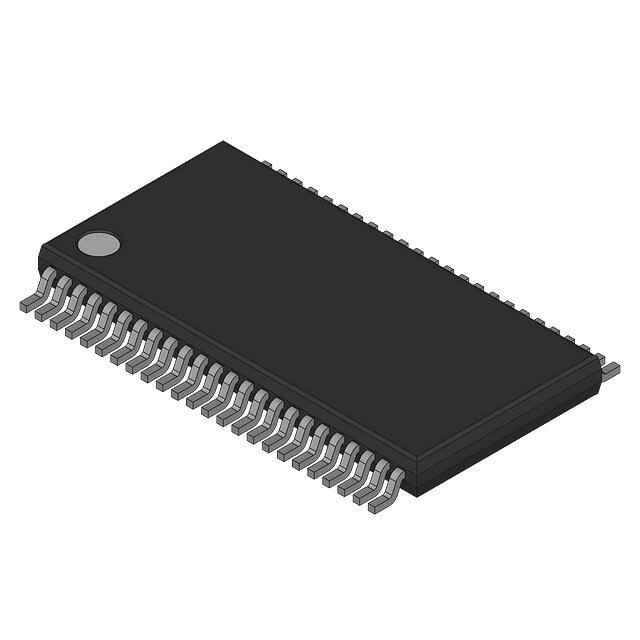
CLC5955
11-bit, 55MSPS Broadband Monolithic A/D Converter
April 2002
N
CLC5955
11-bit, 55MSPS Broadband Monolithic A/D Converter
General Description
Features
The CLC5955 is a monolithic 11-bit, 55MSPS analog-to-digital
converter. The device has been optimized for use in IF-sampled
digital receivers and other applications where high resolution,
high sampling rate, wide dynamic range, low power dissipation,
and compact size are required. The CLC5955 features differential
analog inputs, low jitter differential universal clock inputs, a low
distortion track-and-hold with 0-300MHz input bandwidth, a bandgap
voltage reference, data valid clock output, TTL compatible CMOS
(3.3V or 2.5V) programmable output logic, and a proprietary multistage quantizer. The CLC5955 is fabricated on the ABIC-V 0.8
micron BiCMOS process.
• 55MSPS
• Wide dynamic range
SFDR: 74dBc
SFDR w/dither: 85dBFS
SNR: 64dB
• IF sampling capability
• Input bandwidth = 0-300MHz
• Low power dissipation: 640mW
• Very small package: 48-pin TSSOP
• Single +5V supply
• Data valid clock output
• Programmable output levels:
3.3V or 2.5V
The CLC5955 features a 74dBc spurious free dynamic range
(SFDR) and a 64dB signal to noise ratio (SNR). The wideband
track-and-hold allows sampling of IF signals to greater than
250MHz. The part produces two-tone, dithered, SFDR of 83dBFS
at 75MHz input frequency. The differential analog input provides
excellent common mode rejection, while the differential universal
clock inputs minimize jitter. The 48-pin TSSOP package provides
an extremely small footprint for applications where space is a
critical consideration. The CLC5955 operates from a single +5V
power supply. Operation over the industrial temperature range of
-40°C to +85°C is guaranteed. National Semiconductor tests
each part to verify compliance with the guaranteed specifications.
Applications
•
•
•
•
•
•
•
•
Cellular base-stations
Digital communications
Infrared/CCD imaging
IF sampling
Electro-optics
Instrumentation
Medical imaging
High definition video
N
ME79TG
CLC5955
CLC5957
N MTD
ADC Block Diagram
Actual Size
First IF Receiver
DAV
Clock
In
IF
Input
AIn
Q
T/H
Q
Q
IF
Saw
CLC5955
11-bit
55MSPS
ADC
~
~
BPF
(150MHz
typ.)
Q
CLC5903
DVGA
(∆G = 42dB)
Noise
BPF
11
Dig.
Tuner/
Filter
AGC
20
DAV
3-bit (Gain Control)
11
Bit Align/Error Correct
Decimation/filter = 190/0.8
Output BW = 50M/190 X 0.8 = 210KHz
ADC
Out
Receiver SINAD vs. Input Amplitude
Single Tone Output Spectrum w/Dither
90
0
Output Level (dBFS)
SINAD dBc (BW = 216KHz)
Fin = 25.3MHZ
Fsample = 66MHz
-10
-20
-30
-40
-50
-60
-70
-80
-90
-100
60
50
40
30
20
10
0
0
4
8
12
16
20
24
Frequency (MHz)
© 2002 National Semiconductor Corporation
Printed in the U.S.A.
80
70
28
32
-125
-100
-75
-50
-25
0
Input (dBFS)
http://www.national.com
�CLC5955 Electrical Characteristics (Vcc= +5V, 55MSPS; unless specified) (Tmin = -40°C, Tmax = +85°C)
PARAMETERS
RESOLUTION
DIFF. INPUT VOLTAGE RANGE
MAXIMUM CONVERSION RATE
SNR
SFDR
CONDITIONS
TEMP
fin = 25MHz, Ain = -1dBFS
fin = 25MHz, Ain = -1dBFS
DYNAMIC PERFORMANCE
large-signal bandwidth
overvoltage recovery time
effective aperture delay (Ta)
aperture jitter
Ain = -3dBFS
Ain = 1.5FS (0.01%)
55
60
65
11
2.048
75
64
74
Bits
V
MSPS
dBFS
dBc
300
12
-0.41
0.3
MHz
ns
ns
ps(rms)
65
64
63
64
64
dBFS
dBFS
dBFS
dBFS
dBFS
74
74
72
69
65
dBc
dBc
dBc
dBc
dBc
+25°C
+25°C
68
58
dBFS
dBFS
+25°C
85
dBFS
+25°C
83
dBFS
Full
Full
Full
Full
+25°C
±0.8
±2.0
0
1.2
2.37
LSB
LSB
mV
%FS
V
Full
Full
Full
+25°C
+25°C
Full
Full
Full
Full
Full
ANALOG INPUTS
analog differential input voltage range
analog input resistance (single ended)
analog input resistance (differential)
analog input capacitance (single-ended)
57
59
-30
2.2
Full
Full
Full
Full
ENCODE INPUTS (Universal)
VIH
VIL
differential input swing
DIGITAL OUTPUTS
output voltage
OUTLEV = 1 (open)
OUTLEV = 0 (GND)
TYP
Full
Full
Full
Full
Full
fin = 5MHz, Ain = -1dBFS
fin = 5MHz, Ain = -1dBFS
logic LOW
logic HIGH
logic HIGH
POWER REQUIREMENTS
+5V supply current
Power dissipation
VCC power supply rejection ratio
UNITS
MIN
+25°C
+25°C
+25°C
+25°C
NOISE AND DISTORTION
signal-to-noise ratio (w/o 50 harmonics)
fin = 5.0MHz
Ain = -1dBFS
Ain = -1dBFS
fin = 25MHz
fin = 75MHz
Ain = -3dBFS
fin = 150MHz
Ain = -15dBFS
fin = 250MHz
Ain = -15dBFS
spurious-free dynamic range
fin = 5.0MHz
Ain = -1dBFS
Ain = -1dBFS
fin = 25MHz
fin = 75MHz
Ain = -3dBFS
fin = 150MHz
Ain = -15dBFS
fin = 250MHz
Ain = -15dBFS
intermodulation distortion
fin1 = 149.84MHz, fin2 = 149.7MHz Ain = -10dBFS
fin1 = 249.86MHz, fin2 = 249.69MHz Ain = -10dBFS
dithered performance
spurious-free dynamic range
Ain = -6dBFS
fin = 19MHz
intermodulation distortion
Ain = -12dBFS
fin1 = 74MHz, fin2 = 75MHz
DC ACCURACY AND PERFORMANCE
differential non-linearity
integral non-linearity
offset error
gain error
Vref
RATINGS
0
0.2
+25°C
+25°C
+25°C
3.2
2.4
Full
Full
+25°C
MAX
30
2.6
2.048
500
1000
2
+25°C
+25°C
+25°C
NOTES
2
1
1
1
1
1
1
1
1
Vpp
Ω
Ω
pF
5
V
V
V
3, 4
3, 4
3, 4
0.01
3.5
2.7
0.4
3.8
3.0
V
V
V
1
1
1
128
640
64
150
750
mA
mW
dB
1
1
Min/max ratings are based on product characterization and simulation. Individual parameters are tested as noted. Outgoing quality levels are
determined from tested parameters.
http://www.national.com
2
CLC5955
�CLC5955 Electrical Characteristics (Vcc= +5V, 55MSPS; unless specified) (Tmin = -40°C, Tmax = +85°C)
PARAMETERS
CONDITIONS
TIMING (CL =7pF DATA; 10pF DAV)
max conversion rate (ENCODE)
min conversion rate (ENCODE)
pulse width high (ENCODE)
50% threshold
pulse width low (ENCODE)
50% threshold
ENCODE falling edge to DATA not valid
ENCODE falling edge to DATA guaranteed valid
rising ENCODE to rising DAV delay 50% threshold
DATA setup time before rising DAV
DATA hold time after rising DAV
pipeline latency
SYMB
TEMP
Full
+25°C
Full
Full
Full
Full
Full
Full
Full
Full
tP
tM
tDNV
tDGV
tDAV
tS
tH
RATINGS
MIN
TYP
55
75
10
UNITS
9.1
9.1
8.3
8.3
tM-2.4
tP-1.6
NOTES
MAX
17.8
12.6
3.0
2
MSPS
MSPS
ns
ns
ns
ns
ns
ns
ns
clk cycle
1
3
3
3
3
3
3
3
Min/max ratings are based on product characterization and simulation. Individual parameters are tested as noted. Outgoing quality levels are
determined from tested parameters.
Notes
1) These parameters guaranteed by test.
2) Typical specifications are based on the mean test values of
deliverable converters from the first three diffusion lots.
3) Values guaranteed based on characterization and simulation.
4) See page 8, Figure 3 for ENCODE Inputs circuit.
Absolute Maximum Ratings
positive supply voltage (Vcc)
differential voltage between any two grounds
analog input voltage range
digital input voltage range
output short circuit duration (one-pin to ground)
junction temperature
storage temperature range
lead solder duration (+300°C)
ESD tolerance
human body model
machine model
Recommended Operating Conditions
-0.5V to +6V
200mV). The clock input is internally biased to VCC/2 with
a termination impedance of 2.5kΩ.
D0-D10
(Pins 31-34, 39-45) Digital data outputs are CMOS and
TTL compatible. D0 is the LSB and D10 is the MSB. MSB
is inverted. Output coding is two’s complement.
Current limited to source/sink 2.5mA typical.
DAV
(Pin 27) Data Valid Clock. Data is valid on rising edge.
Current limited to source/sink 5mA typical.
OUTLEV
(Pin 28) Output Logic 3.3V or 2.5V option.
Open = 3.3V, GND = 2.5V.
VCM
(Pin 21) Internal common mode voltage reference. Nominally
+2.4V. Can be used for the input common mode voltage.
This voltage is derived from an internal bandgap reference.
VCM should be buffered when driving any external load.
Failure to buffer this signal can cause errors in the internal
bias currents.
GND
(Pins 1-4, 8, 11, 12, 15, 19, 20, 23-26, 35, 36, 47, 48)
circuit ground.
+AVCC
(Pins 5-7, 16-18, 22,) +5V power supply for the analog
section. Bypass to ground with a 0.1µF capacitor.
+DVCC
(Pins 37, 38, 46) +5V power supply for the digital section.
Bypass to ground with a 0.1µF capacitor.
NC
(Pin 29) No connect. May be left open or grounded.
OGND
(Pin 30) Option ground. May be tied to GND or left floating.
7
http://www.national.com
�CLC5955 Applications
Analog Inputs and Bias
Figure 1 depicts the analog input and bias scheme. Each
of the differential analog inputs are internally biased to a
nominal voltage of 2.40 volts DC through a 500Ω resistor
to a low impedance buffer. This enables a simple
interface to a broadband RF transformer with a centertapped output winding that is decoupled to the analog
ground. If the application requires the inputs to be DC
coupled, the Vcm output can be used to establish the
proper common -mode input voltage for the ADC. The
Vcm voltage reference is generated from an internal
bandgap source that is very accurate and stable.
ENCODE Clock Inputs
The CLC5955’s differential input clock scheme is
compatible with all commonly used clock sources.
Although small differential and single-ended signals are
adequate, for best aperture jitter performance a low noise
differential clock with a high slew rate is preferred. As
depicted in Figure 3, both ENCODE clock inputs are
internally biased to VCC/2 though a pair of 5KΩ resistors.
The clock input buffer operates with any common-mode
voltage between the supply and ground.
VCCA
ADC
Bias Mirror
Ain
5kΩ
5kΩ
5kΩ
To T/H
and ADC
500µΑ
Ain
500Ω
ENC
500Ω
+
1.23V
Bandgap
Reference
5kΩ
ENC
2KΩ
2.4V
–
Vcm
BJT Current Mirror
GNDA
Figure 1: CLC5955 Bias Scheme
Figure 3: CLC5955 ENCODE Clock Inputs
The Vcm output may also be used to power down the
ADC. When the Vcm pin is pulled above 3.5V, the internal
bias mirror is disabled and the total current is reduced to
less than 10mA. Figure 2 depicts how this function can
be used. The diode is necessary to prevent the logic gate
from altering the ADC bias value.
The internal bias resistors simplify the clock interface to
another center-tapped transformer as depicted in Figure
4. A low phase noise, RF synthesizer of moderate amplitude (1 - 4Vpp) can drive the ADC through this interface.
ENC
~
ENC
CLC5955
CLC5955
5V CMOS
"1" = on
"0" = off
Vref
Figure 4: Transformer Coupled Clock Scheme
Figure 2: Power Shutdown Scheme
http://www.national.com
8
CLC5955
�Figures 5 shows the clock interface scheme for square
wave clock sources.
To ease user interface to subsequent digital circuitry, the
CLC5955 has a data valid clock output (DAV). In order to
match delays over IC processing variables, this digital
output also uses the same output buffer as the data bits.
The DAV clock output is simply a delayed version of the
ENCODE input clock. Since the ADC output data change
is slaved to the falling edge of the ENCODE clock, the
rising DAV clock edge occurs near the center of the data
valid window (or eye) regardless of the sampling frequency.
ENC
0.01µF
ENC
0.01µF
CLC5955
Minimum Conversion Rate
This ADC is optimized for high-speed operation. The
internal bipolar track and hold circuits will cause droop
errors at low sample rates. The point at which these
errors cause a degradation of performance is listed on
the specifications page as the minimum conversion rate.
If a lower sample rate is desired, the ADC should be
clocked at a higher rate, and the output data should be
decimated. For example, to obtain a 10MSPS output, the
ADC should be clocked at 20MHz, and every other output
sample should be used. No significant power savings
occurs at lower sample rates, since most of the power is
used in analog circuits rather than digital circuits.
Figure 5: TTL, 3V or 5V CMOS Clock Scheme
VCCD
.4Vref
+
-
Controlled Current
Output Buffer
CML to
CMOS
Digital
Signal
+
-
50Ω
Digital
Output
10kΩ
Output
Level
GNDD
Open = 3.3Vhi
GND = 2.5Vhi
Figure 6: CLC5955 Digital Outputs
Digital Outputs and Level Select
Figure 6 depicts the digital output buffer and bias used in
the CLC5955. Although each of the eleven output bits
uses a controlled current buffer to limit supply transients,
it is recommended that parasitic loading of the outputs is
minimized. Because these output transients are harmonically related to the analog input signal, excessive loading
will degrade ADC performance at some frequencies.
The logic high level is slaved to the internal 2.4 voltage
reference. The OUTLEV control pin selects either a 3.3V
or 2.5V logic high level. An internal pullup resistor selects
the 3.3 volt level as the default when the OUTLEV pin is
left open. Grounding the OUTLEV pin selects the 2.5V
logic high level.
CLC5955
9
http://www.national.com
�CLC5955
11-bit, 55MSPS Broadband Monolithic A/D Converter
This is to make the last page rotate correctly!
LIFE SUPPORT POLICY
NATIONAL’S PRODUCTS ARE NOT AUTHORIZED FOR USE AS CRITICAL COMPONENTS IN LIFE SUPPORT DEVICES OR SYSTEMS
WITHOUT THE EXPRESS WRITTEN APPROVAL OF THE PRESIDENT AND GENERAL COUNSEL OF NATIONAL SEMICONDUCTOR
CORPORATION. As used herein:
1. Life support devices or systems are devices or systems which, a) are intended for surgical implant into the body, or b) support or
sustain life, and whose failure to perform, when properly used in accordance with instructions for use provided in the labeling, can
be reasonably expected to result in a significant injury to the user.
2. A critical component is any component of a life support device or system whose failure to perform can be reasonably expected to
cause the failure of the life support device or system, or to affect its safety or effectiveness.
N
National Semiconductor
Corporation
National Semiconductor
Europe
Tel: 1(800) 272-9959
Fax: 1(800) 737-7018
E-mail: support@nsc.com
www.national.com
Fax: +49 (0) 1 80-530 85 86
E-mail: europe.support.nsc.com
Deutsch Tel: +49 (0) 1 69 9508 6208
English Tel: +44 (0) 870 24 0 2171
Francais Tel: +33 (0) 1 41 91 8790
National Semiconductor
Asia Pacific Customer
Response Group
Tel: 65-2544466
Fax: 65-2504466
E-mail: ap.support@nsc.com
National Semiconductor
Japan Ltd.
Tel: 81-3-5639-7560
Fax: 81-3-5639-7507
National does not assume any responsibility for use of any circuitry described, no circuit patent licenses are implied and National reserves the right at any time without notice to change said circuitry and specifications.
http://www.national.com
10
�