Product
Folder
Sample &
Buy
Support &
Community
Tools &
Software
Technical
Documents
DRV8842
SLVSAB8G – MAY 2010 – REVISED MARCH 2016
DRV8842 DC Motor Driver IC
1 Features
3 Description
•
•
•
The DRV8842 provides an integrated motor driver
solution for printers, scanners, and other automated
equipment applications. The device has one H-bridge
driver, and is intended to drive one DC motor, one
coil of a stepper motor, or other loads. The output
driver block consists of N-channel power MOSFETs
configured as an H-bridge. The DRV8842 can supply
up to 5-A peak or 3.5-A RMS output current (with
proper heatsinking at 24 V and 25°C).
1
•
•
•
•
•
•
Single H-Bridge Current-Control Motor Driver
8.2-V to 45-V Operating Supply Voltage Range
Five-Bit Winding Current Control Allows Up to 32
Current Levels
Low MOSFET RDS(on) Typical 0.2 Ω (HS + LS)
5-A Maximum Drive Current at 24 V, 25°C
Built-In 3.3-V Reference Output
Industry-Standard PWM Control Interface
Thermally Enhanced Surface Mount Package
Protection Features:
– Overcurrent Protection (OCP)
– Thermal Shutdown (TSD)
– VM Undervoltage Lockout (UVLO)
– Fault Condition Indication Pin (nFAULT)
Separate inputs to independently control each half of
the H-bridge are provided.
Internal shutdown functions are provided for
overcurrent protection, short-circuit protection,
undervoltage lockout, and overtemperature.
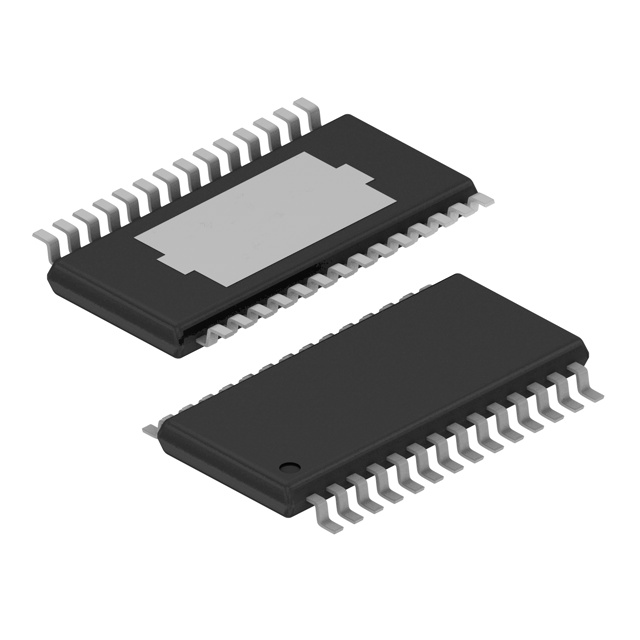
TheDRV8842 is available in a 28-pin HTSSOP
package with PowerPAD™ (Eco-friendly: RoHS & no
Sb/Br).
2 Applications
•
•
•
•
•
•
Device Information(1)
Printers
Scanners
Office Automation Machines
Gaming Machines
Factory Automation
Robotics
PART NUMBER
DRV8842
PACKAGE
HTSSOP (28)
BODY SIZE (NOM)
9.70 mm × 4.40 mm
(1) For all available packages, see the orderable addendum at
the end of the datasheet.
Simplified Schematic
8.2 to 45 V
IN1
DRV8842
Controller
IN2
Current Control
Decay Mode
nFAULT
+
H-Bridge
Motor Driver
5A
±
Current
Control
1
An IMPORTANT NOTICE at the end of this data sheet addresses availability, warranty, changes, use in safety-critical applications,
intellectual property matters and other important disclaimers. PRODUCTION DATA.
�DRV8842
SLVSAB8G – MAY 2010 – REVISED MARCH 2016
www.ti.com
Table of Contents
1
2
3
4
5
6
7
Features ..................................................................
Applications ...........................................................
Description .............................................................
Revision History.....................................................
Pin Configuration and Functions .........................
Specifications.........................................................
1
1
1
2
3
4
6.1
6.2
6.3
6.4
6.5
6.6
4
4
4
5
5
6
Absolute Maximum Ratings ......................................
ESD Ratings..............................................................
Recommended Operating Conditions.......................
Thermal Information ..................................................
Electrical Characteristics...........................................
Typical Characteristics ..............................................
Detailed Description .............................................. 7
7.1
7.2
7.3
7.4
Overview ................................................................... 7
Functional Block Diagram ......................................... 8
Feature Description................................................... 8
Device Functional Modes........................................ 12
8
Application and Implementation ........................ 13
8.1 Application Information............................................ 13
8.2 Typical Application ................................................. 13
9
Power Supply Recommendations...................... 16
9.1 Bulk Capacitance Sizing ......................................... 16
10 Layout................................................................... 17
10.1 Layout Guidelines ................................................. 17
10.2 Layout Example .................................................... 17
10.3 Thermal Considerations ........................................ 18
11 Device and Documentation Support ................. 19
11.1
11.2
11.3
11.4
11.5
Documentation Support ........................................
Community Resources..........................................
Trademarks ...........................................................
Electrostatic Discharge Caution ............................
Glossary ................................................................
19
19
19
19
19
12 Mechanical, Packaging, and Orderable
Information ........................................................... 19
4 Revision History
NOTE: Page numbers for previous revisions may differ from page numbers in the current version.
Changes from Revision F (December 2015) to Revision G
Page
•
Changed the typical RDS(on) value from 0.65 Ω to 0.2 Ω in the Features section .................................................................. 1
•
Changed ENBL and PHASE to IN1 and IN2 (respectively) in the Simplified Schematic, Functional Block Diagram,
Typical Application Schematic, and Example Layout images ............................................................................................... 1
Changes from Revision E (August 2013) to Revision F
Page
•
Added ESD Ratings table, Feature Description section, Device Functional Modes, Application and Implementation
section, Power Supply Recommendations section, Layout section, Device and Documentation Support section, and
Mechanical, Packaging, and Orderable Information section ................................................................................................. 1
•
Added Protection Features and related list items to Features ............................................................................................... 1
•
Changed the MIN value for ISENSEx pin voltage row from –0.3 V to –0.8 V........................................................................ 4
2
Submit Documentation Feedback
Copyright © 2010–2016, Texas Instruments Incorporated
Product Folder Links: DRV8842
�DRV8842
www.ti.com
SLVSAB8G – MAY 2010 – REVISED MARCH 2016
5 Pin Configuration and Functions
PWP Package
28-Pin HTSSOP
Top View
CP1
CP2
VCP
VM
OUT1
ISEN
OUT2
OUT2
ISEN
OUT1
VM
VREF
VREF
GND
1
2
3
28
4
25
24
27
26
5
6
23
GND
(PPAD)
7
8
22
21
9
20
10
19
11
18
12
17
13
16
14
15
GND
I4
I3
I2
I1
I0
NC
IN1
IN2
DECAY
nFAULT
nSLEEP
nRESET
V3P3OUT
Pin Functions
PIN
NAME
NO.
TYPE (1)
EXTERNAL COMPONENTS
OR CONNECTIONS
DESCRIPTION
POWER AND GROUND
GND
14, 28
—
Device ground
VM
4, 11
—
Bridge A power supply
Connect to motor supply (8.2 - 45 V). Both pins must be
connected to same supply.
V3P3OUT
15
O
3.3-V regulator output
Bypass to GND with a 0.47-μF, 6.3-V ceramic capacitor.
Can be used to supply VREF.
CP1
1
IO
Charge pump flying capacitor
CP2
2
IO
Charge pump flying capacitor
VCP
3
IO
High-side gate drive voltage
Connect a 0.1-μF 16-V ceramic capacitor and a 1-MΩ
resistor to VM.
IN1
21
I
Input 1
Logic input controls state of OUT1. Internal pulldown.
IN2
20
I
Input 2
Logic input controls state of OUT2. Internal pulldown.
I0
23
I
I1
24
I
I2
25
I
Current set inputs
Sets winding current as a percentage of full-scale. Internal
pulldown.
I3
26
I
I4
27
I
DECAY
19
I
Decay mode
Low = slow decay, open = mixed decay,
high = fast decay. Internal pulldown and pullup.
nRESET
16
I
Reset input
Active-low reset input initializes the logic and disables the Hbridge outputs. Internal pulldown.
nSLEEP
17
I
Sleep mode input
Logic high to enable device, logic low to enter low-power
sleep mode. Internal pulldown.
12,13
I
Current set reference input
Reference voltage for winding current set. Both pins must
be connected together on the PCB.
18
OD
Fault
Logic low when in fault condition (overtemperature,
overcurrent)
6, 9
IO
Bridge ground / Isense
Connect to current sense resistor. Both pins must be
connected together on the PCB.
Connect a 0.01-μF 50-V capacitor between CP1 and CP2.
CONTROL
VREF
STATUS
nFAULT
OUTPUT
ISEN
(1)
Directions: I = input, O = output, OZ = tri-state output, OD = open-drain output, IO = input/output
Submit Documentation Feedback
Copyright © 2010–2016, Texas Instruments Incorporated
Product Folder Links: DRV8842
3
�DRV8842
SLVSAB8G – MAY 2010 – REVISED MARCH 2016
www.ti.com
Pin Functions (continued)
PIN
TYPE (1)
EXTERNAL COMPONENTS
OR CONNECTIONS
DESCRIPTION
NAME
NO.
OUT1
5, 10
O
Bridge output 1
Connect to motor winding. Both pins must be connected
together on the PCB.
OUT2
7, 8
O
Bridge output 2
Connect to motor winding. Both pins must be connected
together on the PCB.
6 Specifications
6.1 Absolute Maximum Ratings
over operating free-air temperature range (unless otherwise noted) (1) (2)
VM
VREF
MIN
MAX
UNIT
Power supply voltage
–0.3
47
V
Digital pin voltage
–0.5
7
V
Input voltage
–0.3
4
V
ISENSEx pin voltage (3)
–0.8
0.8
V
Peak motor drive output current, t < 1 μS
Internally limited
Continuous motor drive output current (4)
0
Continuous total power dissipation
A
5
A
See Thermal Information
TJ
Operating virtual junction temperature
–40
150
°C
TA
Operating ambient temperature
–40
85
°C
Tstg
Storage temperature
–60
150
°C
(1)
(2)
(3)
(4)
Stresses beyond those listed under Absolute Maximum Ratings may cause permanent damage to the device. These are stress ratings
only, and functional operation of the device at these or any other conditions beyond those indicated under Recommended Operating
Conditions is not implied. Exposure to absolute–maximum–rated conditions for extended periods may affect device reliability.
All voltage values are with respect to network ground pin.
Transients of ±1 V for less than 25 ns are acceptable
Power dissipation and thermal limits must be observed.
6.2 ESD Ratings
VALUE
V(ESD)
(1)
(2)
Electrostatic discharge
Human body model (HBM), per ANSI/ESDA/JEDEC JS-001, all pins (1)
±2000
Charged device model (CDM), per JEDEC specification JESD22-C101, all
pins (2)
±500
UNIT
V
JEDEC document JEP155 states that 500-V HBM allows safe manufacturing with a standard ESD control process.
JEDEC document JEP157 states that 250-V CDM allows safe manufacturing with a standard ESD control process.
6.3 Recommended Operating Conditions
over operating free-air temperature range (unless otherwise noted)
MIN
(1)
MAX
UNIT
VM
Motor power supply voltage
8.2
45
VREF
VREF input voltage (2)
1
3.5
IV3P3
V3P3OUT load current
0
1
mA
fPWM
Externally applied PWM frequency
0
100
kHz
(1)
(2)
4
V
V
All VM pins must be connected to the same supply voltage.
Operational at VREF between 0 V and 1 V, but accuracy is degraded.
Submit Documentation Feedback
Copyright © 2010–2016, Texas Instruments Incorporated
Product Folder Links: DRV8842
�DRV8842
www.ti.com
SLVSAB8G – MAY 2010 – REVISED MARCH 2016
6.4 Thermal Information
DRV8842
THERMAL METRIC (1)
PWP (HTSSOP)
UNIT
28 PINS
RθJA
Junction-to-ambient thermal resistance
31.6
°C/W
RθJC(top)
Junction-to-case (top) thermal resistance
15.9
°C/W
RθJB
Junction-to-board thermal resistance
5.6
°C/W
ψJT
Junction-to-top characterization parameter
0.2
°C/W
ψJB
Junction-to-board characterization parameter
5.5
°C/W
RθJC(bot)
Junction-to-case (bottom) thermal resistance
1.4
°C/W
(1)
For more information about traditional and new thermal metrics, see the Semiconductor and IC Package Thermal Metrics application
report, SPRA953.
6.5 Electrical Characteristics
over operating free-air temperature range (unless otherwise noted)
PARAMETER
TEST CONDITIONS
MIN
TYP
MAX
UNIT
POWER SUPPLIES
IVM
VM operating supply current
VM = 24 V, fPWM < 50 kHz
5
8
mA
IVMQ
VM sleep mode supply current
VM = 24 V
10
20
μA
VUVLO
VM undervoltage lockout voltage
VM rising
7.8
8.2
V
3.3
3.4
V
0.6
0.7
V
5.25
V
V3P3OUT REGULATOR
V3P3
V3P3OUT voltage
IOUT = 0 mA to 1 mA
3.2
LOGIC-LEVEL INPUTS
VIL
Input low voltage
VIH
Input high voltage
2.2
VHYS
Input hysteresis
0.3
IIL
Input low current
VIN = 0
IIH
Input high current
VIN = 3.3 V
RPD
Internal pulldown resistance
0.45
–20
33
0.6
V
20
μA
100
μA
100
kΩ
nFAULT OUTPUT (OPEN-DRAIN OUTPUT)
VOL
Output low voltage
IO = 5 mA
IOH
Output high leakage current
VO = 3.3 V
0.5
V
1
μA
0.8
V
±40
μA
DECAY INPUT
VIL
Input low threshold voltage
For slow decay (brake) mode
0
VIH
Input high threshold voltage
For fast decay (coast) mode
2
IIN
Input current
RPU
Internal pullup resistance (to 3.3 V)
RPD
Internal pulldown resistance
V
130
kΩ
80
kΩ
H-BRIDGE FETS
RDS(ON)
HS FET on resistance
RDS(ON)
LS FET on resistance
IOFF
Off-state leakage current
VM = 24 V, IO = 1 A, TJ = 25°C
0.1
VM = 24 V, IO = 1 A, TJ = 85°C
0.13
VM = 24 V, IO = 1 A, TJ = 25°C
0.1
VM = 24 V, IO = 1 A, TJ = 85°C
0.13
–40
0.16
0.16
40
Ω
Ω
μA
MOTOR DRIVER
fPWM
Internal current control PWM frequency
tBLANK
Current sense blanking time
50
kHz
tR
Rise time
30
200
ns
tF
Fall time
30
200
ns
μs
3.75
Submit Documentation Feedback
Copyright © 2010–2016, Texas Instruments Incorporated
Product Folder Links: DRV8842
5
�DRV8842
SLVSAB8G – MAY 2010 – REVISED MARCH 2016
www.ti.com
Electrical Characteristics (continued)
over operating free-air temperature range (unless otherwise noted)
PARAMETER
TEST CONDITIONS
MIN
TYP
MAX
UNIT
160
180
°C
3
μA
660
685
mV
PROTECTION CIRCUITS
IOCP
Overcurrent protection trip level
tTSD
Thermal shutdown temperature
6
Die temperature
A
150
CURRENT CONTROL
IREF
VREF input current
VREF = 3.3 V
VTRIP
ISENSE trip voltage
VREF = 3.3 V, 100% current setting
Current trip accuracy
(relative to programmed value)
ΔITRIP
AISENSE
Current sense amplifier gain
–3
635
VREF = 3.3 V, 5% current setting
–25%
25%
VREF = 3.3 V, 10% to 34% current setting
–15%
15%
VREF = 3.3 V, 38% to 67% current setting
–10%
10%
VREF = 3.3 V, 71% to 100% current setting
–5%
5%
Reference only
5
V/V
6.6 Typical Characteristics
7
14
6.5
12
IVMQ (PA)
IVM (mA)
6
5.5
10
5
8
-40qC
25qC
85qC
125qC
4.5
4
10
15
20
25
30
V(VMx) (V)
35
40
45
-40qC
25qC
85qC
125qC
6
10
15
20
Figure 1. IVMx vs V(VMx)
35
40
D002
350
-40°C
25°C
85°C
125°C
325
RDS(ON) HS + LS (mŸ)
350
300
250
300
275
250
225
200
200
8V
24 V
45 V
175
150
150
8
13
18
23
28
33
V(VMx) (V)
38
43
±50
C001
±25
0
25
50
75
TA (ƒC)
100
125
C002
Figure 4. RDS(ON) vs Temperature
Figure 3. RDS(ON) vs V(VMx)
6
45
Figure 2. IVMxQ vs V(VMx)
400
RDS(ON) HS + LS (mŸ)
25
30
V(VMx) (V)
D001
Submit Documentation Feedback
Copyright © 2010–2016, Texas Instruments Incorporated
Product Folder Links: DRV8842
�DRV8842
www.ti.com
SLVSAB8G – MAY 2010 – REVISED MARCH 2016
7 Detailed Description
7.1 Overview
The DRV8842 device is an integrated motor driver solution for printers, scanners, and other automated
equipment applications. The device integrates a single NMOS H-bridge, charge pump, current sense, current
regulation, and device protection circuitry. The DRV8842 device can be powered from a single voltage supply
from 8.2 V to 45 V, and is capable of providing a continuous output current up to 5 A.
A simple PWM interface allows for easy interfacing to an external controller. A 5 bit current control scheme
allows for up to 32 discrete current levels. The current regulation method is adjustable between slow, mixed, and
fast decay.
The integrated protection circuits allow the device to monitor and protect against overcurrent, undervoltage, and
overtemperature faults, which are all reported through a fault indication pin (nFAULT). A low-power sleep mode
is integrated, which allows the system to lower power consumption when not driving the motor.
Submit Documentation Feedback
Copyright © 2010–2016, Texas Instruments Incorporated
Product Folder Links: DRV8842
7
�DRV8842
SLVSAB8G – MAY 2010 – REVISED MARCH 2016
www.ti.com
7.2 Functional Block Diagram
VM
3.3 V
LS Gate
Drive
CP1
V3P3OUT
V3P3OUT
Internal
VCC
Charge Pump
Low Side
Gate
Drive
CP2
HS Gate
Drive
VM
VCP
3.3 V
VM
VREF
VM
VM
+
VREF
Additional
Bulk
Capacitor
VM
IN1
OUT1
IN2
OUT2
I0
I1
+
I2
Stepper
Motor
BDC
Motor Driver
+
Control Logic
and Indexer
±
±
I3
I4
OUT2
DECAY
OUT2
nRESET
nSLEEP
ISEN
Thermal
Shut
Down
nFAULT
GND
PPAD
ISEN
GND
7.3 Feature Description
7.3.1 PWM Motor Driver
The DRV8842 contains one H-bridge motor driver with current-control PWM circuitry. A block diagram of the
motor control circuitry is shown in Figure 5.
8
Submit Documentation Feedback
Copyright © 2010–2016, Texas Instruments Incorporated
Product Folder Links: DRV8842
�DRV8842
www.ti.com
SLVSAB8G – MAY 2010 – REVISED MARCH 2016
Feature Description (continued)
VM
OCP
VM
VCP, VGD
OUT1
Predrive
DCM
OUT2
IN1
IN2
PWM
DECAY
OCP
ISEN
+
I[4:0]
A =5
DAC
5
VREF
Figure 5. Motor Control Circuitry
Note that there are multiple VM, ISEN, OUT, and VREF pins. All like-named pins must be connected together on
the PCB.
7.3.2 Bridge Control
The IN1 and IN2 input pins directly control the state of the OUT1 and OUT2 outputs. Either input can also be
used for PWM control of the load. Table 1 shows the logic.
Table 1. H-Bridge Logic
xIN1
xIN2
xOUT1
xOUT2
0
0
L
L
0
1
L
H
1
0
H
L
1
1
H
H
The control inputs have internal pulldown resistors of approximately 100 kΩ.
7.3.3 Current Regulation
The maximum current through the load is regulated by a fixed-frequency PWM current regulation, or current
chopping. When the H-bridge is enabled, current rises through the winding at a rate dependent on the DC
voltage and inductance of the winding. Once the current hits the current chopping threshold, the bridge disables
the current until the beginning of the next PWM cycle.
For DC motors, current regulation is used to limit the start-up and stall current of the motor. Speed control is
typically performed by providing an external PWM signal to the xIN1 or xIN2 input pins.
If the current regulation feature is not needed, it can be disabled by connecting the ISENSE pins directly to
ground and the VREF pins to V3P3.
The PWM chopping current is set by a comparator which compares the voltage across a current sense resistor
connected to the ISEN pin, multiplied by a factor of 5, with a reference voltage. The reference voltage is input
from the VREF pin, and is scaled by a 5-bit DAC that allows current settings of zero to 100% in an approximately
sinusoidal sequence.
Submit Documentation Feedback
Copyright © 2010–2016, Texas Instruments Incorporated
Product Folder Links: DRV8842
9
�DRV8842
SLVSAB8G – MAY 2010 – REVISED MARCH 2016
www.ti.com
The full-scale (100%) chopping current is calculated in Equation 1.
VREFX
ICHOP
5 u RISENSE
(1)
Example:
If a 0.25-Ω sense resistor is used and the VREFx pin is 2.5 V, the full-scale (100%) chopping current will be
2.5 V / (5 x 0.25 Ω) = 2 A.
Five input pins (I0 - I4) are used to scale the current in the bridge as a percentage of the full-scale current set by
the VREF input pin and sense resistance. The I0 - I4 pins have internal pulldown resistors of approximately
100 kΩ. The function of the pins is shown in Table 2.
Table 2. Pin Functions
10
I[4..0]
RELATIVE CURRENT
(% FULL-SCALE CHOPPING CURRENT)
0x00h
0%
0x01h
5%
0x02h
10%
0x03h
15%
0x04h
20%
0x05h
24%
0x06h
29%
0x07h
34%
0x08h
38%
0x09h
43%
0x0Ah
47%
0x0Bh
51%
0x0Ch
56%
0x0Dh
60%
0x0Eh
63%
0x0Fh
67%
0x10h
71%
0x11h
74%
0x12h
77%
0x13h
80%
0x14h
83%
0x15h
86%
0x16h
88%
0x17h
90%
0x18h
92%
0x19h
94%
0x1Ah
96%
0x1Bh
97%
0x1Ch
98%
0x1Dh
99%
0x1Eh
100%
0x1Fh
100%
Submit Documentation Feedback
Copyright © 2010–2016, Texas Instruments Incorporated
Product Folder Links: DRV8842
�DRV8842
www.ti.com
SLVSAB8G – MAY 2010 – REVISED MARCH 2016
7.3.4 Decay Mode
During PWM current chopping, the H-bridge is enabled to drive current through the motor winding until the PWM
current chopping threshold is reached. This is shown in Figure 6 as case 1. The current flow direction shown
indicates the state when the IN1 pin is high and the IN2 pin is low.
Once the chopping current threshold is reached, the H-bridge can operate in two different states, fast decay or
slow decay.
In fast decay mode, once the PWM chopping current level has been reached, the H-bridge reverses state to
allow winding current to flow in a reverse direction. As the winding current approaches zero, the bridge is
disabled to prevent any reverse current flow. Fast decay mode is shown in Figure 6 as case 2.
In slow decay mode, winding current is re-circulated by enabling both of the low-side FETs in the bridge. This is
shown in Figure 6 as case 3.
Figure 6. Decay Mode
The DRV8842 supports fast decay, slow decay and a mixed decay mode. Slow, fast, or mixed decay mode is
selected by the state of the DECAY pin - logic low selects slow decay, open selects mixed decay operation, and
logic high sets fast decay mode. The DECAY pin has both an internal pullup resistor of approximately 130 kΩ
and an internal pulldown resistor of approximately 80 kΩ. This sets the mixed decay mode if the pin is left open
or undriven.
Mixed decay mode begins as fast decay, but at a fixed period of time (75% of the PWM cycle) switches to slow
decay mode for the remainder of the fixed PWM period.
7.3.5 Blanking Time
After the current is enabled in an H-bridge, the voltage on the xISEN pin is ignored for a fixed period of time
before enabling the current sense circuitry. This blanking time is fixed at 3.75 μs. Note that the blanking time also
sets the minimum on time of the PWM.
Submit Documentation Feedback
Copyright © 2010–2016, Texas Instruments Incorporated
Product Folder Links: DRV8842
11
�DRV8842
SLVSAB8G – MAY 2010 – REVISED MARCH 2016
www.ti.com
7.3.6 Protection Circuits
The DRV8842 device is fully protected against undervoltage, overcurrent and overtemperature events.
7.3.6.1 Overcurrent Protection (OCP)
An analog current limit circuit on each FET limits the current through the FET by removing the gate drive. If this
analog current limit persists for longer than the OCP time, all FETs in the H-bridge will be disabled and the
nFAULT pin will be driven low. The device will remain disabled until either nRESET pin is applied, or VM is
removed and re-applied.
Overcurrent conditions on both high and low side devices; i.e., a short to ground, supply, or across the motor
winding will all result in an overcurrent shutdown. Overcurrent protection does not use the current sense circuitry
used for PWM current control, and is independent of the ISENSE resistor value or VREF voltage.
7.3.6.2 Thermal Shutdown (TSD)
If the die temperature exceeds safe limits, all FETs in the H-bridge will be disabled and the nFAULT pin will be
driven low. Once the die temperature has fallen to a safe level operation will automatically resume.
7.3.6.3 Undervoltage Lockout (UVLO)
If at any time the voltage on the VM pins falls below the undervoltage lockout threshold voltage, all circuitry in the
device will be disabled and internal logic will be reset. Operation will resume when VM rises above the UVLO
threshold.
7.4 Device Functional Modes
7.4.1 nRESET and nSLEEP Operation
The nRESET pin, when driven active low, resets the internal logic. It also disables the H-bridge driver. All inputs
are ignored while nRESET is active.
Driving nSLEEP low will put the device into a low power sleep state. In this state, the H-bridges are disabled, the
gate drive charge pump is stopped, the V3P3OUT regulator is disabled, and all internal clocks are stopped. In
this state all inputs are ignored until nSLEEP returns inactive high. When returning from sleep mode, some time
(approximately 1 ms) needs to pass before the motor driver becomes fully operational. Note that nRESET and
nSLEEP have internal pulldown resistors of approximately 100 kΩ. These signals need to be driven to logic high
for device operation.
12
Submit Documentation Feedback
Copyright © 2010–2016, Texas Instruments Incorporated
Product Folder Links: DRV8842
�DRV8842
www.ti.com
SLVSAB8G – MAY 2010 – REVISED MARCH 2016
8 Application and Implementation
NOTE
Information in the following applications sections is not part of the TI component
specification, and TI does not warrant its accuracy or completeness. TI’s customers are
responsible for determining suitability of components for their purposes. Customers should
validate and test their design implementation to confirm system functionality.
8.1 Application Information
The DRV8842 device is used in brushed motor or stepper motor control. The onboard current regulation allows
for limiting the motor current through simple pin configurations.
8.2 Typical Application
1
CP1
DRV8842
GND
28
0.01 µF
27
2
CP2
I4
VCP
I3
VM
I2
OUT1
I1
ISEN
I0
VM
26
3
0.1 µF
0.1 µF
1M
4
5
25
24
100 m
6
7
BDC
8
9
10
OUT2
NC
OUT2
IN1
ISEN
IN2
OUT1
DECAY
VM
nFAULT
VREF
nSLEEP
VREF
nRESET
23
22
21
20
19
VM
11
100 µF
18
0.1 µF
12
17
14
GND
PPAD
10 NŸ
13
V3P3OUT
16
15
0.47 µF
R1
R2
Figure 7. Typical Application Schematic
Submit Documentation Feedback
Copyright © 2010–2016, Texas Instruments Incorporated
Product Folder Links: DRV8842
13
�DRV8842
SLVSAB8G – MAY 2010 – REVISED MARCH 2016
www.ti.com
Typical Application (continued)
8.2.1 Design Requirements
Table 3 shows the design parameters for this application.
Table 3. Design Parameters
DESIGN PARAMETER
REFERENCE
EXAMPLE VALUE
Supply Voltage
VM
24 V
Motor Winding
Resistance
RM
3.9 Ω
Motor Winding
Inductance
LM
2.9 mH
ITRIP
1.5 A
Sense Resistor
RSENSE
100 mΩ
VREF Voltage
VREF
0.75 V
Target Chopping
Current
8.2.2 Detailed Design Procedure
8.2.2.1 Current Regulation
The maximum current (ITRIP) is set by the Ix pins, the VREF analog voltage, and the sense resistor value
(RSENSE). When starting a brushed DC motor, a large inrush current may occur because there is no back-EMF
and high detent torque. Current regulation will act to limit this inrush current and prevent high current on start-up.
ITRIP = VREF / (5 × RSENSE)
(2)
Example: If the desired chopping currents is 1.5 A:
• Set RSENSE = 100 mΩ
• VREF would have to be 0.75 V
• Create a resistor divider network from V3P3OUT (3.3 V) to set VREF = 0.75 V
• Set R2 = 10 kΩ and set R1 = kΩ
8.2.2.2 Sense Resistor
For optimal performance, it is important for the sense resistor to be:
• Surface-mount
• Low inductance
• Rated for high enough power
• Placed closely to the motor driver
The power dissipated by the sense resistor equals Irms2 × R. For example, if the RMS motor current is 1.5 A and
a 200-mΩ sense resistor is used, the resistor will dissipate 1.5 A2 × 0.2 Ω = 0.3 W. The power quickly increases
with greater current levels.
Resistors typically have a rated power within some ambient temperature range, along with a derated power curve
for high ambient temperatures. When a PCB is shared with other components generating heat, margin should be
added. It is always best to measure the actual sense resistor temperature in a final system, along with the power
MOSFETs, as those are often the hottest components.
Because power resistors are larger and more expensive than standard resistors, it is common practice to use
multiple standard resistors in parallel, between the sense node and ground. This distributes the current and heat
dissipation.
14
Submit Documentation Feedback
Copyright © 2010–2016, Texas Instruments Incorporated
Product Folder Links: DRV8842
�DRV8842
www.ti.com
SLVSAB8G – MAY 2010 – REVISED MARCH 2016
8.2.3 Application Curves
Figure 8. DRV8842 Current Regulation
Figure 9. DRV8842 Direction Change
Submit Documentation Feedback
Copyright © 2010–2016, Texas Instruments Incorporated
Product Folder Links: DRV8842
15
�DRV8842
SLVSAB8G – MAY 2010 – REVISED MARCH 2016
www.ti.com
9 Power Supply Recommendations
The DRV8842 device is designed to operate from an input voltage supply (VM) range from 8.2 V to 45 V. The
device has an absolute maximum rating of 47 V. A 0.1-µF ceramic capacitor rated for VM must be placed at
each VM pin as close to the DRV8842 as possible. In addition, a bulk capacitor must be included on VM.
9.1 Bulk Capacitance Sizing
Having appropriate local bulk capacitance is an important factor in motor drive system design. It is generally
beneficial to have more bulk capacitance, while the disadvantages are increased cost and physical size.
The amount of local capacitance needed depends on a variety of factors, including:
• The highest current required by the motor system.
• The power supply’s capacitance and ability to source current.
• The amount of parasitic inductance between the power supply and motor system.
• The acceptable voltage ripple.
• The type of motor used (Brushed DC, Brushless DC, Stepper).
• The motor braking method.
The inductance between the power supply and motor drive system will limit the rate current can change from the
power supply. If the local bulk capacitance is too small, the system will respond to excessive current demands or
dumps from the motor with a change in voltage. When adequate bulk capacitance is used, the motor voltage
remains stable and high current can be quickly supplied.
The data sheet generally provides a recommended value, but system-level testing is required to determine the
appropriate sized bulk capacitor.
The voltage rating for bulk capacitors should be greater than the operating voltage, to provide margin for cases
when the motor transfers energy to the supply.
Power Supply
Parasitic Wire
Inductance
Motor Drive System
VM
+
±
+
Motor
Driver
GND
Local
Bulk Capacitor
IC Bypass
Capacitor
Figure 10. Setup of Motor Drive System With External Power Supply
16
Submit Documentation Feedback
Copyright © 2010–2016, Texas Instruments Incorporated
Product Folder Links: DRV8842
�DRV8842
www.ti.com
SLVSAB8G – MAY 2010 – REVISED MARCH 2016
10 Layout
10.1 Layout Guidelines
Each VM terminal must be bypassed to GND using a low-ESR ceramic bypass capacitors with recommended
values of 0.1 μF rated for VM. These capacitors should be placed as close to the VM pins as possible with a
thick trace or ground plane connection to the device GND pin.
The VM pin must be bypassed to ground using a bulk capacitor rated for VM. This component may be an
electrolytic.
A low-ESR ceramic capacitor must be placed in between the CP1 and CP2 pins. TI recommends a value of
0.1 μF rated for VM . Place this component as close to the pins as possible.
A low-ESR ceramic capacitor must be placed in between the VM and VCP pins. TI recommends a value of
0.47 μF rated for 16 V. Place this component as close to the pins as possible. In addition, place a 1 MΩ between
VM and VCP.
Bypass V3P3OUT to ground with a ceramic capacitor rated 6.3 V. Place this bypassing capacitor as close to the
pin as possible.
The current sense resistor should be placed as close as possible to the device pins to minimize trace inductance
between the pin and resistor.
10.2 Layout Example
+
0.1 µF
CP1
GND
0.1 µF
CP2
I4
VCP
I3
1 MŸ
RISEN
VM
I2
OUT1
I1
ISEN
I0
0.47 µF
0.1 µF
OUT2
NC
OUT2
IN1
ISEN
IN2
OUT1
DECAY
VM
nFAULT
VREF
nSLEEP
VREF
nRESET
GND
V3P3OUT
0.1 µF
Figure 11. Example Layout
Submit Documentation Feedback
Copyright © 2010–2016, Texas Instruments Incorporated
Product Folder Links: DRV8842
17
�DRV8842
SLVSAB8G – MAY 2010 – REVISED MARCH 2016
www.ti.com
10.3 Thermal Considerations
The DRV8842 has thermal shutdown (TSD) as described above. If the die temperature exceeds approximately
150°C, the device will be disabled until the temperature drops to a safe level.
Any tendency of the device to enter TSD is an indication of either excessive power dissipation, insufficient
heatsinking, or too high an ambient temperature.
10.3.1 Power Dissipation
Average power dissipation in the DRV8842 when running a DC motor can be roughly estimated by: Equation 3.
P
2 u RDS(ON) u IOUT
2
(3)
where P is the power dissipation of one H-bridge, RDS(ON) is the resistance of each FET, and IOUT is the RMS
output current being applied to each winding. IOUT is equal to the average current drawn by the DC motor. Note
that at start-up and fault conditions this current is much higher than normal running current; these peak currents
and their duration also need to be taken into consideration. The factor of 2 comes from the fact that at any
instant two FETs are conducting winding current (one high-side and one low-side).
The maximum amount of power that can be dissipated in the device is dependent on ambient temperature and
heatsinking.
Note that RDS(ON) increases with temperature, so as the device heats, the power dissipation increases. This must
be taken into consideration when sizing the heatsink.
10.3.2 Heatsinking
The PowerPAD™ package uses an exposed pad to remove heat from the device. For proper operation, this pad
must be thermally connected to copper on the PCB to dissipate heat. On a multi-layer PCB with a ground plane,
this can be accomplished by adding a number of vias to connect the thermal pad to the ground plane. On PCBs
without internal planes, copper area can be added on either side of the PCB to dissipate heat. If the copper area
is on the opposite side of the PCB from the device, thermal vias are used to transfer the heat between top and
bottom layers.
For details about how to design the PCB, see the TI application report, PowerPAD™ Thermally Enhanced
Package (SLMA002), and the TI application brief, PowerPAD™ Made Easy (SLMA004), available at www.ti.com.
In general, the more copper area that can be provided, the more power can be dissipated.
18
Submit Documentation Feedback
Copyright © 2010–2016, Texas Instruments Incorporated
Product Folder Links: DRV8842
�DRV8842
www.ti.com
SLVSAB8G – MAY 2010 – REVISED MARCH 2016
11 Device and Documentation Support
11.1 Documentation Support
11.1.1 Related Documentation
For related documentation see the following:
• Calculating Motor Driver Power Dissipation, SLVA504
• CPG005_DRV88xx Evaluation Modules, SLVU410
• PowerPAD™ Thermally Enhanced Package, SLMA002
• PowerPAD™ Made Easy, SLMA004
• Solenoid Driving With DRV8841/42, SLVA460
• Various Reference Voltage Driving Techniques for Motor Drive Current Regulation, SLOA170
• Understanding Motor Driver Current Ratings, SLVA505
11.2 Community Resources
The following links connect to TI community resources. Linked contents are provided "AS IS" by the respective
contributors. They do not constitute TI specifications and do not necessarily reflect TI's views; see TI's Terms of
Use.
TI E2E™ Online Community TI's Engineer-to-Engineer (E2E) Community. Created to foster collaboration
among engineers. At e2e.ti.com, you can ask questions, share knowledge, explore ideas and help
solve problems with fellow engineers.
Design Support TI's Design Support Quickly find helpful E2E forums along with design support tools and
contact information for technical support.
11.3 Trademarks
PowerPAD, E2E are trademarks of Texas Instruments.
All other trademarks are the property of their respective owners.
11.4 Electrostatic Discharge Caution
These devices have limited built-in ESD protection. The leads should be shorted together or the device placed in conductive foam
during storage or handling to prevent electrostatic damage to the MOS gates.
11.5 Glossary
SLYZ022 — TI Glossary.
This glossary lists and explains terms, acronyms, and definitions.
12 Mechanical, Packaging, and Orderable Information
The following pages include mechanical, packaging, and orderable information. This information is the most
current data available for the designated devices. This data is subject to change without notice and revision of
this document. For browser-based versions of this data sheet, refer to the left-hand navigation.
Submit Documentation Feedback
Copyright © 2010–2016, Texas Instruments Incorporated
Product Folder Links: DRV8842
19
�PACKAGE OPTION ADDENDUM
www.ti.com
16-Mar-2016
PACKAGING INFORMATION
Orderable Device
Status
(1)
Package Type Package Pins Package
Drawing
Qty
Eco Plan
Lead/Ball Finish
MSL Peak Temp
(2)
(6)
(3)
Op Temp (°C)
Device Marking
(4/5)
DRV8842PWP
ACTIVE
HTSSOP
PWP
28
50
Green (RoHS
& no Sb/Br)
CU NIPDAU
Level-3-260C-168 HR
-40 to 85
DRV8842
DRV8842PWPR
ACTIVE
HTSSOP
PWP
28
2000
Green (RoHS
& no Sb/Br)
CU NIPDAU
Level-3-260C-168 HR
-40 to 85
DRV8842
(1)
The marketing status values are defined as follows:
ACTIVE: Product device recommended for new designs.
LIFEBUY: TI has announced that the device will be discontinued, and a lifetime-buy period is in effect.
NRND: Not recommended for new designs. Device is in production to support existing customers, but TI does not recommend using this part in a new design.
PREVIEW: Device has been announced but is not in production. Samples may or may not be available.
OBSOLETE: TI has discontinued the production of the device.
(2)
Eco Plan - The planned eco-friendly classification: Pb-Free (RoHS), Pb-Free (RoHS Exempt), or Green (RoHS & no Sb/Br) - please check http://www.ti.com/productcontent for the latest availability
information and additional product content details.
TBD: The Pb-Free/Green conversion plan has not been defined.
Pb-Free (RoHS): TI's terms "Lead-Free" or "Pb-Free" mean semiconductor products that are compatible with the current RoHS requirements for all 6 substances, including the requirement that
lead not exceed 0.1% by weight in homogeneous materials. Where designed to be soldered at high temperatures, TI Pb-Free products are suitable for use in specified lead-free processes.
Pb-Free (RoHS Exempt): This component has a RoHS exemption for either 1) lead-based flip-chip solder bumps used between the die and package, or 2) lead-based die adhesive used between
the die and leadframe. The component is otherwise considered Pb-Free (RoHS compatible) as defined above.
Green (RoHS & no Sb/Br): TI defines "Green" to mean Pb-Free (RoHS compatible), and free of Bromine (Br) and Antimony (Sb) based flame retardants (Br or Sb do not exceed 0.1% by weight
in homogeneous material)
(3)
MSL, Peak Temp. - The Moisture Sensitivity Level rating according to the JEDEC industry standard classifications, and peak solder temperature.
(4)
There may be additional marking, which relates to the logo, the lot trace code information, or the environmental category on the device.
(5)
Multiple Device Markings will be inside parentheses. Only one Device Marking contained in parentheses and separated by a "~" will appear on a device. If a line is indented then it is a continuation
of the previous line and the two combined represent the entire Device Marking for that device.
(6)
Lead/Ball Finish - Orderable Devices may have multiple material finish options. Finish options are separated by a vertical ruled line. Lead/Ball Finish values may wrap to two lines if the finish
value exceeds the maximum column width.
Important Information and Disclaimer:The information provided on this page represents TI's knowledge and belief as of the date that it is provided. TI bases its knowledge and belief on information
provided by third parties, and makes no representation or warranty as to the accuracy of such information. Efforts are underway to better integrate information from third parties. TI has taken and
continues to take reasonable steps to provide representative and accurate information but may not have conducted destructive testing or chemical analysis on incoming materials and chemicals.
TI and TI suppliers consider certain information to be proprietary, and thus CAS numbers and other limited information may not be available for release.
Addendum-Page 1
Samples
�PACKAGE OPTION ADDENDUM
www.ti.com
16-Mar-2016
In no event shall TI's liability arising out of such information exceed the total purchase price of the TI part(s) at issue in this document sold by TI to Customer on an annual basis.
OTHER QUALIFIED VERSIONS OF DRV8842 :
• Enhanced Product: DRV8842-EP
NOTE: Qualified Version Definitions:
• Enhanced Product - Supports Defense, Aerospace and Medical Applications
Addendum-Page 2
�PACKAGE MATERIALS INFORMATION
www.ti.com
26-Feb-2019
TAPE AND REEL INFORMATION
*All dimensions are nominal
Device
DRV8842PWPR
Package Package Pins
Type Drawing
SPQ
HTSSOP
2000
PWP
28
Reel
Reel
A0
Diameter Width (mm)
(mm) W1 (mm)
330.0
16.4
Pack Materials-Page 1
6.9
B0
(mm)
K0
(mm)
P1
(mm)
W
Pin1
(mm) Quadrant
10.2
1.8
12.0
16.0
Q1
�PACKAGE MATERIALS INFORMATION
www.ti.com
26-Feb-2019
*All dimensions are nominal
Device
Package Type
Package Drawing
Pins
SPQ
Length (mm)
Width (mm)
Height (mm)
DRV8842PWPR
HTSSOP
PWP
28
2000
350.0
350.0
43.0
Pack Materials-Page 2
�GENERIC PACKAGE VIEW
PWP 28
TM
PowerPAD TSSOP - 1.2 mm max height
SMALL OUTLINE PACKAGE
4.4 x 9.7, 0.65 mm pitch
Images above are just a representation of the package family, actual package may vary.
Refer to the product data sheet for package details.
4224765/A
www.ti.com
�PACKAGE OUTLINE
PWP0028C
TM
PowerPAD TSSOP - 1.2 mm max height
SCALE 2.000
SMALL OUTLINE PACKAGE
C
6.6
TYP
6.2
A
0.1 C
PIN 1 INDEX
AREA
SEATING
PLANE
26X 0.65
28
1
2X
9.8
9.6
NOTE 3
8.45
14
15
B
0.30
0.19
0.1
C A B
28X
4.5
4.3
SEE DETAIL A
(0.15) TYP
2X 0.95 MAX
NOTE 5
14
15
2X 0.2 MAX
NOTE 5
0.25
GAGE PLANE
1.2 MAX
5.18
4.48
THERMAL
PAD
0 -8
0.15
0.05
0.75
0.50
DETAIL A
A 20
TYPICAL
28
1
3.1
2.4
4223582/A 03/2017
PowerPAD is a trademark of Texas Instruments.
NOTES:
1. All linear dimensions are in millimeters. Any dimensions in parenthesis are for reference only. Dimensioning and tolerancing
per ASME Y14.5M.
2. This drawing is subject to change without notice.
3. This dimension does not include mold flash, protrusions, or gate burrs. Mold flash, protrusions, or gate burrs shall not
exceed 0.15 mm per side.
4. Reference JEDEC registration MO-153.
5. Features may differ or may not be present.
www.ti.com
�EXAMPLE BOARD LAYOUT
PWP0028C
TM
PowerPAD TSSOP - 1.2 mm max height
SMALL OUTLINE PACKAGE
(3.4)
NOTE 9
(3.1)
METAL COVERED
BY SOLDER MASK
SYMM
28X (1.5)
1
28X (0.45)
28
SEE DETAILS
(R0.05) TYP
(5.18)
26X (0.65)
(0.6)
SYMM
(9.7)
NOTE 9
SOLDER MASK
DEFINED PAD
(1.2) TYP
( 0.2) TYP
VIA
15
14
(1.2) TYP
(5.8)
LAND PATTERN EXAMPLE
EXPOSED METAL SHOWN
SCALE: 8X
SOLDER MASK
OPENING
METAL UNDER
SOLDER MASK
METAL
SOLDER MASK
OPENING
EXPOSED METAL
EXPOSED METAL
0.05 MAX
ALL AROUND
NON-SOLDER MASK
DEFINED
(PREFERRED)
0.05 MIN
ALL AROUND
SOLDER MASK
DEFINED
SOLDER MASK DETAILS
15.000
4223582/A 03/2017
NOTES: (continued)
6. Publication IPC-7351 may have alternate designs.
7. Solder mask tolerances between and around signal pads can vary based on board fabrication site.
8. This package is designed to be soldered to a thermal pad on the board. For more information, see Texas Instruments literature
numbers SLMA002 (www.ti.com/lit/slma002) and SLMA004 (www.ti.com/lit/slma004).
9. Size of metal pad may vary due to creepage requirement.
10. Vias are optional depending on application, refer to device data sheet. It is recommended that vias under paste be filled, plugged
or tented.
www.ti.com
�EXAMPLE STENCIL DESIGN
PWP0028C
TM
PowerPAD TSSOP - 1.2 mm max height
SMALL OUTLINE PACKAGE
(3.1)
BASED ON
0.125 THICK
STENCIL
28X (1.5)
METAL COVERED
BY SOLDER MASK
1
28
28X (0.45)
(R0.05) TYP
26X (0.65)
(5.18)
BASED ON
0.125 THICK
STENCIL
SYMM
15
14
SYMM
(5.8)
SEE TABLE FOR
DIFFERENT OPENINGS
FOR OTHER STENCIL
THICKNESSES
SOLDER PASTE EXAMPLE
BASED ON 0.125 mm THICK STENCIL
SCALE: 8X
STENCIL
THICKNESS
SOLDER STENCIL
OPENING
0.1
0.125
0.15
0.175
3.47 X 5.79
3.10 X 5.18 (SHOWN)
2.83 X 4.73
2.62 X 4.38
4223582/A 03/2017
NOTES: (continued)
11. Laser cutting apertures with trapezoidal walls and rounded corners may offer better paste release. IPC-7525 may have alternate
design recommendations.
12. Board assembly site may have different recommendations for stencil design.
www.ti.com
�IMPORTANT NOTICE AND DISCLAIMER
TI PROVIDES TECHNICAL AND RELIABILITY DATA (INCLUDING DATASHEETS), DESIGN RESOURCES (INCLUDING REFERENCE
DESIGNS), APPLICATION OR OTHER DESIGN ADVICE, WEB TOOLS, SAFETY INFORMATION, AND OTHER RESOURCES “AS IS”
AND WITH ALL FAULTS, AND DISCLAIMS ALL WARRANTIES, EXPRESS AND IMPLIED, INCLUDING WITHOUT LIMITATION ANY
IMPLIED WARRANTIES OF MERCHANTABILITY, FITNESS FOR A PARTICULAR PURPOSE OR NON-INFRINGEMENT OF THIRD
PARTY INTELLECTUAL PROPERTY RIGHTS.
These resources are intended for skilled developers designing with TI products. You are solely responsible for (1) selecting the appropriate
TI products for your application, (2) designing, validating and testing your application, and (3) ensuring your application meets applicable
standards, and any other safety, security, or other requirements. These resources are subject to change without notice. TI grants you
permission to use these resources only for development of an application that uses the TI products described in the resource. Other
reproduction and display of these resources is prohibited. No license is granted to any other TI intellectual property right or to any third
party intellectual property right. TI disclaims responsibility for, and you will fully indemnify TI and its representatives against, any claims,
damages, costs, losses, and liabilities arising out of your use of these resources.
TI’s products are provided subject to TI’s Terms of Sale (www.ti.com/legal/termsofsale.html) or other applicable terms available either on
ti.com or provided in conjunction with such TI products. TI’s provision of these resources does not expand or otherwise alter TI’s applicable
warranties or warranty disclaimers for TI products.
Mailing Address: Texas Instruments, Post Office Box 655303, Dallas, Texas 75265
Copyright © 2019, Texas Instruments Incorporated
�