DS36277
www.ti.com
SNLS086E – JULY 1998 – REVISED APRIL 2013
Dominant Mode Multipoint Transceiver
Check for Samples: DS36277
FEATURES
DESCRIPTION
•
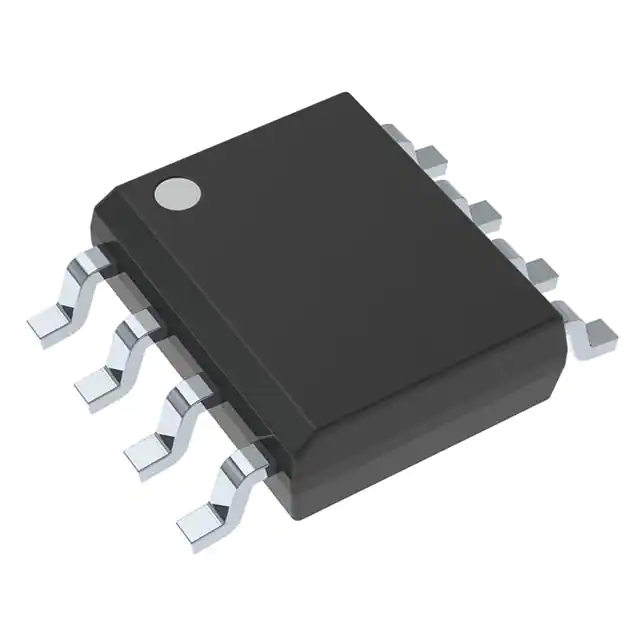
The DS36277 Dominant Mode Multipoint Transceiver
is designed for use on bi-directional differential
busses. It is optimal for use on Interfaces that utilize
Society of Automotive Engineers (SAE) J1708
Electrical Standard.
1
2
•
•
•
•
•
FAILSAFE Receiver, RO = HIGH for:
– OPEN Inputs
– Terminated Inputs
– SHORTED Inputs
Optimal for Use in SAE J1708 Interfaces
Compatible with Popular Interface Standards:
– TIA/EIA-485 and TIA/EIA-422-A
– CCITT Recommendation V.11
Bi-Directional Transceiver
– Designed for Multipoint Transmission
Wide Bus Common Mode Range
– (−7V to +12V)
Available in PDIP and SOIC Packages
The device is similar to standard TIA/EIA-485
transceivers, but differs in enabling scheme. The
Driver's Input is normally externally tied LOW, thus
providing only two states: Active (LOW), or Disabled
(OFF). When the driver is active, the dominant mode
is LOW, conversely, when the driver is disabled, the
bus is pulled HIGH by external bias resistors.
The receiver provides a FAILSAFE feature that
ensures a known output state when the Interface is in
the following conditions: Floating Line, Idle Line (no
active drivers), and Line Fault Conditions (open or
short). The receiver output is HIGH for the following
conditions: Open Inputs, Terminated Inputs (50Ω), or
Shorted Inputs. FAILSAFE is a highly desirable
feature when the transceivers are used with
Asynchronous Controllers such as UARTs.
Connection and Logic Diagram
See Package Number D (R-PDSO-G8)
or
P (R-PDIP-T8)
1
2
Please be aware that an important notice concerning availability, standard warranty, and use in critical applications of
Texas Instruments semiconductor products and disclaimers thereto appears at the end of this data sheet.
All trademarks are the property of their respective owners.
PRODUCTION DATA information is current as of publication date.
Products conform to specifications per the terms of the Texas
Instruments standard warranty. Production processing does not
necessarily include testing of all parameters.
Copyright © 1998–2013, Texas Instruments Incorporated
�DS36277
SNLS086E – JULY 1998 – REVISED APRIL 2013
www.ti.com
Truth Table
Driver
Inputs
Outputs
DE
DI
DO/RI
DO /RI
L
L
L
H
L
H
H
L
H
X
Z
Z
Receiver
Inputs
Output
RE
DO/RI–DO /RI
RO
L
≥ 0 mV
H
L
≤ −500 mV
L
L
SHORTED
H
L
OPEN
H
H
X
Z
These devices have limited built-in ESD protection. The leads should be shorted together or the device placed in conductive foam
during storage or handling to prevent electrostatic damage to the MOS gates.
Absolute Maximum Ratings (1) (2)
Supply Voltage (VCC)
Input Voltage (DE , RE , and DI)
Unit
7
V
5.5
V
−10V to +15
V
5.5
V
P Package
(derate 9.3 mW/°C above +25°C)
1168
mW
D Package
(derate 5.8 mW/°C above +25°C)
726
mW
−65°C to +150
°C
Driver Output Voltage/Receiver Input Voltage
Receiver Output Voltage (RO)
Maximum Package Power Dissipation @ +25°C
Value
Storage Temperature Range
Lead Temperature (Soldering 4 sec.)
260
°C
ESD Rating (HBM, 1.5 kΩ, 100 pF)
7.0
kV
(1)
(2)
“Absolute Maximum Ratings” are those values beyond which the safety of the device cannot be specified. They are not meant to imply
that the devices should be operated at these limits. The tables of “Electrical Characteristics” specify conditions for device operation.
If Military/Aerospace specified devices are required, please contact the Texas Instruments Sales Office/ Distributors for availability and
specifications.
Recommended Operating Conditions
Supply Voltage, VCC
Bus Voltage
Operating Temperature (TA) DS36277T
2
Submit Documentation Feedback
Min
Max
Units
4.75
5.25
V
−7
+12
V
−40
+85
°C
Copyright © 1998–2013, Texas Instruments Incorporated
Product Folder Links: DS36277
�DS36277
www.ti.com
SNLS086E – JULY 1998 – REVISED APRIL 2013
Electrical Characteristics (1) (2)
Over recommended Supply Voltage and Operating Temperature ranges, unless otherwise specified.
Symbol
Parameter
Conditions
Min
Typ
Max
Units
1.5
3.6
DRIVER CHARACTERISTICS
VOD
Differential Output Voltage
IO = 0 mA (No Load)
VoDO
Output Voltage
IO = 0 mA (Output to GND)
VoDO
Output Voltage
VT1
Differential Output Voltage
(Termination Load)
RL = 54Ω (485)
ΔVT1
Balance of VT1
|VT1 − VT1 |
RL = 54Ω
VOS
Driver Common Mode
Output Voltage
RL = 54Ω
ΔVOS
(Figure 1)
RL = 100Ω (422)
See (3)
VOH
Output Voltage High
IOH = −22 mA
VOL
Output Voltage Low
IOL = +22 mA
IOSD
Driver Short-Circuit
Output Current
VO = +12V
V
0
6
V
1.3
2.2
5.0
V
1.7
2.6
5.0
V
0.2
V
−0.2
(Figure 1)
RL = 100Ω
RL = 54Ω
V
6
−0.2
RL = 100Ω
Balance of VOS
|VOS − VOS |
6
0
See
(3)
RL = 100Ω
(Figure 2)
0.2
V
0
2.5
3.0
V
0
2.5
3.0
V
−0.2
0.2
V
−0.2
0.2
V
2.7
3.7
1.3
(Figure 3)
VO = −7V
V
2
V
92
290
mA
−187
−290
mA
−0.150
0
V
RECEIVER CHARACTERISTICS
Differential Input High
Threshold Voltage (4)
VO = VOH, IO = −0.4 mA
VTL
Differential Input Low
Threshold Voltage (4)
VO = VOL, IO = 8.0 mA
VHST
Hysteresis (5)
VCM = 0V
IIN
Line Input Current
(VCC = 4.75V, 5.25V, 0V)
Other Input = 0V
DE = VIH (6)
IOSR
Short Circuit Current
VO = 0V
IOZ
TRI-STATE Leakage Current
VO = 0.4 to 2.4V
VOH
Output High Voltage
(Figure 12)
VOL
Output Low Voltage
(Figure 12)
VID = −0.5V, IOL = +8 mA
0.3
0.7
V
VID = −0.5V, IOL = +16 mA
0.3
0.8
V
VTH
RIN
−7V ≤ VCM ≤ +12V
−0.5
−0.230
V
−7V ≤ VCM ≤ +12V
80
mV
VI = +12V
0.5
1.5
mA
VI = −7V
−0.5
−1.5
mA
−15
−32
−85
mA
−20
1.4
+20
μA
VID = 0V, IOH = −0.4 mA
2.3
3.7
VID = OPEN, IOH = −0.4 mA
2.3
3.7
RO
Input Resistance
10
V
V
20
kΩ
DEVICE CHARACTERISTICS
VIH
High Level Input Voltage
VIL
Low Level Input Voltage
IIH
High Level Input Current
VIH = 2.4V
IIL
Low Level Input Current
VIL = 0.4V
VCL
Input Clamp Voltage
ICL = −18 mA
ICC
Output Low Voltage
Supply Current
(No Load)
DE ,
RE ,
or
DI
2.0
VCC
V
GND
0.8
V
20
μA
−100
μA
−0.7
−1.5
V
DE = 0V, RE = 0V, DI = 0V
39
60
mA
DE = 3V, RE = 0V, DI = 0V
24
50
mA
ICCD
DE = 0V, RE = 3V, DI = 0V
40
75
mA
ICCX
DE = 3V, RE = 3V, DI = 0V
27
45
mA
ICCR
(1)
(2)
(3)
(4)
(5)
(6)
Current into device pins is defined as positive. Current out of device pins is defined as negative. All voltages are referenced to ground
unless otherwise specified.
All typicals are given for VCC = 5.0V and TA = +25°C.
Δ |VT1| and Δ |VOS| are changes in magnitude of VT1 and VOS, respectively, that occur when the input changes state.
Threshold parameter limits specified as an algebraic value rather than by magnitude.
Hysteresis defined as VHST = VTH − VTL.
IIN includes the receiver input current and driver TRI-STATE leakage current.
Submit Documentation Feedback
Copyright © 1998–2013, Texas Instruments Incorporated
Product Folder Links: DS36277
3
�DS36277
SNLS086E – JULY 1998 – REVISED APRIL 2013
www.ti.com
Switching Characteristics (1)
Over recommended Supply Voltage and Operating Temperature ranges, unless otherwise specified.
Symbol
Parameter
Conditions
Min
Typ
Max
Units
DRIVER CHARACTERISTICS
tPLHD
Diff. Prop. Delay Low to High
RL = 54Ω
8
17
60
ns
tPHLD
Diff. Prop. Delay High to Low
CL = 50 pF
8
19
60
ns
tSKD
Diff. Skew (|tPLHD–tPHLD|)
CD = 50 pF
2
10
ns
tr
Diff. Rise Time
(Figure 4 and Figure 5)
11
60
ns
tf
Diff. Fall Time
11
60
ns
tPLH
Prop. Delay Low to High
22
85
ns
tPHL
Prop. Delay High to Low
RL = 27Ω, CL = 15 pF
(Figure 6 and Figure 7)
25
85
ns
tPZH
Enable Time Z to High
25
60
ns
tPZL
Enable Time Z to Low
RL = 110Ω
CL = 50 pF
(Figure 8 – Figure 11 )
30
60
ns
tPHZ
Disable Time High to Z
16
60
ns
tPLZ
Disable Time Low to Z
11
60
ns
15
37
90
ns
15
43
90
ns
6
15
ns
12
60
ns
RECEIVER CHARACTERISTICS
VID = −1.5V to +1.5V
CL = 15 pF
(Figure 13 and Figure 14)
tPLH
Prop. Delay Low to High
tPHL
Prop. Delay High to Low
tSK
Skew (|tPLH–tPHL|)
tPZH
Enable Time Z to High
tPZL
Enable Time Z to Low
28
60
ns
tPHZ
Disable Time High to Z
20
60
ns
tPLZ
Disable Time Low to Z
10
60
ns
(1)
4
CL = 15 pF
(Figure 15 and Figure 16)
All typicals are given for VCC = 5.0V and TA = +25°C.
Submit Documentation Feedback
Copyright © 1998–2013, Texas Instruments Incorporated
Product Folder Links: DS36277
�DS36277
www.ti.com
SNLS086E – JULY 1998 – REVISED APRIL 2013
PARAMETER MEASUREMENT INFORMATION
Figure 1. Driver VT1 and VOS Test Circuit
Figure 2. Driver VOH and VOL Test Circuit
Figure 3. Driver Short Circuit Test Circuit
CL includes probe and stray capacitance
The input pulse is supplied by a generator having the following characteristics: f=1.0 MHz, 50% duty cycle, Tr and
tf